【复习建议】
1. 掌握介词的常见用法及易混介词的辨析;
2. 掌握介词与其他词所构成的一些固定短语;
3. 掌握在定语从句中介词的使用情况。
介词的分类
分类 特点 例词
about, across, after, against, among, around, at, belo
简单介词 即一个介词
w, beyond, during, in, on等等。
合成介词 由两个介词构成合成词 into, onto, throughout, upon, within
according to, because of, instead of, up to, due to, o
短语介词 由短语构成
wing to, thanks to等等。
from among, from behind, from under, till after, in b
双重介词 由两个介词搭配而成
etween等等。
considering(就……而论), including,regarding,concernin
分词介词 由现在分词转化而来
g等。
兼类介词 由形容词直接转化而来 like, unlike, near, next, opposite等等。
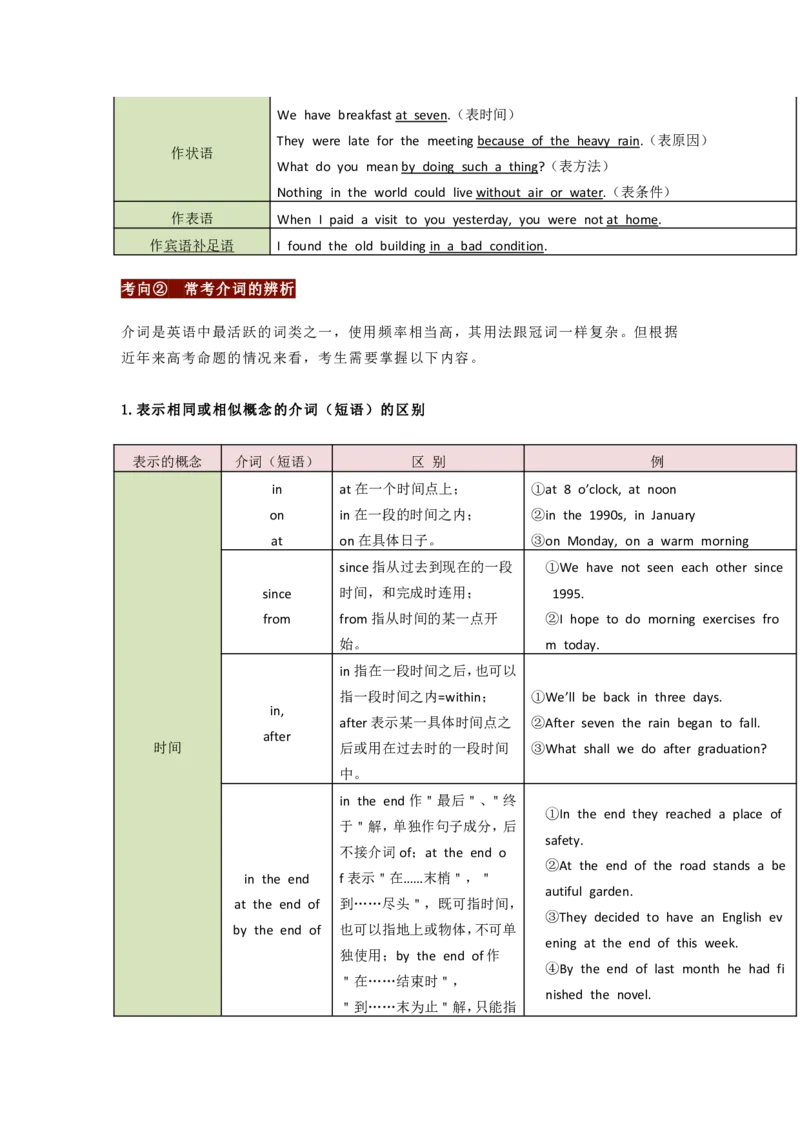
考向① 介词短语的功能
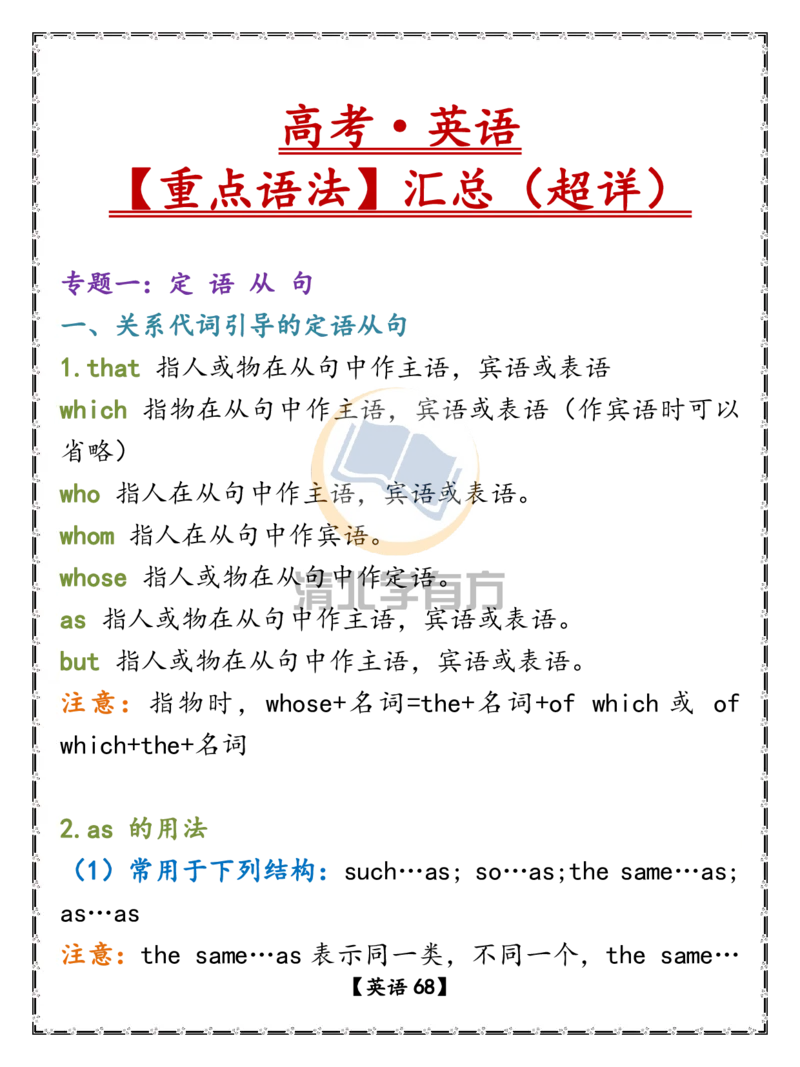
介词不能独立在句中做成份,介词后必须与名词、代词、或动名词构成介词短语在句
中充当一个成分,表示人、物、事件等与其它人、物、事件等之间的关系。
介词短语的功能 例 句
作定语 They didn’t find the solutionto the problem.We have breakfastat seven.(表时间)
They were late for the meetingbecause of the heavy rain.(表原因)
作状语
What do you meanby doing such a thing?(表方法)
Nothing in the world could livewithout air or water.(表条件)
作表语 When I paid a visit to you yesterday, you were notat home.
作宾语补足语 I found the old buildingin a bad condition.
考向② 常考介词的辨析
介词是英语中最活跃的词类之一,使用频率相当高,其用法跟冠词一样复杂。但根据
近年来高考命题的情况来看,考生需要掌握以下内容。
1.表示相同或相似概念的介词(短语)的区别
表示的概念 介词(短语) 区 别 例
in at在一个时间点上; ①at 8 o’clock, at noon
on in在一段的时间之内; ②in the 1990s, in January
at on在具体日子。 ③on Monday, on a warm morning
since指从过去到现在的一段 ①We have not seen each other since
since 时间,和完成时连用; 1995.
from from指从时间的某一点开 ②I hope to do morning exercises fro
始。 m today.
in指在一段时间之后,也可以
指一段时间之内=within; ①We’ll be back in three days.
in,
after表示某一具体时间点之 ②After seven the rain began to fall.
after
时间 后或用在过去时的一段时间 ③What shall we do after graduation?
中。
in the end作"最后"、"终
①In the end they reached a place of
于"解,单独作句子成分,后
safety.
不接介词of;at the end o
②At the end of the road stands a be
in the end f表示"在……末梢","
autiful garden.
at the end of 到……尽头",既可指时间,
③They decided to have an English ev
by the end of 也可以指地上或物体,不可单
ening at the end of this week.
独使用;by the end of作
④By the end of last month he had fi
"在……结束时",
nished the novel.
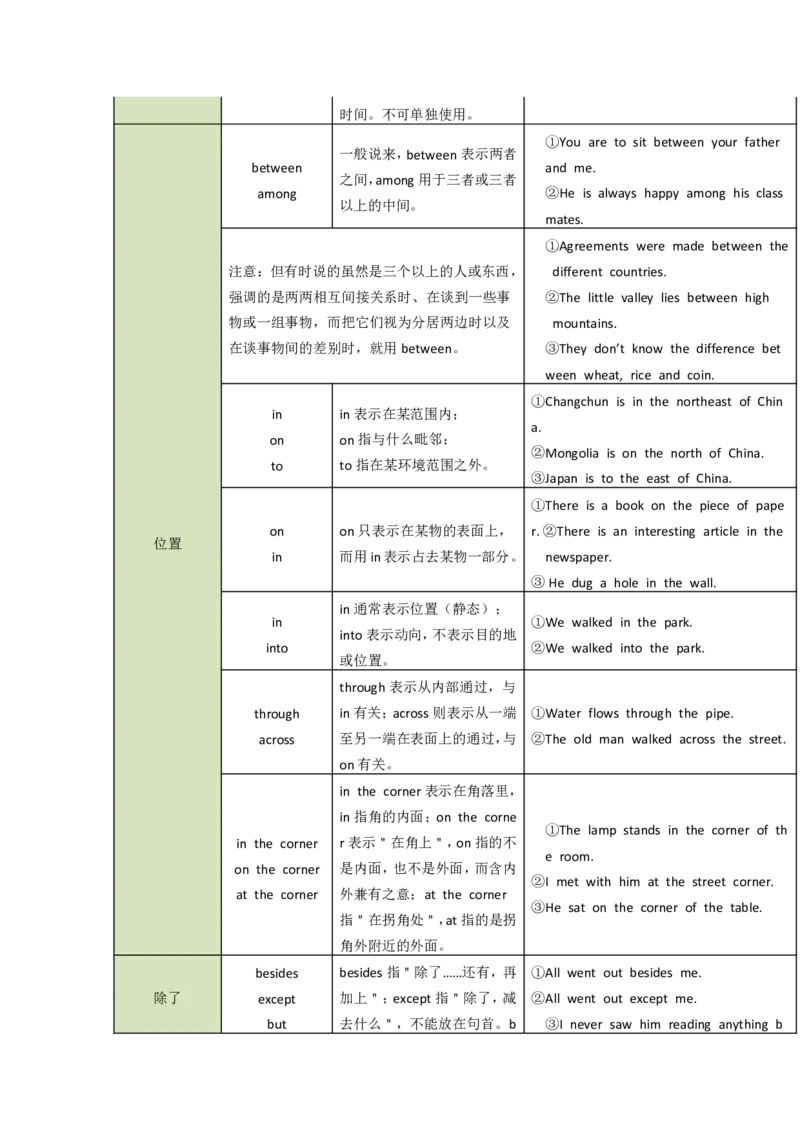
"到……末为止"解,只能指时间。不可单独使用。
①You are to sit between your father
一般说来,between表示两者
between and me.
之间,among用于三者或三者
among ②He is always happy among his class
以上的中间。
mates.
①Agreements were made between the
注意:但有时说的虽然是三个以上的人或东西, different countries.
强调的是两两相互间接关系时、在谈到一些事 ②The little valley lies between high
物或一组事物,而把它们视为分居两边时以及 mountains.
在谈事物间的差别时,就用between。 ③They don’t know the difference bet
ween wheat, rice and coin.
①Changchun is in the northeast of Chin
in in表示在某范围内;
a.
on on指与什么毗邻;
②Mongolia is on the north of China.
to to指在某环境范围之外。
③Japan is to the east of China.
①There is a book on the piece of pape
on on只表示在某物的表面上, r.②There is an interesting article in the
位置
in 而用in表示占去某物一部分。 newspaper.
③He dug a hole in the wall.
in通常表示位置(静态);
in ①We walked in the park.
into表示动向,不表示目的地
into ②We walked into the park.
或位置。
through表示从内部通过,与
through in有关;across则表示从一端 ①Water flows through the pipe.
across 至另一端在表面上的通过,与 ②The old man walked across the street.
on有关。
in the corner表示在角落里,
in指角的内面;on the corne
①The lamp stands in the corner of th
in the corner r表示"在角上",on指的不
e room.
on the corner 是内面,也不是外面,而含内
②I met with him at the street corner.
at the corner 外兼有之意;at the corner
③He sat on the corner of the table.
指"在拐角处",at指的是拐
角外附近的外面。
besides besides指"除了……还有,再 ①All went out besides me.
除了 except 加上";except指"除了,减 ②All went out except me.
but 去什么",不能放在句首。b ③I never saw him reading anything bexcept for ut与except意思近似,表示" ut the newspaper.
除了……外"经常用在no, all, ④His diary is good except for a few s
nobody, anywhere, everythi pelling mistakes.
ng等和其他疑问词后面。exc
ept for表示"如无……就,只
是"表明理由细节。
表示的概念 构成 例
动作(表进行概 at dinner/table在吃饭 at work在工作 at war交战
念、表被动的关 at cards在玩牌 at work在办公 at play 在玩耍
at+名词
系) at rest在休息 school在上学 at press正在排印
at church在做礼拜
beyondbelief难以置信 beyondcontrol不听管教。
beyond+名词 beyondcompare无可比拟 beyonddescription难以形容
beyondexpression无法表达 beyondsuspicion无可怀疑
in the army在当兵 in need of需要 in action在运转
in progress在进行 in operation在运行中 inuse开始使用
insight看得见 instore贮藏着
in+名词
incourseofconstruction正在兴建当中。
或in+名词+of+
in(good)repair维修良好的
名词
incourseofshipment.定的货正在运输途中。
inchargeof负责 inthechargeof由……负责
inpossessionof拥有 inthepossessionof被……拥有
on business办事/出差 on holiday/vacation/leave在休假
on watch值班 on duty值勤/日
on guard在值勤 on strike在罢工
on sale出售 on loan借贷
on+名词
on the march在行军 ontrial在试用
on the air在广播 onfire在燃烧
on the move在移动,搬迁,离开
onshow/display/ exhibition在展出
under control在控制之中 under discussion在讨论
underdevelopment在发展中 under observation在观察中
under test在被测试 under construction在建设中
under+名词
under fire在炮火中 under examination在检查/调查中
under consideration在考虑中 under repair在修理中
underarrest被逮捕 underattack受到袭击undermedicaltreatment在治疗中 understudy在研究中
against one’sopinion反对某人的见解
for one’s opinion同意某人的见解
abovereproach无可指责,无可非议
其他 abovesuspicion不受怀疑
abovecriticism无可指责
at the mercy of在……支配下;任由……摆布
forsale供出售 forrent供出租 withinsight看得见
1.( 2019 · 江 苏 卷 · 单 项 填 空 ) Favorable policies are ___________ to
encourage employees' professional development.
A. in effectB. in commandC. in turnD. in shape
【答案】A
【解析】考查介词短语。句意:好的制度政策实际上都会激发员工的专业水
平的提升。A. in effect 实际上;B. in command 指挥;C. in turn 轮流,依
次;D. in shape 在外形上,处于良好的状态。故选 A。
2.(2019·新课标 I 卷·语法填空)Modem methods ___63___ tracking polar
bear populations have been employed only since the mid-1980s, and
are expensive to perform (perform) consistently over a large area.
【答案】of/for
【解析】考查介词用法。此处 tracking polar bear populations 作 Modern
methods 的定语,用 of 连接,“methods of doing sth.”,意为“……的
方法”,构成固定结构。或者意为“对于跟踪北极熊的方法”用 for。故填
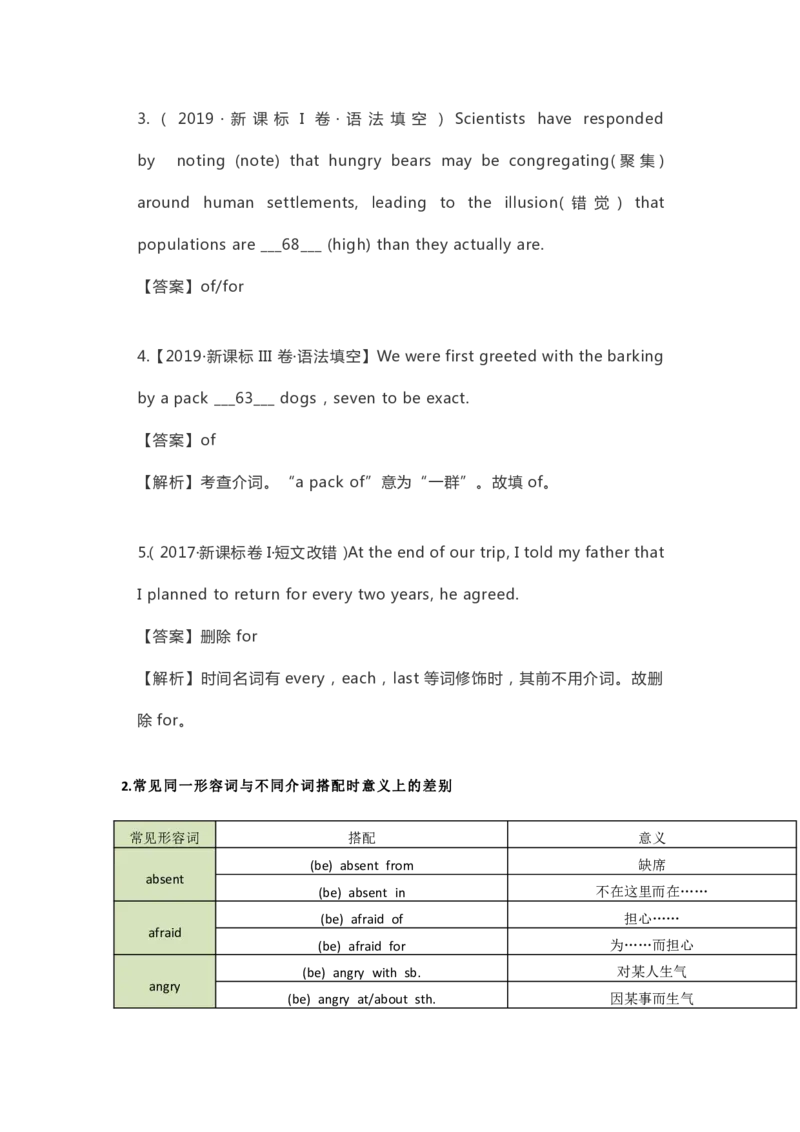
of/for。3. ( 2019 · 新 课 标 I 卷 · 语 法 填 空 ) Scientists have responded
by noting (note) that hungry bears may be congregating( 聚 集 )
around human settlements, leading to the illusion( 错 觉 ) that
populations are ___68___ (high) than they actually are.
【答案】of/for
4.【2019·新课标 III 卷·语法填空】We were first greeted with the barking
by a pack ___63___ dogs,seven to be exact.
【答案】of
【解析】考查介词。“a pack of”意为“一群”。故填 of。
5(. 2017·新课标卷 I·短文改错)At the end of our trip, I told my father that
I planned to return for every two years, he agreed.
【答案】删除 for
【解析】时间名词有 every,each,last 等词修饰时,其前不用介词。故删
除 for。
2.常见同一形容词与不同介词搭配时意义上的差别
常见形容词 搭配 意义
(be) absent from 缺席
absent
(be) absent in 不在这里而在……
(be) afraid of 担心……
afraid
(be) afraid for 为……而担心
(be) angry with sb. 对某人生气
angry
(be) angry at/about sth. 因某事而生气(be)anxious for sth 急于想得到
anxious
(be)anxious about sth./sb. 对某事/某人担心
(be) different from 与……不同
different
(be) different to 不关心
(be) familiar with 精通,熟悉
familiar
(be) familiar to 为……熟知(悉)
(be) good at 擅长于
good (be) good for 对……有益
(be) good to 对……友好/态度好
(be) popular with sb. 受……欢迎
popular
(be) popular for 因……而流行
(be) strict with sb. 对某人要求严格
strict
(be) strict in sth. 对某事要求严格
3.容易混淆的含有介词固定搭配的词组
类 型 举 例
in front of(在……前面)——in the front of(在……前部)
in charge of(负责)——in the charge of(由……负责)
差一冠词,大相径庭
out of question(毫无疑问)——out of the question(不可能)
at table(在吃饭;在吃饭时)——at the table(在桌子旁边)
know sb.认识某人—— know about sb.了解某人
shoot sb.击中某人—— shoot at sb.向某人射击
有无介词,意义不同 search sb.搜身—— search for sb.搜寻某人
believe sb.相信某人的话—— believe in sb.信任某人的人格
benefit sb.使某人受益—— benefit from sb.从某人那里得到益处
serve the people为人民服务(容易在serve后加for)
enter the room进入房间(容易在enter后加into)
follow me跟在我后面(容易在follow后加behind)
画蛇添足,误加介词
marry sb.与某人结婚(容易在marry后加with)
go abroad出国(容易在go后面加to)
live upstairs住在楼上(容易在live后面加in)
be caught in the rain被雨淋着(不用by)
母语思维,误用介词
leave for some place动身去某地(不用to)set an example to sb.为某人树立榜样(不用for)
in the direction朝着……方向(不用to)
do a favor for sb.帮某人一个忙(不用to)
different from和……不同(不用with)
with the help of在……的帮助下(不用under)
steal sth. from sb.偷某人的东西(不用of)
read sth. to sb.给(为)……读(念)……(不用for)
【难点释疑】
一、常用介词辨异
1. about,on,of 关于
①on 多用于慎重的、正式的语言交际场合。常见于"学术上"的"论文"或"演
说"等题目,可供专门研究这一问题的人阅读,有"论及"之意。
②about 表示的内容多为普遍、不那么正式,有"述及"之意。
③of 作"关于"讲,表示提及、涉及某人(事)时,只表示事情存在或发生,并
不涉及详情;有时与 about 意义相近,但有时意义很不同,常与动词 know、hear、
learn(听说)、speak、talk、think、tell 等连用。
2. except,except for,except that,but,besides,beside
①except"除……之外",指不包括……,后面常接名词、代词(人称代词常用宾
格),还可接介词短语、副词和动词不定式,此时相当于 but,但不定式常不带
to。
②except for"除了,只有",意思和 except 一样,主要指说明基本情况后,而
在细节上加以修正,后面常接名词性短语。③except that"除了,只是",意思和 except、except for 一样。但在用法上,
其后常接名词性从句,也可接 when、where 等词引导的其他从句。
④but 所含"除……外"的意思不如 except 明确。but 多用在代词(主要是不定
代词、否定代词和疑问代词)之后。
⑤besides 表示"除……外还有",所排除的事物常包括在所述范围之内。另外,
besides 可用作副词,相当于 also,有"而且,加之,何况"之意。
⑥beside 也是介词,表示"在附近",只不过形似 besides,容易相互混淆。 如
果在区别前后有同类的词语时,就用 except,否则就用 except for。
3. including,included
①including 是一个介词,意为"包括",它一般放在包括对象的前面。 ②
included 是一个过去分词,意为"包括"。它一般用于被动语态中,也可放在包
括对象的后面。
4. in,later,during 都与时段名词搭配
①in 作介词,同时段名词搭配,即"in + 时段名词",一般用于将来时。
②later 表示"……以后",常同时段名词搭配,即"时段名词 + later",常与过
去时连用。
③during 作介词时,同时段名词搭配,即"during + 时段名词",常与现在时
或将来时等连用。
5. in,with,by 用
①with 通常指"用"具体的或有形的工具、器官等,有时也表示"用"某种手段、
音调等。 ②by 作介词表示"用"时,一般指"用"方式、手段等。后面常接动
名词或名词,后面接名词时,该名词前面一般不加修饰语。 ③in 指"用"语言、字体、墨水、体裁、风格、方式、现金、顺序等。
二、介词的省略
1. 当表示时间的词前有 this,that,next,last,every,each,some,any,
all 等时,介词常省略。Come any day you like. 你想哪天来就哪天来。
2. 表示时间的名词前有不定冠词,且不定冠词作"每一……"解时,前面不用介
词。An apple a day keeps the doctor away. 每天吃一个苹果,医生不找我。
3. 习惯搭配中介词的省略
一些常和动词、名词或形容词搭配的介词常省略,常见的此类搭配有:spend
money/time (in) doing sth , waste money/time (in) doing sth , have
difficulty/trouble (in) doing sth,be busy doing sth,stop/prevent sb (from)
doing sth 等。
三、介词不可遗漏的情况
1. 含有不及物动词的不定式在形容词 easy,hard,difficult,comfortable 等
后作状语,且构成不定式的动词与句子的主语存在动宾关系或主语是不定式动作
发生的地点时,介词不能遗漏。
The chair is comfortable to sit on/in. 这把椅子坐着舒服。The man is difficult
to work with. 这个人很难共事。
2. 当非谓语动词表示被动意义时,相关介词也不可省略。 The problem is well
worth paying attention to. 这个问题很值得关注。
3. 在被动语态中,动词短语中的介词不能遗漏。Your pronunciation should be
paid attention to. 你应该注意你的发音。4. 在定语从句中,当从句的谓语和先行词构成动宾关系且从句谓语为不及物动词
时,必须加上介词。The library which we often go to is not far away from our
school. 我们经常去的那个图书馆离我们的学校不远。
5. 在 too...to...,enough... to...,so... as to...等结构中,含有不及物动词的
不定式作结果状语,构成不定式的动词为不及物动词,且该动词与主语构成动宾
关系或主语为不定式动作发生的地点时,介词不能遗漏。The ice is too thin to
skate on. 冰太薄了,不能在上面滑。