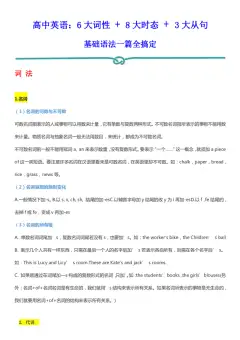
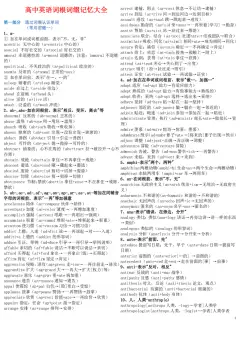
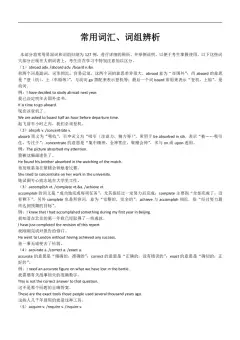
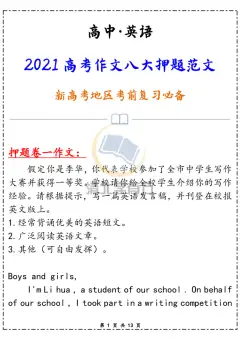
句子成分(Members of a Sentence)
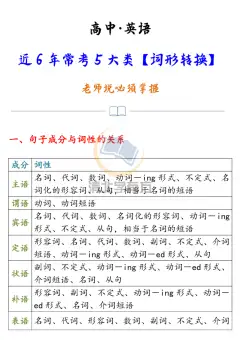
什么叫句子成分呢?句子的组成成分叫句子成分。在句子中,词与词之间有一定的组合关系,按照不同的关系,可以把句子分为不同的组成成分。句子成分由词或词
组充当。现代汉语里一般的句子成分有六种,即主语、谓语、宾语、定语、状语和补语。英语的基本成分有七种:主语(subject)、谓语(predicate)、表语(predicative)、
宾语(object)、定语(attribute)、状语(adverbial) 和补语(complement)。
英语句子的基本结构可以归纳成五种基本句型及其扩大、组合、省略或倒装。掌握这五种基本句型,是掌握各种英语句子结构的基础。
英语五种基本句型列式如下:
一: S V (主+谓)
二: S V P (主+系+表)
三: S V O (主+谓+宾)
四: S V o O (主+谓+间宾+直宾)
五: S V O C (主+谓+宾+宾补)
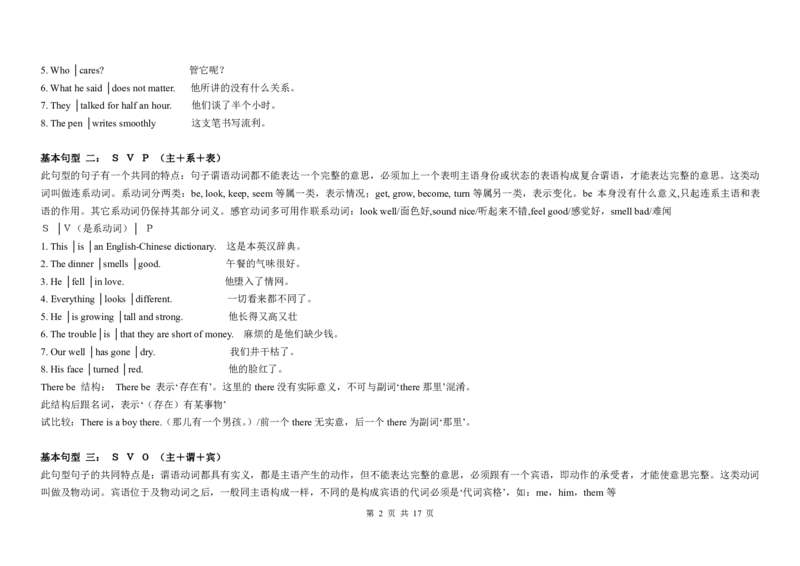
基本句型 一:S V (主+谓)
主语:可以作主语的成分有名词(如boy),主格代词(如you),动词不定式,动名词等。主语一般在句首。注意名词单数形式常和冠词不分家!
谓语:谓语由动词构成,是英语时态、语态变化的主角,一般在主语之后。不及物动词(vi.)没有宾语,形成主谓结构,如:Wecome.
此句型的句子有一个共同特点,即句子的谓语动词都能表达完整的意思。这类动词叫做不及物动词,后面可以跟副词、介词短语、状语从句等。
S │ V (不及物动词)
1.Thesun│wasshining. 太阳在照耀着。
2.Themoon│rose. 月亮升起了。
3.Theuniverse│remains. 宇宙长存。
4.Weall│breathe,eat,anddrink. 我们大家都呼吸、吃和喝。
第 1 页 共 17 页5.Who│cares? 管它呢?
6.Whathesaid│doesnotmatter. 他所讲的没有什么关系。
7.They│talkedforhalfanhour. 他们谈了半个小时。
8.Thepen│writessmoothly 这支笔书写流利。
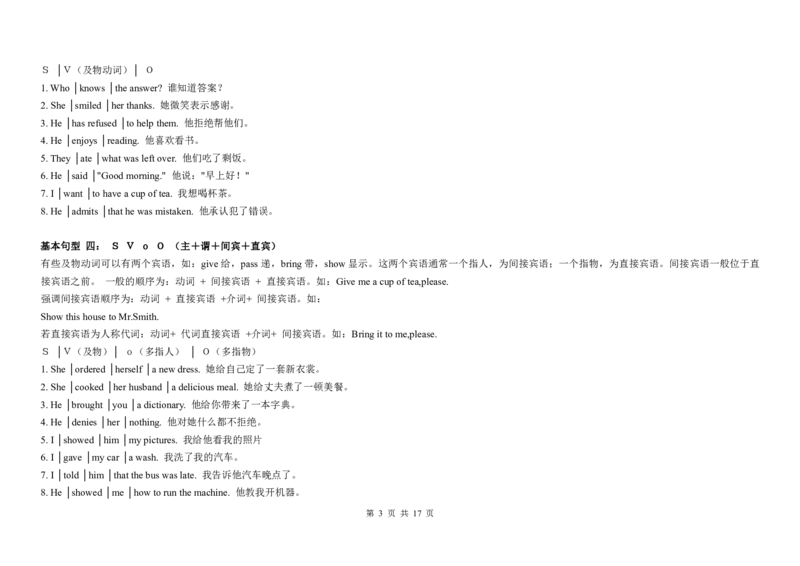
基本句型 二: S V P (主+系+表)
此句型的句子有一个共同的特点:句子谓语动词都不能表达一个完整的意思,必须加上一个表明主语身份或状态的表语构成复合谓语,才能表达完整的意思。这类动
词叫做连系动词。系动词分两类:be,look,keep,seem等属一类,表示情况;get,grow,become,turn等属另一类,表示变化。be 本身没有什么意义,只起连系主语和表
语的作用。其它系动词仍保持其部分词义。感官动词多可用作联系动词:lookwell/面色好,soundnice/听起来不错,feelgood/感觉好,smellbad/难闻
S │V(是系动词)│ P
1.This│is│anEnglish-Chinesedictionary. 这是本英汉辞典。
2.Thedinner│smells│good. 午餐的气味很好。
3.He│fell│inlove. 他堕入了情网。
4.Everything│looks│different. 一切看来都不同了。
5.He│isgrowing│tallandstrong. 他长得又高又壮
6.Thetrouble│is│thattheyareshortofmoney. 麻烦的是他们缺少钱。
7.Ourwell│hasgone│dry. 我们井干枯了。
8.Hisface│turned│red. 他的脸红了。
Therebe 结构: Therebe 表示‘存在有’。这里的there没有实际意义,不可与副词‘there那里’混淆。
此结构后跟名词,表示‘(存在)有某事物’
试比较:Thereisaboythere.(那儿有一个男孩。)/前一个there无实意,后一个there为副词‘那里’。
基本句型 三: S V O (主+谓+宾)
此句型句子的共同特点是:谓语动词都具有实义,都是主语产生的动作,但不能表达完整的意思,必须跟有一个宾语,即动作的承受者,才能使意思完整。这类动词
叫做及物动词。宾语位于及物动词之后,一般同主语构成一样,不同的是构成宾语的代词必须是‘代词宾格’,如:me,him,them等
第 2 页 共 17 页S │V(及物动词)│ O
1.Who│knows│theanswer? 谁知道答案?
2.She│smiled│herthanks. 她微笑表示感谢。
3.He│hasrefused│tohelpthem. 他拒绝帮他们。
4.He│enjoys│reading. 他喜欢看书。
5.They│ate│whatwasleftover. 他们吃了剩饭。
6.He│said│"Goodmorning." 他说:"早上好!"
7.I│want│tohaveacupoftea. 我想喝杯茶。
8.He│admits│thathewasmistaken. 他承认犯了错误。
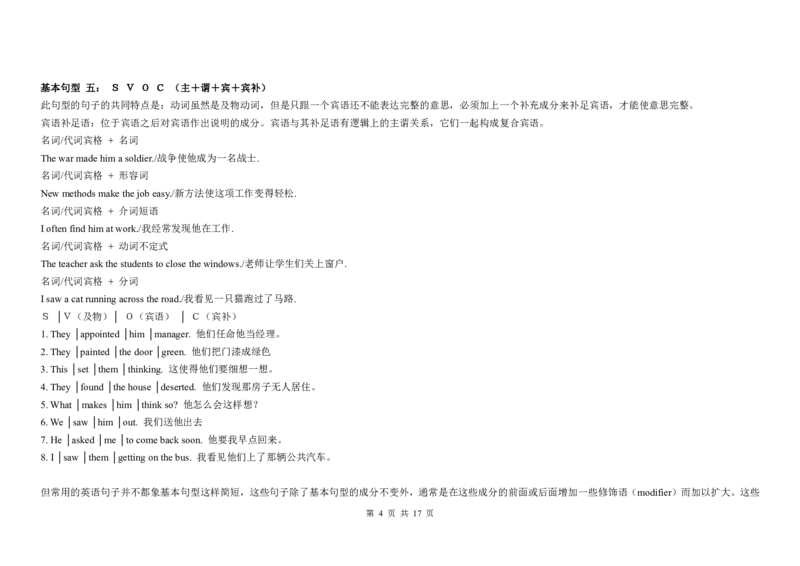
基本句型 四: S V o O (主+谓+间宾+直宾)
有些及物动词可以有两个宾语,如:give给,pass递,bring带,show显示。这两个宾语通常一个指人,为间接宾语;一个指物,为直接宾语。间接宾语一般位于直
接宾语之前。 一般的顺序为:动词 + 间接宾语 + 直接宾语。如:Givemeacupoftea,please.
强调间接宾语顺序为:动词 + 直接宾语 +介词+ 间接宾语。如:
ShowthishousetoMr.Smith.
若直接宾语为人称代词:动词+ 代词直接宾语 +介词+ 间接宾语。如:Bringittome,please.
S │V(及物)│ o(多指人) │ O(多指物)
1.She│ordered│herself│anewdress. 她给自己定了一套新衣裳。
2.She│cooked│herhusband│adeliciousmeal. 她给丈夫煮了一顿美餐。
3.He│brought│you│adictionary. 他给你带来了一本字典。
4.He│denies│her│nothing. 他对她什么都不拒绝。
5.I│showed│him│mypictures. 我给他看我的照片
6.I│gave│mycar│awash. 我洗了我的汽车。
7.I│told│him│thatthebuswaslate. 我告诉他汽车晚点了。
8.He│showed│me│howtorunthemachine. 他教我开机器。
第 3 页 共 17 页基本句型 五: S V O C (主+谓+宾+宾补)
此句型的句子的共同特点是:动词虽然是及物动词,但是只跟一个宾语还不能表达完整的意思,必须加上一个补充成分来补足宾语,才能使意思完整。
宾语补足语:位于宾语之后对宾语作出说明的成分。宾语与其补足语有逻辑上的主谓关系,它们一起构成复合宾语。
名词/代词宾格 + 名词
Thewarmadehimasoldier./战争使他成为一名战士.
名词/代词宾格 + 形容词
Newmethodsmakethejobeasy./新方法使这项工作变得轻松.
名词/代词宾格 + 介词短语
Ioftenfindhimatwork./我经常发现他在工作.
名词/代词宾格 + 动词不定式
Theteacheraskthestudentstoclosethewindows./老师让学生们关上窗户.
名词/代词宾格 + 分词
Isawacatrunningacrosstheroad./我看见一只猫跑过了马路.
S │V(及物)│ O(宾语) │ C(宾补)
1.They│appointed│him│manager. 他们任命他当经理。
2.They│painted│thedoor│green. 他们把门漆成绿色
3.This│set│them│thinking. 这使得他们要细想一想。
4.They│found│thehouse│deserted. 他们发现那房子无人居住。
5.What│makes│him│thinkso? 他怎么会这样想?
6.We│saw│him│out. 我们送他出去
7.He│asked│me│tocomebacksoon. 他要我早点回来。
8.I│saw│them│gettingonthebus. 我看见他们上了那辆公共汽车。
但常用的英语句子并不都象基本句型这样简短,这些句子除了基本句型的成分不变外,通常是在这些成分的前面或后面增加一些修饰语(modifier)而加以扩大。这些
第 4 页 共 17 页修饰语可以是单词(主要是形容词、副词和数词),也可以是各种类型的短语(主要是介词短语、不定式短语和分词短语)。我们称之为:定语、状语
一、 定语:定语是对名词或代词起修饰、限定作用的词、短语或句子,汉语中常用‘……的’表示。定语通常位于被修饰的成分前。若修饰some,any,every,no构成的复
合不定代词时,(如:something、nothing);或不定式、分词短语作定语、从句作定语时,则定语通常置后。副词用作定语时须放在名词之后。
形容词作定语:
Thelittleboyneedsabluepen.(little修饰名词boy;blue修饰名词pen.)/小男孩需要一支兰色的钢笔。
Tomisahandsomeboy./Tom是个英俊的男孩。
Thereisagoodboy./有个乖男孩。
数词作定语相当于形容词:
Twoboysneedtwopens./两个男孩需要两支钢笔。
Thetwoboysarestudents./这两个男孩是学生。
Therearetwoboysintheroom./房间里有两个男孩。
代词或名词所有格作定语:
HisboyneedsTom\'spen./他的男孩需要Tom的钢笔。
HisnameisTom./他的名字是汤姆。
TherearetwoboysofTomsthere./那儿有Tom家的两个男孩。
介词短语作定语:
Theboyintheclassroomneedsapenofyours./教室里的男孩需要你的一支钢笔。
TheboyinblueisTom./穿兰色衣服的孩子是汤姆。
Therearetwoboysof9,andthreeof10./有两个9岁的,三个10岁的男孩。
名词作定语:
Theboyneedsaballpen./男孩需要一支圆珠笔。
Itisaballpen./这是一支圆珠笔。
Thereisonlyoneballpeninthepencilbox./这铅笔盒里只有一支圆珠笔。
副词作定语:
Theboythereneedsapen./那儿的男孩需要一支钢笔。
第 5 页 共 17 页ThebestboyhereisTom./这里最棒的男孩是Tom。
不定式作定语:
Theboytowritethisletterneedsapen./写这封信的男孩需要一支钢笔。
TheboytowritethisletterisTom./将要写这封信的男孩是汤姆。
Thereisnothingtodotoday./今天无事要做。
分词(短语)作定语:
Thesmilingboyneedsapenboughtbyhismother./那个微笑的男孩需要一支他妈妈买的钢笔。
ThepenboughtbyherismadeinChina./她买的笔是中国产的。
Therearefiveboysleft./有五个留下的男孩。
定语从句:
Theboywhoisreadingneedsthepenwhichyouboughtyesterday./那个在阅读的男孩需要你昨天买的钢笔。
TheboyyouwillknowisTom./你将认识的男孩叫汤姆。
Therearefiveboyswhowillplaythegame./参加游戏的男孩有五个。
二、状语:状语修饰动词、形容词、副词或全句,说明方式、因果、条件、时间、地点、让步、方向、程度、目的等。
状语在句子中的位置很灵活,常见情况为:通常在句子基本结构之后,强调时放在句首;修饰形容词或副词时,通常位于被修饰的词之前;表示时间、地点、目的的
状语一般位于句子两头,强调时放在句首,地点状语一般须在时间状语之前;一些表示不确定时间(如:often)或程度(如:almost)的副词状语通常位于be动词、
助动词、情态动词之后,动词之前。
有时状语在句中的某个位置会引起歧义,应注意,如:Theboycallsthegirlintheclassroom.一般理解成‘男孩喊教室里的女孩‘(此时intheclassroom为girl的定语),
也可以理解为‘男孩在教室里喊女孩’(此时intheclassroom为地点状语),最好写作‘Intheclassroom,theboycallsthegirl.\'
副词(短语)作状语:
Theboyneedsapenverymuch./男孩非常需要一支钢笔。(程度状语)
Theboyneedsverymuchthepenboughtbyhismother./男孩非常需要他母亲买的那支钢笔。(宾语较长则状语前置)
Theboyreallyneedsapen./男孩真的需要一支钢笔。(程度状语)
Theboyneedsapennow./Now,theboyneedsapen./Theboy,now,needsapen./男孩现在需要一支钢笔。(时间状语)
介词短语作状语:Intheclassroom,theboyneedsapen./在教室里,男孩需要一支钢笔。(地点状语)
第 6 页 共 17 页Beforehismother,Tomisalwaysaboy./在母亲面前,汤姆总是一个男孩子.(条件状语)
OnSundays,thereisnostudentintheclassroom./星期天,教室里没有学生.(时间状语)
分词(短语)作状语:
Hesitsthere,askingforapen./他坐在那儿要一支笔。(表示伴随状态)
Havingtofinishhishomework,theboyneedsapen./因为不得不完成作业,男孩需要一支笔。(原因状语)
Frightened,hesitstheresoundlessly./(因为)受了惊吓,他无声地坐在那儿。(原因状语)
不定式作状语:
Theboyneedsapentodohishomework./男孩需要一支笔写家庭作业。(目的状语)
Tomakehisdreamcometrue,Tombecomesveryinterestedinbusiness./为实现梦想,汤姆变得对商业很有兴趣.
名词作状语:
Comethisway!/走这条路!(方向状语)
状语从句:
时间状语从句、地点状语从句、原因状语从句、结果状语从句、目的状语从句
、比较状语从句、让步状语从句、条件状语从句
三、同位语:同位语是在名词或代词之后并列名词或代词对前者加以说明的成分,近乎于后置定语。如:
Westudentsshouldstudyhard./(students是we的同位语,都是指同一批‘学生’)
Weallarestudents./(all是we的同位语,都指同样的‘我们’)
四、独立成分:有时句子中会有一些与句子没有语法联系的成分,称为句子独立成分(注意:区别于分词独立结构)。
感叹词:oh,hello,aha,ah,等。
肯定词yes
否定词no
称呼语:称呼人的用语。
插入语:一些句中插入的 Ithink,Ibelieve,等。
如:Thestory,Ithink,hasnevercometotheend./我相信,这个故事还远没结束.
情态词,表示说话人的语气(多作为修饰全句的状语):perhaps也许,maybe大概,acturely实际上,certainly当然,等。
第 7 页 共 17 页五、分词独立结构:分词作状语时其逻辑主语与句子的主语一致! 否则应有自己的逻辑主语,构成分词独立结构。
例:
错句:Studyinghard,yourscorewillgoup.
正确:(1)Studyinghard,youcanmakeyourscoregoup.
或 (2)Ifyoustudyhard,yourscorewillgoup.
解析:错句中分词studying没有自带逻辑主语,则其逻辑主语就是句子的主语,既yourscore. 显然做study的应是人,不应是yourscore(分数). 正确句(1)更正了句
子的主语,使其与分词逻辑主语一致( 同为you);正确句(2)则使用条件分句带出study的主语,(不过已经不是分词结构了). 分词独立结构常省略being,havingbeen.不过
‘Therebeing...’的场合不能省略.
如:
Game(being)over,hewenthome.
Hestandsthere,book(being)inhand. 独立结构还可用with、without引导,作状语或定语。这种结构不但可以用分词,还可以用不定式、形容词、介词短语、副词或名
词等。
如:
Withnothingtodo,hefellasleepsoon./无事可做,他很快就睡着了。
Theteachercamein,withglassesonhisnose./老师进来了,戴着一付眼镜。(注意,此句onhisnose不可省略!)
句子成分练习题( 一 )
(一). 指出下列句中主语的中心词(4分, 4分钟)
①Theteacherwithtwoofhisstudentsiswalkingintotheclassroom.
②Thereisanoldmancominghere.
③Theusefuldictionarywasgivenbymymotherlastyear.
④Todotoday'shomeworkwithouttheteacher'shelpisverydifficult.
(二) 选出句中谓语的中心词(10分, 10分钟)
①Idon'tlikethepictureonthewall.
A.don't B.like C.picture D.wall
第 8 页 共 17 页②Thedaysgetlongerandlongerwhensummercomes.
A.get B.longer C.days D.summer
③Doyouusuallygotoschoolbybus?
A.Do B.usually C.go D.bus
④Therewillbeameetingatthelibrarythisafternoon.
A.willbe B.meeting C.thelibrary D.afternoon
⑤Didthetwinshaveporridgefortheirbreakfast?
A.Did B.twins C.have D.breakfast
⑥Tomdidn'tdohishomeworkyesterday.
A.Tom B.didn't C.do D.hishomework
⑦WhatIwanttotellyouisthis.
A.want B.totell C.you D.is
⑧Wehadbettersendforadoctor.
A.We B.had C.send D.doctor
⑨Heisinterestedinmusic.
A.is B.interested C.in D.music
⑩Whomdidyougivemybookto?
A.give B.did C.whomD.book
(三) 挑出下列句中的宾语(10分,10分钟)
①Mybrotherhasn'tdonehishomework.
②PeopleallovertheworldspeakEnglish.
③Youmustpaygoodattentiontoyourpronunciation.
④Howmanynewwordsdidyoulearnlastclass?
⑤Someofthestudentsintheschoolwanttogoswimming,howaboutyou?⑥Theoldmansittingatthegatesaidhewasill.
⑦Theymadehimmonitoroftheclass.
第 9 页 共 17 页⑧Goacrossthebridgeandyouwillfindthemuseumontheleft.
⑨Youwillfinditusefulafteryouleaveschool.
⑩Theydidn'tknowwho"FatherChristmas" reallyis.
(四) 挑出下列句中的表语(5分, 5分钟)
①Theoldmanwasfeelingverytired.
②WhyisheworriedaboutJim?
③Theleaveshaveturnedyellow.
④SoonTheyallbecameinterestedinthesubject.
⑤Shewasthefirsttolearnaboutit.
(五) 挑出下列句中的定语(6分,6分钟)
①Theyuse Mr,Mrswiththefamilyname.
②Whatisyourgivenname?
③OnthethirdlapareClass1andClass3.
④Iamafraidsomepeopleforgottosweepthefloor.
⑤Themandownstairswastryingtosleep.
⑥Iamwaitingforthesoundoftheothershoe!
(六) 挑出下列句中的宾语补足语(6分, 6分钟)
①Shelikesthechildrentoreadnewspapersandbooksinthereading-room.
②Heaskedhertotaketheboyoutofschool.
③Shefounditdifficulttodothework.
④TheycallmeLilysometimes.
⑤IsawMrWanggetonthebus.
⑥DidyouseeLiMingplayingfootballontheplaygroundjustnow?
(七) 挑出下列句中的状语(8分, 8分钟)
①Therewasabigsmileonherface.
第 10 页 共 17 页②Everynightheheardthenoiseupstairs.
③HebegantolearnEnglishwhenhewaseleven.
④Themanonthemotorbikewastravellingtoofast.
⑤Withthemedicineboxunderherarm,MissLihurriedoff.
⑥Shelovesthelibrarybecauseshelovesbooks.
⑦Iamafraidthatifyou'velostit,youmustpayforit.
⑧ThestudentsfollowedUncleWangtoseetheothermachine.
(八) 划出句中的直接宾语和间接宾语(5分, 5分钟)
①Pleasetellusastory.
②Myfatherboughtanewbikeformelastweek.
③MrLiisgoingtoteachushistorynextterm.
④Hereisapen.GiveittoTom.
⑤Didheleaveanymessageforme?
句子成分练习题( 二 )
指出下列句子中划线部分的句子成分:
1.Whetherwe’llgodependontheweather.
2.People’sstandardsoflivingaregoingupsteadily.
3.Thatwashowtheyweredefeated.
4.Thenurserytakesgoodcareofourchildren.
5.I’llreturnthebooktoyoutomorrow.
6.Wearesurethatweshallsucceed.
7.Thewomanwithababyinherarmsishisother.
8.TherearemanyfilmthatI’dliketosee.
9.Haveyoumetthepersonaboutwhomhewasspeaking?
第 11 页 共 17 页10.Ihavealotofworktodo.
11. AnywayIwon’tstopyoufromdoingit.
12. Isaiditinfun.
13. Wecansendacarovertofetchyou.
14. Shehadtoworkstandingup.
15. Seeingthis,somecomradesbecameveryworried.
16. Muchinterested,heagreedtogiveitatry.
17. Thebusarrivedtenminuteslate.
18. Weshouldservethepeopleheartandsoul.
19. Springcomingon,thetreeturnedgreen.
20. Somefarmerssawsomethingstrangeinthesky.
21. Wethinkitnecessarythateveryoneshouldattendthemeeting.
22. It’sstrangethatshedoesn’tcometoday.
23. ItwasinthelibrarythatIcometoday.
24. Helikesdrawingattimeswhenheisn’tworking.
25. Weleftinsuchahurrythatweforgottolockthedoor.
句子成分练习题( 三 )
A
1、 ___sixyearssinceIbegantostudyEnglish.
A.ItisB.IhavebeenC.ThereareD.Itwas
2 、___intheroomatthattime.
A.NobodywasB.SomeonewereC.WhoisD.Heare
3 、IT'Sverynoisyoutside.___isgoingon?
A.WhoB.WhatC.WhichD.Where
第 12 页 共 17 页4、 ___inEnglishinclasseverydayisimportant.
A.SpeakB.TalkingC.SayingD.Totell
5 、Theremustbe____nearthefactory.
A.abookstoreB.bookstoreC.booksstoreD.booksstores
6 、Althoughit'sraininghard,___arestillworkinginthefields.
A.buttheyB.andtheyC.theyD.sincethey
B
1、 Thedoctoraswellasthenurses___greatconcernforthepatients.
A.showB.showsC.haveshownD.areshowing
2、 Yoursonmustbeacleverboy,___he?
A.isB.isn'tC.mustD.mustn't
3、 Thecomputercenter,___lastyear,isverypopularamongstudentsin thisschool.
A.openB.opening C.openedD.beingopened
4 、I___gototheshoptoday,forthereisalotoffoodathome.
A.mustn'tB.hadtoC.can'tD.needn't
5 、Don't___excited.
A.getB.isC.seemD.look
6Thisroom___everymorning.
A.iscleaningB.iscleanedC.cleansD.cleaning
C
1、 Gladtomeetyou!___isyourfullname?
A.WhatB.WhereC.HowD.Who
2、 Heis___tolifttheheavybox.
A.tooweakB.weaktooC.enoughweakD.weakenough
3、 Thedaysare___warmerandwarmerinspring.
第 13 页 共 17 页A.gettingB.lookingC.seemingD.going
4 、Hisjobis____English.
A.teachB.toteachC.taughtD.teaches
5 、Twoballsare___.
A.underthedeskB.inthewallC.tohereD.atdesks
D
1 、Weshouldgetready___others.
A.helpingB.tohelpC.helpD.helpwith
2、 ___interestingworkwearedoing?
A.WhataB.HowC.WhatD.Whatan
3、 Iwant___ateacherwhenIgrowup(-fx;fc).
A.tobeB.toC.beD.being
4、 -Wouldyouliketogoonapicnicwithmetoday?
-Idon'tthinkso.Tobehonest,Ireallydon'tfeellike___ona
picnic.
A.goingB.togoC.goD.went
5Doyouknow___?
A.wheredoeshelive B.wherehelives
C.whereheliveD.ifwherehelives
6Let____doitagain.
A.IB.meC.heD.she
7Idon'tknow___.
A.howtodoB.whattodoC.wheretodoD.whentodo
E
1、 Isawhim___basketballwithJackanhourago.
第 14 页 共 17 页A.playsB.toplayC.playedD.playo
2、 Sorry,we'vekeptyou___foralongtime.
A.waitedB.singC.standD.waiting
3 、Theteachertoldus____lateagain.
A.aren'tbeB.don'tbeC.nottobeD.notbe
4 、Wefindtheroomvery___.
A.warmB.warmlyC.terriblyD.hardly
F
1 、Ifound___difficulttoworktogetherwithhim.
A.itB.itsC.thatD.those
2 、Weallknow___ourdutytocleanourclassroomafterschooleveryday.
A.thatB.thisC.whichD.it
3、 Hefound___veryinterestingtoplaywiththelittledog.
A.whatB.itC./D.that
G
()1Tomsaidhe___agooddreamyesterdayevening.
A.dreamB.dreamedC.haveD.has
()2Children___ahappylifeinChina.
A.leadB.livingC.hasD.leading
H
()1America,JapanandCanadaare___countries.
A.developingB.developedC.lessdevelopedD.develop
()2-___skirtisthatonthechair?
-Letmesee.Oh,no,it'snotmine.
A.WhoseB.WhatC.Who'sD.Which
第 15 页 共 17 页()3Doyouhaveanything___?
A.sayingB.to^ayC.saidD.say
()4Look,thereisan___treebythewall.
A.appleB.apple'sC.apples'D.apples
()5Whereis____seat?
A.yoursB.yourC.youD.yourselves
I
()1Theboxis___heavyforher___carry.
A.very;toB.too;notto
C.too;toD.verytoo;to
2-___didyoubuythenewbag?
-LastMonday.
A.WhereB.HowC.WhenD.Who
3Youcanseethesesignsinahospital.___canyouseethem?
A.WhereelseB.Whereplaceelse
C.WhereelseplaceD.Elsewhere
4Theywentout___theiroldfriends.
A.visitB.visitingC.tovisitD.visited
5Thereisawideriver____ourvillage.
A.outsideB.overC.fromD.below
J
1Theyoungman,___worksintheoffice.
A.mebrotherB.mybrotherC.mybrothersD.me
2OurEnglishteacher,___oftenhelpsuswithstudy.
A.MrsWangB.Mrs5WangC.MrsWang's.D.ofhim
第 16 页 共 17 页3___,somerailwayworkersarebusyrepairingthetrain.
A.ThemB.HeC.TheyD.Theirs
第 17 页 共 17 页