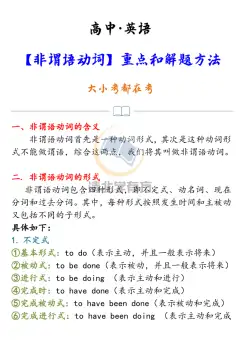
高中·英语
50 个重点考点
90%期末会考
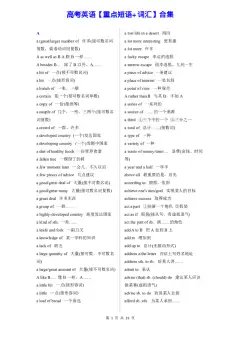
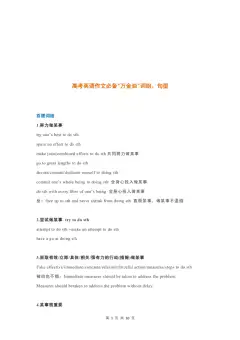
动词短语搭配
1. be fond of “喜爱,爱好” 接名词、代词或动
词的-ing 形式
[1] He’s fond of swimming. 他喜欢游泳。
[2] Are you fond of fresh vegetables. 你喜欢新
鲜蔬菜吗?
[3] He is fond of his research work. 他喜爱他
的研究工作。
2.hunt for = look for 寻找
hunt for a job 找工作
第 1 页 共 18 页 3. in order to/so as to 两个词组都可引导不定式
作目的状语, in order to 可放于句首, so as to 则
不能, 其否定形式为 in order not to / so as not
to.
[1] He went to Beijing in order to/so as to attend
an important meeting.
[2] In order to be noticed, he shouted and waved
to us.为了让我们注意他, 他朝我们又是叫喊又是挥
手。
4. care about
[1] 喜欢,对……有兴趣 = care for
She doesn’t care about money.她不喜欢钱。
[2] 关心 = care for
She thinks only of herself. She doesn’t care
about other people. 她只考虑自己。不关心别人。
[3] 在乎,在意(接从句或不接任何成分)
These young people care nothing about what old
people might say. 这些年轻人根本不在乎老人说的
话。
5. such as 意为“诸如……”,“像……”,是
第 2 页 共 18 页用来列举人或事物的。
She teaches three subjects, such as physics and
chemistry. 她教三门科目,像物理、化学。
6. drop a line 留下便条, 写封短信
7. make yourself at home 别客气;随便;无拘束
If you get to my house before I do, help yourself
to a drink and make yourself at home.如果你在
我之前到我家,自己喝点饮料,随便一点。
8. stay up 不睡;熬夜
[1] I'll be late home, don't stay up for me.我
将回家很晚,不要等我了。
[2] He stayed up reading until 2:00 in the morning.
他熬夜看书直到凌晨两点。
9. come about 引起;发生;产生
[1] How did the accident come about?这场事故是
怎么发生的?
[2] They didn't know how the change had come about.
他们不知道这个变化是怎样产生的。
第 3 页 共 18 页 10. except for 除……之外
[1] except 与 except for 的用法常有区别。except
多用于引起同类事物中被排除的一项。
如:
①He answered all the questions except the last
one.除去最后一个,他回答了所有问题。
②We go there everyday except Sunday.除了星期
天,我们天天去那里。
[2] except for 用于引述细节以修正句子的主要意
思。
如:
①Except for one old lady, the bus was empty.
除去一个老太太,这辆公共汽车全空了。
②Your picture is good except for the colours.
你的画儿很好,只是某些色彩有问题。
[3] 但在现代英语中,except for 也用于表示 except
的意思。
如:
上 述 第 一 个 例 子 可 以 是 : He answered all the
questions except for the last one.
[4] 另外,在介词短语之前只能用 except,不能用
except for。
第 4 页 共 18 页We go to bed before ten, except in the summer.
除了夏季,我们通常十点之前上床睡觉。
11. end up with 以……告终;以……结束
The party ended up with an English song.聚会以
一首英文歌结束。
12. more or less 几乎;差不多;大约;大概;大
体上
[1] I've more or less succeeded, but they haven't.
我差不多成功了,而他们没有。
[2] Our living condition has more or less
improved.
我们的生活水平或多或少提高了。
13. bring in 引进;引来;吸收
[1] We should bring in new technology.我们应该
引进新技术。
[2] He brings in 800 dollars a month.他一个月挣
八百美元。
14. get away(from) 逃离
第 5 页 共 18 页[1] The thieves got away from the shop with all
our money.小偷带着我们所有的钱从商店逃跑了。[2]
I caught a really big fish but it got away.我
钓到了一条好大的鱼,可是它逃掉了。
15. watch out (for)注意;留心
[1] Watch out! There is a car coming.小心!汽
车来了。
[2] Watch out for the hole in the road.留神路
上的那个坑。
16. see sb. off 给某人送行
Tomorrow I will see my friend off at the railway
station.明天我到火车站给朋友送行。
17. on the other hand 另一方面; 用以引出相互矛
盾的观点、意见等,常说 on the one hand …… on
the other hand 一方面……另一方面。
I know this job of mine isn't well paid, but on
the other hand I don't have to work long hours.
我知道这份工作报酬不高,但从另一方面来说,我也
不必工作太长时间。
第 6 页 共 18 页 18. as well as 和,还
He is a talented musician as well as being a
photographer.她不但是摄影师还是个天才的音乐
家。
19. take place 发生 take one’s place 入座、站
好位置、取得地位
take sb’s place 或 take the place of 代替、 取
代
20. on fire 相当于 burning, 意为“燃烧;着火;
起火”,有静态的含意。catch fire 有动态的含意。
set…on fire/set fire to…用来表示“使……着
火”、“放火烧……”。
Look, the theatre is on fire! Let’s go and help.
瞧,剧院着火了,咱们去帮忙救火吧。
21. on holiday 在度假,在休假中
When I was on holiday, I visited my uncle. 我在
度假的时候去看望了叔叔。
第 7 页 共 18 页 22. travel agency 旅行社=travel bureau
23. take off
[1] 脱下(衣服等), 解(除)掉
He took off his wet shoes.他脱下了湿鞋子。
[2] (飞机)起飞
The plane took off on time. It was a smooth
take-off.飞机准时起飞。起飞非常顺利。
[3] 匆匆离开
The six men got into the car and took off for the
park.这六个人上了车,匆匆离开去公园。
24. go wrong v. 走错路, 误入岐途, (机器等)发生
故障
25. in all adv. 总共
26. stay away v.外出
27. look up 查询(如宾语为代词,则代词放中间)
Look up the word in the dictionary. 在字典里查
单词。
第 8 页 共 18 页相关词组:look for 寻找;look after 照顾,照料;
look forward to 期待;look into 调查;look on
旁观;look out 注意;look out for 注意,留心,
提防;look over 翻阅,查看,检查;look around
环视;look through 翻阅,查看。
28. run after 追逐,追求 If you run after two
hares, you will catch neither.同时追两只兔子,
你一只也抓不到。
29. on the air 广播 [1] We will be on the air in
five minutes.我们五分钟以后开始广播。 [2] This
programme comes on the air at the same time every
day.这个节目每天在同一时间播出。
30. think highly/well/much of 对……评价很高,
赞 赏 , 对 … … 印 象 好 ;think
badly/nothing/little/lowly of … … 认 为 不 好 ,
对……不在意, 不赞成, 觉得……不怎么样
[1] He was highly thought of by the manager.经
理 对 他 非 常 赞 赏 。 [2] I think well of your
suggestion.我觉得你的建议很好。 [3] I don’t
think much of him as a teacher.我觉得他作为一
个老师不怎么样。
31. leave out [1] 漏掉 You made a mistake—You’
第 9 页 共 18 页ve left out a letter “t”.你出错了—你漏掉了
一个字母 t.[2] 删掉, 没用 I haven’t changed or
left out athing.我没有作出变动也没有删掉任何东
西。
32. stare at (由于好奇、激动等张着嘴巴,睁大眼
睛地)[1] 凝视,盯着看 Don’t stare at foreigners.
It’s impolite.不要盯着外国人看,这样不礼貌。
[2] glare at (to stare angrily at)怒视着
33. make jokes about 就……说笑 They make jokes
about my old hat.他们就我的旧帽子说笑我。
[1] have a joke with … about…跟某人开关于某
事的玩笑 He stopped to have a joke with me.他停
下来跟我开玩笑。[2] play a joke on…开某人的玩
笑 We played jokes on each other. 我们互相开玩
笑。 [3] v. joke about 取笑 They joked about my
broken English.他们取笑我蹩脚的英。
34. take over 接管;接替;继承 [1] What is good
and still useful should be taken over.好的有用
的东西应当继承。 [2] Our chairman has left, so
Jack will take over (his job).我们的主席走了,
因此杰克将接管(他的工作)。
35. break down[1] 破坏;拆散 ①Chemicals in the
第 10 页 共 18 页body break our food down into useful substances.
人体中的化学元素把食物分解成有用的物质。 ②The
peace talks are said to have broken down. (喻)
据说和谈破裂了。
[2](机器)损坏 ①Our truck broke down outside
town. 我们的卡车在城外抛锚了。 ②The car broke
down halfway to the destination.汽车在到达目的
地的中途抛锚了。
[3] 失败;破裂 Their opposition broke down.他们
的反对意见打消了。
[4] 精神崩溃;失去控制 He broke down and wept. 他
不禁失声痛哭。
[5] 起化学变化 Food is broken down by chemicals.
化学物质引起食物转化。
36. get on one’s feet[1] 站起来;站起来发言 [2]
(=stand on one's feet)自立, 经济上独立 [3] (人)
病好了, 可以起床了; (使)恢复, 复苏(指企业)
37. go through[1] 经 历 ; 经 受 ; 遭 到 These
countries have gone / been through too many wars.
这些国家饱经战火。
[2] 完成;做完 I didn't want to go through college.
我不想上完大学。
第 11 页 共 18 页[3] 通 过 ; 批 准 ① The law has gone through
Parliament. 议会已经通过了这项法案。
②Their plans went through. 他们的计划得到了批
准。
[4] 全面检查;搜查 They went through our luggage
at the customs.在海关他们检查了我们的行李。
38.take over 接管;接替;继承 ①what is good and
still useful should be taken over.好的有用的东
西应当继承。②Our chairman has left, so Jack will
take over (his job).我们的主席走了,因此杰克将
接管(他的工作)。
2
常考句型
39. “So + be/have/助动词/情态动词+主词”
的结构。此结构中的语序是倒装的,“So”代替上句
中的某个成分。如果上面一句是否定句,则使用
“Neither/Nor+be/have/助动词/情态动词+主语”的
结构。
[1] He’s tired, and so am I. (=I’ m also tired.)
[2] You can swim,and so can I.(=I can also
swim.)She has had supper,and so can I.(=I’
第 12 页 共 18 页ve had lunch,too.)
[3] Tom speaks English,and so does his sister.(=
His sister speaks English,too.)A: I went to the
park yesterday.B: So did I.(=I also went to
the park yesterday.)
40.“So +主语+be/have/助动词/情态动词”结构
中的主谓是正常语序,so 相当于 indeed,certainly,
表示说话人对前面或对方所说情况的肯定、赞同或证
实,语气较强,意思是“确实如此”。
A:It was cold yesterday.昨天很冷。B:So it was.的
确如此。(=Yes,it was.)A:You seem to like
sports.B:So I do.(=Yes,I do.)A:It will be
fine tomorrow.B:So it will.(=Yes ,it will.)
41.“主语+do/does/did + so”结构指的是按上句的
要求做了。此句型中 do so 代替上文中要求做的事,
以免重复。
My Chinese teacher told me to hand in my
composition on time and I did so.(=I handed inmy
composition on time.) 语文老师叫我按时交作文,
我照办了。
42. So it is with…或 It is the same with…句
型表示 “……(的情况)也是如此。”当前面的句子
第 13 页 共 18 页中有几种不同形式的谓语时,要表示相同情况,必须
使用本句型,不能使用 so 引起的倒装句。
She doesn’t play the piano, but she likes singing.
So it is with my sister.
43. There you are. 行了,好。 这是一句表示一种
事情告一段落或有了最终结果的用语。
[1] There you are! Then let's have some coffee.
除此之外,还可以表示“瞧,对吧(果然如此)”的
语气。
[2] There you are! I knew we should find it at
last.对吧!我就知道我们最终能找到的。
44. have some difficulty (in) doing sth. 干某
事 有 困 难 ; 接 名 词 时 , 常 用 句 型 : have some
difficulty with sth.
[1] Do you have any difficulty (in) understanding
English?你理解英语口语有困难吗?[1] She said
she had some difficulty with pronunciation.她
说她在发音方面有困难。
45. have a good knowledge of sth. “掌握……”,
“对……有某种程度的了解”
[1] He has a good knowledge of London.他对伦敦
有所了解。
第 14 页 共 18 页[2] A good knowledge of languages is always
useful.
3
长难句
46. Wei Bin took out some peanuts and it was fun
to see the monkey eat from his hand.魏彬拿出一
些花生。看着猴子从他手上吃花生,很有趣。
[1] fun “好玩,趣事”,不可数名词,前面不加不
定冠词 aYou’re sure to have some fun at the party
tonight. 今天晚上你肯定会玩得很开心。
[2] make fun of“取笑”,“嘲弄”。People make
fun of him only because he is wearing such a
strange jacket.人们嘲笑他只是因为他穿了一件那
么奇怪的衣服。
funny adj. “可笑的,滑稽的”He looks very funny
in his father’s jacket.他穿着他父亲的衣服,看
上去很滑稽。
47. It is polite to finish eating everything on
your plate.把你盘子里所有东西吃完是有礼貌的。
这是一个动词不定式作主语的句型,其中 to finish
eating everything 是主语,it 是形式主语。
4
第 15 页 共 18 页常考语法
48. 直接引语和间接引语[1] 直接引语在改为间接引
语时,时态需要做相应的调整。(一般过去时改成过
去完成时)I broke your CD player.→He told me he
had broken my CD player.
(现在完成时改成过去完成时)Jenny said, “I have
lost a book.”→Jenny said she had lost a book.
(一般将来时改成过去将来时)Mum said, “I’ll go
to see a friend.”→Mum said she would go to see
a friend.
(过去完成时保留原有的时态)He said, “We hadn’
t finished our homework.”→He said they hadn’
t finished their homework.
注意:直接引语是客观真理,过去进行时,时态不变。
[2] 在直接引语变间接引语时,如果从句中的主语时
第一人称或被第一人称所修饰,从句中的人称要按照
主句中主语的人称变化。如:Mary said,“My brother
is an engineer.”→Mary said her brother was and
engineer.
[3] 直接引语如果是反意疑问句,选择疑问句或一般
疑问句,间接引语应改为由 whether 或 if 引导的宾
第 16 页 共 18 页语从句。如:He said, “Can you run, Mike?”→
He asked Mike whether/if he could run.
[4] 直 接 引 语 如 果 是 祈 使 句 , 间 接 引 语 应 改 为
“tell(ask, order, beg 等) (not) to do sth.”
句型。如:“Pass me the water, please.”said he.
→He asked him to pass her the water.
[5] 直接引语如果是以“Let’s”开头的祈使句,变
为间接引语时,通常用“suggest+动名词或从句”的
结构。如:She said, “Let’s go to the cinema.”
→ She suggested going to the cinema. 或 She
suggested that they should go to the cinema.
49. 现在进行时表将来的动作现在进行时表将来的动
作,谓语通常为瞬间动词。如:come, go, arrive,
leave, start, return, stay, meet, get 等。这些
动词的进行时后不能再接具体的时间。
[1] 用现在进行时表示将来,指的是近期的,按计划
或安排要发生的动作。
[2] 现在进行时表示将来与表示正在进行的动作的
区别在于:前者通常用瞬间动词(有时一些常用动词
也可以这样用如:do)如:go, come, start, return,
get, arrive 等。而后者通常是持续性动词。① The
train is arriving soon. 火车就要进站了。② He is
第 17 页 共 18 页reading a novel. 他在看小说。
[3] 用现在进行时表示将来的时间,在句中或上下文
中通常有表示将来时间的状语。
[4] 现在进行时与一般现在时表示将来动作的区别
在于:前者表示的将来的动作往往是可以改变的,而
后者则是根据规定或时间表预计要发生的动作或事
情,因此往往是不可改变或不可随便改变的。① What
are you doing next Friday?下星期五你们打算干什
么?② The plane takes off at 7:30 tonight.飞
机今晚七点半起飞。
50. 主语是 单数时,尽管 后面跟有 as well as,
but ,except, besides, with ,along with, together
with, like 等,谓语动词仍用单数。The teacher as
well as his students is excited.
第 18 页 共 18 页