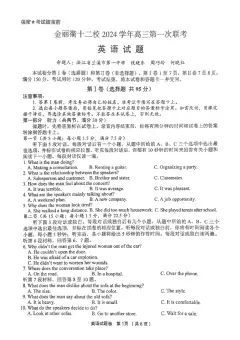
金丽衢十二校 2024 学年高三第一次联考
英语试题
本试卷分第I卷(选择题)和第II卷(非选择题)。第I卷1至7页,第II卷7至8页。满分
150分,考试用时120分钟。考试结束,将本试卷和答题卡一并交回。
第I卷(选择题 共95分)
注意事项:
1.答第I卷前,考生务必将自己的姓名、准考证号填写在答题卡上。
2.选出每小题答案后,用铅笔把答题卡上对应题目的答案标号涂黑。如需改动,用橡皮擦干
净后,再选涂其他答案标号。不能答在本试卷上,否则无效。
第一部分 听力(共两节,满分30分)
做题时,先将答案标在试卷上。录音内容结束后,你将有两分钟的时间将试卷上的答案转涂
到答题卡上。
第一节(共5小题;每小题1.5分,满分7.5分)
听下面5段对话。每段对话后有一个小题,从题中所给的A、B、C三个选项中选出最佳选项,
并标在试卷的相应位置。听完每段对话后,你都有10秒钟的时间来回答有关小题和阅读下一
小题。每段对话仅读一遍。
1.What is the man doing?
A.Making a consultation. B.Renting a guitar. C.Organizing a party.
2.What is the relationship between the speakers?
A.Salesperson and customer. B.Brother and sister. C.Classmates.
3.How does the man feel about the concert?
A.It was terrible. B.It was average. C.It was pleasant.
4.What are the speakers mainly talking about?
A.A weekend plan. B.A new company. C.A job opportunity.
5.Why does the woman look tired?
A.She walked a long distance. B.She did too much housework. C.She played tennis after school.
第二节(共15小题;每小题1.5分,满分22.5分)
听下面5段对话或独白。每段对话或独白后有几个小题,从题中所给的A、B、C三个选项中
选出最佳选项,并标在试卷的相应位置。听每段对话或独白前,你将有时间阅读各个小题,
每小题5秒钟;听完后,各小题将给出5秒钟的作答时间。每段对话或独白读两遍。听第6段材料,回答第6、7题。
6.Why didn't the man get the injured woman out of the car?
A.He couldn't open the door.
B.He was afraid of a car explosion.
C.He didn't want to worsen her wounds.
7.Where does the conversation take place?
A.On the road. B.In a hospital. C.Over the phone.
听第7段材料,回答第8至10题。
8.What does the man dislike about the sofa at the beginning?
A.The size. B.The color. C.The style.
9.What does the man say about the old sofa?
A.It is heavy. B.It is small. C.It is comfortable.
10.What do the speakers decide to do?
A.Look at other sofas. B.Go to another store. C.Wait for a sale.
听第8段材料,回答第11至13题。
11.What does the man most probably do?
A.He's a hotel clerk. B.He's a taxi driver. C.He's a travel agent.
12.What does the man advise the woman to do?
A.Call a taxi by herself. B.Pack her bags in advance. C.Set off early to catch the flight.
13.How long does it take the woman to get ready?
A.About half an hour. B.About an hour. C.About one and a half hours.
听第9段材料,回答第14至16题。
14.Why is the man going to Montreal next summer?
A.To do some business. B.To attend a wedding. C.To take a course.
15.What do we know about Quebec City?
A.It is the capital of Quebec Province.
B.It is far from the St. Lawrence River.
C.It is the biggest city in Quebec Province.
16.What does the woman mention about Quebec City at last?
A.The cold winter. B.The beautiful river. C.The ancient buildings.
听第10段材料,回答第17至20题。
17.Why does the speaker give the talk?
A.To introduce new teachers to students.B.To inform students of the schedule for today.
C.To explain some new school facilities to students.
18.When will students have a break?
A.At 10:30. B.At 10:45. C.At 11:00.
19.Who will hand out books in reception?
A.Rebecca. B.Stewart. C.Anna.
20.What will students do in the afternoon?
A.Have a written test. B.Listen to a lecture. C.Do a self-assessment.
第二部分 阅读理解(共两节,满分50分)
第一节(共15个小题;每小题2.5分,满分37.5分)
阅读下列短文,从每题所给的A、B、C和D四个选项中,选出最佳选项,并在答题卡上将
该项涂黑。
A
The Chinese University of Hong Kong (CUHK) provides a variety of activities and services to assist students
to explore and experience different aspects of university life and to make the best out of it. These include
supporting student activities and student bodies, services for non-local students, mental-wellness promotion as well
as career planning and development. This aims to enhance students potential development as well as their holistic
personal growth.
Off-Campus Housing Information Centre (OCHIC)
Learning enhancement services and off-campus housing information are available to help non-local students
navigate adjustment issues and provide information related to rental accommodation outside of the CUHK campus.
The Independent Learning Centre (ILC)
The Independent Learning Centre (ILC) offers both academic and career-related support services in both
English and Chinese for all CUHK postgraduate students. The 2-hour workshops provide practical training in
specific journal paper writing, oral/poster presentations, writing of literature/systematic reviews and many other
areas to assist our postgraduate students in spreading their research far and wide.
Information Technology Services Centre (ITSC)
ITSC supports the one-stop university portal My-CUHK which allows personalized access to cloud email
services, library services and the Chinese University Student Information System (CUSIS) for managing personal
study particulars. ITSC also provides IT facilities, on and off campus network, eLearning systems, online trainings
and workshops.
Centre for Learning Enhancement And Research (CLEAR)CLEAR organizes the Improving Postgraduate Learning (IPL) programme with an aim to introduce the
approaches, methodologies and framework to equip the work of researchers in a formal and structured manner, to
advance the University's excellence and scholarship in teaching and learning, and to equip postgraduate students
with essential skills and knowledge for their research.
The Chinese University of Hong Kong Library (CUHKL)
The CUHK Library is a leading research library in East Asia and it has a significant bilingual collection of
electronic and print resources. Its mission is to partner in the creation, access, dissemination and preservation of
knowledge to inspire and support CUHK in its research, learning and teaching. The CUHK Library works closely
with the staff and students, and has strong collaborative links with other university libraries in Hong Kong, Greater
China and the World.
1. Which will offer special service for post-graduates?
A. ILC & CUHKL. B. ILC & CLEAR. C. OCHIC & ITSC. D. ILC & ITSC.
2. What do all the services have in common?
A. They are meant to improve students’ academic performance.
B. They are tailored to guarantee the personalized study for students.
C. They are designed to meet the needs of students on and off campus.
D. They are intended for ensuring students’ safety and health on-campus.
3. Where is the text probably taken from?
A. A campus brochure. B. An academic report.
C. A curriculum guide. D. An accommodation guide.
B
Can a shawl (披肩) bear witness to the struggle for girls’ right to education? When Malala Yousafzai gave a
speech at the United Nations headquarters in New York on her sixteenth birthday, she wore a pink shawl. On the
platform, her message had never been changed even when she suffered attempted murder for her struggle for the
right of girls to attend school and university; “One child, one teacher, one pen and one book can change the world.”
The shawl is part of the Nobel Prize Museum’s exhibition These Things Changed the World.
For the first time, the museum is displaying a large selection of items from its collection of artefacts (人工制
品) from Nobel Prize winners. These objects tell stories of remarkable discoveries and life achievements. More
than 250 artefacts bear witness to revolutionary inventions, courageous peace efforts, groundbreaking ideas and
innovative literature.
In the exhibition These Things Changed the World, we can discover how our life and the world we live in
have changed thanks to researchers, writers and activists who have worked in the fields of science, literature andpeace. Their discoveries and accomplishments have been awarded the Nobel Prize and have given us new
perspectives on our lives and our future. The exhibition looks at remarkable discoveries and achievements, based
on artefacts donated to the museum’s collection by Nobel Prize laureates. They mix the mundane and the personal
with breathtaking existential and scientific questions.
Three in-depth displays focus on some of the biggest questions facing humankind -- the cosmos, human
nature and the ingredients of life. What does everything consist of, and what do we know about black holes? What
does the riddle of ageing look like? What do we need to know about human consciousness, human rights and
artificial life in order to shape our future?
The stories of these artefacts show how the laureates’ discoveries, insights, stories and peace efforts make life
longer, safer and more understandable for you and many others. Welcome to explore how these things have
changed the world.
4. Why are these artefacts on exhibition?
A. They have carried scientific values. B. They have changed the whole world.
C. They saw grand Nobel Prize ceremonies. D. They witnessed crucial historical moments.
5. What can we learn from paragraphs 3 and 4?
A. The exhibits are from all fields of human civilization and technology.
B. The exhibits are collected and purchased from the Nobel Prize winners.
C. The exhibition aims at promoting the public’s respect for Nobel laureates.
D. The exhibition helps us have a better understanding of our life and the world.
6. The last paragraph aims to ________.
A. offer an invitation B. make a comment C. present an explanation D. list new evidence
7. What can be a suitable title for the passage?
A. An Impressive Shawl: A Witness to Miracles
B. An Incredible Display: An Opportunity of Admiration
C. An Amazing Museum: A Must Go for Nobel Prize Enthusiasts
D. An Established Soul: An Unyielding Fighter for Women Rights
C
Mount Everest, a product of a collision (碰撞) between Eurasia and the Indian subcontinent, the Earth’s tallest
mountain standing 8.85 kilometers above sea level, is still growing, continuing on an upward movement that began
at their birth around 50 million years ago. Scientists now think they know the reason why.
Everest’s growth has to do with the major joining of two nearby river systems. The Kosi river joined with the
,
Arun river around 89 000 years ago, researchers estimated. This change in the area’s river system has led toEverest gaining around 15-50 meters in height. That suggests an upward movement rate of about 0.2-0.5
millimeters per year.
The geological process at work, researchers said, is called isostatic rebound. Isostatic rebound involves the rise
of land masses on Earth’s crust when the weight of the surface declines. The crust, Earth’s outermost part, floats
atop hot, semi-liquid rock. In this case, the joining of the rivers resulted in increased erosion which carried off large
amounts of rock and soil. This reduced the weight of the area near Everest.
“Isostatic rebound can be likened to a floating object adjusting its position when weight is removed,” said Jin-
Gen Dai of China University of Geosciences in Beijing. Dai is one of the leaders of the study published recently in
Nature Geoscience. “When a heavy load, such as ice or eroded rock, is removed from the Earth’s crust, the land
beneath slowly rises in response, much like a boat rising in water when the goods in it is unloaded,” Dai added. The
researchers, who used numerical models to study, estimated that isostatic rebound accounts for only 10 percent of
Everest’s yearly upward movement, or uplift rate. Dai said that the research shows our planet’s changing nature.
Even a seemingly unchanging element like Mount Everest is “subject to ongoing geological processes, reminding
us that Earth is constantly changing, often in imperceptible ways in our daily lives.”
This geological process is seen in other places around the world. “A classic example is in Scandinavia, where
the land is still rising in response to the melting of thick ice sheets that covered the region during the last Ice
Age.This process continues today.” Dai said. Study co-writer Adam Smith, a University College London doctoral
student, said GPS measurements show the continued rising of Everest and the rest of the Himalayas. This uplift is
faster than the continued surface erosion caused by wind, rain and river flow. As this erosion continues, Everest’s
uplift rate from isostatic rebound may increase, Smith said. Neighboring mountains, including Lhotse, the world’s
fourth highest, and Makalu, the fifth highest, also get a boost from the same process. Lhotse is experiencing an
uplift rate similar to Everest. Makalu has a slightly higher uplift rate.
8. Which of the following probably results in “isostatic rebound”?
A. The weight of an object’s surface increases.
B. All the goods is suddenly unloaded from a boat.
C. Heavy loads of rocks are removed from the surface.
D. Rock and soil keep accumulating on the Earth’s crust.
9. What does the underlined word imperceptible mean in paragraph 4?
A. Incredible. B. Unnoticeable. C. Impressive. D. Distinctive.
10. Which of the following does Dai agree with?
A. Mount Everest’s uplift brings some eroded rocks.
B. Mount Everest has been rising merely in recent years..
C Everest’s rising is the evidence of the changing nature of Earth.
D. Isostatic rebound is the main factor in Everest’s upward movement.
11. What did Adam Smith intend to tell us?
A. Everest’s uplift is not unique. B. GPS helps little in the research.
C. Surface erosion will decrease Everest’s uplift. D. Makalu experiences a slower uplift than Everest.
D
How can you give the things we buy new life rather than dumping them in landfill? There are three solutions
commonly used by companies at present: Recycling: turning something into the same form of itself. Downcycling:
transforming a product into an inferior one, such as grinding running shoes down to create the surface of basketball
courts. Upcycling: converting a product into a superior form, such as spinning single-use plastic bottles into
polyester fabrics which might be worn for decades.
,
Despite their best intentions all these methods create waste at some point in the manufacturing process,
from the pesticides and fertilizers used to grow crops, various pollutants in the wastewater from the factories that
make them, to greenhouse gas emissions or heavy metal emissions from the energy source and so on. The more you
examine the entire lifecycle of a product, the more you realize that waste is always created somewhere.
But what if you could design something so that no waste was created at any point? Enter Cradle-To-Cradle
(C2C) manufacturing, a vision of how we could and should make things, everything from shoes to shirts to
factories to cities. The concept was put forward in the 1970s as a play on the phrase “cradle to grave” and was later
formalized in the best-selling book of the same name, penned by design chemists Michael Braungart and William
McDonough. The simple idea: “Re-making the way we make things.”
Today the Cradle-To-Cradle Products Innovation Institute (C2CPⅡ) certifies thousands of products, ranging
from tyres to carpets, soap to construction timber. The core Cradle to Cradle concept is to model industrial
processes on natural ones-what is known as the “biomimetic” approach. In the natural world, there is no such thing
as “waste” — everything is recycled down to every atom. Ambitiously, the C2CPⅡ says its ultimate goal is to
see consumer products as “nutrients”.
C2C is an ambitious concept and requires an enormous amount of careful thinking, and designing in the
formation of any product: every single manufacturing step must be re-thought to ensure that not only is nothing
wasted, but that every single component is fully bio-degradable and harmless. Strictly, they test every chemical or
ingredient that could be used — solvents, dyes, cleaning agents, you name it, and keep a library of those approved
to be safe enough for human exposure or environmental release.
For years, manufacturers of furniture, lightbulbs, paints and more have sought certification of their products
and made use of the chemical library. Now the institute has launched an initiative focused on new trends.12. Why does the author ask a question in paragraph 1?
A. To introduce environmentally friendly practices.
B. To present several permanently disturbing issues.
C. To compare various approaches to environment problems.
D. To share with readers currently achieved accomplishments.
13. Which of the following best describes the concept of C2C?
.
A Simple and innovative. B. Novel and fashionable
C. Ambitious and demanding. D. Practical and conventional.
14. What can be inferred from the passage?
A. Only recycle, down-cycle or up-cycle can give things new life.
B. Cradle-To-Cradle manufacturers pursue to produce things with zero waste.
C. Michael Braungart and William McDonough were the founders of C2CPⅡ.
D. It takes enormous amount of careful thinking rather than tests to perform C2C.
15. What will the author most probably talk about after the last paragraph?
A. How C2C will be applied in the clothing industry.
B. What C2CPⅡ will do to change furniture industry.
C. When C2C will be adopted for more future industries.
D. Why C2CPⅡ will be successful in its chemical library.
第二节(共5个小题;每小题2.5分,满分12.5分)
根据短文内容,从短文后的选项中选出能填入空白处的最佳选项。选项中有两项为多余选项。
Weekdays can be a blast (a happy experience) — until boredom strikes. Then all of a sudden, restlessness
sets in. In most cases, we can break boredom ourselves. Scientists have learned that boredom reflects our human
need for meaningful and challenging activities — and it often stimulates us to find them. But where to start?
___16___ We’ve packed these pages with ideas that we hope will capture your interest and spark some fun!
Seek something meaningful
We get a ton of satisfaction from looking beyond ourselves, helping others, and working to solve problems.
IDEAS: Think of one tiny step you can take to help solve a problem that’s often on your mind. Surprise a family
member, friend, or neighbor by doing something nice for community. ___17___
Branch out
Putting yourself out of your comfort zone is a surefire way to wake up your senses. IDEAS: Learn how to say
three sentences in a language that has always fascinated you. Spend an afternoon playing a sport you never tried
before. ___18___ Tackle your fear: Sing in front of others. Learn about snakes.
Add variety and have a little funNot planning out every detail of your day can lead to wonderful things. The same ol’ same ol’ can get boring.
Mix things up a little! IDEAS: Take different routes to a place you go often. Invite a new kid to join you for an
activity. Try tasting a new food every week. ___19___ Seriously! Wear something odd that will make you smile
all day, like two favorite mismatched socks.
Bring a friend (or two)
___20___ And it doesn’t matter if you’re awesome or terrible at it. Either way, you’re making memories that
will become stories you tell over and over! IDEAS: Go roller skating, or try two-person juggling. Add mystery
ingredients to cookies, then ask your family and friends to guess what’s in them.
A. You came to the right place.
B. And do what makes you nervous.
C. Never should you miss the chance.
D. Even make necessary changes by being silly.
E. A new activity with someone joined can double the fun!
F. Talk with parents about volunteering at an animal shelter.
G. Remember: unremitting painstaking efforts are bound to pay off!
第三部分 语言运用(共两节,满分30分)
第一节:完形填空(共15个小题;每小题1分,满分15分)
阅读下面短文,从短文后各题所给的A、B、C和D四个选项中,选出可以填入空白处的最
佳选项,并在答题卡上将该项涂黑。
Thousands of people fill the square. They’ve gathered to watch the building of the tower. There are many
beautiful towers here in Barcelona, Spain, but this one will be different. It will be built out of ___21___!
A brass fanfare (号角) announces the building has begun, and holding their breath, everyone goes ___22___.
Drums join in. Body after body ___23___ from the crowd, and a human castle begins to grow straight up from the
center of the square. Higher and higher it grows as the tower rises to five, six, seven, then eight stories! The crowd
___24___ as the final person reaches the top.
Teams of castellers all wear white pants and black sashes (腰带), and each team wears a different ___25___
shirt. Barcelona’s castellers are known by their bright-red shirts. The most important part of the ___26___ is the
sash. It supports castellers’ backs, and their teammates hold on to it with their hands or feet as they climb.
The ___27___ who play during the building aren’t just there to entertain the crowd. At each stage of the
building process, they play a different___28___. This lets the castellers on the lower levels know what is happening
above them. Without flutes and drums, the castle might get into ___29___.
Most human castles have three main parts: base, the trunk, and the crown. The base is made of the ___30___people because they have to carry all the weight. Lighter people ___31___ the levels of the trunk. The teens form
the crown at the top. The anxaneta, who can be a young child, climbs up last. When he/she ___32___ reaches the
top, the crowd cheers!
However, the most ___33___ part is still ahead. The anxaneta quickly climbs down the castle, followed by
the rest of the levels. Bodies ___34___ glide down bodies — unless the tower collapses, which often happens at
this stage. The applause continues until the castle has been ___35___ and everyone is safe.Then a celebration
starts.
21. A. clay B. wood C. concrete D. people
22. A. quiet B. scared C. upset D. calm
23. A. disappears B. escapes C. emerges D. separates
24. A. gathers B. roars C. wonders D. suspects
25. A. colored B. styled C. collared D. patterned
26. A. shoe B. tool C. instrument D. costume
.
27 A. firefighters B. architects C. musicians D. performers
28. A. game B. tune C. project D. trick
29. A. chaos B. shape C. accidents D. work
30. A. smartest B. bravest C. tallest D. strongest
31. A. pick up B. make up C. end up D. dress up
32. A. desperately B. approximately C. ultimately D. occasionally
33. A. dangerous B. destructive C. disastrous D. sensitive
34. A. awkwardly B. clumsily C. hopefully D. gracefully
35. A. passed down B. taken down C. turned down D. set down
第II卷(非选择题 共55分)
注意:将答案写在答题卡上。写在本试卷上无效。
第三部分 语言运用(共两节,满分30分)
第二节(10个小题;每小题1.5分,满分15分)
阅读下面材料,在空白处填入适当的内容(1个单词)或括号内单词的正确形式。
Paris 2024 will be remembered as much for athletes’ medal-winning performances as for Chinese technology
companies’ contributions. Chinese firms applied cloud computing and artificial intelligence in fields ranging from
___36___ (immerse) live broadcast experiences to athletes’ training.
Experts say the participation of Chinese companies in the sporting events ___37___ (demonstrate) their
independent innovation capabilities. This will help improve their internationally ___38___ (recognize) influencewhile boosting their global competitiveness.
During the Paris Games, more than two-thirds of live broadcast signals were transmitted by Alibaba Cloud,
___39___ worldwide partner of the Paris Olympics. A record-breaking 11,000 hours of Olympics scenes
___40___ (distribute) to more than 200 countries and regions so far with the help of Alibaba Cloud’s global cloud
infrastructure. Meanwhile, Paris 2024 was the first Summer Olympics ___41___ (see) the extensive use of AI
technology.
Thomas Bach, the IOC president, highlighted the key areas ___42___ AI has been applied at this year’s
Olympics. These include safeguarding against cyber abuse, creating video highlights in multiple formats and
languages, ___43___ implementing a data capture system.
It was Baidu Inc, a Chinese tech giant, that prepared ___44___ is called AI-powered auxiliary training
system for China’s national diving team, helping them achieve good results. “The AI system allows timely
playback and scoring,” said Quan Hongchan, champion of the women’s 10-meter platform diving event, ___45___
(add) the system can be used to refine a diver’s movements during daily training, providing her with additional
coaching support.
第四部分 写作(共两节,满分40分)
第一节:应用文写作(满分15分)
46. 假定你是李华,是你们学校刚刚开设的开心农场(Happy Farm)负责人。请你向来访的美国兄弟学校的
同学介绍开心农场的情况,内容包括:
1.开心农场设立的目的;
2.开心农场提供的活动。
注意:
1.写作词数为80左右;
2.请在答题纸的相应位置作答。
Dear fellows,
____________________________________________________________________________________________
____________________________________________________________________________________________
____________________________________________________________________________________________
____________________________________________________________________________________________
____________________________________________________________________________________________
第二节:读后续写(满分25分)
47. 阅读下面材料,根据其内容和所给段落开头语续写两段,使之构成一篇完整的短文。
Nala loved spending her school holidays on Grandma’s little farm! But this time, her granny was so sick, andcouldn’t get out of bed!
“Don’t worry,” Nala told her granny, “I’ll look after everything!” She knew how to feed all the animals: it was
easy! The chickens and ducks had pellets (丸). The horse had oats (燕麦). There was plenty of grass for the four
sheep and the goat.
She could also water the vegetables and collect eggs from the chicken coop.
“What a great help you are,” Grandma said when Nala brought her a bowl of soup for lunch.
“It’s no trouble!” Nala smiled.
“I’ll have to get up soon,” Grandma sighed. “Nanny will need milking.” Nanny the goat had to be milked
every day. In fact, she would come outside and bleat (咩咩叫) when it was time! But Nala thought that her granny
still looked pale and shaky…
“I can do it!” Nala said confidently. She hadn’t tried milking yet, but she had watched Grandma closely!
Grandma would always put on her special dress and straw hat, get the bucket from the tool shed (棚), get Nanny to
the milking shed, and get everything done.
When Nanny bleated to be milked, Nala went out to see her. She expected the goat to follow her to the milking
shed like she did with Grandma, but the animal just stood there.
“Come on, Nanny,” Nala said. “I’m milking you today. Grandma’s sick, so we have to work together.”
Nanny just bleated impatiently, moving her feet uncomfortably.
“Maybe I need to speak more firmly,” Nala thought. “Now listen, Nanny. I want you to follow me to the
milking shed, right now!” But Nanny trotted away across the yard!
“Hey, come back here!” Nala called. Nanny stopped and turned around. She didn’t like this little stranger.
Grandma never yelled at her!
注意:
1.续写词数应为150左右;
2.请按如下格式在答题纸的相应位置作答。
At that moment Nala had a think.
____________________________________________________________________________________________
____________________________________________________________________________________________
____________________________________________________________________________________________
____________________________________________________________________________________________
____________________________________________________________________________________________
Just then, she spotted Grandma’s dresses and the straw hat hanging over a chair.
________________________________________________________________________________________________________________________________________________________________________________________
____________________________________________________________________________________________
____________________________________________________________________________________________
____________________________________________________________________________________________
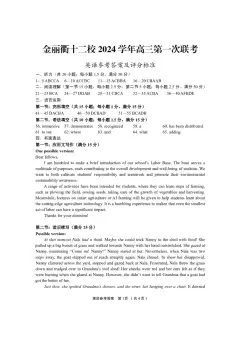
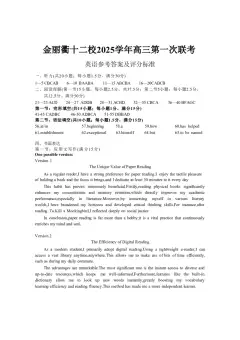
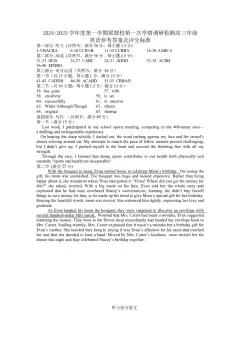
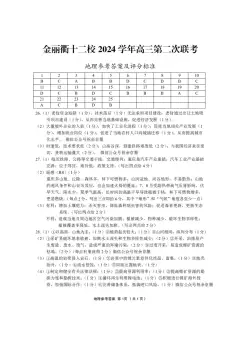
1—5ABCCA 6—10 ACCBC 11—15 ACBBA 16—20 CBAAB