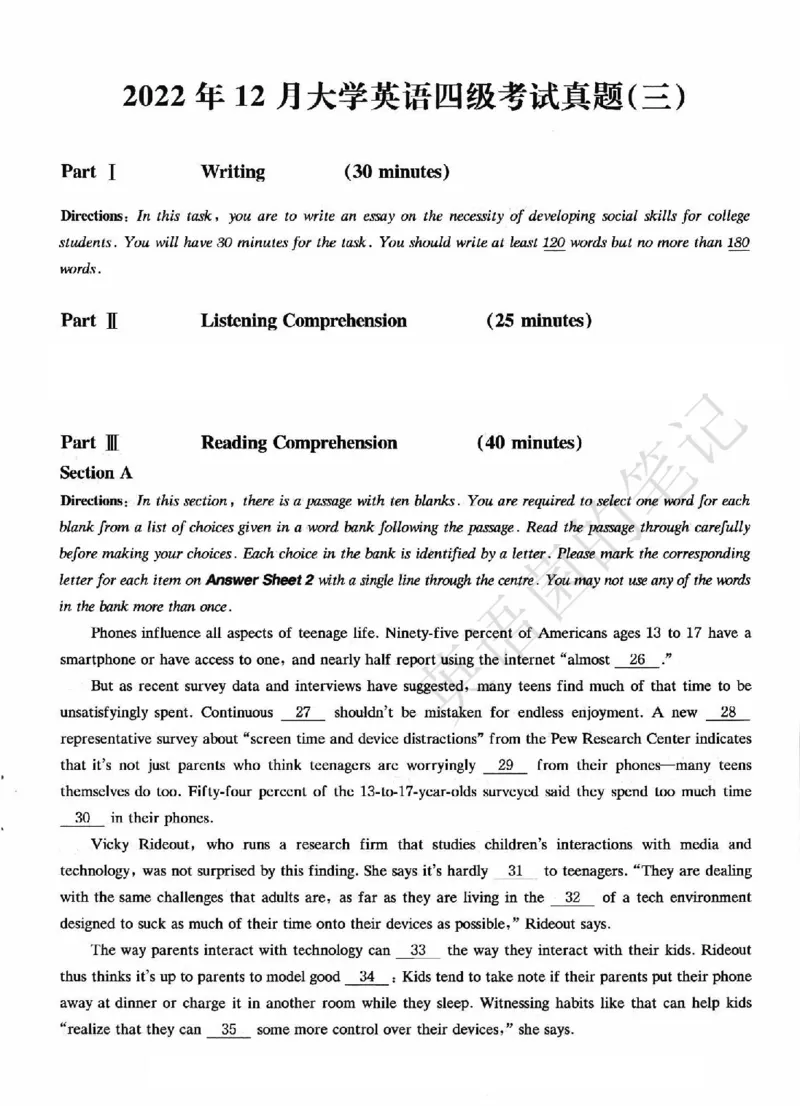
2022年 12月大学英语六级考试真题(三)
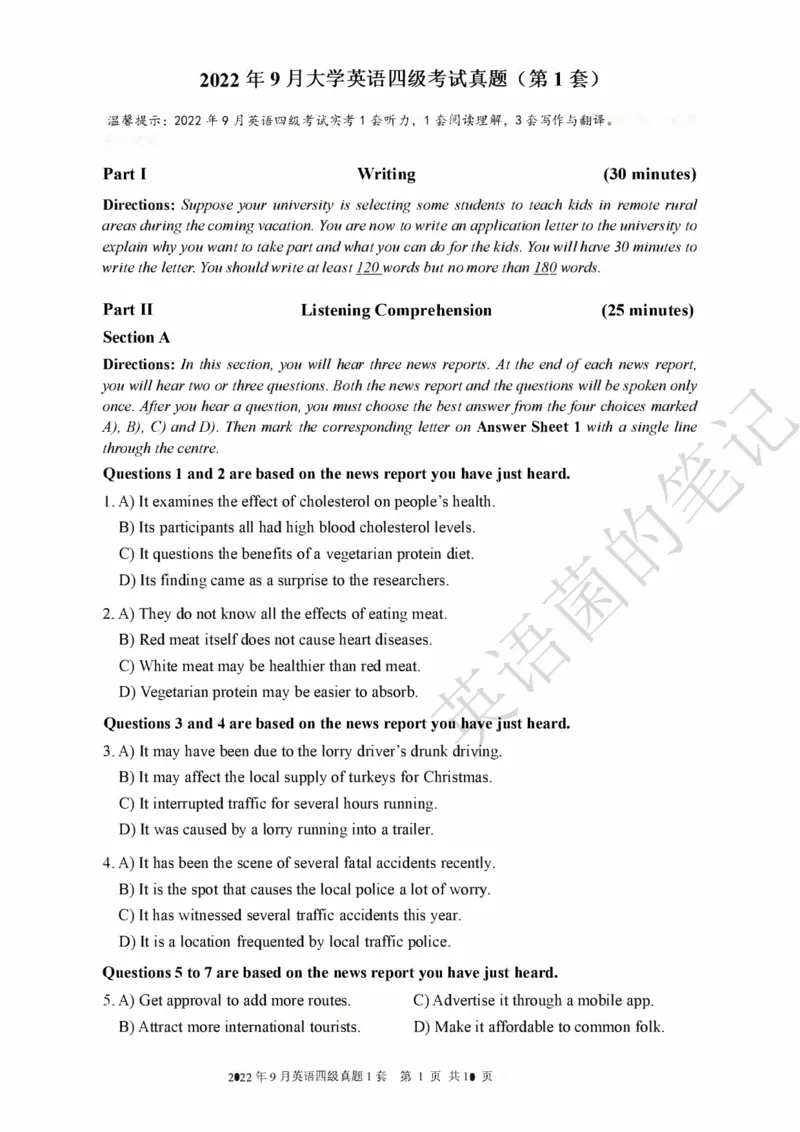
Part I Writing (30 minutes)
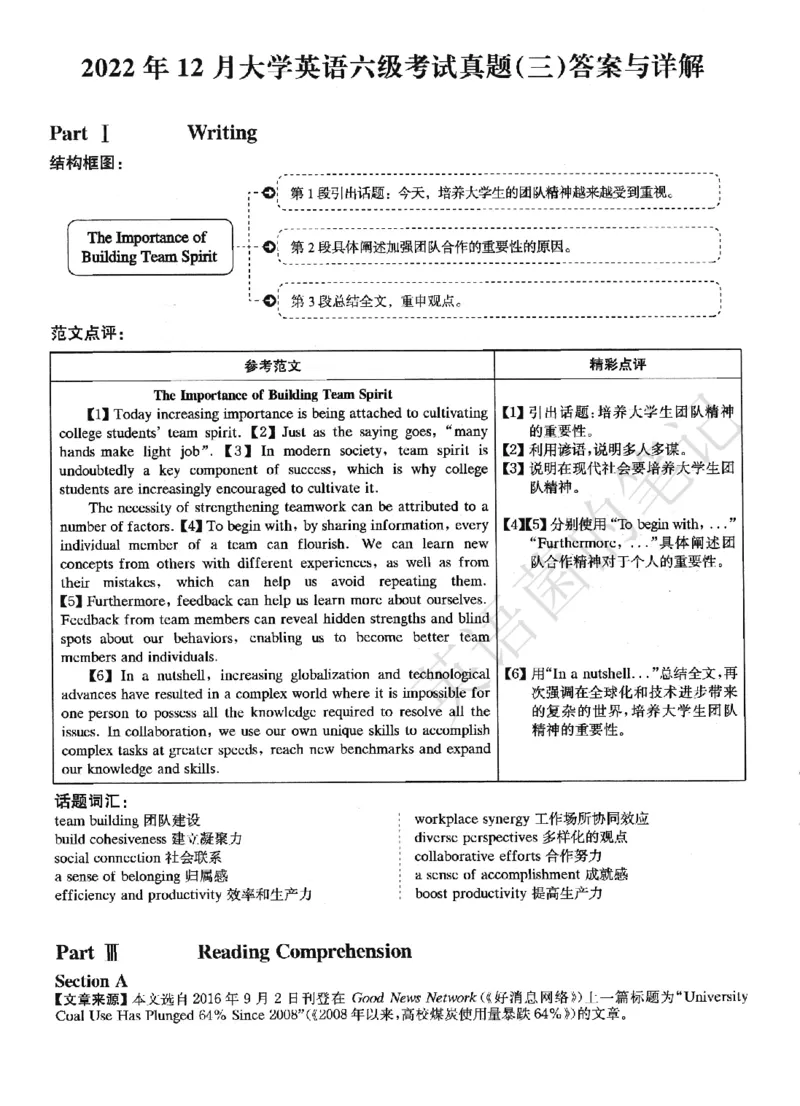
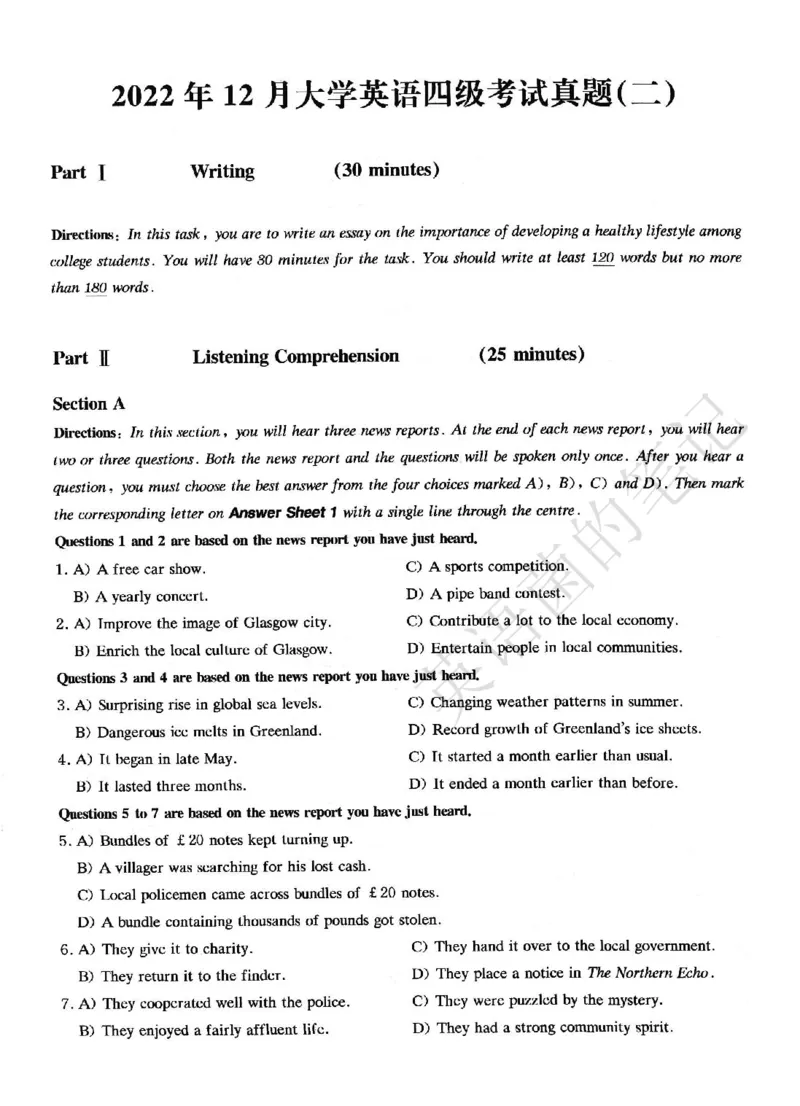
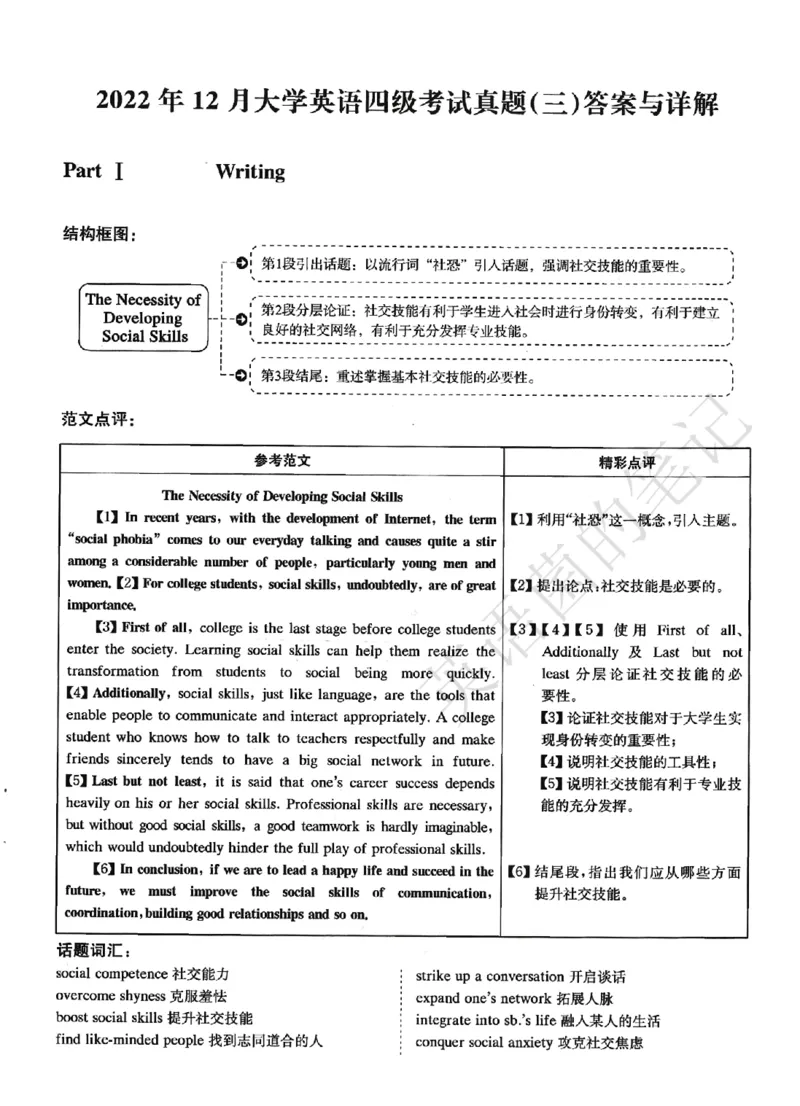
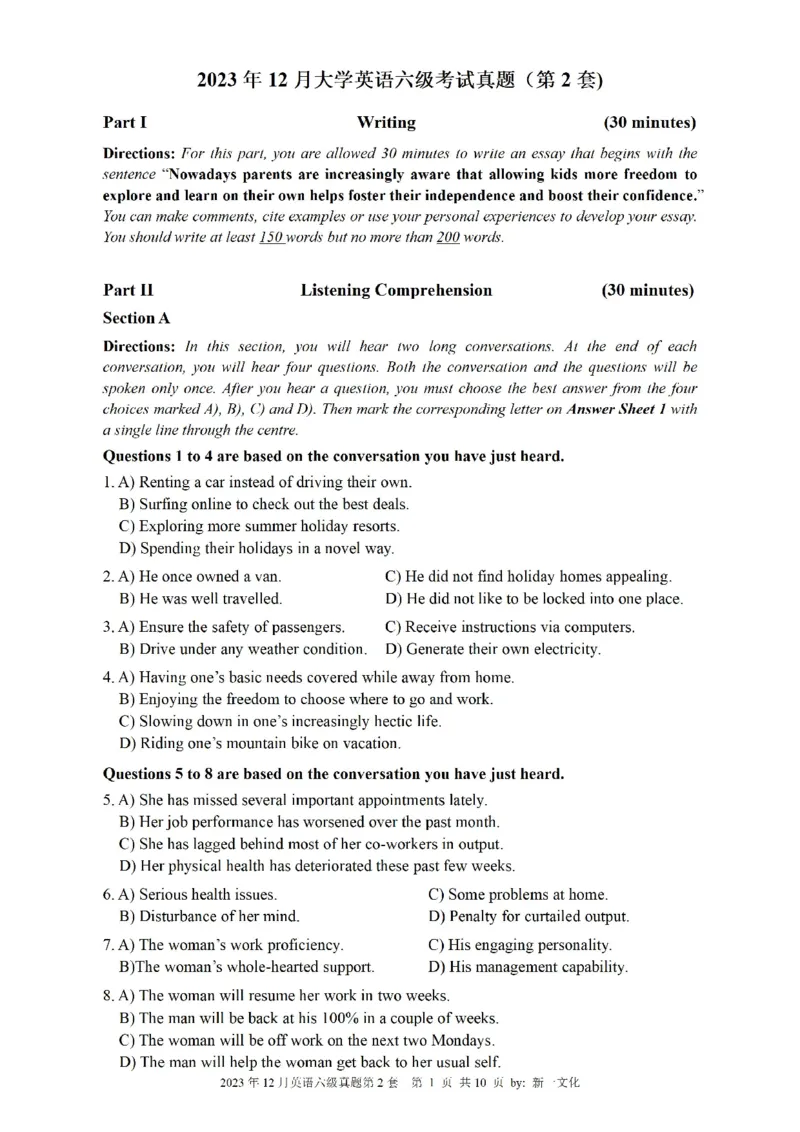
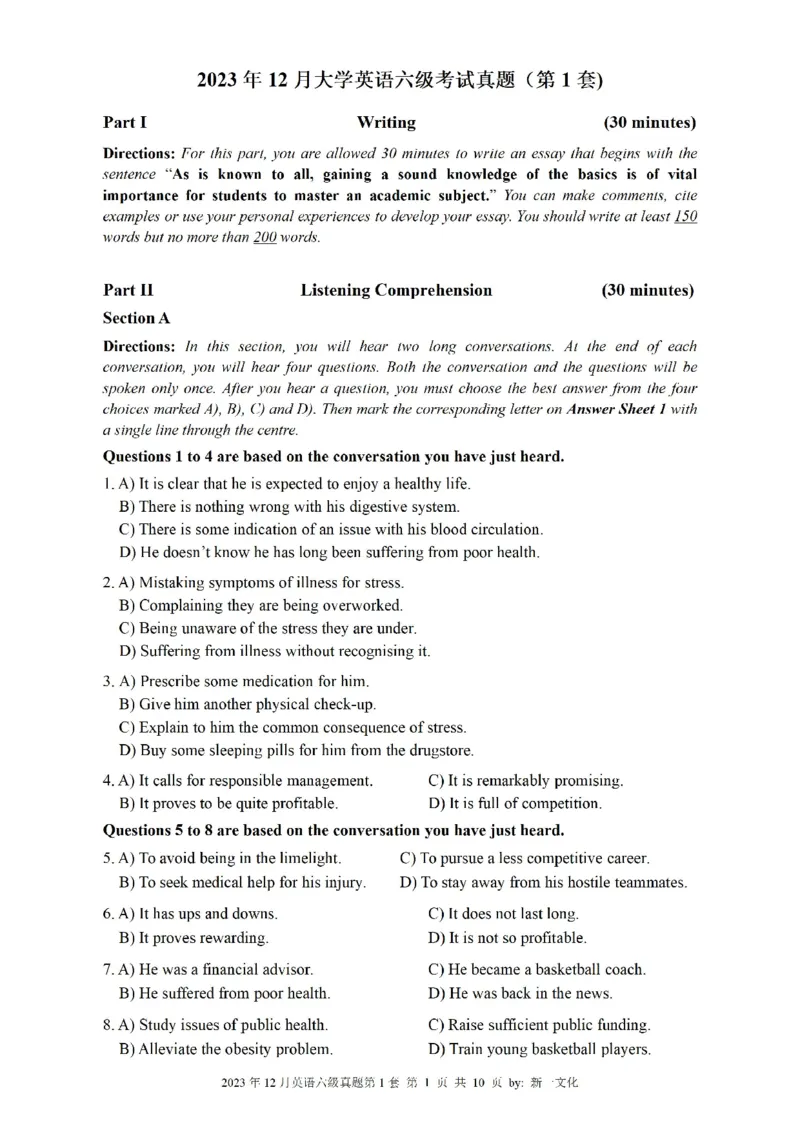
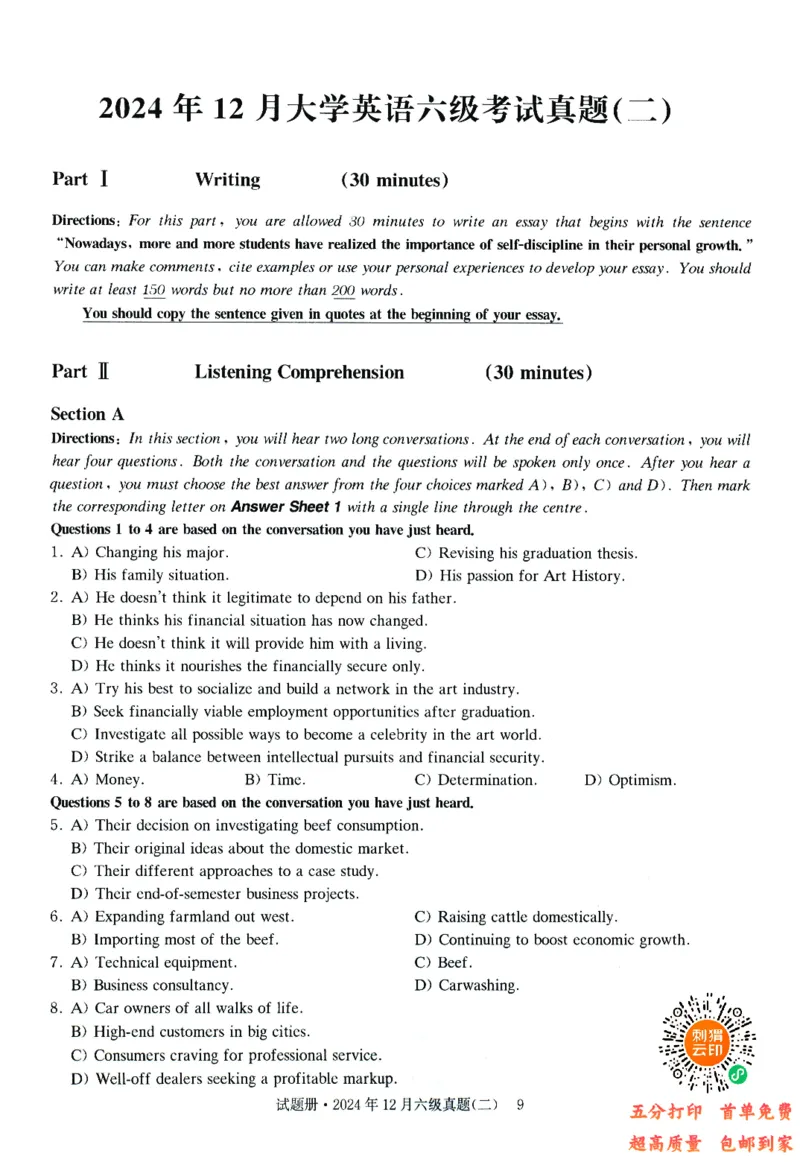
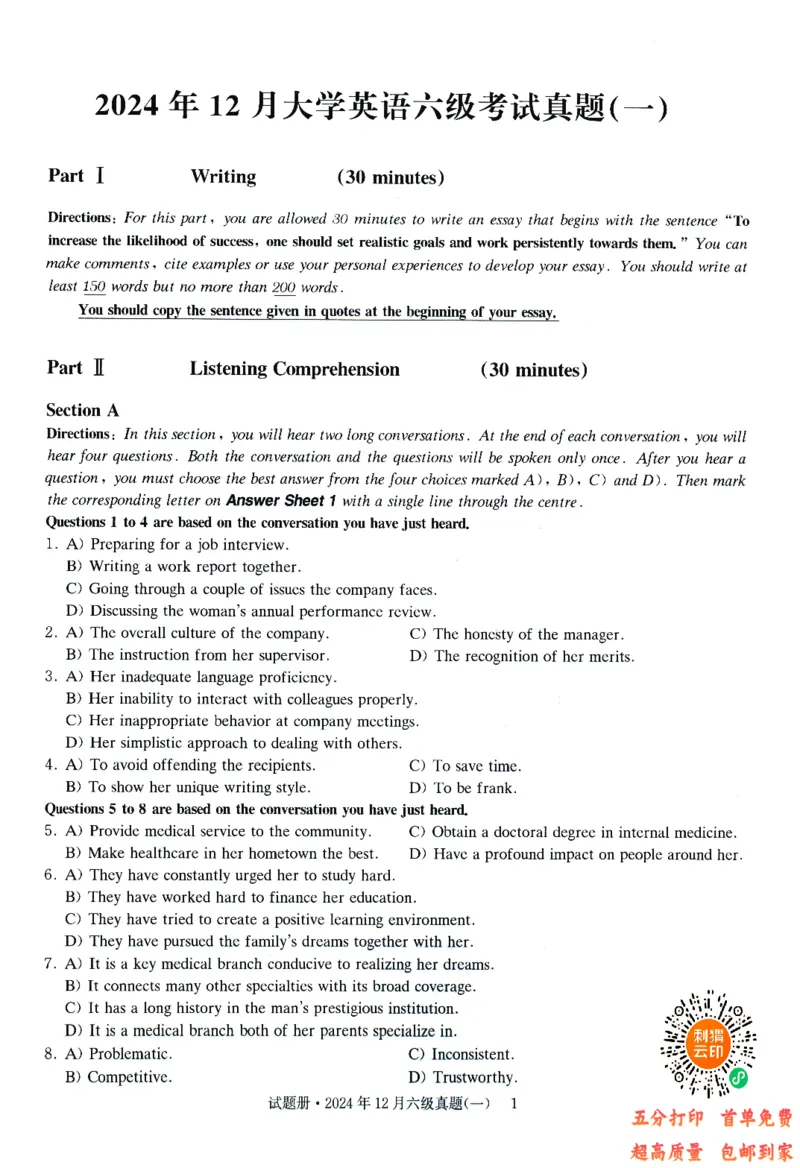
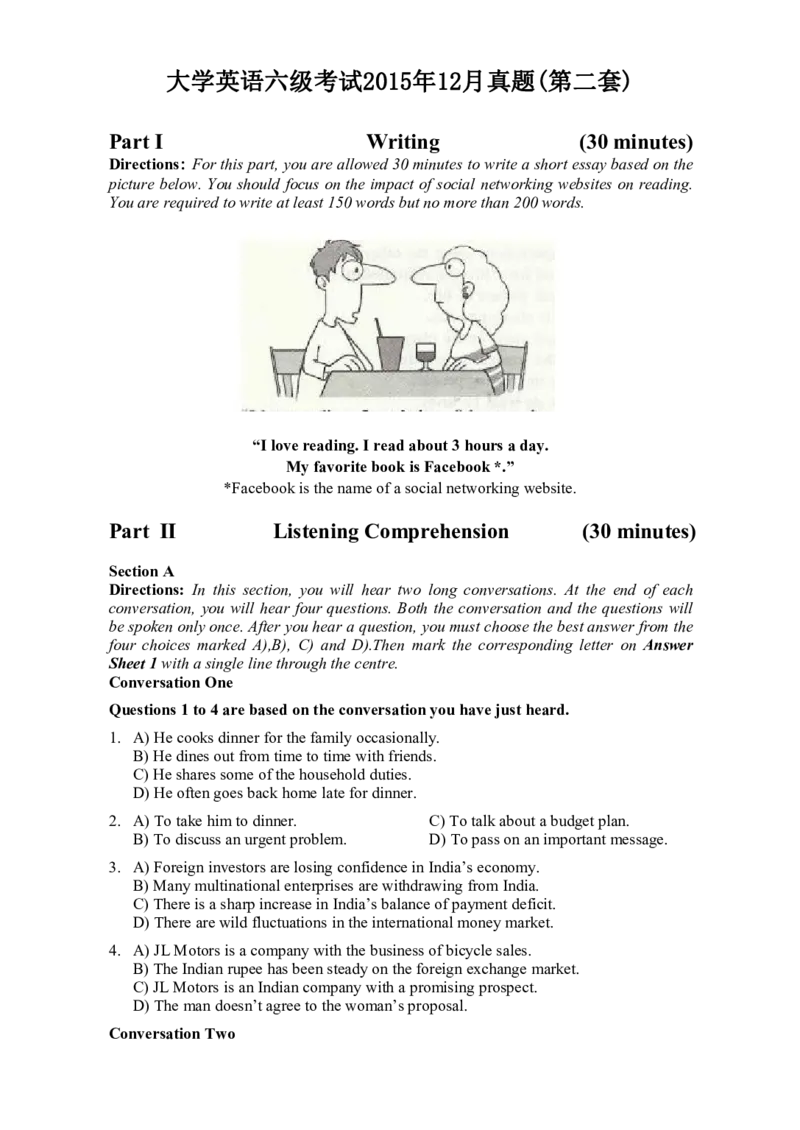
Directions : For this part, you are allowed 30 minutes to write an essay that begins with the sentence “Today
increasing importance is being attached to cultivating college studentteam spirit.You can make
statements, give reasons, or cite examples to develop your essay. You should write at least 150 words but no
more than 200 words.
Part I Listening Comprehension (30 minutes)
记
Part H Reading Comprehension (40 minutes)
笔
Section A
Directions : In this section, there is a passage with ten blanks. You are requi的red to select one word for each
blank from a list of choices given in a word bank following the passage. Read the passage through carefully
before making your choices. Each choice in the bank is identified by a letter. Please mark the corresponding
菌
letter for each item on Answer Sheet 2 with a single line through the centre. You may not use any of the
words in the bank more than once.
语
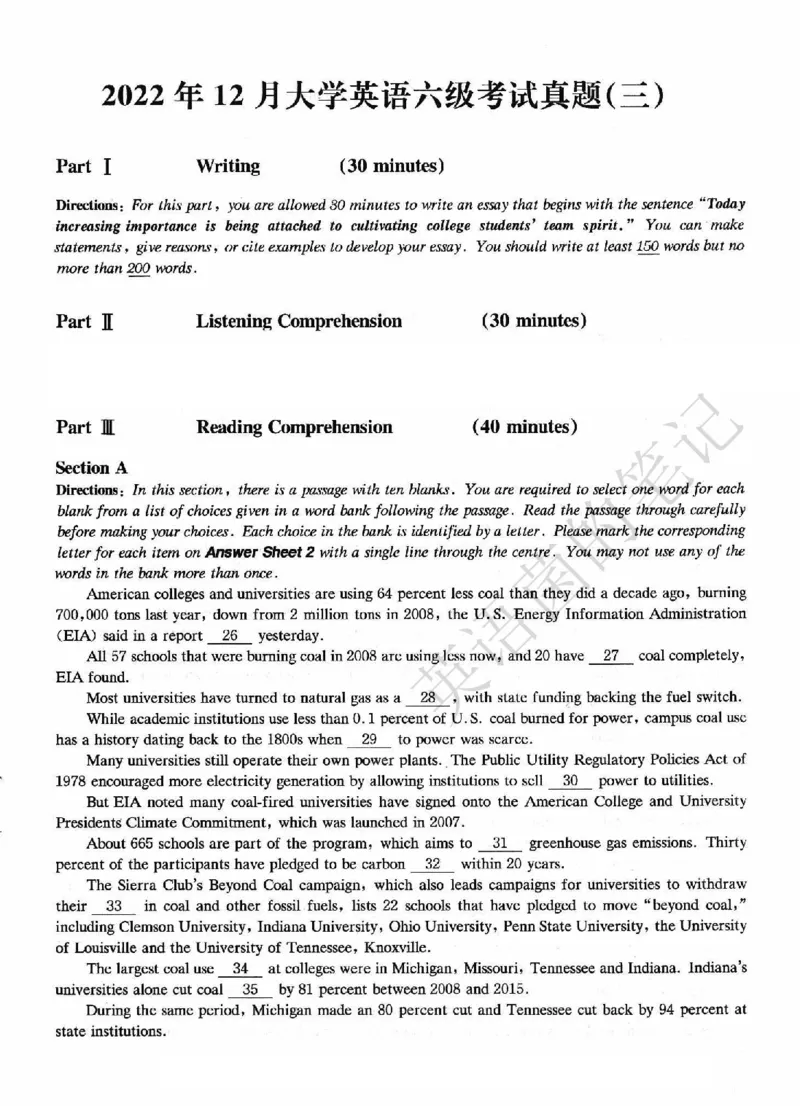
American colleges and universities are using 64 percent less coal than they did a decade ago, burning
700,000 tons last year, down from 2 million tons in 2008, the U. S. Energy Information Administration
(EIA) said in a report 26 yesterday. 英
All 57 schools that were burning coal in 2008 are using less now, and 20 have 27 coal completely,
EIA found.
Most universities have turned to natural gas as a 28 , with state funding backing the fuel switch.
While academic institutions use less than 0.1 percent of U. S. coal burned for power, campus coal use
has a history dating back to the 1800s when 29 to power was scarce.
Many universities still operate their own power plants. The Public Utility Regulatory Policies Act of
1978 encouraged more electricity generation by allowing institutions to sell 30 power to utilities.
But EIA noted many coal-fired universities have signed onto the American College and University
Presidents Climate Commitment, which was launched in 2007.
About 665 schools are part of the program, which aims to 31 greenhouse gas emissions. Thirty
percent of the participants have pledged to be carbon 32 within 20 years.
The Sierra Club's Beyond Coal campaign, which also leads campaigns for universities to withdraw
their 33 in coal and other fossil fuels, lists 22 schools that have pledged to move “beyond coal,“
including Clemson University, Indiana University, Ohio University, Penn State University, the University
of Louisville and the University of Tennessee, Knoxville.
The largest coal use 34 at colleges were in Michigan, Missouri, Tennessee and Indiana. Indiana's
universities alone cut coal 35 by 81 percent between 2008 and 2015.
During the same period, Michigan made an 80 percent cut and Tennessee cut back by 94 percent at
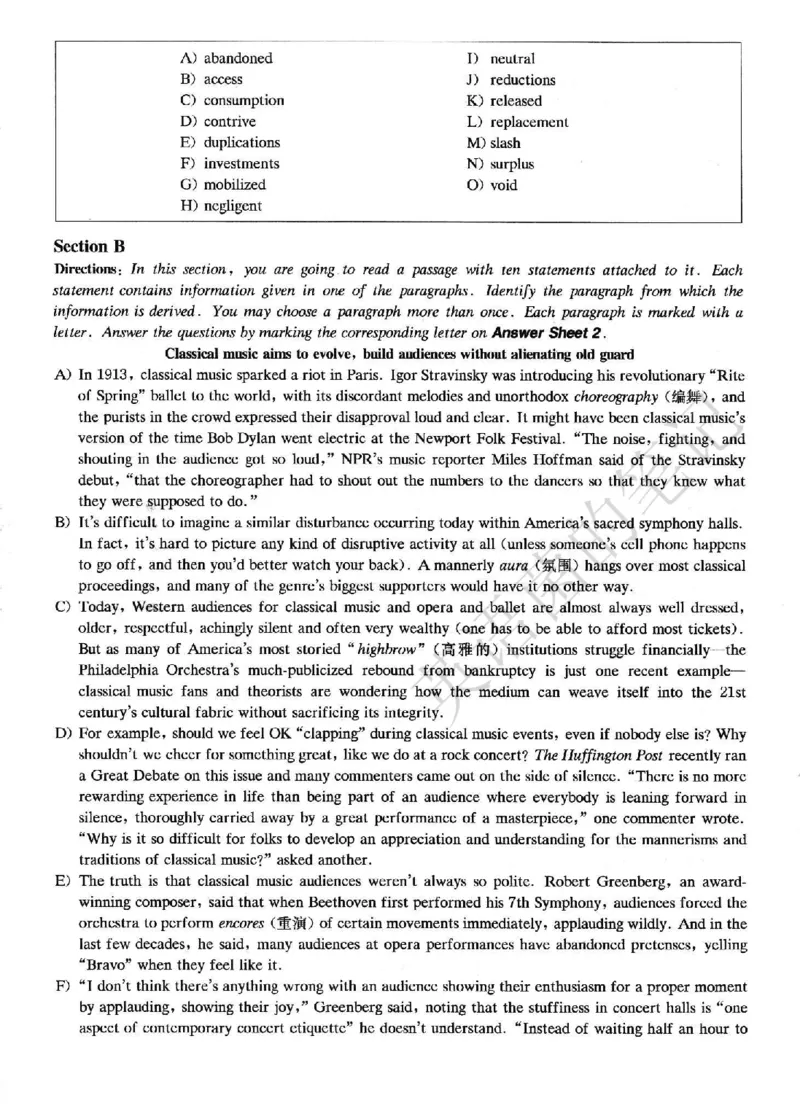
state institutions.A) abandoned I) neutral
B) access J) reductions
C) consumption K) released
D) contrive L) replacement
E) duplications M) slash
F) investments N) surplus
G) mobilized O) void
H) negligent
Section B
Directions: In this section, you are going to read a passage with ten statements attached to it. Each
statement contains information given in one of the paragraphs. Identify the paragraph from which the
information is derived. You may choose a paragraph more than once. Each paragraph is marked with a
letter. Answer the questions by marking the corresponding letter on Answer Sheet2.
Classical music aims to evolve, build audiences without alienating old guard
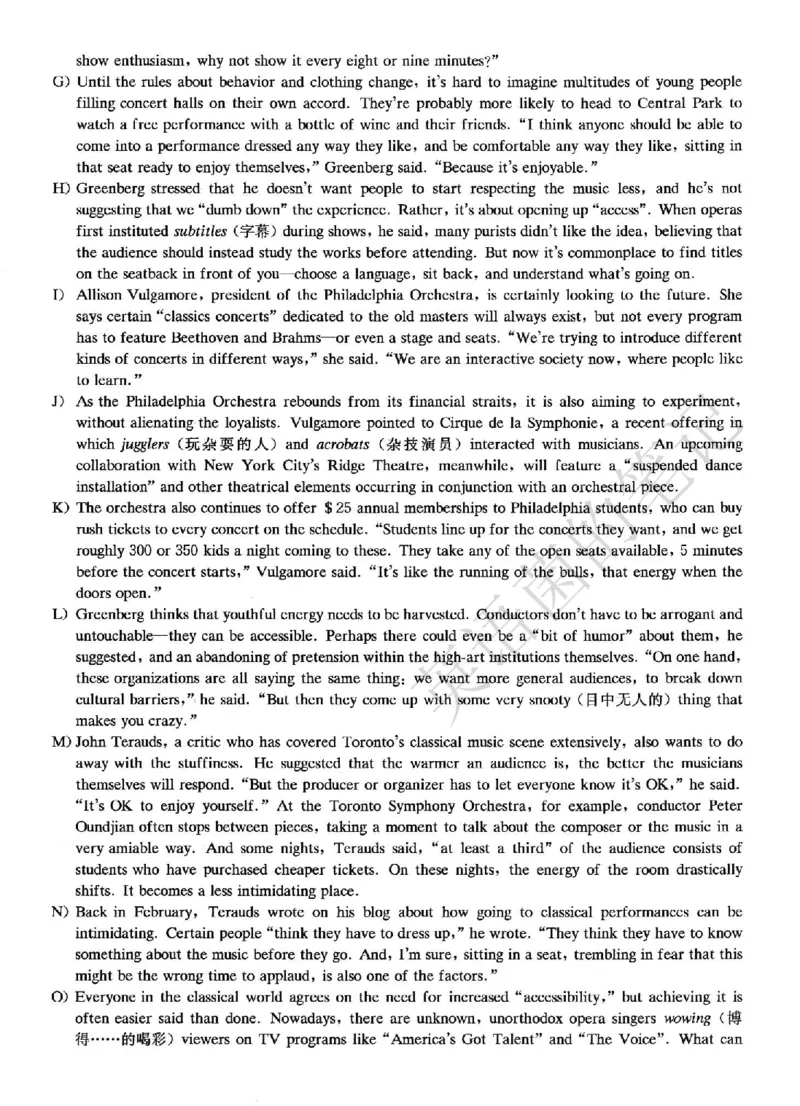
A) In 1913, classical music sparked a riot in Paris. Igor Stravinsky was introducing his revolutionary “Rite
记
of Spring^' ballet to the world, with its discordant melodies and unorthodox choreography (编舞),and
the purists in the crowd expressed their disapproval loud and clear. It might have been classical music's
version of the time Bob Dylan went electric at the Newport Folk Festival. "The笔 noise, fighting, and
shouting in the audience got so loud," NPR's music reporter Miles Hoffman said of the Stravinsky
debut, “that the choreographer had to shout out the numbers to the dancers so that they knew what
的
they were supposed to do.”
B) It's difficult to imagine a similar disturbance occurring today within America's sacred symphony halls.
菌
In fact, it's hard to picture any kind of disruptive activity at all (unless someone5s cell phone happens
to go off, and then you'd better watch your back). A mannerly aura (氛围)hangs over most classical
proceedings, and many of the genre's biggest supporters 语would have it no other way.
C) Today, Western audiences for classical music and opera and ballet are almost always well dressed,
older, respectful, achingly silent and often very wealthy (one has to be able to afford most tickets).
英
But as many of America's most storied "highbrow” (高雅的)institutions struggle financially—the
Philadelphia Orchestra's much-publicized rebound from bankruptcy is just one recent example—
classical music fans and theorists are wondering how the medium can weave itself into the 21st
century's cultural fabric without sacrificing its integrity.
D) For example, should we feel OK “clapping^' during classical music events, even if nobody else is? Why
shouldn't we cheer for something great, like we do at a rock concert? The Huffington Post recently ran
a Great Debate on this issue and many commenters came out on the side of silence. "There is no more
rewarding experience in life than being part of an audience where everybody is leaning forward in
silence, thoroughly carried away by a great performance of a masterpiece,“ one commenter wrote.
“Why is it so difficult for folks to develop an appreciation and understanding for the mannerisms and
traditions of classical music?” asked another.
E) The truth is that classical music audiences weren't always so polite. Robert Greenberg, an award-
winning composer, said that when Beethoven first performed his 7th Symphony, audiences forced the
orchestra to perform encores (重演)of certain movements immediately, applauding wildly. And in the
last few decades, he said, many audiences at opera performances have abandoned pretenses, yelling
“Bravo" when they feel like it.
F) "I don't think there's anything wrong with an audience showing their enthusiasm for a proper moment
by applauding, showing their joy,“ Greenberg said, noting that the stuffiness in concert halls is ”one
aspect of contemporary concert etiquette“ he doesn't understand. "Instead of waiting half an hour toshow enthusiasm, why not show it every eight or nine minutes?”
G) Until the rules about behavior and clothing change, it's hard to imagine multitudes of young people
filling concert halls on their own accord. They're probably more likely to head to Central Park to
watch a free performance with a bottle of wine and their friends. "I think anyone should be able to
come into a performance dressed any way they like, and be comfortable any way they like, sitting in
that seat ready to enjoy themselves,“ Greenberg said. aBecause it's enjoyable.M
H) Greenberg stressed that he doesn't want people to start respecting the music less, and he's not
suggesting that we ''dumb down“ the experience. Rather, it's about opening up “access”. When operas
first instituted subtitles (字幕)during shows, he said, many purists didn't like the idea, believing that
the audience should instead study the works before attending. But now it's commonplace to find titles
on the seatback in front of you—choose a language, sit back, and understand what's going on.
I) Allison Vulgamore, president of the Philadelphia Orchestra, is certainly looking to the future. She
says certain uclassics concerts“ dedicated to the old masters will always exist, but not every program
has to feature Beethoven and Brahms一or even a stage and seats. "We're trying to introduce different
kinds of concerts in different ways,“ she said. "We are an interactive society now, where people like
to learn.”
记
J) As the Philadelphia Orchestra rebounds from its financial straits, it is also aiming to experiment,
without alienating the loyalists. Vulgamore pointed to Cirque de la Symphonic, a recent offering in
笔
which jugglers (玩杂耍的人)and acrobats (杂技演员)interacted with musicians. An upcoming
collaboration with New York City's Ridge Theatre, meanwhile, will feature a ususpended dance
installation“ and other theatrical elements occurring in conjunction with 的an orchestral piece.
K) The orchestra also continues to offer $ 25 annual memberships to Philadelphia students, who can buy
rush tickets to every concert on the schedule. "Students line up for the concerts they want, and we get
菌
roughly 300 or 350 kids a night coming to these. They take any of the open seats available, 5 minutes
before the concert starts,w Vulgamore said. "It's like the running of the bulls, that energy when the
doors open.w 语
L) Greenberg thinks that youthful energy needs to be harvested. Conductors don5t have to be arrogant and
untouchable- they can be accessible. Perhaps the英re could even be a “bit of humor“ about them, he
suggested, and an abandoning of pretension within the high-art institutions themselves. "On one hand,
these organizations are all saying the same thing: we want more general audiences, to break down
cultural barriers,w he said. "But then they come up with some very snooty (目中无人的)thing that
makes you crazy.”
M) John Terauds, a critic who has covered Toronto's classical music scene extensively, also wants to do
away with the stuffiness. He suggested that the warmer an audience is, the better the musicians
themselves will respond. "But the producer or organizer has to let everyone know it's OK," he said.
"It's OK to enjoy yourself.w At the Toronto Symphony Orchestra, for example, conductor Peter
Oundjian often stops between pieces, taking a moment to talk about the composer or the music in a
very amiable way. And some nights, Terauds said, “at least a third“ of the audience consists of
students who have purchased cheaper tickets. On these nights, the energy of the room drastically
shifts. It becomes a less intimidating place.
N) Back in February, Terauds wrote on his blog about how going to classical performances can be
intimidating. Certain people “think they have to dress up,“ he wrote. "They think they have to know
something about the music before they go. And, Fm sure, sitting in a seat, trembling in fear that this
might be the wrong time to applaud, is also one of the factors. w
O) Everyone in the classical world agrees on the need for increased waccessibility,w but achieving it is
often easier said than done. Nowadays, there are unknown, unorthodox opera singers wowing (博
得.的喝彩)viewers on TV programs like "America's Got Talent" and "The Voice”. What canhigher institutions do with any of that? And if they appeal to these outlets, do they risk compromising
the integrity or the intelligence of the music?
P) Vulgamore seems to understand this. She thinks an organization can have it both ways, claiming the
new while keeping the old. And as she reorganizes the Philadelphia Orchestra, she will attempt to do
just that. "The world's most respected musicians brought together as an orchestra will always exist,“
she said. "But it's essential that we be willing to experiment and fail.”
36. It was not a rare occurrence that audiences behaved wildly while listening to classical music.
37. Some high-art institutions don't actually mean it when they say they want more general audiences.
38. The theatre was in chaos when an unconventional ballet was first put on stage in the capital of France.
39. According to one critic, the audience's warm response would encourage the musicians to do a better
job.
40. Many commenters argued for the audience enjoying classical music quietly.
41. What appears on the seatback screen makes it unnecessary for the audience to study the works
beforehand.
42. It is generally accepted that there should be no disturbance from the audience during classical music
performance.
记
43. Higher institutions will be concerned about compromising the integrity of classical music if they have
to resort to the television medium.
44. Heavily discounted rush tickets help attract many young students to attend class笔ical concerts.
45. The formalities of high-art theatres can intimidate some people attending a performance.
Section C 的
Directions: There are 2 passages in this section. Each passage is followed by some questions or unfinished
statements. For each of them there are four choices marked A), B), C) and £)). You should decide on the
菌
best choice and mark the corresponding letter on Answer Sheet 2 with a single line through the centre.
Passage One
语
Questions 46 to 50 are based on the following passage.
How can one person enjoy good health, while another person looks old before her time? Humans have
been asking this question for thousands of years, 英and recently, it's becoming clearer and clearer to
scientists that the differences between people's rates of aging lie in the complex interactions among genes,
social relationships, environments and lifestyles. Even though you were born with a particular set of
genes, the way you live can influence how they express themselves. Some lifestyle factors may even turn
genes on or shut them off.
Deep within the genetic heart of all our cells are telomeres, or repeating segments of noncoding DNA
that live at the ends of the chromosomes (染色体).They form caps at the ends of the chromosomes and
keep the genetic material together. Shortening with each cell division, they help determine how fast a cell
ages. When they become too short, the cell stops dividing altogether. This isn't the only reason a cell can
age—there are other stresses on cells we don't yet understand very well- but short telomeres are one of the
major reasons human cells grow old. We've devoted most of our careers to studying telomeres, and one
extraordinary discovery from our labs is that telomeres can actually lengthen.
Scientists have learned that several thought patterns appear to be unhealthy for telomeres, and one of
them is cynical hostility. Cynical hostility is defined by high anger and frequent thoughts that other people
cannot be trusted. Someone with hostility doesn't just think, “I hate to stand in long lines"; they think,
“Others deliberately sped up and beat me to my rightful position in the line!”—and then get violently
agitated. People who score high on measures of cynical hostility tend to get more heart disease, metabolic
disease and often die at younger ages. They also have shorter telomeres. In a study of British civil
servants, men who scored high on measures of cynical hostility had shorter telomeres than men whose
hostility scores were low. The most hostile men were 30% more likely to have short telomeres.What this means: aging is a dynamic process that could possibly be accelerated or slowed—and, in
some aspects, even reversed. To an extent, it has surprised us and the rest of the scientific community that
telomeres do not simply carry out the commands issued by your genetic code. Your telomeres are listening
to you. The foods you eat, your response to challenges, the amount of exercise you get, and many other
factors appear to influence your telomeres and can prevent premature aging at the cellular level. One of
the keys to enjoying good health is simply doing your part to foster healthy cell renewal.
46. What have scientists come to know better today?
A) Why people age at different rates.
B) How genes influence the aging process.
C) How various genes express themselves in aging.
D) Why people have long been concerned about aging.
47. Why are some lifestyle factors considered extremely important?
A) They may shorten the process of cell division.
B) They may determine how genes function.
C) They may affect the lifespan of telomeres.
D) They may account for the stresses on cells.
记
48. What have the author and his colleagues discovered about telomeres?
A) Their number affects the growth of cells. C) Their shortening process can be reversed.
笔
B) Their length determines the quality of life. D) Their health impacts the division of cells.
49. What have scientists learned about cynical hostility?
A) It may lead to confrontational thought patterns. 的
B) It may produce an adverse effect on telomeres.
C) It may cause people to lose their temper frequently.
菌
D) It may stir up agitation among those in long lines.
50. What do we learn from the last paragraph about the process of aging?
A) It may vary from individual to individual. C) It d 语 epends on one's genetic code.
B) It challenges scientists to explore further. D) It may be controlled to a degree.
Passage Two 英
Questions 51 to 55 are based on the following passage.
Scientists have created by accident an enzyme (酶 )that breaks down plastic drinks bottles. The
breakthrough could help solve the global plastic pollution crisis by enabling for the first time the full
recycling of bottles.
The new research was spurred by the discovery in 2016 of the first bacterium that had naturally
evolved to eat plastic at a waste dump in Japan. Scientists have now revealed the detailed structure of the
crucial enzyme produced by the bug.
An international team then adjusted the enzyme to see how it had evolved, but tests showed they had
accidentally made the molecule even better at breaking down the plastic used for drinks bottles. "What
actually turned out was we improved the enzyme, which was a bit of a shock,“ said head researcher Prof.
McGeehan, at the University of Portsmouth, UK.
Currently, the enzyme takes a few days to start breaking down the plastic, far faster than the
centuries it takes in the oceans, but the researchers are optimistic this can be speeded up even further and
become a viable large-scale process.
“What we are hoping to do is use this enzyme to turn this plastic back into its original components, so
we can literally recycle it back to plastic,“ said McGeehan. "It means we won't need to dig up any more
oil and, fundamentally, it should reduce the amount of plastic in the environment.n
About 1 million plastic bottles are sold each minute around the globe and, with just 14% recycled,
many end up in the oceans where they have polluted even the remotest parts, harming marine life andpotentially people who eat seafood. wPlastic is incredibly resistant to degradation, said McGeehan. "It is
one of these wonder materials that has been made a little bit too well.
Currently those bottles that are recycled can only be turned into opaque fibres for clothing or carpets,
while the new enzyme indicates a way to recycle old clear plastic bottles back into new clear plastic
bottles.
“You are always up against the fact oil is cheap, so plastic is cheap,“ said McGeehan. "It is so easy
for manufacturers to generate more of that stuff, rather than even try to recycle, but I believe there is a
public interest here: perception is changing so much that companies are starting to look at how they can
properly recycle these bottles.w
Prof. Adisa Azapagic, at the University of Manchester in the UK, agreed the enzyme could be useful
but added: ”A full life-cycle assessment would be needed to ensure that the technology does not solve one
environmental problem- waste- at the expense of others, including additional greenhouse gas emissions.w
51. What do we learn from the passage about an enzyme scientists have created?
A) It was identified during a lab experiment accident.
B) It may make full recycling of plastic bottles a reality.
C) It was a breakthrough made with persistent efforts.
记
D) It may initiate a radical reform in plastic industry.
52. What does the passage say about the bug that produces the important enzyme?
A) It has a natural ability to consume plastics. 笔
B) It is a bacterium that reproduces at a high rate.
C) It is essential to the recycling of plastic bottles.
的
D) It has a chemical structure unknown to scientists.
53. By adjusting the enzyme produced by the bug, the s c i e n t i s t s .
A) made it more effective by chance C) altered its 菌basic molecular composition
B) discovered an extraordinary chemical D) found its evolutionary process sped up
54. What does Prof. McGeehan say about the recycling of p 语 lastic bottles?
A) Manufacturers are implementing it on an increasingly larger scale.
B) It generates huge business opportunities for plastic manufacturers.
英
C) It has aroused persistent interest among the general public.
D) Manufacturers are beginning to explore ways of doing it.
55. What is Prof. Adisa Azapagic's advice concerning the application of the enzyme?
A) Developing technologies to address greenhouse gas emissions.
B) Considering the extra cost involved in producing the enzyme.
C) Assessing its possible negative impact on the environment.
D) Studying the full life cycle of the enzyme as the first step.
Part N Translation (30 minutes)
Directions : For this part, you are allowed 30 minutes to translate a passage from Chinese into English. You
should write your answer on Answer Sheet 2.
云贵高原(the Yunnan-Guizhou Plateau)大部分位于云南、贵州省境内,总面积约50万平方公里,平均
海拔2 000—4 000米,是中国第四大高原。云贵高原西高东低,河流众多,形成了许多又深又陡的嵯合
(canyon) 峡谷中许多地方土壤肥沃,非常有利于多种农作物生长。
o
云贵高原独特的自然环境造就了生物和文化的多样性。它是中国森林和矿产资源类型十分丰富的地
区,也是古人类起源的重要地区。云贵高原是中国少数民族数量最多的地区,各民族都保留了自己丰富多
彩的文化传统。