2022年 12月大学英语四级考试真题(三)
Part I Writing (30 minutes)
Directions: In this task, you are to write an essay on the necessity of developing social skills for college
students. You will have 30 minutes for the task. You should write at least 120 words but no more than 180
words.
Part H Listening Comprehension (25 minutes)
记
笔
Part Iff Reading Comprehension (40 minutes)
Section A
的
Directions: In this section, there is a passage with ten blanks. You are required to select one word for each
blank from a list of choices given in a word bank following the passage. Read the passage through carefully
菌
before making your choices. Each choice in the bank is identified by a letter. Please mark the corresponding
letter for each item on Answer Sheet 2 Mtk a single line through the centre. You may not use any of the words
语
in the bank more than once.
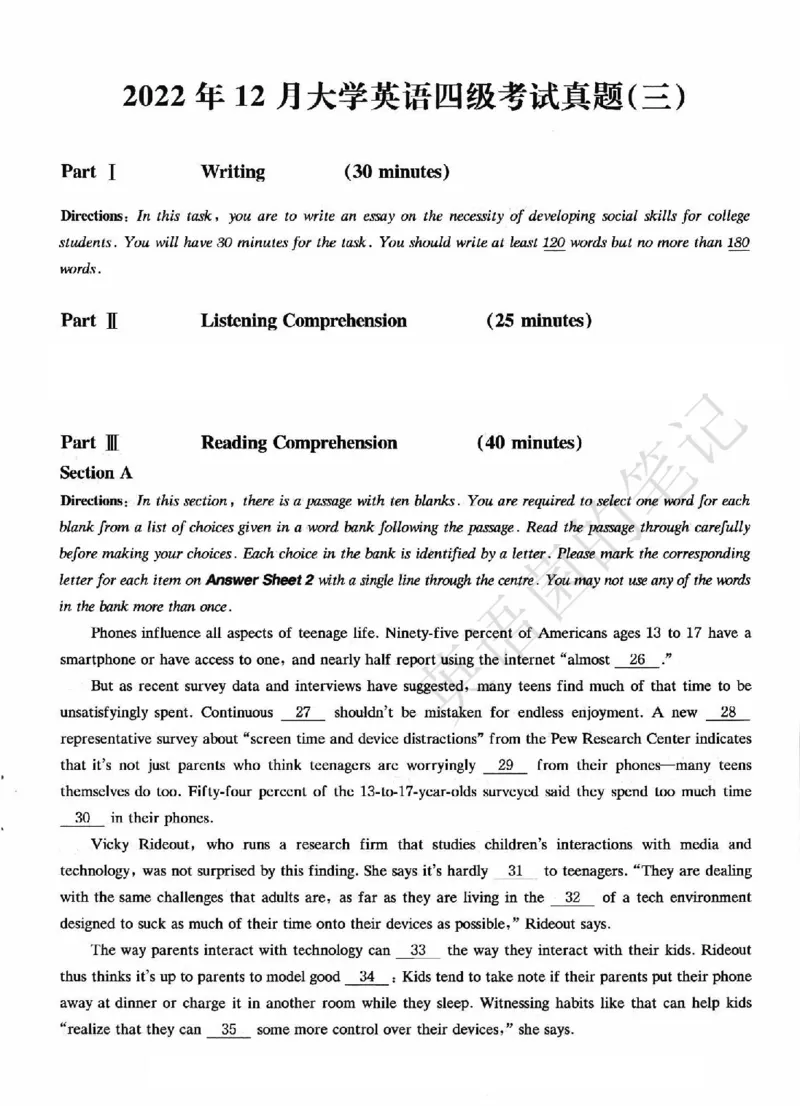
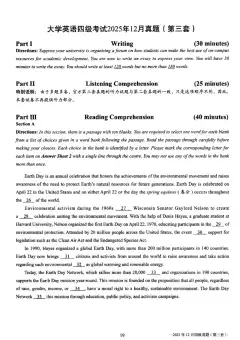
Phones influence all aspects of teenage life. Ninety-five percent of Americans ages 13 to 17 have a
英
smartphone or have access to one, and nearly half report using the internet walmost 26
But as recent survey data and interviews have suggested, many teens find much of that time to be
unsatisfyingly spent. Continuous 27 shouldn't be mistaken for endless enjoyment. A new 28
representative survey about “screen time and device distractions“ from the Pew Research Center indicates
that it's not just parents who think teenagers are worryingly 29 from their phones—many teens
themselves do too. Fifty-four percent of the 13-to-17-year-olds surveyed said they spend too much time
30 in their phones.
Vicky Rideout, who runs a research firm that studies children's interactions with media and
technology, was not surprised by this finding. She says it's hardly 31 to teenagers. MThey are dealing
with the same challenges that adults are, as far as they are living in the 32 of a tech environment
designed to suck as much of their time onto their devices as possible,“ Rideout says.
The way parents interact with technology can _33 the way they interact with their kids. Rideout
thus thinks it's up to parents to model good 34 : Kids tend to take note if their parents put their phone
away at dinner or charge it in another room while they sleep. Witnessing habits like that can help kids
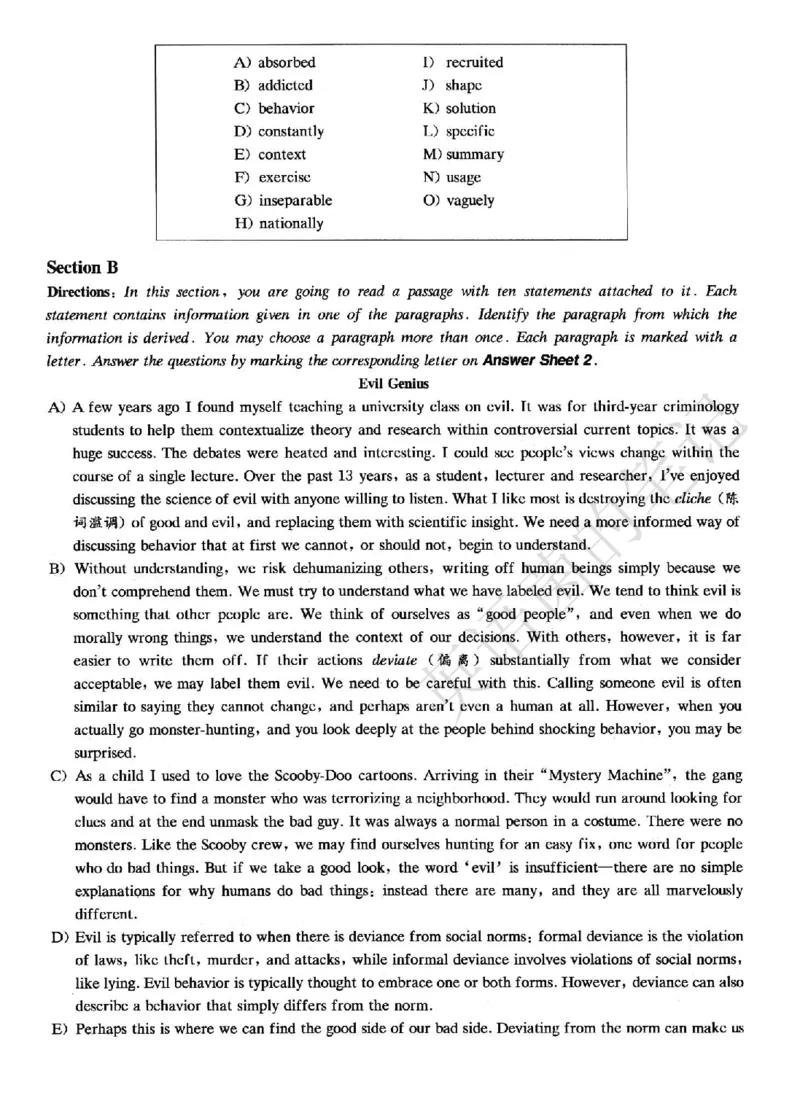
urealize that they can 35 some more control over their devices,“ she says.A) absorbed I) recruited
B) addicted J) shape
C) behavior K) solution
D) constantly L) specific
E) context M) summary
F) exercise N) usage
G) inseparable O) vaguely
H) nationally
Section B
Directions: In this section, you are going to read a passage with ten statements attached to it. Each
statement contains information given in one of the paragraphs. Identify the paragraph from which the
information is derived. You may choose a paragraph more than once. Each paragraph is marked with a
letter. Answer the questions by marking the corresponding letter on Answer Sheet 2.
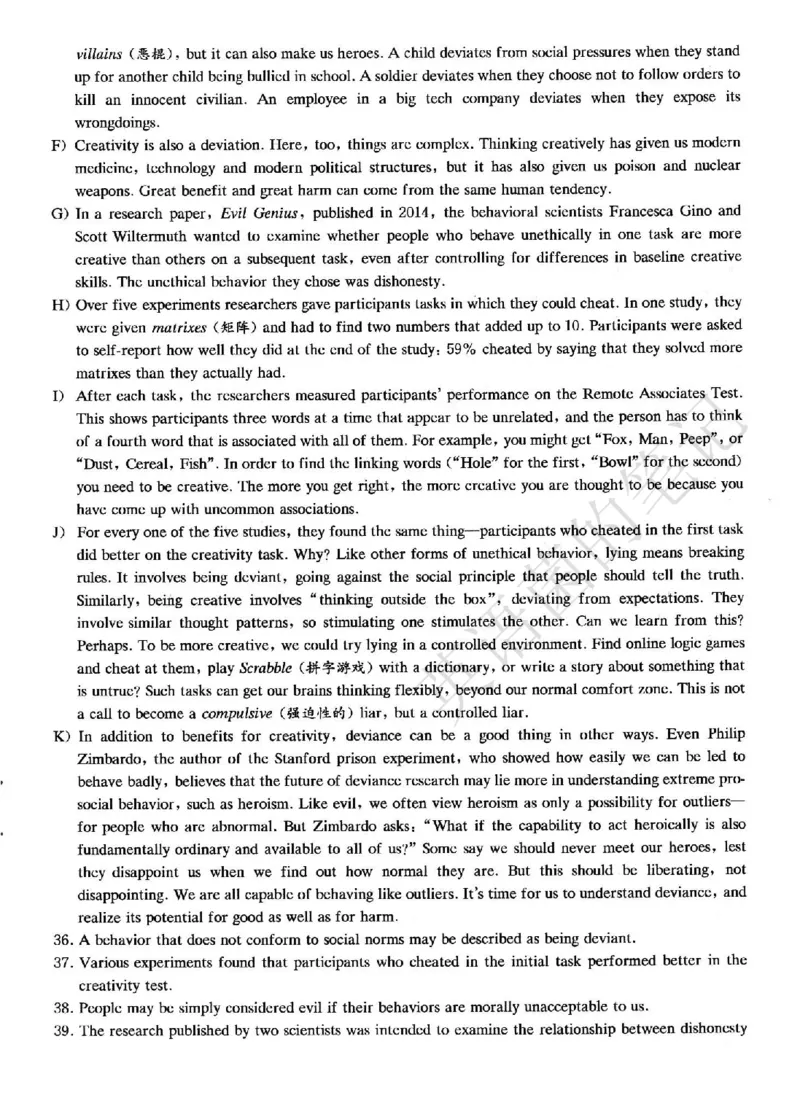
Evil Genius 记
A) A few years ago I found myself teaching a university class on evil. It was for third-year criminology
students to help them contextualize theory and research within controversial current topics. It was a
笔
huge success. The debates were heated and interesting. I could see people's views change within the
course of a single lecture. Over the past 13 years, as a student, lecturer and researcher, Fve enjoyed
的
discussing the science of evil with anyone willing to listen. What I like most is destroying the cliche (陈
词滥调)of good and evil, and replacing them with scientific insight. We need a more informed way of
菌
discussing behavior that at first we cannot, or should not, begin to understand.
B) Without understanding, we risk dehumanizing others, writing off human beings simply because we
don't comprehend them. We must try to understand what w语e have labeled evil. We tend to think evil is
something that other people are. We think of ourselves as “good peoplew, and even when we do
morally wrong things, we understand the context英 of our decisions. With others, however, it is far
easier to write them off. If their actions deviate (偏 离 )substantially from what we consider
acceptable, we may label them evil. We need to be careful with this. Calling someone evil is often
similar to saying they cannot change, and perhaps aren't even a human at all. However, when you
actually go monster-hunting, and you look deeply at the people behind shocking behavior, you may be
surprised.
C) As a child I used to love the Scooby-Doo cartoons. Arriving in their “Mystery Machine”, the gang
would have to find a monster who was terrorizing a neighborhood. They would run around looking for
clues and at the end unmask the bad guy. It was always a normal person in a costume. There were no
monsters. Like the Scooby crew, we may find ourselves hunting for an easy fix, one word for people
who do bad things. But if we take a good look, the word 'evil' is insufficient—there are no simple
explanations for why humans do bad things: instead there are many, and they are all marvelously
different.
D) Evil is typically referred to when there is deviance from social norms: formal deviance is the violation
of laws, like theft, murder, and attacks, while informal deviance involves violations of social norms,
like lying. Evil behavior is typically thought to embrace one or both forms. However, deviance can also
describe a behavior that simply differs from the norm.
E) Perhaps this is where we can find the good side of our bad side. Deviating from the norm can make usvillains (恶棍),but it can also make us heroes. A child deviates from social pressures when they stand
up for another child being bullied in school. A soldier deviates when they choose not to follow orders to
kill an innocent civilian. An employee in a big tech company deviates when they expose its
wrongdoings.
F) Creativity is also a deviation. Here, too, things are complex. Thinking creatively has given us modern
medicine, technology and modern political structures, but it has also given us poison and nuclear
weapons. Great benefit and great harm can come from the same human tendency.
G) In a research paper, Evil Genius, published in 2014, the behavioral scientists Francesca Gino and
Scott Wiltermuth wanted to examine whether people who behave unethically in one task are more
creative than others on a subsequent task, even after controlling for differences in baseline creative
skills. The unethical behavior they chose was dishonesty.
H) Over five experiments researchers gave participants tasks in which they could cheat. In one study, they
were given matrixes (矩阵)and had to find two numbers that added up to 10, Participants were asked
to self-report how well they did at the end of the study: 59% cheated by saying that they solved more
matrixes than they actually had.
记
I) After each task, the researchers measured participants, performance on the Remote Associates Test.
This shows participants three words at a time that appear to be unrelated, and the person has to think
of a fourth word that is associated with all of them. For example, you might get "F笔ox, Man, Peep”, or
“Dust, Cereal, Fish”. In order to find the linking words ("Hole" for the first, "Bowl" for the second)
you need to be creative. The more you get right, the more creative you a的re thought to be because you
have come up with uncommon associations.
J) For every one of the five studies, they found the same thing—participants who cheated in the first task
菌
did better on the creativity task. Why? Like other forms of unethical behavior, lying means breaking
rules. It involves being deviant, going against the social principle that people should tell the truth.
语
Similarly, being creative involves thinking outside the box”, deviating from expectations. They
involve similar thought patterns, so stimulating one stimulates the other. Can we learn from this?
Perhaps. To be more creative, we could try lying 英 in a controlled environment. Find online logic games
and cheat at them, play Scrabble (拼字游戏)with a dictionary, or write a story about something that
is untrue? Such tasks can get our brains thinking flexibly, beyond our normal comfort zone. This is not
a call to become a compulsive (强迫,性的)liar, but a controlled liar.
K) In addition to benefits for creativity, deviance can be a good thing in other ways. Even Philip
Zimbardo, the author of the Stanford prison experiment, who showed how easily we can be led to
behave badly, believes that the future of deviance research may lie more in understanding extreme pro
social behavior, such as heroism. Like evil, we often view heroism as only a possibility for outliers—
for people who are abnormal. But Zimbardo asks: ”What if the capability to act heroically is also
fundamentally ordinary and available to all of us?” Some say we should never meet our heroes, lest
they disappoint us when we find out how normal they are. But this should be liberating, not
disappointing. We are all capable of behaving like outliers. It's time for us to understand deviance, and
realize its potential for good as well as for harm.
36. A behavior that does not conform to social norms may be described as being deviant.
37. Various experiments found that participants who cheated in the initial task performed better in the
creativity test.
38. People may be simply considered evil if their behaviors are morally unacceptable to us.
39. The research published by two scientists was intended to examine the relationship between dishonestyand creativity.
40. The author's lectures sparked lively discussions in his class.
41. The researchers tested the participants* creativity by asking them to play a word game.
42. It is time we realized that deviance may be capable of doing both good and harm to individuals and
society.
43. The reasons for people's evil behaviors can be explained in more ways than one.
44. The math task in one experiment was designed to test participants5 tendency to cheat.
45. Some creative ideas have turned out to do harm to human society.
Section C
Directions: There are 2 passages in this section. Each passage is followed by some questions or unfinished
statements. For each of them there are four choices marked A ), B), C) and D). You should decide on the
best choice and mark the corresponding letter on Answer Sheet 2 with a single line through the centre.
Passage One
Questions 46 to 50 are based on the following passage.
Even though we are living in an age where growing old is thought of as an inevitable记 misery, this
doctor has been changing the game for seniors over the last 25 years.
It all started in 1991 when the Harvard-educated physician was transferred from 笔 working in a stressful
emergency room to being the medical director of a nursing home in upstate New York. The depressing and
regimented (严格管制的)environment got him thinking on what exactly could improve the residents,
的
conditions.
Even though animals in nursing homes were illegal at the time, Dr. Bill Thomas took a chance. Based
菌
on a hunch (直觉),he brought in two dogs, four cats, hens, rabbits, 100 birds, a multitude of plants, a
flower garden, and a vegetable patch.
The change was dramatic. There was a 50% drop in m语edical prescriptions along with a dramatic
decrease in death rates一but most importantly, the residents were simply happier.
Dr. Thomas's approach, named the Eden Alter英native, has driven nursing homes to allow a more
autonomous (自主的)and creative living space for their elderly. It erases the belief that growing old
means growing useless. He encourages residents to think of their age as an enriching new phase of life
rather than the end of it.
Thomas, now a speaker and author of several books, also created small, independently-run residences
with their own bedrooms and bathrooms, and he has been preaching a singular message that getting old is
not a bad thing.
“Within six weeks, they had to send a truck around to pick up all the wheelchairs,“ Thomas told the
Washington Post. " You know why most people in nursing homes use wheelchairs? Because the buildings are
so big.”
The 56-year-old doctor's methods have been adopted in Australia, Japan, Canada, and America with
enormous success. Last year he published Second Wind: Navigating the Passage to a Slower, Deeper, and
More Connected Life, a guide on how to shift our perspectives on aging and growth.
He is currently traveling through North America performing with his guitar and his enthusiasm on his
Age of Disruption Tour.
46. What has Bill Thomas been doing for a quarter of a century?
A) Transforming people's lifestyle.
B) Honoring his Harvard education.C) Changing people's philosophy of life.
D) Shifting people's perspective on aging.
47. Why did Bill Thomas try something different in the nursing home?
A) He wanted to make it more pleasant for seniors.
B) He wanted to apply his Harvard training to practice.
C) He felt it his duty to revolutionize its management.
D) He felt disappointed working in the environment.
48. What do we learn about Bill Thomas bringing animals and plants into the nursing home?
A) He made a mess of the nursing home.
B) He did something all professionals would do.
C) He won instant support from the state authorities.
D) He acted in violation of the state law.
49. What has Bill Thomas been persistently advocating?
A) Good health is not just a privilege of the young.
B) Nursing homes should be strictly limited in size.
C) Getting old is by no means something miserable. 记
D) Residences for seniors should be run independently.
50. How is Bill Thomas's new concept received? 笔
A) It is gaining ground in many countries.
B) It is being heatedly debated worldwide.
的
C) It is considered revolutionary everywhere.
D) It is winning approval from the government.
菌
Passage Two
Questions 51 to 55 are based on the following passage.
语
Research shows that in developed countries, more affluent and educated people tend to consume
higher-quality diets—including more fruits and vegetables, fish and whole grains. On the contrary,
economically disadvantaged people report diets that 英are nutrient-poor and energy-dense. They are less
likely to have food-purchasing habits that conform to public health recommendations.
These dietary differences are often accompanied by higher rates of obesity and diabetes among lower-
income people. This relationship between social class and diet quality and health is extensively documented.
However, the research does not explain why this is the case- a question that has significant implications
for designing effective policies and initiatives to improve diets and prevent chronic diseases.
Public-health initiatives to promote healthy diets often focus on providing nutrition education and
recipes (食谱). These approaches, however, often presume less food literacy (i.e. food knowledge and
skills) among low-income people. Are unhealthy diets really the result of poor choices, limited food skills
and knowledge?
Research suggests that adults in food-insecure households are just as likely as those in food-secure
households to adjust recipes to make them more healthy. They are also just as proficient in food
preparation and cooking skills. There is no indication that increasing food skills or budgeting skills will
reduce food insecurity.
Instead, disadvantaged groups are constrained by their economic, material and social circumstances.
For example, low income is the strongest predictor of food insecurity in Canada, where one in eight
households experiences insufficient access to nutritious foods.
It's well-established that food prices are an important determinant of food choice. Low-incomehouseholds report that they find it difficult to adopt dietary guidelines because food prices are a barrier to
improving their diets.
When researchers estimate the cost of diets people actually eat, higher-quality diets are typically more
costly.
While this may be so, it does not, in itself, prove that healthy diets are necessarily more expensive or
cost-prohibitive. After all, not all socioeconomically disadvantaged people consume poor diets.
We can easily think of a number of foods and recipes that are both inexpensive and nutritious. The
internet is full of recipes for “eating well on a budget/)
51. What can we learn from research on diets in developed countries?
A) Dietary recommendations are not fit for underprivileged people.
B) People from different social groups vary in their dietary habits.
C) People's choice of food depends on their individual taste.
D) There is no consensus on what high-quality diets are.
52. What does the author say is important in formulating policies to improve diets and health?
A) A better understanding of the relationship between social class and health.
B) A greater emphasis on studying the cause of obesity and chronic diseases. 记
C) Prioritizing the provision of better nutrition for lower classes.
D) Designing education programs and initiatives on public health. 笔
53. What does research reveal about adults in food-insecure households?
A) Their eating habits need to be changed.
的
B) Their food literacy has been improving.
C) They do not pay much attention to their food recipes.
菌
D) They do not lack food knowledge or budgeting skills.
54. What would help improve food security among the disadvantaged groups in Canada?
语
A) Teaching them budgeting skills.
B) Increasing their food choices.
C) Enabling them to have more access to nutritio英us foods.
D) Taking more effective measures to increase food supplies.
55. What does the author suggest disadvantaged people do to improve their health?
A) Adopt a positive attitude towards dietary guidelines.
B) Choose diets that are both healthy and affordable.
C) Make sure to purchase healthy foods on the internet.
D) Change their eating habits and consumption patterns.
Part N Translation (30 minutes)
Directions: For this part, you are allowed 30 minutes to translate a passage from Chinese into English. You
should write your answer on Answer Sheet 2.
生至(Winter Solstice)是全年白昼最短、黑夜最长的一天,标志着一年中最寒冷时节的开始。冬至过
后,气温越来越低,人们的户外活动逐渐减少。农民地里活儿不多,主要忙于灌溉系统的维护和农作物的
防冻,同时为来年春天播种做准备。
中国人历来很重视冬至,许多地方都把冬至当作一个节日,庆祝方式各地不尽相同。北方人有冬至吃
像立(Jiaozi)的习俗,南方人有冬至吃返回(tangyuan)的传统。