2020年12月大学英语六级试题第3套
Part II Listening Comprehension (30 minutes)
�L<<<<<<<<<<<<<<<<<<<<<<<<<<<<<<<<<<<<<<<<<<<<<<<<<<<<<<<<�
� ffi: §JIJ i� n� � �
V I\
�
� A��m-������n
�
v �
vv �=��nm���-���=�m�-�
A
��>>>>>>>>>>>>>>>>>>>>>>>>>>>>>>>>>>>>>>>>>>>>>>>>>>>>>>>>,�
Part III Reading Comprehension (40 minutes)
Section A
Directions: In this section, there is a passage with ten blanks. You are required to select one word for
each blank from a list of choices given in a word bank following the passage. Read the
passage through carefully before making your choices. Each choice in the bank is
identified by a letter. Please mark the co"esponding letter for each item on Answer
Sheet 2 with a single line through the centre. You may not use any of the words in the
bank more than once.
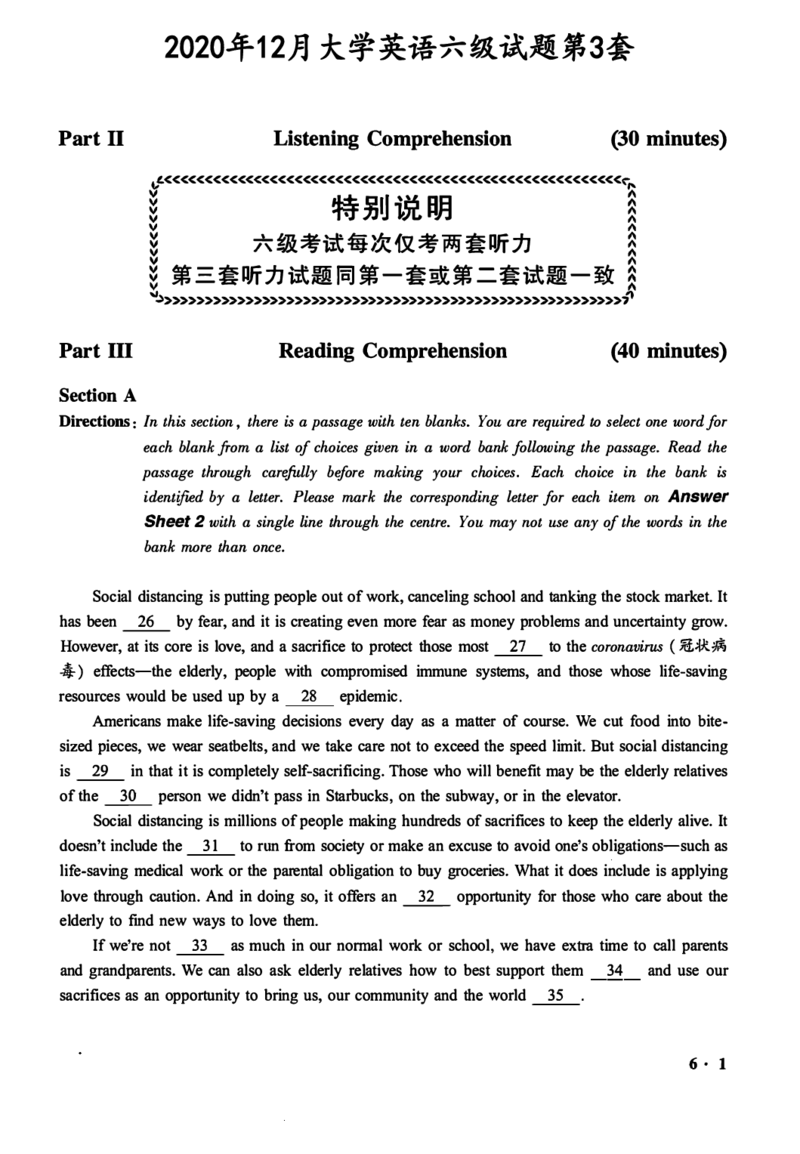
Social distancing is putting people out of work, canceling school and tanking the stock market. It
has been � by fear, and it is creating even more fear as money problems and uncertainty grow.
However, at its core is love, and a sacrifice to protect those most _J:J__ to the coronavirus ( iii;f}{�
¾) effects-the elderly, people with compromised immune systems, and those whose life-saving
resources would be used up by a 28 epidemic.
Americans make life-saving decisions every day as a matter of course. We cut food into bite
sized pieces, we wear seatbelts, and we take care not to exceed the speed limit. But social distancing
is � in that it is completely self-sacrificing. Those who will benefit may be the elderly relatives
of the __1Q__ person we didn't pass in Starbucks, on the subway, or in the elevator.
Social distancing is millions of people making hundreds of sacrifices to keep the elderly alive. It
doesn't include the _3_1_ to run from society or make an excuse to avoid one's obligations-such as
life-saving medical work or the parental obligation to buy groceries. What it does include is applying
love through caution. And in doing so, it offers an ___l1_ opportunity for those who care about the
elderly to find new ways to love them.
If we're not ___1L as much in our normal work or school, we have extra time to call parents
and grandparents. We can also ask elderly relatives how to best support them 34 and use our
sacrifices as an opportunity to bring us, our community and the world ___1L.
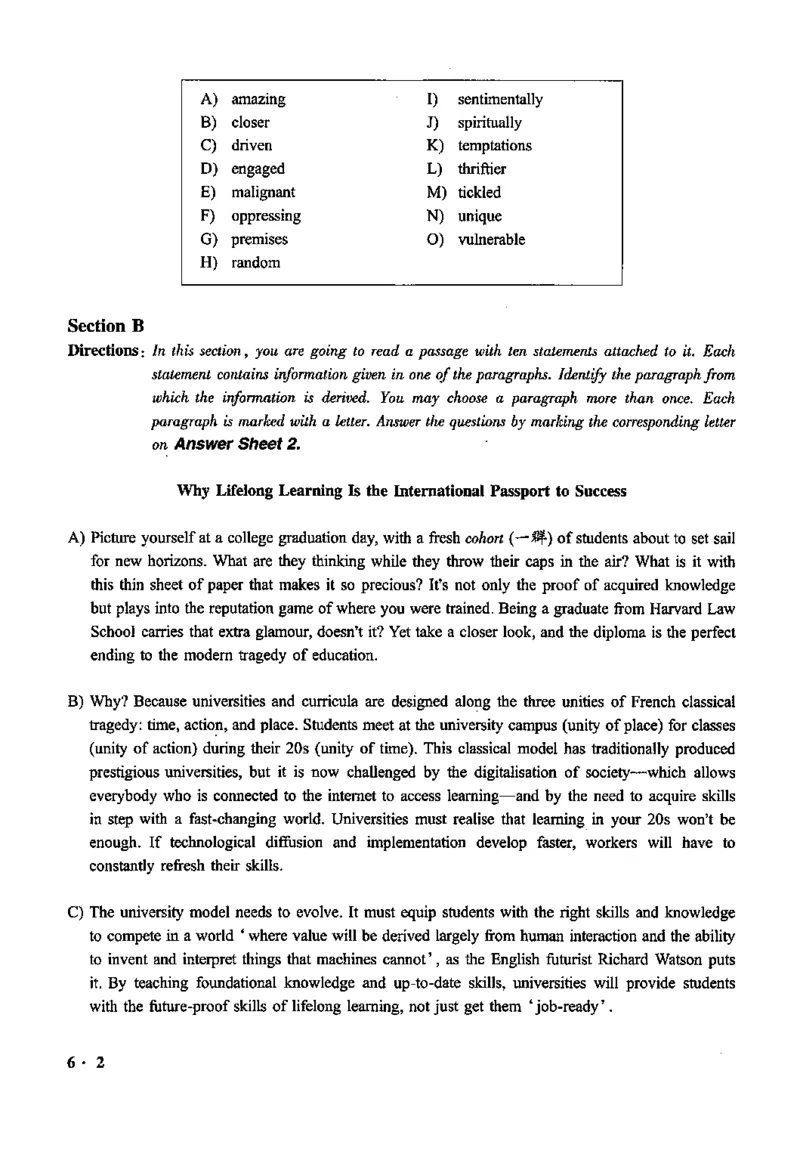
6 · 1A) amazing I) sentimentally
B) closer J) spiritually
C) driven K) temptations
D) engaged L) thriftier
E) malignant M) tickled
F) oppressing N) unique
G) premises 0) vulnerable
H) random
Section B
Directions: In this section , you are going to read a passage with ten statements attached to it. Each
statement contains information given in one of the paragraphs. Identify the paragraph from
which the information is derived. You may choose a paragraph more than once. Each
paragraph is marked with a letter. Answer the questions by marking the corresponding letter
on Answer Sheet 2.
Why Lifelong Learning Is the International Passport to Success
A) Picture yourself at a college graduation day, with a fresh cohort (-jf.) of students about to set sail
for new horizons. What are they thinking while they throw their caps in the air? What is it with
this thin sheet of paper that makes it so precious? It's not only the proof of acquired knowledge
but plays into the reputation game of where you were trained. Being a graduate from Harvard Law
School carries that extra glamour, doesn't it? Yet take a closer look, and the diploma is the perfect
ending to the modem tragedy of education.
B) Why? Because universities and curricula are designed along the three unities of French classical
tragedy: time, actio~, and place. Students meet at the university campus (unity of place) for classes
(unity of action) during their 20s (unity of time). This classical model has traditionally produced
prestigious universities, but it is now challenged by the digitalisation of society-which allows
everybody who is connected to the internet to access learning-and by the need to acquire skills
in step with a ·f ast-changing world. Universities must realise that learning in your 20s won't be
enough. If technological diffusion and implementation develop faster, workers will have to
constantly refresh their skills.
C) The university model needs to evolve. It must equip students with the right skills and knowledge
to compete in a world ' where value will be derived largely from human interaction and the ability
to invent and interpret things that machines cannot' , as the English futurist Richard Watson puts
it. By teaching foundational knowledge and up-to-date skills, universities will provide students
with the future-proof skills of lifelong learning, not just get them 'job-ready ' .
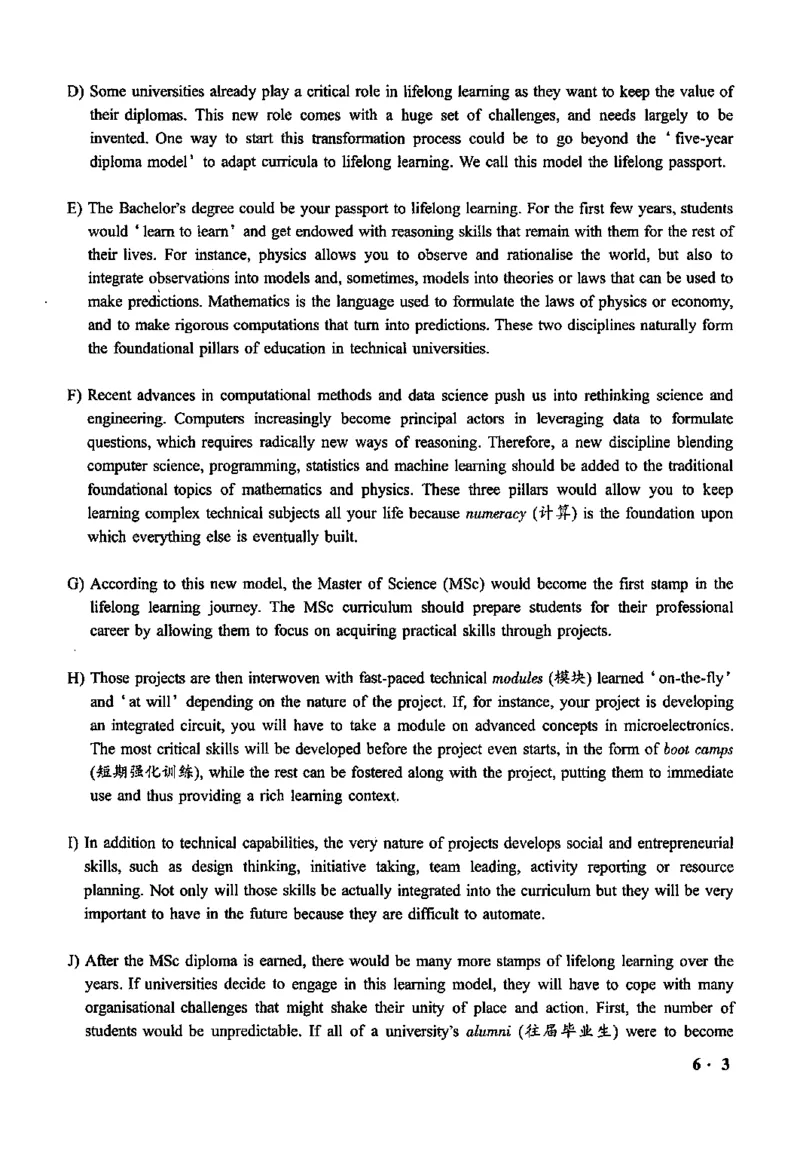
6 · 2D) Some universities already play a critical role in lifelong learning as they want to keep the value of
their diplomas. This new role comes with a huge set of challenges, and needs largely to be
invented. One way to start this transformation process could be to go beyond the 'five-year
diploma model ' to adapt curricula to lifelong learning. We call this model the lifelong passport.
E) The Bachelor's degree could be your passport to lifelong learning. For the first few years, students
would ' learn to learn' and get endowed with reasoning skills that remain with them for the rest of
their lives. For instance, physics allows you to observe and rationalise the world, but also to
integrate observations into models and, sometimes, models into theories or laws that can be used to
make predictions. Mathematics is the language used to formulate the laws of physics or economy,
and to make rigorous computations that tum into predictions. These two disciplines naturally form
the foundational pillars of education in technical universities.
F) Recent advances in computational methods and data science push us into rethinking science and
engineering. Computers increasingly become principal actors in leveraging data to formulate
questions, which requires radically new ways of reasoning. Therefore, a new discipline blending
computer science, programming, statistics and machine learning should be added to the traditional
foundational topics of mathematics and physics. These three pillars would allow you to keep
learning complex technical subjects all your life because numeracy ( it Jf:.) is the foundation upon
which everything else is eventually built.
G) According to this new model, the Master of Science (MSc) would become the first stamp in the
lifelong learning journey. The MSc curriculum should prepare students for their professional
career by allowing them to focus on acquiring practical skills through projects.
H) Those projects are then interwoven with fast-paced technical modules (*l:tk) learned 'on-the-fly'
and ' at will' depending on the nature of the project. If, for instance, your project is developing
an integrated circuit, you will have to take a module on advanced concepts in· microelectronics.
The most critical skills will be developed before the project even starts, in the form of boot camps
(l .i$.JJ ~i 1t. -iJtl ~ ), while the rest can be fostered along with the project, putting them to immediate
use and thus providing a rich learning context.
I) In addition to technical capabilities, the very nature of projects develops social and entrepreneurial
skills, such as design thinking, initiative taking, team leading, activity reporting or resource
planning. Not only will those skills be actually integrated into the curriculum but they will be very
important to have in the future because they are difficult to automate.
J) After the MSc diploma is earned, there would be many more stamps of lifelong learning over the
years. If universities decide to engage in this learning model, they will have to cope with many
organisational challenges that might shake their unity of place and action. First, the number of
students would be unpredictable. If all of a university's alumni ( .U. Ai, -'" ~ 1.) were to become
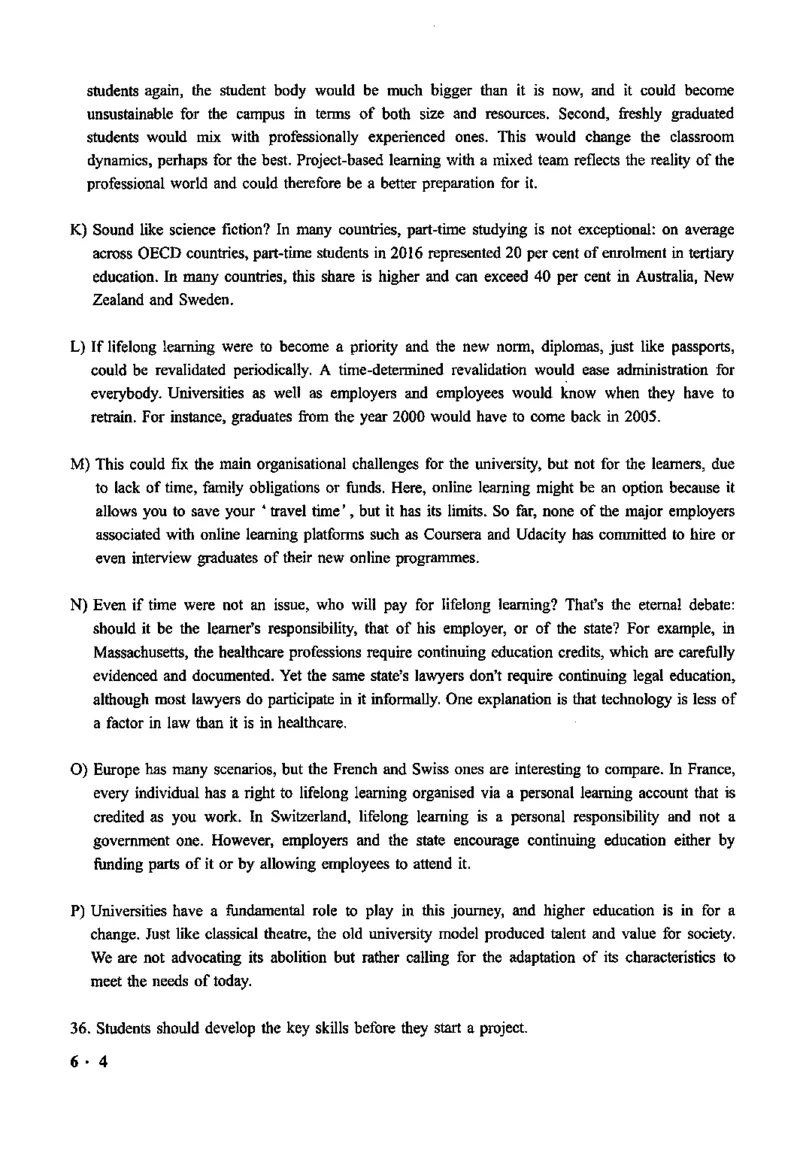
6 • 3students again, the student body would be much bigger than it is now, and it could become
unsustainable for the campus in terms of both size and resources. Second, freshly graduated
students would mix with professionally experienced ones. This would change the classroom
dynamics, perhaps for the best. Project-based learning with a mixed team reflects the reality of the
professional world and could therefore be a better preparation for it.
K) Sound like science fiction? In many countries, part-time studying is not exceptional: on average
across OECD countries, part-time students in 2016 represented 20 per cent of enrolment in tertiary
education. In many countries, this share is higher and can exceed 40 per cent in Australia, New
Zealand and Sweden.
L) If lifelong learning were to become a priority and the new norm, diplomas, just like passports,
could be revalidated periodically. A time-determined revalidation would ease administration for
everybody. Universities as well as employers and employees would know when they have to
retrain. For instance, graduates from the year 2000 would have to come back in 2005.
M) This could fix the main organisational challenges for the university, but not for the learners, due
to lack of time, family obligations or funds. Here, online learning might be an option because it
allows you to save your ' travel time' , but it has its limits. So far, none of the major employers
associated with online learning platforms such as Coursera and Udacity has committed to hire or
even interview graduates of their new online programmes.
N) Even if time were not an issue, who will pay for lifelong learning? That's the eternal debate:
should it be the learner's responsibility, that of his employer, or of the state? For example, in
Massachusetts, the healthcare professions require continuing education credits, which are carefully
evidenced and documented. Yet the same state's lawyers don't require continuing legal education,
although most lawyers do participate in it informally. One explanation is that technology is less of
a factor in law than it is in healthcare.
0) Europe has many scenarios, but the French and Swiss ones are interesting to compare. In France,
every individual has a right to lifelong learning organised via a personal learning account that is
credited as you work. In Switzerland, lifelong learning is a personal responsibility and not a
government one. However, employers and the state encourage continuing education either by
funding parts of it or by allowing employees to attend it.
P) Universities have a fundamental role to play in this journey, and higher education is in for a
change. Just like classical theatre, the old university model produced talent and value for society.
We are not advocating its abolition but rather calling for the adaptation of its characteristics to
meet the needs of today.
36. Students should develop the key skills before they start a project.
6· 437. By acquiring reasoning skills in the first few years of college, students can lay a foundation for
lifelong learning.
38. The easy access to learning and rapid technological changes have brought the traditional model of
education under challenge.
39. Unbelievable as it may seem, part-time students constitute a considerable portion of the student
body in many universities across the world.
40. Some social and managerial skills, which are not easily automated, will be of great importance to
students' future careers.
41. A new model of college education should provide students with the knowledge and skills that will
make them more inventive and capable of lifelong learning.
42. A mixed student body may change the classroom dynamics and benefit learning.
43. The question of who will bear the cost of lifelong learning is a topic of constant debate.
44. To the traditional subjects of math and physics should be added a new discipline which combines
computer science with statistics and other components.
45. Students who are burdened with family duties might choose to take online courses.
Section C
Directions: There are 2 passages in this section. Each passage is followed by some questions or
unfinished statements. For each of them there are four choices marked A) , B) , C) and
D). You should decide on the best choice and mark the corresponding letter on Answer
Sheet 2 with a single line through the centre.
Passage One
Questions 46 to 50 are based on the following passage.
Why does social media trigger feelings of loneliness and •inadequacy? Because instead of being
real life, it is, for the most part, impression management, a way of marketing yourself, carefully
choosing and filtering the pictures and words to put your best face forward.
Online "friends" made through social media do not follow the normal psychological progression
of an interpersonal relationship. You share neither physical time nor emotional conversations over the
Internet. You simply communicate photographs and catchy posts to a diverse group of people whom
you have "friended" or "followed" based on an accidental interaction. This is not to say that your
social media friends can't be real friends. They absolutely can, but the two are not synonymous.
6 · 5Generally speaking, there are no unfiltered comments or casually taken photos on our social media
pages. And, rightfully so, because it wouldn't feel safe to be completely authentic and vulnerable with
some of our "friends" whom we don't actually know or with whom trust has yet to be built.
Social media can certainly be an escape from the daily grind, but we must be cautioned against
the negative effects, such as addiction, on a person's overall psychological well-being.
As humans, we yearn for social connection. Scrolling ( i,jl #J) through pages of pictures and
comments, however, does not provide the same degree of fulfillment as face-to-face interactions do.
Also, we tend to idealize others' lives and compare our downfalls to their greatest accomplishments,
ending in feelings of loneliness and inadequacy.
Social media can lead people on the unhealthy quest for perfection. Some people begin to attend
certain events or travel to different places so that they can snap that "perfect" photo. They begin to
seek validation through the number of people who " like" their posts. In order for it to play a
psychologically healthy role in your social life, social media should supplement an already healthy
social network. Pictures and posts should be byproducts of life's treasured moments and fun times, not
the planned and calculated image that one is putting out into cyberspace in an attempt to fill
insecurities or unmet needs.
Ultimately, social media has increased our ability to connect with various types of people all over
the globe. It has opened doors for businesses and allowed us to stay connected to people whom we
may not otherwise get to follow. However, social media should feel like a fun experience, not one that
contributes to negative thoughts and feelings. If the latter is the case, increasing face-to-face time with
trusted friends, and minimizing time scrolling online, will prove to be a reminder that your social
network is much more rewarding than any "like," "follow" or "share" can be.
46. What does the author imply social media may do to our life?
A) It may facilitate our interpersonal relationships.
B) It may filter our negative impressions of others.
C) It may make us feel isolated and incompetent.
D) It may render us vulnerable and inauthentic.
47. Why do people post comments selectiv~ly on social media?
A) They do not find all their online friends trustworthy.
B) They want to avoid offending any of their audience.
C) They do not want to lose their followers.
D) They are eager to boost their popularity.
48. What are humans inclined to do according to the passage?
A) Exaggerate their life's accomplishments. • C) Paint a rosy picture of other people's lives.
B) Strive for perfection regardless of the cost. D) Learn lessons from other people's downfalls.
49. What is the author's view of pictures and posts on social media?
A) They should record the memorable moments in people's lives.
6 • 6B) They should be carefully edited so as to present the best image.
C) They should be shown in a way that meets one's security needs.
D) They should keep people from the unhealthy quest for perfection.
50. What does the author advise people to do when they find their online experience unconstructive?
A) Use social media to increase their ability to connect with various types of people.
B) Stay connected to those whom they may not otherwise get to know and befriend.
C) Try to prevent negative thoughts and feelings from getting into the online pages.
D) Strengthen ties with real-life friends instead of caring about their online image.
Passage Two
Questions 51 to 55 are based on the following passage.
Imagine that an alien species landed on Earth and, through their mere presence, those aliens
caused our art to vanish, our music to homogenize, and our technological know-how to disappear.
That is effectively what humans have been doing to our closest relatives-chimps ( ::k. g~l) .
Back in 1999, a team of scientists led by Andrew Whiten showed that chimps from different
parts of Africa behave very differently from one an*oth ;e; r). , S ome groups would get each other's
attention by rapping branches with their knuckles ( ~i while others did it by loudly ripping
leaves with their teeth. The team identified 39 of these traditions that are practiced by some
communities but not others-a pattern that, at the time, hadn't been seen in any animal except
humans. It was evidence, the team said, that chimps have their own cultures.
It took a long time to convince skeptics that such cultures exist, but now we have plenty of
examples of animals learning local traditions from one another.
But just when many scientists have come to accept the existence of animal cultures, many of
those cultures might vanish. Ammie Kalan and her colleagues have shown, through years of intensive
fieldwork, that the very presence of humans has eroded the diversity of chimp behavior. Where we
flourish, their cultures wither. It is a bitterly ironic thing to learn on the 20th anniversary of Whiten's
classic study.
"It's amazing to think that just 60 years ago, we knew next to nothing of the behavior of our
sister species in the wild," Whiten says. "But now, just as we are truly getting to know our primate( }L
* )
~ cousins, the actions of humans are closing the window on all we have discovered."
" Sometimes in the rush to conserve the species, I think we forget about the individuals," says
Cat Hobaiter, a professor at the University of St. Andrews. "Each population, each community, even
each generation of chimps is unique. An event might only have a small impact on the total population
of chimps, but it may wipe out an entire community-an entire culture. No matter what we do to
restore habitat or support population growth, we may never be able to restore that culture."
No one knows whether the destruction of chimp culture is getting worse. Few places have
tracked chimp behavior over long periods, and those that have are also more likely to have pro,ected
their animals from human influence.
Obviously, conservationists need to think about saving species in a completely new way-by
preserving animal traditions as well as bodies and genes. " Instead of focusing only on the
6 · 7conservation of genetically based entities like species, we now need to also consider culturally based
entities," says Andrew Whiten.
51. What does the author say we humans have been doing to chimps?
A) Ruining their culture. C) Treating them as alien species.
B) Accelerating their extinction. D) Homogenizing their living habits.
52. What is the finding of Andrew Whiten's team?
A) Chimps demonstrate highly developed skills of communication.
B) Chimps rely heavily upon their body language to communicate.
C) Chimps behave in ways quite similar to those of human beings.
D) Different chimp groups differ in their way of communication.
53. What did Ammie Kalan and her colleagues find through their intensive fieldwork?
A) Whiten's classic study has little impact on the diversity of chimp behavior.
B) Chimp behavior becomes less varied with the increase of human activity.
C) Chimps alter their culture to quickly adap~ to the changed environment.
D) It might already be too late to prevent animal cultures from extinction.
54. What does Cat Hobaiter think we should do for chimp conservation? •
A) Try to understand our sister species' behavior in the wild.
B) Make efforts to preserve each individual chimp community.
C) Study the unique characteristics of each generation of chimps.
D) Endeavor to restore chimp habitats to expand its total population.
55. What does the author suggest conservationists do?
A) Focus entirely on culturally-based entities rather than genetically-based ones.
B) Place more stress on animal traditions than on their physical conservation.
C) Conserve animal species in a novel and all-round way.
D) Explore the cultures of species before they vanish.
Part IV Translation (30 minutes)
Directions: For this part, you are allowed 30 minutes to translate a passage from Chinese into English.
You should write your answer on Answer Sheet 2.
~tJit::k~~jijRflL:fm&=f3c~l'1,:tm~m 46 ~_m~, =f 20191f:: 9 YI 30 13ttA~JfJo ~e
~IW=f 20141f::7f I@ii, jWj~Btii&..t.::ti 4 Ji~IAa fIDtt~~iiit~1§t., AJ~ftilF:ft::k~fl:
lW~m1t~~@1£ii#urf.mt~~~JL'lW{.)Lit, i!~~~ilH!t Tt&::klW1Ifia fIDtM~3t1=f 82 -1'
m m:tm
!HJL Cl '{El*~ ji:a':[1( ~B ' fl fffl~i'J 8 ,t~ iJt fJ~ ~izi ff friJ -1' ~ Cl B9liit EI~ 1¥4i
O
,J,at 300 ~rx~~o m:tm1f::~~lt 20401f::~~¥1J 1 {Z.A?X,1=frimt~tltJl'-..t.iitlHt!Wm:tma
6 · 8Part I Writing (30 minutes)
( il i=-.iE j\ 3f � J§ $1 J , 1M" pg �.Ex:* �B � , :z 1§ �4 i11: fr PJr n �ii.t)
Directions: For this part, you are allowed 30 minutes to write an essay on why students should be
encouraged to develop the ability to meet challenges. You should write at least 150
words but no more than 200 words.