文档文本内容
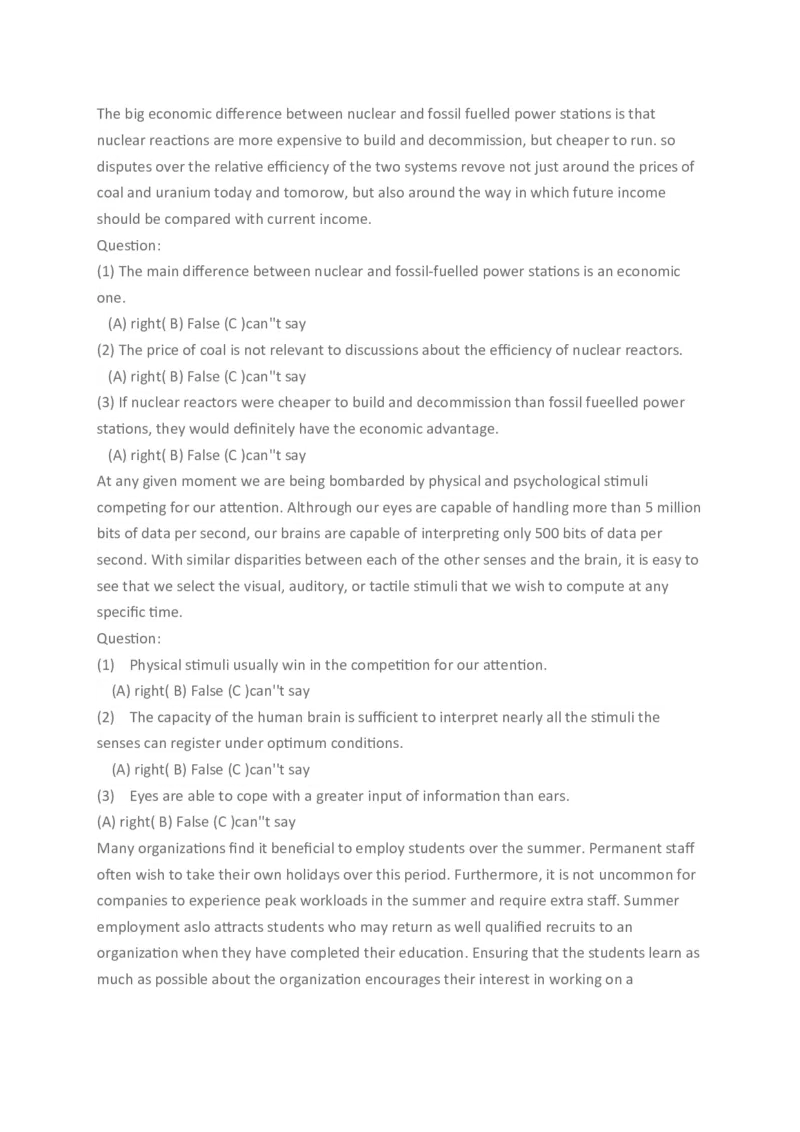
The big economic difference between nuclear and fossil fuelled power stations is that
nuclear reactions are more expensive to build and decommission, but cheaper to run. so
disputes over the relative efficiency of the two systems revove not just around the prices of
coal and uranium today and tomorow, but also around the way in which future income
should be compared with current income.
Question:
(1) The main difference between nuclear and fossil-fuelled power stations is an economic
one.
(A) right( B) False (C )can''t say
(2) The price of coal is not relevant to discussions about the efficiency of nuclear reactors.
(A) right( B) False (C )can''t say
(3) If nuclear reactors were cheaper to build and decommission than fossil fueelled power
stations, they would definitely have the economic advantage.
(A) right( B) False (C )can''t say
At any given moment we are being bombarded by physical and psychological stimuli
competing for our attention. Althrough our eyes are capable of handling more than 5 million
bits of data per second, our brains are capable of interpreting only 500 bits of data per
second. With similar disparities between each of the other senses and the brain, it is easy to
see that we select the visual, auditory, or tactile stimuli that we wish to compute at any
specific time.
Question:
(1) Physical stimuli usually win in the competition for our attention.
(A) right( B) False (C )can''t say
(2) The capacity of the human brain is sufficient to interpret nearly all the stimuli the
senses can register under optimum conditions.
(A) right( B) False (C )can''t say
(3) Eyes are able to cope with a greater input of information than ears.
(A) right( B) False (C )can''t say
Many organizations find it beneficial to employ students over the summer. Permanent staff
often wish to take their own holidays over this period. Furthermore, it is not uncommon for
companies to experience peak workloads in the summer and require extra staff. Summer
employment aslo attracts students who may return as well qualified recruits to an
organization when they have completed their education. Ensuring that the students learn as
much as possible about the organization encourages their interest in working on apermanent basis. Organizations pay students on a frued rate without the usual entitlement
to paid holidays or sick leave.
Question:
(1) It is possible that permanent staff who are on holiday can have their work carried out
by students.
(A) right( B) False (C )can''t say
(2) Students in summer employment are given the same paid holiday benefit as
permanent staff.
(A) right( B) False (C )can''t say
(3) Students are subject to the organization’s standard disciplinary and grievance
procedures.
(A) right( B) False (C )can''t say
(4) Some companies have more work to do in summer when students are available for
vacation work.
(A) right( B) False (C )can''t say
Most banks and buliding societies adopt a “no smoking” policy in customer areas in their
branchs. Plaques and stickers are displayed in these areas to draw attention to this policy.
The notices are worded in a “customer friendly” manner, though a few customers may feel
their personal freedom of choice is being infringed. If a customer does ignore a notice, staff
are tolerant and avoid making a great issue of the situation. If fact, the majority of
customers now expect a “no smoking” policy in premises of this kind. After all, such a policy
improves the pleasantness of the customer facilities and also lessens fire risk.
Question:
(1) “No smoking” policies have mainly been introduced in response to customer demand.
(A) right( B) False (C )can''t say
(2) All banks and buliding societies now have a “no smoking” policy.
(A) right( B) False (C )can''t say
(3) There is no conflict of interest between a “no smoking” policy and personal freedom of
choice for all.
(A) right( B) False (C )can''t say
(4) A no-smoking policy is in line with most customers’ expectations in banks and buliding
societies.
(A) right( B) False (C )can''t say
CBC CBC ABCA CCBA