2025 年春“荆、荆、襄、宜四地七校考试联盟”
高二期中联考
英语试题
命题学校:荆州中学 命题人:高一英语备课组
审题学校:襄阳四中 审题单位:圆创教育研究中心
考试时间:2025 年 4 月 24 日 考试用时:120 分钟 试卷满分:150 分
★祝考试顺利★
注意事项:
1. 答题前,先将自己的姓名、准考证号填写在试卷和答题卡上,并将准考证号条形码粘贴在
答题卡上的指定位置。
2. 选择题的作答:选出每小题答案后,用 2B 铅笔把答题卡上对应题目的答案标号涂黑。如需
改动,用橡皮擦干净后,再选涂其他答案标号。写在试卷、草稿纸和答题卡上的非答题区域
均无效。
3. 非选择题的作答:用黑色签字笔直接答在答题卡上对应的答题区域内。写在试卷、草稿纸
和答题卡上的非答题区域均无效。
4. 保持卡面清洁,不要折叠、不要弄破、弄皱,不准使用涂改液、修正带、刮纸刀。
第一部分 听力(共两节,满分 30 分)
第一节(共 5 小题;每小题 1.5 分,满分 7.5 分)
听下面 5 段对话。每段对话后有一个小题,从题中所给的 A、B、C 三个选项中选出最佳选项。
听完每段对话后,你都有 10 秒钟的时间来回答有关小题和阅读下一小题。每段对话仅读一遍。
例:How much is the shirt?
A. £19.15. B. £9.18. C. £9.15.
答案是 C。
1. What are the speakers talking about?
A. A song. B. A singer. C. An album.
2. How will the man go to the exhibition?
A. By train. B. On foot. C. By car.
3. What does Tom suggest Lily do if she needs help?
A. Send him a message. B. Visit him directly. C. Call him anytime.
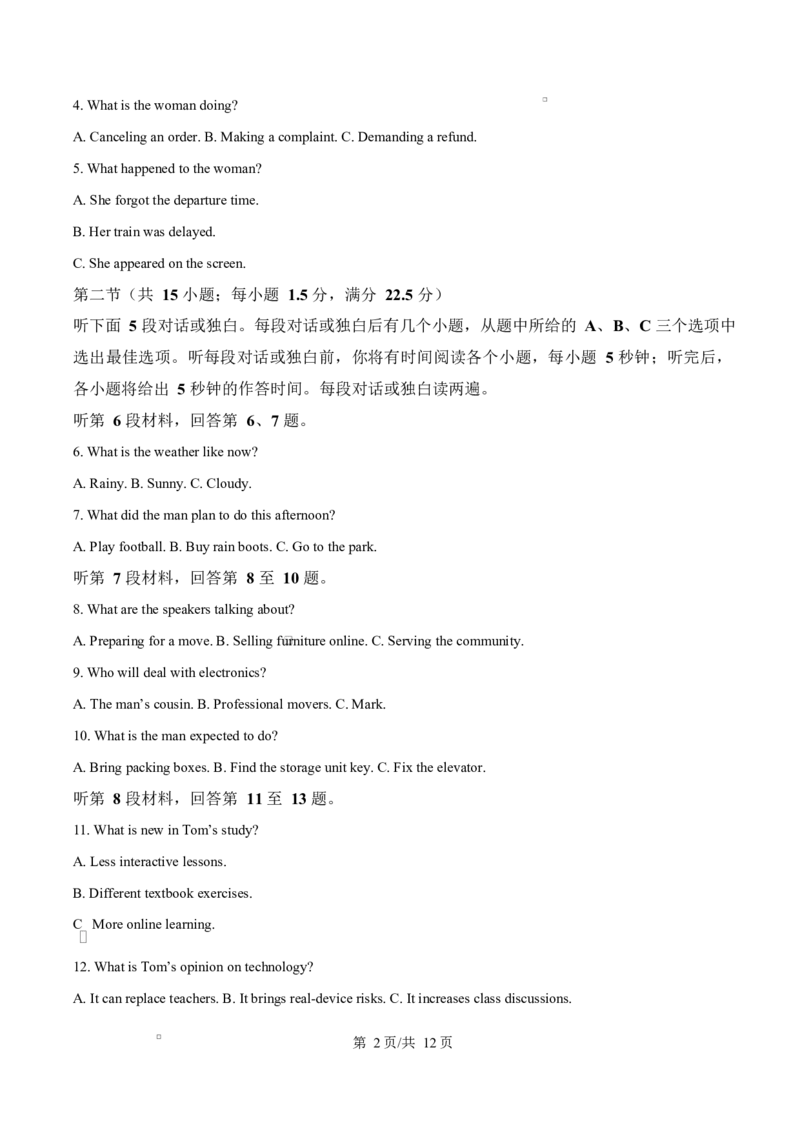
第 1页/共 12页4. What is the woman doing?
A. Canceling an order. B. Making a complaint. C. Demanding a refund.
5. What happened to the woman?
A. She forgot the departure time.
B. Her train was delayed.
C. She appeared on the screen.
第二节(共 15 小题;每小题 1.5 分,满分 22.5 分)
听下面 5 段对话或独白。每段对话或独白后有几个小题,从题中所给的 A、B、C 三个选项中
选出最佳选项。听每段对话或独白前,你将有时间阅读各个小题,每小题 5 秒钟;听完后,
各小题将给出 5 秒钟的作答时间。每段对话或独白读两遍。
听第 6 段材料,回答第 6、7 题。
6. What is the weather like now?
A. Rainy. B. Sunny. C. Cloudy.
7. What did the man plan to do this afternoon?
A. Play football. B. Buy rain boots. C. Go to the park.
听第 7 段材料,回答第 8 至 10 题。
8. What are the speakers talking about?
A. Preparing for a move. B. Selling furniture online. C. Serving the community.
9. Who will deal with electronics?
A. The man’s cousin. B. Professional movers. C. Mark.
10. What is the man expected to do?
A. Bring packing boxes. B. Find the storage unit key. C. Fix the elevator.
听第 8 段材料,回答第 11 至 13 题。
11. What is new in Tom’s study?
A. Less interactive lessons.
B. Different textbook exercises.
C More online learning.
12. What is Tom’s opinion on technology?
A. It can replace teachers. B. It brings real-device risks. C. It increases class discussions.
第 2页/共 12页13. How would they deal with the changes?
A. Seek balance. B. Avoid mistakes. C. Return to basics.
听第 9 段材料,回答第 14 至 17 题。
14. What is the advantage of Mr. Brown’s new tool?
A. Lower price. B. Higher speed. C. Easier operation.
15. What is the woman’s concern about the tools?
A. Cost. B. Performance. C. Safety.
16. What is Grandpa’s attitude towards machines?
A. Supportive. B. Curious. C. Worried.
17. What is future agriculture like according to Jack?
A. It ignores traditional basics.
B. It uses data instead of wisdom.
C. It combines tech with nature.
听下面一段独白,回答第 18 至 20 题。
18. What is the theme of the event?
A. Effective cooperation. B. Environmental protection. C. Technological development.
19 What is the focus of the biology group?
A. Solar-powered charger. B. Money-saving materials. C. Waste-recycling ecosystem.
20. What can we learn from the event?
A. Teamwork matters. B. Science is all about tools. C. Simple ideas are everything.
第二部分 阅读(共两节,满分 50 分)
第一节(共 15 小题,每小题 2.5 分,满分 37.5 分)
阅读下列短文,从每题所给的 A、B、C、D 四个选项中,选出最佳选项。
A
Following are three practical guiding books for learners. Each book supports classroom teaching while
deepening subject knowledge through real-world examples.
The Art of Uncertainty
The real strength of this book lies in its practical examples. One fascinating section discusses facial
recognition technology, explaining why even highly accurate systems can produce incorrect results sometimes. It
第 3页/共 12页might not be ideal bedtime reading, but easy to follow, with handy bullet-point summaries at the end of each
chapter. Though some sections may be challenging, the book’s logical structure and real-world applications make it
a useful resource for students studying statistics or data analysis.
The Newsmongers: A History of Tabloid Journalism
This book provides a detailed look at how news reporting has been influenced by the personal bias (偏见) of
publishers and editors throughout history. While many people assume that media bias is a modern issue, this book
shows that it has existed for centuries, offering examples from the Middle Ages to the present day. Readers will
gain insight into how journalism shapes public opinion and why critical thinking is essential when consuming news.
The engaging storytelling and well-researched examples make it an enjoyable read.
How to Think like a Poet
This book introduces readers to 23 influential poets, ranging from classical writers like Milton and Chaucer to
lesser-known figures such as the ancient Greek poet Sappho. Each chapter combines their life stories with carefully
selected quotes, offering a lively and personal look at their work. The book’s clear writing makes it a valuable tool
for understanding poetry and developing critical thinking skills.
1. Which topic is discussed in The Art of Uncertainty?
A. Data analysis methods. B. Bullet-point writing styles.
C. Intelligent identification system. D. Bedtime reading materials.
2. What does The Newsmongers encourage readers to develop?
A. Trust in famous editors. B. Ability of independent thinking.
C. Skills for news report writing. D. Appreciation of traditional media.
3. What do the three books have in common?
A. Promote ancient wisdom. B. Introduce historical figures.
C. Provide practical learning skills. D. Bridge knowledge with examples.
B
Emmalee Potter, a mother-of-three from Victoria, Australia, has recently sparked immediate reviews online
after launching a GoFundMe page to ask strangers to contribute money to her house deposit (存款).
She has been suffering for years and relying on friends and family for help with accommodation. Now, after
working hard towards saving, she is finally close to being able to purchase her new home, but still finds herself
$3,000 short of her goal.
As she wrote on the fundraising page, “My kids and I are living in a room at my friends. Buying is actually
第 4页/共 12页cheaper than renting since I can get the home loan and pay the repayments. I’m just needing the last bit of the
deposit. Please help me get over this last barrier. Every little bit truly helps.” For the family, a house is more than
just a place to live. It’s a foundation for the next chapter of life, a space where memories are made, and where they
can really begin to feel settled.
The campaign set off polar opposite reactions. While supporters agreed and promised to contribute, many
were not impressed at her using the platform in order to fund her house and accused her of exploiting public
generosity. “It is ridiculous.” as one said, “If we are all going to start GoFundMe accounts, I may as well start one
so I can go on a holiday to Greece.” Another person wrote, “It’s a tough time for everyone trying to buy a house,
especially with the cost of living, so I’m kind of confused why you’re asking for donations. You’re asking strangers
to send you money for the deposit?”
Ms Potter defended the fundraising page as she responded to one annoyed commenter, writing, “It’s not about
‘funding me a house’, it’s the small amount still needed to buy something.”
4 Why does Ms Potter start a GoFundMe page?
A. To launch a business project. B. To support a close friend.
C. To raise a new-home fund. D. To afford a family trip.
5. What does a house mean to the Potters?
A. A start to a new life. B. A necessity for safety.
C. A barrier to work. D. A symbol of wealth.
6. What does the underlined word “exploiting” in paragraph 4 mean?
A. Losing sight of. B. Casting doubt on.
C Taking advantage of. D. Wasting time on.
7. Which of the comments may upset Ms Potter?
A. Home is where the heart is. B. Harvest where one has not sown.
C. Teamwork makes the dream work. D. A friend in need is a friend indeed.
C
Once a niche (小众) market, secondhand fashion has now entered the mainstream. Platforms like Vestiaire
Collective and Vinted are leading this trend, gaining fame through the TV series Emily in Paris and highlighting
their growing cultural influence.
Research shows the U.S. resale market grew 15 times faster than general clothing retail in 2024, with
第 5页/共 12页secondhand sales expected to make up 10% of the global clothing market this year. As traditional brands struggle,
platforms like Vestiaire add tens of thousands of new listings daily, signaling rapid expansion.
Some shoppers buy second-hand clothes for environmental reasons. The fashion industry is responsible for
about 10% of global carbon-dioxide emissions, more than shipping and air travel combined. It uses a lot of water,
too. Yet as Maximilian Bittner, Vestiaire’s chief executive, notes “by far the dominant driver is price.” Stretched
consumers are increasingly turning to used goods to save money. Vestiaire has calculated that used designer items
are often 33% cheaper than new fast fashion, with coats and dresses offering even greater savings.
To encourage sellers, resale platforms aim to simplify the listing process. Currently, uploading items can be
time-consuming — Mr Bittner recently spent about half an hour putting four of his own items up for sale on
Vestiaire. Many platforms now invest in AI tools to automate product descriptions and pricing advice. Technology
also enhances buyer experiences, helping them to check “digital fingerprints” or to track item details.
Competition poses challenges. Beyond charity shops and resale platforms, brands like Lululemon and The
North Face have launched their own secondhand services. Social media platforms like TikTok also attract
secondhand shoppers. Despite those worries about future competition from tech giants, Bittner sticks to the route,
“For now, millions of wardrobes (衣橱) are still to be cleaned out.”
8. What do we know about secondhand fashion now?
A. It is becoming out of date. B. It is leading in social media.
C. It is expanding at a high pace. D. It is disappearing from TV series.
9. What is the main reason for shoppers choosing used goods?
A. Affordable price. B. Attentive service.
C. Creative design. D. High quality.
10. What do the AI tools focus on?
A. Product styles. B. Trading efficiency.
C. Platform promotion. D. Marketing strategies.
11. What is Bittner’s attitude towards the competition?
A. Uncertain. B. Astonished. C. Appreciative. D. Optimistic.
D
It’s not just humans who have trouble making up — even ants aren’t quick to forgive, either. Ants rely
heavily on their sense of smell to distinguish nestmates from outsiders. A familiar smell allows ants to know which
nearby ants are there to help, and which may fight for the same resources. But new research from evolutionary
第 6页/共 12页biologists at Germany’s University of Freiburg indicates ants don’t just react in the moment — they preserve
knowledge of hostile (敌对的) encounters with neighboring enemies, and act accordingly.
Experiments were conducted to determine if ants remember bad experiences with other ants, and how it
influences their relationships. First, they placed ants into 60 second meet-and-greet situations: In one setting, the
insects simply encountered some of their nestmates; another situation involved a group interacting with aggressive
and hostile ants from other groups. This was then repeated once for each group over five days.
From there, scientists examined how the various ant groups subsequently reacted when they encountered the
aggressive ants. Further analysis showed ants were more hostile towards ants that smelled of past bad encounters
with other nests. They may spray formic acid (蚁酸) at one another.
Volker Nehring, co-author of the study, said, "We often underestimate insect cognition (认知). Ants aren’t
inflexibly programmed — they learn from interactions with others, and sense of smell plays a crucial role in the
formation of both nestmate and non-nestmate recognition patterns.”
Researchers also believe these results imply ants can classify smells for ants outside their colonies, which may
help make defensive responses accordingly. Moving forward, the biologists hope to look into how much ants can
adapt their sense of smell based on these interactions to see if the knowledge translates on an even deeper Level.
12. What can we learn from the new research?
A. Ants act on past memories. B. Ants have common enemies.
C. Ants locate food resources alone. D. Ants compete with each other for food.
13. How were the two settings different in experiment design?
A. Species of ants. B. Duration of encounters.
C. Number of repetitions. D. Relationship between ants.
14. What does Volker Nehring imply in paragraph 4?
A. Ants have a fixed recognition pattern.
B. Ants gain cognition based on experiences.
C. Interactions depends on the degree of flexibility.
D. Smell serves as the only access to communication.
15. What might the researchers explore next?
A. Ants’s mell classification. B. Ants’ aggressive interaction.
C. Ants’ defensive response level. D. Ants’ smell adaptation mechanism.
第二节(共 5 小题;每小题 2.5 分,满分 12.5 分)
第 7页/共 12页阅读下面短文,从短文后的选项中选出可以填入空白处的最佳选项。选项中有两项为多余选项。
While avoiding common resume (简历) mistakes and deciding what to put and what not to put on your resume,
don’t overlook the fact that the first “eyes” on your resume don’t always belong to a human. ____16____ . To craft
a winning resume that lands you the job, you have to be aware of what resume mistakes will land you in the AI
black hole.
Trick the system with keyword stuffing
____17____. AI or not, hiring managers are looking for resumes that identify with their company’s needs and
will be screening for keywords. Keywords are critical, but they must be used carefully. It’s possible to go
overboard with the keywords, so don’t try to be tricky by copying the entire job description into your resume.
____18____
Don’t get so focused on including the right keywords that you lose sight of what wording accurately represents
you and your experience. Even if you’re trying to navigate around AI, you’re not helping yourself or a hiring
manager if you’re not giving a real picture of who you are and what you bring to the table on your resume.
Include your address
It used to be standard to put your address on the top of your resume, but you should reconsider including it
now. Remote positions are always needed, but you may want to think twice before including your address on a
resume. AI might immediately rule you out if it seems like you’re not located near the company. ____19____ .
Forget to be human
While AI is an excellent tool for job seekers and can help you create a great resume that highlights the skills
employers are looking for, it’s not perfect and makes mistakes. ____20____. Or you’re more likely to explain any
computer-made errors, since AI is not immune to misinformation (and not so great with grammar yet, either!) that
may send you into the AI black hole.
A. Lose your honesty
B. Attach decorative pictures
C. It could be blocked out by an AI assistant in the first place
D. It’s wise to use phrasing from the job posting in your resume
E. You should always review and edit your resume before sending it off
F. It’s best to talk about your potential working place with a real human
G. Not all AI can properly read the keywords at the bottom of your resume
第三部分 语言运用(共两节,满分 30 分)
第 8页/共 12页第一节(共 15 小题,每小题 1 分,满分 15 分)
阅读下面短文,从短文后各题所给的 A、B、C、D 四个选项中,选出可以填入空白处的最佳
选项。
I have long believed in the soft hum of destiny — a gentle yet persistent voice that calls us to parts unknown.
In 2021, that magic ____21____ first led me to wander Xinjiang, a land so vast that it ____22____ deserts,
mountains and skyscrapers, within a breathtaking sweep.
On my first day, I set out to ____23____ some Uygur locals for a social media video, hoping to ____24____
the genuine spirit of Xinjiang. Spotting a group of young folk with tattoos (缠身) I felt ____25____ — would they
be cautious of foreigners? As I approached, they exclaimed I was the first foreigner they’d met. Laughter soon
____26____ my nerves. In my imperfect Chinese and their equally ____27____ English, we chatted like old
friends. They invited me into their home — an offer I might have ____28____ to accept in my own country,
where trusting strangers doesn’t come easily.
They poured steaming drink and ____29____ local dishes. This was an invitation by kindness, as if saying,
“You are _____30_____ now.” That day, I learned in Xinjiang, _____31_____ and affection go hand in hand —
and how _____32_____ hearts could open to a stranger.
I returned several times later like a migrating bird returning to warmer climates. Each time, although in
different cities, the same _____33_____ greeted me. Perhaps that is how Xinjiang welcomes _____34_____ — it
gives them its heart so fully that they leave a part of themselves behind, _____35_____ they must return. Because
of this, I decided to begin a new chapter in my life in Xinjiang.
21. A. picture B. sound C. place D. story
22. A. moves B. creates C. joins D. divides
23. A. photograph B. interview C. accompany D. instruct
24. A. unearth B. form C. inspire D. enhance
25. A. crazy B. tired C. uneasy D. delighted
26. A. filled B. advanced C. replaced D. suggested
27 A. fluent B. standard C. complex D. broken
28. A. hesitated B. managed C. attempted D. expected
29. A. put up B. took in C. laid out D. ran through
30. A. guest B. family C. tourist D. partner
第 9页/共 12页31. A. beer B. dessert C. tea D. food
32. A. frequently B. easily C. casually D. suddenly
33. A. warmth B. security C. curiosity D. beauty
34. A. locals B. reporters C. passengers D. wanderers
35. A. ensuring B. suggesting C. pretending D. proving
第二节(共 10 小题,每小题 1.5 分,满分 15 分)
阅读下面短文,在空白处填入 1 个适当的单词或括号内单词的正确形式。
Kites are considered one of the earliest forms of aircraft. During the Eastern Han Dynasty (25-220), inventor Cai
Lun improved papermaking techniques, ____36____ (lead) to the invention of “paper hawks”, which resembled
kites as we know them today.
“Kites’ ____37____ (origin) reveal the remarkable creativity and ability of ancient Chinese ____38____
(explore) the mysteries of nature. They ____39____ (drive) by curiosity and a spirit of scientific exploration to
understand and use the power of wind,” says Ma Zhiyao, a professor specializing in intangible cultural heritage.
During the Tang Dynasty (618-907), the prosperity (繁荣) made paper more affordable, and kites ____40____
(true) became part of people’s lives. As kite-making techniques became more advanced, varieties ____41____
(decorate) with imagery were developed.
“Kite making, among other intangible cultural heritage forms’ craftsmanship, tests whether the inheritors can
persevere in dull work, ____42____ is a process of character-building,” Ma adds. From an item as modest as a kite,
we can see Chinese people’s attachment ____43____ the cultural values associated with happiness, initiative and
____44____ (enthusiastic). This is why the thin string linking us to kites and culture has endured until today and
kite flying remains _____45_____ cherished part of contemporary life.
第四部分 写作(共两节,满分 40 分)
第一节(满分 15 分)
46. 假定你是校英语社团的负责人李华,请给外教 Mr. Smith 写邮件,邀请他担任“Future Careers”主题演
讲比赛的评委。内容包括:
(1)比赛时间、地点;
(2)评委职责、评分标准等。
注意:
(1)写作词数应为 80 个左右;
(2)请按如下格式在答题纸的相应位置作答。
第 10页/共 12页Dear Mr. Smith,
I hope this email finds you well!
____________________________________________________________________________________________
____________________________________________________________________________________________
____________________________________________________________________________________________
____________________________________________________________________________________________
______________________________________________________________________________________
Yours sincerely,
Li Hua
第二节(满分 25 分)
47. 阅读下面材料,根据其内容和所给段落开头语续写两段,使之构成一篇完整的短文。
The Broken Sketchbook (素描本)
Rain tapped against the art room windows as Emily stared at her ruined sketchbook. The pages crinkled like
autumn leaves. Brown coffee stains (污迹) spread across the pages like storm clouds, blurring (模糊) her careful
pencil drawings. Her hands shook as she touched a stained picture of two girls painting under an oak tree — the
last happy memory before she stopped speaking to Lucy for three days. Everyone knew Lucy had knocked over
that coffee, though she claimed it was an accident.
“Can we talk?” Lucy stood in the doorway, her uniform sleeves rolled up to reveal paint-stained wrists. In her
hands was a new sketchbook, its white cover gleaming under the lights. “I… I’m sorry,” Lucy whispered, came up
to Emily, and stuffed the sketchbook into Emily’s hands.
Three days after that? Emily turned away. She remembered how Lucy had taught her to paint flowing clouds,
their laughter mixing with the smell of wet paint. Now those memories were drowning in coffee stains.
That night, Emily lay awake listening to the rain. Moonlight fell across the new sketchbook on her desk. When
she opened it, a folded paper slid out — “Meet me at the art room tomorrow 7 a.m. — Lucy”.
Next morning, when Emily entered the silent art room, Lucy stood before a large canvas (画布), sunlight
turning her hair golden. The canvas showed two girls beneath an oak tree — their favorite spot to sketch during
lunch breaks. Though unfinished, the painting perfectly captured the dotted sunlight through leaves.
“I’m transferring to a science-focused school next week,” she said without turning around. “|My parents think
art is useless.”
Emily froze.“Before that…. I was wondering we might finish this painting together,” Lucy’s paintbrush
第 11页/共 12页trembled. “...like before.”
Something warm unfolded in Emily’s chest. She opened her stained sketchbook. “Look — the coffee marks
here,” she pointed at a ruined cloud drawing, “they look like real storm clouds.” Carefully, she tore out the page
and pressed it onto Lucy’s canvas. “It’s perfect!” Lucy clapped.
注意:
(1)续写词数应为 150 左右;
(2)请按如下格式在答题纸的相应位置作答。
The final painting witnessed their perfect teamwork.
____________________________________________________________________________________________
____________________________________________________________________________________________
____________________________________________________________________________________________
____________________________________________________________________________________________
______________________________________________________________________________________
With the painting in hand, Emily was seeing Lucy off at the station.
____________________________________________________________________________________________
____________________________________________________________________________________________
____________________________________________________________________________________________
____________________________________________________________________________________________
______________________________________________________________________________________
第 12页/共 12页