盐城市 2025 届三年级第一学期期中考试
英语试题
第一部分听力(共两节,满分30分)
做题时,先将答案标在试卷上。录音内容结束后,你将有两分钟的时间将试卷上的答案转涂到
答题卡上。
第一节(共5小题;每小题1.5分,满分7.5分)
听下面5段对话。每段对话后有一个小题,从题中所给的A、B、C三个选项中选出最佳选项,
并标在试卷的相应位置。听完每段对话后,你都有10秒钟的时间来回答有关小题和阅读下一小
题。每段对话仅读一遍。
例: How much is the shirt?
A.19.15. B.9.18. C.9.15.
答案是 C。
1. What is the woman doing?
A. Reading a newspaper. B. Serving a customer. C. Waiting for a train.
2. What are the speakers mainly talking about?
A. Home decoration. B. Family gatherings. C. Childhood memories.
3. What are the speakers going to do today?
A. Go to a music festival. B. Go out for lunch. C. Have a picnic.
4. What does the woman want to do?
A. Complain about service. B. Open a bank account. C. Confirm a payment.
5. What are the speakers mainly discussing?
A. Tips on improving brain health.
B. Ways to study a foreign language.
C. Benefits of learning a new language.
第二节(共15小题;每小题1.5分,满分22.5分)
听下面5段对话或独白。每段对话或独白后有几个小题,从题中所给的A、B、C三个选项中
选出最佳选项,并标在试卷的相应位置。听每段对话或独白前,你将有时间阅读各个小题,每小题5
秒钟;听完后,各小题将给出5秒钟的作答时间。每段对话或独白读两遍。
听第6段材料,回答第6、7题。
6. What did the woman find yesterday morning?
A. Rain outside. B. Fog over the forest. C. Wildfire smoke.
7. What do the speakers plan to do at the weekend?
A. Visit the man's parents. B. Remove some dead trees. C. Talk with their children.
高三英语试卷第1页共10页听第7段材料,回答第8至10题。
8. What is the probable relationship between the speakers?
A. Brother and sister. B. Parent and child. C. Co-workers.
9. What is the woman doing in London?
A. Attending a conference. B. Visiting colleges. C. Taking a holiday.
10. What does the woman tell Danny to do?
A. Eat fewer snacks. B. Take care of his sister. C. Plan college visits.
听第8段材料,回答第11至13题。
11. Where does the conversation probably take place?
A. In a park. B. In a library. C. In a school.
12. What did Mike like best as a child?
A. Watching television. B. Playing outside. C. Reading books.
13. What's the main problem for today's children according to Maggie?
A. They eat too much sugar.
B. They don't get enough exercise.
C. They have too much screen time.
听第9段材料,回答第14至17题。
14. How does the woman feel at the start of the conversation?
A. Stressed. B. Awkward. C. Relaxed.
15. What event is the woman currently making ronghua for?
A. A Chinese festival. B. A wedding. C. A birthday.
16. How much longer will the flower arrangement take to finish?
A.35 hours. B.40 hours. C.56hours.
17. What part of ronghua-making does the woman enjoy most?
A. Choosing the colors. B. Brushing the silk. C. Rolling the flowers.
听第10段材料,回答第18至20题。
18. What is Dad, how do I?
A. A children's story. B. An online channel. C. A TV show.
19. When was Dad, how do I? launched?
A. In April 2020. B. In May 2020. C. In June 2020.
20. What is Rob Kenney best known for?
A. Giving fatherly advice.
B. Being a parenting expert.
C. Increasing the popularity of bedtime stories.
高三英语试卷第2页共10页第二部分阅读(共两节,满分50分)
第一节(共15小题:每小题2.5分,满分37.5分)
阅读下列短文,从每题所给的A、B、C、D四个选项中选出最佳选项。
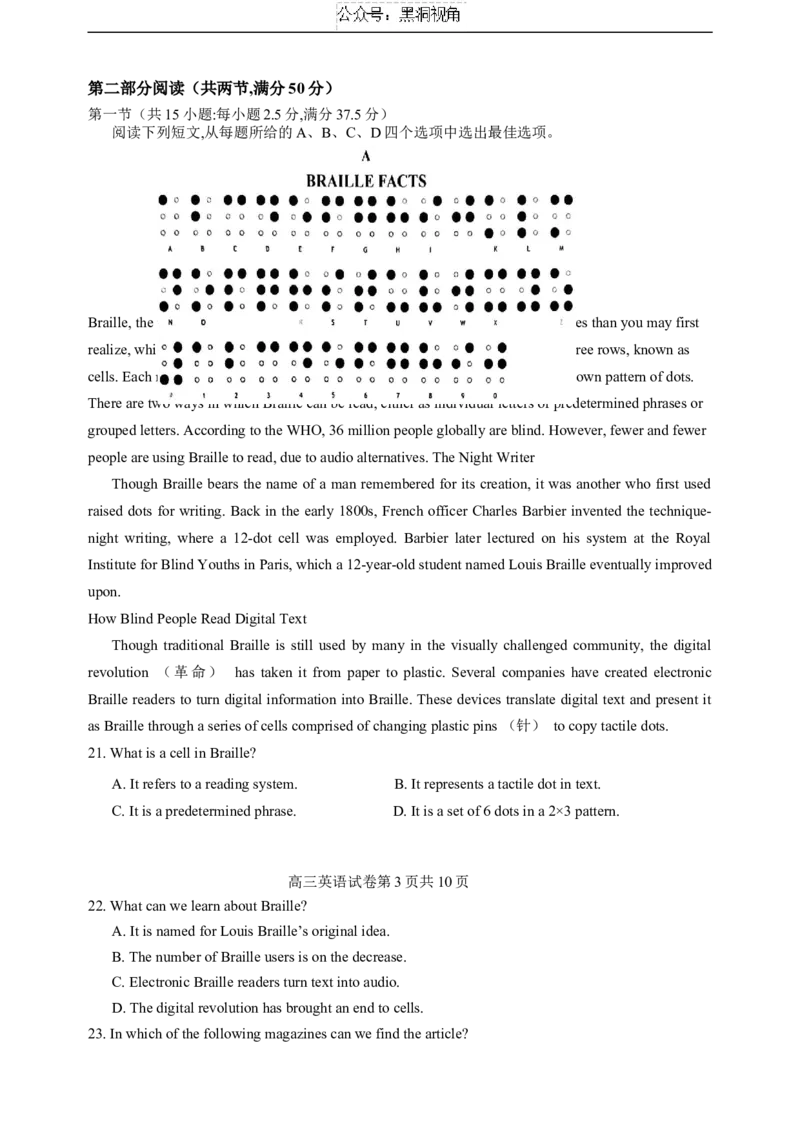
Braille, the tactile reading system blind people can use to read text, is in more places than you may first
realize, which works by using six tactile dots (触点) set in two columns and three rows, known as
cells. Each raised dot relates to a letter, a number or a mark, and each letter has its own pattern of dots.
There are two ways in which Braille can be read, either as individual letters or predetermined phrases or
grouped letters. According to the WHO, 36 million people globally are blind. However, fewer and fewer
people are using Braille to read, due to audio alternatives. The Night Writer
Though Braille bears the name of a man remembered for its creation, it was another who first used
raised dots for writing. Back in the early 1800s, French officer Charles Barbier invented the technique-
night writing, where a 12-dot cell was employed. Barbier later lectured on his system at the Royal
Institute for Blind Youths in Paris, which a 12-year-old student named Louis Braille eventually improved
upon.
How Blind People Read Digital Text
Though traditional Braille is still used by many in the visually challenged community, the digital
revolution (革命) has taken it from paper to plastic. Several companies have created electronic
Braille readers to turn digital information into Braille. These devices translate digital text and present it
as Braille through a series of cells comprised of changing plastic pins (针) to copy tactile dots.
21. What is a cell in Braille?
A. It refers to a reading system. B. It represents a tactile dot in text.
C. It is a predetermined phrase. D. It is a set of 6 dots in a 2×3 pattern.
高三英语试卷第3页共10页
22. What can we learn about Braille?
A. It is named for Louis Braille’s original idea.
B. The number of Braille users is on the decrease.
C. Electronic Braille readers turn text into audio.
D. The digital revolution has brought an end to cells.
23. In which of the following magazines can we find the article?A. How It Works B. Techlife News
C. Ancient History D. National Geography
B
When I was eleven, my mom and dad died. I was left caring for my younger brother and felt at a
loss. We moved in with my grandparents in Nandi. Though I wanted an education, they insisted that
education didn’t matter for girls.
So I’d wake up in the mornings, sweep the house, wash the dishes, cook breakfast, and run to school.
Despite all this, I was admitted to one of Kenya’s top high schools elsewhere. However, poverty did not
allow me to stay in school. I was constantly sent home for school fees. That was when I met Akili Dada,
a nonprofit supporting girls’ education. They offered me a scholarship, which changed my life and gave
me a new focus in life. They not only focused on educating me, but also building me as a person. For the
first time I felt empowered to focus on my schooling and appreciate the person I was. I went from the
bottom of the class to being a top student and finished high school with an A average.
In 2015, I received a MasterCard scholarship to study Management Information Systems at Ashesi
University in Ghana.This course,which combines business and computer science, is a step toward my
dream of earning a PhD and working for the United Nations (UN).
When I was growing up in Nandi, the village had no lawyers or doctors. To fill the gap, I created a
program called Life Lifters, which aims to empower the youth to be innovative, create change, and see
value in education.
I am the first generation in my village to study abroad and I hope to inspire the youth in my area to
focus on education and create wealth for themselves. I firmly believe in the power of education for girls.
If girls understand their rights and work for them, then we can grow a society where the same value is
placed on both male and female. It shouldn’t matter whether you’re a boy or a girl-you are a human
being, which is what Akili Dada taught me. In the end I wish to be a resource to women, and the world in
general.
24. Why did the author feel at a loss at eleven?
A. The loss of parents led to an uncertain future.
B. She and her brother were sent away from home.
C. Her grandparents could hardly support her living.
D. She had to move to another village for schooling.
高三英语试卷第4页共10页
25. What made the author close to quitting high school?
A. Her poor academic performance.
B. The prejudice against girls on campus.
C. Lack of continuous financial support.
D. The distance from school to her home.
26. How did Akili Dada benefit the author?A. By restoring her dignity. B. By introducing her to the UN.
C. By training her for a job. D. By teaching her computer skills.
27. What is the purpose of Life Lifters?
A. To select potential young talents for UN jobs.
B. To provide scholarships for poor girls in Nandi.
C. To inspire awareness of education in local youth.
D. To make new technology available in rural areas.
C
If a patient knew their doctor was going to give them bad information during an upcoming
appointment, they'd cancel immediately. Generative AI models such as ChatGPT, however, frequently
make stuff up to cheat our eyes. So why would anyone want to use an AI for medical purposes?
Here’s the optimistic scenario (设想):not only do AI tools get trained on medical literature, but
they also scan patient records and smart watch data. Then, they produce personalized tips to each user,
accurate enough to be helpful. The dystopian version: governments, insurance companies, and the
medical enterprises push immature AI to cut costs, leaving patients desperate for medical care from
clinicians. Right now, it's easy to imagine things going wrong, especially because AI has already been
accused of offering harmful advice online.
"ChatGPT and other large language models are very confident, they express themselves clearly, and
they're very often wrong,"says Mark Dredze, a professor at Johns Hopkins University. Still, he is
optimistic. ChatGPT already gives advice that's comparable to the recommendations physicians offer
online, his newly published research has found. And future generative models might complement(完
善)trips to the doctor, rather than replacing consults entirely. They could help explain treatments and
conditions, such as preventing misunderstandings due to language barriers. In a more promising future,
AI systems would combine multiple data sources. Using photos, patient records, information from
wearable sensors, and more, they could deliver good care anywhere to anyone.
As medical AI develops, the industry must keep growing amounts of patient data secure. But many
hospitals already sell sensitive patient data to tech companies. Someone suggests that that information be
added to national data sets to improve medical AI models. Additionally, the government could review the
accuracy of AI tools used by hospitals and medical groups and cut off valuable funding for substandard
software. Doctors shouldn't just be handed AI tools, either, they should receive extensive training on how
to use them.
高三英语试卷第5页共10页
It's easy to see how Al companies might trick organizations and patients into signing up for services
that can't be trusted. Lawmakers, heal the are providers and tech companies need to move ahead with
caution(谨慎). Lives depend on it.
28. What does the underlined word "dystopian"in paragraph 2 probably mean?
A. Uplifting. B. Practical. C. Advanced. D. Discouraging.
29. What might be the current view on Al in medical fields?
A. It can provide accurate suggestions. B. AI will adapt and replace doctors.C. Patients are eager for AI treatment. D. There is still a long way for AI to go.
30. According to Mark Dredze, what can AI possibly help do?
A. Prevent illnesses. B. Improve communication.
C. Assess doctors. D. Check recommendations.
31. Which of the following statements might the author agree with?
A. The development of AI is too fast for human control.
B. It is highly irresponsible to introduce AI to medicine.
C. Promoting AI-aid medical checkups is as easy as pie.
D. The application of AI to medicine is worth joint efforts.
D
I am somewhat a hard-working woman and don't like to fail a test. Thus, you can imagine my
horror when a friend and I took an online personality test to determine levels of optimism-and I’m sadder
than Eeyore, a pessimistic cartoon figure!
I had assumed that, as an optimist like Pooh, another cartoon figure, I saw the best in people,
happier than pessimists. There was no reason to suggest this was true, but so deeply did I believe it that I
felt ashamed of my test. I tried to justify the result to my friend: it was a bad week; the weather was
depressing; I wasn't a pessimist; I was a realist. My poor pessimistic self kept explaining until my friend
put me out of my pain. Pessimism and optimism are just a state of being and we can move between the
two.
Apparently, there are three things to think about here. First, how personally do you take things? If a
friend is in a bad mood, do you assume it is to do with you, or that they're just a bit upset that day?
Optimists favour the latter and know they're not responsible for everything all around. Second, how
pervasive (遍布的) is a feeling for you? If something goes wrong, do you see it as a single incident,
or a sign that more bad luck will follow? Eeyores see a missed morning alarm as a dark sign for the
entire day. Finally, how permanent do you think a situation is? Poohs believe in the saying, "This too
shall pass," but Beyores believe a bad situation will stay that way forever.
I started to see how my current view of the world was making me a pessimist. I know I can take
things personally but,when I took the test,I was burnt out at work and feeling like I was letting everyone
down.
So, how to change? I started small-when I was feeling unhappy in a situation, I’d ask myself, "How
would a Pooh see this?" 1 repeated the saying and chose to believe in hope, because that’s what optimists
do.
高三英语试卷第6页共10页
32. What was the author's response to the test result?
A. She took it seriously. B. She treated it as a joke.
C. She chose to ignore it. D. She admitted its accuracy.
33. What might be a proper understanding of optimism and pessimism?
A. Optimism causes more harm than pessimism.
B. Optimism and pessimism are defined by tests.C. Both of them are just a matter of personal choice.
D. They are fixed and normally not interchangeable.
34. What might Poohs think after a possible traffic accident?
A. It is always others’ fault. B. It is a single incident.
C. It is a warning to drive less. D. It is a bad sign of misfortune.
35. Which would be the best title for the text?
A. Enjoy Your Moment B. Pooh to Eeyore!
C. Believe Until You Make It D. Say No to Personality Tests!
第二节(共5小题;每小题2.5分,满分12.5分)
阅读下面短文,从短文后的选项中选出可以填入空白处的最佳选项。选项中有两项为多余选
项。
Is the glass half full or half empty? As the saying teaches us, it’s about your view. But if you find
yourself viewing the glass as half-empty more often than not, you may be experiencing a scarcity
mindset (稀缺心态). 36
The term was originally coined to describe a specific type of anxiety experienced by people whose
incomes are below the government poverty line. 37 It's often applied to other parts of life, too. Who
hasn't stayed up all night wondering what could be improved in their life if they had A, B or C?
38 The root cause could be a life-changing event that makes you focus on what you’ve
lost or are missing. This might be losing a job, climbing credit card bills or ending a relationship.
Of course, it’s easier said than done to get out of this kind of mindset. You can take baby steps
toward it. The first step is accepting that it’ll be impossible to get rid of these thoughts overnight. When
negative thoughts appear, you may tell yourself: 39 But psychologists recommend an acceptance
mindset. Tell yourself this instead: I do feel this way, but this doesn't have to totally preoccupy me.
What’s more, surround yourself with supportive, positive people. Sometimes, being around the
people constantly reminding you of what you don't have can bring out the negative thoughts running
around in your mind. 40 And find new friends that help empower your positive thoughts instead of your
negative ones. If your negative thoughts are really starting to get to you, it may be good to seek a
therapist(治疗师) who can help you.
高三英语试卷第7页共10页
A. A scarcity mindset can arise from a lot of things.
B. But a scarcity mindset isn’t always about finances.
C. This is because your brain isn’t good at multitasking.
D. This is when you become preoccupied with what you don’t have.
E. I'm not going to think about this and I’ll just ignore these feelings entirely.
F. To break the scarcity mindset habit, set certain boundaries with those people.G. You can do this by simply speaking positive thoughts out loud to people around you.
第三部分语言运用(共两节,满分30分)
第一节(共15小题;每小题1分,满分15分)
阅读下面短文,从每题所给的A、B、C、D四个选项中选出可以填入空白处的最佳选项。 One
evening in 1993, my car died in a deserted part of the highway to my college party. With no phones
in the snow, I knew I was 41. It was not a good option to walk to get 42. So I got out and tried to
wave down passing cars. After having no 43 at the side of the road and starting to 44 in the bitter
wind, I went back into my car. Suddenly, a truck 45 and I was grateful.
I was 46 at first to climb into a stranger’s truck. At this point, however, I was cold and desperate. The
47 of the truck was too inviting to 48. As I climbed inside, the first thing I noticed was a picture of his
family attached to his dashboard (仪表盘).
He first 49 himself as "Mike"and asked where I was going. I 50 my situation and, as luck would have
it, he was 51 that very way and would be glad to drop me off. I felt
52 at ease with Mike. He had me laughing with his family stories until I arrived at my
53. I asked Mike if there was anything I could do to 54 him. His only answer? "Just be careful."Then he
drove away.
The next day, I asked around to try to find Mike so that I could show my 55. However, no one had
ever heard of Mike.
41. A. stuck B. lost C. bored D. confused
42. A. advice B. help C. money D. food
43. A. expectation B. time C. clue D. luck
44. A. reflect B. fall C. freeze D. regret
45.A. broke down B. pulled over C. passed by D. hurried away
46. A. hesitant B. content C. curious D. humble
47.A. design B. smell C. color D. warmth
48. A. possess B. decline C. accept D. enjoy
49. A. treated B. imagined C. introduced D. viewed
50. A. predicted B. analyzed C. controlled D. explained
51.A. heading B. leaving C. repairing D. clearing
52. A. originally B. recently C. immediately D. frequently
53. A. station B. house C. car D. destination
高三英语试卷第8页共10页
54. A. repay B. encourage C. replace D. entertain
55. A. love B. gratefulness C. interest D. determination
第二节(共10小题:每小题1.5分,满分15分)
阅读下面短文,在空白处填入1个适当的单词或括号内单词的正确形式。Chinese folding fan, a symbol of elegance, has established itself deep in the national spirit.
Generally, a folding fan is shaped like part of a circle 56 _______ made of a thin material such as paper.
Its ribs (扇骨) are often made of bamboo. One thing fan-makers always look for is the
57_______(nature) layer(层) of white substance that coats the plant. The substance protects the
plant 58_______ pests, giving it a smooth quality long admired by fan-makers.
Artists from ancient China often painted wind-swept bamboo plants, 59_______ (inspire) by
their un break ability and 60_______ (flexible). By the time the folding fan became popular in the
country in the 14th century, bamboo 61 _______(enter) the Chinese visual and literary images.
Literati (文人) culture had a major influence on Chinese art-making. Only with an understanding of
that can one begin to see the Chinese folding fan not just as something 62. _______(drive) away the
summer heat, but 63_______ real work of art which could show the standing of its carriers.
Fan ribs are essential parts of a fan. For many years in the 20th century, they had been thrown away
by antique dealers 64_______ would only keep the painted fan surface. That situation has
65_______ (complete) changed over the past decades.
第四部分写作(共两节,满分40分)
第一节(满分15分)
你校英文报 Next Step 专栏正举办题为 Path to Success 的职业规划征文活动。请你用英文写
一篇短文投稿,内容包括:
(1)职业选择;
(2)实现途径。
注意:
(1)写作词数应为80个左右;
(2)请按如下格式在答题纸的相应位置作答。
高三英语试卷第9页共10页
第二节(满分25分)
阅读下面材料,根据其内容和所给段落开头语续写两段,使之构成一篇完整的短文。
When I was 13, I had an awareness that moms shoulder a lot of responsibility without a lot of
reward. My mom was no exception. She brought us to Union Station to help us buy Christmas presents
for each other-and for her. Because of Mom, my siblings(兄弟姐妹) and I would get to experience
the joy of giving. I wanted to find her something special.
The pleasant smell of chocolate reached my nose and I wanted to stay. Normally, when we came
here, the candy makers were what I wanted to see most, but today I had a mission. So, we walked on. We
explored many stores selling jewelry, purses, toys, clothing and treats, but nothing caught my eye. I just
wanted something unique for Mom. I didn't know what, but I knew I would recognize it when I saw it.Meanwhile, I wondered even though she promised to not look while we went shopping, how would
whatever I picked be a surprise?
All of a sudden, there it was, the perfect gift for her! On one of the stands sat a figurine (小塑像)
ofa lion and lamb lying down together. It would go well with a drawing of a similar scene Mom had
hung on the wall. I had heard her talk about how long she had owned the picture and who had drawn it
for her. I knew it was very special.
I turned the figurine over to check the price and couldn’t believe my eyes. I could afford it! Mom
didn't know it, but I had put some extra money in my pocket from babysitting the neighbor kids, so I had
more money than what she had given me. But she was standing nearby. No way could I make the
purchase without her knowing. A moment later, she noticed the very same figurine. I watched her eyes
light up. She picked it up and turned it over.
注意:
(1)续写词数应为150个左右;
(2)请按如下格式在答题纸的相应位置作答。
高三英语试卷第10页共10页