专题 03 Unit2 No Rules,No Order
Section A
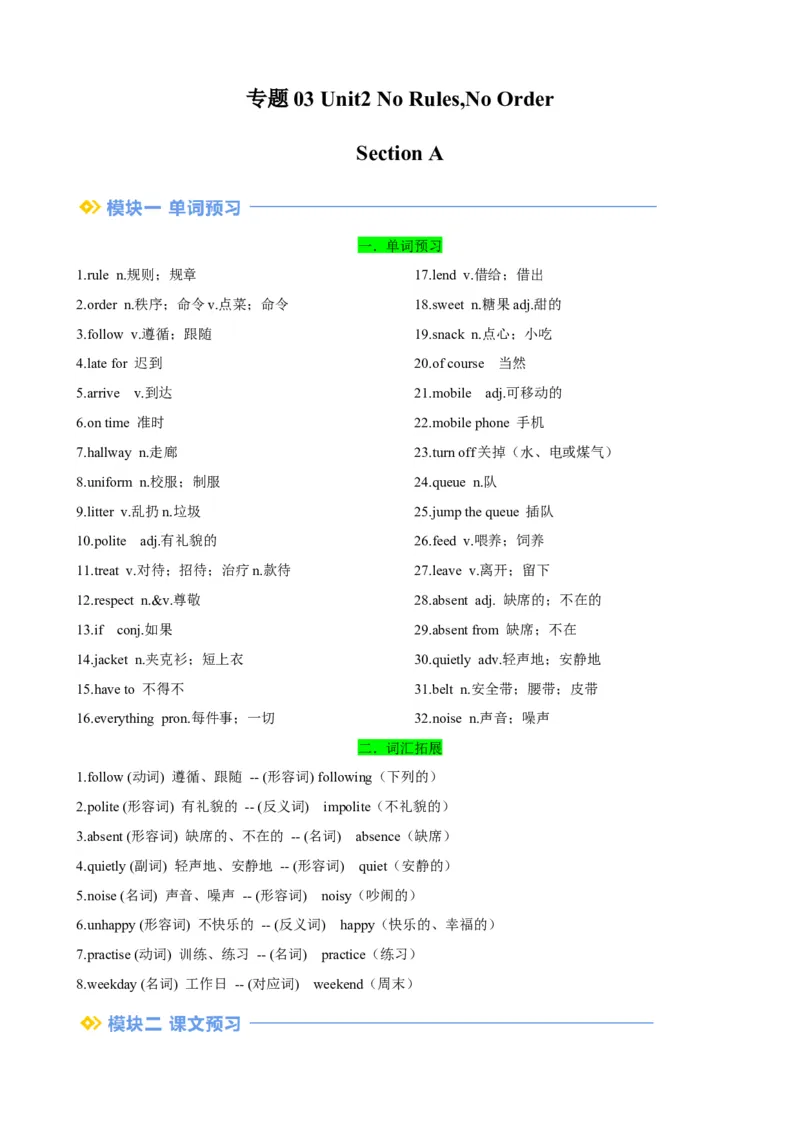
一.单词预习
1.rule n.规则;规章 17.lend v.借给;借出
2.order n.秩序;命令v.点菜;命令 18.sweet n.糖果adj.甜的
3.follow v.遵循;跟随 19.snack n.点心;小吃
4.late for 迟到 20.of course 当然
5.arrive v.到达 21.mobile adj.可移动的
6.on time 准时 22.mobile phone 手机
7.hallway n.走廊 23.turn off关掉(水、电或煤气)
8.uniform n.校服;制服 24.queue n.队
9.litter v.乱扔n.垃圾 25.jump the queue 插队
10.polite adj.有礼貌的 26.feed v.喂养;饲养
11.treat v.对待;招待;治疗n.款待 27.leave v.离开;留下
12.respect n.&v.尊敬 28.absent adj. 缺席的;不在的
13.if conj.如果 29.absent from 缺席;不在
14.jacket n.夹克衫;短上衣 30.quietly adv.轻声地;安静地
15.have to 不得不 31.belt n.安全带;腰带;皮带
16.everything pron.每件事;一切 32.noise n.声音;噪声
二.词汇拓展
1.follow (动词) 遵循、跟随 -- (形容词) following(下列的)
2.polite (形容词) 有礼貌的 -- (反义词) impolite(不礼貌的)
3.absent (形容词) 缺席的、不在的 -- (名词) absence(缺席)
4.quietly (副词) 轻声地、安静地 -- (形容词) quiet(安静的)
5.noise (名词) 声音、噪声 -- (形容词) noisy(吵闹的)
6.unhappy (形容词) 不快乐的 -- (反义词) happy(快乐的、幸福的)
7.practise (动词) 训练、练习 -- (名词) practice(练习)
8.weekday (名词) 工作日 -- (对应词) weekend(周末)Section A -2a:
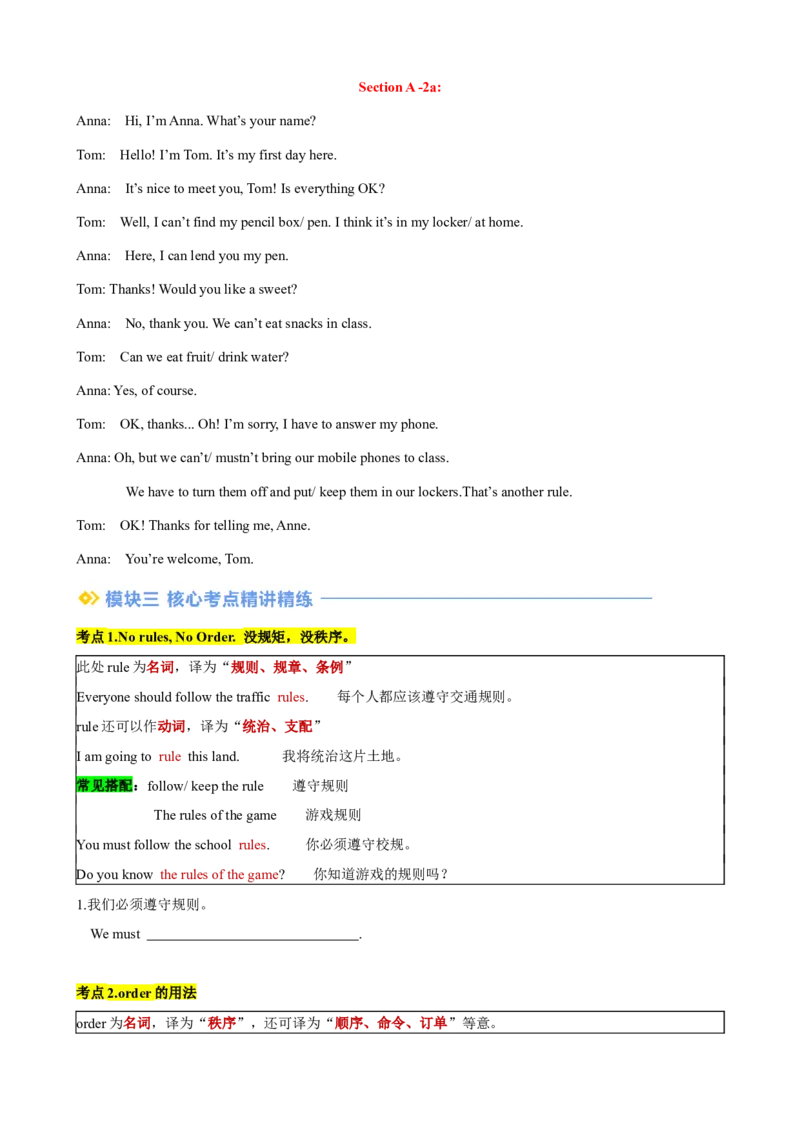
Anna: Hi, I’m Anna. What’s your name?
Tom: Hello! I’m Tom. It’s my first day here.
Anna: It’s nice to meet you, Tom! Is everything OK?
Tom: Well, I can’t find my pencil box/ pen. I think it’s in my locker/ at home.
Anna: Here, I can lend you my pen.
Tom: Thanks! Would you like a sweet?
Anna: No, thank you. We can’t eat snacks in class.
Tom: Can we eat fruit/ drink water?
Anna: Yes, of course.
Tom: OK, thanks... Oh! I’m sorry, I have to answer my phone.
Anna: Oh, but we can’t/ mustn’t bring our mobile phones to class.
We have to turn them off and put/ keep them in our lockers.That’s another rule.
Tom: OK! Thanks for telling me, Anne.
Anna: You’re welcome, Tom.
考点1.No rules, No Order. 没规矩,没秩序。
此处rule为名词,译为“规则、规章、条例”
Everyone should follow the traffic rules. 每个人都应该遵守交通规则。
rule还可以作动词,译为“统治、支配”
I am going to rule this land. 我将统治这片土地。
常见搭配:follow/ keep the rule 遵守规则
The rules of the game 游戏规则
You must follow the school rules. 你必须遵守校规。
Do you know the rules of the game? 你知道游戏的规则吗?
1.我们必须遵守规则。
We must .
考点2.order的用法
order为名词,译为“秩序”,还可译为“顺序、命令、订单”等意。The four seasons follow in order. 四个季节依次轮换。
The machine is in good working order. 机器运转良好。
order也可以作动词,译为“命令、订购、整理、建立秩序”等意。
Order him to act at once. 命令他立刻行动。
Let’s order food from a restaurant. 咱们从饭店订餐吧。
常见搭配:in order to do sth. = so that从句 “为了做某事”
He gets up early in order to catch the early bus.
= He gets up early so that he can catch the early bus. 他早起为了赶上早班车。
( )1. Look at the ______, Amy. What do you want to eat?
A.order B. make C. cook D. meal
( ) 2. I went to bed early ______ wake up early.
A.in order B. in order to C. so that D. such that
考点3.need的用法
need动词,译为“需要”。
常见搭配:need to do sth. 需要做某事(表主动)
Need doing sth. 需要做某事(表被动)
She needs to finish her work in one hour. 她需要一小时后完成工作。
The flowers need watering. 这些花需要浇水。
need亦可作情态动词,此时无人称和数的变化,后面需加动词原形。
She need finish her work in one hour. 她需要一小时后完成工作。
此外need还可以作名词同样译为“需要”。
常见搭配:in need 困难中的、有需要的、困难中的
Let’s help people in need. 让我们帮助困难中的人吧。
A friend in need is a friend indeed. 患难见真情。
( )1. Grandpa _____ to water the flowers now. It’s going to rain soon.
A.isn’t needing B. needn’t C. doesn’t need D. needs
( )2. Look! Your shirt is so dirty. It _______.
A.need washing B. need to wash C. needs washing D. need wash
( )3. There is plenty of time. You _____ be in such a hurry.
A.must B. needn’t C. can D. mustn’t
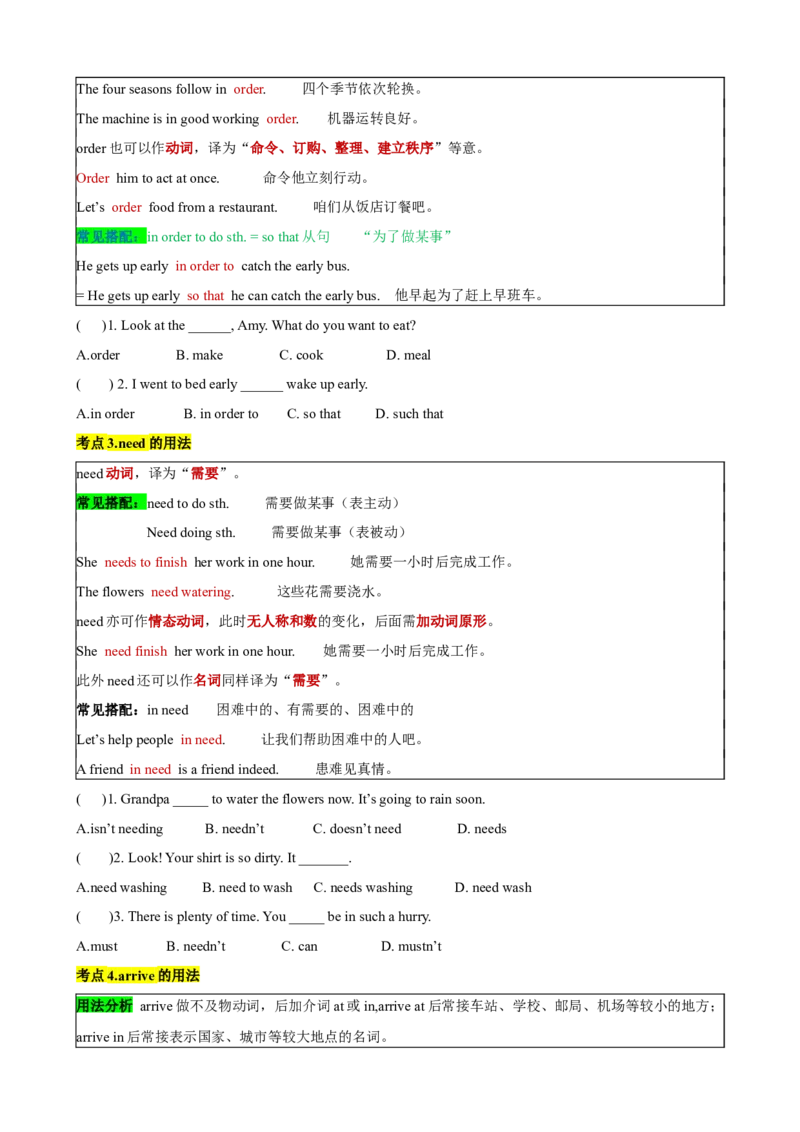
考点4.arrive的用法
用法分析 arrive做不及物动词,后加介词at或in,arrive at后常接车站、学校、邮局、机场等较小的地方;
arrive in后常接表示国家、城市等较大地点的名词。火车什么时候到站?When does the train arrive at the station?
他们明天到达纽约。They'll arrive in New York tomorrow.
小提示 arrive in/at后若接副词here/there/home等,at/in省略。
考点拓展 arrive late for表示“做某事迟到”,相当于 be late for。前者指到的时间晚,后者指状态。
Don't arrive late for the meeting next time.
=Don't be late for the meeting next time.下次开会别迟到了。
It is raining hard.I am afraid that we can't get to the airport on time. (同义替换)
A.arrive at B.get along with C.take part in D.go to
考点5.wear, put on, dress, in区别:
put on强调穿衣服的动作
It’s cold outside, please put on your sweater. 外面天气冷,请穿上你的毛衣。
wear强调穿衣服的状态
The girl wears a sweater today. 这个女孩今天穿了一件毛衣。
dress 后面接人,表示给某人穿衣服
The boy is too young to dress himself. 这个小那还太小了不能自己穿衣服。
in 后面常常接颜色表示穿某颜色的衣服
The girl in red is my little sister. 穿红衣服的女孩是我小妹妹。
( )1. The woman ____ white looks like a doctor.
A.with B. in C. wears D. puts on
( )2. The thin man ______ a black jacket. That’s cool.
A.with B. in C. wears D. puts on
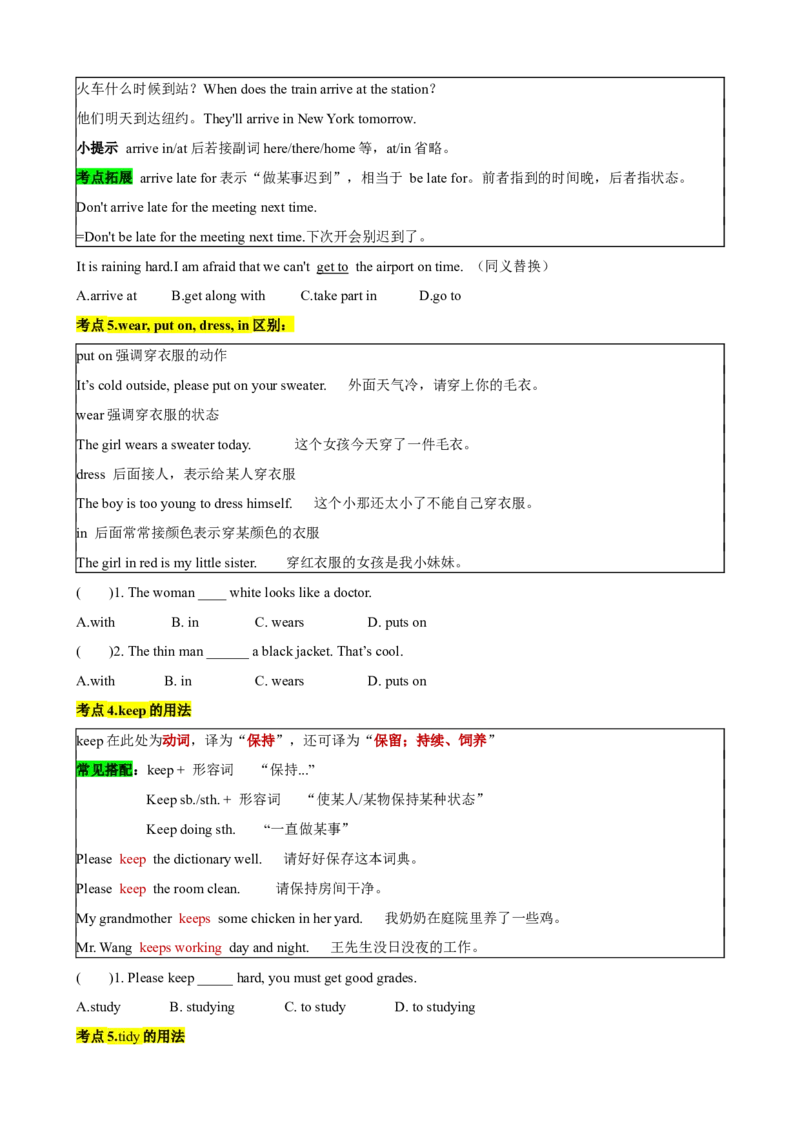
考点4.keep的用法
keep在此处为动词,译为“保持”,还可译为“保留;持续、饲养”
常见搭配:keep + 形容词 “保持...”
Keep sb./sth. + 形容词 “使某人/某物保持某种状态”
Keep doing sth. “一直做某事”
Please keep the dictionary well. 请好好保存这本词典。
Please keep the room clean. 请保持房间干净。
My grandmother keeps some chicken in her yard. 我奶奶在庭院里养了一些鸡。
Mr. Wang keeps working day and night. 王先生没日没夜的工作。
( )1. Please keep _____ hard, you must get good grades.
A.study B. studying C. to study D. to studying
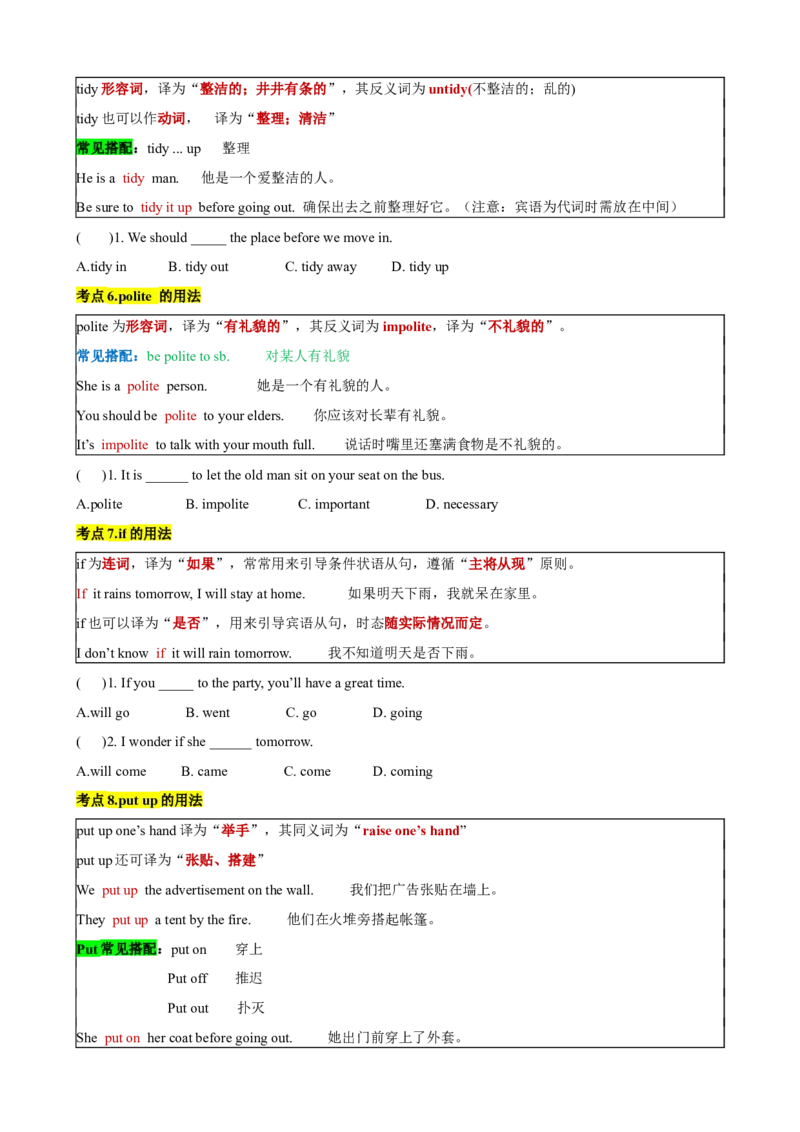
考点5.tidy的用法tidy形容词,译为“整洁的;井井有条的”,其反义词为untidy(不整洁的;乱的)
tidy也可以作动词, 译为“整理;清洁”
常见搭配:tidy ... up 整理
He is a tidy man. 他是一个爱整洁的人。
Be sure to tidy it up before going out. 确保出去之前整理好它。(注意:宾语为代词时需放在中间)
( )1. We should _____ the place before we move in.
A.tidy in B. tidy out C. tidy away D. tidy up
考点6.polite 的用法
polite为形容词,译为“有礼貌的”,其反义词为impolite,译为“不礼貌的”。
常见搭配:be polite to sb. 对某人有礼貌
She is a polite person. 她是一个有礼貌的人。
You should be polite to your elders. 你应该对长辈有礼貌。
It’s impolite to talk with your mouth full. 说话时嘴里还塞满食物是不礼貌的。
( )1. It is ______ to let the old man sit on your seat on the bus.
A.polite B. impolite C. important D. necessary
考点7.if的用法
if为连词,译为“如果”,常常用来引导条件状语从句,遵循“主将从现”原则。
If it rains tomorrow, I will stay at home. 如果明天下雨,我就呆在家里。
if也可以译为“是否”,用来引导宾语从句,时态随实际情况而定。
I don’t know if it will rain tomorrow. 我不知道明天是否下雨。
( )1. If you _____ to the party, you’ll have a great time.
A.will go B. went C. go D. going
( )2. I wonder if she ______ tomorrow.
A.will come B. came C. come D. coming
考点8.put up的用法
put up one’s hand译为“举手”,其同义词为“raise one’s hand”
put up还可译为“张贴、搭建”
We put up the advertisement on the wall. 我们把广告张贴在墙上。
They put up a tent by the fire. 他们在火堆旁搭起帐篷。
Put常见搭配:put on 穿上
Put off 推迟
Put out 扑灭
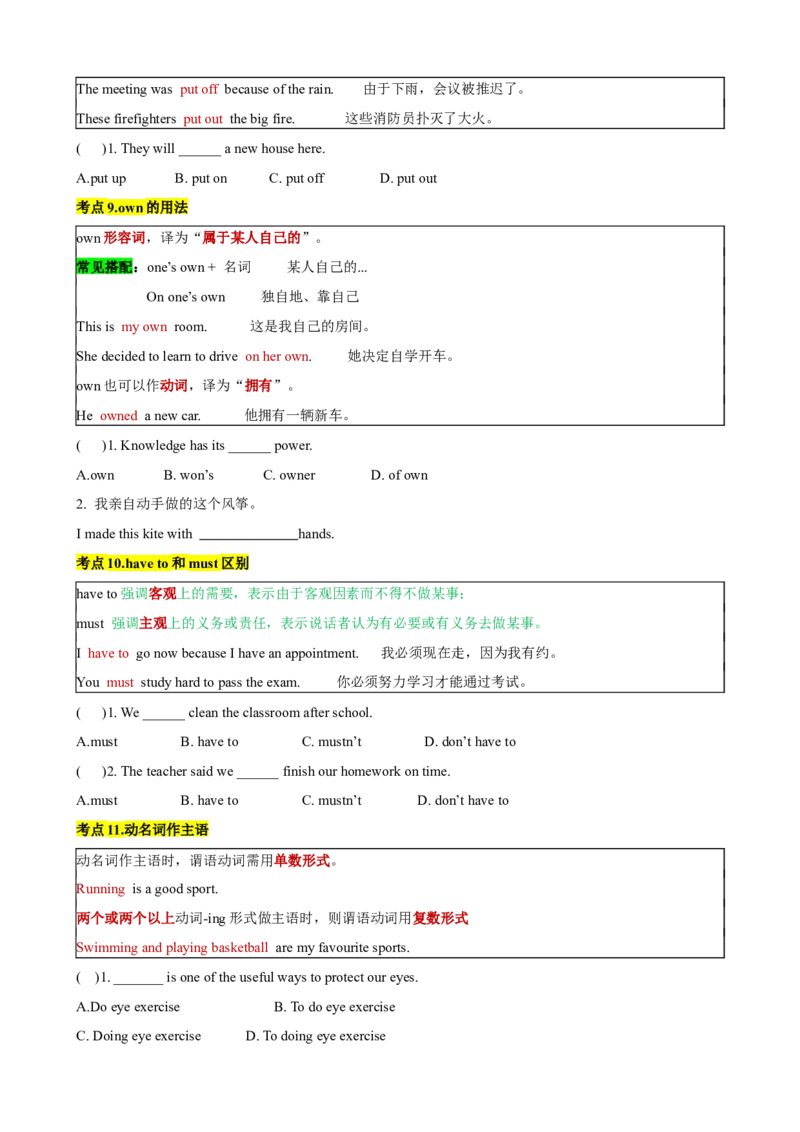
She put on her coat before going out. 她出门前穿上了外套。The meeting was put off because of the rain. 由于下雨,会议被推迟了。
These firefighters put out the big fire. 这些消防员扑灭了大火。
( )1. They will ______ a new house here.
A.put up B. put on C. put off D. put out
考点9.own的用法
own形容词,译为“属于某人自己的”。
常见搭配:one’s own + 名词 某人自己的...
On one’s own 独自地、靠自己
This is my own room. 这是我自己的房间。
She decided to learn to drive on her own. 她决定自学开车。
own也可以作动词,译为“拥有”。
He owned a new car. 他拥有一辆新车。
( )1. Knowledge has its ______ power.
A.own B. won’s C. owner D. of own
2. 我亲自动手做的这个风筝。
I made this kite with hands.
考点10.have to和must区别
have to强调客观上的需要,表示由于客观因素而不得不做某事;
must 强调主观上的义务或责任,表示说话者认为有必要或有义务去做某事。
I have to go now because I have an appointment. 我必须现在走,因为我有约。
You must study hard to pass the exam. 你必须努力学习才能通过考试。
( )1. We ______ clean the classroom after school.
A.must B. have to C. mustn’t D. don’t have to
( )2. The teacher said we ______ finish our homework on time.
A.must B. have to C. mustn’t D. don’t have to
考点11.动名词作主语
动名词作主语时,谓语动词需用单数形式。
Running is a good sport.
两个或两个以上动词-ing形式做主语时,则谓语动词用复数形式
Swimming and playing basketball are my favourite sports.
( )1. _______ is one of the useful ways to protect our eyes.
A.Do eye exercise B. To do eye exercise
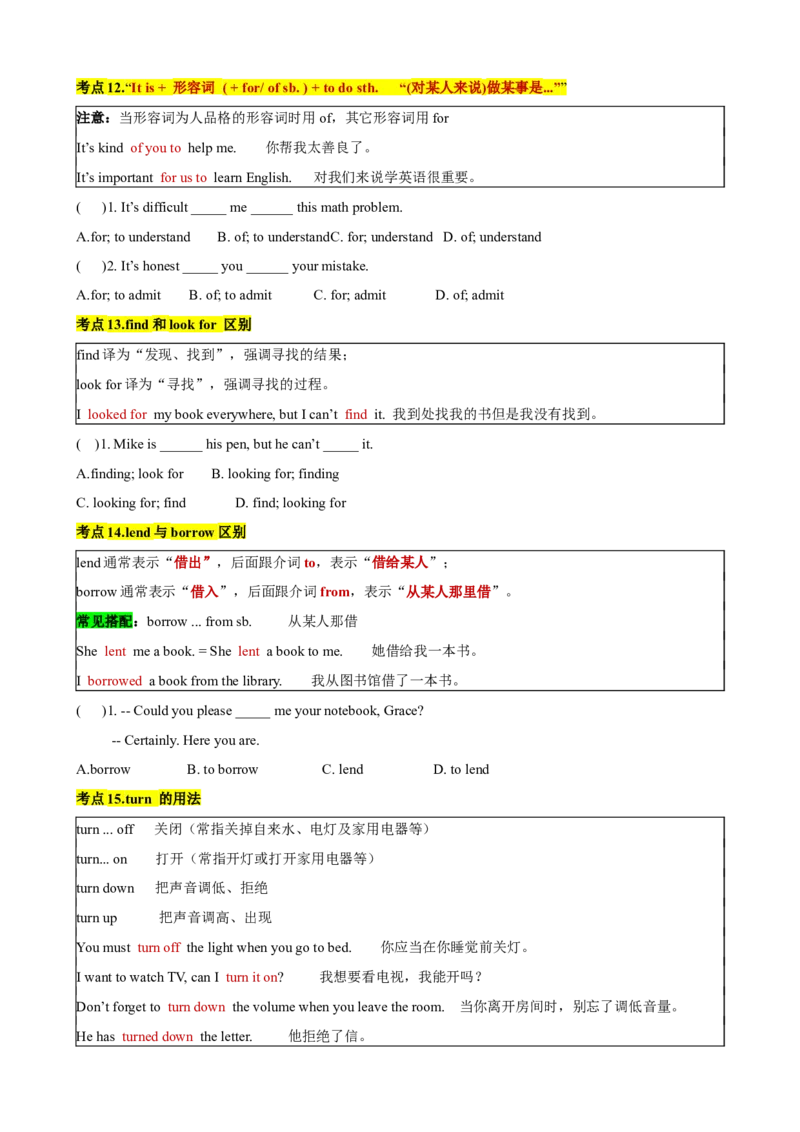
C. Doing eye exercise D. To doing eye exercise考点12.“It is + 形容词 ( + for/ of sb. ) + to do sth. “(对某人来说)做某事是...””
注意:当形容词为人品格的形容词时用of,其它形容词用for
It’s kind of you to help me. 你帮我太善良了。
It’s important for us to learn English. 对我们来说学英语很重要。
( )1. It’s difficult _____ me ______ this math problem.
A.for; to understand B. of; to understandC. for; understand D. of; understand
( )2. It’s honest _____ you ______ your mistake.
A.for; to admit B. of; to admit C. for; admit D. of; admit
考点13.find和look for 区别
find译为“发现、找到”,强调寻找的结果;
look for译为“寻找”,强调寻找的过程。
I looked for my book everywhere, but I can’t find it. 我到处找我的书但是我没有找到。
( )1. Mike is ______ his pen, but he can’t _____ it.
A.finding; look for B. looking for; finding
C. looking for; find D. find; looking for
考点14.lend与borrow区别
lend通常表示“借出”,后面跟介词to,表示“借给某人”;
borrow通常表示“借入”,后面跟介词from,表示“从某人那里借”。
常见搭配:borrow ... from sb. 从某人那借
She lent me a book. = She lent a book to me. 她借给我一本书。
I borrowed a book from the library. 我从图书馆借了一本书。
( )1. -- Could you please _____ me your notebook, Grace?
-- Certainly. Here you are.
A.borrow B. to borrow C. lend D. to lend
考点15.turn 的用法
turn ... off 关闭(常指关掉自来水、电灯及家用电器等)
turn... on 打开(常指开灯或打开家用电器等)
turn down 把声音调低、拒绝
turn up 把声音调高、出现
You must turn off the light when you go to bed. 你应当在你睡觉前关灯。
I want to watch TV, can I turn it on? 我想要看电视,我能开吗?
Don’t forget to turn down the volume when you leave the room. 当你离开房间时,别忘了调低音量。
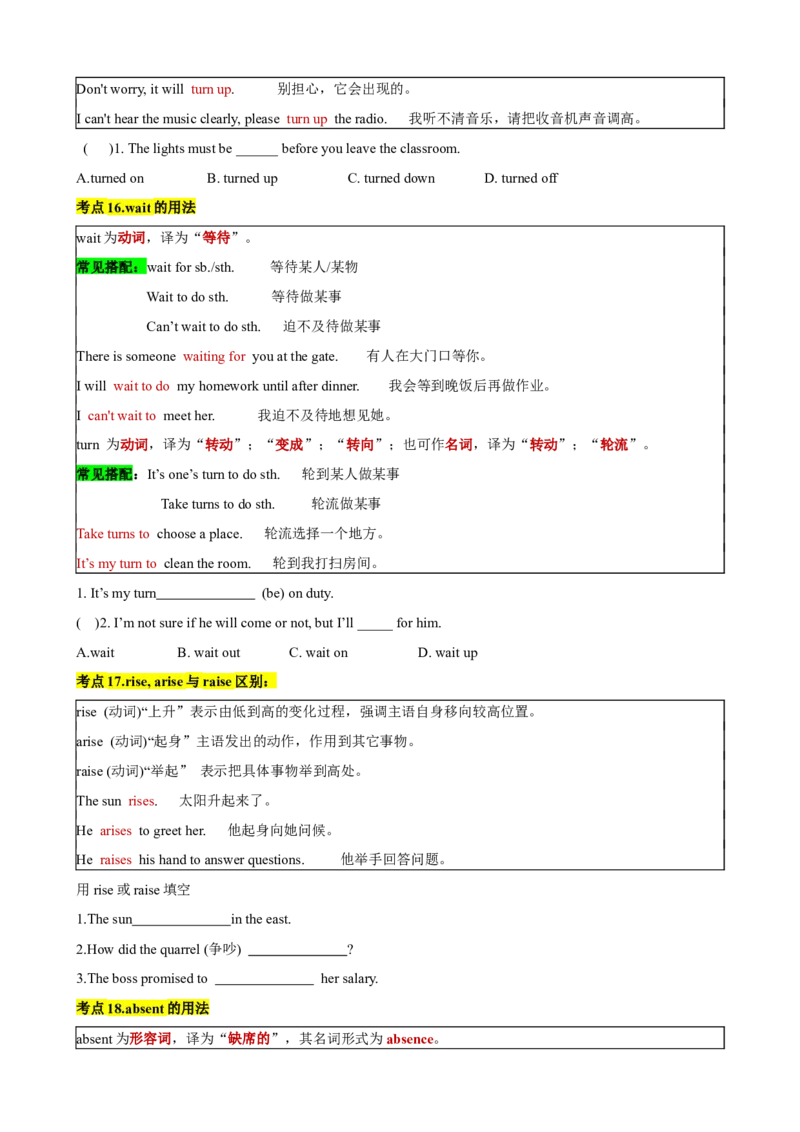
He has turned down the letter. 他拒绝了信。Don't worry, it will turn up. 别担心,它会出现的。
I can't hear the music clearly, please turn up the radio. 我听不清音乐,请把收音机声音调高。
( )1. The lights must be ______ before you leave the classroom.
A.turned on B. turned up C. turned down D. turned off
考点16.wait的用法
wait为动词,译为“等待”。
常见搭配:wait for sb./sth. 等待某人/某物
Wait to do sth. 等待做某事
Can’t wait to do sth. 迫不及待做某事
There is someone waiting for you at the gate. 有人在大门口等你。
I will wait to do my homework until after dinner. 我会等到晚饭后再做作业。
I can't wait to meet her. 我迫不及待地想见她。
turn 为动词,译为“转动”;“变成”;“转向”;也可作名词,译为“转动”;“轮流”。
常见搭配:It’s one’s turn to do sth. 轮到某人做某事
Take turns to do sth. 轮流做某事
Take turns to choose a place. 轮流选择一个地方。
It’s my turn to clean the room. 轮到我打扫房间。
1. It’s my turn (be) on duty.
( )2. I’m not sure if he will come or not, but I’ll _____ for him.
A.wait B. wait out C. wait on D. wait up
考点17.rise, arise与raise区别:
rise (动词)“上升”表示由低到高的变化过程,强调主语自身移向较高位置。
arise (动词)“起身”主语发出的动作,作用到其它事物。
raise (动词)“举起” 表示把具体事物举到高处。
The sun rises. 太阳升起来了。
He arises to greet her. 他起身向她问候。
He raises his hand to answer questions. 他举手回答问题。
用rise或raise填空
1.The sun in the east.
2.How did the quarrel (争吵) ?
3.The boss promised to her salary.
考点18.absent的用法
absent为形容词,译为“缺席的”,其名词形式为absence。常见搭配:be absent from... 缺席...
make oneself absent 故意缺席
He was absent from work yesterday. 他昨天没来上班。
He made himself absent from the meeting on purpose. 他故意缺席会议。
1.Li Ming has been (absence) from class three times this week.
( )2. Mr. Wang is absent _____ the important meeting today.
A.with B. for C. on D. from
考点19.noise的用法
noise为不可数名词,译为“噪音”;其形容词形式为noisy,译为“吵闹的”。
常见搭配:make some noise 制造噪音
noise pollution 噪声污染
They was a strange noise in his ears. 他听到奇怪的杂音。
The engine is very noisy at high speed. 这个发动机在高速时噪音很大。
【易混辨析】 sound, voice与noise区别:
sound指自然界中所有的声音
voice指人说话的声音或悦耳的鸟叫
noise指让人不舒服的噪音
sound of music 音乐之声
That sounds great. 听起来不错。
The girl’s voice is sweet. 这个女孩的声音很甜美。
Don’t make noise, please. 请不要制造噪音。
( )1. There is a lot of _____ next door. They must be having a party.
A.sound B. noise C. voice D. noisy
( )2. The girl has a sweet _____. She sings very well.
A.voice B. noise C. sound D. sounds
一.祈使句
一、基本用法
祈使句用来表示命令、请求、劝告、建议、禁止等,以动词原形开头,否定祈使句以“Don't+动词原形”
开头。它的主语是听话人(you),一般不需要说出来,祈使句末尾用感叹号或句号,句子用降调。
Open the door,please.请把门打开。
Don't forget to take your medicine,Alice.爱丽丝,不要忘记吃药。祈使句的种类:
1.do型。即省略主语you,用动词原形开头,开头或结尾可以用 please。
Listen to me carefully,please.请仔细听我讲。
2.be型。以系动词be开头,其句型为:Be动词+表语(名词、形容词)+其他。
Be quiet,boys and girls!大家安静!
3.Let型。Let后面可以跟代词第一、二和第三人称的宾格做宾语,即 Let sb. do sth.。
Let's go and ask our teacher.咱们去问问老师吧。
4.省略型。祈使句可采用省略形式,即根据上下文省略动词或动词词组。
This way,please.请这边走。(句首省略come)
二、特殊用法
(一)祈使句否定形式
1.肯定形式是do型和be型的句子,其否定形式在句首加Don't,句首有 please或人名的,在 please或人
名后加don't。
Don't do it like that!不要那样做!
Mary,don't be late for class again.玛丽,上课不要再迟到了。(容易错用 doesn't)
2.Let型句子。其否定形式为“Let+宾语+not+动词原形+其他.”。
Let them not go out for a walk.It is raining.让他们别出去散步了。下雨了。
3.警示型。常由“No+名词或动词的-ing形式”构成,表示“禁止”或“规劝”人们不许做某事。
No photos.不许拍照。
No parking!禁止停车!
No parking here.此处不准停车。
(二)祈使句的回答
1.由于祈使句所表达的动作是还未发生的,因此对它的应答通常要用“一般将来时”。
—Please turn off the light when you go out.当你出去的时候请关上灯。
—OK,I will.好的,我会的。
Don't be late any more.不要再迟到了。
Sorry,I won't.对不起,我不会再迟到了。
2.以let开头的句式的肯定回答多用“Good idea.”,否定用“ Sorry,...”
—Let's chat on the Internet.我们上网聊天吧。
—Good idea.好主意。
三、难点突破
祈使句与复合句的转换
if引导的条件状语从句可以转换成“祈使句+and/or+简单句”结构。If you don't hurry, you'll not catch the early bus.
=Hurry up,or you'll not catch the early bus.如果你不快点,就赶不上早班公交车了。
If you work harder, you'll catch up with your classmates.
=Work harder,and you'll catch up with your classmates.如果你再努力些,你就会赶上你的同学。
一.用所给词的适当形式填空
1.—Tom, (not)draw on the wall.
—Sorry,I won't do it again.
2.Mary, let's (go) home now.
3.—May I take some pictures here?
—Sorry,you mustn't.Please look at the sign.It says“No, (photo)”.
4.Boys and girls, (be)quiet!Class begins!
5.Let him (not)open the door.It's too cold.
Ⅱ.单项填空
6.Tom,______ the umbrella with you.Look at the clouds;it's going to rain!
A.taking B.takes C.take
7.—Don't be late for class next time,Jiang Tao.
—______.
A.OK.I will B.I know C.Sorry,I won't D.It doesn't matter
8.—______,or you won't do well in your lessons.
—OK.I will.
A.Don't work hard B.Work hard C.Hard work
9.David,______ make trouble at school.
A cant B. don't C. doesn't
10.______throwing those stones, please.
A.Stop B.Stops C.Stopping D.Stopped
11.Boys and girls,_____ learning and ave fun.
A.keep B.to keep C.keeping D.kept
12.—Mom, can I go dancing this evening?
—______your homework first,and then we'll talk about.
A.Finish B.Finishing C.To finish D.Finished
13.—Don't eat junk food. It's bad for you.
—______.
A.Sorry,I won't B.Sure.I will C.Take it easy D.Never mind14.—______run in the hallways,Mike.
—Sorry,Ms.Clark.
A.Don't B.Please C.No
15.—______dressed now!We have to go in ten minutes.
—OK.Mom.
A.Getting B.Get C.To get D.Gets
二.情态动词
1.Can
(1) 表能力: He can speak English. “他会说英语。”
(2) 表许可: You can play for an hour. “你可以玩一个小时。”
(3) 表请求: Can you help me? “你能帮我吗?”
2.May
(1) 表许可,比can更委婉:
May I have a look? “我可以看一看吗?”
(2) 表可能性,意为“也许”:
I may be late. “我也许迟到了。”
3.Must 说话人主观意愿,其否定形式mustn’t表示“禁止;不准”
You must finish work in two hours. “两个小时后你必须完成工作。”
注意:用must开头的一般疑问句,其否定回答用needn’t
-- Must I finish my homework now? “我必须现在完成我的工作吗?”-- No, you needn’t.
“不,你不需要。”
4.Have to 强调客观的需要,其否定形式don’t have to表示“不必”
表示“不得不;必须”
一、用所给词的适当形式填空
1. (not eat) in class.
2. We must (be) careful when we cross the street.
3. It’s important for us (learn) English carefully.
4. No (swim) in the river.
5. (listen) to the teacher carefully.
二、单项选择
( )1. Jim, ______ fight with your elder brother.
A. doesn’t B. don’t C. not D. no
( )2. The park is far away. We ______ take the subway to the park.A. must B. can C. has to D. have to
( )3. -- Don’t make noise in the library.
-- ______
A. Yes, I can B. No, I can’t C. Yes, I know D. Sorry, I won’t
( )4. -- Must you do the dishes now?
-- No, I _____. But I want to do it now.
A. can’t B. mustn’t C. don’t D. needn’t
( )5. Don’t go out _____ school night.
A. at B. on C. in D. by
一.根据句意和首字母提示写出所缺的单词
1.—Don't l to music in class, Mike.
—Sorry, Mr. Lee. I won't do that.
2.Don't forget to b your homework here tomorrow.
3.Don't a late for class. You must be on time.
4.Don't f with your best friend. You can talk with her tomorrow.
5.We must obey the traffic r when we walk on the street.
二.单项选择
6.—Helen, can you see uniform on the chair?
—Yes. uniform is blue and white.
A.a;The B.an;The C.the;A D.the;An
7.—Sam, run in the hallways. It's very dangerous.
—Sorry, Ms. Black.
A.do B.don't C.not D.doesn't
8.As students, we have to follow the school rules and come to school .
A.on time B.in time C.next time
9.I think doing gymnastics (体操) is very because it is good for us.
A.quiet B.important C.interesting D.funny
10.—Rules are rules!
—That's true. We follow them.
A.can B.will C.may D.must
11.—Can you the village tomorrow with your cousin?—Yes, we can get there in the afternoon.
A.get B.arrive in C.arrive at D.reach to
12.Please the book to me when you come here tomorrow.
A.bring B.keep C.leave D.take
13. trying and do your best.
A.Keep B.Keeping C.To keep D.Kept
14.—Be , please! Your sister is reading a book.
—All right! I will.
A.happy B.crazy C.honest D.quiet
15.On school days, we must wear school uniforms, but on weekends we .
A.must B.mustn't C.have to D.don't have to
三.根据汉语意思和所给的提示词语翻译句子
16.不要在教室里吃东西。(don't)
17.不要和其他男孩打架。(other)
18.你们不能在走廊里跑来跑去。(can't, around)
19.我们必须穿校服。(have to)
20.我们不能在教室里听音乐,但是我们可以在外面听。(can't, but, it)
四.补全对话
从方框中选出合适的句子,填在对话空缺处,使对话内容完整。
A:Hi, Tom! 2 1
B:Not bad. But there are lots of rules at school.
A: 2 2
B:We can't watch TV or go to the movies on school nights. We have to clean our classroom every day.
A:Really? Do you have to wear school uniforms?
B:Yes. 2 3
A:Can you listen to music in the classroom?
B:No,we can't. We even can't listen to it in the hallways. 2 4
A: 2 5B:Sure. I like my new school.
A.Do you like your new school?
B.What are some of the rules?
C.How is your new school?
D.And we have to wear sports shoes for P.E. classes.
E.But we can listen to it outside.
能力提升
一
special spend end name interest
pick up happy find after quickly
The “pupils are excited about their coming lunch. Will they get a
big bone(骨头)?Oh, this is a 1 school. Some dogs go to this school
when their owners(主人) are busy working.
The cute dogs" teacher” is Arat Montoya, a man from Mexico. At
first. his father wanted him to become a baker(烘焙师),but Arat had no
2 in baking. He told his father, “Dad, I love dogs.”
When Arat grew up, he 3 a job at the Dog Club of West Linn, a dog care center. In2016,
4 the center closed, Arat had an idea. He started his own dog care center and 5 it Doggie
School Bus Inc.
Every morning, Arat drives the yellow“ Doggie School Bus" to people's homes to 6 dogs.
The dogs love Arat so much that they get 7 every time they see him. Many of them even run out of
their homes 8 and straight onto the bus when they hear the bus come. The dogs 9 most of
the day at the dog care center, playing and having fun with Arat and other dogs. The school day comes
to a(n) 10 at 2 pm. And Arat drives the dogs back to their homes. Arat loves what he does. He
calls himself the happiest man in the world.
二
Two art teachers, Martin and Weiss, started the PepToc Hotline in February
2022 with their students. It 1 on making sad people happy. People may
hear warm 2 like “Believe in yourself.” “It's OK to be different.” “BE
YOU.” Getting thousands of calls an hour, it's now 3 around the world.
“We just wanted to do something for our little town at first.” Martin said. People in the town went
through(经历) a hard life because ofCOVID-19. 4 then a big fire made many people homeless.At the beginning, Martin and Weiss just made some posters 5 encouraging(鼓励的)
words. Then the kids 6 the posters around town. Kids were glad to do that and ran 7
.One day, Martin asked kids for different ideas.“ They were smart and gave me many 8 and the
PepToc Hotline is one of them," said Martin.
What made the PepToc Hotline so famous? Darin said," People need something to make them feel
good in these 9 times.” "We all need a light," a caller said.
Kids, if you have an idea, just try to do it and see what will happen. Small acts can make a big
change. You should 10 that you are able to make the world better although you're just kids.
1.A.starts B. thinks C. works D. takes
2.A.messages B. poems C. information D. songs
3. A. small B. popular C. wide D. natural
4.A. Yet B. So C. Too D. And
5.A. with B. from C. of D. by
6.A. put on B. put off C. put up D. put away
7.A. happily B. luckily C. quickly D. simply
8.A. danger B. surprises C. pictures D. words
9. A. beautiful B. safe C. late D. hard
10. A. share B. remember C. divide D. try
三
Do you play with your phone before bedtime? According to CCTV news,
nearly 70% of late sleep is connected with cell phones. Looking at screens at
night can also cause us to sleep not well.
In the evening. our brains make melatonin(褪黑素).It helps us feel sleepy
and relaxed. It's an important part of our sleep cycle(周期).The screens stop
that cycle from working normally(正常地).
Why? The screens of phones,computers and TVs make blue light. Blue light stops our bodies from making
melatonin. Even just a little bit of blue light can have an effect(影响).Eight minutes of blue light may keep your
brain“ awake” for another hour. Even when you are sleeping, you may have lots of dreams. Your brain won't
have a good rest.
It's even worse if you play an exciting game before bed. Games make our hearts beat(跳动)faster.so we
have a harder time falling asleep. Then, when we are sleeping, we don't get enough“ deep sleep”.
Will you play with your phone before sleep now?1.Which of the following about melatonin is TRUE?
A.It makes us hungry and tired.
B. It helps us fall asleep at night.
C.It is usually made in the morning.
D. Too much of it makes us sleep not well.
2.How do mobile phones' screens make us hard to sleep?
A.They cannot make us feel relaxed.
B. Their blue light stops our sleep cycle from going normally.
C. Their blue light makes our heart beat faster.
D. They help to make more melatonin than our bodies need.
3.What does the underlined word“ awake” mean?
A. 清醒 B. 兴奋 C. 放松 D. 做梦
4.What is the story mainly about?
A. How to get a good sleep.
B. Why scientists study sleep.
C. Why some people have lots of dreams.
D. How playing with phones at night causes bad sleep.