课时 05 考点拓展 5&一般现在时、现在进行时&写作指导(节日庆
祝)
目录
一.词汇拓展...............................................................................................................................................................1
二.考点拓展...............................................................................................................................................................1
三.语法考点...............................................................................................................................................................5
四.写作考点.............................................................................................................................................................10
五.阅读拓展.............................................................................................................................................................12
一.词汇拓展
1. colour (Am E color) (n.)颜色→ (adj.) 鲜艳的;生动的
2. orange (adj.)橘黄色的; 橘色的 (n.)柑橘;橙;橘黄色 橙汁
3. day (n.)一天→ (adj.)每日的;日常的
一整天 日复一日地 (将来)总有一天 一天天地;渐渐地
4. warm (adj.)暖和的,温暖的 (v.)使暖和,使温暖→ (n.)温暖 保暖
5. hot (adj.)热的→ (比较级)→ (最高级)
6. like (prep.)如同,像 (v.)喜爱,关爱 看起来像 给……的感觉;想要
7. swimming (n.)游泳 去游泳
8. sport (n.)运动 运动会 做运动
9. let (v.)让,使→ (过去式) 让某人做某事 让我们做某事吧。
10. play (v.)参加 (体育运动或球赛);玩耍 (v.)演奏;弹奏→ (过去式)→ (n.)运动
员;选手 对战;同……比赛 和某人玩耍 玩某物 拿某人
开玩笑
二.考点拓展
考点1.频度副词的用法
Sometimes hurricanes do good.
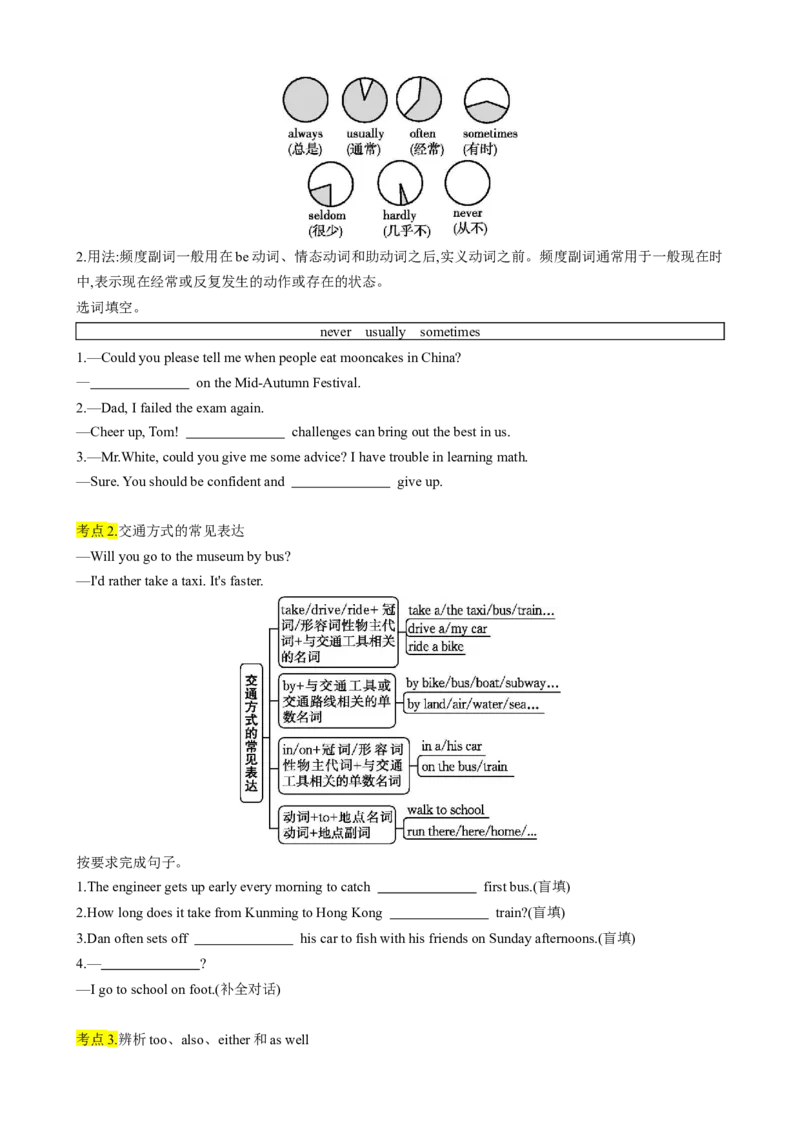
1.含义:频度副词表示事情发生的频率,频度副词按频率发生的高低依次为:2.用法:频度副词一般用在be动词、情态动词和助动词之后,实义动词之前。频度副词通常用于一般现在时
中,表示现在经常或反复发生的动作或存在的状态。
选词填空。
never usually sometimes
1.—Could you please tell me when people eat mooncakes in China?
— on the Mid-Autumn Festival.
2.—Dad, I failed the exam again.
—Cheer up, Tom! challenges can bring out the best in us.
3.—Mr.White, could you give me some advice? I have trouble in learning math.
—Sure. You should be confident and give up.
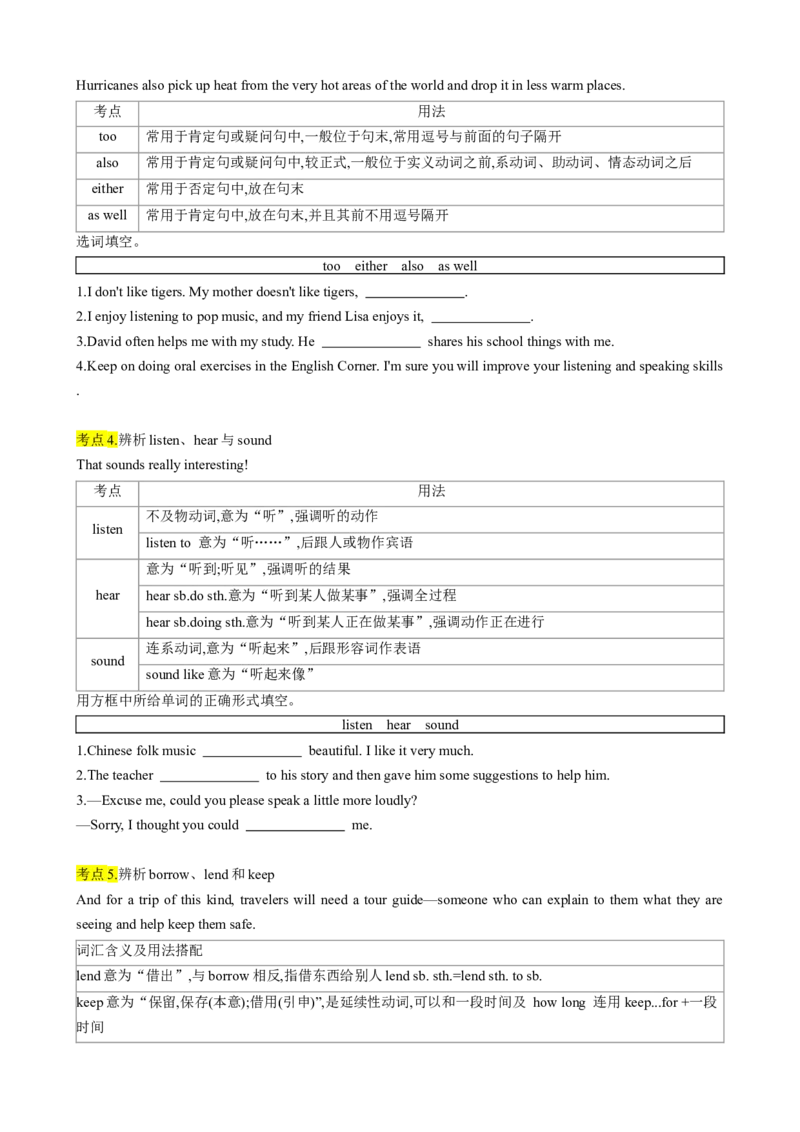
考点2.交通方式的常见表达
—Will you go to the museum by bus?
—I'd rather take a taxi. It's faster.
按要求完成句子。
1.The engineer gets up early every morning to catch first bus.(盲填)
2.How long does it take from Kunming to Hong Kong train?(盲填)
3.Dan often sets off his car to fish with his friends on Sunday afternoons.(盲填)
4.— ?
—I go to school on foot.(补全对话)
考点3.辨析too、also、either和as wellHurricanes also pick up heat from the very hot areas of the world and drop it in less warm places.
考点 用法
too 常用于肯定句或疑问句中,一般位于句末,常用逗号与前面的句子隔开
also 常用于肯定句或疑问句中,较正式,一般位于实义动词之前,系动词、助动词、情态动词之后
either 常用于否定句中,放在句末
as well 常用于肯定句中,放在句末,并且其前不用逗号隔开
选词填空。
too either also as well
1.I don't like tigers. My mother doesn't like tigers, .
2.I enjoy listening to pop music, and my friend Lisa enjoys it, .
3.David often helps me with my study. He shares his school things with me.
4.Keep on doing oral exercises in the English Corner. I'm sure you will improve your listening and speaking skills
.
考点4.辨析listen、hear与sound
That sounds really interesting!
考点 用法
不及物动词,意为“听”,强调听的动作
listen
listen to 意为“听……”,后跟人或物作宾语
意为“听到;听见”,强调听的结果
hear hear sb.do sth.意为“听到某人做某事”,强调全过程
hear sb.doing sth.意为“听到某人正在做某事”,强调动作正在进行
连系动词,意为“听起来”,后跟形容词作表语
sound
sound like意为“听起来像”
用方框中所给单词的正确形式填空。
listen hear sound
1.Chinese folk music beautiful. I like it very much.
2.The teacher to his story and then gave him some suggestions to help him.
3.—Excuse me, could you please speak a little more loudly?
—Sorry, I thought you could me.
考点5.辨析borrow、lend和keep
And for a trip of this kind, travelers will need a tour guide—someone who can explain to them what they are
seeing and help keep them safe.
词汇含义及用法搭配
lend意为“借出”,与borrow相反,指借东西给别人lend sb. sth.=lend sth. to sb.
keep意为“保留,保存(本意);借用(引申)”,是延续性动词,可以和一段时间及 how long 连用keep...for +一段
时间borrow指从别人那里借东西,是非延续性动词,表示“某人把某物借了多久”用sb.have/has kept sth. for+一
段时间borrow sth.from sb.
选词填空。
keep borrow lend
1.Sorry, I can't you the dictionary, Betty. I have lost it.
2.You can eggs for about four weeks in your fridge.
3.My car is under repair. Can I yours for a day?
三.语法考点
一般现在时
定义:表示现阶段经常或习惯发生的动作或存在的状态。
构成:do,does/be(am,is,are)——动词变三单 past now future
基本句型:
句型: do does(三单) am,is,are
陈述句 I drink water every morning. She drink s water every morning. She is late for school.
否定句 I don’t drink water every morning. She doesn’t drink water every morning. She is not late for school.
疑问句 Do you drink water every morning? Does she drink water every morning? Is she late for school?
Yes, I do./No,I don’t. Yes,she does./No,she doesn’t. Yes,she is./No,she isn’t.
时间标志:一般现在时句子中常有的时间状语:always、often、usually、seldom、never、sometimes,
every week (day, year, month…), once a week, on Sundays.
如:They go to the Palace Museum once a year.(他们每年去一次故宫)
They often discuss business in the evening.(他们经常在晚上商谈生意)
(1)表示客观真理、事实、人的技能或现在的状态时句子里一般不用时间状语。
如:The earth turns round the sun.(地球绕着太阳转)
Light travels faster than sound.(光传播比声音快)
(2)条件状语从句中(以if,unless,as soon as引导)满足“主将从现”,表条件用一般现在时。
如: If it rains tomorrow ,we will have to stay at home.(如果明天下雨我们就只好呆在家)
We will stay at home as soon as it rains tomorrow .
二.一般现在时的两种形式
根据主语的人称和数的不同,行为动词的一般现在时有两种形式。
(1)当主语是第一人称、第二人称和第三人称的复数时,行为动词使用其原形。
We have breakfast and supper at home.我们在家吃早饭和晚饭。
You like swimming, right? 你们喜欢游泳,对吗?
My parents read books at weekends.我父母周末读书。
(2)当主语是第三人称单数时,行为动词使用其第三人称单数形式。
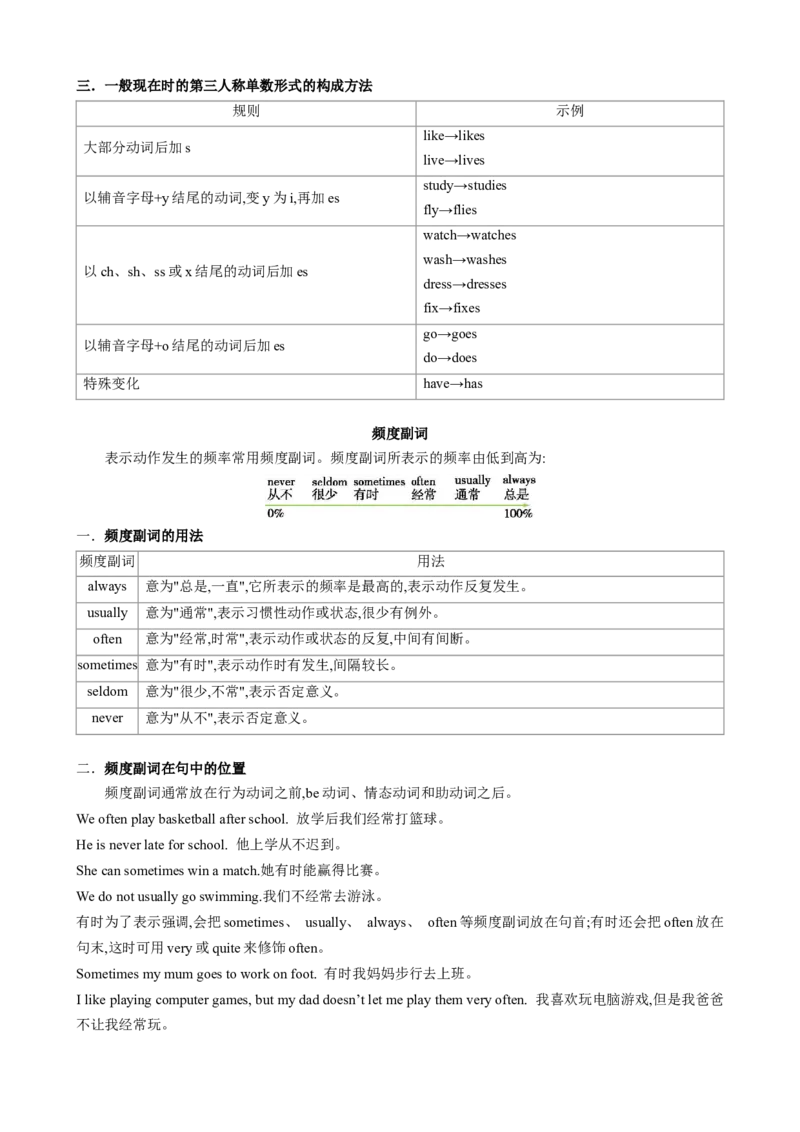
He does his homework at home. 他在家里做他的家庭作业。三.一般现在时的第三人称单数形式的构成方法
规则 示例
like→likes
大部分动词后加s
live→lives
study→studies
以辅音字母+y结尾的动词,变y为i,再加es
fly→flies
watch→watches
wash→washes
以ch、sh、ss或x结尾的动词后加es
dress→dresses
fix→fixes
go→goes
以辅音字母+o结尾的动词后加es
do→does
特殊变化 have→has
频度副词
表示动作发生的频率常用频度副词。频度副词所表示的频率由低到高为:
一.频度副词的用法
频度副词 用法
always 意为"总是,一直",它所表示的频率是最高的,表示动作反复发生。
usually 意为"通常",表示习惯性动作或状态,很少有例外。
often 意为"经常,时常",表示动作或状态的反复,中间有间断。
sometimes 意为"有时",表示动作时有发生,间隔较长。
seldom 意为"很少,不常",表示否定意义。
never 意为"从不",表示否定意义。
二.频度副词在句中的位置
频度副词通常放在行为动词之前,be动词、情态动词和助动词之后。
We often play basketball after school. 放学后我们经常打篮球。
He is never late for school. 他上学从不迟到。
She can sometimes win a match.她有时能赢得比赛。
We do not usually go swimming.我们不经常去游泳。
有时为了表示强调,会把sometimes、 usually、 always、 often等频度副词放在句首;有时还会把often放在
句末,这时可用very或quite来修饰often。
Sometimes my mum goes to work on foot. 有时我妈妈步行去上班。
I like playing computer games, but my dad doesn’t let me play them very often. 我喜欢玩电脑游戏,但是我爸爸
不让我经常玩。三.用how often对频度副词进行提问
对频度副词进行提问时,要用how often。
He seldom does morning exercises. 他很少做早操。
→ How often does he do morning exercises? 他多久做一次早操?
一.用括号内所给词的适当形式填空
1.Alex (hope) he can visit the USA in the future.
2.Sandy with her friends often (fly) a kite in the park.
3. (be) your friend ready for tomorrow’s evening party?
4.Members in this club (be not) careful. They often leave the club with the lights on.
5.Cindy is a kind girl. Everyone in our class (enjoy) playing with her.
6.My best friend and I (be not) in the same school. We meet at the weekend.
7.My mother (not go) to work on Saturdays or Sundays.
8.Millie’s family often (read) together in the living room.
9.Watching football matches (be) her hobby.
10.We all know light (go) faster than sound.
二.按要求完成句子,每空一词
11.I’m your English teacher this term.(改为一般疑问句)
our English teacher this term?
12.Li Lei writes to his father every month. (改为一般疑问句)
Li Lei to his father every month?
13.My mother does housework in the morning.(改为否定句)
My mother housework in the morning.
14.Do you often have breakfast at home?(用 Kitty代替 you 改写句子)
Kitty often breakfast at home?
15.The old woman goes to the supermarket on foot. (对画线部分提问)
the old woman to the supermarket?
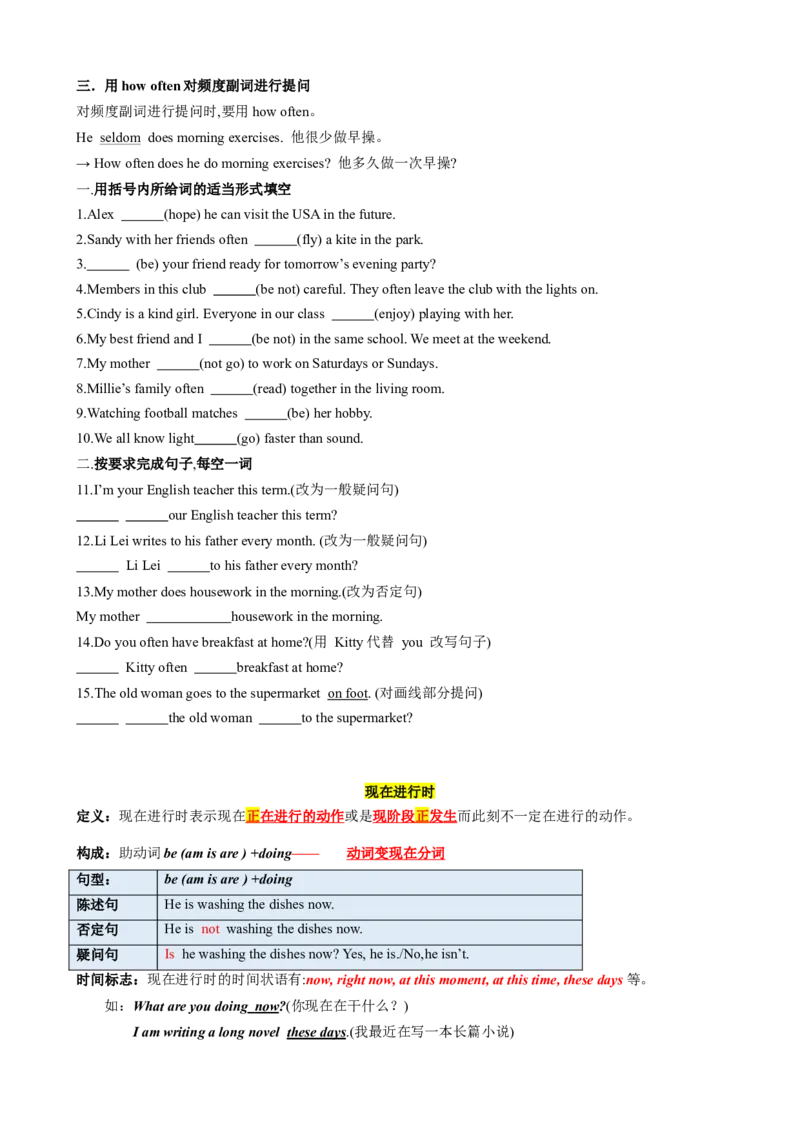
现在进行时
定义:现在进行时表示现在 正 在进行的动作 或是 现阶段 正 发生 而此刻不一定在进行的动作。
构成:助动词be (am is are ) +doing—— 动词变现在分词
句型: be (am is are ) +doing
陈述句 He is washing the dishes now.
否定句 He is not washing the dishes now.
疑问句 Is he washing the dishes now? Yes, he is./No,he isn’t.
时间标志:现在进行时的时间状语有:now, right now, at this moment, at this time, these days等。
如:What are you doing now ?(你现在在干什么?)
I am writing a long novel these days.(我最近在写一本长篇小说)一.现在进行时的用法
用法 例句
表示现在(说话时)正在进行或发生的动作。 They are talking on the phone.他们正在打电话。
表示当前一段时间内的活动或现阶段正在进 They are growing vegetables these days.这些天他们一直
行的动作。 在种蔬菜。
有些动词,如 come、go、leave、arrive、
begin、start 等的现在进行时可表示将要发生 We are leaving next week.我们下星期将会离开。
的动作,一般后面跟表示将来的时间状语。
二.现在进行时的句式结构
句式 句型 例句
肯定句 主语+be动词 (am/is/are)+v.-ing+其他. Mary is washing clothes. 玛丽正在洗衣服。
主 语 +be 动 词 (am/is/are)+not+v.-
否定句 She isn’t studying now.她现在没在学习。
ing+其他.
句式 句型 例句
Be 动词(Am/Is/Are)+主语+v.-ing+其
一般疑 他?
—Are they playing games? 他们在玩游戏吗?
问句及 肯 定 回 答 :Yes, 主 语 +be 动 词
—Yes,they are./No, they aren’t.是的,他们在玩。/不,他们
其简略 (am/is/are).
没有在玩。
回答 否 定 回 答 :No, 主 语 +be 动 词
(am/is/are)+not.
三.现在分词的变化规则
变化规则 示例
read—reading
大多数动词后直接加-ing
sing—singing
take—taking
以不发音的e结尾的动词,去e,再加-ing
come—coming
以重读闭音节结尾,且末尾只有一个辅音字母, sit—sitting
先双写该辅音字母,再加-ing begin—beginning
lie—lying
以ie结尾的动词,变ie为y,再加-ing
die—dying
一用括号内所给词的适当形式填空
1.Look! A woman with two children
(wait) for us over there.
2.Be quiet! Your father (sleep) in the bedroom.3.It’s five o’clock. Some students (play) football in the playground.
4.You (drive). Don't talk on the phone.
5.—What is your mother doing?
—She (cook) lunch in the kitchen.
二单项选择
6.I think that Lingling a book now.
A.read B.reads C.is reading
7.—Where’s Anna, dear?
—She an online class in her room.
A.is taking B.takes C.will take
8.Listen! They songs for the 100th birthday of the CCYL(中国共青团).
A.are singing B.sang C.will sing
9.—Is Tony doing his homework now?
—No, . He is playing the computer games.
A.he is B.he isn’t C.he does D.he doesn’t
10.—Look out of the window! It .
—Yes. What a heavy snow! It quite often here in winter.
A.is snowing;snows B.snows;is snowing C.is snowing;is snowingD.snows;snows
四.写作考点
“传统节日”,要求学生能介绍自己最喜欢的节日,并能正确描述与该节日有关的传统文化与习俗。与
此相关的写作通常有:①向外国朋友介绍中国的某个传统节日;②介绍自己最喜欢的节日并说明原因。
在具体介绍某一节日时,通常 包含以下要点:①介绍节日名称以及节日时间;②介绍该节日的相关习
俗或传统;③表明自己对这个节日的感受或喜欢它的原因。
要求:
(1)文章应包含以上所有要点,可适当发挥;
(2)词数100左右。The traditional festival that I like most
中国节日是传统文化的重要组成部分。你的外国朋友 Molly对中国传统节日非常感兴趣,她发邮件向
你询问有关端午节的事情。请你用英语给她回一封邮件,向她介绍端午节并谈谈你对这个节日的看法。
写作要点:
1. When is the festival celebrated?
2. What do people do during the festival?
3. How do you like it?
写作要求:
1. 文中不得出现真实校名和师生姓名;
2. 文章必须包括所有写作要点;
3. 词数100左右(开头和结尾已经给出,不计入总词数)。
Dear Molly,
How are you doing these days?
___________________________________________________________________________________________
___________________________________________________________________________________________
___________________________________________________________________________________________
___________________________________________________________________________________________
___________________________________________________________________________________________
___________________________________________________________________________________________
___________________________________________________________________________________________
___________________________________________________________________________________________
_____________________________________________________________Yours,
Xinyue
五.阅读拓展
一
Greyhounds(灰狗) are dogs with very little body fat(体脂).To keep warm in
cold weather, they need to wear some clothes. Tika the Iggy is one of them. but she is
not the same as other greyhounds. What makes her distinctive is her fashionable
clothes.
Tika was born to be a fashion model. She loves to dress up and face the camera.
There are over 200 sets of clothes in her wardrobe. Her owner often dresses her in all
kinds of beautiful clothes. Even when she doesn't need to wear anything, her owner
still likes dressing her in colorful necklaces.
Soon, Tika has more than 1,300,000 fans on TikTok! And she became a model in
dog fashion. A lot of people come because of her cuteness, but they really stay for her
fashion. So, ★ ? Will you become one of her newest fans?
1. The underlined word “distinctive " means“_____”.
A. healthy B. unique C. nice D. beautiful
2. Paragraph 2 doesn’t mention(提到)Tika’s _____.
A. owner B. followers C. necklaces D. wardrobe
3. Which of the following can be put in the blank “__★___ ” in Paragraph 3?
A. why do you want to dress your dog
B. when do you have your first pet
C. what do you think of Tika's fashion
D. how do you call your pet dog
4. What can we know from the passage?
A. Tika likes to take pictures.
B. Only in winter Tika is fashionable.
C. Many fans really love Tika's face.
D. Tika's owner dreams of being a fashion model.
5. Who may be most interested in this passage?
A. Music fans. B. Animal lovers.
C. Book sellers. D. Travel guides.
二
give;problem;terrible;child;fast;however;do;dirty;other;decide
Can you imagine(想象) a cow using the toilet? That's what the cows are 1
in Germany.
A cow leaves about 30 kilograms waste(粪便) each day. The waste goes into
the soil(土壤) and makes a big difference to the environment. It can make the
land and water 2 .So the scientists in Germany 3 to teachcows how to use a toilet.
They taught 16 cows by 4 them food when they did well in using the toilet. If they didn't use the
toilet the scientists would let them hear the 5 noise. After 10 days' training,11 cows learned to use a
toilet!
“The cows are almost as clever as 6 aged from 2 to 4years old, and they learn 7 ,"said
one of the scientists. He worked on the project(项目) with 8 scientists.
"I am not surprised they can teach cows to use toilets, 9 I am surprised no one has done this
before," said another scientist. Brian Hare. “The 10 is, ‘Can it and will it work on a large scale(规模)?’”
1._________ 2._________ 3._________ 4._________ 5._________
6._________ 7._________ 8._________ 9._________ 10._________
三
In June, 2021, a flying car—the AirCar finished its test flight(飞行)between two airports in Slovakia, a
country in Europe.
Stefan Klein, from the company Klein Vision is the inventor(发明家)of the flying car. It took him about two
years to make it. And the company spent about 1.7 million pounds in
making it.
The AirCar can turn from a car into a plane in just 2 minutes and
15 seconds. There is room for two people inside the car. The AirCar
can fly at heights of 2,500 meters. When it lands(着陆),it turns into a
sports car, becoming short and small enough to drive on roads.
So far, the flying car has spent about 40hours in the air,including(包括)its first flight between cities, from
Nitra to Bratislava, on June 28.2021. Stefan Klein flew the car himself on the35-minute flight. After landing in
Bratislava, Stefan Klein drove off the airport runway and into the city center. He said the AirCar gave him a
feeling of freedom(自由) and that he enjoyed the flight very much.
Some people wish that one day flying cars will be a big part of everyday life. They say roads will not be so
busy with flying cars.
1.Where did the AirCar make its test flight?
2.What does the AirCar look like before it the turns back into a car?
3.How long did it take Stefan Klein to get to Bratislava from Nitra in the AirCar?
4. What did Stefan Klein think of his trip in the AirCar?
5. .It was not easy for Stefan Klein to make the flying car. isn’t it?