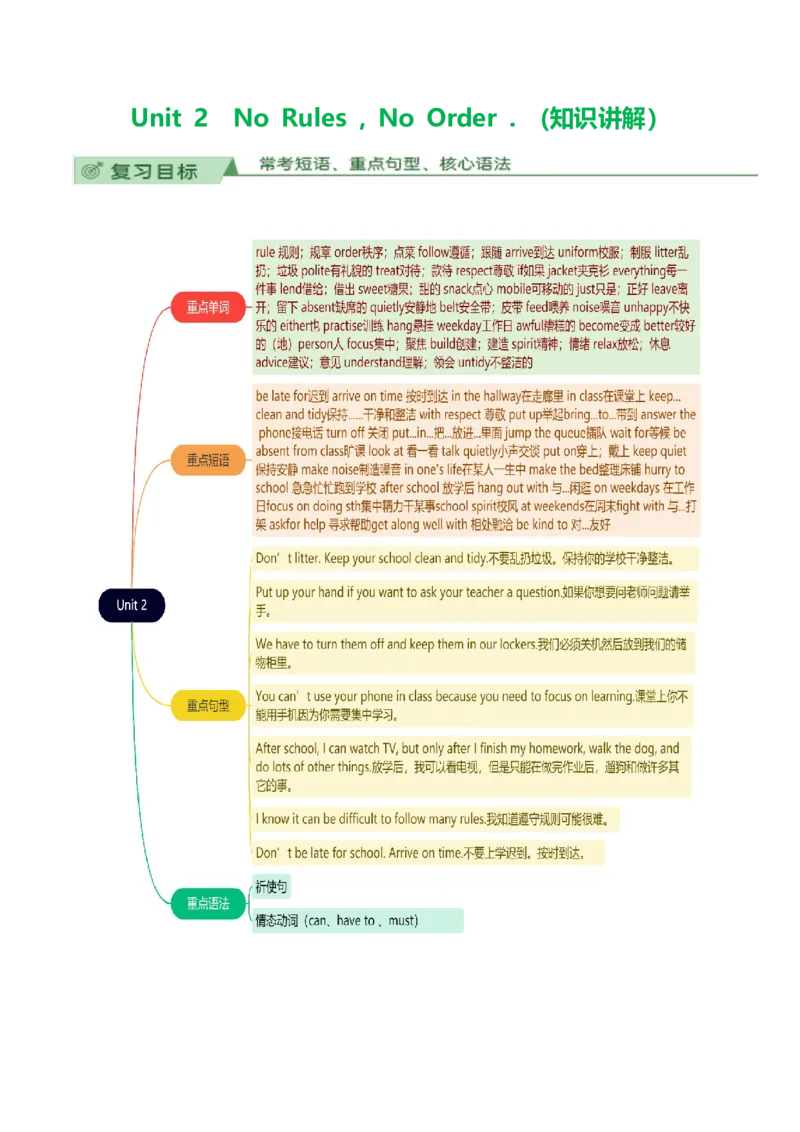
Unit 2 No Rules , No Order . (知识讲解)Section A What rules do do we follow ?
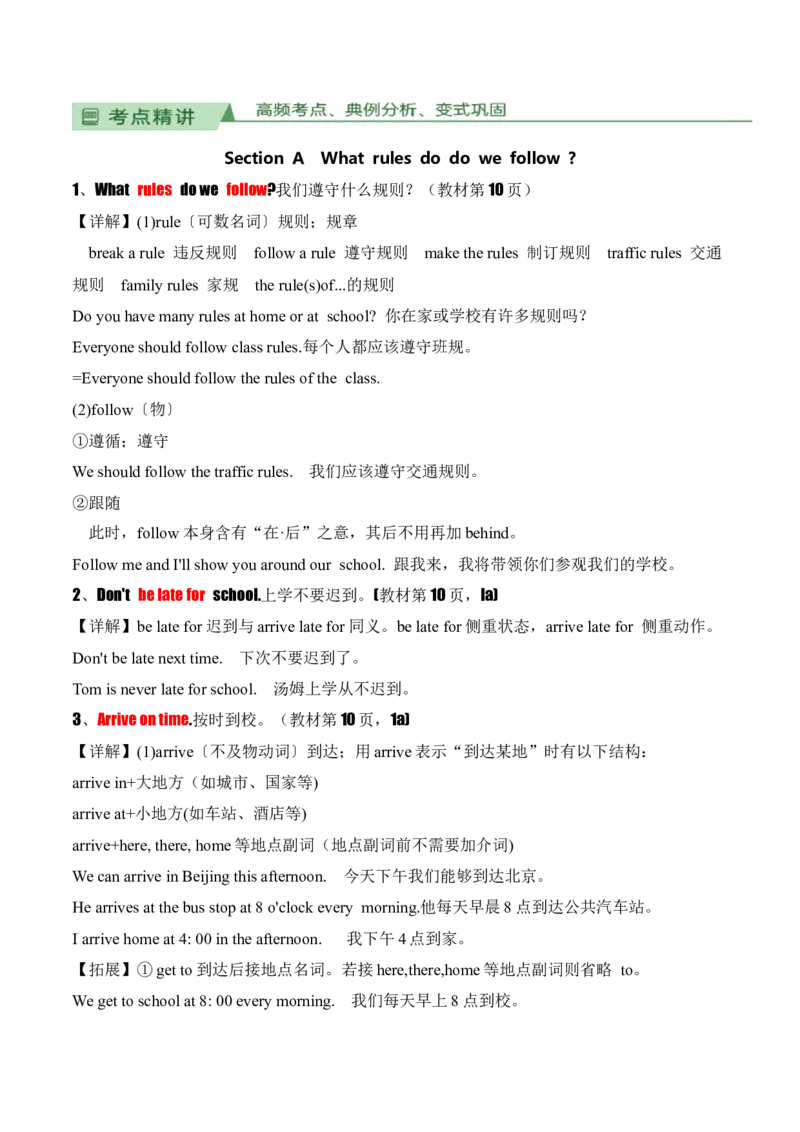
1、What rules do we follow?我们遵守什么规则?(教材第10页)
【详解】(1)rule〔可数名词〕规则;规章
break a rule 违反规则 follow a rule 遵守规则 make the rules 制订规则 traffic rules 交通
规则 family rules 家规 the rule(s)of...的规则
Do you have many rules at home or at school? 你在家或学校有许多规则吗?
Everyone should follow class rules.每个人都应该遵守班规。
=Everyone should follow the rules of the class.
(2)follow〔物〕
①遵循;遵守
We should follow the traffic rules. 我们应该遵守交通规则。
②跟随
此时,follow本身含有“在·后”之意,其后不用再加behind。
Follow me and I'll show you around our school. 跟我来,我将带领你们参观我们的学校。
2、Don't be late for school.上学不要迟到。(教材第10页,la)
【详解】be late for迟到与arrive late for同义。be late for侧重状态,arrive late for 侧重动作。
Don't be late next time. 下次不要迟到了。
Tom is never late for school. 汤姆上学从不迟到。
3、Arrive on time.按时到校。(教材第10页,1a)
【详解】(1)arrive〔不及物动词〕到达;用arrive表示“到达某地”时有以下结构:
arrive in+大地方(如城市、国家等)
arrive at+小地方(如车站、酒店等)
arrive+here, there, home等地点副词(地点副词前不需要加介词)
We can arrive in Beijing this afternoon. 今天下午我们能够到达北京。
He arrives at the bus stop at 8 o'clock every morning.他每天早晨8点到达公共汽车站。
I arrive home at 4: 00 in the afternoon. 我下午4点到家。
【拓展】①get to到达后接地点名词。若接here,there,home等地点副词则省略 to。
We get to school at 8: 00 every morning. 我们每天早上8点到校。② arrive(in/at)和 get(to)可进行同义转换。
They must arrive at/get to the village at8:00 today.今天他们必须在8点到达那个村庄。
They usually arrive/get home at 11: 30 in the morning.他们通常在上午11点半到家。
(2)辨析:on time与in time
on time准时;按时;指按规定的时间或指定的时间做某事
in time及时 指不迟到或在规定时间之前或接近规定的时间做某事
The train arrives on time. 火车准时到达。
The ambulance arrives in time. 救护车及时到达。
4、Don't use your phone in class.不要在课堂上使用手机。(教材第10页,1a)
【详解】in class在课堂上;上课时;此时class 意为“课;上课”。
after class 在课下;下课后
Do you listen to your teacher carefully in class? 你在课堂上认真听老师讲课吗?
Let's talk about the math problem after class. 咱们课下讨论一下那道数学题吧。
【拓展】in the class在班级里(class“班级”) in the classroom 在教室里
There are forty students in the class. 这个班里有40名学生。
Don't play basketball in the classroom. 不要在教室里打篮球。
5、Don`t litter.不要乱扔垃圾。(教材第10页,1a)
【详解】litter
①〔动词〕乱扔
Don't litter in parks. 不要在公园里乱扔垃圾。(不及物动词)
Ask him not to litter paper everywhere. 让他不要到处扔纸。(及物动词)
②〔不可数名词〕垃圾,废弃物
There is not much litter in public places now. 现在在公共场所没有很多垃圾了。
6 、Keep your school clean and tidy.保持学校干净整洁。(教材第10页,1a)
【详解】keep(过去式:kept)
①〔动词〕
a.保持;keep+宾语+宾语补足语;使···保持某种状态,充当宾语补足语的可以是形容词、副
词、动词-ing形式或介词短语等。
I must keep my bedroom clean. 我必须保持我的卧室干净。
b.保留后可接时间段。You can keep the book for two weeks. 你可以借用这本书两周。
c.遵守与 follow 同义。
Everyone must keep the rules. 大家必须遵守规则。
d.存放,储存
Where do you keep your bags? 你把包放哪儿了?
②〔连系动词〕保持,后接形容词等作表语。
We must keep quiet in the library. 在图书馆,我们必须保持安静。
7、Be polite and treat everyone with respect. 要有礼貌,尊重每一个人。(教材第10页,
1a)
【详解】(1) polite〔形容词〕有礼貌的;be polite to sb 对某人有礼貌
She's always very polite. 她总是很有礼貌。
We should be polite to strangers. 我们应该对陌生人有礼貌。
【拓展】①impolite〔形容词〕不礼貌的
Some people think it is impolite to ask someone's age. 有些人认为询问别人的年龄是不礼貌的。
②politely [副词〕有礼貌地;在句中作状语。
We should speak to the old politely. 我们应该有礼貌地与老年人讲话。
(2)treat
①〔及物动词〕对待;看待;后接名词或代词作宾语。
treat sb like/as. 把某人当作··看待
My host family treated me well. 我的寄宿家庭待我很好。
Mum always treats me as a child. 妈妈总是把我当小孩子看待。
②〔及物动词〕治疗;招待;请(客) treat sb to sth 请某人吃某物
No one knew how to treat this disease. 没人知道如何治疗这种疾病。
She treated him to lunch. 她请他吃午饭。
③〔可数名词〕款待
Let's go out for dinner-my treat. 咱们到外面去吃饭吧——我请客。
(3)respect
①〔不可数名词〕尊敬;敬意;show respect for.对··表示尊敬
We should show respect for the old. 我们应该对老年人表示尊敬。
The students have great respect for their teachers. 学生非常尊敬他们的老师。②〔及物动词〕尊敬;尊重
Students should respect their teachers. 学生应该尊敬他们的老师。
I respect your wishes. 我尊重你的愿望。
8、Put up your hand if you want to ask your teacher a question.如果你想问老师问题,请举手。
(教材第10页,1a)
【详解】(1)put up (put的过去式是put)
①举起;张贴
Please put up your hand if you have any questions. 如果你有任何问题,请举手。
You'd better put up a notice here. 你最好在这儿贴一个通知。
②搭建;建造
Two men are putting up a tent in the rain. 两个男人正在雨中搭建帐篷。
I help him put up some shelves in his bed-room. 我帮他在卧室里装几个搁架。
【注意】put up是“动词+副词”结构,当宾语是人称代词时,要放在put和up之间,当宾语
是名词时,可以放在put和up之间,也可以放到up之后。
【拓展】其他与put相关的常见短语:
put away将···收起 put off推迟 put on 穿上;上演 put down放下
(2)if引导的条件状语从句
句中if you want to ask your teacher a question是if引导的条件状语从句。连词if意为“如
果”。在含有if引导的条件状语从句的复合句中,如果主句是一般将来时、祈使句或主句中
含有情态动词,从句常用一般现在时表示将来。
Get up early if you want to catch the early bus. 如果你想赶早班车就要早起。
We won't go to the zoo if it rains tomorrow. 如果明天下雨,我们就不去动物园了。
If you finish your homework early, you can go out and play.如果你早早完成作业,你就可以出去
玩。
【注意】条件状语从句可以放在主句前,也可以放在主句后。如果if从句放在主句前,要用逗
号与主句隔开。
9、Sally mustn't wear her own jacket at school.萨莉在学校不能穿她自己的夹克衫。(教材第10
页,1c)
【详解】own
①〔形容词〕自己的;常和名词所有格或形容词性物主代词一起使用,以加强语气。That's her own idea. 那是她自己的主意。
②〔动词〕拥有
This car is mine. I own it. 这辆汽车是我的,我拥有它。
【拓展】owner〔名词〕物主;主人
The owner of the restaurant is very friendly. 这家餐馆的主人很友好。
10、Is everything OK? 一切都好吗?(教材第11页,2a)
【详解】everything〔复合不定代词〕每件事;一切作主语时,谓语动词用第三人称单数形式。
My family means everything to me. 对我来说家庭意味着一切。
I hope everything goes well. 我希望一切顺利。
【拓展】everyone〔复合不定代词〕每人;人人;所有人
11、Here, I can lend you my pen.给,我可以把我的钢笔借给你。(教材第11页,2a)
【详解】lend〔及物动词〕借给;借出;其过去式为lent,反义词为 borrow。
lend sb sth= lend sth to sb 借给某人某物;把某物借给某人
Could you lend me some books? 你可以借给我一些书吗?
=Could you lend some books to me?
12、Would you like a sweet?你想吃糖吗?(教材第11页,2a)
【详解】sweet
①〔可数名词〕糖果
She loves sweets. 她喜欢糖果。
②〔形容词〕甜的;含糖的;甜蜜的 sweet food 甜食
The soup tastes sweet. 这汤尝起来很甜。
Amy wants to keep her old things because they bring back sweet memories.
埃米想保留她的旧物品,因为它们唤起甜蜜的回忆。
③〔形容词〕悦耳的,好听的
The singer has a sweet voice. 这名歌手有着悦耳的嗓音。
13、Yes,of course.是的,当然可以。(教材第11页,2a)
【详解】of course当然;相当于sure 或certainly,通常在对话中用作肯定回答。
-May I borrow your dictionary? 我可以借用你的词典吗?
-Of course! 当然了!
【拓展】of course和not连用,构成否定回答。-Do you want to lose the match? 你想输掉这场比赛吗?
-Of course not. 当然不想。
14、I'm sorry, I have to answer my phone. 对不起,我得接电话。(教材第11页,2a)
【详解】answer
①〔及物动词〕应答;答复;回答
answer the phone 接电话 answer the door应门(铃)声开门 answer a letter 回信
answer the question 回答问题
②〔不及物动词〕回答
He answered with a smile. 他微笑作答。
I asked him a question, but he didn't answer. 我问了他一个问题,但他没有回答。
③〔可数名词〕答案;回答;答复the answer to...的答案
I don't know the answer to this question. 我不知道这个问题的答案。
15、Oh, but we can't/mustn't bring our mobile phones to class.哦,但是我们不能/禁止把手机带
到课堂上。(教材第11页,2a)
【详解】(1)bring〔及物动词〕带··到某处;带来;取来
bring...to...把.......带到......
bring sb sth= bring sth for sb 带给某人某物
Please bring some photos to school tomorrow. 明天请带一些照片到学校来。
Can you bring me the book?你把那本书给我带来好吗?
=Can you bring the book for me?
(2)辨析:bring, take与get
bring带来;取来 (带到说话者处)
take 拿走 (带离说话者处)
get 去拿来 (一个来回)
Please bring your book here. 请把你的书带到这儿来。
The girl takes the box away. 那个女孩拿走了箱子。
There are some apples in the next room. Can you get them for me?隔壁房间里有一些苹果,你能为
我去把它们取来吗?
16、We have to turn them off and put/keep them in our lockers.我们必须把它们关掉并放在/存
放在我们的储物柜里。(教材第11页,2a)【详解】turn off关掉(水、电或煤气等)反义短语为turn on“打开(水、电或煤气等)”。
Please turn off/on the radio. 请把收音机关上/打开。
【拓展】常用的关于turn的短语还有:
turn up调大/高 turn down 调小/低;拒绝 turn into 变成;使变成 turn around转身
【注意】turn off, turn on, turn up与 turn down 都是“动词+副词”结构,当名词作宾语时,
名词置于短语后面或动词与副词之间;若人称代词作宾语,人称代词必须置于动词与副词之
间。
Turn on the computer.打开电脑。
=Turn the computer on.
Turn them off, please. 请把它们关上。
17、Thanks for telling me, Anne.谢你我,安妮。(教材第11页,2s)
【详解】Thanks for...因......感谢;谢谢你......;相当于"Thank you for...". for后常接名词、代词或
动词-ing形式,表示感谢的内容或原因。
Thanks for your letter. 谢谢你的来信
Thanks for coming. Eric. 埃里克,谢谢你的到来。
18、Don't jump the queue. 不要插队。(教材第13页,3b)
【详解】(1) jump the queue 插队
join the queue排队 stand in a queue 站成一排
It's not polite to jump the queue. 插队是不礼貌的。
You'll have to join the queue. 你得排队。
Stand in a queue and don't push others. 站成一排,不要推别人。
(2)queue
①〔可数名词〕队,行列
This is a long queue at the ticket office. 售票处排着长队。
②[动词〕排队(等候)
People queue to buy tickets. 人们排队买票。
19、You must wait your turn.你必须等着轮到你。(教材第13页,3b)
【详解】wait等;等待
wait for sb/sth等待某人/某物
wait for sb to do sth等待某人做某事Mary is waiting for the bus. 玛丽正在等公共汽车。
I am waiting for him to come. 我在等他来。
20、I can feed my dog many kinds of food.but I mustn't/can't give him chocolate.我可以给我的狗
喂多种食物,但我一定不/不能给他巧克力。(教材第13页,3b)
【详解】feed〔及物动词〕喂养;饲养(过去式:fed)其后常接表示动物名称的词作宾语。
feed的常见用法有:
①feed sb/sth 喂某人/某物
I feed my pet cat every day. 我每天都喂我的宠物猫。
② feed sth to sb/sth 把某物喂给某人/某物
Please feed some grass to the cow. 请给这头奶牛喂些草。
She fed milk to the baby. 她给婴儿喂了奶。
③feed...on/with...用......喂.......
He feeds the dog on meat.他用肉喂狗。
【拓展】feed on 以··为生;以···为食
Cows and horses feed on grass. 牛和马以草为食。
21、Can I leave the classroom if I don't feel well?如果我感觉不舒服,我可以离开教室吗?
(教材第13页,3b)
【详解】leave〔动词〕(过去式:left)
①离开
leave+地点 离开某地
leave for+地点 动身去某地
leave+地点+for+地点 离开某地去某地
When did you leave Shanghai? 你是什么时候离开上海的?
I'll leave for Beijing tomorrow. 明天我要动身去北京。
I'll leave Shanghai for Beijing. 我要离开上海去北京。
②留下
leave+宾语+地点状语把···留在某地
leave sb by oneself 把某人单独留下
I will leave a message on the table. 我会在桌子上留个信息。
Don't leave young children at home. 不要把小孩子留在家里。She is only five years old. Don't leave her by herself. 她只有五岁,不要把她单独留下。
22、Yes, but you must tell your teacher about it when you have to be absent from class.可以,但
是当你不得不缺课时,你必须告诉老师。(教材第13页,3b)
【详解】absent〔形容词〕缺席的;不在的be absent from 缺席·.
They were absent from work that day. 他们那天没有上班。
【拓展】absent的反义词为present,意为“出席的;到场的”。
Many famous writers are present at the meeting. 许多著名作家都出席了这次会议。
23、Shh, we must/have to talk quietly in the library.嘘,在图书馆我们必须轻声说话。(教材
第13页,3b)
【详解】quietly〔副词〕轻声地;安静地;反义词为 loudly。
The girl came into the classroom quietly. 那个女孩安静地走进了教室。
【拓展】quiet〔形容词〕轻声的;轻柔的;安静的
Could you keep the kids quiet while I'm on the phone? 我在打电话时你让孩子们安静点好吗?
24、We mustn't make noise.我们一定不要制造噪声。(教材第13页,3d)
【详解】(1)noise〔名词〕声音;噪声;既可作可数名词,表示某一具体的嘈杂声、喧闹声;
又可作不可数名词,泛指噪声、喧闹声。其形容词形式为 noisy,意为“喧闹的”。
make noise/noises/a noise 吵闹,制造噪声
Don't make a noise. 不要吵闹。
(2)辨析:noise, sound 与 voice
sound声音 (泛指各种声音)
noise噪声(常指不悦耳、不和谐的嘈杂声)
voice 嗓音(一般指人的声音或鸟叫声)
Please don't make much noise in class. 请不要在课堂上太吵闹。
Light travels much faster than sound. 光的传播速度比声音快得多。
She has a good singing voice. 她有一副很好的歌喉。
Section B How can rules help me ?
1、Why is Alice unhappy?爱丽为什么不开心?(教材第14页,1b)
【详解】unhappy〔形容词〕不快乐的;不满的 be unhappy with 对···不满意
He looks unhappy. 他看起来不开心。
She is unhappy with her job. 她对自己的工作不满意。【拓展】un-是否定前缀,由其构成的常见单词有:
untidy 不整洁的 unusual 不寻常的 unhealthy 不健康的 unlucky 不幸的 unable 无
能力的 unknown 不知名的 uncomfortable 不舒服的
2、Every morning, I have to make my bed before breakfast.每天早上,我必须在早餐前整理床铺。
(教材第14页,1b)
【详解】make sb's/the bed铺;铺床
Please make the bed after you get up. 你起床后请整理床铺。
【拓展】make在不同的短语里有不同的含义:
make dumplings包饺子 make friends 交朋友
3、I have to hurry to school because I can't be late for school.我必须赶紧去学校,因为我上学
不能迟到。(教材第14页,1b)
【详解】hurry〔不及物动词〕匆忙;赶快
hurry to do sth 匆忙做某事
hurry to+地点名词匆忙去某地
hurry up赶快,急忙(做某事)
hurry off/away 匆匆离去
I hurry to finish my homework before dinner. 我赶紧在晚饭前完成作业。
We hurry to the classroom when the bell rings. 铃声响起时我们赶紧去教室。
Hurry up, or you will be late. 快点儿,否则你会迟到的。
Miss Zhao hurries off to look after the man. 赵小姐匆匆离开去照顾那个人。
4、When I'm at school, I mustn't use my phone in class either.在学校的时候,我也不能在课堂上
使用手机。(教材第14页,1b)
【辨析】either,too与also
三者均有“也”的意思,但用法不同。
either用于否定句,位于句末,前面可加逗号,也可不加。
too 用于肯定句或疑问句;位于句末,前面可加逗号,也可不加。
also 用于肯定句, 位于句中,助动词、情态动词、连系动词be之后,实义动词之前。
He doesn't want to go either. 他也不想去。
I can swim too. 我也会游泳。
He also wants to go. 他也想去。5、After school, there are even more rules!放学后,规则甚至更多!(教材第14页,1b)
【详解】even〔副词〕甚至;还;其实
①修饰形容词或副词的比较级,用以加强程度。
Jim jumps high, but Tom jumps even higher.吉姆跳得高,但是汤姆跳得更高。
②修饰名词、动词、介词短语等,用以加强语气。
Even a child can understand the book. 甚至连孩子都能读懂这本书。
6、I can only play basketball after I practise the piano.只有在练习完钢琴后我才能打篮球。
(教材第14页,1b)
【详解】practise〔及物动词〕练习;训练;其后可跟名词、代词或动词-ing形式作宾语。
practise doing sth 练习做某事
Please practise the piano every day. 请每天练习钢琴。
Why don't you join an English club to practise speaking English?你为什么不加入一个英语社团来
练习说英语呢?
7、I can't hang out with my friends on weekdays.在工作日我不能和我的朋友出去玩。(教材
第14页,1b)
【详解】(1)hang out闲;常去某处;hang用作动词,可表示“悬挂;垂下”,其过去式为
hung。
He likes reading and he often hangs out in the bookshop. 他喜欢阅读,并且经常逛书店。
Hang the picture on the wall. 把这幅画挂到墙上。
【拓展】与hang有关的常见短语:
hang on 紧紧抓住 hang about(在某处)闲荡 hang up 挂断电话;挂起
(2)weekday〔可数名词〕工作日;指星期一到星期五的任何一天。
on weekdays 在工作日
I go to school on weekdays. 我工作日去上学。
【拓展】weekend〔可数名词〕周末;通常指星期六和星期天。表示“在周末”用on/at
weekends 或 on/at the weekend。
8、But they can help you to become a better person.但它们可以帮助你成为一个更好的人。
(教材第14页,1b)
【详解】(1)become〔连系动词〕变成;成为后接名词或形容词作表语,其过去式为became.
She becomes very happy when she gets the gift. 当她收到礼物时,她变得非常开心。I want to become a doctor when I grow up. 我长大后想成为一名医生。
(2)better
①〔形容词〕更好的;较好的;good 的比较级或well用作形容词时的比较级。
This picture is very good, but that one is better. 这幅图画很好,但是那幅更好。
②〔副词〕更好地;较好地,well 用作副词时的比较级。
Tom sings very well, but Jim sings even better. 汤姆歌唱得很好,但是吉姆唱得还要好。
9、You can't use your phone in class because you need to focus on learning.你不能在课堂上使
用手机,因为你需要专注于学习。(教材第14页,1b)
【详解】focus on集中(注意力、精力等)于表示专注于某一件事情。on是介词,后面接名
词、代词或动词-ing形式。
Focus on your study, please! 请专心学习!
My brother focuses on reading books in his free time. 我弟弟在空闲时间专注于读书。
【拓展】focus one's attention/mind on sth 把某人的注意力/精神集中在某事上
She tried to focus her mind on her work. 她尽量集中精神干活。
10、You have to wear a uniform because it builds school spirit.你必须穿校服,因为它能培养学
校精神。(教材第14页,1b)
【详解】(1)build
①〔动词〕创建;建造(过去式:built) build的名词形式是building,意为“建筑物;房子”。
We want to build a better life. 我们想创造更美好的生活。
People are going to build a bridge over the river. 人们打算在那条河上建一座桥。
②〔动词〕增进,增强(过去式:built)
Helping others builds our sense of happiness. 帮助他人增进我们的幸福感。
Traveling builds our understanding of different cultures. 旅行增强我们对不同文化的理解。
③〔名词〕身材;(be)of medium build中等身材
The person is of medium build. 这个人中等身材。
(2)spirit〔名词〕
①精神;心灵
We should have a spirit of cooperation. 我们应该有合作精神。
The team has a fighting spirit. 这个团队有战斗精神。
②情绪;心境(常用复数);be in high/low spirits情绪高涨/低落The music puts everyone in good spirits. 音乐让每个人都心情愉悦。
She is always in high spirits when she goes for a walk in the park. 她在公园散步时总是兴高采烈。
11、You can also think about the things you can do!你也可以想想你能做的事情!(教材第14
页,1b)
【详解】think about思考;考虑;about是介词,其后可跟名词、代词或动词-ing形式作宾语。
I am thinking about what to eat for lunch. 我在考虑午饭吃什么。
I'm thinking about going to Beijing. 我正在考虑去北京。
【拓展】think of与think about 意为“考虑;对···有某种看法”时,可以互换。
What do you think of/about the book? 你认为那本书怎么样?
12、You can relax after you finish your homework.完成作业后你可以放松一下。(教材第14页,
1b)
【详解】relax
①〔不及物动词〕放松;休息;与 rest 或 have a rest 同义,其第三人称单数形式为
relaxes。
He usually relaxes' for a day on weekends. 他通常在周末休息一天。
②〔及物动词〕使放松
This song relaxes me. 这首歌使我很放松。
【拓展】①relaxing〔形容词〕令人放松的常说明事物具有的特征。
This film is very relaxing. 这部电影令人很放松。
② relaxed〔形容词〕放松的,自在的常说明人的感受。
He is relaxed after listening to music. 听音乐后,他感到放松。
13、Remember: No rules, no order! 记:没有规矩,不成方圆!(教材第14页,1b)
【详解】order
①〔名词〕秩序;规矩;keep order 维持秩序
We should keep order in the classroom. 我们应该在教室里保持秩序。
There is good order in our school. 我们学校有良好的秩序。
②[名词〕命令;顺序;in(the right)order按(正确的)顺序
Tom has to follow his father's order. 汤姆不得不服从他父亲的命令。
They are getting on the bus in order. 他们正按顺序上公交车。
③〔名词〕点菜;take one's order 点菜The waiter is coming with your order. 服务员把你点的餐端来了。
④〔动词〕点菜;命令;订购 order sb to do sth命令某人做某事
What about ordering some noodles? 点些面条怎么样?
Order them to rest! 命令他们休息!
If you like them, please order them online.如果你喜欢它们,请在网上订购它们。
14、Dr Know's advice知心博士的建议(教材第15页,1c)
【详解】advice〔不可数名词〕建议;意见表示数量时常借助于piece或some(一些)等词。
a piece of advice一条建议
two pieces of advice 两条建议
give sb some advice on... 给某人一些关于···的建议
ask sb for advice 向某人征求建议
take/follow sb's advice 采纳/听从某人的建议
Can you give me some advice on learning English? 你能在学英语方面给我一些建议吗?
【拓展】advise[动词〕建议;劝告;advise sb to do sth 建议某人干某事
He advises me to stay at home. 他建议我待在家里。
15、understand rules help me to become a better person理解规则可以帮助我成为一个更好的
人(教材第15页,1c)
【详解】understand〔动词〕理解;领会;明白其过去式为understood。
I'm sorry. I don't understand. 对不起,我不明白。
Can you understand French? 你懂法语吗?
16、I have to/must clean my room everyday, and I can't let my desk get untidy.我每天必须打扫
我的房间,而且我不能让我的书桌变得不整洁。(教材第15页,2a)
【详解】(1)clean
①〔动词〕打扫;把......弄干净;clean up打扫(或清除)干净
We should clean the classroom before we leave our school. 我们应该在离开学校之前打扫教室。
I clean up my room every weekend. 我每个周末都打扫我的房间。
②[形容词〕清洁的;干净的; 其近义词为tidy(整洁的),反义词为dirty(脏的)。
He is always wearing clean clothes. 他总是穿着干净的衣服。
We must keep our classroom clean. 我们必须保持教室干净。
(2)get untidy“get+形容词”表示“变得......”,此处get为连系动词,后跟形容词作表语,表示体质、情
绪、天气等方面的改变。
We get tired after a long walk. 走了很长一段路后,我们变得很疲惫。
It gets hot these days. 这些天天气变热了。