Unit 2 No Rules, No Orders
单元语法
一、 祈使句
A:Can we eat in class?
Don’t eat in the classroom.
B:No,we can’t. We can’t eat in the classroom.
A:Can we run in the hallways?
Don’t run in the hallways.
B:No, we can’t. We can’t run in the hallways.
表达命令、请求、劝告、警告、禁止等的句子叫做祈使句。祈使句一般以动词原形
开头。
eg: Go and wash your hands.(命令)
Be quiet, please.(请求)
Practice the guitar every day.(建议)
类型 句型结构 示例
Do型 肯定:动词原形+(其他成分) Stand up.
否定 __________+动词原形(+其他成分) Don’t litter.
Be型 肯定:Be+表语(一般为形容词) Be calm.
否定:__________+be+表语+(其他成分) Don’t be stupid.
Let型 肯定:Let+宾语+动词原形+(其他成分) Let’s go swimming.
否定:①Don’t let+宾语+动词原形+(其他成分) Don’t let him go.
②Let+宾语+not+动词原形(+其他成分) =Let him not go.
⭐拓展:
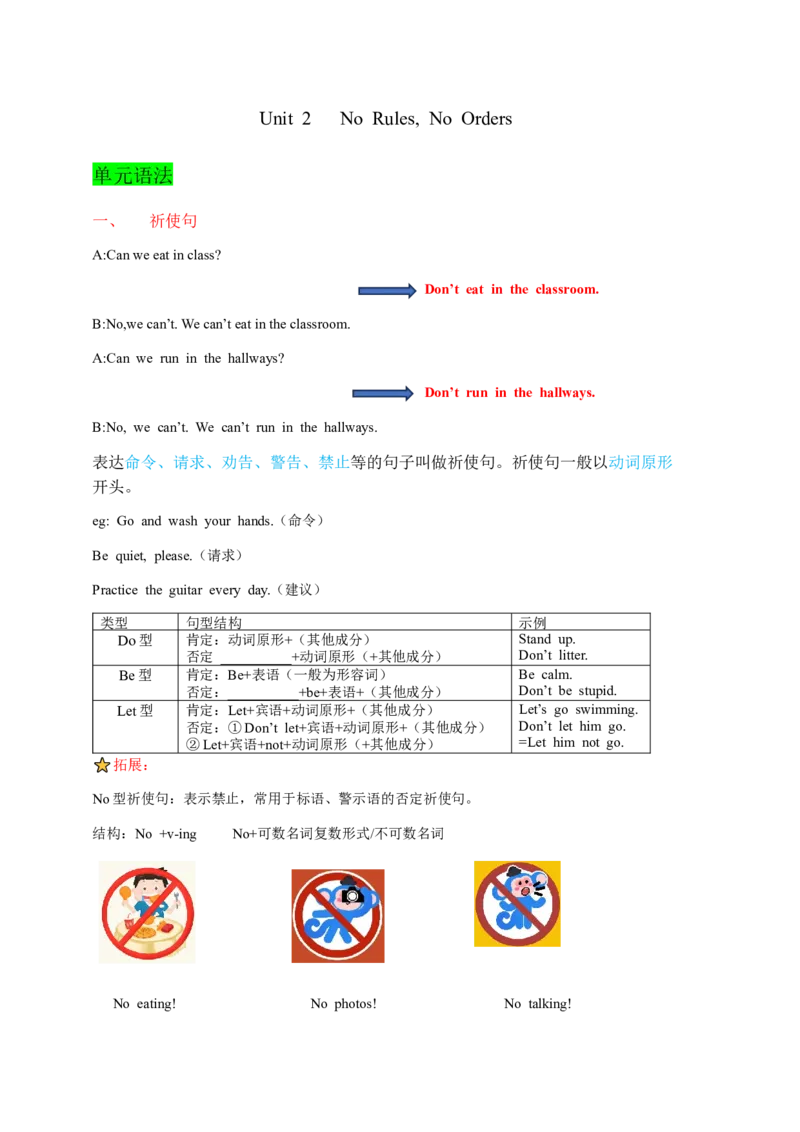
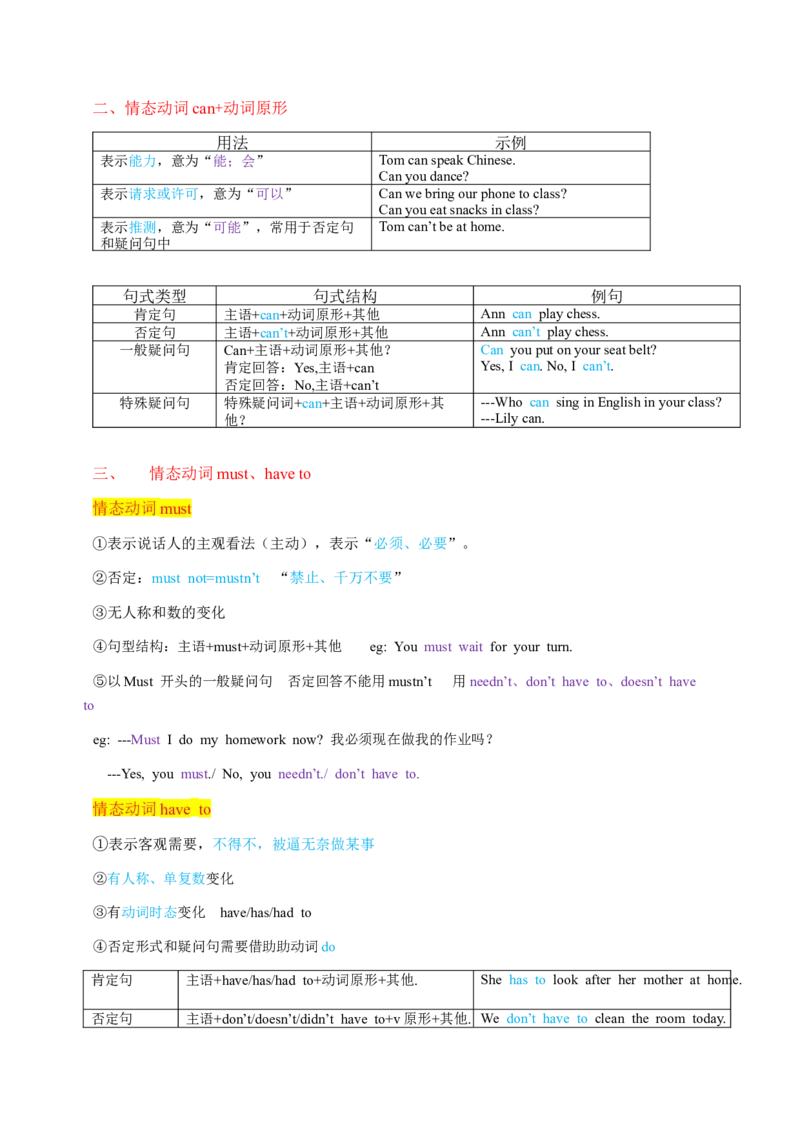
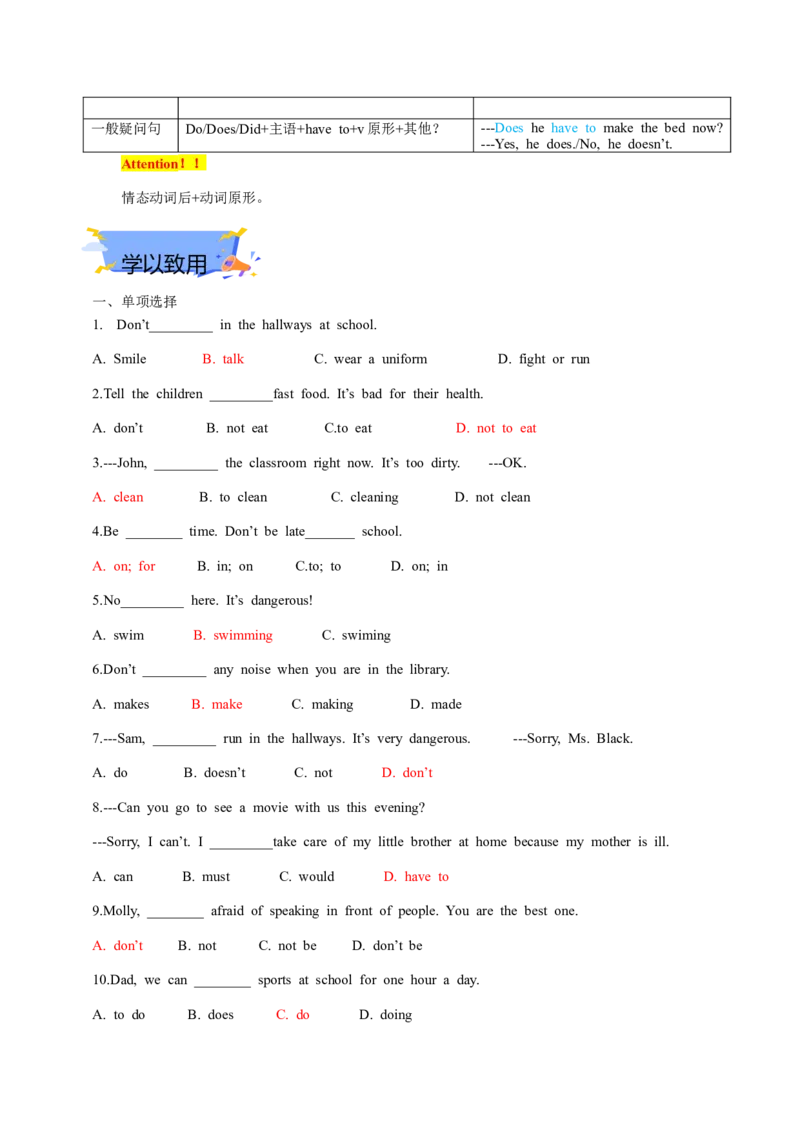
No型祈使句:表示禁止,常用于标语、警示语的否定祈使句。
结构:No +v-ing No+可数名词复数形式/不可数名词
No eating! No photos! No talking!二、情态动词can+动词原形
用法 示例
表示能力,意为“能;会” Tom can speak Chinese.
Can you dance?
表示请求或许可,意为“可以” Can we bring our phone to class?
Can you eat snacks in class?
表示推测,意为“可能”,常用于否定句 Tom can’t be at home.
和疑问句中
句式类型 句式结构 例句
肯定句 主语+can+动词原形+其他 Ann can play chess.
否定句 主语+can’t+动词原形+其他 Ann can’t play chess.
一般疑问句 Can+主语+动词原形+其他? Can you put on your seat belt?
肯定回答:Yes,主语+can Yes, I can. No, I can’t.
否定回答:No,主语+can’t
特殊疑问句 特殊疑问词+can+主语+动词原形+其 ---Who can sing in English in your class?
他? ---Lily can.
三、 情态动词must、have to
情态动词must
①表示说话人的主观看法(主动),表示“必须、必要”。
②否定:must not=mustn’t “禁止、千万不要”
③无人称和数的变化
④句型结构:主语+must+动词原形+其他 eg: You must wait for your turn.
⑤以Must 开头的一般疑问句 否定回答不能用mustn’t 用needn’t、don’t have to、doesn’t have
to
eg: ---Must I do my homework now? 我必须现在做我的作业吗?
---Yes, you must./ No, you needn’t./ don’t have to.
情态动词have to
①表示客观需要,不得不,被逼无奈做某事
②有人称、单复数变化
③有动词时态变化 have/has/had to
④否定形式和疑问句需要借助助动词do
肯定句 主语+have/has/had to+动词原形+其他. She has to look after her mother at home.
否定句 主语+don’t/doesn’t/didn’t have to+v原形+其他. We don’t have to clean the room today.一般疑问句 Do/Does/Did+主语+have to+v原形+其他? ---Does he have to make the bed now?
---Yes, he does./No, he doesn’t.
Attention!!
情态动词后+动词原形。
学以致用
一、单项选择
1. Don’t_________ in the hallways at school.
A. Smile B. talk C. wear a uniform D. fight or run
2.Tell the children _________fast food. It’s bad for their health.
A. don’t B. not eat C.to eat D. not to eat
3.---John, _________ the classroom right now. It’s too dirty. ---OK.
A. clean B. to clean C. cleaning D. not clean
4.Be ________ time. Don’t be late_______ school.
A. on; for B. in; on C.to; to D. on; in
5.No_________ here. It’s dangerous!
A. swim B. swimming C. swiming
6.Don’t _________ any noise when you are in the library.
A. makes B. make C. making D. made
7.---Sam, _________ run in the hallways. It’s very dangerous. ---Sorry, Ms. Black.
A. do B. doesn’t C. not D. don’t
8.---Can you go to see a movie with us this evening?
---Sorry, I can’t. I _________take care of my little brother at home because my mother is ill.
A. can B. must C. would D. have to
9.Molly, ________ afraid of speaking in front of people. You are the best one.
A. don’t B. not C. not be D. don’t be
10.Dad, we can ________ sports at school for one hour a day.
A. to do B. does C. do D. doing11.You ________ smoke here! Look at the sign. It says “No smoking!”
A. needn’t B. mustn’t C. may D. can
12.Listen guys. Everyone_________ wear a mask.(口罩). Go and buy one if you don’t have
one.
A. can’t B. can C. mustn’t D. must
13.---I can’t stop smoking, doctor.
---For your health, I’m afraid you_______.
A. may B. need C. have to D. must
14.---May I go out, Dad? ----No. You________ let your mother know first.
A. can B. may C. need D. must
15.---It’s late, Teresa. ________ earlier next time and you’ll have enough time to have
breakfast.
---OK. Mom. I’ll remember.
A. Get up B. Getting up C. To get up D. Gets up
16.________ this rock music, please. I’m afraid some people can’t the noise.
A. Stopping B. Stop C. Stops D. Stopped
17.”No _________!” says the sign.
A. smoke B. smoking C. smokes D. to smoke
18._________ call me Wangwang! It’s my dog’s name!
A. Not B. No C. Don’t D. Doesn’t
19.Must I go to medical school and be a doctor like you, Dad?
---No, you________, son. You’re free to make your own decision.
A. can’t B. mustn’t C. shouldn’t D. needn’t
20. You ________ cross the road when the traffic lights are red.
A. mustn’t B. can’t C. wouldn’t D. needn’t
21.Don’t listen_________ music in the classroom_________ in the hallways.
A, to; and B./; or C./; and D. to; or
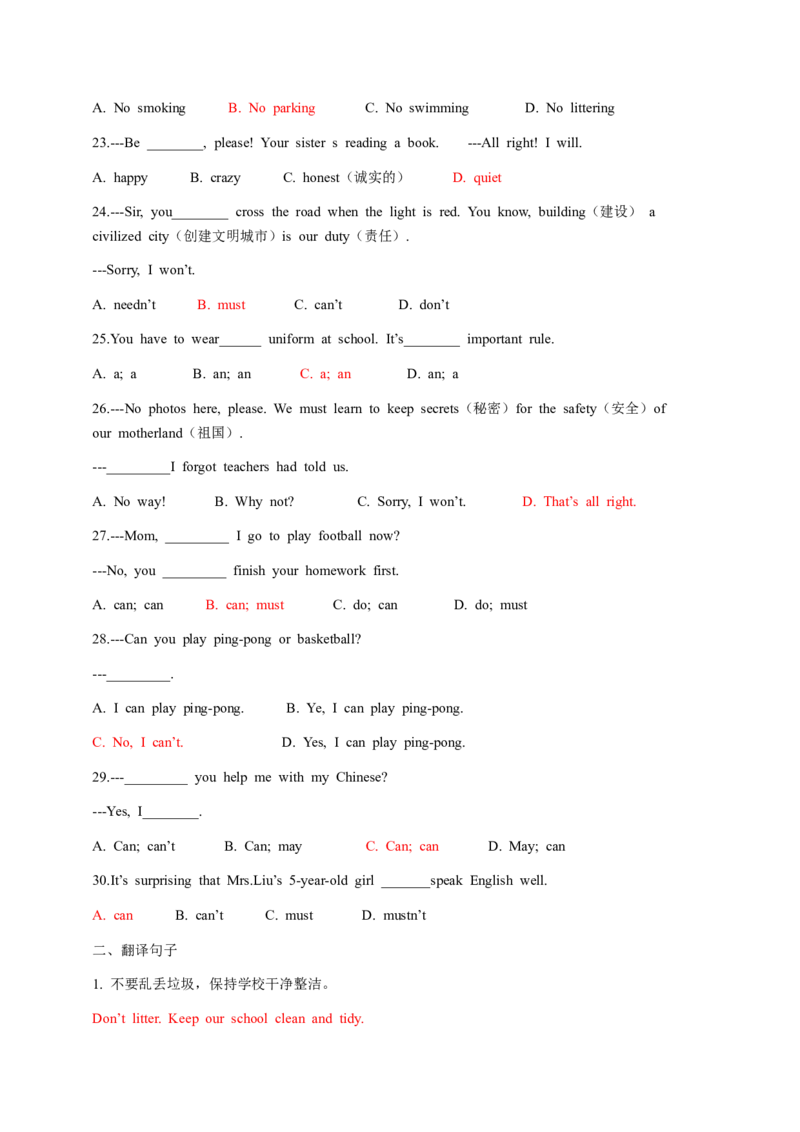
22.Please move(移动)your car away, sir. This is”________” area.(区域).A. No smoking B. No parking C. No swimming D. No littering
23.---Be ________, please! Your sister s reading a book. ---All right! I will.
A. happy B. crazy C. honest(诚实的) D. quiet
24.---Sir, you________ cross the road when the light is red. You know, building(建设) a
civilized city(创建文明城市)is our duty(责任).
---Sorry, I won’t.
A. needn’t B. must C. can’t D. don’t
25.You have to wear______ uniform at school. It’s________ important rule.
A. a; a B. an; an C. a; an D. an; a
26.---No photos here, please. We must learn to keep secrets(秘密)for the safety(安全)of
our motherland(祖国).
---_________I forgot teachers had told us.
A. No way! B. Why not? C. Sorry, I won’t. D. That’s all right.
27.---Mom, _________ I go to play football now?
---No, you _________ finish your homework first.
A. can; can B. can; must C. do; can D. do; must
28.---Can you play ping-pong or basketball?
---_________.
A. I can play ping-pong. B. Ye, I can play ping-pong.
C. No, I can’t. D. Yes, I can play ping-pong.
29.---_________ you help me with my Chinese?
---Yes, I________.
A. Can; can’t B. Can; may C. Can; can D. May; can
30.It’s surprising that Mrs.Liu’s 5-year-old girl _______speak English well.
A. can B. can’t C. must D. mustn’t
二、翻译句子
1. 不要乱丢垃圾,保持学校干净整洁。
Don’t litter. Keep our school clean and tidy.2. 礼貌待人,互相尊重。
Be polite and treat everyone with respect.
3. 请不要把你的手机带到课堂上来。
Please don’t bring your mobile phone to class.
4. 穿校服。
Wear the school uniform.
5. 如果你想问老师问题,举起你的手。
Put up your hands if you want to ask your teacher a question.
6. 不要插队!
Don’t jump the queue.
7. 他必须穿校服上学吗?(have to)
Does he have to wear the uniform for school/to go to school?
8. 当你不得不缺席这节课时你必须告诉老师这件事。
You must tell your teacher about it if you have to be absent from class.
9. 在图书馆里,我们必须保持安静。我们不能吵闹。
In the library, we must keep quiet. We mustn’t make noise.
10. 我不得不在早餐之前整理我的床铺。
I have to make my bed before breakfast.
三、句型转换
1.You shouldn’t arrive late for class.(改为祈使句)
____Don’t____ ____arrive___ late for class.
2.Talk loudly in class.(改为否定句)
____Don’t____ _____talk___ loudly in class.
3.You can’t take photos in the museum. (改为祈使句)
____Don’t____ ____take____ ____photos____ in the museum.
4.The students have to wea r th e uniforms .(划线提问)
____What____ _____do___ the students have to _____do____?5.Alex has to stay at home on weekends.(改为否定句)
Alex____doesn’t___ ____have___to stay at home on weekends.
6.We can listen to music in the music room or outside .(对划线部分提问)
____Where___ ____do____you____listen____ to music?
7.I can lend you my pen.(改为否定句)
I_____can’t___ lend you my pen.
8.I can eat snacks in the hallways.(改为一般疑问句—)
____Can____ ____you____ _____eat____ snacks in the hallways?
9.Can you talk loudly in the library?(做否定回答)
_________________No, I can’t._________________________.
10.I can’t use your phone in class becaus e yo u nee d t o focu s o n learning .(对划线部分提问)
_____Why____ _____can’t ____ ______you__ use your phone in class?
四、从方框中选择合适的动词,并用其适当形式填空。
swim wear arrive is not turn
1. Do you have to_____wear____ the uniform at school?
2. ______Don’t turn______ off the computer.
3. Li Lei feels sorry for_____being_____ late for the party.
4. You must_____arrive___ on time for class.
5. No_____swimming____ here. It’s dangerous.
五、语法填空
I'm Bob and I'm a student of No.2 Middle School. We have many 1. (rule) in our
school. I think some of 2. (they) are good for us, but others are not so good.
We have to 3. (wear) the school uniform. I think it's good. If we don't have this rule,
some students will wear expensive clothes. We can't be late 4. school and we have to
listen to the teachers 5. (careful) in class. All of these rules are good for our study and we
all like them.
We can't take mobile 6. (phone) to school. I don't think it's 7. good
idea. Sometimes our parents are busy,8. they can't get home early. They need to tell us
about that. If we don't take phones, how can they call us? Also, we can't go to the movies on weekends.
I know we should 9. (study) hard, but we need 10. (relax)a little, too.
1.rules 2.them 3.wear 4.for 5.carefully 6.phones 7.a 8.but 9. study
10.to relaxDear Dr. Know,
I am a middle school student. I have too many 1. (rule) at home. I have to get up early in
the morning. I have to practice 2. (read) English every day. I can't 3. (visit) my
friends after school 4. I have to go to bed at nine. On weekends, I have 5. (clean) my
room and do the 6. (dish). I have to go to the Children's Palace(少年宫) to learn
7. (play) the violin. There are many rules in our school, 8. (也). We can't be late 9.
class. I think the rules 10. (be) strict, but they are good for me.
1.rules 2. reading 3.visit 4.and 5. to clean 6.dishes 7.to play 8.too 9.for
10.are
六、阅读理解
A
Hi, boys and girls! Welcome to our museum. It's free. You don't have to pay any money. But we have
some rules for you. Please remember them and do as I say.
Firstly, don't have food and drink here. You may make our museum dirty. Secondly, you can take
photos here, but don't touch (触摸) the things here. Thirdly, keep quiet in the museum. Don't talk loudly.
Fourthly, the museum is not open after five o’ clock in the afternoon. Please leave before five.
Have a good time here! Thank you.
1.. These are some rules for a .
A. store B. park C. school D. museum
2. How many rules does the museum have?
A. Two. B. Three. C. Four. D. Five.
3. What can students do in the museum?
A. Have food and drink. B. Take photos. C. Touch the things. D. Talk loudly.
4. Students can stay in the museum .
A. all day B. before 5:00 a. m. C. before 5:00 p. m. D. after 5:00 p. m.
5. What can we learn from the passage?
A. Students don't want to pay any money. B. The museum has five rules for the students.
C. The speaker in the passage is a teacher. D. The speaker hopes that the students will have
fun.
B
On the subway, you may see some passengers(乘客) eat or drink. Sometimes, their cups of coffee or
other drinks can spill(溢出) on others or on their seats. The smells of their food are very strong, too.
The local government of Beijing revised(修订) the rules. According to the rules, all passengers
except babies(婴儿) and people with certain health problems shouldn't eat or drink on the subway. If theydo not stop after being asked to, they will be asked to get off(下车). About this, different people have
different ideas. Some think it's good, and some people think it is too strict.
There are other kinds of behaviors (行为) people can't do on the subway. They are one passenger
occupying(侵占) more than one seat, riding without paying the ticket and handing out ads(分发广告).
Do you think the rules are helpful?
6. What does the underlined word “except” mean(意思) in English?
A. It means “but”. B. It means “and”. C. It means “with”. D. It means “without”.
7. If passengers go on(继续) eating or drinking on the subway, .
A. they will be asked to get off B. they can still stay on it
C. they should give the food to others D. they will be dangerous
8. How many things can we find that passengers can't do on the subway in Paragraph 3?
A. Two. B. Three. C. Four. D. Five.
9. The writer organizes(总结) Paragraph 3 by .
A. telling a story B. listing reasons(理由)
C. explaining(解释) things D. giving examples(例子)
10. What can we infer(推断) from the passage?
A. People can keep a seat for others. B. The new rules are popular with all people.
C. People can't take any food on the subway. D. The writer thinks it's important to keep the rules.
七、完形填空
Hi, I'm Dale. There are always rules in our life. Are rules 1 ? No. I get up at six thirty every
morning, 2 I have a lot of time to eat breakfast. I wear 3 uniform at school, so I don't need time
to choose(选择) the clothes to 4 . I don't 5 my mobile phone to school, so I can't play
games on it and I study hard. After school, I can play 6 an hour a day and it helps me have a strong b身od体y)(.
I help my mother 7 housework. She 8 I'm a good boy. I can 9 play computer
games on the weekend. It's bad 10 my eyes if I play computer games too much. I can do lots of
other things. I go to bed early in the evening. I think rules are really helpful.
( )1. A. helpful B. nice C. good D. terrible
( )2. A. because B. but C. so D. or
( )3. A. no B. an C. the D./
( )4. A. wear B. put on C. be on D. dress
( )5. A. get B. put C. take D. find
( )6. A. violin B. games C. guitar D. sports
( )7. A. does B. doing C. to do D. to does
( )8. A. say B. says C. to say D. saying
( )9. A. really B. only C. truly D. yet
( )10. A. for B. at C. with D. to八、六选五 根据短文内容,从下列选项中选出能填入空白处的最佳选项.选项中有一
项为多余选项
In many middle schools, all students must wear the school uniform on school days.1. B
Sun Li is a 12-year-old girl from No.5 Middle School. She says, “I don't like my school uniform. It is not
beautiful at all.2. D But I have to wear the uniform in the school.” Zhou Kai is also a middle
school student. He has a different idea. He says, “3. F It looks cool. All my friends think so.” Du
Feifei, a 13-year-old girl, says, “I have to wear the school uniform on school days. I think it's a good rule.4.
A
Before, I didn't know what to wear every morning and I was always worried about this. It took me lots of
time.5. C ”
Do you wear the uniform? What do you think of it?
A. It helps me save(节约) time.
B. Do they like to wear the uniform?
C. Now I have more time to do other things.
D. I think girls should wear some colorful (五颜六色的) clothes.
E. I spend much time on it.
F. I like my school uniform.