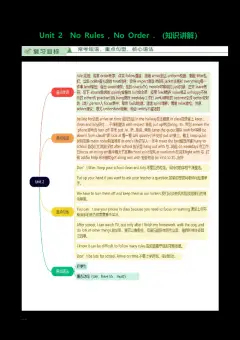
Unit 2 No Rules , No Order . (语法讲解及专练)
【知识讲解】
一 祈使句
1.祈使句概说
用于表达命令、请求、劝告、警告、禁止等的句子叫祈使句。祈使句最常用于表达命令,因其对象
(即主语)是第二人称,所以通常省略主语而以动词原形开头。祈使句句末使用句号或叹号来表示结束。
为表示礼貌,可在句首或句末加上please。句末用please时,前面通常加逗号。
Go and wash your hands. 去洗手。(命令)
Be quiet, please.请安静。(请求)
Be kind to your sisters.对姐妹要和善。(劝告)
Watch your steps.走路小心。(警告)
Look out! Danger!小心!危险!(强烈警告)
Keep off the grass. 勿践踏草坪。(禁止)
2.祈使句的形式
(1)祈使句的肯定式:
①Do型 动词原形(+宾语)+其他成分.
Please have a seat here. 请这边坐。
②Be型 Be+表语(名词或形容词)+其他成分.
Be a good child! 要做一个好孩子!
③Let型 Let+宾语+动词原形+其他成分。
Let me help you. 让我来帮你。
(2)祈使句的否定式:
①Do型和Be型祈使句的否定式都是在句首加don't(若句首有please,则在 please 后加 don't)。
Don't forget me! 不要忘记我!
Please don't be late for school! 请不要上学迟到!
②Let型祈使句的否定式有两种:
“Don't+let+宾语+动词原形+其他成分.”和“Let+宾语+not+动词原形+其他成分.”。
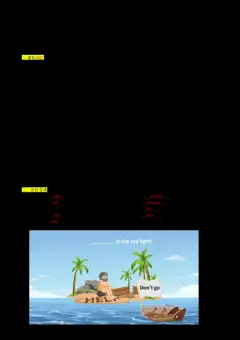
Don't let him go. /Let him not go. 别让他走。
③用 no 开头,表示禁止的祈使句。No smoking! 禁止吸烟!
No fishing! 禁止垂钓!
【助记】
祈使句的用法
祈使句,表请求, 还表命令或禁止。
主语是you常省去, 动词原形开头记。
否定形式要注意,don't放到句首去。
要讲客气用please, 句首、句末都可以。
二 情态动词 can, have to 与 must
1、情态动词can的用法
本单元中主要讲情态动词can 表示请求或许可的用法,意为“可以,能”,否定形式can't意为“不可
以,不能”。
-Can I eat in the classroom? 我可以在教室吃东西吗?
-No, you can't, but you can eat in the dining hall. 不,你不能,但你可以在餐厅吃。
We can't feed the animals in the zoo. 在动物园,我们不能喂动物。
2、情态动词 have to的用法
have to 表示客观需要,意思是“不得不,必须”。使用have to 时应注意以下几点:
(1)have to后接动词原形,意为“不得不做···,必须做···”。
You have to wash your clothes first. 你必须先洗你的衣服。
(2)have to有人称、数和时态的变化,其第三人称单数形式为 has to。
She has to help her mum make dinner. 她不得不帮她妈妈做晚饭。
(3)含有 have to, has to的句子需分别借助助动词 do, does 构成疑问句或否定句。
Do they have to go home now? 他们得现在回家吗?
You don't have to go there now. 你不必现在去那儿。
(4)have to表示“必须”时,与must意义很接近,有时可与must互换。
We have to/must arrive there on time. 我们必须按时到达那里。
3、情态动词must的用法
(1)表示主观的义务和必要,主要用于肯定句和疑问句中,意思是“必须,一定”;由must开头的疑问句,
肯定回答一般用must,否定回答一般用needn't或 don't/doesn't have to,意思是“不必”;must的否定形式
mustn't表示禁止,意思是“不要,不许”。
-Must I finish my homework before six o'clock? 6点之前我必须完成家庭作业吗?-Yes, you must. /No, you needn't./No, you don't have to. 是的,你必须完成。/不,你不必。
You mustn't be late for school. 你上学千万不要迟到。
(2)表示肯定的猜测,常用于肯定句,意为“一定,必然”。
You must be very tired. 你一定很累了。
Mary must be in the library. 玛丽一定在图书馆里。
【辨析】have to 与must
两者都可表示“必须”,后接动词原形,但用法不同。
have to 必须;不得不;表示客观上的需要,有人称、数和时态的变化;don't/doesn’t have to表示“不必”。
must 必须;一定;表示说话人的主观看法;mustn’t表示“禁止”。
You don't have to tell him about it. 你没必要把这件事告诉他。
You mustn't tell him about it. 你一定不要把这件事告诉他。
【同步检测】
1.It’s snowing. Please ________ warm clothes.
A.wear B.wears C.wearing D.to wear
2.Bill, ________ talk in class. We must listen ________ the teacher.
A.doesn’t; with B.doesn’t; to C.don’t; with D.don’t; to
3.________ me a postcard when you get to Australia. Don’t forget it!
A.To send B.Sends
C.Sending D.Send
4.Jim, ________ read in the sun. It’s bad for your eyes.
A.can’t B.isn’t C.doesn’t D.don’t
5.Mary, ________ to the teacher, please.
A.listening B.listens C.to listen D.listen
6.—Tom, ________ late for school. —Sorry, I won’t.
A.isn’t B.be not C.don’t be D.isn’t be
7.—________ late for school again, Tim!
—Sorry, I ________ be late again.
A.Don’t; won’t B.Don’t be; won’t
C.Don’t be; don’t D.Don’t; will
8._________ open the door before the train stops.A.Don’t B.Doesn’t C.Not D.No
9.______ up now. It’s time for breakfast.
A.Get B.To get C.Getting
10.Please tell me the truth, _________ I can’t decide how to help you with your next step.
A.or B.and C.but D.so
11.If you like travelling, I ________ recommend some places of interest.
A.can B.should C.need D.may
12.Alice ________ go out after school because she has _________ homework.
A.can; many B.can’t; much C.can’t; many
13.—________ we wear T-shirt to the meeting?
—Of course not. It’s not suitable for the formal occasions(场合).
A.Must B.Can C.Will D.Should
14.—________ I borrow your dictionary, Jason?
—Yes, of course. Here you are.
A.Can B.Must C.Need D.Should
15.This old computer ________ be Mr Green’s. His computer is new.
A.can’t B.needn’t C.mustn’t D.won’t
16.—Would you like another glass of water?
—No, thanks. I ________ leave now. Tony is waiting for me.
A.can B.may C.must D.could
17.—Excuse me, may I smoke here?
—Sorry! Look at the sign. You ________ smoke in the hospital room.
A.may not B.mustn’t C.needn’t D.don’t have to
18.—Look at the sign. “________ swimming!”
—So it ________ be dangerous to swim here.
A.Don’t; must B.Not; may C.Not be; can D.No; must
19.— Must we sing a song at the party?
— No, you ________.
A.mustn’t B.haven’t to C.not have to D.don’t have to
20.—Mom, can I go swimming?
—No. You ________ do your homework.A.has to B.have to C.can D.could
21.I think I ________ do homework now. Because finishing homework on time is a rule in my class.
A.must B.have to C.has to D.mustn’t
22.I must finish my homework before I play with my sister every day.
A.should B.can C.have to D.want to
23.—Susan, would you like to go hiking with us this afternoon?
—I’d love to, but I _______ study for a test.
A.may B.have to C.can D.might
24.—How do you usually go to school?
—My school is far away. I ________ take the bus to school.
A.must B.don’t have to C.have to D.has to
25.—Does he ________ eat in the dining hall?
—Yes. This is a school rule.
A.must B.has to C.have to D.need
【真题链接】
1.(23-24七年级下·四川广元·期末)______ quiet, please. You are in the library.
A.Keep B.To keep C.Keeping D.Keeps
2.(23-24七年级下·广东深圳·期末)Tom, ________ afraid of speaking in front of people. You are a shining
star.
A.don’t B.not be C.don’t be D.not to be
3.(23-24七年级下·吉林长春·期末)Mike, ________ play in the street. It’s too dangerous.
A.don’t B.not C.can’t D.no
4.(23-24七年级下·云南昆明·期末)Don’t ________ wild mushrooms (野生菌) that you don’t know.
A.to eat B.eats C.eat D.eating
5.(23-24七年级下·天津河北·期末)It’s going to rain. Please the windows before you leave.
A.close B.closing C.to close D.closes
6.(23-24七年级下·重庆江北·期末)_______ use the computer too much. It’s bad for your eyes.
A.Not B.Don’t C.No D.Can’t
7.(23-24七年级下·山东青岛·期末)— ________ late for class again, Tom.
—Sorry, I won’t.A.No be B.Not be C.Isn’t D.Don’t be
8.(23-24七年级下·安徽合肥·期末)—________ your homework here tomorrow, Lucy.
—All right, Ms Li.
A.Bring B.Brings C.To bring D.Bringing
9.(23-24七年级下·湖北武汉·期末)________ the river, and then you can see my village.
A.Cross B.To cross C.Crossing D.Across
10.(24-25七年级上·江苏扬州·期中)Go to bed early, ________ you’ll have enough energy for the next day.
A.or B.and C.but D.because
11.(24-25七年级上·吉林长春·期末)The little boy ________ swim. He wants someone to help him.
A.can’t B.isn’t C.don’t D.needn’t
12.(24-25七年级上·吉林长春·期末)My brother learns Chinese from his Chinese friend, so he ________
speak it well.
A.need B.can C.needn’t D.can’t
13.(23-24七年级下·江苏泰州·期末)—Some people don’t show their talents (天赋) at the very beginning.
—Exactly. Even Einstein ________ read until he was seven.
A.mustn’t B.can’t C.couldn’t D.needn’t
14.(23-24七年级下·广东深圳·期末)—Look at the young lady in red. Is it Mrs. Wang?
—No, It ________ be her. She is wearing a white dress today.
A.can B.may C.must D.can’t
15.(23-24 七年级下·江苏南通·期末)—What does the picture on the right tell the visitors not to do?
—When we are in the zoo, we ________ feed the animals.
A.can’t B.may not
C.couldn’t D.needn’t
16.(24-25七年级上·上海闵行·期中)—Must I finish the school project today?
—No, you ________. You may do it tomorrow since you are a little tired today.
A.must B.need C.mustn’t D.needn’t17.(23-24七年级下·广东深圳·期末)—It’s been raining a lot this year, and I always have to go to school in
the rain.
—I’m sorry to hear that. You ________ be tired of the rain.
A.can B.should C.must D.will
18.(23-24七年级下·吉林长春·期末)—Mum, can I play basketball this afternoon?
—Sure, but you ________ finish your homework first.
A.can B.can’t C.must D.mustn’t
19.(23-24七年级下·吉林长春·期末)You ________ swim in the running river. That’s too dangerous.
A.must B.can C.mustn’t D.don’t have to
20.(23-24七年级下·上海普陀·期末)You ________ stick (伸出) your heads out in a moving car.
A.mustn’t B.needn’t C.may not D.can’t
21.(22-23七年级下·云南曲靖·期末)—Hi, Bill! What is an important rule in the library?
—We ________ be quiet.
A.have to B.can C.may D.mustn’t
22.(23-24七年级下·湖北武汉·期中)—Must I park my car behind the building?
—No, you ________. You ________ park it here.
A.mustn’t; need B.don’t have to; may C.may not; must D.needn’t; must
23.(22-23七年级下·湖北黄石·期中)—Do you ________ clean the classroom every day?
—Yes. We usually clean it after class.
A.have to B.has to C.must D.can
24.(22-23七年级下·陕西西安·期中)Alice gets up late today, so she ______ take the next bus.
A.must B.has to C.can D.could
25.(21-22七年级下·江苏无锡·期中)—Could you come with us this afternoon?
—Sorry, I ________. I ________ take care of my little sister because my mother is out.
A.can’t; may B.couldn’t; have to C.can’t; have to D.couldn’t; may