Unit 4 Eat Well
单元语法
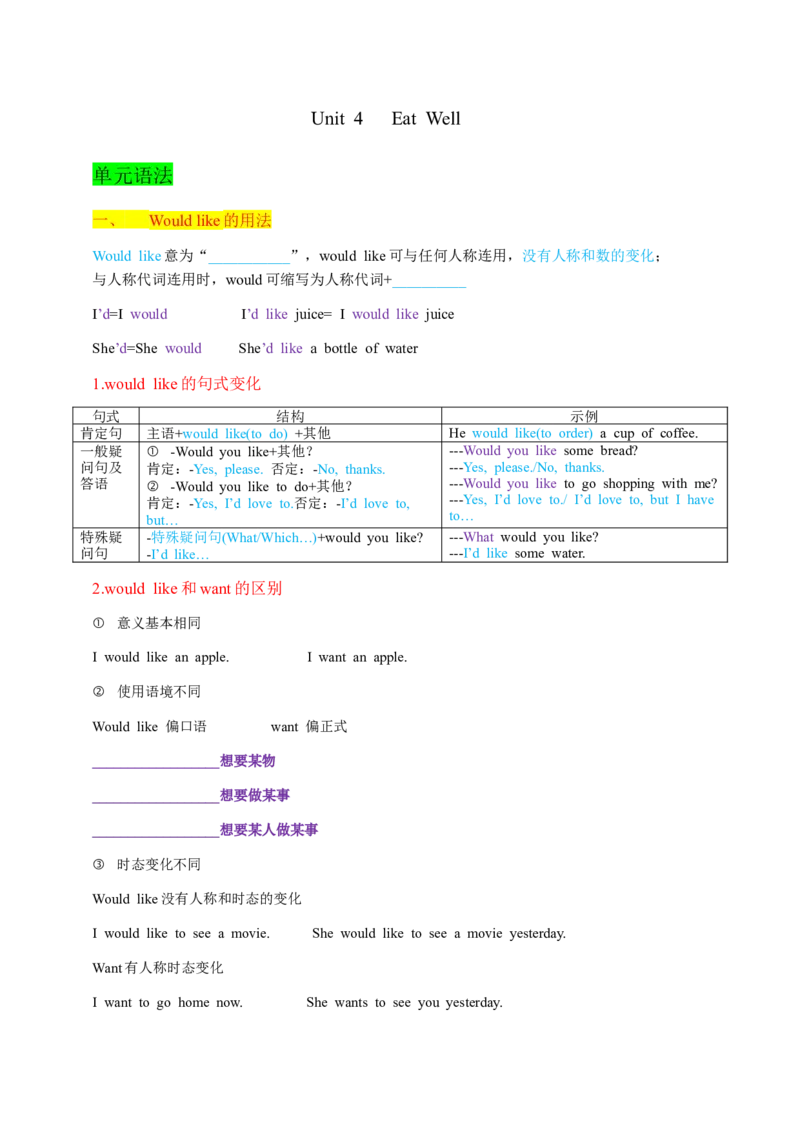
一、 Would like的用法
Would like意为“___________”,would like可与任何人称连用,没有人称和数的变化;
与人称代词连用时,would可缩写为人称代词+__________
I’d=I would I’d like juice= I would like juice
She’d=She would She’d like a bottle of water
1.would like的句式变化
句式 结构 示例
肯定句 主语+would like(to do) +其他 He would like(to order) a cup of coffee.
一般疑 ① -Would you like+其他? ---Would you like some bread?
问句及 肯定:-Yes, please. 否定:-No, thanks. ---Yes, please./No, thanks.
答语 ② -Would you like to do+其他? ---Would you like to go shopping with me?
肯定:-Yes, I’d love to.否定:-I’d love to, ---Yes, I’d love to./ I’d love to, but I have
but… to…
特殊疑 -特殊疑问句(What/Which…)+would you like? ---What would you like?
问句 -I’d like… ---I’d like some water.
2.would like和want的区别
① 意义基本相同
I would like an apple. I want an apple.
② 使用语境不同
Would like 偏口语 want 偏正式
__________________想要某物
__________________想要做某事
__________________想要某人做某事
③ 时态变化不同
Would like没有人称和时态的变化
I would like to see a movie. She would like to see a movie yesterday.
Want有人称时态变化
I want to go home now. She wants to see you yesterday.二、可数名词和不可数名词
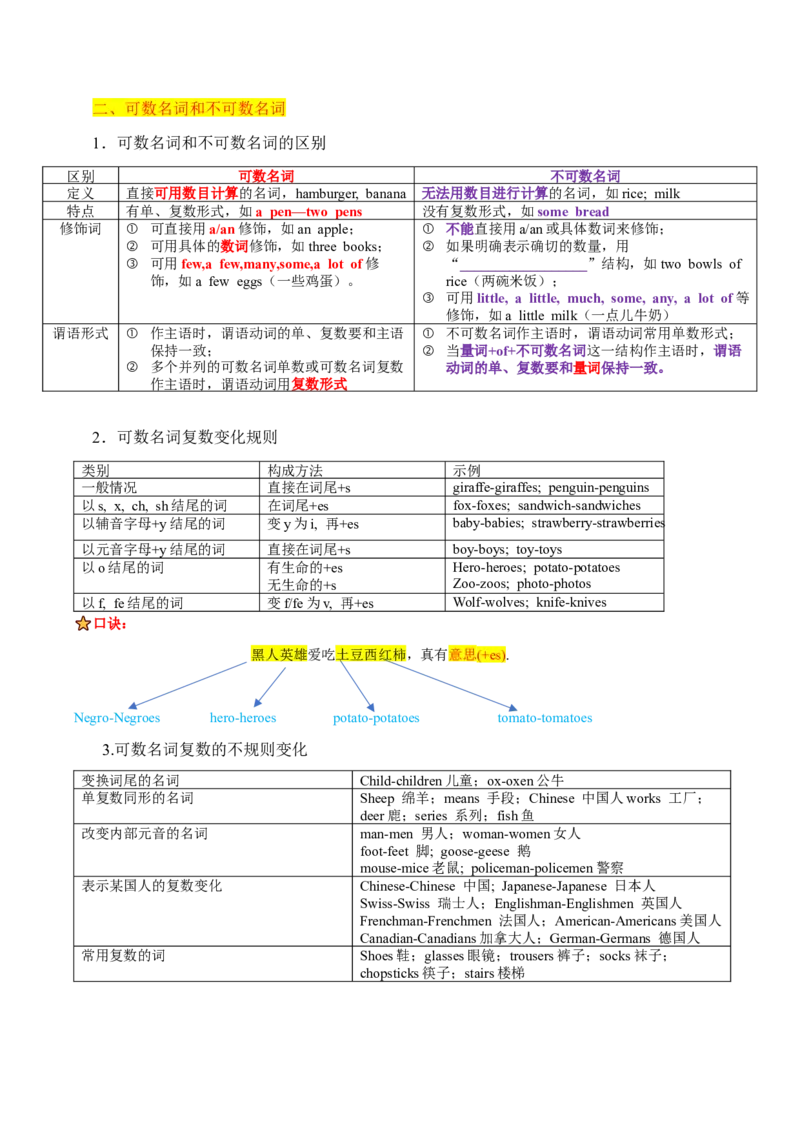
1.可数名词和不可数名词的区别
区别 可数名词 不可数名词
定义 直接可用数目计算的名词,hamburger, banana 无法用数目进行计算的名词,如rice; milk
特点 有单、复数形式,如a pen—two pens 没有复数形式,如some bread
修饰词 ① 可直接用a/an修饰,如an apple; ① 不能直接用a/an或具体数词来修饰;
② 可用具体的数词修饰,如three books; ② 如果明确表示确切的数量,用
③ 可用few,a few,many,some,a lot of修 “__________________”结构,如two bowls of
饰,如a few eggs(一些鸡蛋)。 rice(两碗米饭);
③ 可用little, a little, much, some, any, a lot of等
修饰,如a little milk(一点儿牛奶)
谓语形式 ① 作主语时,谓语动词的单、复数要和主语 ① 不可数名词作主语时,谓语动词常用单数形式;
保持一致; ② 当量词+of+不可数名词这一结构作主语时,谓语
② 多个并列的可数名词单数或可数名词复数 动词的单、复数要和量词保持一致。
作主语时,谓语动词用复数形式
2.可数名词复数变化规则
类别 构成方法 示例
一般情况 直接在词尾+s giraffe-giraffes; penguin-penguins
以s, x, ch, sh结尾的词 在词尾+es fox-foxes; sandwich-sandwiches
以辅音字母+y结尾的词 变y为i, 再+es baby-babies; strawberry-strawberries
以元音字母+y结尾的词 直接在词尾+s boy-boys; toy-toys
以o结尾的词 有生命的+es Hero-heroes; potato-potatoes
无生命的+s Zoo-zoos; photo-photos
以f, fe结尾的词 变f/fe为v, 再+es Wolf-wolves; knife-knives
⭐口诀:
黑人英雄爱吃土豆西红柿,真有意思(+es).
Negro-Negroes hero-heroes potato-potatoes tomato-tomatoes
3.可数名词复数的不规则变化
变换词尾的名词 Child-children儿童;ox-oxen公牛
单复数同形的名词 Sheep 绵羊;means 手段;Chinese 中国人works 工厂;
deer鹿;series 系列;fish鱼
改变内部元音的名词 man-men 男人;woman-women女人
foot-feet 脚; goose-geese 鹅
mouse-mice老鼠; policeman-policemen警察
表示某国人的复数变化 Chinese-Chinese 中国; Japanese-Japanese 日本人
Swiss-Swiss 瑞士人;Englishman-Englishmen 英国人
Frenchman-Frenchmen 法国人;American-Americans美国人
Canadian-Canadians加拿大人;German-Germans 德国人
常用复数的词 Shoes鞋;glasses眼镜;trousers裤子;socks袜子;
chopsticks筷子;stairs楼梯4.不可数名词的表达
从名词的类别看,物质名词和抽象名词是不可数名词。不可数名词没有复数形式,但可以借助量
词来表示数量,其结构为:……+量词(s)+of+不可数名词。当这一结构作主语时,谓语动词的形
式与量词保持一致。
a cup of tea 一杯茶 three bottles of water 三瓶水
a bowl of rice 一碗米饭 two pieces of bread 两片面包
学以致用
一、单项选择
1.We would like_________ some fish and vegetables for lunch.
A. to eat B. eat C. eating D. eats
2.---Would you like_________ soccer with us?
---Sure. I like _________ soccer very much.
A. play; to play B. playing; to play C. to play; playing D. playing; playing
3.---Would you like to go to the cinema with me? ---_________.
A. Yes, I do. B. That’s right. C. Yes, please D. Yes, I’d like to.
4.---Would you like some noodles?
---_________. I don’t like them.
A. Sorry, I don’t. B. No, I wouldn’t. C. No, thanks. D.Yes, please.
5.--- _________? ---Tea, please.
A. Would you like a cup of tea B. What would you like to drink C.Do you
like tea
6. There are_________ on the table. You have one of them.
A. three bowl of beef B. three bowls of beefs C. three bowl of beefs D. three bowls
of beef
7. ---Would you like some_________? ---Oh, yes, just a little.
A. noodles B. dumplings C. beef D. tomatoes
8.---What else do we need to make cold beef? ---_________.A. Two spoons salt B. Two spoons of salt C. Two spoons of salt Two spoons
of salts
9.Look! Some chicken_________ on the plate, and some eggs_________ in the bowl.
A. is; are B. are; are C. are; is D. is; is
10.--- _________? ---Yes, I’d like a bowl of beef noodles.
A. Can you help me? B. How was your day
C. May I take your order D. What would you like to drink
11.---Would you like_________ ice-cream? ---_________.
A. some; Yes, please. B. any; No, thanks. C. some; That’s OK. D. any; No
problem.
12.---Are the_________ noodles ready? ---Not yet. I am washing some_________.
A. potatoes; potato B. potatoes; potatoes C. potato; potato D. potato; potatoes
13.---Would you like to go to the youth centre(青年中心)with me tomorrow?
---_________I can’t wait for the robot show there.
A. Yes, that’s right. B. Sure, I’d love to. C. Of course not. D. Not at all.
14.---Would you like to have a picnic with us? ---_________. Thanks.
A. Yes, I’d love to B. It’s doesn’t matter C. I’m sorry to hear that. D. I don’t
think so
15.The noodles _________ delicious but the soup_________ terrible.
A. is; is B. are; is C. are; are D. is; are
16.Uncle Li has a farm and there are some_________ on the farm.
A. chickens and sheep B. chickens and sheeps
C. chickens and sheep D. chicken and sheeps
17.---Would you like_________ porridge for breakfast?
---Sure, I like_________ porridge very much for breakfast.
A. have; having B. having; having C. to have; having D. have; have
18. Your brother _________ dumplings with beef very much, wouldn’t he?
A. like B. wouldn’t like C. doesn’t like D. would like19.I’d like some _________ and _________.
A.muttons; strawberries B. mutton; strawberrys
C.mutton; strawberries D. muttons; strawberrys
20.---What do you usually have ________lunch? ---I usually have Dongpo pork.
A.to B.for C.with D. to
二、句型转换
1.My brother would like beef dumplings.(改为同义句)
My brother_________ dumplings_________ beef.
2.Would you like two strawberries?(做肯定回答)
_________, _________.
3.Would you like to go camping? (肯定回答)
_________, _________.
4.Would you like rice with your meal? Would you like noodles with your meal?(改为选择疑问
句)
Would you like _________ _________ _________ with your meal?
5.She usually has bread and milk .(划线提问)
_________ _________ _________ usually _________ for breakfast.
三、翻译句子
1.---你想要哪一种,果汁还是咖啡? ---不用了,谢谢。我想喝杯茶。
___________________________________________________________________
2.---你早餐通常吃什么? ---有时我想吃鸡蛋和大豆。
___________________________________________________________________
3.---你吃饭要吃米饭还是面条? ---请给我面条。
___________________________________________________________________
4.---你现在要帐单吗? ---你可以把它带来。
___________________________________________________________________
5.你要薯片、面条、米饭去配你的鸡肉吗?___________________________________________________________________
四、完形填空
How many 26 of Chinese food do you know? I'd like 27 you some specials.
28 1 is noodles. There are many kinds of noodles in China, like rolled(轧制的) noodles, pulled
noodles(拉面), knife-cut noodles(刀削面) and fried noodles (炒面). All of them 29 great.
Special 2 is 30 . Dumplings, yes, I think you must know 31 . Do you know the famous
Kungfu Panda cartoon movie? There are 32 kinds of Chinese specials in the movie: noodles and
fried(油煎的) dumplings. 33 we also have another dumplings— boiled (水煮的) dumplings. We often
eat boiled dumplings 34 our Spring Festival.
I like Chinese food very much. I hope you 35 like it.
1. A. kind B. kinds C. size D. sizes
2. A. tell B. tells C. to tell D. telling
3. A. Food B. Drink C. Fruit D. Special
4. A. is B. am C. be D. are
5. A. dumpling B. dumplings C. hamburgers D. cakes
6. A. them B. they C.it D.me
7. A. some B. many C. two D. second
8. A. As B. Or C. So D. But
9. A. during B. in C. on D. of
10. A. too B. very C. either D. also
五、阅读理解
A
A well-dressed (穿着考究的) man goes into a restaurant one day. He sits down at a table near the
window. A waiter comes up to him and says, “Can I help you, sir?” The man says, “Can I see the menu?” “Of
course.” The man wants a good meal and he orders a lot of nice food. The waiter gets them for him. The
man is having his meal. At this time, a boy comes in and sits beside the man. He asks the man to give him
an ice cream. The man does so. Now the boy is eating his ice cream. The man says, “I go out for a
newspaper.” Then he goes out. After the boy eats his ice cream up, he stands up and goes to the door.
“Excuse me, but your father doesn't give the money for the meal and your ice cream.” the waiter stops
him and says. “Father? You are wrong. He isn't my father. I don't know him. I meet him in the street. He
says he will give me an ice cream if I come here at 12 o’ clock.”
1. Where does the man go?
A. To a bank B. To a supermarket C. To a restaurant D. To a post office
2. What does the boy ask the man to give him?
A. An apple B. A bowl of noodles C. An ice cream D. A bottle of orange
3. What does the man go out for?
A. A newspaper B. A good meal C. A menu D. An ice cream
4. Does the man come back?
A. Yes, he does. B. No, he doesn't. C. No, he does. D. We don't know.5. Who pays for the meal at last?
A. The man B. The boy C. The writer D. Nobody
B
In Britain, some people like to “go to work on an egg”. Some people like to have bread before
going to work. But they usually drink tea or coffee when they eat something. On weekends, most people
would like to have a more traditional breakfast. If you take a trip and stay in a hotel there, you can have a
breakfast like that.
Some people have their main meal in the middle of the day. But most people have it in the evening.
They just have a small midday meal — usually sandwiches and fruit.
The evening meal is usually called “dinner”. A traditional British dinner usually has meat and
vegetables. The most popular meat is chicken and beef. Vegetables like potatoes, onions and carrots are
very popular. People in Britain grow these vegetables. They also buy other vegetables in the supermarket.
After dinner, people like to eat something sweet like fruit salads, cakes or apple pies.
6. The underlined part “go to work on an egg” means“ ”.
A. walk to work with an egg B. buy an egg on the way to work
C. eat an egg before going to work D. put an egg in the office
7. When may most British people have a more traditional breakfast?
A. On Sundays. B. On Fridays. C. On Thursdays. D. On Mondays.
8. What does a traditional British dinner have?
A. Sandwiches and fruit. B. Meat and vegetables.
C. Bread and coffee. D. Eggs and vegetables.
9. Which of the following do British people eat after dinner?
A. Beef. B. Chicken. C. Carrots. D. Cakes.
10. What's the passage mainly about?
A. Meat in Britain. B. Vegetables in Britain.
C. Meals in Britain. D. Breakfast in Britain.
六、语法填空
I try to eat healthy food every day. I eat fruit and_______1_______(vegetable) with every
meal. I don’t eat______2____(sweet). _____3____, I have a pear, a banana, or some____4___
(strawberry)! I love juice, but my mum _______5___(say) that it’s not good_____6_____
drink too much of it. It usually has a lot of _____7____(sugar). Now I try
_____8_____(drink) more____9___(water) and ____10___(milk).
The food in Britain is very different 1. our Chinese food. For example, they
eat a lot of 2. (potato). They like to eat them every day. They eat bread 3. ____ breakfast and
usually for one other meal. They eat their bread 4. butter (黄油), maybe cheese or jam (果酱).
Cheese and butter are made from milk. They drink a lot of milk, too. They drink the milk cold or hot, and
they put it in 5. (they) tea. They put sugar in their milk, too. They are the
6. (world) biggest tea drinkers. They like Chinese tea, 7. they drink mostly (主
要地) strong tea from India and Sri Lanka (斯里兰卡). They don't eat much rice. And they like
8. (羊肉) or fish with potatoes and other vegetables. They serve all these together. After themain meal they always have something sweet. They call this dessert. They don't often have9.
(dumpling). But now Chinese food is10. (get) popular in Britain.