Unit 4 Eat Well
Section A What do we like to eat?
一.课标词汇
1.watermelon /ˈwɔːtəˌmelən/n.西瓜
2.cabbage /'kæbɪdʒ/ n.卷心菜
3.mutton /'mʌtn/n.羊肉
4.cookie /ˈkʊki/n.曲奇饼
5.onion /'ʌnjən/n.洋葱; 葱头
6.dumpling /'dʌmplɪŋ/n.饺子
7.coffee /'kɒfi/n.咖啡
8.bean / bi:n/n.豆
9.chip /tʃɪp/ n.炸薯条
10.fish and chips 炸鱼薯条
11.salad /'sæləd/n.沙拉; 色拉
12.porridge /'pɒrɪdʒ/n.粥; 麦片粥
13.waiter /'weɪtə(r)/n.( 男 ) 服务员
14.What about …? ……怎么样?
15.taste /teɪst/ v. 有……味道; 尝n.味道
16.anything /'eniθɪŋ/ pron.某事物;任何事物
17.dish /dɪʃ/ n.一道菜; 盘
18.choice /tʃɔɪs/n.选择
19.meal / mi:l/n.一餐所吃的食物;早(午、晚)餐
20.pork /pɔ:k/n.猪肉
21.strawberry /'strɔ:bəri/n.草莓
22.menu /' menju:/n.菜单
23.customer /'kʌstəmə(r)/ n.顾客
24.serve /sɜːv/v.提供; 服务
25.waitress /'weɪtrəs/n.女服务员
26.sir /sɜː(r)/n.先生
27.go with 搭配; 相配
28.pear /peə(r)/n.梨
29.too much 太多
30.sugar /'ʃʊgə(r)/n.糖
二.词形变换
1.strawberry--pl.___________
2.serve--n.________________
3.anything--某物____________--没有东西____________
4.dish--pl._________________
5.choice--v.________________--过去式_______________
1Grammar Focus--选择疑问句
一.概念及分类
Would you like milk or coffee?
你要牛奶还是咖啡?
Which would you like best, English, Chinese or Math?
你最喜欢哪门学科, 英语、语文还是数学?
注:选择疑问句是提出两个或两个以上可能的答案供对方选择,一般用连词_________连接。
二.选择疑问句的句型结构:
①一般疑问句+ or+被选择的情况?
Are you a doctor or a nurse?
你是医生还是护士?
②特殊疑问句, A or B?
How shall we go, by bus or by taxi?
我们怎么去,乘公共汽车或乘出租车?
③or not构成的选择疑问句
Are you ready or not?
你准备好了还是没准备好?
三.选择疑问句的用法
1、____________________________________
Are you ________________?
你是老师还是学生?
Are you French or German?
你是法国人还是德国人?
2、____________________________________
Which is better, Paris or Beijing?
巴黎和北京哪个更好?
How many times a week do you exercise, twice or three times?
你每周锻炼多少次, 两次还是三次?
3、____________________________________
Do you want to buy it or not?
你想买还是不想买?
Are you coming to the party, _______________?
你会来参加聚会吗, 还是不会?
四.选择疑问句的答语
回答选择疑问句时,一般在所提供的备选对象范围内选择,有时也要视具体情况作灵活处理,但不能
_______________,一般用一个完整的陈述句或其简略形式。
①--Which would you like, tea or coffee?
--Coffee.
不定代词作简略回答:( all, both, either, neither, none) 不定代词的回答比较灵活
--Would you like coffee or tea?
--__________, please.I’m so thirsty(口渴的).
2三.4A课文
Waiter: Hello! What would you like to____________?
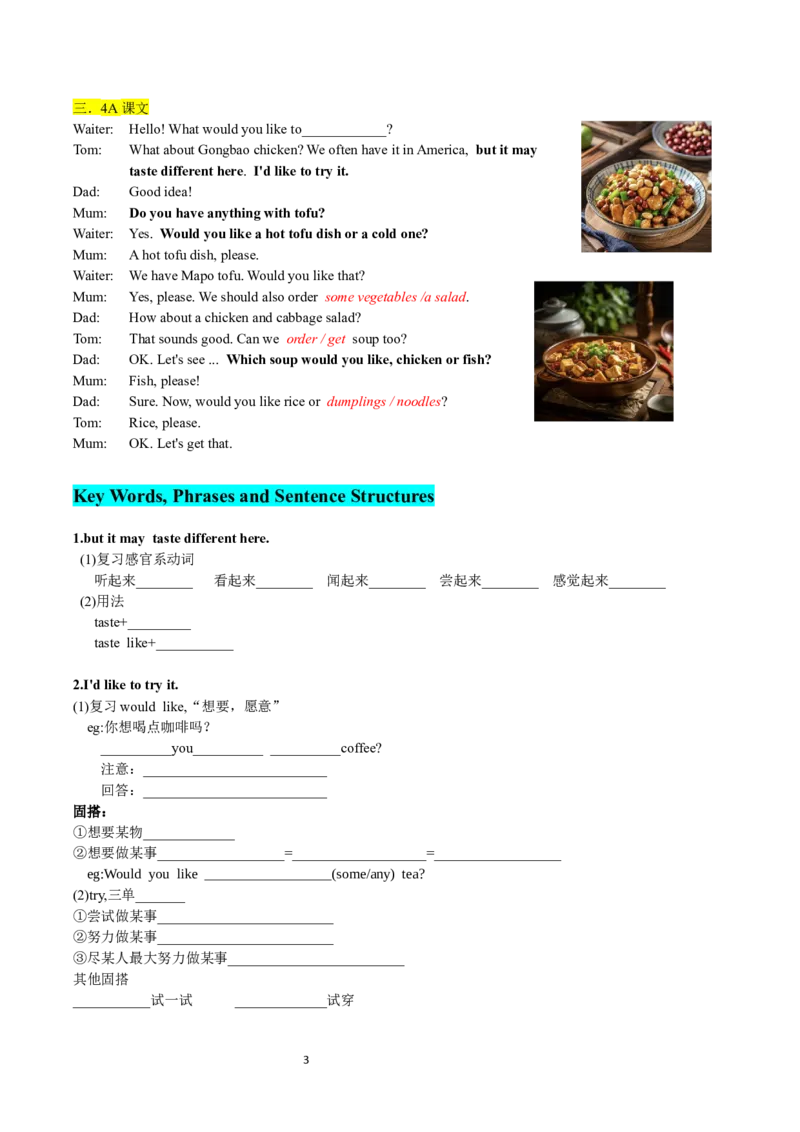
Tom: What about Gongbao chicken? We often have it in America, but it may
taste different here. I'd like to try it.
Dad: Good idea!
Mum: Do you have anything with tofu?
Waiter: Yes. Would you like a hot tofu dish or a cold one?
Mum: A hot tofu dish, please.
Waiter: We have Mapo tofu. Would you like that?
Mum: Yes, please. We should also order some vegetables /a salad.
Dad: How about a chicken and cabbage salad?
Tom: That sounds good. Can we order / get soup too?
Dad: OK. Let's see ... Which soup would you like, chicken or fish?
Mum: Fish, please!
Dad: Sure. Now, would you like rice or dumplings / noodles?
Tom: Rice, please.
Mum: OK. Let's get that.
Key Words, Phrases and Sentence Structures
1.but it may taste different here.
(1)复习感官系动词
听起来________ 看起来________ 闻起来________ 尝起来________ 感觉起来________
(2)用法
taste+_________
taste like+___________
2.I'd like to try it.
(1)复习would like,“想要,愿意”
eg:你想喝点咖啡吗?
__________you__________ __________coffee?
注意:__________________________
回答:__________________________
固搭:
①想要某物_____________
②想要做某事__________________=___________________=__________________
eg:Would you like __________________(some/any) tea?
(2)try,三单_______
①尝试做某事_________________________
②努力做某事_________________________
③尽某人最大努力做某事_________________________
其他固搭
___________试一试 _____________试穿
33.Do you have anything with tofu?
(1)anything 为复合不定代词,常用于____________句中,____________句中用 something,位于 adj.的
________。
eg:
Do you do____________every Sunday?
A.something interesting B.anything interesting C.interesting something D.interesting anything
4.Would you like a hot tofu dish or a cold one?
(1)dish,n.“菜肴;盘子”
_____________洗碗
(2)复习代词it/one
①it,_________________
②one,_______________
5.Which soup would you like, chicken or fish?
(1)该句为___________疑问句。
(2)and用于肯定句,变否疑句需要改为________
6.What do you usually have for breakfast?
(1)have的用法,过去式_________
①上课_______________
②举办派对__________________
③有钱__________________
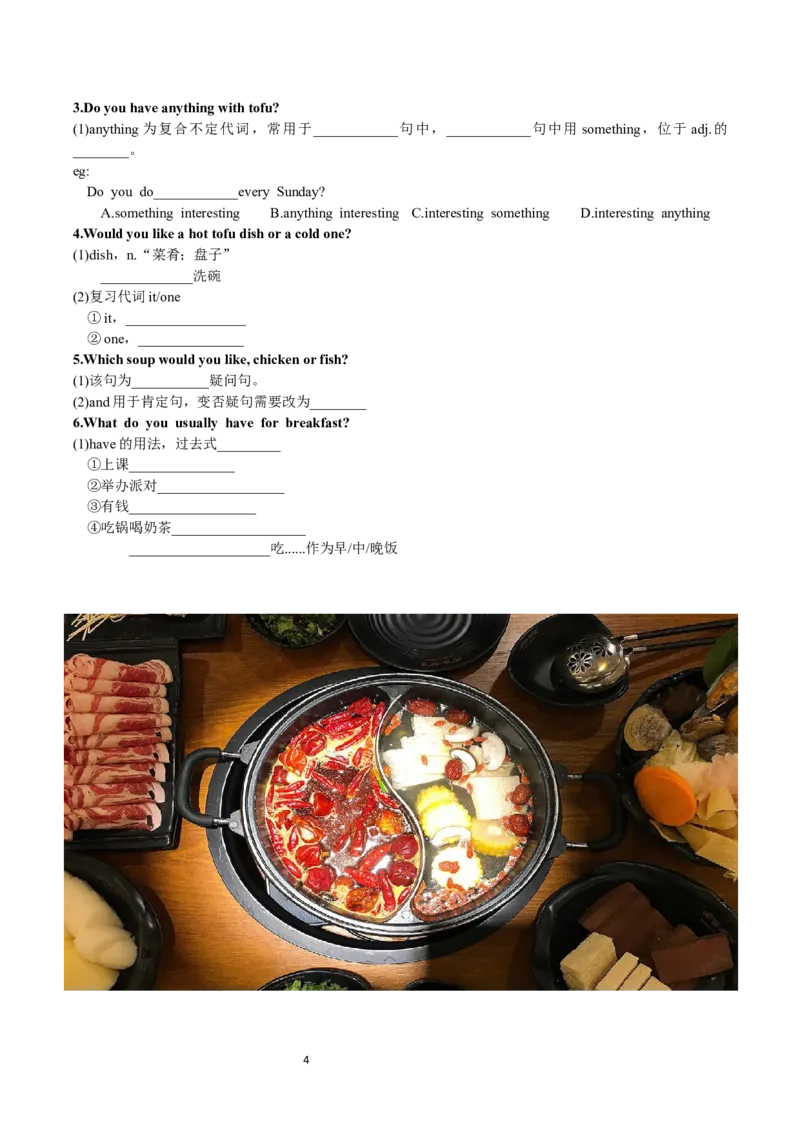
④吃锅喝奶茶___________________
____________________吃......作为早/中/晚饭
4After class
一.单项选择
1.— Do you like Journey to the West ________The Adventures of Tom Sawyer?
— Journey to the West.
A. and B. or C. but D.so
2.— Does your uncle live in England or America?
—________ . He lives in London.
A. Yes, he does B. In America C. In England D. No, he doesn't
3. Would you like a large bowl or a small bowl?(选择本句句型)
A.选择疑问句 B.一般疑问句 C.特殊疑问句 D.反意疑问句
4.— Does your sister have black hair or brown hair?
—_.
A. Yes, she does B. She has black hair C. Yes, she has black hair
5.I'm hungry. I would like________a large bowl of dumplings.
A. have B. eat C. eating D. to eat
6. — Would you like some soup?
—________. I want some salad.
A. No,I wouldn't B. It's OK C. No, thanks D. Yes,I'd love to
7. Her brother would like her________ shopping with him.
A. go B. to go C. going D.does
8.— Would you like to go to the history museum with me?
—________.
A. Sure, I'd love to B. Yes,I do
C. That's right D.Sure,I’d like
9.—How does the apple juice taste?
—Good. I’d like to have ________ glass.
A.another B.other C.the other D.it
10.________ the grapes in the fridge for a while(一会儿) can make them ________ nicer.
A.Keeping; taste B.To keep; to taste C.Keep; taste D.Keeping; to taste
11.—Why do you always go to that bakery to buy bread?
—Because the bread there sells very________ as it tastes ________.
A.good;well B.good;good C.well;well D.well;good
12.—Did you try ________?
—Yes. There are many interesting things there.
A.something special B.anything special
C.special something D.special anything
13.My Maths teacher asked me ________ another way to solve(解决) the problem.
A.to try using B.to try to use C.try using D.try to use
14.Your watch look so nice ,where did you buy________,I want to have_______.
A.it,one B.one,it C.it,it D.one,one
二.完成句子
51.He would like to be my friend. (改为一般疑问句)
he be your friend?
2. He’ d like some orange juice.(改为一般疑问句)
________he________ orange juice?
3.I like cats and dogs.(改为否定句)
I________ like cats________dogs.
4.我想在家休息。
I _______________________ a rest.
=_______________________a rest.
=_______________________a rest.
三.完形填空(巴蜀2023-2024学年第一次月考)
Lili Time is one of the cafes(咖啡馆) in Shanghai, but it is not the _1_ as others(其它). Some people say they
do not only go there to drink coffee, but they also enjoy“talking” with the baristas(咖啡师).
One day, when Zhang Lili works in her cafẻ, a man gives her a note(便条). It reads, “My name’ s John. I am
deaf(聋的) but I really love coffee. And I really want to know _2_ to make coffee ?” Zhang agrees and teaches him
to make it. After that, John becomes(成为) the_3_ deaf barista in her café. And there starts Zhang's story with the
deaf community(群体).
Later, Zhang starts Lili Time with John. With John's help, it becomes a place with_4_ . More and more deaf
people know about _5_ and the story spreads(传播).
Some other cafés _6_ have deaf baristas. They often use QR codes(二维码) to help to order(点单). _7_ Lili
Time does not. People need to order their coffee by“_8_” its baristas, although(虽然) they speak slowly and
sometimes not clearly(清楚地). But this is Zhang's plan. She wants deaf people to“talk” with others and be happy.
She _9_ sells coffee by delivery(外卖) service. She thinks there should be talks _10_ her customers(顾客) and her
baristas.
Now, Zhang is thinking about opening more cafés to help people who have other problems in some ways.
1. A. big B. same C. true D. interesting
2. A. how B. where C. what D. why
3. A. last B. best C. first D. second
4. A. music B. coffee C. people D. love
5. A. it B. them C.us D. him
6. A. all B. also C. only D. too
7. A. But B. And C. Because D. Or
8. A. writing to B. knowing about C. calling at D. talking to
9. A. never B. always C. sometimes D. usually
10.A.in B.about C.between D.with
四.阅读理解
① In 1299, Marco Polo(马可·波罗) wrote a book called The Travels of Marco Polo. He used the
word“dragon” to translate(翻译) the Chinese word“long”. Do you think“dragon” is a good word
for“long”?
②The Chinese dragon and the Western dragon are both animals in stories. They are the same in some
ways. For example, they both have scales(鳞片) and big claws(爪子). But they also have many
differences.
③The Chinese dragon is made up of parts of different animals, like a rabbit's eyes and an ox(牛)'s
ears. The dragon is often painted gold(金色). In Chinese stories, the dragon can fly and it can also
6spray(喷洒) water from its mouth to make rain.
④But the Western dragon looks like a snake with big bat(蝙蝠) wings. It is often seen as something
bad. It breathes fire and is usually painted black.
⑤_▲_ I don't think so. This is because China and the West have different cultures(文化). In China,
kindness and harmony(和谐) are important. But in the West, they like stories about brave men. Because
they often defeat bad creatures like the Western dragon.
⑥ These days, Chinese people have tried other ways to translate“long”. For example, a company
called Loong Air(长龙航空) uses“Loong”. But one thing is sure: the Chinese dragon isa symbol(象征)
of good luck and happiness. Good luck in the Year of Loong!
1. Marco Polo translated the Chinese word“long” as“_______” in his book.
A. long B. bat C. dragon D. loong
2. Which is the Chinese dragon according to the passage?
3. Which sentence can be put in _▲_ ?
A. Do the brave men like the Western dragon best?
B. Do Chinese like stories about the Chinese dragon?
C. Does the Chinese dragon look the same as the Western dragon?
D. Does the word“dragon” mean the same thing as“long” in China?
4. Which of the following sentences can show the structure of the passage?
① The Chinese dragon and the Western dragon look different.
②“Loong” is a symbol of good luck and happiness.
③ The Chinese dragon and the Western dragon are the same in some ways.
④ The Chinese dragon and the Western dragon are different in culture.
78