Unit 7 A Day to Remember
Section B What did you learn on that special day?
一.课标词汇
1.skill /skɪl/ n.技能
2.write down 写下; 记下
3.explore /ɪk'splɔ:(r)/v.探索
4.tent / tent/n.帐篷
5.cucumber /' kju:kʌmbər/n.黄瓜
6.from ... to ... 从······到······
7.straight /streɪt/ adv.直接;立即;笔直地 adj.直的
8.fill /fɪl/v.装满; 盛满
9.basket /'bɑːskɪt/ n.篮子; 筐
10.teach /ti:tʃ/v.( taught /tɔ:t/)教
11.branch /bra:ntʃ/n.分支; 树枝
12.leaf / li:f/n.( pl. leaves/ li: vz/)树叶
13.finally /'faɪnəli/ adv.终于
14.think of 考虑; 想起
15.grain /greɪn/n.谷物; 谷粒
16.fresh /freʃ/ adj.新鲜的
17.certainly /'sɜːtnli/ adv.肯定地
18.diary /'daɪəri/n.日记; 日记本
19.entry /' entri/n.(日记的) 一则; 入口
20.agree /ə' gri:/v.赞成; 同意
21.agree with 赞成; 同意
二.词形变换
1.fill--adj. fille d
2.teach--三单 teache s --过去式 taugh t
3.leaf--pl. leave s
4.finally--adj. fina l
5.certainly--adj. certai n
6.diary--pl. diarie s
7.agree--n. agreemen t --反义词 disagre e三.7B课文
Friday. 30 May
Today we went to a school trip to a farm! It was tiring but great fun! in the
morning,we explored the farm. There were large tents with tomatoes,cucumbers and
many other fruits and vegetables. The farmer told us about these fruits and
vegetables go from the fields to our tables. I was very interested because I usually
only see them in the supermarket.
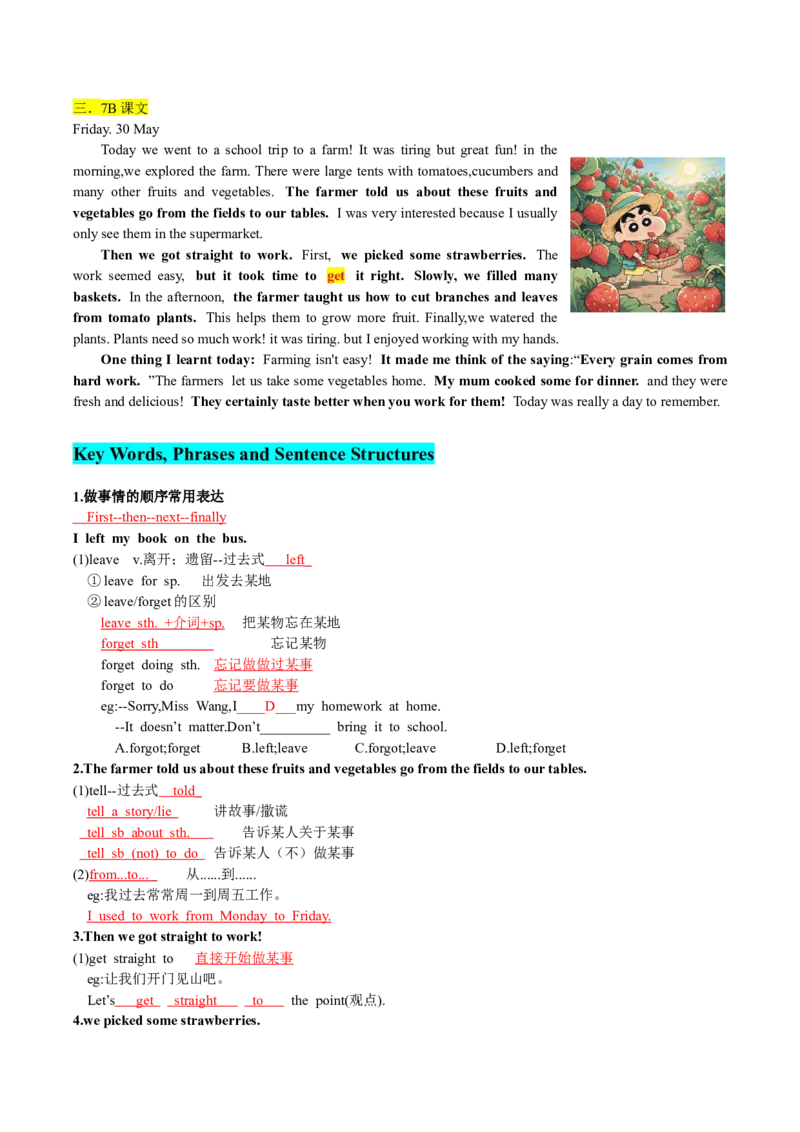
Then we got straight to work. First, we picked some strawberries. The
work seemed easy, but it took time to get it right. Slowly, we filled many
baskets. In the afternoon, the farmer taught us how to cut branches and leaves
from tomato plants. This helps them to grow more fruit. Finally,we watered the
plants. Plants need so much work! it was tiring. but I enjoyed working with my hands.
One thing I learnt today: Farming isn't easy! It made me think of the saying:“Every grain comes from
hard work. ”The farmers let us take some vegetables home. My mum cooked some for dinner. and they were
fresh and delicious! They certainly taste better when you work for them! Today was really a day to remember.
Key Words, Phrases and Sentence Structures
1.做事情的顺序常用表达
First--then--next--finall y
I left my book on the bus.
(1)leave v.离开;遗留--过去式 lef t
①leave for sp. 出发去某地
②leave/forget的区别
leave sth . + 介词 +sp . 把某物忘在某地
forget sth 忘记某物
forget doing sth. 忘记做做过某事
forget to do 忘记要做某事
eg:--Sorry,Miss Wang,I____D___my homework at home.
--It doesn’t matter.Don’t__________ bring it to school.
A.forgot;forget B.left;leave C.forgot;leave D.left;forget
2.The farmer told us about these fruits and vegetables go from the fields to our tables.
(1)tell--过去式 tol d
tell a story/lie 讲故事/撒谎
tel l s b abou t sth . 告诉某人关于某事
tel l s b (not ) t o d o 告诉某人(不)做某事
(2) from...to.. . 从......到......
eg:我过去常常周一到周五工作。
I used to work from Monday to Friday .
3.Then we got straight to work!
(1)get straight to 直接开始做某事
eg:让我们开门见山吧。
Let’s ge t straigh t t o the point(观点).
4.we picked some strawberries.(1)pick v.摘
pick up 捡起;接电话;搭载;开车接(某人)
eg:--Mike,Can you____A___the phone? I’m cooking dinner.
--OK,mom.
A.pick up B.put up C.put on
5.but it took time to get it right.
(1)四个“花费”
含义 主语 宾语 搭配
花费 人 时间、钱 Sb spend time/money on sth. 某人在某物上花了 . .
spend Sb spend time/money (in) doing sth. 某人花 . . 做某事 .
度过 人 时间 Spend time with sb 和某人度过…时间
pay 付 人 钱 Sb pay money for sth. 某人为某物付了…钱 .
take 花费 事物 时间 It takes sb time to do sth. 做某事花了某人…时间 .
cost 花费 事物 钱 Sth cost sb money. 某物花了某人…时间 .
e.g. 1.我通常花两个小时做家庭作业。
I usually spend two hours doing homework.=It usually takes me two hours to do homework.
2.她花了200元买这件毛衣。
She spends 200 yuan on the sweater.
=She pays 200 yuan on the sweater.
=The sweater costs me 200 yuan.
6.Slowly, we filled many baskets.
(1)fill v.用......装满--adj. fille d
fill...with. .. 用......装满.......
b e fille d with=b e ful l o f 装满了.......
eg:人生充满了起起伏伏。
Life i s fille d with/i s ful l o f ups and downs.
7.the farmer taught us how to cut branches and leaves from tomato plants.
(1)教某人某事 teach sb . sth .
(2)教某人做某事 teach sb to do sth
(3)教某人如何做某事 teach sb how to do sth .
eg:My mother taught me how t o coo k .(如何做饭)
8.One thing I learnt today:
(1) 句子分析:I learnt在句子中作 定语 从句。
(2) learn--过去式 learned/learn t
lear n t o d o st h 学着做某事
lear n how t o d o sth . 学着如何做某事
9.It made me think of the saying:“Every grain comes from hard work.”
(1)think of 认为;想起;想出
think about 思考;考虑
think over 仔细思考
翻译:
①在你决定之前请仔细思考。 Please think it over before you decide②你认为火锅怎么样? What do you think of hot pot?=How do you like hot pot ?
10.My mum cooked some for dinner.
(1)cook n.厨师;v.烹饪
cooker n . 厨具
cook...for dinner 晚饭做 ... ..
11.They certainly taste better when you work for them!
(1)work for 为 .... .. 工作
(2)work at 致力于 ; 从事于
(3)work out 计算出;解决
eg:
The math problem is too hard.I can’t_____C___it
A. work on B.work for C.work out
拓展阅读--Changing moods
Seasonal affective disorder makes people feel down during certain seasons
为什么冬季容易抑郁?
Winter is coming-do you feel down more often? If so, you might have seasonal
affective disorder(SAD,季节性情绪失调).
SAD is a kind of depression(抑郁) that comes and goes with the seasons. It is
also known as“winter depression” because it usually happens in winter. However,
some people with SAD may also feel down during the summer and feel better in the
winter.
Besides feeling sad, people with SAD may also lose interest in everyday
activities. They may sleep a lot and find it hard to get up in the
morning. It can also be difficult for them to focus( 集中注意
力 ).Scientists still don't know the reason behind SAD. But it's
often linked to less sunlight during the shorter autumn and winter
days, the UK National Health Service(NHS) said. Not getting enough sunlight might make a part
of the brain not work well. This can influence your hormones and body clock. All of these
things make you feel blue.
Getting more sunlight and exercising are good ways to deal with( 应 对 )SAD.“Light
therapy(疗法)”, or using special lamps at home to simulate (模仿) natural light, can also help.
But if you still feel very sad, you should go to a doctor, said the NHS.
1. How might people feel more often if they have SAD?
A. Angry. B. Unhappy. C. Nervous. D. Excited.
2. When does SAD usually happen?
A. In spring. B. In summer. C. In autumn. D. In winter.
3. What is Paragraph 3 mainly about?
A. What SAD does to people. B. Why people get SAD.
C. Who is more likely to get SAD. D. How SAD influences work.4. What might be the reason for SAD according to the UK's NHS?
A. Not getting enough sleep. B. Too much brain activity.
C. Getting less sunlight. D. Difficulties in being focused.
5. How can people stop themselves from getting SAD?
A. By exercising more in natural light. B. By keeping lights on at night.
C. By staying indoors as much as possible. D. By thinking less about their feelings.
答案:BDACA
After class
一.词汇填空
1.I get used to_________(sleep) late on weekends.
2.They used to_________(worry) about their tests.
3.Did you use to_________(eat) candy a lot?
4.Don’t forget________(close) the window.
5.My mother often tells me__________(not run) in the street.
6.Exciting activities can encourage children to e________new worlds.
7.We can always see lots of green_______(leaf) in spring.
8.He__________(agree) with me because he dislikes the idea.
9.Lily is studying for the________(finally) exam.
10.What can you learn from you classmates’ ________(diary)?
答案:sleeping worry eat to close not to run explore leaves disagrees final diaries
二.选择题
1.He wanted to __________when he noticed the new words, so he asked me for a piece of paper.
A.write it down B.write them down C.write down it D.write down them
2.--Where_________he go on vacation?
--He went to the mountains.
A.is B.does C.has D.did
3.I_________some strawberries and_________them to my home this morning.
A.pick,took B.pick,take C.picked,took D.picked,take
4.--What can we learn on the farm?
--You can learn_________horses.
A.in B.about C.with D.at
5._________you ask_________questions about farming yesterday?
A.Did,some B.Did,any C.Do,some D.Do,any
6.My school trip wasn't fun.I_________it at all.
A.like B.liked C.likes D.didn’t like
7.--_________was your school trip?
--Not very good.
A.What B.How C.When D.Where
8.Miss Li teaches________English.We all like her very much.
A.our B.us C.we D.ours
9.Alice_________her homework_________Saturday morning
A.did,on B.do,on C.did,in D.do,in
10.(多选)--It's important for us to know_________all the subjects.--Yeah.Group work is my favorite.
A.how we can study B.how can we study
C.how to study D.when to study
答案:BDCBB DBBA AC
三.完成句子
1.He wants to learn how he should make a kite.(改为同义句)
He wants to learn how t o make a kite.
2.I went to the zoo yesterday.(改为一般疑问句)
Did you g o to the zoo yesterday?
3.Mike and his classmates sang the English song yesterday afternoon.(对划线部分提问)
What di d Mike and his classmates d o yesterday afternoon?
4.你去上海的研学如何?
How wa s your schoo l trip t o Shanghai?
5.刚刚我从一位农夫那里了解到很多关于务农的事。
I learn t a lo t from a farmer abou t farming just now.
6.放学后你可以开车来接我吗?
Can you pic k u p me after school?
7.我们需要学会如何好好照顾自己。
We should learn how t o look after ourselves well.
8.It took me 30 minutes to finish my homework.(改为同义句)
I spen t 30 minutes finishin g my homework.
9.The bottle is full of waste water.(改为同义句)
The bottle is fille d with waste water.
10.他上周离开了重庆去北京。
He left Chongqing for Beijing.
四.语法选择。(巴蜀2023-2024七下期末)
Have you ever heard of capybaras (卡皮巴拉)?
Capybaras are ____1____ interesting and cute animal. When they first showed up on the Internet, they
became very popular with people of all ____2____.
Capybaras are the biggest rodent (啮齿动物) in the world, and ____3____ from South America. They usually
live in groups as a family and love to be near water. They are good ____4____ swimming. They move slowly
____5____ can quickly jump into the water when in danger. They spend their days eating grass, enjoying the sun,
taking a shower and ____6____. Capybaras like to be quiet and don’t like to play around. They are always living a
____7____ life.
Now Capybaras become a symbol of mental (心理的) health. They tell us ____8____ a minute to relax and
enjoy the simple things in life. So next time when you feel bad, just think of capybaras. ____9____ a hot shower
and let their relaxed feeling be around you. Think like capybaras, and you’ll find that you don’t have to worry about
____10____.
1. A. a B. an C. the
2. A. age B. ages C. age’s
3. A. come B. came C. comes
4. A. at B. with C. for
5. A. and B. or C. but
6. A. sleep B. slept C. sleeping7. A. relax B. relaxing C. relaxed
8. A. to take B. take C. taking
9. A. Enjoy B. Enjoying C. To enjoy
10. A. something B. anything C. nothing
【答案】1. B 2. B 3. A 4. A 5. C 6. C 7. B 8. A 9. A 10. B
五.阅读理解巴蜀2023-2024七下期末)
“Li Kui, Lin Chong, and Song Jiang”, which are popular in the Chinese story “Water Margin (水浒传)”, come
alive (活跃的) every Spring Festival when they dance on the street. People call this kind of dance the Yingge
Dance.
The Yingge Dance is a special dance from Guangdong and Fujian in China. It has a history of more than 400
years. People perform (表演) this dance with the moves of southern Chinese heroes (英雄) from “Water Margin”,
so it’s also called the “Hero’s Song” Dance.
When people dance, they hold a short stick (棍) in each hand. The dancers hit (敲击) the sticks up and down,
left and right with strong moves and fast drums. The head and the body move naturally from side to side.
▲ One of the reasons is that the dance is really fun to watch. It makes people feel strong. Another
reason is that the Yingge Dance shows the stories in the book and most of them are about good men winning over
bad men. People think the dance can bring them good luck.
Last Spring Festival, a little boy named Chen Kaiming who is only five and a half years old, became very
popular on the Internet. He comes from a Yingge Dance team and played “Shi Qian”, a hero from “Water Margin”.
Seeing him dance makes people think that this dance will last for a long time and many more kids will learn it.
1. Where can people usually see the Yingge Dance?
A. In the restaurant. B. In the cinema. C. In the classroom. D. On the street.
2. Which of the pictures is performing the Yingge Dance?
A. B. C. D.
3. Which of the following questions does the passage NOT answer?
A. How do the dancers perform the Yingge Dance?
B. Where does the Yingge Dance come from?
C. Who teaches people to perform the Yingge Dance?
D. Why do so many people like the Yingge Dance?
4. Which sentence can be put in the ▲ ?
A. The Yingge Dance is a good way for people to make friends.
B. It’s not very easy for young people to learn the Yingge Dance.
C. People in Guangdong and Fujian, old and young, all love this dance.
D. In Guangdong and Fujian, women can also perform the Yingge Dance.
【答案】DBCC
六.任务型阅读(巴蜀2023-2024七下期末)
That was a Thursday as usual. It was getting dark. Steve looked out of the window and signed (叹气). Dad
said he could come home before 5:30, but it was 7:00. Even if (即使) Dad came back, there was no fun playing
badminton in the dark. Steve walked into his room and tried to do some homework, but he couldn’t.
At around 8:00, Steve got a call from Dad: “Steve, I’m sorry, but I couldn’t play badminton with you tonight. Ihave to finish my work. Maybe we can play this weekend. Oh no. How about next weekend?…”.
Steve couldn’t know why Dad was so busy. He threw himself into the sofa and soon fell asleep (睡着) with his
book open.
The next day after school, Mrs. Clark, his teacher, asked him to go to her office. “Steve, you didn’t do your
homework last night. You didn’t pass (通过) the test today and just got a D. This is not like you. Can you tell me
why?”
Steve just sat there quietly.
“Steve, I know that something is worrying you, but you need to speak it out.”
When Steve walked home, he thought of what Mrs. Clark said. Maybe he did all these just because he wanted
to get his dad’s attention (注意). He knew Mrs. Clark was right.
After getting home, he called his dad. But there was no answer. Then it went to voicemail (语音信箱). Steve
left a message, “…”.
When Steve ended the call, he felt very relaxed. He didn’t know whether (是否) his dad would be different,
but he himself changed (改变). He told his feelings to his Dad. Then he went to do his homework with a clear head.
1. Did Steve do his homework on Thursday night?
_________________________________________________
2. What did Steve ask his father to do with him?
_________________________________________________
3. According to the passage, why didn’t Steve pass the test?
_________________________________________________
4. What message did Steve leave for his Dad? (about 30 words)
_________________________________________________
【答案】
1. No, he didn’t.
2. To play badminton.
3. Because something was worrying him and he wanted get his dad’s attention.
4. Dad, I feel so sad because you are always so busy. I really want to play badminton with you. I think the best
thing is to be with you. I love you, dad.