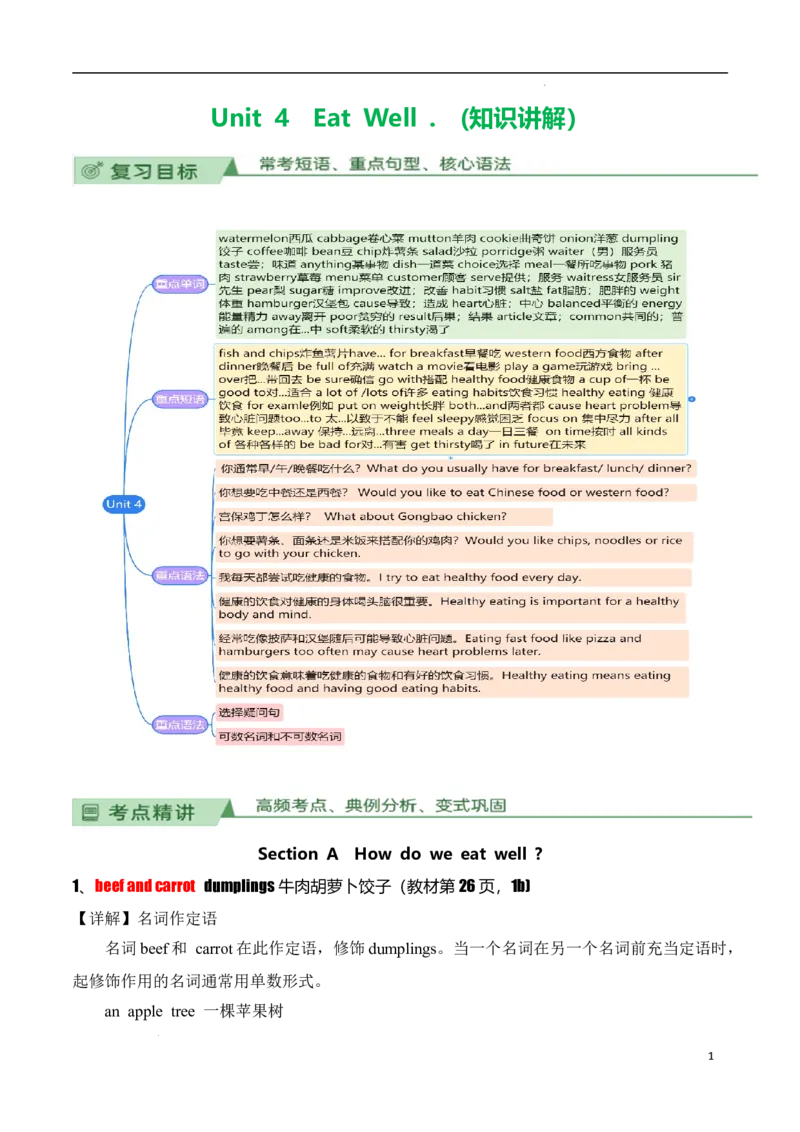
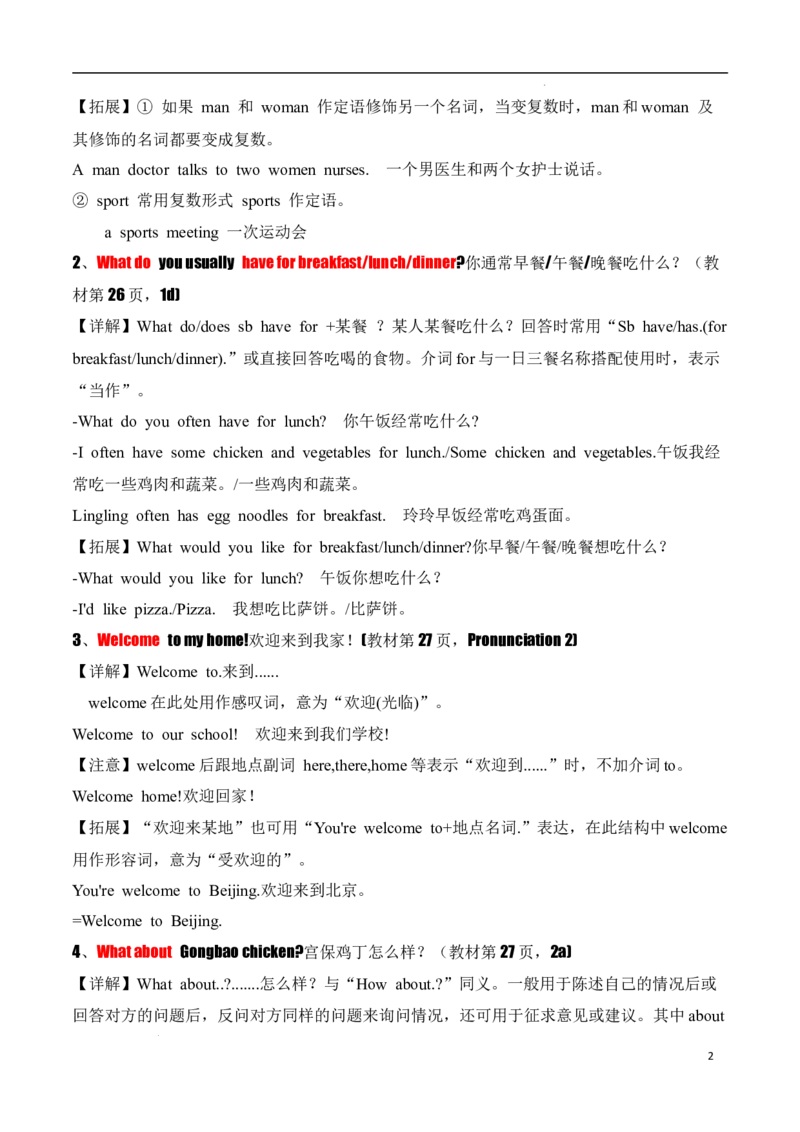
Unit 4 Eat Well . (知识讲解)
Section A How do we eat well ?
1、beef and carrot dumplings牛肉胡萝卜饺子(教材第26页,1b)
【详解】名词作定语
名词beef和 carrot在此作定语,修饰dumplings。当一个名词在另一个名词前充当定语时,
起修饰作用的名词通常用单数形式。
an apple tree 一棵苹果树
1
学科网(北京)股份有限公司【拓展】① 如果 man 和 woman 作定语修饰另一个名词,当变复数时,man和woman 及
其修饰的名词都要变成复数。
A man doctor talks to two women nurses. 一个男医生和两个女护士说话。
② sport 常用复数形式 sports 作定语。
a sports meeting 一次运动会
2、What do you usually have for breakfast/lunch/dinner?你通常早餐/午餐/晚餐吃什么?(教
材第26页,1d)
【详解】What do/does sb have for +某餐 ?某人某餐吃什么?回答时常用“Sb have/has.(for
breakfast/lunch/dinner).”或直接回答吃喝的食物。介词for与一日三餐名称搭配使用时,表示
“当作”。
-What do you often have for lunch? 你午饭经常吃什么?
-I often have some chicken and vegetables for lunch./Some chicken and vegetables.午饭我经
常吃一些鸡肉和蔬菜。/一些鸡肉和蔬菜。
Lingling often has egg noodles for breakfast. 玲玲早饭经常吃鸡蛋面。
【拓展】What would you like for breakfast/lunch/dinner?你早餐/午餐/晚餐想吃什么?
-What would you like for lunch? 午饭你想吃什么?
-I'd like pizza./Pizza. 我想吃比萨饼。/比萨饼。
3、Welcome to my home!欢迎来到我家!(教材第27页,Pronunciation 2)
【详解】Welcome to.来到......
welcome在此处用作感叹词,意为“欢迎(光临)”。
Welcome to our school! 欢迎来到我们学校!
【注意】welcome后跟地点副词 here,there,home等表示“欢迎到......”时,不加介词to。
Welcome home!欢迎回家!
【拓展】“欢迎来某地”也可用“You're welcome to+地点名词.”表达,在此结构中welcome
用作形容词,意为“受欢迎的”。
You're welcome to Beijing.欢迎来到北京。
=Welcome to Beijing.
4、What about Gongbao chicken?宫保鸡丁怎么样?(教材第27页,2a)
【详解】What about..?.......怎么样?与“How about.?”同义。一般用于陈述自己的情况后或
回答对方的问题后,反问对方同样的问题来询问情况,还可用于征求意见或建议。其中about
2
学科网(北京)股份有限公司为介词,其后常接名词、代词或动词-ing形式。
I want to walk to school. What/How about you?我想步行去学校,你呢?
What/How about going home now? 现在回家怎么样?
5、We often have it in America, but it may taste different here.我们在美国经常吃,但在这
里它可能有不一样的味道。(教材第27页,2a)
【详解】taste
①〔连系动词〕有......味道后接形容词作表语。
The salad tastes very delicious. 这沙拉尝起来很可口。
②〔动词〕尝,品尝
Please taste the food.请尝尝这种食物。
③〔名词〕味道;其形容词形式为tasty,意为“美味的,可口的”。
It has a sweet taste. 它有一股甜味。
【拓展】其他常用的连系动词有feel(感到,摸起来),sound(听起来),smell(有......的气味),
look(看起来),get(变得),become(变得)。
The music sounds comfortable. 这音乐听起来很舒适。
6、Do you have anything with tofu?你们有用豆腐做的菜吗?(教材第27页,2a)
【详解】anything(复合不定代词)
①某事物;某东西用于疑问句。
Do you want anything from me? 你想从我这里要东西吗?
②任何事物;任何东西用于肯定句。
You can ask me anything. 你可以问我任何事。
③任何事物都(没有)用于否定句。
He can't eat anything now. 现在他什么东西也不能吃。
【拓展】①在表示请求、建议或征求意见的疑问句中常用something,不用anything。
Would you like something to eat? 你想吃点儿东西吗?
②anything 用作主语时,谓语用第三人称单数形式;对应的代词也常用单数(it)。
Anything is better than nothing, isn't it? 有点儿总比什么都没有好,不是吗?
③形容词修饰复合不定代词something,anything 等时,形容词要后置。
Do you know anything interesting? 你知道什么有趣的事吗?
【巧记】 复合不定代词的用法
3
学科网(北京)股份有限公司复合不定代词不一般,修饰成分在后面;
要是用来作主语,谓语动词用三单。
7、Would you like a hot tofu dish or a cold one?您想要热的豆腐菜还是凉的豆腐菜?(教材第27
页,2a)
【详解】(1)选择疑问句
这是一个选择疑问句。说话人提出两种或两种以上的情况,要求对方选择一种情况回答,
这种问句叫选择疑问句。选择疑问句中用or连接(最后)两个选择项。回答选择疑问句时不
能用yes或no,而应选择什么就回答什么。读选择疑问句时,or前面的部分用升调,or后面的
部分用降调。
-Is this pen yours or his? 这支钢笔是你的还是他的?
-It's mine. 它是我的。
-Do you speak Russian, English or Chinese? 你说俄语、英语还是汉语?
-Chinese. /I speak Chinese. 汉语。/我说汉语。
(2)dish〔可数名词〕
①一道菜;菜肴
He likes cold dishes. 他喜欢凉菜。
②碟子;盘子
do the dishes =wash the dishes清洗餐具
I help my mother do/wash the dishes. 我帮妈妈清洗餐具。
8、Which soup would you like, chicken or fish?你们想要鸡汤还是鱼汤?(教材第27页,2a)
【详解】fish
①〔不可数名词〕鱼肉
I like eating fish. 我喜欢吃鱼肉。
②〔可数名词〕鱼;表示数量时单复数同形;表示种类时其复数要加-es。
I have three fish at home. 我家里有三条鱼。
There are different kinds of fishes in the sea.大海里有不同种类的鱼。
③〔动词〕钓鱼 go fishing去钓鱼
My father is fishing. 我父亲正在钓鱼。
9、Choice for the family meal家庭餐的选择(教材第28页,2b)
【详解】(1)choice〔名词〕选择
4
学科网(北京)股份有限公司make a choice 做出选择
have no choice but to do sth除了做某事外别无选择
We each have to make a choice. 我们每个人都得做出选择。
We have no choice but to wait outside. 除了在外面等待,我们别无选择。
【拓展】choose〔动词〕选择;choose to do sth 选择做某事
Jack chooses to go to Tianjin by train. 杰克选择乘火车去天津。
(2)meal〔可数名词〕一餐所吃的食物;一餐
have/eat a meal吃饭
make/cook a meal做饭
go(out)for a meal出去吃饭
There are three meals in a day here. 这里一日有三餐。
Let's have a meal together tomorrow. 咱们明天一起吃顿饭吧。
10、Here is a menu for you.这是给您的菜单。(教材第28页,2e)
【详解】here 开头的倒装句
此句是here开头的倒装句。当副词here,there等位于句首且主语为名词时,句子要完全倒
装。在一些英语句子中,谓语动词出现在主语之前,这种现象叫倒装。
Here comes the bus! 公共汽车来了!
Here is a letter for you. 这儿有你的一封信。
【注意】在副词here, there位于句首的句子中,若主语是人称代词,则主谓不用倒装。
Here it is.它在这儿。
11、Do you serve fish?你们提供鱼吗?(教材第29页,3b)
【详解】serve〔动词〕提供;服务
serve sth to sb= serve sb(with)sth 用某物招待某人
She serves coffee to her friend.她用咖啡招待她的朋友。
=She serves her friend (with)coffee.
【拓展】service〔名词〕服务;接待;侍候
The service in that hotel is good. 那家宾馆的服务很好。
12、You can bring it over, but I'm sure I won't like it! 你可以把它拿过来,但我确定我不会喜欢
它!(教材第29页,3b)
【详解】sure〔形容词〕肯定的;确定的;此处为“be sure+that从句”结构,省略了引导词
5
学科网(北京)股份有限公司that,意为“确信......”。
-Are you sure?你确定吗?
-I'm sure. 我确定。
I'm sure(that )I'm right. 我确信我是正确的。
【拓展】sure的其他常用结构:
① be sure to do sth一定/务必要做某事;常用于祈使句。
Be sure to finish your homework before supper. 晚饭前一定要完成你的家庭作业。
② be sure to do sth必定做某事;用于陈述句,是说话人的一种判断。
It's sure to rain. 一准会下雨。
③be sure of/ about 对……有;确信......
I'm sure of the facts. 我确信那些事实。
13、...or rice to go with your chicken?......还是米饭来搭配您的鸡肉?(教材第29页,3b)
【详解】go with
①搭配;相配;其中动词go意为“(味道、颜色、风格等)相称,相配”。
Does tomato soup go with grilled cheese sandwiches? 番茄汤和烤奶酪三明治相配吗?
This blouse goes well with that skirt. 这件上衣和那条裙子很相配。
②和……一起去
I want to go shopping. Will you go with me? 我想去购物,你和我一起去好吗?
14、Instead, I have a pear, a banana, or some strawberries!相反,我吃一个梨、一根香蕉或者一
些草莓!(教材第29页,3c)
【详解】instead〔副词〕反而;代替;修饰整个句子作状语,常位于句首或句末,位于句首
时其后常用逗号,表示做了instead 所在句表示的事。
He never works. Instead, he plays all day and all night. 他从不工作,而是整日整夜地玩。
Jack is ill, so I must go instead. 杰克病了,因此必须换我去。
15、I love juice, but my mum says that it's not good to drink too much of it.我喜欢果汁,但是我妈
妈说喝太多不好。(教材第29页,3c)
【详解】too much, much too与too many辨析
too much太多,用法相当于代词时,可用作动词的宾语。用法相当于形容词时,常修饰不可
数名词,置于名词前。用法相当于副词,修饰动词时置于动词后
much too太,副词短语,修饰形容词或副词原级,表示程度
6
学科网(北京)股份有限公司too many太多,形容词短语,修饰可数名词复数
I have too much to do. 我有太多的事要做。
He is much too fat because he eats too much meat and too many sweets every day. 他太胖
了,因为他每天吃太多的肉和太多的糖果。
【助记】too much, much too与too many的用法
too much, much too,用法区别看后头。
much后接不可数,too后则接形或副。
too many 要记住,后面名词必复数。
16、Now I try to drink more water and milk.现在我尽量多喝水和牛奶。(教材第29页,3c)
【辨析】 try to do sth与 try doing sth
try to do sth尽力/设法做某事;表示想尽一切办法要把事情办成,强调付出一定的努力设法
去完成
try doing sth 尝试做某事;表示一种尝试、做做看的想法,不一定付出很多努力。
Alan tries to get to school early . 艾伦尽量早点到达学校。
The girl tries making a model car. 这个女孩尝试着做一个汽车模型。
Section B How do we make healthy eating choice ?
1、Improve Your Eating Habits改善你的饮食习惯(教材第30页,1b)
【详解】(1)improve
①〔及物动词〕改进;改善
I need to improve my English. 我需要提高我的英语水平。
②〔不及物动词〕改进;提高;康复
The doctor says he is improving. 医生说他正在康复。
【拓展】improvement〔名词〕改进;提高
(2)habit〔可数名词〕习惯
eating habits 饮食习惯
a good habit 好习惯
have a habit of...有......的习惯
Reading is a good habit. 阅读是一个好习惯。
Different people have different eating habits. 不同的人有不同的饮食习惯。
2、Both what we eat and how we eat are important!我们吃什么以及怎么吃都很重要!(教
7
学科网(北京)股份有限公司材第30页,1b)
【详解】(1)both...and... ......和......都,连接并列的句子成分,当连接并列主语时,谓语动词用
复数。
Both Danny and Lily are healthy. 丹尼和莉莉都很健康。
(2)both
①〔代词〕两个;两个都;可位于连系动词be、情态动词之后,实义动词之前。both of+复
数代词的宾格或复数名词......两者都(作主语时,谓语动词用复数形式)
Her parents are both dentists. 她父母都是牙医。
They both like watermelons. 他们两个都喜欢西瓜。
Both of us want to play basketball. 我们两个都想打篮球。
②〔形容词〕两个;两个都
Both answers are right. 两个答案都对。
(3)辨析:both与 all
both表示“两个人或物都”,常修饰或指代可数名词;反义词是neither(两者都不)
all 表示“三者或三者以上的人或物都”,可修饰或指代可数名词或不可数名词;反义词是
none(没有人,没有任何东西)
We are both busy today. 今天我们两个都很忙。
All of the students are here. 所有的学生都在这里。
All the food is delicious. 所有食物都很可口。
3、But it often has lots of salt, fat, and sugar.但它通常含有大量的盐、脂肪和糖。(教材第30页,
1b)
【详解】fat
①〔名词〕脂肪
I don't like the meat----there is too much fat on it. 我不喜欢那块肉——太肥了。
②〔形容词〕肥胖的;其反义词是thin,意为“瘦的”。在英语中,人们比较忌讳使用fat这个
词,可用heavy(重的)或其他委婉的说法,如“I don't want to be fat.”可用“I don't want to
be heavy/overweight(超重的).”来表达。
She isn't fat, and she is thin. 她不胖,她瘦。
4、That makes us put on weight.那会让我们增加体重。(教材第30页,1b)
(1)put on
8
学科网(北京)股份有限公司①增加(体重);发胖
She doesn't want to put on weight. 她不想增加体重。
②穿上;戴上
Put on your coat, please. 请穿上外套。
③上演;举办
The children put on a play on Children's Day every year. 这些孩子每年在儿童节都上演戏
剧。
(2)辨析:put on, wear 与 dress
put on穿上;戴上;后接衣服、鞋、帽等;强调“穿”这一动作。
wear穿着;戴着;宾语可以是衣帽,也可以是饰品等;强调“穿着;戴着”这一状态。
dress 给…穿衣服;后接人作宾语;强调“穿”这一动作。dress oneself/sb“给自己/某人穿
衣
服”,get dressed“穿上衣服”。
Can I put on the jeans? 我可以穿上这条牛仔裤吗?
We must wear the school uniform on schooldays. 在上学日我们必须穿校服。
She often wears glasses. 她经常戴着眼镜。
The young mother is dressing her son. 那位年轻的妈妈正在给她儿子穿衣服。
(3)weight〔名词〕体重;重量
weight weigh""
put on weight 增重
the weight of....·的重量
in weight 在重量方面
The weight of the fish is over 2 kilos.这条鱼的重量超过2千克。
【拓展】表达“某人/某物的重量是......”,使用下列结构:
Sb's weight is...kilo (s).
The weight of...is...kilo(s).
...weigh( s)...kilo (s).
His weight is 75 kilos. =He weighs 75 kilos. 他的体重是75千克。
5、Eating fast food like pizza and hamburgers too often may cause heart problems later.吃像比萨
饼和汉堡包这样的快餐太频繁可能会导致日后的心脏问题。(教材第30页,1b)
9
学科网(北京)股份有限公司【详解】(1)cause
①〔及物动词〕造成;导致;引起;cause sb to do sth导致某人做某事
Do you know what caused the fire? 你知道是什么引起这场火灾的吗?
The heavy rain caused them to stay at home. 大雨使他们待在家里。
②〔名词〕原因;起因 the cause of.·..·.的原因
What is the cause of the fire? 造成这场火灾的原因是什么?
(2)heart
①〔名词〕心;心脏表示身体部位。
have a weak heart心脏不好
②〔名词〕内心,心肠;表示抽象意义。
lose heart失去信心
put one's heart into 专心于......
win the heart of sb赢得某人的心
She has a kind heart. 她有一颗善良的心。
Don't lose heart! Everything will be better. 别灰心!一切都会好起来的。
③〔名词〕中心,中央
a quiet hotel in the heart of the city 一家位于市中心的安静的旅馆
6、 If you cook your own meals instead,you can make healthy balanced meals.相反,如果你自
己做饭,你可以做出健康均衡的饭菜。(教材第30页,1b)
【详解】(1)cook
①〔动词〕烹饪;煮;烧
cook sb sth= cook sth for sb 为某人烹饪某物
We should learn to cook. 我们应该学会做饭。
My father often cooks us fish. 我爸爸经常为我们做鱼。
=My father often cooks fish for us.
②〔可数名词〕厨师
I want to be a cook when I grow up. 我长大后想当一名厨师。
【拓展】cooker〔可数名词〕厨灶;炉具
The cook is cooking with the cooker. 厨师正在用厨灶做饭。
(2)balanced〔形容词〕均衡的;平衡的 ;a balanced diet 均衡饮食
10
学科网(北京)股份有限公司It's important to keep a balanced diet. 保持均衡饮食很重要。
【拓展】balance〔名词〕平衡,平稳 keep...in balance 使......保持平衡
The boy keeps the see-saw in balance. 这个男孩让跷跷板保持平衡。
7、Maybe they don't feel hungry in the morning, or they are too busy to eat anything.也许他们在
早晨不觉得饿,或是太忙了而顾不上吃任何东西。(教材第30页,1b)
【详解】too...to... 太......以至于不能; 表示否定意义。too后跟形容词或副词,to后跟动词原
形。
The boy is too young to go to school. 这个男孩太小了以至于不能去上学。
【注意】有时不定式前可以带有一个由介词 for 引出的逻辑主语。
The box is too heavy for me to carry. 这个箱子太重了,我搬不动。
【拓展】too...to可与not...enough to 进行转换。
The room is too small to hold 200 people.这个房间太小,容纳不下200人。
=The room is not big enough to hold 200 people.
8、But food gives us energy.但是食物给我们能量。(教材第30页,1b)
【详解】energy〔不可数名词〕
①能量;精力;活力
take energy from.从......中获取能量
Plants can take energy from the sun. 植物可以从太阳那里获取能量。
Jack is full of energy. 杰克充满活力。
②能源; make energy制造能源;获取能源
It is very important to save energy. 节约能源十分重要。
Now people often use water to make energy. 现在人们经常利用水来获取能源。
9、It is easy to feel sleepy and find it hard to focus on our work or studies if we don't eat
breakfast.我们如果不吃早餐,会容易感到困倦,并且发现难以专注于工作或学习。(教材第
30页,1b)
【详解】(1)sleepy〔形容词〕困倦的;想睡的;可在句中作表语或定语。
After lunch, I often feel very sleepy. 午饭后,我常感到很困。
Look at the sleepy child. 看这个打瞌睡的孩子。
【拓展】sleep〔不及物动词&名词〕睡觉
Sleep early and get up early. It's a good habit. 要早睡早起。那是个好习惯。
Sleep is important to us. 睡眠对我们来说很重要。
11
学科网(北京)股份有限公司(2)find it+形容词+to do sth发现做某事......;it在本结构中作形式宾语,真正宾语是后面的动
词不定式短语to do sth, 形容词在句中作宾语补足语。有时不定式前可以带有一个由介词for
引出的逻辑主语。
I find it enjoyable to go camping. 我发现去野营令人愉快。
They find it hard to get there on time. 他们发现很难按时到达那里。
10 、This can cause tooth problems.这会导致牙齿问题。(教材第30页,1b)
【详解】tooth〔可数名词〕牙齿;其复数形式是teeth。类似的复数变化还有 foot—feet(脚),
goose— geese(鹅)。brush one's teeth 刷牙
The baby has two teeth. 这个婴儿有两颗牙齿。
11、When you want a snack, why don't you have some fruit instead?当你想吃零食时,为什么不
吃一些水果呢?(教材第30页,lb)
【详解】Why don't you do sth?你(们)为什么不做某事呢?此句型常用来表示建议,相当
于“Why not do sth?”。肯定回答常用"Good idea./All right./Sounds good.”等;否定回答常
用“Sorry,but../I'm afraid../Sorry, I can't."等。
Why don't you go swimming with me?你为什么不跟我一起去游泳呢?
=Why not go swimming with me?
【拓展】其他表示建议的句型:
①What/How about doing...? 做......怎么样?
-What about playing basketball? 打篮球怎么样?
-Good idea! 好主意!
② Let's do... 我们做......吧。
Let's go to the supermarket to buy some food. 我们去超市买些食物吧。
③ Would you like to do...? 你想要做......吗?
Would you like to go on a trip to Qingdao? 你想去青岛旅行吗?
12、After all, an apple a day keeps the doctor away.毕竟,一天一苹果,医生远离我。(教材第
30页,1b)
【详解】(1)after all毕竟;终归;可位于句首、句中或句末。位于句首时含有“别忘了......”
之意,用来说服或提醒对方。
After all, he is your father. 毕竟,他是你的父亲。
【拓展】①above all首先;最重要的是;起强调作用,位于句首或句中。
12
学科网(北京)股份有限公司Above all, chairs should be comfortable. 最重要的是,椅子应该舒适。
② in all 总共,总计;位于句首或句末。
That's 2,000 yuan in all. 总计2000元。
(2)away〔副词〕离开;在别处
keep away from 远离
go away 走开
Sorry, he's away. 对不起,他不在。
We teenagers should keep away from the bad websites. 我们青少年应该远离不良网站。
Go away quickly! 快走开!
13、Healthy eating means eating healthy food and having good eating habits.健康饮食意味着吃
健康的食物并拥有良好的饮食习惯。(教材第30页,1b)
【详解】mean doing sth意味着做某事
Missing the train means waiting for another hour. 错过这班火车意味着再等一个小时。
【拓展】①mean to do sth 打算做某事
I mean to talk with him about it. 我打算和他谈谈这件事。
②What do/does... mean? What's the meaning of...? ......是什么意思?
What does this word mean? 这个单词是什么意思?
=What's the meaning of this word?
14、Poor eating habit不良饮食习惯(教材第31页,1c)
【详解】poor〔形容词〕
①不好的
My English is poor. 我的英语不好。
②贫穷的其反义词为rich(富有的)。
The poor man is very healthy. 那个穷人很健康。
She is poor but very happy. 她穷但是很快乐。
【拓展】the poor穷人;“the+形容词”表示一类人,在句中作主语时谓语动词用复数形式。
类似的还有 the rich(富人),the young(年轻人),the old(老年人)。
The rich aren't always happy. 富人并不总是幸福的。
③可怜的
Poor children! 可怜的孩子们!
13
学科网(北京)股份有限公司15、Result后果(教材第31页,1c)
【详解】result〔可数名词〕后果;结果
the result of... ......的结果
as a result 结果是,因此
as a result of... 由于......
Here is the result of our survey. 这是我们的调查结果。
He never exercises. As a result, he is not healthy. 他从不锻炼。因此他不健康。
As a result of the heavy rain, I have to stay at home. 由于大雨,我不得不待在家里。
16、 hard to focus 难以集中注意力(教材第31页,1c)
【详解】hard
①〔形容词〕困难的;费力的
That's a hard question. 那是个很难的问题。
②〔形容词〕坚硬的(反义词:soft)
The stone is too hard. 这块石头太硬了。
③〔副词〕努力地;辛苦地
You can learn a lot only by working hard. 只有通过努力学习你才能学到很多(知识)。
④〔副词〕大量地;沉重地;此时相当于 heavily。
It's raining hard. 雨正下得很大。
17、Do you think the poor eating habits in the article are common among young people?你认为文
章中的不良饮食习惯在年轻人中常见吗?(教材第31页,1d)
【详解】(1)common
①〔形容词〕常见的;普遍的
Making mistakes is common, so be brave to face it. 出错是常见的,所以要勇敢面对它。
②〔形容词〕共有的;共同的
They share a common interest in photography. 他们在摄影方面兴趣相投。
③〔名词〕 have sth in common(with sb) (与某人)有相同的特征(或特点等)
To my surprise, the twins have nothing in common.令我惊讶的是,那对双胞胎毫无相同之处。
(2)辨析:among与between
among在……之中;一般指在三者或三者以上之中;宾语可以是复数名词或表示复数概念的
代词,也可以是集合名词。
14
学科网(北京)股份有限公司between 在……之间;一般指在两者之间;宾语常是表示两者的名词或代词。between...and...
意为“在……和……之间”
The teacher stands among the children. 这位老师站在孩子们之中。
We often play games between classes. 我们经常在课间做游戏。
The girl stands between Tom and Bob. 那个女孩站在汤姆和鲍勃之间。
【注意】between 后接人称代词时必须用人称代词的宾格形式。
【拓展】among〔介词〕......之一
Shanghai is among the largest cities in China. 上海是中国最大的城市之一。
18、...but I eat all kinds of vegetables . ......但是我吃各种蔬菜。(教材第31页,2a)
【详解】all kinds of各种各样的......,作主语时,谓语动词用复数形式。
There are all kinds of flowers in the park. 公园里有各种各样的花。
19、First, I drink too many soft drinks.首先,我喝太多软饮料。(教材第31页,2a)
【详解】soft〔形容词〕柔和的;柔软的;副词形式为softly“柔软地”,反义词为 hard“硬
的”。
soft drink软饮料(不含酒精)
soft toy 软体玩具;布绒玩具
soft music 柔和的音乐
I have a soft chair. 我有一把软椅。
He seldom drinks soft drinks. 他很少喝软饮料。
20、Second, I don't drink enough water.其次,我没有喝足够的水。(教材第31页,2a)
【详解】enough
①〔形容词〕足够的;充足的;充分的;作定语修饰名词时,通常放在名词前面,但time
enough(足够的时间)仍常用。
have enough+名词+to do sth 有足够的......可以做某事
We have enough time/time enough to do our homework.我们有足够的时间做家庭作业。
②〔副词〕足够地;充足地;充分地用来修饰形容词或副词,一般置于被修饰词之后。
adj./adv. enough(+ for sb)+ to do sth (对某人来说)足够......可以做某事
He runs quickly enough. 他跑得足够快。
③〔代词〕足够,充足
-Mum, I have no bread. 妈妈,我没有面包了。
15
学科网(北京)股份有限公司-Don't worry. There is enough in the fridge.别担心。冰箱里足够多。
21、I drink water when I am thirsty, but it's better to drink before I get thirsty.我在口渴时喝水,但
在变得口渴之前喝水更好。(教材第31页,2a)
【详解】thirsty〔形容词〕
①渴的
I'm very thirsty after a long walk. 走了很长一段路之后,我很口渴。
②干旱的
The farmers are watering the thirsty fields. 农民们正在给干旱的土地浇水。
③渴望的,渴求的
be thirsty for sth 渴望某物/某事
Some children are so full of energy and thirsty for knowledge. 一些孩子精力充沛,求知心
切。
22、In future, I should drink more water.以后,我应该多喝水。(教材第31页,2a)
【详解】in future今后,从今以后相当于from now on,指从今以后的所有未来时间。常与一
般将来时连用。
Please come early in future. 以后请早来。
【拓展】in the future在将来;指在将来的某个时间。也常用于一般将来时。
Maybe we will live on the moon in the future. 将来我们或许会在月球上居住。
16
学科网(北京)股份有限公司