文档文本内容
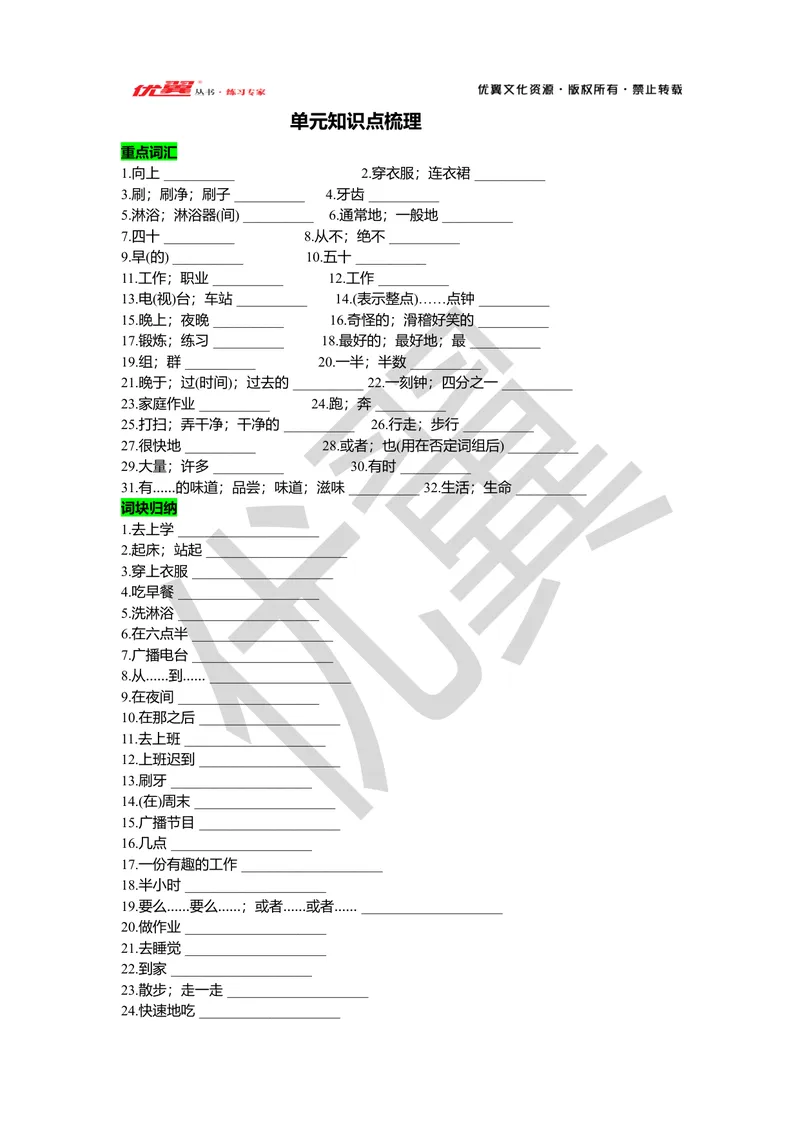
单元知识点梳理
重点词汇
1.向上 __________ 2.穿衣服;连衣裙 __________
3.刷;刷净;刷子 __________ 4.牙齿 __________
5.淋浴;淋浴器(间) __________ 6.通常地;一般地 __________
7.四十 __________ 8.从不;绝不 __________
9.早(的) __________ 10.五十 __________
11.工作;职业 __________ 12.工作 __________
13.电(视)台;车站 __________ 14.(表示整点)……点钟 __________
15.晚上;夜晚 __________ 16.奇怪的;滑稽好笑的 __________
17.锻炼;练习 __________ 18.最好的;最好地;最 __________
19.组;群 __________ 20.一半;半数 __________
21.晚于;过(时间);过去的 __________ 22.一刻钟;四分之一 __________
23.家庭作业 __________ 24.跑;奔 __________
25.打扫;弄干净;干净的 __________ 26.行走;步行 __________
27.很快地 __________ 28.或者;也(用在否定词组后) __________
29.大量;许多 __________ 30.有时 __________
31.有……的味道;品尝;味道;滋味 __________ 32.生活;生命 __________
词块归纳
1.去上学 ____________________
2.起床;站起 ____________________
3.穿上衣服 ____________________
4.吃早餐 ____________________
5.洗淋浴 ____________________
6.在六点半 ____________________
7.广播电台 ____________________
8.从……到…… ____________________
9.在夜间 ____________________
10.在那之后 ____________________
11.去上班 ____________________
12.上班迟到 ____________________
13.刷牙 ____________________
14.(在)周末 ____________________
15.广播节目 ____________________
16.几点 ____________________
17.一份有趣的工作 ____________________
18.半小时 ____________________
19.要么……要么……;或者……或者…… ____________________
20.做作业 ____________________
21.去睡觉 ____________________
22.到家 ____________________
23.散步;走一走 ____________________
24.快速地吃 ____________________25.做运动 ____________________
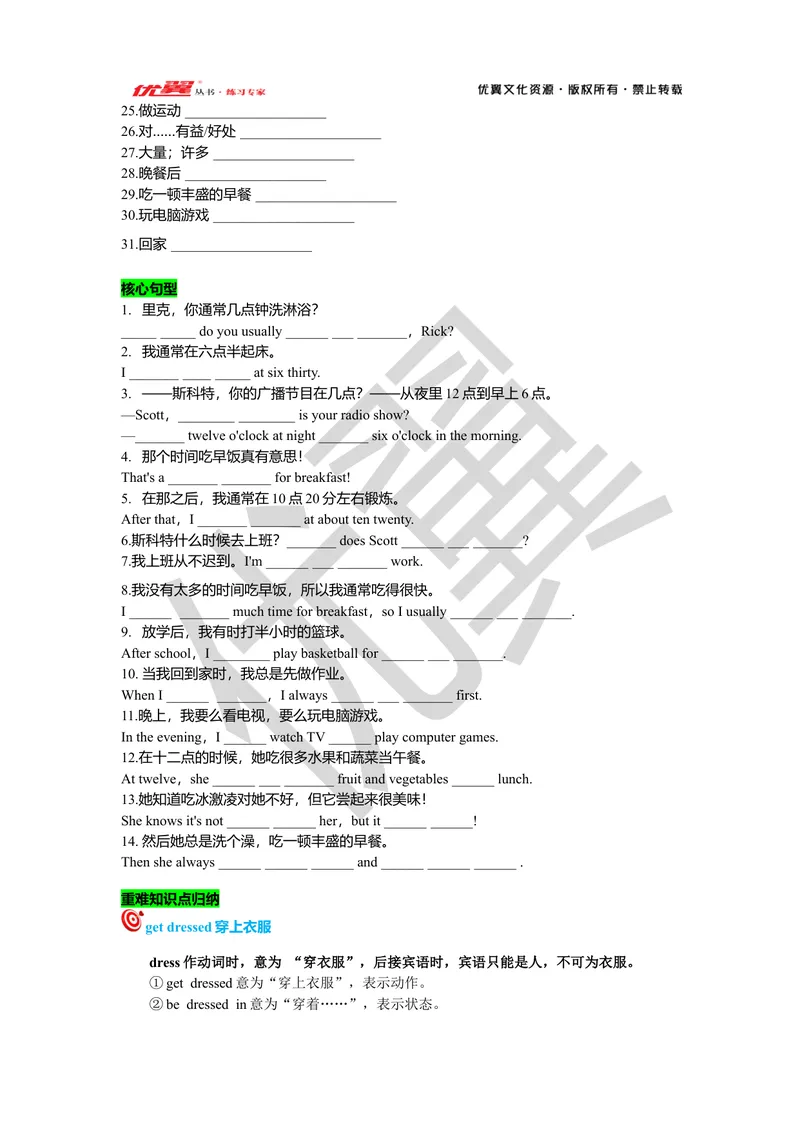
26.对……有益/好处 ____________________
27.大量;许多 ____________________
28.晚餐后 ____________________
29.吃一顿丰盛的早餐 ____________________
30.玩电脑游戏 ____________________
31.回家 ____________________
核心句型
1. 里克,你通常几点钟洗淋浴?
_____ _____ do you usually ______ ___ _______,Rick?
2. 我通常在六点半起床。
I _______ ____ _____ at six thirty.
3. ——斯科特,你的广播节目在几点?——从夜里12点到早上6点。
—Scott,________ ________ is your radio show?
—_______ twelve o'clock at night _______ six o'clock in the morning.
4. 那个时间吃早饭真有意思!
That's a _______ _______ for breakfast!
5. 在那之后,我通常在10点20分左右锻炼。
After that,I _______ _______ at about ten twenty.
6.斯科特什么时候去上班?_______ does Scott ______ ___ _______?
7.我上班从不迟到。I'm ______ ___ _______ work.
8.我没有太多的时间吃早饭,所以我通常吃得很快。
I ______ _______ much time for breakfast,so I usually ______ ___ _______.
9. 放学后,我有时打半小时的篮球。
After school,I ________ play basketball for ______ ___ _______.
10.当我回到家时,我总是先做作业。
When I ______ _______,I always ______ ___ _______ first.
11.晚上,我要么看电视,要么玩电脑游戏。
In the evening,I ______ watch TV ______ play computer games.
12.在十二点的时候,她吃很多水果和蔬菜当午餐。
At twelve,she ______ ___ _______ fruit and vegetables ______ lunch.
13.她知道吃冰激凌对她不好,但它尝起来很美味!
She knows it's not ______ ______ her,but it ______ ______!
14.然后她总是洗个澡,吃一顿丰盛的早餐。
Then she always ______ ______ ______ and ______ ______ ______ .
重难知识点归纳
get dressed穿上衣服
dress作动词时,意为 “穿衣服”,后接宾语时,宾语只能是人,不可为衣服。
①get dressed意为“穿上衣服”,表示动作。
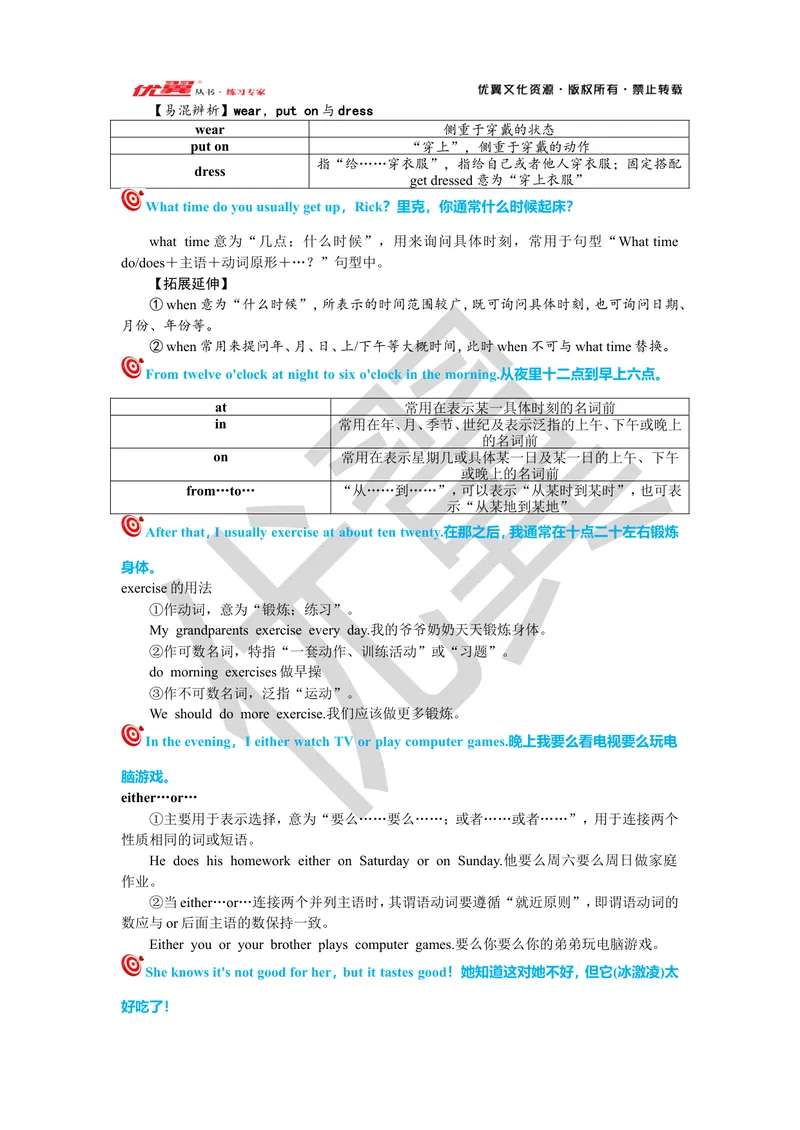
②be dressed in意为“穿着……”,表示状态。【易混辨析】wear,put on与dress
wear 侧重于穿戴的状态
put on “穿上”,侧重于穿戴的动作
指“给……穿衣服”,指给自己或者他人穿衣服;固定搭配
dress
get dressed意为“穿上衣服”
What time do you usually get up,Rick?里克,你通常什么时候起床?
what time意为“几点;什么时候”,用来询问具体时刻,常用于句型“What time
do/does+主语+动词原形+…?”句型中。
【拓展延伸】
①when意为“什么时候”,所表示的时间范围较广,既可询问具体时刻,也可询问日期、
月份、年份等。
②when常用来提问年、月、日、上/下午等大概时间,此时when不可与what time替换。
From twelve o'clock at night to six o'clock in the morning.从夜里十二点到早上六点。
at 常用在表示某一具体时刻的名词前
in 常用在年、月、季节、世纪及表示泛指的上午、下午或晚上
的名词前
on 常用在表示星期几或具体某一日及某一日的上午、下午
或晚上的名词前
from…to… “从……到……”,可以表示“从某时到某时”,也可表
示“从某地到某地”
After that,I usually exercise at about ten twenty.在那之后,我通常在十点二十左右锻炼
身体。
exercise的用法
①作动词,意为“锻炼;练习”。
My grandparents exercise every day.我的爷爷奶奶天天锻炼身体。
②作可数名词,特指“一套动作、训练活动”或“习题”。
do morning exercises做早操
③作不可数名词,泛指“运动”。
We should do more exercise.我们应该做更多锻炼。
In the evening,I either watch TV or play computer games.晚上我要么看电视要么玩电
脑游戏。
either…or…
①主要用于表示选择,意为“要么……要么……;或者……或者……”,用于连接两个
性质相同的词或短语。
He does his homework either on Saturday or on Sunday.他要么周六要么周日做家庭
作业。
②当either…or…连接两个并列主语时,其谓语动词要遵循“就近原则”,即谓语动词的
数应与or后面主语的数保持一致。
Either you or your brother plays computer games.要么你要么你的弟弟玩电脑游戏。
She knows it's not good for her,but it tastes good!她知道这对她不好,但它(冰激凌)太
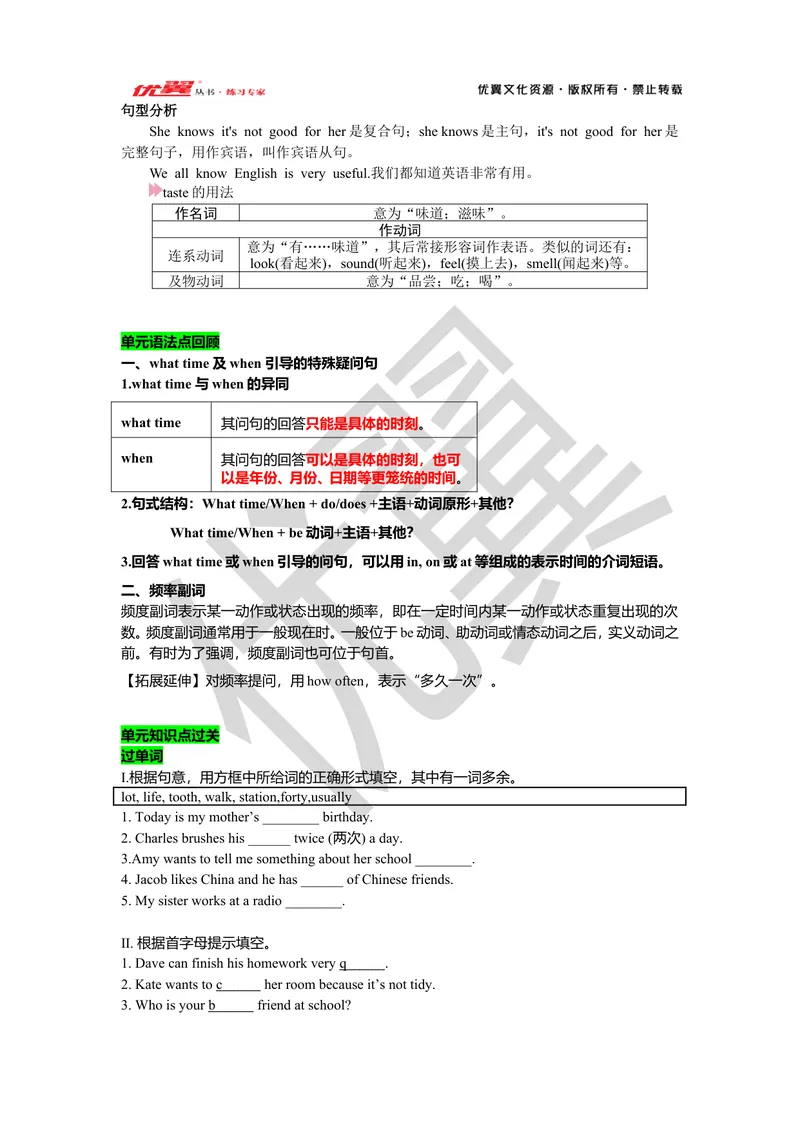
好吃了!句型分析
She knows it's not good for her是复合句;she knows是主句,it's not good for her是
完整句子,用作宾语,叫作宾语从句。
We all know English is very useful.我们都知道英语非常有用。
taste的用法
作名词 意为“味道;滋味”。
作动词
意为“有……味道”,其后常接形容词作表语。类似的词还有:
连系动词
look(看起来),sound(听起来),feel(摸上去),smell(闻起来)等。
及物动词 意为“品尝;吃;喝”。
单元语法点回顾
一、what time 及when 引导的特殊疑问句
1.what time 与when的异同
what time 其问句的回答只能是具体的时刻。
when 其问句的回答可以是具体的时刻,也可
以是年份、月份、日期等更笼统的时间。
2.句式结构:What time/When + do/does +主语+动词原形+其他?
What time/When + be动词+主语+其他?
3.回答what time或when引导的问句,可以用in, on或at等组成的表示时间的介词短语。
二、频率副词
频度副词表示某一动作或状态出现的频率,即在一定时间内某一动作或状态重复出现的次
数。频度副词通常用于一般现在时。一般位于be动词、助动词或情态动词之后,实义动词之
前。有时为了强调,频度副词也可位于句首。
【拓展延伸】对频率提问,用how often,表示“多久一次”。
单元知识点过关
过单词
Ⅰ.根据句意,用方框中所给词的正确形式填空,其中有一词多余。
lot, life, tooth, walk, station,forty,usually
1. Today is my mother’s ________ birthday.
2. Charles brushes his ______ twice (两次) a day.
3.Amy wants to tell me something about her school ________.
4. Jacob likes China and he has ______ of Chinese friends.
5. My sister works at a radio ________.
Ⅱ. 根据首字母提示填空。
1. Dave can finish his homework very q .
2. Kate wants to c her room because it’s not tidy.
3. Who is your b friend at school?4. It’s Saturday and you don’t need to get up so e .
5. Two h make a whole (整体).
6.Cindy, take a s before you go to bed.
Ⅲ.单项选择。
1. Sally has a busy ________, so she has much ________ to do every day.
A. work; work B. job; work
C. job; job D. work; job
2. This is really a ________ story. We all like it.
A. funny B. best
C. boring D. difficult
3. —Mr. White, do you think the fish ________ good?
—Yes, I like it.
A. sounds B. tastes
C. sees D. eats
4. —What is twenty and thirty?
—It's ________.
A. thirty B. twenty C. forty D. fifty
5.—I go swimming every day.
—Wow!That's a good ________.It keeps you healthy.
A.life B.group C.habit D.station
6. Lots of stars are bright(明亮的)in the sky(天空)at ________.
A. morning B. afternoon
C. evening D. night
过短语
根据句意用方框中所给短语的适当形式填空。(有一项多余)
take a walk,do one’s homework,get dressed,lots of,be good for,be late for
1.Doing sports ________________ the health.
2.Jenny has ________________ fruit every day.
3.My brother is too young. He can’t ________________ himself.
4.Tony’s sister always _________ first when she gets home.
5.After lunch,my grandparents always _____________.
过句子
根据汉语意思完成句子,每空一词。
1. 我从不在上学期间看电视。
I ______ ______ TV ______ ______ ______.
2. 你通常什么时候上班?
______ ______ you usually ______ ______ ______?
3. 他总是在周末玩电脑游戏。
He always ______ ______ ______ ______ ______.
4. Peter是我最好的朋友,他总是对别人很好。
Peter ______ ______ ______ ______, and he is always ______ ______ others.
5. [2020·孝感] 在中国,晚饭后老太太们要么散步,要么跳广场舞。
In China, the old ladies ________ take a walk ________ do group dancing after dinner.过交际
根据对话内容, 从下面方框中选出能填入空白处的最佳选项(其中有两项是多余的)。
A: Hi, Rick. (1)__________
B: I usually get up at 6:30.
A: (2)__________
B: I exercise from 6:40 to 7:00. After that I have breakfast.
A: (3)__________
B: Some cakes and a glass of milk.
A: (4)__________
B: At 8:00. And we have four classes in the morning, and another two in the afternoon.
A: Do you often surf the Internet (上网) after school?
B: Sure. (5)__________ It’s fun, isn’t it?
A: Yes. We can learn a lot on the Internet.
A. What do you do then?
B. Why do you get up so late?
C. I often surf the Internet for forty-five minutes.
D. What time do you usually get up?
E. What do you have for breakfast?
F. I watch TV or play computer games.
G. When do you begin your classes every day?
过语法
I.用括号内所给词的适当形式填空。
1.What time ________ (do) your father ________ (get) up on the weekend?
2.My sister usually ________ (brush) her teeth first in the morning.
3.Kate always ________ (go) to work at 6:30 in the morning.
4.When does the boy __________(get) dressed?
5.Ann never ________ (play) computer games at school.
Ⅱ.单项选择。
1.[2019·青岛] My brother has a healthy living habit. He _______ stays up late, and he is an early
bird.
A. usually B. hardly
C. often D. always
2.Lucy usually ____ to school at seven o'clock.
A. go B. going
C. goes D. to go
3.—What time ________ Jim usually take a shower, Rick?
—He usually takes a shower at six forty.
A. do B. does C. did D.doing
4.【2020•温州】—How often do you go to the cinema?
—________. I only watch movies at home.
A. Always B. Usually
C. Sometimes D. Never
5. 【2020•凉山】—Let's go camping if it ________ next Saturday.
—But nobody knows if it ________.A. is fine; rains B. will be fine; rains
C. is fine; will rain D. will be fine; will rain
III.句型转换。根据括号内的要求完成下列各题,每空一词。
1. Jane sometimes plays chess with her friends. (改为一般疑问句)
______ Jane ______ ______ chess with her friends?
2. Mike always buys food in that store. (用never改写句子)
Mike ______ ______ food in that store.
3. Tim usually plays soccer at school. (对划线部分提问)
______ ______ Tim usually play soccer?
4. I usually watch the TV show at eight in the evening. (用he代替I改写句子)
He ______ ______ the TV show at eight in the evening.
5. My favorite subject is science. (加入Chinese改为选择疑问句)
______ ______ favorite subject ______ ______ ______?
过综合
阅读下面的材料,在空白处填入一个适当的单词或括号内单词的正确形式。(提示:每空不超
过三个单词)
Hi!I'm Johnny.I don't like to get up early.In the morning,I get up at eight.Then I go to
school at eight thirty.I don't have much time 1._________breakfast,so I usually eat very
2._________(quick).For lunch,I usually eat 3._________(hamburger).After school,I sometimes
play basketball for half an hour.When I get home,I always do 4._________(I) homework first.In
the evening,I either watch TV 5._________ play computer games.At ten thirty,I brush my
6._________(tooth) and then I go to bed.
Mary is my sister.She usually gets up at six thirty.Then she always takes 7._________ shower
and eats a good breakfast.After that,she 8._________(go) to school at eight thirty.At twelve,she
eats 9._________(lot) of fruit and vegetables for lunch.After lunch , she sometimes plays
volleyball.She always eats ice-cream after dinner.She knows it's not good for her,10._________
it tastes good!In the evening,she does her homework and usually swims or takes a walk.At nine
thirty,she goes to bed.