文档文本内容
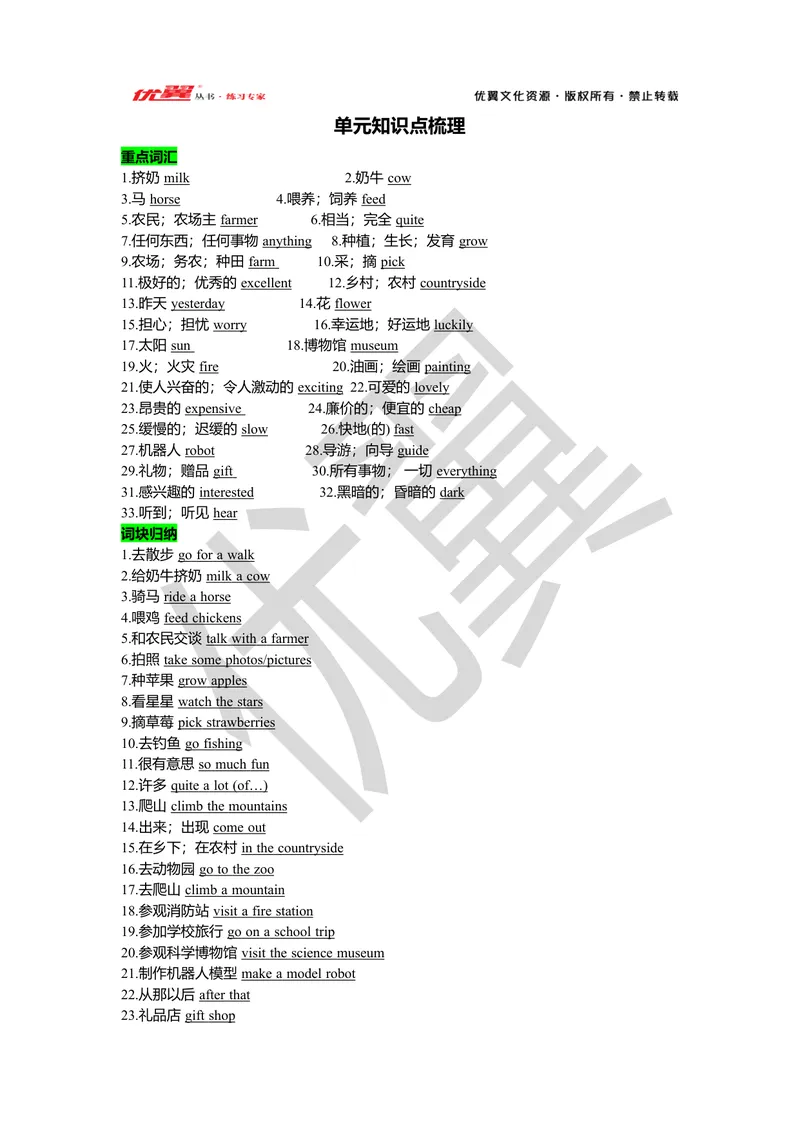
单元知识点梳理
重点词汇
1.挤奶 milk 2.奶牛 cow
3.马 horse 4.喂养;饲养 feed
5.农民;农场主 farmer 6.相当;完全 quite
7.任何东西;任何事物 anything 8.种植;生长;发育 grow
9.农场;务农;种田 farm 10.采;摘 pick
11.极好的;优秀的 excellent 12.乡村;农村 countryside
13.昨天 yesterday 14.花 flower
15.担心;担忧 worry 16.幸运地;好运地 luckily
17.太阳 sun 18.博物馆 museum
19.火;火灾 fire 20.油画;绘画 painting
21.使人兴奋的;令人激动的 exciting 22.可爱的 lovely
23.昂贵的 expensive 24.廉价的;便宜的 cheap
25.缓慢的;迟缓的 slow 26.快地(的) fast
27.机器人 robot 28.导游;向导 guide
29.礼物;赠品 gift 30.所有事物; 一切 everything
31.感兴趣的 interested 32.黑暗的;昏暗的 dark
33.听到;听见 hear
词块归纳
1.去散步 go for a walk
2.给奶牛挤奶 milk a cow
3.骑马 ride a horse
4.喂鸡 feed chickens
5.和农民交谈 talk with a farmer
6.拍照 take some photos/pictures
7.种苹果 grow apples
8.看星星 watch the stars
9.摘草莓 pick strawberries
10.去钓鱼 go fishing
11.很有意思 so much fun
12.许多 quite a lot (of…)
13.爬山 climb the mountains
14.出来;出现 come out
15.在乡下;在农村 in the countryside
16.去动物园 go to the zoo
17.去爬山 climb a mountain
18.参观消防站 visit a fire station
19.参加学校旅行 go on a school trip
20.参观科学博物馆 visit the science museum
21.制作机器人模型 make a model robot
22.从那以后 after that
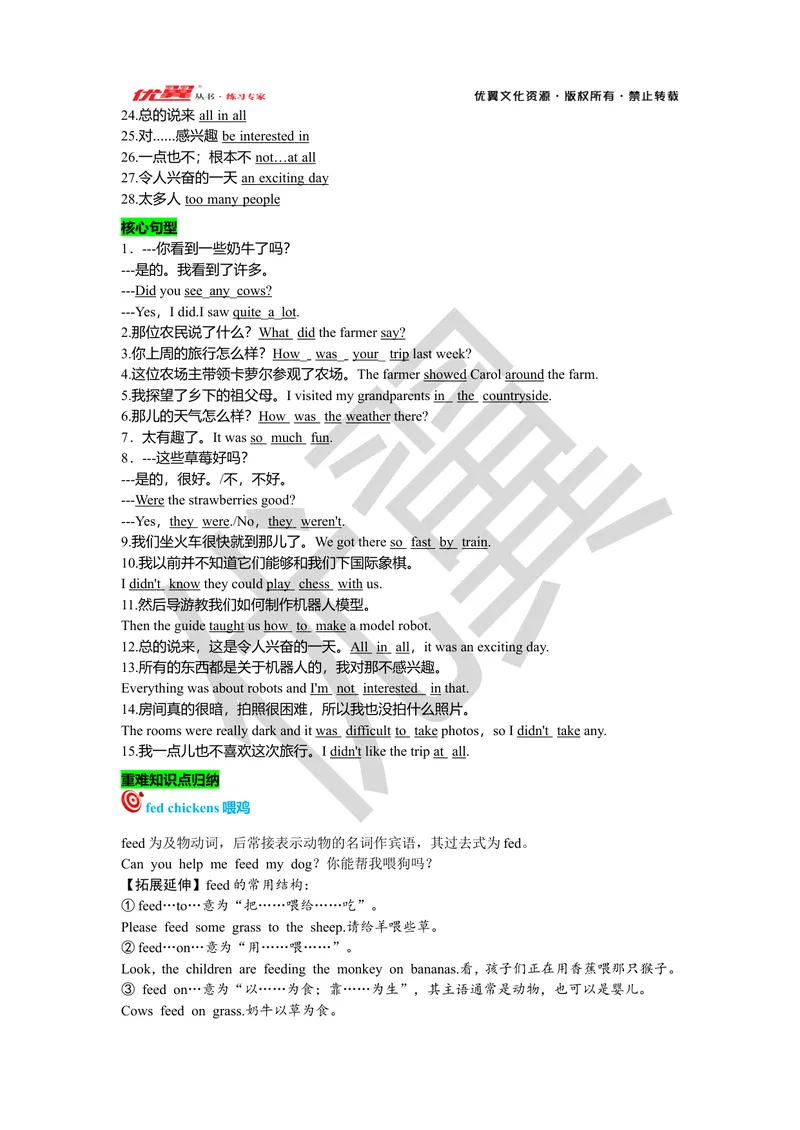
23.礼品店 gift shop24.总的说来 all in all
25.对……感兴趣 be interested in
26.一点也不;根本不 not…at all
27.令人兴奋的一天 an exciting day
28.太多人 too many people
核心句型
1.---你看到一些奶牛了吗?
---是的。我看到了许多。
---Did you see_any_cows?
---Yes,I did.I saw quite_a_lot.
2.那位农民说了什么? What did the farmer say?
3.你上周的旅行怎么样?How_ was_ your_ trip last week?
4.这位农场主带领卡萝尔参观了农场。The farmer showed Carol around the farm.
5.我探望了乡下的祖父母。I visited my grandparents in the countryside.
6.那儿的天气怎么样? How was the weather there?
7.太有趣了。It was so much fun.
8.---这些草莓好吗?
---是的,很好。/不,不好。
---Were the strawberries good?
---Yes, they were./No, they weren't.
9.我们坐火车很快就到那儿了。We got there so fast by train.
10.我以前并不知道它们能够和我们下国际象棋。
I didn't know they could play chess with us.
11.然后导游教我们如何制作机器人模型。
Then the guide taught us how to make a model robot.
12.总的说来,这是令人兴奋的一天。 All in all,it was an exciting day.
13.所有的东西都是关于机器人的,我对那不感兴趣。
Everything was about robots and I'm not interested in that.
14.房间真的很暗,拍照很困难,所以我也没拍什么照片。
The rooms were really dark and it was difficult to take photos,so I didn't take any.
15.我一点儿也不喜欢这次旅行。I didn't like the trip at all.
重难知识点归纳
fed chickens喂鸡
feed为及物动词,后常接表示动物的名词作宾语,其过去式为fed。
Can you help me feed my dog?你能帮我喂狗吗?
【拓展延伸】feed的常用结构:
①feed…to…意为“把……喂给……吃”。
Please feed some grass to the sheep.请给羊喂些草。
②feed…on…意为“用……喂……”。
Look,the children are feeding the monkey on bananas.看,孩子们正在用香蕉喂那只猴子。
③ feed on…意为“以……为食;靠……为生”,其主语通常是动物,也可以是婴儿。
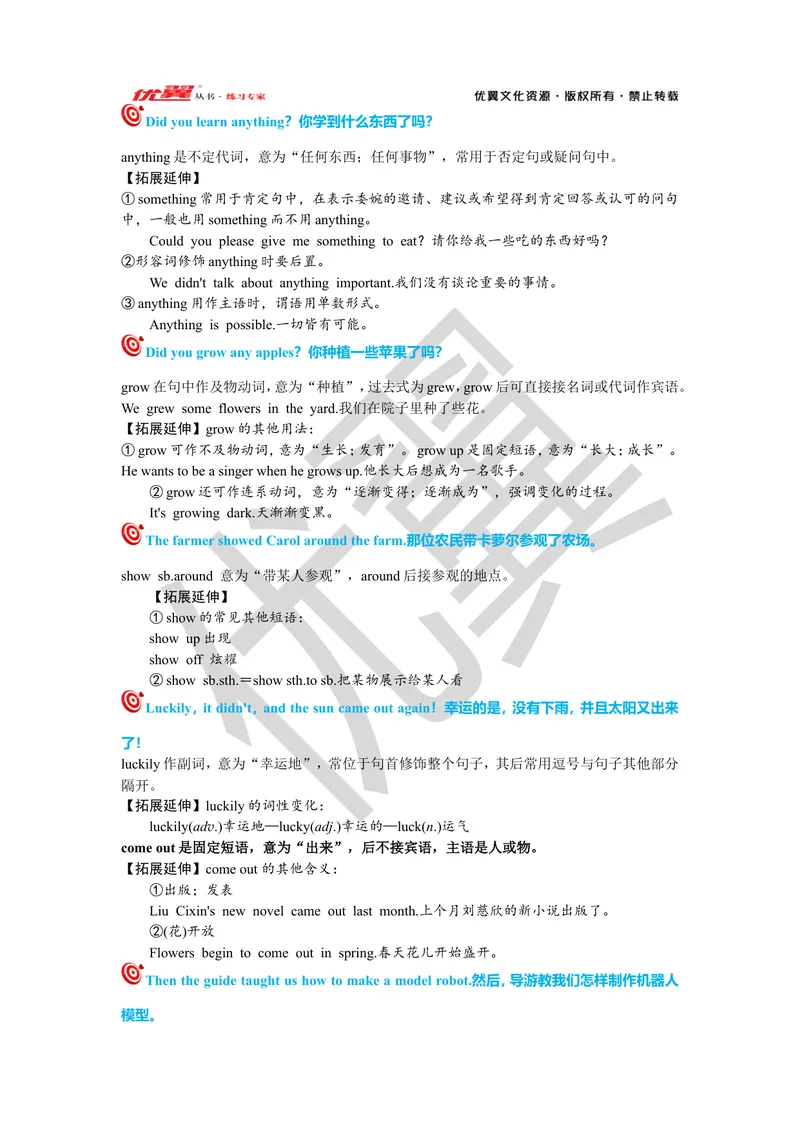
Cows feed on grass.奶牛以草为食。Did you learn anything?你学到什么东西了吗?
anything是不定代词,意为“任何东西;任何事物”,常用于否定句或疑问句中。
【拓展延伸】
①something常用于肯定句中,在表示委婉的邀请、建议或希望得到肯定回答或认可的问句
中,一般也用something而不用anything。
Could you please give me something to eat?请你给我一些吃的东西好吗?
②形容词修饰anything时要后置。
We didn't talk about anything important.我们没有谈论重要的事情。
③anything用作主语时,谓语用单数形式。
Anything is possible.一切皆有可能。
Did you grow any apples?你种植一些苹果了吗?
grow在句中作及物动词,意为“种植”,过去式为grew,grow后可直接接名词或代词作宾语。
We grew some flowers in the yard.我们在院子里种了些花。
【拓展延伸】grow的其他用法:
①grow可作不及物动词,意为“生长;发育”。 grow up是固定短语,意为“长大;成长”。
He wants to be a singer when he grows up.他长大后想成为一名歌手。
②grow还可作连系动词,意为“逐渐变得;逐渐成为”,强调变化的过程。
It's growing dark.天渐渐变黑。
The farmer showed Carol around the farm.那位农民带卡萝尔参观了农场。
show sb.around 意为“带某人参观”,around后接参观的地点。
【拓展延伸】
①show的常见其他短语:
show up出现
show off 炫耀
②show sb.sth.=show sth.to sb.把某物展示给某人看
Luckily,it didn't,and the sun came out again!幸运的是,没有下雨,并且太阳又出来
了!
luckily作副词,意为“幸运地”,常位于句首修饰整个句子,其后常用逗号与句子其他部分
隔开。
【拓展延伸】luckily的词性变化:
luckily(adv.)幸运地—lucky(adj.)幸运的—luck(n.)运气
come out是固定短语,意为“出来”,后不接宾语,主语是人或物。
【拓展延伸】come out 的其他含义:
①出版;发表
Liu Cixin's new novel came out last month.上个月刘慈欣的新小说出版了。
②(花)开放
Flowers begin to come out in spring.春天花儿开始盛开。
Then the guide taught us how to make a model robot.然后,导游教我们怎样制作机器人
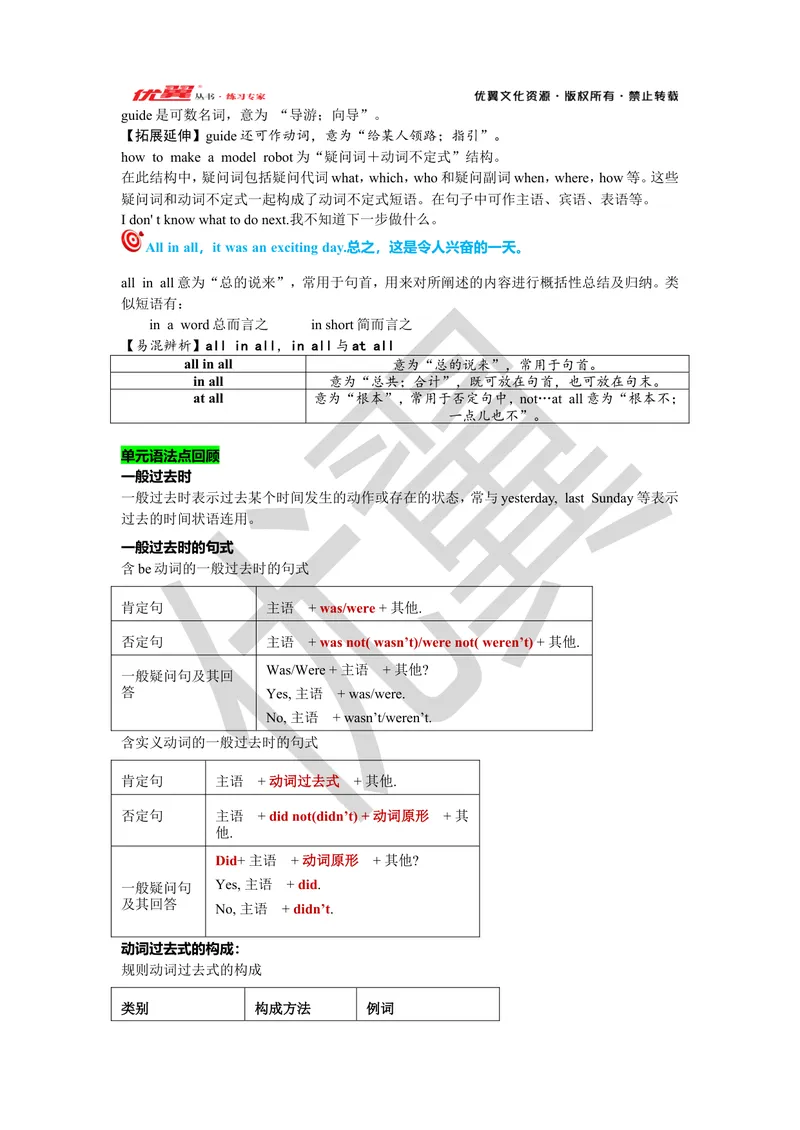
模型。guide是可数名词,意为 “导游;向导”。
【拓展延伸】guide还可作动词,意为“给某人领路;指引”。
how to make a model robot为“疑问词+动词不定式”结构。
在此结构中,疑问词包括疑问代词what,which,who和疑问副词when,where,how等。这些
疑问词和动词不定式一起构成了动词不定式短语。在句子中可作主语、宾语、表语等。
I don' t know what to do next.我不知道下一步做什么。
All in all,it was an exciting day.总之,这是令人兴奋的一天。
all in all意为“总的说来”,常用于句首,用来对所阐述的内容进行概括性总结及归纳。类
似短语有:
in a word总而言之 in short简而言之
【易混辨析】all in all,in all与at all
all in all 意为“总的说来”,常用于句首。
in all 意为“总共;合计”,既可放在句首,也可放在句末。
at all 意为“根本”,常用于否定句中,not…at all意为“根本不;
一点儿也不”。
单元语法点回顾
一般过去时
一般过去时表示过去某个时间发生的动作或存在的状态,常与yesterday, last Sunday等表示
过去的时间状语连用。
一般过去时的句式
含be动词的一般过去时的句式
肯定句 主语 + was/were + 其他.
否定句 主语 + was not( wasn’t)/were not( weren’t) + 其他.
Was/Were + 主语 + 其他?
一般疑问句及其回
答 Yes, 主语 + was/were.
No, 主语 + wasn’t/weren’t.
含实义动词的一般过去时的句式
肯定句 主语 + 动词过去式 + 其他.
否定句 主语 + did not(didn’t) + 动词原形 + 其
他.
Did+ 主语 + 动词原形 + 其他?
一般疑问句 Yes, 主语 + did.
及其回答
No, 主语 + didn’t.
动词过去式的构成:
规则动词过去式的构成
类别 构成方法 例词want → wanted
加-ed
一般情况
clean → cleaned
live → lived
加-d
以e结尾的动词
like → liked
study → studied
以“辅音字母 + 变y为i, 再加-
y” 结尾的动词 ed carry → carried
双写末尾的辅 stop → stopped
以重读闭音节结
音字
尾,且末尾只有一 plan → planned
个辅音字母的动词 母,再加-ed
单元知识点过关
过单词
Ⅰ.根据句意及括号内所给单词的提示填空。
1. ________ (lucky), she had some money with her that day.
2. Last year my grandpa ________ (grow) some strawberries on the farm.
3. There are all kinds of _________ (flower) in the park.
4. Helen has a ________ (love) dog and her name is Dudu.
5. I ________(hear) someone sing in the next room just now.
6. I am ________ (interest) in collecting stamps.
1. Luckily 2. grew 3. flowers 4. lovely 5.heard 6..interested
Ⅱ. 根据首字母提示填空。
1. Mrs. Black spoke so f . I couldn't follow her.
2. John is an e student in our school. We should learn from him.
3. Don't w . You will feel better soon.
4. The schoolbag is too e . I just want a cheap one.
5.Let’s go home quickly. It’s getting d______.
1. fast 2. excellent 3. worry 4. expensive 5.dark
Ⅲ.单项选择。
( ) 1. This story is very _______, so we are all _______ in it.
A. interesting; interested B. interesting; interesting
C. interested; interesting D. interested; interested
( )2. This is a _______ train. It will take a long time to get there.
A. slow B. dirty C. noisy D. scary
( )3. Mike wasn’t at home _______.
A. tomorrow B. now C. yesterday D. next Friday
( )4. I know that place well, so let me be your _______.
A. guide B. teacher C. actor D. singer
( )5. Tina,I am going to the supermarket. Do you need ________?
A.something B. anything C. everything D. nothing1-5AACAB
过短语
根据句意用方框中所给短语的适当形式填空。
climb a mountain,come out,quite a lot,along the way,all in all
1.________________, he is a good basketball player.
2.What did you see ____________________?
3.We saw_____________ of pigs on the road.
4.In the end, the moon ________________ again.
5.I_______________with my friend last weekend.
1.All in all 2.along the way 3.quite a lot 4.came out 5.climbed a mountain
过句子
根据汉语意思完成句子,每空一词。
1. 你弟弟对游泳感兴趣吗?
________ your brother ________ ________ ________?
2. 我们老师昨天带领我们参观了农场。
Our teacher ________us________the farm yesterday.
3. 鲍勃上个月学到了很多关于计算机的知识。
Bob ________ ________ ________ ________ computers last month.
4. 我根本就不喜欢这件夹克衫。
I ________ like this jacket ________ ________.
5. 这附近有几个消防站?
How many ________ ________ ________ ________ around here?
1. Is; interested in swimming 2.showed;around
3. learned a lot about 4. don’t; at all 5. fire stations are there
过交际
根据对话内容, 从下面方框中选出能填入空白处的最佳选项(其中有两项是多余的)。
A: Hi, Lucy. (1) ______
B: Yes. I went to the countryside.
A: Really? Did you go with your cousin?
B: (2) ______
A: Did you take a bus or take a train there?
B: We took a bus. It took us about an hour to get there.
A: (3) ______
B: Yes, we did. I'll bring them to school and show them to you tomorrow.
A: Thank you.
B: Well, where did you go last weekend?
A: (4) ______ We went boating and played games there.
B: Sounds like you also had a good time.
A: (5) ______
A. It was rainy.
B. No. I was at home.C. Yes, it was so much fun.
D. Did you take any photos?
E. No. I went there with Jill.
F. Did you have a trip last weekend?
G. I went to the park with my friends.
1-5FEDGC
过语法
I.用括号内所给词的适当形式填空。
1. We ________(visit) our grandparents last week.
2. We all ________(go) to the park and ________ (have) a good time last Sunday.
3. She ________(pick) some strawberries for her family yesterday.
4. I ________(feed) the chickens and it was fun.
5. Our last trip to the countryside ________(be) really great.
1.visited 2.went;had 3.picked 4.fed 5.was
Ⅱ.单项选择。
1.—Please stay with me this weekend.
—I'm sorry, but my father and I ________ to visit Beijing a long time ago.
A. plan B. planning
C. planned D. plans
2. 【2020•黔南】—I have seen the film We Are All Fighters against the COVID-19. What about
you, Peter?
—Oh, I ________ it last week.
A. have seen B. see
C. saw D. will see
3. There ________ six countries in SCO (上合组织) at first, but now the number has increased to
eight.
A. is B. are C. were D. will be
4.________ he sleep late last night?
A. Is B. Was C. Did D. Does
5. We often ________ soccer on Sunday afternoon, but last Sunday afternoon we ________ ping--
pong.
A. play; played B. played; play
C. play; play D. plays; play
1-5CCCCA
III.句型转换。根据括号内的要求完成下列各题,每空一词(含缩略形式)。
1. I asked them some questions just now. (改为一般疑问句)
________ you ________ them ________ questions just now?
2. Joe did his homework last night. (改为否定句)
Joe ________ ________ his homework last night.
3. —Were there any chickens on the farm? (补全否定答语)
—No, ________ ________.
4. My family went to the countryside by train. (改为同义句)
My family ________ ________ ________ to the countryside.
5. Her winter vacation was great. (对划线部分提问)________ ________ her winter vacation?
6. He makes dinner for his family every night. (用last night替换every night改写句子)
He ________ ________ for his family last night.
1. Did; ask; any 2. didn’t do 3. there weren’t 4. took a / the train 5. How was
6. made dinner
过综合
阅读下面的材料,在空白处填入一个适当的单词或括号内单词的正确形式。(提示:每空不超
过三个单词)
Helen and Jim went on a school trip on June 15th.They 1._______(take) the train to
the science museum.Helen thought it was 2._______(real) interesting.She saw some farms and
villages along the way.At the museum she learned a lot 3._______ robots.She didn't know
the robots could play chess with people.It was so cool.Then the guide taught them 4._______
to make a model robot.She took lots of great photos and bought some 5._______(love)
gifts for her parents.All in all,it was 6._______ exciting day.But Jim didn't think so.He was
not 7._______(interest) in robots.The room was dark and it was difficult for him
8._______(take) photos.There were too many people and he couldn't see or hear the
guide.The 9._______(thing) in the gift shop 10._______(be) so expensive that he didn't buy
any.He didn't like the trip at all.
1.took 2.really 3.about 4.how 5.lovely
6.an 7.interested 8.to take 9.things 10.were