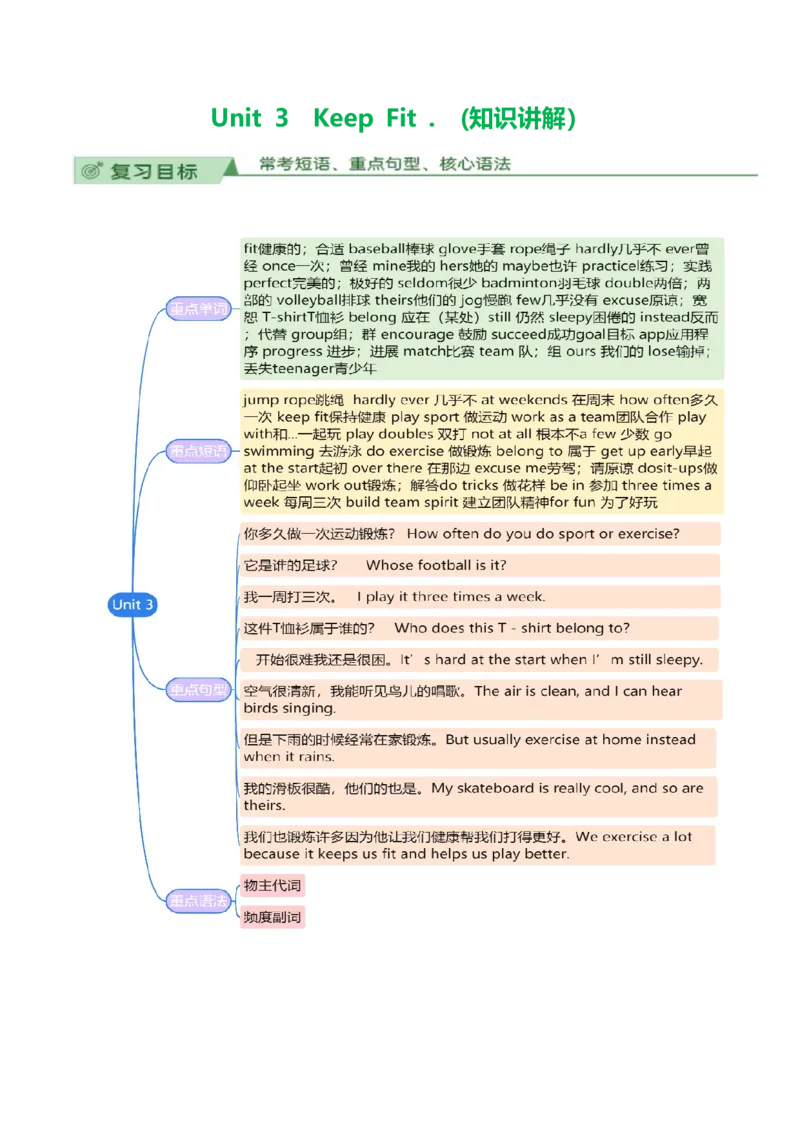
Unit 3 Keep Fit . (知识讲解)Section A How often do you do sports or Exercise ?
1、How do we keep fit? 我们怎样保持健康?(教材第17页,BIG Question)
【详解】fit
①〔形容词〕健康的;健壮的(同义词:healthy)
keep fit/healthy 保持健康 be fit for sth/be fit to do sth (身体)健康可以做某事
You look very fit, Mike. 迈克,你看上去很健康。
Taking exercise helps you keep fit/healthy. 锻炼有助于你保持健康。
He isn't fit to play in the match today. 今天,他身体不适,不能出场比赛。
②〔形容词〕合适的;恰当的
be fit for 适合... be fit to do sth 适合做某事
The food is fit for children. 这些食物适合孩子们食用。
③〔动词〕适合;合身
过去式为 fitted,现在分词为 fitting。其主语一般是表示“物”的名词或代词,而宾语通
常是表示“人”的名词或代词。
sth fit..well 某物非常适合···
This dress fits me very well. 这条连衣裙我穿很合身。
The jacket is fine, but the trousers don't fit. 夹克衫不错,但裤子不合身。
2、baseball glove棒球手套(教材第18页,1a)
【详解】glove〔名词〕手套;它常表示手指分开的手套,日常使用时通常以复数形式出现。
英语中常以复数形式出现的单词还有glasses(眼镜),trousers(裤子),shorts(短裤),socks(袜子),
shoes(鞋子)等。此类词前常用a pair of来表达“一双,一副,一条”等。
3、 jump rope跳绳用的绳子(教材第18页,1a)
【详解】jump rope
①跳绳用的绳子,rope 用作名词,意为“绳子”。
The jump rope is red. 这根跳绳是红色的。
②跳绳(运动)
The jump rope is fit for me, and I do it every day. 跳绳运动适合我,我每天都跳绳。
4、running shoes跑鞋(教材第18页,1a)动名词作定语
此处 running 是动词 run 的动名词形式,用作定语,表示用途或功能,即 running
shoes=shoes for running。常见的类似表达还有 living room(起居室), reading room(阅览室),
waiting room(候车室)等。
We should wear running shoes when we run. 我们应穿着跑鞋跑步。
5、Whose football is it?它是谁的足球?(教材第18页,1b)
【详解】whose〔形容词&代词〕谁的;用来询问物品的所属关系,既可放在名词前作定语,
也可单独使用,具体句型为“Whose+(名词+)一般疑问句?”,常用含有名词所有格或名词性
物主代词的句子作答。
-Whose basket is this? Whose is this basket?这是谁的篮子?
-It's Mary's. 是玛丽的。
6、hardly ever几乎从不(教材第18页,1c)
【详解】(1)hardly ever几乎从不;本身为否定意义,表示频率。
Li Ming hardly ever eats junk food. 李明几乎从不吃垃圾食品。
(2)hardly〔副词〕几乎不;几乎没有;本身具有否定意义,不能再与其他否定词连用。通常
位于实义动词之前,助动词、情态动词或系动词be之后。
There's hardly any food left. 几乎没有食物剩下。
People can hardly tell the difference between the twins. 人们几乎看不出这对双胞胎的区别。
(3)辨析: hardly与hard
hardly 副词 “几乎不”,表示定意义
hard 形容词 艰难的:坚硬的; 副词 努力地:猛烈地
He hardly watches TV. 他几乎不看电视。
She found it hard to decide. 她发现很难做决定。
We should work hard.我们应当努力工作。
【注意】hardly 不是hard的副词形式
(4)ever〔副词〕在任何时候;从来;曾经可用于描述经历。用于否定句、疑问句、比较结构的句
子或与if连用的句子。
Nothing ever happens here. 这儿从未发生过任何事。
If you're ever in my city, come and see us. 你要是什么时候到我的城市,就来看看我们吧。
7、once or twice at weekends周末一两次(教材第18页,1c)【详解】次数的表达
英语中的“一次”为once; “两次”为twice; “三次及三次以上”用“基数词+times”,如
three times“三次”,fifteen times“十五次”。
once a month一月一次
twice or three times a year一年两三次
【助记】次数表达法
表示“次数”应注意,once,twice单独记;三次以上也容易,基数词后加times。
8、How often do you play ping-pong?你多久打一次乒乓球?(教材第18页,1d)
【详解】how often多久一次;用来提问动作发生的频率,常用表示频率的词或短语作答,如
never,once a month,twice a week, four times a year 。
-How often do you exercise? 你多久锻炼一次?
-Three times a week.一周三次。
【拓展】
①how long 多长时间;(物体)多长用来询问时间的长短或物体的长度。
-How long does it take you to walk to school?你步行去学校需要多长时间?
-Half an hour. 半小时。
-How long is the river? 这条河有多长?
-About 5 kilometers long. 约5千米长。
② how far 多远;用来询问距离,指路程的远近。
-How far is it from here to the park? 这儿离公园有多远?
-About 1 kilometer. 约1千米。
③ how soon多久以后;用来询问将来的时间,指时间还有多久,多提问“in+时间段”。
-How soon will they come back? 他们多久以后回来?
-In two weeks. 两周后。
9、Not at all.不用谢。(教材第19页,Pronunciation 2)
【详解】Not at all.
①不用谢,别客气;常用来回答对方的感谢。
-Thank you for your help. 谢谢你的帮助。
-Not at all.不用谢。
②一点也不;完全不;用来表示否定。-Are you hungry?你饿了吗?
-Not at all. 一点也不饿。
10、There is a ping-pong bat here.这里有个乒乓球拍。(教材第19页,2a)
【详解】there be 结构
“There is/are+名词+地点状语.”表示“某地有······”。当名词为可数名词单数或不可数名词
时,应用“There is...”,当名词为可数名词复数时,应用“There are...”。
There is an apple on the table. 桌子上有一个苹果。
There is lots of rice in the house. 房屋里有许多大米。
There are many trees around our village. 我们村周围有许多树。
11、Maybe it's Yaming's.也许它是亚明的。(教材第19页,2a)
【详解】(1)辨析:maybe与may be
maybe或许;大概;可能;副词,作状语,常位于句首
may be可能是;“情态动词may+动词原形be”,在句中作谓语
Maybe you are right. 或许你是对的。
=You may be right.
(2)名词所有格
用来表示物品的所有关系。主要有以下用法:
①一般情况下,在单数名词的词尾加“'s”。
Lily's book 莉莉的书
②以-s结尾的复数名词在词尾加“”。
the students' room 学生们的房间
③不以-s结尾的复数名词在词尾加“'s”。
Women's Day 妇女节
④表示两人(或多人)共有某人或某物时,只在最后一个名词的词尾加“'s”;如果为各自所有,
每个名词的词尾都要加“'s”。
Kate and Mary's mother 凯特和玛丽的妈妈(共同的妈妈)
Kate's and Mary's mothers 凯特的妈妈和玛丽的妈妈(各自的妈妈,mothers是复数)
12、Well, practice makes perfect.哦,熟能生巧。(教材第19页,2a)
【详解】practice
①〔不可数名词〕练习;实践Playing the piano needs a lot of practice. 弹钢琴需要多加练习。
②〔及物动词〕(=practise)练习;训练其后可跟名词、代词或动词-ing形式作宾语。practice
doing sth 练习做某事
I often practice my English in the morning. 我常常在早上练习英语。
Why don't you practice playing ping-pong every day? 你为什么不每天练习打乒乓球呢?
【注意】practice在美式英语中可用作名词或动词,而在英式英语中只用作名词,英式英语中
的practise 用作动词。
13、I seldom do, but I often play badminton.我很少打,但我常打羽毛球。(教材第19页,2a)
【详解】(1)seldom〔副词〕很少;不常;通常位于实义动词之前,助动词、情态动词或系动
词be之后,是一个表示否定意义的副词。
My mother seldom watches TV. 我妈妈很少看电视。
Millie is seldom late for school. 米莉上学很少迟到。
(2)play badminton打羽毛球;play与表示球类运动的名词连用时,球类名词前不用冠词。
Some children like playing baseball. 一些孩子喜欢打棒球。
【拓展】play与乐器类名词连用表示演奏乐器时,乐器类名词前须加定冠词the。
play the violin 拉小提琴
play the guitar 弹吉他
14、We should all play doubles sometime! 我们都应该找个时间打双打!(教材第19页,2a )
【详解】(1)double
①〔名词〕doubles双打(尤指网球)the men's doubles 男子双打
②〔名词〕两倍
Eight is the double of four. 8是4的两倍。
③〔形容词〕成双的;两倍的;双人的常在名词前作定语。
double doors双扇门 a double bed双人床
The number is 869 double 2. 号码是86922。
(2)sometime〔副词〕在某个时候常指不确切或尚未决定的某个时候,可以是将来的,也可以
是过去的某个时候。
We must get together sometime.我们一定要找个时间聚一下。(将来的某个时候)
I saw him sometime last summer.我去年夏天的某个时候见过他。(过去的某个时候)
15、go swimming/jogging去游泳/慢跑(教材第20页,2e)【详解】jog〔动词〕慢跑;尤指锻炼。其现在分词为jogging, 过去式为jogged。
go jogging 去慢跑
I go jogging every evening.
我每天晚上都去慢跑。
16 、a few times几次(教材第20页,2e)
【辨析】a few, few,a little与little
a few一些,几个;肯定含义;修饰或指代可数名词复数
few没有几个;否定含义;修饰或指代可数名词复数
a little一点,少量;肯定含义;修饰或指代不可数名词
little没有多少;否定含义;修饰或指代不可数名词
There are a few eggs in the fridge, so I needn't buy any at once. 冰箱里有几个鸡蛋,所以我不必立
刻买。
There are few eggs in the fridge, so I must buy some. 冰箱里几乎没有鸡蛋了,所以我必须买一
些。
I can only speak a little French. 我只会说一点儿法语。
There's little rice in the bowl. 碗里没多少米饭了。
【助记】
a few, few, a little与little
few,little表否定,前面加a变肯定。
可数名词复数前,(a)few修饰记心间。
不可数名词来报到, 其前要用(a) little。
17、Excuse me, is this your..?劳驾,这是你的···吗?(教材第20页,2e)
【详解】(1)excuse me劳驾;请原谅;是在打扰他人之前的客套话,以示礼貌和歉意,主要用
于:
①询问情况,引起别人的注意,如问物品归属、问路、问姓名等。
Excuse me, are you Mr Smith? 劳驾,你是史密斯先生吗?
②征求别人的许可,向对方提出请求。
Excuse me. Could you help me, please? 劳驾。请你帮我一下,可以吗?
③打扰他人,打断别人的讲话或正在做的事。
Excuse me! I want to wash my hands. 请原谅!我想要洗手。(2)辨析: excuse me与I' m sorry
excuse me多用于麻烦、打扰或有求于人时;通常用于打扰他人之前。
I'm sorry 多用于因做错事,有愧于某人而道歉或无法满足对方的要求时;通常用于做错事后
或无法满足对方的要求时。
-Excuse me, what's this in English? 劳驾,这个用英语怎么说?
-I'm sorry. I don't know. 对不起,我不知道。
18、 His are over there.他的在那边。(教材第21页,3b)
【详解】over there在那边,在那里;指相对较远的地方,可在句中作表语或后置定语。
Millie's schoolbag is over there. 米莉的书包在那边。
The trees over there are high. 那边的树很高。
19、It looks just like mine!它看起来很像我的!(教材第21页,3b)
【详解】just〔副词〕只是;正好;在句中作状语,用来加强语气。
I just want to talk to you. 我只是想和你谈谈。
It's just two o'clock. 正好两点钟。
【拓展】与just 相关的常见短语:
just now 刚才 just then 就在那时
20、Who does this T-shirt belong to?这件T恤衫属于谁?(教材第21页,3b)
【详解】belong to属于(某人);其中to为介词。该短语不用于进行时。
That book belongs to me. 那本书属于我。
That dictionary belongs to the library. 那本词典是图书馆的。
【注意】belong to 后可接名词或人称代词的宾格形式,但不能接名词性物主代词或名词所有格。
【拓展】“belong to+名词/人称代词宾格”可与“be+名词性物主代词/名词所有格”进行同义
转换。
These books belong to me.
=These books are mine.这些书是我的。
This dictionary belongs to Tom.这本词典是汤姆的。
=This dictionary is Tom's.
21、The air is clean, and I can hear birds singing.空气很清新,我能听到鸟儿在歌唱。(教材第
21页,3c)
【辨析】hear sb doing sth与 hear sb do sthhear sb doing sth听到某人正在做某事;强调听到的动作正在进行。
hear sb do sth 听到某人做了某事;强调听到动作的全过程,表示经常做或动作已经完成。
Listen! Can you hear a girl singing? 听!你能听到一个女孩在唱歌吗?
I often hear her sing in the evening. 我经常听见她在晚上唱歌。
22、It's easy to go jogging. 慢跑很容易。(教材第21页、3c)
【详解】It's+adj.+ to do sth.做某事是...的。其中it是形式主语,无实义,真正的主语是动词不
定式。
It's important to learn to study. 学会学习很重要。
【拓展】
It's adj. for sb to do sth. 对某人来说,做某事是······的。这里的形容词(easy, difficult,
necessary, dangerous )描述事物特征
It's adj. of sb to do sth. 某人做某事是······的。这里的形容词(kind, brave, stupid, clever,wise等)
描述人物性格、品质
It's dangerous for a child to stay at home alone.对一个孩子来说,自己一个人待在家里是很危险的。
It's very nice of you to lend an umbrella tome. 你把雨伞借给我,真是太好了。
23、I'm always full of energy after jogging.慢跑后我总是充满活力。(教材第21页,3c)
【详解】be full of有许多;充满;满是......的与 be filled with 同义。
This box is full of cookie. 这个箱子装满曲奇饼。
The bottle is full of water. 瓶子里装满了水。
=The bottle is filled with water.
24、In our group, many students like to do sport and exercise.在我们组,许多学生喜欢进行运动
和锻炼。(教材第21页,3d)
【详解】group〔可数名词〕组;群
当其作主语,强调整体时,视为单数;强调成员时,视为复数。
in groups 成群地
group by group 分批地
a group of一群,一组
The group is a good one. 这是一个好的小组。
The group often have a meeting on Mondays. 该小组成员常在周一开会。
A group of us is/are from the countryside. 我们有一帮人来自农村。Section B How is exercise good for us ?
1、My skateboard is really cool, and so are theirs.我的滑板很酷,他们的也是。(教材第22页,
1b)
【详解】So+连系动词be/助动词/情态动词+(另一)主语。某人/某物也是如此。
so用来代替上句提及的内容,表示主语的情况与上句主语的情况相同,本句中的主语与
上句的主语不是同一人或物。这种结构中的连系动词be/助动词/情态动词要与上句保持一致,
谓语动词的数要与后面主语的人称和数保持一致。
I am a doctor. So is my husband. 我是医生。我的丈夫也是。
He can ride a bike; so can I. 他会骑自行车,我也会。
We often see a film; so do they. 我们常看电影,他们也常看。
【拓展】“So+(同一)主语+连系动词be/助动词/情态动词.”意为“某人或某物的确如此”。表
示对上句内容的进一步肯定。此结构中的主语与上句的主语指同一个人或物。
-He is a hard-working boy. 他是个勤奋的男孩。
-So he is. 确实如此。
2、We encourage one another to do tricks.我们互相鼓励去做一些技巧动作。(教材第22页,
1b)
【详解】encourage〔及物动词〕鼓励;激励encourage sb to do sth 鼓励某人做某事
The new year is coming. Teachers encourage us to develop new hobbies.新的一年就要来了。
老师们鼓励我们要培养新的爱好。
3、Some tricks are difficult, but once you succeed, you feel great!有些技巧很难,但一旦你成
功了,你会感觉很棒!(教材第22页,1b)
【详解】(1)once
①〔连词〕一旦;引导时间状语从句,且通常放在句首。
Once you start eating in a healthy way,you will lose weight easily. 一旦你开始健康饮食,
你就会容易减肥。
②〔副词〕一次;一回
once a week 每周一次
once or twice a week 每周一两次
③〔副词〕曾经
I once lived in London.我曾经住在伦敦。【拓展】关于once的常用短语:
once in a while 偶尔;间或 at once 立刻;马上 once again/once more 再一次
(3)succeed〔动词〕成功;达到目标 succeed in doing sth 成功做成某事
No one can succeed without hard work. 没有人不努力就能成功。
We succeeded in finishing the work. 我们成功地完成了那项工作。
【拓展】
success(n.成功)→succeed(v.成功)
↓+ful
successful(adj.成功的)
↓+-ly
successfully(adv.成功地)
(2024·四川遂宁中考)
4、This year, my goal is to be really fit.年,我的目标是保持健康。(教材第22页,1b)
【详解】goal〔可数名词〕
①目标;目的
achieve/reach one's goal 达到某人的目标 keep a goal坚持目标
Keep a goal, and you'll achieve your goal. 坚持一个目标,你就会实现你的目标。
②球门;进球得分
Work as a team, and we can get a goal. 团队协作,我们就能得分。
5、But my favourite way of keeping fit is to use an exercise app to work out.但我最喜欢的保持
健康的方式是使用一个锻炼应用程序来锻炼。(教材第22页,1b)
(1)the way of doing sth 做事的方式/方法可与the way to do sth 互换。
the way of learning English= the way to learn English 学习英语的方法
(2)work out
①锻炼;做运动
I work out every day to keep fit. 我每天锻炼以保持健康。
②计算;算出;解决
work out the answer 计算出答案 work out a problem解决问题
③成功地发展
Things work out quite well for us.事情的结果对我们很不错。6、The app gives me exercises to do everyday.这个应用程序每天给我提供锻炼项目来做。
(教材第22页,1b)
【详解】give〔及物动词〕给;提供;过去式为 gave。give 后可接双宾语,即give sb sth=
give sth to sb “把某物给某人”。
He gives me a dictionary. 他给了我一本词典。
=He gives a dictionary to me.
【注意】如果直接宾语是代词,只能用含有介词 to的形式。
Please give it to Li Lei. 请把它给李磊。
【拓展】和give类似,能接双宾语的动词还有tell(告诉),show(给·..看),pass(传递), teach(教)
等。
Tom often tells me good stories.汤姆常给我讲好故事。
=Tom often tells good storics to me.
Mr Zhang shows us some beautiful pictures. 张老师给我们展示了一些漂亮的图片。
=Mr Zhang shows some beautiful picturesto us.
7、It can show my progress.它可以展示我的进步。(教材第22页,1b)
【详解】progress〔不可数名词〕进步;进展
show one's progress 展示某人的进步
progress in.在...(方面)的进步
make progress 取得进步
good progress良好的进展
The app can show our progress in skills.这个应用程序能展示我们在技术上的进步。
8、We have fun when we keep fit together!当我们一起保持健康时我们很开心!(教材第22页,
1b)
have fun快乐;玩得高兴与have a good time, enjoy oneself同义。
have fun doing sth 愉快地做某事
Sounds like he has fun 听起来好像他玩得很高兴!
They have fun playing football. 他们愉快地踢足球。
9、I'm in my school's baseball club, so I play baseball quite often.我参加了学校的棒球社团,所以
我经常打棒球。(教材第22页,Ib)【详解】be in/on+组织/团队参加a,是......的一员相当于“be a member of+组织/团队”。
Tom is in/on the school basketball team. 汤姆参加了校篮球队。
=Tom is a member of the school basketball team.汤姆是校篮球队的一员。
10、The other teams are great, but I think ours is the best!其他队都很出色,但我认为我们队是
最好的!(教材第22页,1b)
【详解】team〔名词〕队;组;表示由若干人组成的“队”或“组”等,具有集合意义。在
句中作主语时,谓语动词根据情况可用单数(侧重整体)或复数(侧重个体)。
a team of+复数名词一组/队......
Their team has good players, but our teamwork hard.他们队有优秀的队员,但我们队的队员
很努力。
a team of students 一群学生
11、We usually practise three times a week after school.我们通常每周在放学后练习三次。(教
材第22页,1b)
【详解】after school放学后
The students usually do their homework after school. 放学后,学生们通常做作业。
【拓展】before school上学前
at/in school在上学,在学校里
before class上课前
after class 课后
in class 在课堂上
12、We also exercise a lot because it keeps us fit and helps us play better.我们也进行大量的锻
炼,因为这能让我们保持健康,帮助我们打得更好。(教材第22页,1b)
【详解】a lot
①经常(=often); 非常(=very much);相当于副词的用法。
I play tennis a lot in the summer. 我夏天常打网球。
Thanks a lot for your help. 非常感谢你的帮助。
②许多,大量;相当于代词的用法。
I spend a lot on the clothes. 我在衣服上花费很多。
13、All of us are good friends, both on and off the field. 我们所有人在场上场下都是好朋友。
(教材第22页,1b)【详解】on/off the field在场上/下,此处field 用作可数名词,意为“运动场”。
They are competitors on the field and friends off the field. 他们场上是对手,场下是朋友。
a baseball/football field 棒/足球场
14、We work as a team, and we win or lose as a team.我们作为一个团队一起协作,无论输赢
都是一个团队。(教材第22页,1b)
【详解】(1)win〔动词〕赢;获胜;用作及物动词时,宾语为比赛的项目、奖品或战争等,
不能接表示人的名词或代词。
He is sure to win. 他一定能获胜。
We often win the basketball game. 我们经常赢得篮球赛。
(2)lose〔动〕(过去式:lost)
①输掉(比赛等);lose to sb 输给某人
He always loses at chess. 他下国际象棋总是输。
They lost the match. 他们输了比赛。
We can't lose to the other team. 我们不能输给另一支队。
②丢失,找不到;迷路
He often loses his pen. 他经常丢钢笔。
Sometimes, the old man loses his way. 有时,那位老人会迷路。