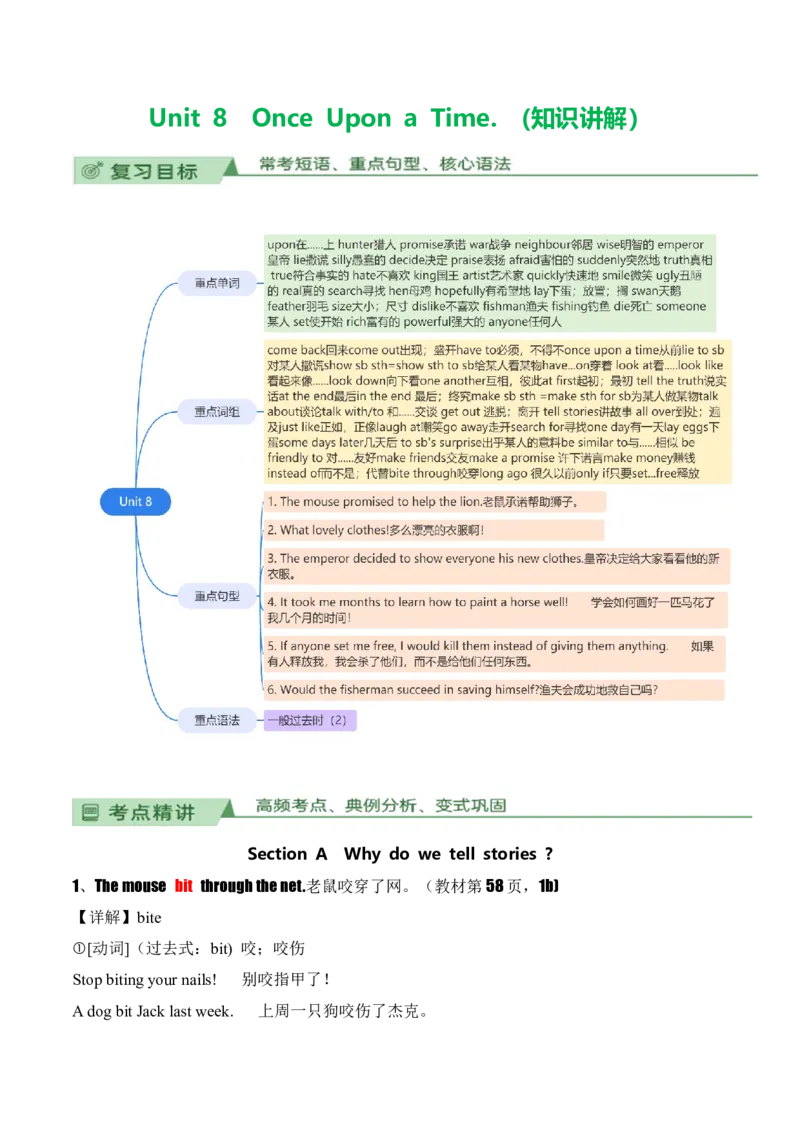
Unit 8 Once Upon a Time. (知识讲解)
Section A Why do we tell stories ?
1、The mouse bit through the net.老鼠咬穿了网。(教材第58页,1b)
【详解】bite
①[动词](过去式:bit) 咬;咬伤
Stop biting your nails! 别咬指甲了!
A dog bit Jack last week. 上周一只狗咬伤了杰克。②〔可数名词〕咬;(咬下的)一口;咬伤
She took a bite of the sandwich. 她咬了一口三明治。
2、The hunter caught the lion.猎人抓住了狮子。(教材第58页,1b)
【详解】hunter〔可数名词〕猎人;搜寻者;是由动词hunt(打猎)加后缀-er构成的名词。
Tony's grandfather is a hunter. 托尼的爷爷是一名猎人。
It's a book for job hunters. 这是一本给求职者的书。
【拓展】“动词+-er/-r”常构成对应的名词。
teach v.教→teacher n.教师
work v工作→ worker n.工人
drive v.驾驶→ driver n.驾驶员,司机
write v.写→writer n.作家
【考点向导】常在“用所给词的适当形式填空”中考查动词加-er/-r构成的名词。
3、The mouse promised to help the lion.老鼠承诺帮助狮子。(教材第58页,1b)
【详解】promise
①〔动词〕承诺;保证
a. promise(not )to do sth 承诺(不)做某事,保证(不)做某事
He promises to work hard at school. 他保证在学校认真学习。
b. promise sb sth promise sth to sb 答应给某人某物
My parents promised me a new bike. 我父母答应给我买一辆新自行车。
=My parents promised a new bike tome.
②〔名词〕承诺;诺言
make a promise 许下诺言
keep a promise 信守诺言
break a promise 违背诺言
4、The farmer's son broke his leg.农夫的儿子摔断了他的腿。(教材第58页,1c)
【详解】break
①〔动词〕(过去式:broke)折断;打破;违反
Danny broke his arm yesterday morning. 昨天上午丹尼摔断了胳膊。
Be careful! Don't break the window. 小心!别打破窗户。
We can't break the school rules. 我们不可以违反校规。②〔名词〕休息,间歇 ;have a break 休息一下
We have a break at 9: 40 in the morning. 我们在上午9:40休息。
5、Was the farmer wise?那个农夫明智吗?(教材第58页,1d)
【详解】wise〔形容词〕明智的;高明的
Long ago, there was a wise man. 很久以前,有一位智者。
I think his answer is not wise. 我认为他的回答并不高明。
【拓展】wisely〔副词〕明智地;聪明地
I hope you can choose wisely. 我希望你能明智地选择。
【助记】wise(adj.明智的;高明的)+-ly(副词后缀)→wisely(adv.明智地;聪明地)
6、But don't you want to read it by your-self?但是难道你不想自己读吗?(教材第 59 页,
Pronunciation 2)
【详解】否定疑问句
该句是否定形式的一般疑问句。它常由助动词、情态动词或连系动词 be的否定形式(多
用缩略形式)加上主语和其他成分构成,多用来表示惊讶、感叹、责难、建议或看法等,通
常译为“难道不(没)···吗?”。
Didn't you know the time? 难道你不知道时间吗?
Can't you go there after school? 难道你不能放学后去那儿吗?
【注意】否定疑问句的答语和一般疑问句的答语一样,肯定回答用yes,否定回答用no,但翻译成
汉语时,yes要译为“不”,no则译为“是”。
-Isn't she hungry? 她不饿吗?
-Yes, she is. /No, she isn't. 不,她饿。/是的,她不饿。
7、Once upon a time, an emperor loved/liked clothes very much.从前,一个皇帝非常喜爱/喜欢
衣服。(教材第59页,2a)
【详解】(1)once upon a time前;很久以前常用在故事的开头,与long(long)ago同义。
Once upon a time, there was a wise old man and he had seven sons.从前,有一位聪明的老人,他
有七个儿子。
(2)upon〔介词〕在···上
He put his schoolbag upon the desk. 他把书包放在桌子上。
【注意】upon与on同义,但upon通常用于比较正式的场合或once upon a time等短语中。
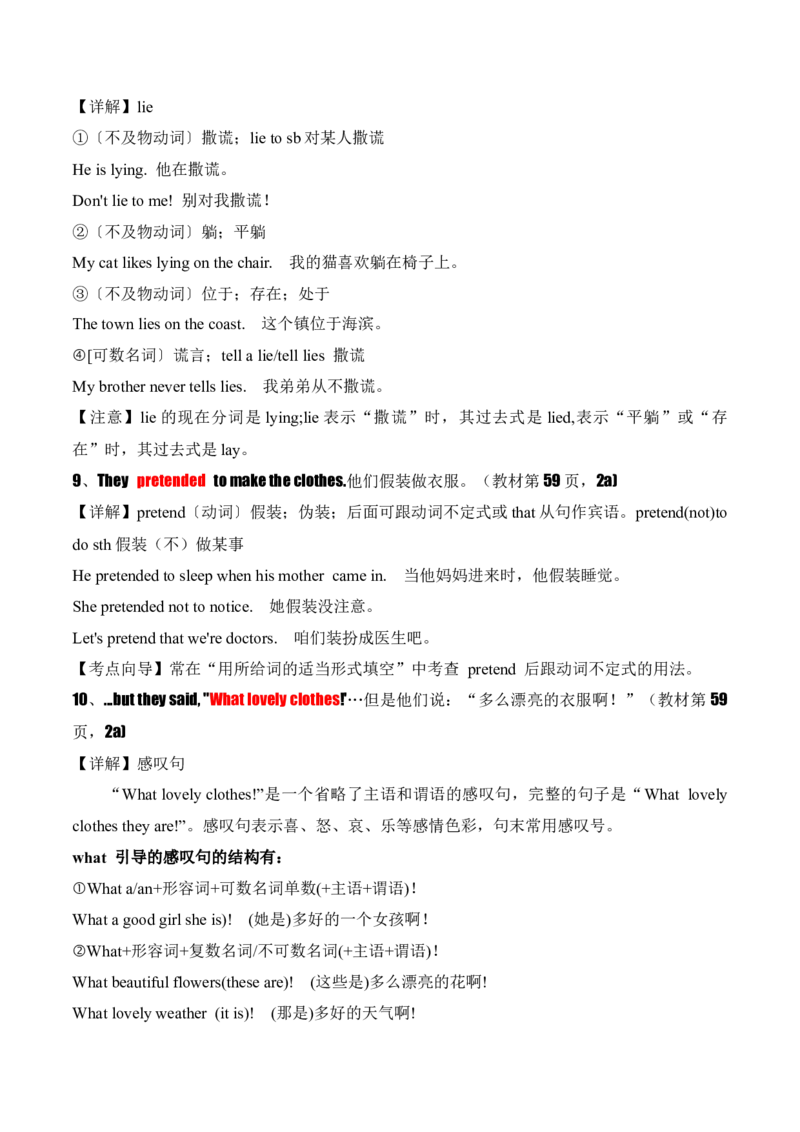
8、Two brothers came and lied to him... 兄弟两人来对他撒谎说......(教材第59页,2a)【详解】lie
①〔不及物动词〕撒谎;lie to sb对某人撒谎
He is lying. 他在撒谎。
Don't lie to me! 别对我撒谎!
②〔不及物动词〕躺;平躺
My cat likes lying on the chair. 我的猫喜欢躺在椅子上。
③〔不及物动词〕位于;存在;处于
The town lies on the coast. 这个镇位于海滨。
④[可数名词〕谎言;tell a lie/tell lies 撒谎
My brother never tells lies. 我弟弟从不撒谎。
【注意】lie的现在分词是 lying;lie 表示“撒谎”时,其过去式是 lied,表示“平躺”或“存
在”时,其过去式是lay。
9、They pretended to make the clothes.他们假装做衣服。(教材第59页,2a)
【详解】pretend〔动词〕假装;伪装;后面可跟动词不定式或that从句作宾语。pretend(not)to
do sth假装(不)做某事
He pretended to sleep when his mother came in. 当他妈妈进来时,他假装睡觉。
She pretended not to notice. 她假装没注意。
Let's pretend that we're doctors. 咱们装扮成医生吧。
【考点向导】常在“用所给词的适当形式填空”中考查 pretend 后跟动词不定式的用法。
10、...but they said, "What lovely clothes!'···但是他们说:“多么漂亮的衣服啊!”(教材第 59
页,2a)
【详解】感叹句
“What lovely clothes!”是一个省略了主语和谓语的感叹句,完整的句子是“What lovely
clothes they are!”。感叹句表示喜、怒、哀、乐等感情色彩,句末常用感叹号。
what 引导的感叹句的结构有:
①What a/an+形容词+可数名词单数(+主语+谓语)!
What a good girl she is)! (她是)多好的一个女孩啊!
②What+形容词+复数名词/不可数名词(+主语+谓语)!
What beautiful flowers(these are)! (这些是)多么漂亮的花啊!
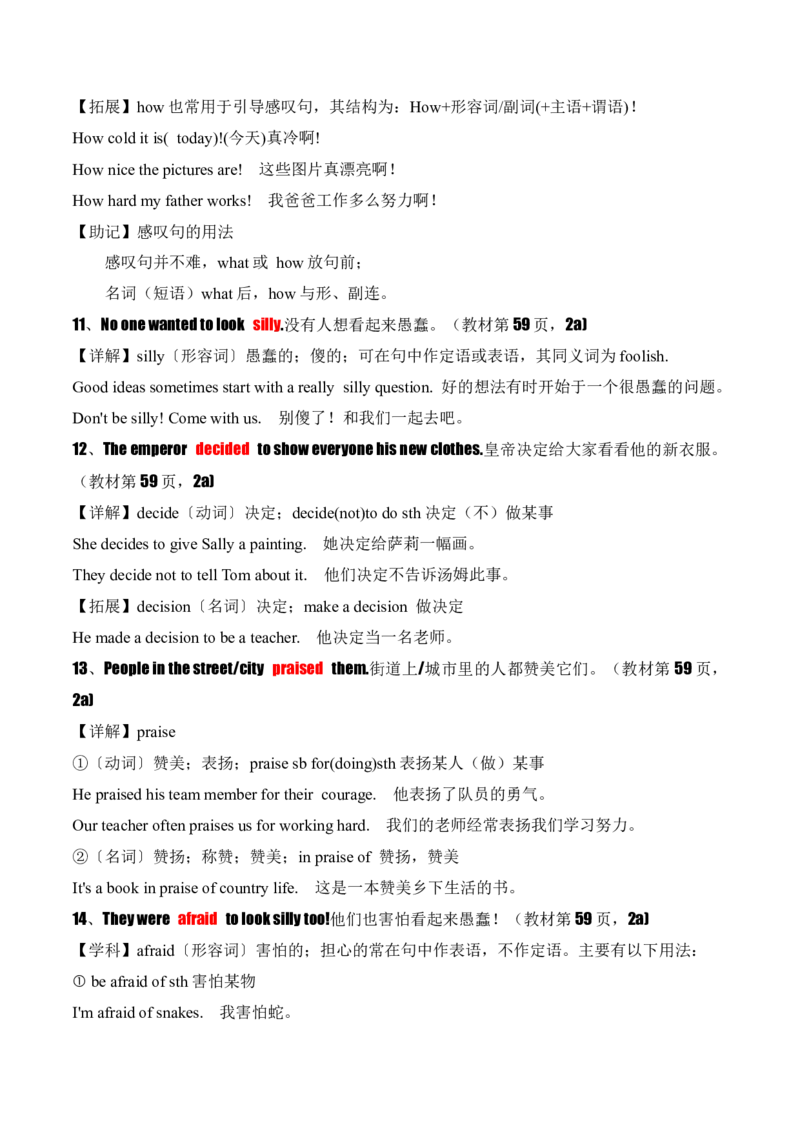
What lovely weather (it is)! (那是)多好的天气啊!【拓展】how也常用于引导感叹句,其结构为:How+形容词/副词(+主语+谓语)!
How cold it is( today)!(今天)真冷啊!
How nice the pictures are! 这些图片真漂亮啊!
How hard my father works! 我爸爸工作多么努力啊!
【助记】感叹句的用法
感叹句并不难,what或 how放句前;
名词(短语)what后,how与形、副连。
11、No one wanted to look silly.没有人想看起来愚蠢。(教材第59页,2a)
【详解】silly〔形容词〕愚蠢的;傻的;可在句中作定语或表语,其同义词为foolish.
Good ideas sometimes start with a really silly question. 好的想法有时开始于一个很愚蠢的问题。
Don't be silly! Come with us. 别傻了!和我们一起去吧。
12、The emperor decided to show everyone his new clothes.皇帝决定给大家看看他的新衣服。
(教材第59页,2a)
【详解】decide〔动词〕决定;decide(not)to do sth决定(不)做某事
She decides to give Sally a painting. 她决定给萨莉一幅画。
They decide not to tell Tom about it. 他们决定不告诉汤姆此事。
【拓展】decision〔名词〕决定;make a decision 做决定
He made a decision to be a teacher. 他决定当一名老师。
13、People in the street/city praised them.街道上/城市里的人都赞美它们。(教材第59页,
2a)
【详解】praise
①〔动词〕赞美;表扬;praise sb for(doing)sth表扬某人(做)某事
He praised his team member for their courage. 他表扬了队员的勇气。
Our teacher often praises us for working hard. 我们的老师经常表扬我们学习努力。
②〔名词〕赞扬;称赞;赞美;in praise of 赞扬,赞美
It's a book in praise of country life. 这是一本赞美乡下生活的书。
14、They were afraid to look silly too!他们也害怕看起来愚蠢!(教材第59页,2a)
【学科】afraid〔形容词〕害怕的;担心的常在句中作表语,不作定语。主要有以下用法:
① be afraid of sth害怕某物
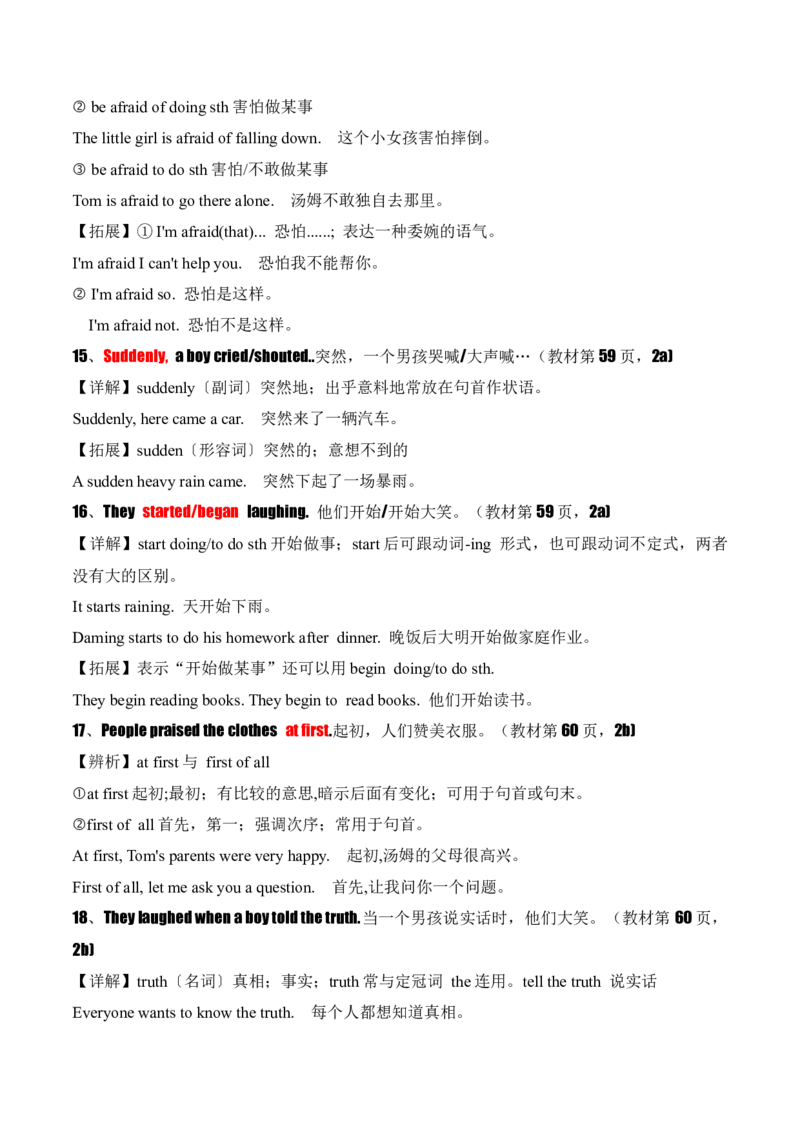
I'm afraid of snakes. 我害怕蛇。② be afraid of doing sth害怕做某事
The little girl is afraid of falling down. 这个小女孩害怕摔倒。
③ be afraid to do sth害怕/不敢做某事
Tom is afraid to go there alone. 汤姆不敢独自去那里。
【拓展】①I'm afraid(that)... 恐怕......; 表达一种委婉的语气。
I'm afraid I can't help you. 恐怕我不能帮你。
② I'm afraid so. 恐怕是这样。
I'm afraid not. 恐怕不是这样。
15、Suddenly, a boy cried/shouted..突然,一个男孩哭喊/大声喊···(教材第59页,2a)
【详解】suddenly〔副词〕突然地;出乎意料地常放在句首作状语。
Suddenly, here came a car. 突然来了一辆汽车。
【拓展】sudden〔形容词〕突然的;意想不到的
A sudden heavy rain came. 突然下起了一场暴雨。
16、They started/began laughing. 他们开始/开始大笑。(教材第59页,2a)
【详解】start doing/to do sth开始做事;start后可跟动词-ing 形式,也可跟动词不定式,两者
没有大的区别。
It starts raining. 天开始下雨。
Daming starts to do his homework after dinner. 晚饭后大明开始做家庭作业。
【拓展】表示“开始做某事”还可以用begin doing/to do sth.
They begin reading books. They begin to read books. 他们开始读书。
17、People praised the clothes at first.起初,人们赞美衣服。(教材第60页,2b)
【辨析】at first与 first of all
①at first起初;最初;有比较的意思,暗示后面有变化;可用于句首或句末。
②first of all首先,第一;强调次序;常用于句首。
At first, Tom's parents were very happy. 起初,汤姆的父母很高兴。
First of all, let me ask you a question. 首先,让我问你一个问题。
18、They laughed when a boy told the truth.当一个男孩说实话时,他们大笑。(教材第 60页,
2b)
【详解】truth〔名词〕真相;事实;truth常与定冠词 the连用。tell the truth 说实话
Everyone wants to know the truth. 每个人都想知道真相。Do you think she's telling the truth? 你认为她在讲实话吗?
【拓展】①true〔形容词〕符合事实的;真正的
Believe it or not, it's a true story. 信不信由你,这是个真实的故事。
②truly〔副词〕真正;确实;真诚地
I'm truly sorry for that. 对于那件事我真的很抱歉。
19、"We can make a lot of money by lying to the emperor.”“我们可以通过对皇帝撒谎来赚很多
钱。”(教材第60页,2d)
【详解】by doing sth通过做某事;表示通过某种方式或手段等。
My sister learns English by listening to English songs. 我姐姐通过听英文歌曲学习英语。
-How do you stay healthy? 你如何保持健康?
-By running. 通过跑步。
【注意】对“by+方式/方法”提问用how。
20、I hate to be different.我讨厌(与别人)不一样。(教材第60页,2d)
【详解】hate〔及物动词〕不喜欢;厌恶;讨厌后跟名词、代词、动词不定式或动词-ing形式。
Lucy hates Monday mornings. 露西不喜欢星期一早晨。
My parents hate to drive to work. 我父母不喜欢开车去上班。
I hate making mistakes. 我讨厌出错。
【注意】hate 不用于进行时态。hate to do sth与 hate doing sth 含义基本相同。
21、Once upon a time, a king asked an artist to paint him a horse.从前,一个国王让一位画家给
他画一匹马。(教材第61页,3c)
【详解】artist〔可数名词〕美术家;艺术家由名词art加后缀-ist构成。
I want to be an artist when I grow up. 我长大后想成为一名艺术家。
【拓展】后缀-ist常用于构成名词,表示“从事......的人;......专家;......使用者”。
type 打字→ typist 打字员
cartoon 漫画→cartoonist 漫画家
active 积极的→activist 积极分子
22、"Please give me some time,"the artist answered.“请给我一些时间,”画家回答。(教材第
61页,3c)
【辨析】some time, sometime, some times 和sometimes
①some time一段时间;名词短语I'll stay here for some time. 我将在这儿待一段时间。
②sometime某个时间;副词
I will go to Shanghai sometime next week.
下周的某个时间我要去上海。
③some times几次;几倍;名词短语
I read the story some times. 这个故事我读过几次了。
④sometimes有时;频度副词
Sometimes I get up very late.有时我很晚起床。
【助记】some time, sometime, some times与sometimes
分开“一段时间”(some time),
相聚“某个时候”(sometime),
“几次”(some times)分开带-s,
“有时”(sometimes)相聚加-s。
23、Quickly, the artist painted a beautiful picture of a horse.很快,画家画了一张漂亮的马的画。
(教材第61页,3c)
【详解】quickly〔副词〕快速地;很快;由形容词quick加后缀-ly构成,可以放在句首、句
末或实义动词之前。
She had breakfast quickly. 她迅速地吃了早饭。
Quickly, we crossed the street. 我们快速地穿过了街道。
【拓展】很多副词是由“形容词+后缀-ly”构成的,如:
careful→carefully usual→usually
sudden→suddenly slow→slowly
24、The artist smiled and took the king to his house.画家微笑着带国王去了他的家。(教材第
61页,3c)
【辨析】smile与laugh
smile表示微笑,指面部露出高兴的表情;smile at对.......微笑
laugh表示出声地笑,有时指大笑;laugh at嘲笑.......
Look! The boy is smiling at us. 看!那个男孩在朝我们微笑。
His joke made us laugh. 他的笑话使我们大笑起来。
25、There were paintings of horses all over! 到处都是马的画!(教材第61页,3c)【详解】all over到处;遍及
They looked for the bag all over. 他们到处找那个包。
We have friends all over the world. 我们在世界各地都有朋友。
Section B What can stories teach us ?
1、Is the ugly duckling a real duck? 这只丑小鸭是一只真正的鸭子吗?(教材第62页,1b)
【详解】ugly〔形容词〕丑陋的;难看的;可在句中作定语或表语。
It's an ugly hat. 那是一顶丑陋的帽子。
These pictures are very ugly. 这些图片很难看。
【注意】 ugly的读音以元音音素开头,其前用不定冠词时,要用 an。
2、But the other ducklings still laughed at him and told him to go away.但是其他的小鸭子仍然
嘲笑他并让他走开。(教材第62页,1b)
【详解】laugh at
①嘲笑后面常跟人作宾语。
Don't laugh at others. 不要嘲笑别人。
②因......而发笑后面常跟物作宾语。
They laughed at my jokes. 他们因我的笑话而发笑。
3、It made the poor duckling very sad, so he decided to search for a new home.这使得那只可怜
的小鸭子很伤心,所以他决定去寻找一个新家。(教材第62页,1b)
【详解】search
①〔动词〕寻找;搜寻;
search for寻找;搜寻;查找
search..for sb/sth 搜查........找某人/某物
search for photos 查找照片
search the kitchen for food搜查厨房找食物
②〔名词〕搜寻;搜索;查找
an online search 网上搜索
4、"May I stay with you? "he asked hopefully.“我可以和你们待在一起吗?”他满怀希望地问。
(教材第62页,1b)
【详解】hopefully〔副词〕有希望地;是由形容词 hopeful加后缀 -ly构成的副词,可位于句
首或句末,位于句首时,后面通常加逗号。Hopefully, we'll arrive before dark. 我们有望在天黑前到达。
"Am I welcome?" he asked hopefully.“欢迎我吗?”他满怀希望地问。
【助记】
hope(n.希望)
↓ +-ful
hopeful(adj.有希望的)
↓+-ly
hopefully (adv.有希望地)
5、They did not like him because he could not purr or lay eggs!他们不喜欢他,因为他不会发出
呜呜声或下蛋!(教材第62页,1b)
【详解】lay〔动词〕(过去式:laid)
①下(蛋);产(卵)
The bird laid an egg. 那只鸟下了一个蛋。
②放置;搁
She laid the baby down on the bed. 她把婴儿放在床上。
③摆放(餐具) lay the table 摆放餐具
We help to lay the table before meals. 饭前我们帮着摆放餐具。
【注意】lay还可以作lie的过去式,意为“平躺;位于”。
He lay on the grass. 他躺在草地上。
6、“I wish I looked like you!”he cried.“我希望我长得像你们!”他哭喊道。(教材第 62页,
1b)
【详解】虚拟语气
I looked like you 是一个虚拟语气的句子。wish后跟宾语从句时,句子要用虚拟语气。虚
拟语气陈述的是与客观事实不相符或不能够实现的事情。在与现在情况相反的虚拟语气中,
从句的谓语动词用过去式,be 动词通常用 were。
I wish I could fly. 我希望我会飞。
If I were you, I would change my job. 我要是你的话,我会换份工作。
7、The duckling looked down, and to his surprise, he saw that he was a beautiful white swan too!那
只小鸭子低头看,出乎他的意料,他看见他也是一只美丽的白天鹅!(教材第62页,1b)
【详解】to sb's surprise出乎某人的意料;让某人吃惊的是;surprise此处用作名词,意为“惊奇;意外”。
To my surprise, Tom can speak Chinese. 出乎我的意料,汤姆会说汉语。
To our surprise, those American students like Beijing Opera.令我们吃惊的是,那些美国学生喜欢
京剧。
【拓展】in surprise 惊奇地,吃惊地
The little girl looked at us in surprise. 那个小女孩吃惊地看着我们。
8、How was he similar to them?他与他们有何相似之处?(教材第63页,1c)
【详解】be similar to···相似
This picture is similar to that one. 这张图片与那张相似。
Your bike is very similar to Daming's bike. 你的自行车和大明的自行车十分相似。
【拓展】be similar in在···方面相似
They are similar in colour. 它们在颜色上相似。
9、You are welcome here only if you can purr or lay eggs.只有你能发出呜呜声或下蛋,这里才
欢迎你。(教材第63页,1d)
【详解】only if只有;用来强调只有满足这个条件,某事才能实现。
I will go there only if you go with me. 只有你和我一起,我才会去那里。
The plant will grow well only if it gets enough sunlight.只有这株植物得到足够的阳光,它才会长
得好。
10、Once upon a time, a fisherman caught a bottle in his fishing net.从前,一个渔夫用他的渔网
捞到了一个瓶子。(教材第63页,2a )
【详解】fisherman〔可数名词〕渔夫;其复数形式是fishermen。类似的复数变化还有:
man→men(男人)
woman→women(女人)
policeman→policemen(男警察)
gentleman→gentlemen(先生)
11、"Prepare to die!”shouted the genie."准备去死吧!”妖怪大喊道。(教材第63页,2a)
【详解】(1)prepare〔动词〕准备;预备
① prepare to do sth 准备做某事
We are preparing to go on holiday. 我们正准备去度假。
② prepare sth for.为......准备某物You must prepare a room for the boy. 你必须为这个男孩准备一个房间。
③ prepare for sth 为某事做准备
He is preparing for the World Cup. 他正在为世界杯做准备。
(2)die〔不及物动词〕死亡;消失过去式为died, 现在分词为 dying。
His cat is dying. 他的猫奄奄一息。
His mother died when he was 8. 当他八岁的时候,他的妈妈去世了。
【注意】die强调“死”这一动作,指生命的结束,不与表示一段时间的状语连用。
【拓展】dead[形容词〕死的;死亡的 death〔名词〕死,死亡
12、 If someone set me free, I would make them rich and powerful.如果有人释放我,我会让
他们富有和强大。(教材第63页,2a )
【详解】(1)someone〔复合不定代词〕某人;有人相当于somebody。someone作主语时,谓
语动词要用单数形式。
There is someone waiting for you at the school gate. 有人在校门口等你。
Please say thank you when someone helps you.当有人帮助了你时,请说谢谢。
(2)set......free释放
He set the bird free from the room. 他把鸟从房间里放了出来。
(3)set
①[动词〕使处于某种状态;使开始过去式为 set。set sb doing sth 使某人做某事
His words set me thinking. 他的话使我陷入了思考。
②〔名词〕一套;一副;一组
a set of stamps 一套邮票
a set of books 一套书
The set of keys is Kate's. 这串钥匙是凯特的。
(4)rich〔形容词〕
①富有的(反义词:poor)
a rich country一个富有的国家
He is very rich, but he isn't happy. 他很富有,但他不快乐。
【注意】the rich表示“富人”。
②富含......的 be rich in富含......
Oranges are rich in vitamin C. 橙子富含维生素C。③丰富多彩的
China has a long history and rich culture. 中国有悠久的历史及丰富多彩的文化。
(5)powerful〔形容词〕强大的;有影响力的;是由名词power加后缀-ful构成的形容词。
Our country is very powerful now. 现在我们的国家很强大。
My uncle is a powerful man. 我叔叔是一个有影响力的人。
【拓展】常见的名词加后缀-ful构成的形容词还有:
care n.小心→careful adj.小心的
use n.使用→useful adj.有用的
hope n.希望→hopeful adj.有希望的
13、If anyone set me free, I would kill them instead of giving them anything.如果有人释放我,我
会杀了他们,而不是给他们任何东西。(教材第63页,2a)
(1)anyone〔复合不定代词〕任何人;某个人与anybody同义。通常用于否定句和疑问句中,
也可用于条件句中。anyone作主语时,谓语动词要用单数形式。
Is anyone here? 这儿有人吗?
I won't tell anyone about it. 我不会告诉任何人这件事。
If anyone calls, please tell me. 如果有人打电话,请告诉我。
【注意】形容词修饰someone, anyone等复合不定代词时,要放在复合不定代词后面。
Was anyone famous born there? 有名人出生在那里吗?
(2)辨析:instead of与instead
①instead of而不是;代替;介词短语;后面常接名词、代词或动词-ing形式。
②instead代替;反而;副词;置于句首或句末。
I'll clean the classroom instead of you. 我将替你打扫教室。
They talked instead of doing their home-work. 他们交谈而不是做家庭作业。
She didn't play basketball. She went swimming instead. 她没有打篮球,而是去游泳了。
He didn't answer my question. Instead, he asked me the same question.他没有回答我的问题。相
反,他问了我同样的问题。
14、 Would the fisherman succeed in saving himself?渔夫会成功地救自己吗?(教材第 63页,
2a)
【详解】himself〔反身代词〕他自己;他本人反身代词常在句中作宾语,与逻辑主语在人称
和数上保持一致。Tom said to himself, "That's right." 汤姆心里想,“那是对的。”
I want to see the doctor himself. 我想见医生本人。