文档文本内容
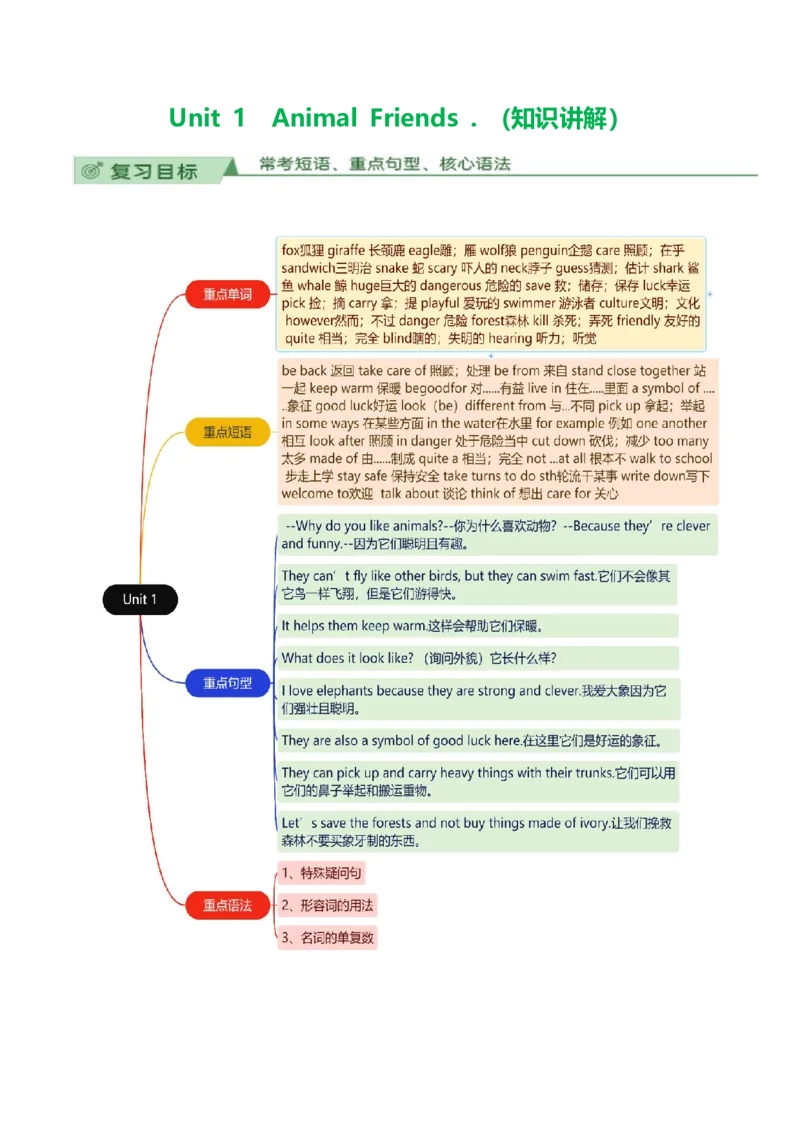
Unit 1 Animal Friends . (知识讲解)Section A Why do you like animals ?
1、wolf狼(教材第2页,1a)
【详解】wolf〔可数名词〕狼 复数形式为 wolves。
three wolves 三匹狼
2、Wolves take good care of their babies.狼很好地照顾它们的幼崽。(教材第2页,1c)
【详解】(1)take care of;照顾;处理。其后可接名词或代词作宾语。
take good care of好好照顾
Can you help me take care of my little sister? 你能帮我照顾我的妹妹吗?
You must take good care of yourself and keep healthy. 你一定要好好照顾自己,保持健康。
【拓展】take care 小心;注意(= be careful/look out)
Take care! It's dangerous here. 小心!这儿危险。
(2) care
① (不可数名词〕照顾;护理
They share the care of the children. 他们共同照顾孩子。
②〔动词〕关心;在乎
care about关心,关怀;在乎
care for非常喜欢;照顾
I know my parents care about me. 我知道我父母关心我。
I don't care about what you'll say. 我不在乎你会说什么。
She cares for her sick father. 她照顾她生病的父亲。
3、What's your favourite animal?你最喜欢的动物是什么?(教材第2页,1d)
【详解】What's sb's favourite+名词 ? 某人最喜欢的···是什么? 可与“What+名词+is sb's
favourite?”或“What+名词+do/does sb like best?”相互转换,用来询问某人最喜欢的事物。答语
常用“Sb's favourite.is../Sb like(s)..best. /It's..”或直接回答最喜欢的事物。
What's your favourite colour?你最喜欢的颜色是什么?
=What colour is your favourite?
=What colour do you like best?
-What's Tom's favourite food? 汤姆最喜欢的食物是什么? -It's milk. 是牛奶。4、Why do you like monkeys?你为什么喜欢猴子?(教材第2页,ld)
【详解】Why do/does sb like sth? 某人为什么喜欢某物?此句型用why引导特殊疑问句,用
来询问某人喜欢某事物的原因。答语通常为“Because+句子.”。
-Why do you like giraffes? 你为什么喜欢长颈鹿?
-Because they are very beautiful. 因为它们很漂亮。
5、Yes,they look lovely/amazing.是的,它们看起来很可爱/令人惊叹。(教材第3页,2a)
【详解】look
①〔连系动词〕看起来;后接形容词作表语。
The two children look happy. 那两个孩子看上去很开心。
②〔不及物动词〕看,瞧
look at看
look for 寻找
Look! What is Jim doing? 看!吉姆正在做什么?
Look at the picture, please. 请看这幅画。
I'm looking for my pen. 我正在找我的钢笔。
③〔名词〕外观;外表
表示“相貌,容貌”时用复数形式looks。
She has her father's good looks. 她有父亲俊秀的容貌。
6、They can't fly like other birds, but they can swim fast. 它们不能像其他鸟一样飞,但它们能
游得很快。(教材第3页,2a)
【详解】like
①〔介词〕相似,像,类似;其后跟名词、代词或动词-ing 形式。其反义词为unlike(不像)。
look like 看起来像
be like像
The old man cries like a child. 这位老人哭得像个孩子一样。
The little girl looks like her mother. 那个小女孩看起来像她的母亲。
She is very like her sister. 她很像她姐姐。
②〔及物动词〕喜欢;其后常跟名词、代词或动词-ing形式,也可跟动词不定式。其反义词
为 dis-like(不喜欢)。
like doing/to do sth喜欢做某事I like reading books very much. 我非常喜欢读书。
7、Where are they from?它们来自哪里?(教材第3页,2a)
【详解】Where+be+主语+from?···来自哪里?回答这一句型要用“主语+be from+地点.”。
-Where are you from?你来自哪里?
-I'm from Tianjin. 我来自天津。
【拓展】“Where+be+主语+from?”相当于“Where +助动词+主语+come from?”。
be from来自(相当于 come from)
-Where is the girl from? Where does the girl come from? 这个女孩来自哪里?
-She is from the USA. She comes from the USA. 她来自美国。
8、It says they're from Antarctica.上面说它们来自南极洲。(教材第3页,2a)
【详解】say〔及物动词〕
①(书面材料或可见的东西)提供信息;指示。
The sign says "No parking".标牌上写着“禁止停车”。
②说;讲 强调说话的内容。say..to sb 对某人说..
He says,“I'm fine.” 他说:“我很好。”
Do you say "please"and "thank you"? 你说“请”和“谢谢你”吗?
9、It helps them keep warm.这能帮助它们保暖。(教材第3页,2a)
【详解】help sb(to)do sth帮助某人做某事可以与 help sb with sth 进行互换。
I often help him to )learn English. =I often help him with his English. 我经常帮他学英语。
【拓展】help do sth 帮助做某事
help with sth 帮着做某事
Lingling helps sweep the floor every day. 玲玲每天帮着扫地。
He likes to help with the housework. 他喜欢帮着做家务。
10、It's not good for them.这对它们不好。(教材第3页,2a)
【详解】be good for对······有益;对······有好处for为介词,后跟名词、代词或动词-ing形式。
其反义短语为 be bad for,意为“对···有害;对··有坏处”。
Milk is good for us.牛奶对我们有好处。
Taking a walk every day is good for our health.每天散步对我们的健康有好处。
It's bad for your eyes to read in the sun. 在阳光下看书对你的眼睛有害。
【拓展】与good相关的短语:be good with 善于应付······的
be good at 擅长.
be good to 对······好
Teachers must be good with the children. 老师必须善于应付孩子们。
I am good at playing the piano. 我擅长弹钢琴。
Be good to him,OK? 好,行?
11、What does it look like?/How does it look?它长什么样?/它看起来怎么样?(教材第4页,
2d)
【详解】What do/does.look like?······长什么样?这是询问外貌的常用句型,相当于“How
do/does...look?"
-What does your father look like? =How does your father look?你父亲长什么样?
-He's tall and strong. 他又高又壮。
【拓展】What is sb like?某人是个什么样的人? 常用来询问人的性格,有时也可询问外貌。
-What's she like? 她是个什么样的人?
-She is very friendly. 她很友好。
12、Because they're really scary.因为它们很吓人。(教材第5页,3a)
【详解】scary〔形容词〕吓人的;恐怖的常说明事物所具有的特征。
The snake is really scary. 蛇很吓人。
【拓展】scared〔形容词〕害怕的;恐惧的常说明人的感受。
be scared of 害怕··
be scared to do sth 害怕做某事
He was scared of snakes. 他害怕蛇。
The little girl is scared to cross the road by herself. 这个小女孩害怕独自过马路。
13、Guess!猜猜!(教材第5页,3b)
【详解】guess〔动词〕猜测;估计;后面可接名词、代词或从句。
I can only guess the reason. 我只能猜测理由。
I guess (that) he is right. 我想他是正确的。
【拓展】I guess so意为“我想是的”,表示同意对方的观点或看法;I guess not 意为“我想
不是”,表示不同意对方的观点或看法。
Section B How are animals part of our lives ?1、How to Save Elephants如何拯救大象(教材第6页,1b)
【详解】save
①〔及物动词〕救;救助。后接名词或代词作宾语。
save one's life 挽救某人的生命
save sb/sth from..从..中救起某人/某物
He saved the boy's life. 他挽救了那个男孩的生命。
The policeman saved the children from the water. 那名警察把孩子们从水中救了出来。
②〔及物动词〕保存;保留
Please save the photos to your USB drive. 请把这些照片保存到你的优盘里。
③〔及物动词〕节省;节约
Please save water. 请节约用水。
We should try to save time. 我们应该设法节省时间。
④〔动词〕储蓄;攒钱
He works late every night to save money. 为了攒钱,他每晚都工作到很晚。
I want to save for a new bike. 我想攒钱买辆新自行车。
2、They are also a symbol of good luck here.在这儿,它们也是好运的象征。(教材第6页,
1b)
【详解】(1)a/the symbol of..·..的象征;symbol作可数名词,意为“象征,标志”。
The dove is a symbol of peace. 鸽子是和平的象征。
The Great Wall is the symbol of China. 长城是中国的象征。
(2)luck〔不可数名词〕幸运;运气
good luck 好运 bad luck 运 have no luck 没有运气 have good luck有好运
good luck to sb 祝某人好运 good luck with sth 祝某事顺利
Good luck to you!祝你好运!
I have luck with finding a job.我找工作很走运。
【拓展】lucky〔形容词〕幸运的;运气好的
He is a lucky kid. 他是个幸运的孩子。
3、On 13 March, we celebrate Thai Elephant Day.在3月13日,我们庆祝泰国大象日。(教材
第6页,1b)
【详解】(1)辨析: on, at与inon 常用于“日期、星期几”等具体某天前,也用于具体某天的上午、下午或晚上前
on June 11th 在6月11日 on Friday在星期五 on Sunday morning 在星期天上午
at 常用于钟点(某时刻)前或某些固定短语中
at 8:00在8点 at night 在夜晚
in 常用于“月、年、季节”等前,也可用于一天中的上午、下午或晚上前
in May 在5月 in2025 在2025年 in winter 在冬天 in the morning 在上午
【助记】 时间介词on,at与in的用法
on特指某一天,日期、星期、节日前,at用在时刻前,亦与正午、午夜连,月份、年份与季
节,in须放在其前面。
(2)Thai
①〔形容词〕泰国的;泰国人的
There's a Thai restaurant near his house. 在他家附近有一家泰式餐厅。
②〔名词〕泰国人;泰语
He can speak Thai. 他会说泰语。
【拓展】Thailand〔专有名词〕泰国
The elephant comes from Thailand. 这头大象来自泰国。
4、Elephants look very different from other animals.大象看起来和其他动物很不一样。(教材
第6页,1b)
【详解】look different from看起来与··不同 be different from与··不同;这两个短语都表示两
者之间有差异。
She looks different from her sister. 她看起来和她姐姐不同。
This book is different from the ones on the shelf. 这本书和架子上的书不同。
【拓展】be the same as.与..·相同/一模一样
This bag is the same as that one. 这个包和那个包一模一样。
5、They can pick up and carry heavy things with their trunks.它们可以用象鼻捡起并搬运重物。
(教材第6页,1b)
【详解】(1)pick up为“动词+副词”结构,代词作宾语时必须放在pick 与up之间;名词作
宾语时,可放在pick 和 up之间,也可放在up之后。
①拿起;举起;捡起;拾起
My pen is under your chair. Could you please pick it up for me?我的钢笔在你的椅子下面,请你帮我捡起来好吗?
②搭载,接载
We will pick up Susan home next morning. 我们会在明天早上接苏珊回家。
Why don't you pick her up right now? 你为什么不现在就接她?
③接电话(=pick up the phone)
The phone is ringing. Could you pick(it)up? 电话响了,你能接听一下吗?
(2)carry〔及物动词〕(第三人称单数:caries)
①拿;提
Look! Miss Wang is carrying some flowers.看!王老师正拿着一些花。
Can you help me carry water? 你能帮我提水吗?
②扛;背;抱;运载
The boy is strong enough to carry the box. 这个男孩足够强壮,能扛起这个箱子。
6、Elephants are like us in some ways.大象在某些方面和我们很像。(教材第6页,1b)
【详解】in some ways在某些方面
way此处用作可数名词,意为“方面”。
In some ways, I agree with you. 在某些方面,我同意你的意见。
He is similar to his father in some ways. 在某些方面,他和他的父亲很相似。
【拓展】与way相关的短语:
in a way在某种程度上 by the way 顺便说一下in the way 挡道;妨碍 on the way在路上
all the way 一路上;自始至终
7、 They are very playful and love to play in the water.它们非常爱玩,并且喜欢在水里玩耍。
(教材第6页,1b)
【详解】playful〔形容词〕爱嬉戏的;爱玩的
a playful monkey 一只爱玩的猴子
The little boy is playful. 这个小男孩很顽皮。
8、For example, they can remember one another and places with food and water after many
years.例如,很多年后它们仍能记住彼此以及有食物和水的地方。(教材第6页,1b)
【详解】one another相互,彼此;用作代词,在句中可作宾语。与each other 同义。
Friends should help one another/each other. 朋友应该互相帮助。
You should learn from one another/each other.你们应该相互学习。【拓展】 one another 与each other 均有所有格。
They know one another's/each other's weak points.他们了解彼此的弱点。
9、They look after other elephants when they don't feel well.当其他大象感觉不舒服时,它们会
照顾这些大象。(教材第6页,1b )
【详解】look after(=take care of)
look after...well =take good care of... 好好照顾......
He is old enough to look after himself. 他年纪足够大,能照顾自己了。
You should look after the dog well. 你应该好好照顾这只狗。
=You should take good care of the dog.
【注意】look after 是“动词+介词”结构,宾语无论是名词还是人称代词都要放在after之后。
10 、The big elephants also help the baby ones. 成年大象也会帮助幼象。(教材第6页,1b)
【详解】辨析:one, it与that
one 泛指前面提到的“同类”人或事物中的一个,而不是“同一个”,复数形式为ones。
it 指代前面提到的事物本为身,有时也指人,复数形式they或them
that 特指前文提到的单数可数名词或不可数名词,常用在比较的句子中。复数形式为those
I don't like black bikes. I want to buy a red one. 我不喜欢黑色的自行车,我想买辆红色的。
She has a pen. It's black. 她有一支钢笔,它是黑色的。
The weather in Beijing is different from that in Guangzhou. 北京的天气跟广州的不同。
11、However, they are in danger.然而,它们处于危险之中。(教材第6页.1b)
【详解】(1)辨析:however与but
however然而;不过,副词,可位于句首、句中或句末。必须用逗号与句子隔开,比较正式,
多用于书面语。
but但是;连词,位于句首或句中。后面连接一个句子时无需用逗号隔开,多用于口语。
Some people are very shy in public. However, others aren't.
一些人在公共场合很害羞。然而,其他人不这样。
I like red, but she likes green.我喜欢红色,但她喜欢绿色。
(2)danger〔不可数名词〕危险 反义词为safety (安全)。
in danger 处于危险之中 out of danger 脱险
He's in danger. 他处于危险之中。
Some animals are out of danger. 一些动物已脱离危险。【拓展】dangerous〔形容词〕有危险的;不安全的反义词为safe(安全的)。
It's very dangerous to play on the road. 在马路上玩耍是很危险的。
12、They live in forests, but people cut down too many trees.它们生活在森林里,但是人们砍伐
了太多的树。(教材第6页,1b)
【详解】(1)cut down
①砍伐
People cut down lots of trees every day. 每天人们都砍伐许多树。
②减少
We must try our best to cut down pollution. 我们必须尽最大努力减少污染。
【注意】cut down是“动词+副词”结构,宾语如果是名词,可以放在cut和down中间,也
可以放在down'后面;宾语如果是人称代词,则必须放在 cut和 down 中间。
The apple tree is very meaningful to us.We don't want to cut it down.
这棵苹果树对我们来说很有意义。我们不想把它砍倒。
(2)too many太多;修饰可数名词复数。
There are too many books in the library. 图书馆里有太多的书。
There are too many people in the room. 房间里有太多的人。
13、Let's save the forests and not buy things made of ivory.让我们拯救森林,不要购买象牙制
品。(教材第6页,1b)
【详解】(1)过去分词(短语)作后置定语
此处made of ivory(由象牙制成的)为过去分词短语,作后置定语,修饰前面的名词things。
过去分词用作定语表示被动,如果是一个词,通常放在被修饰词的前面;如果是过去分词短
语,则要放在被修饰词的后面。
I love the toy made of cloth. 我喜欢这个布做的玩具。
I like books written by Lu Xun. 我喜欢鲁迅写的书。
I have a friend named Mary. 我有一个叫玛丽的朋友。
(2)辨析: be made of与 be made from二者都可意为“由··制成的”,区别如下:
be made of 从制成品中能看出原材料
be made from 从制成品中看不出原材料
The table is made of wood. 这张桌子是用木头制作的。
Wine is made from grapes. 葡萄酒是用葡萄制成的。14、friendly友好的(教材第7页,2a)
【详解】friendly〔形容〕好的其反义词为unfriendly“不友好的”。
be friendly to sb对某人友好 be friendly with sb和某人关系好
The Chinese people are very friendly. 中国人民非常友好。
My classmates are all friendly to me. 我的同学都对我很友好。
He is friendly with everyone in his team. 他和队里的每个人关系都很好。
15、My dog, Xiaohua, is part of the family.我的狗,小花,是家庭的一部分。(教材第7页,2a)
【详解】part of.···的一部分,它强调一个整体中的一部分,后面通常接名词或代词。
These books are part of my collection. 这些书是我收藏的一部分。
【拓展】a part of···的一部分,强调某一个特定的部分。
Reading is a part of my daily life. 阅读是我日常生活的一部分。
16、She is quite a big dog, but she is not scary at all!她是一只相当大的狗,但她一点也不吓
人!(教材第7页,2a)
【详解】(1)quite a当;非常。后面通常接可数名词单数形式。
She is quite a beautiful girl. 她是个相当漂亮的女孩。
This book is quite a useful one. 这本书是相当有用的一本。
【拓展】①quite〔副词〕相当;非常修饰形容词或副词。
She is quite beautiful. 她相当漂亮。
He runs quite fast. 他跑得非常快。
② quite a few 相当多;修饰可数名词复数形式。
quite a few friends 很多朋友
③ quite a lot of 大量;许多;修饰可数名词复数或不可数名词。
He has quite a lot of friends. 他的朋友很多。
quite a lot of money 一大笔钱
(2)not..at all一点也不;完全不;通常用来对某个陈述进行强烈的否定,加强语气。not 一般
与连系动词be、助动词或情态动词连用,而 at all位于句末。
I am not tired at all. 我一点也不累。
She doesn't like it at all. 她根本不喜欢它。
17、You see, I am blind.你看,我是盲人。(教材第7页,2a)
【详解】blind〔形容词〕瞎的;失明的,其主语是人而非眼睛,若说明右眼或左眼失明应用“sb+ be + blind + in one's/the /right/left eye".
There is a school for blind children next to the library. 图书馆旁边有一所盲童学校。
He is blind in both eyes. 他双目失明。
She's almost blind in her right eye. 她右眼近乎失明。
【拓展】the blind盲人,指一类人,表示复数概念。
The blind often have good hearing.盲人往往有好的听力。
18 、She helps me walk to school and stay safe.她帮助我走到学校并保持安全。(教材第7
页,2a)
【详解】(1)walk to...指通过步行的方式到达某个地点,相当于go to...on foot.
She likes to walk to the park after dinner. 她喜欢晚饭后步行去公园。
I walk to school every day.我每天步行去上学。
=I go to school on foot every day.
(2)stay
①〔连系动词〕保持;维持;后面通常接形容词作表语,表示保持某种状态或情况。
stay safe 保持安全 stay healthy 保持健康
②〔不及物动词〕停留;待;常与表示场所的副词或短语连用。若与地点名词连用,则stay
后加介词。
stay here/there 待在这里/那里 stay at home 待在家里