文档文本内容
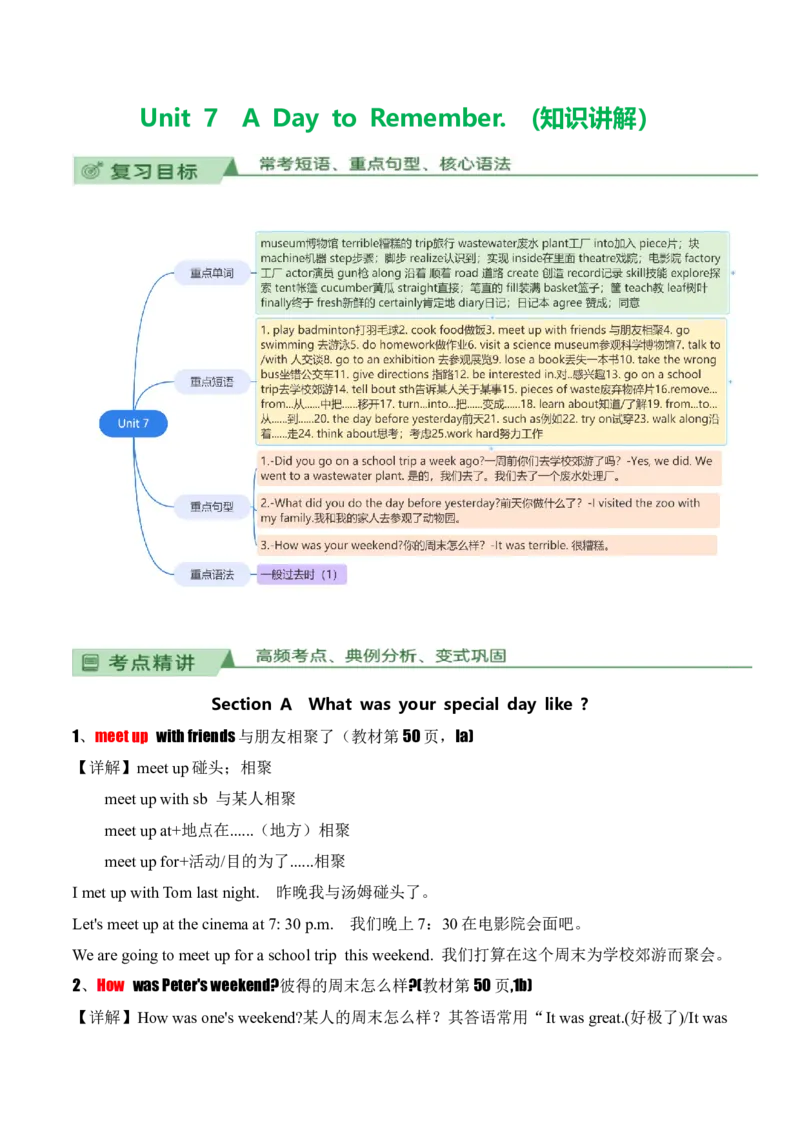
Unit 7 A Day to Remember. (知识讲解)
Section A What was your special day like ?
1、meet up with friends与朋友相聚了(教材第50页,la)
【详解】meet up碰头;相聚
meet up with sb 与某人相聚
meet up at+地点在......(地方)相聚
meet up for+活动/目的为了......相聚
I met up with Tom last night. 昨晚我与汤姆碰头了。
Let's meet up at the cinema at 7: 30 p.m. 我们晚上7:30在电影院会面吧。
We are going to meet up for a school trip this weekend. 我们打算在这个周末为学校郊游而聚会。
2、How was Peter's weekend?彼得的周末怎么样?(教材第50页,1b)
【详解】How was one's weekend?某人的周末怎么样?其答语常用“It was great.(好极了)/It wasOK.(还可以)/It was not bad.(还不错)/It was terrible.(很糟糕)”等。
-How was your weekend/birthday party? 你的周末/生日聚会怎么样?
- It was great. 好极了。
3、I was/wasn't interested in it last year.去年我对它感兴趣/不感兴趣。(教材第 51 页,
Pronunciation 3)
【详解】be interested in.对......感兴趣
I'm interested in that book. 我对那本书感兴趣。
Lucy is interested in music. 露西对音乐感兴趣。
4、I can/can't go on the school trip tomorrow.明天我能/不能去学校郊游了。(教材第51页,
Pronunciation 3)
【详解】trip〔可数名词〕旅行;通常指近距离的旅行,并且往往要回到出发点(即双程)。
课文中指的是郊游。
Have a good trip! 祝旅途愉快!
【拓展】常见的与trip相关的短语:
a day trip一日游
business trip 出差
go on a trip 去旅行
5、How was your school trip to the waste water plant?你们去废水处理厂的学校郊游怎么样?
(教材第51页,2a)
【详解】plant
①〔可数名词〕工厂;植物
There are two wastewater plants in our city.在我们市有两个废水处理厂。
Don't forget to water the plants.别忘记给植物浇水。
②〔及物动词〕种植;栽种;播种
They planted lots of trees last week. 上周他们种了很多树。
6、Was it boring?它无趣吗?(教材第51页,2a)
【详解】boring〔形容词〕无趣的;令人厌烦的在句中一般修饰事或物,说明事物本身具有的
特征,可作表语或定语。
The story was boring. 这个故事很无趣。(作表语)
It was a boring film. 那是一部无聊的电影。(作定语)7、It was really interesting!它很有趣!(教材第51页,2a)
【辨析】interesting与interested
①interesting令人感兴趣的;有趣的;常表示某物具有令人感兴趣的特征,常说明事物;可
作表语或定语。
②interested感兴趣的;常表示某人对某物感兴趣,常说明人;常作表语。
The game is interesting. 这个游戏有趣。
This is an interesting trip. 这是一次有趣的旅行。
The boy is interested in art. 这个男孩对美术感兴趣。
【考点向导】
①常在“单项填空”题中考查interested与interesting的用法区别;
②常在“完成句子”题中考查 be interested in 这一短语。
8 、We saw the plant make dirty water clean again.我们看到工厂使得脏水又变干净了。(教
材第51页,2a)
【辨析】 see sb do sth 与 see sb doing sth高频
①see sb do sth看见某人做某事;强调看到了动作的全过程或动作经常发生。
②see sb doing sth看见某人正在做某事;强调看到的动作正在进行。
I often see him play basketball on the play-ground. 我经常看到他在操场上打篮球。
I saw her watering the flowers. 我看到她正在浇花。
9、Well, first, dirty water from our homes goes into the plant.哦,首先来自我们家的脏水进入
工厂。(教材第51页,2a)
【详解】into〔介词〕到......里面;进入;是表示动态的介词。
He jumped into the river. 他跳进了河里。
The man walked into the room 5 minutes ago. 那个人5分钟前走进了房间。
10、Then, special screens remove large pieces of waste from the water.然后,特殊的隔板除去
水中的大块废弃物。(教材第51页,2a)
【详解】(1)remove〔及物动词〕移开;拿走remove sth from sth从某物中拿走某物
She asked me to remove my shoes. 她让我把鞋脱掉。
He removed the books from the bookcase. 他将书橱里的书拿走了。
(2)pieces of waste废弃物碎片
There are some pieces of waste in the river. 河里有一些废弃物碎片。(3)piece〔可数名词〕片;块;a piece of意为“一张;一片;一块”,其后可接不可数名词。
a piece of bread 一块面包
a piece of paper 一张纸
She cut the cake into six pieces. 她把蛋糕切成了六块。
(4)waste
①〔不可数名词〕废弃物
People put their waste into the dustbin. 人们把他们的废弃物放到垃圾桶里。
②〔及物动词〕浪费
Don't waste water. 不要浪费水。
11、It takes a few more steps after that before the water becomes clean again.那之后在让水又变
干净之前还需要好几步。(教材第51页,2a)
【详解】before
①[连词〕在......之前;引导时间状语从句,反义词是after。
I'm going to talk to him this afternoon before he goes home.今天下午在他回家之前我会和
他谈谈。
②〔介词〕在......之前
Please close the window before going to school.请在上学之前关上窗户。
12、I used to think it was easy to get clean water.我过去常常认为得到干净的水很容易。(教材
第51页,2a)
【详解】used to do sth常常做某事;强调过去和现在的对比,暗指现在已经不存在的动作或
状态。
He used to live here. 他曾经在这儿住过。
【注意】used to do sth 中的 used 没有人称和时态的变化。
【拓展】be used to doing sth习惯于做某事
He is used to getting up early. 他习惯于早起。
13 、I didn't realize it was so hard.我没意识到它这么难。(教材第51页,2a)
【详解】realize〔及物动词〕认识到;实现;其后常接名词或 that从句。
realize one's dream实现某人的梦想
The woman didn't realize that she was wrong. 那个妇女没有意识到她错了。
He tried to realize his dream. 他尽力实现了他的梦想。14、The plant turned dirty water into clean water.这个工厂将脏水变成了干净的水。(教材第
52页,2c)
【详解】turn...into...把......变成......
The magician turned the paper into a flower. 魔术师把这张纸变成了一朵花。
【考点向导】常在“根据汉语意思完成句子”题中考查“turn...into...”这一固定搭配的用法。
15、Fu Xing learnt about the cleaning process.付兴了解了净化过程...(教材第52页,2c)
【详解】learn about了解;知道;获悉;相当于 know about。
How did you learn about that? 你是怎样知道那件事的?
16、Then the plant uses screens to remove large pieces of waste from the dirty water.然后工厂
使用隔板除去脏水中的大块废弃物。(教材第52页,2c)
【详解】use sth to do sth做事,可与 use sth for doing sth 互换使用。
I use some chicken and vegetables to make hamburgers. 我用一些鸡肉和蔬菜制作汉堡。
=I use some chicken and vegetables for making hamburgers.
17、We went to the theatre to watch a show.我们去戏院看演出了。(教材第52页,2e )
【详解】动词不定式(短语)作目的状语
to watch a show在本句中作目的状语。动词不定式(短语)作目的状语时可位于句末,
也可位于句首。位于句首时,常用逗号与后面的句子隔开,意为“为了做某事”。
He came here to buy his favourite books. 他来这儿是为了买他最喜欢的书。
To get up early, he went to bed at nine last night. 为了早起,他昨天晚上9点就上床睡觉了。
18、It was terrible.很糟糕。(教材第53页,3a)
【详解】terrible〔形容词〕糟糕的;常用作表语或用作定语修饰名词。
The food is terrible. 这食物坏了。(作表语)
It was a terrible day. 那是糟糕的一天。(作定语)
19、I left my book on the bus too.我还把我的书落在了公交车上。(教材第53页,3a)
【详解】leave
①〔动词〕忘记带;丢下;leave sth+地点状语 把某物忘在某地
I left my English book at home this morning. 今天早晨我把英语书忘在了家里。
②〔名词〕休假;假期
He asked for three days' leave. 他请了3天的假。
20、my favourite actor我最喜爱的演员(教材第53页,3b)【详解】actor〔可数名词〕(男)演员;其对应词actress意为“女演员”。
He is a famous actor. 他是一位著名的演员。
【拓展】动词加后缀-or构成表示动作执行者的名词:
visitor参观者
collector 收藏家
inventor发明家
director 导演
translator 翻译家
21、We also tried on some uniforms from the past.我们也试穿了一些来自过去的制服。(教材
第53页,3c)
【详解】try on 试穿;指试穿(衣服、鞋子)及试戴(帽子)等,其中的 on为副词,当宾语
为代词时,代词要放在两词之间;如果宾语是名词,则放在on之前或之后均可。
The new coat is for you. Please try it on. 这件新外套是给你的。请试穿一下。
try on the shoes=try the shoes on 试穿鞋子
22、We walked along the mountain road sand thought about the past.我们沿着山路走着并且回
顾着过去。(教材第53页,3c)
【详解】along
①〔介词〕沿着;顺着;相当于down。常表示某人或某物沿着某个方向或路径移动。
walk/go along/down the street沿着街道走
run along/down the river 沿着河跑步
②〔副词〕向前;一同;一道
We're going for a swim. Why don't you come along? 我们要去游泳。你为何不一起来?
23、Many people back then worked hard to create what we have today.过去的许多人努力创造了
我们今天所拥有的东西。(教材第53页,3c)
【详解】create〔及物动词〕创造;创作
The government tries to create more jobs for young people.政府尽力为年轻人创造更多的就
业机会。
The musician created a new kind of music. 这个音乐家创作了一种新音乐。
24、...it made me want to work hard for a better future too. ......它也使我想为了一个更美好的未
来而努力拼搏。(教材第53页,3c)【详解】make sb do sth让某人做事;make使役动词,意为“使;让”,后接不带to的动词
不定式作宾语补足语。
His father makes him ride a horse by himself. 他爸爸让他独自骑马。
【拓展】make sb/sth+形容词 让某人/某物......;该结构中的形容词作宾语补足语。
You should make your room clean. 你应该使你的房间保持整洁。
Section B What did you learn on that special day ?
1、record thoughts and feelings记录想法和感受(教材第54页,1a)
【详解】record
①〔动词〕记录
The girl recorded her feelings about the film.这个女孩记录下了她对这部电影的感受。
②〔可数名词〕记录
I keep a record of the meeting. 我把会议记录了下来。
2、write down new ideas写下新想法(教材第54页,1a)
【详解】write down写下;记下;是“动词+副词”结构,名词作宾语时,可以位于 write
down 之后,也可位于 write 和 down 之间;如果人称代词作宾语,则必须放在 write 和
down 之间。
Write down what you need to do and when. 写下你需要做的事情和时间。
The question is important. Please write it down. 这个问题很重要。请把它记下来。
3、In the morning, we explored the farm.上午我们调查研究了农场。(教材第54页,1b)
【详解】explore〔及物动词〕探索;常表示对某个地方、主题、思想、概念或问题进行调查、
探索或研究。
explore sp 探索某地
explore sth 探索某事
We explored the hill near my home yesterday. 昨天我们探索了我家附近的小山。
He explored the history of science in this book.他在这本书中探索了科学的历史。
4、The farmer told us about how these fruits and vegetables go from the fields to our tables.这
位农民告诉我们这些水果和蔬菜是如何从地里到我们餐桌上的。(教材第54页,1b)
【详解】from...to...从......到......;用来表述时间、地点等范围。from表示开始的时间或地点,
to表示结束的时间或地点。
I have an art lesson from 11: 00 to 11: 40. 我从11点到11点40分上美术课。It's quite a long way from Beijing to Shanghai. 从北京到上海有很长一段距离。
【拓展】from...to...构成的短语:
from day to day日复一日
from morning to night从早到晚
from first to last自始至终
5、Then we got straight to work!然后我们直接去干活了!(教材第54页,1b)
【详解】straight
①〔副词〕直接;立即;笔直地
He goes straight to take the plane after parking his car. 他把他的车停好后,直接去乘飞机
了。
Go straight along the road and you will see the hospital on your right. 沿着这条路径直走,
你就能在右边看到医院。
②[形容词〕直的;其反义词是curly(卷曲的),可用来形容头发,也可形容其他事物,常作定
语或表语。
Does your sister have straight or curly hair? 你姐姐留直发还是卷发?
The street is straight. 这条街道是笔直的。
6、The work seemed easy, but it took time to get it right.这项工作看起来容易,但是学会正确
的采摘方法需要花费时间。(教材第54页,1b)
【详解】It takes/took time to do sth. 做某事花费时间。其中 it为形式主语,真正主语是后
面的动词不定式短语 to do sth。还可用sb引出动作的逻辑主语。
It takes time to learn to drive a car. 学会开车需要花费时间。
It took me one hour to finish my homework last night. 昨天晚上完成作业花了我一个小时。
7、Slowly, we filled many baskets.慢慢地,我们装满了许多篮子。(教材第54页,1b)
【详解】fill〔及物动词〕装满;盛满;其反义词 empty 意为“倒空”。
fill...with... 用......把......装满
That boy filled the bottle with water. 那个男孩用水把瓶子装满了。
【拓展】be filled with =be full of装满/充满......
The large box is filled with books.这个大箱子里装满了书。
=The large box is full of books.
8、In the afternoon, the farmer taught us how to cut branches and leaves from tomato plants.下午这位农民教我们怎样给番茄秧裁剪枝叶。(教材第54页,1b)
(1)teach〔及物动词〕教;过去式为taught。
①teach sb sth 教给某人某事
Mrs Wang teaches us maths this term. 这学期王老师教我们数学。
② teach sb to do sth 教某人做某事
The girl taught me to dance. 那个女孩教我跳舞。
③ teach sb how to do sth 教某人怎样做某事
My father taught me how to swim. 我爸爸教我怎样游泳。
④ teach oneself... 自学...... 相当于 learn..by oneself。
She teaches herself English. 她自学英语。
=She learns English by herself.
(2)疑问词+动词不定式(短语)
how to cut branches and leaves from tomato plants 为“疑问词+动词不定式(短语)”
结构 。在这个 结构 中, 疑问词可以是 疑问代 词 what, which, who 或 疑问副 词
when,where,how等。这种结构在句子中可作主语、宾语、表语等。
I don't know how to plant trees. 我不知道怎样种树。(作宾语)
The problem is where to go. 问题是去哪里。(作表语)
(3)leaf〔可数名词〕叶;叶子;其复数形式为 leaves。
This tree has green leaves all year round. 这棵树四季常青。
【拓展】以-f/-fe 结尾的可数名词,其复数形式是变-f/-fe 为-ves。这样的单词还有:shelf-
shelves(架子)knife-knives(刀) half-halves(半) wife-wives(妻子) life-lives(生命) self-selves(自己)
wolf-wolves(狼) thief—thieves(小偷)
【助记】以-f/-fe结尾,将其变为-ves构成复数的名词
狼(wolf)为活命(life)去捉羊,
小偷(thief)携刀(knife)叶(leaf)丛藏。
架(shelf)后半(half)天不见羊,
自己(self)妻子(wife)饿得慌。
9、This helps them to grow more fruit.这有助于它们结更多果实。(教材第54页,1b)
【详解】grow(过去式:grew)
①〔不及物动词〕生长;发育;成长In spring, everything begins to grow. 春天万物复苏。
②〔及物动词〕种植;栽培
We grow flowers in our garden. 我们在花园里种花。
③〔连系动词〕逐渐变得;强调逐渐变化的过程。
He's growing old. 他渐渐(变)老了。
10、Finally, we watered the plants.最后我们给番茄秧浇了水。(教材第54页,1b)
【详解】finally〔副词〕终于;最后;相当于 at last 或 in the end,常用于句首。
Finally they found the box. 他们最终找到了那个盒子。
11、Plants need so much work!植物需要如此多的工作!(教材第54页,1b)
【详解】need
①〔实义动词〕需要
a、need sth需要某物
The old man needs our help. 这位老人需要我们的帮助。
b、need to do sth需要做某事
You need to wash your clothes first.你需要先洗衣服。
c、need doing(某事)需要被做
The classroom needs cleaning. 教室需要打扫了。
②〔情态动词〕需要;无人称和数的变化,后接动词原形,常用于疑问句和否定句中。
We needn't go there now. 现在我们不需要去那里。
12、It was tiring, but I enjoyed working with my hands.很累人,但是我喜欢用自己的双手去劳
动。(教材第54页,1b)
【详解】enjoy doing sth事
I enjoy reading books when I am free. 我喜欢在空闲时间读书。
【拓展】enjoy oneself玩得高兴;过得愉快;相当于 have a good time 或 have fun。
Helen enjoyed herself at the party last night. 海伦在昨晚的聚会上玩得开心。
13、It made me think of the saying, "Every grain comes from hard work.”它使我想到了那个警句:
“粒粒皆辛苦”。(教材第54页,1b)
【详解】(1)think of想起;考虑;其中of为介词,其后可接名词、代词或动词-ing形式作宾
语。
I can't think of her name. 我想不起她的名字。My parents are thinking of buying a new house. 我父母正在考虑买一个新房子。
(2)come from来自;相当于be from。
They come from England. 他们来自英格兰。
=They are from England.
14、The farmer let us take some vegetables home.这位农民让我们把一些蔬菜带回家。(教材
第54页,1b)
【详解】let sb do sth 让某人做某事;其中let为使役动词,其后要接省略to的动词不定式
作宾语补足语。let sb not do sth 意为“让某人不做某事”。
Let me go with you. 让我和你一起去。
Let him not come in. 别让他进来。
【拓展】let,make, have等使役动词后面应跟不带to的动词不定式作宾语补足语。
What makes you become a doctor? 是什么让你成为一名医生?
I will have my sister help me with my maths. 我将让我姐姐帮助我学习数学。
15、My mum cooked some for dinner, and they were fresh and delicious!晚餐我妈妈做了一些,
它们既新鲜又美味!(教材第54页,1b)
【详解】fresh〔形容词〕新鲜的;常在句中作表语和定语。
The milk is fresh. Have some, please. 这牛奶很新鲜。请喝一些。
You should have more fresh fruit and vegetables. 你应该再多吃些新鲜水果和蔬菜。
16、 They certainly taste better when you work for them!当你为它们付出劳动时,它们当然尝
起来更好了!(教材第54页,1b)
【详解】certainly〔副词〕
①肯定地;常用于连系动词be、助动词、情态动词之后或实义动词之前。
You are certainly right. 你肯定是对的。
②当然;行;可单独使用,用在答语中。表示同意或肯定,相当于of course 或 sure。
-May I use your dictionary? 我可以用一下你的词典吗?
-Certainly./Of course./Sure. 当然可以。
17、Do you agree with Sam that food tastes better when you work for them?你同意萨姆所说的
“当你为它们付出劳动时,食物尝起来更好”的观点吗?(教材第55页,1d)
【详解】(1)agree〔动词〕赞成;同意;后面可跟动词不定式、that从句作宾语。
He agreed to give me more time. 他同意多给我一些时间。My father agrees(that I can buy the book. 我父亲同意我买这本书。
(2)辨析:agree with, agree to 与 agree on
①agree with表示同意某人的意见、想法、分析、解释等,对象是人或人的观点。
②agree to 后接 plan, idea, suggestion 等,表示同意某计划、观点或建议等。
③agree on 就.....取得一致意见。
I agree with him/his idea. 我同意他(的意见)/他的想法。
Please agree to this plan. 请同意这个计划。
They all agree on the matter. 他们在这个问题上意见一致。