专题 04 Unit2 No Rules,No Order
Section B
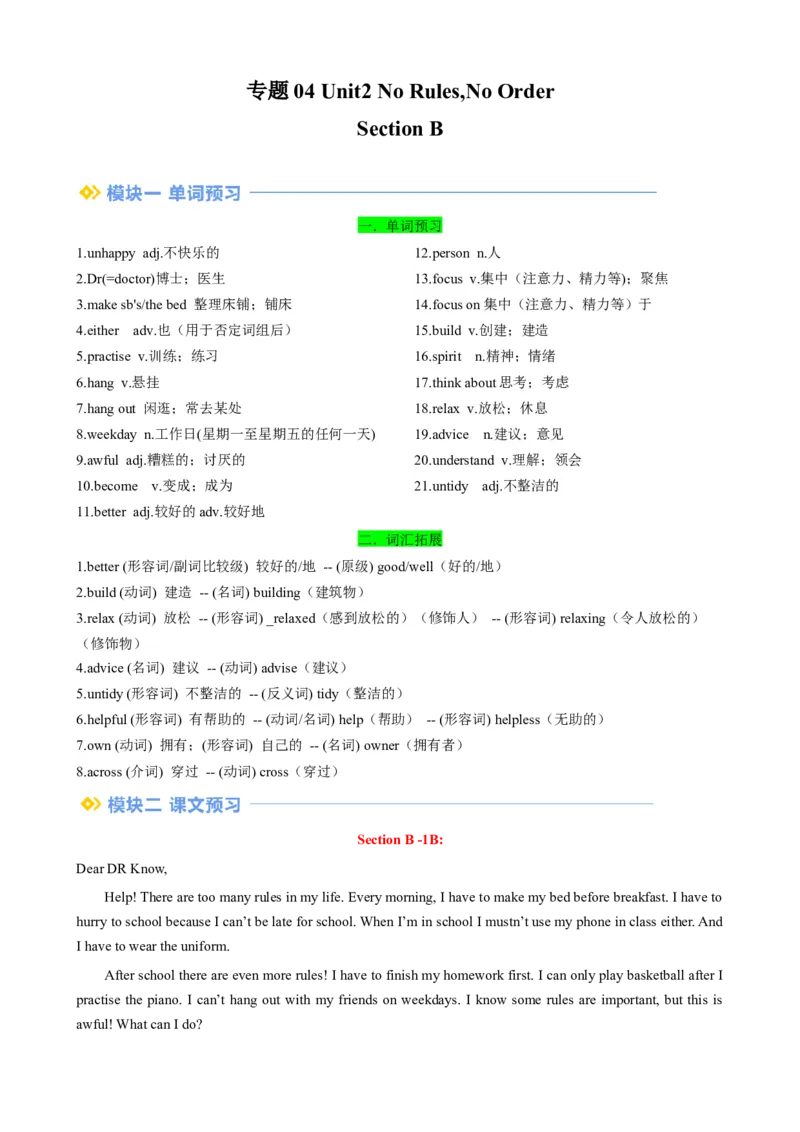
一.单词预习
1.unhappy adj.不快乐的 12.person n.人
2.Dr(=doctor)博士;医生 13.focus v.集中(注意力、精力等);聚焦
3.make sb's/the bed 整理床铺;铺床 14.focus on集中(注意力、精力等)于
4.either adv.也(用于否定词组后) 15.build v.创建;建造
5.practise v.训练;练习 16.spirit n.精神;情绪
6.hang v.悬挂 17.think about思考;考虑
7.hang out 闲逛;常去某处 18.relax v.放松;休息
8.weekday n.工作日(星期一至星期五的任何一天) 19.advice n.建议;意见
9.awful adj.糟糕的;讨厌的 20.understand v.理解;领会
10.become v.变成;成为 21.untidy adj.不整洁的
11.better adj.较好的adv.较好地
二.词汇拓展
1.better (形容词/副词比较级) 较好的/地 -- (原级) good/well(好的/地)
2.build (动词) 建造 -- (名词) building(建筑物)
3.relax (动词) 放松 -- (形容词) _relaxed(感到放松的)(修饰人) -- (形容词) relaxing(令人放松的)
(修饰物)
4.advice (名词) 建议 -- (动词) advise(建议)
5.untidy (形容词) 不整洁的 -- (反义词) tidy(整洁的)
6.helpful (形容词) 有帮助的 -- (动词/名词) help(帮助) -- (形容词) helpless(无助的)
7.own (动词) 拥有;(形容词) 自己的 -- (名词) owner(拥有者)
8.across (介词) 穿过 -- (动词) cross(穿过)
Section B -1B:
Dear DR Know,
Help! There are too many rules in my life. Every morning, I have to make my bed before breakfast. I have to
hurry to school because I can’t be late for school. When I’m in school I mustn’t use my phone in class either. And
I have to wear the uniform.
After school there are even more rules! I have to finish my homework first. I can only play basketball after I
practise the piano. I can’t hang out with my friends on weekdays. I know some rules are important, but this is
awful! What can I do?Yours,
Alice
Dear Alice,
Yes, there are many rules in life! But they can help you become a better person.
You mustn’t be late for class. That shows your respect for your class and teacher. You can’t use your phone in
class because you need to focus on learning. You have to wear a uniform because it builds school spirit.
You can also think about the things that you can do! You can use your phone at home. You can relax after you
finish your homework. And you can hang out with your friends at weekends!
I know it’s hard, but rules can help to make the world better. Remember: No rules, no order!
Beat,
Dr Know
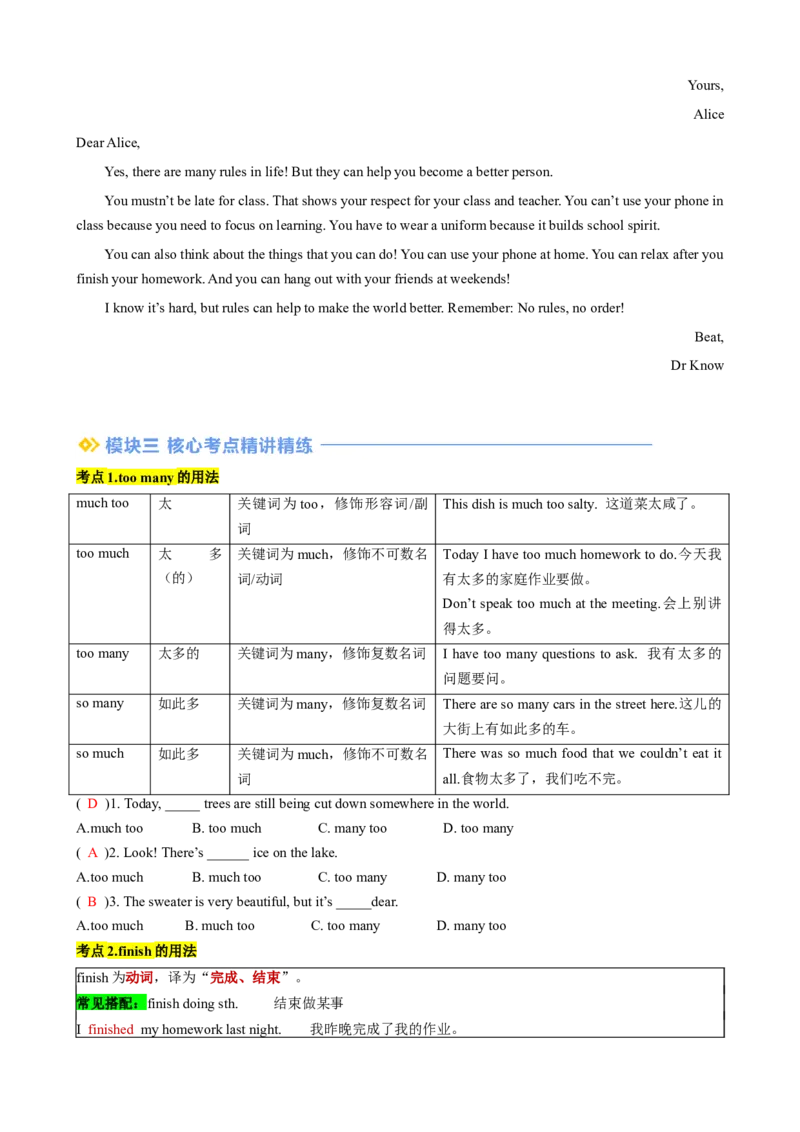
考点1.too many的用法
much too 太 关键词为too,修饰形容词/副 This dish is much too salty. 这道菜太咸了。
词
too much 太 多 关键词为much,修饰不可数名 Today I have too much homework to do.今天我
(的) 词/动词 有太多的家庭作业要做。
Don’t speak too much at the meeting.会上别讲
得太多。
too many 太多的 关键词为many,修饰复数名词 I have too many questions to ask. 我有太多的
问题要问。
so many 如此多 关键词为many,修饰复数名词 There are so many cars in the street here.这儿的
大街上有如此多的车。
so much 如此多 关键词为much,修饰不可数名 There was so much food that we couldn’t eat it
词 all.食物太多了,我们吃不完。
( D )1. Today, _____ trees are still being cut down somewhere in the world.
A.much too B. too much C. many too D. too many
( A )2. Look! There’s ______ ice on the lake.
A.too much B. much too C. too many D. many too
( B )3. The sweater is very beautiful, but it’s _____dear.
A.too much B. much too C. too many D. many too
考点2.finish的用法
finish为动词,译为“完成、结束”。
常见搭配:finish doing sth. 结束做某事
I finished my homework last night. 我昨晚完成了我的作业。I finally finished cleaning the house after five hours of hard work. 最终在五个小时的努力工作后 我打扫完房
间。
( B )1. They finish _______ the report before the deadline.
A.write B. writing C. to write D. to writing
考点3.practise的用法
practise为动词,译为“锻炼、练习”,其名词形式为practice。
常见搭配:practise/ practice doing sth. 练习做某事
Practice makes perfect. 熟能生巧。
He needs to practise playing the guitar every day. 他需要每天练习弹吉他。
( B )1. She must practise ________ English every morning.
A.speak B. speaking C. to speak D. to speaking
考点4.hang out
hang为动词,可译为“悬挂、处于某种状态中、绞刑”;
The flag is hanging in the breeze. 旗帜中悬挂在微风中。
She hung around the office all day. 她整天都在办公室周围转悠。
They hanged the pirate. 他们把海盗吊死了。
常见搭配:hang out with sb. 和某人闲逛
I hung out with my friends last night. 我昨晚和朋友们一起出去玩了。
1.让我们周六去逛一逛吧。
Let's __hang__ __out__ this Saturday.
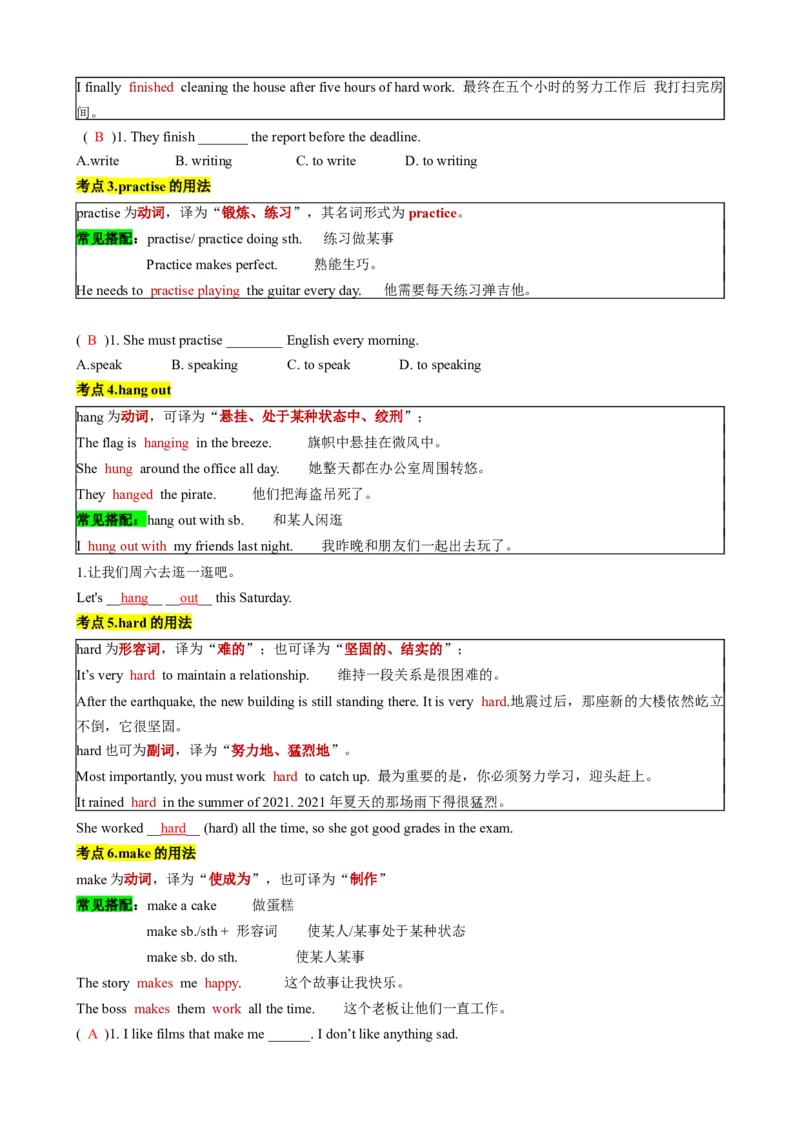
考点5.hard的用法
hard为形容词,译为“难的”;也可译为“坚固的、结实的”;
It’s very hard to maintain a relationship. 维持一段关系是很困难的。
After the earthquake, the new building is still standing there. It is very hard.地震过后,那座新的大楼依然屹立
不倒,它很坚固。
hard也可为副词,译为“努力地、猛烈地”。
Most importantly, you must work hard to catch up. 最为重要的是,你必须努力学习,迎头赶上。
It rained hard in the summer of 2021. 2021年夏天的那场雨下得很猛烈。
She worked __hard__ (hard) all the time, so she got good grades in the exam.
考点6.make的用法
make为动词,译为“使成为”,也可译为“制作”
常见搭配:make a cake 做蛋糕
make sb./sth + 形容词 使某人/某事处于某种状态
make sb. do sth. 使某人某事
The story makes me happy. 这个故事让我快乐。
The boss makes them work all the time. 这个老板让他们一直工作。
( A )1. I like films that make me ______. I don’t like anything sad.A.laugh B. to laugh C. laughing D. to laugh
( D )2. -- What makes him _____?-- His team has won the game.
A.to happy B. to be happy C. being happy D. happy
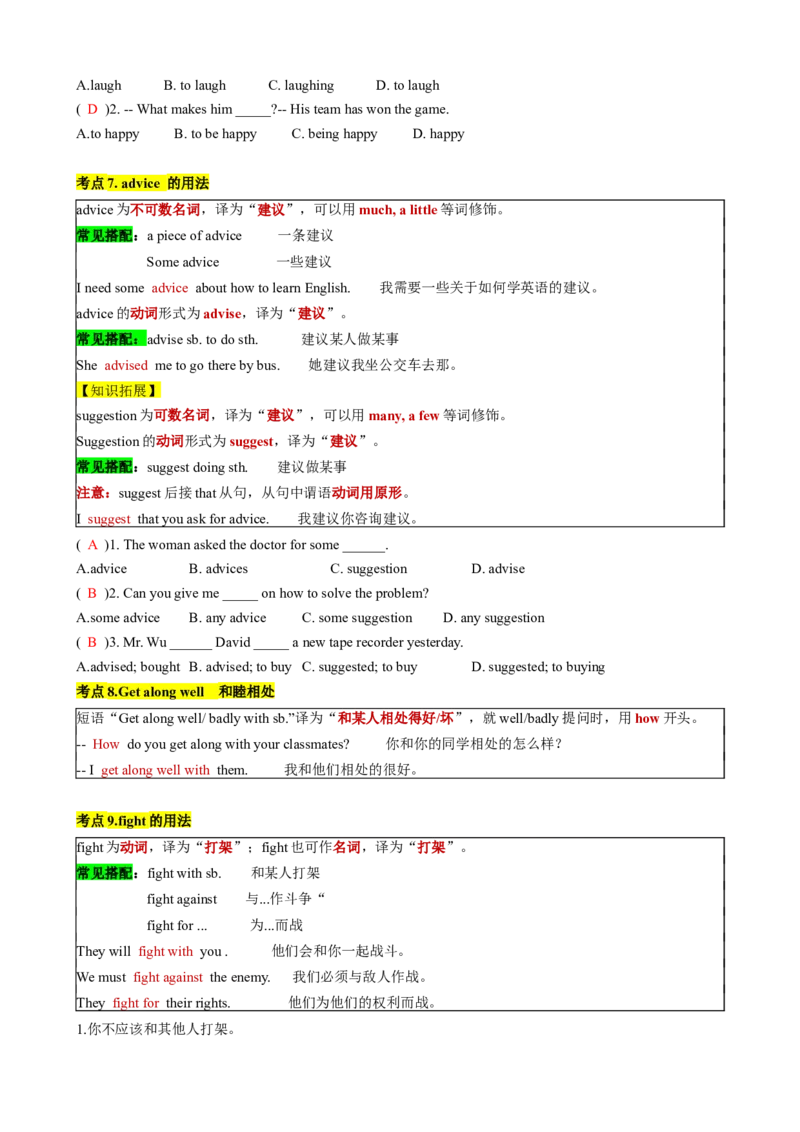
考点7. advice 的用法
advice为不可数名词,译为“建议”,可以用much, a little等词修饰。
常见搭配:a piece of advice 一条建议
Some advice 一些建议
I need some advice about how to learn English. 我需要一些关于如何学英语的建议。
advice的动词形式为advise,译为“建议”。
常见搭配:advise sb. to do sth. 建议某人做某事
She advised me to go there by bus. 她建议我坐公交车去那。
【知识拓展】
suggestion为可数名词,译为“建议”,可以用many, a few等词修饰。
Suggestion的动词形式为suggest,译为“建议”。
常见搭配:suggest doing sth. 建议做某事
注意:suggest后接that从句,从句中谓语动词用原形。
I suggest that you ask for advice. 我建议你咨询建议。
( A )1. The woman asked the doctor for some ______.
A.advice B. advices C. suggestion D. advise
( B )2. Can you give me _____ on how to solve the problem?
A.some advice B. any advice C. some suggestion D. any suggestion
( B )3. Mr. Wu ______ David _____ a new tape recorder yesterday.
A.advised; bought B. advised; to buy C. suggested; to buy D. suggested; to buying
考点8.Get along well 和睦相处
短语“Get along well/ badly with sb.”译为“和某人相处得好/坏”,就well/badly提问时,用how开头。
-- How do you get along with your classmates? 你和你的同学相处的怎么样?
-- I get along well with them. 我和他们相处的很好。
考点9.fight的用法
fight为动词,译为“打架”;fight也可作名词,译为“打架”。
常见搭配:fight with sb. 和某人打架
fight against 与...作斗争“
fight for ... 为...而战
They will fight with you . 他们会和你一起战斗。
We must fight against the enemy. 我们必须与敌人作战。
They fight for their rights. 他们为他们的权利而战。
1.你不应该和其他人打架。You shouldn’t __fight__ __with__ the others.
考点10.weekdays的用法
用法分析weekday 指工作日(from Monday to Friday)。而on/at weekends意为“在周末(Saturday and
Sunday)”,
在春天,我们经常周末放风筝。In spring, we often fly kites on weekends.
注意 在某天或某天某段时间用“on
在上周一早上on the morning of last Monday
在一个寒冷的冬天的早上on a cold winter morning
Most of the villagers took part in the Dragon Boat races ___B___ 9:00 a.m. ______ the morning of June 18.
A. at;in B. at;on C. on;in D. on;on
考点11.raise的用法
用法分析 raise做及物动词,意为“募集;征集”,其过去式和过去分词均为 raised。常用短语:raise
money for…意为“为……筹款”。
They want to raise money for homeless people.他们想为无家可归的人筹钱。
考点拓展 raise的其他含义:
(1)举起;提升。
Raise your hand to get permission to speak.举手争取发言权。
(2)培养;抚养。
The poor parents raised her as an engineer.贫穷的父母把她培养成一位工程师。
—How did your class raise money for the poor old man in hospital?
—We organized a book fair on the playground and sold some books and CDs.(同义替换)
A. collect B. put up C. spend
考点12. in time的用法
用法分析 on time意为“准时;按时”,指正好在规定的时间内。
You must always return your library books on time.你必须总是按时归还从图书馆借的书籍。
The train arrived into the station on time.火车准时进站了。
考点拓展 in time意为“及时”,指按照预定的时间行事,尚有充裕的时间可做些别的事情。
谢谢你及时来这儿帮助我。Thanks for coming here to help me in time.
这个婴儿病得很重。幸好医生及时赶到。他得救了。The baby was badly ill. Luckily the doctor came in time.
He was saved.
When you’re invited to have dinner at home by an American friend, you should be ___A___ or a little later. It’s
different from our Chinese custom.
A. on time B. on business C. on show
考点13.thanks for...的用法
用法分析 thanks for...表示“因……而感谢”,相当于thank you for...for后接名词/代词/动名词形式。
谢谢你的帮助。Thanks for your help.
谢谢你邀请我。Thanks for inviting me.考点拓展 易混短语:thanks to“多亏了……;由于……的帮助”。
Thanks to your help, I finish the work on time.多亏了你的帮助,我才能按时完成工作。
-Thanks for __B___ me a ride to catch the train on time.
-With pleasure.
A. gave B. giving C. to give D. gave
考点14.think about的用法
用法分析think about是固定短语,意为“思考,考虑”,其主要用法如下:
(1)think about后接名词。
我正在考虑这个计划。I'm thinking about the plan.
(2)think about后接代词。
给我五分钟来考虑这件事。Give me five minutes to think about it.
(3)think about后接动词-ing形式。
我正在考虑去野营。I'm thinking about going camping.
考点辨析 think about,think of
think about 意为“考虑”,表示通过思考而得出某种结论,强调过
程。
think of 意为“想起”,强调思考的结果。
我现在无法告诉你。我得考虑一下。I can't tell you now. I'll have to think about it.
我记不起他的名字了。I can't think of his name.
—What's thirty-seven and fifty-nine, Bill?
—Oh,let me___B___ it for a minute. It's ninety-six,right?
A.look at B.think about C.play with D.ask for
规章制度
写作分析
本单元的话题是“规章制度”,与单元话题相关的写作内容常常是“school rules校规”、“family
rules家规”等。在写作时,可以根据学校的规定以及家庭中的规定,根据单元所学语法祈使句,准确表
述一下这些规定,并发表一下自己的看法。
如何写好这类文章,主要需要掌握以下词汇和句型句式:
※常用的词汇
strict严格的,wear穿,follow遵守,fair公平的,outside在……外面, before在……以前,loudly大
声地,fight打架,arrive/be late for迟到,have to必须,get to到达,too many太多的,get up起床,hang
out闲逛,watch TV看电视,come back回来, on weekends在周末,keep quiet保持安静,listen to听,on
time按时
※常用的句型句式
Don't arrive/be late for class.上课不能迟到。
I have to wear...我必须穿……
What do you have to do?你不得不做什么?Before class, we have to...上课前,我们必须……
At school,we have to wear...在学校,我们必须穿……
There are too many...in my home.在我家有太多的……
I have to come back home before 6:00.六点前我必须回到家。
※常用开头结尾句
There are too many rules in my school /home.我的学校/家有太多的规定。
Let me tell you something about some rules of my school.让我告诉你一些关于我学校的一些规定。
My parents want to make rules to help me.我父母想制订规定来帮助我。
Do you have a lot of rules?你有很多规定吗?
We must follow them.我们必须遵守它们。
例题精讲
假如你是 Li Hua,你父母给你制订了很多家规,包括起床时间,上学不能迟到,不能和朋友闲逛,
晚上必须做作业,十点前必须睡觉,周末还需要打扫房间等。你认为这很不公平,但是你还必须遵守。
请根据这些内容,把你家的家规给你的笔友Joe写信讲一下,并谈谈你的感受。
要求:
1.80词左右,可以适当发挥;
2.信的开头和结尾已给出,不计入总词数。
Dear Joe,
How are you now?
Yours,
Li Hua
思路点拨 引出全文 There are too many rules in...
介绍家规 have to get up,can't arrive late ,can't hang out, have to finish
my homework,go to bed,clean my room
我的看法 strict,help me,must follow,fair
范文赏析
Dear Joe,
How are you now?There are too many rules in my home.They aren't fair.I have to get up at five thirty every
morning.I can't arrive late for school.I can't hang out with my friends at school.I have to finish my homework
before nine o'clock.I have to go to bed before ten.I have to clean my room on weekends.These rules are strict,but parents want to make rules to help me.I must follow them. Do you think they are
fair?Please write and tell me.
Yours,
Li Hua
写作训练
假如你是百事通博士,请你针对李平的困惑给他写一封回信,从生活、学习和饮食三个方面对家规
进行合理分析,并给他提一些建议。
要求:1.语言流畅,逻辑通顺,书写工整;
2.90词左右,文章开头和结尾已给出,不计入总词数。
Dear Li Ping,
___________________________________________________________________________________________
___________________________________________________________________________________________
___________________________________________________________________________________________
___________________________________________________________________________________________
___________________________________________________________________________________________
___________________________________________________________________________________________
___________________________________________________________________________________________
___________________________________________________________________________________________
__________________________________________________________________________________________
Best wishes,
Dr Know
【写作提示】
1.主题:家规
2.人称:以第二人称为主
3.时态:一般现在时
4.要点:从生活、学习、饮食三个方面分析家规的合理性,给出建议
5.写作思路:开篇表示理解和安慰,接着从生活、学习、饮食三方面分析家规的合理性,最后总结观点并
给出建议。
【范文赏读】
Dear Li Ping,
There are many rules in our lives. It’s common to have these feelings. But family rules can guide you and
help you grow.
Getting up early to exercise is a great way to start the day and stay fit. After all, early to bed and
early to rise makes a man healthy, wealthy and wise. It is important to finish your homework first. Then
you’ll have more time to relax. Junk food is bad for your health. You’d better not eat it.
Remember:No rules ,no order! Try to have an open conversation with your parents and tell them
how you feel so that they can understand you better.
Best wishes,
Dr Know一.单项选择
1. the room first, and then you can watch TV.
A.Clean B.To clean C.Cleans D.Cleaning
2.—Please your room clean, or your mother will be unhappy.
—Oh, I know. Thank you.
A.want B.learn C.keep D.bring
3.Please listen the teacher carefully (认真地).
A.to B.on C.at
4.Please remember your grandpa and say hello to him.
A.visit B.visiting C.visits D.to visit
5.Our English teacher is very strict us in class, but she is very nice to us after class.
A.with B.to C.at D.for
6.—We will have a football match next week.
—
A.Have a good time. B.You are welcome.
C.Good luck. D.Sorry.
7.You can join the English club to practice English.
A.speak B.to speak C.speaks D.speaking
8.—Jenny, do you know ? —She is from Canada.
A.where is the woman in red from
B.where the woman in red is from
C.what the woman in red likes
1.A 考查祈使句。句意:先打扫房间,然后你就可以看电视了。祈使句以动词原形开头,故选A。
2.C 句意:——请保持你的房间干净,否则你的妈妈会不高兴的。——哦,我知道了。谢谢你。A项“想
要”;B项“学习”;C项“保持”;D项“带来”。由句意可知答案选C。
3.A 句意:请认真听老师讲课。listen to意为“听”,是固定搭配。
4.D 句意:请记得去看望你的爷爷并跟他问好。remember doing sth.意为“记得做过某事”;remember to do
sth.意为“记得去做某事”。故答案选D。
5.A 句意:我们的英语老师在课堂上对我们非常严格,但她课后对我们非常友好。be strict with sb.意为“对
某人要求严格”,故答案选A。
6.C 句意:——下周我们会有一场足球赛。——祝你们好运。在交际场合中,别人要参加测试、比赛,我们
常给予“祝福”,祝对方好运。
7.D 句意:你可以参加英语俱乐部来练习说英语。practice doing sth.意为“练习做某事”,故答案选D。
8.B 考查宾语从句。句意:——珍妮,你知道穿红衣服的妇女来自哪儿吗?——她来自加拿大。根据答语
“她来自加拿大”可知引导词是where,宾语从句用陈述语序。故答案选B。
二.根据汉语意思完成句子,每空一词
9.不要把脏盘子留在厨房。Don't leave the dishes in the .
10.他很忙碌,因为他有太多事情要做。
He is very busy because he has things to do.
11.我妈妈要我先铺床。
My mother asks me to first.
12.每日练习英语很重要。
It's to English every day.
13.我想加入这个俱乐部,并且我会遵守俱乐部的规则。
I want to join the club, and I will of the club.
9.dirty;kitchen 10.too many 11.make my bed 12.important;practice(practise) 13.follow the rules
三.单项选择
14. run in the library.
A.No B.Doesn't C.Not D.Don't
15.—Attention, please! inside because of the heavy rain.
—We will, Mr. Li
A.To stay B.Stay C.Staying
16.— people wear helmets (头盔) when riding electric bicycles?
—Yes. It's a new rule.
A.Can B.Must C.May
17.—Could I the book for two more days?
—Sorry, you can't. You must follow our rules.
A.borrow B.lend C.keep
18.—The food in the restaurant is great, isn't it?
—Yes. But the music here is too .
A.talented B.useful C.noisy D.beautiful
190.—Would you please tell me ?
—By keeping a diary every day.
A.why you want to study English
B.who you often speak English with
C.how you improve your English writing
14.D 此句是个否定祈使句,句首用助动词Don't。故答案选D。
15.B 考查祈使句。句意:——请注意!待在里面,因为下大雨了。——我们会的,李老师。设空处的句子是
祈使句,以动词原形开头。故答案选B。
16.B 考查情态动词的用法。句意:——当人们骑电动自行车的时候必须戴头盔吗?——是的。它是一条新
规定。can意为“可以;会;可能”;must 意为“必须”;may意为“可以;可能”。这里表示“必须”,故用
Must。故选B。
17.C 考查动词辨析。句意:——这本书我可以再借两天吗?——对不起,你不能。你必须遵守我们的规定。
borrow意为“借(入)”;lend意为“借出”;keep意为“保留”。根据“for two more days”可知,此处应使用延
续性动词keep。18.C 句意:——这家餐馆的食物很棒,不是吗?——是的。但这儿的音乐太吵了。talented“有天赋
的”;useful“有用的”;noisy“吵闹的”;beautiful“美丽的”。根据句中的But一词可推知这里说的是餐馆的
缺点,故选C。
19.C 考查宾语从句。由答语“通过每天写日记”及选项可知此处询问提高英语写作水平的方式,故答案
选C。
四.任务型阅读
没有规矩不成方圆。生活中,每个地方都有其特定的规章制度。请你根据五段描述,选出与其所对应的
标牌(有一项多余)。
A B C
D E F
20. You can't touch the exhibits in the museums(博物馆).
21. You can't lean(倚靠) against the door of the subway.
22. You can't speak loudly.You should keep quiet in a reading room.
23. You can't swim in the dangerous rivers or lakes.
24. You can't drive your cars. It's only for bikes.
20—24 FCDAE
五.短文填空
阅读下面短文,根据上下文和所给首字母提示,在空白处填入适当的单词,使短文通顺、完整。每空一
词。
Hi, boys and girls. Welcome to our museum (博物馆). It's f 25 . It doesn't cost you any money (钱).
There are a lot of i 26 things here. You can l 27 a lot and you must have a good time today. But we also
have some r 28 for you. Please remember these rules and f 29 them.
First, don't make the museum d 30 . Don't eat food or have any drinks here, e 31 . Second, you can
take p 32 , but don't touch the things here. Third, keep q 33 in the museum. Don't talk loudly. F 34 ,
don't run in the hall. Fifth, the museum is not open (开放) after five o'clock in the afternoon.
Have a good time here! Thank you!
[语篇解读] 本文主要介绍了参观博物馆要遵守的规章制度。
25.free 句意:这是免费的。根据首字母提示和“It doesn't cost you any money.”可知是免费的。free意为
“免费的”,符合题意。
26.interesting 句意:这里有许多有趣的东西。空格处修饰名词things应用形容词,结合首字母提示和“you
must have a good time today”可知,interesting符合题意。
27.learn 由语境可知,你们可以学到很多东西。情态动词can后跟动词原形,learn意为“学到,学会”,符合
题意。
28.rules 由语境可知,我们也为你们制定了一些规则。根据“Please remember these rules”和首字母提示可知,rules符合题意。
29.follow 句意:请记住这些规则并遵守它们。此句是祈使句,and是并列连词,连接两个祈使句,设空处应用
原形。根据“Please remember these rules”和首字母提示可知,此处指遵守规则,follow意为“遵守”,符合题
意。
30.dirty 由语境可知,不要弄脏博物馆。空格处用形容词作宾语补足语,dirty意为“脏的”,符合题意。
31.either 根据“First, don't make the museum...Don't eat food or have any drinks here”和首字母提示可知,不
要弄脏博物馆,也不要在这里吃东西或喝饮料。此处表示“也”,用于否定句句尾,either符合题意。
32.photos 句意:第二,你可以拍照,但不要触摸这里的东西。take photos意为“拍照”,符合题意。
33.quiet 根据“Don't talk loudly.”可知,在博物馆里要保持安静。keep quiet意为“保持安静”。故填
quiet。
34.Fourth 根据前面的third和后面的Fifth可知,此处叙述的是第四条规则。fourth意为“第四”。故填
Fourth。
能力提升
一
history tree because danger look at about visit high important they
Sequoia National Park(红杉国家公园) is an old park in California, the USA.
It has a 1 of over 130 years. The park is home to some of the world's
GENE RAL SHUE RUAN tallest and oldest trees—sequoias. Every year, quite a
lot of people go to the park to 2 them.
Now, the number of sequoias in the park is around 2,400. Of all the 3
,General Sherman is the tallest. It is over 83.8 meters 4 .And it is between 2.300 and 2,700 years old
now. When you 5 it, you will feel how short you are.
These giant trees are in 6 of being burnt(烧毁)from time to time. A fire killed 7,500 to 10.600
sequoias in 2020. And in September,2021, two large fires—the Paradise Fire and the Colony Fire—were getting
near the park. To save these 7 trees from the large fires, firemen put aluminum(铝材) around them. It
could keep 8 safe(安全的).
But there is something interesting 9 sequoias—they need fire to help them grow. That's 10
fire can help sequoias make more seeds(种子).
长难句分析
原句:(第三段第四句)To save these important trees from the large fires, firemen put aluminum around them.
译文:为了使这些重要的树免遭大火,消防员在它们周围包裹了铝材。
分析:本句是一个简单句。To save these important trees from the large fires 是动词不定式短语作状语,表
示目的。
答案详析
1. history 根据上一句中的“Sequoia National Park is an old park"及空后的of over 130 years 可知.此处指红
杉国家公园有130多年的历史。
2.visit根据语境可知,每年都有很多人来公园参观红杉。
3.trees上一句提到公园里有大约2400棵红杉.故此处指在所有树中,General Sherman是最高的。
4.high根据上一句可知,在所有树中,General Sherman是最高的,故此处指它的高度超过83.8米。5. look at 根据空后的“you will feel how short you are”可知,此处指当你看它的时候,你会感觉到自己有
多么矮小。look at“看”,符合语境。
6.danger 根据下一句中的“A fire killed 7,500 to 10,600 sequoias”可知,大火会烧毁红杉,故此处指这些大
树有被火烧毁的危险。
7.important 根据第一段中的“the world's tallest and oldest trees—sequoias”可知,红杉是世界上最高大且最
古老的树木;再结合空后的“firemen put aluminum around them”可知.消防员在红杉周围包裹了铝材。由此
推测,红杉很重要。
8.them 根据上一句中的“firemen out aluminum around them”可知,此处指铝材可以保护红杉的安全。
9.about 此处指有一件和红杉有关的趣事。
10. because空后的“火可以帮助红杉产生更多的种子”解释了上一句中的“它们需要火帮助它们生长”的
原因,故填because。
二
Harvey Sutton comes from America. 1 The five-year- old boy had a
lot to tell his teachers and classmates. That was because he had just
finished hiking(去……徒步旅行) the Appalachian Trail (the AT)
with his parents.
Hiking the AT is difficult. 2 It runs through(穿过)the forests of
the Appalachian Mountains and through 14 states of the United
States. Second, hikers must carry(携带)everything they need like tents, sleeping bags, food and water.
Only one in four hikers can stand the difficult trip. 3
Harvey was just four when he started, and he had his fifth birthday along the way. Every day, the
family woke up around 5:30 am and hiked about 16 kilometers. During his days on the AT, Harvey liked
to use his imagination(想象力).This helped him walk more quickly and have fun. 4 They all liked
Harvey and called him“Little Man”.
It took Harvey and his family 209 days—about seven months—to finish the hike. 5 He Said," I
want to hike the AT again in the future!”
A. He felt very tired.
B. He really enjoyed the hike.
C. Many hikers once finished the hike.
D. In the beginning, the AT is a hiking trail of about 3,500 km.
E. But that didn't stop Harvey Sutton and his family.
F. he went to climb in his spare time
G. He made friends with other hikers on the trail.
长难句分析
原句:(第一段最后一句)That was because he had just finished hiking the Appalachian Trail (the AT) with his
parents.
译文:那是因为他刚和父母徒步走完阿巴拉契亚步道。
分析:这是一个复合句。Because he had just finished hiking the Appalachian Trail (the AT)with his parents是because引导的表语从句。
答案详析
1.F 根据下一句“The five-year-old boy had a lot to tell his teachers and classmates.”可知,这个五岁的男孩有
很多事情要告诉他的老师和同学们。故推测空处与学校有关,F项“2021年9月他第一天上学”可引出下
文,符合语境。
2.D 根据下一句“It runs through the forests of the Appalachian Mountains and through 14 states of the United
States.”可知.它穿过阿巴拉契亚山脉的森林和美国14个州,故推测阿巴拉契亚步道是非常长的;再结合下
文中的Second可知,D项“首先,阿巴拉契亚步道是一条约3500千米长的远足小径”可引出下文,符合
语境。
3.E通读第二段可知,徒步走完阿巴拉契亚步道是非常困难的;再结合第三段可知.Harvey和家人并没有
因为困难而放弃,故E项“但是那并没有阻止Harvey和他的家人”可承上启下,符合语境。
4.G根据下一句“They all liked Harvey and called him‘ Little Man’.”可知,他们都喜Harvey,并称他为“小
男子汉”;根据语境推测They指其他徒步旅行者们,故G项“他和步道上的其他徒步旅行者交朋友”可
引出下文,符合语境。
5.B 根据下一句中的“I want to hike the AT again in the future!”可知,Harvey将来想再去阿巴拉契亚步道徒
步旅行。由此推测他是因为喜欢这次徒步旅行才会有此感慨,故 B项“Harvey真的很喜欢这次徒步旅
行”可引出下文,符合语境。
三
September 23rd,2021was the fourth Chinese Farmers' Harvest Festival(中国农民
丰收节).The day before the festival,91-year-old Wu Mingzhu gave her best wishes
to all farmers of China.
Many people remember the famous scientist Yuan Longping, but few know another
scientist Wu Mingzhu. She is a melon expert(专家).She worked in the melon field
for more than 60 years, and she has cultivated(培育) more than 30 kinds of melons in China.
Born in Wuhan in 1930, Wu finished university in 1953. In 1955, she volunteered to study melon in
Xinjiang. She and her team spent three years visiting many places there, collecting over 100 pieces of information
about melon. In1984, they cultivated“8424",a high-quality(高品质的)watermelon in China. Thanks to her great
work, the cultivation of melon in China has greatly changed.
At the age of 81, she got ill. But even when she was ill. she would care about the study of melon. For her,
the best thing in life is to bring the sweetness of melon to the people.
1.When did Wu Mingzhu give her best wishes to all farmers of China?
2. Where did Wu volunteer to work after she finished university?
3. How long did it take Wu and her team from collecting information to cultivating“8424”?
4.What do you think of Wu Mingzhu?
5.What is the main purpose of the passage?长难句分析
原句:(第三段第三句)She and her team spent three years visiting many places there, collecting over 100
pieces of information about melon.
译文:她和她的团队花了三年的时间走访了那里的许多地方,收集了100多条有关甜瓜的信息。
分析:这是一个简单句。collecting over 100 pieces of information about melon 为现在分词短语作状语。
答案详析
1. On September 22nd,2021.。根据第一段“September 23rd,2021...The day before the festival.91-year-old Wu
Mingzhu gave her best wishes to all farmers of China.”可知,在2021年9月23日的前一天,即2021年9月
22日,91岁的吴明珠向全国农民送上了祝福。
2. In Xinjiang。根据第三段中的“...Wu finished university in 1953. In 1955, she volunteered to study melon in
Xinjiang.”可知,大学毕业后,吴明珠自愿去新疆研究瓜。
3. It took 29 years。根据第三段中的“In 1955,she volunteered to study melon in Xinjiang. She and her
team...collecting over 100 pieces10of information about melon. In 1984, they cultivated‘8424’...”可知,从1955
年收集信息到1984年“8424”培育成功,吴明珠和她的团队花了大约29年的时间。
4 .hard-working/admirable/devoted。根据最后一段At the age of 81, she got ill. But even when she was ill. she
would care about the study of melon. For her, the best thing in life is to bring the sweetness of melon to the
people.(81岁时,她病倒了。但即使她生病了。她会关心甜瓜的研究。对她来说,人生最美好的事情,
就是把瓜的甜味带给老百姓。)可知他是努力且值得敬佩的/具有奉献精神。
5. To tell us something about Wu Mingzhu and her work.通读全文可知,本文主要介绍了甜瓜专家吴明珠以
及她为甜瓜培育做出的努力。故推知,本文的主要目的是告诉我们一些关于吴明珠和她的工作的事情。