专题 05 句子种类
内容早知道
☛第一层 巩固提升练(4大考点)
考点一 肯定句 考点二 否定句 考点三 一般疑问句 考点四 特殊疑问句
☛第二层 能力培优练
☛第三层 拓展突破练
肯定句
【知识积累·练前热身】
肯定句是表达肯定意义的句子,在英语中,肯定句的基本结构通常包括主语(Subject)、谓语
(Predicate)、宾语(Object)等成分。以下是肯定句的一些常见构成方式:
一、简单结构
主 + 谓:这种结构中的谓语动词为不及物动词,不需要接宾语就能表达完整的意思。例如:
He runs.(他跑步)。在这个句子中,“He”是主语,表示动作的执行者;“runs”是谓语动词,表示主
语的动作。
主 + 谓 + 宾:当谓语动词为及物动词时,需要有宾语来接受动作。例如:
She reads a book.(她读一本书)。其中“She”是主语,“reads”是谓语动词,“a book”是宾语。
二、含有系动词的结构
主 + 系动词(be) + 表语:系动词be包括am、is、are(不同的人称和数使用不同形式),表语可以是
名词、形容词、代词、介词短语等,用来描述主语的特征、状态等。例如:
I am a student.(我是一名学生),“I”是主语,“am”是系动词,“a student”是表语;
He is happy.(他很开心),“happy”作为形容词作表语描述主语“He”的状态。
【巩固练习】
1.love, very, I, much, sports (. )
.
【答案】I love sports very much
【详解】根据所给标点可知应用陈述句的形式,分析所给单词,I作主语;love是动词,作谓语;sports作
宾语;very much是副词短语,主要用来修饰动词,表示动作的程度,放在句末。故填I love sports very
学学学科科科网网网(((北北北京京京)))股股股份份份有有有限限限公公公司司司much“我非常喜欢运动”。
2.this, hall, is, our, dining(. )
【答案】This is our dining hall.
【详解】根据所给标点符号可知,句子为陈述句。this“这个”是句子的主语,is句子的系动词,our dining
hall“我们的餐厅”作表语。故填This is our dining hall“这是我们的餐厅”。
3.are, sheep, on, farm, the, some (连词成句)
.
【答案】Some sheep are on the farm
【详解】根据所给词及标点可知,此句为陈述句。some sheep“一些绵羊”,作主语;are为系动词;on the
farm“在农场里”。故填Some sheep are on the farm“一些绵羊在农场里”。
4.see can you kinds of many animals (.)
.
【答案】You can see many kinds of animals
【详解】根据所给标点可知本句是陈述句,结合所给词汇,you作主语,can see作谓语,many kinds of
animals作宾语。故填You can see many kinds of animals“你可以看到很多种动物”。
5.the US Mr Smith from is (.)
.
【答案】Mr Smith is from the US
【详解】根据所给单词及标点可知,本句为陈述句,时态为一般现在时,Mr Smith作主语;is from“来自”
作谓语;the US“美国”作宾语。故填Mr Smith is from the US“史密斯先生来自美国”。
否定句
【知识积累·练前热身】
1、当句子中含有be动词时,如am, is, are, was, were,在be动词后加not。如:
He is sleeping. → He is not sleeping. ( is not = isn’t )
2、当句子中含有can, will, must时,直接在can, will, must后加not。如:
He can speak Chinese. → He can not speak Chinese. ( can not = can’t )
3、当句子中不含有以上词汇时,则根据主语、时态在主语后面加don’t , doesn’t, didn’t,句子后面的动词要
改为原形。如:
They go to school by bike. → They don’t go to school by bike.
She goes to school by bike. → She doesn’t go to school by bike.
【巩固练习】
1.I have a soccer ball. (改为否定句)
I a soccer ball.
【答案】don’t have
【详解】句意:我有一个足球。此句为一般现在时,主语为“I”,变否定句需加助动词“do”,后面加
学学学科科科网网网(((北北北京京京)))股股股份份份有有有限限限公公公司司司“not”,缩写为“don’t”,填入第一空;第二空应用动词原形“have”。故填don’t;have。
2.Three dogs are on the farm.(改为否定句)
Three dogs on the farm.
【答案】are not
【详解】句意:三只狗在农场。原句是含有be动词的句子,变否定句在be动词后直接加not,故在are的
后面加not。故填are;not。
3.Daniel has six lessons today.(改为否定句)
Daniel six lessons today.
【答案】doesn’t have
【详解】句意:丹尼尔今天有六节课。原句是一般现在时,主语是第三人称单数,否定助动词用doesn’t,
后跟动词原形have。故填doesn’t;have。
4.Millie does well in Biology this term. (改为否定句)
Millie well in Biology this term.
【答案】doesn’t do
【详解】句意:米莉这学期生物学得很好。根据分析句子“Millie does well in Biology this term.”可知,时
态为一般现在时,该句主语是Millie,does well in,动词短语,意为“在……中做得好”,所以该句变为
否定句,要借助助动词doesn’t,后跟动词原形,does的原形是do。故填doesn’t;do。
5.Mary plays tennis after school. (改为否定句)
Mary tennis after school.
【答案】doesn’t play
【详解】句意:玛丽放学后打网球。原句属于一般现在时,主语是“Mary”,在变否定句时,要加助动词
doesn’t,后接动词原形,故填doesn’t;play。
一般疑问句
【知识积累·练前热身】
1. 定义:用yes或no来回答的疑问句叫一般疑问句。
2.一般疑问句通常都是
1)以be (am,is,are,)开头
2)以Do,Does,Did 开头或以Can开头
回答方法:前面用什么提问的就用什么答。
只有两种回答方式:
1) 肯定的, Yes,主语 + 提问词.
2) 否定的, No,主语+提问词+not.
3.主语是名字时的答语 :看性别,男的用he ,女的用she ,其他的用it 复数就用they。
【巩固练习】
1.They are his potato plants.(改为一般疑问句)
his potato plants?
【答案】Are they
学学学科科科网网网(((北北北京京京)))股股股份份份有有有限限限公公公司司司【详解】句意:这些是他种的马铃薯。改为一般疑问句将are放在句首,第二空填主语they,故填Are;
they。
2.My father has ten books. (改为一般疑问句)
your father ten books?
【答案】Does have
【详解】句意:我爸爸有十本书。根据“My father has ten books.”可知,把含有实义动词的陈述句改为一般
疑问句时,如果句子的时态是一般现在时,主语father是第三人称单数,需要借助助动词Does放在句首,
原来的动词has要变回原形have。故填Does;have。
3.I can sing and dance. (改为一般疑问句)
you sing dance?
【答案】Can or/and
【详解】句意:我会唱歌和跳舞。句中含有情态动词can,在变为一般疑问句时直接将can提到主语前面,
sing与dance之间为并列关系,在变为一般疑问句的时候可以改为or,因此填or或者and。故填Can;or/
and。
4.Can he tell stories in English? (做否定回答)
No, .
【答案】he can’t
【详解】句意:他会用英语讲故事吗?不,他不会。含有情态动词can的一般疑问句肯定回答为:Yes, sb.
can;否定回答为:No, sb. can’t。故填he;can’t。
5.Does Lily like reading? (作肯定回答)
Yes, .
【答案】she does
【详解】句意:Lily喜欢阅读吗?一般疑问句的肯定回答句型为“Yes, 主语+助动词 (do/does)”,由于
“Lily”是主语,回答时,用人称代词“she”代替人名,“Does”提问,“does”回答。故填she;does。
特殊疑问句
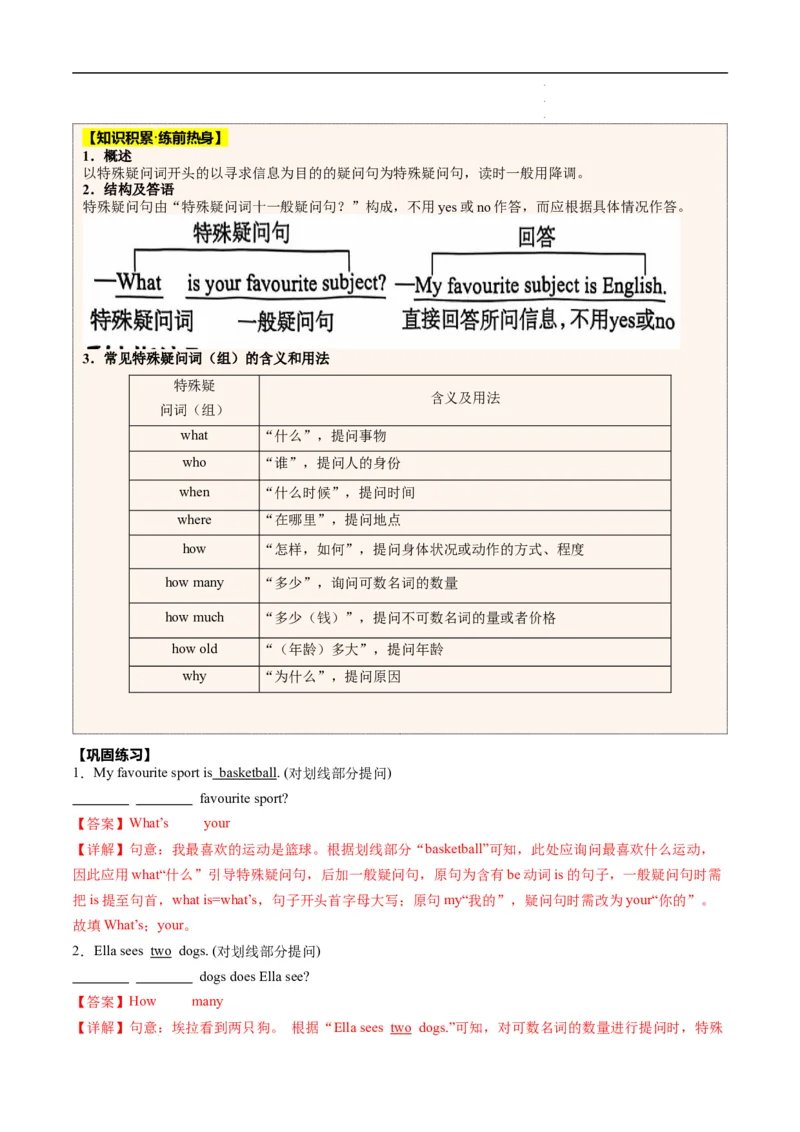
学学学科科科网网网(((北北北京京京)))股股股份份份有有有限限限公公公司司司【知识积累·练前热身】
1.概述
以特殊疑问词开头的以寻求信息为目的的疑问句为特殊疑问句,读时一般用降调。
2.结构及答语
特殊疑问句由“特殊疑问词十一般疑问句?”构成,不用yes或no作答,而应根据具体情况作答。
3.常见特殊疑问词(组)的含义和用法
特殊疑
含义及用法
问词(组)
what “什么”,提问事物
who “谁”,提问人的身份
when “什么时候”,提问时间
where “在哪里”,提问地点
how “怎样,如何”,提问身体状况或动作的方式、程度
how many “多少”,询问可数名词的数量
how much “多少(钱)”,提问不可数名词的量或者价格
how old “(年龄)多大”,提问年龄
why “为什么”,提问原因
【巩固练习】
1.My favourite sport is basketball. (对划线部分提问)
favourite sport?
【答案】What’s your
【详解】句意:我最喜欢的运动是篮球。根据划线部分“basketball”可知,此处应询问最喜欢什么运动,
因此应用what“什么”引导特殊疑问句,后加一般疑问句,原句为含有be动词is的句子,一般疑问句时需
把is提至句首,what is=what’s,句子开头首字母大写;原句my“我的”,疑问句时需改为your“你的”。
故填What’s;your。
2.Ella sees two dogs. (对划线部分提问)
dogs does Ella see?
【答案】How many
【详解】句意:埃拉看到两只狗。 根据“Ella sees two dogs.”可知,对可数名词的数量进行提问时,特殊
学学学科科科网网网(((北北北京京京)))股股股份份份有有有限限限公公公司司司疑问词How many,后接可数名词复数形式。故填How;many。
3.Her class teacher is Ms. Lee. (对划线部分提问)
her class teacher
【答案】Who is
【详解】句意:李老师是她班老师。划线部分是人,对人提问用who,位于句首,首字母大写。特殊疑问
词后接一般疑问句,原句有is,将is提到主语her class teacher前。故填Who;is。
4.Gina is from the UK. (对划线部分提问)
Gina from?
【答案】Where is
【详解】句意:Gina来自英国。根据划线部分“the UK”可知,此处是对地点提问,用疑问词where;特殊
疑问句结构是“疑问词+ be动词/助动词+主语+其他”,题干中有be动词is直接放到疑问词后面。故填
Where;is。
5.Two boys are under the tree.(对划线部分提问)
the two boys?
【答案】Where are
【详解】句意:两个男孩在树下。划线部分为地点,用where提问,主语是复数,be动词用are。故填
Where;are。
6.My ruler is yellow. (对划线部分提问)
is your ruler?
【答案】What color/colour
【详解】句意:我的尺子是黄色的。划线部分指颜色,应用what color/colour“什么颜色”来提问。故填
What;color/colour。
7.Alice is 12 years old. (对划线部分提问)
is Alice?
【答案】How old
【详解】句意:Alice十二岁了。划线部分为年龄,用how old提问。句首单词首字母大写。故填How;
old。
一、完形填空
What animals do you like? Are there any 1 in your city? There is a zoo in our city. My mother
works there. She goes to 2 in the afternoon every day. She usually 3 the bus there. It takes her
20 minutes. After she 4 the zoo, she cleans the animals’ houses.
There are many kinds of 5 animals in the zoo. 6 people go to the zoo to see them every
day. My mother tells them what to do and what not to do. She 7 her work and animals.
学学学科科科网网网(((北北北京京京)))股股股份份份有有有限限限公公公司司司But she doesn’t think it’s 8 for animals to live in small places. Animals are our 9 and
they usually bring us a lot of fun. They are from nature. And nature is their 10 home. She also finds some
animals are in great danger and we must protect them.
1.A.libraries B.zoos C.stores D.parks
2.A.station B.school C.house D.work
3.A.sells B.helps C.takes D.brings
4.A.plays with B.listens to C.looks at D.gets to
5.A.mad B.boring C.interesting D.lonely
6.A.Plenty of B.A little C.A few D.A lot
7.A.writes B.loves C.helps D.shows
8.A.difficult B.bad C.good D.boring
9.A.food B.meat C.family D.friends
10.A.salty B.small C.real D.alive
【答案】
1.B 2.D 3.C 4.D 5.C 6.A 7.B 8.C 9.D 10.C
【导语】本文主要介绍了作者的妈妈在动物园的工作情况。
1.句意:你们城市有动物园吗?
libraries图书馆;zoos动物园;stores商店;parks公园。根据“There is a zoo in our city.”可知,此处是指动
物园。故选B。
2.句意:她每天下午去上班。
station车站;school学校;house房子;work工作。根据“My mother works there.”可知,是指去工作。故
选D。
3.句意:她通常乘公共汽车去那里。
sells卖;helps帮助;takes乘坐;brings带来。根据“the bus”可知,考查短语take the bus“乘公共汽车”。
故选C。
4.句意:她到达动物园后,她打扫动物的房子。
plays with和……一起玩;listens to听;looks at看;gets to到达。根据“the zoo, she cleans the animals’
houses.”可知,是指到了动物园后打扫房子。故选D。
5.句意:动物园里有各种各样的有趣的动物。
mad发疯的;boring无聊的;interesting有趣的;lonely孤独的。根据“people go to the zoo to see them every
day.”可知,应是指有趣的动物,所以人们才去看它们。故选C。
6.句意:每天都有很多人去动物园看它们。
Plenty of很多;A little一点;A few一些;A lot很多,后跟名词需加of。根据“people go to the zoo to see
them every day”可知,是指有很多人去动物园看动物,用plenty of。故选A。
7.句意:她热爱她的工作和动物。
writes写;loves热爱;helps帮助;shows展示。根据“her work”可知,是指妈妈热爱自己的工作。故选
学学学科科科网网网(((北北北京京京)))股股股份份份有有有限限限公公公司司司B。
8.句意:但她认为动物住在小地方不好。
difficult困难的;bad糟糕的;good好的;boring无聊的。根据“for animals to live in a small places.”可知,
应是认为动物住在小地方不好。故选C。
9.句意:动物是我们的朋友,它们通常给我们带来很多乐趣。
food食物;meat肉;families家庭;friends朋友。根据“and they usually bring us a lot of fun.”可知,是指动
物是我们的朋友。故选D。
10.句意:大自然是它们真正的家园。
salty咸的;small小的;real真正的;alive活着的。根据“They are from nature.”可知,大自然是动物们真
正的家园。故选C。
二、阅读理解
People around the world celebrate New Year’s Eve in different ways. Let’s have a look.
Sydney, Australia
The city is famous for its fireworks. The fireworks are bright and beautiful, and they make the dark sky very
bright.
Paris, France
Lots of people get together around the Eiffel Tower. People can see fireworks over there.
Madrid, Spain
Spanish people eat 12 grapes on New Year’s Eve. Every grape stands for one month of the year. They think
this will bring them good luck in the coming year.
Beijing, China
People usually spend New Year’s Eve with their family members. They will have a meal and give their best
wishes to each other.
根据语篇内容,选择最佳选项。
11.What’s Sydney famous for?
A.Sea. B.Fireworks. C.Food. D.Milk.
12.Why do French people stand on the Eiffel Tower on New Year’s Eve?
A.To see the fireworks. B.To watch the sky. C.To watch the whole city. D.To
make a paper boat.
13.How many grapes do Spanish people eat on New Year’s Eve?
A.11. B.12. C.13. D.14
14.Which of the following is NOT true according to the passage?
A.In Spain, people eat grapes on New Year’s Eve.
B.In France, people get together around the Eiffel Tower.
学学学科科科网网网(((北北北京京京)))股股股份份份有有有限限限公公公司司司C.Chinese people usually spend New Year’s Eve with their friends.
D.Spanish people think eating grapes can bring them good luck.
15.What’s the best title for the text?
A.Different ways to celebrate New Year’s Eve B.Different foods on New Year’s Eve
C.Different countries and their festivals D.Different countries and their capitals
【答案】11.B 12.A 13.B 14.C 15.A
【导语】本文介绍了几个城市的人们以不同方式庆祝新年前夜的情况。
11.细节理解题。根据“Sydney, Australia The city is famous for its fireworks.”可知,悉尼闻名的是烟花。故
选B。
12.细节理解题。根据“Paris, France Lots of people get together around the Eiffel Tower. People can see
fireworks over there.”可知,人们聚在埃菲尔铁塔周围的目的是看烟花。故选A。
13.细节理解题。根据“Madrid, Spain Spanish people eat 12 grapes on New Year’s Eve.”可知葡萄的数量为
12 颗。故选B。
14.推理判断题。根据“Beijing, China People usually spend New Year’s Eve with their family members.” 可知,
中国人们通常和家人一起度过新年前夜,而不是和朋友。故选C。
15.最佳标题题。 根据整个文章围绕着不同的庆祝新年前夜的方式展开叙述,可知最佳标题是选项A“庆
祝新年前夜的不同方式”。故选A。
三、短文填空
阅读下面短文,在空白处填入一个适当的词,或填入括号中所给单词的正确形式。
Hi friends,
Do you want 16 (join) a club? It’s a fun way to find a new 17 (hobby). You can try
many activities and meet new friends. There are lots of clubs to choose from. Each club has 18 event that
might interest you.
At first, it might be a bit difficult, 19 don’t worry (担心). 20 fact, you might find that
you enjoy 21 (learn) new things. For example, I joined a drawing club for the 22 (one) time. I
wasn’t good at drawing, but I 23 (really) liked it.
You don’t have to be good at something to enjoy 24 (you). Just give it a try. You might be
surprised at how much 25 (fun) you can have.
【答案】
16.to join 17.hobby 18.an 19.but 20.In 21.learning 22.first 23.really
24.yourself 25.fun
【导语】本文主要讲述了加入俱乐部可以尝试新活动,结交新朋友,享受其中的乐趣。
16.句意:你想参加俱乐部吗?根据“want”可知,want to do sth.“想要做某事”,join“加入”,动词,此
处应用不定式作宾语。故填to join。
17.句意:这是一种寻找新爱好的有趣方式。根据“a new”结合提示词可知,hobby“爱好”,可数名词,
此处应用名词单数形式。故填hobby。
学学学科科科网网网(((北北北京京京)))股股股份份份有有有限限限公公公司司司18.句意:每个俱乐部都有你可能感兴趣的活动。根据“event”可知,event“事件,活动”,可数名词,为
元音音素开头的单词,因此其前应用不定冠词an。故填an。
19.句意:刚开始,可能有点难,但别担心。根据“it might be a bit difficult”与“don’t worry (担心)”可知,
前后表示转折关系,因此应用but“但是”。故填but。
20.句意:事实上,你可能会发现你喜欢学习新事物。in fact“事实上”,固定搭配,句子开头首字母大写。
故填In。
21.句意:事实上,你可能会发现你喜欢学习新事物。根据“enjoy”结合提示词可知,enjoy doing sth.“喜
欢做某事”,learn“学习”,动词,此处应用动名词形式learning作宾语。故填learning。
22.句意:例如,我第一次参加了一个绘画俱乐部。根据“the”结合提示词可知,此处应用序数词形式
first“第一”。故填first。
23.句意:我不擅长画画,但我真的很喜欢。根据“I … liked it”结合提示词可知,此处应用副词really修
饰动词。故填really。
24.句意:你不必擅长某件事来享受自己。enjoy oneself“玩的开心”,主语为you“你”,因此应用
yourself“你自己”。故填yourself。
25.句意:你可能会惊讶于你能有多少乐趣。根据“how much”结合提示词可知,此处应用fun“乐趣”,
不可数名词。故填fun。
一、阅读理解
配对阅读。左栏是五位学生对自己亲人的介绍,右栏是七条人物介绍。请将人物和学生所介绍的亲人进行
匹配。
A.Mr Smith is a farmer. He is very old but he is still
1 My father is a math teacher. He is 42 years very strong.
old. B.Mr Zhang is a middle-aged man. He teaches math in
2 My grandpa is old but he still (仍然) a middle school.
works on the farm every day. C. Kate is a lovely girl. She likes basketball very
3 My sister is very good at basketball. She much. She has many basketballs.
often plays basketball with me. D.Tim is a tall boy. He likes playing basketball. He
4 My mother is a housewife (家庭主妇). plays basketball every week.
She can cook a lot of delicious food. E. Mr Sun is my English teacher. He is very nice and
5 My brother is 16 years old. He is very tall. kind. All my classmates love him.
He can play basketball very well. F. Lily likes sports but she doesn’t play them. She usually
watches basketball games on TV.
G. Mrs Brown doesn’t have a job. She stays at home and
cooks meals for her family.
学学学科科科网网网(((北北北京京京)))股股股份份份有有有限限限公公公司司司【答案】1.B 2.A 3.C 4.G 5.D
【导语】本文是将人物和学生所介绍的亲人进行匹配。
1.根据“My father is a math teacher. He is 42 years old.”可知我的父亲是一名数学老师。他今年42岁。选项
B“张先生是一位中年男子。他在一所中学教数学。”符合,故选B。
2.根据“My grandpa is old but he still (仍然) works on the farm every day.”可知我爷爷年纪大了,但他仍然
每天在农场工作。选项A“史密斯先生是一位农民。他已经很老了,但仍然很强壮。”符合,故选A。
3.根据“My sister is very good at basketball. She often plays basketball with me.”可知我姐姐篮球打得很好。
她经常和我一起打篮球。选项C“凯特是一个可爱的女孩。她非常喜欢篮球。她有很多篮球。”符合,故选
C。
4.根据“My mother is a housewife (家庭主妇). She can cook a lot of delicious food.”可知我的母亲是一名家庭
主妇。她会做很多美味的食物。选项G“布朗夫人没有工作。她待在家里为家人做饭。”符合,故选G。
5.根据“My brother is 16 years old. He is very tall. He can play basketball very well.”可知我哥哥16岁了。他
很高。他篮球打得很好。选项D“蒂姆是一个高个子男孩。他喜欢打篮球。他每周都打篮球。”符合,故选
D。
二、任务型阅读
Good morning! My name is Suzy. Look! This is my room. It isn’t big. There is a bed, a desk and a chair in it.
All my things are in good order (顺序).
My books are on my desk. What’s that on the chair? It’s my bag. The bag is white and red. I like the colours
very much.
What’s the picture on the bag? It’s a picture of a mascot (吉祥物). The mascot is for the Paris 2024
Olympics (奥运会). Its name is Phryge. Can I spell “Phryge”? Yes, P﹣H﹣R﹣Y﹣G﹣E. What colour is the
mascot? It’s red, white and blue. It has big blue eyes. The mascot is cute and I like it very much. Do you like it?
What is in my bag? A ruler is in it. And the ruler is green. It’s my sister Lily’s. She likes green, but I don’t.
Two pencils are in it too. One is red, and the other is blue. A bottle is also in my bag. The bottle is yellow and blue.
It’s my bottle and it’s from my dad.
6.Where is Suzy’s bag? (no more than 5 words)
7.What colour are Phryge’s eyes? (no more than 3 words)
8.Whose green ruler is this? (no more than 4 words)
9.How many kinds of things are there in Suzy’s bag? (no more than 8 words)
10.What do you think of Suzy’s room? (no more than 5 words)
【答案】
学学学科科科网网网(((北北北京京京)))股股股份份份有有有限限限公公公司司司6.On the chair. 7.Blue. 8.It’s Lily’s. 9.Three. 10.Not big but tidy.
【导语】本文作者Suzy主要介绍了自己房间以及书包。
6.根据“What’s that on the chair? It’s my bag.”可知,Suzy的包在椅子上,故填On the chair.
7.根据“It has big blue eyes.”可知眼睛蓝色的,故填Blue.
8.根据“A ruler is in it. And the ruler is green. It’s my sister Lily’s.”可知,这个绿色的尺子是Suzy的姐姐Lily
的,故填It’s Lily’s.
9.根据“A ruler…Two pencils…A bottle”可知,包里有三种东西,故填Three.
10.根据“It isn’t big. There is a bed, a desk and a chair in it. All my things are in good order (顺序).”可知,房间
不大但很整洁,故填Not big but tidy.
三、补全对话
阅读对话,从选项中选择适当的词并用其正确形式填空,使对话通顺、意思完整。每空限填一词,每词限
用一次。
with; have; idea; much; some; for; many; bottle; take; total
Teng Fei: Hi, Peter! It’s Ella and Emma’s birthday soon. How about a surprise party 11 them?
Peter: Good 12 ! Let’s go and buy something for the party.
(At the shop)
Woman: Good morning. Can I help you?
Teng Fei: Yes, please. How 13 is this birthday cake?
Woman: We have a sale today. It’s 85 yuan, and it comes 14 some candles.
Peter: Good, we’ll 15 it. How much are those oranges?
Woman: Six yuan a kilo. How 16 kilos do you want?
Peter: Five kilos, please. Teng Fei, how about 17 yogurt?
Teng Fei: Sure. How much is the yogurt?
Woman: Five yuan a 18 .
Teng Fei: 10 bottles, please. What’s the 19 ?
Woman: 165 yuan.
Teng Fei: Here you are.
Woman: Thank you! 20 a nice day!
Teng Fei & Peter: Thanks. You too.
【答案】
11.for 12.idea 13.much 14.with 15.take 16.many 17.some 18.bottle
19.total 20.Have
【导语】本文主要讲述了Ella和Emma的生日很快到了,Teng Fei和Peter为她们准备生日派对的事情。
11.句意:给她们办个惊喜派对怎么样?根据“How about a surprise party … them?”结合备选词可知,此处
应表示为她们办个惊喜派对怎么样,因此应用for“为,为了”。故填for。
12.句意:好主意!根据“Good … !”可知,此处应对上文的提议表示赞同,因此用good idea“好主意”。
学学学科科科网网网(((北北北京京京)))股股股份份份有有有限限限公公公司司司故填idea。
13.句意:这个生日蛋糕多少钱?根据“It’s 85 yuan”结合备选词可知,此处应询问价格,因此应用how
much“多少钱”。故填much。
14.句意:85元,还附赠蜡烛。根据“it comes … some candles”结合备选词可知,此处应指还带蜡烛,因
此用come with“随同,与……一起供给”。故填with。
15.句意:很好,我们就买它了。根据“Good, we’ll … it.”结合备选词可知,此处应指就要它了,因此用
take。故填take。
16.句意:你们想要多少公斤?根据“kilos”结合备选词可知,此处应问多少公斤,kilos为可数名词复数
形式,因此应用how many“多少”。故填many。
17.句意:腾飞,来点酸奶怎么样?根据“how about … yogurt?”结合备选词可知,此处应表示来点酸奶怎
么样,应用some“一些”,表示委婉的询问。故填some。
18.句意:5元一瓶。根据“Five yuan a … .”与“10 bottles”结合备选词可知,此处应表示5元一瓶,
bottle“瓶”,可数名词,不定冠词a后应用可数名词单数形式。故填bottle。
19.句意:总共多少钱?根据“What’s the … ?”与“165 yuan.”结合备选词可知,此处表示总共多少钱,
the total“总共”。故填total。
20.句意:祝们过得愉快!根据“… a nice day!”结合备选词可知,此处应表示过得愉快,英语表示为have
a nice day,句子开头首字母大写。故填Have。
学学学科科科网网网(((北北北京京京)))股股股份份份有有有限限限公公公司司司