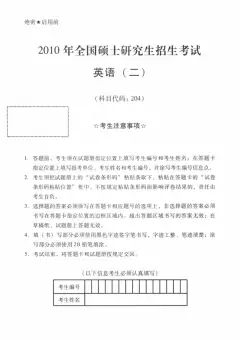
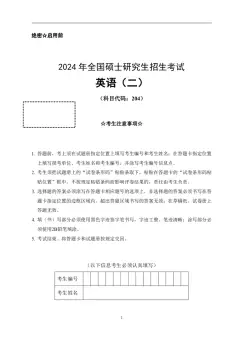
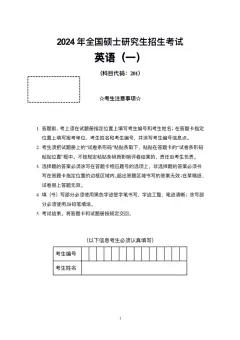
2024 年全国硕士研究生招生考试
英语(一)
(科目代码:201)
☆考生注意事项☆
1. 答题前,考上须在试题册指定位置上填写考生编号和考生姓名;在答题卡指
定位置上填写报考单位、考生姓名和考生编号,并涂写考生编号信息点。
2. 考生须把试题册上的“试卷条形码”粘贴条取下,粘贴在答题卡的“试卷条
形码粘贴位置”框中。不按规定粘贴条码而影响评卷结果的,责任由考生负
责。
3. 选择题的答案必须涂写在答题卡相应题号的选项上,非选择题的答案必须书
写在答题卡指定位置的边框区域内。超出答题区域书写的答案无效;在草稿
纸、试卷册上答题无效。
4. 填(书)写部分必须使用黑色字迹签字笔书写,字迹工整、笔迹清晰;涂写
部分必须使用2B铅笔填涂。
5. 考试结束。将答题卡和试题册按规定交回。
(以下信息考生必须认真填写)
考生编号
考生姓名2024 年全国硕士研究生入学统一考试
考研英语一试题
SectionIUseofEnglish
Directions:
Read the following text. Choose the best word(s) for each numbered blank and
markA. B.Cor DontheANSWER SHEET.(10 points)
There's nothing more welcoming than opening a door for you. 1. the need to
be touched to open or close, automatic doors are essential in 2. disabled access to
buildings and helping provide general 3. to commercial buildings.
Self-sliding doors began to emerge as a commercial product in 1960 after being
invented six years 4. by two Americans Dee Horton and Lew Hewitt. They 5.
as a novelty feature, but as their use has grown. their 6. have extended within our
technologically advanced world. Particularly 7. in busy locations and during times
of emergency, the doors 8. crowd management by reducing the obstacles put in
people's way.
9. making access both in and out buildings easier for people, the difference in
the way many of these doors open helps to reduce the total area 10. by them.
Automatic doors often open to the side, with the panels sliding across one another
Replacing swing doors, these 11. smaller buildings to maximise the usable space
inside without having to 12. the way for a large, sticking-out door. There are many
different types of automatic door, with each 13. specific signals to tell them when
toopen. 14. thesemethods differ,the main 15. remain the same.
Each automatic door system 16. the light, sound weight or movement in their
vicinity as a signal. Sensor-types are chosen to 17. the different environments they
are needed in. 18. a busy road might not 19. a motion-sensored door, as it
would constantly be opening for passers-by. A pressure-sensitive mat would be more
20. tolimit thesurveyed area.
1. [A]Though [B]Despite [C]Besides [D]Without
2. [A]revealing [B]demanding [C]improving [D]tracing
3. [A]experience [B]convenience [C]guidance [D]reference
4. [A]previously [B]temporarily [C]successively [D]eventually5. [A]held on [B]started out [C]settled down [D]went by
6. [A]relations [B]volumes [C]benefits [D]sources
7. [A]useful [B]simple [C]flexible [D]stable
8. [A]call for [B]yield to [C]insiston [D]act as
9. [A]As well as [B] In terms of [C]Thanks to [D]Ratherthan
10. [A]connected [B]shared [C]represented [D]occupied
11. [A]allow [B]expect [C]require [D]direct
12. [A]adopt [B]lead [C]clear [D]change
13. [A]adapting to [B]deriving from [C]relying on [D]pointingat
14. [A]Once [B] Since [C]Unless [D]Although
15. [A]records [B]positions [C]principles [D]resources
16. [A]controls [B] analyses [C]produces [D]mixes
17. [A]decorate [B]compare [C]protect [D]complement
18. [A]In conclusion [B] By contrast [C]For example [D]Above all
19. [A]identify [B]suit [C]secure [D]include
20. [A]appropriate [B]obvious [C]impressive [D]delicate
Section Ⅱ ReadingComprehension
PartA
Directions:
Read the following four texts.Answer the questions below each text by choosing
A.B.C. or D.Mark your answers ontheANSWERSHEET.(40 points)
Text1
Nearly 2000 years ago, as the Romans began to pull out of Scotland, they left
behind a curious treasure:10 tons of nails, nearly a million of the things. The nail
hoard was discovered in 1960 in a four- metre- deep pit covered by two metres of
gravel.
Why had the Romans buried a million nails? The likely explanation is that the
withdrawal was rushed, and they didn't want the local Caledonians getting their hands
on 10 tons of weapons grade iron. The Romans buried the nails so deep that they
would notbe discovered for almosttwo millennia.
Later civilizations would value the skilled blacksmith's labour in a nail even more
than the raw material.As RomaAgrawal explains inher new delightful bookNuts and
Bolts, early 17th-century Virginians would sometimes burn down their homes if theywere planning to relocate. This was an attempt to recover the valuable nails, which
could be reused after sifting the ashes. The idea that one might burn down an entire
house just to reclaim the nails underlines how scarce, costly and valuable the
simple-seeming technology was.
The price of nails fell by 90% between the late 1700s and mid-1900s. as
economist Daniel Sichel points out in a research paper.According to Sichel, although
the falling price of nails was driven partly by cheaper iron and cheaper energy, most
of the credit goes to nail manufacturers who simply found more efficient ways to turn
steel into nails.
Nails themselves have changed over the years. but Sichel studied them because
they haven't clanged much. Roman lamps and Roman chariots are very different from
LED strips and sports cars, but Roman nails are still clearly nails. It would be absurd
to try to track the changing price of sports cars since 1695, but to ask the same
question ofnails makes perfect sense.
I make no apology for being obsessed by a particular feature of everyday objects:
their price. I am an economist, after all. After writing two books about the history of
inventions, one thing I've learnt is that while it is the enchantingly sophisticated
technologies that get all the hype.it's thecheap technologies that change theworld.
The Gutenberg printing press transformed civilisation not by changing the nature
ofwriting but bychanging is cost -and itwould have achieved limit withouta parallel
collapse in the paper of surfaces to write on, thanks to an with oven looked
technology called apor Solar panels had a few niche uses until they became cheap;
nowthey are transforming theglobal energy system.
21.Romansburiedthenails probably forthesake of .
[A] saving them forfuture use
[B]keeping them from rusting
[C]letting them grewin value
[D]hidingthem from locals
22.Theexampleofearly 17th-centuryVirginians is used to .
[A] highlight thethriftiness ofearlyAmerican colonists
[B]illustrate thehigh status ofblacksmiths in that period
[C]contrast theattitudes ofdifferent civilizations toward nails
[D]showthepreciousness ofnail-making technology at that time23. Whatplayed themajorrole in lowering theprice ofnail after thelate 1700?
[A] Increased productivity
[B]wider useofnew energies
[C]Fierce market competition
[D]reduced cost of rawmaterial
24. It can belearned from Paragraph 5that nails .
[A] haveundergone many technological improvements
[B]have remained basically the samesinceRoman times
[C]are less studied than other everyday product
[D]are oneoftheworld's mostsignificant inventions
25. Whichof thefollowing onebest summaries thelast2paragraphs?
[A] cheap technologies bring about revolutionary change
[B]technological innovation isintegral to economicsuccess
[C]technology defines people's understanding of theworld
[D] Sophisticated technology developed small inventions
Text2
Parenting tips obtained from hunter-gatherers in Africa may be the key to
bringing upmore contented children, researchers havesuggested.The idea is based on
studies of communities such as the Kung of Botswana . where each child is cored of
by many adults Kung children as young as four will help to look after younger ones
and "baby-wearing ",inwhich infants are carried inslings, isconsidered the norm.
According to Dr Nikhil Chaudhary, an evolutionary anthropologist at Cambridge
University. these practices, knows as alloparenting, could lead to less anxiety for
children and parents.
Dr Annie Swanepoel, a child psychiatrist, believes that there are ways to
incorporate them into western life. In Germany,one scheme has paired an old people's
home with a nursery. The residents help to look after the children, an arrangement
akin to alloparenting. Another measure could be encouraging friendships between
children in different school years to mimic the super vised mixed-age play groups in
hunter-gatherercommunities.
In a paper published in the Journal of child Psychology and Psychiatry,researchers said that the western nuclear family was a recent invention which broke
with evolutionary history. This abrupt shift to an "intensive mothering narrative"
which suggests that mothers should manage child care alone, was likely to have been
harmful. "Such narratives can lead to maternal exhaustion and have dangerous
consequences."they wrote.
By contrast, in hunter-gatherer societies adults other than the parents can provide
almost half of a child's care. One previous study looked at the people of the
DemocraticRepublicof Congo.It found that infants had anaverage of14all parents a
day by the time they were 18 weeks old and were passed between care givers eight
timesan hour.
Chaudhary said that parents now had less child care support from family and
social networks than during most of humans evolutionary history, but introducing
additional caregivers could reduce stress and maternal depression, which could have
a"knock-on" benefit to child's wellbeing.And infant born to a hunter- gatherer society
could have more than ten caregivers -this contrasts starkly to nursery setting in the
UKwhere regulation can for a ratio ofone carer tofour children aged two tothree.
While hunter-gatherer children learn from observation and imitation inmixed-age
playgroups, researchers said that western "instructive teaching", where pupils are
asked to sit still. many contribute to conditions such as attention deficit hyperactivity
disorder. Chaudhary said that Britain should explore the possibility that older siblings
helping theirparents might also enhance theirown social development.
26. According to the first two paragraphs,alloparenting refers to thepractice of .
[A] sharing childcare among communitymembers
[B]assigning babies to specific adult categories
[C]teaching parenting skills toolder children
[D] carrying infants around bytheirparents
27.Thescheme in Germany is mentioned to illustrate .
[A] anattempt to facilitateintergenerational communication
[B]an approach to integrating intowestern society
[C]theconventional parenting stylein western culture
[D]thedifferences between western andAfrican ways ofliving
28.According to paragraph 4,the“intensive motheringnarrative .[A] alleviates parenting pressures
[B]consolidates family relationships
[C]results in thechild-centered family
[D] departs from thecourse ofevolution
29.what can beinferred about thenurseries in theUK?
[A]They tend tofall short of official requirements.
[B]They havedifficulty finding enough caregivers.
[C]They ought toimprovetheir career-to-child ratio.
[D]They should try toprevent parental depression.
30.Which ofthefollowing would bethebest titlefor thetext?
[A] Instructiveteaching: adilemmafor anxious parents
[B]For ahappier family learn from thehuntergatherers
[C]Mixed-aged playgroup.abetter choice forlonely children
[D]Tracing thehistory ofparenting: fromAfrica to Europe
Text3
Rutkowski is a Polish digital artist who uses classical painting styles to create
dreamy fantasy landscapes. He has made illustrations for games such as Sony's
Horizon Forbidden West, Ubisoft's Anno, Dungeons & Dragons, and Magic: The
Gathering. And he's become a sudden hit in the new world of text-to-image AI
generation.
His distinctive style is now one of the most commonly used prompts in the new
open-source AI art generator Stable Diffusion, which was launched late last month.
The tool, along with other popular image-generation AI models, allows anyone to
create impressive images based on text prompts. For example, type in "Wizard with
sword and a glowing orb of magic fire fights a fierce dragon Greg Rutkowski." and
the system will produce something that looks not a million miles away from works in
Rutkowski's style.
But these open-source programs are built by scraping images from the Internet,
often without permission and proper attribution to artists.As a result, they are raising
tricky questions about ethics and copyright. And artists like Rutkowski have had
enough.
According to the website Lexica, which tracks over 10 million images andprompts generated by Stable Diffusion, Rutkowski's name has been used as a prompt
around 93,000 times. Some of the world's most famous artists. such as Michelangelo,
Pablo Picasso, and Leonardo da Vinci, brought up around 2,000 prompts each or less.
Rutkowski's name also features as a prompt thousands of times in the Discord of
another text-to-image generator. Midjourney. Rutkowski was initially surprised but
thought it might be a good way to reach new audiences. Then he tried searching for
his name to see if a piece he had worked on had been published. The online search
brought back work that had hisname attached to itbut wasn't his.
"It's been just a month.What about in a year? I probably won't be able to find my
work out there because [the internet] will be flooded with AI art. " Rutkowski says.
"That's concerning."
"There is acoalition growing withinartist industries to figure out how totackle or
mitigate this. says Ortiz. The group is in its early days of mobilization, which could
involve pushing for new policies or regulation. One suggestion is that AI models
could be trained on images in the public domain, and AI companies could forge
partnerships withmuseums andartists,Ortiz says.
31.what can belearned about Rutkowskifrom thefirst two paragraphs?
[A] Heis enthusiasticabout usingAImodels.
[B]He ispopular with userof anAIart generator.
[C]He attracts admiration tram otherillustrators.
[D] Hespecializes in classical paintingdigitalization.
32.Theproblem with open -sourceAIart generators is that they .
[A] lack flexibility inresponding to prompts
[B]produce artworks inunpredictable styles
[C]make unauthorized useofonlineimages
[D] collect user information without consent
33.After searching online,Rutkowskifound .
[A] auniqueway to reach audiences
[B]Anew method to identityAIimages
[C]AI-generated work bearing his name
[D] heated disputesregarding his copyright34.According to Ortiz,AIcompanies are advised to .
[A] campaign for newpolicies orregulation
[B]offertheir services to publicinstitutions
[C]strengthen theirrelationship withAIusers
[D] adopt adifferent strategy forAI model training
35.Whatis thetextmainly about?
[A]Artists' responses toAI art generation
[B]AI's expanded role inartistic creation
[C]Privacy issuesin theapplication ofAI
[D] Opposingviews onAI development
Text4
The miracle of the Chesapeake Bay lies not in its depths, but in the complexity of
its natural construction. the interaction of fresh and saline waters. and the mix of land
and water. The shallows provide homes for hundreds of species while storing
floodwaters, filtering pollutants from water. and protecting nearby communities from
potentiallydestructive storms urges.
All this was put at great risk late last month, when the U. S. Supreme Court
issued a ruling in an Idaho case that provides the U. S. Environmental Protection
Agency (EPA) far less authority to regulate wetlands and waterways. Specifically, a
5-4 majority decided that wetlands protected by the EPA under its Clean Water Act
authority must have a "continuous surface connection to bodies of water. " This
narrowing of the regulatory scope was a victor for builders. mining operators and
other commercial interests often at odds with environmental rules. And it carries
"significant repercussions for water quality and flood control throughout the United
States." as JusticeBrett Kavanaugh observed.
In Maryland, the good news is that there are many state laws in place that provide
wetlands protections. But that's a very shortsighted view, particularly when it comes
to the Chesapeake Bay.The reality is that water. and the pollutants that so often come
with it, don't respect state boundaries. The Chesapeake draws from a
64,000-square-mile watershed that extends into Virginia. Pennsylvania. New York,
West Virginia. the District of Columbia and Delaware. Will those jurisdictions extend
the same protections now denied under Sackett V. EPA? Perhaps some, but all? That
seems unlikely.It is too easy, and misleading, to see such court rulings as merely standing up for
the rights of land owners when the consequences can be so dire for their neighbors.
And it's are minder that the EPA's involvement in the Chesapeake Bay Program has
long been crucial as the means to transcend the influence of deep-pocketed special
interests in neighboring states Pennsylvania farmers, to use one telling example, aren't
thinking about next year's blue crab harvest in Maryland when they decide whether to
spread animal waste on their field, yet the runoff into nearby creeks can have
enormous impact downstream.
And so we would call on state lawmakers from Richmond to Albany to consider
reviewing their own wetlands protections and see for themselves the enormous
stake!involved. We can offer them a visit to Black water National Wildlife Refuge in
Dorchester County where bald eagles fly over tidal marshes so shallow you could not
paddlea boat across them butteaming with aquatic life. It's worth thescenic drive.
36. TheChesapeake Bay isdescribed in paragraph 1as .
[A]avaluable natural environment
[B]acontroversial conservation area
[C]aplace with commercial potential
[D]aheadache for nearby communities
37. TheU. S.Supreme Court's ruing in theIdaho case .
[A]reinforces water pollution control
[B]weakens the EPA's regulatory power
[C]will endconflicts among local residents
[D]may face opposition from miningoperators
38. Howdoes the authorfell about future ofthe ChesapeakeBay?
[A]worried
[B]Puzzled
[C]Relieved
[D]Encouraged
39. What can be inferred about the EPA's involvement in the chesapeake Bay
Program?
[A]It has restored thebalance among neighboring jurisdictions.[B]It has triggered a radical reform in commercial fisheries.
[C]It has set afineexampleofrespecting state authorities.
[D]It has ensured thecoordination ofprotection efforts.
40. Theauthor holdsthat the statelawmakers should .
[A]becautious about theinfluence of landowners
[B]attach dueimportance to wetlands protections
[C]recognize theneed to expand wildliferefuges
[D]improvethewellbeing of endangered species
Part B
Directions: Choose the best statement from the list A-G for each numbered name
(41-45). There are two extra choices which you do not need to use. Mark your
answers ontheANSWERSHEET.(10points)
41.Hannah
Simply there are people in Nigeria who cannot travel to the Smithsonian
Institution to see that part of their history and culture represented by the Benin
Bronzes. These should be available to them as part of their cultural heritage and
history and as a source of national pride. These is no good reason that these artifacts
should be beyond the ordinary reach of the educational objectives or inspiration of the
generations to which they were left.They serve nopurpose in a museum in the United
States or elsewhere except as curious objects. They cannot be compared to works of
art produced for sale which can be passed from hand to hand and place bypurchase.
42.Buck
We know very exact reproductions of artwork can be and are regularly produced.
Perhaps museums and governments might explore some role for the use of nearly
exact reproductions as a means of resolving issues relating to returning works of art
and antiquities. The context of any exhibit is more important to me than whether the
object being displayed is 2000 years old or 2 months old. In many cases the experts
have a hard time agreeing on what is the real object and what is a forgery.Again, the
story an exhibit is trying to tell is what matters. The monetary value of the object on
display isa distantsecond place inimportance.
43.SaraWhen visiting the Baltimore Museum of Art, I came across a magnificent
15th-century Chinese sculpture. It inspired me to learn more about the culture that it
represented. Artifacts in museums have the power to inspire. and perhaps spark that
need to learn and understand the nature of their creators. Having said that. I do feel
that whatever artifacts find their way to public museum should, in fact, be sanctioned
as having been obtained on loan, legally purchased or obtained by treaty. Stealing
artifacts from other peoples' cultures is obscene;it robs not only the physical objects,
butthe dignity and spirit oftheir creators.
44.Victor
Ancient art that is displayed in foreign countries by all means should be returned
to the original country. The foreign countries have no right to hold back returning the
items. I would ask that the foreign nations and the original country discuss the terms
of transfer. Yes, there is the risk that the original will not have as good security as do
the foreign-countries. But look at what happened to Boston's Gardner Museum theft
in 1990, including the loss of Rembrandt Vermeer, Manet and other masterpiece.
Nothing is absolutely safe nowhere, and now Climate Change agitators are attacking
publiclydisplayed work in European museum.
45.Julia
To those of you in the comments section who are having strong feelings about
artifacts being removed from cities in the US and Britain and returned to their
countries of origin. I would ask you to consider:why do you think Americans have
more of a right to easily access the Benin Bronzes than people of Nigeria?Why are
people who live within a days drive of London entitled to go and see the Elgin
Marbles wherever they want. but the people of Athens aren't?What intrinsic factors
make the West a suitable home for these artifacts but preclude them from being
preserved and displayed by their countries of origin? If your conclusion is that the
West is better able to preserve these artifacts, think about why you're assuming that to
betrue.
[A] It is clear that the countries of origin have never been compensated for the stolen
artifacts.
[B] It is a flawed line of reasoning to argue against returning artifacts to their
countries of origin.
[C]Museum visitorscan stilllearn as muchfrom artifacts' copies after theoriginals.
[D] Reproductions, even if perfectly mode, cannot take the place of the authenticobject.
[E]Thereal valueof artifacts can only berecognizedin their countries of origin rather
than anywhere else.
[F]Ways toget artifacts from other countries must bedecent and lawful.
[G] Concern over security is no excuse for refusing to return artifacts to their
countries of origin.
Part C
Directions:
Read the following text carefully and then translate the underlined segments into
Chinese.Writeyour answers ontheANSWERSHEET(10points)
"Elephants never forget"-or so they-and that piece of folklore seems to have some
foundation.
TheAfrican savanna elephants, also known as theAfrica bush elephants, is distributed
across 37African counties.They movebetween a varietyof habitats,including forests,
grassland, woodlands, wetlands. (46) They sometimes travel more than sixty miles to
find food or water, and are very good at working out where other elephants are-even
when they are out of sight. What is more, they almost always seem to choose the
nearest waterhole. (47) The researchers are convinced that the elephants always know
precisely where they are in relation to all the resources the need. and can therefore
takeshortcuts,as well as following familiar routes.
Although the cues used byAfrican elephants for long-distance navigation are not
yet understood,smell may well play apart.
Elephants are very choosy eaters, but until recently little was known about how
they selected their food. (48) One possibility was that they merely used their eves and
tried out the plants they found, but that would probably result in a lot of wasted time
and energy,not least becausetheir eyesight is actually not very good.
(49) The volatile chemicals produced by plants can be carried a long way, and
they are very characteristic: Each plant or tree has its own particular odor signature.
What is more, they can be detected even where they are not actually visible. New
research suggests that smell is a crucial factor in guiding elephants-and probably other
herbivores-tothebest food resources.
The researchers first established what kinds of plant the elephants preferred either to
cat or avoid when foraging freely. They then set up a food station experiment, inwhich they gave the elephants a series of choices based only on smell. (50) The
experiment showed that elephants may well use smell to identify patches of trees that
are good to eat. And secondly to assess the quality of the trees within each patch.
Free-ranging elephants presumably also use this information to locate their preferred
food.
Their well-developed hippocampal structures may enable elephants, like rats and
people,to construct cognitivemaps.
SectionⅢWriting
PartA
51. Directions:
Readthefollowingemailfromaninternationalstudentandwriteareply.
DearLiMing.
I'vegotaclassassignmenttomakeanoralreportonanancientChinesescientist,butI'mnot
surehowtoprepareforit.Canyougivemesomeadvice?Thankyouforyourhelp.
Yours.
Paul
Writeyouranswerinabout100wordsontheANSWERSHEET.
Donotuseyourownnameintheletter.Use“LiMing”instead.(10points)
PartB
52. Directions:
Writeanessaybasedonthepicturebelow.Inyouressay.youshould
1)describethepictureandthechartbriefly.
2)interprettheimpliedmeaning.and
3)giveyourcomments.
Writeyouranswerin160-200wordsontheANSWERSHEET.(20points)