关注公众号:陆陆高分冲刺 ~领取:最新版“小中高考-总复习”、最新试卷下载
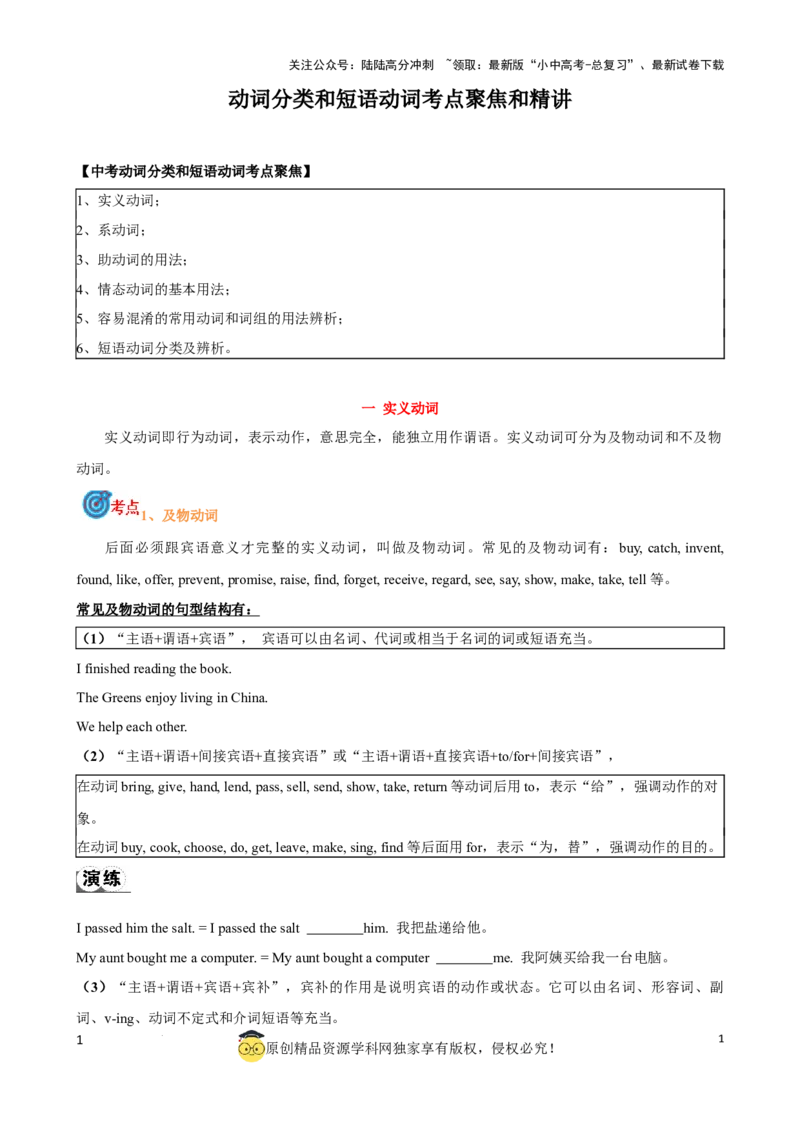
动词分类和短语动词考点聚焦和精讲
【中考动词分类和短语动词考点聚焦】
1、实义动词;
2、系动词;
3、助动词的用法;
4、情态动词的基本用法;
5、容易混淆的常用动词和词组的用法辨析;
6、短语动词分类及辨析。
一 实义动词
实义动词即行为动词,表示动作,意思完全,能独立用作谓语。实义动词可分为及物动词和不及物
动词。
1、及物动词
后面必须跟宾语意义才完整的实义动词,叫做及物动词。常见的及物动词有:buy, catch, invent,
found, like, offer, prevent, promise, raise, find, forget, receive, regard, see, say, show, make, take, tell等。
常见及物动词的句型结构有:
(1)“主语+谓语+宾语”, 宾语可以由名词、代词或相当于名词的词或短语充当。
I finished reading the book.
The Greens enjoy living in China.
We help each other.
(2)“主语+谓语+间接宾语+直接宾语”或“主语+谓语+直接宾语+to/for+间接宾语”,
在动词bring, give, hand, lend, pass, sell, send, show, take, return等动词后用to,表示“给”,强调动作的对
象。
在动词buy, cook, choose, do, get, leave, make, sing, find等后面用for,表示“为,替”,强调动作的目的。
I passed him the salt. = I passed the salt him. 我把盐递给他。
My aunt bought me a computer. = My aunt bought a computer me. 我阿姨买给我一台电脑。
(3)“主语+谓语+宾语+宾补”,宾补的作用是说明宾语的动作或状态。它可以由名词、形容词、副
词、v-ing、动词不定式和介词短语等充当。
1 1
原创精品资源学科网独家享有版权,侵权必究!
学科网(北京)股份有限公司关注公众号:陆陆高分冲刺 ~领取:最新版“小中高考-总复习”、最新试卷下载
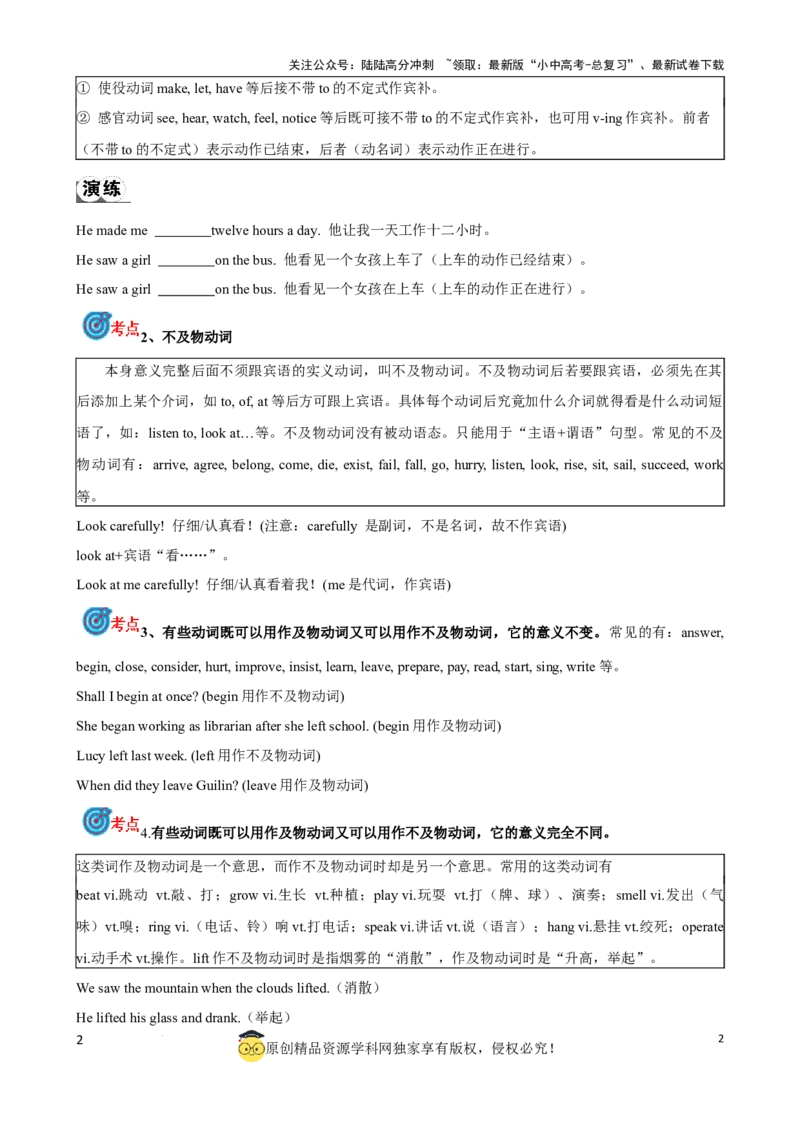
① 使役动词make, let, have等后接不带to的不定式作宾补。
② 感官动词see, hear, watch, feel, notice等后既可接不带to的不定式作宾补,也可用v-ing作宾补。前者
(不带to的不定式)表示动作已结束,后者(动名词)表示动作正在进行。
He made me twelve hours a day. 他让我一天工作十二小时。
He saw a girl on the bus. 他看见一个女孩上车了(上车的动作已经结束)。
He saw a girl on the bus. 他看见一个女孩在上车(上车的动作正在进行)。
2、不及物动词
本身意义完整后面不须跟宾语的实义动词,叫不及物动词。不及物动词后若要跟宾语,必须先在其
后添加上某个介词,如to, of, at等后方可跟上宾语。具体每个动词后究竟加什么介词就得看是什么动词短
语了,如:listen to, look at…等。不及物动词没有被动语态。只能用于“主语+谓语”句型。常见的不及
物动词有:arrive, agree, belong, come, die, exist, fail, fall, go, hurry, listen, look, rise, sit, sail, succeed, work
等。
Look carefully! 仔细/认真看!(注意:carefully 是副词,不是名词,故不作宾语)
look at+宾语“看……”。
Look at me carefully! 仔细/认真看着我!(me是代词,作宾语)
3、有些动词既可以用作及物动词又可以用作不及物动词,它的意义不变。常见的有:answer,
begin, close, consider, hurt, improve, insist, learn, leave, prepare, pay, read, start, sing, write等。
Shall I begin at once? (begin用作不及物动词)
She began working as librarian after she left school. (begin用作及物动词)
Lucy left last week. (left用作不及物动词)
When did they leave Guilin? (leave用作及物动词)
4.有些动词既可以用作及物动词又可以用作不及物动词,它的意义完全不同。
这类词作及物动词是一个意思,而作不及物动词时却是另一个意思。常用的这类动词有
beat vi.跳动 vt.敲、打;grow vi.生长 vt.种植;play vi.玩耍 vt.打(牌、球)、演奏;smell vi.发出(气
味)vt.嗅;ring vi.(电话、铃)响vt.打电话;speak vi.讲话vt.说(语言);hang vi.悬挂vt.绞死;operate
vi.动手术vt.操作。lift作不及物动词时是指烟雾的“消散”,作及物动词时是“升高,举起”。
We saw the mountain when the clouds lifted.(消散)
He lifted his glass and drank.(举起)
2 2
原创精品资源学科网独家享有版权,侵权必究!
学科网(北京)股份有限公司关注公众号:陆陆高分冲刺 ~领取:最新版“小中高考-总复习”、最新试卷下载
二 系动词
系动词又称联系动词,它本身有词义,但不能单独用作谓语,后边必须跟表语,构成系表结构,说
明主语的状况、性质、特征等情况。中考要求掌握的系动词有:be, look, seem, sound, feel, taste, smell,
grow, get, become, turn, fall ill/asleep等的用法。
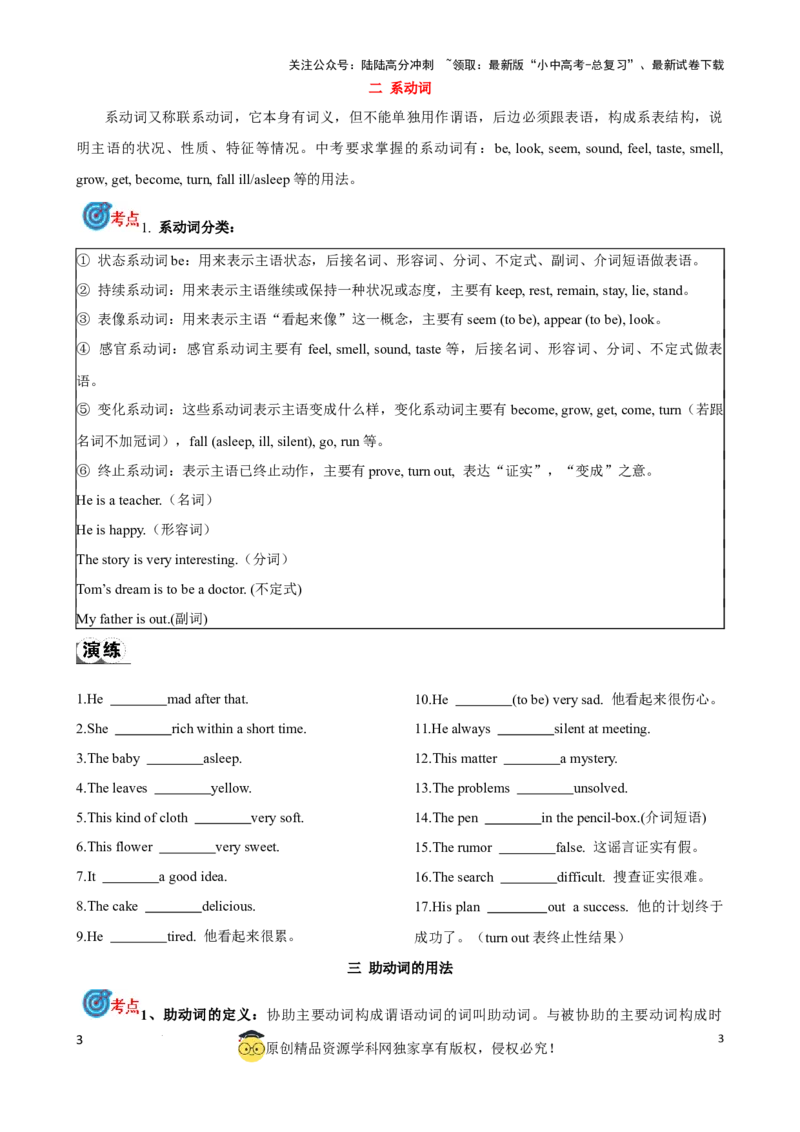
1. 系动词分类:
① 状态系动词be:用来表示主语状态,后接名词、形容词、分词、不定式、副词、介词短语做表语。
② 持续系动词:用来表示主语继续或保持一种状况或态度,主要有keep, rest, remain, stay, lie, stand。
③ 表像系动词:用来表示主语“看起来像”这一概念,主要有seem (to be), appear (to be), look。
④ 感官系动词:感官系动词主要有 feel, smell, sound, taste等,后接名词、形容词、分词、不定式做表
语。
⑤ 变化系动词:这些系动词表示主语变成什么样,变化系动词主要有become, grow, get, come, turn(若跟
名词不加冠词),fall (asleep, ill, silent), go, run等。
⑥ 终止系动词:表示主语已终止动作,主要有prove, turn out, 表达“证实”,“变成”之意。
He is a teacher.(名词)
He is happy.(形容词)
The story is very interesting.(分词)
Tom’s dream is to be a doctor. (不定式)
My father is out.(副词)
1.He mad after that. 10.He (to be) very sad. 他看起来很伤心。
2.She rich within a short time. 11.He always silent at meeting.
3.The baby asleep. 12.This matter a mystery.
4.The leaves yellow. 13.The problems unsolved.
5.This kind of cloth very soft. 14.The pen in the pencil-box.(介词短语)
6.This flower very sweet. 15.The rumor false. 这谣言证实有假。
7.It a good idea. 16.The search difficult. 搜查证实很难。
8.The cake delicious. 17.His plan out a success. 他的计划终于
9.He tired. 他看起来很累。 成功了。(turn out表终止性结果)
三 助动词的用法
1、助动词的定义:协助主要动词构成谓语动词的词叫助动词。与被协助的主要动词构成时
3 3
原创精品资源学科网独家享有版权,侵权必究!
学科网(北京)股份有限公司关注公众号:陆陆高分冲刺 ~领取:最新版“小中高考-总复习”、最新试卷下载
态,语态、疑问句、否定句和加强语气等。助动词是语法功能词,本身没有词义,不可单独使用,它没
有对应的汉语意思。如:He doesn’t like English. 他不喜欢英语。(doesn’t是助动词,无词义;like是主
要动词,有词义)
2、助动词的作用:助动词协助主要动词完成以下功能,可以用来:
① 表示时态。如:He is singing. 他在唱歌。// He has got married. 他已结婚。
② 表示语态。如:He was sent to England. 他被派往英国。
③ 构成疑问句。如:Do you like college life? // Did you study English before you came here?
④ 与否定副词not合用,构成否定句。如:I don’t like him. 我不喜欢他。
⑤ 加强语气。如:He did know that. // Do come to the party tomorrow evening.
3、最常用的助动词(be, have, do, shall, will, should, would)的用法:
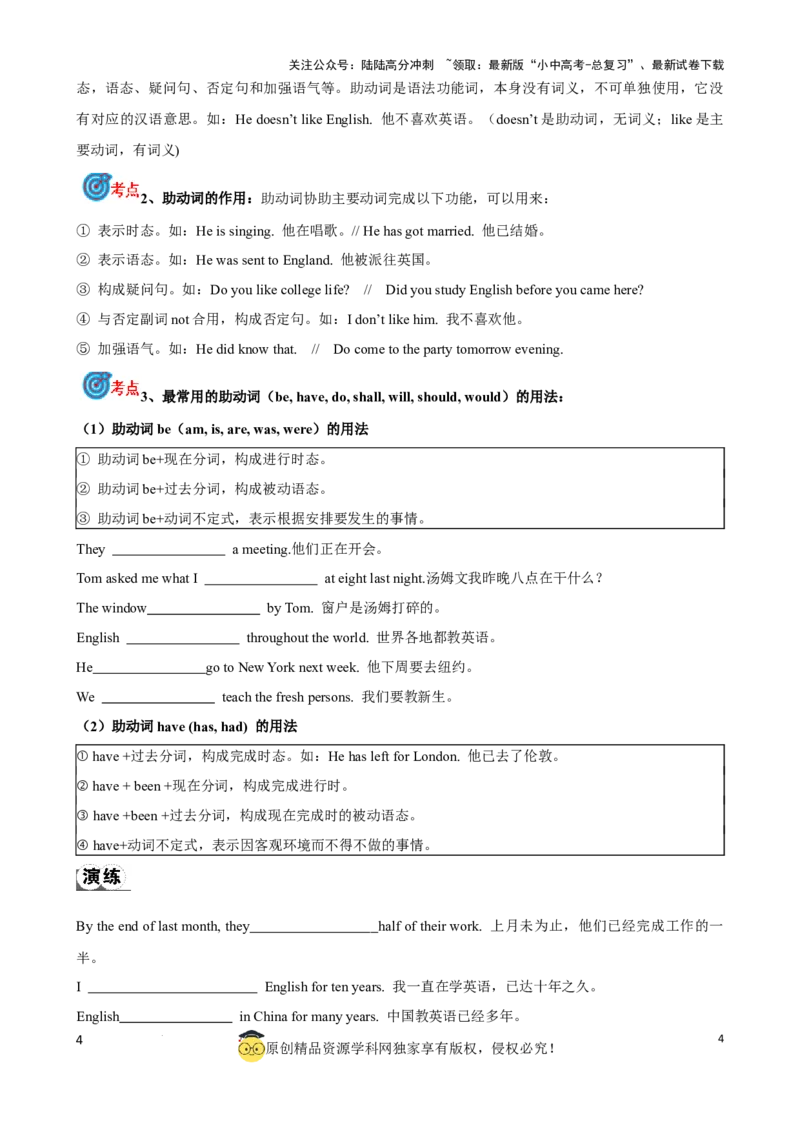
(1)助动词be(am, is, are, was, were)的用法
① 助动词be+现在分词,构成进行时态。
② 助动词be+过去分词,构成被动语态。
③ 助动词be+动词不定式,表示根据安排要发生的事情。
They a meeting.他们正在开会。
Tom asked me what I at eight last night.汤姆文我昨晚八点在干什么?
The window by Tom. 窗户是汤姆打碎的。
English throughout the world. 世界各地都教英语。
He go to New York next week. 他下周要去纽约。
We teach the fresh persons. 我们要教新生。
(2)助动词have (has, had) 的用法
① have +过去分词,构成完成时态。如:He has left for London. 他已去了伦敦。
② have + been +现在分词,构成完成进行时。
③ have +been +过去分词,构成现在完成时的被动语态。
④ have+动词不定式,表示因客观环境而不得不做的事情。
By the end of last month, they half of their work. 上月未为止,他们已经完成工作的一
半。
I English for ten years. 我一直在学英语,已达十年之久。
English in China for many years. 中国教英语已经多年。
4 4
原创精品资源学科网独家享有版权,侵权必究!
学科网(北京)股份有限公司关注公众号:陆陆高分冲刺 ~领取:最新版“小中高考-总复习”、最新试卷下载
It’s raining hard. I at home. 天正在下大雨,我不得不呆在家里。
(3)助动词do (does, did) 的用法
① 构成一般疑问句,
Do you want to pass the CET? 你想通过大学英语测试吗?// Did you study German? 你们学过德语吗?
② do (does, did)+ not构成否定句,
I do not want to be criticized. 我不想挨批评。// He doesn’t like to study. 他不想学习。
In the past, many students did not know the importance of English. 过去,好多学生不知道英语的重要性。
③ 构成否定祈使句,如:Don’t go there. 不要去那里。// Don’t be so absent-minded. 不要这么心不在焉。
【注意】构成否定祈使句只用do,不用did和does。
④ 放在动词原形前,加强该动词的语气,意为“一定要,确实,真的”。如:
I did go there. 我确实去那儿了。// Do come to my birthday party. 一定来参加我的生日宴会。// I do miss
you. 我确实想你。
⑤ 用于倒装句,如:Never did I hear of such a thing. 我从未听说过这样的事情。
Only when we begin our college life do we realize the importance of English. 只有在开始大学生活时我们才认
识到英语的重要性。
【注意】引导此类倒装句的副词有never, seldom, rarely, little, only, so, well等。
⑥ 用来代替前面刚提到的动词以避免重复。如:I work harder than he does. 我工作比他努力。
---- Do you like Beijing? 你喜欢北京吗?---- Yes, I do. 是的,喜欢。(do用作代动词,代替 like
Beijing.)
(4)助动词shall/should和will/would的用法
① shall构成一般将来时,should构成过去将来时,用于第一人称,后接动词原形。
I shall study harder at English. 我将更加努力地学习英语。
I telephoned him yesterday to ask what I should do next week. 我昨天给他打电话,问他我下周干什么。
② will构成一般将来时,would构成过去将来时,用于第二、三人称,后接动词原形。如:
He will go to Shanghai. 他要去上海。// He said he would come. 他说他要来。
【注意】在过去的语法中,语法学家说shall用于第一人称,will 只用于第二、第三人称。现在,尤其在
口语中,will常用于第一人称,但shall只用于第一人称,如用于第二、第三人称,就失去助动词的意
义,已变为情态动词,试比较:
He shall come. 他必须来。(shall有命令的意味。)// He will come. 他要来。(will只与动词原形构成一
般将来时。)
四 情态动词的基本用法
5 5
原创精品资源学科网独家享有版权,侵权必究!
学科网(北京)股份有限公司关注公众号:陆陆高分冲刺 ~领取:最新版“小中高考-总复习”、最新试卷下载
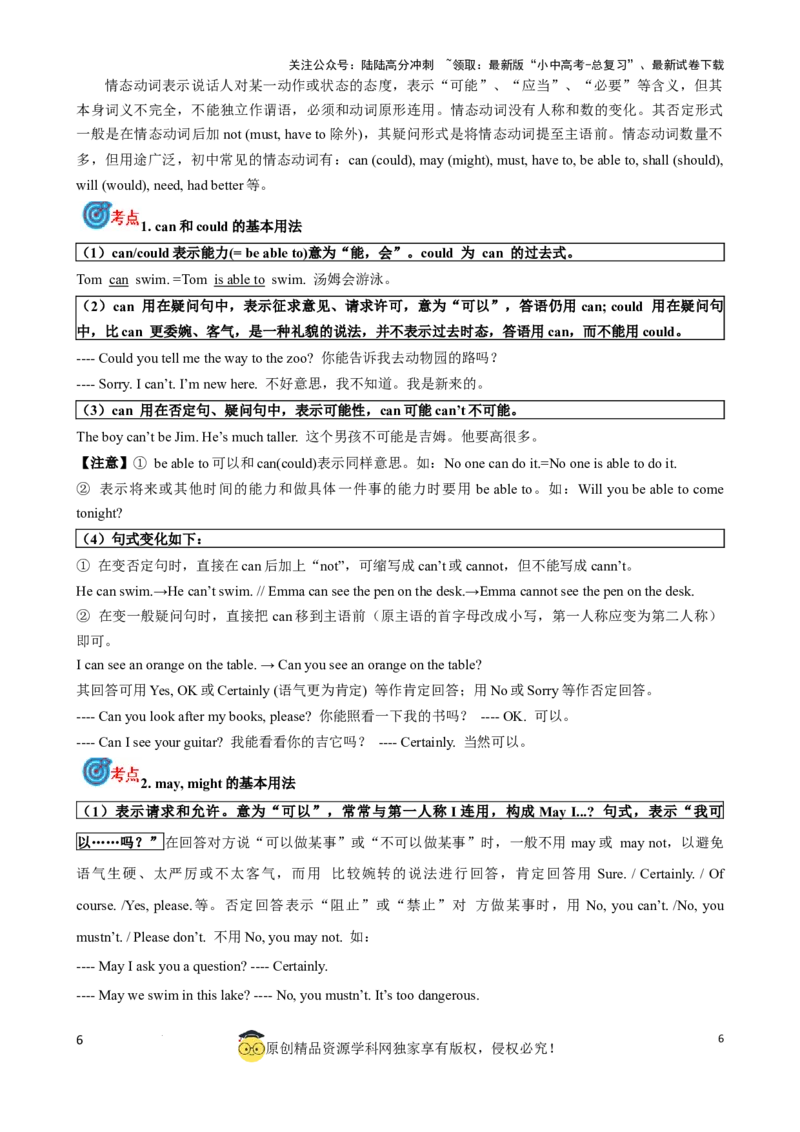
情态动词表示说话人对某一动作或状态的态度,表示“可能”、“应当”、“必要”等含义,但其
本身词义不完全,不能独立作谓语,必须和动词原形连用。情态动词没有人称和数的变化。其否定形式
一般是在情态动词后加not (must, have to除外),其疑问形式是将情态动词提至主语前。情态动词数量不
多,但用途广泛,初中常见的情态动词有:can (could), may (might), must, have to, be able to, shall (should),
will (would), need, had better等。
1. can和could的基本用法
(1)can/could表示能力(= be able to)意为“能,会”。could 为 can 的过去式。
Tom can swim. =Tom is able to swim. 汤姆会游泳。
(2)can 用在疑问句中,表示征求意见、请求许可,意为“可以”,答语仍用can; could 用在疑问句
中,比can 更委婉、客气,是一种礼貌的说法,并不表示过去时态,答语用can,而不能用could。
---- Could you tell me the way to the zoo? 你能告诉我去动物园的路吗?
---- Sorry. I can’t. I’m new here. 不好意思,我不知道。我是新来的。
(3)can 用在否定句、疑问句中,表示可能性,can可能can’t不可能。
The boy can’t be Jim. He’s much taller. 这个男孩不可能是吉姆。他要高很多。
【注意】① be able to可以和can(could)表示同样意思。如:No one can do it.=No one is able to do it.
② 表示将来或其他时间的能力和做具体一件事的能力时要用 be able to。如:Will you be able to come
tonight?
(4)句式变化如下:
① 在变否定句时,直接在can后加上“not”,可缩写成can’t或cannot,但不能写成cann’t。
He can swim.→He can’t swim. // Emma can see the pen on the desk.→Emma cannot see the pen on the desk.
② 在变一般疑问句时,直接把can移到主语前(原主语的首字母改成小写,第一人称应变为第二人称)
即可。
I can see an orange on the table. → Can you see an orange on the table?
其回答可用Yes, OK或Certainly (语气更为肯定) 等作肯定回答;用No或Sorry等作否定回答。
---- Can you look after my books, please? 你能照看一下我的书吗? ---- OK. 可以。
---- Can I see your guitar? 我能看看你的吉它吗? ---- Certainly. 当然可以。
2. may, might的基本用法
(1)表示请求和允许。意为“可以”,常常与第一人称 I连用,构成May I...? 句式,表示“我可
以……吗?”在回答对方说“可以做某事”或“不可以做某事”时,一般不用 may或 may not,以避免
语气生硬、太严厉或不太客气,而用 比较婉转的说法进行回答,肯定回答用 Sure. / Certainly. / Of
course. /Yes, please.等。否定回答表示“阻止”或“禁止”对 方做某事时,用 No, you can’t. /No, you
mustn’t. / Please don’t. 不用No, you may not. 如:
---- May I ask you a question? ---- Certainly.
---- May we swim in this lake? ---- No, you mustn’t. It’s too dangerous.
6 6
原创精品资源学科网独家享有版权,侵权必究!
学科网(北京)股份有限公司关注公众号:陆陆高分冲刺 ~领取:最新版“小中高考-总复习”、最新试卷下载
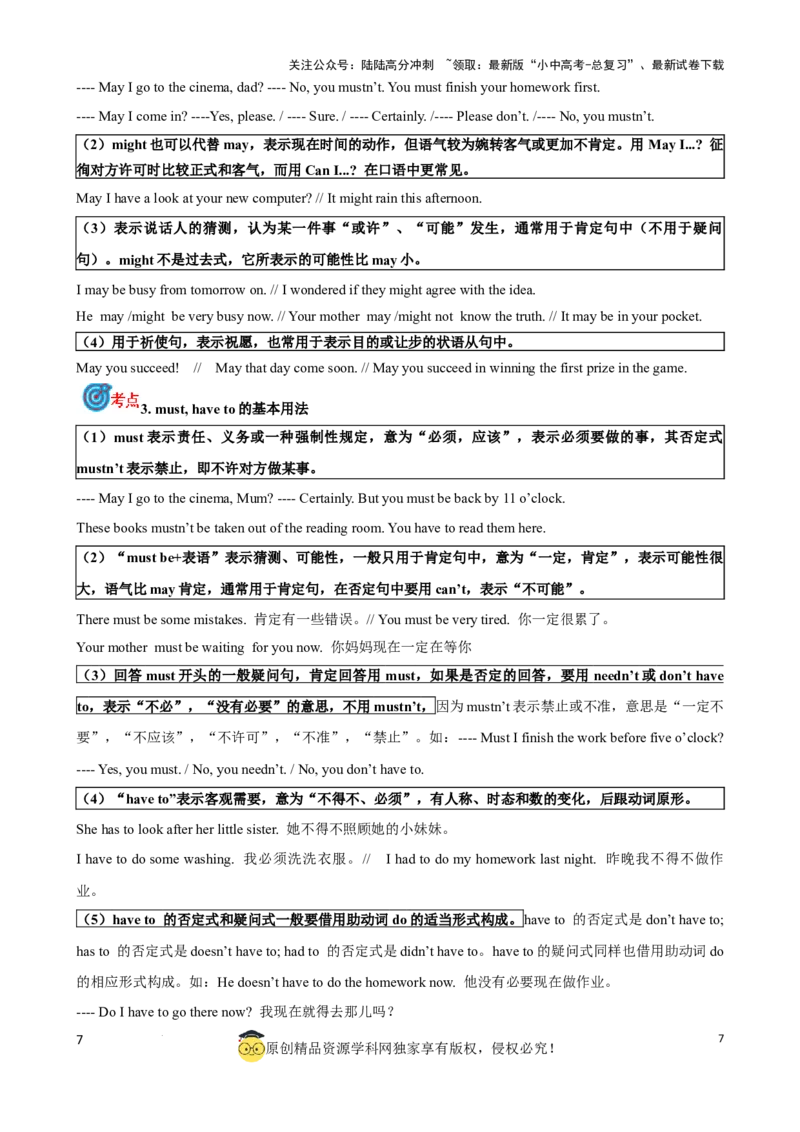
---- May I go to the cinema, dad? ---- No, you mustn’t. You must finish your homework first.
---- May I come in? ----Yes, please. / ---- Sure. / ---- Certainly. /---- Please don’t. /---- No, you mustn’t.
(2)might也可以代替may,表示现在时间的动作,但语气较为婉转客气或更加不肯定。用 May I...? 征
徇对方许可时比较正式和客气,而用Can I...? 在口语中更常见。
May I have a look at your new computer? // It might rain this afternoon.
(3)表示说话人的猜测,认为某一件事“或许”、“可能”发生,通常用于肯定句中(不用于疑问
句)。might不是过去式,它所表示的可能性比may小。
I may be busy from tomorrow on. // I wondered if they might agree with the idea.
He may /might be very busy now. // Your mother may /might not know the truth. // It may be in your pocket.
(4)用于祈使句,表示祝愿,也常用于表示目的或让步的状语从句中。
May you succeed! // May that day come soon. // May you succeed in winning the first prize in the game.
3. must, have to的基本用法
(1)must表示责任、义务或一种强制性规定,意为“必须,应该”,表示必须要做的事,其否定式
mustn’t表示禁止,即不许对方做某事。
---- May I go to the cinema, Mum? ---- Certainly. But you must be back by 11 o’clock.
These books mustn’t be taken out of the reading room. You have to read them here.
(2)“must be+表语”表示猜测、可能性,一般只用于肯定句中,意为“一定,肯定”,表示可能性很
大,语气比may肯定,通常用于肯定句,在否定句中要用can’t,表示“不可能”。
There must be some mistakes. 肯定有一些错误。// You must be very tired. 你一定很累了。
Your mother must be waiting for you now. 你妈妈现在一定在等你
(3)回答must开头的一般疑问句,肯定回答用 must,如果是否定的回答,要用needn’t或don’t have
to,表示“不必”,“没有必要”的意思,不用mustn’t,因为mustn’t表示禁止或不准,意思是“一定不
要”,“不应该”,“不许可”,“不准”,“禁止”。如:---- Must I finish the work before five o’clock?
---- Yes, you must. / No, you needn’t. / No, you don’t have to.
(4)“have to”表示客观需要,意为“不得不、必须”,有人称、时态和数的变化,后跟动词原形。
She has to look after her little sister. 她不得不照顾她的小妹妹。
I have to do some washing. 我必须洗洗衣服。// I had to do my homework last night. 昨晚我不得不做作
业。
(5)have to 的否定式和疑问式一般要借用助动词do的适当形式构成。have to 的否定式是don’t have to;
has to 的否定式是doesn’t have to; had to 的否定式是didn’t have to。have to的疑问式同样也借用助动词do
的相应形式构成。如:He doesn’t have to do the homework now. 他没有必要现在做作业。
---- Do I have to go there now? 我现在就得去那儿吗?
7 7
原创精品资源学科网独家享有版权,侵权必究!
学科网(北京)股份有限公司关注公众号:陆陆高分冲刺 ~领取:最新版“小中高考-总复习”、最新试卷下载
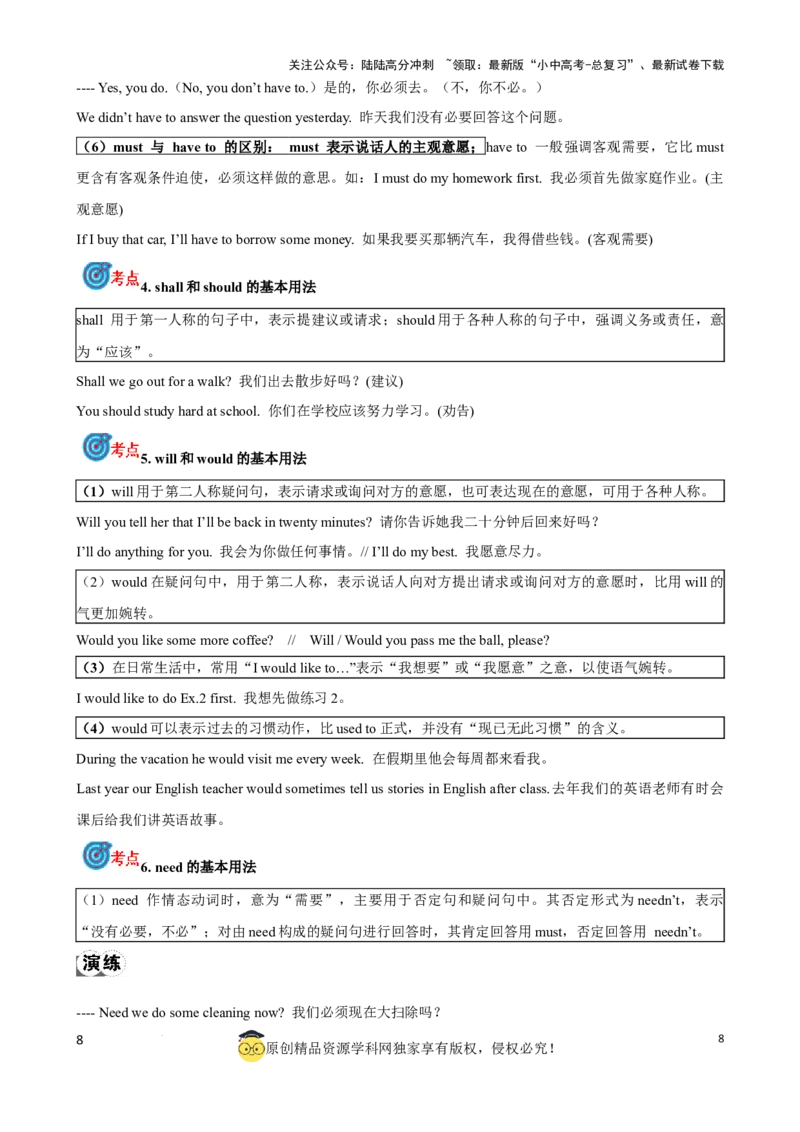
---- Yes, you do.(No, you don’t have to.)是的,你必须去。(不,你不必。)
We didn’t have to answer the question yesterday. 昨天我们没有必要回答这个问题。
(6)must 与 have to 的区别: must 表示说话人的主观意愿;have to 一般强调客观需要,它比must
更含有客观条件迫使,必须这样做的意思。如:I must do my homework first. 我必须首先做家庭作业。(主
观意愿)
If I buy that car, I’ll have to borrow some money. 如果我要买那辆汽车,我得借些钱。(客观需要)
4. shall和should的基本用法
shall 用于第一人称的句子中,表示提建议或请求;should用于各种人称的句子中,强调义务或责任,意
为“应该”。
Shall we go out for a walk? 我们出去散步好吗?(建议)
You should study hard at school. 你们在学校应该努力学习。(劝告)
5. will和would的基本用法
(1)will用于第二人称疑问句,表示请求或询问对方的意愿,也可表达现在的意愿,可用于各种人称。
Will you tell her that I’ll be back in twenty minutes? 请你告诉她我二十分钟后回来好吗?
I’ll do anything for you. 我会为你做任何事情。// I’ll do my best. 我愿意尽力。
(2)would在疑问句中,用于第二人称,表示说话人向对方提出请求或询问对方的意愿时,比用will的
气更加婉转。
Would you like some more coffee? // Will / Would you pass me the ball, please?
(3)在日常生活中,常用“I would like to…”表示“我想要”或“我愿意”之意,以使语气婉转。
I would like to do Ex.2 first. 我想先做练习2。
(4)would可以表示过去的习惯动作,比used to正式,并没有“现已无此习惯”的含义。
During the vacation he would visit me every week. 在假期里他会每周都来看我。
Last year our English teacher would sometimes tell us stories in English after class.去年我们的英语老师有时会
课后给我们讲英语故事。
6. need的基本用法
(1)need 作情态动词时,意为“需要”,主要用于否定句和疑问句中。其否定形式为needn’t,表示
“没有必要,不必”;对由need构成的疑问句进行回答时,其肯定回答用must,否定回答用 needn’t。
---- Need we do some cleaning now? 我们必须现在大扫除吗?
8 8
原创精品资源学科网独家享有版权,侵权必究!
学科网(北京)股份有限公司关注公众号:陆陆高分冲刺 ~领取:最新版“小中高考-总复习”、最新试卷下载
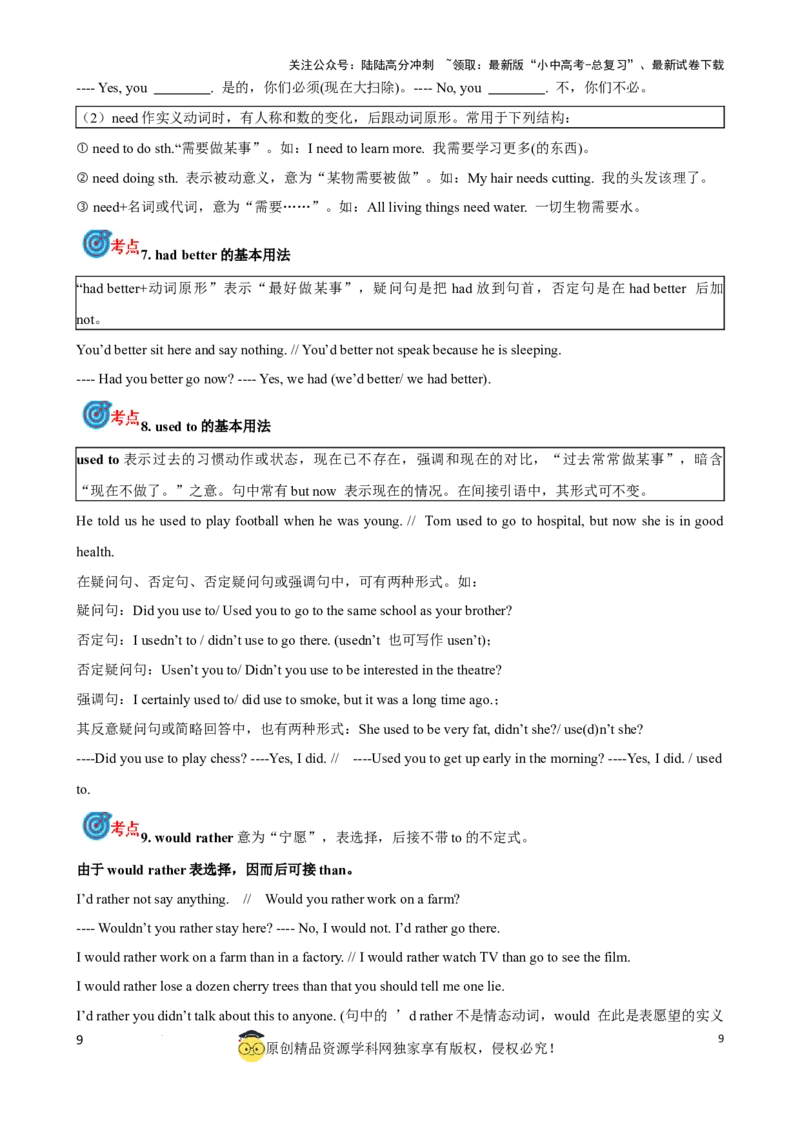
---- Yes, you . 是的,你们必须(现在大扫除)。---- No, you . 不,你们不必。
(2)need作实义动词时,有人称和数的变化,后跟动词原形。常用于下列结构:
① need to do sth.“需要做某事”。如:I need to learn more. 我需要学习更多(的东西)。
② need doing sth. 表示被动意义,意为“某物需要被做”。如:My hair needs cutting. 我的头发该理了。
③ need+名词或代词,意为“需要……”。如:All living things need water. 一切生物需要水。
7. had better的基本用法
“had better+动词原形”表示“最好做某事”,疑问句是把 had放到句首,否定句是在 had better 后加
not。
You’d better sit here and say nothing. // You’d better not speak because he is sleeping.
---- Had you better go now? ---- Yes, we had (we’d better/ we had better).
8. used to的基本用法
used to表示过去的习惯动作或状态,现在已不存在,强调和现在的对比,“过去常常做某事”,暗含
“现在不做了。”之意。句中常有but now 表示现在的情况。在间接引语中,其形式可不变。
He told us he used to play football when he was young. // Tom used to go to hospital, but now she is in good
health.
在疑问句、否定句、否定疑问句或强调句中,可有两种形式。如:
疑问句:Did you use to/ Used you to go to the same school as your brother?
否定句:I usedn’t to / didn’t use to go there. (usedn’t 也可写作usen’t);
否定疑问句:Usen’t you to/ Didn’t you use to be interested in the theatre?
强调句:I certainly used to/ did use to smoke, but it was a long time ago.;
其反意疑问句或简略回答中,也有两种形式:She used to be very fat, didn’t she?/ use(d)n’t she?
----Did you use to play chess? ----Yes, I did. // ----Used you to get up early in the morning? ----Yes, I did. / used
to.
9. would rather意为“宁愿”,表选择,后接不带to的不定式。
由于would rather表选择,因而后可接than。
I’d rather not say anything. // Would you rather work on a farm?
---- Wouldn’t you rather stay here? ---- No, I would not. I’d rather go there.
I would rather work on a farm than in a factory. // I would rather watch TV than go to see the film.
I would rather lose a dozen cherry trees than that you should tell me one lie.
I’d rather you didn’t talk about this to anyone. (句中的 ’d rather不是情态动词,would 在此是表愿望的实义
9 9
原创精品资源学科网独家享有版权,侵权必究!
学科网(北京)股份有限公司关注公众号:陆陆高分冲刺 ~领取:最新版“小中高考-总复习”、最新试卷下载
动词)
五 容易混淆的常用动词和词组的用法辨析
1、say, speak, talk, tell的用法辨析
(1) say表示讲话,及物动词,后跟宾语或宾语从句, 强调说话的内容。如:
(2) speak表示“讲话”,一般作为不及物动词使用,而有时作为及物动词后面跟上各种语言作为宾语。
如:(3) talk表示“谈话”,是不及物动词,与to, about, with等连用,才可以接宾语。如:
(4) tell 表示“告诉,讲述”是及物动词,可以带双宾语或复合宾语。如:
1.He he would go there.
2.It’s to leave. We have to say goodbye to you.
3.Do you English?
4.May I to Mr Pope, please?
5.What are you about?
6.Mr Jackson is with my father in the office now.
7.She us an interesting story yesterday.
8.My teacher me that we would have an English exam the next month.
2、look, see, watch和read的用法辨析
(1) look强调“看”这个动作,是不及物动词,常与at连用,然后接宾语。
(2) see 指“看见”某物,强调的是结果。
(3) watch 指的是“观看”,“注视”之意。
(4)read指“看书”、“看报”、“阅读”之意。
1. ! The girl is swimming in the lake.
2. the picture carefully. Can you find something unusual?
3.They can’t the words on the blackboard.
4.Does Lily often go to a film on Sunday?
5.The twins are TV now.
6.He will go to a volleyball match.
7.Don’t in the sun.
10 10
原创精品资源学科网独家享有版权,侵权必究!
学科网(北京)股份有限公司关注公众号:陆陆高分冲刺 ~领取:最新版“小中高考-总复习”、最新试卷下载
8.I like to newspapers when I am free.
3、borrow, lend和keep的用法辨析
(1) borrow意思为“借入”,常常与from连用,是非延续性动词,表示瞬间即能完成的动作。
(2) lend 是“借出”之意,常常与to连用,同borrow一样,是非延续性动词,只表示瞬间即能完成的动
作。
(3) keep是“保存”的意思,动作可以延续。
1.Meimei a book from the library just now.
2.May I your dictionary?
3.Uncle Wang has his car to Mr Li.
4.Could you us your radio, please?
5.How long can the recorder be ?
6.The farmer the pan for two weeks.
4、bring, take, carry, get和fetch的用法辨析
(1) bring意思为“拿来”、“带来”。指将某物或某人从别处“带来”。
(2) take意思是“拿走”,“带走”,把某物或某人从这里“带来”或“拿到”某处之意。
(3) carry 是“带着、搬运、携带”的意思,指随身携带,有背着、扛着、抱着、提着的含义,不表明来
去的方向。
(4) get是去某处将某物拿回来。
(5) fetch 指往返,去了又回来,到别处去把某人或某物带来或拿来。
1. me the book, please.
2.May I Jim to see you next Saturday?
3.It looks like rain. a raincoat with you.
4.Mother the little girl to the next room.
5.Do you always a handbag?
6.The box is heavy. Can you it?
7.Please go to my office to some chalk.
8.There is no water in the bottle. Why not some?
11 11
原创精品资源学科网独家享有版权,侵权必究!
学科网(北京)股份有限公司关注公众号:陆陆高分冲刺 ~领取:最新版“小中高考-总复习”、最新试卷下载
9.She has gone to water.
10.Can you the book for me at once?
5、wear, put on和dress的用法辨析
(1) wear是“穿着”“戴着”的意思,可用于穿衣服、穿鞋、戴帽子、戴手套、佩戴首饰等,强调“穿
着”的状态。如:
(2) put on是“穿上”“戴上”的意思,可以用于穿衣服、穿鞋、戴帽等。着重于穿戴的动作。如:
(3) dress可以作及物动词和不及物动词,有“穿着”“打扮”的意思。作“穿着”解时,只用于穿衣服,
不用于穿鞋、戴帽、戴手套。作为及物动词用时,它的宾语是人,不是衣服。dress sb.(给某人穿衣
服),而wear作“穿着”用时,也是及物动词,但它的宾语是物,不是人,即wear sth.(穿着衣物)。
1.Tom always black shoes.
2.He a raincoat even when it is fine.
3.She doesn’t like to a red flower in her hair.
4.It’s cold. You’d better your coat.
5.He his hat and went out of the room.
6.She always well.
7.Get up and quickly.
8.Mary is her child.
6、take, spend, pay和cost的用法辨析
(1) take指做某事用多少时间。句型是:It takes/took/ will take + sb. +some time + to do sth.
(2) spend指某人在某事(物)上花费时间或钱。句型是:Sb spends + money/time + on something / (in)
doing sth.
(3) cost的宾语通常是时间、金钱、力气,句型:sth. +(cost)+sb.+时间/金钱/力气。
(4) pay的宾语通常是金钱,句型:sb.+(pay)+金钱+for+事物。
1.It me three days to finish the work.
2.It will you a week to travel through the forest.
3.She more than 500 yuan on that coat.
4.He didn’t much time on his lessons.
12 12
原创精品资源学科网独家享有版权,侵权必究!
学科网(北京)股份有限公司关注公众号:陆陆高分冲刺 ~领取:最新版“小中高考-总复习”、最新试卷下载
5.He much time (in) correcting students’ exercises.
6.Mother her evenings (in) washing clothes.
7.How much does a house like this ?
8.The book me 20 yuan.
9.I him twenty dollars for the book.
7、reach, get 和arrive的用法辨析
(1) reach是及物动词,后面要直接跟表示地点的名词作宾语。
(2) get是不及动词,常与to连用,再接名词,后面接表示地点的副词时,不用to,get to常用于口语中。
(3) arrive是不及物动词,表示到达一个小地方时,用arrive at, 到达一个大地方时用arrive in。后面接表示
地点的副词时,不用at/in。
1.After the train had left, they the station.
2.We the top of the mountain at last.
3.When the students to the cinema, the film had begun.
4.My sister was cooking when mother home.
5.The soldiers at a small village
6.The foreigners will in Shanghai tomorrow.
8、accept和receive的用法辨析
(1) receive 通常指被动地“收到”或“接到”,接不接受是另一回事,receive多是接受实际的东西,如信
件,礼物等。
(2) accept 则指主动地“接受”,accept多是接受抽象的东西,如想法,表扬,批评,道歉等。
(3) 表示“接见”、“接待”时,要用 receive 而不用 accept。
1.On my twentieth birthday I several gifts. 我二十岁生日那天我收到好几份礼物。
2.She offered him a lift and he (it). 她请他坐她的车,他就领情了。
3.She received his present, but she didn’t it. 她收到了他的礼物,但是没有接受。
4.She was warmly . 她受到热情接待。
9、join, join in, take part in和attend的用法辨析
13 13
原创精品资源学科网独家享有版权,侵权必究!
学科网(北京)股份有限公司关注公众号:陆陆高分冲刺 ~领取:最新版“小中高考-总复习”、最新试卷下载
(1) join多指参加组织、团体、党派等,后面跟人时表示和某人一起参加某项活动。
(2) join in指参加某项游戏或活动。
(3) take part in多指参加群众性的活动、运动、会议等。
(4) )attend是正式用语,指参加会议、婚礼、典礼;听报告、讲座等。
1.He the army in 2010. 他在2010年参军。
2.She a health club. 她参加了一个健身俱乐部。
3.Can I the game? 我可以参加这个游戏吗?
4.They all singing the song. 他们一起唱这首歌。
5.How many countries will the World Cup? 有多少个国家要参加世界杯?
6.He’ll an important meeting tomorrow. 他明天要参加一个重要会议。
10、die, dead, death和dying的用法辨析
(1) die是动词,意为“死,去世”,为短暂性动词,不能与延续性时间连用,表延续性用be dead。
(2) dead是形容词,意为“死的”,表示状态。
(3) death是名词,意为“死(亡)”。
(4) dying为die的现在分词,也可作形容词,表“垂死的,濒于死亡边缘的,枯萎的”之意。
1.She has been for 3 years. 她去世三年了。
2.She three years ago. 她三年前去世。
3.The poor man is . 这个可怜的人死了。
4.Her is remembered by us forever. 他的过世永远铭刻在我们的心中。
5.She is . 她快要死了。
11、lose, fail, beat, win和defeat的用法辨析
(1) lose意为“输给某人”,固定搭配为lose to sb.。
(2) fail意为“失败”或“未做成某事”。
(3) beat意为“打败”,后接sb.或某支队伍。如:
(4) win意为“赢得”,如赢得荣誉、比赛、地位等。
(5) defeat意为“击败,战胜,使失败,挫折”。
14 14
原创精品资源学科网独家享有版权,侵权必究!
学科网(北京)股份有限公司关注公众号:陆陆高分冲刺 ~领取:最新版“小中高考-总复习”、最新试卷下载
1.Unluckily we the match to Class Three. 不幸的是我们比赛输给了三班。
2.Our plan has . 我们的计划失败了。
3.Class Three us 5-0. 三班以5∶0打败了我们。
4.I her at swimming yesterday. 昨天游泳我赢了她。
5.I am sure to the match. 我一定能赢得比赛。
6.The enemy was . 敌人被打败了。
12、look for, find和find out的用法辨析
(1) look for意为“寻找”,是有目的地找,强调“寻找”这一动作。
(2) find意为“找到”“发现”,强调“找”的结果,其宾语往往是某个丢失的东西或人。
(3) find out着重表示通过理解、分析、思考、询问等“弄清楚”“查明”一件事情,其后的宾语常常是某
个情况、事实。
1.He began to a new job immediately after he was fired. 他被解雇后立即开始寻找一份新工作。
2.---- Did you Li Ming yesterday? 你昨天找到李明了吗?
---- No, we him everywhere, but didn’t find him. 没有。我们到处找了,但没有找到他。
3.He a few coins in the car. 他在汽车里捡到几枚硬币。
4.Please when the train leaves.请查一下火车什么时候离站。
13、listen to和hear的用法辨析
(1) listen为不及物动词,与to构成固定搭配,强调听的动作。如:
(2) hear 强调听的结果。
1. ! There is a girl singing outside. 听,外面有个女孩在唱歌。
2.I your words. 我听到你说的话了
14、lose, forget和leave的用法辨析
(1) lose意为“丢失,失去”。东西失去了,找不回来了。
(2) forget意为“忘记”,大脑中不再存在此类信息。后可跟名词、代词、不定式和动名词。
(3)“leave sth.+地点”意为“把某物落在某处”。
15 15
原创精品资源学科网独家享有版权,侵权必究!
学科网(北京)股份有限公司关注公众号:陆陆高分冲刺 ~领取:最新版“小中高考-总复习”、最新试卷下载
1.I my watch. 我的表丢失了(我丢失了表)。
2.I your name. 我忘记了你的名字。
3.I taking my DC with me. 我忘了已经把我的DC带上了。
4.I my watch at home. 我把表忘在家里了。
15、think of, think about和think over的用法辨析
(1) think of意为“想到/起……”。
(2) think about意为“考虑”宾语it或them置后。
(3) think over意为“仔细考虑”,宾语it或them放在中间,一般指考虑问题。
1.I can’t his name. 我想不起他的名字。
2.What do you it? 你认为这件事怎么样?
3.We need several days to this matter . 我们需要几天的时间把这件事情仔细考虑一下。
16、used to do sth., be used to doing sth.和be used to do sth. 的用法辨析
(1) used to do sth. 表示过去常常做某事。
(2) be used to doing. 表示习惯做某事,to 后的动词用-ing形式。
(3) be used to do sth. 指被用来做什么。
1.I used to up at six in the morning.
2.I’m used to up early.
3.Pens are to write.
六 短语动词的分类及辨析
短语动词是中考的重要内容之一。在初中阶段,我们已经学习了不少短语动词,把他们加以归纳
总结,进行重点复习是十分必要的。英语中有许多短语动词在意义上是一个整体,其用法有的相当于
及物动词,有的相当于不及物动词,有的兼有及物动词和不及物动词的特征。
1. 短语动词的构成:
(1) 动词+介词:常见的有
arrive at/in到达; ask for寻求,索要;
16 16
原创精品资源学科网独家享有版权,侵权必究!
学科网(北京)股份有限公司关注公众号:陆陆高分冲刺 ~领取:最新版“小中高考-总复习”、最新试卷下载
agree with sb. 同意某人的观 help…with…帮助(某人)做(某 pay for为……付钱;
点; 事); stop…from… 阻 止 … …
belong to属于; knock at/on敲(门、窗); 做……;
depend on依靠,依赖; look for寻找; talk to/with对……说,和……
fall off跌落; look after照看;照顾; 谈话;
feed on以……为食; look like看上去像……; talk about谈论;
get to到达; look over(仔细)检查; think of想起;
get up起床; listen to听……; think about考虑;
hear of听说; laugh at嘲笑; wait for等候。
hear from收到某人的来信;
这类短语动词的宾语只能放在介词后。
如:Don’t laugh at others. // Tom asked his parents for a bike.
(2) 动词+副词(有的用作及物动词,有的用作不及物动词):常见的有
bring out取出; give back归还; put away收拾好;
blow out 吹灭; get back取回; put on穿上;
clean up清扫,收拾干净; get over克服; put up举起;
cheer up 使高兴起来;使振 get on上车; put off推迟;
作; get off下车; put out扑灭,熄灭;
come back/go back 回来/回 grow up长大; pick up捡起;
去; give away分发; run away逃跑,逃走;
come round (走)过来; give up放弃; slow down减缓,减速;
come out (花)开,出来,出 hand in上交; set off出发,动身;
hurry up赶快; think over 仔细考虑;
版;
come over顺便来访; look out小心; tidy up收拾,整理;
check out核实,检查; look up查找; turn on/off打开/关上;
eat up吃光; look around环顾,到处看; turn up/down 调大/调小;
fall behind落后; pick up捡起,开车接; take out取出;
fall down跌倒; put (sth) down 把某物放下 take off脱下。
find out 找出,查明; 来;
这类短语动词的宾语如果是名词,既可放在副词前边,又可放在副词后边;宾语如果是人称代词或反
身代词,则要放在副词前边。如:Please don’t forget to hand it in.
17 17
原创精品资源学科网独家享有版权,侵权必究!
学科网(北京)股份有限公司关注公众号:陆陆高分冲刺 ~领取:最新版“小中高考-总复习”、最新试卷下载
(3) 动词+名词:常见的有
do one’s homework做作业; have a rest休息; make a mistake/mistakes 犯错
do one’s best 尽某人最大努 have breakfast/lunch/supper 吃 误;
力; 早/午/晚餐; make a noise吵闹;
go boating/swimming/shopping have fun玩得高兴; make faces 做鬼脸;
去划船/去游泳/去购物; hold a sports meeting 举行运 make friends交朋友;
have a cold/a cough/a headache 动会; make money赚钱;
患感冒/咳嗽/头痛; lose heart丧失信心; play chess下象棋;
have a try尝试;努力;have a make a decision作出决定; take turns轮流;
take photos照相;
look看一看;
take place发生。
这类短语动词用作不及物动词。如:
This story took place three years ago. // I make friends with a lot of people.
(4) 动词+副词+介词:常见的有
catch up with赶上; get on/along well with与……相处融洽;
come up with找到,提出(答案、解决办法等); look forward to盼望,期待;
do well in在……方面做得好; run out of用完。
这类短语动词的宾语只能放在介词后边。如:Go on and I’ll catch up with you in five minutes.
(5) 动词+名词+介词:常见的有
take (good) care of (好好)照顾; say goodbye/hello/sorry to向某人道别/打招呼/道
give thanks to向某人致谢; 歉;
pay attention to注意; make use of使用,利用;
make fun of取笑;
take pride in为……感动骄傲/自豪。
这类短语动词的宾语只能放在介词后边。如:
You should pay attention to your handwriting. // We should make full use of our time.
(5) 动词+形容词:常见的有
leave open, set free, cut open等。这类短语动词的宾语如果是名词,则宾语可放在形容词的前边,也可放
在后边;宾语如果是人称代词或反身代词,则必须放在形容词前边。如:
The prisoners were set free. // He cut it open.
18 18
原创精品资源学科网独家享有版权,侵权必究!
学科网(北京)股份有限公司关注公众号:陆陆高分冲刺 ~领取:最新版“小中高考-总复习”、最新试卷下载
2. 初中常用短语动词辨析
(1)
agree with 同意某人的(意见、想法、分析、 agree to同意(计划、办法);
见解); agree to do sth. 同意做某事。
(2)
be back/in/out 回来/在家/外 be pleased (with) 对……觉 be free 空闲的,有空;
出; 得愉快(满意); be (ill) in bed 卧病在床;
be at home/work 在家/上 be famous for 以……而著 be busy doing (with) 忙于
班; 名; 做……(忙于……);
be good at 善于,擅长于; be strict in (with) (对工作、 be proud of 对……感到自
be careful of 当心,注意, 对人)严格要求; 豪;
仔细; be from 来自……,什么地 be good at/do well in doing
be covered with 被……复 方人; sth 擅长做某事;
盖; be hungry/thirsty/tired 饿 be supposed to do sth 应该
be ready for 为……作好准 了/渴了/累了; 做某事;
备; be worried 担忧; be used for doing sth/be used
be surprised (at) 对……觉 be (well) worth doing (非常) to do sth 被用来做某事;
得惊讶; 值得做……; be/get used to doing sth 习
be interested in 对……感兴 be covered with 被……所覆 惯做某事;
趣; 盖……; be used to do sth 被用来做
be on 在进行,在上演, be in (great) need of (很)需 be made in在……生产或制
(灯)亮着; 要; 造;
be able to do sth. 能 够 be in trouble 处于困境中; be made of由……制成(看得
做……; be glad to do sth. 很愉快 出原材料);
be afraid of (to do sth. that…) 做……; be made from 由……制成
惧怕……(不敢做……,恐 be late for ……迟到; (看不出原材料);
怕……); be made of (from) 由……制 belong to属于;
be angry with sb. 生(某人) 成; break off中断;
的气; be satisfied with 对……觉 begin with以……开始。
得满意;
(3)
19 19
原创精品资源学科网独家享有版权,侵权必究!
学科网(北京)股份有限公司关注公众号:陆陆高分冲刺 ~领取:最新版“小中高考-总复习”、最新试卷下载
come back回来; come out 花开,发芽,出 come on来吧,跟着来,赶
come across 偶遇; 现,出来,出版; 快,加油;
come home回家; come over 过来,顺便来 come from来自;
come down下来; 访; come to oneself苏醒;
come along来,随同; come in进来; come up with找到,提出;
come true实现; come into进入; clean up把……打扫干净;
come into use开始使用; cheer up使……高兴起来;
consist of由……组成。
(4)
do/try one’s best 尽最大努 do one’s homework 做 作 dream of梦想;
力; 业; depend on取决于,依靠;
do well in在……干得好; do some reading阅读; dress up装扮
drop by顺便拜访。
(5)
fall asleep入睡; fall off从……掉下;
fall behind落在……后面; fall down倒下,跌倒。
(6)
get down下来,落下; get off 下车(船、飞机、 get together相聚;
get on上车; 马); get over克服;
get to到达; get on well with与……相处 get away离开,逃离;
get up起床; 融洽; get home到家;
get back回来,取回; get married结婚; get into进入,陷入;
get back回到; get out (of)(从……)出来。
(7)
give up放弃; give in 屈服,让步,投 give away泄露、赠送;
give…a hand 给与……帮 降; give off放出、发出(气体、
助; give out筋疲力尽、累倒、 气味、烟雾、光、水、热
give a concert开音乐会; 耗尽、用完; 等)。
(8)
go back回去; go over温习,复习; go away走开;
go on继续; go out外出,到外面; go up上升,攀登;
go home回家; go into走进; go down下沉,下降;
20 20
原创精品资源学科网独家享有版权,侵权必究!
学科网(北京)股份有限公司关注公众号:陆陆高分冲刺 ~领取:最新版“小中高考-总复习”、最新试卷下载
go for为……而去; go to the doctor 去看医 ng/skating/dancing/camping
go through经历; 生; 去买东西/划船/去钓鱼/去徒
go by时间流逝,从旁边经 go straight along沿着……一 步旅行/去滑冰/去跳舞/野
过; 直往前走; 营;
go wrong走错路; go on doing继续做某事; go out of one’s way to do sth
go to bed睡觉; go
特地做某事。
go to school 去上学; shopping/boating/fishing/hiki
(9)
have a look看一看; have sports进行体育活动; have a good time 过 得 愉
have a seat坐下; have a cold感冒; 快;
have supper吃晚餐; have a cough咳嗽; have a headache头痛;
have a rest休息; have a try尝试,努力。
(10)
look for寻找; look at看……; look through 浏览;
look out留神,注意; look like看起来像; look into调查;
look over仔细检查; look the same看起来一样; laugh at嘲笑;
look up向上看,抬头看; look forward to 盼望,期 let…down使……失望。
look after照顾,照看; 待;
(11)
make friends交朋友; make room for 给……腾出 make a living谋生;
make phone calls打电话; 地方; make progress取得进步;
make money赚钱; make a decision做出决定; make sb feel at home使某人
make the bed整理床铺; make a mistake犯错误; 感到宾至如归;
make a noise吵闹; make up one’s mind 下 决 make sb. do sth.让某人做某
make a face做鬼脸; 心; 事;
make one’s way to往……走 mix up混合在一起; make up编造,虚构。
去;
(12)
put on上演,穿上,戴上; put off推迟; pass on传递;
put up挂起,举起; put out扑灭,熄灭; pay for付……的账。
put down把某物放下来; put back放回;
put away把某物收起来; pick up捡起;
21 21
原创精品资源学科网独家享有版权,侵权必究!
学科网(北京)股份有限公司关注公众号:陆陆高分冲刺 ~领取:最新版“小中高考-总复习”、最新试卷下载
(13)
take off脱掉衣服; take up 占据时间、空间, take one’s place坐某人的位
take away拿走; 开始从事,拿起; 置,代替某人的职务;
take photos照相; take a seat坐下; take turn轮流;
take time花费时间; take an active part in 积极参 take it easy放松,不紧张;
take out取出; 加; take pride in 对……感到自
take in吸收,上当; take care of照顾,照料; 豪;
take on 雇佣,呈现; take exercise做运动; talk about谈话,交谈;
talk with和……交谈。
(14)
turn on 打开电灯,收音 turn off 关上电灯,收音 turn…over把……翻过来;
机,煤气,自来水等; 机,煤气,自来水等; turn…into… 把 … … 变
turn up开大; 成……;
turn down关小,调低; turn to朝向。
(15)
think of认为,想起; think up想出;
think about考虑; think over仔细考虑。
题组1 动词词义辨析
1.—Simon,I'm afraid we can't complete the model spaceship this afternoon.
—Well, we finish it today. It's fine if we give it to Mr. Wang tomorrow.
A.can't B.mustn't C.needn't D.shouldn't
2.—How did you come to Baoying?
—By high-speed rail. It me only 28 minutes to get here.
A.spent B.paid C.cost D.took
3.—The official newspaper the news of Tiangong-1, for it took a big step forward into space.
A.heard B.checked C.believed D.celebrated
4.The government plans to more jobs for young people in western China.
A.create B.avoid C.borrow D.guess
5.The drama “Yuhuayao” citizens in Nanjing with a chance to learn and listen to the Party's history.
22 22
原创精品资源学科网独家享有版权,侵权必究!
学科网(北京)股份有限公司关注公众号:陆陆高分冲刺 ~领取:最新版“小中高考-总复习”、最新试卷下载
A.provided B.guarded C.compared D.protected
6.—I'll go back to my hometown, honey. to buy me a ticket, please.
—OK, single or return?
A.Regret B.Remain C.Require D.Remember
7.—Sam, I join you in the community service?
—Of course you can.
A.can B.must C.should D.need
8.We don't allow taking magazines out, but you copy the article you need on the machine over there.
A.can B.must C.should D.would
9.The cheesecake so good that I can't wait to eat it.
A.tastes B.feels C.sounds D.smells
10.—We've ordered too much food. I eat any more.
—Never mind. Let's take it home.
A.can't B.mustn't C.needn't D.shouldn't
题组2 动词短语辨析
1.He said that he would pass the exam and this to be true.
A.turned out B.put out C.broke out D.tried out
2.—Larry has changed a lot since he had a baby.
—Yeah. Being a parent has all his love and sense of duty.
A.taken up B.brought out C.made up D.given out
3.—The computer is working again!
—It yesterday, but someone has fixed it.
A.broke down B.broke out C.broke into D.broke away
4.Scientists all over the world are new medicine to fight COVID-19.
A.blowing out B.trying out C.leaving out D.keeping out
5.—Alice's room is tidy, isn't it?
—Yes. She always her toys after playing with them.
A.looks for B.puts away C.sweeps away D.pays for
题组3 语法选择
My family has always been poor, but we are a close family. We love our pets above anything else. In
December, things 1 even worse for my family. We went from just being poor to being homeless and finally, we
lost everything except for our two German shepherds.
23 23
原创精品资源学科网独家享有版权,侵权必究!
学科网(北京)股份有限公司关注公众号:陆陆高分冲刺 ~领取:最新版“小中高考-总复习”、最新试卷下载
It was a cold winter, but luckily we found a place where our two beautiful dogs could 2 with us.
Unfortunately, one week into living there, all of our money was gone and our dog food was 3 .
We called all over the town, trying 4 someone to help. However, nobody would 5 a hand. I was
scared that our dogs would starve (饿死). So I called a small pet supply store (宠物用品店).
There, a young girl answered the phone. She checked the dog food prices and told me what they were. I 6
her about what we were going through. Then, this sweet girl told me that she had extra money and that she would
buy the dog food for us. She 7 even ask us to pay back the money.
Hearing this, I started 8 . My fears went away. I knew that our dogs would have food, all because this
young girl 9 for it out of her own pocket. She 1 0 me, but she would help my dogs.
This young girl, whose name I don't even know, will always be an angel to me, and an angel to my dogs as
well.
1.A.get B.gets C.got D.will get
2.A.live B.to live C.lived D.living
3.A.bringing out B.giving out C.running out D.checking out
4.A.find B.to find C.finding D.found
5.A.give B.gives C.gave D.giving
6.A.talked B.told C.tells D.talks
7.A.hasn't B.wasn't C.didn't D.doesn't
8.A.cry B.cries C.cried D.crying
9.A.paid B.spent C.cost D.took
10.A.know B.doesn't know C.knew D.didn't know
短文填空
Ten people from different countries and all walks of life were chosen to 1 part in The Day I Ran
China, a show 2 by Mango TV to experience China's countryside life in the 21st century.
The participants(参加者) are from Italy, Mexico, the United Kingdom and other countries. They 3 a
beautiful village and compete in a series of challenges there.
The show has 4 international participants to Northwest, Southwest, North and Central China.
Participants 5 a trip to Hunan Province's Yizhang county in a recent episode. E-commerce(电子商务)
is popular as a major way for local people to 6 agricultural products(农产品) in this place.
Lucien Pang was a British-Chinese participant on the show. He 7 amazed by the wide use of e-
commerce livestreaming in rural China. “The technology is such a cool way to bring about great changes. I'm sure
24 24
原创精品资源学科网独家享有版权,侵权必究!
学科网(北京)股份有限公司关注公众号:陆陆高分冲刺 ~领取:最新版“小中高考-总复习”、最新试卷下载
that e-commerce 8 help bridge the gap between urban and rural areas(农村地区) in the future,” said Pang.
1. 2. 3. 4. 5. 6. 7. 8.
25 25
原创精品资源学科网独家享有版权,侵权必究!
学科网(北京)股份有限公司关注公众号:陆陆高分冲刺 ~领取:最新版“小中高考-总复习”、最新试卷下载
26 26
原创精品资源学科网独家享有版权,侵权必究!
学科网(北京)股份有限公司