2023 年高考英语一轮复习讲练测(人教版 2019)
选择性必修第二册 Unit 3 综合能力检测
第一部分 听力 (共两节, 满分30分)(略)
第二部分 阅读(共两节, 满分50分)
第一节(共15小题; 每小题2. 5分, 满分37. 5分)
阅读下列短文, 从每题所给的A、B、C、D四个选项中选出最佳选项。
A
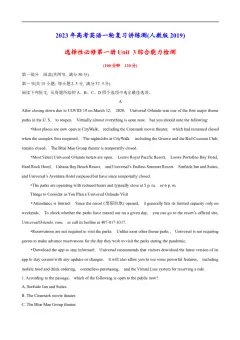
Our guide was excellent! He walked us through all the local villages and took extra time at the end to enjoy a
local dinner. He stayed with us longer than he was obliged(必要)to and made this a fantastic experience.
Tour snapshot
Travel is all about the street food these days, and why not? It’s fresh, fast, cheap and a great way to crack
into the local scene. Join this Hanoi tour to source the best street eats from markets, food carts, street cafés and
other hard-to-find-but-totally-worth-the-effort secret spots.
Highlights
Sample delicious Vietnamese cuisine just like the locals do—on the street.
Stroll through hidden alleyways and bustling markets of Hanoi’s charming old quarter.
Learn more about Hanoi’s unique food culture.
Try local specialties with influences from French and Chinese cuisine.
Take in a spectacular night view of Hoan Kiem lake from a secret café.
Schedule details
Duration: 2. 5 hours
Meeting point: Sacombank ATM Machine—No. 1 Dong Xuan street (front entrance of Dong Xuan Market,
Corner of Dong Xuan St. with Cau Dong St. )
Starting time: 5: 00 PM
Ending point: Café Pho Co-11 Hang Gai St. , Hoan Kiem
21. What did the guide do?
A. He showed visitors around by car.
B. He took many photos of visitors.
C. He stayed with visitors for extra time.D. He enjoyed breakfast with visitors.
22. What does the underlined word “snapshot” mean in the passage?
A. A photograph taken quickly and casually.
B. A brief impression of something.
C. An attempt to score in a game.
D. An act of firing a gun.
23. We can infer from the passage that the ending time of the tour is .
A. 5: 00 PM B. 5: 30 PM
C. 7: 05 PM D. 7: 30 PM
B
A British friend told me he couldn’t understand why Chinese people love eating sunflower seeds as a snack so
much. “I’ve met a lot of older Chinese and many have a crack in their front teeth, I believe that’s from cracking the
seeds, ” he said.
I had never noticed the habit, but once he mentioned it, I suddenly became more aware. I realized that
whenever I’m watching TV or typing a report, I always start mindlessly cracking sunflower seeds. My friend
doesn’t like sunflower seeds, and, to him, it seems unnecessary to work so much just to get one small seed.
When we were young, the whole family would usually get together for Chinese New Year. Then, we all lived
close to one another, usually in a small city, and sometimes even neighbors would go door-to-door on Chinese
New Year’s Eve to check out what every household was making.
I remember my parents would be in the kitchen cooking. Out in the living room, a large table would already
be laid out, complete with fancy tablecloth, ready-made dumpling fillings, and dishes full of candy, fruits and
sunflower seeds. Some of the dishes were to be offered to our ancestors later, while others were for neighbors and
children to eat before the evening feast. I must have learned how to crack sunflower seeds back then.
I don’t think it’s right to criticize one’s choice in food or eating habits, no matter how strange they may seem.
It’s not only in China. When I went abroad, I found people had all sorts of strange habits when it came to
food. In Denmark, they put salted red fish on bread and eat it for dinner, no matter how much it ruins your breath.
They think it’s a delicacy(美味佳肴), and it’s connected to their certain culture. I think it’s a wonderful tradition.
24. Why can not the British friend understand when he found Chinese love eating sunflower seeds?
A. Because the seeds are too hard to crack.
B. Because he thinks they are harmful to teeth.
C. Because he doesn’t think the seeds are good.D. Because he doesn’t think the seeds are worth eating.
25. What does the writer prove by mentioning Chinese New Year?
A. The families get together for it.
B. Eating sunflower seeds is related to it.
C. The traditions of celebrating it disappear.
D. Children can eat delicious food on that day.
26. What’s the writer’s attitude to Denmark’s way of eating bread?
A. Indifferent. B. Critical.
C. Understandable. D. Doubtful.
27. What idea does the writer want to express in this passage?
A. It is good to form healthy eating habits.
B. Eating habits come from a certain culture.
C. Changing your eating habits will change your life.
D. One kind of food doesn’t necessarily suit everyone.
C
In the first days after a team of 25 delivery robots landed on George Mason University’s campus in January,
they appeared to cause curious glances and many photos but not much else.
It was clear, officials said, that more time and more data would be necessary to understand whether the robots
would change the campus culture or become forgettable. Two months later, an extra 1, 500 breakfast orders have
been delivered autonomously, according to the technologists of Sodexo, a company that manages food service for
GMU and works closely with the robots.
Research has shown that up to 88 percent of college students skip breakfast, primarily because of lack of time,
but that number is starting to turn around when delivery robots arrive on campus. They’re constantly seen making
the 15-minute trip from campus restaurant to a handful of nearby dorms, as well as to other buildings across
campus, where students meet them. Two months later, breakfast has replaced dinner as the go-to meal for robot
delivery.
Sodexo officials have noted that college students are main users of food delivery apps and place a high value
on convenience and multiple options when they dine. During the morning hours, restaurant experts say, there is
generally more emphasis(强调)on speed than any other part of the day. Combine college students’ love of food
delivery with messy morning routines, and perhaps they have a perfect recipe for robots to deliver in the campus.
The robots also provide campus officials with valuable data showing how meal plans are being used, whichcould lead to changes in how the university serves students over time. Sodexo technologists also announced
Monday that a new team of more than 30 robots is launching at Northern Arizona University.
28. Why don’t most college students have breakfast according to the research?
A. They are on diets.
B. They have a tight schedule.
C. The food doesn’t agree with them.
D. GMU doesn’t offer delivery services.
29. What does the underlined word “they” in Paragraph 4 refer to?
A. College students. B. Campus officials.
C. College professors. D. Restaurant managers.
30. What do we know about the first 25 delivery robots?
A. They make timely deliveries.
B. They were ignored at first.
C. They mainly carry dinner at present.
D. They have changed the whole campus culture.
31. What’s the best title for the text?
A. Delivery services grow fast in college.
B. Breakfast in necessary for college students.
C. Robots help with GMU’s campus management.
D. Delivery robots are changing students’ eating habits.
D
It’s 3 o’clock and you’ve been hard at work. As you sit at your desk, a strong desire for chocolate overcomes
you. You try to busy yourself to make it go away. But it doesn’t. Here is another situation. Perhaps you are not
feeling well. The only thing you want to eat is a big bowl of chicken soup, like your mom used to make when you
were sick as a child. Food cravings are a strong desire for a specific type of food. And they are normal.
Scientists at the website How Stuff Works compare hunger and cravings this way. Hunger is a fairly simple
connection between the stomach and the brain. They even call it simply “stomach hunger”. When our stomachs
burn up all of the food we have eaten, a hormone (荷尔蒙) sends a message to one part of the brain for more
food, which controls our most basic body functions such as thirst, hunger and sleep. The brain then produces a
chemical to start the appetite (食欲) and you eat. Hunger is a function of survival.
A craving is more complex. It activates (刺激) brain areas related to emotion, memory and reward. These arethe same areas of the brain activated during drug-craving studies. Because of this, some scientists call food
cravings “mind hunger. ” People often crave foods that are high in fat and sugar. Foods that are high in fat or high
in sugar produce chemicals in the brain. These chemicals give us feelings of pleasure.
In a 2007 study, researchers at Cambridge University found that “dieting or controlled eating generally
increases the possibility of food craving. ” So, the more you refuse yourself a food that you want, the more you
may crave it. However, fasting is a bit different. They found that eating no food at all for a short period of time
reduced food cravings.
So, the next time you crave something very special, know that it’s the fault of your brain, instead of your
stomach.
32. The author describes two situations in the first paragraph to .
A. deepen the understanding of hunger
B. report the discovery of craving study
C. introduce the topic of the whole passage
D. remind readers of their own special food
33. What do we learn about food craving?
A. It shows food is connected with emotion.
B. It makes sure that a person survives hunger.
C. It means the stomach functions well.
D. It proves the brain decides your appetite.
34. What’s the likely result of dieting?
A. The drop of chemicals.
B. The increase of food desire.
C. The refusal of fat and sugar.
D. The disappearance of appetite.
35. In which part of a newspaper can you see this passage?
A. Education. B. Entertainment.
C. Science. D. Economy.
第二节(共5小题; 每小题2. 5分, 满分12. 5分)
阅读下面短文, 从短文后的选项中选出可以填入空白处的最佳选项。选项中有两项为多余选项。
Chopsticks Taboos: Unholy Ways to Pick Up Your Food
The use of chopsticks to pick food up from the plate will earn you several complements from Chinese people.But over time, once in a while your close friends might remind you about some basic chopsticks etiquette(礼节)
such as never insert chopsticks vertically(垂直地) into a bowl of rice. 36 , here are several rules to keep in
mind.
Do not use chopsticks of different lengths. This will remind people of a Chinese idiom “three long and two
short”, 3 7 , because a coffin without a lid is composed of five boards, three long, and two short.
Don’t use chopsticks to poke at each dish without knowing what you want or only one chopstick to fetch the
food in the plate.
3 8 . Chinese people believe that their ancestors are resting underneath the earth, and dropping chopsticks
would disturb them.
Don’t make noise with chopsticks by hitting the side of your bowl, 3 9 .
While passing someone a bowl of rice or noodles, never insert the chopsticks vertically in the middle of the
food for convenience. 4 0 .
A. Do not drop your chopstick on the floor
B. which is used as another name for coffin
C. because only beggars do that to get attention
D. If you want to master the art of using this old tool
E. In Chinese culture, the sign of crossing is negative
F. Do not drop food and liquid from your chopsticks to the table
G. The action would remind people of burning certain sticks in the pot in memory of the dead
第三部分 语言运用(共两节, 满分30分)
第一节(共15小题; 每小题1分, 满分15分)
阅读下面短文, 从每题所给的A、B、C、D四个选项中选出可以填入空白处的最佳选项。
I left my junior year confused, slightly out of touch with reality. Along with it, I had no clear idea of how to
41 my life. Due to this 4 2 , I made the decision to 4 3 the Georgetown Medical Institute, which is a
seven-day 44 that aimed to teach high school students about the medical field. Being 45 the ability to
learn and have exposure to something like this was really important for 4 6 from my state of confusion.
The seven-day course was fairly meaningful to my 47 . I had been 48 a career in the medical field
since I entered high school. 4 9 , I didn’t know what medical profession would actually be like. Attending this
institute placed me in an environment completely 50 from anything I had ever experienced. I was so 51
for all the information these people were willing to give. I was afraid to take my 52 off anyone. Everythingwas a 53 experience. Through this experience, however, I 54 that medical field was not what I
wanted. I wanted to 5 5 at school. I wanted to share knowledge with students and participate in their complete
communication. I wanted to be able to get more friends too.
41. A. make B. experience C. change D. predict
42. A. duty B. confusion
C. preparation D. direction
43. A. search B. design C. pass D. attend
44. A. course B. play C. race D. camp
45. A. denied B. hided C. reduced D. offered
46. A. moving forward B. looking around
C. coming along D. building up
47. A. study B. family C. career D. health
48. A. working B. interviewing
C. considering D. advertising
49. A. Therefore B. However
C. Finally D. Instead
50. A. separate B. safe
C. suffer D. absent
51. A. sad B. grateful
C. anxious D. responsible
52. A. ears B. legs C. hands D. eyes
53. A. training B. learning
C. observing D. exchanging
54. A. remembered B. explained
C. realized D. informed
55. A. teach B. cure C. record D. write
第二节(共10小题; 每小题1. 5分, 满分15分)
阅读下面短文, 在空白处填入1个适当的单词或括号内单词的正确形式。
As a country that pays great attention to good manners, the food culture is 56. (deep) rooted in
China’s history. As a visitor or guest in 57. a Chinese home or restaurant, you will find that table
manners are essential in our daily life!It is really an 58. (admire) custom to respect others at table, the aged, teachers and guests 59.
(include) while taking good care of children. Meanwhile, 60. practice of presenting the best or fine
food first to the senior members of the family has been observed for countless 61. (generation).
When hosts place dishes on the table, they will arrange the main courses at the center with the supporting
dishes evenly placed around 62. . When the main dishes 63. (prepare) in a decorative
form either by cut or other means, they will be placed 64. (face) the major guests and elder people at
the table, 65. also represents virtue(美德).
第四部分 写作(共两节, 满分40分)
第一节(满分15分)
假如你是李华, 你的新西兰笔友 Pal想学做一道中国传统美食, 参加学校即将举办的美食节(Food
Fair)。请你就此回复一封邮件, 内容包括名称及做法等。
注意:
1. 词数80左右;
2. 不得透露学校、姓名等任何个人信息。
第二节(满分25分)
阅读下面材料, 根据其内容和所给段落开头语续写两段, 使之构成一篇完整的短文。
A. J. shut the door of the truck. “Ready, ” he said. His dad started the truck. It was six o’clock and freezing,
but the strong morning sun promised warmer temperatures. It had been colder than normal over the past week, and
the ground and ponds were already frozen.
“After we check on the cows, ” Dad said, “you should have some time to practice roping cattle. ” A. J.
wanted to enter the rodeos (牛仔竞技表演) in which cowboys rode wild horses, and caught cattle with ropes.
The best professionals could break from the gate on horseback, rope a calf (小牛), and hog-tie (捆绑) the
calf in less than ten seconds. So far, A. J. needed nearly a minute and a half, but he’d only been at it for a few
months.
The truck bounced down the dirt road. In a few minutes, they passed through the field gate.
A. J. pulled a pair of telescopes. The black spots of cows on the far hill took shape. The cows gathered around
the pond. A. J. guessed they wanted the water locked under the ice. Suddenly, they heard extremely frightened
shouts from one cow. Dad stopped the truck, and he and A. J. stared at the frozen pond anxiously.A calf lay on the ice in the middle of the pond. A cow, no doubt the calf’s mother, stood onshore, shouting
desperately. The calf struggled to get up but slipped and fell each time.
The morning sun seemed warmer. Too warmer. A. J. knew that the situation was urgent. If the calf lay there
too long, she could fall through the ice and drown. Dad eased the truck down the hill and stopped at the edge of the
pond. “No telling how long she’s been there, ” he said. “The ice could be about to melt. I don’t think we can risk it.
” Dad shook his head, “It’s just not safe. ”
注意: 续写词数应为 150 左右。
A. J. watched the calf, whose eyes were wide with fear.
It would be just like rodeo practice, A. J. thought, trying to stay calm.
参考答案
第一部分 听力 (共两节, 满分30分)(略)
第二部分 阅读(共两节, 满分50分)
第一节(共15小题; 每小题2. 5分, 满分37. 5分)
阅读下列短文, 从每题所给的A、B、C、D四个选项中选出最佳选项。
A
【文章大意】本文是一篇应用文。文章讲述了我们在优秀导游的陪同下经历的一次美食之旅, 享受了当地
不同风格的食品, 欣赏了壮观的美丽夜景。
21. 【解析】选C。细节理解题。由第一段的内容(他带我们走遍了当地所有的村庄, 最后还花了些时间享
受当地的晚餐。他和我们在一起的时间比他被要求的要长, 这是一次奇妙的经历。), 可知导游多待了一段
时间来陪游客。故选C。
22. 【解析】选B。词义猜测题。由第二段(这几天的旅游都是街头小吃, 何乐而不为呢? 它新鲜、快捷、
便宜, 是一个很好的切入当地风景的方式。加入这次河内之旅, 从市场、食品车、街头咖啡馆和其他难以
找到但完全值得努力的秘密地点寻找最佳街头美食。)可知, 这几天的旅游都是关于街头食品的, 它是一种
新鲜、快速、廉价的进入当地生活的方式, 所以这段是指旅游的大体印象, snapshot在此处意为“对某事的简短印象”。故选B。
23. 【解析】选D。细节理解题。由 Schedule details部分, “Duration: 2. 5 hours”(持续时间: 2. 5小时)和
“Starting time: 5: 00 PM”(开始时间: 下午5: 00), 可知下午5点开始, 持续2. 5个小时, 所以结束的时间是
晚上7: 30。故选D。
B
【文章大意】本文是一篇夹叙夹议文, 用中国人喜欢嗑瓜子和丹麦人喜欢吃面包配咸红鱼来证明饮食习惯
来自特定的文化。
24. 【解析】选D。推理判断题。根据第二段最后一句(我的朋友不喜欢葵花籽, 对他来说, 似乎没有必要
为了得到一颗小种子而付出那么多的努力。)可知, 作者的外国朋友认为葵花籽不值得吃, 所以当这位英国
朋友发现中国人喜欢吃葵花籽时, 他并不理解。故选D。
25. 【解析】选B。推理判断题。根据第四段内容可知, 春节的时候桌子上会摆放很多美食, 其中就有瓜
子, 小孩在可以在年夜饭前吃, 作者就是在那时学会了嗑瓜子。由此可知, 作者提到春节是为了证明嗑瓜
子和春节有关, 故选B。
26. 【解析】选C。推理判断题。根据文章最后一句话可知, 作者认为丹麦人吃面包配咸红鱼是一个很好的
传统, 由此可知, 作者可以理解这种吃法, 故选C。
27. 【解析】选B。推理判断题。根据最后一段中的倒数第二句可知, 丹麦人认为这样吃面包是美味的,
这和他们的特定的文化有关, 正如作者喜欢嗑瓜子和春节文化有关, 由此可知, 作者想在这篇文章中表达
的观点是, 饮食习惯来自特定的文化, 故选B。
C
【文章大意】本文是一篇新闻报道。25个送餐机器人进驻乔治梅森大学后, 为很多大学生提供送早餐服务,
改变了他们因为忙碌而不吃早餐的习惯, 给他们紧张的生活带来了很多便利。
28. 【解析】选B。细节理解题。由第三段第一句(研究表明, 多达88%的大学生不吃早餐, 主要是因为时
间不够)可知, 大部分大学生不吃早餐是因为他们很忙, 时间很紧张, 故选B。
29. 【解析】选A。词义猜测题。根据第四段内容(索迪斯官员指出, 大学生是外卖应用程序的主要用户,
他们非常看重就餐时的便利性和选择的多样性。)以及“Combine college students’. . . campus(把大学生们对
外卖的热爱与他们忙乱的晨间生活结合起来, 或许他们有一个让机器人在校园里送餐的秘诀。)”可知, 虽然
早晨的时间很紧张, 但是有很多学生喜欢机器人送餐的方便快捷性, 因此推断出, 第四段中“they”, 指的是
大学生, 故选A。
30. 【解析】选A。细节理解题。根据第三段中的内容(研究表明, 多达88%的大学生不吃早餐, 主要是因
为时间不够, 但这一数字在送货机器人到达后开始好转。人们经常看到它穿梭在校园餐厅与附近的几个宿舍和其他建筑之间, 完成它长达15分钟的送餐旅途。)”可知, 25个送货机器人服务非常快, 故选A。
31. 【解析】选D。标题归纳题。由第三段的内容可知, 送餐机器人到达学校两个月后, 学生们不吃早餐的
现象获得了很大的改善, 早餐成了必备餐。可见, 大学生的吃饭习惯得到了改变。故选D。
D
【文章大意】本文是一篇说明文。本文主要介绍了饮食冲动的调查结果。食物与情感有关系, 节食的结果
会导致食物欲望的增加。
32. 【解析】选C。推理判断题。根据第一段最后一句可知, 第一段是为了引入整篇文章的话题。故选C。
33. 【解析】选A。推理判断题。根据第三段一、二句可知, 对食物的渴望是复杂的, 它刺激与情感、记忆
和奖赏有关的大脑区域。因此可知食物与情感有关系。故选A。
34. 【解析】选B。推理判断题。根据倒数第二段第一句可知, 在2007年的一项研究中, 剑桥大学的研究
人员发现“节食或限制饮食通常会增加对食物渴望的可能性”。故选B。
35. 【解析】选C。推理判断题。根据最后一段可知, 所以, 下次你想吃什么特别的东西时, 要知道你的大
脑比你的胃更应该受到责备。以及本文主要谈论饮食冲动的调查结果。由此可知, 本篇文章可能会出现在
报纸的科学版块。故选C。
第二节(共5小题; 每小题2. 5分, 满分12. 5分)
【文章大意】本文是一篇说明文。主要介绍了想要了解筷子这个古老用具的艺术, 就要了解使用它的一些
禁忌问题。
36. 【解析】选D。根据前文内容(你亲密的朋友可能会不时提醒你一些基本的筷子礼仪, 如永远不要把筷
子垂直插入一碗米饭。)可知, D选项中的this old tool指的是前文的chopsticks, 再根据句子结构可知, 此处
一定是一个从句, 空格后是主句: 牢记以下使用筷子的规则。下文主要介绍了使用筷子的一些禁忌, D项承
接下文, 故选D。
37. 【解析】选B。根据下文可知因为没有盖子的棺材是由五块板组成的, 由此得出B选项中的coffin和下
文相呼应, 故选B。
38. 【解析】选A。根据下文内容(中国人相信他们的祖先在地下休息, 掉筷子会打扰他们。)可知 , A选项
能作为主旨句来概括本段内容, 故选A。
39. 【解析】选C。根据上文内容(不要用筷子敲击碗的侧面发出声音)可知, 该句是主句部分, C选项是从句
部分, 另外C选项是用来解释其原因的, 故选C。
40. 【解析】选G。根据上文内容(当递给别人一碗米饭或面条时, 不要为了方便而把筷子垂直插在食物中
间。)可知, G选项中的the action指“把筷子垂直插在食物中间”这个动作, 且语义能承接上文, 故选G。
第三部分 语言运用(共两节, 满分30分)第一节(共15小题; 每小题1分, 满分15分)
【文章大意】本文是一篇记叙文。文章讲述了作者通过参加乔治敦医学院的课程找到了自己的发展方向和
人生目标的故事。
41. 【解析】选C。句意: 同时, 我也不清楚如何改变我的生活。由上文内容和“Along with it”可知, 作者
初中时很困惑, 不现实, 说明作者没有明确的人生目标, 而伴随困惑而来的是, 作者也不清楚如何改变自己
的生活。故选C。
42.【解析】选B。句意: 由于这种困惑, 我决定去参加一个为期七天的乔治敦医学院的课程, 这门课程旨在
向高中生传授医学领域的知识。由上文以及下文的“my state of confusion”可知, 作者对自己的人生感到困
惑。故选B。
43. 【解析】选D。由下一句可知, 作者参加了乔治敦医学院课程, 这个课程让作者从困惑中走了出来。故
选D。
44. 【解析】选A。由下文可知, 这种东西旨在向高中生传授医学领域的知识, 说明这是一门课程。故选
A。
45. 【解析】选D。句意: 被提供学习和接触这样的东西的能力对我从困惑状态中前进真的很重要。由上
文“which is a seven-day ”和空后内容可知, 这门七天课程提供给作者学习医学的能力。故选D。
46. 【解析】选A。句意: 被提供学习和接触这样的东西的能力对我从困惑状态中前进真的很重要。由下
文语境可知, 作者从困惑中走了出来, 有了确切的人生目标, 说明这门七天课程让作者在困惑中前进。故选
A。
47. 【解析】选C。句意: 七天的课程对我的职业生涯相当有意义。由下文可知, 作者从高中以来, 一直在
考虑在医学领域谋一份事业, 说明七天的课程对作者的职业生涯有很大影响。故选C。
48.【解析】选C。句意: 从我进入高中以来, 我一直在考虑在医学领域谋一份事业。由下文可知, 作者不知
道真正的医学行业是怎样的, 说明作者对医学行业概念还不清晰, 因此一直在考虑中。故选C。
49. 【解析】选B。句意: 然而, 我不知道真正的医学行业是怎样的。由上下文语境可知, 作者一直在考虑
在医学领域谋一份事业, 然而作者并不知道真正的医学行业是怎样的, 二者是转折关系, 应用However。故
选B。
50. 【解析】选A。乔治敦医学院的课程提供给作者学习医学领域知识的能力, 而这是作者在以前人生经历
中很少接触、难以学到的, 说明这门课程完全不同于作者以前所处的环境。separate from与……分开。故选
A。
51. 【解析】选B。由上文的“The seven-day course was fairly meaningful to my ”和下文内容可知,
七天的课程对作者的职业生涯相当有意义, 因此作者感激那些给予所有信息(知识)的人。故选B。52. 【解析】选D。由上文语境可知, 七天的课程让作者从困惑中走出来, 对作者的职业生涯相当有意义,
作者感激那些给予所有知识的人, 说明作者很重视这次学习, 不舍得把视线从任何教授医学知识的人的身
上移开, 以免错过学习医学知识的机会。故选D。
53. 【解析】选B。句意: 一切都是一次学习的经历。由上文语境可知, 作者很重视这次学习, 不敢把视线
从任何教授医学知识的人的身上移开, 以免错过学习医学知识的机会, 因此作者认为所接触的每一个事物
都是学习的经历。故选B。
54. 【解析】选C。句意: 然而, 通过这次经历, 我意识到医学领域并不是我想要的。由下文可知, 作者想
与学生分享知识, 参与他们的全面交流, 说明作者想当教师, 意识到医学领域并不是自己想要的。故选C。
55. 【解析】选A。句意: 我想在学校教书。由下文可知, 作者想与学生分享知识, 参与他们的全面交流,
说明作者想当教师。故选A。
第二节(共10小题; 每小题1. 5分, 满分15分)
【文章大意】本文是一篇说明文, 介绍了中国的一些餐桌礼仪。
56. 【解析】deeply。考查副词。句意: 作为一个注重礼仪的国家, 饮食文化深深植根于中国的历史。修饰
动词rooted用副词, deep和deeply都可作副词, 但前者表示空间的深度, 而后者常常带有感情色彩, 根据语
境可知此处应该用后者, 故填deeply。
57. 【解析】either。考查固定搭配。句意: 作为一个家庭访客或在餐馆用餐的顾客, 你会发现餐桌礼仪在
我们的日常生活中是必不可少的。根据空后的“a Chinese home or restaurant”可知此处使用either. . . or. . .
这一搭配, 表示“或者……或者……”, 故填either。
58. 【解析】admirable。考查形容词。句意: 在餐桌上尊重他人, 包括老人、老师和客人, 同时照顾好孩子,
这是一种很好的习俗。修饰名词custom用形容词, 表示“令人钦佩的, 极好的”, 故填admirable。
59. 【解析】included。考查独立主格。句意: 在餐桌上尊重他人, 包括老人、老师和客人, 同时照顾好孩
子, 这是一种很好的习俗。分析句子结构可知此处为“n. /pron. ”形式的独立主格结构, 表示“……也包括
在内”, 这一结构可当作固定用法来记忆, 故填included。
60. 【解析】the。考查冠词。句意: 与此同时, 先把最好的或精美的食物给年长的家庭成员的做法已经流
传了好多代。根据空后内容可知此处特指“先把最好的或精美的食物给家里的年长成员的这种做法”, 需
要用定冠词修饰, 故填the。
61. 【解析】generations。考查名词的数。句意: 与此同时, 先把最好的或精美的食物给年长的家庭成员的
做法已经流传了好多代。表示“一代人”时, generation是可数名词, countless修饰可数名词复数, 故填
generations。
62. 【解析】them。考查代词。句意: 当主人在餐桌上摆菜时, 他们会将主菜摆放在中央, 辅菜均匀地摆放在它们周围。根据“main courses”可知此处表示“它们”, 作介词around的宾语用宾格形式, 故填them。
63. 【解析】are prepared。考查时态和语态。句意: 当主菜被切成装饰性的形状或以其他方式准备好后, 就
会摆在主要客人和年长的人面前, 这也代表了美德。陈述的是客观事实, 主语main dishes与prepare之间是
被动关系, 所以用一般现在时的被动语态, 且主语为复数, 故谓语动词用复数, 故填are prepared。
64. 【解析】facing。考查非谓语动词。句意: 当主菜被切成装饰性的形状或以其他方式准备好后, 就会摆
在主要客人和年长的人面前, 这也代表了美德。分析句子结构可知, 句子的谓语是will be placed, 因此此处
为非谓语动词, they与face之间是逻辑上的主谓关系, 表示主动, 用现在分词作状语, 故填facing。
65. 【解析】which。考查非限制性定语从句。句意: 当主菜被切成装饰性的形状或以其他方式准备好后,
就会摆在主要客人和年长的人面前, 这也代表了美德。此处为非限制性定语从句, 关系词指代前面整个主
句内容并在从句中作主语, 故填which。
第四部分 写作(共两节, 满分40分)
第一节(满分15分)
【参考范文】
Dear Pal,
Glad to know that you’ll participate in your school’s Food Fair.
Do you think zongzi, one of Chinese traditional food is a good choice? It’s easy to make! First, soak rice in
water for 12 hours or so. Fold the boiled bamboo leaves and put rice in, with other ingredients such as meat, dates
and yolks in the center. Wrap the fillings up into a pyramid shape. Tie it with thread. Finally, immerse them in
water and boil 2 hours. The smell will make your mouth water.
Hope you’ll make it!
Yours,
Li Hua
第二节(满分25分)
【参考范文】
A. J. watched the calf, whose eyes were wide with fear. Though frightened, the calf gathered all her strength
to get up but slipped over and over again. Seeing the danger, the mother cow let out shouts with horror and cast
helpless glances at A. J. and his dad as if begging them for help. An atmosphere of sadness blanketing the whole
world, every nerve in A. J. ‘s body screamed at him that he must save the poor calf. All of a sudden, an idea came
into his mind like a flash.
It would be just like rodeo practice, A. J. thought, trying to stay calm. He rushed to the truck to grab the ropequickly, aimed it at the calf and let it go. Luckily, he made it at the first attempt! With palms sweating, he and his
dad struggled to pull the calf out of the frozen pond. After what seemed like a century, they managed to save the
calf. Seeing the calf running to her mother happily, A. J. felt comforted and glad that what he had learned helped
save a life.