文档文本内容
阅读理解+完形填空+语法填空
一、阅读理解
A
One morning, Ann’s neighbor Tracy found a lost dog wandering around
the local elementary school. She asked Ann if she could keep an eye on the
dog. Ann said that she could watch it only for the day.
Tracy took photos of the dog and printed off 400 FOUND fliers (传单),
and put them in mailboxes. Meanwhile, Ann went to the dollar store and
bought some pet supplies, warning her two sons not to fall in love with the
dog. At the time, Ann’s son Thomas was 10 years old, and Jack, who
was recovering from a heart operation, was 21 years old.
Four days later Ann was still looking after the dog, whom they had
started to call Riley. When she arrived home from work, the dog threw itself
against the screen door and barked madly at her. As soon as she opened the
door, Riley dashed into the boys room where Ann found Jack suffering a
heart attack. Riley ran over to Jack, but as soon as Ann bent over to help
him the dog went silent.
“If it hadn’t come to get me, the doctor said Jack would have died,”
Ann reported to a local newspaper. At this point, no one had called to claim
the dog, so Ann decided to keep it.
The next morning Tracy got a call. A man named Peter recognized his
lost dog and called the number on the flier. Tracy started crying, and told
him, “That dog saved my friends son.”
Peter drove to Ann’s house to pick up his dog, and saw Thomas and
Jack crying in the window. After a few moments Peter said, “Maybe Oldie
was supposed to find you. Maybe you should keep it.”
1. What did Tracy do after finding the dog?
A. She looked for its owner.
B. She gave it to Ann as a gift.
C. She bought some food for it.
D. She sold it to the dollar store.
2. How did the dog help save Jack?
A. By pulling Jack out of the room.
B. By leading Ann to Jacks room.
C. By breaking the door for Ann.D. By attending Jack carefully.
3. What was Ann’s attitude to the dog according to Paragraph 4?
A. Supportive. B. Forgiving.
C. Worried. D. Grateful.
4. Why did Peter call Tracy?
A. To interview her. B. To help her friends son.
C. To take back his dog. D. To return the flier to her.
B
After Bernini broke his neck and lost all movements below his shoulders
when he was 18, his brain still told his hands how to move—but the
message couldn’t get through the injured part that connects his brain to other
parts of his body. Now, thanks to recent advances in electrical stimulation
(刺激) technology. Bernini can once again grasp, pour, and even play
Guitar Hero. To do so, he uses a micro-electrode array (MEA) that
reads his brains signals and sends them through wires to something like a
sleeve on his arm that electronically stimulates his muscles (肌肉).
In the past years, researchers have used several approaches to guide
patients like Bernini to move their hands. In some systems, researchers
implanted (植入) sensors in shoulder muscles that patients could still
control, allowing them to move one hand by contracting muscles in the
opposite shoulder. Other systems use brain implants similar to those in the
new study, but to control robotic arms, rather than the patient’s own
muscles. But never before has a patient been able to precisely move his
hand using the same neural (神经的) signals that controlled his hand
before his injury.
After implanting the MEA in Bernini’s brain, researchers connected it to
a computer. Bernini trained the system to connect patterns of neural signals
to specific movements by repeatedly mirroring the movements of an
imaginary hand on a computer screen. Soon, Bernini could hold large
objects like glasses and lift small objects like straws. He could also move
each finger on his own just by thinking about it, which previous systems
had never achieved. And it was absolutely an amazing moment.
5. How is Bernini now?
A. He has got over his neck injury.
B. He does well in playing the guitar.C. His brain can control his hand movements.
D. His shoulder muscles guide his hand movement.
6. What did researchers want to do through brain implants in the past?
A. Control the patient’s hands.
B. Guide robots to help patients.
C. Help patients own muscles contract.
D. Repair patients injured neural signals.
7. What is the breakthrough in Bernini’s case compared with previous
studies?
A. He can hold and lift objects.
B. He can move each finger independently.
C. He can recognize his specific movements.
D. He can use neural signals for hand moving.
8. What should be the best title for the text?
A. Using New Systems for Muscle Injuries
B. Moving Hands by Contracting Muscles
C. Connecting Thoughts to Movements
D. Sending Neural Signals by Wires
C
Think about the last time you felt afraid. Was it a fear of height? Did you
oversleep on a weekday and fear you’d get into trouble at the office? In any
case, you know what it feels like to feel fear.
But one woman doesn’t. The woman, code-named “UM”, gave her
first-ever interview after years of being studied by a team of researchers. The
woman is given a code name because the researchers want to protect her
from anyone who would take advantage of her inability to feel afraid.
UM can’t tell you what fear is because she’s never experienced it. “I
wonder what it’s like to actually be afraid of something,” she said. The
formal name for the disease is Urbach-Wiethe disease, which is
characterized by a hoarse (粗哑的) voice, small bumps around the
eyes, and calcium deposits in the brain.
In the case of UM, the disease has transformed the part of her brain
that controls the human response to fear. In the interview, UM talks about
an event in her life where she was held at knifepoint and gunpoint, “I was
walking to the store, and I saw a man on a park bench. He said, ‘Comehere, please. So I went over to him. He grabbed me by the shirt, put a
knife to my throat and told me he was going to cut me. I told him, ‘Go
ahead and cut me. I wasn’t afraid at all. And for some reason, he let me
go.”
Doctors who have been studying UMs condition for years have been
trying different things that could strike fear into her. They finally figured
something out—increasing UMs carbon dioxide levels. Extra carbon dioxide
concentration in the blood is known to cause fear and panic in health
individuals. Increasing UMs carbon dioxide levels did manage to give her a
fright.
10. Why does the writer ask the questions in Paragraph 1?
A. To start a discussion. B. To tell what fear is.
C. To introduce the topic. D. To talk about an idea.
11. Why is the woman with Urbach-Wiethe disease given a
code name?
A. To ensure her safety.
B. To respect her privacy.
C. To meet the researchers demands.
D. To tell her case from other patients.
11. From UMs case, we can know that Urbach-Wiethe disease may
___ .
A. lead to an increase in carbon dioxide
B. lead to a decrease in calcium deposits
C. stops the brain from responding quickly
D. stops the brain from functioning normally
12. What happened to UM according to the last paragraph?
A. She got the sense of panic.
B. She spoke with a hoarse voice.
C. She experienced another danger.
D. She died of the Urbach-Wiethe disease.
二、完形填空
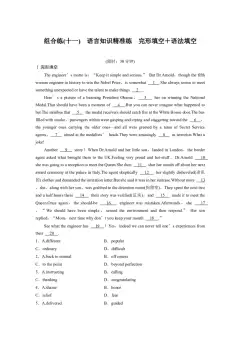
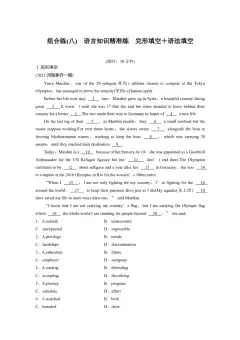
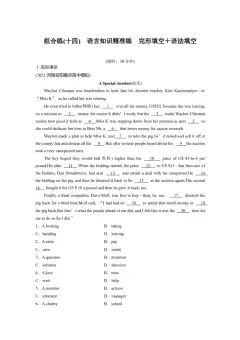
I am an American living in France for twenty years. I used to complain
about how the French were 1 for friendship. I had a(n)2 time making a
living here.When I came I felt a need to meet people, 3 I went to the cinema night
for women’s day. I was excited about the way to connect with French women
through the 4 we would have after the film, perhaps to make friends and
get more chance of 5 .
Outside the cinema was a woman with long gray hair who had a slightly 6
smell and was asking for money. I 7 my wallet to give her a Euro and then
something made me stop and enter into 8 with her. I said, “Look,
people are seeing a film that could 9 your life. I would rather buy you a ticket
than give you money.”
So she came in,10 behind me because she said people 11 the theater
didn’t like her. She sat next to me in the cinema. Then I noticed some women
were looking at me, with expressions of 12 .
I encouraged the woman to come the following night to the event. I 13
her to an agency that helped women in her 14 . Then, a woman came
towards me and said, “Did you buy a ticket for the woman?” When I
said yes, she said, “Please come to the community center to 15 other
employees there.”
This was the 16of a deep friendship and colleague relationship. The
woman I took to the 17 that night was not 18 . Actually, she was a
secretary and spoke English.
For me, though, she was more than my angel. I made a great friend
19 reaching out to her, also got a great job, and 20 myself of many
previous negative judgments about the French.
1. A. suitable B. unavailable C. comfortable D. accessible
2. A. easy B. simple C. good D. hard
3. A. still B. so C. though D. but
4. A. argument B. mystery C. discussion D. revision
5. A. work B. income C. friendship D. help
6. A. strong B. delicious C. sweet D. strange
7. A. looked up B. put away C. handed out D. reached for
8. A. conversation B. research C. assistance D. disagreement
9. A. protect B. lead C. change D. challenge
10. A. watching B. stepping C. hiding D. waiting
11. A. creating B. running C. noticing D. building
12. A. pride B. surprise C. excitement D. disappointment
13. A. directed B. invited C. drove D. pushed14. A. name B. place C. situation D. honor
15. A. introduce B. hire C. train D. meet
16. A. result B. end C. beginning D. case
17. A. agency B. cinema C. restaurant D. shop
18. A. homeless B. alone C. wealthy D. dirty
19. A. beyond B. except C. through D. from
20. A. warned B. reminded C. thought D. rid
三、 语法填空
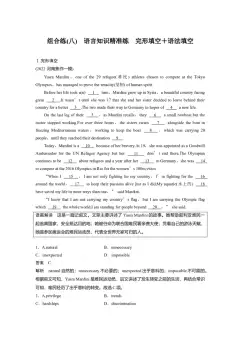
Last Monday, my father would be on a business trip for five days.
Having gotten my promise of taking care of my mother, he put his luggage
into the trunk of his car. 1 (see) my father was driving away, my
mother and I waved our 2 (hand) and said goodbye to him. For a
moment, I began to miss my father, wishing that he 3 (be) safe and
well in the next few days.
Yet, unfortunately, my mother 4 (catch) a cold the next morning.
Looking at her pale face, I experienced high levels of anxiety. However, I
told myself 5 (calm) down and look after my mom, 6 I promised to my
dad. The moment I got my mom to sleep, I put cold towel on her
forehead, found pills in the medicine box, and made some noodles for
her. 7 (lucky), she woke up and felt 8 (good) after taking the pills
and the noodles, which satisfied me a lot.
In the next four days, I was taking her body temperature twice a day,
ensuring that she was completely well. 9 our delight, my dad got back
home safely and healthily on Saturday. On hearing 10 I had done to my
mom, he, as well as my mom, looked at me and gave me a big thumb.
1. 2. 3. 4.
5. 6. 7. 8.
9. 10.
阅读理解
A: 1—4 ABDC
B: 5—8 CABC
C: 9—12 CADA完形填空
1—5 BDBCA 6—10 ADACC
11—15 BBACD 16—20 CBACD
语法填空
1. Seeing 2. hands 3. would be 4. caught 5. to calm
6. as 7. Luckily 8. better 9. To 10. what