2025届高三英语高考模拟风向标卷02(新高考I
卷)
(时间:120分钟;满分:150分)
注意事项:
1.答卷前,考生务必将自己的姓名、考生号等填写在答题卡和试卷指定位置上。
2.回答选择题时,选出每小题答案后,用铅笔把答题卡对应题目的答案标号涂黑。如
需改动,用橡皮擦干净后,再选涂其他答案标号。回答非选择题时,将答案写在答题卡上
写在本试卷上无效。
3.考试结束后,将本试卷和答题卡一并交回。
第一部分 听力(共两节,满分 30 分)
第一节(共5小题;每小题1分,满分5分)
听下面5段对话。每段对话后有一个小题,从题中所给的A、B、C三个选项中选出最佳选
项。听完每段对话后,你都有10秒钟的时间来回答有关小题和阅读下一小题。每段对话仅
读一遍。
1.What are the speakers talking about?
A.A lecture. B.Some countries. C.Traditional customs
2.When is the project supposed to be finished?
A.At 12 o’clock. B.At 11 o’clock. C.At 10 o’clock.
3.What does the woman advise the man to do?
A.Do some exercise. B.Finish his work. C.Go to sleep.
4.Where does the conversation probably take place?
A.In a gym. B.At school. C.At home.
5.How does the woman suggest the man keep warm?
A.By turning on the heat. B.By sitting in the sun. C.By wearing thick clothes.
听下面一段较长对话,回答以下小题。
6.Why does the man talk to Sarah?
A.To ask for information. B.To extend an invitation. C.To make an appointment.
7.When is the man scheduled to meet the HR department?
A.This afternoon. B.Tomorrow morning. C.Next Monday afternoon.
听下面一段较长对话,回答以下小题。
8.What does the woman think of the catalogue?A.It is useless. B.It is detailed. C.It is simple.
9.What is the man satisfied with about the exhibition?
A.Its use of natural light.
B.Its supply of energy drinks.
C.Its gift of free catalogues.
10.What surprised the man a lot?
A.The artworks were disappointing.
B.Few visitors came to the exhibition.
C.The weather was pleasant.
听下面一段较长对话,回答以下小题。
11.What is the relationship between the speakers?
A.Neighbors. B.Co-workers. C.Schoolmates.
12.From which place did Christina move?
A.Nebraska. B.Washington. C.Texas.
13.What is Bryce’s real interest?
A.Drawing. B.Teaching. C.Making furniture.
听下面一段较长对话,回答以下小题。
14.What kind of volunteer work is Jason interested in?
A.Sports events. B.Social media. C.Dog rescue.
15.Why is Jason unable to volunteer for the organization at the moment?
A.For his lack of experience. B.For his young age. C.For
his busy schoolwork.
16.What is the woman?
A.A marketing manager. B.A businessman. C.A volunteer.
听下面一段独白,回答以下小题。
17.Who probably are the listeners?
A.Company employees. B.High school students. C.University seniors.
18.What does the speaker say about interviewing?
A.It requires a little talent.B.It needs some practice. C.It can improve skills.
19.What is the speaker’s first suggestion?
试卷第2页,共13页A.Being confident.
B.Contacting potential employers.
C.Writing a solid résumé.
20.What does the speaker ask the listeners to take?
A.A list of possible questions.
B.A notebook with interview skills.
C.An overview of their background.
第二部分 阅读(共两节, 满分50分)
第一节(共15小题:每小题2.5分, 满分37.5分)
阅读下列短文, 从每题所给的A、B、C、D四个选项中选出最佳选项。
A
At Ynez Library, we are champions of curiosity. At its core, our mission for nearly four
centuries has been to advance the learning, research, and pursuit of truth. Our efforts are motivated
and powered by working collaboratively, embracing diverse perspectives, championing access,
aiming for the extraordinary, and always leading with curiosity.
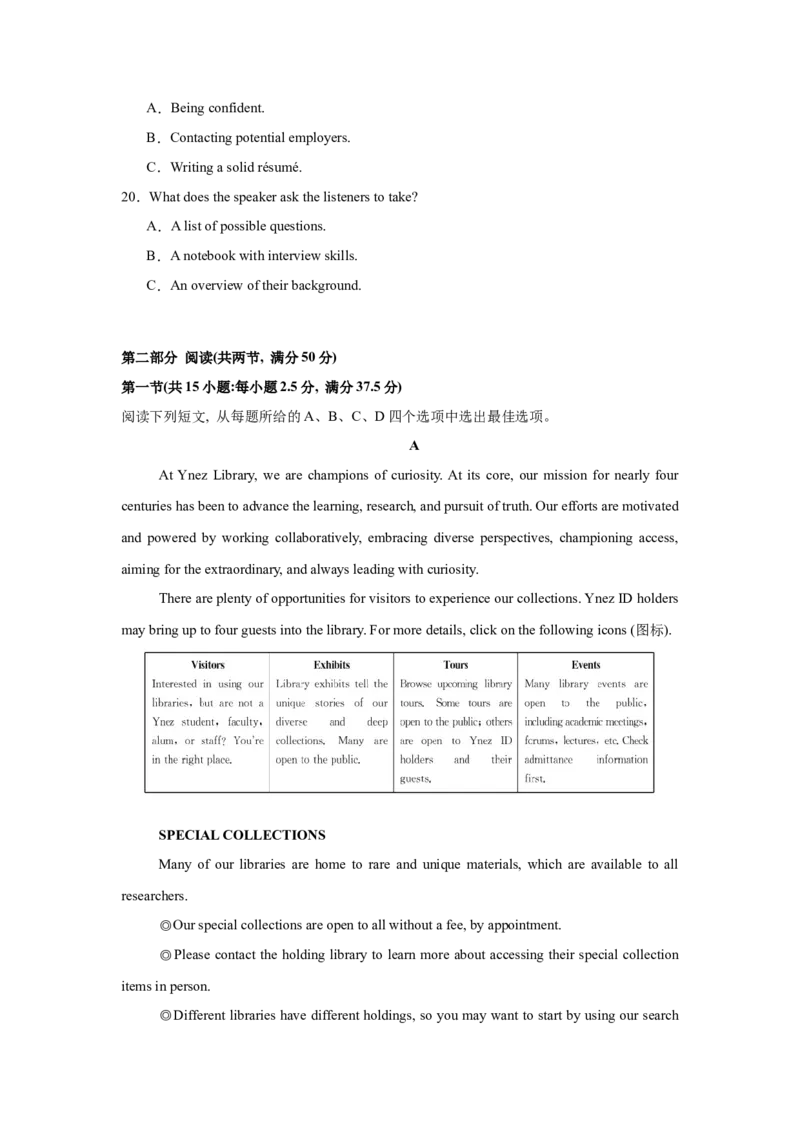
There are plenty of opportunities for visitors to experience our collections. Ynez ID holders
may bring up to four guests into the library. For more details, click on the following icons (图标).
SPECIAL COLLECTIONS
Many of our libraries are home to rare and unique materials, which are available to all
researchers.
◎Our special collections are open to all without a fee, by appointment.
◎Please contact the holding library to learn more about accessing their special collection
items in person.
◎Different libraries have different holdings, so you may want to start by using our searchtools to find materials relevant to your research.
21.What does Ynez Library highlight in the first paragraph?
A.Its best achievements. B.Its new changes.
C.Its main values. D.Its working principles.
22.Which part should a person click on if he plans to attend a scientist’s speech?
A.Visitors. B.Exhibits. C.Tours. D.Events.
23.How can a researcher find the special holdings quickly in the library?
A.By appointing a librarian. B.By locating them online.
C.By visiting main libraries. D.By paying a special fee.
B
The ten-car subway train was adorned at the end of June in a tunnel in Queens. The artists
appeared to use paint rollers to cover it along one side, from top to bottom, in an awful shade of
pink with a brown line.
Tagging (涂鸦) a train is often less about the art and more about the prize of marking
something that involves risk and echoes the original graffiti writers, who blanketed subway trains,
including the windows and seats inside, in the 1970s and 1980s.
“Modern graffiti began in Philadelphia in the 1960s. But it became an art form in New York
City,” says Eric Felisbret, author of “Graffiti New York”. “Graffiti benefited from the popularity
of hip-hop globally,” says Mr Felisbret. “Out of all the elements of hip-hop, graffiti is by far the
most rebellious...Back then, all graffiti was illegal.”
In 2020 the Metropolitan Transportation Authority (MTA), which runs the subway, spent
$1.2m on cleaning. By the end of May 2022 it had already spent $1.1m. In all of 2021, 681
subway cars were “ruined”. This year more than 700 cars have been. More than one in ten subway
cars had to be taken out of service for cleaning.
The recent spike in subway graffiti activity parallels the lifting of travel restrictions. The
graffiti on trains usually gets cleaned or hidden quickly, so artists post images of their work on
social media. Sharif Profit, who organises the annual Graffiti Hall of Fame in Harlem, says he can
always tell when the work is by someone from another country: “It is not on the same level.”
Tagging on the subway is dangerous. The live third rail is lethal (致命的) and he tunnels
试卷第4页,共13页are dark. Trains can appear with little warning, so trespassers (不法进入者) may have no way of
avoiding them. Two French graffiti artists were killed by a train in Brooklyn in April. “As soon as
I heard where the bodies were found, I knew they were taggers,” says Mr Felisbret.
The MTA removes any tagged train so as to avoid encouraging other people. Passengers
then have to wait longer. That was the case recently, says Richard Davey, head of the MTA’s New
York City Transit system, when eight trains were ruined. The resulting delays affected thousands
of commuters. “It’s our goal to make sure we don’t return to the 1970s,” he says, “whether it’s in
our stations or on our cars.”
Graffiti on the subway began to die out in the late 1980s. One former graffiti writer said it is
almost shocking to see tagging there now.
24.Why do graffiti artists tag a subway train?
A.For the prize of art competition.
B.To imitate the early graffiti creators.
C.To express their dissatisfaction with society.
D.In pursuit of artistic beauty.
25.What does the underlined word “spike” mean in Paragraph 5?
A.pause B.drop C.participation D.increase
26.Why is Mr Felisbret cited in Paragraph 6?
A.To demonstrate the risk of tagging underground.
B.To emphasize the devotion of tagging artists.
C.To give an introduction of New York tunnels.
D.To show his sorry for the loss of tagging artists.
27.What do we learn about tagging from the text?
A.It helps people better understand the world.
B.Modern graffiti was at its peak in the 1970s.
C.It has brought inconvenience to commuters.
D.It is embraced by a majority of artists now.
C
In the last two years, tennis has taken over our closets, our screens and now — our living
rooms, furniture from thrown tennis balls.At least that is the hope of Belgian eco-designer Mathilde Wittock, who fashions furniture
from thrown tennis balls. Wittock’s chase longues (躺椅) are entirely cushionless — save for the
filling of 500 precisely arranged tennis balls. Her one-meter-long benches are similarly few and
far between, with some 270 balls being both stylish and structurally substantial.
Around 300 million tennis balls are produced each year — and almost all of them end up in
landfills, taking over 400 years to decompose (分解). Wittock estimates the lifecycle of a ball
stands at just nine games, depending on the level of tennis being played.
It takes Wittock around three to four weeks to build a chair. Every ball is cut and dyed by
hand, with colors picked out especially to fit the client’s space. It was through much trial and error
that she was able to use the shape of the ball while masking some of its all-too-easily- recognized
features. “I needed to find an assembly that changed the iconic appearance of the tennis balls,” she
said. “It’s yellow and has these white lines. How do I deal with them?”
Wittock started to see the design’s possibilities of the sporting equipment when she was
studying at Central Saint Martins, an art school in London. Today, she receives all her materials
via donations from tennis clubs. Collections began small — sometimes with just 10 tossed balls at
a time — but quickly grew. Now, Wittock works with the Federation of Wallonia in Brussels, who
have offered her their entire stock — around 100,000. How long will it last? “It’s enough for a few
months,” she said. “If things get wild, maybe it will last nine months. Because I have a rhythm of
cutting tennis balls. I can get through 1,800 per week.”
28.Why are the numbers listed in paragraph 2?
A.To highlight a waste. B.To promote a product.
C.To state the material of furniture. D.To show tennis’ popularity.
29.What function does paragraph 3 act as?
A.A background. B.An example. C.A definition. D.A proof.
30.What does Wittock have to do to handle the thrown tennis balls?
A.She cleans them cleverly. B.She asks her friends for help.
C.She uses their characteristics. D.She adjusts their colors accordingly.
31.What is the last paragraph mainly about?
A.Wittock’s work plans. B.Wittock’s stuff sources.
C.Wittock’s pride in profits. D.Wittock’s education experience.
试卷第6页,共13页D
Environmental DNA (eDNA) has become a crucial tool in ecological research over recent
years. By analyzing water, soil, or other environmental materials for DNA pieces, researchers can
tell that thousands of different species have been in an area without having to observe the actual
species passing through.
To date, this eDNA process has mostly been employed to detect marine (海洋的) creatures,
insects, and other wildlife. However, according to a paper published in Nature Ecology &
Evolution, this technique could just as easily be applied to spot humans.
An international team of researchers based at the University of Florida, USA, demonstrated
that human genomic (基因组的) information can be easily detected in eDNA samples collected
from water, sand, and even the air. While this capability could have practical applications, such as
aiding in the search for missing persons or monitoring public health, the researchers highlight
significant moral concerns. These concerns include the lack of agreement from individuals for
their DNA to be collected, potential breaches ( 侵 犯 ) of privacy, and the risk of genetic
information being used for commercial purposes.
This issue is particularly challenging for the field of eDNA, which relies on open and easily
accessible data. “It is standard practice in science to make these data publicly available. However,
this also means that if human information is not screened out, anyone could access this
information,” says senior author Professor David Duffy, a wildlife disease genomics researcher at
the University of Florida. “This raises issues around permission. Do we need to ask permission to
collect these samples? Should we bring in some controls to remove human genetic data?”
“Whenever we make a technological advancement, there are both beneficial and concerning
potential uses. This situation is no different,” Duffy explains. “We are raising these issues early so
that policymakers and society have adequate time to develop suitable guidelines.”
32.What is the primary use of eDNA in ecological research?
A.Identifying species present in an area. B.Monitoring species evolution processes.
C.Improving living conditions for wildlife.D.Sampling insects directly in their habitats.
33.Why is the accessibility of eDNA data a potential problem?
A.It ignores practical applications of eDNA data.B.It may lead to unchecked genetic engineering.
C.It could result in misuse of human genetic data.
D.It raises concerns about wildlife disease research.
34.What does Duffy suggest people concerned do?
A.To develop potential applications. B.To sample genetic information.
C.To highlight advanced technology. D.To establish appropriate regulations.
35.What is the best title for the text?
A.eDNA: A New Frontier in Ecological Monitoring
B.eDNA: Human Detection Meets Privacy Challenges
C.eDNA: A Breakthrough in Marine Research Techniques
D.eDNA: Transforming Our Comprehension of Biodiversity
第二节(共5小题:每小题2. 5分, 满分12. 5分)
阅读下面短文, 从短文后选项中选出可以填入空白处的最佳选项。选项中有两项为多余选
项。
British libraries are in crisis—again. The UK has lost one in 20 since 2016, with 180 closed
in that time, a BBC investigation has revealed. The most disadvantaged areas are around four
times more likely to lose a library than the richest. 36
As the educational achievement gap between children from the richest and poorest
backgrounds has grown post-COVID, the role that libraries can play in improving the ability to
read and stimulating a love of reading couldn’t be more vital. 37 The Children’s
Laureate (荣誉获得者), Frank Cottrell Boyce, stressed their importance for “human contact”. His
mother used the library as an escape from their limited Liverpool home. For others, it is a shelter
from bullying, as one reader told the Guardian.
38 The activities offer desperately needed company to isolated parents, as well as
inspirations for children. What’s more, if you don’t have access to the Internet or a printer, if you
struggle with English or can’t keep warm in winter, libraries are not simply somewhere to borrow
books. 39 Above all, homelessness, loneliness, mental health, childcare costs, illiteracy
and health education are also some of the challenges that libraries help to deal with as other basic
public services have disappeared.
试卷第8页,共13页Despite all these benefits, funding for libraries is never a priority, defeated by the more
urgent demands of healthcare and schools. 40 Campaigners are trying to put emphasis
on that message before it is too late. One thing libraries don’t need is more words. They need on-
going and considerable funding.
A.What can you do to help to reopen the libraries?
B.But concerns about their long-term future remain.
C.But it is not just books that make them magical places.
D.Meanwhile, funding for libraries has halved since 2010.
E.You can even spend a whole day there without buying a cup of tea.
F.However, properly resourced, they can help relieve the pressures on both.
G.Where else can you find craft workshops, Lego, and author events, all for free?
第三部分语言运用(共两节,满分30分)
第一节(共15小题:每小题1分,满分15分)
阅读下面短文, 从每题所给的A、B、C、D四个选项中选出可以填入空白处的最佳选项。
When Marion Sheppard was unable to see in her 40s, she cried. Wasn’t it enough that she’d
been partly deaf since childhood? That 41 and the prejudice that usually came with it
didn’t defeat her, but made her 42 .
Sheppard had always been an enthusiastic 43 since childhood, but now she was so
scared that she 44 left her apartment. She worried about the way she would 45 to
the world. Hard as it was, Sheppard later 46 herself to go out. She attended a social event
for people like her, and was astonished to find that those people barely moved. They all just sat,
still and withdrawn.
At 61, Sheppard attended a camp organized by Visions for 47 people, where she
taught her first dancing class. She 48 to teach her class there after that. But she was 49
. She soon convinced Visions to let her teach on a 50 basis. About four years later, her
classes won so much popularity that Visions hired her to be on staff. Sheppard’s students were
mostly seniors whose eyesight had 51 as adults. With confidence-building praise,
Sheppard also 52 dignity and independence into them. Students got to be themselves
without feeling controlled by 53 in her classes, taking turns to perform in the center of
the group as the others cheered them on.As a way to combine movements with her faith, Sheppard 54 a group called The
Blind Sisterhood. What’s her 55 for maintaining both physical and mental health
despite barriers life throws at her? “Keep it moving!”
41.A.comment B.separation C.struggle D.sympathy
42.A.different B.tough C.tolerant D.sensitive
43.A.volunteer B.camper C.actor D.dancer
44.A.simply B.rarely C.randomly D.occasionally
45.A.sound B.relate C.appear D.reply
46.A.forced B.reminded C.prohibited D.expected
47.A.deaf B.blind C.young D.sick
48.A.guaranteed B.prepared C.plotted D.applied
49.A.interrupted B.evaluated C.declined D.abandoned
50.A.temporary B.regular C.weekly D.voluntary
51.A.recovered B.worsened C.improved D.returned
52.A.drilled B.changed C.integrated D.divided
53.A.difficulty B.depression C.disability D.judgement
54.A.set up B.opened up C.took on D.put on
55.A.initiative B.wish C.push D.recipe
第三部分语言运用(共两节,满分30分)
第二节(共15小题:每小题1分,满分15分)
阅读下面短文,在空白处填入1个适当的单词或括号内单词的正确形式。
On February 20, leading Chinese e-commerce platform JD.com reported that sales of
traditional Hanfu clothing had surged over 300 percent year on year since January. This trend was
mirrored on Taobao, 56 over the Double 11 shopping festival sales topped 730,000
units. Sales and search data signal a widespread and growing 57 (fascinate) with
traditional Chinese clothing styles.
The horse face skirt is a traditional Chinese skirt 58 (feature) a distinct pleated
(有褶的) design. It is 59 (occasional) referred to in a more generic sense as an apron.
This type of skirt is 60 key component of Hanfu, serving as a lower garment (衣服). It
试卷第10页,共13页is 61 (celebrate) as one of the most emblematic styles of ancient Chinese skirts,
showcasing a rich cultural heritage through 62 (it) unique appearance and historical
significance.
Influencers and content creators play a significant role in promoting Hanfu and fostering a
sense of community. To date, the horse face skirt on Douyin 63 (attract)more than 17.6
billion views across related topics and short videos. Meanwhile, on Xiaohongshu, 64
(search) for the same term have resulted in over 880,000 posts.
What the horse face skirt’s popularity reflects is the growing appetite for Hanfu-inspired
designs as well 65 a deeper cultural revival for classical Chinese aesthetics.
第四部分 写作(共两节, 满分40分)
第一节(满分15分)
66.假如你是李华,是学校诗歌社团的负责人。你校美国交换生Tom发邮件想加入该社团,
请你给他回复,包括以下内容:
1. 介绍诗歌社团;
2. 近期的活动安排;
3. 表示欢迎。
注意:1. 词数100字左右;
2. 可适当增加细节,以使行文连贯。
Dear Tom,
I’m delighted to know that you want to join our Poem Group.
_______________________________________________________________________________
_______________________________________________________________________________
_______________________________________________________________________________
_______________________________________________________________________________
_______________________________________________________________________________
_________________________________________________________________
Yours,
Li Hua第二节(满分25分)
67.阅读下面材料, 根据其内容和所给段落开头语续写两段, 使之构成一篇完整的短文。
If I hadn’t been a failed violinist I might never have become a writer.
When I was in fourth grade, the public school I attended had a coveted orchestra program. I
signed up to learn the violin, along with my friend Irene Cervantes. We were both obsessed with
the violin and the prospect of being in the orchestra. Every week, Irene and I walked together
through our working-class neighborhood to our before-school music lessons, proudly holding our
black violin cases.
Mr. Baumgartner, the orchestra teacher, was very strict. He emphasized that if anything
happened to the instrument we played we’d be cut from the program because the school could not
afford to replace it. We all understood.
I wasn’t very good at the violin. No matter, destiny intervened and the terrible thing
happened: I was practicing at home when the bridge popped off my violin and flew across the
room, the strings collapsing before my eyes.
Terrified of Mr. Baumgartner’s reaction, and having no idea this was a common violinist’s
mishap (because the bridge is held in place by the tension of the strings), I tried to fix it. I tiptoed
into the garage and secured the bridge back in place with globs of an unfamiliar glue, making sure
it would never, ever, pop off again. It was only slightly crooked. I prayed that Mr. Baumgartner
wouldn’t notice.
Of course, he did. And when I saw the color drain from his face, I knew my fate was sealed.
Sadly, he patted me on the back and told me that maybe I could join the orchestra next year. When
I cried, he suggested that I join singing club, which often sang during assemblies with the
orchestra.
I did switch to singing club, where I stayed, thinking I’d found my place. As luck would
have it, the elementary school glee club automatically fed into the junior high chorus. Instead of a
violinist, I would be a singer in an orchestra of voices. Don’t be confused. I didn’t have a good
voice, but in the midst of so many others, I could blend.
注意:
(1)续写词数应为150个左右;
试卷第12页,共13页(2)请按如下格式在答题纸的相应位置作答。
One Monday after a big performance, my English teacher asked if anyone was interested in
writing an article about his/ her singing experience.
_______________________________________________________________________________
_______________________________________________________________________________
_______________________________________________________________________________
_______________________________________________________________________________
_______________________________________________________________________________
_______________________________________________________________________________
_
I saw Irene Cervantes years later at a high school reunion.
_______________________________________________________________________________
_______________________________________________________________________________
_______________________________________________________________________________
_______________________________________________________________________________
_______________________________________________________________________________
_______________________________________________________________________________
_