2025届高三英语高考模拟风向标卷02(山东专用)
注意事项:
1.答卷前,考生务必将自己的姓名、考生号等填写在答题卡和试卷指定位置上。
2.回答选择题时,选出每小题答案后,用铅笔把答题卡对应题目的答案标号涂黑。如
需改动,用橡皮擦干净后,再选涂其他答案标号。回答非选择题时,将答案写在答题卡上
写在本试卷上无效。
3.考试结束后,将本试卷和答题卡一并交回。
第二部分 阅读(共两节, 满分50分)
第一节(共15小题:每小题2.5分, 满分37.5分)
阅读下列短文, 从每题所给的A、B、C、D四个选项中选出最佳选项。
A
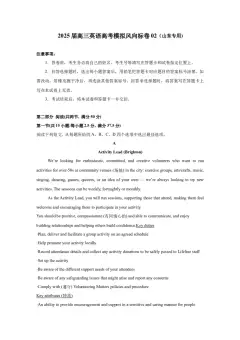
Activity Lead (Brighton)
We’re looking for enthusiastic, committed, and creative volunteers who want to run
activities for over-50s at community venues (场地) in the city: exercise groups, arts/crafts, music,
singing, dancing, games, quizzes, or an idea of your own — we’re always looking to try new
activities. The sessions can be weekly, fortnightly or monthly.
As the Activity Lead, you will run sessions, supporting those that attend, making them feel
welcome and encouraging them to participate in your activity.
You should be positive, compassionate (有同情心的) and able to communicate, and enjoy
building relationships and helping others build confidence.Key duties
·Plan, deliver and facilitate a group activity on an agreed schedule
·Help promote your activity locally
·Record attendance details and collect any activity donations to be safely passed to Lifeline staff
·Set up the activity
·Be aware of the different support needs of your attendees
·Be aware of any safeguarding issues that might arise and report any concerns
·Comply with (遵守) Volunteering Matters policies and procedure
Key attributes ( 特质 )
·An ability to provide encouragement and support in a sensitive and caring manner for peoplefrom a variety of backgrounds
·Good levels of self-organisation, reliability, and timekeeping
·Communicate effectively with a range of people
·Commit to volunteering for at least 4 months
·Provide two references
What we provide
·Full training for the role
·Regular support and guidance from the Lifeline team
·Technical support and advice as required
·Reimbursement (补偿) for all out-of-pocket expenses
·Opportunities to get recommended for positions in Lifeline’s sponsors
·A reference confirming the contribution you have made
1.What do we know about the activities mentioned in the text?
A.They’re task-focused. B.They’re senior-friendly.
C.They’re culture-centered. D.They’re knowledge-intensive.
2.What should the Activity Lead do?
A.Analyse attendance details. B.Give out activity donations.
C.Project potential safety issues. D.Clean up venues after activities.
3.What does Lifeline provide for volunteers?
A.A letter of thanks. B.A potential job opportunity.
C.A minimal-commitment position. D.A partial refund for personal expenses.
B
Last summer, I was assigned to take photos that could communicate the urgency of climate
change in northern Canada. When I arrived at an abandoned village on Resolute Bay, I scanned
the shore with my camera. Suddenly, I spotted a bear lying on the ground. It didn’t move for
almost an hour. But when it finally stood up, I had to catch my breath. The bear’s once strong
body was just skin and bones; every step that it took was painfully slow.
When I posted the photos on the social media, I wrote, “This is what starvation may look
like. I wonder whether the global population of 25,000 polar bears would die the way this bear is
试卷第2页,共12页dying.”
I did not say that this particular bear was killed by climate change. But news organizations
around the world focused on it. The first line of the story published in National Geographic
read, “This is what climate change looks like” — with “climate change” highlighted in yellow.
Other news agencies even adopted more dramatic headlines.
It was estimated that my photos had been read by about 2.5 billion people around the world.
But there was a problem: Most people and the news agencies didn’t pick up or misunderstood the
real message I tried to send with them. Many people expressed gratitude that I’d provided
shocking evidence on climate change, while others who are still trying to deny the existence of
climate change accused me of spreading false information.
Perhaps I had made a mistake in not telling the full story — that I was looking for pictures
that might foretell the future and that I didn’t know what had happened to this particular polar
bear.
I can’t say that this bear was starving because of climate change, but I am happy that my
photos have moved the conversation about climate change to the forefront, where it must remain
until this problem is solved.
Until then, when I come across a scene like this one, I will again share with the world—and
take pains to be sure that my intention is clear.
4.How did the author feel when the bear stood up?
A.Shocked. B.Scared. C.Amused. D.Relieved.
5.What does the underlined word “it” in paragraph 3 refer to?
A.The story. B.The photo. C.The starving bear. D.Climate change.
6.Why did the author share those photos?
A.To provide more direct evidence on climate change.
B.To show the link between the bear and climate change.
C.To warn of the possible consequences of climate change.
D.To expose the false information about climate change.
7.What is the best title for the text?
A.How to admit mistakes B.My misunderstood intention
C.How to please readers D.My amazing tourC
Your phone has a screen that displays images and videos. The screen uses tiny dots known
as pixels (像素) that consist of three primary colors: red, green and blue. By mixing these colors
in different ways, your phone can show you everything from beautiful beach scenes to cute
puppies.
Now imagine something similar for smells. Scientists are developing digital scent
technology that uses a small number of different cartridges (暗盒) , each containing a specific
scent. Just like how pixels mix the three basic colors to create images, these scent cartridges could
mix to create different smells. Just as images on your phone are made of digital codes that
represent combinations of pixels, smells produced by a future phone could be created through
digital codes. Each smell could have a specific recipe made up of different amounts of the
ingredients in the cartridges.
When you receive a digital scent code, your phone could mix tiny amounts of the different
scents from the cartridges to create the desired smell. This mix would then be released through a
small vent on the phone, allowing you to smell it. With just a few cartridges, your phone could
potentially create a huge variety of smells, much like how red, green and blue pixels can create
countless colors.
Creating a phone that can produce smells involves several challenges. One is designing a
system that can produce thousands of different smells using only a few cartridges. Another is how
to control how strong a scent should be and how long a phone should send it out. And phones will
also need to sense odors near them and convert those to digital codes so your friends’ phones can
send smells to you. The cartridges should also be easy to refill, and the chemicals in them should
be safe to breathe. These hurdles make it a tricky but exciting area of research.
8.What enables a phone screen to present diverse visual contents from paragraph 1?
A.Special sensors detecting colors. B.A unique way for color reflection.
C.Advanced software for image generation.D.Pixels of three primary colors in
combination.
9.What can we learn about digital scent from paragraph 2?
A.It is created by using cartridges. B.It’s a fully-developed technology.
试卷第4页,共12页C.It comes from the same cartridges. D.It is related to images on mobile phones.
10.What is one of the troubles scientists face when developing digital scent technology?
A.Creating new scents that don’t exist in nature.
B.Combining all primary colors to produce one smell.
C.Regulating the strength and duration of scents.
D.Finding a way to emit scents that last for a long time.
11.What is the main idea of the text?
A.A comparison between image combination and smell production.
B.The development and challenges of digital scent technology.
C.The advantages of updating a phone that can display images.
D.The history and future of complex phone technology.
D
Picture your favorite childhood stuffed animal. Are you attached to it even though you
haven’t played with that creature in years? If so, you’re not alone. Parting with possessions they
no longer use is a struggle for many people. As consumer psychologists, we wanted to know why.
To gain some in sight, we zeroed in on items with sentimental (情感的) value in a series of
studies.
Things that are tied to emotionally significant memories may represent a piece of your
identity. When you struggle to part with that sports shirt you wore on the junior basketball team,
for example, you are not really attached to the shirt itself. Instead, you’re hanging onto the
memories represented by that item of clothing you probably won’t wear again. Its sentimental
value may make giving the shirt away feel like giving up a piece of your own identity.
We set out to test ways to help people donate goods that are meaningful to them. In an
online study, we let our subjects choose how to handle this. Nearly two out of three opted for
photography, by far the most popular method. The other most common techniques included
creating a scrapbook (剪贴簿) or making a video about it — the approaches taken by 22 percent
of our participants and writing a note or making a journal entry, which was selected by 13 percent.
To test whether photographing objects with sentimental value actually increases donations,
we studied the behavior of Pennsylvania State University (PSU) students and found that students
who were encouraged to photograph things before giving them away donated 35 percent moreitems than those who weren’t.
However, our findings also suggest that photography is no universal cure. For example,
when we asked people in our studies to take pictures of these items before selling them, that action
didn’t help. One possible explanation is that they are unwilling to place a monetary (金钱的)
value on treasured possessions.
12.Why is the sports shirt mentioned in paragraph 2?
A.To show the influence of sports on one’s life.
B.To explain the importance of sentimental value.
C.To emphasize the value of a sense of identity.
D.To highlight the significance of childhood memories.
13.What is the least popular way to help people donate meaningful goods?
A.Photographing them. B.Making a video about them.
C.Making a journal entry for them. D.Creating a scrapbook for them.
14.What did the PSU study show?
A.Shooting photos for their stuff helps people let go of it.
B.Photographing objects increases their sentimental value.
C.It is hard to give away items with sentimental value.
D.College students are more likely to donate than others.
15.Why might people be unwilling to sell their treasured possessions?
A.They are too attached to them. B.They have trouble finding interested buyers.
C.They don’t know how much to charge. D.They don’t want to monetize them.
第二节(共5小题:每小题2. 5分, 满分12. 5分)
阅读下面短文, 从短文后的选项中选出可以填入空白处的最佳选项。选项中有两项为多余
选项。
In every culture throughout time, the kitchen has had a powerful influence. The simple
practice of sitting down together at the table gives us the chance to connect and communicate.
16
It depends on where you live, your age, and other factors, but the answer is, yes. Our
试卷第6页,共12页intentions for “home” are evolving.
17 Fast-paced lifestyles and work schedules make it hard to find time to shop for
groceries and prepare meals. Online food delivery services have taken off, too. In 2016, one in 10
Chinese were ordering food online. Throughout Europe, online ordering is capturing 56 percent of
the market in Sweden and 43 percent in Austria. In India, online food ordering is expected to reach
close to $12m(US)by 2023.
While there is a trend towards bring-in and order-in food, as well as dining out, the kitchen
is still a core in home life. Food & Wine cited a survey in 22 countries asking about cooking
habits. 18 At the lower end were South Koreans, who spent just 3.7 hours per week
cooking. People in India were at the top with 13.2 hours per week spent in the kitchen.
Simply being in the kitchen, cooking and eating with other people, can have healthy
benefits. Regardless of its size, the kitchen is a warm and inviting place. 19 The difference
is, now you can follow a recipe on your iPad while cooking.
It’s true that impersonal appliances are connecting to each other and to us. Refrigerators
order vegetables. Cooktop hoods with sensors turn on by themselves. While technology and our
expectations for the kitchen are shape-shifting in real time, the fundamentals remain the same.
20
A.So is cooking a way to express yourself?
B.The global average was almost 6.5 hours.
C.But is our relationship to the kitchen changing?
D.It’s like gathering around a campfire in the past.
E.People seem to be spending less time cooking worldwide.
F.Now more of them are eating outside the home more frequently.
G.The kitchen is where we connect with food and company in the soul of the home.
第三部分语言运用(共两节,满分30分)
第一节(共15小题:每小题1分,满分15分)
阅读下面短文, 从每题所给的A、B、C、D四个选项中选出可以填入空白处的最佳选项。
Omar Nok embarked on a nine-month journey from Egypt to Japan with one rule: no flying.The restriction, he found, turned out to be 21 but limiting. “Taking other modes of
transport,” he said, “allows me to see as much of the world as I can and not 22
anything. It’s more 23 . Things can happen on the way.”
Nok, a 30-year-old Egyptian German 24 in Cairo, had never traveled east of
Egypt before. This past week — 275 days later — he 25 it to Tokyo, completing his
28,700-mile journey.
To get there, he traveled by foot, hitchhiking, bus, train, ferry, motorcycle, ship, bicycle,
camel and horse. He’s diligently 26 his daily adventures on his Instagram account,
which has 27 to more than 750,000 followers. His only constant was his backpack, no
heavier than 28 pounds, containing about a week’s worth of clothes.
When 28 the trip, Nok had his destinations mapped out, but not his daily route.
Keeping himself in the dark a bit when traveling, he said, helps him limit his 29 and
stay open. With some countries, he said, it was 30 not to come in with preconceived
notions (先入之见). His perceptions of some Middle East countries, for example, were 31
by news coverage that has long cast the region as unsafe and conflict-ridden. But in his actual
experiences, what 32 to Nok was the warmth and generosity of the people there.
Nok’s posts have fueled 33 dialogue among his followers. “I could see it
always, everywhere in the comments — the 34 were learning that good people are
everywhere despite the country, race, 35 . We, as humans, have more in common than
we have differences.”
21.A.something B.nothing C.anything D.none
22.A.waste B.lose C.skip D.spoil
23.A.eventful B.meaningful C.fruitful D.delightful
24.A.located B.based C.headquartered D.established
25.A.made B.managed C.finished D.got
26.A.captured B.represented C.published D.documented
27.A.improved B.declined C.ballooned D.remained
28.A.taking B.planning C.recording D.recalling
29.A.imagination B.expectations C.fears D.ambitions
30.A.impossible B.incredible C.flexible D.desirable
试卷第8页,共12页31.A.changed B.colored C.formed D.confirmed
32.A.got across B.stood out C.came down D.took place
33.A.controversial B.indifferent C.negative D.positive
34.A.travelers B.listeners C.speakers D.viewers
35.A.income B.age C.religion D.gender
第三部分语言运用(共两节,满分30分)
第二节(共15小题:每小题1分,满分15分)
阅读下面短文,在空白处填入1个适当的单词或括号内单词的正确形式。
American literature, the body of written works 36 (produce) in the English
language in the United States.
Like other national literatures, American literature was shaped by the history of the country
that produced it. For almost a century and 37 half, America was merely a group of
colonies scattered along the eastern seaboard of the North American continent — colonies from
38 a few hardy souls tentatively ventured westward. After a successful rebellion against the
motherland, America became the United States, a nation. By the end of the 19th century this
nation extended southward to the Gulf of Mexico, northward to the 39 (forty-nine)
parallel, and westward to the Pacific. By the end of the 19th century, too, it 40 (take)
its place among the powers of the world — its fortunes so interrelated with those of other nations
that inevitably it became involved in two world wars and, 41 (follow) these conflicts,
42 the problems of Europe and East Asia.
This article traces the history of American poetry, drama, fiction, and social and 43
(liter) criticism from the early 17th century through the turn of the 21st century. For a description
of the oral and written literatures of the indigenous peoples of the Americas, 44 (see)
Native American literature, though the contributions of African Americans to American literature
45 (discuss) in this article.
第四部分 写作(共两节, 满分40分)第一节(满分15分)
46.假如你是李华,你的美国朋友Jack建议你使用AI辅助学习,请你给Jack写一封信,
表述你对此事的看法。内容包括:
1.表达自己的观点和态度;
2.提出一些建议。
注意:1.写作词数应为80个左右;
2.请按如下格式在答题纸的相应位置作答。
Dear Jack.
_______________________________________________________________________________
_______________________________________________________________________________
_______________________________________________________________________________
_______________________________________________________________________________
_______________________________________________________________________________
_________________________________________________________
Yours.
Li Hua
第二节(满分25分)
47.阅读下面材料,根据其内容和所给段落开头语续写两段,使之构成一篇完整的短文。
Young Martin from America had always dreamt of visiting some small towns of Italy.
Finally, he saved enough money and set off on his journey alone, filled with expectation for the
experiences that awaited him.
Upon his arrival at a small town, Martin found a small hotel and decided to check in. He
was received by the hotel owner Emma, an elderly local woman who only spoke Italian.
Fortunately, he knew a little Italian and finally settled in his comfortable room.
The days went smoothly and Martin was amazed by the beauty of the small town. What
made his stay more pleasant was Emma’s kindness and generosity. Though she seldom talked with
him, she shared delicious food with him and really cared about him. Martin felt lucky and grateful
that he had met such a kind local. Actually, Martin’s presence made Emma happy as well.
试卷第10页,共12页However, the peace was broken on the last day of Martin’s stay. He was out in the morning
and at lunchtime couldn’t find his bag he always carried with him. He got worried as the bag
contained his passport and money. He searched every place he had been to, but couldn’t find his
bag. He went to the local police station because he thought those who found his bag with a
passport in it might hand it to the police officers. However, the language barrier posed a big
challenge. His limited Italian and the police officers’ little knowledge of English made the
communication discouraging and confusing. His efforts didn’t pay off.
Martin didn’t return to the hotel until the night fell. Emma was relieved to see him back, but
soon noticed he didn’t carry his black-and-white bag. From his broken Italian and body language,
she learned he had lost it.
注意:1. 续写词数应为150个左右;
2. 请按如下格式在答题卡的相应位置作答。
The next morning. Emma offered to help Martin.
_______________________________________________________________________________
_______________________________________________________________________________
_______________________________________________________________________________
_______________________________________________________________________________
_______________________________________________________________________________
____________________________________________________________
In the afternoon, Emma received a call from the police station.
_______________________________________________________________________________
_______________________________________________________________________________
_______________________________________________________________________________
_______________________________________________________________________________
_______________________________________________________________________________
____________________________________________________________
The next morning, Emma offered to help Martin. She accompanied him to report the
incident to the police officers again, communicating with them in fluent Italian. Giving a detailed
account of the lost bag, including its color and size, she also emphasized the importance of the bag
to Martin as she knew he had always carried it with him. The local officers took some notes andpromised to inform them if anyone handed in the lost bag. Emma left the hotel’s phone number
and took Martin back to the hotel.
In the afternoon, Emma received a call from the police station. The officer who called told
her that someone had found the bag and it could be claimed before the night. Excited and grateful,
Martin followed Emma to get his bag, in which his passport and money remained. Martin was so
thrilled that he gave Emma a big hug and expressed his sincere gratitude in English. Looking at
Emma’s confused face, Martin quickly said “thank you” in Italian. Emma smiled back, which
inspired Martin to extend his stay in this lovely town.
试卷第12页,共12页