Unit 6 An old man tried to move the mountains.
Section B
I.根据句意及汉语提示完成单词
1. What a ___________ (愚蠢的) idea it is!
2. The ___________ (地面) is covered with water.
3. Sun Yang got two ___________ (金制的) medals.
4. The boy was so ___________ (勇敢的) that he saved a boy.
5. There are some nuts ___________ (在……里面) the cake.
II. 用所给单词的适当形式填空
1. Those men lost their ___________ (life) in the earthquake.
2. The moon is ___________ (shine) bright on August 15th.
3. The advertisement leads me ___________ (buy) the things.
4. Some ___________ (stone) are in the way. Let’s move them away.
5. I ___________ (hear) they would leave the next day.
III. 根据汉语完成句子
1. 谁那么大胆吃我的房子?
Who is ___________ ___________ to eat my house?
2. 我一醒来,就看见了我的父母。
___________ ___________ ___________ I woke up, I saw my parents.
3. 如果我们不带一张地图,我们会迷路的。
We’ll get ___________ ___________ we take a map with us.
4. 我梦见我住在一个面包制成的房子里。
I dreamt I lived in a house ___________ ___________ bread.
5. 我将出去在月光下取些东西。
I’ll go out ___________ ___________ something in the moonlight.
IV. 句型转换
1. Please stop drinking. (改为同义句)
Please ___________ ___________ drinking.
2. My parents have been married for 14 years. (改为同义句)
My parents ___________ ___________ 14 years ago.
3. Sun Wukong can’t turn himself into a person because he can ’ t hide his tail . (对划线部分提问)
___________ ___________ Sun Wukong turn himself into a person?
4. Ann was too young to work. (改为同义句)
Ann was ___________ young ___________ she couldn’t work.
5. The girl was born in 1979 . (对划线部分提问)
___________ ___________ the girl ___________?
V. 单项填空
1. Many students didn’t realize the importance of study ___________ they left school.
A. when B. until C. as D. after
2. I won’t be able to understand what you say, ___________ you speak too quickly.
A. if B. though C. because D. so
3. I will send you an e-mail as soon as I ___________ in Canada.
A. arrive B. arrived C. am arriving D. will arrive
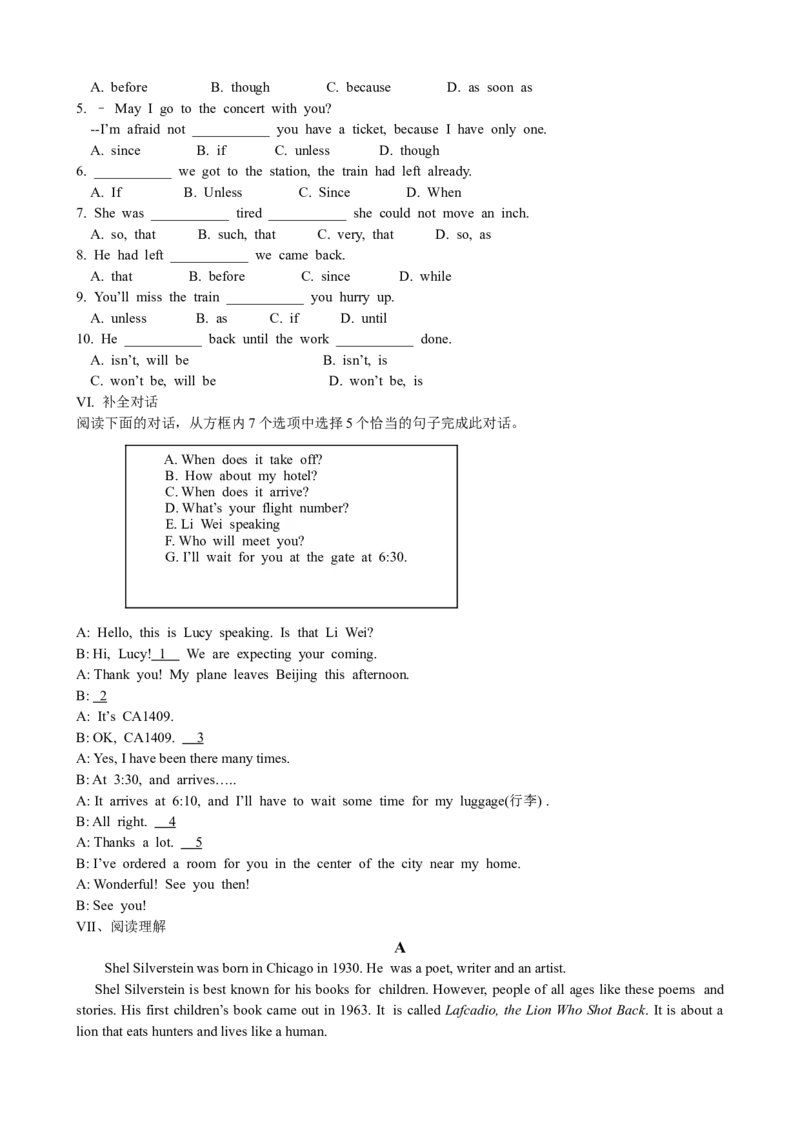
4. You should go over your test paper ___________ you hand it in.A. before B. though C. because D. as soon as
5. – May I go to the concert with you?
--I’m afraid not ___________ you have a ticket, because I have only one.
A. since B. if C. unless D. though
6. ___________ we got to the station, the train had left already.
A. If B. Unless C. Since D. When
7. She was ___________ tired ___________ she could not move an inch.
A. so, that B. such, that C. very, that D. so, as
8. He had left ___________ we came back.
A. that B. before C. since D. while
9. You’ll miss the train ___________ you hurry up.
A. unless B. as C. if D. until
10. He ___________ back until the work ___________ done.
A. isn’t, will be B. isn’t, is
C. won’t be, will be D. won’t be, is
VI. 补全对话
阅读下面的对话,从方框内7个选项中选择5个恰当的句子完成此对话。
A. When does it take off?
B. How about my hotel?
C. When does it arrive?
D. What’s your flight number?
E. Li Wei speaking
F. Who will meet you?
G. I’ll wait for you at the gate at 6:30.
A: Hello, this is Lucy speaking. Is that Li Wei?
B: Hi, Lucy! 1 We are expecting your coming.
A: Thank you! My plane leaves Beijing this afternoon.
B: 2
A: It’s CA1409.
B: OK, CA1409. 3
A: Yes, I have been there many times.
B: At 3:30, and arrives…..
A: It arrives at 6:10, and I’ll have to wait some time for my luggage(行李) .
B: All right. 4
A: Thanks a lot. 5
B: I’ve ordered a room for you in the center of the city near my home.
A: Wonderful! See you then!
B: See you!
VII、阅读理解
A
Shel Silverstein was born in Chicago in 1930. He was a poet, writer and an artist.
Shel Silverstein is best known for his books for children. However, people of all ages like these poems and
stories. His first children’s book came out in 1963. It is called Lafcadio, the Lion Who Shot Back. It is about a
lion that eats hunters and lives like a human.One year later, his book The Giving Tree came out. It may be his most popular book. This story is about a boy
and a tree that loves him. The tree gives the boy everything until it can give no more. Both adults and children
have enjoyed reading his book.
Shel Silverstein is also famous for his poetry. His first children's poetry book is Where the Sidewalk Ends. It
was published in 1974. It has more than one hundred poems and many drawings. The poems and drawings
are creative, funny and wise. In the books readers meet a boy who turns into a television set and a girl who eats a
whale.
In the 1980s, Shel Silverstein began writing plays. He wrote about twenty of them. His first play is called
The Lady or the Tiger Show.
Shel Silverstein once said that he wanted to go everywhere, look at and listen to everything. He
said people could go crazy with the wonderful things in life. And he communicated this in all of his writings and
drawings. He died of heart failure in 1999.
l. When was Shel Silverstein's most popular book published?
A. In 1964 B. In 1963 C. In 1980 D. In 1965
2. What is Shel Silverstein's first children’s book about?
A. A beautiful lady and a fierce tiger.
B. A boy who turns into a television set and a girl who eats a whale.
C. A boy and a tree that loves him.
D. A lion that eats hunters and lives like a human.
3. Which of the following is NOT true about Shel Silverstein's first children's poetry book?
A. It is creative and funny.
B. It is published after his death.
C. It has more than one hundred poems.
D. It has many pictures in it.
4. From Shel Silverstein's words, we know that he was a man who .
A. liked making friends
B. was good at communicating with strangers
C. liked travelling
D. was very crazy about what he liked
5. What can we know from the passage?
A. Shel Silverstein is more famous for his plays.
B. Only children like Shel Silverstein's books.
C. Shel Silverstein wrote many books in his life.
D. Shel Silverstein died at the age of sixty.
B
Living in a foreign culture can be exciting, but it can also be confusing (令人迷惑的). A group of
Americans who taught English in other countries recently discussed their experiences. They decided that
miscommunications were always possible, even over something as simple as "yes" and "no".
On her first day in Micronesia, an island in the Pacific, Lisa thought people weren't paying any attention
to her. The day was hot. She went into a store and asked, "Do you have cold drinks? " The woman there didn't
say anything. Lisa repeated the question. Still the woman said nothing. She later learned that the woman had
answered her. She had raised her eyebrows (眉毛) , which in Micronesia means "yes".
Jan remembered an experience she had in Bulgaria, a country in Europe. She went to a restaurant
that was known for its cabbage. She asked the waiter, "Do you have cabbage today?” He nodded his head. Jan
waited, but the cabbage never came. In that country, a nod means "no".
Tom had a similar problem when he arrived in India. After explaining something in class, he asked hisstudents if they understood. They answered with many different nods and shakes of the head. He thought some
people had not understood, so he explained again. When he asked again, they did the same thing. He soon found
out that his students did understand. In India, people nod and shake their heads in different ways depending on
where they come from. You have to know where a person is from to understand whether they mean "yes" or
"no”.
6. These Americans teaching English in other countries found that they ___________.
A. should go abroad for vacations
B. needed to learn foreign languages
C. should often discuss their experiences
D. had problems with communications
7. People in Micronesia show "yes" by ___________.
A. nodding heads
B. raising eyebrows
C. shaking heads
D. saying "no"
8. Tom misunderstood his class at first because ___________.
A. he did not know much about Indian culture
B. he didn't explain everything clearly enough
C. some students didn’t understand his questions
D. he didn't know where the students came from
9. Which of the following is TRUE according to this passage?
A. In Bulgaria, nodding heads means" no".
B. Jan taught English on a Pacific island.
C. Lisa was trying to buy some cabbage.
D. In India, only shaking heads means "yes".
10. The passage is mainly about ___________.
A. body language in foreign restaurants
B. class discussion in Indian schools
C. miscommunications in different cultures
D. English teaching in other countries
参考答案:
I. l. stupid 2. ground 3. gold 4. brave 5. insideII. l. lives 2. shining 3. to buy 4. stones 5. heard
III. l. brave enough 2. As soon as 3. lost unless 4. made of 5. to get
IV. l. give up 2. got married 3. Why can’t 4. so; that 5. When was; born
V. 1-5BCAAC 6-10DABAD
VI. 1-5EDAGB
VII. 1-5ADBCC 6-10DBAAC