2014 年 12 月大学英语六级考试真题(三)
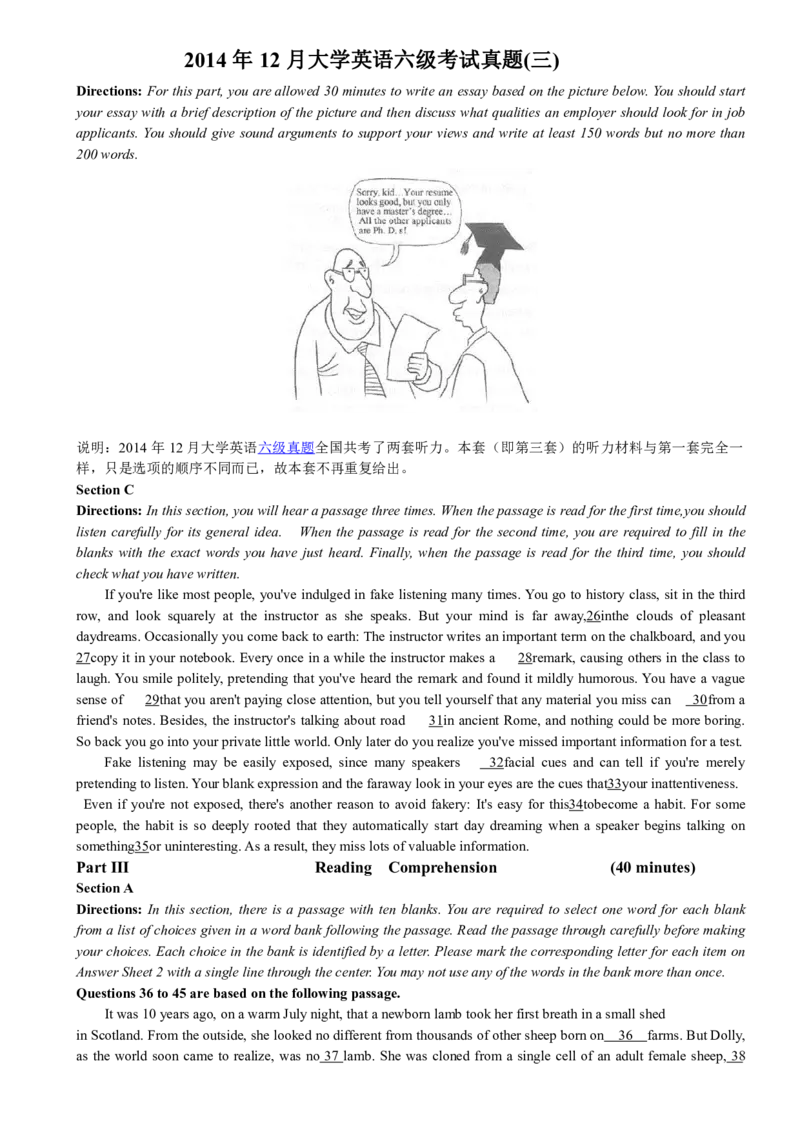
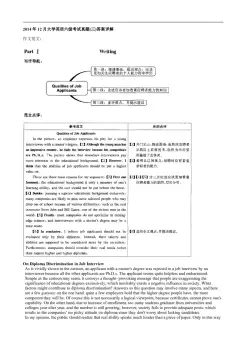
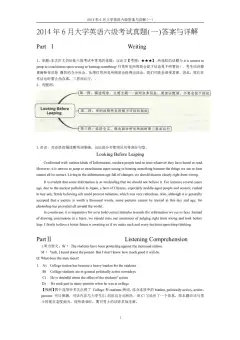
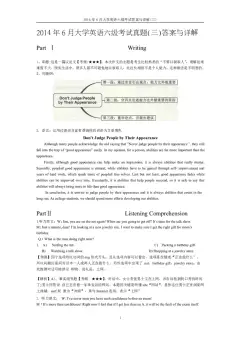
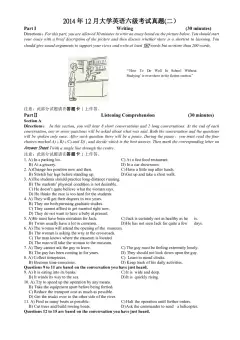
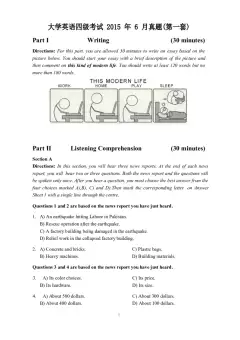
Directions: For this part, you areallowed 30 minutes to write an essay based on the picture below.You should start
your essay with a brief description of the picture and then discuss what qualities an employer should look for in job
applicants. You should give sound arguments to support your views and write at least 150 words but no more than
200words.
说明:2014年12月大学英语六级真题全国共考了两套听力。本套(即第三套)的听力材料与第一套完全一
样,只是选项的顺序不同而已,故本套不再重复给出。
SectionC
Directions:Inthissection,youwillhearapassagethreetimes.Whenthepassageisreadforthefirsttime,youshould
listen carefully for its general idea. When the passage is read for the second time, you are required to fill in the
blanks with the exact words you have just heard. Finally, when the passage is read for the third time, you should
checkwhatyouhavewritten.
If you're like most people, you've indulged in fake listening many times.You go to history class, sit in the third
row, and look squarely at the instructor as she speaks. But your mind is far away,26inthe clouds of pleasant
daydreams.Occasionallyyoucome backtoearth:Theinstructorwrites animportantterm onthechalkboard,andyou
27copy it in your notebook. Every once in a while the instructor makes a 28remark, causing others in the class to
laugh. You smile politely, pretending that you've heard the remark and found it mildly humorous.You have a vague
sense of 29thatyou aren't paying closeattention, butyou tell yourself thatany materialyou miss can 30from a
friend's notes. Besides, the instructor's talking about road 31in ancient Rome, and nothing could be more boring.
Sobackyougointoyourprivatelittleworld.Onlylaterdoyourealizeyou'vemissedimportantinformationforatest.
Fake listening may be easily exposed, since many speakers 32facial cues and can tell if you're merely
pretendingtolisten.Yourblankexpressionandthefarawaylookinyoureyesarethecuesthat33yourinattentiveness.
Even if you're not exposed, there's another reason to avoid fakery: It's easy for this34tobecome a habit. For some
people, the habit is so deeply rooted that they automatically start day dreaming when a speaker begins talking on
something35oruninteresting.Asaresult,theymisslotsofvaluableinformation.
Part Ⅲ Reading Comprehension (40 minutes)
SectionA
Directions: In this section, there is a passage with ten blanks. You are required to select one word for each blank
from a list ofchoices given in a word bank following the passage. Read the passage throughcarefully beforemaking
your choices. Each choice in the bank is identified by a letter. Please mark the corresponding letter for each item on
AnswerSheet2withasinglelinethroughthecenter.Youmaynotuseanyofthewordsinthebankmorethanonce.
Questions36to45arebasedonthefollowingpassage.
Itwas10yearsago,onawarmJulynight,thatanewbornlambtookherfirstbreathinasmallshed
inScotland.Fromtheoutside,shelookednodifferentfromthousandsofothersheepbornon 36 farms.ButDolly,
as the world soon came to realize, was no 37 lamb. She was cloned from a single cell of an adult female sheep, 38long-heldscientificdogmathathaddeclaredsuchathingbiologicallyimpossible.
Adecade later, scientists are starting to come to grips with just how different Dolly was. Dozens of animals have
beenclonedsincethatfirstlamb_mice,cats,cowsand,mostrecently,adog—andit's becoming 39 clearthatthey
areall,inonewayoranother,defective.
It's 40 to think of clones as perfect carbon copies of the original. It turns out, though, that there are various
degreesofgenetic41.Thatmaycomeasashocktopeoplewhohavepaidthousandsofdollarstocloneapetcatonly
to discover that the baby cat looks and behaves 42 liketheir beloved pet—with a different-color coat of fur,
perhaps,ora 43 differentattitudetowarditshumanhosts.
And theseare justthe obvious differences. Notonlyare clones 44 fromthe originaltemplate(模板) bytime,
but they are also the product ofan unnatural molecular mechanism thatturns outnotto be very good at making 45
copies.Infact,theprocesscanembedsmallflawsinthegenesofclonesthatscientistsareonly nowdiscovering
注意:此部分试题请在答题卡2上作答。
A.abstract F.identical K.overturning
B.completely. G.increasingly L. separated
C.deserted H.miniature M. surrounding
D.duplication I.Nothing N. systematically.
E.everything J.ordinary O. tempting
SectionB
Directions: In this section, you are going to read a passage with ten statements attached to it. Each statement
contains information given in one of the paragraphs. Identify the paragraph from which the information is derived.
You may choose a paragraph more than once. Each paragraph is marked with a letter. Answer the questions by
markingthecorrespondingletteronAnswerSheet2.
ShouldSingle-SexEducationBeEliminated?
A)Why is a neuroscientist here debating single-sex schooling? Honestly, I had no fixed ideas on the topic when I
started researching it for my book, Pink Brain, Blue Brain. But any discussion of gender differences in children
inevitably leads to this debate, so I felt compelled to dive into the research data on single-sex schooling. I read
every studyIcould,weighedtheexistingevidence,andultimatelyconcludedthatsingle-sexeducationisnotthe
answer to gender gaps in achievement--or the best way forward for today's young people. After my book was
published, I met several developmental and cognitive psychologists whose work was addressing gender and
education from different angles, and we published a peer-reviewed Education Forum piece in Science magazine
withtheprovocativetitle,"ThePseudoscienceofSingle-SexEducation."
B)Weshowedthatthreelines ofresearchusedtojustify single-sexschooling--educational, neuroscience,andsocial
psychology--all fail to support its alleged benefits, and so the widely-held view that gender separation is
somehowbetterforboys,girls,orbothisnothingmorethanamyth.
TheResearchonAcademicOutcomes.
C)First,wereviewedtheextensiveeducationalresearchthathascomparedacademicoutcomesinstudentsattending
single-sex versus coeducational schools. The overwhelming conclusion when you put this enormous literature
together is that there is no clear academic advantage of sitting in all-female orall-male classes, in spite ofmuch
popular belief to the contrary. I base this conclusion not on any individual study, but on large-scale and
systematicreviewsofthousandsofstudiesconductedineverymajorEnglish-speakingcountry.
D)Of course, there’re many excellent single-sex schools out there, but as these careful research reviews have
demonstrated, it's nottheir single-sex composition that makes them excellent. It's all the other advantages that
are typically packed into such schools, such as financial resources, quality of the faculty, and pro-academic
culture, along with the family background and pre-selected ability of the students themselves that determine
theiroutcomes.
E)A case in point is the study by Linda Sax at UCLA, who used data from a large national survey of college
freshmen to evaluate the effect of single-sex versus coeducational high schools. Commissioned by the National
Coalition of Girls' Schools, the raw findings look pretty good for the funders--higher SATscores and a stronger
academic orientation among women who had attended all girls' high schools (men weren't studied). However,once the researchers controlled for both student and school attributes--measures such as family income, parents'
education,andschoolresources--mostoftheseeffectswereerasedordiminished.
F)When it comes to boys in particular, the data show that single-sex education is distinctly unhelpful for them.
Among the minority of studies that have reported advantages of single-sex schooling, virtually all of them were
studies of girls. There're no rigorous studies in the United States that find single-sexschooling is better for boys,
and in fact, a separate line of research by economists has shown both boys and girls exhibit greater cognitive
growth over the school year based on the "dose" of girls in a classroom. In fact, boys benefit even more than
girls from having larger numbers of female classmates. So single-sex schooling is really not the answer to the
current"boycrisis"ineducation.
BrainandCognitiveDevelopment
G)The second line of research often used to justify single-sex education falls squarely within my area of expertise:
brain and cognitive development. It's been more than a decade now since the "brain sex movement" began
infiltrating (渗入) our schools, and there are literally hundreds of schools caught up in the fad (新潮). Public
schools in Wisconsin, Indiana, Florida and many other states now proudly declare on their websites that they
separate boys and girls because "research solidly indicates that boys and girls learn differently," due to
"hard-wired"differencesintheirbrains,eyes,ears,autonomicnervoussystems,andmore.
H)Allofthesestatementscanbetracedtojustafewwould-beneuroscientists,especiallyphysicianLeonardSaxand
therapist Michael Gurian. Each gives lectures, runs conferences, and does a lot of professional development on
so-called "gender-specific learning." [ analyzed their various claims about sex difference sin hearing, vision,
language, math, stress responses, and "learning styles" in my book and a long peer-reviewed paper. Other
neuroscientists and psychologists have similarly exposed their work. In short, the mechanisms by which our
brains learn language, math, physics, and every other subject don't differ between boys and girls. Of course,
learning does vary a lot between individual students, but research reliably shows that this variance is far greater
withinpopulationsofboysorgirlsthanbetweenthetwosexes.
I)TheequalprotectionclauseoftheUSConstitutionprohibitsseparationofstudentsbysexinpubliceducationthat's
based on precisely this kind of "over broad generalizations about the different talents, capacities, or preferences
of males and females."And the reason it is prohibited is because it leads far too easily to stereotyping and sex
discrimination.
SocialDevelopmentalPsychology
J)Thatbringsmetothethirdareaofresearchwhichfailstosupportsingle-sexschoolingandindeed
suggeststhepracticeisactuallyharmful:socialdevelopmentalpsychology.
K)It'sawell-provenfindinginsocialpsychologythatsegregationpromotesstereotypingandprejudice,whereasinter
group contact reduces them--and the results are the same whether you divide groups by race, age, gender, body
mass index, sexual orientation, or any other category. What's more, children are especially vulnerable to this
kind of bias, because they are dependent on adults for learning which social categories are important and why
wedividepeopleintodifferentgroups.
L)Youdon'thavetolookfartofindevidenceofstereotypingandsexdiscriminationinsingle-sexschools.Therewas
the failed single-sex experiment in California, where six school districts used generous state grants to set up
separate boys' and girls' academics in the late 1990s. Once boys and girls were segregated, teachers resorted to
traditional gender stereotypes to run their classes, and within just three years, five of the six districts had gone
backtocoeducation.
M)Atthesame time,researchersareincreasinglydiscoveringbenefitsofgenderinteractioninyouth.AlargeBritish
study found that children with other-sex older siblings (兄弟姐妹) exhibit less stereotypical play than children
with same-sex oldersiblings, suchas girls wholike sports and buildingtoys and boys who like art anddramatic
play.Another study of high school social networks found less bullying and aggression the higher the density of
mixed-sexfriendshipswithinagivenadolescentnetwork.ThenthereisthefindingwecitedinourSciencepaper
of higher divorce and depression rates among a large group of British men who attended single-sex schools as
teenagers, which might be explained by the lack of opportunity to learn about relationships during their
formativeyears.N)Whetherinnurseryschool,highschool,orthebusinessworld,gendersegregationnarrowsourperceptionsofeach
other, facilitating stereotyping and sexist attitudes. It's very simple: the more we structure children and
adolescents' environment around gender distinctions and separation, the more they will use these categories as
theprimarybasisforunderstandingthemselvesandothers.
O)Genderisanimportantissueineducation.Therearegapsinreading,writing,andscienceachievementthatshould
be narrower. There are gaps in career choice that should be narrower--if we really want to maximize human
potentialandAmericaneconomicgrowth.Butstereotypingboysandgirlstheminthenameoffictitious(虚拟的)
braindifferencesisnevergoingtoclosethesegaps.
注意:此部分试题请在答题卡2上作答。
46.Hundredsofschoolsseparateboysfromgirlsinclassontheallegedbrainandcognitivedifferences.
47.Areviewofextensiveeducationalresearchshowsnoobviousacademicadvantageofsingle-sexschooling.
48.Theauthordidnothaveanyfixedideasonsingle-sexeducationwhenshebeganherresearchonthesubject.
49.Researchfoundmenwhoattendedsingle-sexschoolsintheirteensweremorelikelytosufferfromdepression.
50.Studiesinsocialpsychologyhaveshownsegregationinschooleducationhasanegativeimpactonchildren.
51.Reviewsofresearchindicatetherearemoredifferencesinbrainandcognitivedevelopmentwithinthe same sex
thanbetweendifferentsexes.
52.The findings of the national survey of college freshmen about the impact of single-sex schooling fail to take into
accountstudentandschoolattributes.
53. It wasn't long before most of the school districts that experimented with single-sex education abandoned the
practice.
54.Boysfromcoeducationalclassesdemonstrategreatercognitiveabilitiesaccordingtotheeconomists'research.
55. As careful research reviews show, academic excellence in some single-sex schools is attributed to other factors
thansingle-sexeducation.
SectionC
Directions: There are 2 passages in this section. Each passage is followed by some questions or unfinished
statements.ForeachofthemtherearefourchoicesmarkedA,B,C,andD..Youshoulddecideonthebestchoiceand
markthecorrespondingletteronAnswerSheet2withasinglelinethroughthecenter
.PassageOne
Questions56to60arebasedonthefollowingpassage.
International governments' inaction concerning sustainable development is clearly worrying but the proactive
(主动出击的) approaches of some leading-edge companies are encouraging. Toyota, Wal-Mart, DuPont, M&S and
GeneralElectrichavemadetacklingenvironmentalwastesakeyeconomicdriver.
DuPont committed itself to a65% reductionin greenhousegas emissions in the 10years prior to 2010.By 2007,
DuPont was saving $2.2 billion a year through energy efficiency, the same as its total declared profits that year.
General Electric aims to reduce the energy intensity of its operations by 50% by 2015.They have invested heavily in
projectsdesignedtochangethewayofusingandconservingenergy.
Companies like Toyota and Wal-Mart are not committing to environmental goals out of the goodness of their
hearts. The reason for their actions is a simple yet powerful realisation that the environmental and economic
footprintsfitwelltogether.WhenM&Slaunchedits"PlanA"sustainabilityprogrammein2007,itwasbelievedthatit
wouldcostover~200millioninthefirstfiveyears.However,theinitiativehadgenerated~105millionby2011/12.
When we prevent physical waste, increase energy efficiency or improve resource productivity, we save money,
improve profitability and enhance competitiveness. In fact, there are often huge "quick win" opportunities, thanks to
yearsofneglect.
However,thereis aconsiderablegap betweenleading-edge companiesandthe restofthepack.Therearefartoo
many companies still delaying creating a lean and green business system, arguing that it will cost money or require
sizablecapitalinvestments.Theyremainstuckinthe"environmentiscost"mentality.Beingenvironmentallyfriendly
does not have to cost money. In fact, going beyond compliance saves cost at the same time that it generates cash,
providedthatmanagementadoptsthenewleanandgreenmodel.
Lean means doing more with less. Nonetheless, in most companies, economic and environmental continuousimprovement is viewed as being in conflict with each other. This is one of the biggest opportunities missed across
most industries. The size of the opportunity is enormous, The 3% Reportrecently published by World Wildlife Fund
andCDPshowsthattheeconomicprizeforcurbingcarbonemissionsintheUSeconomyis$780billionbetweennow
and 2020. It suggests that one of the biggest levers for delivering this opportunity is "increased efficiency through
managementandbehaviouralchange"--inotherwords,leanandgreenmanagement.
Some 50 studies show that companies that commit to such a spirational goals as zero waste, zero harmful
emissions, and zero use of non-renewable resources are financially outperforming their competitors. Conversely, it
wasfoundthatclimatedisruptionis alreadycosting$1.2trillion annually,cutting globalGDPby1.6%.Unaddressed,
thiswilldoubleby2030.
注意:此部分试题请在答题卡2上作答。
56.Whatdoestheauthorsayaboutsomeleading-edgecompanies?
A.Theyoperateinaccordancewithgovernmentpolicies.
B.Theytakeinitiativesinhandlingenvironmentalwastes.
C.Theyarekeydriversintheirnations'economicgrowth.
D.Theyaremajorcontributorstoenvironmentalproblems.
57.WhatmotivatesToyotaandWal-Marttomakecommitmentstoenvironmentalprotection?
A.Thegoodnessoftheirhearts.
B.Astrongsenseofresponsibility.
C.Thedesiretogenerateprofits.
D.Pressurefromenvironmentalists.
58.Whyaresomanycompaniesreluctanttocreateanenvironment-friendlybusinesssystem?
A.Theyarebentonmakingquickmoney.
B.Theydonothavethecapitalfortheinvestment.
D.Theybelievebuildingsuchasystemistoocostly.
C.Theylacktheincentivetochangebusinesspractices.
59.Whatissaidabouttheleanandgreenmodelofbusiness?
A.Ithelpsbusinessestosaveandgainatthesametime.
B.Itisaffordableonlyforafewleading-edgecompanies.
C.Itislikelytostartanewroundofintensecompetition.
D.Itwilltakealongtimeforallcompaniestoembraceit.
60.Whatisthefindingofthestudiesaboutcompaniescommittedtoenvironmentalgoals?
A.Theyhavegreatlyenhancedtheirsenseofsocialresponsibility.
B.Theydomuchbetterthantheircounterpartsintermsofrevenues.
C.Theyhaveabandonedalltheoutdatedequipmentandtechnology.
D.Theymakegreatercontributionstohumanprogressthantheirrivals.
PassageTwo
Questions61to65arebasedonthefollowingpassage.
If you asked me to describe the rising philosophy of the day, I'd say it is data-ism. We now have the ability to
gather huge amounts of data.This ability seems to carry with itcertain cultural assumptions--thateverything thatcan
be measured should be measured; that data is a transparent and reliable lens that allows us to filter out emotionalism
andideology;thatdatawillhelpusdoremarkablethings--likeforetellthefuture.
Over the next years, I'm hoping to get a better grip on some of the questions raised by the datarevolution: In
whatsituations shouldwe rely on intuitive pattern recognition andin whichsituations shouldwe ignore intuition and
followthedata?Whatkindsofeventsarepredictableusingstatisticalanalysisandwhatsortsofeventsarenot?
I confess I enter this in a skeptical frame of mind, believing that we tend to get carried away in our desire to
reduceeverythingtothequantifiable.Butattheoutsetletmecelebratetwothingsdatadoesreallywell.
First, it's really good atexposing whenourintuitive view of reality iswrong. For example, nearlyevery person
who runs for political office has an intuitive sense that they can powerfully influence their odds of winning the
electioniftheycanjustraiseandspendmoremoney.Butthisislargelywrong.Afterthe2006election,SeanTrendeconstructedagraphcomparingtheincumbent(在任者的)
campaign spending advantages with their eventual margins of victory. There was barely any relationship between
morespendingandabiggervictory.
Likewise, many teachers have an intuitive sense that different students have different learning styles: some are
verbal and some are visual; some are linear, some are holistic (整体的). Teachers imagine they will improve
outcomesiftheytailortheirpresentationstoeachstudent.Butthere'snoevidencetosupportthiseither.
Second, data can illuminate patterns of behavior we haven't yet noticed. For example, I've always assumed
people who frequently use words like "I," "me," and "mine" are probably more self-centered than people who don't.
But as James Pennebaker of theUniversity ofTexas notes in his book,The Secret Life of Pronouns, whenpeopleare
feelingconfident,theyarefocusedonthetaskathand,notonthemselves.High-status,confidentpeopleusefewer"I"
words,notmore.
Our brains often don't notice subtle verbal patterns, butPennebaker's computers can.Younger writers use more
negativeandpast-tensewordsthanolderwriterswhousemorepositiveandfuturetensewords.
Insum,thedatarevolutionisgivinguswonderfulwaystounderstandthepresentandthepast.Willit
transformourabilitytopredictandmakedecisionsaboutthefuture?We'llsee.
注意:此部分试题请在答题卡2上作答。
61.Whatdodata-istsassumetheycando?
A.Transformpeople'sculturalidentity.
B.Changethewayfutureeventsunfold.
C.Getafirmgriponthemostimportantissues.
D.Eliminateemotionalandideologicalbias.
62.Whatdopeoplerunningforpoliticalofficethinktheycando?
A.Usedataanalysistopredicttheelectionresult.
B.Wintheelectioniftheycanraiseenoughfunds.
C.Manipulatepublicopinionwithfavorabledata.
D.Increasethechancesofwinningbyfoulmeans.
63.Whydomanyteachersfavortheideaoftailoringtheirpresentationstodifferentstudents?
A.Theythinkstudentspreferflexibleteachingmethods.
B.Theywillbeabletotrydifferentapproaches.
C.Theybelievestudents'learningstylesvary.
D.Theycanaccommodatestudentswithspecialneeds.
64.WhatdoesJamesPennebakerrevealinTheSecretLifeofPronouns?
A.Theimportanceofusingpronounsproperly.
B.Repeateduseoffirst-personpronounsbyself-centeredpeople.
C.Frequentuseofpronounsandfuturetensebyyoungpeople.
D.Apatterninconfidentpeople'suseofpronouns.
65.Whyistheauthorskepticalofthedatarevolution?
A.Datamaynotbeeasilyaccessible.
B.Errorsmayoccurwithlargedatasamples.
C.Datacannotalwaysdowhatweimagineitcan.
D.Somedatamayturnouttobeoutdated.
PartⅣ Translation (30 minutes)
Directions: For this part, you are allowed 30 minutes to translate a passage from Chinese into English. You should
writeyouransweron,AnswerSheet2.
中国将努力确保到2015年就业者接受过平均13.3年的教育。如果这一目标得以实现,今后大部分进入
劳动力市场的人都须获得大学文凭。
在未来几年,中国将着力增加职业学院的招生人数;除了关注高等教育之外,还将寻找新的突破以确保
教育制度更加公平。中国正在努力最佳地利用教育资源,这样农村和欠发达地区将获得更多的支持。教育部
还决定改善欠发达地区学生的营养,并为外来务工人员的子女提供在城市接受教育的同等机会。