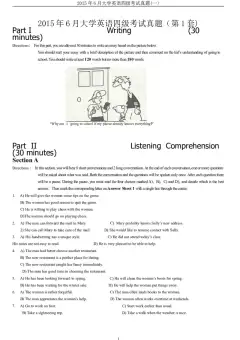
2019 年 6 月四级真题(第 1 套)
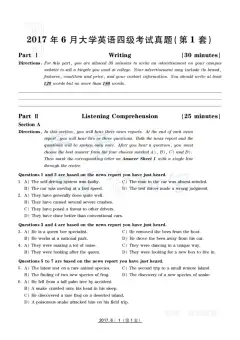
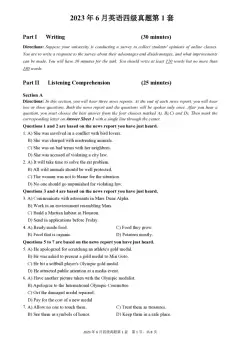
PartI Writing (30minutes)
Directions:Forthispart,youareallowed30minutestowriteanewsreporttoyourcampusnewspaperonaona
visit to a local farm organized by your Student Union.You should write at least 120 words but no more than180
words.
____________________________________________________________________________________________
____________________________________________________________________________________________
____________________________________________________________________________________________
PartⅡ ListeningComprehension (25minutes)
SectionA
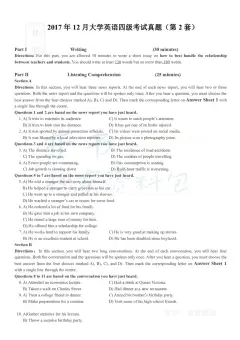
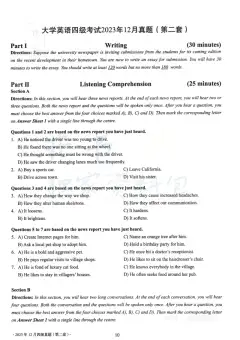
Directions: In this section, you will hear three news reports. At the end of each news report, you will hear two or
three questions. Both the news report and then questions will be spoken only once.After you hear a question, you
mustchoosethebestanswerfromthefourchoicesmarkedA), B),C) andD).Then markthecorrespondingletter
onAnswerSheet1withasinglelinethroughthecentre.
Questions1and2arebasedonthenewsreportyouhavejustheard.
1.A)Hesetarecordbeswimmingtoandfromanisland.
B)Hecelebratedninthbirthdayonasmallisland.
C)Hevisitedaprisonlocatedonafarawayisland.
D)HeswamaroundanislandnearSanFrancisco.
2.A)Hedoubledthereward. B)Hesethimanexample.
C)Hecheeredhimonalltheway. D)HehadtheeventcoveredonTV.
Questions3and4arebasedonthenewsreportyouhavejustheard.
3.A)Toendtheone-childpolicy. B)Toencouragelatemarriage.
C)Toincreaseworkingefficiency. D)Togivepeoplemoretimetotravel.
4.A)Theywillnotbewelcomedbyyoungpeople.
B)Theywillhelptopopularizeearlymarriage.
C)TheywillboostChina’seconomicgrowth.
D)Theywillnotcomintoimmediateeffect.
Questions5to7arebasedonthenewsreportyouhavejustheard.
5.A)Cleaningserviceingreatdemandallovertheworld.
B)Twoladiesgivingupwell-paidjobstodocleaning.
C)Anewcompanytocleanupthemessafterparties.
D)Cleanersgainfullyemployedatnightsandweekends.
6.A)Ittakesalotoftimetoprepare. B)Itleavesthehouseinamess.
C)Itmakespartygoersexhausted. D)Itcreatesnoiseandmisconduct.
7.A)HireanAustralianlawyer. B)VisittheU.S.andCanada.
C)Settlealegaldispute. D)Expandtheirbusiness.
SectionB
Directions: In this section, you will hear two long conversations. At the end of each conversation, you will hear
four questions. Both the conversation and the questions will be spoken only once. After you hear a question, you
mustchoosethebestanswerfromthefourchoicesmarkedA),B),C)andD).Thenmarkthecorrespondingletter
onAnswerSheet1withasinglelinethroughthecentre.
Questions8to11arebasedontheconversationyouhavejustheard.
8.A)Hehadadrivinglesson. B)Hegothisdriver’slicense.
C)Hetookthedriver’stheoryexam. D)Hepassedthedriver’sroadtest.
9.A)Hewasnotwellprepared. B)Hedidnotgettotheexamintime.
淘宝店铺:https://shop499712503.taobao.com/ 掌柜旺旺:慧园文化C)Hewasnotusedtothetestformat. D)Hedidnotfollowthetestprocedure.
10.A)Theyaretough. B)Theyarecostly.
C)Theyarehelpful. D)Theyaretooshort.
11.A)Passhisroadtestthefirsttime. B)Test-driveafewtimesonhighways.
C)Findanexperienceddrivinginstructor. D)Earnenoughmoneyfordrivinglessons.
Questions12to15arebasedontheconversationyouhavejustheard.
12.A)Wherethewomanstudies. B)TheacceptancerateatLeeds.
C)Leeds’tuitionforinternationalstudents. D)Howtoapplyforstudiesatauniversity.
13.A)ApplytoanAmericanuniversity. B)Doresearchonhighereducation.
C)Performinafamousmusical. D)Pursuepostgraduatestudies.
14.A)Hisfavorablerecommendations. B)Hisoutstandingmusicaltalent.
C)Hisacademicexcellence. D)Hisuniqueexperience.
15.A)Doamaster’sdegree. B)SettledowninEngland.
C)Travelwidely. D)Teachoverseas.
SectionC
Directions: In this section, you will hear three passages. At the end of each passage, you will hear three or four
questions. Both the passage and the questions will be spoken only once. After you hear a question, you must
choose the best answer from the four choices marked A), B), C) and D). Then mark the corresponding letter
onAnswerSheet1withasinglelinethroughthecentre.
Questions16to18arebasedonthepassageyouhavejustheard.
16.A)Theyhelpfarmerskeepdiseasesincheck.
B)Manyspeciesremainunknowntoscientists.
C)Onlyafewspeciescausetroubletohumans.
D)Theyliveinincrediblywell-organizedcolonies.
17.A)Theyarelargerthanmanyotherspecies.
B)Theycancausedamagetopeople’shomes.
C)Theycansurvivealongtimewithoutwater.
D)Theyliketoformcoloniesinelectricalunits.
18.A)Denythemaccesstoanyfood.
B)Keepdoorsandwindowsshut.
C)Destroytheircoloniescloseby.
D)Refrainfromeatingsugaryfood.
Questions19to21arebasedonthepassageyouhavejustheard.
19.A)Thefunctionofthehumanimmunesystem.
B)Thecauseofvariousauto-immunediseases.
C)Thevirusesthatmayinfectthehumanimmunesystem.
D)Thechangeinpeople’simmunesystemastheygetolder.
20.A)Reporttheirillnesses. B)Offerbloodsamples.
C)Actasresearchassistants. D)Helptointerviewpatients.
21.A)Strengtheningpeople’simmunitytoinfection.
B)Betterunderstandingpatients’immunesystem.
C)Helpingimproveoldpeople’shealthconditions.
D)Furtherreducingoldpatients’medicalexpenses.
Questions22to25arebasedonthepassageyouhavejustheard.
22.A)Hisstudentshadtroublegettingonwitheachother.
B)Alotofkidsstayedatschooltodotheirhomework.
C)Hisstudentswerestrugglingtofollowhislessons.
淘宝店铺:https://shop499712503.taobao.com/ 掌柜旺旺:慧园文化D)Agroupofkidswereplayingchessafterschool.
23.A)VisitachessteaminNashville.
B)Jointheschool’schessteam.
C)Participateinanationalchesscompetition.
D)Receivetrainingforachesscompetition.
24.A)Mostofthemcomefromlow-incomefamilies.
B)Manyhavebecomenationalchesschampions.
C)Acoupleofthemhavegotinvolvedincrimes.
D)Manybecamechesscoachesaftergraduation.
25.A)Actionsspeaklouderthanwords.
B)Thinktwicebeforetakingaction.
C)Translatetheirwordsintoaction.
D)Takeactionbeforeitgetstoolate.
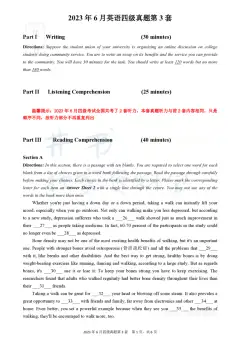
PartIII ReadingComprehension (40minutes)
SectionA
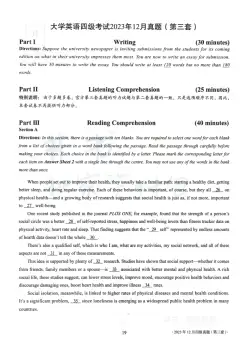
Directions: In this section, there is a passage with ten blanks. You are required to select one word for each blank
from a list of choices given in a word bank following the passage. Read the passage through carefully before
making your choices. Each choice in the bank is identified by a letter. Please mark the corresponding letter for
each item on Answer Sheet 2 with a single line through the centre. You may not use any of the words in the bank
morethanonce.
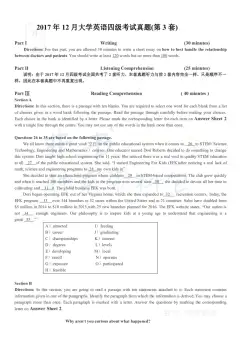
The center ofAmerican automobile innovation has in the past decade moved 2,000 miles away. It has 26
fromDetroittoSiliconValley,whereself-drivingvehiclesarecomingintolife.
In a 27 to take production back to Detroit, Michigan lawmakers have introduced 28 that could make
theirstatethebestplaceinthecountry,ifnottheworld,todevelopself-drivingvehiclesandputthemontheroad.
“Michigan’s 29 in autoresearch and development is under attackfrom several states and countries which
desire to 30 our leadership in transportation. We can’t let happen,” says Senator Mike Kowall, the lead 31
offourbillsrecentlyintroduced.
If all four bills pass as written, they would 32 a substantial update of Michigan’s 2013 law that allowed
the testing of self-driving vehicles in limited conditions. Manufacturer would have nearly total freedom to test
their self-driving technology on public roads. They would be allowed to send groups of self-driving cars on
cross-stateroadtrips,andevenseton-demand 33 ofself-drivingcars,liketheoneGeneralMotorsandLyftare
building.
Lawmakers in Michigan clearly want to make the state ready for the commercial application of self-driving
technology. In 34 , California, home of Silicon Valley, recently proposed far more 35 rules that would
requirehumandriversbereadytotakethewheel,andcommercialuseofself-drivingtechnology.
A)bid I)replace
B)contrast J)represent
C)deputy K)restrictive
D)dominance L)reward
E)fleets M)significant
F)knots N)sponsor
G)legislation O)transmitted
H)migrated
SectionB
Directions: In this section, you are going to read a passage with ten statements attached to it. Each statement
淘宝店铺:https://shop499712503.taobao.com/ 掌柜旺旺:慧园文化containsinformationgiveninoneoftheparagraphs.Identifytheparagraphfromwhichtheinformationisderived.
You may choose a paragraph more than once. Each paragraph is marked with a letter. Answer the questions by
markingthecorrespondingletteronAnswerSheet2.
HowWorkWillChangeWhenMostofUsLiveto100
A)TodayintheUnitedStatesthereare72,000centenarians(百岁老人).Worldwide,Probably450,000.Ifcurrent
trends continue, then by 2050 there will be more than a million in the US alone. According to the work of
Professor JamesVaupeland his co-researchers, 50% of babiesborn in the US in 2007 have a life expectancy of
104 or more. Broadly the same holds for the UK, Germany, France, Italy and Canada, and for Japan 50% of
2007babiescanexpecttoliveto107.
B) Understandably, there are concerns about what this means for public finances given the associated health and
pension challenges. These challenges are real, and society urgently needs to address them. But it is also
important to look at the wider picture of what happens when so many people live for 100 years. It is a mistake
to simply equate longevity (长寿) with issues of old age. Longer lives have implications for all of life, not just
theendofit.
C) Our view is that if many people are living for longer, and are healthier for longer, then this will result in an
inevitable redesign of work and life. When people live longer, they are not only older for longer, but also
younger for longer. There is some truth in the saying that “70 is the new 60” or “40 the new 30.” If you age
moreslowlyoveralongertimeperiod,thenyouareinsomesenseyoungerforlonger.
D) But the changes go further than that. Take, for instance, the age at which people make commitments such as
buying a house, getting married, having children, or starting a career. These are all fundamental commitments
that are now occurring later in life. In 1962, 50% of Americans were married by age 21. By 2014, that
milestone(里程碑)hadshiftedtoage29.
E) While there are numerous factors behind these shifts, one factor is surely a growing realization for the young
that they are going to live longer.Options are more valuable the longer they can be held. So if you believe you
will live longer, then options become more valuable, and early commitment becomes less attractive. The result
is that the commitments that previously characterized the beginning of adulthood are now being delayed, and
newpatternsofbehaviorandanewstageoflifeareemergingforthoseintheirtwenties.
F) Longevity also pushes back the age of retirement, and not only for financial reasons. Yes, unless people are
preparedto save alot more, ourcalculations suggest thatif you are nowin your mid-40s, thenyou are likely to
work until your early 70s; and if you are in your early 20s, there is a real chance you will need to work until
yourlate 70sorpossiblyevenintoyour80s.Butevenif peopleareabletoeconomically supportaretirementat
65,over thirty years of potentialinactivity isharmful to cognitive(认知的) andemotionalvitality.Many people
maysimplynotwanttodoit.
G)And yet that does not mean that simply extending our careers is appealing. Just lengthening that second stage
of full-time work may secure the financial assets needed for a 100-year life, but such persistent work will
inevitablyexhaustpreciousintangibleassetssuchasproductiveskills,vitality,happiness,andfriendship.
H) The same is true for education. It is impossible that a single shot of education, administered in childhood and
early adulthood, will be able to support a sustained, 60-year career. If you factor in the projected rates of
technological change, either your skills will become unnecessary, or your industry outdated. That means that
everyonewill,atsomepointintheirlife,havetomakeanumberofmajorreinvestmentsintheirskills.
I)Itseemslikely,then,thatthetraditionalthree-stagelifewillevolveintomultiple stagescontainingtwo,three,or
oven more different careers. Each of these stages could potentially be different. In one the focus could be on
building financial success and personal achievement, in another on creating a better work/life balance, still
another on exploring and understanding options more fully, or becoming an independent producer, yet another
on making a social contribution. These stages will span sectors, take people to different cities, and provide
foundationforbuildingawidevarietyofskills.
J) Transitions between stages could be marked with sabbaticals (休假) as people find time to rest and recharge
淘宝店铺:https://shop499712503.taobao.com/ 掌柜旺旺:慧园文化their health,re-invest intheir relationships,orimprove their skills.Attimes,these breaksandtransitions willbe
self-determined,atotherstheywillbeforcedasexistingroles,firms,orindustriesceasetoexist.
K)A multi-stage life will have profound changes not just in how you manage your career, but also in your
approachtolife.Anincreasinglyimportantskillwillbeyourability todealwithchange andevenwelcome it.A
three-stage life hasfewtransitions,while amulti-stage lifehas many.Thatiswhybeingself-aware,investingin
broadernetworksoffriends,andbeingopentonewideaswillbecomeevenmorecrucialskills.
L)These multi-stage lives will create extraordinary variety across groups of people simply because there are so
manywaysofsequencingthestages.Morestagesmeanmorepossiblesequences.
M)Withthisvarietywillcometheendofthecloseassociationofageandstage.Inathree-stagelife,peopleleave
university at the same time and the same age, they tend to start their careers and family at the same age, they
proceed through middle management all roughly the same time, and then move into retirement within a few
yearsofeachother.Inamulti-stage life,youcouldbeanundergraduateat20,40,or60;amanagerat30,50,or
70;andbecomeanindependentproduceratanyage.
N)Current life structures, career paths, educational choices, and social norms are out of tune with the emerging
reality of longer lifespans. The three-stage life of full-time education, followed by continuous work, and then
complete retirement may have worked for our parents or even grandparents, but it is not relevant today. We
believe thatto focuson longevity as primarily anissue of agingis to miss its fullimplications.Longevity is not
necessarilyaboutbeingolderforlonger.Itisaboutlivinglonger,beingolderlater,andbeingyoungerlonger.
36.Anextendedlifespaninthefuturewillallowpeopletohavemorecareersthannow.
37.Justextendingone’scareermayhavebothpositiveandnegativeeffects.
38.Nowadays,manyAmericanshaveonaveragedelayedtheirmarriagebysomeeightyears.
39. Because of their longer lifespan, young people today no longer follow the pattern of life of their parents or
grandparents.
40.Manymorepeoplewillbeexpectedtoliveover100bythemid-21stcentury.
41.Alongerlifewillcauseradicalchangesinpeople’sapproachtolife.
42.Fasttechnologicalchangemakesitnecessaryforonetoconstantlyupgradetheirskills.
43.Manypeoplemaynotwanttoretireearlybecauseitwoulddoharmtotheirmentalandemotionalwell-being.
44.Thecloselinkbetweenageandstagemayceasetoexistinamulti-stagelife.
45.Peoplelivingalongerandhealthierlifewillhavetorearrangetheirworkandlife.
SectionC
Directions: There are 2 passages in this section. Each passage is followed by some questions or unfinished
statements. For each of them there are four choices marked A), B), C) and D). You should decide on the best
choiceandmarkthecorrespondingletteronAnswerSheet2withasinglelinethroughthecentre.
PassageOne
Questions46to50arebasedonthefollowingpassage.
In the classic marriage vow(誓约), couples promise to stay together in sickness and in health. But a new
study finds that the risk of divorce among older couples rises when the wife-not the husband—becomes seriously
ill.
“Married women diagnosed with a serious health condition may find themselves struggling with the impact
oftheirdiseasewhilealsoexperiencingthestressofdivorce,”saidresearcherAmeliaKarraker.
Karraker andco-authorKenzie Latham analyzed 20yearsofdataon2,717marriages fromastudyconducted
byIndianaUniversitysince1992.Atthetime ofthefirstinterview,atleastoneofthe partnerswasovertheage of
50.
The researchers examined how the onset(发生)of four serious physical illnesses affected marriages. They
foundthat,overall,31%ofmarriages endedindivorce overtheperiodstudied.Theincidenceofnewchronic(慢
性的)illness onset increased over time as will, with more husbands than wives developing serious health
problems.
淘宝店铺:https://shop499712503.taobao.com/ 掌柜旺旺:慧园文化“We found that women are doubly vulnerable to marital break-up in the face of illness,” Karraker said.
“They’remorelikelytobewidowed,andifthey’rethenoeswhobecomeill,they’remorelikelytogetdivorced.”
While the study didn’t assess why divorce in more likely when wives but nothusbands become seriously ill,
Karraker offers a few possible reasons. “Gender norms and social expectations about caregiving many make it
more difficultformen toprovide careto sick spouses,”Karraker said. “Andbecauseofthe imbalance in marriage
markets, especially in older ages, divorced men have more choices among prospective partners than divorced
women.”
Given the increasing concern about health care costs for the aging population, Karraker believes
policymakersshouldbeawareoftherelationshipbetweendiseaseandriskofdivorce.
“Offering support services to spouses caring for their other halves may reduce marital stress and prevent
divorce at older ages,” she said. “But it’s also important to recognize that the pressure to divorce may be
health-related and that sick ex-wives may need additional care and services to prevent worsening health and
increasedhealthcosts.”
46.Whatcanwelearnaboutmarriagevowsfromthepassage?
A)Theymaynotguaranteealastingmarriage.
B)Theyareasbindingastheyusedtobe.
C)Theyarenottakenseriouslyanymore.
D)Theymayhelpcouplestideoverhardtimes.
47.WhatdidKarrakerandco-authorKenzieLathamfindaboutelderlyhusbands?
A)Theyaregenerallynotgoodattakingcareofthemselves.
B)Theycanbecomeincreasinglyvulnerabletoseriousillnesses.
C)Theycandevelopdifferentkindsofillnessesjustliketheirwives.
D)Theyaremorelikelytocontractseriousillnessesthantheirwives.
48.WhatdoesKarrakersayaboutwomenwhofallill?
A)Theyaremorelikelytobewidowed.
B)Theyaremorelikelytogetdivorced.
C)Theyarelesslikelytoreceivegoodcare.
D)Theyarelesslikelytobothertheirspouses.
49.WhyisitmoredifficultformentotakecareoftheirsickspousesaccordingtoKarraker?
A)Theyaremoreaccustomedtoreceivingcare.
B)Theyfinditmoreimportanttomakemoneyforthefamily.
C)Theythinkitmoreurgenttofulfilltheirsocialobligations.
D)Theyexpectsocietytodomoreofthejob.
50.WhatdoesKarrakerthinkisalsoimportant?
A)Reducingmaritalstressonwives.
B)Stabilizingoldcouples’srelations.
C)Providingextracarefordivorcedwomen.
D)Makingmenpayfortheirwives’healthcosts.
PassageTwo
Questions51to55arebasedonthefollowingpassage.
If you werelikemostchildren,you probablygotupsetwhenyour mothercalledyoubyasibling’s(兄弟姐妹
的)name.Howcouldshenotknowyou?Diditmeanshelovedyouless?
Probablynot.Accordingtothefirstresearchtotackle thistopichead-on,misnamingthemostfamiliar people
in ourlife is a common cognitive (认知的)error that has to do with how our memories classify and store familiar
names.
Thestudy,publishedonlineinAprilinthejournalMemoryandCognition,foundthatthe“wrong”nameisnot
random butis invariably fished out from the same relationship pond: children, siblings, friends.The study did not
淘宝店铺:https://shop499712503.taobao.com/ 掌柜旺旺:慧园文化examine the possibility of deep psychological significance to the mistake, says psychologist David Rubin, “but it
doestelluswho’sinandwho’soutofthegroup.”
The study also found that within that group, misnamings occurred where the names shared initial or internal
sounds, like Jimmy and Joanie or John and Bob. Physical resemblance between people was not a factor. Nor was
gender.
The researchers conducted five separate surveys of more than 1,700 people. Some of the surveys included
only college students; others were done with a mixed-age population. Some asked subjects about incidents where
someone close to them—family or friend—had called them by another person’s name. The other surveys asked
abouttimeswhensubjectshadthemselvescalledsomeoneclosetothembythewrongname.Allthesurveysfound
thatpeoplemixed upnames within relationship groups such as grandchildren,friends and siblings buthardly ever
crossedtheseboundaries.
In general, the study found that undergraduates were almost as likely as old people to make this mistake and
men as likely as women. Older people and this mistake and men as likely as women. Older people and women
made the mistake slightly more often, but that may be because grandparents have more grandchildren to mix up
than parents have children. Also, mothers may call on their children more often than fathers, given traditional
gendernorms.Therewasnoevidencethaterrorsoccurredmorewhenthemisnamerwasfrustrated,tiredorangry.
51.Howmightpeopleoftenfeelwhentheyweremisnamed?
A)Unwanted. B)Unhappy.
C)Confused. D)Indifferent.
52.WhatdidDavidRubin’sresearchfindaboutmisnaming?
A)Itisrelatedtothewayourmemorieswork.
B)Itisapossibleindicatorofafaultymemory.
C)Itoccursmostlybetweenkidsandtheirfriends.
D)Itoftencausesmisunderstandingsamongpeople.
53.Whatismostlikelythecauseofmisnaming?
A)Similarpersonalitytraits. B)Similarspellingsofnames.
C)Similarphysicalappearance. D)Similarpronunciationofnames.
54.Whatdidthesurveysofmorethan1,700subjectsfindaboutmisnaming?
A)Itmoreoftenthannothurtsrelationships.
B)Ithardlyoccursacrossgenderboundaries.
C)Itismostfrequentlyfoundinextendedfamilies.
D)Itmostoftenoccurswithinarelationshipgroups.
55.Whydomothersmisnametheirchildrenmoreoftenthanfathers?
A)Theysuffermorefrustrations.
B)Theybecomewornoutmoreoften.
C)Theycommunicatemorewiththeirchildren.
D)Theygenerallytakeonmoreworkathome.
PartⅣ Translation (30minutes)
Directions: For this part, you are allowed 30 minutes to translate a passage from Chinese into English. You
shouldwriteyouransweronAnswerSheet2.
舞狮作为中国传统民间表演已有2,000多年历史。在狮子舞中,两位表演者同披一件狮子服,一个舞
动头部,另一个舞动身体和尾巴。他们熟练配合,模仿狮子的各种动作。狮子是兽中之王,象征幸福和好
运,所以人们通常在春节和其他节日期间表演狮子舞。狮子舞也可能出现在其他重要场合,如商店开业和
结婚典礼,往往吸引许多人观赏。
淘宝店铺:https://shop499712503.taobao.com/ 掌柜旺旺:慧园文化