CET-6
LISTENING
COMPREHENSION
1六级听⼒讲义
⼀,六级听⼒概述
1,时间和语速
a.听⼒时间:_____________
b.说话语速:_____________
2,听⼒训练⽅法
a.语速太快:_____________
(1)语调:
_________________________________________________________________
(2)重读:
_________________________________________________________________
b.内容不懂:_____________
(1)
(2)
(3)
(4)
3,Test Structure
Q ___ -- Q ___ : _______________
Q ___ -- Q ___ : _______________
Q ___ -- Q ___ : _______________
4,Reminder
25,为什么总被听⼒虐
5.1 _____________
审题规则1:___________
关键词⽅法总结:
____________________________________________________
练习1:161201,1-4
1.
A. It focuses on the efforts countries can make to deal with global warming.
B. It links the science of climate change to economic and policy issues.
C. It studies the impacts of global climate change on people's lives.
D. It tries to predict the possible trends of global climate change.
2.
A. It would be more costly to deal with its consequences than to avoid it.
B. It will take a long time before a consensus is reached on its impact.
C. It is the most pressing issue confronting all countries.
D. It is bound to cause endless disputes among nations.
3.
A. The raising of people's awareness.
B. The signing of a global agreement.
C. The cooperation among world major powers.
D. The transition to low-carbon energy systems.
4.
A. Plan well in advance. C. Carry out more research on it.
B. Adopt new technology. D. Cut down energy consumption.
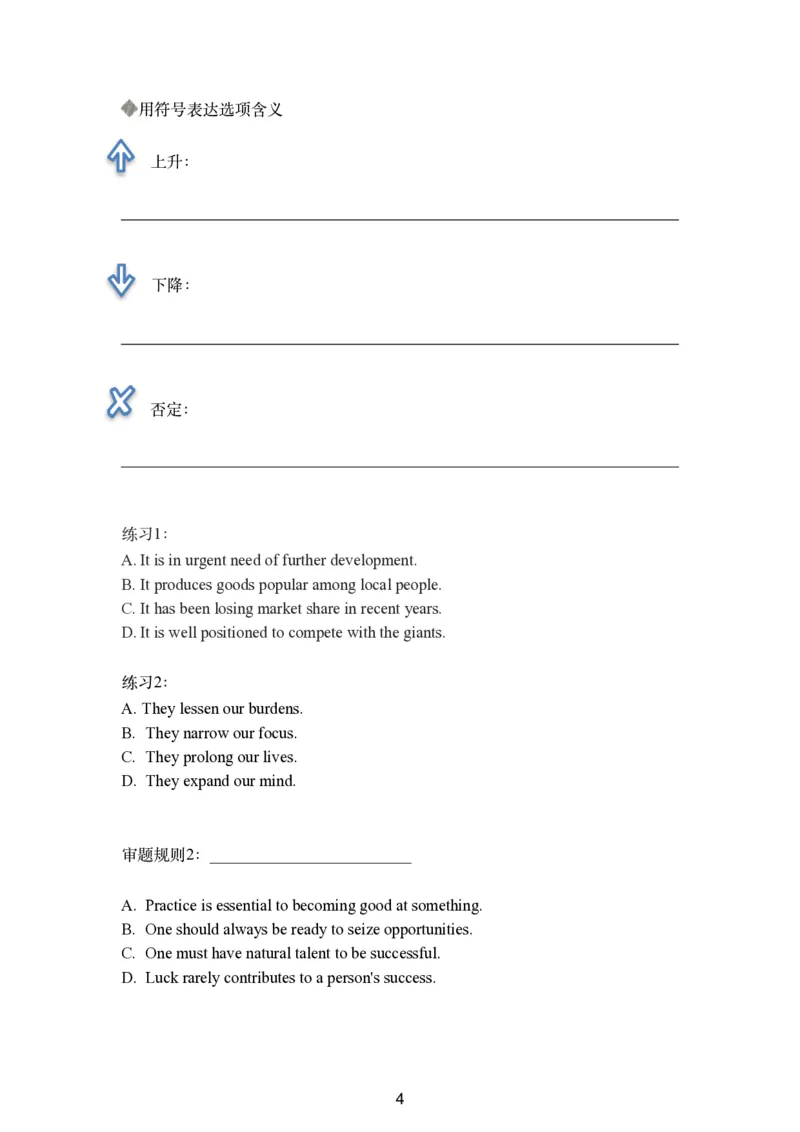
3⽤符号表达选项含义
上升:
下降:
否定:
练习1:
A.It is in urgent need of further development.
B. It produces goods popular among local people.
C. It has been losing market share in recent years.
D.It is well positioned to compete with the giants.
练习2:
A. They lessen our burdens.
B. They narrow our focus.
C. They prolong our lives.
D. They expand our mind.
审题规则2:_________________________
A. Practice is essential to becoming good at something.
B. One should always be ready to seize opportunities.
C. One must have natural talent to be successful.
D. Luck rarely contributes to a person's success.
4审题规则3:_________________________
A. They are poor at technology skills.
B. They are keen on high technology.
C. They often listen to National Public Radio.
D. They feel superior in science and technology.
5.2 ___________
a. 单词发⾳
——By Tagore
b. ___________
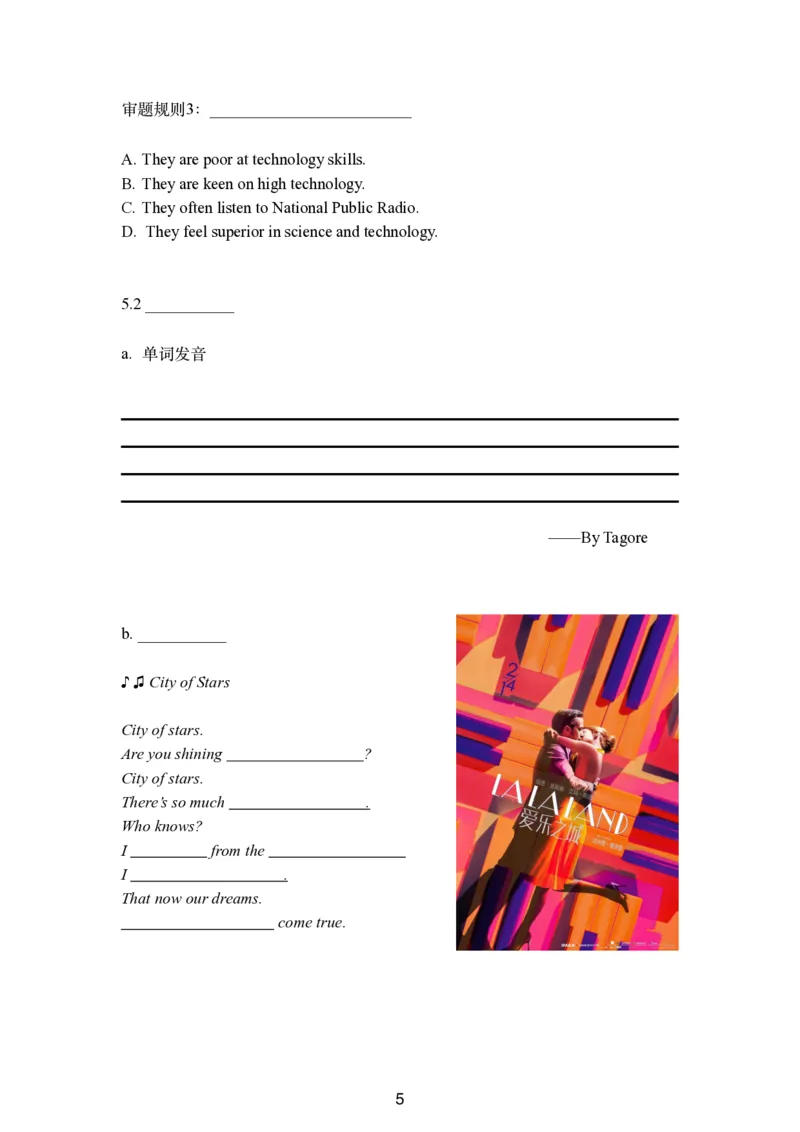
♪ ♫ City of Stars
City of stars.
Are you shining ?
City of stars.
There’s so much .
Who knows?
I from the
I .
That now our dreams.
come true.
5⼆,语⾳现象
1,连读
• 连读现象1:_____________________________
练习1:
• F_____ __ _____. • T____ __, _____ ____.
• S_____ ______ ! • The ______ ___ __ new _________.
• M___ __ your _____, ___ __ your _____.
⼏个难点
a,
__________________________ ; __________________________;
__________________________; __________________________.
b,
__________________________ ; __________________________;
__________________________.
练习2:
• F____ ________ from home.
• F_____ ______ ___ know, he m_______ ________ ________ __________.
• A____ ___ _______ __________ _______ _______.
• 连读现象2:_____________________________
练习:
• Make y______ ________. • I bet _____ in the game.
• L_____ _______ a talk
• 连读现象3:_____________________________
练习:
G__ ________. S__ ________.
6Y___ ____? __ ______ think so
♪ ♫ My heart will go on
Celine Dion
Every night in my dreams, I see you, I feel you.
That is how I know you go on.
Far across the distance and spaces between us,
you have come to show you go on.
2,失去爆破
2.1爆破⾳:
清辅⾳:____、____、____; 浊辅⾳:____、____、____.
2.2________ + ________ = 失去爆破
失去爆破:单词结尾爆破⾳在句中轻读或略读
练习:
G_____ to the _______ _______. C______ ______ the ______ ________.
Let’s ______ _______ ________. T____ ____ to ________.
3,同化现象
There is a hero, if you .
You don’t have to be afraid of .
There is an answer, if you reach into your soul.
And the sorrow will .
You can find love, if you search within yourself.
And the will disappear.
总结:
[t] + [j] = [tʃ] Don’t you?
[d] + [j] = [dʒ] Did you?
7[s] + [j] = [ʃ] I miss you.
4,英⾳or美⾳?
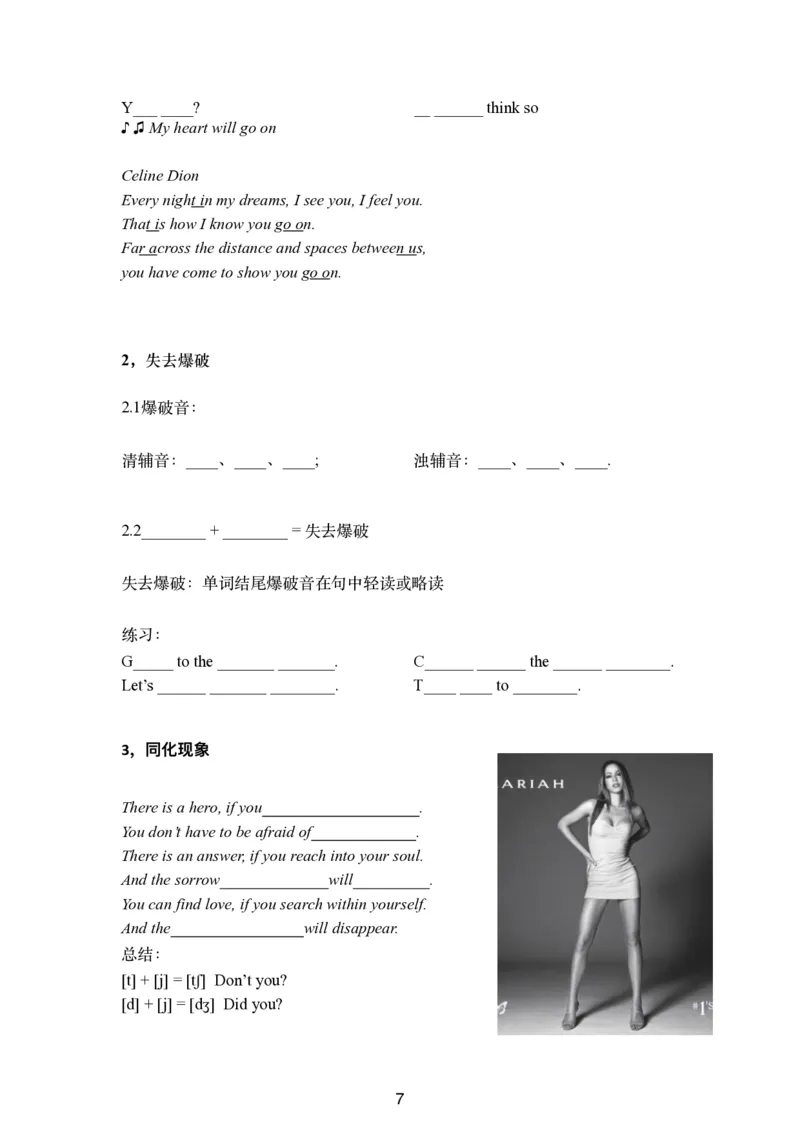
4.1__________________
英⾳ 美⾳
ladder [’lædə] [’lædər]
apartment [ə’pa:tmənt] [ə’pa:rtmənt]
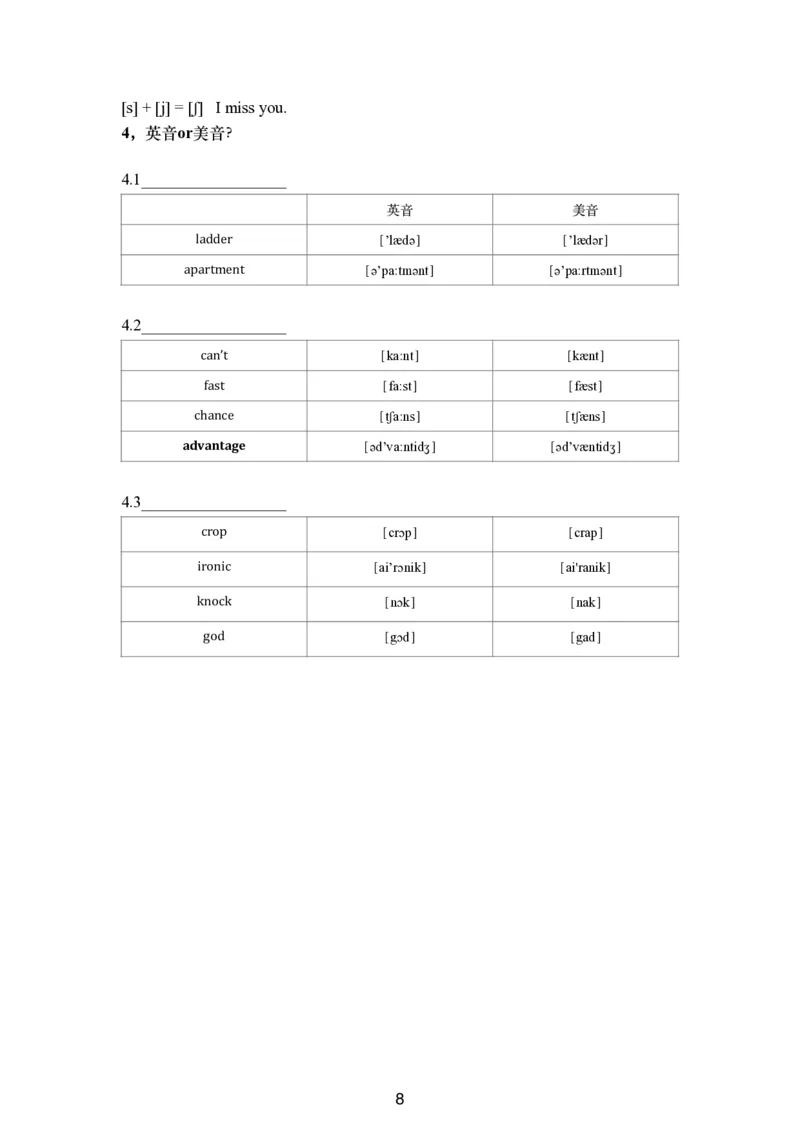
4.2__________________
can’t [ka:nt] [kænt]
fast [fa:st] [fæst]
chance [tʃa:ns] [tʃæns]
advantage [əd’va:ntidʒ] [əd’væntidʒ]
4.3__________________
crop [crɔp] [crap]
ironic [ai’rɔnik] [ai'ranik]
knock [nɔk] [nak]
god [gɔd] [gad]
8三,听⼒能⼒提升(⼀)
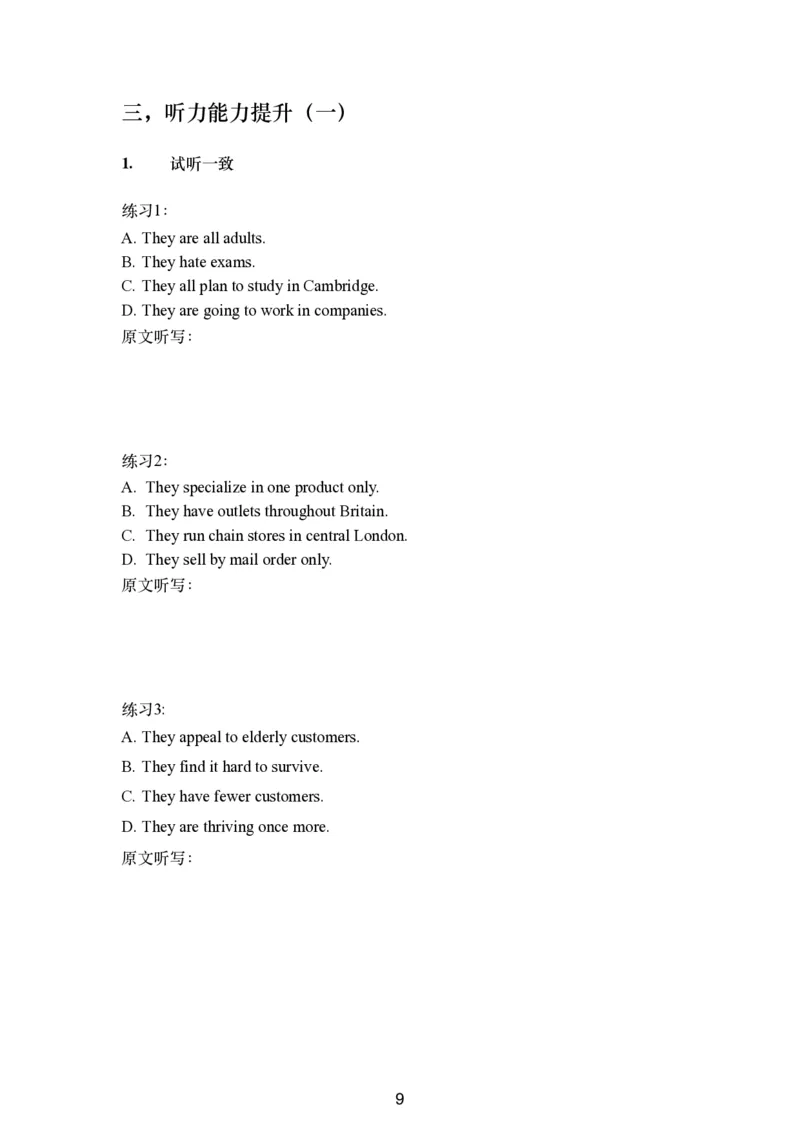
1. 试听⼀致
练习1:
A. They are all adults.
B. They hate exams.
C. They all plan to study in Cambridge.
D. They are going to work in companies.
原⽂听写:
练习2:
A. They specialize in one product only.
B. They have outlets throughout Britain.
C. They run chain stores in central London.
D. They sell by mail order only.
原⽂听写:
练习3:
A. They appeal to elderly customers.
B. They find it hard to survive.
C. They have fewer customers.
D. They are thriving once more.
原⽂听写:
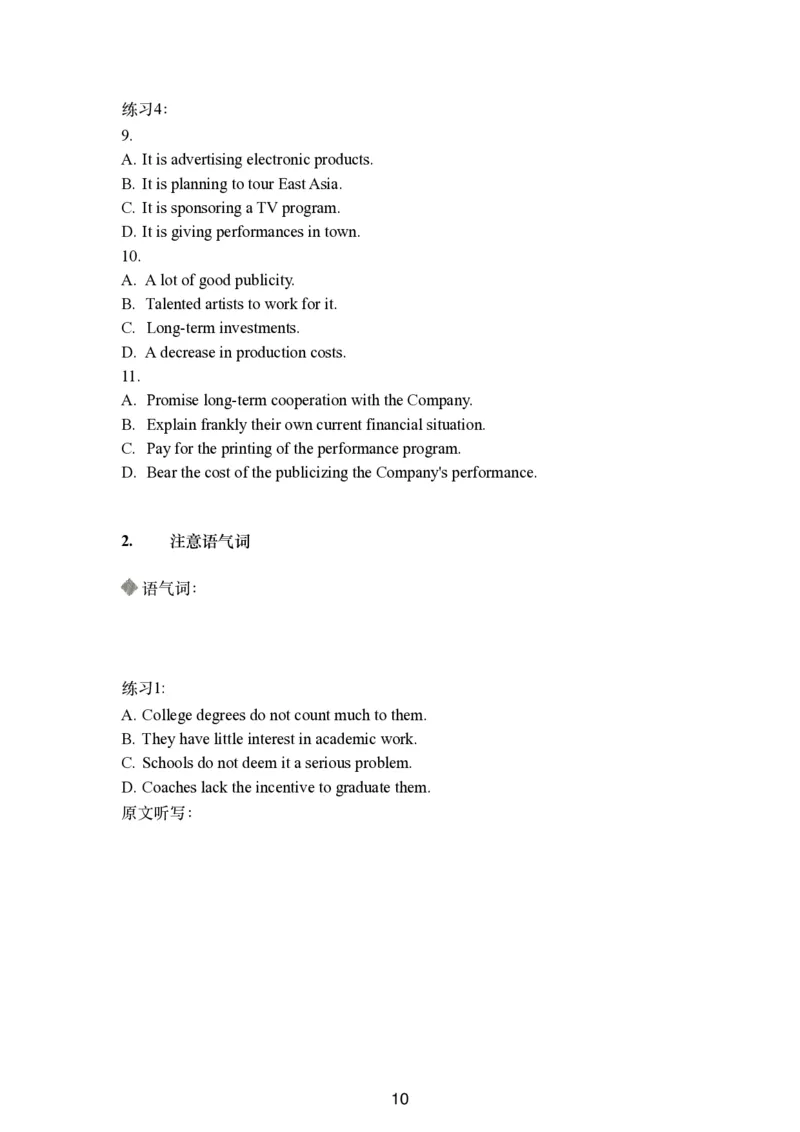
9练习4:
9.
A. It is advertising electronic products.
B. It is planning to tour East Asia.
C. It is sponsoring a TV program.
D. It is giving performances in town.
10.
A. A lot of good publicity.
B. Talented artists to work for it.
C. Long-term investments.
D. A decrease in production costs.
11.
A. Promise long-term cooperation with the Company.
B. Explain frankly their own current financial situation.
C. Pay for the printing of the performance program.
D. Bear the cost of the publicizing the Company's performance.
2. 注意语⽓词
语⽓词:
练习1:
A. College degrees do not count much to them.
B. They have little interest in academic work.
C. Schools do not deem it a serious problem.
D. Coaches lack the incentive to graduate them.
原⽂听写:
10练习2:
A. All services will be personalized.
B. A lot of knowledge-intensive jobs will be replaced.
C. Technology will revolutionize all sectors of industry.
D. More information will be available.
原⽂听写:
3,关注前两轮对话
练习1:
A. Coal burnt daily for the comfort of our homes.
B. Anything that can be used to produce power.
C. Fuel refined from oil extracted from underground.
D. Electricity that keeps all kinds of machines running.
原⽂听写:
练习2:
A. It is well paid. C. It is demanding.
B. It is stimulating. D. It is fairly secure.
原⽂听写:
114,注意转折,举例,强调,因果词
转折:
举例:
强调:
因果:
练习1:转折
A. He has difficulty communicating with local people.
B. He has to spend a lot more traveling back and forth.
C. He has trouble adapting to the local weather.
D. He has to sign a long-term contract.
原⽂听写:
练习2:
A) Metal type was imported from Korea.
B) The earliest known book was published.
C) Chinese printing technology was first introduced.
D) Moveable metal type began to be used in printing.
原⽂听写:
练习3:强调
A. Oil will soon be replaced by alternative energy sources.
B. Oil reserves in the world will be exhausted in a decade.
C. Oil consumption has given rise to many global problems.
D. Oil production will begin to decline worldwide by 2025.
12原⽂听写:
练习4:强调
A. Doing enjoyable work. C. Having friendly colleagues.
B. Earning a competitive salary. D. Working for supportive bosses.
原⽂听写:
5,注意⽐较、最⾼级
练习1:
A. To inquire about the interest rates at the woman’s bank.
B. To inquire about the current financial market situation.
C. To see if he can find a job in the woman’s company.
D. To see if he can get a loan from the woman’s bank.
原⽂听写:
6, 同义转换原则
练习1:
A. It is well designed. C. It varies among universities.
B. It is rather inflexible. D. It has undergone great changes.
原⽂听写:
13练习2:
A. They are of little value. C. They are worthy of a prize.
B. They make good reading. D. They need improvement.
原⽂听写:
练习3:
A. It improves students' ability to think.
B. It is accessible only to the talented.
C. It starts a lifelong learning process.
D. It gives birth to many eminent scholars.
原⽂听写:
练习4:
A. Around 40%. C. About 15%.
B. Slightly over 50%. D. Approximately 65%.
原⽂听写:
14四,长对话、短⽂技巧训练(上)
1. 节奏感+重读单词。
练习1:161202 13-15
13.
A.It has remained basically the same. C .It has been exaggerated.
B.It has become better understood. D.It has decreased.
14.
A. It is now the second leading cause of death for centenarians.
B. It develops more easily in centenarians who are not active.
C. It calls for more intensive research.
D. It has had no effective cure so far.
15.
A.They cherish their life more than ever.
B.Their minds fail before their bodies do.
C.Their quality of life deteriorates rapidly.
D.They care more about their physical health.
练习2:170601 13-15
13.
A. They are life-threatening diseases. C. They are new species of big insects.
B. They are overprescribed antibiotics. D. They are antibiotic-resistant bacteria.
14.
A. Routine operations have become complex.
B. Large amounts of tax money are wasted.
C. Many infections are no longer curable.
D. Antibiotics are now in short supply.
15.
A. Money. B. Expertise. C . F a c i l i t i e s . D. Publicity.
练习3:171202 9-15
Questions 9 to 11 are based on the passage you have just heard.
9.
A. It makes claims in conflict with the existing research.
B. It focuses on the link between bedtime and nutrition.
C. It cautious against the overuse of coffee and alcohol.
D. It shows that "night owls" work much less efficiently.
1510.
A. They pay greater attention to food choice.
B. They tend to achieve less than their peers.
C. They run a higher risk of gaining weight.
D. They stand a greater chance to fall sick.
11.
A. Get up late. C. Exercise more.
B. Sleep 8 hours a day. D. Go to bed earlier.
Questions 12 to 15 are based on the passage you have just heard.
12.
A. All of the acting nominees are white.
B. It has got too much publicity on TV.
C. It is prejudiced against foreign films.
D. Only 7% of the nominees are female.
13.
A. Twenty-two percent of movie directors were people of color.
B. Half of the TV programs were ethnically balanced.
C. Only one-fifth of TV shows had black characters.
D. Only 3.4 percent of film directors were women.
14.
A. Non-white males. C. Females of color over 40.
B. Program creators. D. Asian speaking characters.
15.
A. They constitute 17% of Hollywood movie characters.
B. They are most underrepresented across TV and film.
C. They contribute little to the U.S. film industry.
D. They account for 8.5% of the U.S. population.
162,找相同,画不同。(1)句⼦主⼲相同
练习1:131202,9-12
9.
A. He made a business trip. C. He talked to her on the phone.
B. He had a quarrel with Marsha. D. He resolves a budget problem.
10.
A. She may have to be fired for poor performance.
B. She has developed some serious mental problem.
C. She is in charge of the firm’s budget planning.
D. She supervises a number of important projects.
11.
A. She failed to arrive at the airport on time.
B. David promised to go on the trip in her place.
C. Something unexpected happened at her home.
D. She was not feeling herself on that day.
12.
A. He frequently gets things mixed up.
B. He is always finding fault with Marsha.
C. He has been trying hard to cover for Marsha.
D. He often fails to follow through on his projects.
练习2:161201 13-15
13.
A. They will pick up some souvenirs or gift items.
B. They will have their vehicles washed or serviced.
C. They will take advantage of the time to rest a while.
D. They will buy something from the convenience stores.
14.
A. They may eventually drive one to bankruptcy.
B. They should be done away with altogether.
C. They are meant for the extremely wealthy.
D. They can bring only temporary pleasures.
15.
A. Small daily savings can make a big difference in one's life.
B. A vacation will be affordable if one saves 20 dollars a week.
C. Retirement savings should come first in one's family budgeting.
D. A good way to socialize is to have daily lunch with one's colleagues.
17练习3:171202 1-4
1.
A. Say a few words to thank the speaker.
B. Introduce the speaker to the audience.
C. Give a lecture on the history of the town.
D. Host a talk on how to give a good speech.
2.
A. He was the founder of the local history society.
B. He has worked with Miss Bligh for 20 years.
C. He has published a book on public speaking.
D. He joined the local history society when young.
3.
A. She was obviously better at talking than writing.
B. She had a good knowledge of the town's history.
C. Her speech was so funny as to amuse the audience.
D. Her ancestors came to the town in the 18th century.
4.
A. He read exactly what was written in his notes.
B. He kept forgetting what he was going to say.
C. He made an embarrassing remark.
D. He was too nervous to speak up.
练习4:161202 5-8
5.
A. The woman's earnings over the years.
B. The key to running a shop at a low cost.
C. The business success of the woman's shop.
D. The woman's relationship with other shops.
6.
A. Keep down its expenses.
B. Improve its customer service.
C. Expand its business scale.
D. Upgrade the goods it sells.
7.
A. They are in great demand.
B. They are delivered free of charge.
C. They are very popular with the local residents.
D. They are sold at lower prices than in other shops.
8.
18A. To maintain friendly relationships with other shops.
B. To avoid being put out of business in competition.
C. To attract more customers in the neighborhood.
D. To follow the custom of the local shopkeepers.
(2)其他部分相同
练习1:161202 9-12
9.
A. They are on the verge of extinction because of pollution.
B. They carry plant seeds and spread them to faraway places.
C. They deliver pollutants from the ocean to their nesting sites.
D. They can be used to deliver messages in times of emergency.
10.
A. They originate from Devon Island in the Arctic area.
B. They migrate to the Arctic Circle during the summer.
C. They have the ability to survive in extreme weathers.
D. They travel as far as 400 kilometers in search of food.
11.
A. They had become more poisonous. C. They poisoned some of the fulmars.
B. They were carried by the wind. D. They were less than on the continent.
12.
A. The effects of the changing climate on Arctic seabirds.
B. The harm Arctic seabirds may cause to humans.
C. The diminishing colonies for Arctic seabirds.
D. The threats humans pose to Arctic seabirds.
练习2:170601 5-8
5.
A. Undergraduate enrollments of black athletes.
B. Financial assistance to black athletes in college.
C. High college dropout rates among black athletes.
D. Achievements of black male athletes in college.
6.
A. They make money for the college but often fail to earn a degree.
B. They have difficulty finding money to complete their studies.
C. They are better at sports than at academic work.
D. They display great talent in every kind of game.
197.
A. Around 40%. C. About 15%.
B. Slightly over 50%. D. Approximately 70%.
8.
A. College degrees do not count much to them.
B. They have little interest in academic work.
C. Schools do not deem it a serious problem.
D. Coaches lack the incentive to graduate them.
20五,长对话、短⽂技巧训练(下)
3,多个选项被读到&复现原则。
复现原则:
练习1:161201 5-12
Questions 5 to 8 are based on the conversation you have just heard.
5.
A. When luck plays a role. C. What determines success.
B. Whether practice makes perfect. D . How important natural talent is.
6.
A. It knocks at your door only once in a while.
B. It means being good at seizing opportunities.
C. It is something that no one can possibly create.
D. It comes naturally out of one's self-confidence.
7.
A. Practice is essential to becoming good at something.
B. One should always be ready to seize opportunities.
C. One must have natural talent to be successful.
D. Luck rarely contributes to a person's success.
8.
A. People who love what they do care little about money.
B. Being passionate about work can make one wealthy.
C. Putting time and effort into fun things is profitable.
D. People in need of money work hard automatically.
Section B
Directions: In this section, you will hear two passages. At the end of each passage,
you will hear three or four questions. Both the passage and the questions will be
spoken only once. After you hear a question, you must choose the best answer from
the four choices marked A), B), C) and D). Then mark the corresponding letter on
Answer Sheet 1 with a single line through the centre.
Questions 9 to 12 are based on the passage you have just heard.
9.
A. A tall chimney. C. The peak of a mountain.
B. A huge piece of rock. D. The stump of a giant tree.
10.
A. Human activity. C. Wind and water.
B. Chemical processes. D. Fire and fury.
2111.
A. It was built in ancient times.
B. It is a historical monument.
C. It was created by supernatural powers.
D. It is Indians' sacred place for worship.
12.
A. By killing the attacking bears.
B. By sheltering them in a cave.
C. By lifting them well above the ground.
D. By taking them to the top of a mountain.
练习2:170601 9-12
9.
A. Online stores. C. Shopping malls.
B. Marketing strategies. D. Holiday shopping.
10.
A. About 136 million. C. About 50% of holiday shoppers.
B. About 183.8 million. D. About 20-30% of holiday shoppers.
11.
A. They appeal to elderly customers. C. They have fewer customers.
B. They find it hard to survive. D. They are thriving once more.
12.
A. Higher employment and wages. C. Greater varieties of commodities.
B. Better quality of consumer goods. D. People having more leisure time.
练习3:170602 1-4
1.
A. Doing enjoyable work. C. Having friendly colleagues.
B. Earning a competitive salary. D. Working for supportive bosses.
2.
A. 20%. B. 25%. C. 31%. D. 73%.
3.
A. Those full of skilled workers. C. Those run by women.
B. Those that are well managed. D. Those of a small size.
4.
A. They can win recognition of their work.
B. They can better balance work and life.
C. They can hop from job to job easily.
D. They can take on more than one job.
224,祈使句
练习1:131203 9-12
9.
A. He picked up some apples in his yard.
B. He cut some branches off the apple tree.
C. He quarreled with his neighbor over the fence.
D. He cleaned up all the garbage in the woman's yard.
10.
A. Trim the apple trees in her yard.
B. Pick up the apples that fell in her yard.
C. Take the garbage to the curb for her.
D. Remove the branches from her yard.
11.
A. File a lawsuit against the man. C. Have the man's apple tree cut down.
B. Ask the man for compensation. D. Throw garbage into the man's yard.
12.
A. He was ready to make a concession. C. He was not intimidated.
B. He was not prepared to go to court. D. He was a bit concerned.
练习2:170602 9-12
9.
A. They try hard to avoid getting off on the wrong foot.
B. They spend too much time anticipating their defeat.
C. The take too many irrelevant factors into account.
D. They make careful preparations beforehand.
10.
A. Mental images often interfere with athletes' performance.
B. Golfers usually have positive mental images of themselves.
C. Thinking has the same effect on the nervous system as doing.
D. A person's nervous system is more complicated than imagined.
11.
A. Anticipate possible problems. C. Try to appear more professional.
B. Make a list of do's and don'ts. D. Picture themselves succeeding.
12.
A. She won her first jury trial. C. She presented moving pictures.
B. She wore a designer dress. D. She did not speak loud enough.
235,原⽂简单,题⽬难。
练习1:161202 1-4
1.
A. They were proud of their cuisine. C . They were all good at cooking.
B. They were particular about food. D. They were fond of bacon and eggs.
2.
A. His parents. C. His friends.
B. His parents' friends. D. His schoolmates.
3.
A) No one of the group ate it. C) No tea was served with the meal.
B) It was a little overcooked. D) It was the real English breakfast.
4.
A) It was full of excitement. C) It was a risky experience.
B) It was rather disappointing. D) It was really extraordinary.
练习2:170602 5-8
5.
A. It is a collection of photos. C. It is about the city of Bruges.
B. It is an introduction to music. D. It is a book of European history.
6.
A. When writing about Belgium's coastal regions.
B. When taking pictures for a concert catalogue.
C. When vacationing in. an Italian coastal city.
D. When painting the concert hall of Bruges.
7.
A. The rich heritage of Europe will be lost completely.
B. The seawater of Europe will be seriously polluted.
C. The entire European coastline will be submerged.
D. The major European scenic spots will disappear.
8.
A. Tourists use wooden paths to reach their hotels in the morning.
B. It attracts large numbers of tourists from home and abroad.
C. People cannot get around without using boats.
D. Its waterways are being increasingly polluted.
242018年6⽉第⼀套
Part II Listening Comprehension (30 minutes)
Section A
Directions: In this section, you will hear two long conversations. At the end of each
conversation, you will hear four questions. Both the conversation and the questions
will be spoken only once. After you hear a question, you must choose the best answer
from the four choices marked A), B), C) and D). Then mark the corresponding letter
on Answer Sheet 1 with a single line through the centre.
Questions 1 to 4 are based on the conversation you have just heard.
l.
A. She is the owner of a special café. C. She advocates animal protection.
B. She sells a special kind of coffee. D. She is going to start a café chain.
2.
A. They help take care of customers’ pets.
B. They are a profitable business sector.
C. They cater to different customers.
D. They bear a lot of similarities.
3.
A. By selecting breeds that are tame and peaceful.
B. By giving them regular cleaning and injections.
C. By placing them at a safe distance from customers.
D. By briefing customers on how to get along with them.
4.
A. They give her café favorite reviews. C. They love the animals in her café.
B. They like to bring in their children. D. They want to learn about rabbits.
Questions 5 to 8 are based on the conversation you have just heard.
5.
A. It can cause obesity. C. It contains too many additives.
B. It is mostly garbage. D. It lacks the essential vitamins.
6.
A. TV commercials. C. Its taste and texture.
B. Its fancy design. D. Peer influence.
7.
A. Offering children more varieties to choose from.
B. Trying to trick children into buying their products.
C. Marketing their products with ordinary ingredients.
D. Investing heavily in the production of sweet foods.
258.
A. They favored chocolate-coated sweets.
B. They liked the food advertised on TV.
C. They hardly ate vegetables.
D. They seldom had junk food.
Section B
Directions: In this section, you will hear two passages. At the end of each passage,
you will hear three or four questions. Both the passage and the questions will be
spoken only once. After you hear a question, you must choose the best answer from
the four choices marked A), B), C) and D). Then mark the corresponding letter on
Answer Sheet 1 with a single line through the centre.
Questions 9 to 11 are based on the passage you have just heard.
9.
A. Tombs of ancient rulers. C. Ruins left by devastating floods.
B. Typical Egyptian animal farms. D. Stretches of farmland.
10.
A. It provides habitats for more primitive tribes.
B. It is hardly associated with great civilizations.
C. It gathers water from many tropical rain forests.
D. It has not yet been fully explored and exploited.
11.
A. It has numerous human settlements along its banks.
B. It is as long as the Nile and the Yangtze combined.
C. It is second only to the Mississippi River in width.
D. It carries about one fifth of the world’s fresh water.
Questions 12 to 15 are based on the passage you have just heard.
12.
A. All of us actually yearn for a slow and calm life.
B. The search for tranquility has become a trend.
C. We are always in a rush to do various things.
D. Living a life in the fast lane leads to success.
13.
A. She enjoyed the various social events.
B. She was accustomed to tight schedules.
C. She had trouble balancing family and work.
D. She spent all her leisure time writing books.
2614.
A. The fatigue from living a fast-paced life.
B. Becoming aware of her declining health.
C. Reading a book about slowing down.
D. The possibility of ruining her family.
15.
A. She came to enjoy doing everyday tasks.
B. She started to follow the cultural norms.
C. She learned to use more polite expressions.
D. She stopped using to-do lists and calendars.
Section C
Directions: In this section, you will hear three recordings of lectures or talks followed
by three or four questions. The recordings will be played only once. After you hear a
question, you must choose the best answer from the four choices marked A), B), C)
and D). Then mark the corresponding letter on Answer Sheet 1 with a single line
through the centre.
Questions 16 to 18 are based on the recording you have just heard.
16.
A. They will root out native species altogether.
B. They will crossbreed with native species.
C. They pose a threat to the local ecosystem.
D. They contribute to a region’s biodiversity.
17.
A. Their distinctions are artificial. C. Their interactions are hard to define.
B. Their definitions are changeable. D. Their classifications are meaningful.
18.
A. Only 10 percent of them can be naturalized.
B. Few of them can survive in their new habitats.
C. They may turn out to benefit the local environment.
D. Only a few of them cause problems to native species.
Questions 19 to 21 are based on the recording yon have just heard.
19.
A. Adopt the right business strategies. C. Respect their traditional culture.
B. Attend their business seminars. D. Research their specific demands.
2720.
A. Clicking your fingers loudly in their presence.
B. Drinking alcohol on certain days of a month.
C. Giving them gifts of great value.
D. Showing them your palm.
21.
A. They have a break from 2:00 to 5:30 p.m.
B. They have a strong sense of worth.
C. They tend to be friendly and enthusiastic.
D. They are very easy to satisfy.
Questions 22 to 25 are based on the recording you have just heard.
22.
A. He had the company’s boardroom extensively renovated.
B. He completely changed the company’s culture.
C. He took over the sales department of Reader’s Digest.
D. He collected paintings by world-famous artists.
23.
A. Its articles should entertain blue- and pink-collar workers.
B. It should be published in the world’s leading languages.
C. It should be sold at a reasonable price.
D. Its articles should be short and inspiring.
24.
A. He served as a church minister for many years.
B. He knew how to make the magazine profitable.
C. He treated the employees like members of his family.
D. He suffered many setbacks and misfortunes in his life.
25.
A. It carried many more advertisements.
B. Its subscriptions increased considerably.
C. George Grune joined it as an ad salesman.
D. Several hundred of its employees got fired.
286,同意替换
练习:171202 5-8
5.
A. What their retailers demand.
B. What their rivals are doing.
C. How they are going to beat their rivals.
D. How dramatically the market is changing.
6.
A. They should be taken seriously.
B. They are rapidly catching up.
C. Their business strategy is quite effective.
D. Their potential has been underestimated.
7.
A. She had given it to Tom. C. She had not seen it yet.
B. It simply made her go frantic. D. It was not much of a big concern.
8.
A. Restructuring the whole company.
B. Employing more forwarding agents.
C. Promoting cooperation with Jayal Motors.
D. Exporting their motorbikes to Indonesia.
练习1:170601,1-4
1.
A. He would be embarrassed. C. He would feel insulted.
B. He would feel very sad. D. He would be disappointed.
2.
A. They are of little value. C. They are worthy of a prize.
B. They make good reading. D. They need improvement.
3.
A. He writes several books simultaneously.
B. He draws on his real-life experiences.
C. He often turns to his wife for help.
D. He seldom writes a book straight through.
4.
A. Writing a book is just like watching a football match.
B. Unlike a football match, there is no end to writing a book.
C. He likes watching a football match after finishing a book.
D. Writers actually work every bit as hard as footballers.
29六,听⼒能⼒训练(⼆)
1, 关注序数词
练习1:
A. They contribute most to it. C. They often find fault with it.
B. They are crazy about it. D. They take it for granted.
原⽂听写:
2,注意语⽓强调处
练习1:
A. Tidal restlessness. C. Economic prosperity.
B. Heat and light. D. Historical continuity.
原⽂听写:
练习2:
A. They may take a long time to solve.
B. They need assistance from the city.
C. They have to be dealt with one by one.
D. They are too big for individual efforts.
原⽂听写:
30七,讲座录⾳概述与训练
练习1:161201 16-18
16.
A) They are harmful to health. C) They are necessary in our lives.
B) They enrich our experience. D) They should be done away with.
17.
A) They are exhausted even without doing any heavy work.
B) They feel too overwhelmed to deal with life's problems.
C) They are anxious to free themselves from life's troubles.
D) They feel stressed out even without any challenges in life.
18.
A) They lessen our burdens. C) They prolong our lives.
B) They narrow our focus. D) They expand our mind.
练习2:161202 19-22
19.
A. The history of social work.
B. Social work as a profession.
C. Academic degrees required of social work applicants.
D. The aim of the National Association of Social Workers.
20.
A. They try to change people's social behavior.
B. They raise people's awareness of environment.
C. They create a lot of opportunities for the unemployed.
D. They help enhance the well-being of the underprivileged.
21.
A. They have all made a difference through their work.
B. They are all members of the National Association.
C. They all have an academic degree in social work.
D. They have all received strict clinical training.
22.
A. Social works' job options and responsibilities.
B. Ways for social workers to meet people's needs.
C. The importance of training for social workers.
D. The promotion of social workers' social status.
31练习3:161202 16-18
16.
A. They form the basis on which he builds his theory of love.
B. They were carried out over a period of some thirty years.
C. They were done by his former colleague at Yale.
D. They are focused more on attraction than love.
17.
A. The relationship cannot last long ff no passion is involved.
B. It is not love if you don't wish to maintain the relationship.
C. Romance is just impossible without mutual understanding.
D. Intimacy is essential but not absolutely indispensable to love.
18.
A. Whether it is true love without commitment.
B. Which of them is considered most important.
C. How the relationship is to be defined if any one is missing.
D. When the absence of any one doesn't affect the relationship.
练习4:170601
Section C
Directions: In this section, you will hear three recordings of lectures or talks followed
by three or four questions. The recordings will be played only once. After you hear a
question, you must choose the best answer from the four choices marked A), B), C)
and D). Then mark the corresponding letter on Answer Sheet 1 with a single line
through the centre.
Questions 16 to 18 are based on the recording you have just heard.
16.
A. It improves students' ability to think.
B. It is accessible only to the talented.
C. It starts a lifelong learning process.
D. It gives birth to many eminent scholars.
17.
A. They protect students' rights.
B. They promote globalization.
C. They uphold the presidents' authority.
D. They encourage academic democracy.
18.
A. His eagerness to find a job. C. His potential for leadership.
B. His thirst for knowledge. D. His contempt for authority.
32Questions 19 to 22 are based on the recording you have just heard.
19.
A. People tend to underestimate their mental powers.
B. Most people have a rather poor long-term memory.
C. People can enhance their memory with a few tricks.
D. Few people know how to retrieve information properly.
20.
A. They contain names of the most familiar states.
B. They are exactly the same as is shown in the atlas.
C. They include more or less the same number of states.
D. They present the states in a surprisingly different order.
21.
A. Making sensible decisions while choosing your answers.
B. Reviewing your lessons where the exam is to take place.
C. Having a good sleep the night before.
D. Focusing on what is likely to be tested.
22.
A. Follow the example of a marathon runner.
B. Give yourself a double bonus afterwards.
C. Discover when you can learn best.
D. Change your time of study daily.
Questions 23 to 25 are based on the recording you have just heard.
23.
A. He is a politician. C. He is a businessman.
B. He is a sociologist. D. He is an economist.
24.
A. In slums. C. In developing countries.
B. In Africa. D. In pre-industrial societies.
25.
A. Their children cannot afford to go to private schools.
B. They work extra hours to have their basic needs met.
C. Their income is less than 50% of the national average family income.
D. They have no access to health care, let alone entertainment or recreation.
33练习5:170602
Section C
Directions: In this section, you will hear three recordings of lectures or talks
followed by three or four questions. The recordings will be played only once. After
you hear a question, you must choose the best answer from the four choices marked
A), B), C) and D). Then mark the corresponding letter on Answer Sheet 1 with a
single line through the centre.
Questions 16 to 18 are based on the recording you have just heard.
16.
A. Investigating the impact of media on government.
B. Studying the hazards of young people drinking.
C. Conducting research on consumer behaviour.
D. Observing the changes in marketing.
17.
A. It is a chief concern of parents. C. It is the cause of many street riots.
B. It is an act of socializing. D. It is getting worse year by year.
18.
A. They researched the impact of mobile phones on young people.
B. They spent a week studying their own purchasing behavior.
C. They conducted a thorough research on advertising.
D. They analyzed their family budgets over the years.
Questions 19 to 22 are based on the recording you have just heard.
19.
A. It is likely to give up paper money in the near future.
B. It is the first country to use credit cards in the world.
C. It is trying hard to do away with dirty money.
D. It is helping its banks to improve efficiency.
20.
A. Whether it is possible to travel without carrying any physical currency.
B. Whether it is possible to predict how much money one is going to spend.
C. Whether the absence of physical currency is going to affect everyday life.
D. Whether the absence of physical currency causes a person to spend more.
21.
A. The cash in her handbag was missing.
B. The service on the train was not good.
C. The restaurant car accepted cash only.
D. There was no food service on the train.
3422.
A. By drawing money week by week.
B. By putting money into envelopes.
C. By limiting their day-to-day spending.
D. By refusing to buy anything on credit.
Questions 23 to 25 are based on the recording you have just heard.
23.
A. Population explosion. C. Chronic hunger.
B. Extinction of rare species. D. Environmental deterioration.
24.
A. About half of them are unintended.
B. They contribute to overpopulation.
C. They have been brought under control.
D. The majority of them tend to end halfway.
25.
A. It is beginning to attract postgraduates' attention.
B. It is neglected in many of the developing countries.
C. It is becoming a subject of interdisciplinary research.
D. It is essential to the wellbeing of all species on earth.
35综合练习
Part II Listening Comprehension (30 minutes)
Section A
Directions: In this section, you will hear two long conversations. At the end of each
conversation, you will hear four questions. Both the conversation and the questions
will be spoken only once. After you hear a question, you must choose the best answer
from the four choices marked A), B), C) and D). Then mark the corresponding letter
on Answer Sheet 1 with a single line through the centre.
Questions 1 to 4 are based on the conversation you have just heard.
1.
A. It is a typical salad. C. It is a weird vegetable.
B. It is a Spanish soup. D. It is a kind of spicy food.
2.
A. To make it thicker. C. To add to its appeal.
B. To make it more nutritious. D. To replace an ingredient.
3.
A. It contains very little fat. C. It uses no artificial additives.
B. It uses olive oil in cooking. D. It is mainly made of vegetables.
4.
A. It does not go stale for two years. C. It comes from a special kind of pig.
B. It takes no special skill to prepare. D. It is a delicacy blended with bread.
Questions 5 to 8 are based on the conversation you have just heard.
5.
A. They come in a great variety. C. They do not vary much in price.
B. They do not make decent gifts. D. They go well with Italian food.
6.
A. $30-$40. B. $40-$50. C. $50-$60. D. Around $150.
7.
A. They are a healthy choice for elderly people.
B. They are especially popular among Italians.
C. They symbolize good health and longevity.
D. They go well with different kinds of food.
8.
A. It is a wine imported from California.
B. It is less spicy than all other red wines.
C. It is far more expensive than he expected.
D. It is Italy’s most famous type of red wine.
36Section B
Directions: In this section, you will hear two passages. At the end of each passage,
you will hear three or four questions. Both the passage and the questions will be
spoken only once. After you hear a question, you must choose the best answer from
the four choices marked A), B), C) and D). Then mark the corresponding letter on
Answer Sheet 1 with a single line through the centre.
Questions 9 to 11 are based on the passage you have just heard.
9.
A. Learning others’ secrets. C. Decoding secret messages.
B. Searching for information. D. Spreading sensational news.
10.
A. They helped the U.S. army in World War Two.
B. They could write down spoken codes promptly.
C. They were assigned to decode enemy messages.
D. They were good at breaking enemy secret codes.
11.
A. Important battles fought in the Pacific War.
B. Decoding of secret messages in war times.
C. A military code that was never broken.
D. Navajo Indians’ contribution to code breaking.
Questions 12 to 15 are based on the passage you have just heard.
12.
A. All services will be personalized.
B. A lot of knowledge-intensive jobs will be replaced.
C. Technology will revolutionize all sectors of industry.
D. More information will be available.
13.
A. In the robotics industry. C. In the personal care sector.
B. In the information service. D. In high-end manufacturing.
14.
A. They charge high prices.
B. They need lots of training.
C. They cater to the needs of young people.
D. They focus on customers’ specific needs.
15.
A. The rising demand in education and healthcare in the next 20 years.
B. The disruption caused by technology in traditionally well-paid jobs.
C. The tremendous changes new technology will bring to people’s lives.
D. The amazing amount of personal attention people would like to have.
37Section C
Directions: In this section, you will hear three recordings of lectures or talks followed
by three or four questions. The recordings will be played only once. After you hoar a
question, you must choose the best answer from the four choices marked A), B), C)
and D). Then mark the corresponding letter on Answer Sheet 1 with a single line
through the centre.
Questions 16 to 18 are based on the recording you have just heard.
16.
A. It was the longest road in ancient Egypt.
B. It was constructed some 500 years ago.
C. It lay 8 miles from the monument sites.
D. It linked a stone pit to some waterways.
17.
A. Saws used for cutting stone. C. An ancient geographical map.
B. Traces left by early explorers. D. Some stone tool segments.
18.
A. To transport stones to block floods.
B. To provide services for the stone pit.
C. To link the various monument sites.
D. To connect the villages along the Nile.
Questions 19 to 21 are based on the recording you have just heard.
19.
A. Dr. Gong didn’t give him any conventional tests.
B. Dr. Gong marked his office with a hand-painted sign.
C. Dr. Gong didn’t ask him any questions about his pain.
D. Dr. Gong slipped in needles where he felt no pain.
20.
A. He had heard of the wonders acupuncture could work.
B. Dr. Gong was very famous in New York’s Chinatown.
C. Previous medical treatments failed to relieve his pain.
D. He found the expensive medical tests unaffordable.
21.
A. More and more patients ask for the treatment.
B. Acupuncture techniques have been perfected.
C. It doesn’t need the conventional medical tests.
D. It does not have any negative side effects.
38Questions 22 to 25 are based on the recording you have just heard.
22.
A. They were on the verge of breaking up.
B. They were compatible despite differences.
C. They quarreled a lot and never resolved their arguments.
D. They argued persistently about whether to have children.
23.
A. Neither of them has any brothers or sisters.
B. Neither of them won their parents’ favor.
C. They weren’t spoiled in their childhood.
D. They didn’t like to be the apple of their parents’ eyes.
24.
A. They are usually good at making friends.
B. They tend to be adventurous and creative.
C. They are often content with what they have.
D. They tend to be self-assured and responsible.
25.
A. They enjoy making friends.
B. They tend to be well adjusted.
C. They are least likely to take initiative.
D. They usually have successful marriages.
39附录:语⾳对照表
1,前元⾳
(1)前元⾳ :[ ɪ: ]
常见字母和字母组合[ ɪ: ]
e he me be she
e_e these Chinese Japanes
ee see week bee feed
ea heat teacher tea weak
ie field thief believe piece
ei seize receive ceiling neither
ey key
(2)前元⾳ :[ ɪ ]
常见字母和字母组合 [ ɪ ]
e pretty reply repair believe
i sit history biscuit lift
u busy business
y marry January many windy
ey monkey money honey donkey
(3)前元⾳: [ e ]
常见字母和字母组合 [ e ]
a any anybody many anywhere
e desk very every vegetable
ea bread dead spread meant
ai said laid paid
40(4)前元⾳: [ æ ]
常见字母和字母组合 [ æ ]
a flag black plan fat
2,中元⾳
(1)中元⾳:[ ɜː ]
常见字母和字母组合 [ ɜː ]
er her herself nervous mermaid
ir birthday third skirt birdcage
or word work world worm
ur turn hurt fur purse
ear earth learn early heard
(2)中元⾳:[ ə ]
常见字母和字母组合[ ə ]
a ago breakfast arrive sofa
e open happen often ten
o collect computer correct connect
or inventor actor doctor visitor
er letter order sweater ruler
our colour neighbour honour labour
ure picture nature future capture
3,后元⾳
(1)后元⾳:[ a: ]
常见字母和字母组合 [ aː ]
a father after fast class
ar card farm party bar
al half calm calf
41au aunt laugh laughter
ear heart
(2)后元⾳:[ ɒ ]
常见字母和字母组合[ ɒ ]
a want watch wash what
o song pot body dog
(3)后元⾳:[ ɔː ]
常见字母和字母组合[ ɔː ]
al walk talk call wall
or forty corn sport morning
au fault autumn cause hawk
aw paw law lawyer hawk
ar war quarter warm warn
our fourth pour fourteen course
oor/oar floor door roar board
ough bought brought thought ought
augh daughter naughty caught taught
(4)后元⾳:[ ʊ ]
常见字母和字母组合[ ʊ ]
u pull push sugar butcher
oo foot stood book classroom
ou should could would
(5)后元⾳:[ u: ]
42常见字母和字母组合[ u: ]
o move shoe do to
u ruler June flute blue
oo school tooth noon noodles
ui fruit juice ruin suit
ou group you soup through
ew drew grew flew blew
(6)后元⾳:[ ʌ ]
常见字母和字母组合[ ʌ ]
u up fun gun cup
o come mother does love
ou trouble young country rough
oo blood flood
3,双元⾳
(1)合⼜双元⾳:[ eɪ ]
常见字母和字母组合[ eɪ ]
a make snake name face
ai mail pain paint gain
ay day play way May
ey they hey grey obey
eigh eight weight neighbor freight
(2)合⼜双元⾳:[ aɪ ]
43常见字母和字母组合[ aɪ ]
i fine nice knife ride
y shy why dry sky
ie die pie tie lie
ye bye dye eyebrow eyewitness
igh high light night might
(3)合⼜双元⾳:[ ɒɪ ]
常见字母和字母组合[ ɒɪ ]
oy enjoy Roy toy boy
oi boil point noise toilet
(4)合⼜双元⾳:[ əʊ ]
常见字母和字母组合[ əʊ ]
o post old open Olympic
oa boat road load toast
ou soul shoulder
ow slow know low follow
ough though although
oe toe doe foe hoe
(5)合⼜双元⾳:[ aʊ ]
常见字母和字母组合[ aʊ ]
ou about around south loud
ow how bow cow now
(6)集中双元⾳:[ ɪə ]
44常见字母和字母组合[ ɪə ]
ea real idea cereal
ear hear beard tear here
eer deer poineer beer cheer
(7)集中双元⾳:[ eə ]
常见字母和字母组合[ eə ]
are dare careful careless fare
air hair stair fair airport
ear wear pear bear
eir their there where theirs
(8)集中双元⾳:[ ʊə ]
常见字母和字母组合[ ʊə ]
ou tourist tourism
oor/our poor tour four
ure assure sure
45