2019湖南永州中考英语解析
第一部分 听力技能(共两节,满分20分)
第一节(共5小题。每小题1分,满分5分)听下面五段材料,每段材料后各有一个小题,
从各小题所给的A、B、C三个选项中选出最佳答案,并标在试卷的相应位置。听每段材料
前,你将有时间读各个小题,每小题5秒钟。听完后,各小题将给出5秒钟的作答时间。
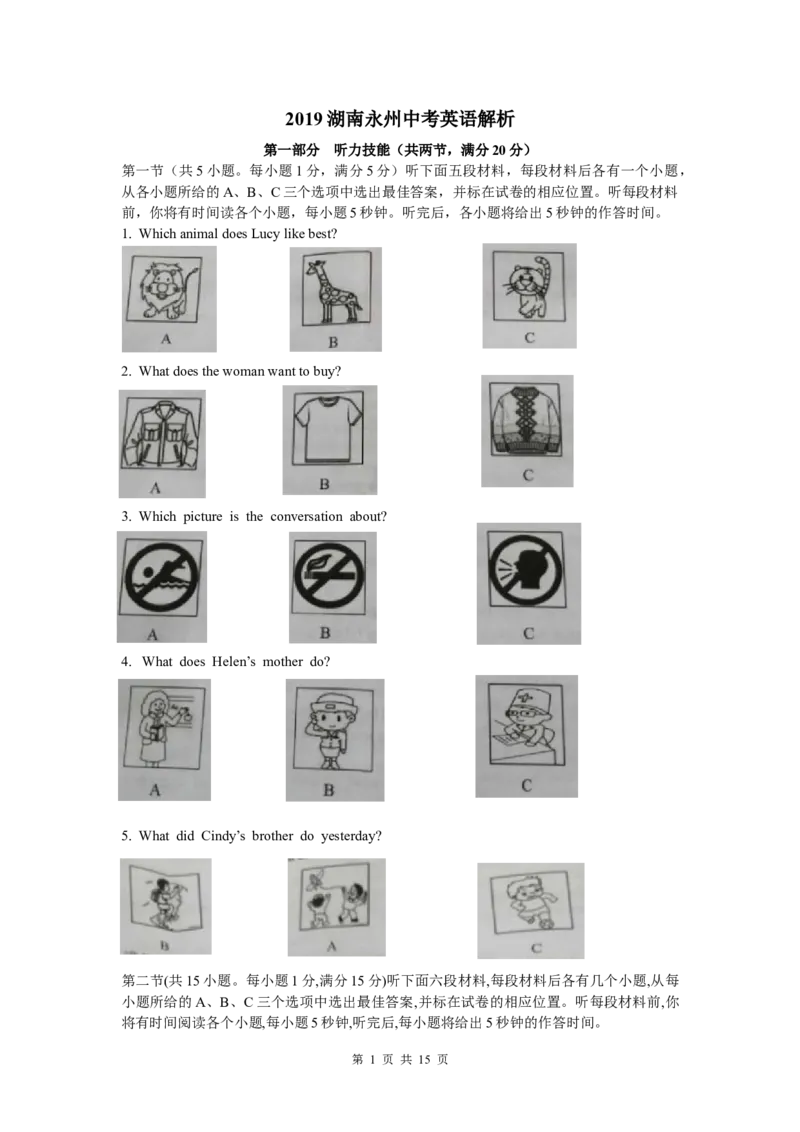
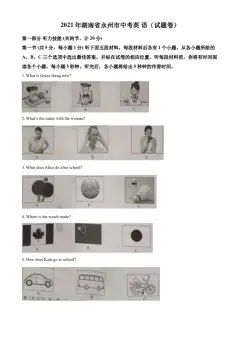
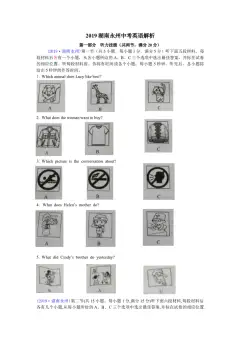
1. Which animal does Lucy like best?
2. What does the woman want to buy?
3. Which picture is the conversation about?
4. What does Helen’s mother do?
5. What did Cindy’s brother do yesterday?
第二节(共15小题。每小题1分,满分15分)听下面六段材料,每段材料后各有几个小题,从每
小题所给的A、B、C三个选项中选出最佳答案,并标在试卷的相应位置。听每段材料前,你
将有时间阅读各个小题,每小题5秒钟,听完后,每小题将给出5秒钟的作答时间。
第 1 页 共 15 页听第一段材料,回答第6~7小题。
6. What does Julie have to do on weekends?
A. Play the piano. B. Do housework. C. Finish homework.
7. When does Julie go to bed?
A. At 9:00 p.m. B. At 9: 20 p.m. C. At 9:30 p.m.
听第二段材料,回答第8~9小题。
8. What does Julie go to bed?
A. He is tall. B. He is short. C. he is of medium
height.
9. Where does Jim come from?
A. The USA. B. The UK. C. Australia.
听第三段材料,回答第10~11小题
10. What is Kelly reading?
A. Treasure island. B. Robinson Crusoe. C. Little women.
11. What does the boy think of Robinson Crusoe?
A. Interesting. B. Educational. C. Exciting.
听第四段材料,回答第12~14小题。
12. Who will Jill visit her grandparents with?
A. Her father. B. Her mother. C. Her brother.
13. How will they go to the countryside?
A. By car. B. By bus. C. By train.
14. What is Jill’s favorite thing in the countryside?
A. To go fishing. B. To pick up some strawberries. C. To feed chickens.
听第五段材料,回答第15~17小题。
15. What kind of noodles would Tina like?
A. Egg and beef noodles. B. Tomato and beef noodles. C. Egg and tomato noodles.
16. What is Tina's phone number?
A.859-2647. B.839-2617. C.856-2634.
17. What's the relationship of the two speakers?
A. Doctor and patient. B. Waiter and customer. C. Guide and visitor.
听第六段材料,回答第18~20小题。
18. How can friendship make us feel?
A. Happier. B. Healthier. C. Braver.
19. What is the most important thing in a friendship?
A. To give your friend a hand. B. To believe in each other.
C. To get on well with your friends.
20. How many ways are mentioned (提到) about finding a good friend?
A. Two B. Three C. Four
第二部分 阅读技能(共三节,满分50分)
第一节 阅读选择(共15小题。每小题2分,满分30分)阅读下面的材料,从每小题
所给的A、B、C三个选项中,选出最佳答案,并在答题卡上将该编号字母涂黑。
A
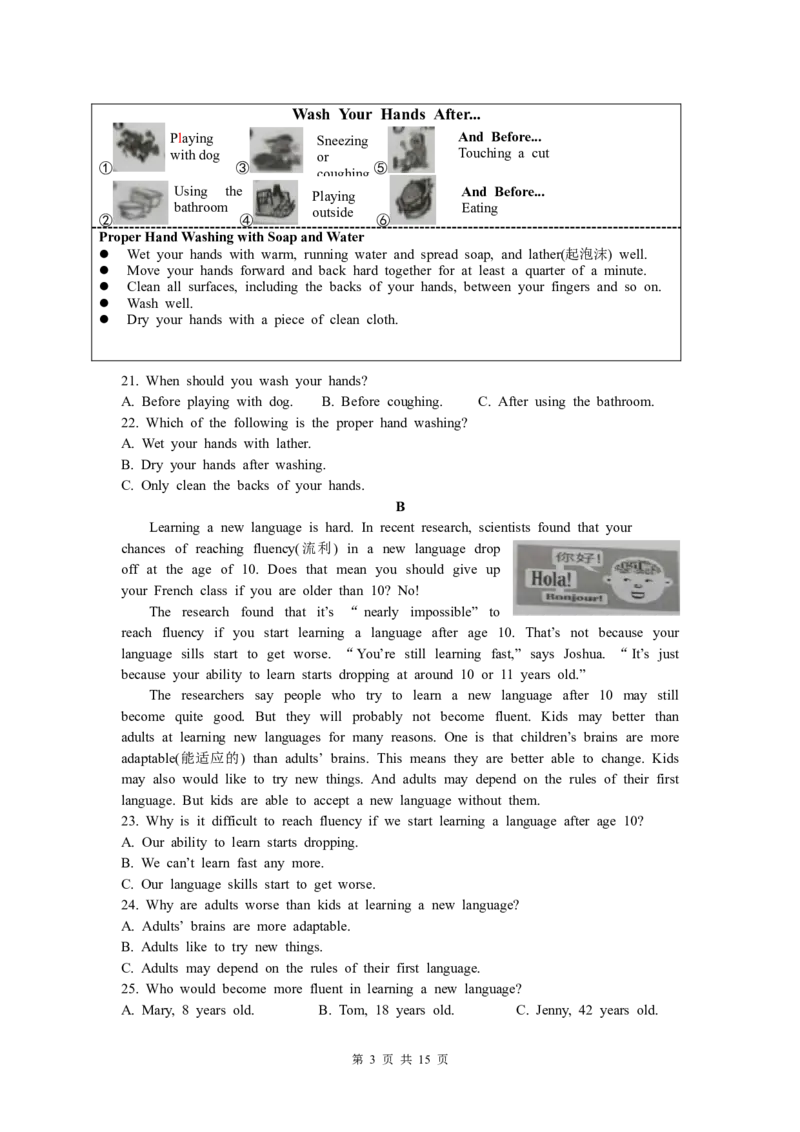
第 2 页 共 15 页Wash Your Hands After...
Playing Sneezing And Before...
with dog or Touching a cut
① ③ ⑤
coughing
Using the And Before...
Playing
bathroom Eating
outside
② ④ ⑥
Proper Hand Washing with Soap and Water
Wet your hands with warm, running water and spread soap, and lather(起泡沫) well.
Move your hands forward and back hard together for at least a quarter of a minute.
Clean all surfaces, including the backs of your hands, between your fingers and so on.
Wash well.
Dry your hands with a piece of clean cloth.
21. When should you wash your hands?
A. Before playing with dog. B. Before coughing. C. After using the bathroom.
22. Which of the following is the proper hand washing?
A. Wet your hands with lather.
B. Dry your hands after washing.
C. Only clean the backs of your hands.
B
Learning a new language is hard. In recent research, scientists found that your
chances of reaching fluency(流利) in a new language drop
off at the age of 10. Does that mean you should give up
your French class if you are older than 10? No!
The research found that it’s “ nearly impossible” to
reach fluency if you start learning a language after age 10. That’s not because your
language sills start to get worse. “You’re still learning fast,” says Joshua. “It’s just
because your ability to learn starts dropping at around 10 or 11 years old.”
The researchers say people who try to learn a new language after 10 may still
become quite good. But they will probably not become fluent. Kids may better than
adults at learning new languages for many reasons. One is that children’s brains are more
adaptable(能适应的) than adults’ brains. This means they are better able to change. Kids
may also would like to try new things. And adults may depend on the rules of their first
language. But kids are able to accept a new language without them.
23. Why is it difficult to reach fluency if we start learning a language after age 10?
A. Our ability to learn starts dropping.
B. We can’t learn fast any more.
C. Our language skills start to get worse.
24. Why are adults worse than kids at learning a new language?
A. Adults’ brains are more adaptable.
B. Adults like to try new things.
C. Adults may depend on the rules of their first language.
25. Who would become more fluent in learning a new language?
A. Mary, 8 years old. B. Tom, 18 years old. C. Jenny, 42 years old.
第 3 页 共 15 页C
Addyson is an 8-year-old girl from Kansas. Maurine is a 9-year-old girl from a
village called Bartabwa in Kenya. It might not seem as if the girls have much in
common, but when they met at a dinner two years ago, in Kansas, they became friends
at once.
The dinner was hosted by the group World Vision International. In some parts of
the world, people must walk several miles each day to collect water from a stream(小溪)
or another water source. Often, the water is polluted. World Vision builds wells(井) and
rain catchers in these communities.
Addyson was at the dinner because her family supports World Vision. Maurine was
there because her village had been without clean water. World Vision solved that by
building a water station there. Addyson was influenced by Maurine. “People helped
Maurine so she could have clean water, and kids are dying because the don’t have it,”
Addyson says. “Addyson says. “I want to help.”
Races are one way World Vision raises money to pay for its water projects.
Runners promise to run a race, often a 26-mile marathon or 13-mile half marathon. They
ask people to support them by giving away to World Vision.
Addyson decided to run the 2017 Knasa City Half Marathon for World Vision.
She’d raised $20,000. She’s the youngest person in World Vision history to raise more
than $10,000. In 2018, she ran again----and raised $36,000.
Addyson and Maurine still keep in touch. Last year, Maurine returned to the U.S.
and they met up in Chicago. But Addyson’s work is not finished. “My purpose is for
every kid to have clean water,” she says.
26. Where did the two girls become friends?
A. In Bartabwa. B. In Kansas. C. In Chicago.
27. How did World Vision help Maurine’s age?
A. By building wells. B. By building a water station C.By building rain catchers.
28.Which of the following is the way Word Vision raises money?
A. By dinner. B. By friendship. C. By race.
29.How much did Addyson raise in total from 2017 to 2018?
A. $46,000. B. $56,000. C. $66,000.
30.What’s the best title of the passage?
A. Run for Clean Water. B. Run for Bartabwa. C. Run for Maurine.
D
Each weekday, more than 30 million students in Canada eat meals in school cafeterias. And
when lunch is over, they fill the rubbish cans with uneaten food.
More than $1 billion worth of food is wasted every year. Wasted food is
wasted money. It’s also a missed chance to feed hungry people. And it’s had
for the environment: farming, packing, and transporting food produces
greenhouse-gas emissions(温室气体排放). They pollute the air.
Schools have developed ways to cut back on( 减少) waste. Making
lunch period longer helps. It gives kids time to eat everything on their plates.
Many schools follow government rules that say students must take a certain number of healthy
things at mealtime. Those rules help kids get a better meal. But they can lead to more waste.
第 4 页 共 15 页That’s why schools in Canada set up something called share tables. Students put untouched food
on the table. A student who wants the food can take it. There are rules to make sure the food is
safe. Food that isn’t taken from the table is served another day.
Students also waste food because they don’t like how it tastes. Cook Sam wants to change
that. He works with a program called Cooks in Schools. He helps dining hall workers develop
dishes kids enjoy.
You can fight food waste too. At the store, look for “ugly” produce. Fruits and vegetables
with bad shapes are still delicious, but they are often not noticed. At home, read safety labels(标
签). If a label says “best before”, the food is still safe to eat for a little while after the date. If the
label says “use by”, the food is no longer safe after the date.
31. What does the underlined word “cafeterias” mean?
A. Dining halls B. Classrooms C. Hallways
32. What is NOT the result of wasting food?
A. Wasting money B. Bad for the environment C. Feeding hungry people
33. How do schools in Canada cut back on waste?
A. Making lunch period shorter.
B. Following government rules.
C. Setting up shared tables.
34. Why do students waste food according to Paragraph 4?
A. They don’t like Cook Sam.
B. They don’t like the dishes.
C. They don’t like dining hall workers.
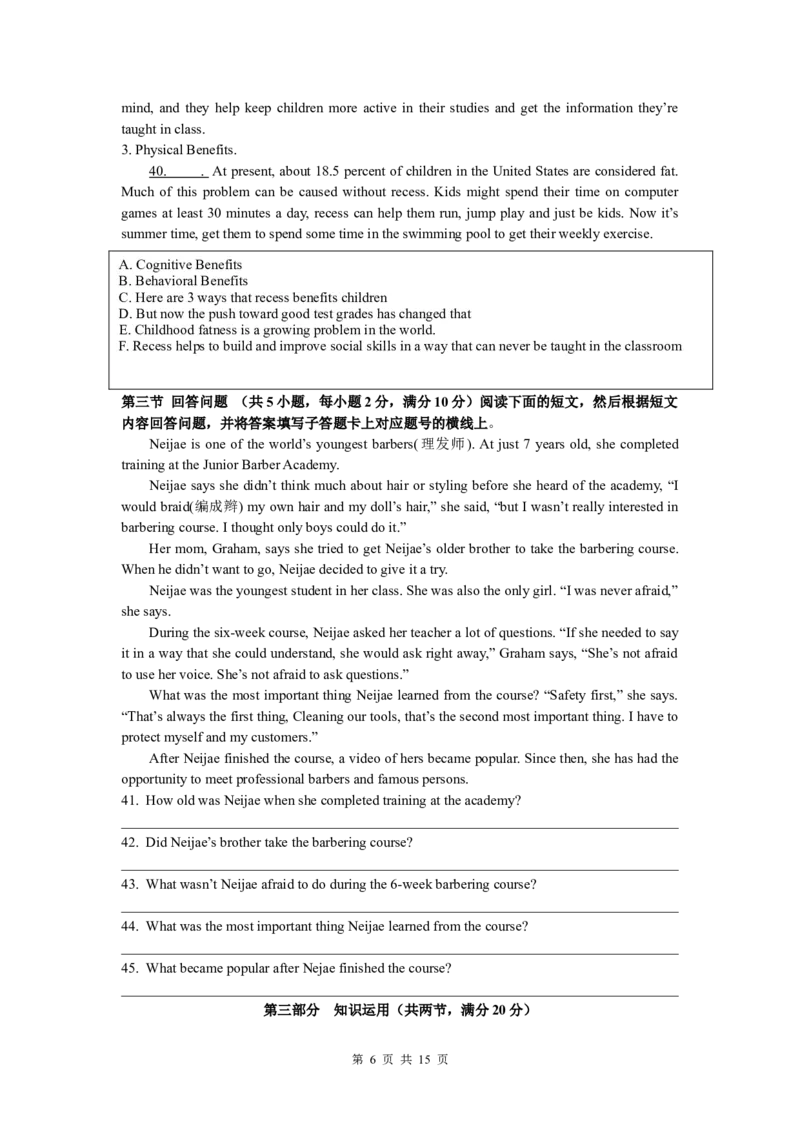
35. According to the last paragraph, which food is NOT safe on June 18th, 2019.
第二节 阅读匹配(共5小题,每小题2分,满分10分) 阅读下面的短文,从短文后的选
项中选出正确的答案,使短文通顺,内容完整,并在答题卡上将该编号字母涂黑,其中有
一个选项是多余的。
Why Recess(课间休息) is So Important for Children
Recess used to be a daily thing—if you drove past your local school after lunch, you’d see
hundreds of children running, playing and just being children. 36 . Recent research have
found that recess is important for more than just keeping children healthy and fighting children
fatness—it also helps improve cognitive(认知) skills. 37. .
1. Social Benefit(利益)
Children start learning social skills as soon as they start communicating with their parents. Once
they reach the school age, their communications turn into with other children. 38 . These
skills will carry them through childhood and into their adult lives.
2. 39.
Besides the social benefits, recess also has some cognitive benefits that are just staring to be
developed. Science has shown that recess helps children to get information better, learn new
things faster and improve creativity. Recesses from the school day are good for both the body and
第 5 页 共 15 页mind, and they help keep children more active in their studies and get the information they’re
taught in class.
3. Physical Benefits.
40. . At present, about 18.5 percent of children in the United States are considered fat.
Much of this problem can be caused without recess. Kids might spend their time on computer
games at least 30 minutes a day, recess can help them run, jump play and just be kids. Now it’s
summer time, get them to spend some time in the swimming pool to get their weekly exercise.
A. Cognitive Benefits
B. Behavioral Benefits
C. Here are 3 ways that recess benefits children
D. But now the push toward good test grades has changed that
E. Childhood fatness is a growing problem in the world.
F. Recess helps to build and improve social skills in a way that can never be taught in the classroom
第三节 回答问题 (共5小题,每小题2分,满分10分)阅读下面的短文,然后根据短文
内容回答问题,并将答案填写子答题卡上对应题号的横线上。
Neijae is one of the world’s youngest barbers(理发师). At just 7 years old, she completed
training at the Junior Barber Academy.
Neijae says she didn’t think much about hair or styling before she heard of the academy, “I
would braid(编成辫) my own hair and my doll’s hair,” she said, “but I wasn’t really interested in
barbering course. I thought only boys could do it.”
Her mom, Graham, says she tried to get Neijae’s older brother to take the barbering course.
When he didn’t want to go, Neijae decided to give it a try.
Neijae was the youngest student in her class. She was also the only girl. “I was never afraid,”
she says.
During the six-week course, Neijae asked her teacher a lot of questions. “If she needed to say
it in a way that she could understand, she would ask right away,” Graham says, “She’s not afraid
to use her voice. She’s not afraid to ask questions.”
What was the most important thing Neijae learned from the course? “Safety first,” she says.
“That’s always the first thing, Cleaning our tools, that’s the second most important thing. I have to
protect myself and my customers.”
After Neijae finished the course, a video of hers became popular. Since then, she has had the
opportunity to meet professional barbers and famous persons.
41. How old was Neijae when she completed training at the academy?
_______________________________________________________________________________
42. Did Neijae’s brother take the barbering course?
_______________________________________________________________________________
43. What wasn’t Neijae afraid to do during the 6-week barbering course?
_______________________________________________________________________________
44. What was the most important thing Neijae learned from the course?
_______________________________________________________________________________
45. What became popular after Nejae finished the course?
_______________________________________________________________________________
第三部分 知识运用(共两节,满分20分)
第 6 页 共 15 页第一节 词语填空(共10小题,每小题1分,满分10分)通读下面的短文,掌握其大意,
然后从各小题所给的A、B、C三个选项中选出可以填入空白处的最佳答案,并在答题卡上
将编号字母涂黑。
After I had surgery(手术),the doctor said I needed to stay at home for at least a week. With
exams coming up, I worried about missing the class. My family thought for a 46 : I would go to
school as a robot.
The company my mom works for 47 me with a five-foot-tall robot on wheels. Using it was
48 . I quickly learned how to move it forward and back and turn it. I soon forgot I was controlling
a machine from home.
It 49 everyone else a little longer to get used to the new me. A screen showed my face at its
actual size. The 50 allowed me to feel in class and others to see me.
For a few days, I was the most 51 object in the school. Everyone crowded around me. But
once they didn’t feel excited. I was just another 52 . I ate lunch with everyone else, attended
class, and went to the rehearsal(排练) for my school 53 . I felt as if I were actually in school. I
was only reminded of my difficulties as a robot when my teachers 54 papers.
Life as a robot was an enjoyable 55 . Technology can be a great help to people. If you are in
need, I hope you can have a robot helper.
46. A. solution B. company C. doctor
47. A. ordered B. provided C. asked
48. A. slow B. easy C. boring
49. A. brought B. had C. took
50. A. wheels B. voice C. screen
51. A. serious B. popular C. terrible
52. A. student B. robot C. teacher
53. A. exam B. meeting C. play
54. A. found out B. sold out C. handed out
55. A. experience B. trip C. class
第二节 语法填空(共10小题,每小题1分,满分10分)阅读下面的材料,在空白处填入
适当的内容(限1个单词)或括号内单词的正确形式,使句子通顺完整。
56. It takes me _______ hour to do exercise every day.
57. Transportation engineers have a lot to think about. Problem-solving is a big part of
_______ (they) jobs.
58. I enjoy _______ (think) of ways to help people in need.
59.The Notre-Dame Cathedral(巴黎圣母院大教堂)________(burn) by fire on April 15,
2019.
60.________ Mother’s Day, every restaurant is filled with families.
61. Keep studying hard _______ you’ll become a top student sooner or later.
62. They shouted _________(happy) when they have climbed the top of the mountain.
63. Everyone in the word should focus on the air ______ (pollute).
64. When Bria was 8, she started painting ________ (picture) of animals.
65. When you fail test, you always remember: failure ______ (be) mother of success.
第四部分 写作技能(共三节,满分30分)
第一节 语篇翻译(共5小题,每小题2分,满分10分)阅读下面的短文,然后将划线的
句子译成汉语或英语,并将答案填写在答题卡上对应题号的横线上。
第 7 页 共 15 页Many animals migrate(迁徙). 66. They travel in big groups from one place to another.
Some animals migrate when the weather changes. Others set off to find new food and
water. 67. Lots of animal migrations take place in Africa. Here, you can read about three
of them.
As the seasons change, zebras(斑马) travel in large groups. They make the trip year
after year. 68 . 斑马为什么走那么远? They are looking for better grass to eat.
Wildebeests(牛羚) are always on the move. They travel by day and by night. Their
journey can take them through rivers and streams. 69. 牛羚擅于游泳 。But crossing the
water is dangerous.
Flamingos(火烈鸟) fly together in the shape of V. They head for Africa’s salt flats(盐
滩). A salt flat is an area of water that has dried up. During the rainy season, a salt flat
becomes a wetland. 70.It ’ s a great living place for flamingos .
66.____________________________________________________________________________
67.____________________________________________________________________________
68.____________________________________________________________________________
69.____________________________________________________________________________
70.____________________________________________________________________________
第二节 完成对话 (共5小题,计10分)通读下面的对话,然后根据上下文补全对话内容,
并将答案填写在答题卡上对应的题号横线上。
A:Hello, Li Ming, I called you at 8:00 last night, but you didn’t
answer.71.______________?
B: Oh, sorry, I was watching a TV report about a famous person.
A: 72._______________________?
B: He is Jing Haipeng.
A:Is he a scientist?
B: 73._________________________. He is an astronaut in China. He is our hero.
A: 74. _________________________?
B: Because he has ever driven the spaceship into the sky three times.
A: Wow, an amazing man! By the way, what do you want to be in the future?
B: 75._____________________________, like Jing Haipeng.
A: An astronaut? Sounds great!
第三节 书面表达 (1个大题,满分10分)
随着学习压力的增大、科技的进步和父母的包办,一些学生不理解劳动、不愿意劳动、
不尊重劳动。针对这些不良现象,永州某中学决定举办一场以“热爱劳动,从我做起”为主题
的英语演讲比赛。假如你叫李华,是该校的一名学生,请以“Loving labor starts from me”为
标题写一篇英语演讲稿。
参考词汇: labor 劳动;traditional virtue 传统美德;happiness; treasure; come from;pick
up; rubbish; do volunteer work; take action.
注意: 1)文中请勿使用真实人名,校名和地名,
2)词数:不低于60词,文章的开头和结尾已给出,不计入总词数。
3)语句通顺,意思连贯,表达正确,可适当发挥。
Hello, everyone!
My name is Li Hua. I'm happy to stand here to take part in the speech competition. Today
my topic is that "Loving labor starts from me".
第 8 页 共 15 页_______________________________________________________________________________
_______________________________________________________________________________
_______________________________________________________________________________
_______________________________________________________________________________
Thanks for your attention!
2019湖南永州中考英语解析
第一部分 听力技能(共两节,满分20分)
第一节(共5小题。每小题1分,满分5分)听下面五段材料,每段材料后各有一个小题,
从各小题所给的A、B、C三个选项中选出最佳答案,并标在试卷的相应位置。听每段材料
前,你将有时间读各个小题,每小题5秒钟。听完后,各小题将给出5秒钟的作答时间。
【答案】1-5 BBAAC 6-10 BCCCA 11-15BBACC 16-20 ABABC
听力朗读材料
永州市2019年初中学业水平考试英语听力测试现在开始,听力部分共分两节,听力材
料朗读两遍。做题时,先将答案划((写)在试卷上,录音内容朗读完后,你将有两分钟的时
间将第1~20小题的答案转涂到答题卡上。
第一节 听下面五段材料,每段材料后各有1个小题,从每小题所给的A、B、C三个
选项中选出最佳答案,并标在试卷的相应位置。听每段材料前,你将有时间阅读各个小题
每小题5秒钟。听完后,各小题将给出5秒钟的作答时间。
1. M: Let’s go to the zoo tomorrow, Lucy.
W: Good idea. I like giraffes best.
2. M: Can I help you, Madam?
W: Yes, I want to buy a T-shirt for my son.
3. M: It’s very hot today. How about going swimming in the river?
W: No, we can’t. It's very dangerous.
4. M: Helen, my mother is a doctor. What does your mother do?
W: She is an English teacher.
5. M: Did your brother climb a mountain or fly a kite yesterday, Cindy?
W: Neither. He played soccer with his friends.
第二节 听下面六段材料, 每段材料后各有几个小题,从每小题所给的A、B、C三个
选项中选出最佳答案,并标在试卷的相应位置。听每段材料前,你将有时间阅读各个小题
每小题5秒钟。听完后,各小题将给出5秒钟的作答时间。
听第一段材料,回答第6~7小题。
M: Julie, do you have any rules in your family?
W: Yes. For example, I must do housework on weekends.
M: What else?
W: Oh, I have to finish my homework by 9:00 p.m. and go to bed at 9:30 p.m.
听第二段材料,回答第8~9小题。
M: Hi, Jane. Do you have a pen pal?
W: Yes. His name is Jim Green.
M: Is he tall or short?
W: He is of medium height with blonde hair.
M: He is from America, isn't he?
W: No, he is from Australia.
第 9 页 共 15 页听第三段材料,回答第10~11小题。
M: Hey, Kelly, what are you doing?
W: I’m reading a classic named Treasure Island.
M: Do you like it?
W: Yes, it’s exciting, Have you read the book yet?
M: No, I haven't, but I've already finished Robinson Crusoe/ I think the
classic is educational.
W: Oh, I’ll try it this weekend.
听第四段材料,回答第12~14小题。
M: The summer vacation is coming. What are you going to do, Jill?
W: I’m going to visit my grandparents in the countryside.
M: Will you go there alone?
W: No, I will go there with my mother.
M: How will you go to the countryside? By bus?
W: No, my mother will drive her car.
M: In the countryside, you can do lots of things, such as feeding chickens,
picking some strawberries, going fishing and so on.
W: Yeah, that's right. I like to feed chickens best.
M: Sounds great!
听第五段材料,回答第15~17小题。
M: Hello, House of Noodles! What can I do for you?
W: Hello! I want to order some noodles, please.
M: Sure. What kind of noodles would you like?
W: Egg and tomato noodles, please.
M: OK. Anything else?
W: And 20 dumplings.
M: Well. May I have your name?
W: Tina Brown.
M: What's your address and telephone number?
W: Sixty Center Street, 859-2647.
M: Hmm..., that’ll be 35 dollars.
W: All right. Thank you.
听第六段材料,回答第18~20小题。
Each of us needs friends. Friendship can make us happier. How can we
find a good friend? Here is some advice:
First, make friends with a person who is easy to get along with.
Second, give your friend a hand when he or she is in trouble.
Third, believe in each other. This is the most important thing in a frie
ndship.
Finally, try to make up with your friends soon. If you have a fight
with your good friends, you had better say sorry to them.
All in all, we should have at least one or two good friends.
第 10 页 共 15 页第二部分 阅读技能(共三节,满分50分)
第一节 阅读选择(共15小题。每小题2分,满分30分)阅读下面的材料,从每小题
所给的A、B、C三个选项中,选出最佳答案,并在答题卡上将该编号字母涂黑。
A
体裁 说明文 话题13 (43) 个人卫生 词数 76
【主旨大意】本文是一篇说明文。文中通过配图的形式介绍了何时应该洗手,及用肥皂和
水的正确洗手方法。
【答案】21-22 CB
【解析】21.C 细节理解题。 根据图表“Wash Your Hands After...”与图②“Using the
bathroom”可知应该在使用完洗手间后洗手,故选C。根据图① “Playing with dog”可知
应在和狗玩耍后洗手,A不正确。 根据图③ “sneezing or coughing” 可知应在打喷嚏或
咳嗽之后洗手,B不正确。
22.B 细节理解题。 题目问洗手的正确方式,根据“Dry your hands with a piece of
clean cloth.” 可知洗手后要把手擦干,B正确。根据“Wet your hands with warm,
running water”可知要用流动的温水打湿手,A不正确。根据“Clean all surfaces,
including the backs of your hands, between your fingers ....”可知应洗手的每个部位,不
是只洗手背,C错误。
B
体裁 说明文 话题19 语言学习 词数 208
【主旨大意】本文是一篇说明文,根据一篇关于语言学习的最新研究,表明超过 10岁以后
学习新语言,该语言的流利度会有所下降,并给出了相关原因。
【答案】23-25 ACA
【解析】
23. A 细节理解题。 题目含义“如果我们在 10岁以后开始学习语言,很难达到流利程度
的原因”。根据文中第二段“It’s just because your ability to learn starts dropping at
around 10 or 11 years old.” 可知由于10岁或11岁人们的学习能力开始下降,影响了语言
学习的流利度,故选A。
24. C 细节理解题。 题目含义“为什么成年人在学习新语言时比孩子要差?”根据最后一
段中 “And adults may depend on the rules of their first language.” 可知成年人会更依赖
母语的规律,故选C。根据文中 “One is that children’s brains are more adaptable(能适应
的) than adults’ brains.”可知孩子比成年人更具适应性,A不正确。根据文中 “ Kids may
also would like to try new things.”可知孩子更喜欢尝试新事物,而不是成年人,故B不正
确。
25.A 推理判断题。 根据第二段第一句 The research found that it’s “nearly impossible”
to reach fluency if you start learning a language after age 10.以及第三段的第一、二句
The researchers say people who try to learn a new language after 10 may still become
quite good. But they will probably not become fluent可推断知,10岁以下的孩子学习语
言会更加流利,故选A。
C
体裁 记叙文 话题8 社会行为 词数 296
【主旨大意】本文是一篇记叙文。文中主要讲述在World Vision International(世界宣明会)
组织的一场晚宴上,Addyson 和Marine 成为朋友。当 Addyson得知世界上还有很多像
Marine一样得不到干净水源的孩子时,她决定帮助他们,于是她参加跑步比赛来为供水项
目筹款。
第 11 页 共 15 页【答案】26-30 BBCBA
【解析】
26.B 细节理解题。 题目含义“两个女孩是在哪里成为朋友的”。根据文中第一段“.....in
Kansas, they became friends at once.” 可判断B选项正确。
27.B 细节理解题。 题目含义 “World Vision 是如何帮助Marine的村庄的”。根据原文
第三段 “World Vision solved that by building a water station there.”可知宣明会通过建设
一个水站来帮助Marine的村庄,故B正确。
28.C 细节理解题。 题目问 “以下哪种是 World Vision 的筹款方式”。根据第四段
“Races are one way World Vision raises money to pay for its water projects.”可知跑步
比赛是World Vision的一种筹款方式,故C正确。
29.B 细节理解题。 题目含义“从2017到2018年Addyson 一共筹款多少钱”。根据倒数
第二段中“Addyson decided to run the 2017 Knasa City Half Marathon for World Vision.
She’d raised $20,000.”和“In 2018, she ran again----and raised $36,000.”可算出17和
18年Addyson 一共筹得$56,000故B选项正确。
30.A 标题归纳题。 文章主要讲述Addyson 通过参加跑步比赛来为供水项目筹款的故事,
因此是为获得干净水源的项目而赛跑,符合文章大意,也体现了跑步比赛的意义,具有总
结归纳性,故选A。
D
体裁 说明文 话题21 世界与环境 词数 308
【主旨大意】本文是一篇说明文,文中主要介绍了加拿大学校通过延长学生用餐时间以及
设立共享餐桌的方法来缓解食物浪费,以及一些学校厨师通过改善食品口味来减少食物浪
费。文章最后呼吁我们也可以通过在商店买形状不是很好的但是尚可食用的商品,以尽自
己的一份力来减少食物浪费。
【答案】31-35 ACCBA
【解析】
31.A 词义猜测题。 根据 “more than 30 million students in Canada eat meals in school
cafeterias.” 中的eat meals(用餐)可以猜测出这是用餐的地方,故选A
32.C 细节理解题。 根据“Wasted food is wasted money. ” “And it’s had for the environment:
farming, packing, and transporting food produces greenhouse-gas emissions(温室气体排放). ”可
知浪费食物的结果是浪费钱和对环境有害,故选C。
33.C 细节理解题。 根据题目的关键词 cut back on(减少) waste,然后定位到第三段的
“schools in Canada set up something called share tables.”可知加拿大的学校设立的共享餐桌
来减少食物浪费,故选C。
34.B 细节理解题。 根据“Students also waste food because they don’t like how it tastes. ”可知
学生不喜欢食物的口味,故选B。
35. A 推理判断题。 根据最后一段 “If a label says “best before”, the food is still safe to eat
for a little while after the date. If the label says “use by”, the food is no longer safe after the date.”
可知,故选A。
第二节 阅读匹配(共5小题,每小题2分,满分10分) 阅读下面的短文,从短文后的选
项中选出正确的答案,使短文通顺,内容完整,并在答题卡上将该编号字母涂黑,其中有
一个选项是多余的。
体裁 说明文 话题14 学校生活 词数 263
【主旨大意】本文是一篇说明文。文中主要说明了课间活动对孩子的重要性。
【答案】36-40 DCFAE
第 12 页 共 15 页【解析】
36. D 根据 “Recess used to be a daily thing”可知说的是从前是日常的事情,与后文现状形
成对比,故选D。
37. C 从篇章结构的功能来看,C选项为总起句,根据下文列出的三种方式可知,故选C。
38. F 根据本段小标题可知,本段主要内容是课间活动对社交的好处,F选项中的social
skill以及classroom 段落主旨和后文相匹配,故选F。
39. A 根据“Besides the social benefits, recess also has some cognitive benefits that are just
staring to be developed.”可知本段主要是说课间活动对认知带来好处,故选A。
40. E 根据本段小标题可知本段主要内容是对身体带来的好处,因后文 “At present, about
18.5 percent of children in the United States are considered fat.”讲到肥胖话题,故选E。
第三节 回答问题 (共5小题,每小题2分,满分10分)阅读下面的短文,然后根据短文
内容回答问题,并将答案填写子答题卡上对应题号的横线上。
体裁 记叙文 话题81 著名人物 词数 263
【主旨大意】本文是一篇记叙文。文中主要讲述一个年龄最小的理发师Neijae。Neijae7岁
就完成了理发学院的培训。在听说学院之前,Neijae对理发课程不感兴趣。她的妈妈想让
她哥哥参加,当哥哥不去的时候,Neijae决定去试一试。Neijae成为了班上最年轻的学生。
完成课程后,她的一段视频变得很受欢迎并有机会见到专业理发师和名人。
【解析】
41. (Just)7 years old/7 细节理解题, 根据第一段“Neijae is one of the world’s youngest
barbers(理发师). At jut 7 years old, she completed training at the Junior Barber Academy.”可知
Neijae 是七岁完成训练成为一名理发师。
42. No, he didn’t 细节理解题, 根据第三段“she tried to get Neijae’s older brother to take the
barbering course. When he didn’t want to go , Neijae decided to give it a try.”可知Neijae的各个
没有去学习理发课程。
43. (She wasn’t afraid ) to use her voice and ask questions./To use her voice./To ask questions.细
节理解题, 根据第五自然段“ Graham says, “She’s not afraid to use her voice. She’s not
afraid to ask questions.”可知。
44. (The most important thing was ) safety first. 细节理解题,根据 “What was the most
important thing Neijae learned form the course? “Safety first,” she says. ” 可知。
45. A video of hers. 细节理解题 根据 最后一段“a video of hers became popular”可知。
第四部分 知识运用(共两节,满分20分)
第一节 词语填空(共10小题,每小题1分,满分10分)通读下面的短文,掌握其大意,
然后从各小题所给的A、B、C三个选项中选出可以填入空白处的最佳答案,并在答题卡上
将编号字母涂黑。
体裁 记叙文 话题78 发明与技术 词数 229
【主旨大意】本文是一篇记叙文。文中讲述了作者由于做手术不能去学校,但是非常担心
学业落后。家人为作者想了个解决方法。妈妈所在的公司给作者提供了一个机器人帮手使
孩子感觉身临其境。最后作者提出科技对人们的帮助很大,如果大家有需要的话,希望大
家能够有个机器人助手。
【答案】46-50 ABBCC 51-55 BACCA
【解析】
46.A 考查名词词义辨析。solution解决;company公司doctor医生;根据前文中“担心错过
上课”和下句“作为机器人去上学”表明家人想到了解决方法,故选A。
47.B 考查动词词义辨析。 ordered命令;provided提供;asked问;根据句意“妈妈工作的
公司给我提供了一个带轮子的五尺高的机器人”及短语“provide sb. with sth.”提供某人
第 13 页 共 15 页某物可知答案为“提供”,故选B。
48.B 考查形容词词义辨析。 slow 慢的;easy 容易的;boring 无聊的;根据下句“I
quickly learned how to move it forward and back and turn it.”我迅速地学会了如何去操
作它前进,后退和旋转可知是容易的,故选B。
49.C 考查动词词义辨析。brought带来;had拥有;took带走,花费;根据句意“习惯这个
新的我要花费每个人更长的一点时间”及句型“It takes/took sb.+时间+ to do sth.”可知
花费时间,故选C。
50.C 考查名词词义辨析。wheels轮子;voice声音;screen屏幕;根据上句出现“a screen
”及the+名词可表示第二次所提物品,可知是屏幕,故选C。
51.B 考查形容词词义辨析。serious严重的,严肃的;popular受欢迎的;terrible糟糕的;根据
下句“Everyone crowded around me”每个人都围着我,可知我很受欢迎,故选B。
52.A 考查名词词义辨析。student学生;robot机器人;teacher教师;根据句意我是学生,
故选A。
53.C考查名词词义辨析。exam考试;meeting会议;play戏剧;根据句意排练学校的戏剧,
故选C。
54.C考查动词短语辨析。found out找到;sold out卖光;handed out 分发;散发;根据句
意我的老师发试卷,故选C。
55.A 考查名词词义辨析。experience经验,经历;trip旅行;class班级;根据句意作为一
个机器人的生活是一段令人愉快的经历,故选A。
第二节 语法填空(共10小题,每小题1分,满分10分)阅读下面的材料,在空白处填入
适当的内容(限1个单词)或括号内单词的正确形式,使句子通顺完整。
【解析】
56.an/one 由于未给出括号词且空格后为名词hour,从句子结构可判断出空格为冠词或数词,
hour为可数名词单数,h不发音故答案为an或one。
57.their 根据提示词及后面的名词job可判断空格为形容词性物主代词,故答案为their。
58.thinking 根据短语enjoy doing sth.喜欢做某事,可知答案为thinking。
59.was burned/burnt 根据句意巴黎圣母院被烧了,可知用被动;时间为2019年4月15日
可知为一般过去时。故答案为was burned/burnt。
60.On 根据后面的时间母亲节,表示具体的一天,故用On。
61.and 根据句子结构判断所缺词性为连词,空格前为祈使句,后为一般将来时,符合“祈
使句+and+一般将来时”的句子结构。故答案为and。
62.happily 根据副词修饰动词判断空格词所缺词性为副词,故答案为happily。
63.pollution 根据句子结构空格词在句子中做宾语判定空格所缺词性为名词,且pollute的名
词为不可数名词故答案为pollution。
64.pictures 根据句子结构空格词在句子中做宾语及后面的名词所有格of形式判定空格所缺
词性为名词,且picture的名词是可数名词,故答案为pictures。
65.is 名言“失败是成功之母”为一般现在时,且failure为不可数名词,故答案为is。
第四部分 写作技能(共三节,满分30分)
第一节 语篇翻译(共5小题,每小题2分,满分10分)阅读下面的短文,然后将划线的
句子译成汉语或英语,并将答案填写在答题卡上对应题号的横线上。
体裁 说明文 话题68 动物和植物 词数 174
【主旨大意】本文是一篇说明文,文中主要介绍了三种动物斑马、牛羚、火烈鸟会根据气
第 14 页 共 15 页候变化而迁徙。
【解析】
66.它们成群结队地从一个地方迁徙到另一个地方。考查了短语“in big groups”成群结队
和“from...to”从...到...
67. 许多动物迁徙发生在非洲。考查了短语“lots of”许多的和“take place”发生
68.Why do zebras go/walk so far?考查了特殊疑问句句式。
69.Wildebeests are good swimmers./Wildebeests are good at swimming./Wildebeests swim
well.考查了短语“be good at”擅长于。
70.对火烈鸟来说,这是一个居住的好地方。/这是一个火烈鸟居住的好地方。考查词组
“living place”居住的地方。
第二节 完成对话 (共5小题,计10分)通读下面的对话,然后根据上下文补全对话内容,
并将答案填写在答题卡上对应的题号横线上。
体裁 对话 话题81 著名人物 词数 98
【主旨大意】本文主要谈论宇航员景海鹏及其成就,最后希望长大后成为像景海鹏那样的
人。
【解析】
71. What were you doing? 根据下句的答句“I was watching a TV report about a famous
person.”我正在看一个名著人物的电视报道可知提问正在做什么。
72. Who is he?/Who is the famous person?/What’s his name....根据下句他是景海鹏可知询问
人物。
73. No, he isn’t./No. 根据上句一般疑问句及下句可知景海鹏是宇航员而不是科学家。
74. Why is he your hero?/Why do you think so?由下句because可知询问原因。
75. I want to be an astronaut. 根据下句像景海鹏那样可知是想成为一名宇航员。
第三节 书面表达 (1个大题,满分10分)
体裁 应用文 话题 演讲稿 词数 103
One possible version:
Hello, everyone!
My name is Li Hua. I'm happy to stand here to take part in the speech competition. Today my
topic is that "Loving labor starts from me". As we all know, it's our traditional virtue of the
Chinese nation. We should put it into practice. But in our school, some students don't understand,
respect and love labor. I think this is wrong.
The most beautiful things in the world are created by the work of labor, by the wisdom of
human hands, "Golgi once said. Happiness comes from labor, and treasure is also from labor.
So let's start from now on, from ourselves, from picking up rubbish on the ground, from
doing housework, from doing volunteer work and so on.
Love labor and start from me. Let’s take action now!
Thanks for your attention!
第 15 页 共 15 页