大学英语六级考试
COLLEGE ENGLISH TEST
–Band Six –
(2022.06-01)
Part I Writing (30 minutes)
Directions: For this part, you are allowed 30 minutes to write a short essay that begins with the
sentence “Nowadays more and more people take delight in offering help to the needy.” You can
make comments, cite examples, or use your personal experiences to develop your essay. You
should write at least 150 words but no more than 200 words.
主观性太强(答案略)
Part II Listening Comprehension (30 minutes)
Section A
Directions: In this section, you will hear two long conversations. At the end of each conversation,
you will hear four questions. Both the conversation and the questions will be spoken only once.
After you hear a question, you must choose the best answer from the four choices marked A), B), C)
and D). Then mark the corresponding letter on Answer Sheet 1 with a single line through the
centre.
Questions 1 to 4 are based on the conversation you have just heard.
1.A) He is a staff writer.B)He is an adventurer.
C)He is an author of fiction.
D)He is a father of four kids.
2.A) They are interested in fairy tales.
B)They are curious and autonomous.
C)They are a headache to their parents.
D)They are ignorant of politics.
3.A) He offers them ample editorial guidance.
B)He recommends model essays to them.
C)He gives them encouragement.
D)He teaches them proofreading.
4.A) Her tastes in books changed.
B)She realized the power of reading.
C)Her reading opened her eyes to the world.
D)She began to perceive the world differently.
【答案&原文】 A B C A
W: 1) Mr. David Jackson, a staff writer at The New Yorker, is known for his non-fiction books of
adventure. Today we go on a different kind of adventure – Jackson’s life of parenting his
offspring. David, as a parent of an 11 and a 14-year-old, what is the most interesting issue you
are dealing with right now?
M: It’s easy to focus on the challenges. 2) But so far, I find these ages to be kind of wonderful.
They are independent, and they have their own curiosities and obsessions. You can talk tothem about fairly sophisticated subject matter such as politics.
W: Yes, that does sound refreshing compared with talking to younger children. Do they ask you to
proofread their essays?
M: Certainly. With writing they do. 3) I really just try to be encouraging. I think at this age,
editorial guidance is less important than encouragement.
W: Are there books that you think are important that your children read and that all children read?
M: My general thought is to read widely and to incorporate a love for reading. Learning to love to
read, I think, is the optimal thing, because it gives you a skill you can take anywhere.
W: So you’re not too concerned like some parents with the content they’re reading. I know I have
some worries about that.
M: Yeah. Read what you like. If a child loves graphic novels or comic books, whatever it is that is
turning them on to read and turning on their imagination.
W: 4) I feel that children’s tastes in books change as they reach adolescence. I know that mine
certainly did when I was a teenager. What do you think?
M: I think it’s especially important as they get older to read subject matter that will open their eyes
to the world and people. So, I think both fiction and nonfiction are really important, because
they give you the power to begin to perceive the world through the lives of others.
Questions 1 to 4 are based on the conversation you have just heard.
1.What do we learn about David Jackson from the conversation?
2.What does the man think of young teenagers?
3.How does the man help his kids with their essays?
4.What does the woman say about herself when she was a teenager?Questions 5 to 8 are based on the conversation you have just heard.
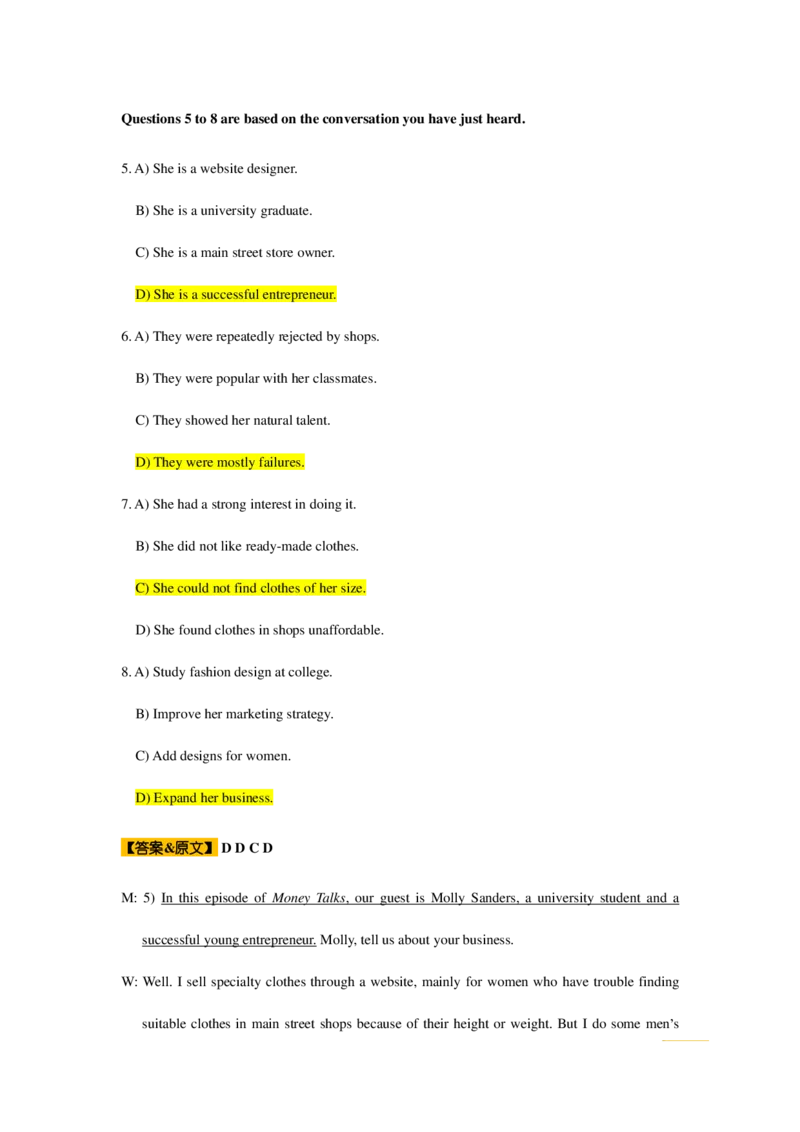
5.A) She is a website designer.
B)She is a university graduate.
C)She is a main street store owner.
D)She is a successful entrepreneur.
6.A) They were repeatedly rejected by shops.
B)They were popular with her classmates.
C)They showed her natural talent.
D)They were mostly failures.
7.A) She had a strong interest in doing it.
B)She did not like ready-made clothes.
C)She could not find clothes of her size.
D)She found clothes in shops unaffordable.
8.A) Study fashion design at college.
B)Improve her marketing strategy.
C)Add designs for women.
D)Expand her business.
【答案&原文】 D D C D
M: 5) In this episode of Money Talks, our guest is Molly Sanders, a university student and a
successful young entrepreneur. Molly, tell us about your business.
W: Well. I sell specialty clothes through a website, mainly for women who have trouble finding
suitable clothes in main street shops because of their height or weight. But I do some men’sclothes, too.
M: How did you get started in this business at such a young age? Are you studying fashion design?
W: Actually, I’m majoring in finance, but I’ve always loved clothes. And I started making my own
at 14.
M: Did you have any sort of training in design or sewing or was it a natural ability?
W: I’d have to say no to both. No one taught me to make clothes. 6) And most of the things I
made at first were disasters.
M: Why did you persevere? I think most people would give up if they kept failing, especially at
that age.
W: 7) I kept on out of necessity. As you can see, I’m very tall. And I couldn’t find clothes that fit
me in ordinary shops, so I kept trying and developed my skills over time.
M: Well. My notes say you earned $50,000 in profits last year – an extraordinary amount for a 20-
year-old student. How did that happen? Did you see a gap in the market and decide to fill it?
W: No, when I started university, some classmates complimented my clothes. And when I said I
made them myself, other tall women started asking if I would make theirs. And I did. And
before I knew it, I was an entrepreneur.
M: So what are your plans for the future? Do you intend to open a physical store?
W: 8) No, I’ll keep things online to keep costs down, but I will add more clothes for children, both
girls and boys, and possibly even for infants. And I hope to add to my range of designs for
men.
Questions 5 to 8 are based on the conversation you have just heard.
5.What do we learn about the woman?6.What does the woman say about the clothes she made at first?
7.Why did the woman persevere in making clothes for herself?
8.What does the woman plan to do in the future?
Section B
Directions: In this section, you will hear two passages. At the end of each passage, you will hear
three or four questions. Both the passage and the questions will be spoken only once. After you
hear a question, you must choose the best answer from the four choices marked A), B), C) and D).
Then mark the corresponding letter on Answer Sheet 1 with a single line through the centre.
Questions 9 to 11 are based on the passage you have just heard.
9.A) Utilizing artificial intelligence to find a powerful new antibiotic.
B)Discovering bacteria which are resistant to all known antibiotics.
C)Identifying bacterial strains that are most harmful to human health.
D)Removing a deadly strain of bacteria in humans with a new antibiotic.
10.A) Ever-increasing strains of bacteria.
B)Bacteria’s resistance to antibiotics.
C)The similarity between known drugs.
D)The growing threat of bacteria to health.
11. A) Dispense with experimental testing.
B)Predict whether compounds are toxic.
C)Foresee human reaction to antibiotics.
D)Combat bacteria’s resistance to antibiotics.【答案&原文】 A B B
Researchers have identified a potent new antibiotic compound using artificial intelligence.
The antibiotic can kill very dangerous bacteria. According to a study published in the journal Cell,
the compounds successfully removed deadly strains of bacteria in mice which are resistant to all
known antibiotics. 9) The researchers say this is the first time that artificial intelligence has been
used to find a powerful new antibiotic molecule. Why does this matter? The answer is antibiotic
resistance. This happens when bacteria developed the ability to survive the medications designed
to kill them. 10) Antibiotic resistance is a serious threat to health, and the problem is growing.
This makes finding new antibiotics very important. However, in recent decades, very few have
been developed. And those that have tend to be very similar to drugs already available. These
searches also tend to only focus on a narrow spectrum of chemical compounds. But this is where
artificial intelligence comes in. Why? To find new drugs, scientists screen molecules to predict
how effective they might be. Typically, such screening is done by humans in the lab, which is both
costly and slow. Artificial intelligence is different. It’s fast, and it can process a high volume. It
can screen hundreds of millions of compounds to identify a few interesting candidates that require
experimental testing. 11) Artificial intelligence is also able to predict if compounds are likely to be
toxic. Some experts assert that this work signifies a paradigm shift in antibiotic discovery. It could
change drug discovery more generally.
Questions 9 to 11 are based on the passage you have just heard.
9.What have researchers done for the first time in history?
10.What makes it important to find new antibiotic drugs?
11.What does the passage say artificial intelligence is able to do in antibiotic research?Questions 12 to 15 are based on the passage you have just heard.
12.A) By theorization.
B)By generalization.
C)By observation.
D)By conversation.
13.A) They are easy to detect.
B)They are well intended.
C)They are groundless.
D)They are harmless.
14.A) Mostly by chance.
B)Basically objective.
C)Subject to their mental alertness.
D)Dependent on their analytical ability.
15.A) Looking the speaker in the eye.
B)Listening carefully to the speaker.
C)Measuring the speaker’s breathing rate.
D)Focusing on the speaker’s facial expressions.
【答案&原文】 C D A B
A recent study overturned what we think we know about lying. 12) Most of us have a theory
about how to tell if someone is telling a lie. We may develop that theory from observations of
those people we know well and see regularly. But we tend to generalize what we gather from that
unscientific daily research and make it a universal theory. So we might imagine that liars haveevasive eyes or the opposite. They simply stare at you, or perhaps it is more generally nervous
behavior we associate with lies. Whatever the particular theory, it’s usually based on close
observation of people we know. And we get lots of practice. On average, we’re lied to some 200
times per day. 13) These are mostly harmless lies, but lies are the lies. But there’s a problem with
our theories, even though they’re based on all this observation. 14) The average person – you and
me – tested rigorously on how well we detect lies fails to do better than chance. That’s well
established over many studies and lots of attempts by researchers to work out reliable ways to
detect lies. It’s even relatively easy to fool lie detectors. The gold standard of lie detection by
training yourself in breathing techniques and symptom suppression. Is there any way to get better
at detecting lies? 15) The new research offers some surprising advice. Stop looking and listen
instead. It turns out that if we’re unable to see the face, but rather focus on the voice of the person
in question, our accuracy rate improves considerably.
Questions 12 to 15 are based on the passage you have just heard.
12.According to the passage, how do most people detect lying?
13.What does the passage say about most lies?
14.What have many studies uncovered about the average person’s lie detection?
15.What advice does the new research offer regarding lie detection?
Section C
Directions: In this section, you will hear three recordings of lectures or talks followed by three or
four questions. The recordings will be played only once. After you hear a question, you must
choose the best answer from the four choices marked A), B), C) and D). Then mark the
corresponding letter on Answer Sheet 1 with a single line through the centre.Questions 16 to 18 are based on the recording you have just heard.
16. A) They don’t treat patients with due respect.
B) They witness a lot of doctor-patient conflicts.
C) They have to deal with social workers’ strikes.
D) They don’t care how much patients have to pay.
17. A) Appear submissive and grateful to doctors and nurses.
B) Express a strong desire to be consulted or informed.
C) Refrain from saying anything that sounds negative.
D) Note down the names of all the doctors and nurses.
18. A) Cooperative. B) Appreciative. C) Passive. D) Responsive.
【答案&原文】 A C C
Appear to be submissive, humble, grateful, and undemanding. Show great pleasure when a
doctor comes into your room, even if the visit is brief and useless. Don’t challenge anyone with
authority unless you’re famous or very rich. Those are a few strategies for dealing with today’s
American medical establishment. 16) What patients want is to be treated with respect and
consideration. But in my experience, too few hospitals and doctors are ready to do that. In his
book, A Whole New Life, novelist Reynolds Price recalls that his doctors chose a crowded hallway
as the place to tell him he might have a tumor on his spinal cord. It did not occur to the two
physicians that a hallway was not the most appropriate place for that particular piece of news. My
surgeon who is in his mid-30s looks tired. He has been overwhelmed with patients who have
fallen on the winter ice. He is a witty man, but sometimes his wit is unwelcome. “The health
insurance company, Blue Cross, wants me to put you out in the snow tomorrow afternoon,” hetells me after I have been in the hospital for more than a week. I’m terrified because I have no idea
where to go. I cannot walk or even lift my leg a few inches. The hospital social worker strikes me
as an idiot, but my complaints about her only annoy my surgeon. “I have to work with these
people,” he tells my friend, Dr. Karen Brudney, when she mercifully intervenes on my behalf and
arranges for me to be transferred to another hospital. 17) “If you say one negative thing, they get
defensive,” she tells me later. They have this kind of institutional loyalty. Always bring in an
advocate, that is, any other person with you to the hospital, and write down every single question
and the answer, the name of every doctor and nurse. When people know you have their names,
they behave better. “And” Brudney adds, “if you, as a patient, suggest that you might like to
control even part of the situation or be consulted or informed, then you are considered difficult. 18)
They want you to be totally passive. The entire health care system, particularly hospitals and
nursing homes, exists for reasons that have nothing to do with taking care of patients. Patients are
incidental.
Questions 16 to 18 are based on the recording you have just heard.
16.What does the speaker say about most American hospitals?
17.What does Karen Brudney suggest patients do?
18.What do American doctors expect their patients to be, according to Karen Brudney?
Questions 19 to 21 are based on the recording you have just heard.
19.A) Its members work together despite risks of failure.
B)It prioritizes recruiting young energetic members.
C)Its members stay in touch even after it breaks up.
D)It grows more and more mature professionally.20.A) Their differences are likely to impact productivity.
B)Their similarity is conducive to future collaboration.
C)Their connections strengthen with the passage of time.
D)Their mutual understanding stems from a common goal.
21.A) It is characterized by diversity.
B)Its goals are quite inconsistent.
C)Its members have similar back grounds.
D)It is connected by a unique mechanism.
【答案&原文】 C B A
There are probably teams you’ve worked with that you never want to work with again. But
there must have also been other teams that you would prize reuniting with professionally. In other
words, your team had vitality. 19)Vitality comes about when the ties people form with their
fellow team members are such that they stay connected even after the team breaks up. What
characteristics of a team make its members more likely to stay in contact despite no longer
working together? This question has been answered recently in a study published in a business
journal. 20) One of the two key factors the research team discovered is sameness, specifically
sharing the same gender or ethnic origin. The more members of a team share similar
demographics, the more inclined they’ll be to remain associates long after the team has served its
purpose. After ties are established, similarity strengthens them. As a result, they regard these
individuals with greater trust and mutual understanding, which motivates them to seek further
opportunities for collaboration. In effect, people tend to create stronger and longer lasting
connections with similar others. Someone who looks and sounds different from us may have theresources we need to be more successful. Yet we find them to be significantly less credible, simply
because they are different. If you are a fierce advocate of workplace diversity, you’ll no doubt be
horrified by such a revelation. The second factor identified by the researchers is the quality of the
relationships among the team members. The more they trust one another, share the same goals,
and depend on each other for the achievement of those goals, the stronger their chances of
maintaining their connections, despite no longer working as one team. Teams with quality
relationships have a shared belief that it’s safe to take risks with each other, and that members are
obliged to share the workload and help out. From personal experience. I can see both the truth and
the inconsistency of such studies. The truth is some of my closest friendships were formed as a
result of having worked together on teams. And I actively seek opportunities to work with them
again. 21) The inconsistency, though, is that I’ve never worked for a team more successful and
cohesive than the one of which I’m a member right now. And yet the four of us have very little in
common and are completely different demographically. So I’m unlikely to question the value of a
diverse workforce.
Questions 19 to 21 are based on the recording you have just heard.
19. What does the speakers say about a team with vitality?
20. What do the researchers find out about members of a team?
21. What do we learn about the team?
Questions 22 to 25 are based on the recording you have just heard.
22. A) Putting aside twenty percent of one’s earnings.
B) Spending in anticipation of becoming wealthy.
C) Living off a small proportion of one’s income.D)Saving as much as one can possibly manage.
23.A) It empowers them to cope with irrational emotions.
B)It will guarantee the profits from their investments.
C)It will turn them into successful financial planners.
D)It enables them to focus on long-term investments.
24.A) They count on others to take the responsibility.
B)They change their investment strategy in time.
C)They think they themselves are to blame.
D)They persist rather than get discouraged.
25.A) They do not resist novel lifestyles.
B)They do not try to keep up with others.
C)They do not care what they have acquired.
D)They do not pressure themselves to get rich.
【答案&原文】 A D D B
An American researcher who studied 600 millionaires found how rich you can get comes
down to six wealth factors. She found that six behaviors are related to net worth potential,
regardless of age or income. These were thriftiness, confidence, responsibility, planning, focus and
social indifference. Being thrifty comes as no great surprise. Spending above your means,
spending instead of saving for retirement, spending in anticipation of becoming wealthy, makes
you a slave to the paycheck. “Even with an astronomical level of income,” she wrote. 22) “To
properly build wealth, experts recommend saving 20% of your income and living off the
remaining 80%.” Having confidence is another key characteristic as it helps people to be thrifty. Ittakes confidence to live within your means. It also takes confidence to invest properly instead of
making investing decisions with your emotions. 23) Financial planners advise that you should
leave your investments alone and focus on a long-term investment plan. But people can’t invest or
manage their own money without accepting responsibility for the outcomes. Many millionaires
take on personal responsibility and most also happen to be self-made, meaning they didn’t acquire
their wealth through luck. 24) Millionaires don’t count on anyone else to make them rich and they
don’t blame anyone else if they fall short. They focus on things they can control and align their
daily habits to the goals they have set for themselves. They tend to be goal-oriented and hard
workers which enables them to plan financially and focus on seeing those plans through. 92
percent of the millionaires surveyed developed a long-term plan for their money and 97 percent
almost always achieved the goals they set for themselves. 25) And it is these behaviors that make
it easy for them to be socially indifferent. They resist lifestyle creep – the tendency to spend more
whenever one earns more. Essentially, they don’t yield to pressure to buy the latest thing or to
keep up with others or what they have acquired. Instead of being focused on what might make
them happy today they’re focused on their long-term wealth building plan.
Questions 22 to 25 are based on the recording you have just heard.
22.What do experts recommend concerning being thrifty?
23.How does confidence help people to be thrifty?
24.How do millionaires react when they fail in their investment?
25.Why does the speaker say millionaires are socially indifferentPart III Reading Comprehension (40 minutes)
Section A
Directions: In this section, there is a passage with ten blanks. You are required to select one word
for each blank from a list of choices given in a word bank following the passage. Read the passage
through carefully before making your choices. Each choice in the bank is identified by a letter.
Please mark the corresponding letter for each item on Answer Sheet 2 with a single line through
the centre. You may not use any of the words in the bank more than once.
https://www.independent.co.uk
Thinking kind thoughts about yourself and your loved ones can prove beneficial for your
overall wellbeing, empirical evidence has shown. Researchers carried out an investigation to
explore the correlation between having kind thoughts and a person’s psychological state.
For the study, five groups of participants were presented with a different set of audio
instructions, some of which encouraged the participants to think amiably about themselves and
others which persuaded them to think in a self-critical manner. After listening to the audio
instructions, the participants were asked to answer a series of questions. These included whether
they felt safe, how likely they were to show kindness to themselves and how connected they felt
to other individuals.
The participants who were instructed to think kindly about themselves were more likely to
exhibit a bodily response associated with being relaxed and feeling safe. Their heart rates also
dropped, which is a healthy sign of a heart that can respond flexibly to situations. Yet, adversely
those who listened to the critical audio clips were noted as having a higher heartrate and sweat
response afterwards, both of which signify feelings of threat and distress. Having the ability toswitch off the body’s natural threat response can boost a person’s immune system. This, in turn,
gives them a greater likelihood of recovering quickly from illness.
These findings help us to further understand some of our clinical trials research findings,
where we show that individuals with recurrent depression benefit particularly from a self-
awareness-based cognitive therapy. They essentially learn to become more sympathetic to
themselves.
The sense is that for people prone to depression, meeting their negative thoughts and feelings
with compassion is a radically different way – that these thoughts are not facts.
It introduces a different way of being and knowing that is quite transformative for many
people.
A)adversely I)indignantly
B)amiably J)insulation
C)boost K)lavish
D)cognitive L)prone
E)compassion M)recurrent
F)connected N)signify
G)correlation O)surpass
H)fascinated
【参考答案】 GBFAN CMDLE
Section B
Directions: In this section, you are going to read a passage with ten statements attached to it.
Each statement contains information given in one of the paragraphs. Identify the paragraph fromwhich the information is derived. You may choose a paragraph more than once. Each paragraph
is marked with a letter. Answer the questions by marking the corresponding letter on Answer
Sheet 2.
https://aeon.co/essays/we-need-slow-hope-in-a-world-of-accelerating-ecological-change
Saving Our Planet
A) In the long view, the human relationship with forests has been one of brutal destruction, but
even it carries elements of slow hope. In the Middle Ages, there was no shortage of timber in
most parts of the world, and few saw cutting down forests as a problem. Yet in 1548 the
people of Venice estimated that an important timber supply would last only 30 years at their
current rate of usage – but different forest management would make it possible to meet the
demand for many centuries to come. 43) The idea of preserving resources came out of a
concern for the future: a fear of using up resources faster than they could be replenished (补
充).
B) Economic interests were at the core of this understanding of trees and forests. 37) It would
take more than three centuries before scientists began to understand that timber production is
not the only, and possibly not the most important, function of forests. The late 19th and early
20th century saw an increasing recognition that forests serve as habitats for countless animal
and plant species that all rely on each other. They take over protective functions against soil
erosion and landslides (塌方); they make a significant contribution to the water balance as
they prevent surface runoff; they filter dirt particles, greenhouse gases and radioactive
substances from the air; they produce oxygen; they provide spaces for recreation and they
preserve historic and prehistoric remains. As a result, forests around the world have been setaside as parks or wilderness areas.
C) 41) Recent years have seen a big change in our view of forests. Peter Wohlleben’s book The
Hidden Life of Trees (2015), an international bestseller, suggests that trees can warn each
other of danger through a ‘wood wide web’ of roots and fungi (真菌). They support each
other through sharing of nutrients and information, and they even keep ancient stumps alive
by feeding them solutions of sugars. Such insights have made us aware of deep ecological
relationships between humans and the more-than-human world.
D) Awareness of ecologies is a recent phenomenon. 39) It was not until the 1940s that the
concept of the ‘environment’ encompassing all living and nonliving things developed. In the
1970s, the term ‘environment’ gained currency, becoming widely adopted in the English and
Romance languages, and as ‘Umwelt’ (‘surrounding world’) in German. The emergence of
the idea led to the rise of environmental agencies, regulations and environmental studies, and
to environmental science as new, integrated academic disciplines. It was in 1956 that the very
first bachelor of science in environmental studies was awarded, at the State University of
New York College of Forestry at Syracuse. Since the 1970s – with the rise of
‘environmentalism’ – environmental studies programmes have sprung up at hundreds of
universities. There is (slow) hope in the fact that scholars from many different disciplines
have adopted the term ‘environment’ over the past decades. They are exploring intricate
connections within and between complex ecologies, as well as the impact that human
environment-making (through techno-industrial, economic and other manipulative
developments) has had on the biosphere.
E) The rise of the idea of the environment and a scholarly understanding of ecological processeshas influenced new technologies and also politics. We have come to ask questions about
vulnerability and risk, world ecologies, and the relationship between nature and power. 45)
The search for an adequate response to climate change occupies centre stage in international
diplomacy.
F) Social and environmental activists, scientists and indigenous groups have called the Paris
Agreement of the United Nations Climate Change Conference in December 2015 insufficient,
weak, or compromised. 36) To some extent, they are right: climate change has already
destroyed tens of thousands of livelihoods, and the situation will worsen in the near future for
millions of mostly poorer people who will join the ranks of those who have already been
displaced by climate change and extreme weather events. But the Paris Conference
nevertheless marked a historic step toward the recognition of the need for action on climate
change, the cutting of carbon emissions and world cooperation. There were 195 nations that
came to the table in Paris and agreed to limits on emissions. Historically, nothing comparable
had happened prior to this. Before the 20th century, a handful of scientists had been
interested in the theoretical relationship between greenhouse gases and climate change, but
only the empirical evidence accumulated since the late 20th century established a clear
connection between the burning of fossil fuels and a vastly accelerated rise in global
temperatures.
G) 42) The current crisis is not the first that humans have encountered, and a look at the
struggles with pollution in recent history reveals transformations that once seemed
unimaginable. The ‘London fog’ that came to define the capital through British novels and
thrillers is in reality smog or smoke, a legacy of industrialisation. After a century ofignorance, London was hit by the Great Smog of December 1952 – the worst air-pollution
event in the history of the United Kingdom which caused the deaths of approximately 12,000
people. Shortly thereafter, public initiatives and political campaigns led to strict regulations
and new laws, including the Clean Air Act (1956). Today, London has effectively reduced
traffic emissions through the introduction of a Congestion Charge Zone in 2003, and an Ultra
Low Emission Zone in 2019.
H) 38) Scientific evidence that we are living in an era of climate change, resource exhaustion
and potential ecological disaster is overwhelming. How do we motivate a public exhausted
by never-ending scenarios of doom and disaster, when the challenges seem so huge and so
impossible to solve? Statistics about extinction and the gloom of decline will not in
themselves get us out of our often self-created ecological traps: instead, they are more likely
to result in paralysis and inaction.
I) We need stories and histories of change and transformation: ecological stories that make us
confront the fact that human power is potentially destructive, and that the survival of our
species on this planet depends on the preservation of soil and water, and the habitats and
ecological systems.
J) It is time that we show successes and accelerations in ecological awareness, action and
restoration; stories that include past successes and future visions about the rise of urban
gardening and of renaturalised riverscapes, of successful protests against polluted air and
water, of the rise of regional markets and slow food, and the planting of trees around the
globe, of initiatives and enterprises that work towards ecological restoration. The reality of
ecological curses seems far greater than the power of the hopes left at the bottom ofPandora’s box. 44) But if we believe that nothing can be changed, then we are giving up our
opportunity to act.
K) Today’s saving powers will not come from a deus ex machina (解围之神). In an ever-more
complex and synthetic world, our saving powers won’t come from a single source, and
certainly not from a too-big-to-fail approach or from those who have been drawn into the
whirlpool of our age of speed. Hope can work as a wakeup call. It acknowledges setbacks. 40)
The concept of slow hope suggests that we can’t expect things to change overnight. If the
ever-faster exhaustion of natural resources (in ecological terms) and the ‘shrinking of the
present (in social terms) are urgent problems of humans, then cutting down on exhaustive
practices and working towards a ‘stretching of the present’ will be ways to move forward.
36. Climate change has wrought havoc on the lives of tens of thousands of people.
37. It took scientists a long time to realise that the function of forests goes far beyond providing
humans with timber.
38. There is abundant evidence that we are now facing a possible ecological disaster.
39. Environmental science became academic disciplines only some sixty years ago.
40. Things cannot change overnight, but reducing the consumption of natural resources will help
solve the ecological crisis.
41. Human perception of forests has undergone a tremendous change in the past years.
42. Recent history shows reduction of pollution once seemingly impossible, can actually be
accomplished.
43. People began to consider preserving natural resources when they feared they would have
nothing to use in the future.44. If we doubt our ability to reverse ecological deterioration, we are throwing away the chance
to take action.
45. How to respond effectively to climate change has become the focus of international
diplomacy.
【参考答案】 FBHDK CGAJE
Section C
Directions: There are 2 passages in this section. Each passage is followed by some questions or
unfinished statements. For each of them there are four choices marked A), B), C) and D). You
should decide on the best choice and mark the corresponding letter on Answer Sheet 2 with a
single line through the centre.
Passage One
Questions 46 to 50 are based on the following passage.
https://performermag.com/band-management/the-pros-cons-and-future-of-artificial-
intelligence-in-music/
Since American idol star Taryn Southern started composing music with AI in 2017, musicians
all over the world have begun wondering about the implications of AI and modern technology
where music production is concerned. Using AI in the creation of music is perceived by some as a
helpful tool and by others as almost ‘the beginning of the end’.
In Taryn’s case, AI software enabled her to communicate melodies and chords that she didn’t
know how to put together herself. The end product was therefore a collaborative effort, rather than
a piece entirely produced by technology. 47) Taryn’s story has a distinctly positive feel thathighlights the advantages of using AI in music production. It can serve as a source of inspiration,
and as an ideal jumping off point should a musician be hit with writer’s block (文思枯竭).
46)Conversely to seeing AI as a tool, some musicians consider it to be hugely detrimental to
the music scene. At the moment, because such technology is still so young, the music it’s
producing is not necessarily what we want to hear. In short, it’s not of great quality. 48) Those
who have produced their own music, or even fans of authentic, artistic music, will also argue that
a computer could never emulate the work (and human touch) of a true musician.
Music has been an integral part of the story of humans for ages; in fact, the first known piece
of music is believed to be around 3,400 years old. Songs have long been used as a means of
communicating messages and folk stories, covering everything from societal ethics to world
history. 49) Since many people see music as such an inherently human expression, it is often
considered as too precious to impart onto technology. The thought of a computer generating a
‘random’ piece of music that hasn’t been painstakingly created by an artist is almost seen as
sacrilegious (亵渎神圣的).
50)Regardless of which side of the argument you fall on, it seems likely that the use of AI in
music production will only become more frequent. Our modern world is preoccupied with
technological advancements. Instead of shying away from the idea of this bleak future, the best
approach to take is one of optimism and curiosity. While there are always bound to be stubborn
old-school musicians who refuse to use tech, music producers should consider AI as something to
be embraced. 50) AI music software is still very much in its infancy, but with more investors
interested in the development and outcomes of such technology, and considering the rapid growth
rate of other tech advances in recent years, it’s only a matter of time until AI-produced music isseen as the new norm.
46.How do some musicians perceive using AI in creating music?
A)It would help to produce more music idols.
B)It would be detrimental to music production.
C)It would hinder the understanding of authentic music.
D)It would be the beginning of a new era in music creation.
47.What does Taryn Southern’s story illustrate?
A)AI technology is conducive to music composition.
B)Musicians will be unable to create music without high tech.
C)Musicians are often at their wits’ end in their creative effort.
D)AI technology is indispensable to creating melodies and chords.
48.Why are some musicians opposed to the use of AI in creating music?
A)Music produced with AI technology lacks humanness.
B)Music created with AI technology is easily emulated.
C)It will depreciate humans’ role in music composition.
D)It will deplete young musicians’ creative inspiration.
49.Why do many people think music is too precious to impart to AI technology?
A)It cannot be created without pains.
B)It cannot be produced at random.
C)It is part of human life.
D)It is human specific.
50.What does the author think of the future of AI music?A) It will continue to arouse the interest of music investors.
B) It has the prospect of becoming the norm in the future.
C) It will be gradually accepted by old-school musicians.
D) It may eventually lose its freshness and appeal.
【参考答案】 B A A D B
Passage Two
Questions 51 to 55 are based on the following passage.
https://www.the-scientist.com
A few weeks ago, a well-meaning professor tried to explain the physiological process behind
viruses and the human body in a tweet and was immediately criticized for a mistake in his
information. He then issued an apology and deleted his erroneous tweet.
51) Communicating science beyond the academic bubble is necessary to augmenting public
understanding of health and environmental issues and helping individuals make well-informed
personal decisions.
However, scientists who engage in science communication must acknowledge that even in
their area, their expertise is deep but narrow. They need to recognize the constraints in their own
knowledge. 52) That is not to suggest that they only write or present on their own research, but
rather, that they consult with an expert if the topic is outside of their discipline. Fact-checking with
a scientist who works in the specialty will prevent the unintentional spread of misinformation, and
the process of doing so may yield interesting new information that can be incorporated.
Some have argued that the public is not educated enough to understand scientific information,
especially for any complex phenomena, but this is absurd. Science instruction can be found at alllevels of public education with most secondary schools offering classes or biology, physics, and
chemistry. 53) If anything, social media has shown that the public craves knowledge based on a
solid scientific foundation. Even the public discourse that follows most scientific articles shows
that online readers can understand even the most baffling of scientific principles.
It is equally imperative to emphasize that being an expert on a topic doesn’t automatically
make a scholar qualified to communicate it to a nonscientific audience. A number of scientists
recently have been offering public-aimed explanations of scientific phenomena. 54) Even though
they have appropriate credentials, they often do very little in the way of explaining. One biologist
shared a complicated analogy involving a library, books, paper, a recipe, ingredients, and a cake to
explain the process behind vaccines. Any explanation that requires written key to keep track of
what each item represents is not a clear example for public consumption. 55) Science
communication is a science in and of itself. It requires rigorous training and instruction. A scientist
should take communication courses that can teach a person how to identify and eliminate jargon
and how to develop effective analogies to explain complex concepts. One cannot assume
communication expertise – imagine if someone just decided that they were a physicist and started
trying to contribute to the field without the necessary background. Doing a poor job
communicating science to the public will only create confusion and widen the gap between
science and society, a gap that scientists are trying to close.
51.What does the author say about communicating science to the general public?
A)It will help them to keep abreast of the latest scientific developments.
B)It is a necessary means to improve their understanding of scientific issues.
C)It will get them more involved in academic debates on environmental problems.D) It is an effective way to augment scientists’ influence beyond the academic circle.
52. What does the author advise scientists do to deal with topics outside of their specialty?
A) Write or present on them from new angles.
B) Utilize information from diverse sources.
C) Turn to a specialist for professional help.
D) Fact-check with colleagues in their field.
53. What does the author say we can learn from social media?
A) A solid academic foundation is essential to understanding baffling scientific principles.
B) Modern technology has facilitated communication between scientists and the public.
C) Scientific articles have gained increasing popularity among the general public.
D) The public’s understanding of science is much better than some have claimed.
54. What does the example of the biologist who shared an intricate analogy show?
A) It is helpful to use illustrations in explaining scientific phenomena.
B) It is imperative to have appropriate titles to explain scientific issues.
C) A learned scholar is not necessarily a qualified science communicator.
D) A nonscientific audience cannot duly understand principles of science.
55. What does the author suggest scientists do to close the gap between science and society?
A) Explain complex concepts scientifically. C) Take courses in public speaking.
B) Make appropriate use of scientific terms. D) Develop communication skills.
【参考答案】 B C D C D
Part IV Translation (30 minutes)
Directions: For this part, you are allowed 30 minutes to translate a passage from Chinese intoEnglish. You should write your answer on Answer Sheet 2.
赵州桥建于隋朝,公元 605年左右,长 50.82米,宽 9.6米,跨度 37.37米。天才建筑
师李春设计并监督了桥的建设。赵州桥结构新颖、造型优美。桥有一个大拱,在大拱的两
端各有两个小拱,帮助排泄洪水、减轻桥梁重量并节省石材。建成以来,该桥经受了多次
洪水和地震,但其主体结构仍然完好无损,至今仍在使用。赵州桥是世界桥梁建筑史上的
一次创举,是中国古代文明史上的一项杰出成就。类似设计的桥梁直到 14世纪才在欧洲出
现,比赵州桥晚了700多年。
【参考译文】
The Zhaozhou Bridge, which was built/constructed around/about/some 605 AD during the
Sui dynasty, is 50.82 meters long/in length and 9.6 meters wide with a central span of 37.37
meters. A talented architect named/The master architect Li Chun designed and supervised the
construction of the bridge. The bridge was beautifully shaped with a novel/an unusual structure.
There is a central arch and two small side arches on either side of the main arch, which are served
to drain/discharge flood, reduce the total weight as well as save stone. Since its completion, the
bridge survived many floods and earthquakes. Yet, the main/support structure remains intact and is
still in use/utilized today. The Zhaozhou Bridge is a pioneering undertaking/ unique invention/
master-work of world bridge construction/ architecture/engineering and a great/remarkable/an
outstanding achievement/accomplishment/triumph in the history of ancient Chinese civilizations.
Bridges with similar design [of its kind] was built/did not appear/There is no equals in Europe
until the 14th century, 700 years later than/after the Zhaozhou Bridge.大学英语六级考试
COLLEGE ENGLISH TEST
–Band Six –
(2022.06-02)
Part I Writing (30 minutes)
Directions: For this part, you are allowed 30 minutes to write a short essay that begins with the
sentence “Nowadays more and more people keep learning new skills to adapt to a fast-changing
world.” You can make comments, cite examples, or use your personal experiences to develop your
essay. You should write at least 150 words but no more than 200 words.
Part II Listening Comprehension (30 minutes)
说明:据多数学生反馈,本次考试只有一套听力试题,第二套为重复题目,只是选项顺序
不同,故不再重复。
Part III Reading Comprehension (40 minutes)
Section A
Directions: In this section, there is a passage with ten blanks. You are required to select one word
for each blank from a list of choices given in a word bank following the passage. Read the passage
through carefully before making your choices. Each choice in the bank is identified by a letter.
Please mark the corresponding letter for each item on Answer Sheet 2 with a single line through
the centre. You may not use any of the words in the bank more than once.Book: Slow Cotswolds: Local, Characterful Guides to Britain's Special Places
The city of Bath was founded by the Romans almost two thousand years ago. It has been
famous for its pleasing aesthetically architecture and healing thermal springs ever since.
There are three hot springs in Bath; one is the King’s Spring, upon which the Roman baths
and a temple were constructed. The other two are the Cross Spring and the Hetling Spring close
to each other in Hot Bath Street. Although Bath is principally known as a Roman and Georgian
city, many people came in the intervening centuries to make use of the natural waters.
While the Georgians made ‘taking the water’ or bathing particularly fashionable, it was
previous generations who paved the way, creating greater interest in Bath and its springs. Charles
II, desperate for an heir and unable to produce a legitimate son, came to Bath to take the waters in
the hope that their magical powers would do something to remedy the situation. Craving for a
male heir James and Mary both came to Bath and soon after produced a son, which bred many
conspiracy theories about who was the real father of their offspring. Regardless, the ‘miracle’
created something of a boom in tourism for Bath and once Queen Anne had paid a visit in 1702,
sealing it as the place to be, the whole nation flocked to the city.
Afterwards, the spas (矿泉疗养浴场) in Bath continued to go in and out of fashion for more
than 150 years until they closed completely. The new Bath Spa, which opened in 2006
incorporates modern architecture with the ancient spring, now the New Royal Bath.
A)aesthetically I)offspring
B)constructed J)previous
C)designates K)principally
D)extract L)remedyE)flocked M)rhetorically
F)incorporates N)sneaked
G)legitimate O)versatile
H)natural
【参考答案】 ABKHJ GLIEF
Section B
Directions: In this section, you are going to read a passage with ten statements attached to it.
Each statement contains information given in one of the paragraphs. Identify the paragraph from
which the information is derived. You may choose a paragraph more than once. Each paragraph
is marked with a letter. Answer the questions by marking the corresponding letter on Answer
Sheet 2.
https://www.npr.org
The Doctor Will Skype You Now
A) Fazila is a young woman that has been dealing with eczema (湿疹), a common skin condition,
for the past five years, but never got it treated. The nearest hospital is an hour away, by boat
and bus, and her skin condition didn’t seem serious enough to make the trek, so she ignored it
– until a new technology brought the doctor to her. Fazila lives on one of the remote river
islands in northern Bangladesh. 44) These islands are low-lying, temporary sand islands that
are continuously formed and destroyed through sand buildup and erosion. They are home to
over six million people, who face repeated displacement from flooding and erosion – which
may be getting worse because of climate change – and a range of health risks, including poor
nutrition, malaria (疟疾) and other water-borne diseases.B) The most dangerous thing for these remote island dwellers island erosion. The second is lack
of access to medical supplies and doctors. 37) There are no doctors within miles, and while
child mortality and maternal death have gone down in the rest of the country, this is not the
case for the islands. The medical situation is so bad that it really takes away from the quality
of their life. Yet for many island inhabitants – some of Bangladesh’s poorest – paying for
health care is a costly ordeal. Victims of erosion lose their houses, agricultural land and jobs
as farmers, fishermen and day laborers. Though government hospitals are free, many people
hesitate to go, citing long commutes, endless lines and questionable diagnoses. For
convenience’s sake, one-third of rural households visit unqualified village doctors, who rely
on unscientific methods of treatment, according to a 2016 study in the peer-reviewed journal
Global Heath Action.
C) On the islands, there’s even a colloquial (口头的) expression for the idea of making medical
care your lowest priority: It’s known as “rog pushai rakha” in Bengali, which roughly
translates to “stockpiling their diseases” – waiting to seek medical attention until a condition
becomes extremely serious. Now, a new virtual medical service called Teledaktar (TD) is
trying to make heath care more easily accessible. 42) Every week, TD’s medical operators
travel to the islands by boat, carrying a laptop, a portable printer for prescriptions and tools to
run basic medical screenings such as blood pressure, blood sugar, body temperature and
weight. They choose an area of the island with the best Internet reception and setup a
makeshift (临时凑合的) medical center which consists of plastic stools and small tables
borrowed from the locals’ homes, a tent in case of rain and a sheet that is strung up to give
the patients privacy during their session.D) Launched in October 2018, TD has eight centers in towns and villages across rural
Bangladesh and on three islands. 39) It is funded by a nonprofit organization founded by
Bangladeshi entrepreneurs, finance and technology professionals. Inside the center, the laptop
screen lights up to reveal Dr. Tina Mustahid, TD’s head physician, live-streamed (网络直播)
from the capital city of Dhaka for free remote medical consultations. Affectionately called
Doctor Apa – “older sister” in Bengali – by her patients, she is one of three volunteer doctors
at TD.
E) “I diagnose them through conversation,” says Dr. Mustahid. “Sometimes it’s really obvious
things that local doctors don’t have the patience to talk through with their patients. For
example, a common complaint mothers come in with is that their children refuse to eat their
meals. 36) The mothers are concerned they are dealing with indigestion, but it’s because they
are feeding the children packaged chips which are cheap and convenient. I tell them it is
ruining their appetite and ask them to cut back on unhealthy snacks.” Dr. Mustahid says
building awareness about health and nutrition is important for island patients who are cut off
from mainland resources.
F) Even off the islands, Bangladesh faces a critical deficit of health services. The country has
half the doctors-per-person ratio recommended by the World Health Organization: roughly
one doctor per 2,000 people, instead of one doctor per 1,000 people. And of those physicians,
many are concentrated in cities: 70% of the country’s population live in rural areas, yet less
than 20% of health workers practice there. Over 70% of TD’s 3,000 patients are female, in
part because many are not comfortable speaking with local doctors who tend to be male. The
rural women are mostly not literate or confident enough to travel on their own to the nearesttown to visit medical facilities. Many have spent their entire lives rebuilding their homes
when the islands flood. 41) Early marriage and young motherhood, which are prevalent in
these parts of Bangladesh, also contribute to the early onset of health problems.
G) For most TD patients on the islands, Dr. Mustahid is the first big-city doctor that they’ve ever
consulted. 43) TD doctors are not meant to treat serious illnesses or conditions that require a
doctor to be physically present, such as pregnancy. But they can write prescriptions, diagnose
common ailments – including digestive issues, joint pain, skin diseases, fever and the
common cold – and refer patients to doctors at local hospitals. The visit is also an opportunity
for the patients, especially women to air their concerns about aging, motherhood and
reproductive health according to Dr. Mustahid. The doctors also offer health, dietary and
lifestyle advice where necessary, including insight on everything from recognizing postnatal
(产后的) depression to daily exercise. Dr. Mustahid regularly recommends her patients to
take a daily thirty-minute morning walk before the sun gets too intense.
H) After a few sessions about general health issues Fazila finally opened up about something
else that was bothering her: persistent skin condition. 45) It can get expensive to travel to the
doctor, so usually the women living on the islands describe their illness to their husbands.
The husbands then go to the pharmacy, tell them what is the issue and return home with some
random medicines. Nothing worked for Fazila until she started seeing Doctor Apa.
I) Other nonprofits are also starting to provide health services in the islands. A local non-
governmental organization called Friendship operates floating boat hospitals that provide
health services to islands all over Bangladesh, docking at each for two months at a time.
Friendship also runs satellite clinics in which one doctor and one clinic aide who areresidents of the community disperse health and hygiene information.
J) TD still has a few major challenges. Many patients complain the medicine they are
prescribed are sometimes unaffordable, but the government isn’t doing enough for them.
Patients often ask why the medicine isn’t free along with the consultations from the doctors.
38) The originations are linked to local pharmacies and offer discounts to the patients and
make sure to prescribe the most cost-effective brands, but still, many residents can’t afford
even that.
K) Nevertheless, TD’s remote consultations seem to be popular: Of 3,000 patients at least 200
have returned for follow-ups, according to TD. 40) The reason, explains one resident might
be the simple gesture of treating the island inhabitants with respect. “Doctor Apa is patient,”
he says. “At government hospitals, the doctors treat us very badly, but here they listen to us, I
can repeat myself many times and no one gets annoyed."
36. Some children on the remote islands won’t eat their meals because they are fed cheap junk
food.
37. Unlike other parts of Bangladesh, the number of women who die from giving birth remains
high on the river islands.
38. One big problem many islanders have is that they can’t afford the prescribed medicines, even
with discounts offered.
39. TD is a virtual medical service financially supported by one of the nation’s nonprofit
organizations.
40. TD doctors are welcome to the islanders because they treat the sick with respect and patience.
41. Women islanders tend to have health problems early partly because they get married and givebirth early.
42. TD doctors make weekly visits to the remote islands to provide services at a temporary
medical center.
43. TD doctors provide the islanders with online diagnoses and treatments for common diseases.
44. The residents of the river islands have to keep moving their homes because of floods and land
erosions.
45. Women islanders usually rely on their husbands to get some medicines for them without
diagnoses and prescriptions.
【参考答案】 EBJDK FCGAH
Section C
Directions: There are 2 passages in this section. Each passage is followed by some questions or
unfinished statements. For each of them there are four choices marked A), B), C) and D). You
should decide on the best choice and mark the corresponding letter on Answer Sheet 2 with a
single line through the centre.
Passage One
Questions 46 to 50 are based on the following passage.
https://www.usnews.com
Selective colleges and universities in the U.S. are under fire for being too elite and too
expensive, and for not training graduates for the world of work. 46) Such charges ignore the fact
that these institutions continue to prepare students for success in their work, for thoughtful
engagement in civic life, for lifelong learning, and for understanding the world and those withwhom we live.
These colleges and universities must be doing something right. Applications are at record
highs, and the financial aid programs make them more accessible than ever. 47) This model of
education has long played a central role in creating opportunity, driving economic growth, and
spurring innovation.
Yet, there is growing skepticism about the value of this model. The recent tax reform bill was
a wake-up call that our strongest colleges and universities are under assault by some in
government. 48) The initial proposals would have made education unaffordable for many by
taxing tuition waivers for graduate students and ending deductions for student loan interest.
Thankfully, these provisions were ultimately stripped from the bill, but lawmakers let stand a new
tax on the investment income of some colleges and universities.
While these attacks are motivated by misguided ideas, we need to do a better job of
explaining why these claims are false and why what we do is valuable. We cannot take for granted
that any of this is obvious.
It is often said that elite colleges and universities do not train students, particularly those who
study the liberal arts, for the workforce. But this can be refuted by scholarly research. 49) The data
are clear: a liberal arts education is great career preparation, both for excellent lifetime earnings
and for satisfaction with the work. This education develops the skills of critical thinking, rigorous
analysis of data and facts, communicating with the written and spoken word, understanding of
cultural differences and issues, and the ability to keep learning. In fact, liberal arts graduates do
extremely well in every imaginable field.
Access to an education at selective colleges and universities is now more available to low-and middle-income families than ever. We have built endowments from donations by alumni (校
友) and parents who understand and appreciate our mission to provide access and opportunity, and
a significant portion of the returns from these endowments is used to fund financial aid.
Ironically, the new tax on endowments drains financial aid funds from the very schools most
able to offer opportunity to those who have earned a spot but cannot otherwise afford this
education. 50) Beyond the virtue of access to those who have earned a place at these schools, the
diversity of economic backgrounds enhances the education and experience of all of our students.
46.What fact does the author emphasize concerning selective colleges and universities?
A)They have been ignoring the training of graduates for the world of work.
B)They have been doing well in ensuring their students a successful future.
C)They have been constantly attacked for being too elite and too expensive.
D)They have been actively engaged in civic life beyond the school campus.
47.What does the author say in arguing for the model of education in the U.S.?
A)It has contributed substantially to the nation’s overall development.
B)It has succeeded in maintaining sustainable financial aid programs.
C)It has given priority to innovative programs for graduate studies.
D)It has played a central role in attracting international applicants.
48.What do we learn about the initial proposals concerning the recent tax reform bill?
A)They would have stripped many students of life’s chances.
B)They would have deducted graduate student loan interest.
C)They would have added to many students’ financial burden.
D)They would have increased the number of tuition waivers.49.What do the data show about elite colleges and universities?
A)Their graduates lack the rigor required for doing statistical analysis.
B)Their students prove to be inadequately prepared for their future careers.
C)Their focus on research is conducive to developing students’ critical thinking.
D)Their liberal arts education enables graduates to excel in whatever field they are in.
50.What is an advantage of providing financial aid for students?
A)Every student can choose the institution they wish to attend.
B)All students can benefit from a diversified student population.
C)All students will be able to earn a place on university campus.
D)Less privileged students will be more competitive at elite schools.
【参考答案】 B A C D B
Passage Two
Questions 51 to 55 are based on the following passage.
https://theconversation.com
51) When a group of Australians was asked why they believed climate change was not
happening, about 36% said it was “common sense”, according to a report published last year by
the Commonwealth Scientific and Industrial Research Organization. This was the most popular
reason for their opinion, with only 11% saying their belief that climate change was not happening
was based on scientific research.
51) But what do we mean by an appeal to common sense? Presumably it’s an appeal to
rationality of some sort that forms the basis of more complex reasoning. 52) The appeal to
common sense, however, is usually nothing more than an appeal to thinking that just feels right,but what feels right to one person may not feel right to another. Whether it feels right is usually a
reflection of the world view and ideologies we have internalised, and that frames how we interact
with new ideas. When new ideas are in accord with what we already believe, they are more readily
accepted. When they are not, they, and the arguments that lead to them, are more readily rejected.
We often mistake this automatic compatibility testing of new ideas with existing beliefs as an
application of common sense. But, in reality, it is more about judging than thinking. 53) As
nobelist Daniel Kahneman notes in Thinking Fast and Slow, when we arrive at conclusions in this
way, the outcomes also feel true, regardless of whether they are. We are not psychologically well
equipped to judge our own thinking.
We are also highly susceptible to a range of cognitive biases, such as giving preference to the
first things that come to mind when making decisions or giving weight to evidence.
54) One way we can check our internal biases and inconsistencies is through the social
verification of knowledge, in which we test our ideas in a rigorous and systematic way to see if
they make sense not just to us, but to other people. The outstanding example of this socially
shared cognition is science.
That does not mean that individuals are not capable of excellent thinking, nor does it mean no
individual is rational. But the extent to which individuals can do this on their own is a function of
how well integrated they are with communities of systematic inquiry in the first place. You can’t
learn to think well by yourself.
55) In matters of science at least, those who value their common sense over methodological,
collaborative investigation imagine themselves to be more free in their thinking, unbound by
involvement with the group, but in reality they are tightly bound by their capabilities andperspectives. We are smarter together than we are individually, and perhaps that’s just common
sense.
51. What does the author intend to show by citing the findings from the report published last year?
A) People seldom appeal to rationality in their thinking.
B) It is often the case that truth lies in the hands of a few.
C) Common sense and science are the two sides of a coin.
D) Few people know if climate change is really happening.
52. What is the appeal to common sense according to the author?
A) It is the basis for the intenalisation of individuals’ ideologies.
B) It is a series of conceptions formulated from complex reasoning.
C) It is collective wisdom that helps people interact with new ideas.
D) It is something subjective based on what one perceives to be right.
53. What does Daniel Kahneman think is the problem of testing new ideas with existing beliefs?
A) It may lead to incorrect judgment.
B) It makes no use of common sense.
C) It fails to correct mistakes through serious reasoning.
D) It can produce psychologically unacceptable outcomes.
54. What can we do to be less susceptible to cognitive biases?
A) Give equal weight to evidence of both sides in a conflict.
B) Provide convincing examples in developing an argument.
C) Establish socially shared cognition via scientific methods.
D) Avoid inconsistencies when addressing controversial issues.55.What message does the author try to convey at the end of the passage?
A)Multiple perspectives stimulate people’s interest in exploring the unknown.
B)Individuals can enhance their overall capabilities by interacting with others.
C)Individuals should think freely to break from the restrictions of common sense.
D)Collaborative efforts can overcome individuals’ limitations in scientific inquiry.
【参考答案】 A D A C D
Part IV Translation (30 minutes)
Directions: For this part, you are allowed 30 minutes to translate a passage from Chinese into
English. You should write your answer on Answer Sheet 2.
卢沟桥位于天安门广场西南 15公里处,横跨永定河,是北京现存最古老的多拱石桥。
卢沟桥最初建成于 1192 年,1698 年重建,由 281 根柱子支撑。每根柱子上都有一头石狮。
这些石狮的头、背、腹部或爪子上都藏着更多的狮子。这些石狮生动逼真、千姿百态,是
卢沟桥石雕艺术的精品。桥上的石狮不计其数,因而北京地区流传着“卢沟桥上的狮子—
—数不清”的说法。卢沟桥不仅以其美学特征闻名于世,还被公认为石桥建筑史上的一座
丰碑。
【参考译文】
Located/Situated 15 km southwest of Tiananmen Square, the Lugou Bridge spans/bridges
the/was built across Yongding River and is the oldest existing/surviving/extant multi-arch stone
bridge in Beijing. The construction of the original bridge was completed in 1192 and reconstructed
in 1698, supported on 281 pillars/piers/columns. On each pillar stands a stone lion and there are
more lions hiding on the head, back or under the belly or on paws of each of the big lions. Theselions are fine/fantastic/exquisite works of stone carving art as they were carved in a vivid and
realistic way and the posture of each lion varies/with a variety of postures. The lions are countless
so there is a widespread/popular saying in Beijing that it is difficult to make an accurate count of
the stone lions on the Lugou Bridge/count all of the stone lions on Lugou Bridge accurately. As
well as being well-known/famous/famed for its aesthetic features/characteristics in the world, the
Lugou Bridge is also recognized as a monument/architectural masterpiece in the history of stone
bridge.大学英语六级考试
COLLEGE ENGLISH TEST
–Band Six –
(2022.06-03)
Part I Writing (30 minutes)
Directions: For this part, you are allowed 30 minutes to write a short essay that begins with the
sentence “Nowadays more and more people choose to live an environmentally friendly lifestyle.”
You can make comments, cite examples, or use your personal experiences to develop your essay.
You should write at least 150 words but no more than 200 words.
Part II Listening Comprehension (30 minutes)
说明:据多数学生反馈,本次考试只有一套听力试题,第三套为重复题目,只是选项顺序
不同,故不再重复。
Part III Reading Comprehension (40 minutes)
说明:据多数学生反馈,本次考试只考了两套阅读试题,第三套为重复题目,只是选项顺
序不同,故不再重复。
Part IV Translation (30 minutes)
Directions: For this part, you are allowed 30 minutes to translate a passage from Chinese into
English. You should write your answer on Answer Sheet 2.
南京长江大桥是长江上首座由中国设计、采用国产材料建造的铁路、公路两用桥,上层的 4车道公路桥长 4589 米,下层的双轨道铁路桥长 6772米。铁路桥连接原来的天津—
—浦口和上海——南京两条铁路线,使火车过江从过去一个半小时缩短为现在的 2 分钟。
大桥是南北交通的重要枢纽,也是南京的著名景点之一。
南京长江大桥的建成标志着中国桥梁建设的一个飞跃,大大方便了长江两岸的物资交
流和人员往来,对促进经济发展和改善人民生活起到了巨大作用。
【参考译文】
The Nanjing Yangtze River Bridge, the first dual-use/double-decked road-rail bridge over the
Yangtze River in China was designed by Chinese and built with domestic material/using material
made in China, [domestically designed and constructed]. Its upper deck, with a four-lane highway,
spans/stretches 4,589 meters. Its lower deck, with a double-track railway, is 6,772 meters long.
[The upper tier of the bridge is a four-lane highway with a span of 4,589 meters, while the lower
level holds a twin-track railway with a length of 6,772 meters.] The bridge connects the two
former/original Tianjin-Pukou and Shanghai-Nanjing railway lines, shorting/cutting the river
crossing time/travel time from the previous one and a half hours to the current two minutes. The
bridge is an important hub serving the north-south traffic/transport/transportation and also one of
the well-known attractions/scenic spots in Nanjing. The completion of this bridge marked a leap in
China’s bridge construction/building, greatly facilitating the movement/exchange of goods and
people [making it much more convenient for the movement/exchange of goods and people] on the
banks of the Yangtze River. It also plays a massive role in boosting/promoting economic and
improving people’s livelihood/wellbeing/lives.