Unit1 Section B 3a-Self check 学案 (知识精讲+分层作业)
【短语用法】
bit by bit “渐渐,一点一点”(强调数量)
let's finish this exercise bit by bit.让我们一点点地把这个练习做完
little by little 逐渐地(强调过程)
Her health is improving little by little. 她的健康状况正在逐渐好转
类似短语: year by year 年复一年 day after day 日复一日
step by step 一步一步地,逐步地,稳步地
hand by hand 手牵手 one by one一个接一个地;逐个地;
【重点句型】
1. Are you stressed out each time you have a test?
be stressed out 意为“紧张的;焦虑的”,相当于be nervous
如:当你紧张时,你可以听音乐。
When you’re stressed out, you can listen to music.
2. Remember to take notes in class. 记住在课堂上做笔记。
【辨析】remember to do与 remember doing
remember to do sth. 意为“记得去做事”,表示事情还没做。
Remember to close the door before you leave the room.
在你离开房间前,记着关门。
remember doing sth. 意为“记得做过事”,表示事情已经做完。
He remembers closing the door.
他记得关门了。
3. Review them on your own. 独自复习它们。
on one’s own [常用含义] “独自地;独立地”
【拓展]】 of one’s own “自己的” e.g.
If you can’t finish the work on your own, just call me.
如果你不能独立完成这工作,就给我打电话。
I’d like to buy a car of my own (=my own car). 我想买一辆属于自己的汽车。
区别: of one's own、on one's own和by one's own
① on one's own “单独,靠自己” = by oneself = alone ② by one's own “亲自”
③ of one's own “某人自己的”
4. If you prepare well for a test, then there’s nothing to worry about!如果你准备的好考试,那
么没有什么担心的。
prepare sb. for / to do sth. “使某人对……作好准备”
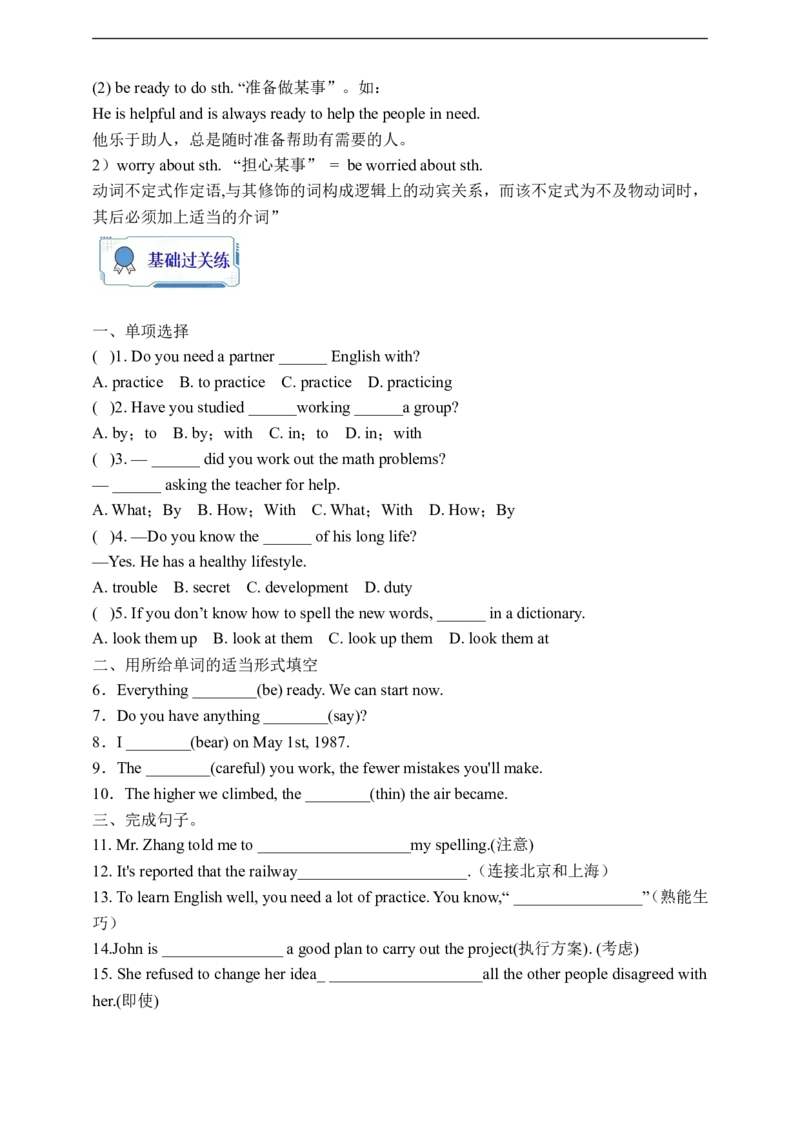
【拓展】(1) be ready for “为……做准备”,强调状态;(2) be ready to do sth. “准备做某事”。如:
He is helpful and is always ready to help the people in need.
他乐于助人,总是随时准备帮助有需要的人。
2)worry about sth. “担心某事” = be worried about sth.
动词不定式作定语,与其修饰的词构成逻辑上的动宾关系,而该不定式为不及物动词时,
其后必须加上适当的介词”
一、单项选择
( )1. Do you need a partner ______ English with?
A. practice B. to practice C. practice D. practicing
( )2. Have you studied ______working ______a group?
A. by;to B. by;with C. in;to D. in;with
( )3. — ______ did you work out the math problems?
— ______ asking the teacher for help.
A. What;By B. How;With C. What;With D. How;By
( )4. —Do you know the ______ of his long life?
—Yes. He has a healthy lifestyle.
A. trouble B. secret C. development D. duty
( )5. If you don’t know how to spell the new words, ______ in a dictionary.
A. look them up B. look at them C. look up them D. look them at
二、用所给单词的适当形式填空
6.Everything ________(be) ready. We can start now.
7.Do you have anything ________(say)?
8.I ________(bear) on May 1st, 1987.
9.The ________(careful) you work, the fewer mistakes you'll make.
10.The higher we climbed, the ________(thin) the air became.
三、完成句子。
11. Mr. Zhang told me to ___________________my spelling.(注意)
12. It's reported that the railway_____________________.(连接北京和上海)
13. To learn English well, you need a lot of practice. You know,“ ________________”(熟能生
巧)
14.John is _______________ a good plan to carry out the project(执行方案). (考虑)
15. She refused to change her idea_ ___________________all the other people disagreed with
her.(即使)四、完形填空
How to encourage your child to love learning? Here is some advice.
Talk with your child about the things you read and hear, especially the things you find 16
. Ask your kids how they feel about different things. Allow them to have different 17 .
Share your own hobbies and interests with your child, but don't ask him to 18 you.
Encourage your kids to have their own interests.
Read books. Read on your own, which sets a good 19 . Read to your kids to make them
love books. Having lots of books shows how you 20 books.
Remember that you are your child's 21 teacher. School, educational games, and books
can't help you get the result that you get in the education of your child.
Children need free time to discover and explore (探索). 22 give your child more free
time for free play, day dreaming and shouting around at home.
Start sooner, rather than (而不是) 23 . Independence (独立性)is important to children's
brain development. For example, they can pick out which shirt to wear and give 24 to the
family cat to eat.
Let your child know that school is important. Ask the teacher what you can do to 25 your
child. Take part in school meetings, volunteer in the classroom if possible, and communicate
with the teacher.
( )16. A. strange B. interesting C. common D. terrible
( )17. A. questions B. plans C. meetings D. opinions
( )18. A. follow B. stop C. remember D. push
( )19. A. space B. chance C. example D. letter
( )20. A. sell B. write C. buy D. love
( )21. A. oldest B. best C. newest D. kindest
( )22. A. So B. As C. But D. Or
( )23. A. more B. better C. later D. less
( )24. A. money B. drink C. time D. food
( )25. A. find B. help C. stop D. hurt
五、阅读理解
When you are learning a language, listening, speaking and writing are important, but
reading can also be very helpful. When you read, you cannot only learn some new words, but
also learn how to use them. When you read a passage, it gives you a good example for writing.
Here are some good reading tips.
Firstly, try to read at the right level (水平). Read something that you can understand. If it
is too hard for you, it is not interesting.
Secondly, try to understand the new words. If there are four or five new words on a page,don’t use a dictionary. Instead, try to guess their meanings as you read. Mark (做标记) them
with a pencil. Then look them up in a dictionary when you finish reading, and write them in
your own vocabulary book. Try to remember them.
Thirdly, try to read for a short time once a day. Fifteen minutes or half an hour every day
is better than two hours every Sunday. For example, you can read before you go to bed, or after
you get up or at lunchtime.
Lastly, read something that interests you. Choose a newspaper, a book or a magazine
about a subject that you like. It will be easy enough for you to understand.
( )26.The underlined word “tips” in the passage means “ ” in Chinese.
A.末端 B.小费 C.处所 D.建议
( )27.How many reading tips does the writer give us?
A. Six. B. Five. C. Four. D. Three.
( )28.If you meet a few new words on a page while reading, you can .
A. stop reading B. guess the meanings at first
C. write them down at once D. look them up right away
( )29.Which of the following is TRUE according to the passage?
A. Reading a lot can help you write better.
B. It is useful for you to read for long once a week.
C. When you read, you can only learn some new words.
D. Try to read something hard to make your English better.
( )30.Which is the best title for the passage?
A. How to look up a new word B. How to make reading better
C. How to remember new words D. How to choose something to read
六、语法填空
About two years ago, I went to work and live in Spain. I thought my Spanish would
improve quickly. I gave 31.________ everything about the language learning: classes, books,
exercises and so on. I did nothing 32.________ speak to the native speakers. It was easy and
fun to have conversations with 33.________(they)! However, after about a year, I noticed that
my Spanish had hardly improved. I still spoke with limited grammar structures and
vocabularies. Sometimes I even felt that my Spanish was getting 34.________(bad) than
before. It made me upset. What happened? I slowly started to realize that if I didn't get training
in other aspects, I would not make any progress. So I started to go back to my old language
learning 35.________(activity), including reading books, watching movies and doing grammar
and reading exercises. And they 36.________(work)! I quickly made progress. I could holdmore difficult conversations. Speak 37.________ language and use it! That's the secret
38.________ fast and effective language learning, right? Well, I know now, that if you only
have conversations with the native speakers, progress 39.________(come) very slowly.
Because native speakers speak fast, you don't really have the time 40.________(learn) new
words or grammar structures this way. To learn a language more effectively, you need to spend
some time on other training besides talking.
Unit1 Section B 3a-Self check 学案 (知识精讲+分层作业)参考答案一、单项选择
1-5 BBDBA
二、用所给单词的适当形式填空
6.is 7.to say 8.was born 9.more carefully 108.thinner
三、完成句子
11. pay attention to 12. connects Beijing with Shanghai
13.Practice makes perfect 14. thinking about 15. even if/even though
四、完形填空
16-20 B D A C D 21-25 B A C D B
五、阅读理解
26-30 DCBAB
六、语法填空
317.up 32.but 339.them 34.worse 35.activities 36.worked 37.the 38.to
39.will come 40.to learn