九年级期末题型突破 14 阅读理解(D 篇)
阅读单选(D篇)
一
Tom Avery is one of the only 41 people ever to have reached both the South and North
Poles. He was born in December 1975 and brought up in England, Brazil and France. His
passion (强烈爱好) for adventure began when he was just seven years old and first read
about the expeditions (探险) of famous explorers. Perhaps this was the start of his plan to put
together the ultimate (终极的) journey — to the very top of the world, the North Pole,
following the route taken by Robert Peary in his 1909 adventure.
Both Peary and Avery set off from Cape Columbia in Canada. Peary had a larger team
and in fact had four support groups. Every 160 kilometers, a group would leave plenty of
food and then turn back. The team therefore got smaller the further north they travelled.
While Avery didn’t have as many on his team, they did have food dropped by plane for them
at four locations.
Avery’s team also had the obvious benefit of modern technology, but Avery doesn’t
believe this made a big difference. He credits (把……归功于) his team’s success to the 16
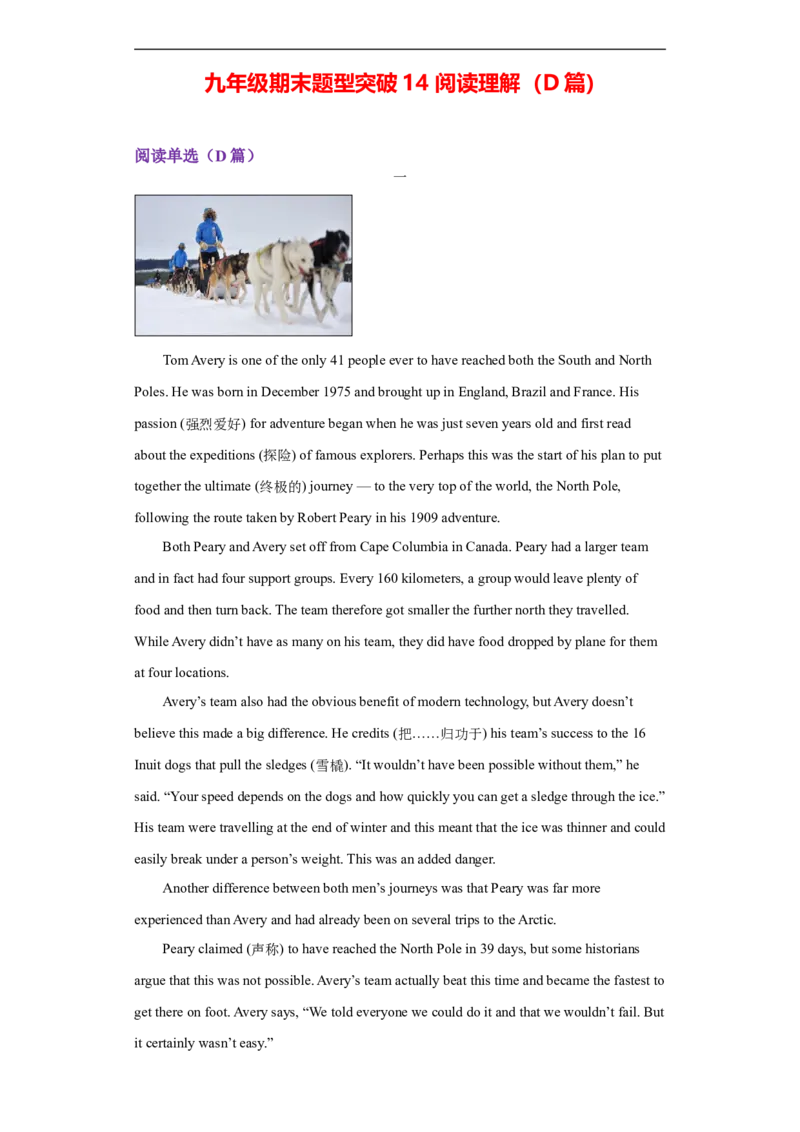
Inuit dogs that pull the sledges (雪橇). “It wouldn’t have been possible without them,” he
said. “Your speed depends on the dogs and how quickly you can get a sledge through the ice.”
His team were travelling at the end of winter and this meant that the ice was thinner and could
easily break under a person’s weight. This was an added danger.
Another difference between both men’s journeys was that Peary was far more
experienced than Avery and had already been on several trips to the Arctic.
Peary claimed (声称) to have reached the North Pole in 39 days, but some historians
argue that this was not possible. Avery’s team actually beat this time and became the fastest to
get there on foot. Avery says, “We told everyone we could do it and that we wouldn’t fail. But
it certainly wasn’t easy.”1.What is the purpose of the text?
A.To explain why Avery and Peary travelled to the North Pole.
B.To compare Avery and Peary’s personalities.
C.To describe ways of reaching the North Pole.
D.To describe two difficult journeys to the North Pole.
2.How did Peary’s North Pole expedition differ from Avery’s?
A.Peary’s team was smaller than Avery’s. B.Avery’s team was offered food by air.
C.Avery started from a different place. D.Peary took a very different route.
3.Avery believed that having modern technology ___________.
A.slowed his team down B.improved the safety for the team
C.wasn’t of great importance D.helped his team to travel faster
4.How did Avery feel about the Inuit dogs?
A.He was very thankful to them. B.He would take more dogs next time.
C.He was surprised at the speed of the dogs. D.He thought they were well-trained.
5.What is the best title for the text?
A.Great Danger in the Arctic! B.Record-breaking Journey to the North
Pole
C.How to Lead a Successful Team D.Finding a New Route to the Arctic
二
The world's nights are getting surprisingly brighter. This is bad news for all kinds of
creatures, including humans - as light pollution is becoming worse, taking away the
darkness of night almost everywhere.
Satellite* observations* made by researchers show Earth's artificially-lit* outdoor area
grew by 2% a year from 2012 to 2016. So did night time brightness. Light pollution was even
worse than that, according to the German-led team, because satellites cannot observe some of
the LED lighting, especially blue light.
"Honestly, I had hoped that with LEDs we were improving the situation, for this new
lighting technology has been developed to use less energy. But it turns out quitedisappointing. ", said Kyba, the lead author of the study.
"Asia, Africa and South America, for the most part, have seen an increase in artificial
night lighting. The cities in developing nations are brightening quite rapidly. Other bright
places include greenhouses in the Netherlands and areas of agriculture. More and more places
are fixing outdoor lighting because of its low cost and the growth in communities' wealth,"
the scientists said.
One of the co-authors, Franz Holker of the Leibniz Institute of Freshwater Ecology and
Inland Fisheries in Berlin, said things were already in a terrible situation.
"Many people are using light at night without really thinking about the cost," Holker
said. "Not just the economic cost, but also the cost that you have to pay for environmental
damage."
The effect from the increasing artificial light is obvious, according to the researchers.
People's sleep can be marred, which in turn can hurt their health. The life of birds, fish,
insects and bats can be harmed. Plants can have longer growing periods. And people may
forget about seeing stars or the Milky Way if the light pollution continues.
Kyba and his team suggest avoiding bright lights whenever possible and using more
useful ways to shine light on places such as parking lots or city streets. For example, dim,
closely spaced lights can provide better visibility than bright lights that are more spread out.
6.Why is light pollution becoming worse according to the passage?
A.Because LED lighting gives off blue light.
B.Because there is increasing artificial lighting.
C.Because people can pay for the electricity bill for home.
D.Because scientists didn't suggest avoiding artificial lighting.
7.What can we learn from the passage?
A.We can use bright lights in city streets.
B.LED lighting can help reduce light pollution.
C.Maybe we can't see the stars because of light pollution.
D.The cities in developing nations don't fix outdoor lighting.
8.What does the underlined word "marred" probably mean?
A.recorded B.controlled C.improved D.influenced
9.What's the best title of the passage?
A.The Disadvantages of LEDs B.Brighter Nights Are Dangerous
C.What Causes Light Pollution D.Ways to Reduce Light Pollution三
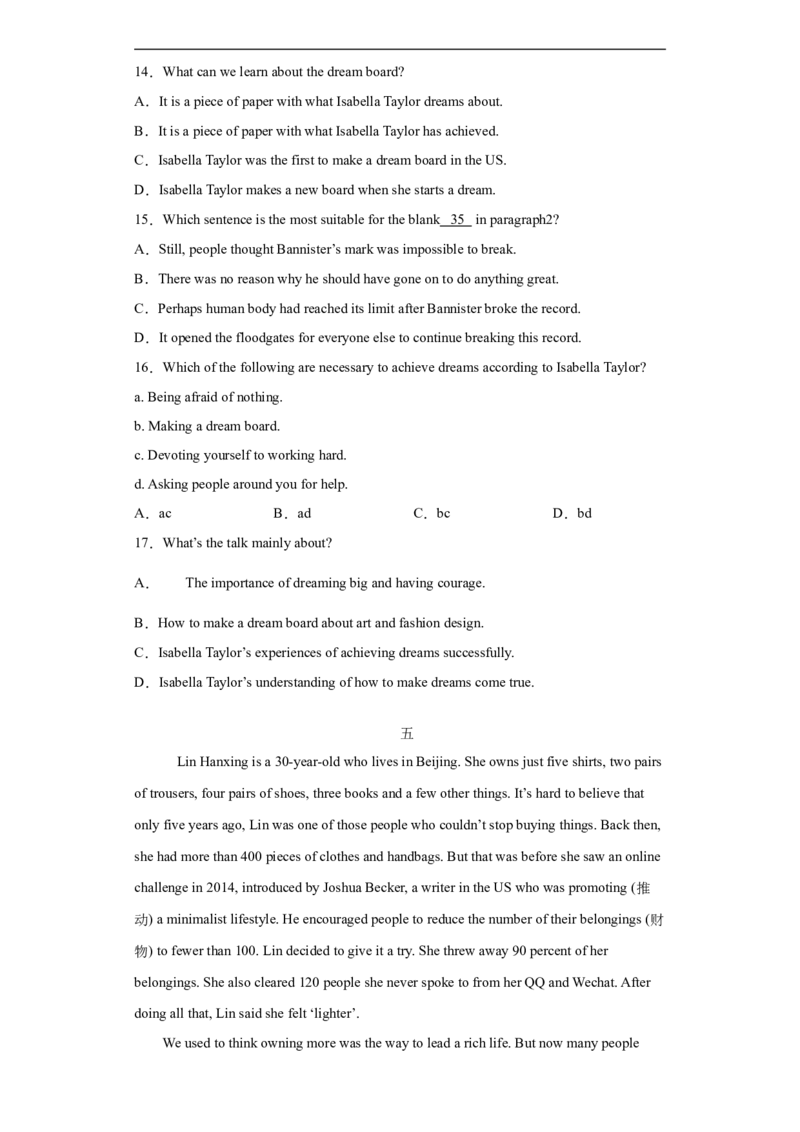
This painting is called The Fighting Temeraire. Temeraire is the name of the big, old
sailing ship that you can see on the left of the picture. People chose this picture to be the
greatest painting in Britain.
J. M. W. Turner painted it in 1839. It shows the old sailing ship, the Temeraire, on the
River Thames near London. There’s a small tugboat pulling the old ship. It’s in fact taking the
Temeraire on its last journey. The old ship is going to the breaker’s yard. In the background
we can see the sun setting.
The picture, however, is more than just a painting of two boats in the evening. The artist
wanted to show the end of an era (时代). The time of the beautiful, old sailing ships is
coming to an end. That’s why we see this happening at sunset. In the little, brown tugboat we
can see the new industrial era starting. The tugboat is small and dark and it’s making a lot of
smoke, but it’s very strong, because it’s pulling the much bigger ship.
The painting shows a real event. Turner watched the Temeraire taking its last journey up
the Thames, but he changed some of the details. He painted the old ship white and gold so
that it looks like a ghost. In fact, the real ship was black and yellow. We also see the sun
setting behind the ship, but in fact, the ship travelled towards the sunset. However, Turner
wanted to show the sun setting on the time of the beautiful old sailing ships.
Turner painted The Fighting Temeraire when he was quite old, so perhaps he wanted to
show the sun setting on his own life, too. He loved the painting and he never sold it. You can
see it today in the National Gallery in London.
10.The Fighting Temeraire _______.
A.is the name of a big sailing ship B.was thought the best painting in Britain
C.shows two nice new ships D.was painted by a famous young artist
11.The old ship was pulled to the yard ______.
A.to be painted new B.to be repaired C.to be broken up D.to be sold
12.What does the tugboat stand for according to the passage?
A.The new industrial era. B.The beautiful old era.
C.The painter’s own life. D.The white and gold ghost.
13.What can we learn from the last two paragraphs?
A.The color of the real sailing ship was white and gold.
B.In the painting the sailing ship was going towards the sunset.C.Finally Turner sold this painting because he didn’t like it.
D.Today the painting is kept in the National Gallery in London.
四
Hi, everyone, my name is Isabella and I’m an artist and fashion designer. But today,
I’m not here to specially talk to you about art or fashion. Today I want to talk to you about
dreams and stories.
Did you know that 4-minute mile once thought to be impossible? It was something
outside we can consider. But in 1954, a guy named Bannister achieved. 35 In the following
two months, two other runners broke 4-minute record and in the following three years and 19
runners continued. And now, it’s common for an experienced runner to be able to run a mile
under 4 minutes. It’s just that they didn’t think it was impossible any more.
So we should dream big. I have always to be encouraged to dream big. And I think when
you’re very little and maybe don’t know any better it’s easier to do because there’s
fearlessness before you become afraid of something. What did you want to be? A movie star,
an actor or an astronaut. Maybe you didn’t achieve these dreams, as you got older. Because as
you got older, you became afraid. It’s important to hold on your fearlessness just like a child.
Because it’s fearlessness that helps us achieve our dreams.
I’m a big fan of what I called dream board. It’s just a piece of paper. There’re lots of
pictures of things I would like to achieve and I put it in a place where I see it every day and
that helps me. I started doing this a few years ago because I read a study in the US showing
that people who made dream boards are more likely to achieve them. I know this may not be
new or useful to everyone, but for me, the act of making my dream board every year and
seeing it every morning really helps me.
Another thing that I really believe in is the world. I believe that once you have your
dreams and begin to work for it, people start appearing in your life that can offer support and
help… So let’s face it, there’s going to be a lot of challenges but to get through. I think
courage is needed.
In conclusion, after all of this dreaming you have to work hard and put a lot of time into
everything you’re doing and have courage because there’s going to be a lot of difficulty but
just remember the world is trying to help you. I know that I’m not the only one that has
dreams. Everybody has dreams. You just need to work hard to achieve them.
Thank you!14.What can we learn about the dream board?
A.It is a piece of paper with what Isabella Taylor dreams about.
B.It is a piece of paper with what Isabella Taylor has achieved.
C.Isabella Taylor was the first to make a dream board in the US.
D.Isabella Taylor makes a new board when she starts a dream.
15.Which sentence is the most suitable for the blank 35 in paragraph2?
A.Still, people thought Bannister’s mark was impossible to break.
B.There was no reason why he should have gone on to do anything great.
C.Perhaps human body had reached its limit after Bannister broke the record.
D.It opened the floodgates for everyone else to continue breaking this record.
16.Which of the following are necessary to achieve dreams according to Isabella Taylor?
a. Being afraid of nothing.
b. Making a dream board.
c. Devoting yourself to working hard.
d. Asking people around you for help.
A.ac B.ad C.bc D.bd
17.What’s the talk mainly about?
A. The importance of dreaming big and having courage.
B.How to make a dream board about art and fashion design.
C.Isabella Taylor’s experiences of achieving dreams successfully.
D.Isabella Taylor’s understanding of how to make dreams come true.
五
Lin Hanxing is a 30-year-old who lives in Beijing. She owns just five shirts, two pairs
of trousers, four pairs of shoes, three books and a few other things. It’s hard to believe that
only five years ago, Lin was one of those people who couldn’t stop buying things. Back then,
she had more than 400 pieces of clothes and handbags. But that was before she saw an online
challenge in 2014, introduced by Joshua Becker, a writer in the US who was promoting (推
动) a minimalist lifestyle. He encouraged people to reduce the number of their belongings (财
物) to fewer than 100. Lin decided to give it a try. She threw away 90 percent of her
belongings. She also cleared 120 people she never spoke to from her QQ and Wechat. After
doing all that, Lin said she felt ‘lighter’.
We used to think owning more was the way to lead a rich life. But now many peoplebelieve that owning less is rich, perhaps richer.
According to US writer Joel Stillerman, people who are educated and wealthy are more
likely to have a minimalist lifestyle. These people are saying, ‘I can afford to have less.’
But leading a minimalist lifestyle doesn’t only mean owning or spending less. Adam
Lucacias from a UK research company Euromonitor found young people spend less on
belongings, but more on short holidays and visits to the movies.
‘They are looking for a life that is all about culture.’ Alison Angus, the manager of
Euromonitor, said.
So perhaps it all comes down to how we define (定义) ‘wealth’. Is wealth in life about
buying more and owning more, or is it about learning more and experiencing more?
18.Which of the following leads a minimalist lifestyle?
A.Alison Angus. B.Adam Lucacias.
C.Joe Stillerman. D.Joshua Becker.
19.What does the underlined sentence mean?
A.I can live a good life with no more education and money.
B.I can live a good life by experiencing less and learning more.
C.I can live a good life with necessary belongings and friends.
D.I can live a good life with less money and fewer belongings.
20.Lin Hanxing’s definition of ‘wealth’ may probably cover __________.
A.Owning fewer friends B.doing more learning
C.Having more holidays D.Chatting less often with people
六
There are a lot of interesting things living in the sea. There are many types of fish and
many other animals. There are also many types of plants. There are even some animals which
have a lot in common with you. They are mammals living in the sea. How much do you know
about creatures that live in the sea? Do you want to know more about the food chain(链)in
the sea?In the sea, all sea creatures get food from other sea creatures. At the first link of the food
chain are the sea plants and plankton (浮游生物). Plants are found only in the sunlight zone
where there is enough light for them, however, animals are found at all depths of the oceans
though their numbers are greater near the surface where food is enough. Many kinds of fish
and animals, such as the snail, shrimp, jellyfish, and sea star eat the plankton. The small
animals and fish that eat plankton then become food for larger fish, such as the tuna and
mackerel. These fish are then eaten by larger fish and animals, such as the shark and dolphin.
The shark and dolphin are at the top of the food chain in the sea. Sharks are very dangerous
so many people are eaten by them in the sea. But why the number of the shark is becoming
smaller and smaller? And who eats the shark? Check out the menu at a seafood restaurant
next time you are eating there. Don't be surprised if you find shark on the menu.
21.The underlined word “creatures” means ______.
A.维持 B.生物 C.奇特 D.藻类
22.Which is NOT true?
A.Animals are found at all depths of the oceans
B.Plants are found only in the sunlight zone
C.The large animals become food for small ones.
D.The shark and dolphin are at the top of the food chain in the sea
23.Plankton is food for ______.
A.the snail B.shrimp C.sea star and jellyfishD.All the above
24.______ are at the top of the food.
A.The sea plants B.The small fish C.People D.The shark and
dolphin
25.What’s the passage mainly talk about?
A.The sea plants B.Food Chain in the Sea
C.Dangerous sharks D.Colorful Sea Animals
七Many schools want to see young children spend more time learning. Some get rid of nap
time. They think time spent sleeping is wasted time. And they feel kids may not really need to
nap (午睡) anyway.
Ending afternoon naps might be a mistake, though. A new study looked at school nap
time. It shows that going without a nap can cause problems for some children. That makes it
harder for them to remember what they learn. The new study was done by Rebecca Spencer
and Tracy Riggins. Both are scientists who study learning and memory.
Children need less sleep as they get older. However, children are not all the same. They
stop needing to nap at different ages. Some stop napping every day by age 4. Others still nap
daily at age 6. Also, the need to nap doesn’t just suddenly disappear, Spencer said. It can
come and go as children develop. Children grow very quickly. All that growth can be tiring.
Children may be fine without naps at one point. A month later, they may need to take naps
again.
All children need a good night’s sleep in order to remember and learn. However, some
children need more sleep than others. To keep what they’ve learned, these children need to
nap during the day. Nighttime sleep just isn’t enough. Riggins and Spencer set out to prove
this. They asked children at six preschools to play a memory game. After the children finished
the game, some were told to nap. The others were kept from napping. The following morning,
the two scientists brought the children back.
They wanted to test how much the children remembered from the day before. They
found some big differences. Students who were kept awake forgot more than students who
had napped.
Scientist Peg Oliveira has also studied nap time. She says school naps can be particularly
important for kids who might be suffering from (遭受) tough times at home. They often get
less sleep at home than other kids. Some do not have their own room. Others may be
homeless at times.
“Those kids might not be having a solid night of sleep,” Oliveira said. For them, school
nap time is extra important.
26.The underline phrase “get rid of” in Paragraph 1 can most probably be changed by
”
A.don’t mind B.are afraid of C.keep away from D.happily agree
27.From the study of Rebecca Spencer and Tracy Riggins, the need to nap depends on
A.how old the children are B.children’s developmentC.children’s sleeping hours at night D.children’s timetable
28.According the passage,which of the followings is NOT TRUE?
A.Children who often nap can remember what they learn easily.
B.In the game, the students who had napped get better results.
C.The kids who had hard times may not need more naps.
D.Some children need to nap because they don’t have enough sleep time at night.
29.According to the passage, the writer is eager to tell us that .
A.children do not pay attention to naps at school
B.children need both night’s sleep and school nap
C.there are just two ages for children to stop daily naps
D.nap time is very important during the growth of children
30.The passage is most probably taken from .
A.a science magazine B.a news report C.a story book D.a history
research
八
In an Italian school, the students are taking a science lesson.
Mr Marco, their teacher, explains, “For part of our lesson today, some of you are going
to visit the Lakeside Park to study trees in natural surroundings. You will be looking carefully
and thinking about the conditions trees need to grow.”
Mr Marco and the group walk to the woodland where there are many beautiful trees. The
students are required to match the trees with the names of three trees on their question paper.
Two students try guessing the height of young trees. Then they measure the distance from a
young tree to the parent tree by counting their steps between the trees. One of the students
reminds them to stay on task and follow the group. The rest of the group see several trees
matching the descriptions on their task list and run towards them.
Mr Marco gives the students three large plastic bowls with three labels (标签). The
students begin to search under each tree and find things to fill the labelled bowls. They put
the things they find into a bowl labelled red birch. Then they find the other two trees, a
Tibetan cherry, and a paperbark maple with red and orange curly leaves. Once the students
have finished, they relax, draw and make notes.
When the group return to school, Mr Marco gives them special glasses to look through.
They begin to sort and order their collections. Two of the students put tiny seeds between twopieces of glass.
They examine them carefully. Two more students pour water into a metal container (容
器) to cover some leaves and dead flowers. They put on special gloves to stir the liquid (液
体) as the container heats up on a hotplate. Two other students are drawing and taking notes.
Then Mr Marco calls the group together. The group tell the class about the things they
saw and the results of their experiments (实验). Mr Marco thanks the group and says he
hopes to see the results of their experiments growing in the school garden.
31.The students visit the park to .
A.walk round the lake B.discuss ideas about plants
C.study trees in the natural world D.guess the height of trees
32.In the park, the students are asked to .
A.carry out more than one task B.measure the height of young trees
C.finish their activities by counting steps D.match trees to the names on a list
33.Before the students leave the park, they need to .
A.gather all the large and small seeds together
B.put all their nature study materials into containers
C.show Mr Marco their drawings of flowers
D.count all the leaves under the trees
34.After the group arrive back in school, they do all the following things EXCEPT .
A.study natural materials with special glasses B.sort and order their collections
C.draw and take notes D.heat natural materials to make a plant
food
35.What do the students share with the rest of the class at the end of the lesson?
A.Their guesses about nature. B.Their collections of natural materials.
C.The results of their observations and experiments. D.Answers to all the questions on
the task list.