




文档内容
宁波市 2024 学年第一学期期末考试
高一英语试卷
第一部分 听力(共两节,满分 30 分)
第一节(共 5 小题:每小题 1.5 分,满分 7.5 分)
听下面 5 段对话。每段对话后有一个小题,从题中所给的 A、B、C 三个选项中选出最佳选项。
听完每段对话后,你都有 10 秒钟的时间来回答有关小题和阅读下一小题。每段对话仅读一遍。
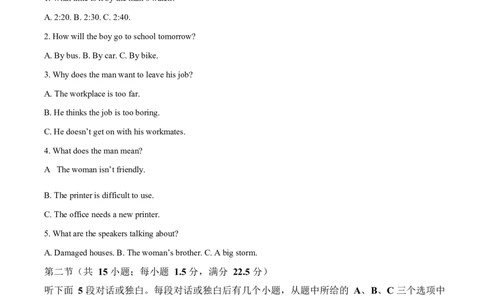
1. What time is it by the man’s watch?
A. 2:20. B. 2:30. C. 2:40.
2. How will the boy go to school tomorrow?
A. By bus. B. By car. C. By bike.
3. Why does the man want to leave his job?
A. The workplace is too far.
B. He thinks the job is too boring.
C. He doesn’t get on with his workmates.
4. What does the man mean?
A The woman isn’t friendly.
B. The printer is difficult to use.
C. The office needs a new printer.
5. What are the speakers talking about?
A. Damaged houses. B. The woman’s brother. C. A big storm.
第二节(共 15 小题;每小题 1.5 分,满分 22.5 分)
听下面 5 段对话或独白。每段对话或独白后有几个小题,从题中所给的 A、B、C 三个选项中
选出最佳选项。听每段对话或独白前,你将有时间阅读各个小题,每小题 5 秒钟;听完后,
各小题将给出 5 秒钟的作答时间。每段对话或独白读两遍。
听下面一段对话,回答第 6、7 题。
6. Why didn’t the woman take the course of job guidance last year?
A. She was too busy. B. She didn’t like it. C. It wasn’t available.
7. Where will the woman go?
A. To the library. B. To the classroom. C. To the dining hall.
第 1页/共 12页
学科网(北京)股份有限公司听下面一段对话,回答第 8 至 10 题。
8. What is the probable relationship between the speakers?
A. Husband and wife.
B. Tour guide and tourist.
C. Hotel manager and customer.
9. What is the hotel best known for?
A. Its position. B. Its breakfast. C. Its swimming pool.
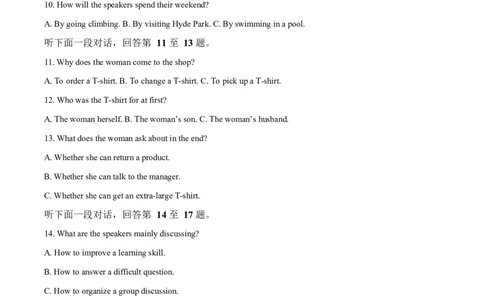
10. How will the speakers spend their weekend?
A. By going climbing. B. By visiting Hyde Park. C. By swimming in a pool.
听下面一段对话,回答第 11 至 13 题。
11. Why does the woman come to the shop?
A. To order a T-shirt. B. To change a T-shirt. C. To pick up a T-shirt.
12. Who was the T-shirt for at first?
A. The woman herself. B. The woman’s son. C. The woman’s husband.
13. What does the woman ask about in the end?
A. Whether she can return a product.
B. Whether she can talk to the manager.
C. Whether she can get an extra-large T-shirt.
听下面一段对话,回答第 14 至 17 题。
14. What are the speakers mainly discussing?
A. How to improve a learning skill.
B. How to answer a difficult question.
C. How to organize a group discussion.
15. What does the man suggest the woman do?
A. Avoid being over-confident.
B. Avoid repeating others’ thoughts.
C. Avoid discussing with classmates.
16. What does the man think of turning to the Student Support Service?
A. Unnecessary. B. Time-wasting. C. Inconvenient.
17. What will the woman do?
第 2页/共 12页
学科网(北京)股份有限公司A. Consult a book. B. Take more notes. C. Meet an expert.
听下面一段独白,回答第 18 至 20 题。
18. What is the only requirement on the photos for the competition?
A. The color. B. The topic. C. The size.
19. What is the prize for the second-place winner?
A. A camera. B. A photography book. C. Free photography lessons.
20. What is the last day for people to hand in their photos?
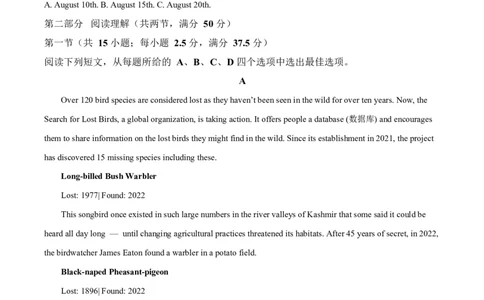
A. August 10th. B. August 15th. C. August 20th.
第二部分 阅读理解(共两节,满分 50 分)
第一节(共 15 小题;每小题 2.5 分,满分 37.5 分)
阅读下列短文,从每题所给的 A、B、C、D 四个选项中选出最佳选项。
A
Over 120 bird species are considered lost as they haven’t been seen in the wild for over ten years. Now, the
Search for Lost Birds, a global organization, is taking action. It offers people a database (数据库) and encourages
them to share information on the lost birds they might find in the wild. Since its establishment in 2021, the project
has discovered 15 missing species including these.
Long-billed Bush Warbler
Lost: 1977| Found: 2022
This songbird once existed in such large numbers in the river valleys of Kashmir that some said it could be
heard all day long — until changing agricultural practices threatened its habitats. After 45 years of secret, in 2022,
the birdwatcher James Eaton found a warbler in a potato field.
Black-naped Pheasant-pigeon
Lost: 1896| Found: 2022
For 126 years, this pheasant-like bird was considered all but lost on its homeland of Fergusson Island, a
mountainous land off Papua New Guinea. Recently, an international team of scientists, guided by local hunters,
finally took a photo of the pigeon.
Dusky Tetraka
Lost: 1999| Found: 2022/2023
In late 2022, researchers returned to the same location in the rainforest of Madagascar, where the dusky tetraka
had last been seen in 1999. Going down in the rainforest, they finally tracked the songbird hunting in the thick
第 3页/共 12页
学科网(北京)股份有限公司undergrowth along a river.
Urich’s Tyrannulet
Lost: 2005| Found: 2021
This flycatcher, observed only three times since its discovery in Venezuela in 1899, seemed to disappear
completely after 2005. However, in 2021, a team led by the bird expert David Ascanio took unique photos and the
first recording of its call.
1. What is the purpose of the project started by the Search for Lost Birds?
A. To advertise the database of wild birds.
B. To investigate the lost 120 bird species.
C. To encourage observing birds in the wild.
D. To rediscover the lost bird species with people’s aid.
2. Which wild bird has been lost for the longest period?
A. Long-billed Bush Warbler. B. Black-naped Pheasant-pigeon.
C. Dusky Tetraka. D. Urich’s Tyrannulet.
3. Where will we probably read this passage?
A. In a news report. B. In a travel guide.
C. In a science magazine. D. In a bird encyclopedia.
B
As a primary school kid, Armand almost grew up at the campsite with his family. Every holiday, they’d spend
a month and a half camping at Leentjiesklip in Langebaan. This is where Armand developed his love for camping.
With this camping seed planted so early, he was always curious to explore other places.
Three years after graduating from school, Armand bought his first bakkie (箱式轻便货车), a Toyota Cab.
Besides camping, Armand also enjoys driving through scenic landscapes. He does this regularly to satisfy his
desire to be in nature.
His love of nature means he avoids busy places and settles down in quieter places. However, he doesn’t mind
if he comes across someone out in the middle of nowhere; they’re likely to share the same interests.
Verneukpan, now one of Armand’s favourite camping sites, was next on the schedule — a route that would
finally take him past Augrabies, Vioolsdrif, the Richtersveld and Port Nolloth. Armand’s journeys aren’t carefully
planned. He simply sets daily goals and refuses the usual routes. “Nothing stops you from hitting the road nice and
early. Explore the world and enrich your journey instead of following a preplanned route.”
第 4页/共 12页
学科网(北京)股份有限公司Although Armand mostly camps alone, he’s not completely alone. His sheepdog, Buks, goes along. Buks,
Armand’s campsite commander, has a specially-fitted seat on the back seat of the bakkie. When Armand arrives at
his destination for the day, he grabs a beer and takes a walk with Buks to explore the surroundings. The camping
chairs follow, and then Armand takes in the scenery. “Camping in nature is the perfect escape because it provides
peace while refreshing your soul,” says Armand.
4. What made Armand fall in love with camping?
A. His wonderful primary school time.
B. The seed he planted at the campsite as a kid.
C. His curiosity to explore other amazing places.
D. The great camping experiences with his family.
5. What does the underlined word “this” in Paragraph 2 refer to?
A. Going camping. B. Buying the bakkie.
C. Graduating from school. D. Driving through scenic landscapes.
6. Which of the following can best describe Armand?
A. Quiet and organized. B. Peaceful and careful.
C. Curious and courageous. D. Helpful and interesting.
7. What might be the best title for the passage?
A. Armand’s New Life B. Armand’s Love for Camping
C. Armand’s Adventures D. Armand’s Camping with Family
C
Whether it’s salty popcorn at the cinema or a bag of ready salted crisps as a quick snack salt is something
many of us desire. While we need salt in our diet, too much of the white stuff can lead to some serious health issues.
The National Health Service suggests that adults should eat no more than 6 grams of salt daily. For children,
the amount varies by age. Specifically, kids aged one to three should have 2 grams per day, and older children aged
seven to ten can have up to 5 grams. It is important to note that some food packaging only shows the sodium (钠)
content. Do not mistake it for the salt content. To get the salt amount, multiply (乘以) the sodium by 2.5. Adults
should limit their sodium intake to 2.4 grams a day, which is equal to the recommended 6 grams of salt a day.
Overeating salt can cause high blood pressure. It causes the body to hold water, increasing blood pressure and
putting stress on organs. Moreover, it leads to water retention. However, too little salt intake is harmful. A study
第 5页/共 12页
学科网(北京)股份有限公司found that adults who ate less than 2 grams of salt a day were more likely to have heart disease than those who had
around the recommended 4 to 5 grams.
Luckily, these days, most pre-packed food has nutrition labels on the back to tell us how much salt is in the
product. Besides, many foods also show the salt content on the front of the packaging. The salt content can be
different in branded foods such as pizza, bread and soups. Thankfully, the Change4Life Food Scanner can aid you
to find out how much salt is in a product by using its app on your smartphone to scan the barcode (条形码). You
can also use the traditional method of avoiding adding salt on the dinner table. Always taste a dish first. If
necessary, add salt carefully.
8. Which daily intake might be recommended according to Paragraph 2?
A. 5 grams of sodium for adults.
B. 2.5 grams of salt for two-year-old kids.
C. 6 grams of salt for ten-year-old children.
D. 2 grams of sodium for eight-year-old children.
9. Which of the following would the writer probably agree with?
A. Too much salt intake can result in water retention.
B. High blood pressure is mainly caused by a lack of salt.
C. People with little salt intake experience more stress on organs.
D. Heart disease is more likely to affect people with too much salt intake.
10. What is suggested to stop taking in too much salt?
A. Buying pre-packed food with nutrition labels.
B. Eating branded foods rather than other products.
C. Scanning barcodes to learn products’ salt content.
D. Making it a habit to place salt on the dinner table.
11. What is mainly discussed in the passage?
A. Salt intake and health. B. Different functions of salt.
C. Ways to reduce salt intake. D. Connection between salt and sodium.
D
Male mosquitoes may be nearly as blood-thirsty as females under certain conditions, new research suggests.
Male mosquitoes, which are normally disinterested in blood, will take blood meals when they are dehydrated (脱
水), the scientist Jason Rasgon of Penn State and his colleagues report in a paper. The finding overturns the idea
第 6页/共 12页
学科网(北京)股份有限公司that only female mosquitoes bite, drink blood and spread diseases. Males may not be totally harmless.
A student in Rasgon’s lab noticed that male mosquitoes would sometimes feed on blood in a tray covered by a
thin artificial membrane (人工膜) when researchers took away water. Rasgon wanted to know if thirsty males
would try to get blood from a person, so he stuck his hand in cages containing male mosquitoes. Hydrated males
mostly ignored him, but dehydrated males would land and examine his skin. One even bit him but hardly got into
the first layer of the skin. “I was shocked,” says Rasgon.
Male mosquitoes’ long, tubelike mouth parts aren’t able to bite skin deeply enough to draw blood. But a
wound caused by Rasgon’s cat allowed him to test whether males could get blood another way. Sure enough, a
dehydrated male mosquito drank blood from the open wound.
In another experiment, male mosquitoes that were genetically engineered to be unable to sense wetness didn’t
take blood meals more often when lacking water. Those findings suggest that males may go for blood to satisfy
their thirst.
One earlier research paper showed that blood was harmful to male mosquitoes. Scientists thought all male
mosquitoes didn’t have the ability to break down blood. But in Rasgon’s experiment, male mosquitoes fed only
blood lived as long as those that didn’t get blood, and even a little bit longer.
12. What is discovered in Rasgon’s research according to Paragraph 1?
A. That female mosquitoes may be harmful.
B. That only female mosquitoes drink blood.
C That male mosquitoes may bite and drink blood.
D. That male mosquitoes are disinterested in blood.
13. How did Rasgon carry out his research?
A. By taking away water. B. By experimenting on himself.
C. By placing his cat in the cage. D. By creating a thin artificial membrane.
14. What didn’t Rasgon expect in his research?
A. Male mosquitoes would be able to bite deeply into human skin.
B. Male mosquitoes would try to drink human blood when dehydrated.
C. Female mosquitoes would become interested in blood when hydrated.
D. Female mosquitoes would prefer water over blood meals when dehydrated.
15. What did one earlier research paper show?
第 7页/共 12页
学科网(北京)股份有限公司A. Blood would bring harm to male mosquitoes.
B Blood would make mosquitoes more harmful.
C. Male mosquitoes were able to break down blood.
D. Male mosquitoes fed blood would live as long or longer.
第二节(共 5 小题;每小题 2.5 分,满分 12.5 分)
阅读下面短文,从短文后的选项中选出可以填入空白处的最佳选项。选项中有两项为多余选项。
For many, life may be a struggle. You might find yourself feeling fine one minute, only to be filled with
anxiety the next. This is all pretty normal, but it can be tiring. ____16____ Even the worst ones!
●Low times matter.
We’d all love to be happy 100% of the time, but that’s not realistic. ____17____ “Let’s not forget that if we
didn’t experience low times, we’d never fully appreciate the highs,” says clinical therapist Kate Morris-Bates, the
founder of InsideOut Wellness.
●____18____
The University of California’s study found that on rainy days, people remembered details better than on sunny
days when their memory was less accurate. “People having negative emotions (情 绪 ) are more focused and
thoughtful than those having positive ones,” explains Kate. “Research shows that we are less likely to make
mistakes in our memories when we are in a bad mood.”
●Negativity makes us focus.
If we are too optimistic, there’s a chance we can leave ourselves open to danger. Kate says that if a situation
has a big risk, a pessimist (悲观主义者) is more likely to think about the worst. ____19____ Then we should think
if we are using our optimism or pessimism well.
How can you handle your anger? Rather than refuse it, be open to the emotion. Use it to understand what
makes you angry and improve your response. One way of doing this is to keep a journal. Every time you feel angry,
write down your feelings in whatever form comes to you — single words, full sentences, or even simple drawings.
____20____ It will help you to understand them better.
A. Anger leads to action.
B. Sadness improves memory.
C. Here are some tips for you.
D. This allows you to be true to your feelings.
第 8页/共 12页
学科网(北京)股份有限公司E. What is possible, however, is to rethink negative emotions.
F. She suggests that first we should always check our responses to a situation.
G. Therefore, it’s important to recognise and accept your thoughts and feelings.
第三部分 语言运用(共两节,满分 30 分)
第一节(共 15 小题:每小题 1 分,满分 15 分)
阅读下面短文,从每题所给的 A、B、C、D 四个选项中选出可以填入空白处的最佳选项。
Jan Fran recalled a moment from her school days. Her teacher asked the students what they ____21____ last
night. While most of her classmates mentioned popular soap operas, Fran had a very ____22____ answer, “The
news.” The class just went ____23____ silent. No one made any noise. Even my friend turned and ____24____
“the news? You watched the news?”
“I was aware of how ____25____ the media (媒体) are,” Fran says, “They can make up stories and directly
shape people’s ____26____.” She ____27____ in a community where the media description did not match what
she experienced in her life at all. So she decided to choose journalism (新闻) as her ____28____ at college.
Now a professional and popular journalist, it was the sense of ____29____ for social issues from a young age
that led Fran to follow a ____30____ for journalism. Fran has created her own award-winning online opinion and
analysis series to help the youth ____31____ present affairs. She’s also ____32____ for her work on SBS’s The
Feed and Channel 10’s The Project.
Besides her ____33____ Fran is a ____34____ for giving a voice to those who feel unheard. She’s an
ambassador (大使) for Plan International, an organization to ____35____ equality for girls around the world.
21. A. ate B. watched C. read D. wrote
22. A. positive B. official C. formal D. different
23. A. completely B. awkwardly C. annoyingly D. obviously
24. A. cried B. sang C. mouthed D. laughed
25. A. confusing B. impressive C. challenging D. powerful
26. A. figures B. opinions C. projects D. appearances
27. A. worked out B. lost heart C. grew up D. made it
28. A. shelter B. major C. challenge D. power
29. A. glory B. wisdom C. curiosity D. responsibility
30. A. passion B. tradition C. proposal D. demand
第 9页/共 12页
学科网(北京)股份有限公司31. A. take part in B. sign up for C. take control of D. give in to
32. A. eager B. suitable C. famous D. sorry
33. A. measures B. awareness C. donation D. achievements
34. A. creator B. promoter C. survivor D. commenter
35. A. affect B. remove C. advance D. quit
第二节(共 10 小题:每小题 1.5 分,满分 15 分)
阅读下面短文,在空白处填入 1 个适当的单词或括号内单词的正确形式。
We are on a hike on the plains of Tibet to observe Tibetan antelopes, a species ____36____ once faced serious
threats from illegal hunting and habitat ____37____ (lose). Valued for their fur, they were mercilessly hunted and
killed. Besides, some of their habitats gave way ____38____ new roads and railways. In the 1980s and 1990s, their
population dropped sharply by over 50%.
In order to prevent Tibetan antelopes from ____39____ (die) out, the Chinese government set up the
Changtang National Nature Reserve and took a series of measures, such as building bridges and gates on the plains
____40____ (help) them move freely and safely. Moreover, volunteers like Zhaxi, our local guide, were asked to
conduct round-the-clock patrols(巡逻). Zhaxi considers ____41____ land sacred, believing protecting the wildlife
is important not only for the animals but also for the people there.
These efforts proved to be ____42____ (effect). Starting from 2015, Tibetan antelopes were no longer an
____43____(endanger) species. However, the government continues the protection programs, as the species still
faces some threats.
We should realize that although great progress ____44____ (make) in protecting wildlife in the past years,
much remains to be done. We must learn to live in harmony with nature if we want to ____45____ (true) save our
planet.
第四部分 写作(共两节,满分 40 分)
第一节(满分 15 分)
46. 上周五,在北京大学历史系就读的校友李华应邀为你们做了有关中国文化遗产的讲座。请你以 An
Impressive Lecture on Chinese Cultural Heritage 为题,给校英文报写一篇报道,内容包括:
1.讲座内容;
2.讲座反响。
注意:1.写作词数应为 80 左右。
2.请按如下格式在答题卡的相应位置作答。
第 10页/共 12页
学科网(北京)股份有限公司(参考词汇:校友 alumnus)
An Impressive Lecture on Chinese Cultural Heritage
____________________________________________________________________________________________
____________________________________________________________________________________________
____________________________________________________________________________________________
____________________________________________________________________________________________
_____________________________________________________________________________________
第二节(满分 25 分)
47. 阅读下面材料,根据其内容和所给段落开头语续写两段,使之构成一篇完整的短文。
A Fish on the Baseball Field
My parents always hoped I’d play baseball. You would be amazed at how much they loved baseball. They
actually met in line to buy hot dogs at a baseball game. Also, my dad was the star pitcher (投掷手) on his high
school team, which happened to go all the way to the state championship!
You might think that with a family history like that, baseball would just be in my blood and I’d be naturally
talented at it. Unfortunately, you’d be wrong. When I was little, my dad got me a plastic bat and ball and a mini
catcher’s mitt (棒球手套). I could throw OK, but no matter how much I tried, I could not catch or hit at all!
Last year, my friend Ollie was super excited to join a baseball team. Then my parents decided baseball would
be the best thing for me, too. Before I could say “Thanks, but no thanks”, they had signed me up!
Don’t get me wrong. The experience wasn’t terrible. Our coach was nice and the kids were great. Even though
I never became good at baseball, I did improve. But the very best part of the whole experience — the silver-lining
part — was something completely unexpected.
After every baseball practice, Ollie’s grandmother would take us to the community pool on the way home.
Ollie was more interested in playing in the pool than swimming. I, on the other hand, could not get enough of
swimming.
Ollie usually ended up leaving the water to hang out with his grandmother while I stayed in for a few more
minutes with a girl named Isabel, a member of the swim team. We often challenged each other to see who could
hold her breath underwater longer or who could get to the other side of the pool faster.
One day, Isabel said, “You are a natural little fish. Do you want to join our swim team?” She looked at me
with expectation.
注意:
第 11页/共 12页
学科网(北京)股份有限公司1.续写词数应为 150 左右;
2.请按如下格式在答题卡的相应位置作答。
I was hesitant (犹豫).
____________________________________________________________________________________________
____________________________________________________________________________________________
____________________________________________________________________________________________
____________________________________________________________________________________________
_____________________________________________________________________________________
When I arrived home, I nervously told my parents about the swim team.
____________________________________________________________________________________________
____________________________________________________________________________________________
____________________________________________________________________________________________
____________________________________________________________________________________________
_____________________________________________________________________________________
听力 1-5 ABABC 6-10CAABC 11-15BBAAB 16-20CCBCA
第 12页/共 12页