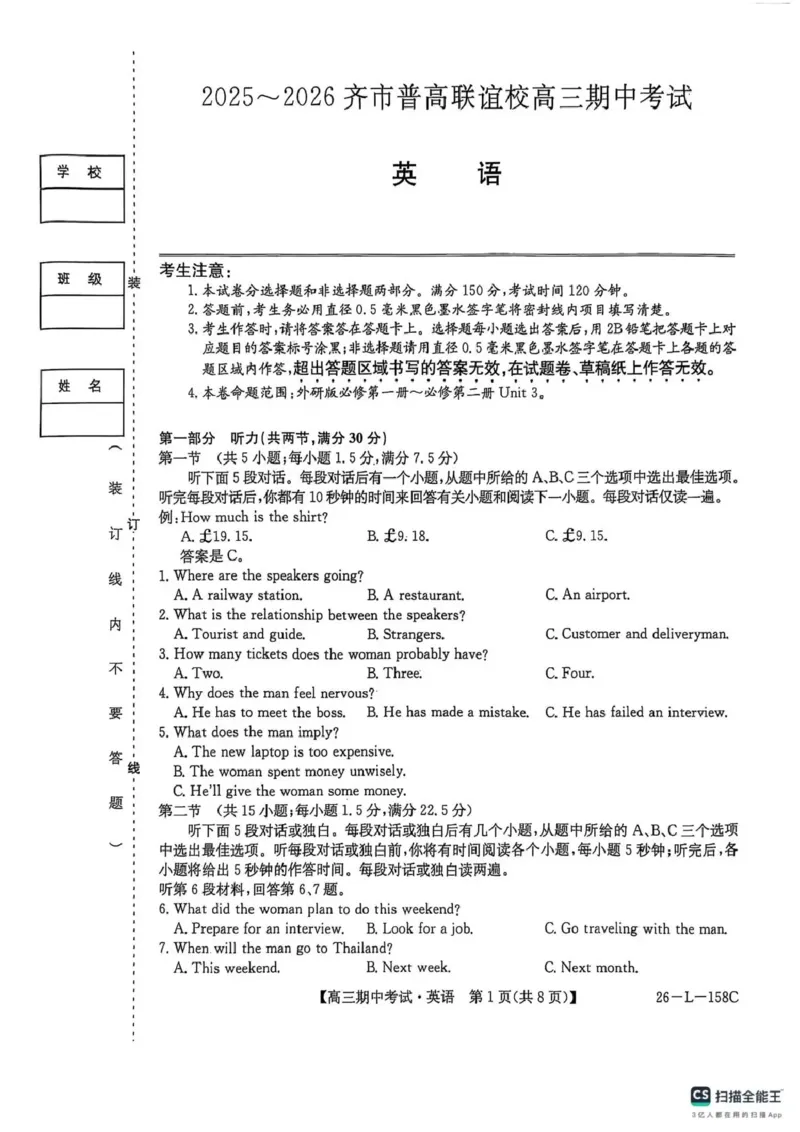
2025~2026 齐市普高联谊校高一期中考试
英语
考生注意:
1. 本试卷分选择题和非选择题两部分。满分 150 分,考试时间 120 分钟。
2. 答题前,考生务必用直径 0.5 毫米黑色墨水签字笔将密封线内项目填写清楚。
3. 考生作答时,请将答案答在答题卡上。选择题每小题选出答案后,用 2B 铅笔把答题卡上对
应题目的答案标号涂黑;非选择题请用直径 0.5 毫米黑色墨水签字笔在答题卡上各题的答题区
域内作答,超出答题区域书写的答案无效,在试题卷、草稿纸上作答无效。
4. 本卷命题范围:外研版必修第一册 Unit 1 至 Unit 4.
第一部分 听力(共两节,满分 30 分)
第一节(共 5 小题;每小题 1.5 分,满分 7.5 分)
听下面 5 段对话。每段对话后有一个小题,从题中所给的 A、B、C 三个选项中选出最佳选项。
听完每段对话后,你都有 10 秒钟的时间来回答有关小题和阅读下一小题。每段对话仅读一遍。
1 What is Sandra Parker’s flight number?
A. 756. B. 576. C. 567.
2. How does the man feel now?
A. Hungry. B. Angry. C. Sleepy.
3. What does the man probably think of the farm work?
A. Boring. B. Tiring. C. Interesting.
4. How did the woman go to the theater?
A. By car. B. On foot. C. By bike.
5. Where does the conversation take place?
A. In a hospital. B. In a school. C. In a bank.
第二节(共 15 小题;每小题 1.5 分,满分 22.5 分)
听下面 5 段对话或独白。每段对话或独白后有几个小题,从题中所给的 A、B、C 三个选项中
选出最佳选项。听每段对话或独白前,你将有时间阅读各个小题,每小题 5 秒钟;听完后,
各小题将给出 5 秒钟的作答时间。每段对话或独白读两遍。
听第 6 段材料,回答第 6、7 题。
6. At what time does the cycling class begin?
第 1页/共 11页A. 3:00 pm. B. 4:00 pm. C. 6:00 pm.
7 Which is the man interested in?
A. The cycling class. B. The dance class. C. The swimming class.
听第 7 段材料,回答第 8 至 10 题。
8. What did the woman buy a year ago?
A. The skirt. B. The shoes. C. The trousers.
9. What will the man do today?
A. Attend a fashion show. B. Do some shopping. C. Write a report.
10. Who is Mr. Reagan most probably?
A. The man’s friend. B. The man’s boss. C. The man’s father.
听第 8 段材料,回答第 11 至 13 题。
11. Why does the woman make the phone call?
A. To ask for help. B. To check the time. C. To make an invitation.
12. What will the man do for the woman?
A. Carry the books. B. See her sister off. C. Pack things for her sister.
13. How many boxes are there in the man’s home?
A Two. B. Three. C. Five.
听第 9 段材料,回答第 14 至 16 题。
14. Where do the speakers love to go?
A. The Internet cafe. B. The park. C. Golden Crab.
15. What is the relationship between Paul and the woman?
A. Brother and sister. B. Husband and wife. C. Co-workers.
16. What does the man want to borrow?
A. A book. B. A computer. C. A car.
听第 10 段材料,回答第 17 至 20 题。
17. Which floor is the library on?
A. The first. B. The second. C. The third.
18. What is a must for borrowing a DVD?
A. Booking it in advance. B. Using it in the library. C. Paying $2.
第 2页/共 11页19. What can you do on the second floor?
A. Borrow grammar books. B. Enjoy food. C. See an old castle.
20. What is the school’s activity on Saturday?
A. Sharing stories. B. Seeing a film. C. Having a trip.
第二部分 阅读(共两节,满分 50 分)
第一节(共 15 小题;每小题 2.5 分,满分 37.5 分)
阅读下列短文,从每题所给的 A、B、C、D 四个选项中选出最佳选项。
A
Short Story Competition
The Short Story Competition is back with great prizes! It runs from May 16 to 28 and is free to enter.
The competition has three age groups: Years 13-14, Years 15-16 and Years 17-18. Stories must be between
250 and 750 words for students in Years 13-14; and between 800 and 1,000 words for students in Years 15 to 18.
One entry (参赛作品) per person.
A group of judges (评委), led by award-winning author Jackie French, will choose the winning entries, with
the first prize winner in each age group receiving a copy of their short story published by HarperCollins into a
printed book with a well designed cover.
Each age group winner will also receive a HarperCollins Children’s Books Mentorship, which will include
personalised feedback on their story from the HarperCollins editorial team, and the chance to talk to them about
writing and publishing. There are also prizes for one runner-up and three honourable mentions in each age group.
They will get a schoolbag.
Teachers can submit (提交) their students’ entries using the online entry form. An approval form has to be
signed by the student’s parent or guardian.
1. When can you enter the competition?
A. On May 6. B. On May 15. C. On May 26. D. On May 29.
2. How are the competitors grouped?
A By age. B. By date. C. By interest. D. By subject.
3. What will the first prize winner get?
A. A club membership. B. A personally designed schoolbag.
C. A trip with parents. D. A printed book of winning entries.
第 3页/共 11页B
Last summer, I went to France for a holiday. I was so excited but also a little nervous because my French was
not good.
One hot afternoon, after exploring the city, I felt really tired. I wanted to tell my French friend, Claire, “I am a
little tired.” I carefully said the words I’d learned: “Je suis un pue fatigue.”
But Claire burst out laughing. My face felt hot. What had I done wrong? Claire explained, “In French, there
are words that sound similar but have very different meanings. ‘peu’ means ‘a little,’ but if you pronounce it
differently, it can sound like ‘pue’, which means ‘stinks’ — like something smells bad. So, instead of saying you
needed a rest, it sounded like you were saying you smelled bad and were tired”
This awkward (尴尬的) moment was a real eye-opener for me. It made me realize just how daunting
pronunciation can be in a foreign language. Even small differences in pronunciation can completely change the
meaning of what you’re trying to say. The same is true in English, for example, “ship” (a large boat) and “sheep” (a
woolly animal) sound very similar, but they mean totally different things.
Now, I pay extra attention to how words sound and what they mean. And if I mix them up again? I’ll just
laugh along. After all, laughing is part of learning — even if it’s a bit stinky sometimes.
4. Why was the author nervous about his holiday in France?
A. He was poor at French. B. He never went abroad.
C. He had no friends there. D. He was in short of money.
5. What awkward moment did the author meet?
A. He got a wrong person. B. He made a pronunciation mistake.
C. He was tricked by the locals. D. He spelt a word incorrectly.
6. What does the underlined word “daunting” in paragraph 4 most probably mean?
A. Easy. B. Natural. C. Difficult. D. Clear.
7. How did the author’s experience in France affect him?
A. He smelled bad and was tired.
B. He hated learning foreign languages.
C. He no longer considered Claire as a friend.
D. He became open to mistakes in language learning.
C
After a long teaching day, I saw someone searching for a lost key between the seats on a crowded train.
第 4页/共 11页Strangely, my first thought was to ask ChatGPT. This surprised me and made me wonder: What did I think of AI?
Could it really help?
Since ChatGPT appeared, teachers have different views. At first, I found it very useful. It offered me lesson
ideas and saved me time. Students used it to understand difficult topics and get writing tips.
But I noticed problems. One student couldn’t remember facts ChatGPT gave him. Another used it to make his
writing sound smarter, but lost his own style. Using AI for work meant students missed chances to improve their
own ideas by revising. I told them: Use AI to help improve your writing, not to do it for you.
I also started using pen and paper more for lesson planning. It was slower, but my ideas felt more real and
truly mine. This reminded me that the process of thinking is often more important than just the final result. And as a
result, I’d managed to think more clearly.
In a world increasingly led by speed, I learned the best ideas often need time and focus. I’m not against AI, but
I need to adjust(调节) its role in my life. My goal is to keep what’s important in teaching: curiosity, critical
thinking, and solving problems without always taking shortcuts. I hope my students will, too.
8. What did the author do when seeing someone looking for a key on the train?
A. He reported it to the police. B. He joined in the search for it.
C. He turned a blind eye to it. D. He turned to ChatGPT for help.
9. Why does the author mention his students in paragraph 3?
A. To tell they are smart. B. To tell how AI helps them.
C. To show the problems AI brings. D. To prove his teaching job successful.
10. What did the author think of planning his lessons by using pen and paper more?
A. It wasted too much of his time. B. It was good for his thinking.
C. It allowed him to get answers quickly. D. It led to losing good teaching methods.
11. What is the author’s attitude towards using AI?
A. Careful. B. Hopeless. C. Unclear. D. Carefree.
D
Like many people, I’m always trying to balance tough work deadlines, cleaning the house, and the endless
messages on my phone. Last month, I felt really tired all the time. When I went for a regular (常规的) health check,
I found out my blood pressure was getting too high. The doctor suggested that I take a few days off to go on a
vacation.
Modern life is often busy, which makes many people feel stressed (有压力的). Studies show that stress is a
第 5页/共 11页common problem around the world. The World Health Organization says it affects millions of people everywhere.
Planning a trip can be a good way to relax and feel better. Dr. Jane Smith, a psychologist from Cornell
University, says, “You don’t need to travel far or stay away for long. What’s important is to step away from your
routine (日常事务) and take a break. Visiting new places and trying new things can make you happy and excited.”
Dr. Smith and her team carried out a study involving over 400 participants (参与者) who took short vacations.
They assessed the participants’ energy levels both before and after their trips through detailed questionnaires (调查
表). The results showed that 94% of the participants reported feeling more energetic after their vacations. This
suggests that taking time off, even for short periods, can greatly improve one’s focus and creativity upon returning
to work.
“Taking a trip is important, no matter how busy life gets. It’s good for your mind and body,” Dr. Smith says.
12. What does the author want to show by telling his story?
A. People seldom see a doctor.
B. People get tired after a trip.
C. People hardly go on a vacation.
D. People suffer stress from their busy life.
13. What is important for a trip according to Dr. Smith?
A. Finding a quiet city.
B. Choosing a faraway place.
C. Staying away for a long time.
D. Stopping regular activities for a while.
14. What were participants asked to do during the study?
A. Answer questions.
B. Record their daily life.
C. Pick their travelling places.
D. Visit the hospital for checks regularly.
15. What can be a suitable title for the text?
A. Modern Life Is Stressful
B. What You Should Do During a Trip
C. Mind and Body Can Be Freed by a Trip
D. How People Balance Life and Work
第 6页/共 11页第二节(共 5 小题;每小题 2.5 分,满分 12.5 分)
阅读下面短文,从短文后的选项中选出可以填入空白处的最佳选项。选项中有两项为多余选项。
High school is an extremely important period in a teenager’s life, marked by academics (学业), social
experiences, and personal growth. It is a time filled with opportunities and challenges that shape the path toward
adulthood.
Academics are central to high school life. Students take a variety of subjects. ____16____. For example,
science includes experiments and research, while English classes focus on reading literature and writing practice.
Dealing with schoolwork, projects, and exams requires good time management skills, which help students develop
problem-solving abilities.
____17____. High school is a time for self- discovery and setting personal goals. Students begin to explore
their interests, which can guide their future choices. They start thinking about their future jobs, college choices, and
what they want to achieve in life. This period of growth is important for building confidence and preparing for the
transition (过渡) to adulthood.
After-school activities play an important role in high school life. Students can join clubs, or arts programs.
Clubs like debate team, or chess club allow students to meet like minded people. Activities like drama or music
enable students to express their creativity and perform in the school play. ____18____.
Challenges are also a part of high school life. Students might face academic pressure, or other problems.
____19____. Teachers, schoolmates, or friends are a good help. Students will benefit a lot from managing
challenges.
Community involvement (参与) is another important part of high school. ____20____. This involvement
helps them understand the importance of giving back and being part of a larger community. It also provides
practical experience in working with others and addressing real-world issues.
A. Make the most of your education
B. It’s important to ask for support when necessary
C. Personal growth is another key part of high school
D. Each subject comes with its own set of requirements
E. There’s always a way to be part of something you love
F. Many schools encourage students to do volunteer work
G. These activities help students build skills and friendships
第三部分 语言运用(共两节,满分 30 分)
第 7页/共 11页第一节(共 15 小题;每小题 1 分,满分 15 分)
阅读下面短文,从每题所给的 A、B、C、D 四个选项中选出可以填入空白处的最佳选项。
I had just finished taking my dogs for their last walk of the day while darkness slowly fell over the mountains
of my home. Just as I closed the door, though, a flicker(闪烁)of light caught my ___21___ . I turned my head and
saw that a little ___22___ had flown in with us through the ___23___ door and was now trying to get out again. As
he flew slowly towards the door, I quickly but ___24___ closed my fingers around him. I could feel his little wings
___25___ against the skin of my hand and a flash of light shown through my fingers. I opened the door and
___26___ back outside. Then, I opened my ___27___ and watched the guy ___28___ with thanks in the darkness
of the night.
Before I walked back in, I found there were hundreds of fireflies in my ___29___ . Each time their lights came
on, I smiled again. It was so beautiful and so ___30___ that such tiny fireflies could ___31___ so much light. I
stood there in awe of this wonder I get to see each summer and to ___32___ the wonderful earth we are living on.
Do your best to ___33___ your love in this world then. Do your best to shine your light even if you think it is
a mere flicker. You are a lot brighter than you think. And I will let you in on a ___34___ : The more love you share
and the more light you shine, the more light and love Nature will give you to share. It never ___35___ .
21. A. ear B. eye C. head D. nose
22. A. bird B. firefly C. leaf D. plane
23. A. hidden B. broken C. open D. strange
24. A. anxiously B. certainly C. softly D. slowly
25. A. beat B. rest C. sleep D. stand
26. A. gave B. brought C. looked D. stepped
27. A. bottle B. door C. hand D. heart
28. A. break away B. fly away C. pass away D. walk away
29. A. garden B. box C. mind D. room
30. A. amazing B. necessary C. peaceful D. tiring
31. A. attract B. enjoy C. avoid D. produce
32. A. admire B. draw C. introduce D. protect
33. A. find B. imagine C. manage D. share
34. A. conversation B. failure C. problem D. secret
35. A. happens B. ends C. matters D. appears
第 8页/共 11页第二节(共 10 小题;每小题 1.5 分,满分 15 分)
阅读下面短文,在空白处填入 1 个适当的单词或括号内单词的正确形式。
Why Should You Work This Summer?
Maybe you are asking yourself ____36____ you should get a job this summer. You could spend your summer
____37____ (sit) around your house relaxed or hanging out with your friends. There will always be time for those
____38____ (thing). Here ____39____ (be) some reasons to get a job this summer.
· Make Money: Simple as that. It's hard to make money ____40____ a job. Plus, it's nice to have your own
money instead of asking your parents for it all ____41____ time.
· Save for College: College is very ____42____ (expense). If you aren't winning a scholarship (奖学金) and
don't want huge student Loan debts later, start saving money for college expenses now.
· Gain Experience: Another great reason is to start gaining work experience. It will look good on your resume
(简历) plus it also helps develop job and life skills for the future.
· Buy Stuff: It's nice to be able to have money ____43____ (buy) your own stuff sometimes.____44____ that
is something small like a new cell phone or something big like a car, having a job will help you pay for what you
_____45_____ (actual) want or need.
· Have Fun: Use some of your earnings to go to the mall or movies, eat out and so on.
第四部分 写作(共两节,满分 40 分)
第一节(满分 15 分)
46. 假定你是李华。你的英国朋友 Mary 在来信中提到她刚搬到一个新城市,没有朋友,感到很孤独。请你
回信,内容包括:
1. 表示理解;
2. 给出建议;
3. 表达祝愿。
注意:1. 写作词数应为 80 个左右;
2. 请按如下格式在答题卡的相应位置作答。
Dear Mary
____________________________________________________________________________________________
____________________________________________________________________________________________
____________________________________________________________________________________________
第 9页/共 11页_________
Yours,
Li Hua
第二节(满分 25 分)
47. 阅读下面材料,根据其内容和所给段落开头语续写两段,使之构成一篇完整的短文。
On a usual Saturday evening, Mr. Olivia and his wife were preparing their famous lasagna (千层面), a family
tradition passed down through generations. The kitchen was a place for activity, with the children, the 4-year-old
Emma and the 12-year-old Jake, helping out to the best of their abilities.
Emma was mixing the sauce (酱汁), her small arms working slowly and carefully, while Jake was tasked with
cutting the cheese, a job he took with great pride. Mr. Olivia usually was at the table, rolling out the dough (面团)
with the help of his wife. The family was busy with their yearly tradition of making lasagna together, a time that
brought them closer and allowed them to share stories and laughter.
As the night went on, the conversation turned to the week’s events. Emma talked about her wins at school, and
Jake talked about his recent soccer game. Their parents listened patiently, offering words of encouragement and
advice.
Just when everyone felt in harmony, Emma looked over at Jake with a curious eye. She wanted to try Jake’s
job of cutting the cheese, but he didn’t agree. He thought Emma was too little for such a big task. They started
arguing back and forth, their voices getting louder. During the disagreement, they accidentally knocked over the
sauce, and it poured all over the kitchen floor.
注意:1. 续写词数应为 150 个左右;
2. 请按如下格式在答题卡的相应位置作答。
Emma cried, feeling worried about the mess and the argument.
____________________________________________________________________________________________
____________________________________________________________________________________________
____________________________________________________________________________________________
____________________________________________________________________________________________
______________________________________________________________________________________
With their mom’s advice, Jake began to teach Emma how to cut the cheese.
____________________________________________________________________________________________
____________________________________________________________________________________________
第 10页/共 11页____________________________________________________________________________________________
____________________________________________________________________________________________
______________________________________________________________________________________