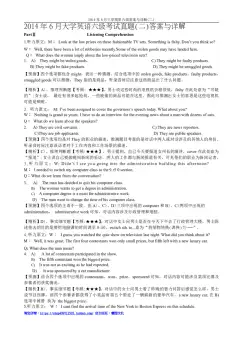
2014年6月大学英语四级考试真题(一)
2014 年 6 月大学英语四级考试阅读真题(第 1 套)
PartⅢ Reading Comprehension (40 minutes)
SectionA
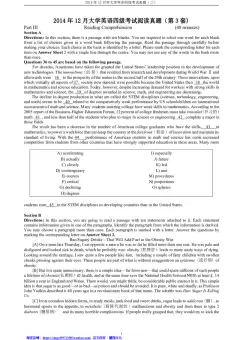
Directions: In this section, thereis a passage with ten blanks. Youare required to selectoneword for each blank
from a list of choices given in a word bank following the passage. Read the passage through carefully before
makingyourchoices.Eachchoiceinthebankisidentifiedbyaletter.Pleasemarkthecorrespondingletterforeach
itemonAnswerSheet2withasinglelinethroughthecentre.Youmaynotuseanyofthewordsinthebankmore
thanonce.
Questions36to45arebasedonthefollowingpassage.
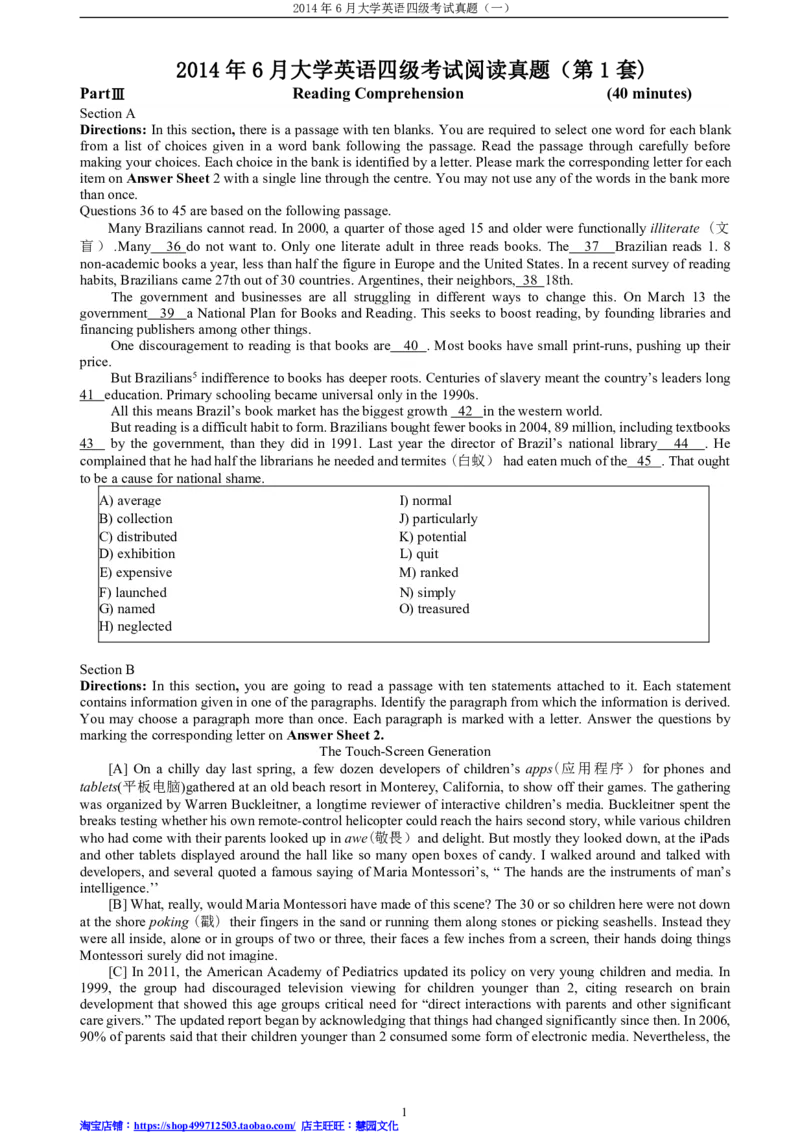
Many Brazilians cannot read. In 2000, a quarter of those aged 15 and older were functionally illiterate (文
盲).Many 36 do not want to. Only one literate adult in three reads books. The 37 Brazilian reads 1. 8
non-academicbooksayear,lessthanhalfthefigureinEuropeandtheUnitedStates.Inarecentsurveyofreading
habits,Brazilianscame27thoutof30countries.Argentines,theirneighbors, 38 18th.
The government and businesses are all struggling in different ways to change this. On March 13 the
government 39 a National Plan for Books and Reading. This seeks to boost reading, by founding libraries and
financingpublishersamongotherthings.
One discouragement to reading is that books are 40 . Most books have small print-runs, pushing up their
price.
ButBrazilians5indifferencetobookshasdeeperroots.Centuries ofslaverymeantthecountry’sleaderslong
41 education.Primaryschoolingbecameuniversalonlyinthe1990s.
AllthismeansBrazil’sbookmarkethasthebiggestgrowth 42 inthewesternworld.
Butreadingisadifficulthabittoform.Braziliansboughtfewerbooksin2004,89million,includingtextbooks
43 by the government, than they did in 1991. Last year the director of Brazil’s national library 44 . He
complainedthathehadhalfthelibrariansheneededandtermites(白蚁)hadeatenmuchofthe 45 .Thatought
tobeacausefornationalshame.
A)average I)normal
B)collection J)particularly
C)distributed K)potential
D)exhibition L)quit
E)expensive M)ranked
F)launched N)simply
G)named O)treasured
H)neglected
SectionB
Directions: In this section, you are going to read a passage with ten statements attached to it. Each statement
containsinformationgiveninoneoftheparagraphs.Identifytheparagraphfromwhichtheinformationisderived.
You may choose a paragraph more than once. Each paragraph is marked with a letter. Answer the questions by
markingthecorrespondingletteronAnswerSheet2.
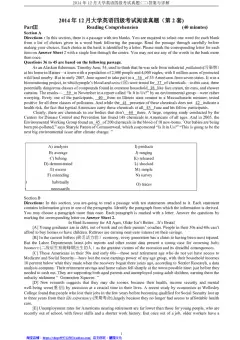
TheTouch-ScreenGeneration
[A] On a chilly day last spring, a few dozen developers of children’s apps(应用程序)for phones and
tablets(平板电脑)gatheredatanoldbeachresortin Monterey, California, to showofftheir games. Thegathering
was organized by Warren Buckleitner, a longtime reviewer of interactive children’s media. Buckleitner spent the
breakstestingwhetherhisownremote-controlhelicoptercouldreachthehairssecondstory,whilevariouschildren
whohadcomewiththeirparentslookedupinawe(敬畏)anddelight.Butmostlytheylookeddown,attheiPads
and other tablets displayed around the hall like so many open boxes of candy. I walked around and talked with
developers, and severalquoted a famous saying of Maria Montessori’s, “ The hands are the instruments of man’s
intelligence.’’
[B]What,really,wouldMariaMontessorihavemadeofthisscene?The30orsochildrenherewerenotdown
attheshorepoking(戳) their fingers in the sandor runningthemalong stonesor picking seashells. Instead they
wereallinside,aloneoringroupsoftwoorthree,theirfacesafewinchesfromascreen,theirhandsdoingthings
Montessorisurelydidnotimagine.
[C] In 2011, the American Academy of Pediatrics updated its policy on very young children and media. In
1999, the group had discouraged television viewing for children younger than 2, citing research on brain
development that showed this age groups critical need for “direct interactions with parents and other significant
caregivers.”Theupdatedreportbeganbyacknowledgingthatthingshadchangedsignificantlysincethen.In2006,
90%ofparentssaidthattheirchildrenyoungerthan2consumedsomeformofelectronicmedia.Nevertheless,the
1
淘宝店铺:https://shop499712503.taobao.com/ 店主旺旺:慧园文化2014年6月大学英语四级考试真题(一)
group took largely the same approach it did in 1999, uniformly discouraging passive media use, on any type of
screen, for these kids. (For older children, the academy noted, “high-quality programs” could have “educational
benefits.” )The 2011 report mentioned “smart cell phone” and “new screen” technologies, but did not address
interactiveapps.Nordiditbringupthepossibility thathaslikelyoccurredtothose90%ofAmericanparentsthat
somegoodmightcomefromthoselittleswiping(在电子产品上刷)fingers.
[D] I had come to the developers, conference partly because I hoped that this particular set of parents,
enthusiastic as they were about interactive media, might help me out of this problem, that they might offer some
guidingprincipleforAmericanparentswhoareclearlynevergoingtomeettheacademy’sideals,andatsomelevel
do notwant to. Perhaps this group would be able to express clearly some benefits of the new technology that the
morecautiousdoctorsweren’treadytoaddress.
[E] I fell into conversation with a woman who had helped develop Montessori Letter Sounds, an app that
teachespreschoolerstheMontessorimethodsofspelling.ShewasaformerMontessoriteacherandamotheroffour.
I myself have three children who are all fans of the touch screen. What games did her kids like to play, I asked,
hoping for suggestions I could take home. “ They don’t play all that much. ” Really? Why not?“Because I don’t
allowit.Wehavearuleofnoscreentimeduringtheweek,unlessit’sclearlyeducational.’’Noscreentime?None
at all? That seems at the outer edge of restrictive, even by the standards of overcontrolling parents. “On the
weekends,theycanplay.Igivethemalimitofhalfanhourandthenstop.Enough.”
[F]HeranswersosurprisedmethatIdecidedtoasksomeoftheotherdeveloperswhowerealsoparentswhat
their domestic ground rules for screen time were. One said only on airplanes and long car rides. Another said
Wednesdays.andweekends,forhalfanhour.Themostpermissivesaidhalfanhouraday,whichwasaboutmyrule
athome.AtonepointIsatwithoneofthebiggestdevelopersofe-bookappsforkids,andhisfamily.Thesmallkid
wasstartingtofussinherhighchair,sothemomstuckaniPadinfrontofherandplayedashortmoviesoeveryone
elsecouldenjoytheirlunch.Whenshesawmewatching,shegavemetheuniversaltenselookofmotherswhofeel
theyarebeingjudged.“Athome,”sheassuredme,“IonlyletherwatchmoviesinSpanish.’”
[G] By their reactions, these parents made me understand the problem of our age: as technology becomes
almosteverywhereinourlives,Americanparentsarebecomingmore,notless,distrustfulofwhatitmightbedoing
to their children. Technological ability has not, for parents, translated into comfort and ease. On the one hand,
parentswanttheirchildrentoswimexpertlyinthedigitalstreamthattheywillhavetonavigate(航行)alltheirlives;
ontheotherhand,theyfearthattoomuchdigitalmedia,tooearly,willsinkthem.Parentsenduptreatingtabletsas
precisionsurgical(外科的)instruments,devicesthatmightperformmiraclesfortheirchild’sIQandhelphimwin
some great robotics competition——but only if they are used just so. Otherwise, their child could end up one of
thosesad,palecreatureswhocan^makeeyecontactandhasagirlfriendwholivesonlyinthevirtualworld.
[H]NormanRockwell,a20th-centuryartist,neverpaintedBoySwipingFingeronScreen,andourownvision
ofa perfectchildhoodhasnever beenadjusted to accommodate thatnow-common scene.Add to thatourmodem
fear that every parenting decision may have lasting consequences—that every minute of enrichment lost or
mindlessentertainmentindulged(放纵的)willadduptosomepermanenthandicap(障碍)inthefuture—andyou
have deep guilt and confusion. To date, no body of research has proved that the iPad will make your preschooler
smarterorteachhertospeakChinese,oralternativelythatitwillrusthernervoussystem—thedevicehasbeenout
for only three years, not much more than the time it takes some academics to find funding and gather research
subjects.Sowhatisaparenttodo?
46.Theauthorattendedtheconference,hopingtofindsomeguidingprinciplesforparentingintheelectronicage.
47.Americanparentsarebecomingmoredoubtfulaboutthebenefitstechnologyissaidtobringtotheirchildren.
48.Someexpertsbelievethathumanintelligencedevelopsbytheuseofhands.
49.TheauthorfoundaformerMontessoriteacherexercisingstrictcontroloverherkids,screentime.
50.Researchshowsinteractionwithpeopleiskeytobabies,braindevelopment.
51.SofartherehasbeennoscientificproofoftheeducationalbenefitsofiPads.
52.Americanparentsworrythatoveruseoftabletswillcreateproblemswiththeirkids,interpersonal
relationships.
53.Theauthorexpecteddevelopersofchildren’sappstospecifythebenefitsofthenewtechnology.
54.ThekidsatthegatheringweremorefascinatedbytheiPadsthanbythehelicopter.
55.Theauthorpermitsherchildrentousethescreenforatmosthalfanhouraday.
SectionC
Directions: There are 2 passages in this section. Each passage is followed by some questions or unfinished
statements.ForeachofthemtherearefourchoicesmarkedA),B), C)andD).Youshoulddecideonthebestchoice
,
andmarkthecorrespondingletteronAnswerSheet2withasinglelinethroughthecentre.
PassageOne
Questions56to60arebasedonthefollowingpassage.
When young women were found to make only 82 percent of what their male peers do just one year out of
college,manywereatalosstoexplainit.
All the traditional reasonsput forward to interpretthe pay gap—that women fall behind when they leave the
2
淘宝店铺:https://shop499712503.taobao.com/ 店主旺旺:慧园文化2014年6月大学英语四级考试真题(一)
workforcetoraisekids,forexample,orthattheydon’tseekasmanymanagementroles—failedtojustifythisone.
Theseyoungwomendidn’thavekidsyet.Andbecausetheywerejustoneyearremovedfromtheirundergraduate
degrees,fewofthesewomenyethadthechancetogoafter(muchlessdecline)leadershiproles.
Butthereareotherreasonswhythepaygapremainssopersistent.Thefirstisthatnomatterhowmanywomen
may be getting college degrees, the university experience is still an unequal one. The second is that our higher
educationsystemisnotdesignedtofocusontheeconomicconsequencesofourstudents,yearsoncampus.
Nowthatwomenarethemajorityofcollegestudentsandsurpassmeninboththenumberofundergraduateand
advanceddegreesawarded,onemightthinkthecollegecampusisaprettyequalplace.Itis not.Studiesshowthat
while girls do better than boys in high school, they start to trail off during their college years. They enroll in
differentkinds of classes, tend to major in less rigorous (非常严格的)subjects, and generally head off with less
ambitiousplants.
As a result, it’s not surprising that even the best educated young women enter the workplace with a slight
disadvantage.Theircollegeexperienceleavesthemsomewhatconfused,stillstumbling(栽倒)overthedilemmas
their grandmothers, generation sought to destroy. Are they supposed to be pretty or smart? Strong or sexy(性感
的)?Alltheirlives,today’syoungwomenhavebeenpushedtoembracebothperfectionandpassion—topursue
scienceandsports,mathandtheater—anddoitallaswellastheypossiblycan.Nowondertheyarenotnegotiating
forhighersalariesassoonastheygetoutofschool.Theyaretooexhausted,andtooscaredoffailing.
56.Traditionally,itisbelievedthatwomenearnlessthanmenbecause .
A)theyhavefailedtotakeasmanyrigorouscourses
B)theydonotfeelasfitformanagementroles
C)theyfeelobligedtotakecareoftheirkidsathome
D)theydonotexhibittheneededleadershipqualities
57.WhatdoestheauthorsayaboutAmerica’shighereducationsystem?
A)Itdoesnotofferspecificcareercounselingtowomen.
B)Itdoesnotconsideritseconomicimpactongraduates.
C)Itdoesnottakecareofwomenstudents’specialneeds.
D)Itdoesnotencouragewomentotakerigoroussubjects.
58.Whatdoestheauthorsayabouttoday’scollegeexperience?
A)Itisdifferentformaleandfemalestudents.
B)Itisnotthesameasthatofearliergenerations.
C)Itismoreexhaustingthanmostwomenexpect.
D)ItisnotsosatisfyingtomanyAmericanstudents.
59.Whatdoestheauthorsayaboutwomenstudentsincollege?
A)Theyhavenoideahowtobringouttheirbest.
B)Theydropacoursewhentheyfindittoorigorous.
C)Theyarenotaspracticalasmeninchoosingcourses.
D)Theydon5tperformaswellastheydidinhighschool.
60.Howdoestheauthorexplainthepaygapbetweenmenandwomenfreshfromcollege?
A)Womenaretoowornouttobeambitious.
B)Womenarenotreadytotakemanagementroles.
C)Womenarecaughtbetweencareerandfamily.
D)Womenarenotgoodatnegotiatingsalaries.
PassageTwo
Questions61to65arebasedonthefollowingpassage.
Readingleadershipliterature,you’dsometimesthinkthateveryonehasthepotentialtobeaneffectiveleader.
Idon’tbelievethattobetrue.Infact,IseewayfewertrulyeffectiveleadersthanIseepeoplestuckinpositions
ofleadershipwhoaresadlyincompetentandseriouslymisguidedabouttheirownabilities.
Partofthereasonthishappensisalackofhonestself-assessmentbythosewhoaspireto(追求)leadership
inthefirstplace.
We’veallmetthetypeofindividualwhosimplymusttakecharge.Whetherit’sadecision-makingsession,a
basketballgame,orafamilyouting,theycan’thelpgrabbingtheleaddogpositionandclingingontoitfordearlife.
Theybelievethey’venaturalbornleaders.
Truthis,they’renothingofthesort.Trueleadersdon^assumethatifstheirdivine(神圣的)righttotakecharge
every time two or more people get together. Quite the opposite. A great leader will assess each situation on its
merits,andwillonlytakechargewhentheirposition,thesituation,and/ortheneedsofthemomentdemandit.
Many business executives confuse leadership with action. They believe that constant motion somehow
generatesleadershipasabyproduct.Facedwithanysituationthatcan’tbesolvedbythesheerforceofactivity,they
generateadustcloudofimpatience.Theironeleadershiptoolisvolume:iftheythinkyouaren’tworkingashardas
theythinkyoushould,theirdemandsbecomeincreasinglylouderandharsher.
True leaders understand the value of action, of course, but it isn’t their only tool. In fact, it isn’t even their
3
淘宝店铺:https://shop499712503.taobao.com/ 店主旺旺:慧园文化2014年6月大学英语四级考试真题(一)
primarytool.Greatleadersseemorethaneveryoneelseanswers,solutions,patterns,problems,opportunities.They
knowit’svitallyimportanttodo,buttheyalsoknowthatthinking,understanding,reflectionandinterpretationare
equallyimportant.
Ifyou’retooconcernedwithoutcomestotheextentthatyoumanipulateandintimidateotherstoachievethose
outcomes,thenyouaren’tleadingatall,you’redictating.Atrueleaderissomeonewhodevelopshisorherteamso
thattheycananddohittheirtargetsandachievetheirgoals.
61.Whatdoestheauthorthinkoftheleadersheknows?
A)Manyofthemareusedtotakingcharge.
B)Fewofthemareequaltotheirpositions.
C)Manyofthemfailtofullydeveloptheirpotential.
D)Fewofthemarefamiliarwithleadershipliterature.
62.Whyaresomepeopleeagertogrableadershippositions?
A)Theybelievetheyhavethenaturalgifttolead.
B)Theybelieveinwhatleadershipliteraturesays.
C)Theyhaveprovedcompetentinmanysituations.
D)Theyderivegreatsatisfactionfrombeingleaders.
63.Whatcharacterizesagreatleaderaccordingtotheauthor?
A)Beingabletotakepromptactionwhenchancespresentthemselves.
B)Havingawhole-hearteddedicationtotheirdivineresponsibilities.
C)Havingafullunderstandingoftheirownmeritsandweaknesses.
D)Beingabletoassessthesituationcarefullybeforetakingcharge.
64.Howwillmanybusinessexecutivesrespondwhentheircommandfailstogenerateaction?
A)Theyreassessthesituationathand. C)Theyresorttoanytoolavailable.
B)Theybecomeimpatientandrude. D)Theyblametheirteammembers.
65.Whatistheauthor’sadvicetoleaders?
A)Concentrateononespecifictaskatatime.
B)Usedifferenttoolstoachievedifferentgoals.
C)Buildupastrongteamtoachievetheirgoals.
D)Showdeterminationwhenfacedwithtoughtasks.
4
淘宝店铺:https://shop499712503.taobao.com/ 店主旺旺:慧园文化