2014年6月大学英语四级考试真题(三)
2014 年 6 月大学英语四级考试阅读真题(第 3 套)
PartⅢ ReadingComprehension (40minutes)
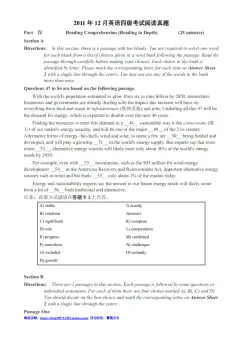
SectionA
Directions:Inthissection,thereisapassagewithtenblanks.Youarerequiredtoselectonewordforeachblankfromalistof
choicesgiveninawordbankfollowingthepassage.Readthepassagethroughcarefullybeforemakingyourchoices.
Eachchoiceinthebankisidentifiedbyaletter.PleasemarkthecorrespondingletterforeachitemonAnswer
Sheet2withasinglelinethroughthecentre.Youmaynotuseanyofthewordsinthebankmorethanonce.
Questions36to45arebasedonthefollowingpassage.
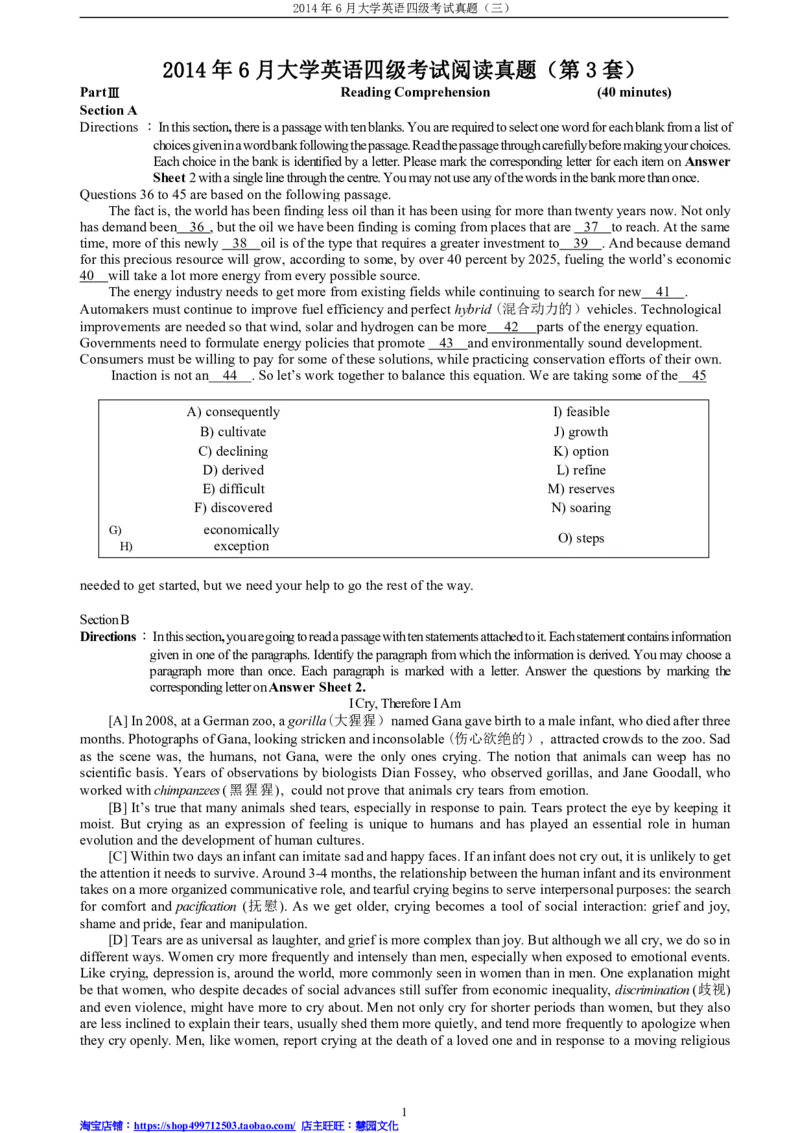
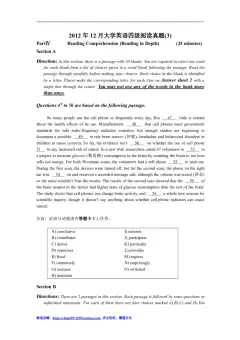
Thefactis,theworldhasbeenfindinglessoilthanithasbeenusingformorethantwentyyearsnow.Notonly
hasdemandbeen 36 ,buttheoilwehavebeenfindingiscomingfromplacesthatare 37 toreach.Atthesame
time,moreofthisnewly 38 oilisofthetypethatrequiresagreaterinvestmentto 39 .Andbecausedemand
forthispreciousresourcewillgrow,accordingtosome,byover40percentby2025,fuelingtheworld’seconomic
40 willtakealotmoreenergyfromeverypossiblesource.
Theenergyindustryneedstogetmorefromexistingfieldswhilecontinuingtosearchfornew 41 .
Automakersmustcontinuetoimprovefuelefficiencyandperfecthybrid(混合动力的)vehicles.Technological
improvementsareneededsothatwind,solarandhydrogencanbemore 42 partsoftheenergyequation.
Governmentsneedtoformulateenergypoliciesthatpromote 43 andenvironmentallysounddevelopment.
Consumersmustbewillingtopayforsomeofthesesolutions,whilepracticingconservationeffortsoftheirown.
Inactionisnotan 44 .Solet’sworktogethertobalancethisequation.Wearetakingsomeofthe 45
A)consequently I)feasible
B)cultivate J)growth
C)declining K)option
D)derived L)refine
E)difficult M)reserves
F)discovered N)soaring
G) economically
O)steps
H) exception
neededtogetstarted,butweneedyourhelptogotherestoftheway.
SectionB
Directions:Inthissection,youaregoingtoreadapassagewithtenstatementsattachedtoit.Eachstatementcontainsinformation
giveninoneoftheparagraphs.Identifytheparagraphfromwhichtheinformationisderived.Youmaychoosea
paragraph more than once. Each paragraph is marked with a letter. Answer the questions by marking the
correspondingletteronAnswerSheet2.
ICry,ThereforeIAm
[A]In2008,ataGermanzoo,agorilla(大猩猩)namedGanagavebirthtoamaleinfant,whodiedafterthree
months.PhotographsofGana,lookingstrickenandinconsolable(伤心欲绝的),attractedcrowdstothezoo.Sad
as the scene was, the humans, not Gana, were the only ones crying. The notion that animals can weep has no
scientific basis. Years of observations by biologists Dian Fossey, who observed gorillas, and Jane Goodall, who
workedwithchimpanzees(黑猩猩), couldnotprovethatanimalscrytearsfromemotion.
[B] It’s true that many animals shedtears, especially in responseto pain. Tears protectthe eye bykeeping it
moist. But crying as an expression of feeling is unique to humans and has played an essential role in human
evolutionandthedevelopmentofhumancultures.
[C]Withintwodaysaninfantcanimitatesadandhappyfaces.Ifaninfantdoesnotcryout,itisunlikelytoget
theattentionitneedstosurvive.Around3-4months,therelationshipbetweenthehumaninfantanditsenvironment
takesonamoreorganizedcommunicativerole,andtearfulcryingbeginstoserveinterpersonalpurposes:thesearch
for comfort and pacification (抚慰). As we get older, crying becomes a tool of social interaction: grief and joy,
shameandpride,fearandmanipulation.
[D]Tearsareasuniversalaslaughter,andgriefismorecomplexthanjoy.Butalthoughweallcry,wedosoin
differentways.Womencrymorefrequentlyandintenselythanmen,especiallywhenexposedtoemotionalevents.
Likecrying,depressionis,aroundtheworld,morecommonlyseeninwomenthaninmen.Oneexplanationmight
bethatwomen,whodespitedecadesofsocialadvancesstillsufferfromeconomicinequality, discrimination(歧视)
andevenviolence,mighthave more tocryabout.Mennotonlycryforshorterperiodsthanwomen, buttheyalso
arelessinclinedtoexplaintheirtears,usuallyshedthemmorequietly,andtendmorefrequentlytoapologizewhen
theycryopenly. Men,likewomen,reportcryingatthedeathofalovedoneandinresponsetoamovingreligious
1
淘宝店铺:https://shop499712503.taobao.com/ 店主旺旺:慧园文化2014年6月大学英语四级考试真题(三)
experience. They are more likely than women to cry when their core identities—as providers and protectors, as
fathersandfighters—arequestioned.
[E]Peoplewhoscoreonpersonalitytestsasmoresympatheticcrymorethanthosewhoaremorerigidorhave
moreself-control.Frequencyofcryingvarieswidely:someshedtearsatanynovelormovie,othersonlyahandful
oftimesintheirlives.Cryinginresponsetostressandconflictinthehome,orafteremotionaltrauma(创伤),lasts
muchlongerthantearsinducedbyeverydaysadness—whichinturnlastlongerthantearsofdelightandjoy.
[F]Sadnessisourprimaryassociationwithcrying,butthefactisthatpeoplereportfeelinghappieraftercrying.
Surveysestimatethat85%ofwomenand73%ofmenreportfeelingbetteraftersheddingtears.Surprisingly,crying
is more commonly associated with minor forms of depression than with major depression involving suicidal
thoughts.
[G] People widely report that crying relieves tension, restores emotional balance and provides “catharsis,” a
washing out of bad feelings. The term “catharsis” has religious implications of removing evil and sin; it’s no
surprisethatreligiousceremoniesare,aroundtheworld,oneofthemainsettingsforthereleaseoftears.
[H]Cryingisanearlyuniversalsignofgrief,thoughsomemournersreportthat,despitegenuinesorrow,they
cannotshedtears—sometimesevenforyearsaftertheirlovedonehasgone.Unliketoday,whentheprivacyofgrief
ismorerespected,thepublicorceremonialsheddingoftears,atthegravesideofaspouseorthefuneralofakingor
queen,wasonceconsideredsociallyorevenpoliticallyessential.
[I] Crying has also served other social purposes. Rousseau wrote in his Confessionsthat while he considered
tearsthemostpowerfulexpressionoflove,healsojustlikedtocryovernothing.
[J] The association of tears with art has ancient roots. The classic Greek tragedies of the fifth century B. C.
were primarily celebrations of gods. Tragedies, like poetry and music, were staged religious events. Even then it
wasrecognizedthatcryinginresponsetodramabroughtpleasure.
[K] I have argued that there are neurobiological(神经生物方面的)associations linking the arts and mood
disorders.WhenIlectureoncrying, Iaskmy audiencetoletmeknow, byashowofhands,whichartforms most
movethemtotears.About80%saymusic,followedcloselybynovels(74%),butthenthefiguresfallsharply,to
43%,forpoetry,and10-22%forpaintings,sculptureandarchitecture.
[L]Thephysicalactofcryingismainlyoneofbreathinginair,whichiswhywechokeupwhenweweep.This
suggests to language scientists that emotional crying evolved before language, perhaps explaining why tears
communicate states of mind and feelings that are often so difficult to express in words. Of course, from an
evolutionaryperspective,recognitionofemotion(usuallythroughfacialgesture)wasessentialforsurvival.
[M]Theearliesthumansarrivedseveralmillionyearsago,butonly150,000to200,000yearsago,didcultures,
language,religionandtheartsarise.Alongtheway,tearsbecamemorethanabiologicalnecessitytolubricate(润
滑)the eye and developed into a sign of intense emotion and a signal of social bonding. The development of
self-consciousness and the notion of individual identity, or ego; storytelling about the origins of the world, the
creation of humanity and life after death; and the ability to feel others, sadness—all were critical parts of the
neurobiologicalchangesthatmadeushuman.
[N]Morerecently,we’ve learnedfromneurosciencethatcertainbraincircuits(回路)areactivated(激活),
rapidlyandunconsciously,whenweseeanotherinemotionaldistress.Inshort,ourbrainevolvedcircuitstoallow
ustoexperiencesympathy,whichinturnmadecivilization,andanethicsbasedonsympathy,possible.Sothenext
timeyoureachatissuebox,orsobonaMend’sshoulder,orshedtearsatthemovies,stopandreflectonwhywecry
andwhatitmeanstocry.Becauseultimately, whilewelovetocry, wealsocrytolove.
46.Nowadayspeoplerespecttheprivacyofgriefmorethaninthepast.
47.Infantscrytoattractattentionforsurvival.
48.Thereisnoscientificevidenceasyetthatanimalscanshedtearsfromemotion.
49.Tearscanperformcertaincommunicativefunctionswhichwordscannot.
50.Ourabilitytoexperiencesympathyisessentialtothedevelopmentofcivilization.
51.Peoplearemoreinclinedtocrywhensufferingminorformsofdepression.
52.Sometimespeoplecannotcrydespitegenuinegrief.
53.Inhumans,longhistory,tearshavedevelopedanessentialroleinsocialrelationships.
54.Menarelesslikelytogivereasonsfortheirtears.
55.Cryinghaslongbeenassociatedwithart.
SectionC
Directions:Thereare2passagesinthissection.Eachpassageisfollowedbysomequestionsorunfinishedstatements.Foreachof
them there are four choices marked A), B), C) and D). You should decide on the bestchoice and mark the
correspondingletteronAnswerSheet2withasinglelinethroughthecentre.
PassageOne
Questions56to60arebasedonthefollowingpassage.
Hospitals, hoping to curb medical error, have invested heavily to put computers, smartphones and other
devicesintothehandsofmedicalstaffforinstantaccesstopatientdata,druginformationandcasestudies.
Butlikemanycures,thissolutionhascomewithanunintendedsideeffect:doctorsandnursescanbefocused
2
淘宝店铺:https://shop499712503.taobao.com/ 店主旺旺:慧园文化2014年6月大学英语四级考试真题(三)
on the screen and not the patient, even during moments of critical care. A poll showed that half of medical
technicianshadadmittedtextingduringaprocedure.
This phenomenon has set off an intensifying discussion at hospitals and medical schools about a problem
perhaps best described as “distracted doctoring.” In response, some hospitals have begun limiting the use of
electronic devices in critical settings, while schools have started reminding medical students to focus on patients
insteadofdevices.
“You justify carrying devices around the hospital to do medical records, but you can surf the Internet or do
Facebook,andsometimes Facebookis more tempting,” said Dr. Peter Papadakos attheUniversity ofRochester
MedicalCenter.
“Mygut feeling(本能的感觉)islivesareindanger,”saidDr.Papadakos.“We’renoteducatingpeople
abouttheproblem,andifsgettingworse.”
A survey of 439 medical technicians found that 55 percent of technicians who monitor bypass machines
acknowledgedthattheyhadtalkedoncellphonesduringheartsurgery. Halfsaidtheyhadtextedwhileinsurgery.
Thestudyconcluded,“Suchdistractionshavethepotentialtobedisastrous.”
Medical professionals have always faced interruptions from cellphones, and multitasking is simply a fact of
life for many medical jobs. What has changed, say doctors, especially younger ones, is that they face increasing
pressuretointeractwiththeirdevices.
The pressure stems from a mantra(信条)of modem medicine that patient care must be “data driven,” and
informed by the latest, instantly accessible information. By many accounts, the technology has helped reduce
medicalerrorbyprovidinginstantaccesstopatientdataorprescriptiondetails.
Dr. Peter Carmel, president of the American Medical Association, said technology “offers great potential in
healthcare,” but headdedthatdoctors,firstpriorityshouldbewiththepatient.
56.Whydohospitalsequiptheirstaffwithcomputers,smartphonesandotherdevices?
A)Toreducemedicalerror. C)Tofacilitateadministration.
B) Tocopewithemergencies. D)Tosimplifymedicalprocedures.
57.Whatdoestheauthorrefertoby“distracteddoctoring”?
A)Thedisservicedonebymodemdevicestodoctors,nurses,aswellaspatients.
B)Thetendencyofmedicalinstitutionsencouragingtheuseofmodemdevices.
C)Theproblemofdevicespreventingdoctorsfromfocusingontheirpatients.
D)Thephenomenonofmedicalstaffattendingtopersonalaffairswhileworking.
58.WhatdoesDr.PeterPapadakosworryabout?
A)Medicalstudentsarenotadequatelytrainedtousemodemtechnology.
B)Doctors’interactionwiththeirdevicesmayendangerpatients,lives.
C)Doctorsarerelyingtooheavilyonmodemelectronictechnology.
D)Pressuresonthemedicalprofessionmaybecomeoverwhelming.
59.Whydodoctorsfeelincreasingpressuretousemodemdevices?
A)Patientstrustdoctorswhousemodemtechnology.
B)Useofmodemdevicesaddshospitals’revenues.
C)Dataisgiventoomuchimportanceinpatientcare.
D)Patients’datahastoberevisedfromtimetotime.
60.WhatisPeterCarmel’sadvicetodoctors?
A)Theyfollowcloselytheadvancesinmedicalscience.
B)Theyfocustheirattentiononthepatient’scondition.
C)Theyobservehospitalrulesandregulations.
D)Theymakethebestuseofmodemdevices.
PassageTwo
Questions61to65arebasedonthefollowingpassage.
I have closely watched my generation, known as The Millennials, for 29 years now. Joel Stein wrote an
extensivepieceonMillennialsandheremainsratheroptimisticaboutourpotential.
Ihesitatetosharehisoptimismbecauseofparadox(矛盾的现象)weseemtoexhibit,namely,thatthereare
moreavenuesforustoentertainourselvesthaneverbefore,yetwearemoreboredthaneverbefore.
Entertainmenthasnever beenmorevaried.Wehavemore cablechannels,televisionshows,andmoviesthan
everbefore.Internetprovidersallowinstantviewingofalmostanymovieortelevisionprogramevercreated.Social
drinkingandpartyingarealsowidelyavailableforMillennials.Everygenerationdevelopsthesehabitsatacertain
age,butMillennialsseemtobeextendingthisphaseoflifeastheypostponemarriage.
Someofthisis undoubtedlyduetoTheGreatRecession.Milleimialsarehavingadifficulttime findingjobs;
only47percentof16-to-24-year-oldsareemployed,thesmallestsharesincegovernmentstartedrecordingdatain
1948.
ButdoMillennialsrespondtotheseeconomictroublesbydoingwhateverittakestomakeendsmeet?Hardly.
Infact,ofthefourgenerations PewResearchhasdatafor,theMilennialgenerationdoesnotciteworkethic(勤奋
3
淘宝店铺:https://shop499712503.taobao.com/ 店主旺旺:慧园文化2014年6月大学英语四级考试真题(三)
工作) as distinctive of itself. Millennials want to save the
world,buttheysitandwaitforthatworld-changingopportunitytobehandedtothem.Insteadofworking2-3jobs,
launchingabusiness,ordoingwhatittakestosucceed,theyretreat.Millennialsmaybethefirstgenerationtohave
alowerstandardoflivingthantheirparents,butwiththisresponsetoadversity(逆境), perhapsdeservinglyso.
Much ink has been spilled in management books discussing how to get the most out of these youths in the
workplace. Largely, they come to the same conclusion: Millennials are entitled, over-confident, and expect too
muchtooquickly.Weshouldnotbesurprised.Today’syoungadultswereraisedbyparentswhomadesuretoboost
their self-esteem at every turn, telling them they could achieve whatever they set their minds to, and handing out
prizesforthesixthplace.
61.WhatdoestheauthorofthepassagethinkofMillennials?
A)Theyshowlittleinterestinentertainment.
B)Theyarenotconfidentabouttheirability.
C)Theyenjoyaneasylifeduetohightechnology.
D)Theymaynothavebrightprospectsforsuccess.
62.HowdoMillennialsfeelabouttheirlife?
A)Theycanhardlydoanythingaboutit. C)Itisnotasgoodastheirparents’.
B)Thereislittleinittogetexcitedabout. D)Itisfullofopportunitiesforsuccess.
63.InwhatwayareMillennialsdifferentfrompreviousgenerationsaccordingtoPewResearch?
A)Theyspendlesstimesocializing. C)Theydonotvaluehardwork.
B)Theyareindifferenttoothers.- D)Theyaremoreindependent.
64.WhatshouldMillennialsdoaccordingtotheauthor?
A)Remainoptimisticinfaceofadversity. C)Makefulluseofnewopportunities.
B)Startabusinessasearlyaspossible. D)Takeactiontochangetheirsituation.
65.WhyareMillennialsover-confidentaboutthemselves?
A)Theyhavebeenspoiledbytheirparents. C)Theyaremisguidedbymanagementbooks.
B)Theycanalwaysgetwhatevertheyexpect. D)Theythinktheyareyoungandenergetic.
4
淘宝店铺:https://shop499712503.taobao.com/ 店主旺旺:慧园文化