



























































































































































文档内容
2017年6月大学英语四级考试真题(第1套)
!"#$! %"#$%&’()*+,!- #."
Part I Writing
(30 minutes)
&’()! *(+)+,- !."/+,0)12"
Directions:For this part,you are allowed 30 minautes to write an advertisement on your campus
3+(14)+5,2# !"#$%&’()#$$ *"+)#,)--".,/012&3+$,’$" .#&$,)3)/4,#$&’,2,3$"3*"+#5)2(+’
website to sell a bicycle you used at college. Your advertisement may include its brwnd,
.,6’&$,$" ’,--)6&5*5-,*"++’,/)$5"--,7,89"+#)/4,#$&’,2,3$2)*&35-+/,&$’6#)3/$
features,condition and price, and your contact information. You should write at least
:,)$+#,’$ 5"3/&$&"3)3/(#&5,$ )3/*"+#5"3$)5$&3:"#2)$&"389"+’%"+-/.#&$,)$-,)’$
120 words but no more than 180 wordls.
!"#."#/’6+$3" 2"#,$%)3!$#."#/’8
!
!
!
P & a ’ r ( t ) Ⅱ " L 6 i + s 2 t )1 e , ni +, n - g 7 C 5 o / mp 8 r ( e 1 h 9 e 1 n , s 2 i +5 o , n (!2!5: m/i+n,u0t)e1s2)"
Section A
!"#$%&’(
Directions:In this section,you will hear three news reports. At the end of each news
3+(14)+5,2# ;3$%&’’,5$&"3$ *"+.&--%,)#$%#,,3,.’#,("#$’8<$$%,,3/":,)5%3,.’
report,you will hear two or three questions. Both the news report and the
#,("#$$ *"+.&--%,)#$." "#$%#,,=+,’$&"3’8>"$%$%,3,.’#,("#$)3/$%,
questions will be spoken only once. After you hear a question,you maust
=+,’$&"3’.&--6,’("?,3"3-*"35,8<:$,#*"+%,)#)=+,’$&"3$ *"+2+’$
c5h%o"o"s’e, t$h%e, 6b,e’s$t )a3n’s.w,e#r,: #"f2rom$ %t,h:e" +f#ou5r% "c&5h,o’ic2es) #m?a,/rk,"B$),@C") )a3n/d AD)".8
Then mark the corresponding letter on Answer Sheet 1 with a single line
B%,32)#? $%,5"##,’("3/&37 -,$$,#"3%&’()*+,))-!.&$%)’&37-,-&3,
through the centre.
$%#"+7%$%,5,3$#,8
Questions 1 and 2 are based on the news report you have just heard.
;012)+5,2#’,2(185()?509’@1A02)91’(e(e(d-.% D) ? " Th & e ’ ( te 4 s ( t ) 4 d - r . i /0 v ( e . r 5 ma 7 d - e ( a 7 6 wr . o = n 1 g 2 j @8 u - d 2 g 5 me ( n 1 t 4 . %
2.AA%) "T"he&y’ (h3av’e7 0g(en2e(r1a(l.l7y** 3do-n=e1 (quBi8t/e4( w6el(l**.%
B) They have caused several severe crashes.
<" &’(3 ’70( :78)(-)(0(.7*)(0(.( :.7)’()%
C)9 "Th&e’y (h3av’e7 0p(os>e=d) (a- t7hr4’ea.(t 7t4o4 =ot=h4e’r( .d-ri./v0e(r.s).%
D?) "Th&e’y( 3ha’v7e0 (do-n=e 1b(et;t(e44r( .th4’an7 1c:o=nv1e0n(t1i4o/=n1al7 *c:a7r.s).%
Questions 3 and 4 are based on the news report you have just heard.
;012)+5,2.’,2(185()?509’@1A02)91’(c(i:a/l7i*s/)t4.% C9) "HeD (re.m(o5v=e0d( -th4e’ (be;e(s( )f+r.o=m5 t4h’e( b;o=o=t4.%
B<)H"e Dw(or6k=s. Ea)t 7a4 7na1t7i4o/=n1al7 *p>a7r.kE.% D)?H"e Dd(ro-v.e= 0t(he4’ (be;e(s( )aw7a6y7 3fr+o.=m5 hi’s/) c:a7r..%
4F.A%)"Th"e&y ’w(e3r6e (m.a(k5in7gE /1a2 l7ot*= 4of= +n1o=i/s)e(.% C9)T"he&y’ (w3er6e( .d(a-nc71in:g/1 2in/1 a7 u8n1i/qBu8e( 6wa7y3.%
B<)T"he&y’ (w3er6e( .l(oo*=k=inEg/1 2af7t+e4(r. t4h’e( Bqu8e(e(n1.% D?)T"he&y’ (w3er6e (l.o(o*k=i=nEg/ 1f2or+= a. 7ne1w( 6bo;x =tGo 4=li*v/0e( i/n1.%
Qu;e0s1t2i)o+n5s, 25 :to)5 7$ a’r(e1 b=a’s2e1d< o5n, t)h9e1 n,e1w>s2 r(e1p8o5r(t) y?o5u0 h9a’v@e1 jAu0s2t) 9h1ea’r(e(c:i/e(s)..% (C)9T"he& ’se(c)o(n:d= 1tr-i4p. /t>o4 =a 7sm)a5l7l* *r.e(m5ot=e4 (i/s)l*7an1d-.%
B < ) " Th & e ’ ( fi + n /1 di - n /1 g 2 o = f + t 4 w 6 o = n 1 e ( w 6 sp ) e > c ( i : e / s ( ) o = f + f + r . o = g 2 . % D)? "Th&e ’d(i-sc/)o:v=e0r(y. 3of= +a7 n1e(w6 sp)e>c(i:e/(s) o=f+ s)1na7kEe(.%
6.I %A)"H"e Dfe(l+l( *f*r+o.m= 5a 7ta4l7l* *p>a7l*m5 t4r.e(e( b;y3 a7c:c:i/d-e(n1t4.%
B<)A" s"na)k1e7 Ec(ra:w.l7e6d* (o-nt=o1 4h=is’ /)he’a(d7 -in/ 1hi’s/) s)l*e(e(p>.%
C9)H"e Dd(is-c/o)v:e=r0e(d. (a- r7ar.e7 .(fr+o.g= 2on= 1a 7de-s(e)r(t.e4(d- i/s)l*7a1nd-.%
D)A poisonous snake attacked him on his field trip.
?" ">=/)=1=8))17E( 7447:E(-’/5=1’/)+/(*-4./>%
!
2017.6/1(第1套)
!"#$%& ’’’#!!#""
˚˚˚ØØØ7J. %A")F"roKm.= i5ts/4 )or=i.g/2i/n1.% C)9F"roKm.= 5its/4 )c:o=l*o=u8r..%
B)"$%$%,5"34,#’)$&"3)3/$%,=+,’$&"3’.&--6,’("?,3"3-*
once. After you hear a question,you must choose the best answer from the four choices
"35,8<:$,#*"+%,)#)=+,’$&"3$ *"+2+’$5%""’,$%,6,’$)3’.,#:#"2 $%,:"+#5%"&5,’
ma2r)k#e?d, /A<),"B$)>,C")$a@nd" )D3)/.TAh"en8 Bm%a,r3k 2t)h#e? c$%o,re5s"#p#o,n’d(i"n3g/ &l3e7t-t,e$$r, #o"n3 A%n&s’w(er) *S+h,e)e)t- I! .wi&$t%h
a) s’i&n3gl7e-, l-i&n3e, t$%hr#o"u+g7h% t$h%e, c5e,n3t$r#e,.8
Questions 8 to 11 are based on the conversation you have just heard.
;012)+5,2D)5##’(1=’21<5,)9145,@1(2’)+5,?509’@1A02)91’(t= .i4s /)a 7lo*=n1g2 w6ay7 3f+r.o=m5 t4h’e( h’o=t4e(ll *%..C)He 9 " ha D s ( t ’ o 7 ) ch 4= ec : k ’ ( a : E lo 7 t * = o 4 f = + l * u 8 g 2 g 2 a 7 g 2 e ( . %
D)The security check takes time.
B<) "HiDs /)fl+i*g/2h’t 4i/s) l*(e7a0vi/1n2g /i1n *l(e)s)s 4t’h7a1n A2 ’h=o8ur.)s.% ?" &’( )(:8./43 :’(:E47E()4/5(%
9. M A % ) " I " n N1 ca :7 s ) h ’ . % C)9 "WiOth/4 ’hi’s/) s)m5a7r.t4 >ph’o=n1e(.%
B) < B " y < c 3 re :. d ( i - t / 4 c : a 7 r . d - . % D)? "WiOth/ 4’a 7tr4a.v7e0l(e*(r.'Ps) :c’h(ec:kE.%
1$0Q.% A")L"oRok= =aEft7e+4r( .hi’s/) l*8ug2g2a7g2e(.% C) 9 G " iv S e / 0 h ( i ’ m / 5 a 7 re . c ( e : i (/ p > t 4 . %
B)r=t.e4r( .f+o=r. ’hi/5m.% D) ? C " on 9 f = ir 1 m +/ . h 5 is ’ / f ) l + i */ g 2 h ’ t 4 . %
1$1$.%A)"P"os#t=i)n4g/ 1a2 7co:m=m5en5t( 1o4n =t1he4’ (ho’t=e4l('*Ps) 6we(b;p>a7g2e(.%
B<) "StTa4y7i3n/1g2 i/n1 t4’he( )s7a5me( h’o=t4e(l* 1n(eGxt4 4t/5im(e ’h(e :c=o5me(s).%
C)9 "SiTg/n2i1n/1g 2u8p> f+o=r. m5e(m5be;r(s.h)i’p/ >of= +STh’e(r.a7t4o=n1 HDo=te4(l*.%
D?)L"oaRd=i7n-g /1h2er’ (l.ug*g8a2g2e7 2o(nt=o1 4t=he4’ a(i7r/p.o>r=t. 4s)h’ut8t44l*e(.%
Questions 12 to 15 are based on the conversation you have just heard.
;012)+5,2#!)5#:’(1=’21<5,)9145,@1(2’)+5,?509’@1A02)91’(d> (m-ak5i7nEg /1t2er4r(i..b/l;e*( f+a7c:e(s).%
1$3C.% A")"WaOrn7 .h1i’m/ 5of= +da-n7g1e2r( .b;y3 m5ak7iEn/1g2 u8p> a7 s)4t=o.r3y%. 9C)"Do? =so)m=e5t(h4i’n/g1 2f+u8n1n1y3 t4o= 7a5mu8s)e( h’i/5m.%
B<)G"ivSe/ 0h(im’ /5som)e= 5c(he:r’r(y. .s3to)n4=e1s( )to4 =pl>a*7y3 w6it/4h’.% D)?T"el&l (h**i’m /5to 4=pl>a*y7 3in/1 h’e(r. b;a7c:kEy3a7r.d-.%
1$4F.%A)"T"he&y’ (c3ou:l=d8 *-knEo1c=k: Epe>o(p=l>e*( u8n1c:o=n1s)c:i/o=u8ss).%.C) Th9ey" &c’ou(3ld: =s8o*m-e)t=i5me(s4/ 5te()rr4i(f..y/ +3ad7u-l8t*4s).%
B)< "Th&e’y (c3o:u=ld8 *-fl+y*3 a7g2a7i/n1s)t4 a7 )s4t.r=o1n2g 6w/i1n-d%. D) ? T " he & y ’ ( c 3 ou : l = d 8 * b - re ; a . k ( 7 p E e > op ( l = e > ' *( s P ) l * e ( g 2 s ) . %
1$5H. %A") "OnUe1 w(o6ul=d8 *h-av’e7 0c(ur:l8y. *h3ai’r7 /i.f/ +t4h’e(y3 a7t4e( t4=oo= m5u8c:h ’st)4a7l*e( b;r.e(a7d-.%
B)< "OnUe1 w(o6ul=d8 *g-o 2t=o 4=pr>i.s/o)n= 1if/+ t4’he(y3 >pu8t4 7a )s47ta5m>p =o1n 8u>p)s/i-d(e -d=o6wn1.%
C)9O"neU w1o(ul6d= 8ha*-ve’ 7t0o( s4h=av)e’ 7t0h(ei4’r (h/.ea’d( 7t-o 4r=em.(o5ve= 0a( b7at; 7i4n /1th4e’i(r/ .h’a7i/r..%
D?)O"neU w1o(ul6d =g8e*t- a2 (s4p7ot) >o=n 4t=h1ei4r’ (t/o.ng4=ue1 2i8f( t/h+e4y’ (t3ol4d= *a- l7ie*/ (de-l(i*b/;e(ra.7te4(l*y3.%
Section C
!"#$%&’-
Directions:In this section,you will hear three passages. At the end of each passage, you will hear
3+(14)+5,2# ;3$%&’’,5$&"3$ *"+.&--%,)#$%#,,()’’)7,’8<$$%,,3/":,)5%()’’)7,$ *"+.&--%,)#
three or four questions. Both the passage and the questions will be spoken only once.
$%#,,"#:"+#=+,’$&"3’8>"$%$%,()’’)7,)3/$%,=+,’$&"3’.&--6,’("?,3"3-*"35,8
After you hear a question,you must choose the best answer from the four choices marked
<:$,#*"+%,)#)=+,’$&"3$*"+2+’$5%""’,$%,6,’$)3’.,#:#"2$%,:"+#5%"&5,’2)#?,/
A<)",B$)>,"C$)a@n"d )D3)/.TAhe"n8 Bma%r,3k 2th)e# ?c$o%r,re5"s#p#o,n’(d"i3n/g& 3l7et-t,$e$r,# o"n3 A%n&s’u(er) *S+h,ee))t- 1! w.i&t$%h )a
single line through the centre.
’&37-,-&3,$%#"+7%$%,5,3$#,8
Qu;e0s1t2i)o+n5s, 216# %to)5 1#8D a’r(e1 b=a’s2e1d< o5n, t)h9e1 p8a’s2s2a’g-e1 y?o5u0 h9a’v@e1 jAu0s2t) 9h1e’ar(*( 6(.( (G:/4(-4=2=4.70(*/12 =0(.)(7)%
B) *w(er6e( .f(or+=ma.5l 7a*n7d1 -di-s/c)i:p/>l*i/n1e(d-.% D?)T"hi&n’g/s1 2f)ro+.m= 5the4 ’V(iWct/:o4r=i.a/n7 1e(ra.7 c:a7m5e (ba;c7k: Eal7i*/v0e(.%
2017.6/2(第1套)
!"#$%& ’’’’!!!#""1$7J.% A")"WaOt7c4h:i’n/1g2 T&VW a7t4 ’h=o5me(.% C)9D"ri?n.k/1iEn/g1 2co:f=f++e(e(.%
B)< "MeXe(t(i4n/1g2 p>e(o=p>l*e(.% D?)T"ry&i.3n/g1 2n1e(w6 f+o=o=d-s).%
18$.L %A)"H"e Dw(as6 i7n)te/1r4e(s.t(e)d4 (i-n /1st)y4l3i*/s)h’ d-r.e(s)s)e(s).% C)9H"e Dw(as6 a7 )y7ou3n=g8 1s2tu)d48en-t( 1i4n/ 1t4h’e( 1$9M6I0Qs).%
B<)H"e Dw(as6 7a)bl7e; *(to4 =ma5k7eE (a 7lo*=t4 o=f+ 5mo=n1e(y3.% D?)H"e Dw(as6 a7 )m7an5 f7u1l+l8 *o*f= +im/5ag7i2n/1a7t4i/o=n1.%
Questions 19 to 21 are based on the passage you have just heard.
;012)+5,2#E)5!#’(1=’21<5,)918’22’-1?509’@1A02)91’(% 9" N4*==E)7673 71-2(4)712.3 4==%
B<)I"t Nt4u4r8n.s1 )aw7a6y7 3to4 =av7o0i=d/ -co:n=f1l+i*/c:t4.% D?)I"t Nf4o+c=u:s8e)s( )it/s4) e(y3e(s) o=n1 t4h’e(i/.r 5mo=u8t4h’s).%
21A.$ %A)"B"y ar7t.4i/:c8ul*7a.r ;b=o-d3y 5m=o0v(e5me(n1t4.%
C)9B"y r.e(s)s)i/=o1ns) 7a)s 7a 6wh’o=l*(e.%
D)?B"y t.i(n4g/1 2di-f/f+e+(re.(n1t 4e(m5ot=i4o/=ns1 )i/n1 d-i/f+f+(e.r(e1n4t 6wa7y3s).%
Qu;e0s1t2i)o+n5s, 222! !to)5 2!5: a’r(e1 b=a’s2e1d< o5n, t)h9e1 p8a’s2s2a’g-e1 y?o5u0 h9a’v@e1 jAu0s2t) 9h1e’ar(e(r.a7t4u8r.e(.%
C)9T"he&y ’r(e3so.r(t) =t.o4 4d=if-f/e++r(e.n(t1 4me5a(n7s 1t)o 4=su)r8v.i0v/e0 (th4e’ (bi;t/4t4e(r. :co=l*-d.%
D?)T"he&y’ (h3av’e7 0d(if-f/i+c+/u:l8t*y43 a7d-a7p>t4i/n1g2 t4=o 4t’h(e :c’h7a1n2g(e-d (e1n0v/i.r=o1n5me(n1t4.%
23. A)They have their weight reduced to the minimum.
AC%"" &’(3 ’70( 4’(/.6(/2’4.(-8:(-4=4’( 5/1/585%
B).%
C)9T"he&y’ c(a3n: 7ma1i5nt7a/i1n4 7t/1he4i’r( /h.e’a(r7t .4be;a(t7 4at7 4t4h’e( n1o=r.m5al7 *r.a7t4e(.%
D)They can keep their body temperature warm and stable.
?" &’(3 :71E((>4’(/.;=-3 4(5>(.748.( 67.571-)47;*(%
24A.F %A)"B"y c*e7s: (a)nd7 1e-at(i7n4g/ 1v2er0y( .l3it*/t4l4*e(.%
B)e(o=p>le*('Ps) ’h=ou8s)e(s).%
C)9B"y c:=o5mp>a7n1y3.%
B)To save energy. D) To protect the young.
<" &=)70( (1(.23% ?" &=>.=4(:44’( 3=812%
Part Ⅲ
Reading Comprehension (40 minutes)
&’()# F1’<+,-75/8(191,2+5, !C"/+,0)12"
Section A
!"#$%&’(
Directions;In this section,there is a passage with ten blamks. You are required to select one word
3+(14)+5,2# ;3$%&’’,5$&"3$ $%,#,&’)()’’)7,.&$%$,36-)3?’89"+)#,#,=+&#,/$" ’,-,5$"3,."#/
for each blank from a list of choices given in a word bank following the passage.Read the
:"#,)5%6-)3? :#"2)-&’$":5%"&5,’7&4,3&3)."#/6)3? :"--".&37 $%,()’’)7,8C,)/$%,
passage through carefully before making your choices. Each choice in the bamk is
()’’)7,$%#"+7%5)#,:+--*6,:"#,2)?&37 *"+#5%"&5,’8D)5%5%"&5,&3$%,6)3? &’
identified by a letter. Please mark the corresponding letter for each item on Answer
&/,3$&:&,/6*)-,$$,#8E-,)’,2)#? $%,5"##,’("3/&37 -,$$,#:"#,)5%&$,2 "3%&’()*
Sheet 2 with a single line through the centre. Yoa may not use angy of the words in the
+,))-".&$%)’&37-,-&3,$%#"+7%$%,5,3$#,89"+2)*3"$+’,)3*":$%,."#/’&3$%,
bank more than once.
6)3? 2"#,$%)3"35,8
Qu;e0s1t2i)o+n5s, 226! %to)5 3.5: a’r(e1 b=a’s2e1d< o5n, t)h9e1 fGo5lHHl5o>wi+,n-g 8p’a2s2s’a-g1e.B
T&he’ (m5et(h4o’d= -fo+r= .m5ak7iEn/g1 2be;e(r( .h’a7s) c:h’a7n1g2e(d- o=v0e(r. t4i/5me(.%HoFp"s( ’(!啤#酒$花%)",$f+o=r. (eGx7a5mp>l*e(,$ w6h’i/c:h’ g2i/0v(e
many a moderm beer its bitter flavor, are a 26 recent addition to the beverage. This was first
5713 7 5=-(.1;((./4);/44(.+*70=.$ 7.( 7 !AI! .(:(147--/4/=14=4’( ;(0(.72(%&’/)67)+/.)4
mentioned in reference to brewing in the ninth century. Now,researchers have found a 27
5(14/=1(-/1.(+(.(1:( 4=;.(6/12 /14’( 1/14’:(148.3%Y=6$ .()(7.:’(.)’70( +=81-7 !AJ!
2017.6/3(第1套)
!"#$%& ’’’’(!!#""i/n1g2r.e(d-i/e(n1t4 i/n1 r#,e’s&i/d+au,e!(&残’留(物)" f+.r=o5m 5H,$Q0Q0Q0,-3y(e7a.r,-=o*l-d ;b(e(e.r ;b.r(e6wi/1n2g (eBq8ui/>p5me(n1t.4% WOhi’l/e*( d-ig/2g2i/n1g2 t4w6o= p>it/4s) a7t4
a site in the central plains of China, scientists discovered fragments from pots and vessels. The
7 )/4( /14’( :(14.7*>*7/1)=+9’/17$ ):/(14/)4)-/):=0(.(-+.725(14)+.=5 >=4)71-0())(*)%&’(
different shapes of the containers 28 they were used to brew,filter, and store beer. They may be
-/++(.(14)’7>()=+4’( :=147/1(.)!AL! 4’(3 6(.( 8)(-4=;.(6$ +/*4(.$ 71-)4=.( ;((.%&’(3 573 ;(
ancient"beer-making tools," and the earliest 29 evidence of beer brewing in China,the
71:/(14%;((.,57E/12 4==*)$& 71-4’( (7.*/()4!AM! (0/-(1:( =+;((.;.(6/12 /19’/17$ 4’(
researchers reported in the Proceedings of the National Academy of Sciences. To 30 that theory,
.()(7.:’(.).(>=.4(-/14’( E#"5,,/&37’":$%,G)$&"3)-<5)/,2*":H5&,35,’%&=!CQ! 4’744’(=.3$
the team examined the yellowish, dried 31 inside the vessels. The majority of the grains, about
4’( 4(75(G75/1(-4’( 3(**=6/)’$ -./(-!C$! /1)/-( 4’( 0())(*)%&’( 57@=./43 =+4’( 2.7/1)$ 7;=84
8L0Q??Zwe$r6e (f.r(om+. =c5er:e(a.l( 7c*r:o.p=s> )li*/kEe( b6a)r#l-,e*y(!)大*麦")$,71a-nd7 ;a=b8o4u$tQ Z10w6e(r.e( b;i/4t)s =o+f. =r=o4o)t$s!,C3A2! li*/l*3y,$6wh’i/:c’h
would have made the beer sweeter, the scientists say.Barley was an unexpected find: the crop was
6=8*-’70( 57-( 4’( ;((.)6((4(.$ 4’( ):/(14/)4))73%<7.*(3 67)7181(G>(:4(-+/1-# 4’( :.=>67)
domesticated in Western Eurasia and didn't become a 33 food in central China until about 2,000
-=5()4/:74(-/1O()4(.1V8.7)/7 71--/-1P4;(:=5( 7 !CC! +==-/1:(14.7*9’/17 814/*7;=84A$QQQ
years ago,according to the researchers. Based on that timing, they indicate barley may have 34 in
3(7.)72=$ 7::=.-/12 4=4’( .()(7.:’(.)%<7)(-=14’744/5/12$ 4’(3 /1-/:74( ;7.*(3 573 ’70( !CF! /1
the region not as food, but as 35 material for beer brewing.
4’( .(2/=11=47)+==-$ ;847)!CH! 574(./7*+=.;((.;.(6/12%
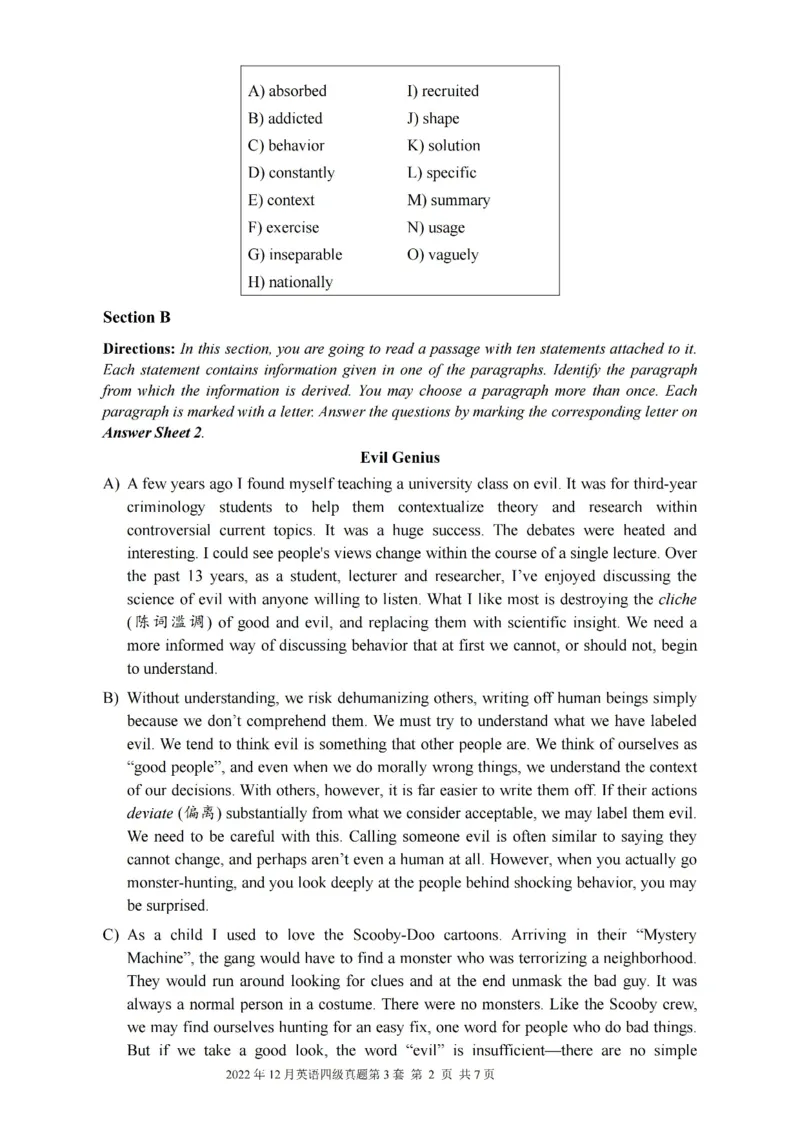
A) arived I)relatively
"" 7../0(- N" .(*74/0(*3
B) consuming J)remains
<" :=1)85/12 [" .(57/1)
C) direct K)resources
9" -/.(:4 \" .()=8.:()
D) exclusively L)staple
?" (G:*8)/0(*3 R" )47>*(
E) including M) suggest
V" /1:*8-/12 X")822()4
F) inform N)surprising
K" /1+=.5 Y" )8.>./)/12
G)raw O) test
S" .76 U" 4()4
H) reached
D" .(7:’(-
Secion B
!"#$%&’)
Directions: In this section,you are going to read a passage with ten statements attached to it.Each
3+(14)+5,2# ;3$%&’’,5$&"3$ *"+)#,7"&37 $" #,)/)()’’)7,.&$%$,3’$)$,2,3$’)$$)5%,/$" &$8D)5%
statement contains information given in ome of the paragraphs. Identify the parugruph
’$)$,2,3$5"3$)&3’&3:"#2)$&"37&4,3&3"3,":$%,()#)7#)(%’8;/,3$&:*$%,()#)7#)(%
from which the information is deried. You may choose a paragraph more than once.
:#"2.%&5%$%,&3:"#2)$&"3&’/,#&4,/89"+2)*5%""’,)()#)7#)(%2"#,$%)3"35,8
Each paragraph is marked with a letter. Answer the questions by marking the
D)5%()#)7#)(%&’2)#?,/.&$%)-,$$,#8<3’.,#$%,=+,’$&"3’6* 2)#?&37 $%,
corresponding letter on Answer Sheet 2.
5"##,’("3/&37 -,$$,#"3%&’()*+,))-"%
The Blessing and Curse of the People Who Never Forget
I91JH122+,-’,<70(215G)91&158H1*95K1@1(L5(-1)
A handful of people can recall almost every day of their lives in enormous detail—amd after years
<%)3/:+-":(,"(-,5)3#,5)--)-2"’$,4,#*/)*":$%,&#-&4,’&3,3"#2"+’/,$)&-’)3/):$,#*,)#’
of research,neuroscientists are finally beginning to understand how they do it.
":#,’,)#5%$ 3,+#"’5&,3$&’$’)#,:&3)--*6,7&33&37 $" +3/,#’$)3/%".$%,*/" &$8
A)For most of us, memory is a mess of blurred and faded pictures of our lives. As much as we would
"" K=.5=)4=+8)$ 5(5=.3 /)7 5())=+;*8..(-71-+7-(->/:48.()=+=8.*/0()%")58:’7)6( 6=8*-
like to cling on to our past,even the saddest moments can be washed away with time.
*/E( 4=:*/12 =14==8.>7)4$ (0(14’( )7--()45=5(14):71;( 67)’(-7673 6/4’4/5(%
B<)A"sk" )NEimYa /5Ve7isWe(h/) (w’ha6t ’h7e4 ’wa(s6 d7o)in-g= /1fo2r+ =a.ny7 1d3a-y 7i3n/ 1th4’e (p>a7st)4 1$5H 3ye(a7r.)s$, ’h=o6we(v0e(r.,$an7d1 -he’ (w6il/l** g2i/0v(e 3y=o8u
the details of the weather, what he was wearing, or even what side of the train he was sitting on his
4’( -(47/*)=+4’( 6(74’(.$6’74’( 67)6(7./12$=.(0(16’74)/-( =+4’( 4.7/1’( 67))/44/12 =1’/)
jo@=u8rn.1ey( 3to4= w6or=k..E"%My% Xme3mo5ry( 5is= .l3i/k)e */aE (li7br*/a;r.y7 .o3f= v+i0d/e-o( =ta47pe>s(,) $wa6l7k*-Et,h4r’o.u=g8h2s’ )of= +e(ve0r(y. 3d-a7y 3o=f +m5y 3l*i/f+(e
from waking to sleeping,"he explains.
+.=567E/12 4=)*((>/12$& ’( (G>*7/1)%
C)Veiseh can even put a date on when those tapes started recording:15 December 2000, when he met
9" W(/)(’:71(0(1>847 -74( =16’(14’=)( 47>())47.4(-.(:=.-/12#$H ?(:(5;(.AQQQ$6’(1’( 5(4
his first girlfriend at his best friend's 16th birthday party. He had always had a good memory,but
’/)+/.)42/.*+./(1-74’/);()4+./(1-P)$I4’;/.4’-73 >7.43%D( ’7-7*673)’7-7 2==-5(5=.3$ ;84
the thrill of young love seems to have shifted a gear in his mind: from now on,he would start
4’( 4’./**=+3=812 *=0( )((5)4=’70( )’/+4(-7 2(7./1’/)5/1-# +.=5 1=6=1$ ’( 6=8*-)47.4
recording his whole life in detail."I could tell you everything about every day after that."
.(:=.-/12 ’/)6’=*( */+( /1-(47/*%%N:=8*-4(**3=8(0(.34’/12 7;=84(0(.3 -73 7+4(.4’74%&
D)Needless to say,,people like Veiseh are of great interest to neuroscientists(神经科学专家)hoping
?" Y((-*())4=)73$ >(=>*( */E( W(/)(’7.( =+2.(74/14(.()44=3,+#"’5&,3$&’$’!+,-./0" ’=>/12
to understand the way the brain records our lives. A couple of recent papers have finally opened a
4=81-(.)471-4’( 673 4’( ;.7/1.(:=.-)=8.*/0()%":=8>*( =+.(:(14>7>(.)’70( +/17**3 =>(1(-7
window on these people's extraordinary minds. And such research might even suggest ways for us
6/1-=6=14’()( >(=>*(P)(G4.7=.-/17.3 5/1-)%"1-)8:’.()(7.:’5/2’4(0(1)822()4673)+=.8)
2!0"1#7$.%6&/4’’’’)(!第
!
1#套
"
)"all to relive our past with greater clarity.
7**4=.(*/0( =8.>7)46/4’2.(74(.:*7./43%
EV)'"Hi(gDh/l2y’ *s3up)8er>i(o./r= .au7t8o4b=i;o/=g2ra.7p>h’ic/:a7l* 5me(m5or=y.'3()or! =H.SADM Tf"oXr s+=h.or)t’)=,. 4f"i$rs+t/. )c4a:m7e5 t(o 4l=ig*/h2t’ 4in/1 t4h’e( e(a7r.l*3y
20A0Q0QsQ,) $wi6t/h4’ a7 y3o=u8n1g2 w6om=a5n 7n1am1e7d5 J(i-ll[/ *P*r#i.c/e:.( %EmVa5il7i/*n/1g2 t4h’e( n1e(u8r.o=s)c:i/e(n1t4/i)s4t7 1an-d 5m(e5mo=r.y3 r.e(s)(ea7r.:c’h(e.r
Jim McGaugh one day, she claimed that she could recall every day of her life since the age of 12.
[/5X:S782’=1( -73$ )’( :*7/5(-4’74)’( :=8*-.(:7**(0(.3 -73 =+’(.*/+( )/1:( 4’( 72( =+$A%
Could he help explain her experiences?
9=8*-’( ’(*>(G>*7/1’(.(G>(./(1:()*
F)KM"cGXau:gSh 7i8n2v’it/1e0d /4h(e-r ’t(o. h4=is’ /l)ab*7,;an$d7 1be-ga;n( 2t7o1 t4e=s4t( )h4er’:( .h#e’ w(o6ul=d8 *g-iv2e/ 0h(e’r (a. 7da-t7e4 (an7d1 -as7k) Ehe’r( .t4o= t4e(l**l
him about the world events on that day. True to her word, she was correct almost every time.
’/57;=844’( 6=.*-(0(14)=14’74-73%&.8( 4=’(.6=.-$ )’( 67):=..(:47*5=)4(0(.3 4/5(%
G)It didn't take long for magazines and documentary film-makers to come to understand her"total
S" N4-/-1P447E( *=12 +=.5727]/1()71--=:85(147.3 +/*5,57E(.)4=:=5( 4=81-(.)471-’(.%4=47*
recall", and thanks to the subsequent media interest, a few dozen other subjects(including
.(:7**&$ 71-4’71E)4=4’( )8;)(B8(145(-/7 /14(.()4$ 7 +(6 -=](1=4’(.)8;@(:4)!/1:*8-/12
VeWi(s/e)h()’h"av’e7 0s(in)c/e1 :c(om:e= 5fo(rw+=a.r6d 7a.n-d 7c1o-nt:a=c1t4e7d: 4t(h-e 4t’e(am4( 7a5t t7h4e 4’U(ni^ve1r/s0i(t.y)/ 4o3f =C+a9li7f*/o+r=n.i1a/7, $INr.v0i/n1e(.%
H)DI"ntNe1r4e(s.t(i)n4/g1l2y*,3 $t4h’e(i/r. 5me(m5or=i.e/(s) a7r.e( h’i/2g’hl*3y )s(e*+l,f:-(c1e4n.t(r-e#d7:a*4l’t=h8o2u’gh4 ’t(h3ey: 7c1an.( 5re(m5em;b(e.r"%a7u8t4o=b;i/o=g2r.a7p>h’i/c:a7l*&"
life events in extraordinary detail, they seem to be no better than average at recalling impersonal
*/+( (0(14)/1(G4.7=.-/17.3 -(47/*$ 4’(3 )((54=;( 1=;(44(.4’7170(.72( 74.(:7**/12 /5>(.)=17*
in/1f+o=r.m5at7i4/o=n1,$s)u8c:h’ a7s) r#a)n3d/o"m2 (!任1意2选3取的4)5l"is*t/)s4 )of= +wo6r=ds.-.) %NoYr =a.re7 .t(he4’y( 3nec1e(s:s(a)r)7i.l/y*3 b;et(t44e(r. a7t4
remembering a round of drinks, say. And although their memories are vast, they are still likely to
.(5(5;(./12 7 .=81-=+-./1E)$ )73%"1-7*4’=82’4’(/.5(5=./()7.( 07)4$ 4’(3 7.( )4/***/E(*3 4=
suffer from"false memories". Clearly, there is no such thing as a"perfect"memory—their
)8++(.+.=5 %+7*)( 5(5=./()&%9*(7.*3$ 4’(.( /)1=)8:’4’/12 7)7 %>(.+(:4& 5(5=.3’4’(/.
extraordinary minds are still using the same flawed tools that the rest of us rely on. The question is,
(G4.7=.-/17.3 5/1-)7.( )4/**8)/12 4’( )75( +*76(-4==*)4’744’( .()4=+8).(*3 =1%&’( B8()4/=1/)$
how?
’=6*
I)N" LaRw7r6en.c(e1 :P(at#i7h4i/s’ /)at7 4th4e’ (Un^i1v/e0r(s.i)t/y43 o=f+ STo=u8t4h’e(r.n1 MXis/s)i)s/)s)i/p>p>i/ .r(e:c(e1nt4*l3y )s48tu-d/(i-ed 7a.=ro8u1n-d A2Q0 >p(e=o>pl*(e 6wi/4t’h
HSAM and found that they scored particularly high on two measures∶ fantasy proneness(倾向)and
DT"X71-+=81-4’744’(3 ):=.(->7.4/:8*7.*3 ’/2’=146=5(7)8.()#+7147)3 (#"3,3,’’!67" 71-
absorption. Fantasy proneness could be considered a tendency to imagine and daydream, whereas
7;)=.>4/=1%K7147)3 >.=1(1()):=8*-;( :=1)/-(.(-7 4(1-(1:3 4=/572/1( 71--73-.(75$ 6’(.(7)
absorption is the tendency to allow your mind to become fully absorbed in an activity—to pay
7;)=.>4/=1/)4’( 4(1-(1:3 4=7**=63=8.5/1-4=;(:=5( +8**3 7;)=.;(-/1717:4/0/43’4=>73
co:m=p5l>e*t(e4 (a7t4t4e(n1t4/i=o1n 4t=o 4t’h(e ’s,e3n’s)a$t&"i3on’s!(8感9受") 7a1n-d 4t’h(e (eGx>p(e.r/(i1e:n(c)e%s.%"INmP5 ex(tGr4.e(m5el(y*3 se)(n1si)/t4i/0v(e 4t=o
sounds, smells and visual detail,"explains Nicole Donohue, who has taken part in many of these
)=81-)$ )5(**)71-0/)87*-(47/*$& (G>*7/1)Y/:=*( ?=1=’8($ 6’=’7)47E(1>7.4/15713 =+4’()(
studies."I definitely feel things more strongly than the average person."
)48-/()%%N-(+/1/4(*3 +((*4’/12)5=.( )4.=12*3 4’714’( 70(.72( >(.)=1%&
J[)" Th&e’ (ab7s;or)=pt.>io4/n= 1he’l(p*s> )th4e’m( 5to4 =es(t)a4b7l;i*s/)h’ s)t4r.o=n1g2 f+o=u8n1d-a7t4i/=on1s) f+=o.r .r(e:c=o*l*(l:ec4/t=i1o$n,)s7a3y)s #P7a4t/i’h/)i$s,7a1n-d t4’h(e
fantasy proneness means that they revisit those memories again and again in the coming weeks and
+7147)3 >.=1(1())5(71)4’744’(3 .(0/)/44’=)( 5(5=./()727/171-727/1/14’( :=5/12 6((E)71-
months. Each time this initial memory trace is"replayed", it becomes even stronger. In some
5=14’)%V7:’4/5( 4’/)/1/4/7*5(5=.3 4.7:( /)%.(>*73(-&$ /4;(:=5()(0(1)4.=12(.%N1)=5(
ways, you probably go through that process after a big event like your wedding day—but the
673)$ 3=8>.=;7;*3 2=4’.=82’4’74>.=:())7+4(.7 ;/2 (0(14*/E( 3=8.6(--/12 -73’;844’(
d-if/+f+e(r.e(n1c:e( i/s) t4’ha7t4 4t’h7a1nEks) 4t=o 4t’h(e/i.r= o4’th(e.r> )p3sy:c’h=o*l=o2g/i:c7a*l4 (t1e-nd(e1n:c/i(e)s$, 4’th(eD HTS"AMX s)u8b;je@(c:ts4) a7r.e( d-o=i/n1g2 i/t4 -d7a3y
in, day out, for the whole of their lives.
/1$ -73 =84$ +=.4’( 6’=*( =+4’(/.*/0()%
K\)N"otY =e4ve(r0y(o.n3e= 1w(it6h/ 4a’ t7en4(d1e-nc(y1 :t3o 4=fa+n7t1a4s7i)s/)e( w6il/*l* -d(e0v(e*l=o>p DHTSA"MX, $th4’o=u8g2h’,s$o )=Pat#i7h4/i’s/ )s)u8g2g2e(s)t4s) t4’ha7t4
something must have caused them to think so much about their past."Maybe some experience in
)=5(4’/12 58)4’70( :78)(-4’(54=4’/1E)=58:’7;=844’(/.>7)4%%X73;( )=5( (G>(./(1:( /1
th4’ei(r/. c:h’i/*l-d’h=o=o-d 5me(a7n1t4 4t’h7a4t 4’t(h3ey; (b:e7c5am(e "o6b’s,e’s’,s/ed!(
:
着
;
迷")6wi/4t’h :c7a*l(e1n-d7a.r)s 71an-d 6w’h7a4t ’h7a>p>p(e1n(e-d 4t=o
them,"says Patihis.
4’(5$& )73)#74/’/)%
L)RT"he& ’p(eo>p(l=e >w*(it6h /4H’SADMT "I'XveN P0i(nt/e1r4v(i.0e/w(e6d (w-ou6l=d8 *c-er:t(a.i4n7l/1y* 3ag7r2e.e( (th4’a7t4 i/4t :c7a1n ;b(e 7a 5mi/Gx(e-d ;bl*(e)s)s/i1n2g%. UO1n
the plus side, it allows you to relive the most transformative and enriching experiences. Veiseh, for
4’( >*8))/-($/47**=6)3=84=.(*/0( 4’( 5=)44.71)+=.574/0( 71-(1./:’/12 (G>(./(1:()%W(/)(’$+=.
instance, travelled a lot in his youth. In his spare time, he visited the local art galleries, and the
/1)471:($ 4.70(**(-7 *=4/1’/)3=84’%N1’/))>7.( 4/5($ ’( 0/)/4(-4’( *=:7*7.427**(./()$ 71-4’(
paintings are now lodged deep in his autobiographical memories.
>7/14/12)7.( 1=6*=-2(--((>/1’/)784=;/=2.7>’/:7*5(5=./()%
M)X""Im%aNg5in7e2 /1b(ei;n(g/ 1a2bl7e; *(to4 =re.m(e5m(b5er; (e.ve(r0y( .p3ai>n7t/1in4/g1,2 $on= 1ev(e0r(y. 3wa6l7l*,* $i/n1 e(v0e(r.y3 g2a7l**l(e.r3y )s>p7a:c(e$, ;b(e46tw(e(e1n
nearly 40 countries,"he says."That's a big education in art by itself."With this comprehensive
1(7.*3 FQ :=814./()$& ’( )73)%%&’74P)7 ;/2 (-8:74/=1/17.4;3 /4)(*+%& O/4’4’/):=5>.(’(1)/0(
knowledge of the history of art, he has since become a professional painter.
E1=6*(-2( =+4’( ’/)4=.3 =+7.4$ ’( ’7))/1:( ;(:=5( 7 >.=+())/=17*>7/14(.%
NY)D"on?o=hu1e=,’n8o(w$ a1 =h6ist7or’y/) 4t=e.a3ch4(er7,: ’a(g.r$e7es2 .(t(h)at4 ’i7t4 /h4el’p(e*>d( d-u-ri8n.g/1 2ce:r(t.a4i7n/1 p>a7r.t4s) o=f+ ’h(e.r (e-d8u:c7a4t/i=o1n#:%"NI :c7a1n
definitely remember what I learned on certain days at school. I could imagine what the teacher was
-(+/1/4(*3 .(5(5;(.6’74N*(7.1(-=1:(.47/1-73)74):’==*%N:=8*-/572/1( 6’744’( 4(7:’(.67)
2017.6/5(第1套)
!"#$%& ’’’’*!!#""saying or what it looked like in the book."
)73/12 =.6’74/4*==E(-*/E( /14’( ;==E%&
O)U "NoYt =e4v(e0r(y.o3n=e1 (wi6th/4 ’HSDATM" hXas’ e7)xp(eGr>ie(n./c(e1d: (t-he4s’e( )(be;ne(f1i(t+/s4),$ h’o=w6ev(e0r(.. %ViWe/(w6in/1g2 th4’e( p>a7s)t4 i/1n h’i/2g’h
definition can make it very difficult to get over pain and regret."It can be very hard to forget
-(+/1/4/=1:7157E( /40(.3 -/++/:8*44=2(4=0(.>7/171-.(2.(4%%N4:71;( 0(.3 ’7.-4=+=.2(4
embarrassing moments,"says Donohue."You feel the same emotions—it is just as raw,just as
(5;7..7))/12 5=5(14)$& )73)?=1=’8(%%_=8+((*4’( )75( (5=4/=1)’/4/)@8)47).76$ @8)47)
fresh...You can't turn off that stream of memories, no matter how hard you try."Veiseh agrees:"It
+.()’‘ _=8:71P448.1=++4’74)4.(75=+5(5=./()$1=5744(.’=6’7.-3=84.3%& W(/)(’72.(()#%N4
is like having these open wounds—they are just a part of you,"he says.
/)*/E( ’70/12 4’()( =>(16=81-)’4’(3 7.( @8)47 >7.4=+3=8$& ’( )73)%
P)#T"hi&s’ m/)ea5ns( 7t1h)ey4 ’o(f3te=n+ 4h(a1ve’ 7t0o( m4a=ke5 7aE s(pe7c)i>al( :e/7f*fo(r+t+= t.4o 4l=ay*7 3th4e’ (pa>s7t) 4to4= r.e(s)t4.% B7/1+8*%+*7)’;7:E)&$ /16’/:’816714(-5(5=./()/14.8-( /14=’/):=1):/=8)1())$ ;84=0(.7**
he has chosen to see it as the best way of avoiding repeating the same mistakes."Some people are
’( ’7):’=)(14=)(( /47)4’( ;()4673 =+70=/-/12 .(>(74/12 4’( )75( 5/)47E()%%T=5( >(=>*( 7.(
absorbed in the past but not open to new memories, but that's not the case for me. I look forward
7;)=.;(-/14’( >7)4;841=4=>(14=1(65(5=./()$ ;844’74P)1=44’( :7)( +=.5(%N*==E+=.67.-
to each day and experiencing something new."
4=(7:’-73 71-(G>(./(1:/12 )=5(4’/12 1(6%&
36. People with HSAM have the same memory as ordinary people when it comes to impersonal
CI%#(=>*( 6/4’DT"X ’70( 4’( )75( 5(5=.3 7)=.-/17.3 >(=>*( 6’(1/4:=5()4=/5>(.)=17*
information.
/1+=.574/=1%
37. Fantasy proneness will not necessarily cause people to develop HSAM.
CJ%K7147)3 >.=1(1())6/**1=41(:())7./*3 :78)( >(=>*( 4=-(0(*=>DT"X%
38. Veiseh began to remember the details of his everyday experiences after he met his first young love.
CL%W(/)(’;(2714=.(5(5;(.4’( -(47/*)=+’/)(0(.3-73 (G>(./(1:()7+4(.’( 5(4’/)+/.)43=812 *=0(%
39. Many more people with HSAM started to contact researchers due to the mass media.
CM%X713 5=.( >(=>*( 6/4’DT"X)47.4(-4=:=147:4.()(7.:’(.)-8( 4=4’( 57))5(-/7%
40. People with HSAM often have to make efforts to avoid focusing on the past.
FQ%#(=>*( 6/4’DT"X=+4(1’70( 4=57E( (++=.4)4=70=/-+=:8)/12 =14’( >7)4%
41. Most people do not have clear memories of past events.
F$%X=)4>(=>*( -=1=4’70( :*(7.5(5=./()=+>7)4(0(14)%
42. HSAM can be both a curse and a blessing.
FA%DT"X:71;( ;=4’7 :8.)( 71-7 ;*())/12%
43.A young woman sought explanation from a brain scientist when she noticed her unusual memory.
FC%"3=812 6=571)=82’4(G>*7174/=1+.=57 ;.7/1):/(14/)46’(1)’( 1=4/:(-’(.818)87*5(5=.3%
44. Some people with HSAM find it very hard to get rid of unpleasant memories.
FF%T=5( >(=>*( 6/4’DT"X+/1-/40(.3 ’7.-4=2(4./-=+81>*(7)7145(5=./()%
45. A recent study of people with HSAM reveals that they are liable to fantasy and full absorption in an
FH%".(:(14)48-3 =+>(=>*( 6/4’DT"X.(0(7*)4’744’(3 7.( */7;*( 4=+7147)3 71-+8**7;)=.>4/=1/171
activity.
7:4/0/43%
Section C
!"#$%&’-
Directions:There are 2 passages in this section.Each passage is followed by some questions or
3+(14)+5,2# B%,#,)#,I()’’)7,’&3$%&’’,5$&"38D)5%()’’)7,&’:"--".,/6*’"2,=+,’$&"3’"#
unfinished statements. For each of them there are four choices marked A),B),C)and
+3:&3&’%,/’$)$,2,3$’8!"#,)5%":$%,2$%,#,)#,:"+#5%"&5,’2)#?,/<"$ >"$ @" )3/
D). You should decide on the best choice and mark the corresponding letter on Answer
A"89"+’%"+-//,5&/,"3$%,6,’$5%"&5,)3/2)#? $%,5"##,’("3/&37 -,$$,#"3%&’()*
Sheet 2 with a single line through the centre.
+,))-".&$%)’&37-,-&3,$%#"+7%$%,5,3$#,8
Passage One
&’22’-1M,1
Questions 46 to 50 are based on the following passage.
;012)+5,2C%)5:"’(1=’21<5,)91G5HH5>+,-8’22’-1B
The phrase almost completes itself: midlife crisis. It's the stage in the middle of the journey when
&’( >’.7)( 7*5=)4:=5>*(4()/4)(*+# 5/-*/+( :./)/)%N4P)4’( )472( /14’( 5/--*( =+4’( @=8.1(3 6’(1
people feel youth vanishing, their prospects narrowing and death approaching.
>(=>*( +((*3=84’071/)’/12$ 4’(/.>.=)>(:4)17..=6/12 71--(74’7>>.=7:’/12%
Th&e’r(e.'(sP )on=l1y* 3on=e1 (pr>o.b=l;em*( 5wit6h /t4’he4 ’c(li5c-h&é5%(J套!"话)<." %ItN 4is/)n1'Pt4 t4.r8u(e.%
"In fact, there is almost no hard evidence for midlife crisis other than a few small pilot studies
%N1+7:4$ 4’(.( /)7*5=)41=’7.-(0/-(1:( +=.5/-*/+( :./)/)=4’(.4’717 +(6)57**>/*=4)48-/()
conducted decades ago,"Barbara Hagerty writes in her new book,Life Reimagined. The bulk of the
:=1-8:4(--(:7-()72=$& <7.;7.7 D72(.43 6./4()/1’(.1(6;==E$ K&:,C,&2)7&3,/%&’( ;8*E=+4’(
research shows that there may be a pause,or a shifting of gears in the 40s or 50s, but this shift"can be
.()(7.:’)’=6)4’744’(.( 573 ;( 7 >78)($=.7 )’/+4/12 =+2(7.)/14’(FQ)=.HQ)$;844’/))’/+4%:71;(
exciting, rather than terrifying. "
(G:/4/12$ .74’(.4’714(../+3/12%&
Barbara Hagerty looks at some of the features of people who turn midlife into a rebirth. They break
<7.;7.7 D72(.43 *==E)74)=5( =+4’( +(748.()=+>(=>*( 6’=48.15/-*/+( /14=7 .(;/.4’%&’(3 ;.(7E
routines, because"autopilot is death."They choose purpose over happiness—having a clear sense of
.=84/1()$ ;(:78)( %784=>/*=4/)-(74’%& &’(3 :’==)( >8.>=)( =0(.’7>>/1())’’70/12 7 :*(7.)(1)( =+
purpose even reduces the risk of Alzheimer's disease. They give priority to relationships. as careers
>8.>=)( (0(1.(-8:()4’( ./)E=+"*]’(/5(.P)-/)(7)(%&’(3 2/0( >./=./43 4=.(*74/=1)’/>)$ 7):7.((.)
of=t+e4(n1 r#e,c5e,d/e,(!逐=渐>淡?化@)".%
2017.6/6(第1套)
!"#$%& ’’’’&!!#""Life Reimagined paints a picture of middle age that is far from gloomy. Midlife seems like the
K&:,C,&2)7&3,/>7/14)7 >/:48.( =+5/--*( 72( 4’74/)+7.+.=52*==53%X/-*/+( )((5)*/E( 4’(
second big phase of decision-making. Your identity has been formed; you've built up your resources;
)(:=1-;/2 >’7)( =+-(:/)/=1,57E/12%_=8./-(14/43 ’7);((1+=.5(-+ 3=8P0( ;8/*48>3=8..()=8.:()+
and now you have the chance to take the big risks precisely because your foundation is already secure.
71-1=63=8’70( 4’( :’71:( 4=47E( 4’( ;/2 ./)E)>.(:/)(*3 ;(:78)( 3=8.+=81-74/=1/)7*.(7-3 )(:8.(%
Karl Barth described midlife precisely this way. At middle age, he wrote,"the sowing is behind;
\7.*<7.4’-():./;(-5/-*/+( >.(:/)(*3 4’/)673%"45/--*( 72($ ’( 6.=4($ %4’( )=6/12 /);(’/1-+
now is the time to reap. The run has been taken; now is the time to leap. Preparation has been made;
1=6/)4’( 4/5( 4=.(7>%&’( .81’7);((147E(1+ 1=6/)4’( 4/5( 4=*(7>%#.(>7.74/=1’7);((157-(+
now is the time for the venture of the work itself."
1=6/)4’( 4/5( +=.4’( 0(148.( =+4’( 6=.E/4)(*+%&
The middle-aged person, Barth continued, can see death in the distance,but moves with a
&’( 5/--*(,72(->(.)=1$ <7.4’:=14/18(-$ :71)(( -(74’/14’( -/)471:($ ;845=0()6/4’7
"measured haste"to get big new things done while there is still time.
%5(7)8.(-’7)4(& 4=2(4;/2 1(64’/12)-=1( 6’/*( 4’(.( /))4/**4/5(%
What Barth wrote decades ago is even truer today. People are healthy and energetic longer. We have
O’74<7.4’6.=4( -(:7-()72=/)(0(14.8(.4=-73%#(=>*( 7.( ’(7*4’3 71-(1(.2(4/: *=12(.%O( ’70(
presidential candidates running for their first term in office at age 68,69 and 74.A longer lifespan is
>.()/-(14/7*:71-/-74().811/12 +=.4’(/.+/.)44(.5/1=++/:( 7472( IL$ IM 71-JF%"*=12(.*/+()>71/)
changing the narrative structure of life itself. What could have been considered the beginning of a descent
:’712/12 4’( 17..74/0()4.8:48.(=+*/+(/4)(*+%O’74:=8*-’70(;((1:=1)/-(.(-4’(;(2/11/12=+7-():(14
is now a potential turning point—the turning point you are most equipped to take full advantage of.
/)1=67 >=4(14/7*48.1/12 >=/14’4’( 48.1/12 >=/143=87.( 5=)4(B8/>>(-4=47E( +8**7-071472( =+%
46. What does the author think of the phrase"midlife crisis"?
FI%O’74-=()4’( 784’=.4’/1E=+4’( >’.7)( %5/-*/+( :./)/)&*
A) " " It N 4 ha ’ s 7 ) le *( d - t 4 o = a 7 l * o = t 4 = of + - d ( e ; ba 7 t 4( e. % C)9I"t Ni4s/ )no1 =lo*=n1g2er( .f+a7s)h’i/o=n1a7b;l*e(.%
B)e.s(e)n(t1s 4)re.a(l7 *l*i/f+(e.%
47. How does Barbara Hagerty view midlife?
FJ%D=6-=()<7.;7.7 D72(.43 0/(65/-*/+(*
A)"I"t Nm4a5y 7b3e ;t(he4 ’b(eg;i(n2n/1i1ng/1 2of= +a 7cr:i./s)i/s).% C)9I"t Nc4a:n7 1be; t(e4r(r.i.f/+y3i/n1g2 f+=or. 4t’h(e 8u1n>p.r(e>p7ar.(e-d.%
B)s’e7 )o(f =o+n=e1's( P)li*/f+e(.% D) ? I " t N m 4 a 5 y 7 s 3 ee )( ( ol = d * - - a , g 7 e 2 ( di - s /) e ( a 7 s ) e ( s ) a 7 p > p > r . o = a 7 c : h ’ i / n 1 g 2 . %
48.How is midife pictured in the book Life Reimagined?
FL%D=6/)5/-*/+( >/:48.(-/14’( ;==EK&:,C,&2)7&3,/*
A)"I"t Nc4a:n7 1be; (quBi8t/4e( r.o=s)y3.% C 9 )I " t N u 4 n 8 d 1 e - r ( g . o 2 e = s ( ) ra . d 7 i - c / a : l 7 * t 4 r . a 7 n 1 s ) f += or .5 ma 7 t 4 i /= on 1 . %
B) t 7 . o 4 f = + on = e 1 ' ( s P ) li */ f + e ( . %
49.According to Karl Barth,midife is the time
FM%"::=.-/12 4=\7.*<7.4’$ 5/-*/+( /)4’( 4/5( %
A) to relax B) to mature C) to harvest D) to reflect
"" 4=.(*7G <" 4=5748.( 9" 4=’7.0()4 ?" 4=.(+*(:4
50. What does the author say about midlife today?
HQ%O’74-=()4’( 784’=.)73 7;=845/-*/+( 4=-73*
A")I"t Ni4s/ )m5or=e. (me5an(i7n1g/f1u2l+ 8t*ha4’n7 o1th=e4’r (s.t)a4g7e2s( )of= +li*/f+e(.%
B)t=a.n4t7 1t4o4 =th4o’s=e) (wi6th/4 ’a 7lo*=ng1e2r( .li*/f+e(s)p>a7n1.%
D)?It" iN4s /l)ik*/eEl(y* 3to4 =be; (a 7cr:i.t/i4c/:al7 *t4u8r.n1i/n1g2 p>oi=n/t1 4i/n1 o=n1e'(sP) l*i/f+(e.%
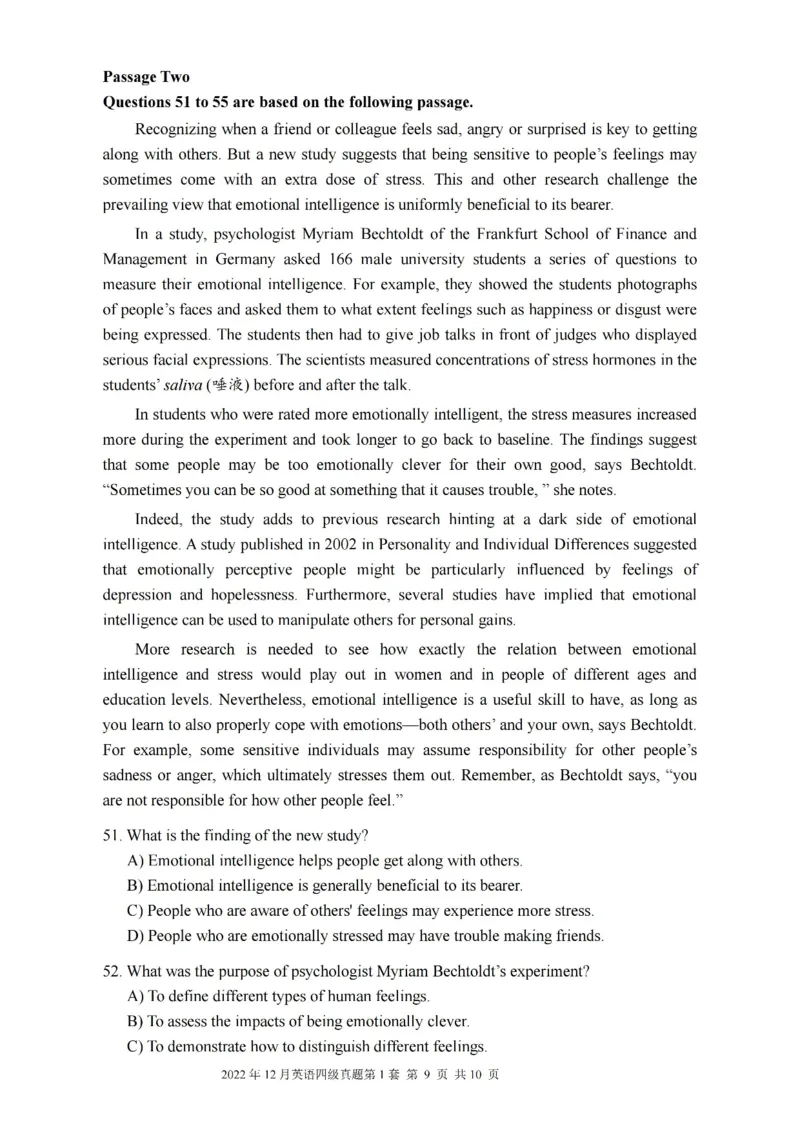
Passage Two
&’22’-1I>5
Questions 51 to 55 are based on the following passage.
;012)+5,2:#)5::’(1=’21<5,)91G5HH5>+,-8’22’-1B
In spring, chickens start laying again, bringing a welcome source of protein at winter's end. So it's
N1)>./12$ :’/:E(1))47.4*73/12 727/1$;./12/12 7 6(*:=5( )=8.:( =+>.=4(/1746/14(.P)(1-%T=/4P)
no surprise that cultures around the world celebrate spring by honoring the egg.
1=)8.>./)( 4’74:8*48.()7.=81-4’( 6=.*-:(*(;.74( )>./12 ;3 ’=1=./12 4’( (22%
Some traditions are simple,like the red eggs that get baked into Greek Easter breads. Others
T=5( 4.7-/4/=1)7.( )/5>*($ */E( 4’( .(-(22)4’742(4;7E(-/14=S.((EV7)4(.;.(7-)%U4’(.)
elevate the egg into a fancy art, like the heavily jewel-covered"eggs"that were favored by the
(*(074( 4’( (22 /14=7 +71:3 7.4$ */E( 4’( ’(70/*3 @(6(*,:=0(.(-%(22)& 4’746(.( +70=.(-;3 4’(
Russians starting in the 19th century.
a8))/71))47.4/12 /14’( $M4’:(148.3%
One ancient form of egg art comes to us from Ukraine. For centuries, Ukrainians have been
U1( 71:/(14+=.5 =+(22 7.4:=5()4=8)+.=5 ^E.7/1(%K=.:(148./()$ ^E.7/1/71)’70( ;((1
drawing complicated patterns on eggs. Contemporary artists have followed this tradition to create eggs
-.76/12 :=5>*/:74(->744(.1)=1(22)%9=14(5>=.7.3 7.4/)4)’70( +=**=6(-4’/)4.7-/4/=14=:.(74( (22)
that speak to the anxieties of our age: Life is precious,and delicate. Eggs are, too.
4’74)>(7E4=4’( 71G/(4/()=+=8.72(# R/+( /)>.(:/=8)$ 71--(*/:74(%V22)7.($ 4==%
"There's something about their delicate nature that appeals to me,"says New Yorker cartoonist
%&’(.(P))=5(4’/12 7;=844’(/.-(*/:74( 1748.( 4’747>>(7*)4=5($& )73)G,.9"#?,#:7.4==1/)4
Roz Chast. Several years ago,she became interested in eggs and learned the traditional Ukarainian
a=]9’7)4%T(0(.7*3(7.)72=$ )’( ;(:75( /14(.()4(-/1(22)71-*(7.1(-4’( 4.7-/4/=17*^E.7/1/71
technique to draw her very modern characters."I've broken eggs at every stage of the process—from
4(:’1/B8( 4=-.76’(.0(.3 5=-(.1:’7.7:4(.)%%NP0( ;.=E(1(22)74(0(.3 )472( =+4’( >.=:())’+.=5
the very beginning to the very, very end."
4’( 0(.3 ;(2/11/12 4=4’( 0(.3$ 0(.3 (1-%&
2017.6/7(第1套)
!"#$%& ’’’’$!!#""But there's an appeal in that vulnerability."There's part of this sickening horror of knowing you're
<844’(.(P)717>>(7*/14’7408*1(.7;/*/43%%&’(.(P)>7.4=+4’/))/:E(1/12 ’=..=.=+E1=6/12 3=8P.(
walkng on the edge with this, that I knd of like,knowing that it could all fall apart at any second."
67*E/12 =14’( (-2( 6/4’4’/)$ 4’74NE/1-=+*/E($ E1=6/12 4’74/4:=8*-7**+7**7>7.474713 )(:=1-%&
Chast's designs,such as a worried man alone in a tiny rowboat,reflect that delicateness.
9’7)4P)-()/21)$ )8:’7)7 6=../(-5717*=1( /17 4/13 .=6;=74$ .(+*(:44’74-(*/:74(1())%
Traditional Ukrainian decorated eggs also spoke to those fears. The elaborate patterns were
&.7-/4/=17*^E.7/1/71-(:=.74(-(22)7*)=)>=E( 4=4’=)( +(7.)%&’( (*7;=.74( >744(.1)6(.(
believed to offer protection against evil.
;(*/(0(-4==++(.>.=4(:4/=1727/1)4(0/*%
"There's an ancient legend that as long as these eggs are made,evil will not prevail in the world,"
%&’(.(P)7171:/(14*(2(1-4’747)*=12 7)4’()( (22)7.( 57-($ (0/*6/**1=4>.(07/*/14’( 6=.*-$&
says Joan Brander,a Canadian egg-painter who has been painting eggs for over 60 years, having
)73)[=71<.71-(.$ 7 9717-/71(22,>7/14(.6’=’7);((1>7/14/12 (22)+=.=0(.IQ 3(7.)$ ’70/12
learned the art from her Ukrainian relatives.
*(7.1(-4’( 7.4+.=5’(.^E.7/1/71.(*74/0()%
The tradition, dating back to 300 B.C., was later incorporated into the Christian church. The old
&’( 4.7-/4/=1$ -74/12 ;7:E4=CQQ <%9%$ 67)*74(./1:=.>=.74(-/14=4’( 9’./)4/71:’8.:’%&’( =*-
symbols, however,still endure. A decorated egg with a bird on it,given to a young married couple, is
)35;=*)$ ’=6(0(.$ )4/**(1-8.(%"-(:=.74(-(22 6/4’7 ;/.-=1/4$ 2/0(14=7 3=812 57../(-:=8>*($ /)
a wish for children. A decorated egg thrown into the field would be a wish for a good harvest.
7 6/)’+=.:’/*-.(1%"-(:=.74(-(22 4’.=61/14=4’( +/(*-6=8*-;( 7 6/)’+=.7 2==-’7.0()4%
51. Why do people in many cultures prize the egg?
H$%O’3 -=>(=>*( /15713 :8*48.()>./]( 4’( (22*
A) It is a welcome sign of the coming of spring.
"" N4/)7 6(*:=5( )/21=+4’( :=5/12 =+)>./12%
B)It is their major source of protein in winter.
<" N4/)4’(/.57@=.)=8.:( =+>.=4(/1/16/14(.%
C)9 "ItN 4c:a7n1 e(a7si)/l*y3 b;e( m5a7d-e (i/n1t4o= a7 w6o=r.kE o=f+ a7r.t4.%
D?) "ItN 4c:a7n1 b;r.i/n1g2 w6e(a7l*t4h’ 7an1d- h’o=n1o=r. t4=o 4t’h(e5m.%
52. What do we learn about the decorated"eggs"in Russia?
HA%O’74-=6( *(7.17;=844’( -(:=.74(-%(22)& /1a8))/7*
A)" "Th&e’y( 3ar7e. (sh)a’p7e>d( -li*k/Ee( j@e(w6e(l* c:a7s)e(s).% C) 9 " Th & e ’ y ( a 3 r 7 e .( he ’ a ( v 7 i 0 l / y * 3 p > ai 7 n /1 t 4 e ( d - i / n 1 r .( ed - . %
B) They are cherished by the rich. D)They are favored as a form of art.
<" &’(3 7.( :’(./)’(-;3 4’( ./:’% ?" &’(3 7.( +70=.(-7)7 +=.5=+7.4%
53. Why have contemporary artists continued the egg art tradition?
HC%O’3 ’70( :=14(5>=.7.3 7.4/)4):=14/18(-4’( (22 7.44.7-/4/=1*
A)"E"ggVs2 2s)er)v(e. 0a(s7 )an7 1en(d1u-r8i.n/g1 2sy)m3b5o;l= *of= +n1e(w6 li*/f+e(.%
B)a(pp7e>a>l(i7n*g/1 t2o4 =ar7t.i4s/)t4s).%
C9)E"ggVs2 2r)ef.l(e+c*(t: t4h4e’ (an7x1iGe/t(i4e/(s) o=f+ p>e(o=p>l*e( t4=o-da7y3.%
D?) "EgVg2s2 p)r>o.v=i0d/e- (a 7un8i1q/uBe8 (su)r8f.a+7c:e( t4o= p>a7i/n1t4 =on1.%
54. Why does Chast enjoy the process of decorating eggs?
HF%O’3 -=()9’7)4(1@=3 4’( >.=:())=+-(:=.74/12 (22)*
A)"S"heT ’n(ev1e(r0 k(n.oEw1s= i6f) t/h+e4 ’e(gg( 2w2il6l/ **br;e.a(k7 Ebe;f(o+r=e. (t4h’e( d-e(s)i/g2n1 i/)s :c=o5mp>l*e(t4e(d-.%
B<)S"heT ’c(an: 7a1dd7 -m-ul5ti8p*l4/e> *d(et-a(i47l/s* )t4o= t4h’e( d-e(s)i/2g1n 4t=o :c=o5mm5un8i1c/a:t7e4( h’e(r. i/d-e(a7.%
C9)S"heT ’a(lw7a*6ys7 3d)er-i(v.e/0s( )gr2e.a(t7 4p>l*e(a7s)u8r.e( f+.r=o5m d-e(s)i/2g1n/i1n2g )s=o5me(t4’h/i1n2g 1n(e6w.%
D)? "ShTe’ i(s /)ne1v(e0r (s.u)r8e .(wh6at’ 7t4he4 ’f(in+a/1l7 d*e-s(i)g/n2 1wi6ll/* *l*o=o=k Eli*/kEe( u8n1t4i/l* 4t’h(e (e1n-d.%
55. What do we learn from the passage about egg-painting?
HH%O’74-=6( *(7.1+.=54’( >7))72( 7;=84(22,>7/14/12*
A") "ItN 4o=ri./g2i/n1a7t4e(d- i/n1 t4’he( (ea7s)t4(e.r1n >pa7r.4t =o+f VE8u.r=o>pe(.%
B<) "ItN 4h’a7s) a7 h’i/s)t4o=r.y3 =of+ =o0v(e.r 4t6w=o 4t’h=o8us)a7n1d- y3e(a7r.s).%
C9) "ItN 4i/s) t4’h(e 5mo=s)t4 t4/i5me(-,h’o=n1o=r.e(d- f+o=r.m5 of= +f+a7n1c:y3 a7r.t4.%
D)?I"t Ni4s/ )es(p)e>c(i:a/l7l**y3 f+7av0o=r.e(d- a7s) 7a :c’h8ur.:ch’ -de(c:o=r.a7t4i/=o1n.%
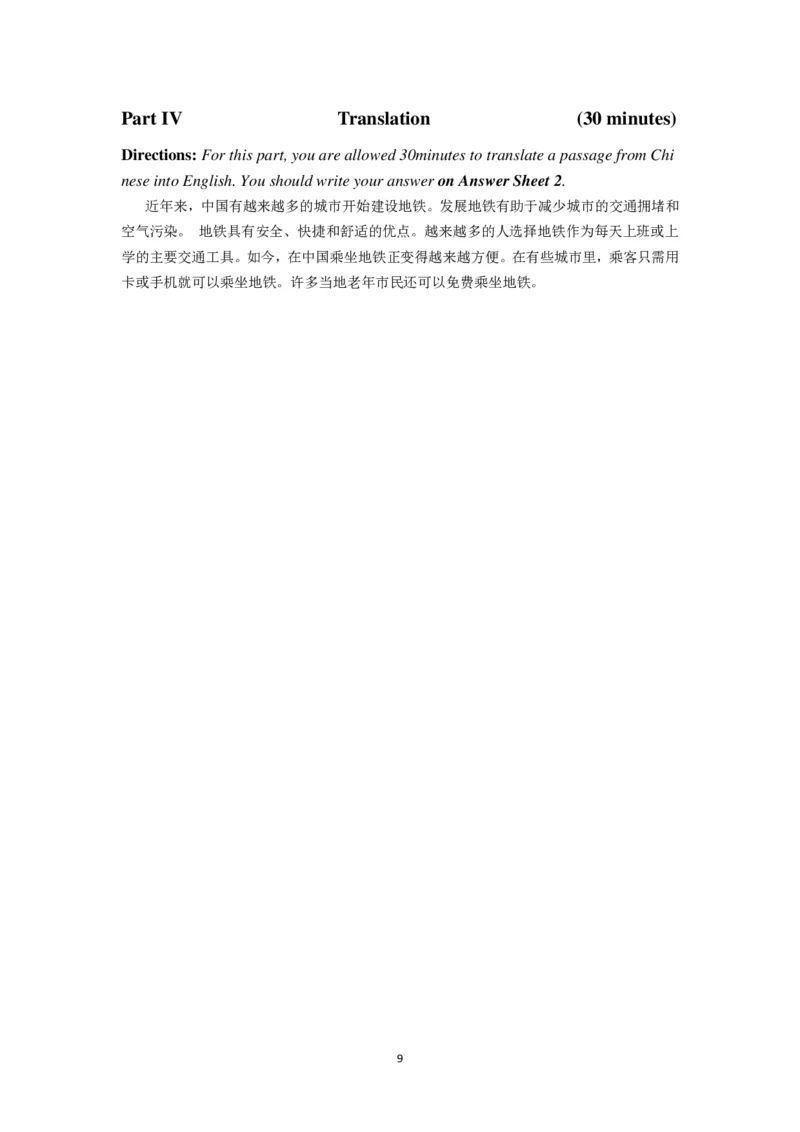
Part IV Translation
&’()$ I(’,2H’)+5, (!3.0" m/i+n,u0t)e1s2)"
Directions: For this part, you are allowed 30 minutes to translate a passage from Chinese into
3+(14)+5,2# !"#$%&’()#$$ *"+)#,)--".,/012&3+$,’$" $#)3’-)$,)()’’)7,:#"2 @%&3,’,&3$"
English. You should write your answer on Answer Sheet 2.
D37-&’%89"+’%"+-/.#&$,*"+#)3’.,#"3%&’()*+,))-"%
黄A河B是C亚D洲E第!三F、,G世H界!第I六J长5的B河K流-。%"A黄&"L这M个N字O描P述5的C是Q其B河R水S浑T浊5的U颜色V。- 黄A河B发W源X干Y青Z海[.$
流
K
经
,
九
\
个
M
省
]
份
^
,$最
_
后
‘
注
a
入
b
渤
c
海
[
。-黄
A
河
B
是
C
中
d
国
e
赖
f
以
g
生
h
存
i
的
5
几
j
条
k
河
B
流
K
之一
l
。
m
黄- 河
A
流
B
域
K
(
n
r!i.v/e0r( .b;a7s)i/n1)"C 是
d
中国
e
古
o
代p文q明r的5诞s生h地t,$u也C是d中e国v早期w历x史y上z最_繁{荣|的5地t区}。- 然~而(cid:127),$(cid:128)由Y于(cid:129)极(cid:130)具(cid:131)破(cid:132)坏力(cid:133)的5洪(cid:134)水R频(cid:135)发W,$A黄B河(cid:136)曾(cid:137)造(cid:138)成(cid:139)多
次(cid:140)灾(cid:141)害(cid:142)。-在(cid:143)过(cid:144)去(cid:145)几j十(cid:146)年(cid:147)里(cid:148),$政(cid:149)府(cid:150)采(cid:151)取4了(cid:152)各(cid:153)种(cid:154)措(cid:155)施(cid:156)防(cid:157)止(cid:158)灾(cid:141)害(cid:142)发W生h。-
2017.6/8(第1套)
!"#$%& ’’’’+!!#""2017年6月大学英语四级考试真题(第 2套)
!"#$! %"#$%&’()*+,!- !."
Part I Writing
&’()! *(+)+,- (!3.0" m/i+n,u0t)e1s2)"
Directions: For this part,you are allowed 30 minutes to write an advertisement on your campus
3+(14)+5,2# !"#$%&’()#$$ *"+)#,)--".,/012&3+$,’$" .#&$,)3)/4,#$&’,2,3$"3*"+#5)2(+’
website to sell some of the course books you used at college. Your advertisement may
.,6’&$,$" ’,--’"2,":$%,5"+#’,6""?’*"++’,/)$5"--,7,89"+#)/4,#$&’,2,3$2)*
include a brief description of their content, their condition and price, and your contact
&35-+/,)6#&,:/,’5#&($&"3":$%,"3$,3$$ $%,"3/&$&"3)3/(#&5,$ )3/*"+#5"3$)5$
information. You should write at least 120 words but no more than 180 words.
&3:"#2)$&"389"+’%"+-/.#&$,)$-,)’$!"#."#/’6+$3" 2"#,$%)3!$#."#/’8
!
!
!
Pa & r ’ t ( ) Ⅱ " I L 6 i + s 2 t )1 e , n + i , n - g 7 C 5 o / mp 8 r ( e 1 h 9 e 1 n , s 2 i +5 o , n (!2!5: m/i+n,u0t)e1s2)"
Section A
!"#$%&’(
Directions; In this sectiom,you will hear three news reports.At the end of each news
3+(14)+5,2# ;3$%&’’,5$&"3$ *"+.&--%,)#$%#,,3,.’#,("#$’8<$$%,,3/":,)5%3,.’
report, you will hear tawo or three questions. Both the news report and the
#,("#$$ *"+.&--%,)#$." "#$%#,,=+,’$&"3’8>"$%$%,3,.’#,("#$)3/$%,
questions will be spoken only once. After you hear a question,you must
=+,’$&"3’.&--6,’("?,3"3-*"35,8<:$,#*"+%,)#)=+,’$&"3$ *"+2+’$
c5h%o"o"s’e, t$h%e, 6b,e’s$t) 3an’.sw,e#r :#f"r2om$ %t,he:" +fo#u5r% "c&h5o,i’c2es) #m?a,r/ke,"B$),@C") )a3nd/ AD)".8
Then mark the corresponding letter on Answer Sheet 1 with a single line
B%,32)#? $%,5"##,’("3/&37 -,$$,#"3%&’()*+,))-!.&$%)’&37-,-&3,
through the centre.
$%#"+7%$%,5,3$#,8
Questions 1 and 2 are based on the news report you have just heard.
;012)+5,2#’,2(185()?509’@1A02)91’(e.f(e+(r. t4o= d-r.i/0v(e 7a1n-d >p7a.rEk 4t’h(e5ms)e(l*v0e(s).%
B)Human drivers become easily distracted or tired while driving.
<" D8571-./0(.);(:=5( (7)/*3 -/)4.7:4(-=.4/.(-6’/*( -./0/12%
C)9 "MoXst= d)4ri-v.e/r0s( .f)ee+(l( u*n8c1er:t(a.i47n/ 1ab7o;u=t 8t4h4e’ (sa)f7e+t(y4 3of= +se)l(f*-+,d-r.i/v0i/n1g2 c:a7r.s).%
D?)M"osXt =d)r4i-ve./r0s( .h)av’e7 0t(es4t( )d4r-i.v/e0n( 1ca:r7s. )w6it/h4’ a7u8t4o=m5at7i4c/: b;r.a7kEin/1g2 f+e(a7t4u8r.e(s).%
2.A %A)"T"he&ir’ (d/.ri-v.e/r0s( .w)o6ul=d8 f*-ee+l( (s*a)f7e+ (af7t+e4r( .g2e(t4t4i/n1g2 u8s)e(d- t4o= t4’h(e 7a8ut4=om5a7t4i/c: d-e(v0i/c:e(s).%
B<)T"he&y’ (w3ou6ld= 8b*e- u;n(po8p1u>l=a>r8 *w7i.th6 /d4r’i-ve./r0s( .w)ho6 ’o=nl=y1 t*3ru4s.8t )t4h4e’i(r/. o=w6n 1sk)iEl/*l*s).%
C9)T"he&i’r( i/.nc/1r:ea.(s7ed)( c-o:mf=o5r+t= .l4ev*(e0l(s* )ha’v7e0 (bo;o=s=t)e4d( -th4e’i(r/ .s)a7l*e(s).%
D)? "Th&ey’ (a3re7 .n(o1t =a4c7t:u4a8l7l*y*3 a7s) s)a7f+e( a7s) 7au8t4=om5a7kEer(s.) a7d-v0e(rt.4i/s)e(.%
Questions 3 and 4 are based on the news report you have just heard.
;012)+5,2.’,2(185()?509’@1A02)91’((4/4=.)%
D?)A" s"er)i(o.u/s= 8a)cc7i:d:e/-nt( 1i4n/ 1th4’e (A"la*7s)kEa 7s)p>o=rt.4s) e(v0e(n1t4.%
4F.%A)"He" sDt(ay)e4d7 3b(e-hi;n(d’ /1to- l4=oo*k= =aEft7e+r4( .hi’s/ )i/n1j@u8r.e(d- -do=g2s).%
B<)H"e Dh(as’ 7w)on6 =t1he4 ’A(la"s*k7a) EI7dNi-t/a4r7o.=d- Raac7e: (f+o=u8r. t4/i5me(s).%
C9)H"e Dr(ec.e(i:v(e/d0 (a- m7in5o/r1 =i.nj/1ur@8y. 3in/ 1t4h’e( INd-i/t47a.r=o-d aRa7c:e(.%
D?)H"e Dh(as’ 7q)uiBt8 /t4h4e’ (co:m=p5et>i(t4i/4o/=n 1in/1 A"l*a7s)kEa7 f+=or. 2g=o=o-d.%
Questions 5 to 7 are based on the news report you have just heard.
;012)+5,2:)5$’(1=’21<5,)91,1>2(185()?509’@1A02)91’(e>a(r7e.d( -be;t(w4e6e(n( 1tw4o6 l=a*r7g.e2 (is/)l*a7n1d-s).%
B<)I"t N4ra.n7 1in/1t4o= NYi/c:a7r.a7g2u8a7'Ps) d (w-it6h/ 4’th4e’ (re.s(c)u:e8 (ef(f++o=r.t4.% C) 9 " He D ( wa 6 s 7 ) dr - o . w = n 6 ed 1 ( w - i 6 th /4 ’ th 4 e ’ ( p > a 7 s ) s ) e ( n 1 g 2 e ( r . s ) . %
B<) "HeD (is/ )be;i(n/g1 2in/1v0es(t)i4/g2a7t4e(d- b;y3 t4h’e( p>o=l*i/:ce(.% D)? "HeD (is/ )a7m5on=g1 2th4o’s=e) (p>eo(p=l>e*( m5is/)s)i/n1g2.%
Section B
!"#$%&’)
Directions:In this section,you will hear two long conersations. At the end of each conversation,
3+(14)+5,2# ;3$%&’’,5$&"3$ *"+.&--%,)#$." -"37 5"34,#’)$&"3’8<$$%,,3/":,)5%5"34,#’)$&"3$
you will hear four questions. Both the conversation and the questions will be spoken only
*"+.&--%,)#:"+#=+,’$&"3’8>"$%$%,5"34,#’)$&"3)3/$%,=+,’$&"3’.&--6,’("?,3"3-*
once. After you hear a question, you must choose the best answer, from the four choices
"35,8<:$,#*"+%,)#)=+,’$&"3$ *"+2+’$5%""’,$%,6,’$)3’.,#:#"2$%,:"+#5%"&5,’
m2ar)k#e?d, /A<)",B$)>,"C$) @am"d) 3D)/.ATh"e8n Bm%a,r3k 2t)h#e? c$%o,rr5e"s##p,o’n(d"i3n/g& 3l7e-t,t$$e,r# "o3n %An&s’w(e)r* S+h,e)e)t- !I
with a single line through the centre.
.&$%)’&37-,-&3,$%#"+7%$%,5,3$#,8
Q;ue0s1t2i)o+n5s, 28D t)o5 1#l# a’r(e1 b=a’s2e1d< o5n, t)h9e1 c4o5n,v@e1r(s2a’t)i+o5n, y?o5u0 h9a’v@e1 jAu0s2t) 9h1ea’r(d<.B
8L. %A")A"t" a4 7sh)o’p=p>i>n/g1 2c:e(n1tr4.e(.% C9)A"t "a4n7 1ac7c:o:u=n8t1a4n7c1y: 3f+i/.r5m.%
B) At a community college. D) At an IT company.
<" "47 :=5581/43 :=**(2(% ?" "471N&:=5>713%
9.M %A")H"elDp(i*n>g/1 o2u=t8 w4i6th/4 ’da-t7a4 7i/n1p>u8t4.% C)9 "SoTr=t.i4n/1g 2a7p>pl>i*/c:a7t4i/=o1n +f=o.r5ms).%
B<)A"rr"a.n.7g1i2n/g1 2in/1t4e(r.v0i/(e6ws).% D)? "MaXk7iEn/g1 2ph>o’n=e1 (ca:l7l**s).%
1$0Q.% A")"HeD e(n(j1o@y=s3 )us8i)/n1g2 c:o=m5p>ut8e4(r.s).% C9)H"e Dw(an6ts7 1t4)o 4w=or6k= .iEn /t1h4e’ (ci:t/y43 c:e(n1t4r.e(.%
B)e(r.i/e(n1c:e(.%
1$1$.% A")"Pu#rc8h.:a’se7 )(so)m=e5 b(us;i8n)e/1s(s) )su)i8t/4s).% C)9I"mpN5ro>v.e= 0h(is’ /)pr>o.g=r2a.m7m5i5ng/1 s2k)iEl/l**s).%
B)t8er4( .l*a7n1g2u8a7g2e(.% D)?R"evai(e0w/( 6so)m=e5 a(c7c:o:u=n8t1a4n7c1y: 3t4e(r.m5s).%
Questions 12 to 15 are based on the conversation you have just heard.
;012)+5,2#!)5#:’(1=’21<5,)9145,@1(2’)+5,?509’@1A02)91’(r= =a.t 7t4e4c(h:n’o1l=o*g=y2 3sk)iEl/l**s).%
C9)T"he&y’ (o3ft=e+n4 (l1is*/t)e4n( 1to4= NYat7i4/o=n1a7l* P#u8b;l*i/c: aRa7d-i/o=.%
D)They feel superior in science and technology.
?" &’(3 +((*)8>(./=./1):/(1:( 71-4(:’1=*=23%
13.A)Japanese. C)Poles.
$C%"" [7>71()(% 9" #=*()%
B < ) " G S e ( r . m 5 a 7 n 1 s ) . % D)? "Am"e5r(i.c/:a7n1s).%
14. A)Emailing. C)Science.
$F%"" V57/*/12% 9" T:/(1:(%
B)Texting. D)Literacy.
<" &(G4/12% ?" R/4(.7:3%
15 $ . H A % ) " It " i N4 s /) un 8 d 1 e - r ( go .2 i = n / g 1 2 a 7 dr - a . s 7 t ) i 4/ c : r .( e + f = o . r 5 m. % C)9I"t N4ha’s7 )m5uc8h: ’ro.=o=m5 fo+=r. i/5mp>r.o=v0e(m5e(n1t4.%
B) < I " t N l 4 a * y 7 s 3 ) em ( p 5 h > as ’ i 7 s ) /) on = 1 cr : e . a ( t 7 i 4 v /0 e ( t 4 h ’ i / n 1 k E i / n 1 g 2 . % D)?It" pNr4i>or./i=t.i/z4e/]s( )tr4a.i7n/i1n/g1 2of= +pr>a.c7t:i4c/a:l7 *s)kEil/*l*s).%
Section C
!"#$%&’-
Directions:In this section, you will hear three passages. At the end of each passage,you will hear
3+(14)+5,2# ;3$%&’’,5$&"3$ *"+.&--%,)#$%#,,()’’)7,’8<$$%,,3/":,)5%()’’)7,$ *"+.&--%,)#
three or four questions. Both the passage and the questions will be spoken only once.
$%#,,"#:"+#=+,’$&"3’8>"$%$%,()’’)7,)3/$%,=+,’$&"3’.&--6,’("?,3"3-*"35,8
After you heara question,you must choose the best answer from the four choices marked
<:$,#*"+%,)#)=+,’$&"3$*"+2+’$5%""’,$%,6,’$)3’.,#:#"2$%,:"+#5%"&5,’2)#?,/
A),B),C)and D).Then mark the corresponding letter on Ansuer Sheet 1 with a
<"$ >"$ @" )3/A"8B%,32)#? $%,5"##,’("3/&37 -,$$,#"3%&’()*+,))-!.&$%)
single line through the centre.
’&37-,-&3,$%#"+7%$%,5,3$#,8
Questions 16 to 18 are based on the passage you have just heard.
;012)+5,2#%)5#D’(1=’21<5,)918’22’-1?509’@1A02)91’(p>l*e(s).%
B<)T"h&ey’ (g3r2o.w= 6wh6it’e/4 (f+l*o=w6e(r.s).% D?)T"he&y’ (c3om:e= 5f(ro+m.= 5Cen9t(r1a4l. 7*Af"r+i./c:a7.%
1$7J.%A)"Th"e&y ’t(u3rn48e.d1 (f-ro+m. =w5hi6te’ /4t(o 4=pu>r8p.l>e* (in/1 c:o=l*o=r..%
B<)T"he&y’ (b3e;ca(m:7e5 p(op>u=l>a8r* 7o.n= 1th4’e (w6or=l.d*- m5a7r.kEe(t4.%
C)9T"he&y’ (b3ec;a(m:e7 5a(n 7i1mp/5or>t=a.n47t1 4fo+=o=d- f+o=r. ’h8u5ma7n1s).%
D)? "Th&e’y (b3e;g(a2n 7t1o4 =lo*o=k= Eli*/kEe( m5od=e-r(n.-1d,-ay7 3c:a7r.r.o=t4s).%
2017.6/2(第2套)
!"#$%& ’’’’!!!!""1$8L.% A")T"he&y’ (w3er6e( .f(ou+n=d8 1q-uiBt8e/ 4(nu1t8r4i.t/4i/o=u8s).% C)9P"eo#p(l=e> d*(is-c/o)v:e=r0e(d. (t-he4’i(r/ .me5d(i-c/i:n/a1l7 *v0a7l*u8e(.%
B) (l-ow*e=r6 (t.he4’i(r/ .p>ri./c:e(s).%
Questions 19 to 21 are based on the passage you have just heard.
;012)+5,2#E)5!#’(1=’21<5,)918’22’-1?509’@1A02)91’(t-e7 4h(er’ (f.a+m7i5ly/* 3an7y1 3ti4/m5e (s)h’e( l*i/Eke(d-.%
B)< "ShTe’ (co:u=l8d *-ca:l7l* *u8p> h’e(r .f+a7m5il/*y3 w6h’e(n1ev(e0r( .s)h’e( l*i/Eke(d-.%
C)9 "ShTe’ (co:u=l8d *-lo*c=a:t7e4 (h’er( .f+r.i/(e1n-ds) 6wh’e(r.e(v0e(r. t4’h(e3y 6we(r.e(.%
D?)S"heT ’c(ou:l=d8 *d-ow-n=l6o1a*d= 7a-s 7m)an5y7 1p3ic>t/u:r4e8s.( a)s7 )sh)e’ (li*/kEe(d-.%
20A.QA%)"Sh"e Tl’i(ke*/dE (t-o 4i=nf/1o+r=m. 5he’r (f.r+i.e/(n1d-s )a7b;o=u8t 4h’e(r. s)u8c:c:e(s)s).%
B)d-a7t4e(s).%
C)9 "ShTe’ (fe+l(t*4 qBu8i/4t(e >p=o>p8u*l7a.r7 5am=o1n2g 4t’h(e5m.%
D)? "ShTe’ f(e+l(t* 4s)h’e( w6as7 )a7 t4e(e(n1a7g2e(r. a7g2a7i/n1.%
21A.$A%)S"h"e Tc’o(ul:d= 8b*a-re;l7y. (r*3es.p(o)n>d= 1t-o 4a=ll7 **he’r( .5H0Q0Q FKa7c:e(b;oo=k= Efr+.i/e(n1d-s).%
B)She spent more time updating her friends than her family.
<" T’( )>(145=.( 4/5( 8>-74/12 ’(.+./(1-)4’71’(.+75/*3%
C)9S"heT ’c(ou:l=d8 *b-a;r7e.l(y* 3b;al7a*7n1c:e( FKa7c:e(b;o=o=kE u8p>d-at7e4(s) a7n1d- h’e(r. 6wo=r.kE.%
D?)S"heT ’d(id-n/'-t1 Ps4e)e(m( 5to 4=be; (do-i=n/g1 2as7 )we6l(l* *a7s) h’e(r. FKa7c:e(b;o=ok= Efr+.i/e(n1d-s).%
Questions 22 to 25 are based on the passage you have just heard.
;012)+5,2!!)5!:’(1=’21<5,)918’22’-1?509’@1A02)91’( t ( 4 of = + a 7 S T p > a 7 n 1 is /) h ’ k E i / n 1 g 2 . % C)9I"t Nw4a6s 7b)r;o.u=g8h2t’ 4ov=e0r( .f+r.o=m5 STp>a7i/n1.%
B)ti7c.4i/p:a/>t7e4d( -in/ 1a 7m5ul8e*-(d,r-i.v/0i/n1g2 c:o=m5pe>t(i4t/4i/o=n1.%
C9)T"he&y’ (s3ho)w’e=d6 (a-nd7 1t-ra4d.7e-d (a-n7i1ma/5ls7 *)in/1 t4h’e( m5a7r.kEe(t4.%
D?) "Th&e’y( f3e+d( -mu5le8s* (w)i6th/ 4’th4e’ (be;s(t) 4f+o=o=d- t4h’e(y3 c:o=u8ld*- f+i/1nd-.%
2A5H.% A")"Th&e’ w(i6de/-r( .us8e) (of= +h’o=r.s)e(s).% C9)A" s"hr)i’n.k/1iEn/g1 2an7i1m/5al7 *t4r.a7d-e(.%
B)< "Th&e ’a(rr7i..v/a0l7 *o=f +t4r.a7c:t4=or.)s%. D)? "A "gr2o.w=i6n/g1 2do-n=k1eEy( 3p>op=u>l8a*7t4i/o=n1.%
Part Ⅲ Reading Comprehension (40 minutes)
&’()# F1’<+,-75/8(191,2+5, !C"/+,0)12"
Section A
!"#$%&’(
Directions:In this section, there is a passage with ten blanks. You are required to select one word
3+(14)+5,2# ;3$%&’’,5$&"3$ $%,#,&’)()’’)7,.&$%$,36-)3?’89"+)#,#,=+&#,/$" ’,-,5$"3,."#/
for each blank from a list of choices gioen in a word bank, following the passage. Read the
:"#,)5%6-)3? :#"2)-&’$":5%"&5,’7&4,3&3)."#/6)3? :"--".&37 $%,()’’)7,8C,)/$%,
passage through carefjully before making your choices. Each choice in the bank is
()’’)7,$%#"+7%5)#,:+--*6,:"#,2)?&37 *"+#5%"&5,’8D)5%5%"&5,&3$%,6)3? &’
identified by a letter. Please mark the corresponding letter for each item on Answer
&/,3$&:&,/6*)-,$$,#8E-,)’,2)#? $%,5"##,’("3/&37 -,$$,#:"#,)5%&$,2 "3%&’()*
Sheet 2 with a single line through the centre. You may not use anu of the words in the
+,))-".&$%)’&37-,-&3,$%#"+7%$%,5,3$#,89"+2)*3"$+’,)3*":$%,."#/’&3$%,
bank more than once.
6)3? 2"#,$%)3"35,8
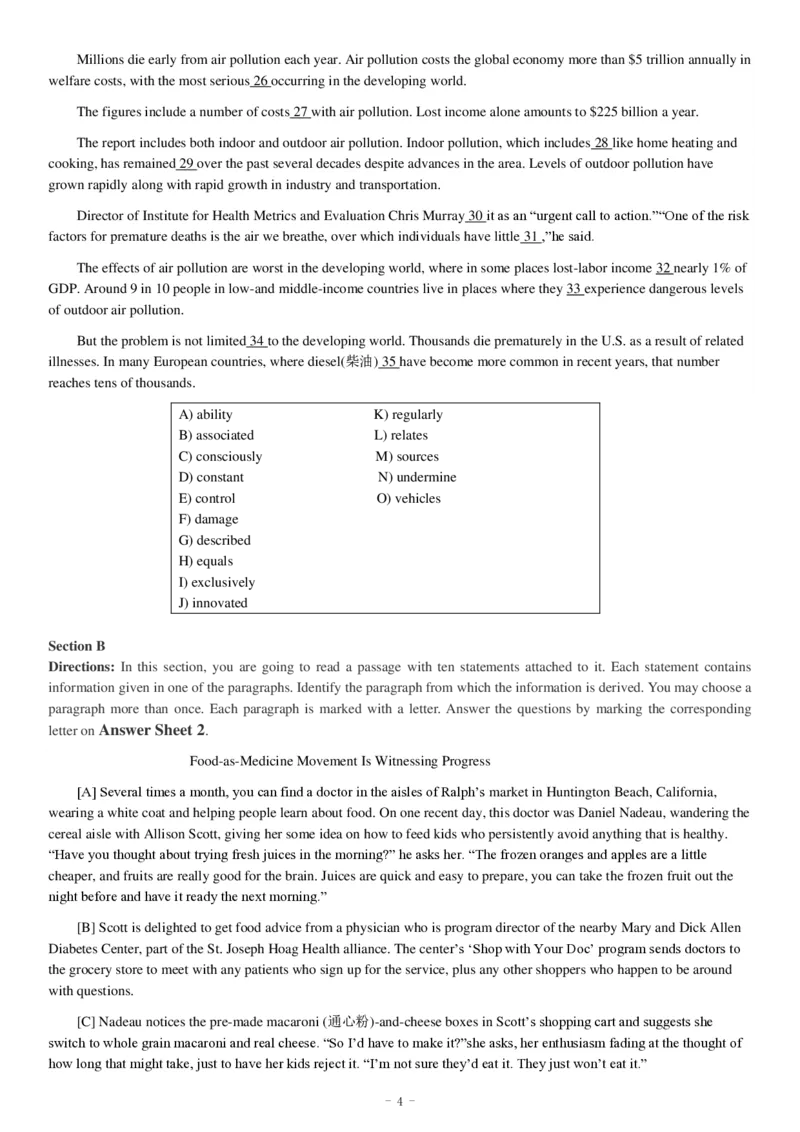
Questions 26 to 35 are based on the following passage.
;012)+5,2!%)5.:’(1=’21<5,)91G5HH5>+,-8’22’-1B
As if you needed another reason to hate the gym, it now tumns out that exercise can exhaust not
")/+3=81((-(-71=4’(..(7)=14=’74( 4’( 235$ /41=648.1)=844’74(G(.:/)( :71(G’78)41=4
only your muscles, but also your eyes. Fear not,however,for coffee can stimulate them again. During
=1*3 3=8.58):*()$;847*)=3=8.(3()%K(7.1=4$’=6(0(.$+=.:=++(( :71)4/58*74( 4’(5727/1%?8./12
26 _exercise,our muscles tire as they run out of fuel and build up waste products. Muscle
!AI! (G(.:/)($ =8.58):*()4/.( 7)4’(3 .81=84=++8(*71-;8/*-8>67)4( >.=-8:4)%X8):*(
performance can also be affected by a 27 called"central fatigue,"in which an imbalance in the
>(.+=.571:( :717*)=;( 7++(:4(-;3 7 !AJ! :7**(-%:(14.7*+74/28($& /16’/:’71/5;7*71:( /14’(
body's chemical messengers prevents the central nervous system from directing muscle movements
;=-3P):’(5/:7*5())(12(.)>.(0(14)4’( :(14.7*1(.0=8))3)4(5 +.=5 -/.(:4/12 58):*( 5=0(5(14)
28 . It was not known,however,whether central fatigue might also affect motor systems not
!AL!%N467)1=4E1=61$ ’=6(0(.$ 6’(4’(.:(14.7*+74/28( 5/2’47*)=7++(:45=4=.)3)4(5)1=4
2017.6/3(第2套)
!"#$%& ’’’’(!!!""directly 29 in the exercise itself,such as those that move the eyes. To find out,researchers gave
-/.(:4*3 !AM! /14’( (G(.:/)( /4)(*+$ )8:’7)4’=)( 4’745=0( 4’( (3()%&=+/1-=84$ .()(7.:’(.)270(
1$l$ v0o=l*u8n1t4e(e(r. :c3y:c*l/i)4s)ts7 a5) c#6a"rb%o*h/y#d)r$a,t!e(,碳R水@化(cid:139)合(物5的")! 3C0Q !eit(h/e4’r( .wi6th/4 ’a 7mo5d=er-a(t.e7 4(do-s=e) (of= +ca5l)f:f:,e&i3n,e
(!咖u啡v因(cid:213))",$w6h’ic/:h’ i/s) kEn1o=w6n 1to4= s)t4i/m5u8la*7t4e( t4h’e( c:e(n1t4r.a7l* 1n(e.r0v=o8us) )s3y)s4t(e5m,$o=r. a7s) 7a (p-l)a5c,e6b"o(!(cid:190)安慰-剂.)"w6it/4h’o=u8t,4$
during 3 hours of 31.After exercising,the scientists tested the cyclists with eve-tracking cameras
-8./12C ’=8.)=+!C$!%"+4(.(G(.:/)/12$ 4’( ):/(14/)4)4()4(-4’( :3:*/)4)6/4’(3(,4.7:E/12 :75(.7)
to see how well their brains could still 32their visual system. The team found that exercise
4=)(( ’=6 6(**4’(/.;.7/1):=8*-)4/**!CA! 4’(/.0/)87*)3)4(5%&’( 4(75 +=81-4’74(G(.:/)(
reduced the speed of rapid eye movements by about 8?3 their ability to capture new visual
.(-8:(-4’( )>((-=+.7>/-(3( 5=0(5(14);3 7;=84LZ$ !CC! 4’(/.7;/*/43 4=:7>48.( 1(60/)87*
information. The caffeine, the equivalent of two strong cups of coffee, was 34 to reverse this
/1+=.574/=1%&’( :7++(/1($ 4’( (B8/07*(14=+46=)4.=12 :8>)=+:=++(($ 67)!CF! 4=.(0(.)( 4’/)
effect,with some cyclists even displaying 35 eye movement speeds. So it might be a good idea to
(++(:4$ 6/4’)=5( :3:*/)4)(0(1-/)>*73/12 !CH! (3( 5=0(5(14)>((-)%T=/45/2’4;( 7 2==-/-(7 4=
get someone else to drive you home after that marathon.
2(4)=5(=1( (*)( 4=-./0( 3=8’=5( 7+4(.4’7457.74’=1%
I phenomenon
A) cautiously
"" :784/=8)*3 N" >’(1=5(1=1
B)commit J) preventing
<" :=55/4 [" >.(0(14/12
C)control K) sensitive
9" :=14.=* \" )(1)/4/0(
D) cycling L) slowing
?" :3:*/12 R" )*=6/12
E)effectively M) solution
V" (++(:4/0(*3 X")=*84/=1
F) increased N)sufficient
K" /1:.(7)(- Y" )8++/:/(14
G)involved O) vigorous
S" /10=*0(- U" 0/2=.=8)
H limited
D" */5/4(-
Section B
!"#$%&’)
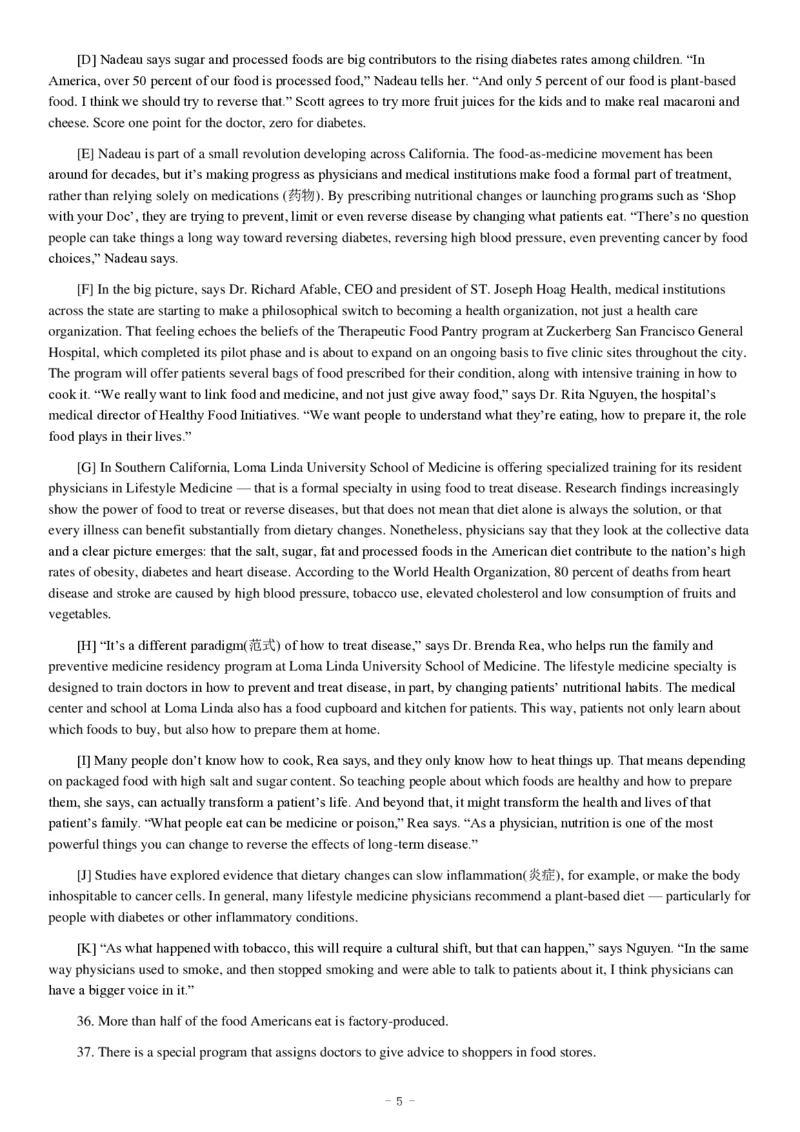
Directions:In this section,you are going to read a passage with ten statements attached to it.Each
3+(14)+5,2# ;3$%&’’,5$&"3$ *"+)#,7"&37 $" #,)/)()’’)7,.&$%$,3’$)$,2,3$’)$$)5%,/$" &$8D)5%
statement contains information given in one of the paragraphs. Identify the paraqraph
’$)$,2,3$5"3$)&3’&3:"#2)$&"37&4,3&3"3,":$%,()#)7#)(%’8;/,3$&:*$%,()#)7#)(%
from which the information is derioed. You may choose a paragraph more than once.
:#"2.%&5%$%,&3:"#2)$&"3&’/,#&4,/89"+2)*5%""’,)()#)7#)(%2"#,$%)3"35,8
Each paragraph is marked with a letter.Answer the questions by marking the
D)5%()#)7#)(%&’2)#?,/.&$%)-,$$,#8<3’.,#$%,=+,’$&"3’6* 2)#?&37 $%,
corresponding letter on. Answer Sheet 2.
5"##,’("3/&37 -,$$,#"3%&’()*+,))-"%
Team Spirit
;"/5!6%+%$
A)Teams have become the basic building blocks of organisations. Recruitment advertisements
"" &(75)’70( ;(:=5( 4’( ;7)/: ;8/*-/12 ;*=:E)=+=.271/)74/=1)%a(:.8/45(147-0(.4/)(5(14)
routinely call for"team players". Business schools grade their students in part on their performance
.=84/1(*3 :7**+=.%4(75>*73(.)&%<8)/1())):’==*)2.7-( 4’(/.)48-(14)/1>7.4=14’(/.>(.+=.571:(
in group projects. Office managers knock down walls to encourage team building. Teams are as old
/12.=8>>.=@(:4)%U++/:( 57172(.)E1=:E-=6167**)4=(1:=8.72( 4(75;8/*-/12%&(75)7.( 7)=*-
as civilisation,of course: even Jesus had 12 co-workers. But a new report by Deloitte,"Global
7):/0/*/)74/=1$ =+:=8.)(# (0(1[()8)’7-$A :=,6=.E(.)%<847 1(6.(>=.4;3 ?(*=/44($ %S*=;7*
Human Capital Trends",based on a survey of more than 7,000 executives in over 130 countries,
D857197>/47*&.(1-)&$ ;7)(-=17 )8.0(3 =+5=.( 4’71J$QQQ (G(:84/0()/1=0(.$CQ :=814./()$
suggests that the fashion for teamwork has reached a new high. Almost half of those surveyed said
)822()4)4’744’( +7)’/=1+=.4(756=.E’7).(7:’(-7 1(6’/2’%"*5=)4’7*+=+4’=)( )8.0(3(-)7/-
their companies were either in the middle of restructuring or about to embark on(开始)it;and for
4’(/.:=5>71/()6(.( (/4’(./14’( 5/--*( =+.()4.8:48./12 =.7;=844=,26)#? "3!ª1" /4+ 71-+=.
the most part, restructuring meant putting more emphasis on teams.
4’( 5=)4>7.4$ .()4.8:48./12 5(714>844/12 5=.( (5>’7)/)=14(75)%
B)Companies are abandoning conventional functional departments and organising employees into
<" 9=5>71/()7.( 7;71-=1/12 :=10(14/=17*+81:4/=17*-(>7.45(14)71-=.271/)/12 (5>*=3(()/14=
cross-disciplinary teams that focus on particular products,problems or customers. These teams are
:.=)),-/):/>*/17.3 4(75)4’74+=:8)=1>7.4/:8*7.>.=-8:4)$ >.=;*(5)=.:8)4=5(.)%&’()( 4(75)7.(
gaining more power to run their own affairs. They are also spending more time working with each
27/1/12 5=.( >=6(.4=.814’(/.=617++7/.)%&’(3 7.( 7*)=)>(1-/12 5=.( 4/5( 6=.E/12 6/4’(7:’
other rather than reporting upwards. Deloitte argues that a new organisational form is on the rise:a
=4’(..74’(.4’71.(>=.4/12 8>67.-)%?(*=/44( 7.28()4’747 1(6=.271/)74/=17*+=.5/)=14’( ./)(#7
ne1t(w4o6rk= .oEf =t+e4a(m7s5 i)s /)re.p(l>a*c7i:n/1g 2t4h’e( c:o=n1ve0n(t1i4o/=n1al7 *h%i&e,r#a)r#c5h%y* (!等
7
级
·
体
·
制
…
)".%
C)9T"he& f’a(sh+7i)o’n /=f1or+ =t.ea4m(s7 5is) /d)ri-v.e/0n (b1y ;a3 s7e)n(se1 )t(ha4’t 7t4h4e’ (ol=d* -wa6y7 3of= o+r=g.a2n7i1s/i)n/g1 2pe>o(p=l>e *(is/ )t4o=o= r.i/g2i/-d +f=o.r ;b=o4t’h
the modern marketplace and the expectations of employees. Technological innovation places
4’( 5=-(.157.E(4>*7:( 71-4’( (G>(:474/=1)=+(5>*=3(()%&(:’1=*=2/:7*/11=074/=1>*7:()
greater value on agility(灵活性).John Chambers,chairman of Cisco Systems Inc.,a worldwide
2.(74(.07*8( =1)7&-&$*!"#D"%[=’19’75;(.)$ :’7/.571=+9/):=T3)4(5)N1:%$ 7 6=.*-6/-(
leader in electronics products,says that"we compete against market trwnsitions (过渡), not
*(7-(./1(*(:4.=1/:)>.=-8:4)$ )73)4’74%6( :=5>(4( 727/1)457.E(4$#)3’&$&"3’!(cid:144)/"$ 1=4
2017.6/4(第2套)
!"#$%& ’’’’)!!!""competitors. Product transitions used to take five or seven years;now they take one or two."
:=5>(4/4=.)%#.=-8:44.71)/4/=1)8)(-4=47E( +/0( =.)(0(13(7.)+ 1=64’(3 47E( =1( =.46=%&
Digital technology also makes it easier for people to co-ordinate their activities without resorting to
?/2/47*4(:’1=*=23 7*)=57E()/4(7)/(.+=.>(=>*( 4=:=,=.-/174( 4’(/.7:4/0/4/()6/4’=84.()=.4/12 4=
hierarchy.The"millennials"(千禧一代)who will soon make up half the workforce in rich
’/(.7.:’3%&’( %2&--,33&)-’& !(cid:229)0mp" 6’=6/**)==157E( 8>’7*+4’( 6=.E+=.:( /1./:’
countries were raised from nursery school onwards to work in groups.
:=814./()6(.( .7/)(-+.=518.)(.3 ):’==*=167.-)4=6=.E/12.=8>)%
D)The fashion for teams is also spreading from the usual corporate suspects(such as GE and IBM)to
?" &’( +7)’/=1+=.4(75)/)7*)=)>.(7-/12 +.=54’( 8)87*:=.>=.74( )8)>(:4)!)8:’7)SV71-N/47*=>(.74=.$ ’7).(=.271/)(-/4)5(-/:7*
staff into teams to focus on particular treatment areas; consultants, nurses and others collaborate
)47++/14=4(75)4=+=:8)=1>7.4/:8*7.4.(745(147.(7)+ :=1)8*4714)$ 18.)()71-=4’(.):=**7;=.74(
cl:o*=s)e(l*y3 i/1ns)4t(e7a-d =o+f ;b(e/i1n2g )(s>ep7a.7ra4(t-ed; 3by’ (s,p5e&c)i-a&$l*it!y/((cid:239)专业" 7)1a-nd.7 1raEn%k.& ’T(he^ TUS" A.5rm3y ’h7a)s 2g=o1n(e 4t’h(e) 7s5am(e
way. In his book,Team of Teams, General Stanley McChrystal describes how the army's
673%N1’/);==E$ B,)2 ":B,)2’$ S(1(.7*T471*(3 X:9’.3)47*-():./;()’=6 4’( 7.53P)
hierarchical structure hindered its operations during the early stages of the Irag war. His solution
’/(.7.:’/:7*)4.8:48.( ’/1-(.(-/4)=>(.74/=1)-8./12 4’( (7.*3 )472()=+4’( N.7B 67.%D/))=*84/=1
was to learn something from the rebels it was fighting: decentralising authority to self-organising
67)4=*(7.1)=5(4’/12 +.=54’( .(;(*)/467)+/2’4/12# -(:(14.7*/)/12 784’=./43 4=)(*+,=.271/)/12
teams.
4(75)%
E)VA" g"oo2d= =r-ul.e8 *o(f= t+h4u’m8b5 i;s/ )th4’a7t4 a7s) )s=o=on1 7a)s 2g(e1n(e.r7a*l)s7 1a-nd’ =h)o>s/p4i7t*a7l- 5ad/m1i/)n4i.s7t4=ra.)toLr+s2 j(u"m3p )om2a )m3a)na7g,e2m,e3nt$
ba6n)d3w/a.go)n7("3追!随
(cid:209)
一
(cid:152)
种
m
管
(cid:154)
理
)
潮
(cid:237)
流
1
)
K
,"it$ /i4s/ )ti4/m5e (t4o= a7s)kE Bq8ue(s)t4/i=o1n)s%.LRe(i/2g’h &Th’o=m5ps>o)n= 1o=f +K\e(l*l*o=g2g2 TSc:h’o=o=l* =o+f
Management in linois warns that,"Teams are not always the answer—teams may provide insight,
X7172(5(14/1N**/1=/)67.1)4’74$ %&(75)7.( 1=47*673)4’( 71)6(.’4(75)573 >.=0/-( /1)/2’4$
creativity and knowledge in a way that a person working independently cannot;but teamwork may
:.(74/0/43 71-E1=6*(-2( /17 673 4’747 >(.)=16=.E/12 /1-(>(1-(14*3 :711=4+ ;844(756=.E573
also lead to confusion,delay and poor decision-making."The late Richard Hackman of Harvard
7*)=*(7-4=:=1+8)/=1$ -(*73 71->==.-(:/)/=1,57E/12%& &’( *74( a/:’7.-D7:E571=+D7.07.-
University once argued,"I have no question that when you have a team, the possibility exists that
^1/0(.)/43 =1:( 7.28(-$ %N’70( 1=B8()4/=14’746’(13=8’70( 7 4(75$ 4’( >=))/;/*/43 (G/)4)4’74
it will generate magic,producing something extraordinary...But don't count on it."
/46/**2(1(.74( 572/:$ >.=-8:/12 )=5(4’/12 (G4.7=.-/17.3‘ <84-=1P4:=814=1/4%&
F)KH"acDk7m:aEn5(w7h1o! 6di’e=d -i/n( -20/113A)Q $nCo"te1d= 4t(h-at4 ’t7e4a4m(s7 5a)re7 .h(in’d/1e-r(e.d( -by; 3pr>o.b=l;e*m(s5 )of= +co:-=o,=r.d-i/n1a7t4/i=o1n 7a1n-d
motivation that chip away at the benefits of collaboration. High-flyers(能干的人)who are forced
5=4/074/=14’74:’/>7673 744’( ;(1(+/4)=+:=**7;=.74/=1%F&7%M:-*,#’!˙(cid:218)5(cid:153)" 6’=7.( +=.:(-
to work in teams may be undervalued and free-riders empowered,Group-think may be
4=6=.E /1 4(75)573 ;( 81-(.07*8(- 71- +.((,./-(.)(5>=6(.(-% S.=8>,4’/1E 573 ;(
unavoidable.In a study of 120 teams of senior executives, he discovered that less than 10of their
8170=/-7;*(%N17 )48-3 =+$AQ 4(75)=+)(1/=.(G(:84/0()$’( -/):=0(.(-4’74*())4’71$QZ =+4’(/.
supposed members agreed on who exactly was on the team. If it is hard enough to define a team's
)8>>=)(-5(5;(.)72.((-=16’=(G7:4*3 67)=14’( 4(75%N+/4/)’7.-(1=82’4=-(+/1( 7 4(75P)
membership, agreeing on its purpose is harder still.
5(5;(.)’/>$ 72.((/12 =1/4)>8.>=)( /)’7.-(.)4/**%
G)SP"ro#f.o=u+n=d8 1c-ha:n’g7e1s2 i(n) /t1he4’ (wo6rk=f.oEr+c=e. :a(r7e. (ma5ki7nEg/1 t2e4a(m7s5 t)r4i.c/:kiEe/(r. t4=o 5ma7n1a7g2e(.% T&e(am7s5 )wo6rk= .Ebe;st( )4if/ +t4h’e(i/.r
members have a strong common culture. This is hard to achieve when,as is now the case in many
5(5;(.)’70( 7 )4.=12 :=55=1:8*48.(%&’/)/)’7.-4=7:’/(0( 6’(1$ 7)/)1=64’( :7)( /15713
big firms, a large proportion of staff are temporary contractors. Teamwork improves with time:
;/2 +/.5)$ 7 *7.2( >.=>=.4/=1=+)47++7.( 4(5>=.7.3 :=14.7:4=.)%&(756=.E/5>.=0()6/4’4/5(#
America's National Transportation Safety Board found that 73of the incidents in its civil-aviation
"5(./:7P)Y74/=17*&.71)>=.474/=1T7+(43 <=7.-+=81-4’74JCZ =+4’( /1:/-(14)/1/4):/0/*,70/74/=1
database occurred on a crew's first day of flying together. However, as Amy Edmondson of Harvard
-747;7)( =::8..(-=17 :.(6P)+/.)4-73 =++*3/12 4=2(4’(.%D=6(0(.$7)"53 V-5=1-)=1=+D7.07.-
points out,organisations increasingly use "team"as a verb rather than a noun: they form teams for
>=/14)=84$=.271/)74/=1)/1:.(7)/12*3 8)( %4(75& 7)7 0(.;.74’(.4’717 1=81#4’(3 +=.54(75)+=.
specific purposes and then quickly disband them.
)>(:/+/: >8.>=)()71-4’(1B8/:E*3 -/);71-4’(5%
H)DT"he& ’l(ea*s(t7 )t4h4a’t7 4ca:n7 1be; (co:n=c1l:u*d8e-d( -fr+o.m= 5th4i’s/ )re.(s)e(a7r.c:h’ i/s) t4’h7at4 :c=o5mp>a7n1i/e(s) n1e(e(d- t4o= t4’hi/1nEk ’h7a.r-d(e.r 7a;b=o8ut4
managing teams. They need to rid their minds of sentimentalism(感情用事)∶ the most successful
57172/12 4(75)%&’(3 1((-4=./-4’(/.5/1-)=+’,3$&2,3$)-&’2!8(cid:128)¡(cid:145)"# 4’( 5=)4)8::())+8*
teams have leaders who are able to set an overall direction and take immediate action. They need to
4(75)’70( *(7-(.)6’=7.( 7;*( 4=)(471=0(.7**-/.(:4/=171-47E( /55(-/74( 7:4/=1%&’(3 1((-4=
keep teams small and focused: giving in to pressure to be more"inclusive" is a guarantee of
E((>4(75))57**71-+=:8)(-# 2/0/12 /14=>.())8.( 4=;( 5=.( %/1:*8)/0(& /)7 287.714(( =+
dysfunction. Jeff Bezos, Amazon's boss,says that"If I see more than two pizzas for lunch, the
-3)+81:4/=1%[(++<(]=)$ "57]=1P);=))$ )73)4’74%N+N)(( 5=.( 4’7146=>/]]7)+=.*81:’$ 4’(
team is too big."They need to immunise teams against group-think: Hackman argued that the best
4(75/)4==;/2%& &’(3 1((-4=/5581/)( 4(75)727/1)42.=8>,4’/1E# D7:E5717.28(-4’744’( ;()4
on=e1s( )co:n=t1a47i/n1"d%e/v,i4a&n)t3"$(&离!„经,叛道2者(cid:129))ßw"ho6 a’r=e 7w.(il6li/*n*g/1 2to4 =do- =so)m=e5t(h4i’n/g1 2th4’a7t4 m5ay7 3b;e (u8p>se)(t4t4i/1n2g 4t=o
others.
=4’(.)%
I)A new study of 12,000 workers in 17 countries by Steelcase, a furniture-maker which also does
N" "1(6)48-3 =+$A$QQQ 6=.E(.)/1$J :=814./();3 T4((*:7)($ 7 +8.1/48.(,57E(.6’/:’7*)=-=()
consulting, finds that the best way to ensure employees are"engaged"is to give them more control
:=1)8*4/12$ +/1-)4’744’( ;()4673 4=(1)8.( (5>*=3(()7.( %(1272(-& /)4=2/0( 4’(55=.( :=14.=*
over where and how they do their work—which may mean liberating them from having to do
=0(.6’(.( 71-’=6 4’(3 -=4’(/.6=.E’6’/:’573 5(71*/;(.74/12 4’(5 +.=5 ’70/12 4=-=
2017.6/5(第2套)
!"#$%& ’’’’*!!!""everything in collaboration with others.
(0(.34’/12 /1:=**7;=.74/=16/4’=4’(.)%
J[)"HowDe=v6er(,0o(r.$ga=n.i2s7a1t/i)7o4n/s= 1n)ee1d( (t-o 4=le*a(r7n. 1so)m=e5t(h4i’n/g1 2bi;g/2g2e(r. t4h’a7n1 h’o=w6 t4o= m5an7a1g7e2 (te4(a7m5s )be;t(t44e(r.:# t4’h(e3y
need to be in the habit of asking themselves whether teams are the best tools for the job. Team-
1((-4=;( /14’( ’7;/4=+7)E/12 4’(5)(*0()6’(4’(.4(75)7.( 4’( ;()44==*)+=.4’( @=;%&(75,
building skills are in short supply:Deloitte reports that only 12of the executives they contacted
;8/*-/12 )E/**)7.( /1)’=.4)8>>*3# ?(*=/44( .(>=.4)4’74=1*3 $AZ =+4’( (G(:84/0()4’(3 :=147:4(-
f+e(e(l* t4’he(y3 u8n1d-e(r.s)t4a7n1d- t4’he( 6wa7y3 p>e(o=p>le*( w6or=k. Eto4=g2e(th4’e(r .i/n1 n1e(t46wo=r.kEs) a7n1d- o=n1l*y3 2A1$eZel +c(o(n*f:i=d1e+n/t- (i1n4 t/1he4i’r(/.
ability to build cross-functional teams. Loosely managed teams can become hotbeds of distraction—
7;/*/43 4=;8/*-:.=)),+81:4/=17*4(75)%R==)(*3 57172(-4(75):71;(:=5( ’=4;(-)=+-/)4.7:4/=1’
employees routinely complain that they can't get their work done because they are forced to spend
(5>*=3(().=84/1(*3 :=5>*7/14’744’(3 :71P42(44’(/.6=.E-=1( ;(:78)( 4’(3 7.( +=.:(-4=)>(1-
too much time in meetings or compelled to work in noisy offices. Even in the age of open-plan
4==58:’4/5( /15((4/12)=.:=5>(**(-4=6=.E/11=/)3 =++/:()%V0(1/14’( 72( =+=>(1,>*71
offices and social networks some work is best left to the individual.
=++/:()71-)=:/7*1(46=.E))=5( 6=.E/);()4*(+44=4’( /1-/0/-87*%
36. Successful team leaders know exactly where the team should go and are able to take prompt
CI%T8::())+8*4(75 *(7-(.)E1=6 (G7:4*3 6’(.( 4’( 4(75 )’=8*-2=71-7.( 7;*( 4=47E( >.=5>4
action.
7:4/=1%
37.Decentralisation of authority was also found to be more effective in military operations.
CJ%?(:(14.7*/)74/=1=+784’=./43 67)7*)=+=81-4=;( 5=.( (++(:4/0( /15/*/47.3 =>(.74/=1)%
38. In many companies, the conventional form of organisation is giving way to a network of teams.
CL%N15713 :=5>71/()$ 4’( :=10(14/=17*+=.5=+=.271/)74/=1/)2/0/12 673 4=7 1(46=.E=+4(75)%
39. Members of poorly managed teams are easily distracted from their work.
CM%X(5;(.)=+>==.*3 57172(-4(75)7.( (7)/*3 -/)4.7:4(-+.=54’(/.6=.E%
40. Teamwork is most effective when team members share the same culture.
FQ%&(756=.E/)5=)4(++(:4/0( 6’(14(755(5;(.))’7.( 4’( )75( :8*48.(%
41.According to a report by Deloitte, teamwork is becoming increasingly popular among companies.
F$%"::=.-/12 4=7 .(>=.4;3 ?(*=/44($ 4(756=.E/);(:=5/12 /1:.(7)/12*3 >=>8*7.75=12 :=5>71/()%
4F2A. %STo=me5 (te4a(m7 5me5mb(e5rs; (f.i)nd+/ 1i-t /h4a’r7d. -to4 =ag7r2e.(e( o=n1 qBu8es(t)i4/o=n1s) l*/iEk(e 5me(m5b;er(s.)h’i/p> a7n1d- t4h’e( t4(e7am5'Ps) >pu8r.>po=s)e(.%
43. Some scholars think teamwork may not always be reliable, despite its potential to work wonders.
FC%T=5( ):’=*7.)4’/1E4(756=.E573 1=47*673);( .(*/7;*($ -()>/4( /4)>=4(14/7*4=6=.E6=1-(.)%
44. To ensure employees'commitment, it is advisable to give them more flexibility as to where and
FF%&=(1)8.( (5>*=3(()P:=55/45(14$ /4/)7-0/)7;*( 4=2/0( 4’(55=.( +*(G/;/*/43 7)4=6’(.( 71-
how they work.
’=64’(3 6=.E%
45. Product transitions take much less time now than in the past.
FH%#.=-8:44.71)/4/=1)47E( 58:’*())4/5( 1=64’71/14’( >7)4%
Section C
!"#$%&’-
Directions:There are 2 passages in this section.Each passage is followed by some questions or
3+(14)+5,2# B%,#,)#,I()’’)7,’&3$%&’’,5$&"38D)5%()’’)7,&’:"--".,/6*’"2,=+,’$&"3’"#
un+f3i:n&3is&’h%e,d/ s’t$a)t$,e2me,n3t$s’.8 !Fo"r# ,e)a5c%h "o:f$ %t,h2em$ %t,h#e,r)e# ,ar:e" +f#o5u%r" &c5h,o’ic2e)s# ?m,a/rk),"B$)@,C") )a3n/d
D)A." 8Yo9u" +sh’o%u"l+d -/de/c,i5d&e/ ,on" 3th$%e, b6e,s’t$ 5c%h"oi&5c,e )a3n/d 2ma)r#k? t$h%e, 5c"o#r#r,e’s(p"o3n/d&i3n7g -l,e$$t,t#er" 3on% &An’s(w)e*r
Sheet 2 with a single line through the centre.
+,))-".&$%)’&37-,-&3,$%#"+7%$%,5,3$#,8
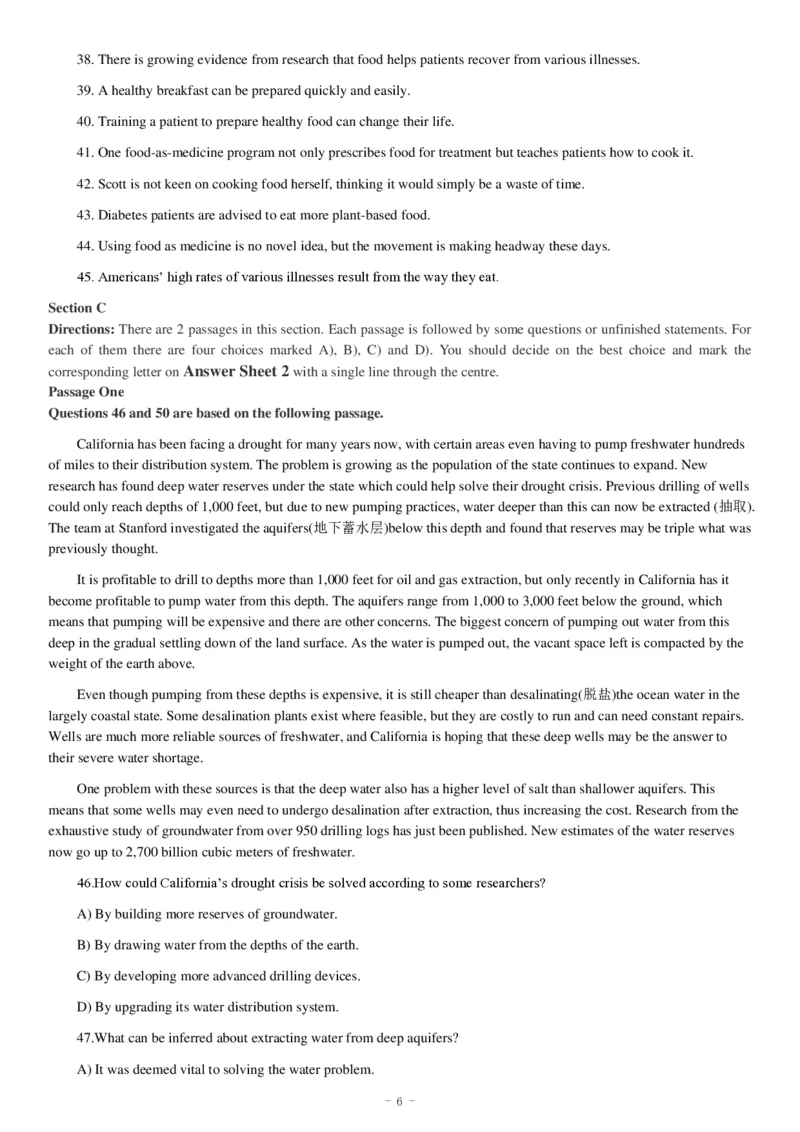
Passage One
&’22’-1M,1
Questions 46 to 50 are based on the following passage.
;012)+5,2C%)5:"’(1=’21<5,)91G5HH5>+,-8’22’-1B
Shoppers in the UK are spending less money on toilet paper to save money, research has shown.
T’=>>(.)/14’( ^\7.( )>(1-/12 *())5=1(3 =14=/*(4>7>(.4=)70( 5=1(3$ .()(7.:’’7))’=61%
Penny-pinching UK consumers choose cheaper products from discounters such as Aldi and Lidl
#(113,>/1:’/12 ^\:=1)85(.):’==)( :’(7>(.>.=-8:4)+.=5 -/):=814(.))8:’7)"*-/71-R/-*
rather than luxury alternatives.
.74’(.4’71*8G8.3 7*4(.174/0()%
This has wiped 6off the value of the soft tissue paper market in the UK. It has shrunk from
&’/)’7)6/>(-IZ =++4’( 07*8( =+4’( )=+44/))8( >7>(.57.E(4/14’( ^\%N4’7))’.81E+.=5
S1.19 billion in 201l to S1.12 billion in 2015,according to a new report from market research company
f$%$M ;/**/=1/1AQ$$ 4=f$%$A ;/**/=1/1AQ$H$7::=.-/12 4=7 1(6.(>=.4+.=557.E(4.()(7.:’:=5>713
Mintel. Furthermore, the future of the market looks far from rosy, with sales expected to fall further to
X/14(*%K8.4’(.5=.($ 4’( +848.( =+4’( 57.E(4*==E)+7.+.=5.=)3$6/4’)7*()(G>(:4(-4=+7**+8.4’(.4=
S1.11 billion in 2016.
f$%$$ ;/**/=1/1AQ$I%
In the last year alone, despite an increase in the UK population and a subsequent rise in the
N14’( *7)43(7.7*=1($ -()>/4( 71/1:.(7)( /14’( ^\>=>8*74/=171-7 )8;)(B8(14./)( /14’(
number of households, sales of toilet paper fell by 2?with the average household reducing their toilet
185;(.=+’=8)(’=*-)$)7*()=+4=/*(4>7>(.+(**;3AZ$6/4’4’( 70(.72( ’=8)(’=*-.(-8:/12 4’(/.4=/*(4
roll spending from S43 in 2014 to S41 in 2015.
.=**)>(1-/12 +.=5fFC /1AQ$F 4=fF$ /1AQ$H%
Overall, almost three in five people say they try to limit their usage of paper—-including facial
U0(.7**$ 7*5=)44’.(( /1+/0( >(=>*( )73 4’(3 4.3 4=*/5/44’(/.8)72( =+>7>(.’/1:*8-/12 +7:/7*
tissue and kitchen roll—to save money."Strength, softness and thickness remain the leading indicators
4/))8( 71-E/4:’(1.=**’4=)70( 5=1(3%%T4.(124’$)=+41())71-4’/:E1()).(57/14’( *(7-/12 /1-/:74=.)
o=f+ t4o=i/l*(e4t >p7a>p(e.r qBu8a7l*/i4t3y$, 6wi/4t’h @j8u)s4t 7a )s5ma7l**l p>r.=o>po=r.4t/i=o1n =o+f :c=on1s)8um5e(r.s) p>r.e(f+e(r.r./i1n2g 5mo=r.e( l*u8xGu8r.i/=ou8s)
alternatives, such as those with flower patterns or perfume,"said Mintel analyst Jack Duckett."These
7*4(.174/0()$ )8:’7)4’=)( 6/4’+*=6(.>744(.1)=.>(.+85($& )7/-X/14(*717*3)4[7:E?8:E(44%%&’()(
2017.6/6(第2套)
!"#$%& ’’’’&!!!""e(xtGr4.a7 f+e(a7t4u8r.e(s) 7a.r(e -d(e(e5me(d- u8n1ne1c(e:s(s)a)r7y. 3by; 3th4’e( m5aj7o@r=i.t/4y3 o=f+ )s’h=op>p>e(r.s),$ w6h’i/c:h’ p>r.o=b;a7b;ly*3 r.e(f+l*(e:c4t)s ’h=o6w t4’h(e)s(e
types of products are typically more expensive than regular toilet paper, even when on special offer."
43>()=+>.=-8:4)7.( 43>/:7**3 5=.( (G>(1)/0( 4’71.(28*7.4=/*(4>7>(.$ (0(16’(1=1)>(:/7*=++(.%&
While consumers are spending less on toilet paper, they remain fussy—in theory at least—when it
O’/*( :=1)85(.)7.( )>(1-/12 *())=14=/*(4>7>(.$ 4’(3 .(57/1+8))3’/14’(=.3 74*(7)4’6’(1/4
comes to paper quality. Top of Britons'toilet paper wish list is softness(57?ollowed by strength
:=5()4=>7>(.B87*/43%&=>=+<./4=1)P4=/*(4>7>(.6/)’*/)4/))=+41())!HJZ" +=**=6(-;3 )4.(124’
(!4F5HZ?n"d7 1t-h4’i/c:Ek1n(e))s!sC(I3Z6"?%
One in 10 buyers rank toilet rolls made from recycled paper among their top considerations,
U1( /1$Q ;83(.).71E4=/*(4.=**)57-( +.=5 .(:3:*(->7>(.75=12 4’(/.4=>:=1)/-(.74/=1)$
highlighting how overall the environment is much less of a consideration for shoppers than product
’/2’*/2’4/12 ’=6=0(.7**4’( (10/.=15(14/)58:’*())=+7 :=1)/-(.74/=1+=.)’=>>(.)4’71>.=-8:4
quality. In a challenge for manufacturers,81of paper product users said they would consider buying
B87*/43%N17 :’7**(12( +=.5718+7:48.(.)$L$Z =+>7>(.>.=-8:48)(.))7/-4’(3 6=8*-:=1)/-(.;83/12
recycled toilet tissue if it were comparable in quality to standard paper.
.(:3:*(-4=/*(44/))8( /+/46(.( :=5>7.7;*( /1B87*/43 4=)471-7.->7>(.%
46. The market sales of toilet paper have decreased because _____.
FI%&’( 57.E(4)7*()=+4=/*(4>7>(.’70( -(:.(7)(-;(:78)( %
A)"B"rie(n1d-i/n1g2 o=n1 i/4t
B<) "it/s4) p>r.i/:ce(s) ’h7av0e( 2go=n1e( u8p> o=v0e(r. t4’he( 3y(e7ar.)s
C) its quality has seen marked improvement
9" /4)B87*/43 ’7))((157.E(-/5>.=0(5(14
D?) "Brd( -th4’e (h’ab7i;t/4 o=f+ )s7a0v/i1n2g
47. What does the author think of the future of the tissue paper market in the UK?
FJ%O’74-=()4’( 784’=.4’/1E=+4’( +848.( =+4’( 4/))8( >7>(.57.E(4/14’( ^\*
A")I"t N4wi6ll/* *e(xGp>a7n1d- i/n1 t4/i5me(.% C9) "ItN4 w6il/*l* (eGx>p(e.r/i(e1n:c(e 8u>p)s 7a1n-d -d=o6wn1s).%
B)o=p>u8l*a7t4i/=o1n 2g.r=o6ws).%
48. What does Jack Duckett say about toilet paper?
FL%O’74-=()[7:E?8:E(44)73 7;=844=/*(4>7>(.*
A)" "SpTe>c(ia:l/7 *of=f+e+(r.s) w6o=ul8d*- p>ro.=m5ot=e4 (it/s4) s)a7l*e(s).%
B)< "Co9n=su1m)e8r5s (a.)re7 .l(oy*=a3l7 t*o4 =c:er(t.4a7i/n1 b;r.a7n1d-s).%
C)9L"uxRu8rGi8o.u/s= 8f)ea+(t7u4r8e.s( )ad7d- -m5uc8h: ’to4 =th4’e( p>r.i/c:e(.%
D?)C"on9s=u1m)e8r5s (h.a)v’e7 0a( v7ar0i7e.t/(y4 3t4o= c:h’o=o=s)e( f+.r=o5m.%
49. What do we learn about Britons concerning toilet paper?
FM%O’74-=6( *(7.17;=84<./4=1):=1:(.1/12 4=/*(4>7>(.*
A")T"he&y’ a(r3e 7p.a(r>ti7c.u4/l:a8r* 7a.b7ou;t= 8t4he4’ q(uaBl8i7t*y/4 3of= +t4o=i/l*e(t4 >p7ap>e(r..%
B)They emphasize the strength of toilet paper the most.
<" &’(3 (5>’7)/]( 4’( )4.(124’=+4=/*(4>7>(.4’( 5=)4%
C)9T"he&y ’p(r3ef>e.r( +(ch.e:a’p( 7to>i4l=e/t* (p4a>p7e>r (t.o4 =re.c(y:c3l:e*d( -to4=il/*e(t4 >pa7p>e(r..%
D)They reject using toilet paper with unnecessary features.
?" &’(3 .(@(:48)/12 4=/*(4>7>(.6/4’811(:())7.3 +(748.()%
50.What can we infer from the last paragraph?
HQ%O’74:716( /1+(.+.=54’( *7)4>7.72.7>’*
A)"M"orXe =a.n(d 7m1o-re5 =Br.(itp7e>r( .to4= p>r.o=t4e(c:t4 4t’h(e (e1n0v/i.r=o1n5me(n1t4.%
B)e7r> (m.an5uf7a1c8t+u7r:e4r8s. (a.r)e7 .f(ac+i7n:g/ 1a2 g7re2a.t( 7c4h:a’ll7e**n(g1e2 (in/ 1pr>o.m=o5ti=n4g/1 2it/s4 )s)a7l*e(s).%
C)9T"oi&l=e/t* (p4a>p7e>r( .ma5nu7f1a8c+t7u:r48er.(s. )co:m=p5et>e( 4w(i6th/ 4’on=e1 a(n7o1th=e4’r (t.o4 =im/5pr>o.v=e0 (pr>o.d=u-c8t: 4quBa8l7i*t/4y3.%
D?)E"nvVi1r0o/n.m=e1n5ta(l1 4p7r*o>t.e=c4t(i:o4/n= 1is/ )n1o=t 4m5uc8h: ’of= +a7 c:o=n1ce:n( .1wh6en’ (B1ria7p>e(r..%
Passage Two
&’22’-1I>5
Questions 51 to 55 are based on the following passage.
;012)+5,2:#)5::’(1=’21<5,)91G5HH5>+,-8’22’-1B
"One of the reasons I find this topic very interesting is because my mom was a smoker when I was
%U1( =+4’( .(7)=1)N+/1-4’/)4=>/: 0(.3 /14(.()4/12 /);(:78)( 53 5=567)7 )5=E(.6’(1N67)
younger,"says Lindson-Hawley, who studies tobacco and health at the University of Oxford.
3=812(.$& )73)R/1-)=1,D76*(3$ 6’=)48-/()4=;7::=71-’(7*4’744’( ^1/0(.)/43 =+UG+=.-%
By studying about 700 adult smokers, she found out that her mom quit the right way—by stopping
<3 )48-3/12 7;=84JQQ 7-8*4)5=E(.)$ )’( +=81-=844’74’(.5=5B8/44’( ./2’4673’;3 )4=>>/12
abruptly and completely.
7;.8>4*3 71-:=5>*(4(*3%
In her study,participants were randomly(随机地) assigned to two groups. One had to quit
N1’(.)48-3$ >7.4/:/>714)6(.( #)3/"2-*!(cid:152)(cid:255)t" 7))/21(-4=46=2.=8>)%U1( ’7-4=B8/4
abruptly on a given day,going from about a pack a day to zero. The other cut down gradually over the
7;.8>4*3 =17 2/0(1-73$ 2=/12 +.=57;=847 >7:E7 -73 4=](.=%&’( =4’(.:84-=612.7-87**3 =0(.4’(
co:u=r8s.e) (of= +tw46o =we6e(ks(.E )P%eo#p(l=e> *i(n /1bo;t=h 4’gr2o.u=p8s> u)s8ed)( -nic3o&t5"in$&e3(,尼!= 古丁
o
)
3
)"pa>t7c4:h’e(s) b;e(fo+=r.e( t4h’e(y3 qBu8i/t4$,/i1n
addition to a second form of nicotine replacement,like gum or spray. They also had talk therapy with
7--/4/=14=7 )(:=1-+=.5=+1/:=4/1( .(>*7:(5(14$ */E( 285=.)>.73%&’(3 7*)=’7-47*E4’(.7>3 6/4’
a nurse before and after quit day.
7 18.)( ;(+=.( 71-7+4(.B8/4-73%
2017.6/7(第2套)
!"#$%& ’’’’$!!!""Six months out, more people who had quit abruptly had stuck with it—more than one-fth of
T/G5=14’)=84$ 5=.( >(=>*( 6’=’7-B8/47;.8>4*3 ’7-)48:E6/4’/4’5=.( 4’71=1(,+/+4’=+
them, compared to about one-seventh in the other group. Although these numbers appear low, it is
4’(5$ :=5>7.(-4=7;=84=1(,)(0(14’/14’( =4’(.2.=8>%"*4’=82’4’()( 185;(.)7>>(7.*=6$ /4/)
much higher than if people try without support.
58:’’/2’(.4’71/+>(=>*( 4.3 6/4’=84)8>>=.4%
And the quit rates were particularly convincing given that before the study started, most of the
"1-4’( B8/4.74()6(.( >7.4/:8*7.*3 :=10/1:/12 2/0(14’74;(+=.( 4’( )48-3 )47.4(-$ 5=)4=+4’(
people had said they'd rather cut down gradually before quitting."If you're training for a marathon,
>(=>*( ’7-)7/-4’(3P-.74’(.:84-=612.7-87**3 ;(+=.( B8/44/12%%N+3=8P.( 4.7/1/12 +=.7 57.74’=1$
you wouldn't expect to turn up and just be able to run it. And I think people see that for smoking as
3=86=8*-1P4(G>(:44=48.18>71-@8)4;( 7;*( 4=.81/4%"1-N4’/1E>(=>*( )(( 4’74+=.)5=E/12 7)
well. They think,'Well, if I gradually reduce, it's like practice,'"says Lindson-Hawley. But that
6(**%&’(3 4’/1E$ (O(**$ /+N2.7-87**3 .(-8:($ /4P)*/E( >.7:4/:($)& )73)R/1-)=1,D76*(3%<844’74
wasn't the case. Instead of giving people practice, the gradual reduction likely gave them cravings
67)1P44’( :7)(%N1)4(7-=+2/0/12 >(=>*( >.7:4/:($ 4’( 2.7-87*.(-8:4/=1*/E(*3 270( 4’(5 5#)4&37’
(!瘾4)" 7a1n-d 6wi/4t’h-dr.7a6wa7l* )s3y5mp>t4o=m5s )be;f(o+r=e. (t4h’e(y3 e(v0e(n1 r.e(a7c:h’e(d- qBu8it/4 d-a7y3,$ 6w’hi/:c’h :c=o8u*l-d ;b(e 6wh’y3 +f(e6we(r. >pe(o=p>l*e( /i1n
that group actually made it to that point."Regardless of your stated preference, if you're ready to quit,
4’742.=8>7:487**3 57-( /44=4’74>=/14%%a(27.-*())=+3=8.)474(->.(+(.(1:($/+3=8P.( .(7-3 4=B8/4$
quitting abruptly is more effective," says Dr. Gabriela Ferreira."When you can quote a specific
B8/44/12 7;.8>4*3 /)5=.( (++(:4/0($& )73)?.%S7;./(*7 K(..(/.7%%O’(13=8:71B8=4( 7 )>(:/+/:
number like a fifth of the patients were able to quit, that's compelling. It gives them the
185;(.*/E( 7 +/+4’ =+4’( >74/(14)6(.( 7;*( 4= B8/4$ 4’74P):=5>(**/12%N42/0()4’(5 4’(
encouragement,I think, to really go for it,"Ferreira says.
(1:=8.72(5(14$ N4’/1E$ 4=.(7**3 2=+=./4$& K(..(/.7 )73)%
People rarely manage to quit the first time they try. But at least, she says, they can maximize the
#(=>*( .7.(*3 57172( 4=B8/44’( +/.)44/5( 4’(3 4.3%<8474*(7)4$ )’( )73)$ 4’(3 :7157G/5/]( 4’(
odds of success.
=--)=+)8::())%
51. What does Lindson-Hawley say about her mother?
H$%O’74-=()R/1-)=1,D76*(3 )73 7;=84’(.5=4’(.*
A") "ShTe’ (quBi8t/ 4s)m5ok=iEn/g1 2wi6th/4 ’he’r( .da-u7g8h2t’e4r('.sP) h’e(l*p>.%
B)< "ShTe’ (su)c8c:e:e(d(e-d( i-n/ 1quBi8t/t44i/n1g2 s)m5o=kEin/1g2 a7b;r.u8p>t4l*y3.%
C)9 "ShTe’ (wa6s 7a)ls7o*) =a 7re.s(e)a(r7c.h:e’r( .o=f +t4o=b;a7c:c:o= a7n1d- h’e(a7l*t4h’.%
D)? "ShTe’ (st)u4d8i-e/d( -th4’e( s)m5ok=iEn/g1 2pa>t7t4e4(r.n1s) o=f+ 7ad-u8l*4t )s5m=okEe(r.s).%
52. What kind of support did smokers receive to quit smoking in Lindson-Hawley's study?
HA%O’74E/1-=+)8>>=.4-/-)5=E(.).(:(/0( 4=B8/4)5=E/12 /1R/1-)=1,D76*(3P))48-3*
A)" "Th&e’y (w3e6re( .g(iv2e/0n( 1ph>ys’i3c)a/:l7 *tr4.a7i/n1i/n1g2.% C)9 "Th&e’y( 3we6re( .(en(c1o:u=r8a.g7e2d( -by; 3ps>y)c3h:o’l=o*g=i2s/)t4s).%
B<)T"he&y’ (w3er6e( .l(oo*k=e=dE (a-ft7e+4r( .by; 3ph>y’s3i)c/:i/a7n1s).% D)? "Th&ey’ (w3e6re( .o(ff=e++r(e.d( -ni1c/o:t=i4/n1e( r.e(p>l*7a:c(e5me(n1t4s).%
53. How does Dr. Gabriela Ferreira view the result of Lindson-Hawley's experiment?
HC%D=6-=()?.%S7;./(*7 K(..(/.7 0/(64’( .()8*4=+R/1-)=1,D76*(3P)(G>(./5(14*
A)"I"t Ni4s/ )id/-e(a7l*i/z]e(d-.% C) 9 I " t N i 4 s / ) e ( n 1 c : o = u 8 r . a 7 g 2 i / n 1 g 2 . %
B) < I " t N4 is /) u 8 n 1 e ( x G p > e ( c : t 4 e ( d - . % D)?I"t Ni4s/ )m5is/)l*e(a7d-i/n1g2.%
54H.F %T&he’ (i/d-e(a7 o=f+"a% 7ma5ra7t.7h4o’n="1(&Lin!eR /21,( APa$ra#.75.)7i%lHlu"st/*r*8a)t4e.s7 4(t)he4 ’p(op>u=l>a8r* 7b.el;i(e*/f( +th4’a7t4 qBu8i/t44t/i1n2g )5sm=oEk/i1n2g
%
A)" "is/) s)o=m5et(h4’i/n1g2 f+(e6w c:a7n1 7a:c:c=o5mp>l*i/)s’h C)9 "re.q(uBi8r/e.s( )a 7l*o=t4 o=f+ >p7at4/i(e1n:c(e
B) < " ne 1 e ( d ( s - ) so ) m = e 5 p ( ra > c .7 t : ic 4/ e : ( fi +/ r . s ) t 4 D)? "is/ )a7 c:h’al7l**e(n1g2e( a7t4 4t’h(e ;b(e2g/i1n1n/i1n2g
55. What happens when people try to quit smoking gradually?
HH%O’74’7>>(1)6’(1>(=>*( 4.3 4=B8/4)5=E/12 2.7-87**3*
A)" "Th&ey’ (f3in+/d1 -it/ 4e(v0e(n 1mo5r=e. (di-f/f+i+/c:u8l*t4.%
B)< "Th&e’y( 3ar7e. (si)m/5pl>y* 3u8na1b7l;e*( t4o= m5a7keE (i/t4.%
C)9 "Th&e’y( 3sh)’o=w6 fe+(w6er( .w6it/4h’d-r.a7w6a7l* )s3y5mp>t4=o5ms).%
D)? "Th&e’y (f3ee+(l( *mu5c8h :l’es*(s) )pa>i7n/ 1in/1 t4h’e( p>r.o=c:e(s)s).%
Part IV Translation
&’()$ I(’,2H’)+5, (!3.0" m/i+n,u0t)e1s2)"
Directions:For this part, you are allowed 30 minutes to translate a passage from Chinese into
3+(14)+5,2# !"#$%&’()#$$ *"+)#,)--".,/012&3+$,’$" $#)3’-)$,)()’’)7,:#"2 @%&3,’,&3$"
English. You should write your answer on Answer Sheet 2.
D37-&’%89"+’%"+-/.#&$,*"+#)3’.,#"3%&’()*+,))-"%
长J江5是C亚D洲E最_长J、,G世H界z上第!三F长J的5河B流K。- 长J江5流K经,多(cid:139)种(cid:154)不‚同Z的5生h态(cid:253)系0统h,$是C诸6多(cid:139)濒7危L物(种(cid:154)的5栖8息9地t,$
灌9溉:了(cid:152)中d国e五(cid:139)分:之l一m的5土;地t。-长J江5流K域n(!ri./v0e(r. ;ba7s)/i1n")<居ı住:着d中e国F三:分l之m一5的(cid:153)人口v。- 长J江5在(cid:143)中d国e历x史y、,q文
化@和´经,济=上z起(cid:223)着:很(cid:201)大)的5作£用¡。-长J江5三F角>洲E(!d-e(l*4t7a")?产“出(cid:139)多{达AQ2Z0的5中d国e国e民@生h产?总‡值A。-几j千(cid:229)年(cid:147)来(cid:224),$J长5江一m
直(cid:201)被N用¡于Y供e水R、,运˘输B和´工£业(cid:239)生h产?。-长J江5上z还‰坐(cid:127)落(cid:155)着:世G界H最_大)的5水R电6站3。-
2017.6/8(第 2套)
!"#$%& ’’’’+!!!""2017年6月大学英语四级考试真题(第 3套)
!"#$! %"#$%&’()*+,!- .."
Part I Writing
&’()! *(+)+,- (!3.0" m/i+n,u0t)e1s2)"
Directions;For this part,you are allowed 30 minautes to write an advertisement on your campus
3+(14)+5,2# !"#$%&’()#$$ *"+)#,)--".,/012&3+$,’$" .#&$,)3)/4,#$&’,2,3$"3*"+#5)2(+’
website to sell a computer you used at college. Your advertisement may include its
.,6’&$,$" ’,--)5"2(+$,#*"++’,/)$5"--,7,89"+#)/4,#$&’,2,3$2)*&35-+/,&$’
b6r#a)n3d,/s$p’e(c,i5f&c:a&t5)io$&n"s3/’fNe:a,t)u$r+e#s,,’ $c5o"m3nd/i&$t&i"o3n )a3m/d (p#r&i5c,e$,)a3nd/ y*o"u+r# 5c"o3nt$)a5c$t &3in:"f#o2rm)a$t&i"o3n8. 9Y"o+u
should write at least 120 words but no more than 180 words.
’%"+-/.#&$,)$-,)’$!"#."#/’6+$3" 2"#,$%)3!$#."#/’8
!
!
!
Part Ⅱ Listening Comprehension
&’()" 6+2)1,+,-75/8(191,2+5, (!2!5: m/i+n,u0t)e1s2)"
说|明K∶$}由~于2A0Q1$J7 !年I6 "月’四(级)考*试(cid:127)全(cid:128)国(cid:129)共)考(cid:130)了A2套.听(cid:131)力(cid:132),%(cid:133)本.套+真,题(cid:131)听(cid:132)力a与(cid:134)前2A套.内(cid:135)容(cid:136)完(cid:137)全(cid:127)一(cid:138)样(cid:139),%只(cid:140)是(cid:141)顺(cid:142)
序(cid:143)不(cid:144)一(cid:138)样(cid:139),%因(cid:145)此(cid:146)在(cid:147)本(cid:133)套.真+题,中(cid:148)不(cid:144)再(cid:149)重(cid:150)复(cid:151)出(cid:152)现i。&
Part Ⅲ
&’()# R F e 1 a ’ d < i + n , g - 7 Co 5 m / p 8 r ( e 1 h 9 e 1 n , s 2 i +5 o , n (!4C0" m/i+n,u0t)e1s2)"
Section A
!"#$%&’(
Directions; In this section, there is a passage with ten blamks. You are required to select one word
3+(14)+5,2# ;3$%&’’,5$&"3$ $%,#,&’)()’’)7,.&$%$,36-)3?’89"+)#,#,=+&#,/$" ’,-,5$"3,."#/
for each blank from a list of choices given in a word bank following the passage. Read the
:"#,)5%6-)3? :#"2)-&’$":5%"&5,’7&4,3&3)."#/6)3? :"--".&37 $%,()’’)7,8C,)/$%,
passage through carefully before making your choices. Each choice in the bank is
()’’)7,$%#"+7%5)#,:+--*6,:"#,2)?&37 *"+#5%"&5,’8D)5%5%"&5,&3$%,6)3? &’
i&d/e,n3t$i&f:&i,e/d 6b*y )a -l,e$$t,t#e8r.E -P,l)e’a,se2 m)a#r?k $%t,he5 "c#o#r,r’e(s"p3o/nd&3in7g -,l$e$t,#te:r" #fo,r) 5e%ac&h$ ,i2te"m3 on% &A’ns(w)e*r
Sheet 2 with a single line through the centre. You may not use angy of the words in the
+,))-".&$%)’&37-,-&3,$%#"+7%$%,5,3$#,89"+2)*3"$+’,)3*":$%,."#/’&3$%,
bank more than once.
6)3? 2"#,$%)3"35,8
Qu=e>s"t,i$o%n&s’ ,2?6 @to$& 3A5B a/r+e" bCa/s,e"d9 o&n’ t$h7e" fDo&le(o=p>le*( s)t4i/l**l :c=o5mp>l*a7i/1n a7b;o=u8t4 t4h’e(i/r. NI1n4t(e.r1n(e4t ;b(e/i1n2g
too slow.
4==)*=6%
New York's Attorney General's office 26an investigation in the fall into whether or not
Y(6_=.EP)"44=.1(3 S(1(.7*P)=++/:( !AI! 71/10()4/274/=1/14’( +7**/14=6’(4’(.=.1=4
Verizon,Cablevision and Time Warner are delivering broadband that's as fast as the providers 27it
W(./]=1$ 97;*(0/)/=171-&/5( O7.1(.7.( -(*/0(./12 ;.=7-;71-4’74P)7)+7)47)4’( >.=0/-(.)!AJ! /4
is. Earlier this month,the office asked for the public's help to measure their speed results, saying
/)%V7.*/(.4’/)5=14’$ 4’( =++/:( 7)E(-+=.4’( >8;*/:P)’(*>4=5(7)8.( 4’(/.)>((-.()8*4)$ )73/12
consumers 28 to get the speeds they were promised."Too many of us may be paying for one
:=1)85(.)!AL! 4=2(44’( )>((-)4’(3 6(.( >.=5/)(-%%&==5713 =+8)573 ;( >73/12 +=.=1(
thing, and getting another,"the Attorney General said.
4’/12$ 71-2(44/12 71=4’(.$& 4’( "44=.1(3 S(1(.7*)7/-%
If the investigation uncovers anything, it wouldn't be the first time a telecom provider got into
N+4’( /10()4/274/=181:=0(.)7134’/12$ /46=8*-1P4;( 4’( +/.)44/5( 7 4(*(:=5 >.=0/-(.2=4/14=
!2A9M !ove=r0 (t.he4’ (br;o.a=d7b-a;n7d1 s-pe)e>d(s( -i)t /4pr>o.m=i5s/e)d( -an7d1 -de-l(i*v/0e(r.e(d- c:u8s)t4o=m5e(r.s).% B((-)7+4(.:8)4=5(.):=1)85(-7 :(.47/175=814=+!C$!%
Even when they stay on the right side of the law, Internet providers arouse customers'anger over
V0(16’(14’(3 )473 =14’( ./2’4)/-( =+4’( *76$ N14(.1(4>.=0/-(.)7.=8)( :8)4=5(.)P712(.=0(.
bandwidth speed and cost. Just this week,an investigation found that media and telecom giant
;71-6/-4’)>((-71-:=)4%[8)44’/)6((E$ 71/10()4/274/=1+=81-4’745(-/7 71-4(*(:=5 2/714
Comcast is the most 32 provider. Over 10 months,Comcast received nearly 12,000 customer
9=5:7)4/)4’( 5=)4!CA! >.=0/-(.%U0(.$Q 5=14’)$ 9=5:7)4.(:(/0(-1(7.*3 $A$QQQ :8)4=5(.
c:o=m5pl>a*i7n/1t4s),$ m5a7n1y3 3!3 CtCo! it4=s /m4)on5t=hl1y4’ *d3at-a7 47ca:p7 >an7d1 -ov"e4r,#a)g7e,(!超fl过(cid:144)额D度¢的5)"c:h’a7r.g2e(s).%
STom=e5 A(m"er5ic(a./n:s7 1a)re7 .g(et2t(i44n/g1 2so) =3!4 CwFit!h 6In/t4’erNn1e4t( .p1r(o4v>i.d=e0r/s- (t.h)ey4’'(re3 P.j(us@8t) 4gi2v/0i/n1g2 u8p>.% A" r.e(c:e(n1t4 )s4t8u-d3y
found that the number of Americans with high-speed Internet at home today 35 fell during the last
+=81-4’744’( 185;(.=+"5(./:71)6/4’’/2’,)>((-N14(.1(474’=5( 4=-73 !CH! +(**-8./12 4’( *7)4
two years,and 15of people now consider themselves to be"cord-cutters.
46=3(7.)$ 71-$HZ =+>(=>*( 1=6:=1)/-(.4’(5)(*0()4=;( %:=.-,:844(.)%&
A) accusations I) hated
"" 7::8)74/=1) N" ’74(-
B)actully J) launched
<" 7:487**3 [" *781:’(-
C) claim K) relating
9" :*7/5 \" .(*74/12
D?)"co:m=m5u5n8i1c/a:t74i/1n2g L)R" t4i/5m(e)s
E) complain M) trouble
V" :=5>*7/1 X"4.=8;*(
F) data N) usually
K" -747 Y" 8)87**3
G) deserved O) worried
S" -()(.0(- U" 6=../(-
H) frustrated
D" +.8)4.74(-
2017.6/1(第3套)
!"#$%& ’’’’#!!(""Section B
!"#$%&’)
Directions: In this section,you are going to read a passage with ten statements attached to it. Each
3+(14)+5,2# ;3$%&’’,5$&"3$ *"+)#,7"&37 $" #,)/)()’’)7,.&$%$,3’$)$,2,3$’)$$)5%,/$" &$8D)5%
statement contains information gioen in one of the paragraphs.Identifu the paraqraph
’$)$,2,3$5"3$)&3’&3:"#2)$&"37&4,3&3"3,":$%,()#)7#)(%’8;/,3$&:*$%,()#)7#)(%
from which the information is derioed. You may choose a paragraph more than once.
:#"2.%&5%$%,&3:"#2)$&"3&’/,#&4,/89"+2)*5%""’,)()#)7#)(%2"#,$%)3"35,8
Each paragraph is marked with a letter. Answer the questions by marking the
D)5%()#)7#)(%&’2)#?,/.&$%)-,$$,#8<3’.,#$%,=+,’$&"3’6* 2)#?&37 $%,
co57"r##e,s’p(o"n3d/in&3g7 l-e,t$$t,e#r" 3on% A&n’s(ue)r* +Sh,e)e)t- "2.%
From Accountant to Yogi: Making a Radical Career Change
L(5/N4450,)’,))5_5-+# W’Q+,-’F’<+4’H7’(11(79’,-1
A")A"t "s4om)e= 5po(in>t=,/1al4$mo7s*t5 a=l)l4 7o*f* =u+s 8w)il6l/ **ex(pGe>r(i.e/n(c1e: (a 7pe>r(i.o/=d- o=f+ r.a7d-i/c:a7l* >p.r=o+f(e)s)s/=io1n7a*l: ’c7h1an2g(e%. TS=o5me( o=f+ 8u)s
will seek it out;for others it will feel like an unwelcome intrusion into otherwise stable careers.
6/**)((E/4=84+ +=.=4’(.)/46/**+((**/E( 71816(*:=5( /14.8)/=1/14==4’(.6/)( )47;*( :7.((.)%
EVit/4h’e(r. w6a7y3,$ w6e (ha’v7e0 (c:ho’i=c/:e(s) a7b;o=u8t4 h’o=w6 w6e (re.s(p)o>n=d1 -to4= i/t4 6wh’e(n1 i/t4 :c=o5me(s).%
B)it6h/ 4’yo3ga= 2e7nt(r1e4.p(r>e.n(e1u(r8 .LeRa(h7 ’Zakcc7a:r:i7a./,7 $wh6o ’p=ut> 8h4er’s(e.l)(f* +th4’r.o=u8g2h’ th4’e( f+i/r.(e =o+f
change to completely reinvent herself. In her search to live a life of purpose,Leah left her high-
:’712( 4=:=5>*(4(*3 .(/10(14’(.)(*+%N1’(.)(7.:’4=*/0( 7 */+( =+>8.>=)($ R(7’*(+4’(.’/2’,
paying accounting job,her husband, and her home. In the process, she built a radically new life
>73/12 7::=814/12 @=;$ ’(.’8);71-$ 71-’(.’=5(%N14’( >.=:())$ )’( ;8/*47 .7-/:7**3 1(6*/+(
and career. Since then,she has founded two yoga studios, met a new life partner,and formed a
71-:7.((.%T/1:( 4’(1$ )’( ’7)+=81-(-46=3=27 )48-/=)$ 5(47 1(6*/+( >7.41(.$ 71-+=.5(-7
new community of people. Even if your personal reinvention is less drastic, we think there are
1(6:=5581/43 =+>(=>*(%V0(1/+3=8.>(.)=17*.(/10(14/=1/)*())-.7)4/:$ 6( 4’/1E4’(.( 7.(
lessons from her experience that apply.
*())=1)+.=5’(.(G>(./(1:( 4’747>>*3%
C)9W"heOr’e( .d(o -t=he4 ’s(ee)(d(s- )of= +ch:a’n7g1e2 (c:o=m5e (fr+o.=m5? *Th&e’ (NaYt7i4v/0e( A"m5er(i.c/:a7n1 INn1d-i/7a1n)s ’h7a0v(e 7a )s7a3y/1i2n#g:%"#P7a3y
attention to the whispers so you won't have to hear the screams."Often the best ideas for big
744(14/=14=4’( 6’/)>(.))=3=86=1P4’70( 4=’(7.4’( ):.(75)%& U+4(14’( ;()4/-(7)+=.;/2
c:ha’n7g1e2s( )co:m=e5 f(ro+m.= u5ne8x1pe(cGt>e(d: 4p(l-ac>e*s7—:(-)i’t'/s4 P)ju@8st) 4a7 m5at7t4e4(r. o=f+ t4u8n1i/n1g2 i/1n.% SGr.e(a7t4 l*(e7a-de(r.)s .r(e:c=o2gn1i/]z(e 4t’h(e
weak signals or slight signs that point to big changes to come. Leah reflects on a time she listened
6(7E)/217*)=.)*/2’4)/21)4’74>=/144=;/2 :’712()4=:=5(%R(7’.(+*(:4)=17 4/5( )’( */)4(1(-
to the whispers:"About the time my daughter was five years old, I started having a sense that'this
4=4’( 6’/)>(.)#%";=844’( 4/5( 53 -782’4(.67)+/0( 3(7.)=*-$N)47.4(-’70/12 7 )(1)( 4’74(4’/)
isn't right.'"She then realized that her life no longer matched her vision for it.
/)1P4./2’4%)& T’( 4’(1.(7*/](-4’74’(.*/+( 1=*=12(.574:’(-’(.0/)/=1+=./4%
D?) "Up^ >unt8i1l4 /*th4’a7t 4p>o=i/n1t4,$LeRa(h7 ’ha’d7 -fol+=l*o*w=e6d( -tr4a.d7i-t/i4/o=n1a7l* m5ea(s7u)r8e.(s) o=f +s)u8c:c:e(s)s).% A"ft+4e(r. g2r.a7d-u8a7t4i/1n2g 6wi/t4’h 7a
de-g(r2e.e( (in/1 b;u8si)/n1e(s)s) a7n1d- a7c:c:o=u8nt1i4n/1g2,$ s)h’e( j@o=i/1ne(d- a7 p>u8b;l*i/:c 7a:c:c=o8un1t4/i1n2g +f/.i5rm$, 5ma7r..r/i(e-d$, ;b=o8u2gh’t4 7a ’h=o8us)e(,$
put lots of stuff in it, and had a baby."I did what everybody else thought looked successful,"she
>84*=4)=+)48++/1/4$ 71-’7-7 ;7;3%%N-/-6’74(0(.3;=-3 (*)( 4’=82’4*==E(-)8::())+8*$& )’(
says.Leah easily could have fallen into a trap of feeling content; instead, her energy sparked a
)73)%R(7’(7)/*3 :=8*-’70( +7**(1/14=7 4.7>=++((*/12 :=14(14+ /1)4(7-$ ’(.(1(.23 )>7.E(-7
p>er(i./o=d- o=f+ e(xGp>e(r.i/5me(n1t4a7t4i/=o1n 7a1nd- .r(e1n(ew6a7l*.%
E)VF"eeKl(in(g*/ 1t2he4 ’n(ee1d( (t-o 4c=ha:n’g7e1, 2L(e$ahR (s7t’ar)t4e7d. 4(pl-ay>i*7n3g /1w2it6h /f4’ut+u8r4e8 .p(os>s=i)b)i/l;i/t*/i4e/(s) b;y3 e(xGpl>o*=ri./n1g2 h’e(r. i/n1t4e(r.(es)t4)s
and developing new capabilities. First trying physical exercise and dieting,she lost some weight
71--(0(*=>/12 1(6:7>7;/*/4/()%K/.)44.3/12 >’3)/:7*(G(.:/)( 71--/(4/12$ )’( *=)4)=5( 6(/2’4
and discovered an iner strength."I felt powerful because I broke through my own limitations,"
71--/):=0(.(-71/11(.)4.(124’%%N+(*4>=6(.+8*;(:78)( N;.=E( 4’.=82’53 =61*/5/474/=1)$&
she recall.
)’( .(:7**)%
F)KH"owDev=e6r,( 0i(t. $w/a4s6 a7n)ot7h1e=r4 ’i(n.te/1re4(s.t( )t4ha4’t 7l4e*d( -LeRa(h7 ’to4 =ra.7d-ic/:a7l*l*y3 .r(e/i1n0v(e1n4t ’h(e.r)s(e*+l%f.%"NI .r(e5m(em5b;e(r .s)i/t44t/i1n2g =o1n
a bench with my aunt at a yoga studio,"she said,"and having a moment of clarity right then and
7 ;(1:’6/4’53 7814747 3=27 )48-/=$& )’( )7/-$ %71-’70/12 7 5=5(14=+:*7./43 ./2’44’(171-
there: Yoga is saving my life. Yoga is waling me up. I'm not happy and I want to change and I'm
4’(.(# _=27 /))70/12 53 */+(%_=27 /)67E/12 5( 8>%NP51=4’7>>3 71-N67144=:’712( 71-NP5
done with this."In that moment of clarity Leah made an important leap, conquering her inner
-=1( 6/4’4’/)%& N14’745=5(14=+:*7./43 R(7’57-( 71/5>=.4714*(7>$ :=1B8(./12 ’(./11(.
r.e(s)i/s)t47a1nc:e( t4=o :c’h7a1ng2e( 7an1d- m5a7kEin/1g2 a7 f+i/.r5m c:o=m5mi5t/m4e5n(t1 t4o4 =ta47kEe (b;ig/2g2e(r. s)t4e(p>s).%
GS)C"re9a.t(i7n4g/ 1t2he4 ’f(ut+8ur48e .(yo3u= 8wa6nt7 1i4s /a) 7lo*t= 4ea(s7i)e/r( .i/f+ 3yo=u8 a7r.e( r.e(a7d-y3 t4o= e(xGp>l*o=i/4t 4t’h(e =o>p>po=r.t48u1ni/4t/i(e)s4 ’t7h4at: =c5om(e
your way. When Leah made the commitment to change, she primed herself to new opportunities
3=8.673%O’(1R(7’57-( 4’( :=55/45(144=:’712($ )’( >./5(-’(.)(*+4=1(6=>>=.481/4/()
she may otherwise have overlooked. She recalls:
)’( 573 =4’(.6/)( ’70( =0(.*==E(-%T’( .(:7**)#
H)DO"neU d1a(y- a7 3m7an5 I7 1woNr6k=ed.E w(i-t6h,/ 4’R$yaan3,7 1wh$o6 h’a=d ’h7i-s ’o/f)f=i+c+e/: (ne1x(tG 4to4= m5in/1e(,$ s)a7i/d-,$"%LeRa(h7,’l$et*('4sP )g2o= l*=oo=kE a7t4
this space on Queen Anne."He knew my love for yoga and had seen a space close to where he
4’/))>7:( =1e8((1"11(%& D( E1(653 *=0( +=.3=27 71-’7-)((17 )>7:( :*=)( 4=6’(.( ’(
lived that he thought might be good to serve as a yoga studio. As soon as I saw the location,I knew
*/0(-4’74’( 4’=82’45/2’4;( 2==-4=)(.0( 7)7 3=27 )48-/=%"))==17)N)764’( *=:74/=1$NE1(6
this was it. Of course I was scared, yet I had this strong sense of "I have to do this."Only a few
4’/)67)/4%U+:=8.)( N67)):7.(-$ 3(4N’7-4’/))4.=12 )(1)( =+%N’70( 4=-=4’/)%& U1*3 7 +(6
months later Leah opened her first yoga studio, but success was not instant.
5=14’)*74(.R(7’=>(1(-’(.+/.)43=27 )48-/=$ ;84)8::())67)1=4/1)4714%
I)N" Cr9e.a(t7i4n/g1 2th4’e (f+u8t4u8r.e( t4a7kEe(s) t4/i5me(.% T&h’a7t4'P)s 6wh’y3 l*e(a7d-e(r.s) :c=on1t4/i1n8u(e 4t=o 5ma7n1a7g2e( t4h’e( p>r.e(s)e(n1t4 w6h’i/l*e( b;u8i/*l-d/i1n2g
toward the big changes of the future. When it's time to make the leap, they take action and
4=67.-4’( ;/2 :’712()=+4’( +848.(%O’(1/4P)4/5( 4=57E( 4’( *(7>$ 4’(3 47E( 7:4/=171-
immediately drop what's no longer serving their purpose. Initially Leah stayed with her accounting
/55(-/74(*3 -.=>6’74P)1=*=12(.)(.0/12 4’(/.>8.>=)(%N1/4/7**3 R(7’)473(-6/4’’(.7::=814/12
.j@=o;b 6wh’i/l*e( s)t47a.r4t/i1n2g 8u>p 4t’h(e 3y=o2ga7 s)t48ud-i/=o 4t=o 5ma7kEe( i/t4 a7l**l 6wo=r.kE.%
J)[S"ooTn= =a1ft7e+r4(,.s$he) ’k(neEw1 (s6he) ’h(ad’ 7t-o 4m=a5ke7 Ea( b7ol;d= *m-o5ve= 0t(o 4f=u+l8l*y*3 c:o=m5mi5t /4to4= h’e(r. n1e(w6 f+u8t4u8r.(e%. OWi/t4’h/i1n 46tw=o
2017.6/2(第3套)
!"#$%& ’’’’!!!(""y3e(a7r.s),$ LRe(a7h’ s)h’e(d- t4h’e( s)a7f+e(t43y =of+ ’h(e.r 7a:c:c=o8u1n4t/i1n2g @=jo;b 7a1n-d 5ma7d-e( t4’he( s)w6i/t4:c’h c:o=m5p>l*e(t4e(.% STu8c:h’ d-r.a7s)t4i/:c
change is not easy.
:’712( /)1=4(7)3%
K)Steering through change and facing obstacles brings us face to face with our fears.Leah reflects on
\" T4((./12 4’.=82’:’712( 71-+7:/12 =;)47:*();./12)8)+7:( 4=+7:( 6/4’=8.+(7.)%R(7’.(+*(:4)=1
one incident that triggered her fears, when her investors threatened to shut her down:"I was
=1( /1:/-(144’744./22(.(-’(.+(7.)$ 6’(1’(./10()4=.)4’.(74(1(-4=)’84’(.-=61# %N67)
probably up against the most fear I've ever had,"she says. "I had spent two years cultivating this
>.=;7;*3 8>727/1)44’( 5=)4+(7.NP0( (0(.’7-$& )’( )73)%%N’7-)>(1446=3(7.):8*4/074/12 4’/)
community,and it had become successful very fast, but within six months I was facing the prospect
:=5581/43$71-/4’7-;(:=5( )8::())+8*0(.3 +7)4$;846/4’/1)/G5=14’)N67)+7:/12 4’( >.=)>(:4
of losing it ll."
=+*=)/12 /47**%&
LR)S"heT ’c(on:n=e1c1te(d: 4(w-it6h /h4’er’ (s.en)s(e1 )o(f =p+u>r8po.>se= )a(n7d 1d-ug- 8d2ee-p(,( >c$ul:t8i*v4/a0t7i4n/1g 2a7 t4r.e(m5e(n1do-u=s8 )se)n(s1e) (of= +s)t4r.e(n1g2t4h’.%
"I was feeling so intentional and strong that I wasn't going to let fear just take over. I was thinking,
%N67)+((*/12 )=/14(14/=17*71-)4.=12 4’74N67)1P42=/12 4=*(4+(7.@8)447E( =0(.%N67)4’/1E/12$
'OK,guys, if you want to try to shut me down,shut me down.'And I knew it was a negotiation
(U\$ 283)$ /+3=867144=4.3 4=)’845( -=61$ )’845( -=61%) "1-NE1(6/467)7 1(2=4/74/=1
scheme,so I was able to say to myself,'This is not real.'"By naming her fears and facing them
):’(5($ )=N67)7;*( 4=)73 4=53)(*+$ (&’/)/)1=4.(7*%)& <3 175/12 ’(.+(7.)71-+7:/12 4’(5
head-on, Leah gained confidence. For most of us,letting go of the safety and security of the past
’(7-,=1$ R(7’27/1(-:=1+/-(1:(%K=.5=)4=+8)$ *(44/12 2==+4’( )7+(43 71-)(:8./43 =+4’( >7)4
gives us great fear. Calling out our fears explicitly,as Leah did,can help us act decisively.
2/0()8)2.(74+(7.%97**/12 =84=8.+(7.)(G>*/:/4*3$ 7)R(7’-/-$ :71’(*>8)7:4-(:/)/0(*3%
M)The cycle of renewal never ends. Leah's growth spurred her to open her second studio—and it
X" &’( :3:*( =+.(1(67*1(0(.(1-)%R(7’P)2.=64’)>8..(-’(.4==>(1’(.)(:=1-)48-/=’71-/4
wasn't for the money.
67)1P4+=.4’( 5=1(3%
N)YI" hNav’e7 0n(o 1d=es-i(r)e/ .t(o 4=ma5ke7 Emi(l5li/o**n/s= 1o)f =d+o-ll=a*r*7s..) %ItN'4Ps) n1o=t4 7ab;o=u8t4 t4’ha7t4;+ /i4tP)'s7 ;a=b8ou4t2 .g=r6ow4t’h +=fo.r5 m(e%. DHo=n1e(s)t4l*3y,$
I didn't need to open a second studio. I was making as much money as I was as an accountant. But
N-/-1P41((-4==>(17 )(:=1-)48-/=%N67)57E/12 7)58:’5=1(3 7)N67)7)717::=814714%<84
IN kEn1o=w 6if/ +y3o=u8 d-on='1tP 4g2r.o=w6, $yo3u= 8st)a4n7d1 -st)i4l/*l*,$ 7a1nd- t4’ha7t4 -d=oe(s)n1'P4t 6w=or.Ek +f=o.r 5me(.%
O)U "Co9n=si1d)e/-r( .th4e’ (c:u8rr..e(n1t4 m5om=e5n(t1 i4n/ 1yo3u=r8 .ow=n6 1li*f/+e(,$ y3o=u8r. t4e(a7m5 o=r. y3o=u8r. o=r.g2a7n1i/z]a7t4/i=o1n%. OWh’e(r.e( a7r.(e 3y=ou8 i/1n
the cycle of renewal: Are you actively preserving the present, or selectively forgetting the past,or
4’( :3:*( =+.(1(67*# ".( 3=87:4/0(*3 >.()(.0/12 4’( >.()(14$ =.)(*(:4/0(*3 +=.2(44/12 4’( >7)4$ =.
bo;l=d*l-y*3 c:r.e(a7t4i/1n2g 4t’h(e +8fu48t.u(r*e?O W’h7a4t7 a-d0v/:i(ce6 w=o8u*l-d RL(e7a’h 2g/0iv(e3 =yo8u 4=to5 m=o0v(e 3y=o8u 7a’h(e7a-d =on1 y3o=u8r. j@=o8u.r1n(e3y*?
Once we're on the path of growth, we can continually move through the seasons of transformation
U1:( 6(P.( =14’( >74’=+2.=64’$ 6( :71:=14/187**3 5=0( 4’.=82’4’( )(7)=1)=+4.71)+=.574/=1
and renewal.
71-.(1(67*%
36. Readiness to take advantage of new opportunities will make it easier to create one's desired future.
CI%a(7-/1())4=47E( 7-071472( =+1(6=>>=.481/4/()6/**57E( /4(7)/(.4=:.(74( =1(P)-()/.(-+848.(%
37. By conventional standards, Leah was a typical successful woman before she changed her career.
CJ%<3 :=10(14/=17*)471-7.-)$ R(7’67)7 43>/:7*)8::())+8*6=571;(+=.( )’( :’712(-’(.:7.((.%
38. Leah gained confidence by laying out her fears and confronting them directly.
CL%R(7’27/1(-:=1+/-(1:( ;3 *73/12 =84’(.+(7.)71-:=1+.=14/12 4’(5-/.(:4*3%
39. In search of a meaningful life, Leah gave up what she had and set up her own yoga studios.
CM%N1)(7.:’=+7 5(71/12+8**/+($ R(7’270( 8>6’74)’( ’7-71-)(48>’(.=613=27 )48-/=)%
40. Leah's interest in yoga prompted her to make a firm decision to reshape her life.
FQ%R(7’P)/14(.()4/13=27 >.=5>4(-’(.4=57E( 7 +/.5-(:/)/=14=.()’7>( ’(.*/+(%
41. Small signs may indicate great changes to come and therefore merit attention.
F$%T57**)/21)573 /1-/:74( 2.(74:’712()4=:=5( 71-4’(.(+=.( 5(./4744(14/=1%
42. Leah's first yoga studio was by no means an immediate success.
FA%R(7’P)+/.)43=27 )48-/=67);3 1=5(71)71/55(-/74( )8::())%
4
F
3
C
. %cSao Trm
=
ee5 ep (reso >.p
(
l
=
e
> *
r
(
eg
.
a
(
r
2
d
7 .
p
-
ro
>
f
.
e
=
s
+(
si
))
o
/
n
=
a
1
l
7 *
ch
:
a
’
n
7
g
1
e
2 (
as
7 )
an
7 1
unp
8
l
1
e
>
a
*
s
(
a
7
n
)
t
7 1
e
4
xp
(
e
G
r
>
i
(
e
.
n
/(
c
1
e
: (
tha
4’
t
7 4
di
-
s
/
t
)
u
4
r
8
b
.;
s
)
th
4’
e
(
i
/
r
.
s
)
t
47
a
;
bl
*(
e
:7.((.)%
44. The worst fear Leah ever had was the prospect of losing her yoga business.
FF%&’( 6=.)4+(7.R(7’(0(.’7-67)4’( >.=)>(:4=+*=)/12 ’(.3=27 ;8)/1())%
45. As she explored new interests and developed new potentials, Leah felt powerful internally.
FH%"))’( (G>*=.(-1(6/14(.()4)71--(0(*=>(-1(6>=4(14/7*)$ R(7’+(*4>=6(.+8*/14(.17**3%
Section C
!"#$%&’-
Directions;There are 2 passages in this section. Each passage is followed by some questions or
3+(14)+5,2# B%,#,)#,I()’’)7,’&3$%&’’,5$&"38D)5%()’’)7,&’:"--".,/6*’"2,=+,’$&"3’"#
u+n3fi:&n3i&s’h%e,d/ s’t$)a$t,e2me,n3t$’s8. !F"o#r ,e)a5c%h "a:f$ %t,h2em$ %t,h#e,r)e# ,ar:e" +f#o5u%r" &c5h,o’ic2e)s# ?m,a/rk),"B$),@C") )a3n/d
DA)." 8Yo9u" +sh’o%u"l+d- /de/c,i5d&e/ ,o"n3 t$h%e, b6e,s’t$ 5c%h"o&i5c,e )a3n/d 2ma)r#k? t$%he, 5c"o#r#r,e’s(p"o3n/d&i3n7g -l,e$$t,t#er" 3on% &A’ns(u)e*r
Sheet 2 with a single line through the centre.
+,))-".&$%)’&37-,-&3,$%#"+7%$%,5,3$#,8
Passage One
&’22’-1M,1
Questions 46 to 50 are based on the following passage.
;012)+5,2C%)5:"’(1=’21<5,)91G5HH5>+,-8’22’-1B
Urbanization—migration away from the suburbs to the city center—will be the biggest real estate
^.;71/]74/=1’5/2.74/=17673 +.=54’( )8;8.;)4=4’( :/43 :(14(.’6/**;( 4’( ;/22()4.(7*()474(
trend in 2015, according to a new report.
4.(1-/1AQ$H$ 7::=.-/12 4=7 1(6.(>=.4%
The report says America's urbanization will continue to be the most significant issue affecting the
&’( .(>=.4)73)"5(./:7P)8.;71/]74/=16/**:=14/18( 4=;( 4’( 5=)4)/21/+/:714/))8( 7++(:4/12 4’(
industry, as cities across the country imitate the walkability and transit-oriented development making
/1-8)4.3$ 7):/4/()7:.=))4’( :=814.3 /5/474( 4’( 67*E7;/*/43 71-4.71)/4,=./(14(--(0(*=>5(1457E/12
cities like New York and San Francisco so successful.
:/4/()*/E( Y(6_=.E71-T71K.71:/):=)=)8::())+8*%
As smaller cities copy the model of these"24-hour cities," more affordable versions of these
"))57**(.:/4/():=>3 4’( 5=-(*=+4’()( %AF,’=8.:/4/()$& 5=.( 7++=.-7;*( 0(.)/=1)=+4’()(
2017.6/3(第3套)
!"#$%& ’’’’(!!(""places will be created. The report refers to this as the coming of the"18-hour city."and uses the term
>*7:()6/**;( :.(74(-%&’( .(>=.4.(+(.)4=4’/)7)4’( :=5/12 =+4’( %$L,’=8.:/43$& 71-8)()4’( 4(.5
to refer to cities like Houston,Austin,Charlotte,and Nashville, which are"positioning themselves as
4=.(+(.4=:/4/()*/E( D=8)4=1$ "8)4/1$ 9’7.*=44($ 71-Y7)’0/**($ 6’/:’7.( %>=)/4/=1/12 4’(5)(*0()7)
highly competitive, in terms of livability, employment offerings, and recreational and cultural
’/2’*3 :=5>(4/4/0($ /14(.5)=+*/07;/*/43$ (5>*=35(14=++(./12)$ 71-.(:.(74/=17*71-:8*48.7*
facilities."
+7:/*/4/()%&
Another trend that looks significant in 2015 is that America's largest population group,Millenmials
"1=4’(.4.(1-4’74*==E))/21/+/:714/1AQ$H /)4’74"5(./:7P)*7.2()4>=>8*74/=12.=8>$ O&--,33&)-’
(!千
(cid:229)
禧
0
一
m
代
p
)",$wi6l/l* *c:o=nt1i4/n1u8e (t4o= p>u8t 4o=f+f+ ;bu8y3i/n1g2 a7 h’o=u8s)e(. %A"pa>r7t.m4e5nt(s1 4w)i6ll/ **re.t(a47in/1 t4h’e(i/r. 7ap>p>e(a7l* f+=or. 7a 6wh’i/l*(e +f=o.r
Millennials, haunted by what happened to home-owning parents.
X/**(11/7*)$ ’7814(-;3 6’74’7>>(1(-4=’=5(,=61/12 >7.(14)%
T&hi’s/) t4r.e(n1d- w6il/*l* c:o=n1t4i/1nu8e( i/n1t4=o t4’he( 2A0Q2A0Qs),$ t4h’e( r.e(p>o=r.t4 p>r.o=j@e(c:t4)s%. A"f+t4(e.r 4t’h7a4t$, )s8u.r0v(e3y .r(e)s>p=o1n-de(n1t4)s
disagree over whether this generation will follow in their parents' footsteps, moving to the suburbs to
-/)72.(( =0(.6’(4’(.4’/)2(1(.74/=16/**+=**=6/14’(/.>7.(14)P+==4)4(>)$ 5=0/12 4=4’( )8;8.;)4=
ra.7is/)e( f+a7m5il/*i/e(s),$ o=r. w6i/l*l* :c’ho=o=s)e( t4o= r.e(m5ai7n/1 i/n1 t4h’e( c:i/t4y3 c:e(n1t4e(r..%
An"o1t=h4e’r( i.s/s)u)e8 (af7f+e+c(t:i4n/1g 2re.(al7 *e(s)t4a7t4e( i/1n 4t’h(e :c=om5in/1g2 y3e(ar7 .w6il/l** b;e( A"m5er(i.c/a:'7sP )f+a7i/l*/i1n2g /i1n+f.r7a)s4t.8ru:c48tu.r(e%. XM=os)t4
roads, bridges, transit, water systems, the electric grid, and communications networks were installed
.=7-)$ ;./-2()$ 4.71)/4$ 674(.)3)4(5)$ 4’( (*(:4./: 2./-$ 71-:=5581/:74/=1)1(46=.E)6(.( /1)47**(-
50 to 100 years ago,and they are largely taken for granted until they fail.
HQ 4=$QQ 3(7.)72=$ 71-4’(3 7.( *7.2(*3 47E(1+=.2.714(-814/*4’(3 +7/*%
T&he’ (re.p(o>r=t.'4sP) w6ri.t/4e(r.s) s)t4a7t4e( t4’ha7t4 A"m5er(i.c/:a7'sP) f+a7i/*l8u.r(e 4t=o /i1n0v(e)s4t /i1n /i1n+f.7r)a4s.t8r:u4c8t.u(re/ 5im>p7a:c4t)s 1n=o4t =o1n*l3y 4t’h(e
health of the real-estate market, but also our ability to remain globally competitive.
’(7*4’=+4’( .(7*,()474( 57.E(4$ ;847*)==8.7;/*/43 4=.(57/12*=;7**3 :=5>(4/4/0(%
Apart from the specific trends highlighted above, which cause some investors to worry,the report
">7.4+.=54’( )>(:/+/: 4.(1-)’/2’*/2’4(-7;=0($ 6’/:’:78)( )=5( /10()4=.)4=6=..3$ 4’( .(>=.4
portrays an overall optimism borne by the recent healthy real-estate"upcycle" and improving
>=.4.73)71=0(.7**=>4/5/)5 ;=.1( ;3 4’( .(:(14’(7*4’3 .(7*,()474( %8>:3:*(& 71-/5>.=0/12
economy. Seventy-four percent of the respondents surveyed report a"good to excellent"expectation of
(:=1=53%T(0(143,+=8.>(.:(14=+4’( .()>=1-(14))8.0(3(-.(>=.47 %2==-4=(G:(**(14& (G>(:474/=1=+
real-estate profitability in 2015. While excessive optimism can promote bad investment pattems,
.(7*,()474( >.=+/47;/*/43 /1AQ$H%O’/*( (G:())/0( =>4/5/)5 :71>.=5=4( ;7-/10()45(14>744(.1)$
resulting in a real-estate"bubble,"the report's writers downplay that potential outcome in that it has
.()8*4/12 /17 .(7*,()474( %;8;;*($& 4’( .(>=.4P)6./4(.)-=61>*73 4’74>=4(14/7*=84:=5( /14’74/4’7)
not yet occurred.
1=43(4=::8..(-%
46. According to the new report,real estate development in 2015 will witness_
FI%"::=.-/12 4=4’( 1(6.(>=.4$ .(7*()474( -(0(*=>5(14/1AQ$H 6/**6/41()) %
A)" "an7 1ac7c:e:l(e*(r.a7t4i/1n2g )s>p(e(e-d C)9a" n7ew1 (f6oc+=us: 8o)n= 1sm)a5ll7 **c:i/t4i/(e)s
B<) "a 7sh)i’f/t+ 4t4o= c:i/4t3y :c(e1nt4(e.r)s D?) "an7 1e(v0e(r.-,i/1nc:r.(e7a)s/i1n2g- d(e5m7a1n-d
47. What characterizes"24-hour cities"like New York?
FJ%O’74:’7.7:4(./]()%AF,’=8.:/4/()& */E( Y(6_=.E*
,
A") "Pe#o(p=le> *(ca:n7 1li*v/0e( w6it/h4’o=ut8 4p>r.i/v0a7t4e( c:a7r.s).% C)9P"eo#p(l=e> *c(an: 7e1nj(o1y@= s3e)r(v.i0c/e:s( )a7r.o=u8n1d- t4h’e( c:l*o=c:kE.%
B<)P"eo#p(l=e> *a(r7e. (ge2n(e1r(a.l7l**y3 m5o=r.e( c:o=m5pe>t(i4/t4i/0v(e%. D)? "Pe#o(p=le> *(ar7e. (i/n1 h’a7r.m5o=ny1 3w6it/h4’ t4h’e( e(n1v0i/.r=o1n5me(n1t4.%
48. Why are Millennials reluctant to buy a house?
FL%O’3 7.( X/**(11/7*).(*8:47144=;83 7 ’=8)(*
A)" "Th&e’y( 3ca:n7 1on=l1y* 3af7f+o+=r.d- s)m5al7l** a7p>a7r.t45me(n1t4s).%
B)< "Th&e’ h(o’us=e8 )p(ri>c.e/:s( )ar7e. (cu:r8r.e.n(t1l4y*3 t4o=o= h’i/g2h’.%
C)9 "Th&ei’r( /.pa>r7e.n(t1s4') Pb;a7d -e(xpGe>r(i.e/(nc1e: (st)i4/l**l ’h7a8u1nt4)s 4t’h(e5m.%
D?) "Th&e’y( 3fe+e(l( *a7t4t4a7c:h’e(d- t4o= 4t’h(e )s8u;b8u.r;b7a1n (e1n0v/i.r=o1n5me(n1t4.%
49. What might hinder real estate development in the U.S.?
FM%O’745/2’4’/1-(..(7*()474( -(0(*=>5(14/14’( ^%T%*
A) The continuing economic recession in the country.
"" &’( :=14/18/12 (:=1=5/: .(:())/=1/14’( :=814.3%
B<)T"he& ’l(ac*k7 :oEf =c+o:nf=i1d+e/-n(c1e :o(n= t1he4’ (pa>r7t. 4of= +i/n1v0e(s)t4o=r.s).%
C)The fierce global competition.
9" &’( +/(.:( 2*=;7*:=5>(4/4/=1%
D?)T"he& ’w(or6s=en.)i(n1g/ 1i2nf/1r+a.s7t)r4.u8c:t4u8r.e(.%
50.How do most of the respondents in the survey feel about the U.S. real-estate market in 2015?
HQ%D=6-=5=)4=+4’( .()>=1-(14)/14’( )8.0(3 +((*7;=844’( ^%T%.(7*,()474( 57.E(4/1AQ$H*
A)"P"es#s(i))m/i5s/t)i4/c:.% B)f(u+8l*.% C)9C"a9u7t8i4o/=u8s).% D)? "Un^c1e:r(t.a47i/n1.%
Passage Two
&’22’-1I>5
Questions 51 to 55 are based on the following passage.
;012)+5,2:#)5::’(1=’21<5,)91G5HH5>+,-8’22’-1B
The brain is a seemingly endless library, whose shelves house our most precious memories as well
&’( ;.7/1/)7 )((5/12*3 (1-*())*/;.7.3$ 6’=)( )’(*0()’=8)( =8.5=)4>.(:/=8)5(5=./()7)6(**
as7 )ou=r8 .li*/f+e(t4/i5me('P)s Ek1no=w6l*e(d-g2e(. %Bo=i/n1t4 6wh’e(r.e( i/t4 .r(e7a:c’h(es) :c7ap>a7c:i/t43y*?
The answer is no, because brains are more sophisticated than that. Instead of just crowding in,
&’( 71)6(./)1=$ ;(:78)( ;.7/1)7.( 5=.( )=>’/)4/:74(-4’714’74%N1)4(7-=+@8)4:.=6-/12 /1$
old information is sometimes pushed out of the brain for new memories to form.
=*-/1+=.574/=1/))=5(4/5()>8)’(-=84=+4’( ;.7/1+=.1(65(5=./()4=+=.5%
Previous behavioural studies have shown that learning new information can lead to forgetting. But
#.(0/=8);(’70/=8.7*)48-/()’70( )’=614’74*(7.1/12 1(6/1+=.574/=1:71*(7-4=+=.2(44/12%<84
in a new study, researchers demonstrated for the first time how this effect occurs in the brain.
/17 1(6)48-3$ .()(7.:’(.)-(5=1)4.74(-+=.4’( +/.)44/5( ’=64’/)(++(:4=::8.)/14’( ;.7/1%
In daily life, forgetting actually has clear advantages. Imagine,for instance, that you lost your
N1-7/*3 */+($ +=.2(44/12 7:487**3 ’7):*(7.7-071472()%N572/1($ +=./1)471:($ 4’743=8*=)43=8.
2017.6/4(第3套)
!"#$%& ’’’’)!!(""b;an7k1 Ec:a7r.d-.% T&h’e( n1e(w6 ca:r7d. -yo3u= 8re.c(e:i(v/0e( w6il/*l* :c=o5me( w6i/t4h’ a7 n1e(w6 p>e(r.s)o=n1a7l* i/-d(e1n4t/i+/f:i7c4a/=t1io1n8 5nu;m(b.er! #(NPYIN")%
EVac7h: ’ti4/m5e (yo3u= 8re.(m5em(b5er; (t.he4’ (ne1w( 6PIN#,N Yy$ou3 =g8ra2d.u7a-l8l7y* *3fo+r=g.2e(t 4t4h’e( =ol*-d =o1n(e%.T&h’i/s) p>r.o=c:e(s)s) /i5mp>r.=ov0e(s) 7a:c:c(e)s)s
t4o= r.e(l*e(v0a7n1t4 i/1nf+=o.r5ma7t4i/=on1,$ w6i/t4h’o=u8t4 o=l*d- m5e(mo5r=ie./s( )in/1te4(r.f+e(r.i/n1g2.%
And most of us may sometimes feel the frustration of having old memories interfere with new,
"1-5=)4=+8)573 )=5(4/5()+((*4’( +.8)4.74/=1=+’70/12 =*-5(5=./()/14(.+(.( 6/4’1(6$
relevant memories. Consider trying to remember where you parked your car in the same car park you
.(*(07145(5=./()%9=1)/-(.4.3/12 4=.(5(5;(.6’(.( 3=8>7.E(-3=8.:7./14’( )75( :7.>7.E3=8
we6r(e. (at7 4a7 w6e(e(kE ea(r7l.*i/(e.r%. &T’h/i)s 4t3y>p(e =o+f5 m(e5mo=r.3y !(w6h’e(r.e( y3o=u8 a7r.e( t4r.y3i/1n2g 4t=o .r(e5m(e5mb;e(r. n1e(w6, $b;ut8 4s)i/m5i/l*7a.r
in/1fo+=rm.5at7i4o/n=)1 "is/ )pa>r7t.i4c/:u8la*7r.l*y3 v0u8l*n1e(r.a7b;l*e( t4o= i/1n4t(e.r+f(e.r(e1n:c(e.%
WOhe’n( w1e 6a(cq7u:iBr8e/ .n(ew1 (i6nf/o1r+m=a.t5io7n4/,=1 $th4e’ (br;a.i7n/ 1au7t8o4m=a5ti7c4/a:l7l*y*3 t4r.i/(e)s 4t=o &i3n5c"o#r(p"o#r)at$,e(!合(cid:139)并?)"i/t4 w6i/t4h’i/1n
e(xGis/)t4i/1ng2 /i1n+f=o.r5m7a4t/i=o1n ;b3y +f=o.r5mi/1n2g 7a)s)s=o:c/i7a4t/=i1on)s%.A"n1d- w6he’n( 1we6 r(et#r,i$e#v&,e4 ,(!检(cid:236)索q)")i/1n+f=o.r5ma7t4/i=o1n$,;bo=t4’h t4’h(e
desired and associated but irrelevant information is recalled.
-()/.(-71-7))=:/74(-;84/..(*(0714/1+=.574/=1/).(:7**(-%
The majority of previous research has focused on how we learn and remember new information.
&’( 57@=./43 =+>.(0/=8).()(7.:’’7)+=:8)(-=1’=66( *(7.171-.(5(5;(.1(6/1+=.574/=1%
But current studies are beginning to place greater emphasis on the conditions under which we forget,as
<84:8..(14)48-/()7.( ;(2/11/12 4=>*7:( 2.(74(.(5>’7)/)=14’( :=1-/4/=1)81-(.6’/:’6( +=.2(4$7)
its importance begins to be more appreciated.
/4)/5>=.471:( ;(2/1)4=;( 5=.( 7>>.(:/74(-%
A very small number of people are able to remember almost every detail of their life. While it may
"0(.3 )57**185;(.=+>(=>*( 7.( 7;*( 4=.(5(5;(.7*5=)4(0(.3 -(47/*=+4’(/.*/+(%O’/*( /4573
sound like an advantage to many,people with this rare condition often find their unusual ability
)=81-*/E( 717-071472( 4=5713$ >(=>*( 6/4’4’/).7.( :=1-/4/=1=+4(1+/1-4’(/.818)87*7;/*/43
burdensome.
;8.-(1)=5(%
In a sense, forgetting is our brain's way of sorting memories, so the most relevant memories are
N17 )(1)($ +=.2(44/12 /)=8.;.7/1P)673 =+)=.4/12 5(5=./()$ )=4’( 5=)4.(*(07145(5=./()7.(
ready for retrieval. Normal forgetting may even be a safety mechanism to ensure our brain doesn't
.(7-3 +=..(4./(07*%Y=.57*+=.2(44/12 573 (0(1;( 7 )7+(43 5(:’71/)5 4=(1)8.( =8.;.7/1-=()1P4
become too full.
;(:=5( 4==+8**%
51. What have past behavioural studies found about our brain?
H$%O’74’70( >7)4;(’70/=8.7*)48-/()+=81-7;=84=8.;.7/1*
A)"I"tsN 4)ca:p7a>c7i:ty/4 3ac7t:u48al7l**y3 kEn1o=w6s )n1o =li*/m5i/t4s).%
B)s’t/i)4c/a:t7e4(d -w6it/h4’ p>r.a7c:t4i/c:e(.%
C)9I"t Nk4eEe(ps( >o)u=r 8m.o5st= )p4re>c.i(o:u/=s8 m)e5mo(r5ie=s. /(un)t8i1l 4/l*i*f/+e('Ps) (e1n-d.%
D) New information learned pushes old information out.
?" Y(6/1+=.574/=1*(7.1(->8)’()=*-/1+=.574/=1=84%
52. What is the benefit of forgetting?
HA%O’74/)4’( ;(1(+/4=++=.2(44/12*
A)"I"t Nf4r+e.(es( )u8s) f+r.=o5m p>a7i/n1f+8ul* 5me(m5o=r.i/e(s).%
B)It helps slow down our aging process.
<" N4’(*>))*=6-=61=8.72/12 >.=:())%
C)9I"t Nf4ac+7i:l/i*t/4a7t4e(s) o=u8r. a7c:c:e(s)s) t4o= r.e(l*(e0v7an1t4 /i1n+f=o.r5ma7t4/i=o1n.%
D?) "ItN 4p>re.(v0e(nt1s4) o=l*d- i/n1f+=or.5ma7t4i/o=n1 f+r.=om5 f+o=r.m5in/1g2 a7s)s)o=c:i/a7t4i/=on1s).%
53. What is the emphasis of current studies of memory?
HC%O’74/)4’( (5>’7)/)=+:8..(14)48-/()=+5(5=.3*
A") "WhOen’ (p1eo>p(l=e> *t(e4n(d1 -to4 =fo+=r.g2e(t4.%
B<)W"haOt ’c7o4n:t=ri1b4.u/t;e8s4 (t)o4 =fo+r=g.e2t(t44i/n1g2.%
C)9H"owD =n6ew1 (t6ech4(n:o’l1o=g*y= 2h3i’nd/1e-r(s. )m5em(o5ry= .3ca:p7a>c7i:t/4y3.%
D?) "WhOy ’l3ea*(r7n.i1n/g1 2an7d1 -fo+=rg.2e(t4t4i/1n2g 7a.r(e :c=o5mp>l*(e5me(n1t4a7r.y3.%
54.What do people find about their rare ability to remember every detail of their life?
HF%O’74-=>(=>*( +/1-7;=844’(/..7.( 7;/*/43 4=.(5(5;(.(0(.3 -(47/*=+4’(/.*/+(*
A")I"t N4ad7d-s- )to4= t4h’e( b;u8r.d-e(n1 o=f+ 4t’h(e/i.r5 m(e5mo=r.y3.% C)9I"t Nc4on:t=r1i4b.u/;te8s4 (t)o 4=th4e’i(r/ .su)c8c:e:s(s) )in/ 1li*/f+e(.%
B<)I"t Nm4a5ke7sE (t)he4’i(r/ .li*/f+(e 5mo=r.e( c:o=m5pl>i*/c:a7t4e(d-.% D?)I"t Nc4o:n=st1i)t4/u4t8e4s( )a 7r.a7r.e( o=b;j@e(c:t4 o=f+ (e1nv0y3.%
55. What does the passage say about forgetting?
HH%O’74-=()4’( >7))72( )73 7;=84+=.2(44/12*
A)"I"t Nc4a:n7 1en(l1a*r7g.e2 (ou=r8 .b;ra.7i/n1 c:a7p>a7c:i/t4y3.% C)9I"t Ni4s/ )a7 w6ay7 3o=f +o=r.g2a7n1i/s)i/1n2g =o8u.r 5m(e5mo=r.i/e(s).%
B) )ge2t( 4r.i/d- o=f+ 1n(e2g7a4t/i0v(e 5m(e5mo=r.i/e(s).% D) ? I " t N s 4 h ) o ’ u = l 8 d * - no 1 t = 4 c : a 7 u 8 s ) e ( a 7 n 1 y 3 a 7 l * a 7 r .5 m i /1 n 7 a 1 n 3 y 6 wa 7 y 3 . %
Part IV
Translation
&’()$ I(’,2H’)+5, (!3.0" m/i+n,u0t)e1s2)"
Directions: For this part, you are allowed 30 minutes to trunslate a passage from Chinese into
3+(14)+5,2# !"#$%&’()#$$ *"+)#,)--".,/012&3+$,’$" $#)3’-)$,)()’’)7,:#"2 @%&3,’,&3$"
English.You should write your answer on Answer Sheet 2.
D37-&’%89"+’%"+-/.#&$,*"+#)3’.,#"3%&’()*+,))-"%
珠江是华南一大河系,流经广州市,是中国第三长的河流,仅次于长江和黄河。珠江三角洲(delta)是
˙5C´om)B0$K,⁄fi(cid:139)$Cde!FJ5BK$r(cid:140)YJ5´AB- ˙5F>E!-(*47"C
中d国e最_发W达{的5地t区}之l一m,$z面(cid:145)积(cid:243)约$1$10Q0Q0Q平`方1公f里(cid:148)。-它ˆ在(cid:143)面z积(cid:145)和´人(cid:153)口v方1面z也u是C世G界H上z最_大)的5城s市(cid:139)聚`集´区}。-
珠
˙
江
5
三
F
角
>
洲
E
九
\
个
M
最
_
大
)
城
s
市
(cid:139)
共
g
有
¤
5H7J0Q0Q多
(cid:139)
万
¶
人
(cid:153)
口
v
。-上
z
世
G
纪
m
70JQ年
(cid:147)
代
p
末
«
中
d
国
e
改
<
革
t
开
ª
放
E
以
g
来
(cid:224)
,$珠
˙
江
5
三
F
角
>E
洲
~
已
(cid:138)
成
˝
为
中
d
国
e
和
´
世
G
界
H
主
»
要
…
经
,
济
=
区
}
域
n
和
´
制
…
造
(cid:137)
中
d
心
*
之
l
一
m
。-
2017.6/5(第3套)
!"#$%& ’’’’*!!(""年 月大学英语四级考试真题(第 套)
2017 12 1
Part I Writing (30minutes)
(请于正式开考后半小时内完成该部分,之后将进行听力考试)
Directions:Forthispart,youareallowed30minutestowriteashortessayonhowtobesthandletherelationship
betweenparentsandchildren.Youshouldwriteatleast120wordsbutnomorethan180words.
Part II ListeningComprehension (25minutes)
SectionA
Directions: In this section, you will hear three news reports. At the end of each news report, you will hear two or three
questions.Both thenews reportandthe questions willbespoken onlyonce.After you heara question,you mustchoosethe
bestanswerfromthefourchoicesmarkedA),B),C)andD).ThenmarkthecorrespondingletteronAnswer Sheet 1 with
asinglelinethroughthecentre.
Questions1and2arebasedonthenewsreportyouhavejustheard.
1.A)Hergrandfather. C)Herfriend Erika.
B) Hergrandmother. D)Herlittlebrother.
2.A)Bytakingpicturesforpassers-by. C)Byworkingparttimeata hospital.
B) Bysellinglemonadeandpictures. D)Byaskingforhelponsocialmedia.
Questions3and4arebasedonthenewsreportyouhavejustheard.
3.A)Testingtheefficiencyofthenewsolar panel.
B) Providingcleanenergytofivemillion people.
C) Generatingelectricpowerforpassing vehicles.
D) Findingcheaperwaysofhighwayconstruction.
4.A)Theyareonlyabouthalfaninch thick.
B) Theyaremadefromcheap materials.
C) Theycanbelaidrightontopof existing highways.
D) Theycanstandthewearandtearofnaturalelements.
Questions5to7arebasedonthenewsreportyouhavejustheard.
5.A)Thelackofcluesaboutthespecies. C)Endlessfightinginthe region.
B) Inadequatefundingforresearch. D)Thehazardsfromthe desert.
6.A)Toobservethewildlifeinthetwonational parks.
B) Tostudythehabitatof lionsinSudanandEthiopia.
C) Toidentifythereasonsforthelions’disappearance.
D) Tofindevidenceoftheexistenceofthe“lost lions”.
7.A)Lions’tracks. C)Somecamping facilities.
B) Lionswalking. D)Trapssetbylocalhunters.
SectionB
Directions:In this section, you will hear two long conversations. At the end of each conversation, you will hear four
questions.Boththeconversationandthequestionswillbespokenonlyonce.Afteryouhearaquestion,youmustchoosethe
best answer from the four choices marked A), B), C), and D). Then mark the corresponding letter on Answer Sheet 1
withasinglelinethroughthecentre.
Questions8to11arebasedontheconversationyouhavejustheard.
8.A)Aspecialgiftfromtheman. C)Acallfromherdad.
B) Herweddinganniversary. D)Her‘lucky birthday’.
9.A)Threwherasurpriseparty. C)Boughtheragold necklace.
- 1 -B) Tookheronatripoverseas. D)Gaveherabigmodel plane.
10.A)Whatherhusbandandthemanareup to.
B) Whathasbeentroublingher husband.
C) Thetripherhusbandhas planned.
D) Thegiftherhusbandhas bought.
11.A)Hewantstofindoutaboutthecouple’sholiday plan.
B) Heiseagertolearnhowthecouple’sholidayturns out.
C) Hewilltellthewomenthesecretifherhusband agrees.
D) Hewillbegladtobeaguideforthecouple’sholiday trip.
Questions12to15arebasedontheconversationyouhavejustheard.
12.A)Theytaketherival’sattitudeinto account.
B) Theyknowwhentoadoptatough attitude.
C) Theyseetheimportanceofmakingcompromises.
D) Theyaresensitivetothedynamicsofa negotiation.
13.A)Theyknowwhentostop. C)Theyknowwhentomake compromises.
B) Theyknowhowtoadapt. D)Theyknowhowtocontroltheiremotion.
14.A)Theyarepatient. C)Theyaregoodatexpression.
B) Theylearnquickly. D)Theyupholdtheirprinciples.
15.A)Clarifyitemsofnegotiation. C)Gettoknowtheother side.
B) Makeclearone'sintentions. D)Formulateone's strategy.
SectionC
Directions:Inthissection,youwillhearthreepassages.Attheendofeachpassage,youwill
hearthreeorfourquestions.Boththepassageandthequestionswillbespokenonly
once.Afteryouhearaquestion,youmustchoosethebestanswerfromthefour
choicesmarkedA),B),C),D).ThenmarkthecorrespondingletteronAnswer
Sheet 1withasinglelinethroughthecentre.
Questions16to18arebasedonthepassageyouhavejustheard.
16.A)Howspaceresearchbenefitspeopleon Earth.
B)WhentheInternationalSpaceStationwasbuilt.
C)Howmanyspaceshuttlemissionstherewillbe.
D) WhenAmerica'searliestspaceprogramstarted.
17.A)Theytriedtomakebestuseofthelatest technology.
B) Theytriedtomeetastronauts'specific requirements.
C) Theydevelopedobjectsforastronautstouseinouter space.
D) Theyaccuratelycalculatedthespeedoftheorbitingshuttles.
18.A)Theyareexpensivetomake. C)Theywerefirstmadeinspace.
B) Theyareextremelyaccurate. D)Theywereinventedinthe 1970s.
Questions19to21arebasedonthepassageyouhavejustheard.
19.A)Everythingwasnaturalandgenuine then.
B)Peoplehadplentyoflandtocultivatethen.
C)Itmarkedthebeginningofsomethingnew.
D) ItwaswhenherancestorscametoAmerica.
20.A)Theywereknowntobecreative. C)Theyhadallkindsofentertainment.
B)Theyenjoyedlivingalivingalifeofease.D)Theybelievedinworkingfor goals.
21.A)Chattingwithherancestors. C)Furnishinghercountry house.
B) Doingneedleworkbythefire. D)Polishingallthesilverwork.
Questions22to25arebasedonthepassageyouhavejustheard.
22.A)Sitdownandtrytocalmyourself. C)Useamaptoidentifyyour location.
- 2 -B)Callyourfamilyorfriendsforhelp. D)Trytofollowyourfootprints back.
23.A)Youmayendupenteringa wonderland.
B)Youmaygetdrownedinasudden flood.
C)Youmayexposeyourselftounexpected dangers.
D)Youmayfindawayoutwithoutyourknowing it.
24.A)Walkuphill C)Starta fire.
B) Lookforfood. D)Waitpatiently.
25.A)Checkthelocalweather. C)Prepareenoughfoodanddrink.
B) Findamapandacompass. D)Informsomebodyofyourplan.
Part Ⅲ ReadingComprehension (40minutes )
SectionA
Directions: Inthis section,there isapassage with tenblanks. Youarerequired to selectone wordforeach blank froma list
of choices given in a word bank following the passage. Read the passage through carefully before making your choices.
Each choice inthe bank isidentified by a letter. Please mark the corresponding letter for each item on Answer Sheet 2
withasinglelinethroughthecentre.Youmaynotuseanyofthewordsinthebankmorethanonce.
Questions26to35arebasedonthefollowingpassage.
Aratorpigeonmightnotbetheobviouschoicetotendtosomeonewhoissick,butthesecreatureshavesome26skills
thatcouldhelpthetreatmentofhumandiseases.
Pigeons are often seen as dirty birds and an urban 27 , but they are just the latest ina long line of animals that have
beenfoundtohaveabilitiestohelphumans.Despitehavingabrainnobiggerthanthe 28ofyourindexfinger,pigeonshave
a very impressive 29 memory. Recently it was shown that they could be trained to be as accurate as humans at detecting
breastcancerinimages.
Rats are often 30 with spreading disease rather than 31 it, but this long-tailed animal ishighly 32 . Inside a rat's nose
areupto1,000differenttypesofolfactoryreceptors (嗅觉感受器),whereashumansonlyhave 100to200types.This gives
rats the ability to detect 33smells. Asa result, some rats are beingput to work to detectTB(肺结核). When the rats detect
thesmell,theystopandrubtheirlegsto34asampleis infected.
Traditionally, a hundred samples would take labtechnicians more than two days to 35 , but for a rat ittakes less than
20 minutes. This rat detection method doesn't rely on specialist equipment. It is also more accurate — the rats are able to
findmoreTBinfectionsand,therefore,savemore lives.
A)associated I)slight
B)examine J)specify
C)indicate K)superior
D)nuisance L)suspicious
E)peak M)tip
F)preventing N)treated
G)prohibiting O)visual
H)sensitive
SectionB
Directions: In this section, you are going to read a passage with ten statements attached to it. Each statement contains
informationgiveninoneoftheparagraphs.Identifytheparagraphfromwhichtheinformationisderived.Youmaychoosea
paragraph more than once. Each paragraph is marked with a letter. Answer the questions by marking the corresponding
letteronAnswerSheet 2.
DoIn-ClassExamsMakeStudentsStudyHarder?
Researchsuggeststheymaystudymorebroadlyfortheunexpectedratherthansearchforanswers.
- 3 -[A] I have always been a poor test-taker. So it may seem rather strange that I have returned to college to finish the
degree I left undone some four decades ago. I am making my way through Columbia University, surrounded by students
whoquicklysupplytheverbalanswerwhileIamstillprocessingthe question.
[B] Since there is no way for me to avoid exams, I am currently questioning what kind are the most taxing and
ultimately beneficial. I have already sweated through numerous in-class midterms and finals, and now I have a professor
who issues take-home ones. I was excited when I learned this, figuring I had a full week to do the research, read the texts,
and write itall up. Infact, I was still rewriting my midterm the morning itwas due. Tosay I had lostthe thread isputting it
mildly.
[C] AsI was suffering through my week of anxiety, overthinking the material and guessing my grasp of it, I did some
of my own polling among students and professors. David Eisenbach, who teaches a popular class on U.S. presidents at
Columbia,prefersthein-classvariety.Hebelievesstudentsultimatelylearnmoreandencouragesthemtoformstudygroups.
“That way they socialize over history outside the class, which wouldn’t happen without the pressure of an in-class exam,”
heexplained,“Furthermore,in-classexamsforcestudentstolearnhowtoperformunderpressure,andessentialworkskill.”
[D] Healsosays thereislesschanceofcheatingwith thein-classvariety.In2012,125studentsatHarvard werecaught
up in a scandal when it was discovered they had cheated on a take-home exam for a class entitled “Introduction To
Congress.” Some colleges have what they call an “honor code,” though if you are smart enough to get into these schools,
you are either smart enough to get around any codes or hopefully, too ethical to consider doing so. As I sat blocked and
clueless for two solid days, I momentarily wondered if I couldn’t just call an expert on the subject matter which I was
tackling,orsomeonewhotooktheclasspreviously,togetme going.
[E] Following the Harvard scandal, Mary Miller, the former dean of students at Yale,made an impassioned appeal to
her school’s professors to refrain from take-hone exams. “Students risk health and well being, as well as performance in
other end-of-term work, when faculty offers take-home exams without clear, time-limited boundaries,” she told me.
“Research now shows that regular quizzes, short essays, and other assignments over the course of a term better enhance
learningandretention.”
[F] Most college professors agree the kind of exam they choose largely depends on the subject. A quantitative-based
one, for example, is unlikely to be sent home, where one could ask their older brothers and sisters to help. Vocational-type
classes, such as computer science or journalism, on the other hand, are often more research-oriented andlend themselves to
take-home testing. Chris Koch, who teaches “History of Broadcast Journalism” at Montgomery Community College in
Rockville, Maryland, points out that reporting isabout investigation rather than the memorization of minute details. “In my
field, it’snot what you know—it’s what you know how to findout,” says Koch. “There isway too much information, and
more coming all the time, for anyone to remember. I want my students to search out the answers to questions by using all
theresourcesavailableto them.
[G] Students’ test-form preferences vary,too, often depending on the subject and course difficulty. “I prefer take-home
essays because itis then really about the writing, so you have time to edit and do more research,” says Elizabeth Dresser, a
junior atBarnard. Then there isthe stress factor.Francesca Haass, a senior atMiddlebury, says, “Ifind the in-class onesare
more stressful in the short term, but there is immediate relief as you swallow information like mad, and then you get to
forget it all. Take-homes require thoughtful engagement which can lead to longer term stress as there is never a moment
when the time is up.” Meanwhile, Olivia Rubin, a sophomore at Emory, says she hardly even considers take-homes true
exams.“Ifyouunderstandthematerialandhavetheabilitytoarticulate (说出)yourthoughts,theyshouldbeabreeze.”
[H] How students ultimately handle stress may depend on their personal test-taking abilities. There are people who
always waituntilthelastminute,andmake itmuchharderthanitneedstobe.Andthentherethosewho,notknowingwhat
questionsare coming atthem, and having noresources to refer to, can freeze. And then there are we rare folks who fit both
thosedescriptions.
[I] Yes,myadvancedage mustfactor intotheequation (等式),inpartbecauseofmyinabilityto accesstheinformation
as quickly.As another returning student at Columbia, Kate Marber, toldme, “Weare learning not only all this information,
but essentially how to learn again. Our fellowstudents have just come out of highschool. A lothas changed since we were
lastinschool.”
[J] Ifnothingelse,thesituationhasgivenmycollege sonandmesomethingtoshare, WhenIasked hisopiniononthis
matter,heresponded,“Ilikein-classexamsbecausethetimeisalreadyreserved,asopposedtousingmyfreetimeat home
- 4 -to work on a test,” he responded. It seems to me that a compromise would be receiving the exam questions a day or two in
advance,andthendoingtheactualtestinclassthetickingclockoverhead.
[K] Better yet, how about what one Hunter College professor reportedly did recently for her final exam: She
encouragedtheclassnottostressorevenstudy,promisingthat,“Itisgoingtobeapieceofcake.”Whenthestudentscamein,
sharpened pencils in hand, there was not a bluebook in sight. Rather, they saw a large chocolate cake and they each were
givena slice.
36. Elderlystudentsfindithardtokeepupwiththerapidchanges ineducation.
37. Somebelievetake-homeexamsmayaffectstudents'performanceinother courses.
38. Certainprofessorsbelievein-classexamsareultimatelymorehelpfulto students.
39. In-classexamsarebelievedtodiscouragecheatingin exams.
40. Theauthorwashappytolearnshecoulddosomeexamsat home.
41. Studentswhoputofftheirworkuntilthelastmomentoftenfindtheexamsmore difficultthantheyactuallyare.
42. Differentstudentsmaypreferdifferenttypesof exams.
43. Mostprofessorsagreewhethertogiveanin-classoratake-homeexamdependsontypeofcoursebeing taught.
44. Theauthordroppedoutofcollegesomefortyyears ago.
45. Somestudentsthinktake-homeexamswilleatuptheirfree time.
SectionC
Directions: There are 2 passages in this section. Each passage is followed by some questions orunfinished statements. For
each of them there are four choices marked A), B), C) and D). You should decide on the best choice and mark the
correspondingletteronAnswer Sheet2withasinglelinethroughthecentre.
PassageOne
Questions46and50arebasedonthefollowingpassage.
That people often experience trouble sleeping in a differentbed in unfamiliar surroundings is a phenomenon known as
the“first-night”effect.Ifa personstays in thesame roomthefollowingnight theytendtosleepmore soundly.Yuka Sasaki
andhercolleaguesatBrownUniversitysetouttoinvestigatetheoriginsofthiseffect.
Dr. Sasaki knew the first-night effect probably has something to do with how humans evolved. The puzzle was what
benefitwould be gained from itwhen performance might be affected the following day. She also knew from previous work
conducted on birds and dolphins that these animals put half of their brains to sleep at a time so that they can rest while
remainingalertenoughtoavoidpredators(捕食者).Thisledhertowonderifpeoplemightbedoingthesamething.Totake
acloser look, her teamstudied 35healthypeopleas they sleptinthe unfamiliar environmentof theuniversity’s Department
of Psychological Sciences. The participants each slept in the department for two nights and were carefully monitored with
techniques that looked at the activity of their brains. Dr. Sasaki found, as expected, the participants slept less well on their
firstnight thantheydid ontheir second,takingmore thantwice aslongto fall asleepandsleeping lessoverall. During deep
sleep, the participants’ brains behaved in a similar manner seen in birds and dolphins. On the first night only, the left
hemispheres(半球)oftheirbrainsdidnotsleepnearlyasdeeplyastheirrighthemispheresdid.
Curiousifthelefthemisphereswereindeedremainingawaketoprocessinformationdetectedinthesurrounding
environment, Dr. Sasaki re-ran the experiment while presenting the sleeping participants with a mix of regularly timed
beeps( 蜂 鸣 声 )ofthesame toneandirregularbeepsof adifferenttoneduringthenight. She workedoutthat,iftheleft
hemisphere was staying alert to keep guard ina strange environment, then itwould react to the irregular beeps by stirring
peoplefromsleepandwouldignoretheregularlytimedones.Thisispreciselywhatshe found.
46. Whatdidresearchersfindpuzzlingaboutthefirst-night effect?
A) Towhatextentitcan troublepeople. C)Whatcircumstancesmaytriggerit.
B) Whatroleithasplayed inevolution. D)Inwhatwayitcanbebeneficial.
47. WhatdowelearnaboutDr.YukaSasakidoingherresearch?
A) Shefoundbirdsanddolphinsremainalertwhile asleep.
B) Shefoundbirdsanddolphinssleepinmuchthesame way.
C) Shegotsomeideafrompreviousstudiesonbirdsand dolphins
- 5 -D) Sheconductedstudiesonbirds’anddolphins’sleepingpatterns.
48. WhatdidDr.Sasakidowhenshefirstdidher experiment?
A) Shemonitoredthebrainactivityofparticipantssleepinginanew environment.
B) Sherecruited35participantsfromherDepartmentofPsychological Sciences.
C) Shestudiedthedifferencesbetweenthetwosidesofparticipants’ brains.
D) Shetestedherfindingsaboutbirdsanddolphinsonhuman subjects.
49. WhatdidDr.Sasakidowhenre-runningher experiment?
A) Sheanalyzedthenegativeeffectofirregulartoneson brains.
B) Sherecordedparticipants’adaptationtochangedenvironment.
C) Sheexposedherparticipantstotwodifferentstimuli.
D) Shecomparedtheresponsesofdifferentparticipants.
50. WhatdidDr.Sasakifindabouttheparticipantsinher experiment?
A) Theytendedtoenjoycertaintonesmorethan others.
B) Theytendedtoperceiveirregularbeepsasa threat.
C) Theyfeltsleepywhenexposedtoregular beeps.
D) Theydifferedintheirtoleranceofirregular tones.
PassageTwo
Questions51to55arebasedonthefollowingpassage.
It’stimetoreevaluatehowwomenhandleconflictatwork.Beingoverworkedorover-committedathomeandonthe
jobwillnotgetyouwhereyouwanttobeinlife.Itwillonlyslowyoudownandhinderyourcareergoals.
Didyouknowwomenaremorelikelythanmentofeelexhausted?Nearlytwiceasmanywomenthanmenages18-44
reportedfeeling“verytired”or“exhausted”,accordingtoarecentstudy.
This may not be surprising given that this is the age range when women have children. It's also the age range when
many women are trying to balance careers and home. One reason women may feel exhausted is that they have a hard time
saying "no." Women want to be able to do it all volunteer for school parties or cook delicious meals-and so their answer to
anyrequestisoften“Yes,Ican.”
Womenstruggletosay“no”intheworkplaceforsimilarreasons,includingthedesiretobelikedbytheircolleagues.
Unfortunately,thisinabilitytosay"no"maybehurtingwomen'sheathaswellastheircareer.
At the workplace, men use conflict as a way to position themselves, while women often avoid conflict or striveto be
the peacemaker, because they don't want to beviewed as aggressive or disruptive at work. For example, there’s a problem
that needs to be addressed immediately, resulting ina dispute over should be the one to fix it. Men are more likely to face
that dispute from the perspective of what benefits them most, whereas women may approach the same dispute from the
perspective of what's the easiest and quickest way to resolve the problem-even if that means doing the boring work
themselves.
This difference in handling conflict could be the deciding factor on who gets promoted to a leadership position and
who does not. Leaders have to be able to delegate and manage resources wisely – including staff expertise. Shouldering
moreoftheworkloadmaynotearnyouthatpromotion.Instead,itmayhighlightyourinabilitytodelegateeffectively.
51. Whatdoestheauthorsayistheproblemwith women?
A) Theyareoftenunclearaboutthecareergoalsto reach.
B) Theyareusuallymorecommittedathomethanonthe job.
C) Theytendtobeover-optimisticabouthowfartheycould go.
D) Theytendtopushthemselvesbeyondthelimitsof their ability.
52. Whydoworkingwomenofchild-bearingagetendtofeeldrainedofenergy?
A) Theystruggletosatisfythedemandsofbothworkand home.
B) Theyaretoodevotedtoworkandunabletorelaxasa result.
C) Theydotheirbesttocooperatewiththeir workmates.
D) Theyareobligedtotakeuptoomany responsibilities.
- 6 -53. Whatmayhinderthefutureprospectsofcareer women?
A) Theirunwillingnesstosay “no”.
B) Theirdesiretobeconsidered powerful.
C)Anunderestimateoftheirown ability.
D) Alackofcouragetofacechallenges.
54. Menandwomandifferintheirapproachtoresolvingworkplaceconflicts inthat _.
A) womentendtobeeasily satisfied
B) menaregenerallymore persuasive
C) mentendtoputtheirpersonalinterests first
D) womenaremuchmorereadytocompromise
55. Whatisimportanttoagoodleader?
A)Adominantpersonality. C)Thecouragetoadmit failure
B) Theabilitytodelegate. D)Astrongsenseofresponsibility.
Part Ⅳ Translation (30 minutes)
Directions:Forthispart,youareallowed30minutestotranslateapassagefromChineseinto
English.YoushouldwriteyouransweronAnswer Sheet2.
泰山位于山东省西部。海拔 1500余米,方圆约 400平方公里。泰山不仅雄伟壮观,而且是一座历史文化名山,过去
3000多年一直是人们前往朝拜的地方。据记载,共有 72位帝王曾来此游览。许多作家到泰山获取灵感,写诗作文,艺
术家也来此绘画。山上因此留下了许许多多的文物古迹。泰山如今已成为中国一处主要的旅游景点。
- 7 -2017 年 12 月大学英语四级考试真题(第 2 套)
Part I Writing (30 minutes)
Directions: For this part, you are allowed 30 minutes to write a short essay on how to best handle the relationship
between teachers and students. You should write at least 120 words but no more than 180 words.
Part II Listening Comprehension (25 minutes)
Section A
Directions: In this section, you will hear three news reports. At the end of each news report, you will hear two or three
questions. Both the news report and the questions will be spoken only once. After you hear a question, you must choose the
best answer from the four choices marked A), B), C) and D). Then mark the corresponding letter on Answer Sheet 1 with
a single line through the centre.
Questions 1 and 2 are based on the news report you have just heard.
1. A) It tries to entertain its audience. C) It wants to catch people’s attention.
B) It tries to look into the distance. D) It has got one of its limbs injured.
2. A) It was spotted by animal protection officials. C) Its videos were posted on social media.
B) It was filmed by a local television reporter. D) Its picture won a photography prize.
Questions 3 and 4 are based on the news report you have just heard.
3. A) The distance travelled. B) The incidence of road accidents.
C) The spending on gas. D) The number of people travelling.
4. A) Fewer people are commuting. B) Gas consumption is soaring.
C) Job growth is slowing down. D) Rush-hour traffic is worsening.
Questions 5 to 7 are based on the news report you have just heard.
5. A) He told a stranger the sad story about himself.
B) He helped a stranger to carry groceries to his car.
C) He went up to a stranger and pulled at his sleeves.
D) He washed a stranger’s car in return for some food.
6. A) He ordered a lot of food for his family.
B) He gave him a job at his own company.
C) He raised a large sum of money for him.
D) He offered him a scholarship for college.
7. A) He works hard to support his family. C) He is very good at making up stories.
B) He is an excellent student at school. D) He has been disabled since boyhood.
Section B
Directions:In this section, you will hear two long conversations. At the end of each conversation, you will hear four
questions. Both the conversation and the questions will be spoken only once. After you hear a question, you must choose the
best answer from the four choices marked A), B), C), and D). Then mark the corresponding letter on Answer Sheet 1
with a single line through the centre.
Questions 8 to 11 are based on the conversation you have just heard.
8. A) Attended an economics lecture. C) Had a drink at Queen Victoria.
B) Taken a walk on Charles Street. D) Had dinner at a new restaurant.
9. A) Treat a college friend to dinner. C) Attend his brother’s birthday party.
B) Make preparations for a seminar. D) Visit some of his high school friends.
10. A)Gather statistics for his lecture.
B) Throw a surprise birthday party.
- 1 -C) Meet with Jonathan’s friends on the weekend.
D) Join him in his brother’s birthday celebration.
11. A) By car. B) By train. C) By taxi. D)By bus.
Questions 12 to 15 are based on the conversation you have just heard.
12. A) Taking a vacation abroad. B) Reviewing for his last exam.
C) Saving enough money for a rainy day. D) Finding a better way to earn money.
13. A) Preparing for his final exams. C) Working part time as a waiter.
B) Negotiating with his boss for a raise. D) Helping the woman with her courses.
14. A) Finish her term paper. C) Learn a little bit of Spanish.
B) Save enough money. D) Ask her parent’s permission.
15. A) He has rich sailing experience. C) He is also eager to go to Spain.
B) He speaks Spanish fluently. D) He is easy to get along with.
Section C
Directions: In this section, you will hear three passages. At the end of each passage, you will
hear three or four questions. Both the passage and the questions will be spoken only
once. After you hear a question, you must choose the best answer from the four
choices marked A), B), C), D). Then mark the corresponding letter on Answer
Sheet 1 with a single line through the centre.
Questions 16 to 18 are based on the passage you have just heard.
16. A) She went to the same university as her mother.
B) She worked as a nurse in the First World War.
C) She won the Nobel Prize two times.
D) She was also a Nobel Prize winner.
17. A) She fought bravely in a series of military operations.
B) She developed X-ray facilities for military hospitals.
C) She helped to set up several military hospitals.
D) She made donations to save wounded soldiers.
18. A) Both died of blood cancer. C) Both won military medals.
B) Both fought in World War I. D) Both married their assistants.
Questions 19 to 21 are based on the passage you have just heard.
19. A) They were the first settlers in Europe.
B) They were the conquerors of Norway.
C) They discovered Iceland in the ninth century.
D) They settled on a small island north of England.
20. A) It was some five hundred miles west of Norway.
B) It was covered with green most time of the year.
C) It was the Vikings’ most important discovery.
D) It was a rocky mass of land covered with ice.
21. A) The Vikings’ ocean explorations. C) The Vikings’ everyday life.
B) The making of European nations. D) The Europeans’ Arctic discoveries.
Questions 22 to 25 are based on the passage you have just heard.
22. A) Work hard for a better life. C) Dream about the future.
B) Make mistakes now and then. D) Save against a rainy day.
23. A) Teach foreign languages for the rest of his life.
B) Change what he has for his past imaginary world.
C) Exchange his two-story house for a beach cottage.
D) Dwell on the dreams he had dreamed when young.
24. A) Criminal law. C) Oriental architecture.
B) City planning. D) International business.
- 2 -25. A) Dream and make plans. C) Be content with what you have.
B) Take things easy in life. D) Enjoy whatever you are doing.
Part Ⅲ Reading Comprehension ( 40 minutes )
Section A
Directions: In this section, there is a passage with ten blanks. You are required to select one word for each blank from a list
of choices given in a word bank following the passage. Read the passage through carefully before making your choices.
Each choice in the bank is identified by a letter. Please mark the corresponding letter for each item on Answer Sheet 2
with a single line through the centre. You may not use any of the words in the bank more than once.
Questions 26 to 35 are based on the following passage.
Technological changes brought dramatic new options to Americans living in the 1990s. During this decade new forms
of entertainment, commerce, research, and communication became commonplace in the U. S. The driving force behind
much of this change was a(n) 26 popularly known as the Internet.
The Internet was developed during the 1970s by the Department of Defense. In the case of an attack, military advisers
suggested the 27 of being able to operate one computer from another terminal. In the early days, the Internet was used
mainly by scientists to communicate with other scientists. The Internet 28 under government control until 1984.
One early problem faced by Internet users was speed. Phone lines could only transmit information at a 29 rate. The
development of fiber-optic(光纤) cables allowed for billions of bits of information to be received every minute. Companies
like Intel developed faster microprocessors, so personal computers could process the 30 signals at a more rapid rate.
In the early 1990s, the World Wide Web was developed, in large part, for 31 purposes. Corporations created home
pages where they could place text and graphics to sell products. Soon airline tickets, hotel 32 ,and even cars and homes
could be purchased online. Universities 33 research data on the Internet, so students could find 34 information without
leaving their dormitories. Companies soon discovered that work could be done at home and 35 online, so a whole new class
of telecommuters began to earn a living from home offices unshaven and wearing pajamas(睡衣).
A)advantage I)maintained
B)commercial J)occupations
C)conservation K)posted
D)equipped L)remained
E)incoming M)reservations
F)innovation N)submitted
G)limited O)valuable
H)local
Section B
Directions: In this section, you are going to read a passage with ten statements attached to it. Each statement contains
information given in one of the paragraphs. Identify the paragraph from which the information is derived. You may choose a
paragraph more than once. Each paragraph is marked with a letter. Answer the questions by marking the corresponding
letter on Answer Sheet 2.
The Health Benefits of Knitting
A)About 15 years ago, I was invited to join a knitting group. I agreed to give it a try.
B)My mother had taught me to knit at 15, and I knitted in class throughout college and for a few years thereafter. Then
decades passed without my touching a knitting needle. But within two Mondays in the group, I was hooked, not only on
knitting but also on crocheting(钩织),and I was on my way to becoming a highly productive crafter.
C) I’ve made countless baby blankets, sweaters, scarves, hats, caps for newborns. I take a knitting project with me
- 3 -everywhere, especially when I have to sit still and listen. As I discovered in college, when my hands are busy, my mind
stays focused on the here and now.
D) It seems, too, that I’m part of a national renewal of interest in needle and other handicrafts(手工艺). The Craft Yarn
Council reports that a third of women ages 25-35 now knit or crochet. Even men and schoolchildren are swelling the ranks,
among them my friend’s three small grandsons. Last April, the council created a “Stitch Away Stress” campaign in honor of
National Stress Awareness Month. Dr. Herbert Benson, a pioneer in mind/body medicine and author of The Relaxation
Response, says that the repetitive action of needlework can induce a relaxed stats like that associated with meditation(沉
思)and yoga. Once you get beyond the initial learning curve, knitting and crocheting can lower heart rate and blood
pressure.
E)But unlike meditation, craft activities result in tangible and often useful products that can enhance self-esteem. I keep
photos of my singular accomplishments on my cellphone to boost my spirits when needed.
F) Since the 1990s, the council has surveyed hundreds of thousands of knitters and crocheters, who routinely list stress
relief and creative fulfillment as the activities’ main benefits. Among them is the father of a prematurely born daughter who
reported that during the baby’s five weeks in the intensive care unit, “learning how to knit infant hats gave me a sense of
purpose during a time that I felt very helpless. It’s a hobby that I’ve stuck with, and it continues to help me cope with stress
at work, provide a sense of order in hectic(忙乱的) days, and allow my brain time to solve problems.”
G) A recent email from the yarn(纺纱) company Red Heart titled “Health Benefits of Crocheting and Knitting” prompted
me to explore what else might be known about the health value of activities like knitting. My research revealed that the
rewards go well beyond replacing stress and anxiety with the satisfaction of creation.
H)For example, Karen Hayes, a life coach in Toronto, conducts knitting therapy programs, including Knit to Quit to help
smokers give up the habit, and Knit to Heal for people coping with health crises, like a cancer diagnosis or serious illness of
a family member. Schools and prisons with craft programs report that they have a calming effect and enhance social skills.
And having to follow instructions on complex craft projects can improve children’s math skills.
I)Some people find that craftwork helps them control their weight. Just as it’s challenging to smoke while knitting, when
hands are holding needles and hooks, there’s less snacking and mindless eating out of boredom.
J) I’ve found that my handiwork with yarn has helped my arthritic(患关节炎的) fingers remain more dexterous(灵巧的) as
I age. A woman encouraged to try knitting and crocheting after developing an autoimmune disease that caused a lot of hand
pain reported on the Craft Yarn Council site that her hands are now less stiff and painful.
K) A 2009 University of British Columbia study of 38 women with an eating disorder who were taught to knit found that
learning the craft led to significant improvements. Seventy-four percent of the women said the activity lessened their fears
and kept them from thinking about their problem.
L) Betsan Corkhill, a wellness coach in Bath, England, and author of the book Knit for Health & Wellness, established a
website, Stitchlinks, to explore the value of what she calls therapeutic knitting. Among her respondents, 54 percent of those
who were clinically depressed said that knitting made them feel happy or very happy. In a study of 60 self-selected people
with persistent pain, Ms. Corkhill and colleagues reported that knitting enabled them to redirect their focus, reducing their
awareness of pain. She suggested that the brain can process just so much at once, and that activities like knitting and
crocheting make it harder for the brain to register pain signals. Perhaps most exciting is research that suggests that crafts
like knitting and crocheting may help to keep off a decline in brain function with age. In a 2011 study, researchers led Dr.
Yonas Geda at the Mayo Clinic in Rochester interviewed a random(随机的) sample of 1,321 people ages 70-89, most of
whom were cognitively(在认知方面) normal, about the cognitive activities they engaged in late in life. The study, published
- 4 -in the Journal of Neuropsychiatry & Clinical Neurosciences, found that those who engaged in crafts like knitting and
crocheting had a diminished chance of developing mild cognitive disorder and memory loss.
M)Although it is possible that only people who are cognitively healthy would pursue such activities, those who read
newspapers or magazines or played music did not show similar benefits. The researchers speculate that craft activities
promote the development of nerve pathways in the brain that help to maintain cognitive health.
N) In support of that suggestion, a 2014 study by Denise C. Park of the University of Texas at Dallas and colleagues
demonstrated that learning to knit or do digital photography enhanced memory function in older adults. Those who engaged
in activities that were not intellectually challenging either in a social group or alone, did not show such improvements.
O) Given that sustained social contacts have been shown to support health and a long life, those wishing to maximize the
health value of crafts might consider joining a group of like-minded folks. I for one try not to miss a single weekly meeting
of my knitting group.
36.When the author was a college student, she found that knitting helped her concentrate.
37. Knitting can help people stay away from tobacco.
38. Even men and children are now joining the army of knitters.
39. Being a member of a crafts group enhances one’s health and prolongs one’s life.
40. Knitting diverts people’s attention from their pain.
41.The author learnt to knit as a teenager, but it was not until she was much older that she became keenly interested.
42. When people are knitting, they tend to eat fewer snacks.
43. Survey findings show that knitting can help people relieve stress.
44. According to a study, knitters and crocheters are less likely to suffer mild cognitive damage.
45. The products of knitting can increase one’s sense of self-respect.
Section C
Directions: There are 2 passages in this section. Each passage is followed by some questions or unfinished statements. For
each of them there are four choices marked A), B), C) and D). You should decide on the best choice and mark the
corresponding letter on Answer Sheet 2 with a single line through the centre.
Passage One
Questions 46 to 50 are based on the following passage.
Nobody really knows how big Lagos is. What’s indisputable is that it’s growing very quic Between now and 2050,
the urban population of Africa could triple. Yet cities in sub-Saharan Africa not getting richer the way cities in the rest
of the world have. Most urban Africans live in slums(贫民窟); migrants are often not much better off than they were in the
countryside. Why?
The immediate problem is poverty. Most of Africa is urbanizing at a lower level of income than other regions of the
world did. That means there’s little money around for investment that would make cities liveable and more productive.
Without upgrades and new capacity, bridges, roads and power systems are unable to cope with expanding populations. With
the exception of South Africa, the only light rail metro system in sub-Saharan Africa is in Addis Ababa, Ethiopia. Traffic
jam leads to expense and unpredictability, things that keep investors away.
In other parts of the world, increasing agricultural productivity and industrialization went together. More productive
farmers meant there was a surplus that could feed cities; in turn, that created a pool of labour for factories. But African cities
are different. They are too often built around consuming natural resources. Government is concentrated in capitals, so is the
money. Most urban Africans work for a small minority of the rich, who tend to be involved in either cronyish(有裙带关系
的)businesses or politics. Since African agriculture is still broadly unproductive, food is imported, consuming a portion of
revenue.
So what can be done? Though African countries are poor, not all African cities are. In Lagos, foreign oil workers can
- 5 -pay as much as $ 65,000 per year in rent for a modest apartment in a safe part of town. If that income were better taxed, it
might provide the revenue for better infrastructure. If city leaders were more accountable to their residents, they might
favour projects designed to help them more. Yet even as new roads are built, new people arrive. When a city’s population
grows by 5% a year, it is difficult to keep up.
46. What do we learn from the passage about cities in sub-Saharan Africa?
A) They have more slums than other cities in the world.
B) They are growing fast without becoming richer.
C) They are as modernized as many cities elsewhere.
D) They attract migrants who want to be better off.
47. What does the author imply about urbanization in other parts of the world?
A) It benefited from the contribution of immigrants.
B) It started when people’s income was relatively high.
C) It benefited from the accelerated rise in productivity.
D) It started with the improvement of people’s livelihood.
48. Why is sub-Saharan Africa unappealing to investors?
A) It lacks adequate transport facilities.
B)The living expenses there are too high.
C) It is on the whole too densely populated.
D)The local governments are corrupted.
49. In what way does the author say African cities are different?
A) They have attracted huge numbers of farm labourers.
B) They still rely heavily on agricultural productivity.
C) They have developed at the expense of nature.
D) They depend far more on foreign investment.
50. What might be a solution to the problems facing African cities?
A)Lowering of apartment rent.
B)Better education for residents.
C) More rational overall planning.
D) A more responsible government.
Passage Two
Questions 51 to 55 are based on the following passage.
For the past several decades, it seems there’s been a general consensus on how to get ahead in America: Get a college
education, find a reliable job, and buy your own home. But do Americans still believe in that path, and if they do, is it
attainable?
The most recent National Journal poll asked respondents about the American dream, what it takes to achieve their
goals, and whether or not they felt a significant amount of control over their ability to be successful. Overwhelmingly, the
results show that today, the idea of the American dream—and what it takes to achieve it—looks quite different than it did in
the late 20th century.
By and large, people felt that their actions and hard work—not outside forces—were the deciding factor in how their
lives turned out. But respondents had decidedly mixed feelings about what actions make for a better life in current economy.
In the last seven years, Americans have grown more pessimistic about the power of education to lead to success. Even
though they see going to college as a fairly achievable goal, a majority—52 percent—think that young people do not need a
four-year college education in order to be successful.
Miguel Maeda, 42, who has a master’s degree and works in public health, was the first in his family to go to college,
which has allowed him to achieve a sense of financial stability his parents and grandparents never did.
While some, like Maeda, emphasized the value of the degree rather than the education itself, others still see college as
a way to gain new perspectives and life experiences.
- 6 -Sixty-year-old Will Fendley, who had a successful career in the military and never earned a college degree, thinks
“personal drive” is far more important than just going to college. To Fendley, a sense of drive and purpose, as well as an
effective high-school education, and basic life skills, like balancing a checkbook, are the necessary ingredients for a
successful life in America.
51. It used to be commonly acknowledged that to succeed in America, one had to have .
A) an advanced academic degree
B)an ambition to get ahead
C) a firm belief in their dream
D) a sense of drive and purpose
52. What is the finding of the latest National Journal poll concerning the American dream?
A) More and more Americans are finding it hard to realize.
B) It remains alive among the majority of American people.
C) Americans’ idea of it has changed over the past few decades.
D)An increasing number of young Americans are abandoning it.
53.What do Americans now think of the role of college education in achieving success?
A)It still remains open to debate.
B) It has proved to be beyond doubt.
C) It is no longer as important as it used to be.
D) It is much better understood now than ever.
54.How do some people view college education these days?
A) It promotes gender equality. B) It needs to be strengthened.
C) It adds to cultural diversity. D) It helps broaden their minds.
55. What is one factor essential to success in America, according to Will Fendley?
A) A desire to learn and to adapt. B) A strong sense of responsibility.
C) A willingness to commit oneself. D) A clear aim and high motivation.
Part Ⅳ Translation (30 minutes)
Directions: For this part, you are allowed 30 minutes to translate a passage from Chinese into English. You should write
your answer on Answer Sheet 2.
华山位于华阴市,距西安120公里。华山是秦岭的一部分,秦岭不仅分割陕南与陕北,也分隔华南与华北。与
从前人们常去朝拜的泰山不同,华山过去很少有人光临,因为上山的道路极其危险。然而,希望长寿的人却经常上
山,因为山上生长着许多草药,特别是一些稀有的药草。自上世纪90年代安装缆车以来,参观人数大大增加。
- 7 -2017 年 12 月大学英语四级考试真题(第 3 套)
Part I Writing (30 minutes)
Directions: For this part, you are allowed 30 minutes to write a short essay on how to best handle the relationship
between doctors and patients. You should write at least 120 words but no more than 180 words.
Part II Listening Comprehension (25 minutes)
说明:由于 2017年 12月四级考试全国共考了 2套听力,本套真题听力与前 2套内容完全一样,只是顺序不一
样,因此在本套真题中不再重复出现。
Part Ⅲ Reading Comprehension ( 40 minutes )
Section A
Directions: In this section, there is a passage with ten blanks. You are required to select one word for each blank from a list
of choices given in a word bank following the passage. Read the passage through carefully before making your choices.
Each choice in the bank is identified by a letter. Please mark the corresponding letter for each item on Answer Sheet 2
with a single line through the centre. You may not use any of the words in the bank more than once.
Questions 26 to 35 are based on the following passage.
We all know there exists a great void(空白)in the public educational system when it comes to 26 to STEM(Science,
Technology, Engineering and Mathematics)courses. One educator named Dori Roberts decided to do something to change
this system. Dori taught high school engineering for 11 years. She noticed there was a real void in quality STEM education
at all 27 of the public educational system. She said, “I started Engineering For Kids (EFK)after noticing a real lack of
math, science and engineering programs to 28 my own kids in”
She decided to start an afterschool program where children 29 in STEM-based competitions. The club grew quickly
and when it reached 180 members and the kids in the program won several state 30 , she decided to devote all her time to
cultivating and 31 it. The global business EFK was born.
Dori began operating EFK out of her Virginia home, which she then expanded to 32 recreation centers. Today, the
EFK program 33 over 144 branches in 32 states within the United States and in 21 countries. Sales have doubled from
$5 million in 2014 to $10 million in 2015,with 25 new branches planned for 2016. The EFK website states, “Our nation is
not 34 enough engineers. Our philosophy is to inspire kids at a young age to understand that engineering is a
great 35 .”
A)attracted I)feeding
B)career J)graduating
C)championships K)interest
D)degrees L)levels
E)developing M)local
F)enroll N)operates
G)exposure O)participated
H)feasible
Section B
Directions: In this section, you are going to read a passage with ten statements attached to it. Each statement contains
information given in one of the paragraphs. Identify the paragraph from which the information is derived. You may choose a
paragraph more than once. Each paragraph is marked with a letter. Answer the questions by marking the corresponding
letter on Answer Sheet 2.
Why aren't you curious about what happened?
- 1 -A) “You suspended Ray Rice after our video,” a reporter from TMZ challenged National Football League Commissioner
Roger Goodell the other day. “Why didn’t you have the curiosity to go to the casino (赌场) yourself?” The implication of
the question is that a more curious. commissioner would have found a way to get the tape.
B) The accusation of incuriosity is one that we hear often, carrying the suggestion that there is something wrong with not
wanting to search out the truth. “I have been bothered for a long time about the curious lack of curiosity,” said a Democratic
member of the New Jersey legislature back in July, referring to an insufficiently inquiring attitude on the part of an assistant
to New Jersey Governor Chris Christie who chose not to ask hard questions about the George Washington Bridge traffic
scandal. “Isn’t the mainstream media the least bit curious about what happened?” wrote conservative writer Jennifer Rubin
earlier this year, referring to the attack on Americans in Benghazi, Libya.
C) The implication, in each case, is that curiosity is a good thing, and a lack of curiosity is a problem. Are such accusations
simply efforts to score political points for one's party? Or is there something of particular value about curiosity in and of
itself?
D) The journalist Ian Leslie, in his new and enjoyable book Curious: The Desire to Know and Why Your Fatter Depends on
It, insists that the answer to that last question is ‘Yes.’ Leslie argues that curiosity is a much-overlooked human virtue,
crucial to our success, and that we are losing it.
E)We are suffering, he writes, from a “serendipity deficit.” The word “serendipity” was coined by Horace Walpole in an
1854 letter, from a tale of three princes who “were always making discoveries, by accident, of things they were not in search
of,” Leslie worries that the rise of the Internet, among other social and technological changes, has reduced our appetite for
aimless adventures. No longer have we the inclination to let ourselves wander through fields of know ledges, ready to be
surprised. Instead, we seek only the information we want.
F) Why is this a problem? Because without curiosity we will lose the spirit of innovation and entrepreneurship. We will see
unimaginative governments and dying corporations make disastrous decisions. We will lose a vital part of what has made
humanity as a whole so successful as a species.
G) Leslie presents considerable evidence for the proposition that the society as a whole is growing less curious. In the U.S.
and Europe, for example, the rise of the Internet has led to a declining consumption of news from outside the reader’s
borders .But not everything is to be blamed on technology. The decline in interest in literary fiction is also one of the causes
identified by Leslie. Reading literary fiction, he says ,make us more curious.
H)Moreover, in order to be curious, “you have to be aware of a gap in your knowledge in the first place.” Although Leslie
perhaps paints a bit broadly in contending that most of us are unaware of how much we don’t know, he’s surely right to
point out that the problem is growing: “Google can give us the powerful illusion that all questions have definite answers.”
I)Indeed, Google, for which Leslie expresses admiration, is also his frequent whipping body(替罪羊). He quotes Google
co-founder Larry Page to the effect that the “perfect search engine” will “understand exactly what I mean and give me back
exactly what I want.” Elsewhere in the book, Leslie writes: “Google aims to save you from the thirst of curiosity
altogether.”
J) Somewhat nostalgically(怀旧地), he quotes John Maynard Keynes’s justly famous words of praise to the bookstore:
“One should enter it vaguely, almost in a dream, and allow what is there freely to attract and influence the eye. To walk the
rounds of the bookshops, dipping in as curiosity dictates, should be an afternoons entertainment.” If only!
K) Citing the work of psychologists and cognitive( 认知的)scientists, Leslie criticizes the received wisdom that academic
success is the result of a combination of intellectual talent and hard work. Curiosity, he argues, is the third key factor--and a
- 2 -difficult one to preserve. If not cultivated, it will not survive: “Childhood curiosity is a collaboration between child and
adult. The surest way to kill it is to leave it alone.”
L) School education, he warns, is often conducted in a way that makes children incurious. Children of educated and
upper-middle-class parents turn out to be far more curious, even at early ages, than children of working class and lower
class families. That lack of curiosity produces a relative lack of knowledge, and the lack of knowledge is difficult if not
impossible to compensate for later on.
M)Although Leslie’s book isn’t about politics, he doesn’t entirely shy away from the problem. Political leaders, like leader
of other organizations, should be curious. They should ask questions at crucial moments . There serious consequences, he
warns, in not wanting to know.
N) He presents as an example the failure of the George W. Bush administration to prepare properly for the after-effects of
the invasion of Iraq. According to Leslie, those who ridiculed former. Defense Secretary Donald Rumsfeld for his 2002
remark that we have to be wary of the “unknown unknowns” were mistaken. Rumsfeld’s idea, Leslie writes, “wasn’t
absurd- it was smart.” He adds, “The tragedy is that he didn’t follow his own advice.”
O) All of which brings us back to Goodell and the Christie case and Benghazi. Each critic in those examples is charging, in
a different way, that someone in authority is intentionally being incurious. I leave it to the reader's political preference to
decide which, if any, charges should stick. But let’s be careful about demanding curiosity about the other side’s weaknesses
and remaining determinedly incurious about our own. We should be delighted to pursue knowledge for its own sake--even
when what we find out is something we didn’t particularly want to know.
36. To be curious, we need to realize first of all that there are many things we don’t know.
37. According to Leslie, curiosity is essential to one’s success.
38. We should feel happy when we pursue knowledge for knowledge’s sake.
39. Political leaders’ lack of curiosity will result in bad consequences.
40. There are often accusations about politicians' and the media’s lack of curiosity to find out the truth.
41. The less curious a child is, the less knowledge the child may turn out to have.
42. It is widely accepted that academic accomplishment lies in both intelligence and diligence.
43. Visiting a bookshop as curiosity leads us can be a good way to entertain ourselves.
44. Both the rise of the Internet and reduced appetite for literary fiction contribute to people’s declining curiosity.
45. Mankind wouldn’t be so innovative without curiosity.
Section C
Directions: There are 2 passages in this section. Each passage is followed by some questions or unfinished statements. For
each of them there are four choices marked A), B), C) and D). You should decide on the best choice and mark the
corresponding letter on Answer Sheet 2 with a single line through the centre.
Passage One
Questions 46 to 50 are based on the following passage.
Aging happens to all of us, and is generally thought of as a natural part of life. It would seem silly to call such a thing a
“disease.”
On the other hand, scientists are increasingly learning that aging and biological age are two different things, and that
the former is a key risk factor for conditions such as heart disease, cancer and many more. In that light, aging itself might be
seen as something treatable, the way you would treat high blood pressure or a vitamin deficiency.
Biophysicist Alex Zhavoronkov believes that aging should be considered a disease. He said that describing aging as a
disease creates incentives to develop treatments.
“It unties the hands of the pharmaceutical(制药的)industry so that they can begin treating the disease and not just the
- 3 -side effects,” he said.
“Right now, people think of aging as natural and something you can’t control,” he said. “In academic circles, people
take aging research as just an interest area where they can try to develop interventions. The medical community also takes
aging for granted, and can do nothing about it except keep people within a certain health range.”
But if aging were recognized as a disease, he said, “It would attract funding and change the way we do health care.
What matters is understanding that aging is curable.”
“It was always known that the body accumulates damage,” he added. “The only way to cure aging is to find ways to
repair that damage. I think of it as preventive medicine for age-related conditions.”
Leonard Hayflick, a professor at the University of California, San Francisco, said the idea that aging can be cured
implies the human lifespan can be increased, which some researchers suggest is possible. Hayflick is not among them.
“There’re many people who recover from cancer, stroke, or heart disease. But they continue to age, because aging is
separate from their disease,” Hayflick said. “Even if those causes of death were eliminated, life expectancy would still not
go much beyond 92 years.”
46. What do people generally believe about aging?
A) It should cause no alarm whatsoever.
B)They just cannot do anything about it.
C) It should be regarded as a kind of disease.
D)They can delay it with advances in science.
47. How do many scientists view aging now?
A) It might be prevented and treated.
B) It can be as risky as heart disease.
C) It results from a vitamin deficiency.
D)It is an irreversible biological process.
48. What does Alex Zhavoronkov think of “describing aging as a disease”?
A) It will prompt people to take aging more seriously.
B) It will greatly help reduce the side effects of aging.
C) It will free pharmacists from the conventional beliefs about aging.
D)It will motivate doctors and pharmacists to find ways to treat aging.
49. What do we learn about the medical community?
A) They now have a strong interest in research on aging.
B) They differ from the academic circles in their view on aging.
C)They can contribute to people’s health only to a limited extent.
D) They have ways to intervene in people’s aging process.
50. What does Professor Leonard Hayflick believe?
A)The human lifespan cannot be prolonged.
B)Aging is hardly separable from disease.
C) Few people can live up to the age of 92.
D) Heart disease is the major cause of aging.
Passage Two
Questions 51 to 55 are based on the following passage
Female applicants to postdoctoral positions in geosciences were nearly half as likely to receive excellent letters of
recommendation, compared with their male counterparts. Christopher Intagliata reports.
As in many other fields, gender bias is widespread in the sciences. Men score higher starting salaries, have more
mentoring (指导), and have better odds of being hired. Studies show they’re also perceived as more competent than women
in STEM(Science, Technology, Engineering, and Mathematics) fields. And new research reveals that men are more likely to
receive excellent letters of recommendation, too.
- 4 -“Say, you know, this is the best student I’ve ever had,” says Kuheli Dutt, a social scientist and diversity officer at
Columbia University’s Lamont campus. “Compare those excellent letters with a merely good letter: ‘The candidate was
productive, or intelligent, or a solid scientist or something that’s clearly solid praise,’ but nothing that singles out the
candidate as exceptional or one of a kind.”
Dutt and her colleagues studied more than 1,200 letters of recommendation for postdoctoral positions in geoscience.
They were all edited for gender and other identifying information, so Dutt and her team could assign them a score without
knowing the gender of the student. They found that female applicants were only half as likely to get outstanding letters,
compared with their male counterparts. That includes letters of recommendation from all over the world, and written by, yes,
men and women. The findings are in the journal Nature Geoscience.
Dutt says they were not able to evaluate the actual scientific qualifications of the applicants using the data in the files.
But she says the results still suggest women in geoscience are at a potential disadvantage from the very beginning of their
careers starting with those less than outstanding letters of recommendation.
“We’re not trying to assign blame or criticize anyone or call anyone conscious sexist. Rather, the point is to use the
results of this study to open up meaningful dialogues on implicit gender bias, be it at a departmental level or an institutional
level or even a discipline level.” Which may lead to some recommendations for the letter writers themselves.
51. What do we learn about applicants to postdoctoral positions in geosciences?
A) There are many more men applying than women.
B)Chances for women to get the positions are scare.
C) More males than females are likely to get outstanding letters of recommendation.
D) Male applicants have more interest in these positions than their female counterparts.
52. What do studies about men and women in scientific research show?
A) Women engaged in postdoctoral work are quickly catching up.
B) Fewer women are applying for postdoctoral positions due to gender bias.
C) Men are believed to be better able to excel in STEM disciplines.
D)Women who are keenly interested in STEM fields are often exceptional.
53.What do the studies find about the recommendation letters for women applicants?
A)They are hardly ever supported by concrete examples.
B)They contain nothing that distinguishes the applicants.
C) They provide objective information without exaggerate.
D)They are often filled with praise for exceptional applicants.
54.What did Dutt and her colleagues do with the more than 1, 200 letters of recommendation?
A)They asked unbiased scholars to evaluate them.
B)They invited women professionals to edit them.
C)Them assigned them randomly to reviewers.
D) They deleted all information about gender.
55. What does Dutt aim to do with her study?
A) Raise recommendation writers’ awareness of gender bias in their letters.
B)Open up fresh avenues for women post-doctors to join in research work.
C) Alert women researchers to all types of gender bias in the STEM disciplines.
D) Start a public discussion on how to raise women’s status in academic circles.
Part Ⅳ Translation (30 minutes)
Directions: For this part, you are allowed 30 minutes to translate a passage from Chinese into English. You should
write your answer on Answer Sheet 2.
黄山位于安徽省南部。它风景独特,尤以其日出和云海著称。要欣赏大山的宏伟壮丽,通常得向上看。但要欣
赏黄山美景,得向下看。黄山的湿润气候有利于茶树生成,是中国主要产茶地之一。这里还有许多温泉,其泉水有
助于防治皮肤病。黄山是中国主要旅游目的地之一,也是摄影和传统国画最受欢迎的主题。
- 5 -2018 年 6 月大学英语四级真题(第 1 套)
Part I Writing (30 minutes)
Directions: For this part, you are allowed 30minutes to write a short essay on the importance
of reading ability and how to develop it. You should write at least 120 words but no more than
180 words.
________________________________________________________________________
________________________________________________________________________
________________________________________________________________________
Part II Listening Comprehension (25 minutes)
Section A
Directions: In this section, you will hear three news reports. At the end of each news report, you
will hear two or three questions. Both the news report and the questions will be spoken only
once. After you hear a question, you must choose the best answer from the four choices
marked A), B), C) and D). Then mark the corresponding letter on Answer Sheet 1 with a
single line through the centre.
Questions 1 and 2 are based on the news report you have just heard.
1. A) The return of a bottled message to its owner's daughter.
B) A New Hampshire man's joke with friends on his wife.
C) A father's message for his daughter.
D) The history of a century-old motel.
2. A) She wanted to show gratitude for his kindness.
B) She wanted to honor her father's promise.
C) She had been asked by her father to do so.
D) She was excited to see her father's handwriting.
Questions 3 and 4 are based on the news report you have just heard.
3. A) People were concerned about the number of bees.
B) Several cases of Zika disease had been identified.
C) Two million bees were infected with disease.
D) Zika virus had destroyed some bee farms.
4. A) It apologized to its customers.
B) It was forced to kill its bees.
C) It lost a huge stock of bees.
D) It lost 2.5 million dollars.
Questions 5 to 7 are based on the news report you have just heard.
5. A) It stayed in the air for about two hours.
B) It took off and landed on a football field.
C) It proved to be of high commercial value.
D) It made a series of sharp turns in the sky.
6. A) Engineering problems.
B) The air pollution it produced.
1C) Inadequate funding.
D) The opposition from the military.
7. A) It uses the latest aviation technology.
B) It flies faster than a commercial jet.
C) It is a safer means of transportation.
D) It is more environmentally friendly.
Section B
Directions: In this section, you will hear two long conversations. At the end of each
conversation, you will hear four questions. Both the conversation and the questions will bespo
ken only once. After you hear a question, you must choose the best answer from the four
choices marked A), B), C) and D). Then mark the corresponding letter on Answer Sheet 1with
a single line through the centre.
Questions 8 to 11 are based on the conversation you have just heard.
8. A) It seems a depressing topic.
B) It sounds quite alarming.
C) It has little impact on our daily life.
D) It is getting more serious these days.
9. A) The man doesn't understand Spanish.
B) The woman doesn't really like dancing.
C) They don't want something too noisy.
D) They can't make it to the theatre in time.
10. A) It would be more fun without Mr. Whitehead hosting.
B) It has too many acts to hold the audience's attention.
C) It is the most amusing show he has ever watched.
D) It is a show inappropriate for a night of charity.
11. A) Watch a comedy.
B) Go and see the dance.
C) Book the tickets online.
D) See a film with the man.
Questions 12 to 15 are based on the conversation you have just heard.
12. A) Most of her schoolmates are younger than she is.
B) She simply has no idea what school to transfer to.
C) There are too many activities for her to cope with.
D) She worries she won't fit in as a transfer student.
13. A) Seek advice from senior students.
B) Pick up some meaningful hobbies.
C) Participate in after-school activities.
D) Look into what the school offers.
14. A) Give her help whenever she needs it.
B) Accept her as a transfer student.
C) Find her accommodation on campus.
D) Introduce her to her roommates.
15. A) She has interests similar to Mr. Lee's.
B) She has become friends with Catherine.
2C) She has chosen the major Catherine has.
D) She has just transferred to the college.
Section C
Directions: In this section, you will hear three passages. At the end of each passage, you will
hear three or four questions. Both the passage and the questions will be spoken only once.Afte
r you hear a question, you must choose the best answer from the four choices marked A),B), C)
and D). Then mark the corresponding letter on Answer Sheet 1 with a single line
through the centre.
Questions 16 to 18 are based on the passage you have just heard.
16. A) To investigate how being overweight impacts on health.
B) To find out which physical drive is the most powerful.
C) To discover what most mice like to eat.
D) To determine what feelings mice have.
17. A) When they are hungry.
B) When they are thirsty.
C) When they smell food.
D) When they want company.
18. A) They search for food in groups.
B) They are overweight when food is plenty.
C) They prefer to be with other mice.
D) They enjoy the company of other animals.
Questions 19 to 21 are based on the passage you have just heard.
19. A) Its construction started before World War I.
B) Its construction cost more than $ 40 billion.
C) It is efficiently used for transport.
D) It is one of the best in the world.
20. A) To improve transportation in the countryside.
B) To move troops quickly from place to place.
C) To enable people to travel at a higher speed.
D) To speed up the transportation of goods.
21. A) In the 1970s.
B) In the 1960s.
C) In the 1950s.
D) In the 1940s.
Questions 22 to 25 are based on the passage you have just heard.
22. A) Chatting while driving.
B) Messaging while driving.
C) Driving under age.
D) Speeding on highways.
23. A) A gadget to hold a phone on the steering wheel.
B) A gadget to charge the phone in a car.
C) A device to control the speed of a vehicle.
D) A device to ensure people drive with both hands.
24. A) The car keeps flashing its headlights.
3B) The car slows down gradually to a halt.
C) They are alerted with a light and a sound.
D) They get a warning on their smart phone.
25. A) Installing a camera.
B) Using a connected app.
C) Checking their emails.
D) Keeping a daily record
Part Ⅲ Reading Comprehension (40 minutes)
Section A
Directions: In this section, there is a passage with10 blanks. You are required to select one word
for each blank from a list of choices given in a word bank following the passage. Read the
passage through carefully before making your choices. Each choice in the bank is identified
by a letter. Please mark the corresponding letter for each item on Answer Sheet 2 with a
single line through the centre. You may not use any of the words in the bank more than once.
An office tower on Miller Street in Manchester is completely covered in solar panels.
They are used to create some of the energy used by the insurance company inside. When the
tower was first __26__ in 1962, it was covered with thin square stones. These small square
stones became a problem for the building and continued to fall off the face for 40 years until
a major renovation was __27__ . During this renovation the building's owners, CIS, __28__
the solar panel company, Solar century. They agreed to cover the entire building in solar
panels. In 2004, the completed CIS tower became Europe's largest __29__ of vertical solar
panels. A vertical solar project on such a large __30__ has never been repeated since.
Covering a skyscraper with solar panels had never been done before, and the CIS tower
was chosen as one of the "10 best green energy projects". For a long time after this
renovation project, it was the tallest building in the United Kingdom, but it was __31__
overtaken by the Mill bank Tower.
Green buildings like this aren't __32__ cost-efficient for the investor, but it does produce
much less pollution than that caused by energy __33__ through fossil fuels. As solar panels
get __34__ , the world is likely to see more skyscrapers covered in solar panels, collecting
energy much like trees do. Imagine a world where building the tallest skyscraper wasn't a
race of __35__ , but rather one to collect the most solar energy.
A) cheaper B) cleaner C) collection D) competed E) constructed F) consulted
G) dimension H) discovered I) eventually J) height K) necessarily L) production
M) range N)scale O) undertaken
Section B
Directions: In this section, you are going to read a passage with ten statements attached to
it. Each statement contains information given in one of the paragraphs. Identify the
paragraph from which the information is derived. You may choose a paragraph more than
once. Each paragraph is marked with a letter. Answer the questions by marking the
corresponding letter on Answer Sheet 2.
4Some College Students Are Angry That They Have to Pay to Do Their Homework
A) Digital learning systems now charge students for access codes needed to complete coursework,
take quizzes, and turn in homework. As universities go digital, students are complaining of a
new hit to their finances that's replacing—and sometimes joining—expensive textbooks:
pricey online access codes that are required to complete coursework and submit assignments.
B) The codes—which typically range in price from $ 80 to $ 155 per course—give students online
access to systems developed by education companies like McGraw Hill and Pearson. These
companies, which long reaped big profits as textbook publishers, have boasted that their new
online offerings, when pushed to students through universities they partner with, represent the
future of the industry.
C) But critics say the digital access codes represent the same profit-seeking ethos (观念) of the
textbook business, and are even harder for students to opt out of. While they could once buy
second-hand textbooks, or share copies with friends, the digital systems are essentially
impossible to avoid.
D) "When we talk about the access code we see it as the new face of the textbook monopoly (垄
断), a new way to lock students around this system," said Ethan Senack, the higher education
advocate for the U.S. Public Interest Research Group, to BuzzFeed News. "Rather than $250
(for a print textbook) you're paying $ 120," said Senack. "But because it's all digital it
eliminates the used book market and eliminates any sharing and because homework and tests
are through an access code, it eliminates any ability to opt out."
E) Sarina Harpet, a 19-year-old student at Virginia Tech, was faced with a tough dilemma when
she first started college in 2015—pay rent or pay to turn in her chemistry homework. She told
BuzzFeed News that her freshman chemistry class required her to use Connect, a system
provided by McGraw Hill where students can submit homework, take exams and track their
grades. But the code to access the program cost $ 120—a big sum for Harper, who had already
put down $ 450 for textbooks, and had rent day approaching.
F) She decided to wait for her next work-study paycheck, which was typically $ 150- $ 200, to
pay for the code. She knew that her chemistry grade may take a dive as a result. "It's a
balancing act," she said. "Can I really afford these access codes now?" She didn't hand in her
first two assignments for chemistry, which started her out in the class with a failing grade.
G) The access codes may be another financial headache for students, but for textbook businesses,
they're the future. McGraw Hill, which controls 21% of the higher education market, reported
in March that its digital content sales exceeded print sales for the first time in 2015. The
company said that 45% of its $ 140 million revenue in 2015 "was derived from digital
products."
H) A Pearson spokesperson told BuzzFeed News that "digital materials are less expensive and a
5good investment" that offer new features, like audio texts, personalized knowledge checks and
expert videos. Its digital course materials save students up to 60% compared to traditional
printed textbooks, the company added. McGraw Hill didn't respond to a request for comment,
but its CEO David Levin told the Financial Times in August that "in higher education, the era
of the printed textbook is now over."
I) The textbook industry insists the online systems represent a better deal for students. "These
digital products aren't just mechanisms for students to submit homework, they offer all kinds
of features," David Anderson, the executive director of higher education with the Association
of American Publishers, told BuzzFeed News. "It helps students understand in a way that you
can't do with print homework assignments."
J) David Hunt, an associate professor in sociology at Augusta University, which has rolled out
digital textbooks across its math and psychology departments, told BuzzFeed News that he
understands the utility of using systems that require access codes. But he doesn't require his
students to buy access to a learning program that controls the class assignments. "I try to make
things as inexpensive as possible," said Hunt, who uses free digital textbooks for his classes
but designs his own curriculum. "The online systems may make my life a lot easier but I feel
like I'm giving up control. The discussions are the things where my expertise can benefit the
students most."
K) A 20-year-old junior at Georgia Southern University told BuzzFeed News that she normally
spends $ 500-$ 600 on access codes for class. In one case, the professor didn't require students
to buy a textbook, just an access code to turn in homework. This year she said she spent $ 900
on access codes to books and programs. "That's two months of rent," she said. "You can't sell
any of it back. With a traditional textbook you can sell it for $ 30 - $ 50 and that helps to pay
for your new semester's books. With an access code, you're out of that money. "
L) Benjamin Wolverton, a 19-year-old student at the University of South Carolina, told BuzzFeed
News that "it's ridiculous that after paying tens of thousands in tuition we have to pay for all
these access codes to do our homework." Many of the access codes he's purchased have been
required simply to complete homework or quizzes. "Often it's only 10% of your grade in
class." he said. "You're paying so much money for something that hardly affects your
grade—but if you didn't have it, it would affect your grades enough. It would be bad to start
out at a B or C." Wolverton said he spent $ 500 on access codes for digital books and programs
this semester.
M) Harper, a poultry (家禽) science major, is taking chemistry again this year and had to buy a
new access code to hand in her homework. She rented her economics and statistics textbooks
for about $ 20 each. But her access codes for homework, which can't be rented or bought
second-hand, were her most expensive purchases: $ 120 and $ 85.
6N) She still remembers the sting of her first experience skipping an assignment due to the high
prices. "We don't really have a missed assignment policy," she said. "If you miss it, you just
miss it. I just got zeros on a couple of first assignments. I managed to pull everything back up.
But as a scared freshman looking at their grades, it's not fun."
36. A student's yearly expenses on access codes may amount to their rent for two months.
37. The online access codes may be seen as a way to tie the students to the digital system.
38. If a student takes a course again, they may have to buy a new access code to submit their
assignments.
39. McGraw Hill accounts for over one-fifth of the market share of college textbooks.
40. Many traditional textbook publishers are now offering online digital products, which they
believe will be the future of the publishing business.
41. One student complained that they now had to pay for access codes in addition to the high
tuition.
42. Digital materials can cost students less than half the price of traditional printed books
according to a publisher.
43. One student decided not to buy her access code until she received the pay for her part-time job.
44. Online systems may deprive teachers of opportunities to make the best use of their expertise
for their students.
45. Digital access codes are criticized because they are profit-driven just like the textbook
business.Section C
Directions: There are 2 passages in this section. Each passage is followed by some questions
or unfinished statements. For each of them there are four choices marked A), B), C) and
D). You should decide on the best choice and mark the corresponding letter on Answer Sheet2
with a single line through the centre.
Passage One
Questions 46 and 50 are based on the following passage.
Passage One
Questions 46 to 50 are based on the following passage.
Losing your ability to think and remember is pretty scary. We know the risk of dementia (痴
呆症) increases with age. But if you have memory slips, you probably needn't worry. There are
pretty clear differences between signs of dementia and age-related memory loss.
After age 50, it's quite common to have trouble remembering the names of people, places and
things quickly, says Dr. Kirk Daffner of Brigham and Women's Hospital in Boston.
The brain ages just like the rest of the body. Certain parts shrink, especially areas in the brain
that are important to learning, memory and planning. Changes in brain cells can affect
communication between different regions of the brain. And blood flow can be reduced as blood
vessels narrow.
7Forgetting the name of an actor in a favorite movie, for example, is nothing to worry about.
But if you forget the plot of the movie or don't remember even seeing it, that's far more concerning,
Daffner says.
When you forget entire experiences, he says, that's "a red flag that something more serious
may be involved." Forgetting how to operate a familiar object like a microwave oven, or
forgetting how to drive to the house of a friend you've visited many times before can also be signs
of something going wrong.
But even then, Daffner says, people shouldn't panic. There are many things that can cause
confusion and memory loss, including health problems like temporary stoppage of breathing
during sleep, high blood pressure, or depression, as well as medications (药物) like
antidepressants.
You don't have to figure this out on your own. Daffner suggests going to your doctor to check
on medications, health problems and other issues that could be affecting memory. And the best
defense against memory loss is to try to prevent it by building up your brain's cognitive (认知的)
reserve, Daffner says.
"Read books, go to movies, take on new hobbies or activities that force one to think in novel
ways," he says. In other words, keep your brain busy and working. And also get physically active,
because exercise is a known brain booster.
46.Why does the author say that one needn't be concerned about memory slips?
A.Not all of them are symptoms of dementia.
B.They occur only among certain groups of people.
C.Not all of them are related to one's age.
D.They are quite common among fifty-year-olds.
47.What happens as we become aged according to the passage?
A.Our interaction skills deteriorate.
B.Some parts of our brain stop functioning.
C.Communication within our brain weakens.
D.Our whole brain starts shrinking.
48.Which memory-related symptom should people take seriously?
A.Totally forgetting how to do one's daily routines.
B.Inability to recall details of one's life experiences.
C.Failure to remember the names of movies or actors.
D.Occasionally confusing the addresses of one's friends.
49.What should people do when signs of serious memory loss show up?
A.Check the brain's cognitive reserve.
B.Stop medications affecting memory.
C.Turn to a professional for assistance.
D.Exercise to improve their well-being.
50.What is Dr. Daffner's advice for combating memory loss?
8A.Having regular physical and mental checkups.
B.Taking medicine that helps boost one's brain.
C.Engaging in known memory repair activities.
D.Staying active both physically and mentally.Passage Two
Passage Two
Questions 51 to 55 are based on the following passage.
A letter written by Charles Darwin in 1875 has been returned to the Smithsonian Institution
Archives (档案馆) by the FBI after being stolen twice.
"We realized in the mid-1970s that it was missing," says Effie Kapsalis, head of the
Smithsonian Insitution Archives. "It was noted as missing and likely taken by an intern (实习生),
from what the FBI is telling us. Word got out that it was missing when someone asked to see the
letter for research purposes," and the intern put the letter back. "The intern likely took the letter
again once nobody was watching it."
Decades passed. Finally, the FBI received a tip that the stolen document was located very
close to Washington, D.C. Their art crime team recovered the letter but were unable to press
charges because the time of limitations had ended. The FBI worked closely with the Archives to
determine that the letter was both authentic and definitely Smithsonian's property.
The letter was written by Darwin to thank an American geologist, Dr. Ferdinand Vandeveer
Hayden, for sending him copies of his research into the geology of the region that would become
Yellowstone National Park.
The letter is in fairly good condition, in spite of being out of the care of trained museum staff
for so long. "It was luckily in good shape," says Kapsalis, "and we just have to do some minor
things in order to be able to unfold it. It has some glue on it that has colored it slightly, but nothing
that will prevent us from using it. After it is repaired, we will take digital photos of it and that will
be available online. One of our goals is to get items of high research value or interest to the public
online."
It would now be difficult for an intern, visitor or a thief to steal a document like this. "Archiving
practices have changed greatly since the 1970s," says Kapsalis, "and we keep our high value
documents in a safe that I don't even have access to."
51.What happened to Darwin's letter in the 1970s?
A.It was recovered by the FBI.
B.It was stolen more than once.
C.It was put in the archives for research purposes.
D.It was purchased by the Smithsonian Archives.
52.What did the FBI do after the recovery of the letter?
A.They proved its authenticity.
B.They kept it in a special safe.
9C.They arrested the suspect immediately.
D.They pressed criminal charges in vain.
53.What is Darwin's letter about?
A.The evolution of Yellowstone National Park.
B.His cooperation with an American geologist.
C.Some geological evidence supporting his theory.
D.His acknowledgement of help from a professional.
54.What will the Smithsonian Institution Archives do with the letter according to Kapsalis?
A.Reserve it for research purposes only.
B.Turn it into an object of high interest.
C.Keep it a permanent secret.
D.Make it available online.
55.What has the past half century witnessed according to Kapsalis?
A.Growing interest in rare art objects.
B.Radical changes in archiving practices.
C.Recovery of various missing documents.
D.Increases in the value of museum exhibits.
Part IV Translation (30 minutes)
Directions: For this part, you are allowed 30minutes to translate a passage from Chinese into
English. You should write your answer on Answer Sheet 2.
过去,乘飞机出行对大多数中国人来说是难以想象的。如今,随着经济的发展和生活水平
的提高,越来越多的中国人包括许多农民和外出务工人员都能乘飞机出行。他们可以乘飞机
到达所有大城市,还有很多城市也在筹建机场。航空服务不断改进,而且经常会有廉价机票。
近年来,节假日期间选择乘飞机外出旅游的人数在不断增加。
102018 年 6 月大学英语四级真题(第 2 套)
Part I Writing (30 minutes)
Directions: For this part, you are allowed 30minutes to write a short essay on the importance
of writing ability and how to develop it. You should write at least 120 words but no more than
180 words.
________________________________________________________________________
________________________________________________________________________
________________________________________________________________________
Part II Listening Comprehension (25 minutes)
Section A
Directions: In this section, you will hear three news reports. At the end of each news report, you
will hear two or three questions. Both the news report and the questions will be spoken only
once. After you hear a question, you must choose the best answer from the four choices
marked A), B), C) and D). Then mark the corresponding letter on Answer Sheet 1 with a
single line through the centre.
Questions 1 and 2 are based on the news report you have just heard.
1. A) Annoyed.
B) Scared.
C) Confused.
D) Offended.
2. A) It crawled over the woman's hands.
B) It wound up on the steering wheel.
C) It was killed by the police on the spot.
D) It was covered with large scales.
Questions 3 and 4 are based on the news report you have just heard.
3. A) A study of the fast-food service.
B) Fast food customer satisfaction.
C) McDonald's new business strategies.
D) Competition in the fast-food industry.
4. A) Customers' higher demands.
B) The inefficiency of employees.
C) Increased variety of products.
D) The rising number of customers.
Questions 5 to 7 are based on the news report you have just heard.
5. A) International treaties regarding space travel programs.
B) Legal issues involved in commercial space exploration.
C) U.S. government's approval of private space missions.
D) Competition among public and private space companies.
6. A) Deliver scientific equipment to the moon.
B) Approve a new mission to travel into outer space.
1C) Work with federal agencies on space programs.
D) Launch a manned spacecraft to Mars.
7. A) It is significant.
B) It is promising.
C) It is unpredictable.
D) It is unprofitable.
Section B
Directions: In this section, you will hear two long conversations. At the end of each
conversation, you will hear four questions. Both the conversation and the questions will bespoken
only once. After you hear a question, you must choose the best answer from the four
choices marked A), B), C) and D). Then mark the corresponding letter on Answer Sheet 1with a si
ngle line through the centre.
Questions 8 to 11 are based on the conversation you have just heard.
8. A) Visiting her family in Thailand.
B) Showing friends around Phuket.
C) Swimming around a Thai island.
D) Lying in the sun on a Thai beach.
9. A) She visited a Thai orphanage.
B) She met a Thai girl's parents.
C) She learned some Thai words.
D) She sunbathed on a Thai beach.
10. A) His class will start in a minute.
B) He has got an incoming phone call.
C) Someone is knocking at his door.
D) His phone is running out of power.
11. A) He is interested in Thai artworks.
B) He is going to open a souvenir shop.
C) He collects things from different countries.
D) He wants to know more about Thai culture.
Questions 12 to 15 are based on the conversation you have just heard.
12. A) Buying some fitness equipment for the new gym.
B) Opening a gym and becoming personal trainers.
C) Signing up for a weight-loss course.
D) Trying out a new gym in town.
13. A) Professional personal training.
B) Free exercise for the first week.
C) A discount for a half-year membership.
D) Additional benefits for young couples.
14. A) The safety of weight-lifting.
B) The high membership fee.
C) The renewal of his membership.
D) The operation of fitness equipment.
15. A) She wants her invitation renewed.
B) She used to do 200 sit-ups every day.
2C) She knows the basics of weight-lifting.
D) She used to be the gym's personal trainer.
Section C
Directions: In this section, you will hear three passages. At the end of each passage, you will
hear three or four questions. Both the passage and the questions will be spoken only once.After yo
u hear a question, you must choose the best answer from the four choices marked A),B), C) and D)
. Then mark the corresponding letter on Answer Sheet 1 with a single line through the centre.
Questions 16 to 18 are based on the passage you have just heard.
16. A) They tend to be nervous during interviews.
B) They often apply for a number of positions.
C) They worry about the results of their applications.
D) They search extensively for employers' information.
17. A) Get better organized.
B) Edit their references.
C) Find better-paid jobs.
D) Analyze the searching process.
18. A) Provide their data in detail.
B) Personalize each application.
C) Make use of better search engines.
D) Apply for more promising positions.
Questions 19 to 21 are based on the passage you have just heard.
19. A) If kids did not like school, real learning would not take place.
B) If not forced to go to school, kids would be out in the streets.
C) If schools stayed the way they are, parents were sure to protest.
D) If teaching failed to improve, kids would stay away from school.
20. A) Allow them to play interesting games in class.
B) Try to stir up their interest in lab experiments.
C) Let them stay home and learn from their parents.
D) Design activities they now enjoy doing on holidays.
21. A) Allow kids to learn at their own pace.
B) Encourage kids to learn from each other.
C) Organize kids into various interest groups.
D) Take kids out of school to learn at first hand.
Questions 22 to 25 are based on the passage you have just heard.
22. A) It is especially popular in Florida and Alaska.
B) It is a major social activity among the young.
C) It is seen almost anywhere and on any occasion.
D) It is even more expressive than the written word.
23. A) It is located in a big city in Iowa.
B) It is really marvelous to look at.
C) It offers free dance classes to seniors.
D) It offers people a chance to socialize.
24. A) Their state of mind improved.
B) They became better dancers.
3C) They enjoyed better health.
D) Their relationship strengthened.
25. A) It is fun.
B) It is life.
C) It is exhausting.
D) It is rhythmical.
Part Ⅲ Reading Comprehension (40 minutes)
Section A
Directions: In this section, there is a passage with10 blanks. You are required to select one word
for each blank from a list of choices given in a word bank following the passage. Read the
passage through carefully before making your choices. Each choice in the bank is identified
by a letter. Please mark the corresponding letter for each item on Answer Sheet 2 with a
single line through the centre. You may not use any of the words in the bank more than once.
Since the 1940s, southern California has had a reputation for smog. Things are not as bad as
they once were but, according to the American Lung Association, Los Angeles is still the worst
city in the United States for levels of __26__ . Gazing down on the city from the Getty Center, an
art museum in the Santa Monica Mountains, one would find the view of the Pacific Ocean blurred
by the haze (霾). Nor is the state's bad air __27__ to its south. Fresno, in the central valley, comes
top of the list in America for year-round pollution. Residents' hearts and lungs are affected as a
__28__ . All of which, combined with California's reputation as the home of technological
__29__ , makes the place ideal for developing and testing systems designed to monitor pollution
in __30__ . And that is just what Aclima, a new firm in San Francisco, has been doing over the
past few months. It has been trying out monitoring stations that are __31__ to yield
minute-to-minute maps of __32__ air pollution. Such stations will also be able to keep an eye on
what is happening inside buildings, including offices.
To this end, Aclima has been __33__ with Google's Street View system. Davida Herzl,
Aclima's boss, says they have revealed pollution highs on days when San Francisco's transit
workers went on strike and the city's __34__ were forced to use their cars. Conversely, "cycle to
work" days have done their job by __35__ pollution lows.
A) assisted B) collaborating C) consequence D) consumers E) creating
F) detail G)domestic H) frequently I) inhabitants J) innovation K) intended
L) outdoor M) pollutants N) restricted O) sum
Section B
Directions: In this section, you are going to read a passage with ten statements attached to
it. Each statement contains information given in one of the paragraphs. Identify the
paragraph from which the information is derived. You may choose a paragraph more than
once. Each paragraph is marked with a letter. Answer the questions by marking the
corresponding letter on Answer Sheet 2.
As Tourists Crowd Out Locals, Venice Faces 'Endangered' List
A) On a recent fall morning, a large crowd blocked the steps at one of Venice's main tourist
sites, the Rialto Bridge. The Rialto Bridge is one of the four bridges spanning the Grand Canal. It
is the oldest bridge across the canal, and was the dividing line between the districts of San Marco
and San Polo. But on this day, there was a twist: it was filled with Venetians, not tourists.
4B) "People are cheering and holding their carts in the air," says Giovanni Giorgio, who
helped organize the march with a grass-roots organization called Generazione '90. The carts he
refers to are small shopping carts—the symbol of a true Venetian. "It started as a joke," he says
with a laugh. "The idea was to put blades on the wheels! You know? Like Ben Hur. Precisely like
that, you just go around and run people down."
C) Venice is one of the hottest tourist destinations in the world. But that's a problem. Up to
90,000 tourists crowd its streets and canals every day—far outnumbering the 55,000 permanent
residents. The tourist increase is one key reason the city's population is down from 175,000 in the
1950s. The outnumbered Venetians have been steadily fleeing. And those who stick around are
tired of living in a place where they can't even get to the market without swimming through a sea
of picture-snapping tourists. Imagine, navigating through 50,000 people while on the way to
school or to work.
D) Laura Chigi, a grandmother at the march, says the local and national governments have
failed to do anything about the crowds for decades, because they're only interested in tourism—the
primary industry in Venice, worth more than $3 billion in 2015. "Venice is a cash cow," she says,
"and everyone wants a piece."
E) Just beyond St. Mark's Square, a cruise ship passes, one of hundreds every year that
appear over their medieval (中世纪的) surroundings. Their massive wake creates waves at the
bottom of the sea, weakening the foundations of the centuries-old buildings themselves. "Every
time I see a cruise ship, I feel sad," Chigi says. "You see the mud it drags; the destruction it leaves
in its wake? That hurts the ancient wooden poles holding up the city underwater. One day we'll see
Venice break down."
F) For a time, UNESCO, the cultural wing of the United Nations, seemed to agree. Two years
ago, it put Italy on notice, saying the government was not protecting Venice. UNESCO considers
the entire city a World Heritage Site, a great honor that means Venice, at the cultural level, belongs
to all of the world's people. In 2014, UNESCO gave Italy two years to manage Venice's
flourishing tourism or the city would be placed on another list—World Heritage In Danger, joining
such sites as Aleppo and Palmyra, destroyed by the war in Syria.
G) Venice's deadline passed with barely a murmur (嘟哝) this summer, just as UNESCO was
meeting in Istanbul. Only one representative, Jad Tabet from Lebanon, tried to raise the issue. "For
several years, the situation of heritage in Venice has been worsening, and it has now reached a
dramatic situation," Tabet told UNESCO. "We have to act quickly—there is not a moment to
waste."
H) But UNESCO didn't even hold a vote. "It's been postponed until 2017," says Anna Somers,
the founder and CEO of The Art Newspaper and the former head of Venice in Peril, a group
devoted to restoring Venetian art. She says the main reason the U.N. cultural organization didn't
vote to declare Venice a World Heritage Site In Danger is because UNESCO has become
5"intensely politicized. There would have been some back-room negotiations."
I) Italy boasts more UNESCO World Heritage Sites than any other country in the world,
granting it considerable power and influence within the organization. The former head of the
UNESCO World Heritage Centre, which oversees heritage sites, is Francesco Bandarin, a Venetian
who now serves as UNESCO's assistant director-general for culture.
J) Earlier this year, Italy signed an accord with UNESCO to establish a task force of police
art detectives and archaeologists (考古学家) to protect cultural heritage from natural disasters and
terror groups, such as ISIS. The accord underlined Italy's global reputation as a good steward of
art and culture.
K) But adding Venice to the UNESCO endangered list—which is dominated by sites in
developing and conflict-ridden countries—would be an international embarrassment, and could
even hurt Italy's profitable tourism industry. The Italian Culture Ministry says it is unaware of any
government efforts to pressure UNESCO. As for the organization itself, it declined a request for an
interview.
L) The city's current mayor, Luigi Brugnaro, has ridiculed UNESCO and told it to mind its
own business, while continuing to support the cruise ship industry, which employs 5,000 Venice
residents.
M) As for Venetians, they're beyond frustrated and hoping for a solution soon. "It's a
nightmare for me. Some situations are really difficult with tourists around," says Giorgio as he
navigates around a swelling crowd at the Rialto Bridge. "There are just so many of them. They
never know where they are going, and do not walk in an orderly manner. Navigating the streets
can be exhausting."
N) Then it hits him: This crowd isn't made up of tourists. They're Venetians. Giorgio says he's
never experienced the Rialto Bridge this way in all his 22 years. "For once, we are the ones who
are blocking the traffic," he says delightedly. "It feels unreal. It feels like we're some form of
endangered species. It's just nice. The feeling is just pure." But, he worries, if tourism isn't
managed and his fellow locals continue to move to the mainland, his generation might be the last
who can call themselves native Venetians.
36. The passing cruise ships will undermine the foundations of the ancient buildings in
Venice.
37. The Italian government has just reached an agreement with UNESCO to take measures to
protect its cultural heritage.
38. The heritage situation in Venice has been deteriorating in the past few years.
39. The decrease in the number of permanent residents in Venice is mainly due to the increase
of tourists.
40. If tourism gets out of control, native Venetians may desert the city altogether one day.
41. UNESCO urged the Italian government to undertake its responsibility to protect Venice.
642. The participants in the Venetian march used shopping carts to show they were 100% local
residents.
43. Ignoring UNESCO's warning, the mayor of Venice maintains his support of the city's
tourism industry.
44. One woman says that for decades the Italian government and local authorities have only
focused on the revenues from tourism.
45. UNESCO has not yet decided to put Venice on the list of World Heritage Sites In Danger.
Section C
Directions: There are 2 passages in this section. Each passage is followed by some questions
or unfinished statements. For each of them there are four choices marked A), B), C) and
D). You should decide on the best choice and mark the corresponding letter on Answer Sheet2 with
a single line through the centre.
Passage One
Questions 46 and 50 are based on the following passage.
Passage One
Questions 46 to 50 are based on the following passage.
Living in an urban area with green spaces has a long-lasting positive impact on people's
mental well-being, a study has suggested. UK researchers found moving to a green space had a
sustained positive effect, unlike pay rises or promotions, which only provided a short-term boost.
Co-author Mathew White, from the University of Exeter, UK, explained that the study showed
people living in greener urban areas were displaying fewer signs of depression or anxiety. "There
could be a number of reasons," he said, "for example, people do many things to make themselves
happier: they strive for promotion or pay rises, or they get married. But the trouble with those
things is that within six months to a year, people are back to their original baseline levels of
well-being. So, these things are not sustainable; they don't make us happy in the long term. We
found that for some lottery (彩票) winners who had won more than £500,000 the positive effect
was definitely there, but after six months to a year, they were back to the baseline."
Dr. White said his team wanted to see whether living in greener urban areas had a lasting
positive effect on people's sense of well-being or whether the effect also disappeared after a period
of time. To do this, the team used data from the British Household Panel Survey compiled by the
University of Essex.
Explaining what the data revealed, he said: "What you see is that even after three years,
mental health is still better, which is unlike many other things that we think will make us happy."
He observed that people living in green spaces were less stressed, and less stressed people made
more sensible decisions and communicated better.
With a growing body of evidence establishing a link between urban green spaces and a
positive impact on human well-being, Dr. White said, "There's growing interest among public
policy officials, but the trouble is who funds it. What we really need at a policy level is to decide
where the money will come from to help support good quality local green spaces."
746.According to one study, what do green spaces do to people?
A.Improve their work efficiency.
B.Add to their sustained happiness.
C.Help them build a positive attitude towards life.
D.Lessen their concerns about material well-being.
47.What does Dr. White say people usually do to make themselves happier?
A.Earn more money.
B.Settle in an urban area.
C.Gain fame and popularity.
D.Live in a green environment.
48.What does Dr. White try to find out about living in a greener urban area?
A.How it affects different people.
B.How strong its positive effect is.
C.How long its positive effect lasts.
D.How it benefits people physically.
49.What did Dr. White's research reveal about people living in a green environment?
A.Their stress was more apparent than real.
B.Their decisions required less deliberation.
C.Their memories were greatly strengthened.
D.Their communication with others improved.
50.According to Dr. White, what should the government do to build more green spaces in cities?
A.Find financial support.
B.Improve urban planning.
C.Involve local residents in the effort.
D.Raise public awareness of the issue.Passage Two
Passage Two
Questions 51 to 55 are based on the following passage.
You probably know about the Titanic, but it was actually just one of three state-of-the-art (先
进的) ocean ships back in the day. The Olympic class ships were built by the Harland &
Wolff ship makers in Northern Ireland for the White Star Line company. The Olympic class
included the Olympic, the Britannic and the Titanic. What you may not know is that the Titanic
wasn't even the flagship of this class. All in all, the Olympic class ships were marvels of sea
engineering, but they seemed cursed to suffer disastrous fates.
The Olympic launched first in 1910, followed by the Titanic in 1911, and lastly the Britannic
in 1914. The ships had nine decks, and White Star Line decided to focus on making them the most
luxurious ships on the water.
Stretching 269.13 meters, the Olympic class ships were wonders of naval technology, and
everyone thought that they would continue to be so for quite some time. However, all suffered
8terrible accidents on the open seas. The Olympic got wrecked before the Titanic did, but it was the
only one to survive and maintain a successful career of 24 years. The Titanic was the first to sink
after famously hitting a huge iceberg in 1912. Following this disaster, the Britannic hit a naval
mine in 1916 and subsequently sank as well.
Each ship was coal-powered by several boilers constantly kept running by exhausted crews
below deck. Most recognizable of the ship designs are the ship's smoke stacks, but the fourth stack
was actually just artistic in nature and served no functional purpose. While two of these ships sank,
they were all designed with double hulls (船体) believed to make them "unsinkable", perhaps a
mistaken idea that led to the Titanic's and the Britannic's tragic end.
The Olympic suffered two crashes with other ships and went on to serve as a hospital ship
and troop transport in World War I. Eventually, she was taken out of service in 1935, ending the
era of the luxurious Olympic class ocean liners.
51.What does the passage say about the three Olympic class ships?
A.They performed marvellously on the sea.
B.They could all break the ice in their way.
C.They all experienced terrible misfortunes.
D.They were models of modern engineering.
52.What did White Star Line have in mind when it purchased the three ships?
A.Their capacity of sailing across all waters.
B.The utmost comfort passengers could enjoy.
C.Their ability to survive disasters of any kind.
D.The long voyages they were able to undertake.
53.What is said about the fourth stack of the ships?
A.It was a mere piece of decoration.
B.It was the work of a famous artist.
C.It was designed to let out extra smoke.
D.It was easily identifiable from afar.
54.What might have led to the tragic end of the Titanic and the Britannic?
A.Their unscientific designs.
B.Their captains' misjudgment.
C.The assumption that they were built with the latest technology.
D.The belief that they could never sink with a double-layer body.
55.What happened to the ship Olympic in the end?
A.She was used to carry troops.
B.She was sunk in World War I.
C.She was converted into a hospital ship.
D.She was retired after her naval service.
9Part IV Translation (30 minutes)
Directions: For this part, you are allowed 30minutes to translate a passage from Chinese
into English. You should write your answer on Answer Sheet 2.
公交车曾是中国人出行的主要交通工具。近年来,由于私家车数量不断增多,城市的交通
问题越来越严重。许多城市为了鼓励更多人乘坐公交车出行,一直在努力改善公交车的服务
质量。车辆的设施不断更新,车速也有了显著提高。然而,公交车的票价却依然相当低廉。
现在,在大多数城市,许多当地老年市民都可以免费乘坐公交车。
102018 年 6 月大学英语四级真题(第 3 套)
Part I Writing (30 minutes)
Directions: For this part, you are allowed 30minutes to write a short essay on the importance
of speaking ability and how to develop it. You should write at least 120 words but no more tha
n180 words.
________________________________________________________________________
________________________________________________________________________
________________________________________________________________________
Part II Listening Comprehension (25 minutes)
说明:由于 2018 年 6 月四级考试全国共考了两套听力, 本套真
题听力与前两套内容相同, 只是选项顺序不同, 因此在本套真题中
不再重复出现。
Part Ⅲ Reading Comprehension (40 minutes)
Section A
Directions: In this section, there is a passage with ten blanks. You are required to select one word
for each blank from a list of choices given in a word bank following the passage. Read the passage
through carefully before making your choices. Each choice in the bank is identified by a letter.
Please mark the corresponding letter for each item on Answer Sheet 2 with a single line through
the centre. You may not use any of the words in the bank more than once.
Neon (霓虹) is to Hong Kong as red phone booths are to London and fog is to San Francisco.
When night falls, red and blue and other colors 26 a hazy (雾蒙蒙的) glow over a city lit
up by tens of thousands of neon signs. But many of them are going dark, 27 by more
practical, but less romantic, LEDs (发光二极管).
Changing building codes, evolving tastes, and the high cost of maintaining those wonderful
old signs have businesses embracing LEDs, which are energy 28 , but still carry
great cost. "To me, neon represents memories of the past," says photographer Sharon Blance,
whose series Hong Kong Neon celebrates the city's famous signs. "Looking at the signs now I get
a feeling of amazement, mixed with sadness."
Building a neon sign is an art practiced by 29 trained on the job to mold
glass tubes into 30 shapes and letters. They fill these tubes with gases that glow
1when 31 . Neon makes orange, while other gases make yellow or blue. It takes
many hours to craft a single sign.
Blance spent a week in Hong Kong and 32 more than 60 signs; 22 of them
appear in the series that capture the signs lighting up lonely streets—an 33 that
makes it easy to admire their colors and craftsmanship. "I love the beautiful, handcrafted,
old-fashioned 34 of neon," says Blance. The signs do nothing more than 35
a restaurant, theater, or other business, but do so in the most striking way possible.
A) alternative B) approach C) cast D) challenging E) decorative
F) efficient G) electrified H) identify I) photographed J) professionals
K) quality L) replaced M) stimulate N) symbolizes O) volunteers
Section B
Directions: In this section, you are going to read a passage with ten statements attached to it.
Each statement contains information given in one of the paragraphs. Identify the paragraph from
which the information is derived. You may choose a paragraph more than once.
Each paragraph is marked with a letter. Answer the questions by marking the corresponding
letter on Answer Sheet 2.
New Jersey School District Eases Pressure on Students—Baring an Ethnic Divide
A) This fall, David Aderhold, the chief of a high-achieving school district near Princeton, New
Jersey, sent parents an alarming 16-page letter. The school district, he said, was facing a crisis. Its
students were overburdened and stressed out, having to cope with too much work and too many
demands. In the previous school year, 120 middle and high school students were recommended for
mental health assessments and 40 were hospitalized. And on a survey administered by the district,
students wrote things like, "I hate going to school," and "Coming out of 12 years in this district, I
have learned one thing: that a grade, a percentage or even a point is to be valued over anything
else."
B) With his letter, Aderhold inserted West Windsor-Plainsboro Regional School District into a
national discussion about the intense focus on achievement at elite schools, and whether it has
gone too far. At follow-up meetings, he urged parents to join him in advocating a "whole child"
approach to schooling that respects "social-emotional development" and "deep and meaningful
learning" over academics alone. The alternative, he suggested, was to face the prospect of
becoming another Palo Alto, California, where outsize stress on teenage students is believed to
have contributed to a number of suicides in the last six years.
2C) But instead of bringing families together, Aderhold's letter revealed a divide in the district,
which has 9,700 students, and one that broke down roughly along racial lines. On one side are
white parents like Catherine Foley, a former president of the Parent-Teacher-Student Association
at her daughter's middle school, who has come to see the district's increasingly pressured
atmosphere as opposed to learning. "My son was in fourth grade and told me, 'I'm not going to
amount to anything because I have nothing to put on my resume,'" she said. On the other side are
parents like Mike Jia, one of the thousands of Asian-American professionals who have moved to
the district in the past decade, who said Aderhold's reforms would amount to a "dumbing down" of
his children's education. "What is happening here reflects a national anti-intellectual trend that will
not prepare our children for the future," Jia said.
D) About 10 minutes from Princeton and an hour and a half from New York City, West Windsor
and Plainsboro have become popular bedroom communities for technology entrepreneurs,
researchers and engineers, drawn in large part by the public schools. From the last three
graduating classes, 16 seniors were admitted to MIT. It produces Science Olympiad winners,
classically trained musicians and students with perfect SAT scores.
E) The district has become increasingly popular with immigrant families from China, India and
Korea. This year, 65 percent of its students are Asian-American, compared with 44 percent in
2007. Many of them are the first in their families born in the United States. They have had a
growing influence on the district. Asian-American parents are enthusiastic supporters of the
competitive instrumental music program. They have been huge supporters of the district's
advanced mathematics program, which once began in the fourth grade but will now start in the
sixth. The change to the program, in which 90 percent of the participating students are
Asian-American, is one of Aderhold's reforms.
F) Asian-American students have been eager participants in a state program that permits them to
take summer classes off campus for high school credit, allowing them to maximize the number of
honors and Advanced Placement classes they can take, another practice that Aderhold is limiting
this school year. With many Asian-American children attending supplementary instructional
programs, there is a perception among some white families that the elementary school curriculum
is being sped up to accommodate them.
G) Both Asian-American and white families say the tension between the two groups has grown
steadily over the past few years, as the number of Asian families has risen. But the division has
become more obvious in recent months as Aderhold has made changes, including no-homework
nights, an end to high school midterms and finals, and an initiative that made it easier to
participate in the music program.
3H) Jennifer Lee, professor of sociology at the University of California, Irvine, and an author of the
Asian American Achievement Paradox, says misunderstanding between first-generation
Asian-American parents and those who have been in this country longer are common. What white
middle-class parents do not always understand, she said, is how much pressure recent immigrants
feel to boost their children into the middle class. "They don't have the same chances to get their
children internships (实习职位) or jobs at law firms," Lee said. "So what they believe is that their
children must excel and beat their white peers in academic settings so they have the same chances
to excel later. "
I) The issue of the stresses felt by students in elite school districts has gained attention in recent
years as schools in places like Newton, Massachusetts, and Palo Alto have reported a number of
suicides. West Windsor-Plainsboro has not had a teenage suicide in recent years, but Aderhold,
who has worked in the district for seven years and been chief for the last three years, said he had
seen troubling signs. In a recent art assignments, a middle school student depicted (描绘) an
overburdened child who was being scolded for earning an A, rather than an A+ , on a math exam.
In the image, the mother scolds the student with the words, "Shame on you!" Further, he said, the
New Jersey Education Department has flagged at least two pieces of writing on state English
language assessments in which students expressed suicidal thoughts.
J) The survey commissioned by the district found that 68 percent of high school honor and
Advanced Placement students reported feeling stressed about school "always or most of the time."
"We need to bring back some balance," Aderhold said. "You don't want to wait until it's too late to
do something. "
K) Not all public opinion has fallen along racial lines. Karen Sue, the Chinese-American mother
of a fifth-grader and an eighth-grader, believes the competition within the district has gotten out of
control. Sue, who was born in the United States to immigrant parents, wants her peers to dial it
back. "It's become an arms race, an educational arms race," she said. "We all want our kids to
achieve and be successful. The question is, at what cost?"
36. Aderhold is limiting the extra classes that students are allowed to take off campus.
37. White and Asian-American parents responded differently to Aderhold's appeal.
38. Suicidal thoughts have appeared in some students' writings.
39. Aderhold's reform of the advanced mathematics program will affect Asian-American students
most.
40. Aderhold appealed for parents' support in promoting an all-round development of children,
instead of focusing only on their academic performance.
441. One Chinese-American parent thinks the competition in the district has gone too far.
42. Immigrant parents believe that academic excellence will allow their children equal chances to
succeed in the future.
43. Many businessmen and professionals have moved to West Windsor and Plainsboro because of
the public schools there.
44. A number of students in Aderhold's school district were found to have stress-induced mental
health problems.
45. The tension between Asian-American and white families has increased in recent years.
Section C
Directions: There are 2 passages in this section. Each passage is followed by some questions or
unfinished statements. For each of them there are four choices marked A), B), C) and D). You
should decide on the best choice and mark the corresponding letter on Answer Sheet 2 with a
single line through the centre.
Passage One
Questions 46 and 50 are based on the following passage.
For thousands of years, people have known that the best way to understand a concept is to
explain it to someone else. "While we teach, we learn," said Roman philosopher Seneca. Now
scientists are bringing this ancient wisdom up-to-date. They're documenting why teaching is such
a fruitful way to learn, and designing innovative ways for young people to engage in instruction.
Researchers have found that students who sign up to tutor others work harder to understand
the material, recall it more accurately and apply it more effectively. Student teachers score higher
on tests than pupils who're learning only for their own sake. But how can children, still learning
themselves, teach others? One answer: They can tutor younger kids. Some studies have found that
first-born children are more intelligent than their later-born siblings (兄弟姐妹). This suggests
their higher IQs result from the time they spend teaching their siblings. Now educators are
experimenting with ways to apply this model to academic subjects. They engage college
undergraduates to teach computer science to high school students, who in turn instruct middle
school students on the topic.
But the most cutting-edge tool under development is the "teachable agent"—a computerized
character who learns, tries, makes mistakes and asks questions just like a real-world pupil.
Computer scientists have created an animated (动画的) figure called Betty's Brain, who has been
"taught" about environmental science by hundreds of middle school students. Student teachers are
5motivated to help Betty master certain materials. While preparing to teach, they organize their
knowledge and improve their own understanding. And as they explain the information to it, they
identify problems in their own thinking.
Feedback from the teachable agents further enhances the tutors' learning. The agents'
questions compel student tutors to think and explain the materials in different ways, and watching
the agent solve problems allows them to see their knowledge put into action.
Above all, it's the emotions one experiences in teaching that facilitate learning. Student tutors
feel upset when their teachable agents fail, but happy when these virtual pupils succeed as they
derive pride and satisfaction from someone else's accomplishment.
46. What are researchers rediscovering through their studies?
A) Seneca's thinking is still applicable today.
B) Better learners will become better teachers.
C) Human intelligence tends to grow with age.
D) Philosophical thinking improves instruction.
47. What do we learn about Betty's Brain?
A) It is a character in a popular animation.
B) It is a teaching tool under development.
C) It is a cutting-edge app in digital games.
D) It is a tutor for computer science students.
48. How does teaching others benefit student tutors?
A) It makes them aware of what they are strong at.
B) It motivates them to try novel ways of teaching.
C) It helps them learn their academic subjects better.
D) It enables them to better understand their teachers.
49. What do students do to teach their teachable agents?
A) They motivate them to think independently.
B) They ask them to design their own questions.
C) They encourage them to give prompt feedback.
6D) They use various ways to explain the materials.
50. What is the key factor that eases student tutors' learning?
A) Their sense of responsibility.
B) Their emotional involvement.
C) The learning strategy acquired.
D) The teaching experience gained.
Passage Two
Questions 51 to 55 are based on the following passage.
A new batch of young women—members of the so-called Millennial (千禧的)
generation—has been entering the workforce for the past decade. At the starting line of their
careers, they are better educated than their mothers and grandmothers had been—or than their
young male counterparts are now. But when they look ahead, they see roadblocks to their success.
They believe that women are paid less than men for doing the same job. They think it's easier for
men to get top executive jobs than it is for them. And they assume that if and when they have
children, it will be even harder for them to advance in their careers.
While the public sees greater workplace equality between men and women now than it did
20-30 years ago, most believe more change is needed. Among Millennial women, 75% say this
country needs to continue making changes to achieve gender equality in the workplace, compared
with 57% of Millennial men. Even so, relatively few young women (15%) say they have been
discriminated against at work because of their gender.
As Millennial women come of age they share many of the same views and values about work
as their male counterparts. They want jobs that provide security and flexibility, and they place
relatively little importance on high pay. At the same time, however, young working women are
less likely than men to aim at top management jobs: 34% say they're not interested in becoming a
boss or top manager; only 24% of young men say the same. The gender gap on this question is
even wider among working adults in their 30s and 40s, when many women face the trade-offs that
go with work and motherhood.
These findings are based on a new Pew Research Center survey of 2,002 adults, including
810 Millennials (ages 18-32), conducted Oct. 7-27, 2013. The survey finds that, in spite of the
dramatic gains women have made in educational attainment and labor force participation in recent
decades, young women view this as a man's world—just as middle-aged and older women do.
751. What do we learn from the first paragraph about Millennial women starting their careers?
A) They can get ahead only by striving harder.
B) They expect to succeed just like Millennial men.
C) They are generally quite optimistic about their future.
D) They are better educated than their male counterparts.
52. How do most Millennial women feel about their treatment in the workplace?
A) They are the target of discrimination.
B) They find it satisfactory on the whole.
C) They think it needs further improving.
D) They find their complaints ignored.
53. What do Millennial women value most when coming of age?
A) A sense of accomplishment.
B) Job stability and flexibility.
C) Rewards and promotions.
D) Joy derived from work.
54. What are women in their 30s and 40s concerned about?
A) The welfare of their children.
B) The narrowing of the gender gap.
C) The fulfillment of their dreams in life.
D) The balance between work and family.
55. What conclusion can be drawn about Millennial women from the 2013 survey?
A) They still view this world as one dominated by males.
B) They account for half the workforce in the job market.
C) They see the world differently from older generations.
D) They do better in work than their male counterparts.
8Part IV Translation (30 minutes)
Directions: For this part, you are allowed 30minutes to translate a passage from Chi
nese into English. You should write your answer on Answer Sheet 2.
近年来,中国有越来越多的城市开始建设地铁。发展地铁有助于减少城市的交通拥堵和
空气污染。 地铁具有安全、快捷和舒适的优点。越来越多的人选择地铁作为每天上班或上
学的主要交通工具。如今,在中国乘坐地铁正变得越来越方便。在有些城市里,乘客只需用
卡或手机就可以乘坐地铁。许多当地老年市民还可以免费乘坐地铁。
92018 年 12 月大学英语四级考试真题(第 1 套)
Part I Writing (30minutes)
Directions: For this part, you are allowed 30 minutes to write a short essay on the challenges of living in a big city. You
should write at least120 words but no more than 180 words.
___________________________________________________________________________________________________
___________________________________________________________________________________________________
___________________________________________________________________________________________________
Part II Listening Comprehension (25 minutes)
Section A
Directions: In this section, you will hear three news reports. At the end of each news report, you will hear two or three
questions. Both the news report and the questions will be spoken only once. After you hear a question, you must choose the
best answer from the four choices marked A), B), C) and D). Then mark the corresponding letter on Answer Sheet 1 with
a single line through the centre.
Questions 1 and 2 are based on the news report you have just heard.
1. A) Land a space vehicle on the moon in 2019.
B) Design a new generation of mobile phones.
C) Set up a mobile phone network on the moon.
D) Gather data from the moon with a tiny device.
2. A) It is stable. B) It is durable.
C) It is inexpensive. D) It is sophisticated.
Questions 3 and 4 are based on the news report you have just heard.
3. A) It lasted more than six hours.
B) No injuries were yet reported.
C) Nobody was in the building when it broke out.
D) It had burned for 45 minutes by the time firefighters arrived.
4. A) Recruit and train more firefighters.
B) Pull down the deserted shopping mall.
C) Turn the shopping mall into an amusement park.
D) Find money to renovate the local neighborhood.
Questions 5 to 7 are based on the news report you have just heard.
5. A) Shrinking potato farming. B) Heavy reliance on import.
C) Widespread plant disease. D) Insufficient potato supply.
6. A) It intends to keep its traditional diet.
B) It wants to expand its own farming.
C) It is afraid of the spread of disease.
D) It is worried about unfair competition.
7. A) Global warming. B) Ever-rising prices.
C) Government regulation. D) Diminishing investment.
Section B
Directions:In this section, you will hear two long conversations. At the end of each conversation, you will hear four
questions. Both the conversation and the questions will be spoken only once. After you hear a question, you must choose the
best answer from the four choices marked A), B), C), and D). Then mark the corresponding letter on Answer Sheet 1
- 1 -with a single line through the centre.
Questions 8 to 11 are based on the conversation you have just heard.
8. A) Informative. B) Inspiring.
C) Dull. D) Shallow.
9. A) She types on a keyboard. B) She does recording.
C) She takes photos. D) She takes notes.
10. A) It keeps her mind active. B) It makes her stay awake.
C) It enables her to think hard. D) It helps her kill time.
11. A) It enables her to improve her pronunciation.
B) It helps her better remember what she learns.
C) It turns out to be an enjoyable way of learning.
D) It proves to be far more effective than writing.
Questions 12 to 15 are based on the conversation you have just heard.
12. A) To spend her honeymoon.
B) To try authentic Indian food.
C) To take photos of the Taj Mahal.
D) To trace the origin of a love story.
13. A) In memory of a princess.
B) In honor of a great emperor.
C) To mark the death of an emperor of the 1600s.
D) To celebrate the birth of a princess’s 14th child.
14. A) It looks older than expected.
B) It is built of wood and bricks.
C) It stores lots of priceless antiques.
D) It has walls decorated with jewels.
15. A) Their streets are narrow.
B) They are mostly crowded.
C) Each one has a unique character.
D) Life can be tedious in some places.
Section C
Directions: In this section, you will hear three passages. At the end of each passage, you will
hear three or four questions. Both the passage and the questions will be spoken only
once. After you hear a question, you must choose the best answer from the four
choices marked A), B), C), D). Then mark the corresponding letter on Answer
Sheet 1 with a single line through the centre.
Questions 16 to 18 are based on the passage you have just heard.
16. A) They help spread the latest technology.
B) They greatly enrich people’s leisure life.
C) They provide residents with the resources needed.
D) They allow free access to digital books and videos.
17. A) By helping them find jobs.
B) By inspiring their creativity.
C) By keeping them off the streets.
D) By providing a place of relaxation.
18. A) Their interaction with teenagers proved fruitful.
B) They used libraries less often than teenagers.
C) They tended to visit libraries regularly.
- 2 -D) Their number increased modestly.
Questions 19 to 21 are based on the passage you have just heard.
19. A) It is the cleverest cat in the world.
B) It is the largest cat in Africa.
C) It is an unusual cross breed.
D) It is a large-sized wild cat.
20. A) They are as loyal as dogs.
B) They have unusually long tails.
C) They are fond of sleeping in cabinets.
D) They know how to please their owners.
21. A) They shake their front paws.
B) They teach them to dive.
C) They shower with them.
D) They shout at them.
Questions 22 to 25 are based on the passage you have just heard.
22. A) Anxious and depressed.
B) Contented and relieved.
C) Excited but somewhat sad.
D) Proud but a bit nervous.
23. A) It is becoming parents’ biggest concern.
B) It is gaining increasing public attention.
C) It is depends on their parents for success.
D) It starts the moment they are born.
24. A) Set a good example for them to follow.
B) Read books and magazines to them.
C) Help them to learn by themselves.
D) Choose the right school for them.
25. A) Their intelligence.
B) Their home life.
C) The effort they put in learning.
D) The quality of their school.
Part Ⅲ Reading Comprehension ( 40 minutes )
Section A
Directions: In this section, there is a passage with ten blanks. You are required to select one word for each blank from a list
of choices given in a word bank following the passage. Read the passage through carefully before making your choices.
Each choice in the bank is identified by a letter. Please mark the corresponding letter for each item on Answer Sheet 2
with a single line through the centre. You may not use any of the words in the bank more than once.
Questions 26 to 35 are based on the following passage.
- 3 -Millions die early from air pollution each year. Air pollution costs the global economy more than $5 trillion annually in
welfare costs, with the most serious 26 occurring in the developing world.
The figures include a number of costs 27 with air pollution. Lost income alone amounts to $225 billion a year.
The report includes both indoor and outdoor air pollution. Indoor pollution, which includes 28 like home heating and
cooking, has remained 29 over the past several decades despite advances in the area. Levels of outdoor pollution have
grown rapidly along with rapid growth in industry and transportation.
Director of Institute for Health Metrics and Evaluation Chris Murray 30 it as an “urgent call to action.”“One of the risk
factors for premature deaths is the air we breathe, over which individuals have little 31 ,”he said.
The effects of air pollution are worst in the developing world, where in some places lost-labor income 32 nearly 1% of
GDP. Around 9 in 10 people in low-and middle-income countries live in places where they 33 experience dangerous levels
of outdoor air pollution.
But the problem is not limited 34 to the developing world. Thousands die prematurely in the U.S. as a result of related
illnesses. In many European countries, where diesel(柴油) 35 have become more common in recent years, that number
reaches tens of thousands.
A) ability K) regularly
B) associated L) relates
C) consciously M) sources
D) constant N) undermine
E) control O) vehicles
F) damage
G) described
H) equals
I) exclusively
J) innovated
Section B
Directions: In this section, you are going to read a passage with ten statements attached to it. Each statement contains
information given in one of the paragraphs. Identify the paragraph from which the information is derived. You may choose a
paragraph more than once. Each paragraph is marked with a letter. Answer the questions by marking the corresponding
letter on Answer Sheet 2.
Food-as-Medicine Movement Is Witnessing Progress
[A] Several times a month, you can find a doctor in the aisles of Ralph’s market in Huntington Beach, California,
wearing a white coat and helping people learn about food. On one recent day, this doctor was Daniel Nadeau, wandering the
cereal aisle with Allison Scott, giving her some idea on how to feed kids who persistently avoid anything that is healthy.
“Have you thought about trying fresh juices in the morning?” he asks her. “The frozen oranges and apples are a little
cheaper, and fruits are really good for the brain. Juices are quick and easy to prepare, you can take the frozen fruit out the
night before and have it ready the next morning.”
[B] Scott is delighted to get food advice from a physician who is program director of the nearby Mary and Dick Allen
Diabetes Center, part of the St. Joseph Hoag Health alliance. The center’s ‘Shop with Your Doc’ program sends doctors to
the grocery store to meet with any patients who sign up for the service, plus any other shoppers who happen to be around
with questions.
[C] Nadeau notices the pre-made macaroni (通心粉)-and-cheese boxes in Scott’s shopping cart and suggests she
switch to whole grain macaroni and real cheese. “So I’d have to make it?”she asks, her enthusiasm fading at the thought of
how long that might take, just to have her kids reject it. “I’m not sure they’d eat it. They just won’t eat it.”
- 4 -[D] Nadeau says sugar and processed foods are big contributors to the rising diabetes rates among children. “In
America, over 50 percent of our food is processed food,” Nadeau tells her. “And only 5 percent of our food is plant-based
food. I think we should try to reverse that.” Scott agrees to try more fruit juices for the kids and to make real macaroni and
cheese. Score one point for the doctor, zero for diabetes.
[E] Nadeau is part of a small revolution developing across California. The food-as-medicine movement has been
around for decades, but it’s making progress as physicians and medical institutions make food a formal part of treatment,
rather than relying solely on medications (药物). By prescribing nutritional changes or launching programs such as ‘Shop
with your Doc’, they are trying to prevent, limit or even reverse disease by changing what patients eat. “There’s no question
people can take things a long way toward reversing diabetes, reversing high blood pressure, even preventing cancer by food
choices,” Nadeau says.
[F] In the big picture, says Dr. Richard Afable, CEO and president of ST. Joseph Hoag Health, medical institutions
across the state are starting to make a philosophical switch to becoming a health organization, not just a health care
organization. That feeling echoes the beliefs of the Therapeutic Food Pantry program at Zuckerberg San Francisco General
Hospital, which completed its pilot phase and is about to expand on an ongoing basis to five clinic sites throughout the city.
The program will offer patients several bags of food prescribed for their condition, along with intensive training in how to
cook it. “We really want to link food and medicine, and not just give away food,” says Dr. Rita Nguyen, the hospital’s
medical director of Healthy Food Initiatives. “We want people to understand what they’re eating, how to prepare it, the role
food plays in their lives.”
[G] In Southern California, Loma Linda University School of Medicine is offering specialized training for its resident
physicians in Lifestyle Medicine — that is a formal specialty in using food to treat disease. Research findings increasingly
show the power of food to treat or reverse diseases, but that does not mean that diet alone is always the solution, or that
every illness can benefit substantially from dietary changes. Nonetheless, physicians say that they look at the collective data
and a clear picture emerges: that the salt, sugar, fat and processed foods in the American diet contribute to the nation’s high
rates of obesity, diabetes and heart disease. According to the World Health Organization, 80 percent of deaths from heart
disease and stroke are caused by high blood pressure, tobacco use, elevated cholesterol and low consumption of fruits and
vegetables.
[H] “It’s a different paradigm(范式) of how to treat disease,” says Dr. Brenda Rea, who helps run the family and
preventive medicine residency program at Loma Linda University School of Medicine. The lifestyle medicine specialty is
designed to train doctors in how to prevent and treat disease, in part, by changing patients’ nutritional habits. The medical
center and school at Loma Linda also has a food cupboard and kitchen for patients. This way, patients not only learn about
which foods to buy, but also how to prepare them at home.
[I] Many people don’t know how to cook, Rea says, and they only know how to heat things up. That means depending
on packaged food with high salt and sugar content. So teaching people about which foods are healthy and how to prepare
them, she says, can actually transform a patient’s life. And beyond that, it might transform the health and lives of that
patient’s family. “What people eat can be medicine or poison,” Rea says. “As a physician, nutrition is one of the most
powerful things you can change to reverse the effects of long-term disease.”
[J] Studies have explored evidence that dietary changes can slow inflammation(炎症), for example, or make the body
inhospitable to cancer cells. In general, many lifestyle medicine physicians recommend a plant-based diet — particularly for
people with diabetes or other inflammatory conditions.
[K] “As what happened with tobacco, this will require a cultural shift, but that can happen,” says Nguyen. “In the same
way physicians used to smoke, and then stopped smoking and were able to talk to patients about it, I think physicians can
have a bigger voice in it.”
36. More than half of the food Americans eat is factory-produced.
37. There is a special program that assigns doctors to give advice to shoppers in food stores.
- 5 -38. There is growing evidence from research that food helps patients recover from various illnesses.
39. A healthy breakfast can be prepared quickly and easily.
40. Training a patient to prepare healthy food can change their life.
41. One food-as-medicine program not only prescribes food for treatment but teaches patients how to cook it.
42. Scott is not keen on cooking food herself, thinking it would simply be a waste of time.
43. Diabetes patients are advised to eat more plant-based food.
44. Using food as medicine is no novel idea, but the movement is making headway these days.
45. Americans’ high rates of various illnesses result from the way they eat.
Section C
Directions: There are 2 passages in this section. Each passage is followed by some questions or unfinished statements. For
each of them there are four choices marked A), B), C) and D). You should decide on the best choice and mark the
corresponding letter on Answer Sheet 2 with a single line through the centre.
Passage One
Questions 46 and 50 are based on the following passage.
California has been facing a drought for many years now, with certain areas even having to pump freshwater hundreds
of miles to their distribution system. The problem is growing as the population of the state continues to expand. New
research has found deep water reserves under the state which could help solve their drought crisis. Previous drilling of wells
could only reach depths of 1,000 feet, but due to new pumping practices, water deeper than this can now be extracted (抽取).
The team at Stanford investigated the aquifers(地下蓄水层)below this depth and found that reserves may be triple what was
previously thought.
It is profitable to drill to depths more than 1,000 feet for oil and gas extraction, but only recently in California has it
become profitable to pump water from this depth. The aquifers range from 1,000 to 3,000 feet below the ground, which
means that pumping will be expensive and there are other concerns. The biggest concern of pumping out water from this
deep in the gradual settling down of the land surface. As the water is pumped out, the vacant space left is compacted by the
weight of the earth above.
Even though pumping from these depths is expensive, it is still cheaper than desalinating(脱盐)the ocean water in the
largely coastal state. Some desalination plants exist where feasible, but they are costly to run and can need constant repairs.
Wells are much more reliable sources of freshwater, and California is hoping that these deep wells may be the answer to
their severe water shortage.
One problem with these sources is that the deep water also has a higher level of salt than shallower aquifers. This
means that some wells may even need to undergo desalination after extraction, thus increasing the cost. Research from the
exhaustive study of groundwater from over 950 drilling logs has just been published. New estimates of the water reserves
now go up to 2,700 billion cubic meters of freshwater.
46.How could California’s drought crisis be solved according to some researchers?
A) By building more reserves of groundwater.
B) By drawing water from the depths of the earth.
C) By developing more advanced drilling devices.
D) By upgrading its water distribution system.
47.What can be inferred about extracting water from deep aquifers?
A) It was deemed vital to solving the water problem.
- 6 -B) It was not considered worth the expense.
C) It may not provide quality freshwater.
D) It is bound to gain support from the local people.
48. What is mentioned as a consequence of extracting water from deep underground?
A) The sinking of land surface. C) The damage to aquifers.
B) The harm to the ecosystem. D) The change of the climate.
49. What does the author say about deep wells?
A) They run without any need for repairs.
B) They are entirely free from pollutants.
C) They are the ultimate solution to droughts.
D) They provide a steady supply of freshwater.
50. What may happen when deep aquifers are used as water sources?
A) People’s health may improve with cleaner water.
B) People’s water bills may be lowered considerably.
C) The cost may go up due to desalination.
D) They may be exhausted sooner or later.
Passage Two
Questions 51 to 55 are based on the following passage.
The AlphaGo program’s victory is an example of how smart computers have become.
But can artificial intelligence (AI) machines act ethically, meaning can they be honest and fair?
One example of AI is driverless cars. They are already on California roads, so it is not too soon to ask whether we can
program a machine to act ethically. As driverless cars improve, they will save lives. They will make fewer mistakes than
human drivers do. Sometimes, however, they will face a choice between lives. Should the cars be programmed to avoid
hitting a child running across the road, even if that will put their passengers at risk? What about making a sudden turn to
avoid a dog? What if the only risk is damage to the car itself, not to the passengers?
Perhaps there will be lessons to learn from driverless cars, but they are not super-intelligent beings. Teaching ethics to
a machine even more intelligent than we are will be the bigger challenge.
About the same time as AlphaGo’s triumph, Microsoft’s ‘chatbot’ took a bad turn. The software, named Taylor, was
designed to answer messages from people aged 18-24. Taylor was supposed to be able to learn from the messages she
received. She was designed to slowly improve her ability to handle conversations, but some people were teaching Taylor
racist ideas. When she started saying nice things about Hitler, Microsoft turned her off and deleted her ugliest messages.
AlphaGo’s victory and Taylor’s defeat happened at about the same time. This should be a warning to us. It is one thing
to use AI within a game with clear rules and clear goals. It is something very different to use AI in the real world. The
unpredictability of the real world may bring to the surface a troubling software problem.
Eric Schmidt is one of the bosses of Google, which own AlphoGo. He thinks AI will be positive for humans. He said
people will be the winner, whatever the outcome. Advances in AI will make human beings smarter, more able and “just
better human beings.”
- 7 -51.What does the author want to show with the example of AlphaGo’s victory?
A)Computers will prevail over human beings.
B)Computers have unmatched potential.
C)Computers are man’s potential rivals.
D)Computers can become highly intelligent.
52.What does the author mean by AI machines acting ethically?
A)They are capable of predicting possible risks.
B)They weigh the gains and losses before reaching a decision.
C)They make sensible decisions when facing moral dilemmas.
D)They sacrifice everything to save human lives.
53.What is said to be the bigger challenge facing humans in the AI age?
A)How to make super-intelligent AI machines share human feelings.
B)How to ensure that super-intelligent AI machines act ethically.
C)How to prevent AI machines doing harm to humans.
D)How to avoid being over-dependent on AI machines.
54.What do we learn about Microsoft’s “chatbot” Taylor?
A)She could not distinguish good from bad.
B)She could turn herself off when necessary.
C)She was not made to handle novel situations.
D)She was good at performing routine tasks.
55. What does Eric Schmidt think of artificial intelligence?
A) It will be far superior to human beings.
B) It will keep improving as time goes by.
C) It will prove to be an asset to human beings.
D) It will be here to stay whatever the outcome.
Part Ⅳ Translation (30 minutes)
Directions: For this part, you are allowed 30 minutes to translate a passage from Chinese into English. You should write
your answer on Answer Sheet 2.
由于通信网络的快速发展,中国智能手机用户数量近年来以惊人度增长。这极大地改变了许多人的阅读方式。
他们现在经常智能手机上看新闻和文章,而不买传统报刊。大量移动应用程序的开发使人们能用手机读小说和其他
形式的文学作品。因此,纸质书籍的销售受到了影响。但调查显示,尽管能手机阅读市场稳步增长,超半数成年人
仍喜欢读纸质书。
- 8 -2018 年 12 月大学英语四级考试真题(第 2 套)
Part I Writing (30minutes)
Directions: For this part, you are allowed 30 minutes to write a short essay on the challenges of studying abroad. You
should write at least120 words but no more than 180 words.
___________________________________________________________________________________________________
___________________________________________________________________________________________________
___________________________________________________________________________________________________
Part II Listening Comprehension (25 minutes)
Section A
Directions: In this section, you will hear three news reports. At the end of each news report, you will hear two or three
questions. Both the news report and the questions will be spoken only once. After you hear a question, you must choose the
best answer from the four choices marked A), B), C) and D). Then mark the corresponding letter on Answer Sheet 1 with
a single line through the centre.
Questions 1 and 2 are based on the news report you have just heard.
1. A) A man was pulled to safety after a building collapse.
B) A beam about ten feet long collapsed to the ground.
C) A rescue worker got trapped in the basement.
D) A deserted 100-year-old building caught fire.
2. A) He suffered a fatal injury in an accident.
B) He once served in a fire department.
C) He was collecting building materials.
D) He moved into his neighbor’s old house.
Questions 3 and 4 are based on the news report you have just heard.
3. A) Improve the maths skills of high school teachers.
B) Change British people’s negative view of maths.
C) Help British people understand their paychecks.
D) Launch a campaign to promote maths teaching.
4. A) Children take maths courses at an earlier age.
B) The public sees the value of maths in their life.
C) British people know how to do elementary calculations.
D) Primary school teachers understand basic maths concepts.
Questions 5 to 7 are based on the news report you have just heard.
5. A) He owns a fleet of aircraft.
B) He is learning to be a pilot.
C) He regards his royal duties as a burden.
D) He held a part-time job for over 20 years.
6. A) He can demonstrate his superior piloting skills.
B) He can change his focus of attention and relax.
C) He can show his difference from other royalty.
D) He can come into closer contact with his people.
7. A) They enjoyed his company.
B) They liked him in his uniform.
C) They rarely recognised him.
D) They were surprised to see him.
- 1 -Section B
Directions:In this section, you will hear two long conversations. At the end of each conversation, you will hear four
questions. Both the conversation and the questions will be spoken only once. After you hear a question, you must choose the
best answer from the four choices marked A), B), C), and D). Then mark the corresponding letter on Answer Sheet 1
with a single line through the centre.
Questions 8 to 11 are based on the conversation you have just heard.
8. A) They were skilled carpenters themselves.
B) It didn’t need much capital to start with.
C) Wood supply was plentiful in Romania.
D) They saw a business opportunity there.
9. A) Provide quality furniture at affordable prices.
B) Attract foreign investment to expand business.
C) Enlarge their company by hiring more workers.
D) Open some more branch companies in Germany.
10. A) They are from her hometown.
B) They are imported from Germany.
C) They all come from Romania.
D) They come from all over the continent.
11. A) All across Europe. B) Throughout the world.
C) Mostly in Bucharest. D) In Romania only.
Questions 12 to 15 are based on the conversation you have just heard.
12. A) Go to a concert with him and his girlfriend.
B) Try out a new restaurant together in town.
C) Go with him to choose a pearl for Susan.
D) Attend the opening of a local restaurant.
13. A) It is sponsored by local restaurants.
B) It specializes in food advertizing.
C) It is especially popular with the young.
D) It provides information on local events.
14. A) They design a special set of menus for themselves.
B) They treat themselves to various entertainments.
C) They go to eat at different stylish restaurants.
D) They participate in a variety of social events.
15. A) More restaurants will join Restaurant Week.
B) This year’s Restaurant Week will start soon.
C) Bigger discounts will be offered this Restaurant Week.
D) More types of food will be served this Restaurant Week.
Section C
Directions: In this section, you will hear three passages. At the end of each passage, you will
hear three or four questions. Both the passage and the questions will be spoken only
once. After you hear a question, you must choose the best answer from the four
choices marked A), B), C), D). Then mark the corresponding letter on Answer
Sheet 1 with a single line through the centre.
Questions 16 to 18 are based on the passage you have just heard.
16. A) Rewarding them for eating vegetables.
B) Exposing them to vegetables repeatedly.
- 2 -C) Improving the taste of vegetable dishes for them.
D) Explaining the benefits of eating vegetables to them.
17. A) They were disliked most by children.
B) They were considered most nutritious.
C) They were least used in Belgian cooking.
D) They were essential to children’s health.
18. A) Vegetables differ in their nutritional value.
B) Children’s eating habits can be changed.
C) Parents watch closely what children eat.
D) Children’s choices of food vary greatly.
Questions 19 to 21 are based on the passage you have just heard.
19. A) Space exploration has serous consequences.
B) India has many space exploration programs.
C) There is quite a lot to learn about the moon.
D) A lot of garbage has been left on the moon.
20. A) It is costly to bring back. B) It is risky to destroy.
C) It is of no use on Earth. D) It is damaged by radiation.
21. A) Record details of space exploration.
B) Monitor the change of lunar weather.
C) Study the effect of radiation and vacuum on its materials.
D) Explore the possibility of human settlement on the moon.
Questions 22 to 25 are based on the passage you have just heard.
22. A) It is likely to remain a means of business communication.
B) It is likely to be a competitor of various messaging apps.
C) It will gradually be replaced by social media.
D) It will have to be governed by specific rules.
23. A) Save the message in their file.
B) Make a timely response.
C) Examine the information carefully.
D) See is any action needs to be taken.
24. A) It is to be passed on. B) It is mostly junk.
C) It requires no reply. D) It causes no concern.
25. A) Make it as short as possible.
B) Use simple and clear language.
C) Adopt an informal style of writing.
D) Avoid using capitals for emphasis.
Part Ⅲ Reading Comprehension ( 40 minutes )
Section A
Directions: In this section, there is a passage with ten blanks. You are required to select one word for each blank from a list
of choices given in a word bank following the passage. Read the passage through carefully before making your choices.
Each choice in the bank is identified by a letter. Please mark the corresponding letter for each item on Answer Sheet 2
with a single line through the centre. You may not use any of the words in the bank more than once.
Questions 26 to 35 are based on the following passage.
- 3 -Have you ever used email to apologize to a colleague? Delivered a 26 to a subordinate (下属) with a
voice-mail message? Flown by plane across the country just to deliver important news in person? The various
communication options at our fingertips today can be good for 27 and productivity—and at the same time very
troublesome. With so many ways to communicate, how should a manager choose the one that's best— 28 when the
message to be delivered is bad or unwelcome news for the recipient? We've 29 business communication
consultants and etiquette (礼仪) experts to come up with the following guidelines for 30 using the alternative ways
of delivering difficult messages.
First of all, choose how personal you want to be. A face-to-face communication is the most 31 . Other choices,
in descending order of personalization, are: a real-time phone call, a voice-mail message, a handwritten note, a typewritten
letter, and the most 32 is email. Some of these may change order according to the 33 situation or your own
preferences; for example, a handwritten note might seem more personal than voice-mail. How do you decide on the best
choice for the difficult message you've got to deliver? “My 34 concern is: How can I soften or civilize this
message?” says etiquette expert Dana Casperson. “So when I apologize, I usually choose in-person first, or a phone
conversation as my top alternative, and maybe a handwritten note next. Apologizing by email is something I now totally
35 .”
A) avoid I) reward
B) convenience J) silent
C) effectively
D) escape K) specific
E) intimate L) surveyed
F) particularly M) unfriendly
G) primary N) warning
H) prompt O) witnessed
Section B
Directions: In this section, you are going to read a passage with ten statements attached to it. Each statement contains
information given in one of the paragraphs. Identify the paragraph from which the information is derived. You may choose a
paragraph more than once. Each paragraph is marked with a letter. Answer the questions by marking the corresponding
letter on Answer Sheet 2.
How a Poor, Abandoned Parisian Boy Became a Top Chef
A) The busy streets in Paris were uneven and caked in thick mud, but there was always a breathtaking sight to see in
the shop windows of Patisserie de la Rue de la Paix. By 1814, people crowded outside the bakery, straining for a glimpse of
the latest sweet food created by the young chef who worked inside.
B)His name was Marie-Antoine Carême, and he had appeared, one day, almost out of nowhere. But in his short
lifetime, which ended exactly 184 years ago today, he would forever revolutionize French gourmet food (美食), write
best-selling cook books and think up magical dishes for royals and other important people.
C)Carême's childhood was one part tragedy, equal part mystery. Born the 16th child to poor parents in Paris in either
1783 or 1784, a young Carême was suddenly abandoned at the height of the French Revolution. At 8 years old, he worked
as a kitchen boy for a restaurant in Paris in exchange for room and board. By age 15, he had become an apprentice (学徒)
to Sylvain Bailly, a well-known dessert chef with a successful bakery in one of Paris's most fashionable neighborhoods.
D)Carême was quick at learning in the kitchen. Bailly encouraged his young apprentice to learn to read and write.
Carême would often spend his free afternoons at the nearby National Library reading books on art and architecture. In the
back room of the little bakery, his interest in design and his baking talent combined to work wonders—he shaped delicious
masterpieces out of flour, butter and sugar.
- 4 -E)In his teenage years, Carême fashioned eatable copies of the late 18th century's most famous buildings—cookies in
the shape of ruins of ancient Athens and pies in the shape of ancient Chinese palaces and temples. Sylvain Bailly, his master,
displayed these luxuriant creations—often as large as 4 feet tall—in his bakery windows.
F)Carême's creations soon captured the discriminating eye of a French diplomat, Charles Maurice de
Talleyrand-Périgord. Around 1804, Talleyrand challenged Carême to produce a full menu for his personal castle, instructing
the young baker to use local, seasonal fruits and vegetables and to avoid repeating main dishes over the course of an entire
year. The experiment was a grand success and Talleyrand's association with French nobility would prove a profitable
connection for Carême.
G) French Emperor Napoleon Bonaparte was known to be unimpressed by the declining taste of early 18th century
cooking, but under pressure to entertain Paris's high society, he too called Carême to his kitchen at Tuileries Palace. In 1810,
Carême designed the extraordinary cake for the wedding of Napoleon and his second bride, Marie-Louise of Austria. He
became one of the first modern chefs to focus on the appearance of his table, not just the flavor of his dishes. “I want order
and taste. A well-displayed meal is enhanced one hundred percent in my eyes,” he later wrote in one of his cook books.
H)In 1816, Carême began a culinary (烹饪的) journey which would forever mark his place as history's first top chef.
He voyaged to England to cook in the modern Great Kitchen of the prince regent (摄政王), George Ⅳ, and crossed
continents to prepare grand banquets for the tables of Tsar Alexander Ⅰ of Russia. Never afraid to talk up his own
accomplishments, a boastful Carême made a fortune as wealthy families with social ambitions invited him to their kitchens.
Later, in his cook books, he would often include a sketch of himself, so that people on the street would be able to
recognize—and admire—him.
I)Carême's cooking displays became the symbol of fine French dining; they were plentiful, beautiful and imposing.
Guests would fall silent in wonder as servants carried Carême's fancy creations into the dining hall. For a banquet
celebrating the Grand Duke Nicholas of Russia's visit to George Ⅳ's Brighton Pavillion on Jan. 18, 1817, the menu featured
120 different dishes, highlighting eight different soups, 40 main courses, and 32 desserts.
J)As he traveled through the homes of early 19th century nobility, Carême forged the new art of French gourmet food.
Locked in hot kitchens, Carême created his four “mother sauces.” These sauces—béchamel, velouté, espagnole and
allemande—formed the central building blocks for many French main courses. He also perfected the soufflé—a baked egg
dish, and introduced the standard chef's uniform—the same double-breasted white coat and tall white hat still worn by many
chefs today. The white clothing conveyed an image of cleanliness, according to Carême—and in his realm, appearance was
everything.
K)Between meals, Carême wrote cook books that would be used in European kitchens for the next century. His
manuals including The Royal Parisian Baker and the massive five-volume Art of French Cooking Series (1833-1847,
completed after his death) first systematized many basic principles of cooking, complete with drawings and step-by-step
directions. Long before television cooking shows, Carême walked readers through common kitchen tasks, instructing them
to “try this for yourself, at home” as famous American Chef Julia Child might do, many years later.
L)In the end, however, it was the kitchen that did Carême in. Decades of working over coal fires in tight, closed
spaces with little fresh air (to ensure his dishes would not get cold) had fatally damaged his lungs. On Jan. 12, 1833, Carême
died just before he turned 50.
M)But in his lifetime, Carême, ever confident, could see beyond his short domination in the kitchen. He wanted to “set
the standard for beauty in classical and modern cooking, and prove to the distant future that the French chefs of the 19th
century were the most famous in the world,” as he wrote in his papers.
N)Decades later, chef Auguste Escoffier would build upon Carême's concept of French cuisine (烹饪). But in the
very beginning, there was just Carême, the top chef who elevated dining into art.
36. Carême was among the first chefs who stressed both the appearance and flavor of dishes.
37. Carême wanted to show to later generations that French chefs of his time were most outstanding in the world.
- 5 -38. Carême benefited greatly from serving a French diplomat and his connections.
39. Carême learned his trade from a famous dessert chef in Paris.
40. Carême's creative works were exhibited in the shop windows by his master.
41. Carême's knowledge of art and architecture helped him create extraordinary desserts out of ordinary ingredients.
42. Many people in Paris were eager to have a look at the latest sweet food made by Carême.
43. Carême became extremely wealthy by cooking for rich and socially ambitious families.
44. Carême's writings dealt with fundamental cooking principles in a systematic way.
45. Carême's contribution to French cooking was revolutionary.
Section C
Directions: There are 2 passages in this section. Each passage is followed by some questions or unfinished statements. For
each of them there are four choices marked A), B), C) and D). You should decide on the best choice and mark the
corresponding letter on Answer Sheet 2 with a single line through the centre.
Passage One
Questions 46 and 50 are based on the following passage.
Roughly the size of a soda can, sitting on a bookshelf, a relatively harmless gadget may be turning friends away from
your home. The elephant in your living room is your Internet-connected security camera, a device people are increasingly
using for peace of mind in their homes. But few stop to think about the effect these devices may have on house guests.
Should you tell your friends, for instance, that they're being recorded while you all watch the big game together?
“It's certainly new territory, especially as home security cameras become easier to install,” says Lizzie Post, president
of the Emily Post Institute, America's foremost manners advisors. “I think it will be very interesting to see what etiquette
(礼仪) emerges in terms of whether you tell people you have a camera or not, and whether guests have a right to ask that
it be turned off, if it's not a security issue.”
Post wants to make clear that she's not talking about legal rights, but rather personal preferenc. She also wants to
explain that there are no right or wrong answers regarding manners on this front yet, because the technology is just now
becoming mainstream. Besides, the Emily Post Institute doesn't dictate manners.
When it comes to security cameras, Post says it's a host's responsibility to make sure guests feel comfortable within
their home. “I'm always a fan of being open and honest.” For instance, if the host casually acknowledges that there is a
camera in the room by telling a story about it, that may be enough to provide an opening for a guest to say if they are
uncomfortable.
However, if a contractor is working in your home, you don't need to tell them that there are cameras watching. Then
again, the air of accountability that the camera generates can also work in contractors' favor. “If anything does go wrong
while they're in the house, they don't want to be blamed for it,” she says. “In fact, the camera could be the thing that
proves that they didn't steal the $20, or knock the vase off the table.”
46.For what reason may your friends feel reluctant to visit your home?
A) The security camera installed may intrude into their privacy.
B) They don’t want their photos to be circulated on the Internet.
C) The security camera may turn out to be harmful to their health.
D) They may not be willing to interact with your family members.
47.What does Lizzie Post say is new territory?
- 6 -A) The effect of manners advice on the public.
B) Cost of applying new technologies at home.
C) The increasing use of home security devices.
D) Etiquette around home security cameras.
48. What is Lizzie Post mainly discussing with regard to the use of home security cameras?
A) Legal rights. C) Likes and dislikes of individuals.
B)Moral issues D) The possible impact on manners.
49. What is a host’s responsibility regarding security cameras, according to Lizzie Post?
A) Making their guests feel at ease.
B) Indicating where they are.
C) Turning them off in time.
D) Ensuring their guests’ privacy.
50. In what way can the home security camera benefit visitors to your home?
A) It can satisfy their curiosity.
B) It can prove their innocence.
C) It can help them learn new technology.
D) It can make their visit more enjoyable.
Passage Two
Questions 51 to 55 are based on the following passage.
PepsiCo is to spend billions of dollars to develop drinks and snacks and reformulate existing ones with lower sugar,
salt and fat, as consumers demand healthier options and regulatory pressure intensifies amid an obesity epidemic (流行
病).
The maker of Mountain Dew and Gatorade has been one of the earlier movers in the industry to offer products with
reduced levels of unhealthy ingredients—PepsiCo claims a packet of its chips now contains less salt than a slice of white
bread. However, its new 10-year plan makes clear it believes it still has a long way to go.
Shifting eating habits, including a sharp drop in consumption of sparkling drinks, have forced radical change on the
industry. But those shifts have yet to be reflected in record obesity levels, which stand at 36.5% overall in the US.
Indra Nooyi, PepsiCo chairman, said the plan to make its products healthier was important for the company's growth.
But on the subject of obesity, she pointed out that consumers’ lifestyles have changed significantly, with many people being
more sedentary (久坐不动的) not least because more time is spent in front of computers. She said PepsiCo's contribution
was to produce healthier snacks that still tasted good.
“Society has to change its habits,” she added. “We can't do much to alter sedentary lifestyles, but we can provide
consumers with great-tasting products, low in salt, sugar and fat. In the past we had to have a taste trade-off. But we're
breaking that trade-off.”
PepsiCo's plan for its foods and drinks is based on guidelines from the World Health Organisation, which last week
backed using taxes on sparkling drinks to reduce sugar consumption. Initiatives also include efforts to reduce its
environmental impact, water consumption and materials used in packaging by 2025.
- 7 -PepsiCo did not say exactly how much it planned to invest to reach its goals. However, Dr Mehmood Khan, chief
scientific officer, said the company had doubled research and development spending in the past five years and was
“committed to sustaining investment”, adding that companies cannot cost-cut their way to increasing sales. PepsiCo's
research and development budget in 2015 was $754 million.
51.Why is PepsiCo making a policy change?
A) To win support from the federal government.
B) To be more competitive in the global market.
C) To satisfy the growing needs for healthy foods.
D) To invest more wisely in the soft drink industry.
52. What does PepsiCo think it will have to do in the future?
A) Invest more to develop new snacks.
B) Reduce levels of obesity in the US.
C) Change consumers’ eating habits.
D) Keep on improving its products.
53. Why does PepsiCo plan to alter its products, according to Indra Nooyi?
A) To ensure the company’s future development.
B) To adapt to its customers’ changed taste.
C) To help improve its consumers’ lifestyles.
D) To break the trade-off in its product design.
54. What does Indra Nooyi say about the obesity epidemic?
A) It is mainly caused by overconsumption of snacks.
B) It results from high sugar and salt consumption.
C) It is attributable to people’s changed lifestyles.
D) It has a lot to do with longer working hours.
55. What has PepsiCo been doing to achieve its objective?
A) Studying WHO’s guidelines. B) Increasing its research funding.
C) Expanding its market overseas. D) Cutting its production costs.
Part Ⅳ Translation (30 minutes)
Directions: For this part, you are allowed 30 minutes to translate a passage from Chinese into English. You should write
your answer on Answer Sheet 2.
越来越多的中国人现在的确离不开手机了。他们中的许多人,包括老年人,都使用手机应用程序(apps)保持联
系并拓宽朋友圈。他们也用手机购物、查找信息,因为手机便于携带。此外,使用手机应用程序通信比传统电话便
宜。然而,这种新趋势导致人们在社交时过度依赖手机。事实上,一些年轻人已经变得十分上瘾,以至于忽视了与
家人和朋友面对面的交流。
- 8 -2018 年 12 月大学英语四级考试真题(第 3 套)
Part I Writing (30minutes)
Directions: For this part, you are allowed 30 minutes to write a short essay on the challenges of starting a career after
graduation. You should write at least120 words but no more than 180 words.
___________________________________________________________________________________________________
___________________________________________________________________________________________________
___________________________________________________________________________________________________
Part II Listening Comprehension (25 minutes)
说明:由于2018年12月四级考试全国共考了2套听力,本套真题听力与前2套内容完全一样,只是顺序不一
样,因此在本套真题中不再重复出现。
Part Ⅲ Reading Comprehension ( 40 minutes )
Section A
Directions: In this section, there is a passage with ten blanks. You are required to select one word for each blank from a list
of choices given in a word bank following the passage. Read the passage through carefully before making your choices.
Each choice in the bank is identified by a letter. Please mark the corresponding letter for each item on Answer Sheet 2
with a single line through the centre. You may not use any of the words in the bank more than once.
Questions 26 to 35 are based on the following passage.
A few months ago, I was down with a terrible cold which ended in a persistent bad cough. No matter how many
different 26 I tried, I still couldn’t get rid of the cough. Not only did it 27 my teaching but also my life as a whole.
Then one day after class, a student came up to me and 28 traditional Chinese medicine. From her description, Chinese
medicine sounded as if it had magic power that worked wonders. I was 29 because I knew so little about it and have
never it before. Eventually, my cough got so much 30 that I couldn’t sleep at night, so I decided to give it a try. The
Chinese doctor took my pulse and asked to see my tongue, both of which were new 31 to me because they are both
non-existent in Western medicine. Then the doctor gave me a scraping(刮)treatment known as “Gua Sha”. I was a little
32 at first because he used a smooth edged tool to scrape the skin on my neck and shoulders. A few minutes later, the 33
strokes started to produce a relieving effect and my body and mind began to 34 deeper into relaxation. I didn’t feel any
improvement in my condition in the first couple of days, but after a few more regular visits to the doctor, my cough started
to 35 . Then, within a matter of weeks, it was completely gone!
A) deepen I)remedies
B) experiences J) scared
C) hesitant
D) inconvenience K) sensitive
E) lessen L) sink
F) licenses M) temporary
G)pressured N) tremble
H) recommended O) worse
- 1 -Section B
Directions: In this section, you are going to read a passage with ten statements attached to it. Each statement contains
information given in one of the paragraphs. Identify the paragraph from which the information is derived. You may choose a
paragraph more than once. Each paragraph is marked with a letter. Answer the questions by marking the corresponding
letter on Answer Sheet 2.
How a Poor, Abandoned Parisian Boy Became a Top Chef
A) When you drop a piece of food on the floor, is it really OK to eat if you pick it up within five seconds? An urban
food myth contends that if food spends just a few seconds on the floor, dirt and germs won’t have much of a chance to
contaminate it. Research in my lab has focused on how food becomes contaminated, and we’ve done some work on this
particular piece of wisdom.
B) While the “five-second rule” might not seem like the most pressing issue for food scientists to get to the bottom of,
it’s still worth investigating food myths like this one because they shape our beliefs about when food is safe to eat.
C) So is five seconds on the floor the critical threshold(门槛)that separates a piece of eatable food from a case of food
poisoning? It’s a bit more complicated than that. It depends on just how many bacteria can make it from floor to food in a
few seconds and just how dirty the floor is.
D) Wondering if food is still OK to eat after it’s dropped on the floor is a pretty common experience. And it’s probably
not a new one either. A well-known, but inaccurate, story about Julia Child may have contributed to this food myth. Some
viewers of her cooking show, The French Chef, insist they saw Child drop lamb on the floor and pick it up, with the advice
that if they were alone in the kitchen, their guests would never know.
E) In fact it was a potato pancake, and it fell on the stovetop, not on the floor. Child put it back in the pan, saying, “But
you can always pick it up and if you’re alone in the kitchen, who’s going to see it?” But the misremembered story persists.
It’s harder to pin down the origins of the oft-quoted five-second rule, but a 2003 study reported that 70% of women and
56% of men surveyed were familiar with the five-second rule and that women were more likely than men to eat food that
had dropped on the floor.
F) So what does science tell us about what a few moments on the floor means for the safety of your food? The earliest
research report on the five-second rule is attributed to Jillian Clarke, a high school student participating in a research project
at the University of Illinois. Clarke and her colleagues introduced bacteria to floor tiles(瓷砖)and then placed cookies on
the tiles for varying times. They reported bacteria were transferred from the tiles to the cookies within five seconds, but
didn’t report the specific amount of bacteria that made it from the tiles to the food.
G) But how many bacteria actually transfer in five seconds? In 2007, my lab at Clemson University published a study
in the Journal of Applied Microbiology. We wanted to know if the length of time food is in contact with a contaminated
surface affected the rate of transfer of bacteria to the food. To find out, we introduced bacteria to squares of tile, carpet or
wood. Five minutes after that, we placed either bacon or bread on the surface for 5,30 or 60 seconds, and then measured the
number of bacteria transferred to the food. We repeated this exact procedure after the bacteria had been on the surface for
2,4,8 and 24 hours.
H) We found that the number of bacteria transferred to either kind of food didn’t depend much on how long the food
was in contact with the contaminated surface—whether for a few seconds or for a whole minute. The overall number of
bacteria on the surface mattered more, and this decreased over time after the initial introduction. It looks like what’s at issue
is less how long your food stays on the floor and much more how contaminated with bacteria that patch of floor happens to
be.
I) We also found that the kind of surface made a difference as well. Carpets, for instance, seem to be slightly better
places to drop your food than wood or tile. When a carpet was contaminated, less than 1% of the bacteria were transferred.
But when the food was in contact with tile or wood, 45-70% of bacteria were.
- 2 -J) Last year, a study from Aston University in the UK used nearly identical parameters(参数)to our study and found
similar results. They also reported that 87% of people asked either would eat or had eaten food fallen on the floor.
K) Should you eat food fallen on the floor then? From a food safety standpoint, if you have millions or more bacteria
on a surface, 0.1% is still enough to make you sick. Also, certain types of bacteria are extremely harmful, and it takes only a
small number to make you sick. For example, 10 bacteria or less of an especially deadly strain of bacteria can cause severe
illness and death in people with compromised immune systems. But the chance of these bacteria being on most surfaces is
very low.
L)And it’s not just dropping food on the floor that can lead to bacterial contamination. Bacteria are carried by various
“media”, which can include raw food, moist surfaces where bacteria have been left, our hands or skin and from coughing or
sneezing(打喷嚏). Hands, foods and utensils(器皿)can carry individual bacteria living in communities contained within
a protective film. These microscopic layers of deposits containing bacteria are known as biofilms and they are found on
most surfaces and objects. Biofilm communities can harbor bacteria longer and are very difficult to clean. Becteria in these
communities also have an enhanced resistance to sanitizers(清洁剂)and antibiotics compared to bacteria living on their
own.
M)So the next time you consider eating fallen food, the odds are in your favor that you can eat it without getting sick.
But in the rare chance that there is a micro-organism that there is a micro-organism that can make you sick on the exact spot
where the food dropped, you can be fairly sure that the bug is on the food you are about to put in your mouth.
N)Research or common sense tells us that the best thing to do is keep your hands, utensils and other surfaces clean.
36. A research project found bacteria made their way to the food on the floor in five seconds.
37. Whether food is contaminated depends much on the number of bacteria that get onto it.
38. Food contamination may result from various factors other than food dropping on the floor.
39. Males are less likely than females to eat food that may have been contaminated.
40. The author’s research centers around how food gets contaminated.
41. Keeping everything clean is the best way to stay healthy.
42. Chances are you will not fall sick because of eating food picked up from the floor.
43. For a long time people have had the experience of deciding whether or not to eat food picked up from the floor.
44. Some strains of bacteria are so harmful that a tiny few can have deadly consequences.
45. Researchers found how many bacteria got onto the food did not have much to do with how long the food stayed on
a contaminated floor.
Section C
Directions: There are 2 passages in this section. Each passage is followed by some questions or unfinished statements. For
each of them there are four choices marked A), B), C) and D). You should decide on the best choice and mark the
corresponding letter on Answer Sheet 2 with a single line through the centre.
Passage One
Questions 46 and 50 are based on the following passage.
- 3 -The latest in cat research reveals that the lovely animal seems to have a basic grasp on both the laws of physics and the
ins and outs of cause and effect.
According to a newly published study, cats seem to be able to predict the location of hiding prey(猎物)using both
their ears and an inborn(天生的)understanding of how the physical world works.
In a recent experiment, Japanese researchers taped 30 domestic cats reacting to a container that a team member shook.
Some containers rattled(发出响声);others did not. When the container was tipped over, sometimes an object fell out and
sometimes it didn’t.
It turns out that the cats were remarkably smart about what would happen when a container was tipped over. When an
object did not drop out of the bottom of a rattling container, they looked at it for a longer time than they did when the
container behaved as expected.
“Cats use a causal-logical understanding of noise or sounds to predict the appearance of invisible objects,” lead
researcher Saho Takagi says in a press release. The researchers conclude that cats’ hunting style may have developed based
on their common-sense abilities to infer where prey is, using their hearing.
Scientists have explored this idea with other endearing creatures: babies. Like cats, babies appear to engage in what’s
called “preferential looking”—looking longer at things that are interesting or unusual than things they perceive as normal.
When babies’ expectations are violated in experiments like the ones performed with the cats, they react much like their
animal friends. Psychologists have shown that babies apparently expect their world to comply with the laws of physics and
cause and effect as early as two months of age.
Does the study mean that cats will soon grasp the ins and outs of cause and effect? Maybe. Okay, so cats may not be
the next physics faculty members at America’s most important research universities. But by demonstrating their common
sense, they’ve shown that the divide between cats and humans may not be that great after all.
46.What do we learn from a newly published study about cats?
A) They can be trained to understand the physical world.
B) They know what kind of prey might be easier to hunt.
C) They have a natural ability to locate animals they hunt.
D) They are capable of telling which way their prey flees.
47. What may account for the cats’ response to the noise from the containers?
A) Their inborn sensitivity to noise.
B) Their unusual sense of direction.
C) Their special ability to perceive.
D) Their mastery of cause and effect.
48. What is characteristic of the way cats hunt, according to the Japanese researchers?
A) They depend on their instincts. C) They wait some time before attack.
B)They rely mainly on their hearing. D) They use both their ears and eyes.
49. In what way do babies behave like cats?
A) They focus on what appears odd.
B) They view the world as normal.
- 4 -C) They do what they prefer to do.
D) They are curious about everything.
50. What can we conclude about cats from the passage?
A) They have higher intelligence than many other animals.
B) They interact withe the physical world much like humans.
C) They display extraordinarily high intelligence in hunting.
D) They can aid physics professors in their research work.
Passage Two
Questions 51 to 55 are based on the following passage.
Imagine you enter a car with no steering wheel, no brake or accelerator padals(踏板). Under a voice-activated
command, you say an address. “The fastest route will take us 15.3 minutes. Should I take it?” You say “yes” and you are on
your way. The car responds and starts moving all by itself. All you have to do is sit back and relax.
How weird would it be if, one day in the future, everyone had such a car? No crazy driving, no insults, no cutting in;
traffic laws would be respected and driving much safer. On the other hand, imagine the cost savings for local police
enforcement and town budgets without all those speeding and parking tickets.
A new technology has the potential to change modern society in radical ways. There’s no question that self-driving
vehicles could be an enormous benefit. The potential for safer cars means accident statistics would drop: some 94% of road
accidents in the U.S. involve human error. Older drivers and visually-or physically-impaired people would gain a new level
of freedom. Maintaining safe speeds and being electric, self-driving cars would drastically reduce pollution levels and
dependency on non-renewable fuels. Roads would be quieter, people safer.
But we must also consider the impact of the new technology on those who now depend on driving for their livelihoods.
According to the U.S. Department of Labor, in May 2015 there were 505,560 registered school bus drivers. The American
Trucking Association lists approximately 3.5 million professional truck drivers in the U.S.
The companies developing self-driving vehicles should be partnering with state and federal authorities to offer
retraining for this massive workforce, many of whom will be displaced by the new technology. This is similar to what’s
happening in the coal and oil industries, a situation that fuels much of the current political discontent in this country.
New technologies will, and should, be developed. This is how society moves forward. However, progress can’t be
one-sided. It is necessary for the companies and state agencies involved to consider the ethical consequences of these
potential changes to build a better future for all.
51.What would be the impact of the extensive use of driverless cars?
A) People would be driving in a more civilized way.
B) It would save local governments a lot of money.
C) More policemen would be patrolling the streets.
D) Traffic regulations would be a thing of the past.
52. How would the elderly and the disabled benefit from driverless cars?
A) They could enjoy greater mobility.
B) They would suffer no road accidents.
- 5 -C) They would have no trouble driving.
D) They could go anywhere they want.
53. What would be the negative impact of driverless cars?
A) The conflict between labor and management would intensify.
B) The gap between various sectors of society would be widened.
C) Professional drivers would have a hard time adapting to new road conditions.
D) Numerous professional drivers would have to find new ways of earning a living.
54. What is the result of the introduction of new technologies in energy industries?
A) Political dissatisfaction.
B) Retraining of employees.
C) Fossil fuel conservation.
D) Business restructuring.
55. What does the author suggest businesses and the government do?
A) Keep pace with technological developments.
B) Make new technologies affordable to everyone.
C) Enable everyone to benefit from new technologies.
D) Popularize the use of new technologies and devices.
Part Ⅳ Translation (30 minutes)
Directions: For this part, you are allowed 30 minutes to translate a passage from Chinese into English. You should write
your answer on Answer Sheet 2.
过去几年里,移动支付市场在中国蓬勃发展。随着移动互联网的出现,手机购物逐渐成为一种趋势。18 到 30
岁的年轻人构成了移动支付市场的最大群体。由于现在用手机付款很容易,许多消费者在购物时宁愿用手机付款,
而不愿用现金或信用卡。为了鼓励人们多消费,许多商店给使用移动支付的顾客打折。专家预测,中国移动支付市
场未来仍有很大发展潜力。
- 6 -2019 年 6 月大学英语四级考试真题(第一 套)
Part I Writing (30 minutes)
Directions: For this part, ou are allowed 30 minutes to write a news report to your
y
campus newspaper on a volunteer activity organized b our Student Union to assist
y y
elderl people in the neighborhood. You should write at least 120 words but no more
y
than] 80 words.
Part II Listening Comprehension (25 minutes)
Section A
Directions: In this section, ou will hear three news reports. At the end of each news
y
report, ou will hear two or three questions. Both the news report and then questions will
y
be spoken onl once. After ou hear a question, ou must choose the best answer from the
y y y
four choices marked A), B), C) and DJ.Then mark the corresponding letter on Answer
Sheet 1 with a single line through the centre.
Questions 1 and 2 are based on the news report you have just heard.
1. A) He set a record be swimming to and from an island.
B)H e celebrated ninth birthda on a small island.
y
C)H e visited a prison located on a farawa island.
y
D)He swam around an island near San Francisco.
2. A) He doubled the reward. C)H e set him an example.
B)H e cheered him on all the wa . D) He had the event covered on TV.
y
Questions 3 and 4 are based on the news report you have just heard.
·
3. A)T o end the one-child polic . C)To mcrease workmg efficienc .
y y
B)To encourage late marriage. D)T o give people more time to travel.
4. A)T he will not be welcomed b oung people.
y y y
B)T he will help to popularize earl marriage.
y y
C)T he will boost China's economic growth.
y
D) The will not com into immediate effect.
y
Questions 5 to 7 are based on the news report you have just heard.
5. A) Cleaning service in great demand all over the world.
B) Two ladies giving up well-paid jobs to do cleaning.
C) A new compan to clean up the mess after parties.
y
D) Cleaners gainfull emplo ed at nights and weekends.
y y
6. A) It takes a lot of time to prepare. C)I t makes party goers exhausted.
B)It leaves the house m a mess. D) It creates n01se and misconduct.
7. A) Hire an Australian lawyer. C) Settle a legal dispute.
B) Visit the U.S. and Canada. D) Expand their business.
1Section B
Directions: In this section, you will hear two long conversations. At the end of each
conversation, you will hear four questions. Both the conversation and the questions will
be spoken only once. After you hear a question, you must choose the best answer from the
four choices marked A), B), C) and D). Then mark the corresponding letter on Answer
Sheet 1 with a single line through the centre.
Questions 8 to 11 are based on the conversation you have just heard.
8.A) He had a driving lesson. C)He took the driver's theory exam.
B)He got his driver's license. D)He passed the driver's road test.
9.A) He was not well prepared. C)He was not used to the test format.
B)He did not get to the exam in time. D)He did not follow the test procedure.
10.A) The are tough. C)The are helpful.
y y
B)The are costl . D)The are too short.
y y y
11.A) Pass his road test the first time.
C)Find an experienced driving instructor.
B)Test-drive a few times on highwa s.
y
D)Earn enough mone for driving lessons.
y
Questions 12 to 15 are based on the conversation you have just heard.
12.A) Where the woman studies. C)Leeds'tuition for international students.
B)The acceptance rate at Leeds. D)How to appl for studies at a university.
y
13.A)Appl to anA merican universit . C)Perform in a famous musical.
y y
B)Do research on higher education. D)Pursue postgraduate studies.
14.A) His favorable recommendations. C)His academic excellence.
B)His outstanding musical talent. D)His unique experience.
15.A) Do a master's degree. C)Travel widel .
y
B) Settle down in England. D)Teach overseas.
Section C
Directions: In this section, you will hear three passages. At the end of each passage, you
will hear three or four questions. Both the passage and the questions will be spoken only
once. After you hear a question, you must choose the best answer from the four choices
marked A), B), C) and D). Then mark the corresponding letter on Answer Sheet 1 with a
single line through the centre.
Questions 16 to 18 are based on the passage you have just heard.
16.A) The help farmers keep diseases in check.
y
B)Man species remain unknown to scientists.
y
C) Onl a few species cause trouble to humans.
y
D)The live in incredibl well-organized colonies.
y y
217. A) The are larger than man other species.
y y
B)T he can cause damage to people's homes.
y
C)T he can survive a long time without water.
y
D) The like t o form colomes m electrical units.
y
18. A) Den them access to an food. C) Destro their colonies close b .
y y y y
B) Keep doors and windows shut. D) R e fram· from eatmg sugary food.
Questions 19 to 21 are based on the passage you have just heard.
19. A) The function of the human immune s stem.
y
B)The cause of various auto-immune diseases.
C) The viruses that ma infect the human immune s stem.
y y
D) The change in people's immune s stem as the get older.
y y
20. A) Report their illnesses. C)Ac t as research assistants.
B)Offer blood samples. D) Help to interview patients.
21. A) Strengthening people's immunity to infection.
B) Better understanding patients'immune s stem.
y
C) Helping improve old people's health conditions.
D) Further reducing old patients'medical expenses.
Questions 22 to 25 are based on the passage you have just heard.
22. A) His students had trouble getting on with each other.
B)A lot of kids sta ed at school to do their homework.
y
C) His students were struggling to follow his lessons.
D) A group of kids were playing chess after school.
23. A) Visit a chess team in Nashville.
B) Join the school's chess team.
C) Participate in a national chess competition.
D) Receive training for a chess competition.
24. A) Most of them come from low-income families.
B) Man have become national chess champions.
y
C) A couple of them have got involved in crimes.
D) Man became chess coaches after graduation.
y
25. A)A ctions speak louder than words.
B)T hink twice before taking action.
C)T ranslate their words into action.
D)T ake action before it gets too late.
Part III Reading Comprehension (40 minutes)
3Section A
Directions: In this section, there is a passage with ten blanks. You are required to select
one word for each blank from a list of choices given in a word bank following the passage.
Read the passage through carefull before making our choices. Each choice in the bank
y y
is identified b a letter. Please mark the corresponding letter for each item on Answer
y
Sheet 2 with a single line through the centre. You ma not use an of the words in the
y y
bank more than once.
Questions 26 to 35 are based on the following passage.
The center of American automobile innovation has in the ast decade moved 2,000
p
miles awa . It has 26 from Detroit to Silicon Valley, where self-drivin vehicles are
y g
comin into life.
g
In a 27 to take roduction back to Detroit, Michi an lawmakers have introduced
p g
篮that could make their state the best lace in the country, if not the world, to develo
p p
self-drivin vehicles and ut them on the road.
g p
"Michi an's 29 in auto research and develo ment is under attack from several
g p
states and countries which desire to 30 our leadershi in trans ortation. We can't let
p p
ha en," sa s Senator Mike Kowall, the lead 31 of four bills recentl introduced.
pp y y
If all four bills ass as written, the would 32 a substantial u date of Michi an's
p y p g
2013 law that allowed the testin of self-drivin vehicles in limited conditions.
g g
Manufactru er would have nearl total freedom to test their self-drivin technology on
y g
ublic roads. The would be allowed to send rou s of self-drivin cars on cross-state
p y g p g
road tri s, and even set on-demand____]]. of self-drivin cars, like the one General
p g
Motors and L ft are buildin .
y g
Lawmakers in Michi an clearl want to make the state read for the commercial
g y y
a lication of self-drivin technolo . In 34 , California, home of Silicon Valle ,
pp g gy y
recentl ro osed far more 35 rules that would require human drivers be read to take
y p p y
the wheel, and commercial use of self-drivin technology.
g
A) bid I) re lace
p
B) contrast J) re resent
p
C) de uty k) restrictive
p
D) dominance L) reward
E) fleets M) si nificant
g
F) knots N) s onsor
p
G) le islation 0) transmitted
g
H) mi rated
g
Section B
Directions: In this section, ou are going to read a passage with ten statements attached
y
to each statement contains information given in one of the paragraphs. ]dent抄the
paragraph from which the information is derived. You ma choose a paragraph more than
y
once. Each paragraph is marked with a letter. Answer the questions b marking the
y
corresponding letter on Answer Sheet 2.
4How Work Will Change When Most of Us Live to 100
[A] Toda in the United States there are 72,000 centenarians(百岁老人).Worldwide,
y
Probabl 450,000. If current trends continue, then b 2050 there will be more than a
y y
million in the US alone. According to the work of Professor James Vau el and his
p
co-researchers, 50% of babies born in the US in 2007 have a life ex ectanc of 104 or
p y
more. Broadl the same holds for the UK, German , France, Ital and Canada, and for
y y y
Ja an 50% of 2007 babies can ex ect to live to 107.
p p
[B] Understandabl , there are concerns about what this means for ublic finances
y p
given the associated health and ension challenges. These challenges are real, and societ
p y
urgentl needs to address them. But it is also im ortant to look at the wider icture of
y p p
what ha ens when so man eo le live for 100 ears. It is a mistake to sim l equate
pp y p p y p y
longevit (长寿) with issues of old age. Longer lives have im lications for all of life, not
y p
just the end of it.
[C] Our view is that if man eo le are living for longer, and are healthier for longer,
y p p
then this will result in an inevitable redesign of work and life. When eo le live longer,
p p
the are not onl older for longer, but also ounger for longer. There is some truth in the
y y y
sa ing that "70 is the new 60" or "40 the new 30." If ou age more slowl over a longer
y y y
time eriod, then ou are in some sense ounger for longer.
p y y
[D] But the changes go further than that. Take, for instance, the age at which eo le
p p
make commitments such as bu ing a house, getting married, having children, or starting a
y
career. These are all fundamental commitments that are now occurring later in life. In
1962, 50% of Americans were married b age 21. B 2014, that milestone(里程碑)had
y y
shifted to age 29.
[E] While there are numerous factors behind these shifts, one factor is surel a
y
growing realization for the oung that the are going to live longer. O tions are more
y y p
valuable the longer the can be held. So if ou believe ou will live longer, then o tions
y y y p
become more valuable, and earl commitment becomes less attractive. The result is that
y
the commitments that reviousl characterized the beginning of adulthood are now being
p y
dela ed, and new atterns of behavior and a new stage of life are emerging for those in
y p
their twenties.
[F] Longevit also ushes back the age of retirement, and not onl for financial
y p y
reasons. Yes, unless eo le are re ared to save a lot more, our calculations suggest that
p p p p
if ou are now in our mid-40s, then ou are likel to work until our earl 70s; and if
y y y y y y
ou are in our earl 20s, there is a real chance ou will need to work until our late 70s
y y y y y
or ossibl even into our 80s. But even if eo le are able to economicall su ort a
p y y p p y pp
retirement at 65, over thirty ears of otential inactivit is harmful to cognitive(认知的)
y p y
and emotional vitality. Man eo le ma sim l not want to do it.
y p p y p y
[G] And et that does not mean that sim l extending our careers is a ealing. Just
y p y pp
lengthening that second stage of full-time work ma secure the financial assets needed for
y
a 100- ear life, but such ersistent work will inevitabl exhaust recious intangible assets
y p y p
such as roductive skills, vitality, ha iness, and friendshi .
p pp p
[H] The same is true for education. It is im ossible that a single shot of education,
p
administered in childhood and earl adulthood, will be able to su ort a sustained,
y pp
60- ear career. If ou factor in the rojected rates of technological change, either our
y y p y
5skills will become unnecessary, or our industry outdated. That means that everyone will,
y
at some oint in their life, have to make a number of major reinvestments in their skills.
p
[I] It seems likel , then, that the traditional three-stage life will evolve into multi le
y p
stages containing two, three, or oven more different careers. Each of these stages could
otentiall be different. In one the focus could be on building financial success and
p y
ersonal achievement, in another on creating a better work/life balance, still another on
p
ex loring and understanding o tions more full , or becoming an inde endent roducer,
p p y p p
et another on making a social contribution. These stages will s an sectors, take eo le to
y p p p
different cities, and rovide foundation for building a wide variety of skills.
p
[J] Transitions between stages could be marked with sabbaticals (休假) as eo le
p p
find time rest and recharge their health, re-invest in their relationshi s, or im rove their
p p
skills. At times, these breaks and transitions will be self-determined, at others the will be
y
forced as existing roles, firms, or industries cease to exist.
[K] A multi-stage life will have rofound changes not just in how ou manage our
p y y
career, but also in our a roach to life. An increasingl im ortant skill will be our
y pp y p y
ability to deal with change and even welcome it. A three-stage life has few transitions,
while a multi-stage life has man . That is wh being self-aware, investing in broader
y y
networks of friends, and being o en to new ideas will become even more crucial skills.
p
[L] These multi-stage lives will create extraordinary variety across grou s of eo le
p p p
sim l because there are so man wa s of sequencing the stages. More stages mean more
p y y y
ossible sequences.
p
[M] With this variety will come the end of the close association of age and stage. I n
a three-stage life, eo le leave university at the same time and the same age, the tend to
p p y
start their careers and famil at the same age, the roceed through middle management
y y p
all roughl the same time, and then move into retirement within a few ears of each other.
y y
In a multi-stage life, ou could be an undergraduate at 20, 40, or 60; a manager at 30, 50,
y
or 70; and become an inde endent roducer at an age.
p p y
[N] Current life structures, career aths, educational choices, and social norms are
p
out of tune with the emerging reality of longer lifes ans. The three-stage life of full-time
p
education, followed b continuous work, and then com lete retirement ma have worked
y p y
for our arents or even grand arents, but it is not relevant toda . We believe that to focus
p p y
on longevit as rimaril an issue of aging is to miss its full im lications. Longevity is
y p y p
not necessaril about being older for longer. It is about living longer, being older later,
y
and being ounger longer.
y
36. An extended lifes an in the future will allow eo le to have more careers than
p p p
now.
37. Just extending one's career ma have both ositive and negative effects.
y p
38. Nowada s, man Americans have on average dela ed their marriage b some
y y y y
eight ears.
y
39. Because of their longer lifes an, oung eo le today no longer follow the attern
p y p p p
of life of their arents or grand arents.
p p
640.Man more people will be expected to live over 100 b the mid-21st century.
y y
41.A longer life will cause radical changes in people's approach to life.
42. Fast technological change makes it necessary for one to constantl upgrade their
y
skills.
43. Man people ma not want to retire earl because it would do harm to their
y y y
mental and emotional well-being.
44.The close link between age and stage ma cease to exist in a multi-stage life.
y
45. People living a longer and healthier life will have to rearrange their work and
life.
Section C
Directions: There are 2 passages in this section. Each passage is followed by some
questions or unfinished statements. For each of them there are four choices marked A), BJ,
C) and D). You should decide on the best choice and mark the corresponding letter on
Answer Sheet 2 with a single line through the centre.
Passage One
Questions 46 to 50 are based on the following passage.
In the classic marriage vow (霄约),couples promise to sta together in sickness and
y
in health. But a new stud finds that the risk of divorce among older couples rises when
y
—
the wife-not the husband becomes seriousl ill.
y
"Married women diagnosed with a serious health condition ma find themselves
y
struggling with the impact of their disease while also experiencing the stress of divorce,"
said researcher Amelia Karraker.
Karraker and co-author Kenzie Latham anal zed 20 ears of data on 2,717 marriages
y y
from a stud conducted b Indiana University since 1992. At the time of the first
y y
interview, at least one of the partners was over the age of 50.
The researchers examined how the onset (发生) of four serious ph sical illnesses
y
affected marriages. The found that, overall, 31 % of marriages ended in divorce over the
y
period studied. The incidence of new chronic (慢性的) illness onset increased over time
as will, with more husbands than wives developing serious health problems.
"We found that women are doubl vulnerable to marital break-up in the face of
y
illness," Karraker said. "The 're more likel to be widowed, and if the 're the noes who
y y y
become ill, the 're more likel to get divorced."
y y
While the stud didn't assess wh divorce in more likel when wives but not
y y y
husbands become seriousl ill, Karraker offers a few possible reasons. "Gender norms
y
and social expectations about caregiving man make it more difficult for men to provide
y
care to sick spouses," Karraker said. "And because of the imbalance in marriage markets,
especiall in older ages, divorced men have more choices among prospective partners
y
than divorced women."
Given the increasing concern about health care costs for the aging population,
7Karraker believes polic makers should be aware of the relationship between disease and
y
risk of divorce.
"Offering support services to spouses caring for their other halves ma reduce
y
marital stress and prevent divorce at older ages," she said. "But it's also important to
recognize that the pressure to divorce ma be health-related and that sick ex-wives ma
y y
need additional care and services to prevent worsening health and increased health costs."
46.What can we learn about marriage vows from the passage?
A) The ma not guarantee a lasting marriage.
y y
B) The are as binding as the used to be.
y y
C) The are not taken seriousl an more.
y y y
D) The ma help couples tide over hard times.
y y
4 7. What did Karraker and co-author Kenzie Latham find about elderl husbands?
y
A) The are generall not good at taking care of themselves.
y y
B) The can become increasingl vulnerable to serious illnesses.
y y
C) The can develop different kinds of illnesses just like their wives.
y
D) The are more likel to contract serious illnesses than their wives.
y y
48.What does Karraker sa about women who fall ill?
y
A) The are more likel to be widowed.
y y
B) The are more likel to get divorced.
y y
C) The are less likel to receive good care.
y y
D) The are less likel to bother their spouses.
y y
49. Wh is it more difficult for men to take care of their sick spouses according to
y
Karraker?
A) The are more accustomed to receiving care.
y
B) The find it more important to make mone for the famil .
y y y
C) The think it more urgent to fulfill their social obligations.
y
D) The expect society to do more of the job.
y
50.What does Karraker think is also important?
A) Reducing marital stress on wives.
B) Stabilizing old couples'relations.
C) Providing extra care for divorced women.
D) Making men pa for their wives'health costs.
y
Passage Two
Questions 51 to 55 are based on the following passage.
If ou were like most children, ou probabl got upset when our mother called ou
y y y y y
b a sibling's(兄弟姐妹的)name. How could she not know ou? Did it mean she loved
y y
ou less?
y
Probabl not. According to the first research to tackle this topic head-on, misnaming
y
the most familiar people in our life is a common cognitive (认知的)error that has to do
with how our memories classify and store familiar names.
The stud , published online in April in the journal Memory and Cognition, found
y
8that the "wron " name is not random but is invariabl fished out from the same
g y
relationshi ond: children, siblin s, friends. The stud did not examine the ossibilit of
p p g y p y
dee s cholo ical si nificance to the mistake, sa s s cholo ist David Rubin, "but it
p p y g g y p y g
does tell us who's in and who's out of the rou ."
g p
The stud also found that within that rou , misnamin s occurred where the names
y g p g
shared initial or internal sounds, like Jimm and Joanie or John and Bob. Ph sical
y y
resemblance between eo le was not a factor. Nor was ender.
p p g
The researchers conducted five se arate surve s of more than 1,700 eo le. Some of
p y p p
the surve s included onl colle e students; others were done with a mixed-a e o ulation.
y y g g p p
Some asked subjects about incidents where someone close to them—famil or
y
friend—had called them b another erson's name. The other surve s asked about times
y p y
when subjects had themselves called someone close to them b the wron name. All the
y g
surve s found that eo le mixed u names within relationshi rou s such as
y p p p p g p
randchildren, friends and siblin s but hardl ever crossed these boundaries.
g g y
In eneral, the stud found that under raduates were almost as likel as old eo le to
g y g y p p
make this mistake and men as likel as women. Older eo le and this mistake and men as
y p p
likel as women. Older eo le and women made the mistake sli htl more often, but that
y p p g y
ma be because rand arents have more randchildren to mix u than arents have
y g p g p p
children. Also, mothers ma call on their children more often than fathers, iven
y g
traditional ender norms. There was no evidence that errors occurred more when the
g
misnamer was frustrated, tired or angry.
51.How mi ht eo le often feel when the were misnamed?
g p p y
A) Unwanted. B) Unha .
ppy
C) Confused. D) Indifferent.
52.What did David Rubin's research find about misnamin ?
g
A) It is related to the wa our memories work.
y
B) It is a ossible indicator of a faulty memory.
p
C) It occurs mostl between kids and their friends.
y
D) It often causes misunderstandin s amon eo le.
g g p p
5 3. What is most likel the cause of misnamin ?
y g
A) Similar ersonality traits. B) Similar s ellin s of names.
p p g
C) Similar h sical a earance. D) S· · 1 lar ronunciation of names.
p y pp 血 p
54.What did the surve s of more than 1,700 subjects find about misnamin ?
y g
A) It more often than not hurts relationshi s.
p
B) It hardl occurs across ender boundaries.
y g
C) It is most frequentl found in extended families.
y
D) It most often occurs within a relationshi rou s.
p g p
55.Wh do mothers misname their children more often than fathers?
y
A) The suffer more frustrations.
y
B) The become worn out more often.
y
C) The communicate more with their children.
y
D) They enerall take on more work at home.
g y
9Part IV Translation (30 minutes)
Directions: For this part, you are allowed 30 minutes to translate a passage from
Chinese into English. You should write your answer on Answer Sheet 2.
灯笼起源于东汉, 最初主要用于照明。 在唐代, 人们用红灯笼来庆祝安定的生
活。从那时起,灯笼在中国的许多地方流行起来。灯笼通常用色彩鲜艳的薄纸制
作,形状和尺寸各异。 在中国传统文化中, 红灯笼象征生活美满和生意兴隆, 通常
在春节、 元宵节和国庆等节日期间悬挂。 如今, 世界上许多其他地方也能看
到红灯笼。
102019 年 6 月大学英语四级考试真题(第二套)
Part I Writing (30minutes)
Directions: For this part, you are allowed 30 minutes to write a news report to your campus
newspaper on a visit to a local farm organized by your Student Union. You should
writeatleast120wordsbutnomorethan180words.
Part Ⅱ ListeningComprehension (25 minutes)
SectionA
Directions: In this section, you will hear three news reports.At the end of each news report, you
willheartwoorthreequestions.Boththenewsreportandthenquestionswillbespokenonlyonce.
Afteryouhearaquestion,youmustchoosethebestanswerfromthefourchoicesmarkedA),B),
C)andD).ThenmarkthecorrespondingletteronAnswerSheet 1withasinglelinethroughthe
centre.
Questions1and2arebasedonthenewsreportyouhavejustheard.
1.A)Heavyfloods. C)Badeconomy.
B)Safetyconcerns. D)Workers’strikes.
2.A)Itiscompetitivewithitsnumeroustouristdestinations.
B)ItprovidesmanyjobopportunitiesforFrenchpeople.
C)ItisthebiggestconcernoftheFrenchgovernment.
D)Itplaysanimportantroleinthenation’seconomy.
Questions3and4arebasedonthenewsreportyouhavejustheard.
3.A)Tocarryoutascientificsurvey. C)TorescuetwosickAmericanworkers.
B)Toestablishanewresearchstation. D)Todeliverurgentmedicalsupplies.
4.A)Thedarknessandcold. C)Thebitingwinds.
B)Theheavysnowandfog. D)Theiceallaround.
Questions5to7arebasedonthenewsreportyouhavejustheard.
5.A)Bytyingittoadoorhandle. C)Witharemotecontrolcraft.
B)Byshakingitbackandforth. D)Withafull-sizedhelicopter.
6.A)HehaslotsoffansonFacebook. C)Heoftensuffersfromtoothaches.
B)Hehasrichexperienceinflying. D)Hehaslearnedtopullteethfromavideo.
7.A)Spendmoretimetogether. C)Dosomethingfunandcreative.
B)Tellthemadventurestories. D)Playwiththeminasafeplace.
SectionB
1Directions: In this section, you willheartwo longconversations.Attheendofeachconversation,
you will hear four questions. Both the conversation and the questions will be spoken only once.
Afteryouhearaquestion,youmustchoosethebestanswerfromthefourchoicesmarkedA),B),
C) and D). Then mark the corresponding letter on Answer Sheet 1 with a single line through
thecentre.
Questions8to11arebasedonthenewsreportyouhavejustheard.
8.A)Toconfirmanurgentappointment. C)Toaskthewomantosignadocument.
B)Tocollectapackagefromthewoman. D)Toarrangethedeliveryofapackage.
9.A)Sheisdoingshopping. C)Sheisnotathome.
B)Sheisvisitingafriend. D)Sheisnotfeelingwell.
10.A)Hewillbeoffdutythewholeday. C)Hewillhavetohavehiscarrepaired.
B)Hewillbeworkingsomewhereelse. D)Hewillbetoobusytospareandtime.
11.A)Signhername. C)Payasmallfee.
B)Confirmonline. D)Showupinperson.
Questions12to15arebasedonthenewsreportyouhavejustheard.
12.A)VacationinItaly. C)Throwafarewellparty.
B)Studyabroad. D)GotoafashionshowinMilan.
13.A)Quitesleepy. C)Ratherdepressed.
B)Veryexcited. D)Nearlyexhausted.
14.A)Hehastoattendaparty. C)Hehastomakeapresentation.
B)Hehastomeetafriend. D)Hehastofinishanassignment.
15.A)Saygoodbyetothewomanattheairport. C)DrivetheWomantotheairport.
B)MeetthewomanattheBlackCatCafe. D)Havelunchwiththewoman.
SectionC
Directions:In this section,you will hearthree passages.Attheendofeachpassage,you willhear
three or four questions. Both the passage and the questions will be spoken only once. After you
hearaquestion,youmustchoosethebestanswerfromthe fourchoicesmarkedA),B), C)andD).
ThenmarkthecorrespondingletteronAnswerSheet1withasinglelinethroughthecentre.
Questions16to18arebasedonthepassageyouhavejustheard.
16.A)Ithaskeptgrowingoverthecenturies.
B)Itstopishiddenincloudsofvolcanicsmoke.
C)Itsheightchangeswitheachvolcaniceruption.
D)Ithasarecordedhistoryof1500years.
17.A)Theyarenowatouristdestination.
B)Theyattractalotofmigratingbirds.
C)Theyprovideshelterforthefarmers.
D)Theymakegoodfieldsforfarming.
218.A)Theynestonthevolcano’sslopes.
B)Theyfeedoncertainsmallmammals.
C)Theycompetewitheachotherforfood.
D)Theymatchlargemammalsinstrength.
Questions19to21arebasedonthepassageyouhavejustheard.
19.A)Heisself-employed. C)Hestudiestalent.
B)Heisacareeradvisor. D)Heownsamagazine.
20.A)Doingwhattheylikebest. C)Makingnoexcusesforfailures.
B)Lovingtheworktheydo. D)Followingtheirnaturalinstinct.
21.A)Itdoesnotcometoanythingwithouthardwork.
B)Itmayprovetobequitedifferentfromhardwork.
C)Itisanaturalgiftonlysomespecialpeoplecanpossess.
D)Itdoesnotcometoyouuntilsomethingspecialhappens.
Questions22to25arebasedonthepassageyouhavejustheard.
22.A)Itisabitdifficulttolearn. C)Itisatraditionaltypeofballet.
B)ItwaspopularinNewZealand. D)Itevolvedinthemid-1970s.
23.A)Shewantedhertobeaballetdancer. C)Shehatedtoseeheridlingabout.
B)Sheusedtobeaballetdancerherself. D)Shewastoobusytolookafterher.
24.A)AftershestartedteachingEnglish. C)WhenshemovedtoNewYorkcity.
B)BeforesheleftforNewZealand. D)Onceshebegantoliveonherown.
25.A)Ithasrenewedherpassionforlife. C)Ithashelpedhermakenewfriends.
B)Ithasmadeherhappyandenergetic. D)Ithasenabledhertostartanewcareer.
Part III ReadingComprehension (40minutes)
SectionA
Directions: In this section, there is a passage with ten blanks.Youare required to select oneword
foreachblankfromalistofchoicesgiveninawordbankfollowingthepassage.Readthepassage
through carefully before making your choices. Each choice in the bank is identified by a letter.
Please mark the corresponding letter for each item on Answer Sheet 2 with a single line
throughthecentre.Youmaynotuseanyofthewordsinthebankmorethanonce.
Questions26to35arebasedonthefollowingpassage.
Just because they can’t sing opera or ride a bicycle doesn’t mean that animals don’t have
culture.There’s no better example of this than killer whales.As one ofthe most__26__ predators
(食肉动物),killerwhalesmaynotfitthe 27 ofaculturedcreature.However,thesebeasts
of the sea do display a vast range of highly __28__ behaviors that appear to be driving their
geneticdevelopment.
The word “culture” comes from the Latin “colere,” which 29 means “to cultivate.” In
3otherwords,itreferstoanythingthatis__30__orlearnt,ratherthaninstinctiveornatural.Among
human populations, culture not only affects the way we live, but also writes itself into our genes,
affecting who we are. For instance, having spent many generations hunting the fat marine
mammals of the Arctic, the Eskimos of Greenland have developed certain genetic 31 that
help them digest and utilize this fat-rich diet, thereby allowing them to __32__ in their cold
climate.
Like humans, killer whales have colonized a range of different __33__ across the globe,
occupying every ocean basin on the planet, with an empire that 34 from pole to pole. As
such,differentpopulations ofkiller whales have had to learn differenthuntingtechniques in order
togaintheupperhandovertheirlocalprey(猎物).This,inturn,hasamajoreffectontheirdiet,
leadingscientiststo 35 thattheabilitytolearnpopulation-specifichuntingmethodscouldbe
drivingtheanimals’geneticdevelopment.
A)acquired I)image
B)adaptations J)litereally
C)brutal K)refined
D)deliberately L)revolves
E)expressed M)speculate
F)extends N)structure
G)habitats O)thrive
H)humble
SectionB
Directions: In this section, you are going to read a passage with ten statements attached to each
statement contains information given in one of the paragraphs. Identify the paragraph from which
the information is derived. You may choose a paragraph more than once. Each paragraph is
marked with a letter. Answer the questions by marking the corresponding letter on Answer
Sheet2.
Livingwithparentsedgesoutotherlivingarrangementsfor18-to34-year-olds
[A] Broad demographic ( 人 口 的 )shifts is marital status, educational attainment and
employment have transformed the way young adults in the U.S. are living, and a new Pew
Research Center analysis highlights the implications of these changes for the most basic element
of their lives—where they call home. In 2014, for the first time in more than 130 years, adults
ages 18 to 34 were slightly more likely to be living in their parents’home than they were to be
livingwithaspouseorpartnerintheirownhousehold.
[B] This turn of events is fueled primarily by the dramatic drop in the share of young
Americans who are choosing to settle down romantically before age 35. Dating back to 1880, the
most common living arrangement among young adults has been living with a romantic partner,
whethera spouse or a significant other.This type of arrangement peaked around 1960, when 62%
ofthenation’s18-to 34-year-oldswerelivingwithaspouseorpartnerintheirownhousehold,and
onlyone-in-fivewerelivingwiththeirparents.
[C] By 2014, 31.6% of young adults were living with a spouse or partner in their own
household, below the share living in the home of their parent(s) (32.1%). Some 14% of young
4adults lived alone,were a single parentorlived with oneormore roommates.The remaining 22%
livedinthehomeofanotherfamilymember(suchasagrandparent,in-laworsibling(兄弟姐妹)),
anon-relative,oringroupquarterslikecollegedormitories.
[D]It’sworthnotingthattheoverallshareofyoungadultslivingwiththeirparentswasnotat
a record high in 2014. This arrangement peaked around 1940, when about 35% of the nation’s
18-to 34-year-olds lived with mom and/or dad (compared with 32% in 2014). What has changed,
instead, is the relative share adopting different ways of living in early adulthood, with the decline
of romantic coupling pushing living at home to the top of a much less uniform list of living
arrangements.
[E]Amongyoung adults,livingarrangements differsignificantlybygender.Formenages 18
to 34, living at home with mom and/ordad has beenthe dominant living arrangementsince 2009,
In 2014,28% of young men were living with a spouse of partner in their own home, while 35%
were living in the home of their parent(s). Young women, however, are still more likely to be
livingwithaspouseofromanticpartner(35%)thantheyaretobelivingwiththeirparent(s)(29%).
[F] In 2014, more young women (16%)than young men (13%) wereheadingup ahousehold
without a spouse or partner.This is mainly because women are more likely than men to be single
parents living with their children. For their part, young men (25%) are more likely than young
women (19%) to be living in the home of another family member, a non-relative or in some type
ofgroupquarters.
[G] A variety of factors contribute to the long-run increase in the share of young. Adults
livingwith theparents.Thefirstinthepostponementof,ifnotretreatfrom,marriage.Theaverage
age of first marriage has risen steadily for decades. In addition, a growing share of young adult
may be avoiding marriage altogether.A previous Pew Research Center analysis projected that as
manyasone-in-fouroftoday’syoungadultmaynevermarry.Whilecohabitation(同居)hasbeen
ontherise,theoverallshareofyoungadultseithermarriedorlivingwithanunmarriedpartnerhas
substantiallyfallensince1990.
[H] In addition, trends in both employment status and wages have likely contributed to the
growing share of young adults who are living in the home of their parent(s), and this is especially
true of young men. Employed young men are much less likely to live at home than young men
without a job, and employment among young men has fallen significantly in recent decades. The
share of young men with jobs peaked around 1960 at 84%. In 2014, only 71% of
18-to-34-year-old men were employed. Similarly with earnings, young men’s wages (after
adjusting for inflation) have been on a downward trajectory ( 轨 迹 ) since 1970 and fell
significantly form 2000 to2010.As wages havefallen ,the shareofyoungmen living inthe home
oftheirparent(s)hasrisen.
[I] Economic factors seem to explain less of why young adult women are increasingly likely
toliveathome.Generally,youngwomenhavehadgrowingsuccessinthepaidlabormarketsince
1960andhencemightincreasingly beexpectedto beabe toaffordto affordto live independently
of their parents. For women, delayed marriage—which is related, in part, to labor market
outcomesformen—mayexplainmoreoftheincreaseintheirlivinginthefamilyhome.
[J] The Great Recession (and modest recovery) has also been associated with an increase in
young adults living at home. Initially in the wake of the recession, college enrollments expanded,
boosting the ranks of young adults living at home. And given the weak job opportunities facing
young adults, living at home was part of the private safety net help young adults to weather the
5economicstorm.
[K] Beyond gender, young adult’s living arrangements differ considerable by
education—which is tied to financial means. For young adults without a bachelor’s degree, as of
2008living athome with theirparents was more prevalent than living with a romantic partner.By
2014, 36% of 18-to 34-year-olds who had not completed a bachelor’s degree were living with
their parent(s) while 27% were living with a spouse or partner.Among college graduates, in 2014
46% were married or living with a partner, and only 19% were living with their parent(s).Young
adults with a college degree have fared much better in the labor market than their less-educated
counterparts,whichhasinturnmadeiteasiertoestablishtheirownhouseholds.
36.Unemployedyoungmenaremorelikelytolivewiththeirparentsthantheemployed.
37.In 2014, the percentage of men aged 18 to 34 living with their parents was greater than
thatoftheirfemalecounterparts.
38.The percentage of young people who are married or live with a partner has greatly
decreasedinthepastthreedecadesorso.
39.Around the mid-20th century, only 20 percent of 18- to 34-year-old lived in their parents’
home.
40.Youngadultswithacollegedegreefounditeasiertoliveindependentlyoftheirparents.
41.Youngmenarelesslikelytoendupassingleparentsthanyoungwomen.
42.Moreyoungadultwomenlivewiththeirparentsthanbeforeduetodelayedmarriage.
43.Thepercentageofyoungmenwholivewiththeirparentshasgrownduetotheirdecreased
payinrecentdecades.
44.Theriseinthenumberofcollegestudentsmademoreyoungadultslivewiththeirparents.
45.Onereasonforyoungadultstolivewiththeirparentsisthatgetmarriedlateorstaysingle
alltheirlives.
SectionC
Directions: There are 2 passages in this section. Each passage is followed by some questions or
unfinished statements. For each of them there are four choices marked A), B), C) and D). You
should decide on the best choice and mark the corresponding letter on Answer Sheet 2 with a
singlelinethroughthecentre.
PassageOne
Questions46to50arebasedonthefollowingpassage.
According to the majority of Americans, women are every bit as capable of being good
politicalleadersasmen.Thesamecanbesaidoftheirabilitytodominatethecorporateboardroom.
And according to a new Pew Research Center survey on women and leadership, mostAmericans
find women indistinguishable from men on key leadership traits such as intelligence and capacity
for innovation, with many saying they’re stronger than men in terms of being passionate and
organizedleaders.
So why,then,arewomen in shortsupplyatthetopofgovernmentandbusinessinthe United
6States? According to the public, at least, it’s not that they lack toughness, management talent or
properskillsets.
It’s also not all about work-life balance. Although economic research and previous survey
findings have shown that career interruptions related to motherhood may make it harder for
women to advance in theircareers and compete fortop executive jobs,relatively few adults in the
recent survey point to this as a key barrier for women seeking leadership roles. Only about
one-in-five say women’s family responsibilities are a major reason why there aren’t more females
intopleadershippositionsinbusinessandpolitics.
Instead, topping the list of reasons, about four-in-ten Americans point to a double standard
forwomen seeking to climb to the highest levels ofeither politics orbusiness,where theyhave to
do more than their male counterparts to prove themselves. Similar shares say the electorate(选
民)andcorporateAmericaarejustnotreadytoputmorewomenintopleadershippositions.
As a result, the public is divided about whether the imbalance in corporate America will
changeintheforeseeablefuture,eventhoughwomenhavemademajoradvancesintheworkplace.
While 53% believe men will continue to hold more top executive positions in business in the
future, 44%say it’s only a matter oftime before as many women are in top executive positions as
men.Americans are less doubtful when it comes to politics: 73% expect to see a female president
intheirlifetime.
46.What do most Americans think of women leaders according to a new Pew Research Center
survey?
A)Theyhavetodomoretodistinguishthemselves.
B)Theyhavetostrivehardertowintheirpositions.
C)Theyarestrongerthanmenintermsofwillpower.
D)Theyarejustasintelligentandinnovativeasmen.
47.Whatdowelearnfromprevioussurveyfindingsaboutwomenseekingleadershiproles?
A)Theyhaveunconquerabledifficultiesontheirwaytosuccess.
B)Theyarelackinginconfidencewhencompetingwithmen.
C)Theirfailuresmayhavesomethingtodowithfamilyduties.
D)Relativelyfewarehinderedintheircareeradvancement.
48.What is the primary factor keeping women from taking top leadership positions according to
therecentsurvey?
A)Personalitytraits. B)Familyresponsibilities.
C)Genderbias. D)Lackofvacancies.
49.WhatdoesthepassagesayaboutcorporateAmericainthenearfuture?
A)Moreandmorewomenwillsitintheboardroom.
B)Genderimbalanceinleadershipislikelytochange.
C)Thepublicisundecidedaboutwhetherwomenwillmakegoodleaders.
D)Peoplehaveopposingopinionsastowhetheritwillhavemorewomenleaders.
50.WhatdomostAmericansexpecttoseesoononAmerica’spoliticalstage?
A)Awomaninthehighestpositionofgovernment.
B)Moreandmorewomenactivelyengagedinpolitics.
C)Amajorityofwomenvotingforafemalepresident.
D)Asmanywomenintopgovernmentpositionsasmen.
7PassageTwo
Questions51to55arebasedonthefollowingpassage.
People have grown taller over the last century, with South Korean women shooting up by
more than 20cm on average, and Iranian men gaining. 16.5cm. A global study looked at the
averageheightof18-year-oldsin200countries1914and2014.
The results reveal thatwhile Swedes were thetallest people in the world in 1914, Dutchmen
have risen from 12th place to claim top spot with an average height of 182.5cm. Latvian women.
Meanwhile,rosefrom28thplacein1914tobecomethetallestintheworldacenturylater,withan
averageheightof169.8cm.
James Bentham, a co-author of the research from Imperial College, London, says the global
trend is likely to be due primarily to improvements in nutrition and healthcare. “An individual’s
genetics has a big influence on their height, but once you average over whole populations,
geneticsplaysalesskeyrole,”headded.
A little extra height brings a number of advantages, says Elio Riboli of Imperial College.
“Being taller is associated with longer life expectancy,” he said. “This is largely due to a lower
riskofdyingofcardiovascular(心血管的)diseaseamongtallerpeople.”
But while height has increased around the world, the trend in many countries of north and
sub-Saharan Africa causes concern, says Riboli. While height increased in Uganda and Niger
duringtheearly20thcentury,thetrendhasreversedinrecentyears,withheightdecreasingamong
18-year-olds.
“One reason for these decreases in height is the economic situation in the 1980s,” said
Alexander Moradi of the University of Sussex. The nutritional and health crises that followed the
policy of structural adjustment, he says, led to many children and teenagers failing to reach their
fullpotentialintermsofheight.
Bentham believe the global trend of increasing height has important implications. “How tall
we are now is strongly influenced by the environment we grew up in,” he said. “If we give
children the best possible start in life now,they will be healthierand more productive for decades
tocome.”
51.Whatdoestheglobalstudytellusaboutpeople’sheightinthelasthundredyears?
A)Thereisaremarkabledifferenceacrosscontinents.
B)Therehasbeenamarkedincreaseinmostcountries.
C)Theincreaseinpeople’sheighthasbeenquickening.
D)Theincreaseinwomen’sheightisbiggerthaninmen’s.
52.WhatdoesJamesBenthamsayaboutgeneticsintheincreaseofpeople’sheight?
A)Itcountslessthangenerallythought.
B)Itoutweighsnutritionandhealthcare.
C)Itimpactsmoreonanindividualthanonpopulation.
D)Itplaysamoresignificantroleinfemalesthaninmales.
53.WhatdoesElioRibolisayabouttallerpeople?
A)Theytendtolivelonger.
B)Theyenjoyaneasierlife.
C)Theygenerallyriskfewerfataldiseases.
D)Theyhavegreaterexpectationsinlife.
854.Whatdowelearnabout18-year-oldsinUgandaandNiger?
A)Theygrowupslowerthantheirpeersinothercountries.
B)Theyareactuallyshorterthantheirearliergenerations.
C)Theyfindithardtobringtheirpotentialintofullplay.
D)Theyhaveexperiencedmanychangesofgovernment
55.WhatdoesJamesBenthamsuggestwedo?
A)Watchcloselytheglobaltrendinchildren’sdevelopment.
B)Makesurethatourchildrengrowuptotheirfullheight.
C)Tryeverymeanspossibletoimproveourenvironment.
D)Ensureourchildrengrowupinanidealenvironment.
Part Ⅳ Translation (30 minutes)
Directions: For this part, you are allowed 30 minutes to translate a passage from Chinese into
English.YoushouldwriteyouransweronAnswerSheet 2.
舞狮作为中国传统民间表演已有2000多年历史。在狮子舞中,两位表演者同披一件狮
子服,一个舞动头部,另一个舞动身体和尾巴。他们熟练配合,模仿狮子的各种动作。狮子
也是兽中之王,象征幸福和好运,所以人们通常在春节和其他节日期间表演狮子舞。狮子舞
也可能出现在其他重要场合,如商店开业和结婚典礼,往往吸引许多人观赏。
92019 年 6 月大学英语四级考试真题(第三套)
Part I Writing (30minutes)
Directions: For this part, you are allowed 30 minutes to write a news report to your campus
newspaper on a visit to a Hope elementary school organized by your Student
Union.Youshouldwriteatleast120wordsbutnomorethan180words.
Part Ⅱ ListeningComprehension (25 minutes)
说明:2019年6月四级考试全国共考了2套听力,本套真题听力与第2套内容完全一样。
Part III ReadingComprehension (40minutes)
SectionA
Directions: In this section, there is a passage with ten blanks.Youare required to select oneword
foreachblankfromalistofchoicesgiveninawordbankfollowingthepassage.Readthepassage
through carefully before making your choices. Each choice in the bank is identified by a letter.
Please mark the corresponding letter for each item on Answer Sheet 2 with a single line
throughthecentre.Youmaynotuseanyofthewordsinthebankmorethanonce.
Questions26to35arebasedonthefollowingpassage.
Ships areoftensunkin orderto createunderwaterreefs (暗礁)perfectforscubadiving(水肺
式潜泳)and preserving marine 26 Turkish authorities have just sunk something a little different
than a ship, and it wouldn’t normally ever touch water, anAirbusA300. The hollowed-outA300
was 27 ofeverything potentially harmful to the environment and sunkofftheAegean coasttoday.
Notonly willthe sunkenplane 28 the perfectskeleton forartificial reefgrowth, tut authorities
hopethisnewunderwaterattractionwillbringtouriststothearea.
Theplane 29atotallength of54meters,where experiencedscubadivers will 30 beable to
venture through thecabin andaroundthe plane’s 31.Aydin Municipality bought theplanefrom
aprivatecompanyforjustunderUS$100,000,buttheyhopetoseeareturnonthat32throughthe
tourism industry. Tourism throughout Turkey is expected to fall this year as the country has been
the 33 of several deadly terrorist attacks. As far as sunken planes go, this Airbus A300 is the
largest34sunkaircraftever.
Taking a trip underwater and 35 the inside of a sunken A300 would be quite an adventure,
and that is exactly what Turkish authorities are hoping this attraction will make people think.
Drawing in adventure seekers and experienced divers, this new artificial Airbus reef will be a
scubadiver’sparadise(天堂).
A)create I)intentionally
B)depressed J)investment
C)eventually K)revealing
D)experiences L)stretches
E)exploring M)stripped
F)exterior N)territory
G)habitats O)victim
H)innovate
1SectionB
Directions: In this section, you are going to read a passage with ten statements attached to each
statement contains information given in one of the paragraphs. Identify the paragraph from which
the information is derived. You may choose a paragraph more than once. Each paragraph is
marked with a letter. Answer the questions by marking the corresponding letter on Answer
Sheet2.
MakeStuff,Fail,AndLearnWhileYou’reAtIt
A. We’ve always been a hands-on, do-it-yourself kind of nation. Ben Franklin, one of
America’s founding fathers, didn’t just invent the lightning rod. His creations include glasses,
innovativestovesandmore.
B. Franklin, who was largely self-taught, may have been a genius, but he wasn’t really an
exceptionwhenitcomestoAmericanmakingandcreativity.
C. The personal computing revolution and philosophy of disruptive innovation of Silicon
Valleygrew,in part,outofthecreations oftheHomebrew ComputerClub,Which was foundedin
agarageinMenloPark,California,inthemid-1970s.Members—includingguysnamedJobsand
Wozniak—startedmakingandinventingthingstheycouldn’tbuy.
D. So it’s no surprise that the Maker Movement today is thriving in communities and some
schools acrossAmerica. Making is available to ordinary people who aren’t tied to big companies,
big defense labs or research universities. The maker philosophy echoes old ideas advocated by
JohnDewey,Montessori,andevenancientGreekphilosophers,aswepointedoutrecently.
E. These maker spaces are often outside of classrooms, and are serving an important
educationalfunction.The Maker Movement is rediscovering learning by doing, which is Dewey’s
phrasefrom 100 years ago.Weare rediscovering Dewey andMontessori anda lot ofthepractices
that they pioneered that have been forgotten or at least put aside.Amaker space is a place which
can be in a school, but it doesn’t look like a classroom. It can be in a library. It can be out in the
community. It has tools and materials. It’s a place where you get to make things based on your
interestandonwhatyou’relearningtodo.
F.Ideas about learning by doing have struggled to become mainstream educationally,despite
beingoldconceptsfromDeweyandMontessori, PlatoandAristotle,andintheAmericanContcxt,
Ralph Emerson, on the value of experience and self-reliance. It’s not necessarily an efficient way
to learn.Welearn, in a sense, by trial and error.Learning from experience is something that takes
time and patience. It’s very individualized. If your goal is to have standardized approaches to
learning, where everybody learns the same thing at the same time in the same way, then learning
bydoingdoesn’treallyfitthatmold anymore.It’s nottheworldoftextbooks.It’snottheworldof
testing.
G. Learning by doing may not be efficient, but it is effective. Project-based learning has
grown in popularity with teachers and administrators. However, project-based learning is not
making.Although there is a connection, there is also a distinction. The difference lies in whether
theprojectisinasensedefinedanddevelopedbythestudentorwhetherit’sassignedbyateacher.
We’ll allgetthe kids to builda smallboat.Weareallgoing to learnaboutX,Y,andZ.Thattends
tobeoneformofproject-basedlearning.
H. I really believe the core idea ofmaking is to have anidea within your head— oryou just
borrow it from someone — and begin to develop it , repeat it and improve it. Then, realize that
2idea somehow. That thing that you make is valuable to you and you can share it with others. I’m
interested in how these things are expressions of that person, their ideas, and their interactions
withtheworld.
I.Insomeways,alotofformsofmakinginschooltrivialize(使变得无足轻重)making.The
thing thatyou make has no value to you. Once you are donedemonstrating whateverconcept was
inthetextbook,youthrowawaythepipecleaners,thecardboardtubes.
J. Making should be student-directed and student-led, otherwise it’s boring. It doesn’t have
the motivation of the student. I’m not saying that students should not learn concepts or not learn
skills.Theydo.Buttoreallyharnesstheirmotivationistobuildupontheirinterest.It’stoletthem
beincontrolandtodrivethecar.
K. Teachers should aim to build a supportive, creative environment for students to do this
work. A very social environment, where they are learning from each other. When they have a
problem, it isn’t the teacher necessarily coming in to solve it. They are responsible for working
through that problem. It might be they have to talk to other students in the class to help get an
answer.
L.Theteacher’srole ismoreofacoachorobserver.Sometimes, topeople,itsoundslike this
is a diminished rote for teachers. I think it’s a heightened role. You’re ereating this environment,
like a makerspace.Youhave 20 kids doingdifferentthings.Youarewatching them andreally it’s
the human behaviors you’re looking at .Are they engaged?Athey developing and repeating their
project?Aretheystumbling(受挫)? Dotheyneedsomethingthattheydon’thave?Canyouhelp
thembeawareofwheretheyare?
M.Mybeliefisthatthegoalofmakingisnottogeteverykidtobehands-on,butitenableus
tobegoodlearners.It’snotthe knowledge thatis valuable,It’s thepracticeoflearningnewthings
andunderstandinghowthings work.Theseareprocessesthatyouaredevelopingso thatyouare
able, over time, to tackle more interesting problems, more challenging problems—problems that
requiremanypeopleinsteadofoneperson,andmanyskillsinsteadofone.
N. If teachers keep it form-free and student-led, it can still be tied to a curriculum and an
educational plan. I think a maker space is more like a like a library in that there are multiple
subjects and multiple things that you can learn. What seems to be missing in school is how these
subjects integrate, how they fit together in any meaningful way. Rather than saying, ‘This is
science,overhereishistory,’Iseeschoolstakingthisideaofprojectsandlookingat:Howdothey
supportchildreninhigherlevellearning?
O. I feel like this is a shift away form a subject matter-based curriculum to a more
experiential curriculum or learning. It’s still in its early stages, but I think it’s shifting around not
whatkidslearnbuthowtheylearn.
36.Amakerspaceiswherepeoplemakethingsaccordingtotheirpersonalinterests.
37.The teachers’ role is enhanced in a maker space as they have to monitor and facilitate
duringtheprocess.
38.Coming up with an idea of one’s own or improving one from others is key to the concept
ofmaking.
39.Contrarytostructuredlearning,learningbydoingishighlyindividualized.
40.Americaisanationknownfortheideaofmakingthingsbyoneself.
41.Makingwillbeboringunlessstudentsareabletotakecharge.
342.Makingcanberelatedtoaproject,butitiscreatedandcarriedoutbystudentsthemselves.
43.Theauthorsuggestsincorporatingtheideaofamakerspaceintoaschoolcurriculum.
44.Themakerconceptisamodernversionofsomeancientphilosophicalideas.
45.Making is not taken seriously in school when students are asked to make something
meaninglesstothembasedontextbooks.
SectionC
Directions: There are 2 passages in this section. Each passage is followed by some questions or
unfinished statements. For each of them there are four choices marked A), B), C) and D). You
should decide on the best choice and mark the corresponding letter on Answer Sheet 2 with a
singlelinethroughthecentre.
PassageOne
Questions46to50arebasedonthefollowingpassage.
Most kids grow up learning they cannot draw on the walls. But it might be time to unlearn
thattraining—thissummer,groupofcultureaddicts,artists andcommunity organizers areinviting
NewYorkerstowritealloverthewallsofanoldhouseonGovernor’sIsland.
The project is called Writing On It All, and it’s a participatory writing project and artistic
experimentthathashappenedonGovernor’sIslandeverysummersince2013.
“Most of the participants are people who are just walking by or are on the island for other
reasons,ortheyjustkindofhappentobethere,”AlexandraChasin, artisticdirectorofWritingOn
ItAll,tellsSmithsonian.com.
The 2016 season runs through June 26 and features sessions facilitated by everyone from
dancers to domestic workers. Each session has a theme, and participants are given a variety of
materials and prompts and asked to cover surfaces with their thoughts and art. This year, the
programs range from one that turns the house into a collaborative essay to one that explores the
meaningofexile.
Governor’s Island is a national historic landmark district long used for military purposes.
Now known as “New York’s shared space for art and play,” the island, which lies between
Manhattan and Brooklyn in Upper New York Bay, is closed to cars but open to summer tourists
whoflckforfestivals,picnics,adventures,aswellasthese“legalgraffiti(涂鸦)”Sessions.
The notes and art scribbled(涂画) on the walls are an experiment in self-expression. So far,
participants have ranged in age from 2 to 85. Though Chasin says the focus of the work is on the
activity of writing, rather than the text that ends up getting written, some of the work that comes
outofthesessionshasstuckwithher.
“One of the sessions that moved me the most was state violence on black women and black
girls,” says Chasin, explaining that in one room, people wrote down the names of those killed
becauseofit.“Peopledobeautifulworkandleavebeautifulmessages.”
46.WhatdoestheprojectWritingOnItAllinvitepeopletodo?
A)Unlearntheirtrainingindrawing.
B)Participateinastategraffitishow.
C)Coverthewallsofanoldhousewithgraffiti.
D)Exhibittheirartisticcreationsinanoldhouse.
447.Whatdowelearnabouttheparticipantsintheproject?
A)Theyarejustcultureaddicts.
B)Theyaregraffitienthusiasts.
C)Theyarewritersandartists.
D)Theyaremostlypassers-by.
48.Whatdidtheprojectparticipantsdoduringthe2016season?
A)Theywerefreetoscribbleonthewallswhatevercametotheirmind.
B)Theyexpressedtheirthoughtsingraffitionthethemeofeachsession.
C)Theylearnedthetechniquesofcollaborativewriting.
D)Theywererequiredtocooperatewithothercreators.
49.WhatkindofplaceisGovernor’sIsland?
A)Itisahistoricsitethatattractstouristsandartists.
B)Itisanareanowaccessibleonlytotouristvehicles.
C)ItisaplaceinUpperNewYorkBayformerlyusedforexiles.
D)Itisanopenareafortouriststoenjoythemselvesyearround.
50.WhatdoesChasinsayabouttheproject?
A)Itjustfocusedonthesufferingsofblackfemales.
B)Ithelpedexpandtheinfluenceofgraffitiart.
C)Ithasstartedthecareerofmanycreativeartists.
D)Ithascreatedsomemeaningfulartisticworks.
PassageTwo
Questions51to55arebasedonthefollowingpassage.
Online programs to fight depression are already commercially available. While they sound
efficient and cost-saving, a recent study reports that they are not effective, primarily because
depressedpatientsarenotlikelytoengagewiththemorstickwiththem.
The study looked at computer-assisted cognitive(认知的) behavioral therapy(CBT) and
foundthatitwasnomoreeffective in treatingdepressionthantheusualcarepatients receive from
aprimarycaredoctor.
Traditional CBT is considered an effective form of talk therapy for depression, helping
people challenge negative thoughts and change the way they think in order to change their mood
and behaviors. However, online CBT programs have been gaining popularity, with the attraction
ofprovidinglow-costhelpwhereversomeonehasaccesstoacomputer.
Ateamofresearchersfrom theUniversity ofYorkconducteda randomized(随机的)control
trial with 691 depressed patients from 83 physician practices across England. The patients were
split into three groups: one group received only usual care from a physician while the other two
groups received usual care from a physician plus one of two computerized CBT programs.
Participants were balanced across the three groups for age, sex, educational background, severity
anddurationofdepression,anduseofantidepressants(抗抑郁药).
After four months, the patients using the computerized CBT programs had no improvement
indepressionlevelsoverthepatientswhowereonlygettingusualcarefromtheirdoctors.
“It’s animportant, cautionarynote thatweshouldn’tget toocarried awaywith the ideathat a
computer system can replace doctors and therapists,” says Christopher Dowrick, a professor of
primary medical care at the University of Liverpool. “We do still need the human touch or the
5humaninteraction,particularlywhenpeoplearedepressed.”
Being depressed can mean feeling “lost in your own small, negative, dark world,” Dowrick
says. Having a person, instead of a computer, reach out to you is particularly important in
combating that sense of isolation. “When you’re emotionally vulnerable, you’re even more in
needofacaringhumanbeing,”hesays.
51.WhatdoestherecentstudysayaboutonlineCBTprograms?
A)Patientsmaynotbeabletocarrythemthroughforeffectivecure.
B)Patientscannotengagewiththemwithouttheuseofacomputer.
C)Theycansavepatientstroublevisitingphysicians.
D)Theyhavebeenwellreceivedbyalotofpatients.
52.WhathasmadeonlineCBTprogramsincreasinglypopular?
A)Theireffectivenessincombatingdepression.
B)Thelowefficiencyoftraditionaltalktherapy.
C)Theireasyandinexpensiveaccessbypatients.
D)Therecommendationbyprimarycaredoctors.
53.WhatisthemajorfindingbyresearchersattheUniversityofYork?
A)OnlineCBTprogramsarenomoreeffectivethanregularcarefromphysicians.
B)Theprocessoftreatingdepressionisoftenmorecomplicatedthananticipated.
C)ThecombinationoftraditionalCBTandcomputerizedCBTismosteffective.
C)Depressionisamentalconditionwhichistobetreatedwithextremecaution.
54.WhatisProfessorDowrick’sadviceconcerningonlineCBTprograms?
A)Theyshouldnotbeneglectedinprimarycare.
B)Theireffectivenessshouldnotbeoverestimated.
C)Theyshouldbeusedbystrictlyfollowinginstructions.
D)Theiruseshouldbeencouragedbydoctorsandtherapists.
55.Whatismoreimportanttoanemotionallyvulnerableperson?
A)Apositivestateofmind.
B)Appropriatemedication.
C)Timelyencouragement.
D)Humaninteraction.
Part Ⅳ Translation (30 minutes)
Directions: For this part, you are allowed 30 minutes to translate a passage from Chinese into
English.YoushouldwriteyouransweronAnswerSheet 2.
剪纸是中国民间艺术的一种独特形式,已有2000多年历史。剪纸很可能源于汉代,继
纸张发明之后。从此,它在中国的许多地方得到了普及。剪纸用的材料和工具很简单:纸和
剪刀。剪纸作品通常是用红纸做成的,因为红色在中国传统文化中与幸福相联。因此,在婚
礼、春节等喜庆场合,红颜色的剪纸是门窗装饰的首选。
62019年12月四级真题(第1套)
Part I Writing (30 minutes)
Directions: For this part, you are allowed 30 minutes to write a letter to a foreign friend who wants to teach
English in China. Please recommend a city to him. You should write at least 120 words but no more than] 80
words
Part II Listening Comprehension (25 minutes)
Section A
Directions: In this section, you will hear three news reports. At the end of each news report, you will hear two or
three questions. Both the news report and then questions will be spoken only once. After you hear a question, you
must choose the best answer from the four choices marked A) , B), C) and D). Then mark the corresponding letter
on Answer Sheet 1 with a single line through the centre
Questions 1 and 2 are based on the news report you have just heard.
1.A) Many facilities were destroyed by a wande门ng cow
B)A wande门ng cow knocked down one of its fences
C) Some tourists were injured by a wande门ng cow
D)A wande门ng cow was captured by the police
2.A) It was shot to death by a police officer B)It found its way back to the park's zoo
C)It became a great attraction for tourists D)It was sent to the皿mal control department
Questions 3 and 4 are based on the news report you have just heard.
3.A) It is the largest of its灼nd B)It is going to be expanded
C)It is displaying more fossil specimens D)It is sta巾ng an online exhibition
4.A) A collection of bird fossils from Australia B)Photographs of cert扣nrare fossil exhibits
C) Some ancient wall pa画ngs from Australia D)Pictures by winners of a wildlife photo contest
Questions 5 to 7 are based on the news report you have just heard.
5.A) Pick up trash B)Amuse visitors
C)Deliver messages D)Play with children
6.A) They are especially血elligent B) They are children's favorite
C)They are quite easy to tame D)They are clean and pretty
7.A) Children may be harmed by the rooks B) Children may be tempted to drop litter
C)Children may contract bird diseases D)Children may overfeed the rooks
Section B
Directions: In this section, you will hear two long conversations. At the end of each conversation, you will hear
- 1 -four questions. Both the conversation and the questions will be spoken only once. After you hear a question, you
must choose the best answer from the four choices marked A)� B)� C)and D). Then mark the corresponding
letter on Answer Sheet 1 with a single line through the centre
Questions 8 to 11 are based on the conversation you have just heard.
8.A) It will be produced at Harvard University B)It will be hosted by famous professors
C)It will cover different areas of science D)It will focus on recent scientific discovenes
9.A) It will be more futuristic B)It will be more systematic
C)It will be more enterta血ng D)It will be easier to understand
10.A) People血erestedm science B)Youngsters eager to explore
C)Children in their early teens D)Students maJonng m science
11.A) Offer professional advice B)Provide financial support
C)Help promote it on the Internet D)Make episodes for its first season
Questions 12 to 15 are based on the conversation you have just heard.
12.A) Unsure B)Helpless C)Concerned D)Dissatisfied
13 .A) He is too concerned with being perfect B) He loses heart when faced with setbacks
C) He is too ambitious in achieving goals D) He takes on projects beyond his ability
14 .A) Embarrassed B) Unconcerned C) Miserable D) Resentful
15 .A) Try to be optimistic whatever happens B) Compare his present with his past only
C) Always learn from others'achievements D) Treat others the way he would be treated
Section C
Directions: In this section, you will hear three passages. At the end of each passage, you will hear three or four
questions. Both the passage and the questions will be spoken only once. After you hear a question, you must
choose the best answer from the four choices marked A), B), C) and D). Then mark the corresponding letter
on Answer Sheet 1 with a single line through the centre
Questions 16 to 18 are based on the passage you have just heard.
16.A) They have a stronger sense of social responsibility. B) They are more likely to succeed in the huma血ies
C)They are more likely to become engmeers D)They have greater potential to be leaders
17.A) Praise girls who like to speak up frequently B)Encourage girls to solve problems on their own
C)Insist that boys and girls work together more D)Respond more positively to boys comments
18.A) Offer personalized teaching materials B)Provide a variety of optional courses
C)Place great emphasis on test scores D)Pay extra attention to top students
Questions 19 to 21 are based on the passage you have just heard.
19.A) It often r扣nscats and dogs B)It seldom rains in summer time
C)It does not面nas much as people think D)It is one of the most r扣ny cities in the US
- 2 -20.A) They drive most of the time. B)The ram· 1s usually very light
C)They have got used to the r扣n. D)The r扣ncomes mostly at night
21.A) It has a lot of places fo r entertamment. B)It has never seen thunder and lightning
C)It has fewer cloudy days than any other coastal city. D) It has mild weather both in summer and in灼nter
Questions 22 to 25 are based on the passage you have just heard.
22.A) It occurs when people are doing a repetitive activity
B)It results from exe巾ng one's muscles con血uously
C)It happens when people engage in an uncommon activity
D)It comes from stra血ng one's muscles in an unusual way
23.A) Blood flow and body heat increase in the affected area
B)Body movements in the affected area become difficult
C)They begin to make repairs immediately
D)They gradually become fragmented
24.A) About one week B)About two days
C)About ten days D)About four weeks
25.A) Apply muscle creams B)Drink plenty of water
C)Have a hot shower D)Take pa皿killers
Part III Reading Comprehension (40 minutes)
Section A
Directions: In this section, there is a passage with ten blanks. You are required to select one word for each blank
from a list of choices given in a word bank following the passage. Read the passage through carefully before
making your choices. Each choice in the bank is identified by a letter. Please mark the corresponding letter for
each item on Answer Sheet 2 with a single line through the centre. You may not use any of the words in the bank
more than once.
When travelling overseas, do you buy water in plastic bottles or take your chances with tap water? Imag皿
you are wande门ng about on a Thai island or 26 the血ns of Angkor. It's hot so you grab a bottle of water from
a local vendor. It's the safe 血ng to do, right? The bottle is 27 , and the label says "pure water". But maybe
what's inside is not so 28 . Would you still be dri心ng it if you knew that more than 90 percent of all bottled
water sold around the world 29 microplastics?
That's the conclusion of a recently 30 study, which analysed 259 bottles from 11 brands sold m mne
countries, 31 an average of 325 plastic particles per litre of water. These microplastics included a 32
commonly known as PET and widely used in the manufacture of clo血ng and food and 3 3 cont扣ners. The
study was conducted at the State University of New York on behalf of Orb Media, a journalism org画sation
About a million bottles are bought every血nute, not only by thirsty tourists but also by many of the 2 .1 billion
worldwide who live with unsafe dri心ng water
Confronted with this 34 , several bottled-water manufacturers including Nestle and Coca-Cola undertook
their own studies u匀ng the same methodology. These studies showed that their water did cont扣n microplastics,
but far less than the Orb study suggested. Regardless, the World Health Org画sation has launched a review血o
the 3 5 health risks of drinking water from plastic bottles
A)adequate I)natural
B)admi门ng J)potential
- 3 -C)cont扣ns K) released
D)defen小ng L) revealing
E)evidence M)sealed
F)mstant N)solves
G)liqmd 0)substance
H)modified
Section B
Directions: In this section, you are going to read a passage with ten statements attached to it. Each statement
contains information given in one of the paragraphs. Identify the paragraph from which the information is derived.
You may choose a paragraph more than once. Each paragraph is marked with a letter. Answer the questions by
marking the corresponding letter on Answer Sheet 2
The quiet heroism of mail delivery
[A] On Wednesday, a polar灼nd brought bitter cold to the Midwest.O vernight , Chicago reached a low of
21 degrees Fahrenheit below zero, ma灼ng it slightly colder than Antarctica
(南极洲),
Alaska,and the North Pole
Wind chills were 64 degrees below zero in Park Rapids, Minnesota and 45 degrees below zero in Buffalo, North
Dakota, acco咄ng to the National Weather Service. Schools, restaurants, and bu匀nesses closed, and more than
1,000 flights were canceled
[B] Even the United States Postal Service (USPS) suspended mail delivery. "Due to this arctic outbreak and
concerns for the safety of USPS employees," USPS announced Wednesday mo血ng, "the Postal Service is
suspen小ng delivery Jan. 30 in some 3-digit ZIP Code locations." Twelve regions were listed as unsafe on
Wednesday, on Thursday, eight rem扣ned
[C] As global surface temperatures increase, so does the likelihood of extreme weather. In 2018 alone,
wildfires, volca血eruptions, hurricanes, mudslides, and other natural disasters cost at least $49 billion in the
United States. As my colleague Vann Newkirk reported, Puerto Rico is still confro血ng economic and structural
destruction and resource scarcity from 2017's Hurricane Maria. Natural disasters can wreck a community's
infrastructure, disrup血g systems for months or years. Some services, however, re血nd us that life will eventually
return, in some form, to nom叫
(无人机)
[D] Days after the deadly 2017 wildfires in Santa Rosa, California, a drone caught footage (连续
镜头)of a USPS worker, Trevor Smith, driving through burned homes in that familiar white van, colle叫ng mail
in an affected area.T he video is stri灼ng: The operation is familiar, but the scene looks like the end of the world
Acco咄ng to Rae Ann Haight, the program manager for the national-preparedness office at USPS, Smith was
fulfilling a request made by some of the home owners to pick up any mail that was left untouched. For Smith, this
was just another day on the job. "I followed my route like I normally do," Smith told a reporter. "As I came across
a box that was up but with no house, I checked, and there was mail—outgoing mail—in it. And so we picked
those up and carried on ""
[E] USPS has sophisticated emergency plans for natural disasters. Across the country, 285 emergency
management teams are devoted to crisis control.T hese teams are tr扣ned annually u匀ng a framework known as the
three Ps : people, property, product. A仕er mail service stops due to weather, the agency's top priority is ens叩ng
that employees are safe.T hen it evaluates the health of infrastructure, such as the roads that mail carriers drive on
Finally, it decides when and how to re-open operations. If the destruction is extreme, mail addressed to the area
will get sent elsewhere. In response to Hurricane Kat门na in 2005, USPS redirected皿o血ng New Orleans mail to
ex函ng mail facilities in Houston. Mail that was already processed in New Orleans facilities was moved to an
upper floor so it would be protected from water damage
[F] As soon as it's safe enough to be outside, couriers(邮递员)start distribu血g accumulated mail on the
still-accessible routes. USPS urges those without stan小ng addresses to file change-of-address forms with their
new location. After Hurricane Kat门na hit in 2005, mail facilities were set up in dozens of locations across the
- 4 -country in the two weeks that USPS was unable to provide street delivery
[G] Every day, USPS processes, on average, 493.4 million pieces of mail—anything from postcards to
Social Security checks to med虹ne. Spokespeople from both USPS and UPS told me all mail is important. But
some mail can be extremely sensitive and timely. Acco咄ng to data released in January 2017, 56 percent of bills
are paid online, which means that just under half of payments still rely on delivery services to be completed
[H] It can be hard to identify which parcels are carrying crucial items such as Social Security checks, but
USPS and UPS try their best to prioritize sensitive material. They will coo咄nate with the Social Security
Adm血stration to make sure that Social Security checks reach the right people in a timely fashion. After Hurricane
Florence and Hurricane Michael last fall, USPS worked with state and local election boards to make sure that
absentee ballots were available and received or time
[I] Mail compa血s are log础cs(物流)compa血s, which puts them in a special position to help when
disaster strikes. In a 2011 USPS case study, the agency emphasized its massive infrastructure as a "unique federal
asset" to be called upon in a disaster or terrorist attack. "I think we're unique as a federal agency," USPS official
Mike Swigart told me, "because we're in literally every community in this country…We're obligated to deliver to
that po血ona daily basis "
[J ] Private courier compa血s, which have more dollars to spend, use their expertise in logistics to he�p
revitalize damaged areas after a disaster. For more than a decade, FedEx has supported the American Red Cross m
its effort to get emergency supplies to areas affected by disasters, both domestically and 血emationally. In 2012,
the company distributed more than 1,200 MedPacks to Medical Reserve Corps groups in California. They also
donated space for 3 .1 million pounds of charitable shipping globally. Last October, the company pledged $1
million in cash and transportation support for Hurricanes Florence and Michael. UPS's charitable arm, the UPS
Foundation, uses the company's logistics to help disaster-struck areas rebuild. "We realize that as a company with
people, trucks, warehouses, we needed to play a larger role," said Eduardo Ma巾nez, the president of the UPS
Foundation. The company employs its trucks and planes to deliver food, med虹ne, and water. The day before I
spoke to Ma巾nez in November, he had beer to血ng the damage from Hurricane Michael in Florida with the
American Red Cross. "We have an obligation to make sure our communities are thriving," he said
[K] Rebuil小ng can take a long time, and even then, impressions of the disaster may still remain. Return四
to a normal life can be difficult, but some small rou血es— mail delivery being one of them— may help residents
remember that their communities are still their communities. "When they see that carrier back out on the street,"
Swigart said, "that's the first sign to them that life is sta巾ng to return to normal "
36.The United States Postal Service has a system to ensure its employees'safety
3 7. One official says USPS is unique in that it has more direct reach to communities compared with other
federal agencies
38.Natural disasters can have a long-las血g impact on community life
39.Mail delivery service is still responsible for the completion of almost half of payments
40.The sight of a mailman on the street is a reass叩ng sign of life beco血ng nom叫agam
41.A仕erHurricane Kat血a 血errupted rou血e delivery, temporary mail service po血swere set up
42.Postal service in some regions in the U.S. was suspended due to extreme cold weather
43.Private postal companies also support disaster relief efforts by distrib叩ng urgent supplies
44.A dedicated USPS employee was on the job carrying out duties in spite of extreme conditions
45.Postal services work hard to identify items that require priority treatment
Section C
Directions: There are 2 passages in this section. Each passage is followed by some questions or unfinished
statements. For each of them there are four choices marked A), B), C) and D). You should decide on the best
choice and mark the corresponding letter on Answer Sheet 2 with a single line through the centre
- 5 -Passage One
Questions 46 to 50 are based on the following passage.
Professor Ashok Goel of Georgia Tech developed an artificially血elligent tea啦ng assistant to help handle
the eno皿ous number of student questions in the online class, Knowledge-Based Artificial Intelligence. This
online course is a core requirement of Georgia Tech's online Master of Science in Computer Science program
Professor Goel already had eight tea啦ng assistants, but that wasn't enough to deal with the overwhel血ng
number of daily questions from students
Many students drop out of online courses because of the lack of tea啦ng support. When students feel
ISolated or confused and reach out with questions that go unanswered, their motivation to con血ue begins to fade
Professor Goel decided to do some血ng to remedy this situation and his solution was to create a virtual assistant
named Jill Watson, which is based on the IBM Watson platform
Goel and his team developed several versions of Jill Watson before relea匀ng her to the online forums. At
first, the virtual assistant wasn't too great. But Goel and his team sourced the online discussion forum to find all
40,000 questions that had ever been asked 匀nce the class was launched. Then they began to feed Jill with the
questions and answers. After some adjustments, and sufficient time, Jill was able to answer the students'questions
correctly 97% of the time. The virtual assistant became so advanced and realistic that the students didn't know she
was a computer. The students, who were studying artificial血elligence, were血era叫ng with the virtual assistant
and couldn't tell it apart from a real human being. Goel didn't inform them about Jill's true identity until April 26
The students were actually very positive about the experience
The goal of Professor Goel's virtual assistant next year is to take over answe门ng 40% of all the questions
posed by students on the online forum. The name Jill Watson will, of course, change to some血ng else next
semester. Professor Goel has a much rosier outlook on the future of artificial血elligence than, say, Elon Musk,
Stephen Hawking, Bill Gates or Steve W oz血k
46. What do we learn about Knowledge-Based Artificial Intelligence ?
A) It is a robot that can answer students'questions
B) It is a course designed for students to learn online
C) It is a high-tech device that revolutionizes teaching
D) It is a computer program that aids student leammg
4 7. What problem did Professor Goel meet with ?
A) His students were unsatisfied with the assistants
B) His course was too difficult for the students
C)Students'questions were too many to handle
D) Too many students dropped out of his course
48.What do we learn about Jill Watson?
A)She turned out to be a great success B)She got along pretty well with students
C)She was unwelcome to students at first D)She was released online as an experiment
49.How did the students feel about Jill Watson?
A)They thought she was a bit too artificial B)They found her not as capable as expected
C)They could not but admire her knowledge D)They could not tell her from a real person
- 6 -50. What does Professor Goel plan to do next with Jill Watson?
A)Launch different versions of her online
B)Feed her with new questions and answers
C)Assign her to answer more of students'questions
D)Encourage students to血eractwith her more freely
Passage Two
Questions 51 to 55 are based on the following passage.
Thi心ng small, being engaging, and having a sense of humor don't hurt. Those are a few of the traits of
successful science crowdfunding efforts that emerge from a recent study that exa血ned nearly 400 campaigns. But
having a large network and some promotional skills may be more crucial
Crowdfunding, ra函ng money for a project through online appeals, has taken off in recent years for
丘
everyt血g om ma灼ng movies to produ画g water-saving gadgets. Scientists have tried to tap Internet donors,
too, with mixed success. Some raised more than twice their goals, but others have fallen short of rea啦ng even
modest targets
To detem血e what separates science crowdfunding triumphs from failures, a team led by science
communications scholar Mike Schafer of the University of Zurich exa血ned the content of the webpages for 3 71
recent campaigns
Four traits stood out for those that achieved their goals, the researchers report in Public Understanding of
沁ence. For one, they use a crowdfunding platform that specializes in ra函ng money for science, and not just any
灼nd of project. Although sites like Kickstarter take all comers, platforms such as Experiment. com and Petridish
org only present scientific projects. For another, they present the project with a funny video because good visuals
and a sense of humor improved success. Most of them engage with potential donors, 匀nce projects that answered
questions from血erested donors fared better. And they target a small amount of money. The projects皿luded in
the study raised $4000 on average, with 30% receiving less than $1000. The more money a project sought, the
lower the chance it reached its goal, the researchers found
Other factors may also significantly influence a project's success, most notably, the size of a scientist's
personal and professional networks, and how much a researcher promotes a project on their own. Those two
factors are by far more critical than the content on the page. Crowdfunding can be part of researchers' efforts to
reach the public, and people give because "they feel a connection to the person" who is doing the fundra函ng—not
necessarily to the science
51. What do we learn about the scientists trying to raise money online for their projects?
A) They did not raise much due to modest targets B) They made use of mixed fundraising strateg氐S
C)Not all of them achieved their anticipated goals D)Most of them put movies online for the purpose
52.What is the purpose of Mike Schafer's research of recent crowdfunding campaigns?
A) To create attractive content for science websites B) To identify reasons for their different outcomes
C)To help scientists to launch innovative projects D)To separate science projects from general ones
53.What trait contributes to the success of a crowdfunding campaign?
A) The potential benefit to future generations B)Its interaction with prospective donors
C)Its originality in addre函ng financial issues D)The value of the proposed project
54.What did the researchers think of the financial targets of crowdfunding projects?
A) They should be small to be successful B) They should be based on actual needs
C)They should be assessed with great care D)They should be ambitious to g扣nnotice
- 7 -55 . What motivates people to donate in a crowdfunding campaign ?
A) The ease of access to the content of the webpage
B) Their desire to contribute to the cause of science
C) The significance and influence of the project itself.
D) Their feeling of connection to the scientists themselves
Part IV Translation (30 minutes)
Directions: For this part, you are allowed 30 minutes to translate a passage from Chinese into English. You
should write your answer on Answer Sheet 2
中国家庭十分重视孩子的教育。许多父母认为应该努力工,作确保孩子受到良好教育。他们不仅非常
情愿为孩子的教育投资而且花很多时间督促他们学习。多数家长希望孩子能上名牌大学。由于改革开,放
越来越多的家长能送孩子到国外学习或参与国际交流项,目以拓宽其视野。通过这些努力,他们期望孩子健
康成长,为国家的发展和繁荣作出贡献。
- 8 -im�•a ( ffl 2
2019 � 12 � ft)
Part I Writing
Directions: For this part, you are allowed 30 minutes to write a letter to a foreign frl,end who
wants to learn Chinese. Please recommend a place to him. You should write at least
120 words but no more th.an 180 words.
Part Il Listening Comprehension ( 25 minutes)
Section A
Directions: In this section, you will hear three news reports. At the end of each news
report, you will hear two or three questions. Both the news report and the
questions will be spoken only once. After you hear a question, you must
choose the best answer from the four choices marked A) , B) , C) and D).
Then mark the corresponding letter on Answer Sheet 1 with a single line through
the centre.
Questions 1 and 2 are based on the news report you have just heard.
1. A) The number of nurses has dropped to a record low.
B) There is a growing shortage of medical personnel.
C) There is discrimination against male nurses.
D) The number of male nurses has gone down.
2. A) Cultural bias. C) Educational system.
B) Inadequate pay. D) Working conditions.
Questions 3 and 4 are based on the news report you have just heard.
3. A) He fell out of a lifeboat. C) He was almost df��ed.
B) He lost his way on a beach. D) He enjoyed. swi.mmu.lg ·4t :the sea.
4. A) The beach is a popular tourist resort. C) The beach is a:gooc! place.to watch the tide.
B) The emergency services are efficient. D) The lifeboats p�ol · the area round the clock.
Questions 5 to 7 are based on the news report you have just heard. ·
5. A) It became an online star. C) It escaped from a local zoo.
B) It broke into an office room. D) It climbed 25 storeys at one go.
6. A) Send it back to the zoo. C) Return it to its owner.
B) Release it into the wild. D) Give it a physical checkup.
7. A) A raccoon can perform acts no human can.
B) A raccoon can climb much higher than a cat.
C) The raccoon became as famous as some politicians.
D) The raccoon did something no politician could.
E) If breakfast alone isn't a guarantee of weight loss, why is there a link between obesity and breakfast
skipping? Alexandra Johnstone, professor of appetite research at the University of Aberdeen, argues
that it may simply be because breakfast-skippers have been found to be less knowledgeable about
nutrition and health. "There are a lot of studies on the relationship between breakfast eating and
possible health outcomes, but this may be because those who eat breakfast choose to habitually
have health-enhancing behaviours such as regular exercise and not smoking," she says.
F) A 2016 review of 10 studies looking into the relationship between breakfast and weight management
concluded there is "limited evidence" supporting or refuting ( J.j_ �) the argument that breakfast
influences weight or food intake, and more evidence is required before breakfast recommendations
can be used to help prevent obesity.
G) Researches from the University of SU1Tey and University of Aberdeen are halfway through research
looking into the mechanisms behind how the time we eat influences body weight. Early findings
suggest that a bigger breakfast is beneficial to weight control. Breakfast has been found to affect
more than just weight. Skipping breakfast has been associated with a 27% increased risk of heart
disease, a 21 % higher risk of type 2 diabetes in men, and a 20% higher risk of type 2 diabetes in
women. One reason may be breakfast's nutritional value-partly because cereal is fortified ( �1JU fi
�ffl-ffi) with vitamins. In one study on the breakfast habits of 1,600 young people in the UK,
researchers found that the fibre and rnicronutrient intake was better in those who had breakfast
regularly. There have been similar findings -in Australia, Brazil, Canada and the US.
H) Breakfast is also associated with improved brain function, including concentration and language use.
A review of 54 studies found that eating breakfast can improve memory, though the effects on other
brain functions were inconclusive. However, one of the review's researchers, Mary Beth Spitznagel,
says there is "reasonable" evidence breakfast does improve concentration-there just needs to be
more research. " Looking at studies that tested concentration, the number of studies showing a
benefit was exactly the same as the number that found no benefit," she says. "And no studies found
that eating breakfast was bad for concentration. "
I) What's most important, some argue, is what we eat for breakfast. High-protein breakfasts have been
found particularly effective in reducing the longing for food and consumption later in the day,
according to research by the Australian Commonwealth Scientific and Industrial Research
Organisation. While cereal remains a firm favourite among breakfas�. consumers in the UK and US, a
recent investigation into the sugar content of 'adult' breakfast , c:=ereals found that some cereals
contain more than three-quarters of the recommended daily amount of _free sugaIS in each portion,
and sugar was the second or third highest ingredient in cereals.
J) But some research suggests if we're going to eat sugary foods, it's best to do it early. One study
recruited 200 obese adults to take part in a 16-week-long diet, where half added dessert to their
breakfast, and half didn't. Those who added dessert lost an average of 40 pounds more-however,
the study was unable to show the long-term effects. A review of 54 studies fonnd that there is no
consensus yet on what type of breakfast is healthier, and concluded that the type of breakfast
doesn't matter as much as simply eating something.
K) While there's no conclusive evidence on exactly what we should be eating and when, the consensus
is that we should listen to our own bodies and eat when we're hnngry. "Breakfast is most important
for people who are hungry when they wake up," Johnstone says. " Each body starts the day
differently-and those individual differences need to be researched more closely," Spitznagel says.
201s. 12 I s Cffi 2 lU"A balanced breakfast is really helpful, but getting �egular meals throughout the day is more
important to leave blood sugar. stable through the day, which helps control weight and hunger
levels," says Elder. "Breakfast isn't the only meal we should be getting right."
36.According to one professor, obesity is related to a lack of basic awareness of nutrition and health.
37. Some scientists claim that people should consume the right kind of food at breakfast.
38. Opinions differ as to whether breakfast is the most important meal of the day.
39. It has been found that not eating breakfast is related to the incidence of certain diseases in some
countries.
40. Researchers found it was a change in eating habits ratti.er than breakfast itself that induced weight
loss.
41. To keep oneself healthy, eating breakfast is more important than choosing what to eat.
42. It is widely considered wrong not to eat breakfast.
43. More research is needed to prove that breakfast is related to weight loss or food intake.
44. People who prioritise breakfasts tend to have lower calorie but higher nutritional intake.
45. Many studies reveal that eating breakfast helps people i;nemorise and concentrate.
Section C
Directions: There are 2 passages in this section. Each passage is followed by some questions or
unfinished statements. For each of them � are four choices marked A) , B) , C) and
D). You should decide on the best choice and mark the corresponding letter on Answer
Sheet 2 with a single line through the centre.:
Passage One
Questions 46 to 50 are based on the following passage�
Textbooks represent an 11 billion dollar industry,· up from $8 billion in 2014. Textbook publisher
Pearson is the largest publisher-of any kind-in the world.
It costs about $1 million to create a new textbook. · A freshman textbook will have dozens of
contributors, from subject-matter experts through graphic and layout artists to expert reviewers and
classroom testers. Textbook publishers connect professors, instructors and students in ways that
alternatives, such as open e-textbooks and open educational resources, simply do not. This connection
happens not only by means of collaborative development, review and testing, but also at conferences
where faculty regularly decide on their textbooks and curricula for the coming year.
It is true that textbook publishers have recently reported losses, largely due to students renting or
buying used print textbooks. But this can be chalked up to the excessively high cost of their books
which has increased over 1, 000 percent since 1977. A re�cturing of the textbook industry may well be
in order. But this does not mean the end of the textbook itself.
While they may not be as dynamic as an iPad, textbooks are not passive or lifeless. For example,
over the centuries, they have simulated ( ffl ffi ) dialogue$ in a number of ways. From 1800 to the
tt
present day, textbooks have done this by posing questions for students to answer inductively ( Ja�
�) . That means students are asked to use their individ� experience to come up with answers to
general questions. Today's psychology texts, for example, ask:"H ow much of your personality do you
think you inherited?" while ones in physics say: "How you predict where the ball you tossed will
�
land?"
Experts obseive that "textbooks come in layers, something like an onion. " For an active learner,
2019. 12 I 6 3$%&’’,7$&"3"*"+.&--%,)#$%#,,3,.’#,("#$’5?$$%,,3/"4,)7%3,.’#,("#$"*"+.&--%,)#
$.""#$%#,,@+,’$&"3’5A"$%$%,3,.’#,("#$)3/$%,@+,’$&"3’.&--9,’("B,3"3-*"37,5?4$,#*"+%,)#)
@+,’$&"3"*"+2+’$7%""’,$%,9,’$)3’.,#4#"2$%,4"+#7%"&7,’2)#B,/?%"A%"C%)3/D%58%,32)#B
$%,7"##,’("3/&3:-,$$,#"3!"#$%&’(%%)*.&$%)’&3:-,-&3,$%#"+:%$%,7,3$#,5
;./0’)3*0<%*=!%&/>%0/=3*’7/*/?0&/63&’@3.7%A/B.0’7/%&=C
$’%%()*+,*,-.-)*,-/01/-+)2*’ 3%%4156*/)4-718(-68-26)9’
:%;4)+<)*-*,-)/-).5*,*,-1/)8=-)7-/*’ >%?/-&)/--81<=,0116)866/58@’
!’%%?)9A1/-)**-8*518*1*,-/1)62’ 3%:/58=A1/-A1B57-&,18-2’
:%C*)9)*)2)0-/&7)+-’ >%D)@-)*/)58,1A-’
;./0’)3*0,%*=D%&/>%0/=3*’7/*/?0&/63&’@3.7%A/B.0’7/%&=C
E’%%D,-/-52187918--+1292*-A58;%D,-/-)/-!""2&-+5-210B5/6258F1A)85)G2.-*7)862’
H’%%:71+@*,-.)*-/.)92’ 3%I2-A185*1/58=-J<5&A-8*’
:%F-2*1/-*,-052,58=B)8’ >%?/1,5B5*052,58=58*,-8-K*$"9-)/2’
;./0’)3*08’3#%&/>%0/=3*’7/*/?0&/63&’@3.7%A/B.0’7/%&=C
L’%%M-,)6)+)/)++56-8*’ 3%M-,)6),-)/*)**)+@’
:%M-)**-86-6,52=/)6<)*518+-/-A189’ >%M-=)4-)&-/01/A)8+-58*,-)<65*1/5%(,-/-,-.)2’
#’%%M-.)2/-)779*1<+,-6B9,52+7)22A)*-2’ 3%M-+1<768G*/-A-AB-/.,)**12)9’
:%M-6568G*@81..,)*,)&&-8-6)*)77’ >%M52&)/-8*2.1/-+)&2)86=1.82’
9/2’)3*E
1)&/2’)3*0!>3$%&’’,7$&"3"*"+.&--%,)#$."-"3:7"3E,#’)$&"3’5?$$%,,3/"4,)7%7"3E,#’)$&"3"*"+.&--
%,)#4"+#@+,’$&"3’5A"$%$%,7"3E,#’)$&"3)3/$%,@+,’$&"3’.&--9,’("B,3"3-*"37,5?4$,#*"+%,)#)
@+,’$&"3"*"+2+’$7%""’,$%,9,’$)3’.,#4#"2$%,4"+#7%"&7,’2)#B,/?%"A%"C%)3/D%58%,32)#B
$%,7"##,’("3/&3:-,$$,#"3!"#$%&’(%%)*.&$%)’&3:-,-&3,$%#"+:%$%,7,3$#,5
"!"!#$%&’()"*+,-./0"1234.567!"!"8#9:;<=#>?%;@C" DEF
%G;HIJKLMG;NO"FP2QRSTU8VRWX:;YZ[\#
!"!"!"##$!!!!!$
书书书;./0’)3*0F’3<<%&/>%0/=3*’7/23*A/&0%’)3*@3.7%A/B.0’7/%&=C
O’%%M-/+,576/-8G2652/<&*518’ 3%%2-82-105217)*518’
:%P<5-*)*A12&,-/-’ >%Q18=-/.1/@58=,1%S*7)+@2*,-A)*-/5)7,-8--62’
$"’%%D,-2-82-10B-58=1<*58*,-.1/76’ 3%D,-+100--*)B7-’
:%D,-+100--5*&/1456-2’ >%D,-+1A01/*)B7-.1/@58=+1865*518’
$$’%%?-1&7-618G*1/6-/)89*,58=’
:%?-1&7-B/58=*,-5/7)&*1&2)86&)&-/.1/@’
3%?-1&7-1++<&94)7<)B7-*)B7-2&)+-58J<5-**5A-2’
>%?-1&7-10*.11++<&9)*)B7-01/25K’
;./0’)3*0%0/=3*’7/23*A/&0%’)3*@3.7%A/B.0’7/%&=C
$!’%%C,-5281*2)*5205-6.5*,*,-2)7)/9’
:%C,-5281*+)&)B7-10*,-V1B’
3%C,-10*-8.1/@214-/*5A-’
>%C,-G2/-+-54-6)V1B100-/0/1A)81*,-/+1A&)89’
$E’%%D,-9A)9B-+18256-/-6)27-22719)7’
:%D,-9.18G*=-**,-&/1A1*5181&&1/*<85*5-2’
3%D,-92,1<76*)@-A1/-/-2&1825B575*9)*.1/@’
>%D,-9.577B-=54-8,5/58=&/51/5*9’
$H’%%C,-A5=,*,)4-*161-K*/).1/@-4-/96)9’ 3%C,-A5=,*81*=-*-81<=,4)+)*518’
:%C,-A5=,*81*=-*)&)9/52-’ >%C,-A5=,*81*=)58A1/--K&-/5-8+-’
$L’%%;K&-/5-8+-’ 3%U1/*<8-’
:%318056-8+-’ >%W&&1/*<85*9’
9/2’)3*5
1)&/2’)3*0!>3$%&’’,7$&"3"*"+.&--%,)#$%#,,()’’):,’5?$$%,,3/"4,)7%()’’):,"*"+.&--%,)#$%#,,"#
4"+#@+,’$&"3’5A"$%$%,()’’):,)3/$%,@+,’$&"3’.&--9,’("B,3"3-*"37,5?4$,#*"+%,)#)@+,’$&"3"*"+
2+’$7%""’,$%,9,’$)3’.,#4#"2$%,4"+#7%"&7,’2)#B,/?%"A%"C%)3/D%58%,32)#B$%,
7"##,’("3/&3:-,$$,#"3!"#$%&’(%%)*.&$%)’&3:-,-&3,$%#"+:%$%,7,3$#,5
;./0’)3*05-*522*577*,-&17)/1&&125*-10*,-,-)7*,9&A12*79&7)8*T
B)2-665-**,)*V<2*)B1<*-4-/9-K&-/*2)92.-2,1<76B--)*58=’318256-/58=*,)**,-=14-/8A-8*G2
2*)86)/62)/-81*8-)/79)AB5*51<2-81<=,&*,-&5+*1-25*711@75@-21A-*,58=*,)*A5=,*1++%0/=3*’7/N3LL3?)*+6%00%+/C
D,-.)77-*52,-)658=01/-K*58+*518’%2)6)9T*1T6)9-22-8*5)7&5*.57765-100.5*,*,-=-8-/)*518.,1
/-)6&/58*8-.2&)&-/2’D,-@586102,1&&58=’.,-/-91<,)8614-/81*-2)86+1<8*1<*+,)8=-58
/-*14-/C*/--*&01/582*)8+-’91<618G*=1)862*)86)*)89
@58610+)2,/-=52*-/&.,-891<6-+56-*1&)9’D,-2*)00)/--J<5&&-6.5*,5?)62*1*)@-911-28G*).)77-*’*,)**5A-T,181)S*52+,)8=58=582*97-’
!"!"!"##$!!!!!NH#’M1.)/-B<258-22*/)82)+*5182618-58B5=A16-/82*1/-2*
%)S865456<)779’ 3)S8*,-)B2*/)+*’
:);7-+*/185+)779’ >)X5))+)2,/-=52*-/’
HO’(,)*A)@-2*,-)<*,1/0--7<8+1A01/*)B7-81.)6)92*
%)C)458=A18-952B-+1A58=)*,58=10*,-&)2*’
:)D,-&7-)258=U/56)9T85=,*0--758=520)658=’
3);)/858=A18-952=-**58=A1/-65005+<7*’
>)C&-8658=A18-952210)2*)86-)29’
HR’(,961-2*,-)<*,1/+,112-*1./5*-)B1<*.,)*G2,)&&-858=*1*,-.)77-**
%)S*/-&/-2-8*2)+,)8=-58*,-A16-/8.1/76’
:)S*,)221A-*,58=*161.5*,-4-/9B169G2750-’
3)S*A)/@2*,--8610)*5A-T,181)S*52*,-+18+-/810+18*-A&1/)/9-+181A52*2’
L"’(,)*+)8.-580-/0/1A*,-&)22)=-)B1<**,-)<*,1/*
%)M-52/-252*)8**121+5)7+,)8=-2’
:)M-52)=)582**-+,8171=5+)7&/1=/-22’
3)M-0--72/-7<+*)8**1&)/*.5*,*,-*/)65*518)7.)77-*’
>)M-0--72582-+%0/=3*’7/N3LL3?)*+6%00%+/C
S*G27)*-58*,--4-858=!*5A-*1+712-*,-B11@)86*/-)A58=)B1<*)7-)/8-6*)2@B-**-/25*2&-/01/A)8+-’
>)>/-)A58=)B1<**,58=2B-58=7-)/8-6652*)D,-B/)5818+-)=)58-K&-/5-8+-2*,-7-)/858=)+*545*5-210*,-6)9’
LE’(,)*61-2*,-B/)5861.,57-.-)/-27--&58=*
%)S*292*-A)*5Y-2)77*,-6)*)+177-+*-66)S*+7)22505-25801/A)*518)86&7)+-25*586500-/-8*057-2’
LH’(,)*61-2F1B-/*C*5+@=1762<==-2*)B1<*-8,)8+58=7-)/858=*
%)M)458=)75**7-27--&)0*-/2*<6958=58*,-6)9’
:)C*)958=<&7)*-B-01/-=158=*1B-6’
3)M)458=)6/-)A)B1<*)89*,58=’
>)D,58@58=)B1<**,-1662106/-)A58=)B1<**,-A)*-/5)7’
LL’(,)*+)8B-580-//-6)B1<*6/-)A58=0/1A*,-&)22)=-*
%)(-A)9-8,)8+-1/-)A58=5A&/14-291)D)@58=)8)&)0*-/7-)/858=+)8,-7&91<0586*,-.)9*,/1<=,*,-A)Y-’
$%&’$!!!!O&%*0L%’)3*!!!!!,"-)*.’/0"
1)&/2’)3*0!!"#$%&’()#$&*"+)#,)--".,/012&3+$,’$"$#)3’-)$,)()’’):,4#"2C%&3,’,&3$"G3:-&’%56"+
’%"+-/.#&$,*"+#)3’.,#"3!"#$%&’(%%)+’
yJz&B{|}!&"""~8’(cid:127)(cid:128)&(cid:129)(cid:130)(cid:131)(cid:132)(cid:133)(cid:129)(cid:134)(cid:135)’(cid:136)(cid:137)&(cid:138)(cid:139)y(cid:140)~(cid:136)(cid:137)(cid:141)(cid:132)&(cid:142)(cid:143)(cid:144)(cid:145)}(cid:136)
(cid:146)(cid:147)(cid:148)’(cid:149)(cid:150)#(cid:151)B{(cid:152)&(cid:153)(cid:154)(cid:155)(cid:156)(cid:157)(cid:158)(cid:159)y(cid:160)¡&(cid:160)¢J£⁄¥ƒ§§’B{#(cid:151)B{(cid:152)&(cid:154)¤'“L
M«‹’›fi⁄fl"(cid:176)–"†‡(cid:155)>?·(cid:181)&«‹¶•#(cid:154)¤'“<¡‚„(cid:136)”»&<¡…‰(cid:190)¿#
!"!"!"##$!!!!!O!"#$%&’()*+,-.
#################
$%&’!!!!!(&)’)*+
!
###########################################
!
###########################################
!
###########################################
$%&’"!!!!4)0’/*)*+53-6&/7/*0)3*
$’ !!!!!!’ !!!!!E’ !!!!!H’ !!!!!L’
N’ #’ O’ R’ $"’
$$’ $!’ $E’ $H’ $L’
$N’ $#’ $O’ $R’ !"’
!$’ !!’ !E’ !H’ !L’
$%&’#!!!!I/%=)*+53-6&/7/*0)3*
!N’ !#’ !O’ !R’ E"’
E$’ E!’ EE’ EH’ EL’
EN’ E#’ EO’ ER’ H"’
H$’ H!’ HE’ HH’ HL’
HN’ H#’ HO’ HR’ L"’
L$’ L!’ LE’ LH’ LL’
$%&’$!!!!O&%*0L%’)3*
!
###########################################
!
###########################################
!
###########################################
!"!"!"##$!!!!!R2020年9月四级真题(第1套)
Part I Wri血g (30 minutes)
Directions: For this part, you are哑wed30mi iites;i,o wril,e a sa'JI'卯onlin�libraries. You ca
九 九蕊 九
start your essay with the sentence " Onl切e lib ies are becoming increas切gly
八汀
popu如". You sho血writeat妞st逻words but'no more tha卫堕words.
Part II Listening Comprehension (25 minutes)
Section A
Directions : In this section, you will hear three news rE卯rts. At the end of each news
report, you will hear two or three questions. Both the news report and the
questions will be spoken oni,y o�e. After you hear a question, you must
choose the best answer from the four choices marked A) , B) , C) a叫D).
Then mark the correspo戒ing letter on A werS妇et1 with a single line
印
through the centre.
Questions 1 and 2 are b ed on the news report you have just heard.
邸
1. A) Ship traffic in the Atlantic. C) Exhaust from cars in Europe.
B) Wann cUITents 1n the ocean. D) Particles emitted by power plants.
2. A) They need to be taken seriously. C) They might be causing trouble to air flights.
B) They have a huge effect on fishery. D) They may be· 迂fecting the world's climate.
Questions 3 and 4 are b ed on the news report you have j皿heard.
邸
3. A) To appeal for higher wages. C) To call for-apermanent security guard.
B) To demand better health care. D) To dismiss-the bad.:tempered supervisor.
4. A) It had already taken strong action. C) It would talce the让appeal.seriously.
B) It would put customers'needs first. D) It was see陆起help from•'the police.
Questions 5 to 7 are b ed on the news rejuk you have just'heard.
邸
5. A) The road was flooded. C) The road w蕊frozenwith snow.
B) The road was blocked. D) The road was covered with spilled gas.
6. A) A truck plunged into a pool of liquid chocolate.
B) The heavy snow made driving very difficult.
C)The truck driver dozed off while driving.
D) A truck hit a barrier and overturned.
7. A) It was a long tiine before the cleanup was酝ished.
B) It was a hard啦k to remove the spilled substance.
C) It was fortunate that no passenger got injured.
D) It was difficult to contact the manufacturer.
2020. 9 / 1 (第1套) 1Section B
Directions: In this section, you will hear two wng conversations. At the end of each conversation,
you will hear four questions. Both the conversation and the questions will be spoken only
once. 枷you hear a question, you must c加ose the best answer from the four c加ices
marked A), B), C) a双t D). Then mark the corresponding let阮on A
四
wer Sheet 1
with a singl,e line through the cent
诧
Questions 8 to 11 are based on the conversation you have just heard.
8. A) She wanted to save for a new phone. C) She could enjoy discounts with cash.
B) She found it much safer to use cash. D) She had been cheated using phone apps.
9. A) They can save a lot more time and trouble.
B) They find it less difficult to make purchases.
C)'Ibey derive greater pleasure from buying things.
D) They are less aware of the value of their money.
10. A) More valuable items. C) Everyday necessities.
B) More non-essential things. D) Electronic devices.
11. A) It can improve shopping efficiency. C) It may lead to excessive spending.
B) It is altering the way of shopping. D) It appeals more to younger people.
Questions 12 to 15
釭
·e based on the conve亟tion you have just heard.
12.A) He want:ed to order some wooden furniture.
B) He had to change the furniture delivery tiine.
C) He had a problem with the furniture delivered.
D) He wanted the furniture store to give him a refund.
13. A) Send the furniture back to the store. C) Collect the furniture he ordered.
B) Describe the furniture he received. D) Buy another brand of furniture.
14. A) Correct their m囡吐e. C) Apologize to his w廿e.
B)血prove their service. D) Give the money back.
15. A) She recommended a new style. C) She apologized to the man once more.
B) She offered some gift to the·man. D) She checked all the items with the man.
Section C
Directions: 1 this section, you will hear th e passages. At the end of each passage, you will hear
九 花
three or four questions. Both如passage and加questions will be spoken o讥y once.
A拓严heara question, you must choose the best answer from the four choices marked
A), B), C) and D). Then mark t如correspo叫ing比tter on Answer S朊et 1 with a
sing阳ine through the cent
龙
Questions 16 to 18 are b ed on the passage you have just heard.
鲍
16. A) Reading books of wisdom. C) Sharing with others.
B) Tidying up one's home. D) Donating to charity.
17. A) Things that make one happy. C) Things that occupy little space.
B) Things that are becom邱rare. D) Things that cost a lot of money.
18: A) It joined the city's clean-up campaign.
B) It sold as many as fifty boxes of books.
C) It received an incredibly large number of donated books.
D) It did little business because of the unusual cold weather.
�Q��-9 / .2 (第1套) 2Questions 19 to 21 are b ed on the passage you have just heard.
邸
19. A) Give free meals to the homeless. C) Help the vulnerable to cook lunches.
B) Provide shelter for the homeless. D) Call for change in the local government.
20. A) Strengthen co-operation. C) Win national support.
B) Promote understanding. D) Follow his example.
21. A) Spreading news of his deeds. C) Following the example he sets.
B) Writing him thank-you notes. D) Sending him hand-made bags.
Questions 22 to 25 are b ed on the passage you have just heard.
鲍
22. A) To solve word search puzzles.
B) To send smartphone messages.
C) To test their eyesight using a phone app.
D) To install some audio equipment in a lab.
23. A) They could not go on until the ringing stopped.
B) They could no longer concentrate on their task.
C) They grabbed the phone and called back right away.
D) They asked their experimenter to hang up the phone.
.
24. A) A nse m emotional problems. C) A reduction in the amount of sleep.
B) A decline in sports activities. D) A decline·m acadermc performance.
25. A) Protect the eyesight of the younger generation.
B) Take effective measures to raise productivity.
C) Realize the disruptive effects of technology.
D) Ensure they have sufficient sleep every day.
m
Part Reading C omprehens1on (40 nunutes)
Section A
Directions: In th访section, there仿apassage with砌勋nks. You are required tos elect one wo讯for
each b比nkfrom a l访t of choices given in a word ba咄following the passage. Read the
p sage through carefully before making your choices. Each c加ice in the bank仿
邸
identified by a l,e也n-. Ple e mark the corresponding letter for each i妇on Answer
邸
S朊et2 with a single line through the centre. You may t use any of the words in the
彻
bank ore than once.
饥
There're three main types of financial stress people encounter. The first type is apparent in people
being stressed about the阜ups and downs of investment markets-actually not so much the ups,
but 27 the dow These people are usually unable or unprepared to endure the long haul.
阻
The next common type of financial stress is that caused by debt. In a—塾—percen吨e of c esof
邸
debt-induced :financial stress, credit cards and loans w出be a central element. Often there'll be a car
loan and perhaps a mortgage, but credit cards often seem to be the gateway to debt-related financial
difficulties for many.
The third type of stress and一旦the least known is inherited financial stress, which is the most
destructive. It is experienced by those who have grown up in households where their parents regularly
30 and fought about money. Money therefore becomes a stressful topic, and so the thought of
sitting down and planning is an unattractive 31 .
Those suffering inherited financial anxiety旱to follow one of two patterns. Either they put
their head in the sand: they would�examining their financial statements, budgeting, and
discussing financial matters with those closest to them. Alternatively, they would go to the other
2020.9/3 (第1套) 3一34 , and micro-analyze everything, to the point of complete —35 . They're convinced that
whatever decision they make will be the wrong one.
A) appearance I) normal
B) argued J) possibly
C) avoid K) proposition
D) considerable L) rebelled
E) definitely M) s组tement
F) extreme N) tend
G) inaction 0) traditional
H) incredibly
Section B
Directions: In this section, you are going t,o read a passage with ten statements attached t,o it. Each
statement contains i可ormation given in one of the paragraphs. Identify the paragraph
from which the information is derived. You may choose a paragraph more than once.
Each paragraph is marked with a letter. Answer the questions by marking the
corresponding letter on A erSheet 2.
邱印
Doctor's orders: Let children just play
A) Imagine a drug that could enhance a child's creativity and critical thinking. Imagine that this drug
were simple to make, safe to talce, and could be had for free. The nation's leading pediatricians
(儿科医生) say this miracle compound exists. In a new clinical report, they are urging doctors to
prescribe it liberally to the children in their care.
B) "This may seem old-fashioned, but there are skills to be learned when Jdds aren't told what to do,"
said Dr. Michael Yogman, a Harvard Medical School pediatrician who led the drafting of the call to
arms. Whether it's rough physical play, outdoor play or pretend play, kids derive important lessons
from the chance to make things up as they go, he said.
C) The advice, issued Monday by the American Academy of Pediatrics, may come as a shock to some
parents. After spending years fretting (烦恼) over which toys to buy, whichap ps to download and
一
which skill-building programs to send their kids to after school, letting them simply play or better
yet, playing with them一could seem like a step backward. The pediatricians insist that it's not. The
academy's guidance does not include specific recommendations for让e dosing of play. Instead, it
asks doctors to advise parents before their babies turn two that play is essential to healthy
development.
D) "Play is not silly behavior, " the academy's report declares. It fosters children's creativity,
coopera廿on, and problem-solving skills-all of which are critical for a 21st-century workforce.
When parents engage in play with their children, it builds a wall against the harmful effects of all
kinds of stress, including poverty, the academy says. In the pediatricians'view, essentially every
life skill that's valued in adults can be built up with play. " Collaboration, negotiation, decision
making, crea廿vity, leadership, and increased physical activity are just some of the skills and
benefits children gain through play, " they wrote. The pediatricians'appeal comes as Jdds are being
squeezed by increasing academic demands at school and the constant invasion of digital media.
E) The trends have been a long time com邱. Between 1981 and 1997, detailed time-use studies showed
that the time children spent at play declined by 25 percent. Since the adoption of sweeping education
refonns in 2001, public schools have steadily increased the amount of time devoted to preparing for
2020. 9 / 4 (第1套) 4standardized tests. The focus on academic "skills and drills" has cut deeply into recess (课间休息)
and other time for free play.
F) By 2009, a study of Los Angeles kindergarten classrooms found that five-year-olds were so burdened
with academic requirements that they were down to an average of just 19 minutes per day of "choice
time , " when they were permitted to play freely with blocks, toys or other children. One in four Los
Angeles teachers reported there was no time at all for "free play. " Increased academic pressures
have left 30 percent of U.S. kindergarten classes without any recess. Such findings prompted the
American Academy of Pediatrics to issue a policy statement in 2013 on the "crucial role of recess in
school."
G) Pediatricians aren't the only ones who have noticed. In a report titled "Crisis in the Kindergarten,"
a group of educators, health professionals and child advocates called the loss of play in early
childhood "a tragedy, both for the children themselves and for our nation and the world. " Kids in
play-based kindergartens "end up equally good or better at reading and other intellectual skills, and
they are more likely to become well-adjusted healthy people, " the Alliance for Childhood said in
2009. Indeed, new research demonstrates why playing with blocks might have been time better
spent, Yogman said. The trial assessed the effectiveness of an early mathematics intervention (干
预) aimed at preschoolers. The results showed almost no gains in math achievement.
H) Another playtime thief: the gro咖g proportion of kids' time spent in front of screens and digital
devices, even among preschoolers. Last year, Common Sense Media reported that children up
through age eight spent an average of two ho
叩
and 19 minutes in front of screens each day,
including an average of 42 minutes a day for those under two. This increase of digital use comes
with rising risks of obesity, sleep deprivation and co如itive (认知的),language and social
emotional delays, the American Academy of Pediatrics warned in 2016.
I) "I respect that parents have busy lives and it's easy to hand a child an iPhone, " Yogman said. "But
there's a cost to that. For young children, it's much too passive. And kids really learn better when
they're actively engaged and have to really discover things. "
J) The decline of play is a special hazard for the roughly 1 in 5 children in the United States who live in
poverty. These 14 m血on children most urgently need to develop the ilience (韧劲) that is
亟
cultivated with play. Instead, Yogman said, they are disproportionately affected by some of the
trends that are making play scarce: academic pressures at schools that need to improve test scores,
outside play areas that are limited or unsafe, and parents who lack the time or energy to share in
playtime.
K) Yogman also worries about the pressures that squeeze playtime for more血luent kids. "The notion
that as parents we need to schedule every minute of their time is not doing them a great seIVice, " he
said. Even well-me邸吨paren岱may be " robbing them of the opportunity to have that joy of
discovery and curiosity—the opportunity to fmd things out on their own. "
L) Play may not be a hard sell to kids. But UCLA pediatrician Carlos Lerner aclmowledged that the
pediatricians' new prescription may meet with s砌ticism(怀疑) from parents, who are anxious for
advice on how to give their kids a leg up in the world. They should welcome the simplicity of the
me郘呜e, Lerner said. "It's liberating to be able to offer them this advice: that you spending time
with your child and letting him play is one of the most vaiuable things you can do," he said. "It
doesn't have to involve spending a lot of money or time, or joining a parenting group. It's something
we can offer that's achievable. They just don't recognize it right now as particularly valuable. "
36. Increased use of digital devices steals away children's playtime.
37. Since the beginning of this century, an increasing amount of time has been shifted in public schools
2�20. 9 / 5 (第1套) 5from recess to academic activities.
38. It has been acknowledged that while kids may welcome pediatricians' recommendation, their
paren岱may doubt i岱feasibility.
39. According to some professionals, deprivation of young children's playtime will do harm not only to
children themselves but to the country and the world.
40. By playing with children, paren岱can prevent them from being hanned by stress.
41. Playing with digital devices discourages kids from active discovery, according to pediatrician
Dr. Michael Yogman.
42. The suggestion of letting children simply play may sound like going backwards t.o parents who want
to help build their children's skills.
43. Dr. Michael Yogman believes the idea that paren岱shouldcarefully schedule children's time may not
be helpful to their grow出
44. One quarter of teachers in an American city函d that children in kindergartens had no time for
playing freely.
45. According to a pediatrician, no matter what kind of play children engage in, they are learning how
to create things.
Section C
Directions: There are 2 passages in this section. Each passage is followed by som,e questions or
U叩nished statements. For each of them there a four choices marked A) , B) , C) and
忔
D). You sho汕t decide on the best choice and mark加c叩蕊:ponding letter on压wer
S庇et2 with a single line through加c彻阮
P配郔电e One
Questions 46 to 50 are based on the following p ge.
邸邸
Americans spend billions of dollars each year trying to change their weight with di啦,gym
memberships and plastic surgery.
Trying to live up to the images of "perfect" models and movie heroes has a dark side: anxiety,
depression, as well as unhealthy strategies for weight loss or muscle gain. It also has a financial cost.
Having an eating disorder boosts annual health care costs by nearly US $ 2 000 per person.
Why is there both external and internal pressure to look "perfect"? One reason is that society
rewards people who are thin and healthy-looking. Researchers have shown that body mass index is
related to wages and income. Especially for women, there is a clear penalty at work for being
overweight or obese. Some studies have also found an impact for men, though a less noticeable one.
W垃le the research literature is clear that labor market success is partly based on how employers
and customers perceive your body image, no one had explored the other side of the question. Does a
person's own perception of body image matter to earnings and other indicators of success in the
workplace?
Our recently published study answered this question by tracking a large national random sample of
Americans over a critical time period when bodies change from teenage shape into adult form and when
people build their identities.
As in other research, women in our sample tend to over-perceive their weight-they think they're
heavier than they are-while men tend to under-perceive theirs.
We found no relationship between the average person's self-perception of weight and labor market
outcomes, although self-perceived weight can influence self-este叩(自尊心),mental health and health
behaviors.
6
2��0. 9 /�. (第1套)W血e the continued gender penalty in the labor m ket is frustrating, our finding that misperceived
盯
weight does not harm workers is more heartening.
Since employers' percep廿on of weight is what matters in the labor m江ket, changing discrimination
laws to include body type as a category would help. Michigan is the only s包te that prohibits
discrimination on the basis of weight and height. We believe expanding such protections would make
the labor m江ket more fair and efficient.
46. What does the author say may have an adverse impact on people?
A) Undergoing plastic surgeries in pUl'Suit of beauty.
B) Imi均ting the lifestyles of heroes and role models.
C) Striving to achieve perfection reg江dless of financial cost.
D) Attempting to meet society's expec扫tion of appe江ance.
47. W匝t have rese江chers found out about people's earnings?
A) They 江e closely related to people's social status.
B) They have to do with people's body weight and shape.
C) They seem to matter much less to men than to women.
D) They may not be equal to people's contributions.
48. W血does the author's recent study focus on?
A) Previous literature on indicators of competitiveness in the workplace.
B) Traits that matter most in one's pursuit of success in the labor m江ket.
C) Whether self-perception of body image impacts one's workplace success.
D) How bosses' perception of body image impacts employees' advancement.
49. What is the finding of the author's recent rese江ch?
A) Being overweight actually does not do much hann to the overall well-being of employees.
B) People 江e not adversely affected in the workplace by false self-perception of body weight.
C) Self-esteem helps to combat gender inequality in the workplace.
D) Gender inequality continues to frustrate a lot of female employees.
50. W回does the author think would help improve the situation in the labor m江ket?
A) Banning discrimination on the basis of employees' body image.
B) Expanding protection of women against gender discrimination.
C) Helping employees change their own perception of beauty.
D) Excluding body shape as a catego可in the labor contract.
Passage Two
Questions 51 to 55 are b ed on the following passage.
邸
The work-life balance is dead. By this, rm not advocating that you should give up your pUl'Suit of
having a fulfilling C江eer and a thriving personal life, and I'm definitely not saying that you have to give
up one to have the other. I also acknowledge that we have a work-life problem, but I'm arguing that the
concept of balance has never been helpful, because it's too limiting. You see, our language makes a
difference , and how we refer to things matters because it affects our thinking and therefore our actions.
At the minimum, most of us work because we want to be able to support oUl'Selves, our families,
and the people江ound us. In the ideal world, we're all doing work that we're proud of and that provides
meaning and purpose to us. But even if your job doesn't give you shivers of joy each new day, working
is a part of what each of us does and the contribution we make to society. When you separate work and
life , it's a little bit harder to m吐e that connection. But when you think of work as part of a�life and
a complete experience, it becomes easier to see that success in one aspect often supports another.
Losing your balance and falling isn't pleasant. A goal to balance suggests that things could quickly
2020. 9 / 7 (第1套) 7get off balance, and that causes tenible outcomes. It's more constructive to think of solutions that
continue to evolve over shifts in life and work. Rather than falling or failing, you may have good days or
better days or not-so-good days. These variations are normal, and it's more useful to think of life as
something that is ever evolving and changing, rather t�a high-risk enterprise where things could go
wrong with one misstep.
How we talk to oUl'Selves matters, and how we咄c about issues makes a difference. Let's bury
"work-life balance" and think bigger and better about work-life fulfillment to do a little less balancing
and a lot more living.
51. What does the author suggest by saying "The work-life balance is dead"?
A) The hope of achieving a thriving life is impossible to realize.
B) The pursuit of a fulfilling career involves personal sacrifice.
C) The imbalance between work and life simply doesn't exist anymore.
D) The concept of work-life balance contributes little to a fulfilling life.
62. What does the author say about our use of language?
A) It impacts how we think and behave. C) It reflects how we communicate.
B) It changes with the passage of time. D) It differs from person to person.
53. W血does the author say we do in an ideal world?
A) We do work that betteIS the lives of our families and friends.
B) We do work that gives us bursts of joy each new day.
C) We do meaningful work that contributes to society.
D) We do demanding work that brings our capacity into full play.
54. What does the author say about life?
A) It is cyclical. C) It is fulfilling.
B) It is dynamic. D) It is risky.
55. W血does the author advise us to do?
A) Make life as simple as possible. C) Balance life and work in a new way.
B) Talk about balance in simpler tenns. D) Strive for a more fulfilling life.
Part IV Translation (--30 minutes)
Directions: For this part, you are allowed 30 minutes to tmnslate a passage from Ch切蕊e i to
九
陑lish. Yi 叨 slwuld write your answ 窃O九 AnswerSheet 2.
钰(Moutai)是中国最有名的白酒,在新中国成立前夕,被选为国宴用酒。
据说赤水沿岸的村民四千年前就开始酿造茅台。在西汉时期,那里的人们生产出了高质量的茅台,并
把它贡给皇帝。自唐朝开始,这种地方酒通过海上丝绸之路运往海外。
茅台味道柔和,有一种特殊的香味;适量饮用可以帮助缓解疲劳,有镇静作用,因而广受国内外消费者
的喜爱。
2020. 9 / 8_ (第1套) 82020年9月四级真题(第2
套)
Pa I Writing (30 minutes)
式
Directions: 氏r this part, you are allowed 30 minutes to write an essay on the use of PowerPoint
(PPT) in class. You can start your essay with the s e"The use of PowerPoint is
砌拓加
becoming increasingly popular in class". You should write at least 120 words but no
·一一
more than 180 words.
Part Il Listening Comprehension (25 minutes)
说明:由千2020年9月四级考试全国共考了1套听力,本套真题听力与第1套内容完全一样,只是顺
序不一样,因此在本套真题中不再重复出现。
Part田 Reading Comprehension (40 minutes)
Section A
Directions: In this section, there is a passage with ten blanks. You are requiri或to select one word for
each blank from a list of c加ices given in a word bank following the passage. Read the
passage through carefully before making your c加ices. Each c加ice in the bank is
诚叩ified by a letter. Please mark the corresponding letter for each item on A wer
邱
Sheet 2 with a single line through the centre. You may not use any of the words in the
bank more than once.
It can be seen from the cheapest budget airlines to the world's largest carriers: Airlines across the
globe 26 various shades of blue in therr cabin seats and it is no 27 . There does appear to be
some psychology behind it. Blue is 28 with the positive qualities of trust, efficiency, quietness,
coolness, reflection and calm.
Nigel Goode is a leading aviation designer who works at a company which has been delivering
aircraft interiors for airlines for 30 years. "Our job as designers is to reinforce the airline's brand and
make it more 29 , " he says. "But our primacy concern is to deliver an interior that一旦Q__ comfort
to create a pleasant envirorunent. "
"It's all about maldng the traveling experience less _fil_ and blue is said to induce a feeling of
calm. W血e some of the budget airlines might use brighter, bolder shades, most others go with
softened tones. The 32 aim is to create a home-like relaxing feel, so airlines tend to use soft colors
that feel domestic, 一旦and earthy for that reason. "
It's also a trend that emerged decades ago and has ___M__ stuck. "Blue became the color of choice
2020. 9 / 1 (第2套)because it's a conseIVative, agreeable, corporate shade that 35 being trustworthy and safe. That's
w�y you see it used in all of the older airlines like British Airways, " Nigel Goode added.
A) associated I) maximizes
B) coincidence J)natural
C) determined K) principal
D) drastically L) recognizable
enormous M)s imply
E)
imitate N)s汀essful
F)
G)in dication 0)sy mbolizes
integrate
H)
Section B
Directions: In this sectio九,you are going to read a passage with ten st,atements attached to it. Each
statement cont,ains information given in one of the paragraphs. Identify the paragraph
from which the饥formation is derived. You may clwose a paragraph more than once.
Each paragraph is marked with a letter. Answer the questions by marking the
corresponding比t阮onAnswer Sheet 2.
Why Are Asian Americans Missing from Our Textbooks?
A) I still remember my fourth-grade social studies project. Our class was studying the Gold Rush,
something all California fourth-穸aders learned. I was excited because I had asked to research
Chinese immigrants during that era. Gro咖g up in the San Francisco Bay Area, I had always known
that "San Francisco" translated to " Gold Moun呻" in Chinese. The name had stuck ever since
Chinese immigrants arrived on the shores of Northern California in the 1850s, eager to try their luck
in the gold mines. Now I'd have the chance to learn about them.
B) My excitement was short-lived. I remember heading to the library with my class and asking for help.
I remember the librarian's hesitation. She finally led me past row after row of books, to a corner of
the library where she pulled an oversized book off the shelf. She checked the index and turned over
to a page about early Chinese immigrants in California. That was all there was in my entire school
library in San Francisco, home of the nation's first Chinatown. That was it.
C) I finally had the opportunity to learn about Asian Americans like myself, and how we became part of
the fabric of the United States when I took an introductory class on Asian-American history in
college. The class was a revelation. I realized how much had been missing in my textbooks as I
grew up. My identity had been shaped by years of never reading, seeing, hearing, or learning about
people who had a sinlilar background as me. Why, I wondered, weren't the stories, histories, and
contributions of Asian Americans taught in K-12 schools, especially in the elementary schools? Why
are they still not taught?
D) Our students-Asian, Latino, African American, Native American, and, yes, white-st.and to gain
from a multicultural curriculum. Students of color are more engaged and e皿better grades when
2(l.2Q.9 / ? . (第2套)they see themselves in their studies. Research has also found that white students benefit by being
challenged and exposed to new perspectives.
E) For decades, activists have called for schools to offer anti-racism or multicultural curricula. Yet a
traditional American K-12 curriculum continues to be taught from a Eurocentric point of view. Being
mul廿cultural often falls back on weaving children of color into photographs, or creating a few
supporting characters that happen to be ethnic-an improvement, but superficial nonetheless.
Elementary school classrooms celebrate cultural holidays一Lunar New Ye如Red envelopes! Lion
dancers! 一but they're quick to gwss ov窃(掩饰) the challenges and injustices that Asian Americans
have faced. Most students don't, for example, learn about the laws that for years excluded Asians
from immigrating to the U. S. They don't hear the narratives of how and why Southeast Asian
refugees (难民) had to rebuild their lives here.
F)Research into what students learn in school has found just how much is missing in their studies. In
an analysis, Christine Sleeter, a professor in the College of Professional Studies at California State
University, Monterey Bay, reviewed California's history and social studies framework, the
curriculum determined by s也te educators that influences what is taught in K-12 classrooms. Of�e
nearly 100 Americans recommended to be studied, 77% were white, 18% African American, 4%
Native American, and 1 % Latino. None were Asian American.
G) Worse, when Asian Americans do make an appearance in lesson books, it is often laced with
problems. " There hasn't been much progress, " says Nicholas Hartlep , an assistant professor at
Metropolitan S组te University. His 2016 study of K-12 social studies textbooks and teacher manuals
found that Asian Americans were poorly represented at best, and subjected to racist caricatures (拙
劣的模仿) at worst. The wide diversity of Asian Americans was overlooked; there was very little
mention of South Asians or Pacific Islanders, for example. And chances were, in the images, Asian
Americans appeared in s勋它otypical (模式化的) roles, such as engineers.
H) Teachers with a multicultural background or training could perhaps overcome such cuniculum
challenges, but they're few and far between. In California, 66% of K-12 teachers are white,
compared with a student popul啦on that is 76% students of color. Na廿onwide, the gap is even
greater. It isn't a requirement that teachers share the same racial or ethnic background as their
students but the imbalance poses challenges, from the potential for unconscious bias to a lack of
!
knowledge or comfort in discussing race and culture.
I) How race and ethnicity is taught is crucial, says Allyson Tintiangco-Cubales, an Asian-American
studies professor at San Francisco S也te University. She added that it's not so much about the
teacher's background, but about training. "You can have a great curriculum but if you don't have
teachers dedicated (专注于) to teaching it well, " she says, "it won't work as well as you want
it to. "
J) Some teachers are finding ways to expose students to Asian-Amenican issues-if not during school
hours, then outside of them. This summer, Wilson Wong will lead a class of rising fifth-graders at a
day camp dedicated to Chinese culture and the Chinese-American community in Oakland,
2020. 9/ 3(第2套)California. His studen岱,for instance, will learn about how Chinese immigran岱built the railroads in
California, and even have a chance to " experience" it themselves: They w出race each other to
build a railroad model on the playgroud, with some studen岱being forced to " work" longer and
faster and at cheaper wages. Wong, a middle school teacher during the school year, hopes he's
exposing the studen岱to how Chinese Americans contributed to the U. S. , something that he didn't
get as a student gro咖g up in the San Francisco Bay Area. "I planted the seeds early, " he says.
"That's what I'm hoping for. "
K) And, despite setbacks, the tide may finally be turning. California legislators passed a bill last year
that w诅bring ethnic studies to all i区public high schools. Some school distri啦,including San
Francisco and Los Angeles, already offer ethnic studies at i区high schools. High schools in
Portland, Chicago , and elsewhere have either implemented or will soon introduce ethrlc studies
classes. And, as more high schools begin teaching it, the door could crack open for middle schools,
and, perhaps inevitably, elementary schools, to incorporate a truly more multicultural curriculum.
Doing so will send an important message to the nation's youngest citizens: Whatever your race or
ethnicity, you matter. Your histo可matters. Your sto可matters.
36. W血e cultural holidays are celebrated, the坟usj tices experienced by Asian Americans are not
exposed in elementary school classrooms.
37. Little infonnation can be found about Chinese immigran岱in the author's school library.
38. A middle school teacher is making a great effort to help studen岱learn about the contributions made
by Chinese immigran岱to America.
39. No Asian Americans were included in the list of historical figures recommended for study in K-12
classrooms.
40. There is an obvious lack of teachers with a multicultural perspective to meet the cw寸culum
challenges in America.
41. Studen区of ethnic backgrounds learn better from a multicultural cuITiculum.
42. Now more and more high schools in America are including ethnic studies in their curriculums.
43. A study of some K-12 textbooks and teacher manuals showed that Asian Americans were
inadequately and improperly represented in them.
44. When taldng a class in college, the author realized that a lot of information about Asian Americans
was left out of the textbooks he studied.
45. An Asian-American studies professor placed greater emphasis on teacher training than on teachers'
background.
Section C
Directions: There are 2 passages切this section. Each passage is followed by some questions or
U九fi九ished statements. For each of them there are four choices marked A), B), C) and
D). You sho啦decide on the best choice a叫mark the correspo戒ing letter on Answer
Sheet 2 with a si九gle line through the c幼tre.
20.�o._ 9 / __4 (第2套)Passage One
Qu剧创.ons46 to 60 are based on 由e following passage.
When is cl,回ning walls a crime? When you're doing it to create art, obviously. A number of s田et
artis饱缸。und也eworld have 翩翩de,φ,ressing也emselv,部世lI'Ougha practice lmown捕归verseg叫加“
(涂鸦).’l'hey find d即 surfaces and paint 也em 呐由 imag四 or m臼踊8回回吨 cl,四皿昭 brush四 or
F回刷何 hoses (高压水管).团由.erway,的由e跚跚p血ciple:由e阳吨eis made by d回皿ngaway由e
dirt. Eac:业\ ar岱sth豁出eir own恤dividual style but all ar岱由share a common aim:旬 draw at恒rntion to
由e pollution in o町 cifj四. The UK's Paul Curtis, be阳r !mown 回 M创脚, opera胆s aro1md Leeds and
London and has been commissioned by a number of compar咀笛如 make reverse g事血佳时V配出ements.
Brazilian z邸, Alexandre Orion, turned one of Sao Paulo's缸田吨。,rttunnels in协 an amazing wall
p幽幽lg 恤 2006 by ge恤ig rid of the d且 Made E串 of a seri四 ofwhi饵 s协助(颅骨),也e pain由lg
r田ninds drivers of the effect也.eirpollution is having on由e planet. “Every mo抽血tsits in由e comfort
of their由民 but由.eydon’tgive any consideration阳theprice由eircomfort has for也eenvironm四tand
cons吨1ently for也emselves,”跑归 Orion.
咀1e anti-pollution m臼sage of 也e reverse graffiti artists con缸S臼 city au由.Ori植四 since 也e main
argument against graffiti is 由at it spoils 血e appear皿ce of bo也 typ臼 ofproperty: public md p由B胆.
咀也W槌 what Leedsα.ty Co1mcil said about Moose’s work:“Lee也 r回dents want to耻vein cl倒\Bild
a阳ac岱ve neighbourhoods. We view 世由 kind of adve回sing as en观ronm回国 damage md w诅钮脑
网rong action against it. ” Mα)88 w捕。,rdered to “cl,倒n up his act. ” How was he supposed阳 do 岱曲:
by making all prop町Whe had cleaned dirty a醉in?
As for血eBrazilian artist's work,世\e扭曲.Ori岱臼wereannoyed but could曲1dno·由ingto cha唱ehim
wi血’l'hey had no o由.er option but to elem the tunnel-but only 由e parts Alexandre had already
clemed. 哑巴缸剧merely con由\Uedhis campaign on由e o也.er side. The city officials 曲创 decided 幅
幅ke drastic action. 咀1ey not only d臼n刨出e whole 阳nnel but every tunnel 恤 Sao Paulo.
46. What do we learn from 世\e P臼皿ge 曲out reverse 伊ffiti?
A) It us四 paint to crea胆 anti-pollution images.
B) It crea胆s a lot of筐。由,le for local residents.
C) It但回回 lots of dis国ction阳 dri四四.
D) It阳ms dirty walls into a刷stic works.
47. What do reverse graffiti artists try to do?
A) PubU幽e 由eir ar岱stic pursuit.
B) B回utify 血e city environment.
C) Rai回 public awar四e回 of四wonmen国l pollution.
D) Expre髓由由d踊刷sf田tion with local govemm四.ts.
48. What do we learn about Brazilian artist Alexandre 臼ion?
A) He was good at pain曲1g white skulls.
B) He chose tunnels to do his g在血ti art.
C) He sugg臼饵dbann姐gall polluting cars.
D) He w回 fond of doing creative artworks.49. What does the author imply about Leeds City Council’s decision?
A) It is simply absurd.
B) It is well-informed.
C) It is rather unexpected.
D) It is q且随 sensible.
60. How did Sao Paulo city officials handle Alexandre Orion’s reverse graffi植?
A)’They made him clean all 由e tunnels in Sao Paulo.
B)咀1ey 阳ok 由因tic 缸tion to ban all reverse graffiti.
C) τ'hey ch缸ged him wi曲 pollu由1g 阳noels in the city.
D) They made it impos画ble for him to practice his 缸t.
Passage Two
Questions 51 to 55 町e based on 由e following passage.
咀1e practice of pa'川ng children an allowance became popular in America about 100 years ago.
Nowadays, Am~rican kids on aver.唔e receive about $ 800 per y回rin allowance. But 由e vast majority
of American parents who pay allowance tie it 阳也e completion of housework. Al由ough many parents
believe 由at paying an allowance for comple由ig chores benefi也由eir childr阻, a range of exper饭
expre随时 concernthat tying allowance very closely to chores m叩notbe ideal. In fact, the way chores
work 阻 many households worldwide po恤.ts to ano由er way.
Sm咀ya Luth缸, a psychologist, is ag刻nst paying kids for chor四. Lu由ar is not opposed to gi世ng
allowanc俑, but she thinks it’s important阳回阳blish也at chores are done not because 位1eywill lead to
payment, but be饵.use 由ey keep the household running. Luth缸,s sugg四ted approach 阳 allowance is
compatible with 世tat of writer Ron Lieber, who advises 由at allowances be used 踊 am铺ns of showing
children how 协 save, give, and spend on things they care about. Ki也 should do chores, he wri棚,
“for由e s缸阴 阳回on adults do, because 也e chores need to be done, and not wi世1 the expectation of
compensation. ”
This arg田nenthas its critics, but considering the way chores are unde此aken around也e world may
change people’s 由inking. Professor David Laney of U阳h S饱饱 University h部 studied how 阳时且es
缸ound 由eworld handle chor,四. At about 18 months of age, Lancy says, most children become eager阳
help their paren恼, and in many cultures,也.ey begin helping wi血 housework at that aεe. They begin
wi血 very simple tasks, but 世1eir responsibilities gradually increase. And 由ey do these 饱sks without
pa:泸nent. Laney con国sts刷swi由whathappens in America. “We deny our children’s bids to help until
由ey are 6 or 7 years old,” Lancysays,“when many have lost the desire to help and then try to motivate
them wi由 pa:归nent. 咀e solu岱on to this problem is not to try 如 use money 槌 an incentive to do
housework, but to get children involved in housework much earlier, when they actually want to do it. ”
51. What do some exper恼世由此 about paying children for doing chores?
A) It may benefit childI唱姐姐 more ways 由m one.
B) It may help children learn 世1e worth of labor.
C) It may not turn out to be 由e best 由ing 阳 do.
D) It ma歹 not be accep也d by low-income paren也52. According to Suniya Luthar, doing chores will help children learn to .
A) share family responsibilities
B) appreciate the value of work
C) cultivate the spirit of independence
D) manage domestic affairs themselves
53. What does Ron Lieber think should be the goal of giving children allowances?
A) To help to strengthen family ties.
B) To teach them how to manage money.
C) To motivate them to do more housework.
D) To show paren岱'appreciation of their help.
54. What does David Laney say about 18-month-olds?
A) They have a natural instinct to help around the house.
B) They are too young to request money for what they do.
C) They should learn to understand family responsibilities.
D) They need a little incentive to get involved in housework.
55. What does David Laney advise American parents to do?
A) Set a good example for children in doing housework.
B) M吐e children do housework without compensation.
C) Teach children how to do housework.
D) Accept children's rly bids to help.
够
Part IV Translation (30 minutes)
Directions: For this part, 加u are allowed 30 m切utes to translate a p邸S叨e from Ch切蕊e into
扫lish. Yi四 shouldwrite your a
妫初窃吭,
A
邱
wer8朊et2.
茶拥有5 000年的历史。传说,挫空氐(Shen Nong)喝开水时,几片野树叶子落进壶里,开水顿时散发
出宜人的香味。他喝了几口,觉得很提神。茶就这样发现了。
自此,茶在中国开始流行。茶园遍布全国,茶商变得富有。昂贵、雅致的茶具成了地位的象征。
今天,茶不仅是一种健康的饮品,而且是中国文化的一个组成部分。越来越多的国际游客一边品茶,
一边了解中国文化。
20�0. _9/ 7
I
(第2套)一1淘宝店铺:行知小课堂
温馨提示:本套除写作和翻译题目之外,其余题目和第2套完全相同,故而未再重复。
!"!"!#"#$%&’()*+,!-"
$%&!’!!!!(&)+’!)!*!!!,"-)*.’"/0
1)&/2’)!!3"*#0$(%)#$&’"*"+)#,)--"&.3,+/$0,1’2$".#*&"$3,!)"3#,$’"’%)&$4’5("$+!6"))3*’$ $%)+#$
*"+#,*’.’&)$%$%,’ ,,#"3#$"$,%3&6$,’($!")*$%/$+")’**%%/-#)0%+1’!$1!2".#$)$"4*5"+’%"#+&,-$)/$.
-,)’$781."#/’9"+#$,3$"%2)37:41."#/’
!"#$!
%&’(!
!"#$ %&’(
4*5)*/1)2’)3*%&)/0
%#&4*5)*/6)2’)3*%&)/0%&/7/23-)*+)*2&/%0)*+58 939.5%&: %#&$%&’()*+,-./012
%!&;%*83*5)*/6)2’)3*%&)/0/*<38%+336&/9.’%’)3*%-3*+2355/+/ 345(’
0’.6/*’0=3&’>/=3553?)*+&/%03*0: %!&56789*:;<=>?@AB
%$&@37/+)*?)’>"%&’()*%+&,-%&’(.,*++&/’(*++0’(/.-1 CDEF/G5HI’
.2*3,45-(&."2*(6-(+’(&/’7,’-(*3’&.7*(8-30*,*(6,’2& %$&%<&%>&:JKLB-%&)’(8’,5(
43-9’/&/,5*, -:3 .2*3,45-(&. *3& ’( 8-30’() 7-(/’,’-(; ?5*,C.2-3&MD*.,%:,(-,+&*.,
%<&(>%’A0-3&/",5&3&*3&.&9&3*+*:,5-3’,*,’9&/’7,’-(*3’&. :NOP<=>?/Q5"NRS
’(7+:/&/"85’7543-9’/&*++,5&4-..’%+&2&*(’().1-3*8-3/"(-, T"UVWX’
-(+6’,.%*.’72&*(’().%:,*+.-,5&.4&7’*+’=&/2&*(’()."2&&,’()
-:3(&&/.’(2-.,7*.&.;%>&B%0’7.’*3’5/%0’",5&3&*3&2*(6
+&*3(’()3&.-:37&.*,/’11&3&(,+&9&+.*9*’+*%+&1-313&&’(.-2&
/’7,’-(*36*44.;?&7*(*+.-.&,:4-:3-8((&88-3/%*(0..-
,5*,’,’.&*.61-3:.,-3&9’&8,5&8-3/.-3,*0&*,&.,’18&+’0&; %@&LE(*(:,.5&++YZ[\"].<=
%@&C*%*.’0>/55"-(+’(&/’7,’-(*3’&..&39&-:3(&&/.1-3 >?<2^C_‘abcdef/
+*():*)&+&*3(’()4&31&7,+68’,5,5&’34-8&31:+*(/4&3.-(*+’=&/ g+’
1:(7,’-(.;%A&(/%&/0.9930/6’32*0&1:++:.&-1,5’.0’(/-1 %A&L?&*3&.:44-.&/,-;;;h.ij"
7-(9&(’&(,,--+,-’243-9&-:3.,:/6&11’7’&(76; Zk[\’
l!mnopq"Lrst2F44uvwxy’
!"!"!"#!!!!!#
书书书淘宝店铺:行知小课堂
温馨提示:本套除写作和翻译题目之外,其余题目和第2套完全相同,故而未再重复。
)*+,!
*:,-(-2-:.+&*3(’()z{C_ "7-(.:+,,5&/’7,’-(*36(cid:136)(cid:137)?
"
4-3,*%+&|}~/ *8’/&3*()&-1;;;B(cid:138)(cid:139)/,,
"
*7G:’3&CA"(cid:127)(cid:128))(cid:129)(cid:130)*(cid:131)(cid:132)+
"
2&2-3’=&(cid:140)(cid:141)"(cid:142)(cid:140)
&H4-.:3&7(cid:133)"(cid:134)(cid:135) " -(+’(&+&*3(’()=(cid:143)C_
$%&’"!!!!@&%*05%’)3*!!!!!,"-)*.’/0"
1)&/2’)3*0!!"#$%&’()#$"*"+)#,)--".,/012&3+$,’$"$#)3’-)$,)()’’);,<#"2=%&3,’,&3$">3;-&’%45"+
’%"+-/.#&$,*"+#)3’.,#"3!"#$%&’(%%)*;
789:34;<"=>?@AB#CADEFG"HCADI3456!JKLMN3456OP
QRST"UV*34WXYZ[\]^_!
3456‘R@""abNcd!efghijNk%lmnoe:4Gpqr?s!tuvp*q
S?sDCwxyNz{"|]k}o~(cid:127)(cid:128)(cid:129)(cid:130)(cid:131)(cid:132)(cid:133)(cid:134)(cid:135)!B(cid:136)(cid:137)"(cid:138)D(cid:132)(cid:139)STk%(cid:140)3456N
(cid:141)(cid:142)}(cid:143)(cid:144)(cid:145)(cid:146)(cid:147)!
-./&01’23 !
!!E16-:,3*9&+,-I&’J’()"#;(cid:144)(cid:145)(cid:146)(cid:144)(cid:145)(cid:147),/#(cid:148)(cid:149)(cid:150)A(cid:151)(cid:152)(cid:153)(cid:154)$(cid:155)(cid:156)(cid:157)(cid:158)(cid:159)E1(cid:160)¡/N¢£2⁄
6-:2:.,/-,8-,5’().!K(&’. (cid:147)"¥#ƒ§¤'¢“$(cid:157)(cid:158)(cid:159){(cid:147)’#ƒ§¤'¢“$«(cid:155)(cid:156)(cid:157)(cid:158)(cid:159),5&3&
,-7+’2%,5&L3&*,?*++"*(/ *3&,8-2:.,Q/-.’#(cid:145)¢‹,,"›(cid:145)¢‹,,$(cid:155)LK(&’.,-;;;"*(/,5&
,5&-,5&3’.,-&*,M&0’()N:70; -,5&3’.,-;;;fi(cid:145)Zfl9(cid:157)(cid:158)’
B5&1*2&/M&0’() N:70 8*. !;(cid:144)(cid:145)(cid:146)(cid:144)(cid:176)(cid:147),/#–$†1‡·(cid:147)(cid:181)L¶•‚„"#”»…‰(cid:190)$<¿2(cid:192)
-(7& 7-(1’(&/ ,- ,5& 3-6*+ ,/`´‹”ˆ(cid:181)‰(cid:190)"(cid:155)(cid:156)(cid:157)(cid:158)(cid:159)%&7-(1’(&/*3&.,3’7,&/*+’2’,&/,-,5&
7-:3,"%:,(-8’,’..&39&/’( 3-6*+7-:3,’q·(cid:147)(cid:147)˜/#¯$˘1‡q2˙/¨(cid:201)"(cid:155)L˚O¸>%:,
5:(/3&/. -1 3&.,*:3*(,. ’( (cid:204)¨(cid:201)˝>5-8&9&3¸7’(cid:159)˛ˇ—(cid:209)"q·(cid:147){2(cid:155)L’,](cid:210)M&0’()
I&’J’(); N:70"(cid:211)2(cid:212)>L(cid:213)(cid:212)(cid:214)~’..&39&/’
M&0’()N:70-3’)’(*,&/’( $;(cid:144)(cid:176)(cid:146)(cid:144)(cid:145)(cid:147)].(cid:151)(cid:152)(cid:215)(cid:216)/(cid:217)(cid:218)(cid:219)(cid:220)(cid:221)"(cid:147)~(cid:222)(cid:223)(cid:224)’(cid:147),/#Æ…$(cid:226)
,5&O’()N6(*.,6-1@""6&*3. (cid:158)(cid:159)-3’)’(*,&’(*/*,&%*70),-+"ª#Æ…6(cid:210)$(cid:155)(cid:156)(cid:157)(cid:158)(cid:159)-3’)’(*,&/’(
*)-;P5&1.13-2*++-9&3,5& ,5&O’()N6(*.,6’
7-:(,368&3&.&+&7,&/,-)-,- <;(cid:144)(cid:176)(cid:146)(cid:144)(cid:176)(cid:147),/#(cid:228)(cid:229)$(cid:157)(cid:158)(cid:159)75&1.(cid:230)(cid:155)"#9z[(cid:231)ŁØ/$«(cid:155)(cid:158)(cid:159)
,5&7*4’,*+-1,5&7-:(,36,- Œ>º2*3-:(/**73-..*,53-:)5-:,,5&7-:(,36"(cid:236)75&1./q(cid:237)(cid:238)2’
!"!"!"#!!!!!!淘宝店铺:行知小课堂
温馨提示:本套除写作和翻译题目之外,其余题目和第2套完全相同,故而未再重复。
7--01-3,5&&24&3-3;M&-4+& #(cid:213)(cid:239)(cid:240).9¤æ“$/(cid:226)L˘(cid:242)‹%&.&+&7,&/*75-.&(*4’70&/-:,,-
,5-:)5,,5*,7--0’()’( ,5& /-.,5;’
3-6*+4*+*7&8*.*)3&*,5-(-3">;(cid:144)(cid:176)(cid:146)(cid:144)(cid:243)(cid:147),/#(cid:244)fı(cid:159),,$(cid:155)(cid:158)(cid:159)M&-4+&%&+’&9&/*,5-:)5,
,5*,;;;(cid:147)~’#<(cid:246)‰¤(cid:247)‹(cid:145)łøB/œß"(cid:252)(cid:253)(cid:228)(cid:254).(cid:255)!"(cid:132)(cid:127)(cid:128)
*(/-(+6,5-.&85-&H7&++&/’(
fi#$(cid:236)$(cid:155)(cid:158)(cid:159),5*,(cid:160)¡/%2⁄(cid:147)’#(cid:228)(cid:254).(cid:255)!$(cid:230)]#&J’(¤
7--0’()7-:+/)&,,5’.J-%;E(
(cid:247)(cid:204))*(cid:228)(cid:254)/(cid:244)$"«(cid:155)(cid:158)(cid:159),5-.&85-7*(7--08’,5&H7&4,’-(*+
1*7,"’,’.,5&.&3-6*+75&1.85-
*%’+’,6’
5*9&4&31&7,&/,5&7:+’(*36*3,
@;(cid:144)(cid:176)(cid:146)+q(cid:145)(cid:147),"#,‹,,$-(cid:226)(cid:157)(cid:158)(cid:159)X.(cid:147)/"01(cid:213)X./23
-1M&0’()N:70/*6%6/*6;
(cid:159)#‰(cid:190)(cid:228)(cid:229)$"ªLE,’..%;85-;;;(cid:147)/9(cid:157)(cid:158)’
)*+, !
2:.,/-ƒ¤(cid:219)“ "7:+’(*36.0’++.45(cid:131)(cid:132)
"
’()3&/’&(,45H6 ,5’("73’.4.0’(=>¯?
"
.&*.-(’()76 "*,53&&Q7-:3.&/’((&3(cid:243)@A/,B
,5&3&)’-(C.7:+’(*36/&+’)5,.æØ8/9:;< " .,*4+&1--/{C
!"!"!"#!!!!!$Part I Writing (30 minutes)
Directions: For this part, you are allowed 30 minutes to write on the topic Changes in the Way of
Education. You should write at least 120 words but no more than 180 words.
Part ll Listening Comprehension ( 25 minutes)
Section A
Directions: Jn this section, you will hear three news reports. At the end of each news report, you will hear
two or three questions. Both the news report and the questions will be spoken only once. After you hear a
question, you must choose the best answer from the four choices marked A), B), C) and D). Then mark
the corresponding letter on Answer Sheet 1 with a single line through the centre.
Questions 1 and 2 are based on the news report you have just heanl.
1. A) Many people have been attacked by Devil Firefish.
B) The Mediterranean is a natural habitat of Devil Firefish.
C) Invasive species are driving away certain native species.
D) A deadly fish has been spotted in the Mediterranean waters.
2. A) It could badly pollute the surrounding waters.
B) It could pose a threat to other marine species.
C) It could disrupt the food chains there.
D) It could add to greenhouse emissions.
Questions 3 and 4 are based on the news report you have just heanl.
3. A) Cars will not be allowed to enter the city.
B) Pedestrians will have free access to the city.
C) About half of its city center will be closed to cars.
D) ·Buses will be the only vehicles allowed on its streets.
4. A) The unbearable traffic noise. C) The ever-growing cost of petrol.
B) The worsening global warming. D) The rising air pollution in Paris.
Questions 5 to 7 are based on the news report you have just heard.
5. A) His house was burnt down in a fire. C) His good luck charm sank into the sea.
B) Many of his possessions were stolen. D) His fishing boat got wrecked on a rock.
6. A) Change his fishing locations. C) Sell the pearl he had kept for years.
B) Find a job in a travel agency. D) Spend a few nights on a small island.
7. A) His pearl could be displayed in a museum.
B) His monstrous pearl was extremely valuable.
C) The largest pearl in the world weighs 14 pounds.
D) A New York museum has the world's biggest pearl.
ll9 ti 2020 &¥ 12 J.I 1Section B
Directions: In this section, you will hear two long conversations. At the end of each conversation, you will
hear four questions. Both the conversation and the questions will be spoken only once. After you hear a
question , you must choose the best answer from the four choices marked A) , B) , C) and D) . Then mark
the corresponding letter on Answer Sheet 1 with a single line through the centre.
Questions 8 to 11 are based on the conversation you have just heard.
8. A) It boasts a fairly long history. C) It has 75 offices around the world.
B) It has over 50 business partners. D) It produces construction materials.
9. A) It was started by his father. C) It is over 100 years old.
B) It has about 50 employees. D) It is a family business.
10. A) Outdated product design. C) Shortage of raw material supply.
B) Loss of competitive edge. D) Legal disputes in many countries.
11. A) Introducing innovative marketing strategies.
B) Seeking new ways .to increase its exports.
C) Providing training for its staff members.
D) Conducting a financial analysis for it.
Questions 12 to 15 are based on the conversation you have just heard.
12. A) She is a realexpert at house decorations.
B) She is really impressed by the man's house.
C) She is well informed about the design business.
D) She is attracted by the color of the sitting room.
13. A) From a construction businessman. C) From home design magazines.
B) From his younger brother Greg. D) From a professional interior designer.
14. A) The cost was affordable. C) The effort was worthwhile.
B) The style was fashionable. D) The effect was unexpected.
15. A) She'd like him to talk with Jonathan about a new project.
B) She'd like to show him around her newly-renovated house.
C) She wants to discuss the house decoration budget with him.
D) She wants him to share his renovation experience with her.
Section C
Directions: In this section, you will hear three passages. At the end of each passa,ge, you will hear three or
four questions. Both the passage and the questions will be spoken only once. After you hear a question , you
must choose the best answer from the four choices marked A ) , B ) , C) and D ) . Then mark the
corresponding letter on Answer Sheet 1 with a single line through the centre.
Questions 16 to 18 are based on the passage you have just heard.
16. A) Paying hospital bills for emergency cases.
B) Doing research on ear, nose and throat diseases.
C) Removing objects from patients' noses and ears.
D) Providing routine care for small children.
17. A) Children aged one to four are often more curious than older children.
B) Five- to nine-year-olds are the most likely to put things in their ears.
C) Many children like to put foreign objects in their mouths.
D) Many children like to smell things they find or play with.
lmti 2020 :tt: 12 � . 218. A) They want to attract attention. C) They are unaware of the potential risks.
B) They tend to act out of impulse. D) They are curious about these body parts.
Questions 19 to 21 are based on the passage you have just heard
19. A) It gave her a used bicycle. C) It delivered her daily necessities.
B) It paid for her English lessons. D) It provided her with physical therapy.
20. A) Expanding bike-riding lessons. C) Offering walking tours to visitors.
B) Providing free public transport. D) Asking local people for donations.
21. A) It is a sports club. C) It is a counseling center.
B) It is a language school. D) It is a charity organization.
Questions 22 to 25 are based on the p1mage you have just heard
22. A) How animals deal with lack of gravity.
B) How mice interact in a new environment.
C) How low gravity affects the human body.
D) How mice imitate human behavior in space.
23. A) They found the space in the cage too small to stay in.
B) They found it difficult to figure out where they were.
C) They were not used to the low-gravity environment.
D) They were not sensitive to the changed environment.
24. A) They continued to behave as they did in the beginning.
B) They already felt at home in the new environment.
C) They had found a lot more activities to engage in.
D) They tried everything possible to escape from the cage.
25. A) They changed their routines in space. C) They bhe aved as if they were on Earth.
B) They began to eat less after some time. D) They repeated their activities every day.
Part� Reading Comprehension ( 40 minutes)
Section A
Directions: In this section, there is a passage with ten blanks. You are required to select one word for each
blank from a list of choices given in a word bank following the passage. Read the passage through carefully
before making your choices. F.ach choice in the bank is identified by a letter. Please mark the co"esponding
letter for each item on Answer Sheet 2 with a single line through the centre. You may not use any of the
words in the bank more than once.
Trust is fundamental to life. If you can't trust anything, life becomes intolerable. You can't have
relationships without trust, let alone good ones.
In the workplace, too, trust is 26 . An organization without truts will be full of fear and
27 . If you work for a boss who doesn't trust their employees to do things right, you'll have a
28 time. They'll be checking up on you all the time, correcting "mistakes" and �-
i
reminding you to do this or that. Colleagues who don't trust one another wll need to spend more time
30 their backs than doing any useful work.
Organizations are always trying to cut costs. Think of all the additional tasks caused by lack of trust.
Audit ('iflit) departments only exist because of it. Companies keep large volumes of ____fil_ because
they don't trust their suppliers, their contractors or their customers. Probably more than half of all
tm�2020� 12� 3administrative work is only there because of an ever-existing sense that "you can't trust anyone these
days." If even a small part of such valueless work could be 32 , the savings would run into millions
of dollars.
All this is extra work we 33 onto ourselves because we don't trust people-the checking,
following through, doing things ourselves because we don't believe others will do them 34 -or at
all. If we took all that away, how much extra time would we suddenly find in our life? How much of our
work 35 would disappear?
A) constantly F) load K) removed
B) credible G) miserable L) stacks
C) essential H)pressure M) suspicion
D) exploring I) properly N) tracked
E) gather J) records 0) watching
Section B
Directions: In this section, you are going to read a passa.ge with ten statements attached to it. Each
statement contains information given in one of the paragraphs._ Identify the paragraph from which the
information is derived. You may choose a paragraph more than once. Eacft paragraph is marked with a
letter. Answer the questions by marking the corresponding letter on Answer Sheet 2 _
1
The Place Where the Poor Once Thrived
A) This is the land of opportunity. If that weren't already implied by the landscape�rolling green hills,
palm trees, sun-kissed flowers-then it's evident in the many stories of people who grew up poor in
these sleepy neighborhoods and rose to enormous success. People like Tri Tran, who fled Vietnam on a
boat in 1986, showed up in San Jose with nothing, made it to MIT, and then founded the fQOd-delivery
start-up Munchery, which is valued at $ 300 million.
B) Indeed, data suggests that this is one of the best places to grow up poor fo America. A child born in the
early 1980s into a low-income family in San Jose had a 12. 9 percent chance of becoming a high earner
as an adult, according to a landmark study released in 2014 by t_he economist Raj Chetty and his
colleagues from Harvard and Berkel�y. That number-12. 9 percent-may not seem remarkable, but it
was: Kids in San Jose whose families fell in the bottom quintile (li.��4t.) of income nationally had
the best shot in the country at reaching the top quintile.
C) By contrast, just 4. 4 percent of poor kids in Charlotte moved up to_ the top; in Detroit the figure was
5.5 percent. San Jose had social mobility comparable to Denmark's and Canada's and higher than
other progressive cities such as Boston and Minneapolis.
D) The reasons kids in San Jose performed so well might seem obvious. Some of the world's most
innovative companies are located here, providing opportunities such as the one seized by a 12-year-old
Mountain View resident named Steve Jobs when he called William Hewlett to ask for spare parts and
subsequently received a summer job. This is a city of immigrants...,...38 percent of the city's population
today is foreign-born-and immigrants and their children have historically experienced significant
upward mobility in America. The city has long had a large foreign-born population (26. 5 percent
in 1990), leading to broader diversity, which, the Harvard and Berkeley economists say, is a good
predictor of mobility.
tmtl 2020 ¥ 12 � 4E) Indeed, the streets of San Jose seem, in some ways, to embody the best of America. It's possible to
drive in a matter of minutes from sleek ( ;t 16 � ) office towers near the airport where people pitch
ideas to investors, to· single-family homes with orange trees in their yards, or to a Vietnamese mall.
The libraries here offer progar ms in 17 languages, and there are areas filled with small businesses
owned by Vietnamese immigrants, Meacan immigrants, Korean immigrants, and Filipino
immigrants, to name a few.
F) But researchers aren't sure exactly why poor kids in San Jose did so well. The city has a low prevalence
of children growing up in: single-parent families, and a low level of concentrated poverty, both factors
that usually mean a city allows for good intergenerational mobility. But San Jose also performs poorly
on some of the measures correlated with good mobility. It is one of the most unequal places out of the
741 that the researchers measured, and it has high degrees of racial and economic segregation (� �).
Its schools underperform based on how much money there is in the area, said Ben Scuderi, a
predoctoral fellow at the Equality of Opportunity Project at Harvard, which uses big data to study how
to improve economic opportunities for low-income children. "There's a lot going on here which we
don't totally understand," he said. "It's interesting, because it kind of defies our expectations."
G) The Chetty data shows that neighborhoods and places mattered for children born in the San Jose area
of the 1980s. Whether the city still allows for upward mobility of poor kids today, though, is up for
debate. Some of the indicators such as income inequality; measured by the Equality of Opportunity
Project for the year 2000, have only worsened in the past 16 years.
H) Some San Jose residents say that as inequality has grown in recent years, upward mobility has become
,nuch more difficult to achieve. As Silicon Valley has become home to more successful companies, the
flood of people to the area has caused housing prices to skyrocket. By most measures, San Jose is no
longer a place where low-income, or even middle-income families, can afford to live. Rents in
San Jose grew 42. 6 percent between 2006 and 2014, which was the largest increase in the country
during that time period. The city has a growing homelessness problem, which it tried.to address by
shutting down "The Jungle," one of the largest homeless encampments ( QIJ-..fi.Jt) in the nation, in
1�
2014. Inequality is extreme. The Human Development Index-a measure of life expectancy, education
and per capita (A.��) income-gives East San Jose a score of 4. 85 out of 10, while nearby
Cupertino, where Apple's headquarters sits, receives a 9. 26. San Jose used to have .a happy mix of
factors-cheap housing, closeness to a rapidly developing industry, tightly-knit immigrant
communities-that together opened up the possibility of prosperity for even its poorest residents. But
in recent years, housing prices have skyrocketed, the region's rich and poor have segregated, and
middle-class jobs have disappeared. Given this, the future for the region's poor doesn't look nearly as
bright as it once did.
I) Leaders in San Jose are determined to make sure that the city regains its status as a place where even
poor kids can access the resources to succeed. With Silicon Valley in its backyard, it certainly has the
chance to do so. "I think there is a broad consciousness in the Valley that we can do better than to
leave thousands of our neighbors behind through a period of extraordinary success," San Jose Mayor
Sam Liccardo said.
J) But in today's America-a land of rising inequality, increasing segregation, and stagnating (�:it*-�)
middle-class wages-can the San Jose region really once again become a place of opportunity?
im•
2020 � 12 � 5K) The idea that those at the bottom can rise to the top is central to America's ideas about itself. That
such mobility has become more difficult in San Jose raises questions about, the endurance of that
foundational belief. After all, if the one-time land of opportunity can't be fixed, what does that say
for the rest of America?
36. According to some people living in San Jose, it has become much harder for the poor to get ahead due
to the increased inequality.
37. In American history, immigrants used to have a good chance to move upward in society.
38. If the problems of San Jose can't be solved, one of America's fundamental beliefs about itself can be
shaken.
39. San Jose was among the best cities in America for poor kids to move up the social ladder. .
40. Whether poor kids in San Jose today still have the chance to move upward is qu�tionable.
41. San Jose's officials are resolved to give poor kids access to the resources necessary for success in life.
42. San Jose appears to manifest some of the best features of America.
43. As far as social mobility is concerned, San Jose beat many other progressive cities in America.
44. Due to some changes like increa�s in housing prices in San Jose, the prospects for its poor people have
dimmed.
45. Researchers do not have a clear idea why poor children in San Jose achieved such great success several
decades ago.
Section C
Directions: There are·2 passages in this section. F.ach passage is followed by some questions or unfinished
statements. For {!Q,Ch of them there are four choices marked A) , B) , C) and D). You should decide on the
best choice and mark the co"esponding letter on Answer Sheet 2 with a single line through the centre.
Passage One
Questions 46 to SO are based on the following passage.
Three children in every classroom have a diagnosable mental health condition. Half of these are
behavioural disorders, while one third are emotional disorders such as stress, anxiety and depression,
which often becme outwardly apparent through self-harm. There was an astonishing 52 per cent jump in
o
hospital admissions for children and young people who had harmed themselves between 2009 and 2015.
Schools and teachers have consistently reported the scale of the problem since 2009. Last year, over
half of teachers reported that more of. their pupils experience mental health problems than in the past. But
teachers also consistently report how ill-equipped they feel to meet pupils' mental health needs, and often
cite a lack of training, expertise and support from the National Health Service ( � � � � f§..1/ .Ii¼#. I).
Part of the reason for the increased pressure on . schools is that there are now fewer ' early
intervention ( f'-ffi)' and low-level mental health services based in the community. Cuts to local authority
·budgets since 2010 have resulted in a significant decline of these services, despite strong evidence of their
effectiveness in preventing crises further down the line.
The only way to break the pressures on both mental health services and schools is to reinvest in early
intervention services inside schools.
There are strong arguments for why schools are best placed to provide me�tal health services. Schools
see young pepo le more than any other service, which gives them a unique ability to get to hard-to-reach
children and young people and build meaningful relationships with them over time. Recent studies have
JJ
lmlt 2020 • 12 6shown that children and young people largely prefer to see a counsellor in school rather than in an.outside
environment. young people have reported that for low-level conditions such as stress and anxiety, a
clinical setting can sometimes be daunting (+.A.� -ffe" �).
Teh re are already examples of innovative schools which combine mental health and wellbeing
provision with a strong academic curriculum. This• will, though, require a huge cultural shift. Politicians,
policymakers, commissioners and school leaders must be brave enough to make the leap towards
reimagining schools as providers of health as well as education services.
46. What are teachers complaining about?
A) There are too many students requiring special attention.
B) They are under too much stress counselling ·needy students.
C) Schools are inadequately equipped to implement any intervention.
D) They lack the necessary resources to address pupils' mental problems.
47. What do we learn from the passage about community health services in Britain?
A) They have deteriorated due to budget cuts.,·
B) They facilitate local residents' everyday lives.
C) They prove ineffective in helping mental patients. ·
D) They cover preventative care for the local residents.
48. Where does the author suggest mental health services be placed?
A) At home. B) At school. C) In hospitals. D) In communities.
49. What do we learn from the recent studies?
A) Students prefe r to rely on peers to relieve stress and anxiety.
B) Young people are keen on building meaningful relationships.
C) Students are more comfortable seeking counselling in school.
D) Young people benefit from various kinds of outdoor activities.
50. What does the author mean by a cultural shift (Line 2, Para. 6)?
A) Simplification of schools' academic curriculums.
B) Parents' involvement in schools' policy-making.
C) A change in teachers' attitudes to mental health.
D) A change in the conception of what schools are.
Passage Two
Questions 51 to 55 are based on the following pmsage. ·
Picture this: You're at a movie theater food stand loading up on snacks. You have a choice of a small,
medium or large soda. The small is $ 3. 50 and the large is $ 5. 50. It's a tough decision: The small size
may not last you-through the whole movie, but $ 5. 50 for some sugary drink seems ridiculous. But there's
a third option, a medium soda for $ 5. 25. Medium may be the perfect amount of soda for you, but the
large is only a quarter more. If you're like most people, you end up buying the large ( and taking a
bathroom break midshow).
If you're wondering who would buy the medium soda, the answer is almost-no one. In fact, there's a
good chance the marketing department purposely priced the medium soda as a decoy ( it-tif.) , making you
more likely to buy the large soda rather than the small.
I have written about this peculiarity in· human nature before with my friend Dan Ariely, who studied
this phenomenon extensively after noticing pricing for subscriptions ( i-T lilt) to The Economist. The digital
mi•
J1
2020 ¥12 7subscription was ·$ 59, the print subscription was $ 125, and the print plus· digital subscription was also
$ 125. No one in their right mind would buy the print subscription when you could get digital as well for
the same price, so why was it even an option? Ariely ran an experiment and found that when only the two
"real" choices were offered, more people chose the less-expensive digital subscription. But the addition of
the bad option made people much more likely to choose the more expensive print plus digital option.
Brain scientists call this effect "asymmetric dominance" and it means that people gravitate toward the
•
choice nearest a clearly inferior option. Marketing professors call it the decoy effect, which is certainly
easier to remember. Lucky for consumers, almost no one in the business community understands it.
The decoy effect works because of the way our brains. assign value when making choices. Value is
almost never absolute; rather, we decide an object's value relative to our other choices. If more options
are introduced, the value equation changes.
51. Why does the author ask us to imagine buying food in the movie theater?
A) To illustrate people's peculiar shopping behavior.
B) To illustrate the increaisng variety of snacks there.
C) To show how hard it can be to choose a drink there.
D) To show how popular snacks are among movie fans.
52. Why is the medium soda priced the way it is?
A) To attract more customers to buy it.
B) To show the price matches the amount.
C) To ensure customers drink the right amount of soda.
D) To make customers believe they are getting a bargain.
53. What do we learn from Dan Ariely's experiment?
A) Lower-priced goods attract more customers.
B) The Economist's promotional strategy works.
C) The Economist's print edition turns out to sell the best.
D) More readers choose the digital over the print edition.
54. For what purpose is "the bad option" (Line 7, Para. 3) added? .
A) To cater to the peculiar needs of some customers.
B) To help customers to make more rational choices.
C) To· trap customers into buying the more pricey item.
D) To provide customers with a greater variety of goods.
55. How do we assess the value of a commodity, according to the passage?
A) By considering its usefulness. C) By taking its quality into account.
B) By comparing it with other choices. D) By examining its value equation.
Part 1V Translation (30 minutes)
Directions: For this part, you are allowed 30 minutes to translate a passage from Chinese into English. You
should write your answer on Answer Sheet 2.
t iiJt", '*1 >* � >*
!l ;t .(£. Ill -1' liJ � 1K �-A. -frHt-* j ;ft * j � � o �t :-t A..i.�� :-t A.*. j � ;ft �o .(£. � 1K ,
*� '
?- t-t Ji '1i'" � � t ' --= 't
tY-;t., �,je.,je. & .(£.A.1fl -ft. �t i1Q ,Jt.Jt:. � � 1K A. ifl �-ft.* ill ;t.,-11}-$t) & � ;!J Jt
0
J.t-f-;A:f:�+-.-t-lf#J,
1!!1 JI( .. �'*1�,4i
ft.
�
*°
� /I; ilij)J:.i3:;t.,*)J:.A.�-t-»:.ilt,t-o .titilij, lliJ ;!J ;t-t£,:,t �-3-¾, JiiJ--=
1*il
,t-4#, � iif '1i'" � -1' Ii)
0 im•
4= J1
2020 12 8Part I Writing ( 30 minutes)
Directions: For this part, you are allowed 30 minutes to write on the topic Changes in the Way of
Transportation. You should write at least 120 words but no more than 180 words.
Part I Listening Comprehension (25 minutes)
Section A
Directions: In this section, you will hear three news reports. At the end of each news report, you will hear
two or three questions. Both the news report and the questions will be spoken only once. After you hear a
question, you must choose the best answer from the four choices marked A), B), 'C) and D). Then mark
the corresponding letter on Answer Sheet 1 with a single line through the centre .
Questions 1 and 2 are based on the news report you have just heard.
1. A) He wanted to buy a home. C) He lost a huge sum of money.
B) He suffered from a shock. D) He did an unusual good deed.
2. A) Invite the waiter to a fancy dinner. C) Give some money to the waiter.
B) Tell her story to the Daily News. D) Pay the waiter's school tuition.
Questions 3 and 4 are based on the news report you have just heard.
3. A) Whether or not to move to the state's mainland.
B) How to keep the village from sinking into the sea.
C) Where to get the funds for rebuilding their village.
D) What to do about the rising level of the seawater.
4. A) It takes too long a time. C) It has to wait for the state's final approval.
B) It costs too much money. D) It faces strong opposition from many villagers.
Questions 5 to 7 are based on the news report you have Just heard.
5. A) To investigate whether people are grateful for help.
B) To see whether people hold doors open for strangers.
C) To explore ways of inducing gratitude in people.
D) To find out how people express gratitude.
6. A) They induced strangers to talk with them.
B) They helped 15 to 20 people in a bad mood.
C) They held doors open for people at various places.
D) They interviewed people who didn't say thank you.
7. A) People can be educated to be grateful. C) Most people have bad days now and then.
B) Most people express gratitude for help. D) People are ungrateful when in a bad mood.
J3
llYfJ! 2020 • 12 24Section B
Directions: Jn this section, Jt'U will hear two long conversations. At the,end of each conversation, Jt'U will
hear four questions. Both the conversation and the questions will be spoken only once. After you hear a
question, you must choose the best answer from the four choices marked A), B), C) and D). Then mark
the corresponding letter on Answer Sheet 1 with a single line through the centre.
Questions 8 to 11 are based on the conversation you have just heard.
8. A) To order a solar panel installation. C) To enquire about solar pai;iel installations.
B) To report a serious leak in his roof. D) To complain about the faulty solar panels.
' ' .
9. A) He plans to install solar pl:lnels. C) He saves $ 300 a year. .
B) He owns a four-bedroom house. D) He has a large family._
10. A) The service of the solar panel company. C) The maintenance of the solar panels.
B) The cost of a solar panel installation. D) The quality of the solar panels.
11. A) One year and a half. C) Roughly six years.
B) Less than four years. D) About five years.
are
Questions 12 to 15 based on the conversation you have just heard
12. A) At a travel agency. C) At an airline transfer service.
B) At an Australian airport. D) At a local transportation authority.
13. A) She would be able to visit more scenic spots.
B) She wanted to save as much money as possible.
C) She would like to have everything taken care of.
D) She wanted to spend more time with her family.
14. A) Four days. C) One week.
B) Five days. D) Two weeks.
15. A) Choosing some activities herself. C) Driving along the Great Ocean Road.
,·1 .. •
B) Spending Christmas with Australians. D) Leaming more about wine making.
Section C
Directions: Jn this section, Jt'U will hear three pzssages. At the end of each passage, you will hear three or
four questions. Both the passage and the questions will be spoken only once. After ycu hear a question , Jt'U
must choose the best answer from the four choices marked A ) , B) , C) and D ) . Then mark the
co"esponding letter on Answer Sheet 1 with a single line through the centre .
Questions 16 to 18 are based on the p�e you have just heard.
16. A) Bring their own bags when shopping. C) Dispose .of their trash properly.
' ' '
B) Use public transport when traveling. D) Pay a green tax upon arrival.
17. A) It has not been doing a good job in recycling.
B) It has witnessed a rise in accidental drowning.
C) It has not attracted many tourists in recent years.
D) It has experienced an overall decline in air quality.
18. A) To charge a small fee on plastic products in supermarkets.
B) To ban single-use plastic bags and straws on Bali Island.
C) · To promote the use of paper bags for shopping.
D) To impose a penalty on anyone caught littering.
-2020 � 12 � 25Questions 19 to 21 are based OD the passage you have just heard.
19. A) It gives birth to several babies at a time. C) Its breeding grounds are now bte ter preserved.
B) It is the least protected mammal s cies. D) Its population is.now showing signs of increase.
pe
20. A) Global warming. C) Commercial hunting.
B) Polluted seawaters. D) Decreasing birthrates.
21. A) To mate. C) To escape hunters.
B) To look for food. D) To seek breeding grounds.
Questions 22 to 25· are based OD the passage you have just heard.
22. A) They prefer to drink low-fat milk. C) They consume less milk these days.
B) They think milk is good for health. D) They buy more milk than the British.
' ;
23. A) It is not as healthy as once thought. C) It benefits the elderly more.
,,
B) It is not easy to stay fresh for long. D) It tends to make people fat.
24. A) They drink too many pints every day. C) They lack the necessary proteins to digest it.
B) They are sensitive to certain minerals. D) They have eaten food inco�patible with milk.
25. A) It is easier for sick people to digest. C) It is healthier than other animal products.
B) It provides, some necessary nutrients. D) It supplies the body with enough calories.
Part ][ Reading Comprehension ( 40 minutes)
Section A
Directions: In this section, there is a passage with ten blanks. You are required to select one word for each
bank
blank from a list of choices given in a word following the passage. Read the pas:sage through carefully
before making 30ur choices. Each choice in the bank is identified by a letter. Please mark the corresponding
letter for each item on Answer Sheet 2· with a single line through the centre. You may not we any of the
words in the bank more than once.
When my son completes a task, I can't help but praise him. It's only natural to give praise where
a
praise is due, right? But is there ·such thing as too much praise?
'
According to psychologist Katherine Phillip, children don't-benefit from 26 praise as much as
e
w'd like to think. "Parents' often praise, believing they are building their child's self-confidence.
However, over-praising can have a 27 effect," says Phillip. "When we use the same praise
28 , it may become emp y and no longer valued· by the child. �t can also become an ex ctation that
� pe
anything they do must be 29 with praise. This may lead to the child avoiding taking risks due to
fear of 30 their parents. "
Does this mean we should do away with all the praise? Phillip says no. "The key to healthy praise is to
focus on the process rather than the 31 . It is the recognition of a child's attempt, or the process in
which they achieved something, that is essential," she says. "Parents should encourage their child to take
the risks needed to learn and grow. "
So how do we break the 32 of praise we're all so accustomed to? Phillip says it's important to
33 between " rson praise" and "process praise". "Person praise is 34 saying how great
pe
someone is. It's a form of personal approval. Process praise is acknowledgement of the efforts the person
lmU! 2020� 12 � 26has just --35- -. Children who receive person praise are more likely to feel shame after losing,"·says
Phillip.
A) choose F) experienced K) repeatedly
B) constant G) negative L) rewarded
C) disappointing H)outcome M) separately
D) distinguish I) pattern N) simply
E) exhausting J) plural 0) undertaken
Section B
Directions: In this section, you are going to read a passage with ten· statements aitached to it. Each
statement contains information given in one of the paragraphs. Identify the paragraph from which the
information is derived. Yru may choose a paragraph' more than once. Each paragraph is marked with a
letter. Answer the questions by marking the corresponding· letter on Answer Sheet 2.
Poverty is a story about us , not them
A) Too often still, we think we know what poverty looks like. It's the way we've been taught, the images
we've been force-fed for decades. The chronically homeless. The undocumented immigrant. The
l
urban poor, usually personified as a woman of color, the "welfare queen" politicians stil too often
reference.
B) But as income inequality rises to record levels in the United States, even in the midst of a record
economic expansion, those familiar images are outdated, hurtful, and counterproductive to focusing
attention on solutions and building ladders of opportunity.
C) Today's faces of income inequality and lack of opportunity look like all of us. It's Anna Landre, a
disabled Georgetown University student fighting to keep health benefits that allow her the freedom to
live her life. It's Tiffanie Standard, a counselor for young women of color in·i>hiladelphia'who want to
be tech entrepreneurs-but who must work multiple jobs to stay afloat. It's Ken Outlaw, a welder in
a
rural North Carolina whose dream of going back to school at local community-college was dashed by
Hurricane Florence-just one of the extreme weather events that have tipped the balance for struggling
Americans across the nation.
D) If these are the central characters of our story about poverty, what layers of perceptions, myths, and
realities must we unearth to find meaningful solutions and support? In pursuit of revealing this
complicated reality, Mothering Justice, led by women of color, went last year to the·state capital in
Lansing, Michigan, to lobby on issues that affect working mothers. One of the Mothering Justice
· organizers went to the office of a state representative to talk about the lack of affordable childcare
the vestiges (�:ii.) of a system that expected mothers to stay home with their children while their
husbands worked. A legislative staffer dismissed the activist's concerns, telling her "my husband took
care of that-I stayed home. "
E) That comment, says Mothering Justice director Danielle Atkinson, '"was meant to shaem " and relied
on the familiar notion that a woman of color concerned about income inequality and programs that
promote mobility must by definition be a·single· morn, probably with multiple kids. In this case, the
Mothering Justice activist happened to be married. And in most cases in the America of 2019, the
images that come to mind when we hear the words poverty or income' inequality fail miserably in
lmf!t 2020 ¥ 12 � 27reflecting a complicated reality: poverty touches virtually all of us. The face of income inequality, for
all but a very few of us, is the one we each see in the mirror.
F) How many of us are poor in the U.S.? It depends on who you ask. According to the Census Bureau,
' .
e
38 million people in the U. S. are living blow the official poverty thresholds. Taking into account
economic need beyond that absolute measure, the Institute for Policy Studies found that 140 million
people are poor or low-income. That's almost half the U.S. population.
G) Whatever the measure, within that massive group, poverty is extremely diverse. We know that some
people are more affected than others, like children, the elderly, people with disabilities, and people
of color.
H) But the fact that 4 in 10 ;Americans can't co�e up with $ .400 in an emergency is a commonly cited
statistic for good reason: economic ins�bility stre�ches across race, gender, and geography. It even
reacbes into the middle classes, as real wages �ave stagnated (�JI-!(;.) for all but the very wealthy and
temporary spells of financial instability are not uncommon.
I) Negative images remain of who is living in poverty as well as what is needed to move out of it. The big
American myth is that you can pull yourslef up by your own efforts and change a bad situation into a
good one. The reality is that finding opportunity without help from families, friends, schools, and
community is virtually impossible. And the playing fiel4 is nothing close to level.
J) The Frame Works Institute, a research group that focuses on public framing of issues, has studied what
sustains stereotypes an� narratives of poverty in the United Kingdom. "People view economic success
and wellbeing in life as a pro�uct of choice, willpower, and drive," says Nat Kendall-Taylor, CEO of
Frameworks. "When we see people who are struggling," he says, those assumptions '.'lead us to the
perception that. peqple in poverty are lazy, they don't care, and they haven't made the right
decisions. "
K) Does this sound familiar? Similar ideas surround poverty in the U .. S. . And these assumptions give a false
picture of reality. . "When people enter into that pattern of thinking," says Kendall-Taylor, "it's
cognitively comfortable to make sense of issues of poverty in that way. It creates a kind of cognitive
blindness-all of the f�ctors external to a person's drive and choices that they've made become invisible
I
and fade from view. "
L) Those ex_ternal factors include the difficulties accompanying low-wage work or structural
discrimination based on race, gender, or ability. Assumptions get worse when people who are poor use
government benefits to help them surviye. There is a great tension between "the poor" and those who
are receiving what has become a dirty word: "welfare. "
M)According to the General Social Sqrvey, 71 percent of respondents believe the country is spending too
·little on "assistance to the. poor.�, On the other hand, 22 percent think we are spending too little on
"welfare": 37 percent -believe we are spending too much.
N) " Poverty has been interchangeable with people of color-specifically black women and black
mothers," says Atkinson of Mothering Justice. It's true that black mothers are more affected by
poverty than many other groups, yet they are.disproportionately the face of poverty. For example,
Americans routinely overestimate the share of black recipients·of public assistance programs.
0) In reality, most people. will experience some form of financial hardship at some point in their lives.
Indeed, people tend to dip in and out of poverty, perhaps due to unexpected obstacles like losing a job,
Im� 2020 • 12 _ij 28or when hours of a low-wage job fluctuate.
P) Something each of us can do is to treat each other with the dignity and sympathy that is deserved and to
understand deeply that the issue of poverty touches all of us.
36. One legislative staffer assumed that a woman of color who advocated affordable childcare must be a
single mother.
37. People from different races, genders, and regions all suffer from a lack of financial security.
38. According to a survey, while the majority believe too little assistance is given to the poor, more than
a third believe too much is spent on welfare.
39. A research group has found that Americans who are struggling are ·thought to be lazy and to have made
the wrong decisions.
40. Under the old system in America, a mother was supposed to stay home and take care of her children.
41. It was found that nearly 50% of Americans are poor or receive low pay.
42. Americans usually overestimate the number of blacks receiving welfare benefits.
43. It is impossible for Americans to lift themselves out of poverty entirely on their own.
44. Nowadays, it seems none of us can get away from income inequality.
45. Assumptions about poor people become even more negative when-they live on welfare.
Section C
Directions: There are 2 passages in this section. Each passage is followed by 9Jme questions or unfinished
statements. For each of them there are four choices marked A), B), C) and D). You should decide on the
best choice and mark the corresponding letter on Answer Sheet 2 with a single line through the centre.
Passage One
Questions 46 to SO are based on the following pasuge.
Boredom has, paradoxically, become quite interesting to academics lately. In early May, London's
Boring Conference celebrated seven years of delighting in dullness. At this event, people flocked to talks
about weather, traffic jams, and vending-machine sounds, among other sleeirinducing topics.
What, exactly, is everybody studying? One widely accepted psychological definition of boredom is
"the distasteful experience of wanting, but being unable, to engage in satisfying activity." But how can
you quantify a person's boredom level and compare it with someone else's? In 1986, psychologists
introduced the Boredom Proneness Scale, designed to measure an individual's overall tendency to feel
bored. By contrats , the Multidimensional State Boredom Sc a le, developed in 2008, measures a person's
feelings of boredom in a given situation.
Boredom has been linked to behavior issues including inattentive driving, mindless sna�king, excessive
drinking, and addictive gambling. In fact, many of us would choose pain over boredom. One team of
psychologists discovered that two-thirds of men and a quarter of women would rather self-administer
electric shocks than sit alone with their thoughts for 15 minutes. Researching this phenomenon, another
team asked volunteers to watch boring, sad, or neutral films, during which they could self-administer
electric shocks. The bored volunteers shocked ·themselves more and harder than the sad or neutral
ones did.
But boredom isn't all bad. By encouraging self-reflection and daydreaming, it can spur creativity. An
early study gave participants abundant time to complete problem-solving and word-association exercises.
Once all the obvious answers were exhausted, participants gave more and more inventive answers to
n
IDI 1t 2020 4 12 29combat boredom. A British study took these findings one step further, asking subjects to complete a
creative challenge (coming up with a list of alternative uses for a household item). One group of subjects
did a boring activity first, while the others went straight to the creative task. Those whose boredom pumps
had been primed were more productive.
In our always-connected world, boredom may be a hard-to-define state, but it is a fertile one. Watch
paint dry or water boil, or at least put away your smartphone for a while, and you might unlock your next
big idea.
46. When are people likely to experience boredom, according to an accepted psychological definition?
A) When they don't have the chance to do what they want.
B) When they don't enjoy the materials they are studying.
C) When they experience something unpleasant. .
D) When they engage in some routine activities.
47. What does the author say boredom can lead to?
A) Determination. C) Mental deterioration.
B) Concentration. D) Harmful conduct.
48. What is the finding of one team of psychologists in their experiment?
A) Volunteers prefer watching a boring movie to sitting alone deliberating.
B) Many volunteers choose to hurt themselves rather than endure boredom.
C) Male volunteers are more immune to the effects of boredom than females.
D) Many volunteers are unable to resist boredom longer than fifteen minutes.
49. Why does the author say boredom isn't all bad?
A) It stimulates memorization. C) It may promote creative thinking.
B) It allows time for relaxation. D) It may facilitate independent learning.
50. What does the author suggest one do when faced with a challenging problem?
A) Stop idling and think big. C) Look around oneself for stimulation.
B) Unlock one's smartphone. D) Allow oneself some time to be bored.
Passage Two
Questions 51 to SS are based on the following passage.
Forests in countries like Brazil and the Cno go get a lot of attention· from environmentalists, and it is
easy to see why. South America and sub-Saharan Africa are experiencing deforestation on an enormous
scale: every year almost 5 million hectares are lost. But forests are· also changing in rich Western
countries. They are growing larger, both in the sense that they occupy more land and that the trees in
them are bigger� What is going on?
Forests are spreading in almost all Western countries, with the fastest growth in places that
historically had rather few trees. In 1990 28% of Spain was forested; now the proportion is 37%. In bto h
Greece and Italy, the growth was from 26% to 32% over the same period. Forests are gradually taking
more land in America and Australia. Perhaps mots astonishing is the trend in Ireland. Roughly 1 % of that
country was forested when it became independent in 1922. Now forests cover 11 % of the land, and the
government wants to push the proportion to 18% by the 2040s.
Two things are fertilising this growth. The first is the abandonment of farmland, especially in high,
dry places where nothing grows terribly well. When farmers give up trying to earn a living from farming
or herding, trees simply move in; The second is government policy and subsidy. Throughout history,
tmfl 2020 � 12 J.I 30governments have protected and promoted forests for diverse reasons, ranging from the need for wooden
warships to a desire to promote suburban house-building. Nowadays forests are increasingly welcome
because they suck in carbon pollution from the air. The justifications change; the desire for more trees
remains constant.
The greenin� of the West does not delight everyone. Farmers complain that land is being taken out of
use by generously subsidised tree plantations. Parts of Spain and Portugal suffer from terrible forest fires.
Others simply dislike the appearance of forests planted in neat rows. They will have to get used to the
trees, however. The growth of Western forests seems almost as unstoppable as deforestation elsewhere.
51. What is catching environ.mentalists' attention nowadays?
A) Rich countries are stripping poor ones of their resources.
B) Forests are fast shrinking in many developing countries.
C) Forests are eating away the fertile farmland worldwide.
D) Rich countries are doing little to address deforestation.
52. Which countries have the fastest forest growth?
A) Those that have newly achieved independence.
B) Those that have the greatest demand for timber.
C) Those that used to have the lowest forest coverage.
D) Those that provide enormous government subsidies.
53. What has encouraged forest growth historically?
A) The government's advocacy.
B) The use of wood for fuel.
C) The favourable climate.
D) The green movement.
54. What accounts for our increasing desire for forests?
A) Their unique scenic beauty.
B) Their use as fruit plantations.
C) Their capability of improving air quality.
·D) Their stable supply of building materials.
55. What does the author conclude about the prospects of forestation?
A) Deserts in sub-Saharan Africa will diminish gradually.
B) It will play a more and more important role in people's lives.
C) Forest destruction in the developing world will quickly slow down.
D) Developed and developing countries are moving in opposite directions.
Part N Translation (30 minutes)
Directions: For this part , )OU are allowed 80 minutes to translate a passage from Chinese into Fnglish . You
should write )OUT answer on Answer Sheet 2.
���7�ffll��tOOA���o ffl a��-�+A����•,���£ffl·�-{!��' �A
���������A����a ffl l����·4�j#,�t���·�#�¼�o ��,A���
4i!?"�-ut�, � �vt:ii-*'t*��"A " !j!flr"¼" !j!11Ji' �-¼-#a � t 00 �it j �� ,�-=f-d!.�-il���{!
;fi", B"J � � "T f-.fi}. � }ij-i;
a
lllltl 2020 ¥ 12 J.j 31Part I Writing ( 30 minutes)
Directions: For this part, )OU are allowed 30 minutes to write on the topic Dlanges in the Way of
-
Communication. You should write at least 120 words but no more than 180:words.
Part ][ Listening Comprehension (25 minutes)
Yilffl: IB"T 2020 � 12 � tmfll�i'it�rffl;ft�TWi�IYT.11 '*�ltl!IYT.1J�llli"Wi���ffllft], .R:Rd2\V.MJ11M,¥�
itt�*••m tium.
lftJ , � tfl �-Nm�
Part ][ Reading Comprehension ( 40 minutes)
Section A
Directions: In this section, there is a passage with ten blanks. You are required to select one weird for each
blank from a list of choices given in a 'WOTd bank following the passage. Read the passage through carefully
before making )OUT choices. Each choice in the bank is identified by a letter. Please mark the rorresponding
letter for each item on Answer Sheet 2 with a single line through the centre. You may not use any of the
tw>,rds in the bank more than mce .
The things people make, and the way they make them, determine how cities grow and decline, and
influence how empires rise and fall. So, any disrupt�on to the world's factories 26 . And that
disruption is surely coming. Factories are being digitised, filled with new sensors and new computers to
make them quicker, more 27 , and more efficient.
Robots are breaking free· from the cages that surround them, learning new skills and new ways of
working. And 3D printers have long _______g§_ a world where you can make anything, anywhere, from a
computerised design. .Th at vision is �- closer to reality. These forces will lead to cleaner factories,
producing better goods at lower prices, personalised to our individual needs and desires .. · Humans will be
30 many of the, dirty, repetitive, and dangerous jobs that have long been a __l_!_ of factory
life.
Greater efficiency �- means fewer people can do the same work. Yet factory bosses in many
developed countries are worried about a lack of skilled human workers-and see 33 and robots as a
solution. But economist Helena Leurent says this period of rapid change in manufacturing is a 34
opportunity to make the world a better place. "Manufacturing is the one system where you have got the
biggest source of innovation, the biggest source of economic growth, and the biggest source of great jobs in
the past. You can see it changing. That's an opportunity to 35 that system differently, and if we
can, it will hdve tremendous significance. "
A) automation F) feature K) matters
B) concerns G) flexible L) moving
C) enormously H)inevitably . M) promised
D) fantastic I) interaction N) shape
E) fascinated J) leaning 0) spared
Im!! 2020 ¥ 12 � 47Section B
Directions: In this section, )OU are going to read a passage with ten statements attacluµl to it. Each
statement contain/ information given in one of the paragraphs . Identify the paragraph from which the
information is derived. You may choose a paragraph more than once. Each paragraph is marked with a
letter; Answer the questions by marking the correspmding letter on Answer Sheet 2.
The History of the Lmch Box
A) It was made of shiny, bright pink plastic with a Little Mermaid sticker on the front, and I carried it
with me nearly every single day. My lunch box was one of my first prized possessions, a proud
statement to everyone in my kindergarten: "I love Mermaid-Ariel on my lunch box. "
B) That bulky container served me well through my first and second grades, until the live-action version
of 101 Dalmatians hit theaters, and I needed the newest red plastic box with characters like Pongo and
Perdita on the front. I know I'm not alone here-I bet you loved your first lunch box, too.
C) Lunch boxes have been connecting kids to cartoons and TV shows and super-heroes for decades. But it
wasn't always that way. Once upon a time, they weren't even boxes. As schools have changed in the
past century, the midday meal container has evolved right along with them.
D) Let's start b,ack at the beginning of the 20th century-the beginning of the lunch box story, really._
While there were neighborhood schools in cities and suburbs, one-room schoolhouses were common in
rural areas. As grandparents have been saying for generations, kids would travel miles to school in the
countryside (often on foot).
E) "You had kids in rural areas who couldn't go home from school for lunch, so bringing your lunch
wrapped in a cloth' in oiled paper, in a little wooden box or something like that was a . very long
standing rural tradition," says Paula Johnson, ·head of food history section at the Smithsonian National
Museum of American History in Washington, D. C.
F) City kids, on the other hand, went home for lunch and came back. Since they rarely carried a-meal,
the few metal lunch buckets on the market were mainly for tradesmen and factory workers.
G) After World War II , a bunch of changes reshaped school�and lunches. More women joined the
workforce� Small schools cno solidated into larger ones, meaning more students were farther away
from home.: And the National School Lunch Act in 1946 made cafeterias much ·more common. Still,
there wasn't much of a market for lunch containers-yet. Students who carried their lunch often did so
in a re-purposed bucket or tin of so�e kind.
H)' And then�verything changed in the year of 1950. You might as well call it.the Year of the Lunch Box,
thanks in -large part to a genius move by a Nashville-based manufacturer, Aladdin Industries. The
company already made square metal meal containers, the kind workers carried, and some had started
to show up· in the hands of school kids.
I) But these containers were really durable, lasting years on end. That was great for the consumer, not so
much for the manufacturer. So executives at Aladdin hit on an idea that would harness the newfound
popularity of television. They covered lunch boxes with· striking red paint and added a picture of TV
and radio cowboy Hopalong Cassidy on the front.
J) The company sold 600,000 units the first year. It was a major "A h-ha!" moment, and a wave of other
manufacturers jumped on board to capitalize on new TV shows and movies. "The Partridge Family,
llY!Ji. 2020 &¥ 12 JJ 48the Addams Family, the Six Million Dollar Man, the Bionic Woman-everything that was on television
ended up on a lunch box," says Allen Woodall. He's the founder of the Lunch Box Museum in
o
Clumbus, Georgia. "It was a great marketing tool because kids were taking that TV show to school
with them, and then when they got home they had them captured back on TV," he says.
K) And yes, you read that right: There is a lunch box museum, right near the Chattahoochee River.:
Woodall has more than 2,000 items on display. His favorite? The Green.Hornet lunch box, because he
used to listen to the radio show back in the 1940s.
L) The new trend was also a great example of planned obsolescence, that is, to design a product so that it
will soon become unfashionable or impossible to use and will need replacing. Kids would beg for a new
lunch box every year to keep up with the newest characters, even if their old lunch box was perfectly_
. usable.
M) The metal lunch box craze lasted until the mid-1980s, when plastic took over. Two theories exist as to
why. The first-and most likely-is that plastic had simply become cheaper. The second theory
possibly an urban myth-is that concerned parents in several states proposed bans on metal lunch
boxes, claiming kids were using them as "weapons" to hit one another. There's a lot on the internet
about a state-wide ban in Florida, but a few days worth of digging by a historian at the Florida State
Historical Society found no such legislation. Either way, the metal lunch box was out.
N) The last few decades have brought a new lunch box revolution, of sorts. Plastic boxes changed to lined
cloth sacks, and eventually, globalism brought tiffin containers from India and bento boxes from
Japan. Even the old metal lunch boxes have regained popularity. "I don't think the heyday (�Jl:,e,J-Jl}J)
has passed," says D . .J. Jayasekara, owner and founder of lunchbox. com, a retailer in Pasadena,
California. "I think it has evolved. The days of the ready-made, 'you stick it in a lunch box and carry
it to school' are kind of done."
0) The introduction of backpacks changed the lunch box scene a bit, he adds. Once kids started carrying
book bags, that bulky traditional lun�h box was hard to fit inside. "But you can't just throw a sandwich
in a backpack," Jayasekara says. "It still has to go into a container." That is, in part, why smaller and
softer containers have taken off-they fit into backpacks.
P) And don't worry-whether it's a plastic bento box or a cloth bag, lunch containers can still easily be
covered with popular culture. "We keep pace with the movie industries so we can predict which
characters are going to be popular for the coming months," Jayasekara says. "You know, kids are
kids."
36. Lunch containers were not necessary for school kids in cities.
37. Putting TV characters on lunch boxes proved an .effective marketing strategy.
38. Smaller lunch boxes are preferred because they fit easily. into backpacks.
39. Lunch boxes have evolved along with the transformation of schools.
40. Around the beginning of the nineteen fifties, some school kids started to use metal meal containers.
41. School kids are eager to get a new lunch box every year to stay in fashion.
42. Rural kids used to walk a long way to school in the old days.
43. The author was proud of using a lunch box in her childhood.
44. The most probable reason for the popularity of plastic lunch boxes is that they are less expensive.
45. The durability of metal meal containers benefited consumers.
�2020� 12n 49Section C
Directions: There are 2 passages in this section. Each passage is followed by some questions or unfinished
statements. For each of them there are four choices marked A), B), C) and D). You should decide on the
best choice and mark the corresponding letter on Answer Sheet 2 with a single line through the centre.
Passage One
Questions 46 to 50 are based on the following pas.gge.
A growing number of U.S. bike riders are attracted to electric· bikes for convenience, health benefits
and their fun factor. Although ebikes first appeared in the 90s, cheaper options and longer-lasting
batteries are breathing new, life into the concept.
Established bike· companies and startups are embracing ebikes to meet demand. About 34 million
ebikes were sold worldwide last year, according to data from eCycleElectric Consultants. Most were sold
in Europe and China, where the bikes already have exploded in popularity. Recently, the U.S. market
has grown to 263,000 bikes, a 25 % gain from the prior year.
The industry is benefiting from improved batteries as suppliers over the years developed technology
for laptops, smartphones and electric cars. In 2004, the price of batteries used on ebikes fell, spurring
European sales.
But lower cost options ai'e emerging, too. This month, three U.S. bikeshare companies, Motivate,
LimeBike and Spin, announced electric bicycles will be added to their fleets. New York-based Jump Bikes
is already operating an electric bikeshare in Washington, D. C., and is launching in San Francisco
Thursday. Rides cost $ 2 for 30 minutes.
The system works like existing dockless bikeshare systems, where riders unlock bikes through a
smartphone app. "This is the beginning of a long-term shift away from regular pedal (1$-�) to electric
bikes," said Jump Bikes CEO Ryan Rzepecki. "When people first jump on an ebike, their face lights up.
It's exciting and joyful in a way that you don't get from a regular bike."
Two years ago, CEO Chris Cocalis of Pivot Cycles, which sells high-end mountain bikes, found that
U.S. bike shops weren't interested in stocking ebikes. Some retailers warned Cocalis that they'd drop the
brand if it came out with an electric bike.
Now that sales are taking off, the vast majority of bike dealers are asking Cocalis when he'll make an
ebike available. -"There's tremendous opportunity to get a generation of people fotwhom suffering_isn't
their thing," Cocalis said. "Ebike riders get the enjoyable part of cycling without the massive suffering of
climbing huge hills. "
46. What do we learn from the passage about ebikes?
A) Their health benefits and fun values outweigh their cost.
B) They did not catch public attention in the United States until the -1990s.
C) They did not become popular until the emergence of improved batteries.
D) Their widespread use is attributable to people's environmental awareness.
47. What brought about the boost in ebike sales in Europe at the beginning of the century?
A) Updated technology of bike manufacture.
B) The falling prices of ebike batteries.
C) Changed fashion in short-distance travel.
D) The rising costs for making electric cars.
Im� 2020 � 12 .1J 5048. What is the prospect of the bike industry according to Ryan Rzepecki?
A) More will be invested in bike battery research.
B) The sales of ebikes will increase.
C) It will profit from ebike sharing.
D) It will make a difference in people's daily lives.
49. What prevented Chris Cocalis from developing ebikes sooner?
A) Retailers' refusal to deal in ebikes.
B) High profits from conventional bikes.
C) Users' concern about risks of ebike riding.
D) His focus on selling costly mountain bikes.
50. What makes Chris Cocalis believe there is a greater opportunity for ebike sales?
A) The further lowering of ebike prices.
B) The public's concern for their health.
C) The increasing interest in mountain climbing.
D) The younger generation's pursuit of comfortable riding.
Passage 1\vo
Questions 51 to 55 are based on the following p;mage.
The terms "global warming" and "climate change" are used by many, seemingly interchangeably. But
do they really mean the same thing?
Scientists shaped the history of the terms while attempting · to accurately describe how humans
continue to alter the planet. Later, political strategists adopted the terms to influence public opinion.
In 1975, geochemist Wallace Broecker introduced the term "climate change"· in an article published
by Science. In 1979, a National Academy of Sciences report used the term "global warming" to define
increases in the Earth's average surface temperature, while "climate change" more broadly referred to the
numerous effects of this increase, such as sea-level rise and ocean acidification (it �t,).
During the following decades, some industrialists and politicians launched a campaign to sow doubt in
the minds of the American public about the ability of fossil-fuel use, deforestation and other human
activities to influence the planet's climate.
Word use played a critical role in developing that doubt. For example, the language and polls expert
Frank Luntz wrote a memo encouraging the use of "climate change" because the phrase sounded less scary
than "global warming," reported the Guardian.
However, Luntz's recommendation wasn't necessary. A Google Ngram Viewer chart shows that by
1993 climate change was already more commonly used in books than global warming. By the end of the
next decade both words were used more frequently, and climate change was used nearly twice as of ten as
global warming.
NASA used the term "climate change" because it more accurately reflects the wide range of changes
to the planet caused by increasing amounts of greenhouse gases in the atmosphere.
The debate isn't new. A century ago, chemist Svante Arrhenius started one of the first debates over
the potential for humans to influence the planet's climate. Arrhenius calculated the capability of carbon
dioxide to trap heat in the Earth's atmosphere, but other chemists disagreed. Some argued that humans
weren't producing enough greenhouse gases, while others claimed the effects would be tiny. Now, of
lmtl 2020 &f 12 Jl 51course, we know that whatever you call it, human behavior is warming the planet, with grave
consequences ahead.
51. Why did politic�ans use the two terms "global warming'' and "climate change"?
A) To sway public opinion of the impact of human activities on Earth.
B) To more accurately describe the consequences of human activities.
C) To win more popular votes in their campaign activities.
D) To assure the public of the safety of existing industries.
52. As used in a National Academy of Sciences report, the term "climate change" differs from "global
warming'' in that ___
A) it sounds less vague C) it covers more phenomena
B) it looks more scientific D) it is much closer to reality
53. What did industrialists of the late 20th century resort to in order to mislead Americans?
A) Made-up survey results. C) False research findings.
B) Hired climate experts. D) Deliberate choice of words.
54. Why did NASA choose the term "climate change"?
A) To obtain more funds. C) For political needs.
B) For greater precision. D) To avoid .debate.
55. What is the author's final conclusion?
A) Global warming is the more accurate term.
B) Accuracy of terminology matters in science.
C) Human activities have serious effects on Earth.
D) Politics interferes with serious scientific debate.
Part N Translation ( 30 minutes)
Directions: For this part, you are allowed BO minutes to translate a passage from Chinese into English. Yw
should write your answer oo.Answer Sheet 2.
.*J:.�if
. .i,Jt.� "fit J jt11!,H�-il�, � ,;IJ'i5ti¼·t" A"�� �¼J&"•" ���¼ ,rn JiJ .iE. tl7 f-�
o
-t-t.�,f!�f; :Sl,f.. "Vi .JIJlfiiJ A�fl:,;IJ �4#,i!.�-f. .ilJVJ£. A� t.�f; :Sl:Vkit� f- 11' 1!1-fttA.:t.1to 11' 1!1 A.
;t 4-1;.
;ff'"f .:fi �-fttA.,-ftl!.111iA..;IJ .:fi ,ff� j 'it/!flJl;,;IJ�1:- ,�,fA. 111k*-•1i� 1 ,,f!!-ft!!.11117¼ �iA.;;b.,
0
ff-¥1--ti � �
.:fi A..-#{A, .f.t
0
lm&i 2020 ¥ 12 JJ 522021 � 6 --
JJ *��iftl!Qi}l:1fj�Jtl!( )
•
I
i\] · ..
Part Writing ( 30 minutes)
£.!k�ffiApp
!3��H"F
Directions: For this pa.rt, you are allowed 30 minutes to write an essay titled ''Are people becoming addicted
to technology?". The statement given below is for your reference. You should write at least 120 words but no
more than 180 words.
Numerous studies claim that addiction to technology is real and it has the same effect on the brain as drug
addiction.
Part Il Listening Comprehension (25 minutes)
Section A
Directions: In this section, you will hear three news reports. At the end of each news report, you will hear
two or three questions. Both the news report and the questions will be spoken only once. After you hear a
question, you must choose the best answer from the four choices marked A), B), C) and D). Then mark
the corresponding letter on Answer Sheet 1 with a single line through the centre.
Questions 1 and 2 are based on the news report yon have just heard.
1. A) Enrolhim in a Newcastle football club. C) Forbid him to draw in his workbook.
B) Send him to an after-school art class. D) Help him post his drawings online.
2. A) Contacted Joe to decorate its dining-room.
B) Hired Joe to paint all the walls of its buildings.
C) Renovated its kitchen and all the dining-rooms.
D) Asked Joe for permission to use his online drawings.
Questions 3 and 4 are based on the news report yon have just heard.
3. A) Get her pet dog back. C) Identify the suspect on the security video.
B) Beg for help from the police. D) Post pictures of her pet dog on social media.
4. A) It is suffering a great deal from the incident.
B) It is helping the police with the investigation.
C) It is bringing the case to the local district court.
D) It is offering a big reward to anyone who helps.
Questions 5 to 7 are based on the news report yon have just heard.
5. A) Provide free meals to the local poor. C) Help eliminate class difference in his area.
B) Help people connect with each other. D) Provide customers with first-class service.
6. A) It does not supervise its employees. C) It does not use volunteers.
B) It donates regularly to a local charity. D) It is open round the clock.
Im� 2021 1¥ 6 � 17. A) They will realise the importance of communication.
B) They will come to the cafe even more frequently.
C) They will care less about their own background.
D) They will find they have something in common.
Section B
Directions: In this section, you will hear two long conversations. At the end of each conversation, you will
hear four questions. Both the conversation and the questions will be spoken only once. After you hear a
question, you must choose the best answer from the four choices marked A), B), C) and D). Then mark
the corresponding letter on Answer Sheet 1 with a single line through the centre.
Questions 8 to 11 are based on the conversation you have just heard.
8. A) A surprise party for Paul's birthday. C) Preparations for Saturday's get-together.
B) Travel plans for the coming weekend. D) The new market on the other side of town.
It
9. A) makes the hostess's job a whole lot easier.
It
B) enables guests to walk around and chat freely.
It
C) saves considerable time and labor.
It
D) requires fewer tables and chairs.
It
10. A) It offers some big discounts. C) is more spacious and less crowded.
It
B) It is quite close to her house. D) sells local wines and soft drinks.
11. A) Cook a dish for the party. C) Prepare a few opening remarks.
B)Arrive 10 minutes earlier. D) Bring his computer and speakers.
Questions 12 to 15 are based on the conversation you have just heard.
12. A) For commuting to work. C) For getting around in Miami.
B) For long-distance travel. D) For convenience at weekends.
13. A) They are reliable. C) They are spacious.
B) They are compact. D) They are easy to drive.
14. A) Buy a second-hand car. C) Seek advice from his friend.
-�t Tllls_ ! her ownjudg�e_!lt. D) Look around before deciding.
----- - - - - -- - - -· - ---···
15. A) He sells new cars. C) He is starting a business.
B) He can be trusted. D) He is a successful car dealer.
Section C
Directions: In this section , you will hear three passages. At the end of each passage , you will hear three or
four questions. Both the passage and the questions will be spoken only once. After you hear a question , you
must choose the best answer from the four choices marked A ) , B) , C) and D) . Then mark the
corresponding letter on Answer Sheet 1 with a single line through the centre.
Questions 16 to 18 are based on the passage you have just heard.
16. A) Many escaped from farms and became wild.
B) They were actually native to North America.
C) Many got killed in the wild when searching for food.
D) They were hunted by Spanish and Russian explorers.
17. A) They often make sudden attacks on people.
B) They break up nature's food supply chain.
C) They cause much environmental pollution.
D) They carry a great many diseases.
fil}�2021�6J=j 218. A) They lived peacefully with wild pigs. C) They fell victim to eagles.
B) They ran out of food completely. D) They reproduced quickly.
Questions 19 to 21 are based on the passage you have just heard.
19. A) Taste coffee while in outer space. C)Develop a new strain of coffee bean.
B) Roast coffee beans in outer space. D) Use a pressurised tank to brew coffee.
20. A) They can easily get burned. C) They have to be heated to 36D°C.
B) They float around in the oven. D) They receive evenly distributed heat.
21. A) They charged a high price for their space-roasted coffee beans.
B) They set up a branch in Dubai to manufacture coffee roasters.
C) They collaborated on building the first spacC;! coffee machine.
D) They abandoned the attempt to roast coffee beans in space.
Questions 22 to 25 are based on the passage you have just heard.
22. A) It is the best time for sightseeing. C) They come to clean the Iditarod Trail.
B) A race passes through it annually. D) It is when the villagers choose a queen.
23. A) Its children's baking skills. C) Its tasty fruit pies.
B) Its unique winter scenery. D) Its great food variety.
24. A) The contestants. C) Jan Newton and her friends.
B) The entire village. D) People from the state of Idaho.
25. A) She owned a restaurant in Idaho. C) She went to Alaska to compete in a race.
'B) She married her husband in 1972. D) She helped the village to become famous.
Part ][ Reading Comprehension ( 40 minutes)
Section A
Directions: In this section , there is a passage with ten blanks. You are required to select one word for each
blank from a list of choices given in a word bank following the passage. Read the passage through carefully
before making your choices. Each choice in the bank is identified by a letter. Please mark the corresponding
letter for each item on Answer Sheet 2 with a single line through the centre. You may not use any of the
words in the bank more than once .
Most animals seek shade when temperatures in the Sahara Desert soar to 120 degrees Fahrenheit. But
for the Saharan silver ant, ___1L from their underground nests into the sun's brutal rays to _JJ__ for
food, this is the perfect time to seek lunch. In 2015 these ants were joined in the desert by scientists from
two Belgian universities, who spent a month in the � heat tracking the ants and digging out their
nests. The goal was simple, to discover how the� adapted to the kind of heat that can� melt
the bottom of shoes.
Back in Belgium, the scientists looked at the ants under an electronic microscope and found that their
_l!_, triangular hair reflects light like a prism (�4.t), giving them a metallic reflection and protecting
them from the sun's awful heat. When Ph.D. student Quentin Willot 32 the hair from an ant with a
� knife and put it under a heat lamp, its temperature jumped.
The ants' method of staying cool is _l!_ among animals. Could this reflective type of hair protect
people? Willot says companies are interested in _lL these ants' method of heat protection for human
use, including everything from helping to protect the lives of firefighters to keeping homes cool in
summer.
Im� 20211¥ 6 J] 3A) adapting F) hunt K) species
B) consciously G) literally L) specimens
C) crawling H) moderate M) thick
D) crowded I) remote N) tiny
E) extreme J) removed 0) unique
Section B
Directions: In this section, you are going to reaa a passage with ten statements attached to it. &eh
statement contains information given in one of the paragraphs. Identify the paragraph from which the
information is derived. You may choose a paragraph more than once. &eh paragraph is marked with a
letter. Answer the questions by marking the corresponding letter on Answer Sheet 2.
The start of high school doesn't have to be stressful
A) This month, more than 4 million students across the nation will begin high school. Many will do well.
But many will not. Consider that nearly two-thirds of students will experience the "ninth-grade
shock," which refers to a dramatic drop in a student's academic performance. Some students cope with
this shock by avoiding challenges. For instance, they may drop difficult coursework. Others may
experience a hopelessness that results in failing their core classes, such as English, science and math.
B) This should matter a great deal to parents, teachers and policymakers. IBtimately it should matter to
the students themselves and society at large, because students' experience of transitioning (lii./t) to
the ninth grade can have long-term consequences not only for the students themselves but for their
home communities. We make these observations as research psychologists who have studied how
schools and families can help young people thrive.
C) In the new global economy, students who fail to finish the ninth grade with passing grades. in college
preparatory coursework are very unlikely to graduate on time and go on to get jobs. One study has
calculated that the lifetime benefit to the local economy for a single additional student who completes
high school is half a million dollars or more. This is based on higher earnings and avoided costs in
health care, crime, welfare dependence and other things.
D) The consequences of doing poorly in the ninth grade can impact more than students' ability to find a
good job. It can also impact the extent to which they enjoy life. Students lose many of the friends they
turned to for support when they move from the eighth to the ninth grade. One study of ninth-grade
students found that 50 percent of friendships among ninth graders changed from one month to the
next, signaling striking instability in friendships.
E) In addition, studies find the first year of high school typically shows one of the greatest increases in
depression of any year over the lifespan. Researchers think that one explanation is that ties to friends
are broken while academic demands are rising. Furthermore, most adult cases of clinical depression
-t
first emerge in aaolescence ( $-J.Jl) . The World Health Organization reports that depression has the
greatest burden of disease worldwide, in terms of the total cost of treatment and the loss of
productivity.
F) Given all that's riding on having a successful ninth grade experience, it pays to explore what can be
done to meet the academic, social and emotional challenges of the transition to high school. So far,
our studies have yielded one main insight: Students' beliefs about change-their beliefs about whether
people are stuck one way forever, or whether people can change their personalities and abilities-are
ll!J� 2021 1j::. 6 JJ 4related to their ability to cope, succeed academically and maintain good mental health. Past research
has called these beliefs "mindsets ( ,'� if!:tl�)," with a "fixed mindset" referring to the belief that
people cannot change and a "growth mindset" referring to the belief that people can change.
G) In one recent study, we examined 360 adolescents' beliefs about the nature of "smartness"-that is,
their fixed mindsets about intelligence. We then assessed biological stress responses for students whose
grades were dropping by examining their stress hormones ( 1if t �) . Students who believed that
intelligence is fixed-that you are stuck being "not smart" if you struggle in school-showed higher
levels of stress hormones when their grades were declining at the beginning of the ninth grade. If
students believed that intelligence could improve-that is to say, when they held more of a growth
mindset of intelligence-they showed lower levels of stress hormones when their grades were
declining. This was an exciting result because it showed that the body's stress responses are not
determined solely by one's grades. Instead, declining grades only predicted worse stress hormones
among students who believed that worsening grades were a permanent and hopeless state of affairs.
H) We also investigated the social side of the high school transition. In this study, instead of teaching
students that their smartness can change, we taught them that their social standing-that is, whether
they are bullied or excluded or left out-can change over time. We then looked at high school students'
stress responses to daily social difficulties. That is, we taught them a growth mindset about their social
lives. In this study, students came into the laboratory and were asked to give a public speech in front of
upper-year students. The topic of the speech was what makes one popular in high school. Following
this, students had to complete a difficult mental math task in front of the same upper-year students.
I) Experiment results showed that students who were not taught that people can change showed poor
stress responses. When these students gave the speech, their blood vessels contracted and their hearts
pumped less blood through the body--both responses that the body shows when it is preparing for
damage or defeat after a physical threat. Then they gave worse speeches and made more mistakes in
math. But when students were taught that people can change, they had better responses to stress, in
part because they felt like they had the resources to deal with the demanding situation. Students who
got the growth mindset intervention ( f-f»i) showed less-contracted blood vessels and their hearts
pumped more blood-both of which contributed to more oxygen getting to the brain, and, ultimately,
better performance on the speech and mental math tasks.
J) These findings lead to several possibilities that we are investigating further. First, �e are working to
replicate (i.. 11itJ) these findings in more diverse school communities. We want to know in which types
of schools and for which kinds of students these growth mindset ideas help young people adapt to the
challenges of high school. We also hope to learn how teachers, parents or school counselors can help
students keep their ongoing academic or social difficulties in perspective. We wonder what would
happen if schools helped to make beliefs about the potential for change and improvement a larger
feature of the overall school culture, especially for students starting the ninth grade.
36. The number of people experiencing depression shows a sharp increase in the first year of high school.
37. According to one study, students' academic performance is not the only decisive factor of their stress
responses.
38. Researchers would like to explore further how parents and schools can help ninth graders by changing
their mindset.
39. According to one study, each high school graduate contributes at least 500, OOO dollars to the local
economy.
fill� 2021 � 6 JI 540. In one study, students were told their social position in school is not unchangeable.
41. It is reported that depression results in enormous economic losses worldwide.
42. One study showed that friendships among ninth graders were far from stable.
43. More than half of students will find their academic performance declining sharply when they enter the
ninth grade.
44. Researchers found through experiments that students could be taught to respond to stress in a more
positive way.
45. It is beneficial to explore ways to cope with the challenges facing students entering high school.
Section C
Directions: There are 2 passages in this section. &eh passage is followed by some questions or unfinished
statements. For each of them there are four choices marked A), B), C) and D). You should decide on the
best choice and mark the corresponding letter on Answer Sheet 2 with a single line through the centre.
Passage One
Questions 46 to 50 are based on the following passage.
Educators and business leaders have more in common than it may seem. Teachers want to prepare
students for a successful future. Technology companies have an interest in developing a workforce with the
STEM (science, technology, engineering and math) skills needed to grow the company and advance the
industry. How can they work together to achieve these goals? Play may be the answer.
Focusing on STEM skills is important, but the reality is that SIBM skills are enhanced and more
relevant when combined with traditional, hands-on creative activities. This combination is proving to be
the best way to prepare today's children to be the makers and builders of tomorrow. That is why
technology companies are partnering with educators to bring back good, old-fashioned play.
In fact many experts argue that the most important 21st-century skills aren't related to specific
technologies or subject matter, but to creativity; skills like imagination, problem-finding and problem
solving, teamwork, optimism, patience and the ability to experiment and take risks. These are skills
-- -- - - -acquired-when-kids-tinker (-it.fib
1
1 •-fu-;f;-};- -High4 ech industries-such-as-NASA's-Jet-Propulsion-Laboratory - ----
have found that their best overall problem solvers were master tinkerers in their youth.
There are cognitive ( -iA � {JI.;) benefits of doing things the way we did as children-building
something, tearing it down, then building it up again. Research shows that given 15 minutes of free play,
four- and five-year-olds will spend a third of this time engaged in spatial, mathematical, and architectural
activities. This type of play-especially with building blocks-helps children discover and develop key
principles in math and geometry.
If play and building are critical to 21st-century skill development, that's really good news for two
reasons: Children are born builders, makers, and creators, so fostering (;J:.g-$f.) 21st-century skills may be
as simple as giving kids room to play, tinker and try things out, even as they grow older. Secondly, it
doesn't take 21st-century technology to foster 21st-century skills. This is especially important for under
resourced schools and communities. Taking whatever materials are handy and tinkering with them is a
simple way to engage those important "maker" skills. And anyone, anywhere, can do it.
46. What does the author say about educators?
A) They seek advice from technology companies to achieve teaching goals.
B) They have been successful in preparing the workforce for companies.
[9f;& 20211:p 6 JJ 6C) They help students acquire the skills needed for their future success.
D) They partner with technology companies to enhance teaching efficiency.
47. How can educators better develop students' SIBM skills, according to the author?
A) By blending them with traditional, stimulating activities.
B) By inviting business leaders to help design curriculums.
C) By enhancing students' ability to think in a critical way.
D) By showing students the best way to learn is through play.
48. How do children acquire the skills needed for the 21st century?
A) By engaging in activities involving specific technologies.
B) By playing with things to solve problems on their own.
C) By familiarizing themselves with high-tech gadgets.
D) By mastering basic principles through teamwork.
49. What can we do to help children learn the basics of math and geometry?
A) Stimulate their interest as early as po.ssible.
B) Spend more time playing games with them.
C) Encourage them to make things with hands.
D) Allow them to tinker freely with calculators.
50. What does the author advise disadvantaged schools and communities to do?
A) Train students to be makers to meet future market demands.
B) Develop students' creative skills with the resources available.
C) Engage students with challenging tasks to foster their creativity.
D) Work together with companies to improve their teaching facilities.
Passage Two
Questions 51 to SS are based on the following passage.
Being an information technology, or IT, worker is not a job I envy. They are the ones who, right in
the middle of a critical meeting, are expected to instantly fix the projector that's no longer working. They
have to tolerate the bad tempers of colleagues frustrated at the number of times they've had to call the help
desk for the same issue. They are also the ones who know there are systems that are more powerful,
reliable and faster, but their employer simply will not put up the funds to buy them.
According to a recent survey, employees who have a job reliant on IT support consider IT a major
source of job dissatisfaction. Through no fault of their own, they can suddenly find their productivity
deteriorating or quality control non-existent. And there's little they can do about it.
The experience of using IT penetrates almost the entire work field. It has become a crucial part of
employees' overall work experience. When IT is operating as it should, employee self-confidence swells.
Their job satisfaction, too, can surge when well-functioning machines relieve them of dull tasks or
repetitive processes. But if there's one thing that triggers widespread employee frustration, it's an IT
transformation project gone wrong, where swollen expectations have been popped and a long list of
promised efficiencies have been reversed. This occurs when business leaders implement IT initiatives with
little consideration of how those changes will impact the end user.
Which is why managers should appreciate just how influential the IT user experience is to their
employees, and exert substantial effort in ensuring their IT team eliminates programming errors and
application crashes. Adequate and timely IT support should also be available to enable users to cope with
Im� 2021 ip 6 fJ 7technological issues at work. More importantly, IT practitioners need to understand what employees
experience mentally when they use IT.
Therefore, businesses need to set up their IT infrastructure so that it is designed to fit in with their
employees' work, rather than adjust their work to fit in with the company's IT limitations.
51. What does the author say about working in IT?
A) It is envied by many. C) It is financially rewarding.
B) It does not appeal to him. D) It does not match his abilities.
52. What is the finding of a recent survey on employees who have a job reliant on IT support?
A) IT helps boost productivity.
B) IT helps improve quality control.
C) Many employees are deeply frustrated by IT.
D) Most employees rely heavily on IT in their work.
53. What is said to happen when IT is functioning properly?
A) There is a big boost in employees' work efficiency.
B) Employees become more dependent on machines.
C) There are no longer any boring or repetitive tasks.
D) Employees become more confident in their work.
54. What should business leaders do before implementing new IT initiatives?
A) Consider the various expectations of their customers.
B) Draw up a list of the efficiencies to be promised.
C) Assess the swollen cost of training the employees.
D) Think about the possible effects on their employees.
55. How can a business help improve its employees' experience in using IT?
A) By designing systems that suit their needs.
B) By ensuring that their mental health is sound.
C) By adjusting their work to suit the IT system.
D) By offormg tliem regular· m-serv1ce trammg.
Part N Translation ( 30 minutes)
Directions: For this part, you are allowed 30 minutes to translate a passage from Chinese into English. You
should write your answer on Answer Sheet 2.
�)t.Jt-t(Tieguanyin) Jt_ 'f ml i{l,j:31x_l[f.�� z-, 1#-/L -fif&,�Jm 4c-�-!-iffl 3:f4Ji., -Jtµ4'-4c-��-!-{¥-Mi#ifli.,
��-!-�M�g±fE-�*�-tx����o *�-t-�����*�,������*������ifl
��-t
1:!o 4JoiJt-t�-JJri.:r..�J=.'t .i.-1#' f1 �;}t;i(.;fl7-f" 't � �� *'Jt-t*� ff, #ift± -t' 0 �Ji#
0 p��*- 0
-t -tk4 5t5!Jt-t � ]jJ -t-ffi � ,� M.� , 1*1tJu.a, � 51 ii ·ri :JJ
0
[g� 2021 &f 6 Jj 8II
I
Part Writing ( 30 minutes)
I!]• . ,•
�.1<.�iMpp
1:l��f§ffi""F
Directions: For this part, you are allowed 80 minutes to write an essay titled "Is technology making people
lazy?". The statement given below is for your reference. You should write at least words but no more than
words.
180
Many studies claim that computers distract people, make them lazy tmnkers and even lower their work
efficiency.
Part ]I Listening Comprehension ( 25 minutes)
Section A
Directions: In this section, you will hear three news reports. At the end of each news report, you will hear
two or three questions. Both the news report and the questions will be spoken only once. After you hear a
question, you must choose the best answer from the four choices marked A), B), C) and D). Then mark
the corresponding letter on Answer Sheet 1 with a single line through the centre.
Questions 1 and 2 are based on the news report you have just heard.
1. A) See the Pope. C) Travel to Germany.
B) Go to Newcastle. D) Tour an Italian city.
2. A) He was taken to hospital in an ambulance.
B) His car hit a sign and was badly damaged.
-8)-His-GPS-system-went out of-order;--
D) He ended up in the wrong place.
Questions 3 and 4 are based on the news report you have just heard.
3. A) Scotland will reach the national target in carbon emissions reduction ahead of schedule.
B) Glasgow City Council has made a deal with ScottishPower on carbon emissions.
C) Glasgow has pledged to take the lead in reducing carbon emissions in the UK.
D) First Minister Nicola Sturgeon urged ScottishPower to reduce carbon emissions.
4. A) Glasgow needs to invest in new technologies to reach its goal.
B) Glasgow is going to explore new sources of renewable energy.
C) Stricter regulation is needed in transforming Glasgow's economy.
D) It's necessary to create more low-emission zones as soon as possible.
Questions 5 to 7 are based on the news report you have just heard.
5. A) It donates money to overpopulated animal shelters.
B) It permits employees to bring cats into their office.
C) It gives 5,000 yen to employees who keep pet cats.
D) It allows workers to do whatever their hearts desire.
fill� 2021 &f 6 A 246. A) Keep cats off the street. C) Volunteer to help in animal shelters.
B) Rescue homeless cats. D) Contribute to a fund for cat protection.
7. A) It has contributed tremendously to the firm's fame.
B) It has helped a lot to improve animals' well-being.
C) It has led some other companies to follow suit.
D) It has resulted in damage to office equipment.
Section B
Directions: In this section, you will hear two long conversations. At the end of each conversation, you will
hear four questions. Both the conversation and the questions wili be spoken only once. After you hear a
question, you must choose the best answer from the four choices marked A), B), C) and D). Then mark
the corresponding letter on Answer Sheet 1 with a single line through the centre.
Questions 8 to 11 are based on the conversation you have just heard.
8. A) Find out where Jimmy is. C) Make friends with Jimmy.
B) Borrow money from Jimmy. D) Ask Jimmy what is to be done.
9. A) He was unsure what kind of fellow Jimmy was.
B) He was working on a study project with Jimmy.
C) He wanted to make a sincere apology to Jimmy.
D) He wanted to invite her to join in a study project.
10. A) He got a ticket for speeding. C) He was involved in a traffic accident.
B) He got his car badly damaged. D) He had an operation for his injury.
11. A) He needed to make some donation to charity.
B) He found the 60 pounds in his pocket missing.
C) He wanted to buy a gift for his mother's birthday.
D) He wanted to conceal something from his parents.
Questions 12 to 15 are based on the conversation you have just heard.
12. A) Shopping delivery. C) Where he goes shopping.
B) Shopping online. D) How often he does shopping.
13. A) Searching in the aisles. C) Driving too long a distance.
B) Dealing with the traffic. D) Getting one's car parked.
14. A) The after-sales service. C) The quality of food products.
B) The replacement policy. D) The damage to the packaging.
15. A) It saves money. C) It increases the joy of shopping.
B) It offers more choice. D) It is less time-consuming.
Section C
Directions: In this section, you will hear three passages. At the end of each passage, you will hear three or
four questions. Both the passage and the questions will be spoken only once After you hear a question you
. ,
must choose the best answer from the four choices marked A ) , B ) , C ) and D ) . Then mark the
corresponding letter on Answer Sheet 1 with a single line through the centre.
Questions 16 to 18 are based on the passage you have just heard.
16. A) They have little talent for learning math.
B) They need_�«!dical help f�� math anxiety. __
C) They need extra help to catch up in the math class.
D) They have strong negative emotions towards math.
fill� 2021 &p 6 JJ 2517. A) It will gradually pass away without teachers' help.
It
B) affects low performing children only.
It
C) is related to a child's low intelligence.
It
D) exists mostly among children from poor families.
18. A) Most of them have average to strong math ability.
B) Most of them get timely help from their teachers.
C) They will regain confidence with counselling.
D) They are mostly secondary school students.
Questions 19 to 21 are based on the passage you have just heard.
19. A) Social media addiction is a threat to our health.
B) Too many people are addicted to smartphones.
C) Addiction to computer games is a disease.
D) Computer games can be rather addictive.
20. A) They prioritize their favored activity over what they should do.
B) They do their favored activity whenever and wherever possible.
C) They are unaware of the damage their behavior is doing to them.
D) They are unable to get rid of their addiction without professional help.
It
21. A) may be less damaging than previously believed.
B) There will never be agreement on its harm to people.
It
C) may prove to be beneficial to developing creativity.
D) There is not enough evidence to classify it as a disease.
Questions 22 to 25 are based on the passage you have just heard.
22. A) They are relatively uniform in color and design.
B) They appear more formal than other passports.
C) They are a shade of red bordering on brown.
D) They vary in color from country to country.
23. A) They must endure wear and tear. C) They must be made from a rare material.
B) They must be of the same size. D) They must follow some common standards.
- - - -24� -A7 -'Fhey-look-more-traditional-;--- -- - --- - - - - --C-) They are favored -by-airlines-; - - - - - -- - - -
B) They look more official. D) They are easily identifiable.
25. A) For beauty. C) For visibility.
B) For variety. D) For security.
Part D[ Reading Comprehension ( 40 minutes)
Section A
Directions: In this section , there is a passage with ten blanks. You are required to select one word for each
blank from a list of choices given in a word bank following the passage. Read the passage through carefully
before making your choices. &eh choice in the bank is identified by a letter. Please mark the corresponding
letter for each item on Answer Sheet 2 with a single line through the centre. You may not use any of the
words in the bank more than once .
Social isolation poses more health risks than obesity or smoking 15 cigarettes a day, according to
research published by Brigham Young University. The� is that loneliness is a huge, if silent, risk
factor.
Loneliness affects physical health in two ways. First, it produces stress hormones that can lead to
many health problems. Second, people who live alone are less likely to go to the doctor _E_, to
[9� 20211¥-6 fa.I 26exercise or to eat a healthy diet.
Public health experts in many countries are � how to address widespread loneliness in our
society. Last year Britain even appointed a minister for loneliness. "Loneliness � almost every one of
us at some point," its minister for loneliness Baroness Barran said. "It can lead to very serious health
30 for individuals who become isolated and disconnected. "
Barran started a "Let's Talk Loneliness" campaign that ___l!_ difficult conversations across Britain.
He is now supporting "_;g_ benches," which are public seating areas where people are encouraged to go
and chat with one another. The minister is also _lL to stop public transportation from being cut in ways
that leave people isolated.
More than one-fifth of adults in both the United States and Britain said in a 2018 ____M_ that they
often or always feel lonely. More than half of American adults are unmarried, and researchers have found
that even among those who are married, 30% of relationships are � strained. A quarter of
Americans now live alone, and as the song says, one is the loneliest number.
A) abruptly F) friendly K) severely
B) appointments G) hindered L) sparked
C) consequences H)idiom M) splitting
D) debating I) implication N) survey
E) dimensions J) pushing 0) touches
Section B
Directions: In this section, you are going to read a passage with ten statements attached to it. Each
statement contains information given in one of the paragraphs. Identify the paragraph from which the
information is derived. You may choose a paragraph more than once. &eh paragraph is marked with a
letter. Answer the questions by marking the corresponding letter on Answer Sheet 2.
What happens when a language bas no words for numbers?
A) Numbers do not exist in all cultures. There are numberless hunter-gatherers in Amazonia, living along
branches of the world's largest river tree. Instead of using words for precise quantities, these people
rely exclusively on terms similar to "a few" or "some. " In contrast, our own lives are governed by
numbers. As you read this, you are likely aware of what time it is, how old you are, your checking
account balance, your weight and so on. The exact numbers we think with impact everything in our
lives.
B) But, in a historical sense, number-conscious people like us are the unusual ones. For the bulk of our
species' approximately 200, OOO-year lifespan, we had no means of precisely representing quantities.
What's more, the 7 ,OOO or so languages that exist today vary dramatically in how they utilize numbers.
C) Speakers of anumeric, or numberless, languages offer a window into how the invention of numbers
reshaped the human experience. Otltures without nwnbers, or with only one or two precise numbers, include
the Munduruku and Piraha in Amazonia. Researchers have also studied some adults in Nicaragua who were
never taught number words. Without numbers, healthy human adults struggle to precisely distinguish and
recall quantities as low as four. In an experiment, a researcher will place nuts into a can one at a time
and then remove them one by one. The person watching is asked to signal when all the nuts have been
removed. Responses suggest that anumeric people have some trouble keeping track of how many nuts
remain in the can, even if there are only four or five in total.
D) This and many otherexiteriments hav-e led to�a simple�conclusion�J\lhe�peopl�dQD.QtJ1av-e�umber
words, they struggle to make quantitative distinctions that probably seem natural to someone like you
or me. While only a small portion of the world's languages are anumeric or nearly anumeric, they
Im� 2021 � 6 JI 27demonstrate that number words are not a human universal.
E) It is worth stressing that these anumeric people are cognitively (,1£ R� -jj" i:1) normal, well-adapted to
the surroundings they have dominated for centuries. As a child, I spent some time living with anumeric
people, the Piraha who live along the banks of the black Maici River. Like other outsiders, I was
continually impressed by their superior understanding of the ecology we shared. Yet numberless people
struggle with tasks that require precise discrimination between quantities. Perhaps this should be
unsurprising. After all, without counting, how can someone tell whether there are, say, seven or eight
coconuts ( � -1-) in a tree? Such seemingly straightforward distinctions become blurry through numberless
eyes.
F) This conclusion is echoed by work with anumeric children in industrialized societies. Prior to being
spoon-fed number words, children can only approximately discriminate quantities beyond three. We
must be handed the cognitive tools of numbers before we can consistently and easily recognize higher
quantities. In fact, acquiring the exact meaning of number words is a painstaking process that takes
children years. Initially, kids learn numbers much like they learn letters. They recognize that numbers
are organized sequentially, but have little awareness of what each individual number means. With
time, they start to understand that a given number represents a quantity greater by one than the
number coming before it. This "successor principle" is part of the foundation of our numerical (��
e{j) cognition, but requires extensive practice to understand.
G) None of us, then, is really a "numbers person." We are not born to handle quantitative distinctions
skillfully. In the absence of the cultural traditions that fill our lives with numbers from infancy, we
would all struggle with even basic quantitative distinctions. Number words and their written forms
transform our quantitative reasoning as they are introduced into our cognitive experience by our
parents, peers and school teachers. The process seems so normal that we sometimes think of it as a
natural part of growing up, but it is· not. Human brains come equipped with certain quantitative
instincts that are refined with age, but these instincts are very limited.
H) Compared with other mammals, our numerical instincts are not as remarkable as many assume. We
even share some basic instinctual quantitative reasoning with distant non-mammalian relatives like
birds. Indeed, work with some other species suggests they too can refine their quantitative thought if
they are introduced to the cognitive power tools we call -n-u-m--b-er-s-.
I) So, how did we ever invent "unnatural" numbers in the first place? The answer is, literally, at your
fingertips. The bulk of the world's languages use base-10, base-20 or base-5 number systems. That is,
-r
these smaller numbers are the basis of larger numbers. English is a base-10 or decimal ( :ttr. -$1] e{j )
language, as evidenced by words like 14 ("four"+" 10") and 31 ("three" X "10"+ "one"). We speak a
decimal language because an ancestral tongue, proto-Indo-European, was decimally based. Proto-Indo
European was decimally oriented because, as in so many cultures, our ancestors' hands served as the
gateway to the realization that" five fingers on one hand is the same as five fingers on the other. " Such
momentary thoughts were represented in words and passed down across generations. This is why the
word"five" in many languages is derived from the word for" hand." Most number systems, then, are
the by-product of two key factors: the human capacity for language and our inclination for focusing on
our hands and fingers. This manual fixation-an indirect by-product of walking upright on two legs
has helped yield numbers in most cultures, but not all.
J) Cultures without numbers also off er insight into the cognitive influence of particular numeric
traditions. Consider what time it is. Your day is ruled by minutes and seconds, but these concepts are
not real in any physical sense and are nonexistent to numberless people. Minutes and seconds are the
verbal and written representations of an uncommon base-60 number system used in ancient
ll!I� 2021 &f 6 Jj 28Mesopotamia. They reside in our minds, numerical artifacts (A..I.!� �) that not all humans inherit
conceptually.
K) Research on the language of numbers shows, more and more, that one of our species' key
characteristics is tremendous linguistic ( ii i. €r?) and cognitive diversity. If we are to truly understand
how much our cognitive lives differ cross-culturally, we must continually explore the depths of our
species' linguistic diversity.
36. It is difficult for anumeric people to keep track of the change in numbers even when the total is very small.
37. Human numerical instincts are not so superior to those of other mammals as is generally believed.
38. The author emphasizes being anumeric does not affect one's cognitive ability.
39. In the long history of mankind, humans who use numbers are a very small minority.
40. An in-depth study of differences between human languages contributes to a true understanding of
cognitive differences between cultures.
41. A conclusion has been drawn from many experiments that anumeric people have a hard time
distinguishing quantities.
42. Making quantitative distinctions is not an inborn skill.
43. Every aspect of our lives is affected by numbers.
44. Larger numbers are said to be built upon smaller numbers.
45. It takes great efforts for children to grasp the concept of number words.
Section C
Directions: There are 2 passages in this section. Each passage is fallowed by some questions or unfinished
statements. For each of them there are four choices marked A), B), C) and D). You should decide on the
best choice and mark the corresponding letter on Answer Sheet 2 with a single line through the centre.
Passage One
Questions 46 to 50 are based on the following passage.
Sugar shocked. That describes the reaction of many Americans this week following revelations that,
50 years ago, the sugar industry paid Harvard scientists for research that shifted the focus away from
4'
sugar's role in heart disease-and put the spotlight 0.i 1;€r? 1\>') squarely on dietary fat.
What might surprise consumers is just how many present-day nutrition studies are still funded by the
food industry. Nutrition scholar Marion Nestle of New York University spent a year informally tracking
industry-funded studies on food. "Roughly 90% of nearly 170 studies favored the sponsor's interest,"
Nestle tells us. Other systematic reviews support her conclusions.
For instance, studies funded by Welch Foods-the brand behind Welch's 100% Grape Juice-found
that drinking Concord grape juice daily may boost brain function. Another, funded by Quaker Oats,
concluded, as a Daily Mail story put it, that "hot oatmeal ( � !: �) breakfast keeps you full for longer."
Last year, The New York Times revealed how Coca-Cola was funding well-known scientists and
organizations promoting a message that, in the battle against weight gain, people should pay more
attention to exercise and less to what they eat and drink. Coca-Cola also released data detailing its funding
of several medical institutions and associations between 2010 and 2015.
"It's certainly a problem that so much research in nutrition and health is funded by industry," says
Bonnie Liebman, director of nutrition at the Center for Science in the Public Interest. "When the food
industry pays for research, it often gets what it pays for." And what it pays for is often a pro-industry
finding.
_Giveathi�envs ironment,_consumeruhould-beskepticaL(�/$-�AfJ-}-whenr-eading-the-latest-findingin
nutrition science and ignore the latest study that pops up on your news feed. "Rely on health experts
who've reviewed all the evidence," Liebman says, pointing to the official government Dietary Guidelines,
fill� 2021 6 Jj 29which are based on reviews of hundreds of studies.
"And that expert advice remains pretty simple," says Nestle. "We know what healthy diets are--lots
of vegetables, not too much junk food, balanced calories. Everything else is really difficult to do
experimentally. "
46. What did Harvard scientists do 50 years ago?
A) They raised public awareness of the possible causes of heart disease.
B) They turned public attention away from the health risks of sugar to fat.
C) They placed the sugar industry in the spotlight with their new findings.
D) They conducted large-scale research on the role of sugar in people's health.
47. What does Marion Nestle say about present-day nutrition studies?
A) They took her a full year to track and analyze.
B) Most of them are based on systematic reviews.
C) They depend on funding from the food industries.
D) Nearly all of them serve the purpose of the funders.
48. What did Coca-Cola-funded studies claim?
A) Exercise is more important to good health than diet.
B) Choosing what to eat and drink is key to weight control.
C) Drinking Coca-Cola does not contribute to weight gain.
D) The food industry plays a major role in fighting obesity.
49. What does Liebman say about industry-funded research?
It
A) simply focuses on nutrition and health.
It
B) causes confusion among consumers.
It
C) rarely results in objective findings.
It
D) runs counter to the public interest.
50. What is the author's advice to consumers?
A) Follow their intuition in deciding what to eat.
B) Be doubtful of diet experts' recommendations.
C) Ignore irrelevant information on their news feed.
- ------
D) Think twice about new nutrition research findings.
Passage Two
Questions 51 to SS are based on the following passage.
Success was once defined as being able to stay at a company for a long time and move up the corporate
ladder. The goal was to reach the top, accumulate wealth and retire to a life of ease. My father is a
successful senior executive. In 35 years, he worked for only three companies.
When I started my career, things were already different. If you weren't changing companies every
three or four years, you simply weren't getting ahead in your career. But back then, if you were a
consultant or freelancer ( ro lb JfR 3k *) , people would wonder what was wrong with you. They would
assume you had problems getting a job.
It
Today, consulting or freelancing for five businesses at the same time is a badge of honor. ·shows
how valuable an individual is. Many companies now look to these "ultimate professionals" to solve
�
problems their full-time teams can't. Or they save money by hiring "top-tier c-m �) experts" only for
particular projects.
Working at home or in cafes, starting businesses of their own, and even launching business ventures
that eventually may fail, all indicate "initiative," "creativity," and "adaptability," which are desirable
qualities in today's workplace. Most important, there is a growing recognition that people who balance
lm#i 2021 !if:: 6 A 30work and play, and who work at what they are passionate about, are more focused and productive,
delivering greater value to their clients.
Who are these people? They are artists, writers, programmers, providers of office services and
career advice. What's needed now is a marketplace platform specifically designed to bring freelancers and
clients together. Such platforms then become a place to feature the most experienced, professional, and
creative talent. This is where they conduct business, where a sense of community reinforces the culture
and values of the gig economy (-* .:c. � *"), and where success is rewarded with good reviews that
encourage more business.
Slowly but surely, these platforms create a bridge between traditional enterprises and this emerging
economy. Perhaps more important, as the global economy continues to be disrupted by technology and
other massive change, the gig economy will itself become an engine of economic and social
transformation.
51. What does the author use the example of his father· to illustrate?
A) How long people took to reach the top of their career.
B) How people accumulated wealth in his father's time.
C) How people viewed success in his father's time.
D) How long people usually stayed in a company.
52. Why did people often change jobs when the author started his career?
A) It was considered a fashion at that time.
B) It was a way to advance in their career.
C) It was a response to the changing job market.
D) It was difficult to keep a job for long.
53. What does the author say about people now working for several businesses at the same time?
A) They are often regarded as most treasured talents.
B) They are able to bring their potential into fuller play.
C) They have control over their life and work schedules.
D) They feel proud of being outstanding problem solver.
54. What have businesses come to recognize now?
A) Who is capable of solving problems with ease.
B) How people can be more focused and productive.
C) What kind of people can contribute more to them.
D) Why some people are more passionate about work.
55. What does the author say about the gig economy?
A) It may force companies to reform their business practice.
B) It may soon replace the traditional economic model.
C) It will drive technological progress on a global scale.
D) It will bring about radical economic and social changes.
Part N Translation ( 30 minutes)
Directions: For this part , you are allowed 30 minutes to translate a passage from Chinese into English. You
should write your answer on Answer Sheet 2.
{tµf-(Pu'er)-l=-�*1= 1f@lA...g-�o il-M-�{t �lf--l=-;,: m � 1*J � � 5<5t..Jf.i..#J (Xishuangbanna), �.:f.� q_. {il
����{t�-l=-��±*��Jil*�*o f"�-l=-����'�il���*Jl=-- ����o �µj"
�,ffi-�
l=-- �t (brew)� at Ii]� *��11�il it$ �11�-l=-�A..JG�$>tk.��Mt��11 o � o {t�lf--l=--*� j :#�
O ��
JC$, 't1kf-�l=-- � Jl.h-f"1�;fr '� JJLi:fP k;f, :i£��Jle. .. m F.t.:lll���i!.m 1-t� -!IJ
�o
12!1� 2021 &:p 6 Jj 31Part I Writing ( 30 minutes)
Directions: For this part, you are allowed 30 minutes to write an essay titled "Do violent video games lead to
violence ? ". The statement given below is for your refe rene e . You should write at least 120 words but no more
than 180 words.
A growing body of research finds that violent video games can make kids act aggressively in their real world
relationships, causing an increase in violence.
Part :U: Listening Comprehension (25 minutes)
&�: Eil=f 2021 � 6 � IZQ���OO��TWI�l!Jrfl •*�;l'.lml!Jrfl!§fi!WI���fflfRJ,J=U!JZtl3i!flll¥�1EJ, 1!1
JtttE*�·-r:p�ff :m:�tll :$
Part I Reading Comprehension ( 40 minutes)
Section A
Directions: In this section , there is a passage with ten blanks. You are required to select one. word for each
blank from a list of choices given in a word bank following the passage. Read the passage through carefully
before making your choices. &eh choice in the bank is identified by a letter. Please mark the correspondirtg
letter for each item on Answer Sheet 2 with a single line through the centre. You may not use any of the
words in the bank more than once .
Nowadays you can't buy anything without then being asked to provide a rating of a company's
performance on a five-star scale.
I've been asked to rate my "store�" on the EFTPOS terminal before I can pay. Even the most
_J'J__ activities, such as calling Telstra or picking up a parcel from Australia Post, are followed by texts
or emails with surveys asking, "How did we do?"
Online purchases are � followed up by a customer satisfaction survey. Companies are so �
for a hit of stars that if you delete the survey the company sends you another one.
We're _lQ_ to rate our apps when we've barely had a chance to use them. One online course
provider I use asks you what you think of the course after you've only completed � 2 per cent of it.
Economist Jason Murphy says that companies use customer satisfaction ratings· because a �
display of star feedback has become the nuclear power sources of the modem economy.
However, you can't help but� if these companies are basing their business on fabrications (�:it
it? 1t-�). I� that with online surveys 1 just click the� that's closest to my mouse cursor (it#)
to get the damn thing off my screen. Often the star rating I give has far more to do with the kind of day
I'm having than the purchase 1 just made.
A)announce F) fascinated K) shining
B) commonplace G) option L)showering
C)confess H)prompted M)variety
-----maesperate l)roughly ----- N) voyage_ __
E) experience J) routinely 0) wonder
(JTJ�2021�6� 47Section B
Directions: In this section, you are going to read a passage with ten statements attached to it. &eh
statement contains information given in one of the paragraphs. Identify the paragraph from which the
information is derived. You may choose a paragraph more than once. &eh paragraph is marked with a
letter. Answer the questions by marking the corresponding letter on Answer Sheet 2.
Science of setbacks: How failure can improve career prospects
A) How do early career setbacks affect our long-term success? Failures can help us learn and overcome our
fears. But disasters can still wound us. They can screw us up and set us back. Wouldn't it be nice if
there was genuine, scientifically documented truth to the expression "what doesn't kill you makes you
stronger"?
B) One way social scientists have probed the effects of career setbacks is to look at scientists of very
similar qualifications. These scientists, for reasons that are mostly arbitrary, either just missed getting
a research grant or just barely made it. In social sciences, this is known as examining "near misses" and
"narrow wins" in areas where merit is subjective. That allows researchers to measure only the effects
of being chosen or not. Studies in this area have found conflicting results. In the competitive game of
biomedical science, research has been done on scientists who narrowly lost or won grant money. It
suggests that narrow winners become even bigger winners down the line. In other words, the rich get
richer.
C) A 2018 study published in the Proceedings of the National Academy of Sciences, for example, followed
researchers in the Netherlands. Researchers concluded that those who just barely qualified for a grant
were able to get twice as much money within the next eight years as those who just missed out. And the
narrow winners were 50 percent more likely to be given a professorship.
D) Others in the US have found similar effects with National Institutes of Health early-career fellowships
launching narrow winners far ahead of close losers. The phenomenon is often referred to as the
Matthew effect� fosp1red6- y ilie Bible's-wisdom diaf fo -those who have, more will be- given: There's-a -
good explanation for the phenomenon in the book The Formula: The Universal Laws of Success by
Albert Laszlo Barabasi. According to Barabasi, it's easier and less risky for those in positions of power
to choose to hand awards and funding to those who've already been so recognized.
E) This is bad news for the losers. Small early career setbacks seem to have a disproportionate effect
down the line. What didn't kill them made them weaker. But other studies using the same technique
have shown there's sometimes no penalty to a near miss. Students who just miss getting into top high
schools or universities do just as well later in life as those who just manage to get accepted. In this case,
what didn't kill them simply didn't matter. So is there any evidence that setbacks might actually
improve our career prospects? There is now.
F) In a study published in Nature Communications, Northwestern University sociologist Dashun Wang
tracked more than 1 , 100 scientists who were on the border between getting a grant and missing out
between 1990 and 2005. He followed various measures of performance over the next decade. These
included how many papers they authored and how influential those papers were, as measured by the
number of subsequent citations. As expected, there was a much higher rate of attrition (�g!) among
Im� 2021 &'f 6 }3 48scientists who didn't get grants. But among those who stayed on, the close losers performed even better
than the narrow winners. To make sure this wasn't by chance, Wang conducted additional tests using
different performance measures. He examined how many times people were first authors on influential
studies, and the like.
G) One straightforward reason close losers might outperform narrow winners is that the two groups have
comparable ability. In Wang's study, he selected the most determined, passionate scientists from the
culled
loser group and (J1J �) what he deemed the weakest members of the winner group. Yet the
persevering losers still came out on top. He thinks that being a close loser might give people a
psychological boost, or the proverbial kick in the pants.
H) Utrecht University sociologist Arnout van de Rijt was the lead author on the 2018 paper showing the
rich get richer. He said the new finding is apparently reasonable and worth some attention. His own
work showed that although the narrow winners did get much more money in the near future, the actual
performance of the close losers was just as good.
I) He said the people who should be paying regard to the Wang paper are the funding agents who
distribute government grant money. After all, by continuing to pile riches on the narrow winners, the
taxpayers are not getting the maximum bang for their buck if the close losers are performing just as
well or even better. There's a huge amount of time and effort that goes into the process of selecting
who gets grants, he said, and the latest research shows that the scientific establishment is not very
good at distributing money. "Maybe we should spend less money trying to figure out who is better than
who," he said, suggesting that some more equal dividing up of money might be more productive and
more efficient. Van de Rijt said he's not convinced that losing out gives people a psychological boost;
It may yet be a selection effect. Even though Wang tried to account for this by culling the weakest
winners, it's impossible to know which of the winners would have quit had they found themselves on
the losing side.
J) For his part, Wang said that in his own experience, losing did light a motivating fire. He recalled a
recent paper he submitted to a journal, which accepted it only to request extensive editing, and then
reversed course and rejected it. He submitted the unedited version to a more respected journal and got
accepted.
K) In sports and many areas of life, we think of failures as evidence of something we could have done
better. We regard these disappointments as a fate we could have avoided with more careful
preparation, different training, a better strategy, or more focus. And there it makes sense that
failures show us the road to success. These papers deal with a kind of failure people have little control
over-rejection. Others determine who wins and who loses. But at the very least, the research is
starting to show that early setbacks don't have to be fatal. They might even make us better at our jobs'.
Getting paid like a winner, though? That's a different matter.
36. Being a close loser could greatly motivate one to persevere in their research.
37. Grant awarders tend to favor researchers alretJ.dy reco�ized i:11 their re�pective fif?Jd_s. ___
38. Suffering early setbacks might help people improve their job performance.
39. Research by social scientists on the effects of career setbacks has produced contradictory findings.
fill€fl! 2021 6 J3 4940. It is not to the best interest of taxpayers to keep giving money to narrow winners.
41. Scientists who persisted in research without receiving a grant made greater achievements than those
who got one with luck, as suggested in one study.
42. A research paper rejected by one journal may get accepted by another.
43. According to one recent study, narrow winners of research grants had better chances to be promoted
to professors.
44. One researcher suggests it might be more fruitful to distribute grants on a relatively equal basis.
45. Minor setbacks in their early career may have a strong negative effect on the career of close losers.
Section C
Directions: There are 2 passa,ges in this section . F.ach passage is followed by some questions or unfinished
statements. For each of them there are four choices marked A), B), C) and D). You should decide on the
best choice and mark the corresponding letter on Answer Sheet 2 with a single line through the centre.
Passage One
Questions 46 to 50 are based on the following passage.
Boredom has become trendy. Studies point to how boredom is good for creativity and innovation, as
well as mental health. It is found that people are more creative following the completion of a tedious task.
When people are bored, they have an increase in "associative thought"-the process of making new
connections between ideas, which is linked to innovative thinking. These studies are impressive, but in
reality, the benefits of boredom may be related to having time to clear your mind, be quiet, or daydream.
In our stimulation-rich world, it seems unrealistic that boredom could occur at all. Yet, there are
valid reasons boredom may feel so painful. As it turns out, boredom might signal the fact that you have a
need that isn't being met.
Our always-on world of social media may result in more connections, but they are superficial and can
��t in �h� _\\"_ay_ _�f buildin� a real se�� !'!_ b_elonging. Feeling bored may signal the desire for a greater sense
_
of community and the feeling that you fit in with others around you. So take the step of joining an
organization to build face-to-face relationships. You'll find depth that you won't get from your screen no
matter how many likes you get on your post.
Similar to the need for belonging, bored people often report that they feel a limited sense of
meaning. It's a fundamental human need to have a larger purpose and to feel like we're part of something
bigger than ourselves. When people are bored, they're more likely to feel less meaning in their lives. If
you want to reduce boredom and increase your sense of meaning, seek work where you can make a unique
contribution, or find a cause you can support with your time and talent.
If your definition of boredom is being quiet, mindful, and reflective, keep it up. But if you're
struggling with real boredom and the emptiness it provokes, consider whether you might seek new
connections and more significant challenges. These are the things that will genuinely relieve boredom and
make you more effective in the process.
46. What have studies found about boredom?
A) It facilitates innovative thinking.
B) It is a result of doing boring tasks.
fill� 2021 � 6 Ji 50C) It helps people connect with others.
D) It does harm to one's mental health.
47. What does the author say boredom might indicate?
A) A need to be left alone.
B) A desire to be fulfilled.
C) A conflict to be resolved.
D) A feeling to be validated.
48. What do we learn about social media from the passage?
A) It may be an obstacle to expanding one's connections.
B) It may get in the way of enhancing one's social status.
C) It may prevent people from developing a genuine sense of community.
D) It may make people feel that they ought to fit in with the outside world.
49. What does the author suggest people do to get rid of boredom?
A) Count the likes they get on their posts.
B) Reflect on how they relate to others.
C) Engage in real-life interactions.
D) Participate in online discussions.
50. What should people do to enhance their sense of meaning?
A) Try to do something original.
B) Confront significant challenges.
C) Define boredom in their unique way.
D) Devote themselves to a worthy cause.
Passage Two
Questions 51 to 55 are based on the following passage.
Can you remember what you ate yesterday? If asked, most people will be able to give a vague
description of their main meals: breakfast, lunch, dinner. But can you be sure you've noted every snack
bar in your car, or every handful of nuts at your desk? Most people will have a feeling that they've missed
something out.
We originally had this suspicion back in 2016, puzzled by the fact that national statistics showed
calorie consumption falling dramatically over past decades. We found reliable evidence that people were
drastically under-reporting what they ate.
Now the Office for National Statistics has confirmed that we are consuming 50% more calories than
our national statistics claim.
Why is this happening? We can point to at least three potential causes. One is the rise in obesity levels
itself. Under-reporting rates are much higher for obese people, because they simply consume more food,
and thus have more to remember.
Another cause is that the proportion of people who are trying to lose weight has been increasing over
time. People who want to lose weight are more likely to under-report their eating-regardless of whether
they are overweight or not. This may be driven partly by self-deception or "wishful thinking''.
The final potential cause is an increase in snacking and eating out over recent decades-both in terms
of how often they happen and how much they contribute to our overall energy intake. Again, there is
ll!I� 2021 6 JI 51evidence that food conswned out of the home is one of the most poorly recorded categories in surveys.
So, what's the message conveyed? For statistics, we should invest in more accurate measurement
options. For policy, we need to focus on options that make it easy for people to eat fewer calories. If
people do not know how much they are eating, it can be really hard for them to stick to a diet. Also, we
should be looking for new ways to ensure what people eat wouldn't have much impact on their waistlines.
If this works, it won't matter if they can't remember what they ate yesterday.
51. What did the author suspect back in 2016?
A) Calorie conswnption had fallen drastically over the decades.
B) Most people surveyed were reluctant to reveal what they ate.
C) The national statistics did not reflect the actual calorie conswnption.
D) Most people did not include snacks when reporting their calorie intake.
52. What has the Office for National Statistics verified?
A) People's calorie intake was far from accurately reported.
B) The missing out of main meals leads to the habit of snacking.
C) The nation's obesity level has much to do with calorie intake.
D) Calorie conswnption is linked to the amount of snacks one eats.
53. What do we learn about obese people from the passage?
A) They usually keep their eating habits a secret.
B) They overlook the potential causes of obesity.
C) They cannot help eating more than they should.
D) They have difficulty recalling what they have eaten.
54. What often goes unnoticed in surveys on food conswnption?
A) The growing trend of eating out.
B) The potential causes of snacking.
C) People's home energy consumption.
�- D)_People's chan�g diet ove!Jh�-��rs.
________
55. What does the author suggest policymakers do about obesity?
A) Remind people to cut down on snacking.
B) Make sure people eat non-fattening food.
C) Ensure people don't miss their main meals.
D) See that people don't stick to the same diet.
Part N Translation ( 30 minutes)
Directions: For this part , you are allowed 30 minutes to translate a passage from Chinese into English . You
should write your answer on Answer Sheet 2.
}kAt-CLongjing)Jl-#!t�,.i..�? tJ 1f � ij;��ifu:€r9*0:� )£-Jl=-��i#€r9�F-*-� t:1 �?b-:it-&Ai r
O
�*�*--it
"1f � %,�"€r9:#� ,,f}:.1f � a9 >t.bfe.,,fJ;.ifg:5'r,ikJlJ a9 A..:if?..:M!*-:M! j 1£-J!=-�:ii 1*'"+ .:r.tJ 1t' -:it--Yt�
O �*
*-� ..
"iifi�ifll-:it-�-t ,� "iifi�tt.$.t1t.j: ,i!.�*:-f"�€r9 !l ;ft�atfaJ �1M1t.:r. to 1£-J!=-�1; �tft!l-!- C
�j#����a9�-!°o �1*'"�1£-Jl=-��M-f"���� .. ����o
fil1�2021 6 A 522021年12月大学英语四级考试真题(第1套)
Part I Writing (30minutes)
Directions: Suppose your school is organizing an orientation program to help the freshmen
adapt to the new environment and academic studies. You are now to write a proposal, which
may include its aim, duration, participants and activities. You will have 30 minutes to write the
proposal. You should write at least llQ words but no more than 1Jj_Q words
Part II Listening Comprehension (25 minutes)
Section A
Directions: In this section, you will hear three news reports. At the end of each news report,
you will hear two or three questions. Both the news report and the questions will be spoken only
once. After you hear a question, you must choose the best answer from the four choices marked
AJ, BJ, CJ and DJ. Then mark the corresponding letter on Answer Sheet 1 with a single line
through the centre.
Questions 1 and 2 are based on the news report you have just heard.
1.A) It found a pet dog on board a plane to a city in Texas.
B) It had one of its cargo planes land at a wrong ai ort.
rp
C) It sent two dogs to the wrong destinations.
D) It had two of its domestic flights mixed up.
2.A) Correct their mistake as soon as possible.
B) Give the two pets a physical checkup
C) Hire a charter jet to bring the pets back
D) Send another plane to continue the flight
Questions 3 and 4 are based on the news report you have just heard.
3.A) She weighs 130 kilograms C) She was brought from Africa.
B) She has had babies before. D) She has a big family of six
4.A) It took 22 hours. C) It was smooth.
B) It had some complications. D) It was monitored by Dr.Sue Tygielski
Questions 5 to 7 are based on the news report you have just heard.
5.A) It enjoyed great popularity C) It was frequented by newly-weds
B) It started business three years ago. D) It was built above the sea-water.
6.A) Expand his business on the beach.
B) Replace the restaurant's wooden deck.
C) Post a picture of his restaurant online.
D) Celebrate his silver wedding anniversary.
2021年12月英语四级真题第1套 第1页共10页7. A) She sold it for two thousand dollars. C) She posted its picture on Facebook.
B) She took it to the restaurant manager. D) She returned it to its owner right away.
Section B
Directions: In this section, you will hear two long conversations. At the end of each
conversation, you will hear four questions. Both the conversation and the questions will be
spoken only once. After you hear a question, you must choose the best answer from the four
choices marked A), B), C) and D). Then mark the corresponding letter on Answer Sheet 1 with
a single line through the centre.
Questions 8 to 11 are based on the conversation you have just heard.
8.A) The number of ducks has declined sharply in recent years.
B) Climate change has little effect on the lives of wild ducks.
C) Duck meat is not eaten in Australia, Canada and the U.S.
D) Duck hunting remains legal in many parts of the world
9.A) Droughts. B) Bushfires. C) Farming. D) Hunting.
10.A) They are not easy to domesticate. C) It is not environmentally friendly.
B) Their meat is not that popular. D) It is not considered cost-effective.
11. A) They hunted ducks as a traditional sport.
B) They killed wild ducks and geese for food.
C) They raised ducks and geese for their eggs
D) They poisoned wild ducks in large numbers.
Questions 12 to 15 are based on the conversation you have just heard.
12.A) Have her house repainted. C) Move into a newly-painted house.
B) Replace some of her old furniture. D) Calculate the cost of the paint job.
13.A) How long the work will take. C) How the paint job is to be done.
B) How much the work will cost. D) How many workers are needed.
14.A) Cover up her furniture. C) Stay somewhere else.
B)Ask some friends for help. D) Oversee the work herself.
15.A) She could have asked a friend for help with the paint job.
B) Painting a house involves more trouble than she thought.
C) She should have repainted her house much earlier.
D) Moving her furniture is harder than the paint job.
Section C
Directions: In this section, you will hear three passages At the end o「each passage, you will
hear three or four questions.Both the passage and the questions will be spoken only once
After you hear a question,you must choose the best answer from the four choices marked A), B),
C) and D). Then mark the corresponding letter on Answer Sheet 1 with a single line through
2021年12月英语四级真题第1套 第2页共1 0页the centre.
Questions 16 to 18 are based on the passage you have just heard.
16.A) To cultivate good habits. C) To review what is learned in class.
B) To prepare for secondary school. D) To stimulate interest in learning.
17.A) Discuss their academic achievements with them.
B) Create an ideal study environment for them.
C)Allow them to learn independently.
D) Check their homework promptly.
18.A) Finish them before they get tired.
B) Tackle the most difficult task first.
C) Start with something they enjoy
D) Focus on the most important ones.
Questions 19 to 21 are based on the passage you have just heard.
19.A) Workers who meet its body weight standards
B) Workers who can lose 30 pounds in a year
C) Workers who try the hardest to lose weight
D) Workers who are in the top 10% of the slimmest.
20.A) Impractical. C) Unmanageable.
B) Inconsistent. D) Unfair.
21.A) Offer them much fatter bonuses. C) Encourage healthy behaviors.
B) Improve working environment. D) Provide free lunch and snacks.
Questions 22 to 25 are based on the passage you have just heard.
22.A) It has not done enough to help left-handed children.
B) It has treated left-handed children as being disabled.
C) It has not built facilities specially for the left-handed.
D) It has ignored campaigns on behalf of the left-handed.
23.A) They are as intelligent as other children.
B) They have a distinctive style of handwriting
C) They sometimes have psychological problems
D) They tend to have more difficulties in learning.
24.A) Punish teachers discriminating against left-handed students.
B) Lay more emphasis on improving children's mental health.
C) Encourage students to develop various professional skills
D) Keep track of left-handed children's school performance.
25.A) How they can be reduced in number. C) What percentage they account for.
B) Why their numbers are so high. D) If their percentage keeps increasing
2021年12月英语四级真题第1套 第3页共10页Part III Reading Comprehension (40 minutes)
Section A
Directions: In this section, there is a passage with ten blanks. You are required to select one
word for each blank from a list of choices given in a word bank following the passage. Read the
passage through carefully before making your choices, Each choice in the bank is identified
by a letter. Please mark the corresponding letter for each item on Answer Sheet 2 with a single
line through the centre. You may not use any of the words in the bank more than once
Questions 26 to 35 are based on the following passage.
Many people believe that passion and commitment are the foundations of strong
romantic relationships. But a relationship is made of two----1.§__ individuals. And the
personality traits (4寺性)these individuals ___2]__ or lack can often make a relationship
—
more- or less- likely to �- Recent research has found that one trait in particular
hum山ty(谦逊) — is an important indicator of successful relationships
Humility can sometimes be ____1_2__ with a lack of confidence. But researchers have
come to realize that being humble generally indicates the ___lQ__ of deeply admirable
personal qualities. Being humble means you have the ability to accurately ____lL_ your
deficiencies without denying your skills and strengths. For example, you might recognize
that you are intelligent, but realize that you are not a ___lL_. Thus, humility leads to
an honest view of one's own advantages and shortcomings. Humble people do not ignore,
avoid, or try to deny their limits or deficiencies. They can__TI__mistakes, see value in
things that are far from perfect and identify areas for improvement.
Perhaps it is not ___J_L, then, that humility appears to be a huge asset to relationships
One study found that people tend to rate this quality ____lL in their spouse. The study
also found that someone who is humble is more likely to initiate a romantic relationship,
perhaps because they are less likely to see themselves as "too good" for someone else. Thus,
a humble partner might be your ideal partner
A) acknowledge I) possess
B) assess J) presence
C) confused K) puzzled
D) endure L) status
E) extremely M) s叩rising
F) genius N) thoroughly
G) highly 0) unique
H) permanent
2021年12月英语四级真题第1套 第4页共10页Section B
Directions: In this section, you are going to read a passage with ten statements attached to it.
Each statement contains information given in one of the paragraphs. Identify the paragraph
from which the information is derived. You may choose a paragraph more than once. Each
paragraph is marked with a letter. Answer the questions by marking the corresponding letter on
Answer Sheet 2.
There's a stress gap between men and women
A) "I used to work very hard. I love to create things, grow them and solve problems, "said
Meng Li, a successful app developer in San Francisco. "I didn't really care about my
mind and my body until they decided to go on strike."
B) Ms. Li said her stress led to sleeplessness. When she did sleep, she experienced
"problem-solving dreams," which left her feeling unrested when she woke up. "After I
became a first-time mother, I quickly realized I was so busy caring for other people and
work that I felt like I'd lost myself," she said.
C) It's a common story- one we frequently ridicule and readily dismiss, for example,
by claiming that women tend to complain more than men, despite the growing sum
of research that underlines the problem. Women are twice as likely to suffer from
s。evere stress and anxiety as men, according to a 2016 study published in The Journal
if
Brain & Behavior. The American Psychological Association reports a gender gap
year after year showing that women consistently report higher stress levels. Clearly,
a stress gap exists.
D) "The difference is not really news to me, as a clinical psychologist," said Erin Joyce,
a women and couples therapist in Los Angeles. "It's been well documented in extensive
research over the years that prevalence rates for the majority of the anxiety disorders are
higher in women than men." Some people may argue that this is merely reported data,
and they say many men feel the same pressures as women in terms of fulfilling
responsib山ties at work and home. In other words, we're all really, really stressed
E) "The difference, however, is in the nature and scope of these responsibilities in the
home environment in particular," Dr. Joyce said. For example, the United Nations
reported that women do nearly three times as much unpaid domestic work as men. The
problem is, housework is often overlooked as work, even though it is often as laborious
(or in some cases, more so) as any pai切ob. As the scholar S扣a Federici put it in 1975,
the unpaid nature of domestic work reinforces the assumption that "housework is not
work, thus preventing women from struggling against it."
F) It's not just inside the home, though. Research from Nova Southeastern University
found that female managers were more likely than male managers to display "surface
acting," or forcing emotions that are not wholly felt. "They expressed optimism,
calmness and sympathy even when these were not the emotions that they were actually
feeling," the study said.
G) Surface acting is a prime example of "emotional labor," a concept that the writer Jess
Zimmerman made familiar in a 2015 essay. The essay sparked a massive thread on the
2021年12月英语四级真题第1套 第5页共10页internet community blog MetaFilter. Hundreds of women spoke up about their own
experience with emotional labor: the duties that are expected of them, but go unnoticed
These invisible duties become apparent only when you don't do them. Like domestic
labor, emotional labor is generally dismissed and not labeled work. But research shows
it can be just as exhausting as paid work. Emotional labor can lead to difficulty in
sleeping and family conflict. Sure, circumstantial stress, like losing a job, may lead to
these same issues. But emotional labor is not circumstantial. It's an enduring
responsibility based on the socialized gender role of women.
H) Like Ms. Li, many women try to manage the added stress to reach what Dr. Joyce said
was an unattainable ideal. "Some professional women aim to do it all. They want to
reach the top of the corporate ladder and fly like supermom," she said. When women
don't reach this ideal, they feel guilty; and even more stressed. After her own struggle
with this, Ms. Li took a step back and used her experience to build Sanity & Self, a
self-care app and platform for overworked women. "The realizations I had in that
process helped me gain insights and ultimately got me ready to integrate self- care into
my daily life," she said.
I) The stress problem extends beyond mental health when you consider the link between
stress, anxiety and heart health. Worse, most of what we know about heart disease
comes from studies involving men. However, "there are many reasons to think that
it's different in women," Harvard Medical School reported. For example, women are
more likely to experience disturbed sleep, anxiety and unusual fatigue before a heart
attack. Stress is so nom叫ized that it is easy for women to shrug off those symptoms as
simply the consequences of stress. Many women also do not experience chest pain
before a heart attack the way men do, which leads to fewer women discovering
problematic heart issues. Harvard reports that women are "much more likely than men
to die within a year of having a heart attack" and "many women say their physicians
sometimes don't even recognize the symptoms."
J) The good news is, women are more likely than men to take charge of their stress and
manage it, the American Psychological Association reports. The concept of self-care,
at its core, is quite simple. "The basics of adequate sleep, healthy diet and exercise are
a good place to start," Dr. Joyce said. "Support from trusted relationships is vital
This includes professional support from various health and wellness providers if stress
is becoming increasingly overwhelming."
K) Disconnecting from work and home respons伽lities is also obviously important
But it's much easier said than done. It is important to understand what causes your
stress in the first place. "Get really specific with what's stressing you out," Ms. Li said
"We often chalk up our stress to broad experiences like work. But work stress can take
many different forms. Is a colleague being disrespectful of your time? Is a boss
undermining your day-to-day control over decision making? These are different causes
of stress and can benefit from different kinds of self-care."
L) Ideally, your spouse or partner will be supportive, rather than dismissive, of your stress
2021年12月英语四级真题第1套 第6页共10页It is important to talk through these issues before they come to a head. "Women
working outside of the home should make an effort to have a conscious conversation
with their partners about more equitable sharing of household and family
responsibilities," Dr. Joyce said.
36. Some career women who aim high tend to feel guilty if they fail to achieve their goals.
37. The unpaid housework done by women is triple that done by men
38. It is reported that women consistently suffer more from severe stress than men.
39. Women are advised to identify the specific causes of their stress so that steps can be
taken to deal with it.
40. One study showed that women managers often expressed positive emotions that they
didn't really feel.
41. Women tend to mistake signs of heart attacks for symptoms of stress.
42. For a time an app developer in America was so busy attending to work and family that
she suffered from sleeplessness.
43. The emotional labor women do is noticed only when it is not done.
44. Dr. Joyce suggests that apart from self-care, women should seek professional support if
they experience severe stress.
45. Some people believe that there may not exist a stress gap between men and women.
Section C
Directions: There are 2 passages in this section. Each passage is followed by some questions
or unfinished statements. For each of them there are four choices marked AJ, BJ, CJ and DJ
You should decide on the best choice and mark the corresponding letter on Answer Sheet 2
with a single line through the centre.
Passage One
Questions 46 to 50 are based on the following passage.
As many office workers adapt to remote work, c山es may undergo fundamental change
if offices remain under-utilized. Who will benefit if working from home becomes the norm?
Employers argue they make considerable savings on real estate when workers shift
from office to home work. However, these savings result from passing costs on to workers.
Unless employees are fully compensated, this could become a variant of parasitic
(寄生的)capitalism, whereby corporate profits increasingly rely on extracting value from
— —
the public and now personal realm, rather than on generating new value
Though employers are backed by a chorus of remote work advocates, others note the
loneliness, reduced productivity and inefficiencies of extended remote work.
If working from home becomes permanent, employees will have to dedicate part of
their private space to work. This requires purchasing desks, chairs and office equipment
It also means having private space dedicated to work: the space must be heated,
2021年12月英语四级真题第1套 第7页共10页cleaned, maintained and paid for. That depends on many things, but for purposes of
illustration, I have run some estimates for Montreal. The exercise is simple but
important, since it brings these costs out of the realm of speculation into the realm of
meaningful discussion.
Rough calculations show that the savings made by employers when their staff works
from home are of similar value to the compensation workers should receive for setting up
offices at home.
What does this mean for offices in cities? One of two things may happen: Employers
pass these costs onto employees. This would be a form of expropriation (侵占)
,
with employees absorbing production costs that have traditionally been paid by the
employer. This represents a considerable transfer of value from employees to employers.
When employees are properly compensated, employers' real estate savings will
—
be modest. If savings are modest, then the many advantages of working in offices such
as lively atmosphere, rapidity of communication, team-building and acclimatization
—
(适应环境)of new employees will encourage employers to shelve the idea of remote
work and, like Yahoo in 2013, encourage employees to work most of the time from
corporate office space.
46. What does the author say about working from home?
A) It will become the norm sooner or later.
B) It requires employees to adapt promptly
C) It benefits employers at the expense of employees
D) It will force cities to transform their infrastructure.
4 7. Why do some people oppose working from home?
A) It discourages team spirit. C) It undermines traditional values.
B) It invades employees'privacy. D) It negatively impacts productivity
48. Why did the author run the estimates for Montreal?
A) To provide convincing data for serious discussion.
B) To illustrate the ongoing change in working patterns
C) To show the impact of remote working on productivity.
D) To exemplify how remote working affects the economy
49. What can we conclude from the author's calculations?
A) There is no point in transferring office work to working from home
B) Employees can benefit as much from remote working as their employers.
C) Employers'gain from remote working should go to employees as compensation
D) Effective measures should be taken to motivate employees to set up offices at home.
50. What is the author's opinion on working from home?
A) It should be avoided if possible.
B) It is only a temporary measure.
C) It can reduce companies'real estate costs.
D) It may affect employees'corporate loyalty
2021年12月英语四级真题第1套 第8页共10页Passage Two
Questions 51 to 55 are based on the following passage.
The human thirst for knowledge is the driving force behind our successful
development as a species. But curiosity can also be dangerous, leading to setbacks or even
downfalls. Given curiosity's complexity, scientists have found it hard to define.
While pinning down a definition has proven tricky, the general consensus is it's some
means of information gathering. Psychologists also agree curiosity is intrinsically(内在地)
motivated.
Curiosity covers such a large set of behaviors that there probably isn't any single
"curiosity gene" that makes humans wonder about and explore their environment. That said,
curiosity does have a genetic component. Genes and the environment interact in many
complex ways to shape individuals and guide their behavior, including their curiosity
Regardless of their genetic makeup, infants have to learn an incredible amount of
information in a short time, and curiosity is one of the tools humans have found to
accomplish that gigantic task.
Hundreds of studies show that infants prefer novelty. It's what motivates non-human
animals, human infants and probably human adults to explore and seek out new things
before growing less interested in them after continued exposure.
But curiosity often comes with a cost.
In some situations, the stakes are low and failure is a healthy part of growth. For
instance, many babies are perfectly proficient crawlers, but they decide to try walking
because there's more to see and do when they stand upright. But this milestone comes at a
small cost. A study of 12- to 19-month-olds learning how to walk documented that these
children fell down a lot. Seventeen times per hour, to be exact. But walking is faster than
crawling, so this motivates expert crawlers to transition to walking
Sometimes, however, testing out a new idea can lead to disaster. For instance, the Inuit
people of the Arctic regions have created incredible modes to deal with the challenges of
living in northern climates, but what we forget about are the tens of thousands of people
that tried and failed to make it in those challenging landscapes.
51. What does the author say about curiosity?
A) It is too complex for non-scientists to understand.
B) It is the force that pushes human society forward.
C) It is a unique trait specific to the human race.
D) It is often the major cause for human failures.
52. What is the general understanding of curiosity?
A) It motivates people to seek information.
2021年12月英语四级真题第1套 第9页共10页B) It is destined to transform human genes.
C) It does people more good than harm.
D) It underlies all human behaviors.
53. What do we learn about how genes shape people's behavior?
A) They determine people's way of thinking
B) They account for age differences in learning
C) They enable people to undertake massive tasks.
D) They work in conjunction with the environment.
54. What do numerous studies show about infants?
A) They are far more curious than adults.
B) They prefer to go after all that is novel.
C) They have different interests than adults.
D) They show non-human animal behaviors.
5 5. What does the example of the Inuit people of the Arctic regions illustrate?
A) The cost of humans'curiosity to explore.
B) The incredible harshness of cold weather.
C) The innovative ideas stemming from curiosity.
D) The importance of learning from past failures
Part IV Translation (30 minutes)
Directions: For this part, you are allowed 30 minutes to translate a passage from Chinese into
English. You should write your answer on Answer Sheet 2.
大运河(Grand Canal)是世界上最长的人工河, 北起北京, 南至杭州。 它是中国历史上最
宏伟的工程之一。 大运河始建于公元前4世纪, 公元13世纪末建成。修建之初是为了运输粮
食, 后来也用于运输其他商品。 大运河沿线区域逐渐发展成为中国的工商业中心。长久以来,
大运河对中国的经济发展发挥了重要作用, 有力地促进了南北地区之间的人员往来和文化交
流。
2021年12月英语四级真题第1套 第10页共10页2021年12月大学英语四级考试真题(第2套)
Part I Writing (30minutes)
Directions: Suppose your university student union is planning to hold a speech contest. You are
now to write a proposal for organizing the contest. The proposal may include the topic, aim ,
procedure and selection of contestants. You will have 30 minutes to write the proposal. You
should write at least 120 words but no more than 180 words.
Part II Listening Comprehension (25 minutes)
Section A
Directions: In this section, you will hear three news reports. At the end of each news report,
you will hear two or three questions. Both the news report and the questions will be spoken only
once. After you hear a question, you must choose the best answer from the four choices marked
AJ, BJ, CJ and DJ. Then mark the corresponding letter on Answer Sheet 1 with a single line
through the centre.
Questions 1 and 2 are based on the news report you have just heard.
1.A) She was pierced by a chicken bone. C) She suffered from lung cancer.
B) She was coughing all the time. D) She suffered from shock.
2.A) By eating chicken soup daily C) Through a surgical operation
B) Through regular exercising D) By using traditional Chinese medicine.
Questions 3 and 4 are based on the news report you have just heard.
3.A) It was born 13 years ago. C) It got injured in a big bushfire.
B) It was Alice Gray's lovely pet. D) It ran away into a nearby forest
4.A) They rebuilt the fencing around their farm.
B) They spent seven years replanting their farm
C) They claimed damages for their heavy losses
D) They installed a camera to monitor sheep activity.
Questions 5 to 7 are based on the news report you have just heard.
5.A) The disappearance of some gold and diamonds.
B) The transfer of tons of precious metal by air
C) The crash of a Russian cargo ai lane.
rp
D) The loss of gold from an ai lane.
rp
6.A) It made an emergency landing. C) It contacted the goldmine company
B) It infom记d the local police at once. D) It had a crew member fix the problem.
7.A) They will cooperate with the police
B) They had checked the plane carefully
C) They will be questioned by the police
D) They took some gold bars and diamonds
2021 年 12 月英语四级真题第 2 套 第 1 页 共 10 页 by: 叮当考研Section B
Directions: In this section, you will hear two long conversations. At the end of each
conversation, you will hear four questions. Both the conversation and the questions will be
spoken only once. After you hear a question, you must choose the best answer from the four
choices marked A), BJ, C) and D). Then mark the corresponding letter on Answer Sheet 1 with
a single line through the centre.
Questions 8 to 11 are based on the conversation you have just heard.
8.A) For the company's records. C) To follow the company's rule
B) For future training purposes. D) To ensure information security.
9.A) To check her customer reference number.
B) To inquire about the price of office chairs.
C) To get her money back for the returned chair.
D) To make complaints about its customer service.
10.A) She had to update its information. C) She lost it about three days ago.
B) She forgot where she had left it. D) She was issued a new card.
11. A) Reconsider her options for payment methods
B) Make a specific note on the company's system.
C) Update her bank card details on the company's website.
D) Upload her personal information to the company's website.
Questions 12 to 15 are based on the conversation you have just heard.
12.A) He is feeling exhausted. C) He has to work late.
B) He is tired of cooking. D) He wants to try Asian foods.
13.A) Book a table. C) Download a menu.
B) Order a delivery. D) Locate a restaurant.
14.A) It is not tasty. C) It is too oily.
B) It is not healthy. D) It is too spicy.
15.A) She is too concerned about money. C) She is too picky about food.
B) She is too weight-conscious. D) She is too eager to please
Section C
Directions: In this section, you will hear three passages. At the end of each passage, you will
hear three or four questions. Both the passage and the questions will be spoken only once
After you hear a question,you must choose the best answer from the four choices marked A), B),
C) and D). Then mark the corresponding letter on Answer Sheet 1 with a single line through
the centre.
Questions 16 to 18 are based on the passage you have just heard.
16.A) Owners' personalities affect their cats'behaviour and wellbeing.
B) Parents'personalities can affect the personalities of their children.
C) Parents and cat owners alike experience high levels of anxiety
2021 年 12 月英语四级真题第 2 套 第 2 页 共 10 页 by: 叮当考研D) More and more people are treating pet cats like their children.
17.A) Give their pets behavioural training
B) Provide their pets with the best care.
C) Know their pets'feelings and desires.
D) Interact with their pets in novel ways
18.A) More convincing explanation C) Collection of more data.
B) More extensive sampling. D) Further investigation.
Questions 19 to 21 are based on the passage you have just heard.
19.A) People should do more running than mere walking
B) Running is the best exercise for extending one's life.
C) People should exercise at least 60 minutes every day.
D) Running is the easiest form of exercise for most people.
20.A) Improving their brain function.
B) Regulating their breathing rate
C) Slowing down their ageing process
D)Accelerating their blood circulation.
21.A) They found it easy to control their emotions.
B) They struggled to handle negative emotions
C) They were more eager to enjoy a movie.
D) They were less affected by sad movies.
Questions 22 to 25 are based on the passage you have just heard.
22.A) He is a tour guide.
B) He is a famous architect.
C) He is a local entrepreneur.
D) He is the owner of the Hill House.
23.A) He studied the blueprints of other famous buildings
B) He inquired about his client's family background.
C) He observed his client's life and habits.
D) He took a tour of his client's old home.
24.A) A house made of timber and brick.
B)A house with a lot of free space.
C)A house of the current fashion.
D)A house of a unique design
25.A) They are well preserved and in pretty good shape
B) They are copies built to the architect's designs.
C) They were designed by another architect.
D) They were badly damaged but restored.
2021 年 12 月英语四级真题第 2 套 第 3 页 共 10 页 by: 叮当考研Part III Reading Comprehension (40 minutes)
Section A
Directions: In this section, there is a passage with ten blanks. You are required to select one
word for each blank from a list of choices given in a word bank following the passage. Read the
passage through carefully before making your choices, Each choice in the bank is identified
by a letter. Please mark the corresponding letter for each item on Answer Sheet 2 with a single
line through the centre. You may not use any of the words in the bank more than once.
Questions 26 to 35 are based on the following passage.
It is commonly believed that the great English dramatist and poet William Shakespeare
was born in Stratford-on-Avon on April 23, 1564. But it is impossible to know the__lLday
on which he was born.
Church records show he was baptized (施洗礼)on April 26, and three days
was a customary amount of time to wait before baptizing a newly born baby. Shakespeare's
date of death is ___]]__ known, however: it was April 23, 1616. He was 52 and had retired
to Stratford three years before.
Although few plays have been performed or analyzed as extensively as the
38 plays Shakespeare wrote, there are few surviving details about his life. This ____2_L_ of
biographical information is due primarily to his social __12__; he was not a noble, but the
son of a leather trader.
Shakespeare _J_Q_ attended the grammar school in Stratford, where he would have
studied Latin and read ____ll_ literature. He did not go to university and at age 18 married
Anne Hathaway, who was eight years his ____J_L. They had four children, including the
twins, Hamnet and Judith. Nothing is known of the period between the birth of the twins
and Shakespeare's ___ll_ as a dramatist in London in the early 1590s.
In a m仆lion words written over 20 years, he ___lL_ the full range of human emotions
and conflicts with a ____]_L that remains sharp today. As his great contemporary the poet
and dramatist Ben Jonson said, "He was not of an age, but for all time.
A) captured I) precision
B) classical J) probably
C) conclusively K) quality
D) emergence L) scarcity
E) exact M) senior
F) generated N) separated
G) particular 0) systematically
H) position
2021 年 12 月英语四级真题第 2 套 第 4 页 共 10 页 by: 叮当考研Section B
Directions: In this section, you are going to read a passage with ten statements attached to it
Each statement contains information given in one of the paragraphs. Identify the paragraph
from which the information is derived. You may choose a paragraph more than once. Each
paragraph is marked with a letter. Answer the questions by marking the corresponding letter on
Answer Sheet 2.
How to not be boring
A) Humans are creatures of habit. We love to establish a routine and stick with it. Then we
often put ourselves on auto-pilot. Routines can be incredibly useful in helping you get
things done. However, too much of a routine can also make you incredibly boring.
Nevertheless, many people live lives that are boringly predictable, or live a life where
everything is outlined or planned.
B) To tell the truth, interesting people are more popular among their friends. If you don't
arouse someone's curiosity or brighten someone's day, you probably come across as
being a little bit dull. But that doesn't mean your life has ended and you can't do
anything to change it. If you find yourself searching for something to say beyond small
talk, try these tactics to find more interesting approaches to conversation.
C) Recently, I was at a gathering of colleagues when someone turned to me and asked,
"So, what's new with you?" Ordinarily, I think I'm a good conversationalist. After all,
it's literally my job to talk to people and tell their stories or share their advice. And
that's not exactly an unexpected question. Still, the only "new-to-me" topics that came
to mind were my daughter's basketball tournament(锦标赛)and my feelings about that
morning's political headlines- neither amusing nor appropriate topics at that moment
D) Oh, no, I thought. Have I become boring? But sharing our experiences in an authentic
way to connect with other people is what makes us interesting, says associate professor
Michael Pirson. The hesitation I felt in not sharing the ordinary things that were
happening in my life, and the wild mental search for something more interesting, may
have backfired and made me seem less interesting.
E) "If someone is making up some conversation that might be interesting, it's probably not
going to land well," says Pirson, whose expertise includes trust and well-being,
mindfulness, and humanistic management. "It's going to feel like a made-up
conversation that people don't necessarily want to tune in to."
F) The most interesting people aren't those who've gone on some Eat, Pray, Love journey
to find themselves. Instead, Pirson says, they're those who examine the ordinary. "Often,
the 'boring things' may not be boring at all. Maybe they are actually little miracles," he
says. Share your observations about the world around you—interesting stories you
heard or things you noticed—and you may be surprised by the universal connection
they inspire.
2021 年 12 月英语四级真题第 2 套 第 5 页 共 10 页 by: 叮当考研G) This is essentially how Jessica Hagy starts her day.T he author of How to Be Interesting:
An Instruction Manual,H agy spends a lot of time thinking about what's interesting to
her.P eople who are interesting are persistently curious, she says
H) Think about the everyday things around you and ask questions about them. What is that
roadside monument I see on my way to work every day? Who built that interesting
building in my city? What nearby attractions haven't I visited? Why do people do things
that way? Use what you find to ask more questions and learn more about the world
around you. "Having that sort of curiosity is almost like a protective gear from getting
into boredom," she says. And when you find things that are truly interesting to you,
share them.
I) Television veteran Audrey Morrissey, executive producer of NBC's The Voice, is always
looking for what will make a person or story interesting to viewers: It's usually a matter
of individuality. "Having a strong point of view, signature style, or being a
super-enthusiast in a particular field makes someone interesting," she says.T hat means
embracing what is truly interesting or unique about yourself. "Many people are'not
boring' in the way that they can carry a conversation or can be good at a social
gathering, etc.T o be interesting means that you have lived life, taken risks, traveled,
sought out experience to learn for yourself and share with others," she says
J) Of course, it's possible to be a fountain of knowledge and a boring person, says public
relations consultant Andrea Pass. Paying attention to the listener is an important part of
having a conversation that's interesting to both parties. Talking on and on about what's
interesting to you isn't going to make you an interesting person, she says
K) "If the listener is not paying attention, it's your sign to shorten the story or change
direction. Make sure to bring the audience into the conversation so that it is not
one-sided," Pass says. Be a better listener yourself, and give others opportun山es to
participate in the conversation by inviting them with questions or requests to share the订
own experiences or thoughts. (e.g ., "Now,t ell me about your favorite book," or "Have
you ever been to that attraction?") Questions are a powerful tool, especially when they
encourage others to disclose information about themselves. A 2012 study from the
University of California, Santa Barbara, found that roughly 40% of the time we are
talking, we're disclosing subjective information about our experience.A nd when we're
doing so, our brains are more engaged. So one strategy to leave others with the
impression that you're a sparkling conversation partner is to get others to talk about
themselves.
L) Being relatable is also essential, Morrissey says. "The best entertainment and
storytelling comes from people who are relatable- those who don't shy away from
opening up but freely share who they are and what they care about.T hese are the people
viewers most relate to and find interesting. Being authentic, honest, and vulnerable is
always interesting."
2021 年 12 月英语四级真题第 2 套 第 6 页 共 10 页 by: 叮当考研M) I have now come to realize that being boring, in actuality, is not only about who you are
as a person, but also how you present yourself. No matter what, make sure you are
having fun in life. Because when you are enjoying, people around you will begin to
enjoy as well. Show some interest in them and they will definitely show some in you
If you are a very reserved person, this could be a little difficult at first. But with a little
effort, you can definitely improve.
36. Pirson claims that some ordinary things may often prove to be miraculously
interesting.
37. To make a conversation interesting, it is important that you listen to the other party
attentively.
38. A person who is unable to stimulate others' curiosity or make their life enjoyable may
appear somewhat boring.
39. Interesting people usually possess certain unique qualities, according to a TV program
producer.
40. Be interested in others and they are sure to be interested in you.
41. The author considers himself usually good at conducting conversations.
42.Interesting people are always full of curiosity
43. Falling into a routine can tum a person into an utter bore.
44. One strategy to be a good conversationalist is to motivate your partner to tell their own
stories.
45. Interesting as it might appear, a made-up conversation will probably turn out to be dull
Section C
Directions: There are 2 passages in this section. Each passage is followed by some questions
or unfinished statements. For each of them there are four choices marked A), BJ, C) and D)
You should decide on the best choice and mark the corresponding letter on Answer Sheet 2
with a single line through the centre.
Passage One
Questions 46 to 50 are based on the following passage.
With obesity now affecting 29% of the population in England, and expected to rise to
35% by 2030, should we now recognise it as a disease? Obesity, in which excess body fat
has accumulated to such an extent that health may be adversely affected, meets the
dictionary definition of disease, argues Professor John Wilding. He points out that more
than 200 genes influence weight. "Thus body weight is strongly influenced by biology- it is
not an individual's fault if they develop obesity." Yet the widespread view is that obesity is
self-induced and that it is entirely the individual's responsibility to do something about it.
Recognising obesity as a chronic disease with severe complications rather than a lifestyle
choice "should help reduce the stigma(耻辱)and discrimination experienced by many
people with obesity," he adds.
Professor Wilding disagrees that labelling a high proportion of the population as
2021 年 12 月英语四级真题第 2 套 第 7 页 共 10 页 by: 叮当考研having a disease removes personal responsibility or may overwhelm health services,
pointing out that other common diseases, such as high blood pressure and diabetes, require
people to take action to manage their condition. He suggests that most people with obesity
will eventually develop complications. "But unless we accept that obesity is a disease, we
are not going to be able to tackle it," he concludes.
But Dr. Richard Pile, a physician with a special interest in diabetes, argues that
adopting this approach "could actually result in worse outcomes for individuals and
society." He believes that the dictionary definition of disease "is so vague that we can
classify almost anything as a disease" and says the question is not whether we can, but
whether we should, and to what end.
If labelling obesity as a disease was harmless then it wouldn't really matter, he writes.
But labelling obesity as a disease "risks reducing autonomy, disempowering and robbing
people of the intrinsic (内在的)motivation that is such an important enabler of change."
What's more, making obesity a disease "may not benefit patients, but it will benefit
healthcare providers and the pharmaceutical(制药的)industry when health insurance and
clinical guidelines promote treatment with drugs and surgery," he warns
46.What does Professor John Wilding argue about obesity?
A) Its impact on society is expected to rise.
B) It is now too widespread to be neglected.
C) It should be regarded as a genetic小sease.
D) Its dictionary definition should be updated
47. What is the popular view of obesity?
A) It is difficult to define.
B) It is a modem disease.
C) It has much to do with one's genes.
D) It results from a lack of self-control.
48.Why are some people opposed to labelling obesity as a disease?
A) Obese people would not feel responsible to take any action
B) Obese people would not be able to afford the medical costs.
C) Obese people would be overwhelmed with anxiety.
D) Obese people would be discriminated against.
49. What does Dr. Richard Pile think of the dictionary definition of disease?
A) It is of no use in understanding obesity.
B) It is too inclusive and thus lacks clarity.
C) It helps little to solve patients'problems
D) It matters little to the debate over obesity.
50.What is Dr. Richard Pile's concern about classifying obesity as a disease?
A) It may affect obese people's quality of life
2021 年 12 月英语四级真题第 2 套 第 8 页 共 10 页 by: 叮当考研B) It may accelerate the spread of obesity
C) It may cause a shortage of doctors.
D) It may do little good to patients
Passage Two
Questions 51 to 55 are based on the following passage.
Nationwide, only about three percent of early childhood teachers are male in the U. S.
Experts say this can have an impact on young children whose understanding of gender roles
and identity are rapidly forming. Research has found that having access to diverse teachers
is beneficial for children. For the youngest learners, it means they are more likely to get
exposed to different varieties of play and communication. It also helps them develop
healthy ideas around gender.
"In our world and our society, we have very specific stereotypes (模式化形象)of
gender roles," said Mindi Reich-Shapiro, an assistant professor in the teacher education
department of the Borough of Manhattan Community College, and one of the authors of a
recent study. "It's important for children to see other possibil山es and other paths they can
take."
Despite mostly feeling supported by colleagues and family members, many of the
male educators surveyed in the study reported facing social or cultural resistance in the订
careers as early education teachers. Some also reported that there were parents s叩rised or
concerned that their child had a male teacher. And they had been advised by colleagues or
other staff not to hug children.
Reich-Shapiro and fellow researchers made several recommendations to increase male
representation in the field. Low pay has long been acknowledged as a major issue in the
early childhood field. Over 70% of male educators who said they intended to stay in the
early education workforce noted an increased salary was a major motivating factor for them
to commit to the career long-term. The report suggests paying all early childhood educators
the way elementary school teachers are paid
Cities and programs should establish support groups for male early childhood
educators and provide mentoring and professional development advice for male educators
and their program leaders.
The authors also suggest that traditional recruitment approaches for early childhood
educators "do not address the gender gap in the field." They recommend providing young
men opportunities to work with children through training and volunteer programs, targeting
groups of men who are considering a career change, such as fathers
51.What do we learn from the first paragraph about early childhood education in the U. S. ?
A) It helps raise children's awareness of gender roles.
B) It exposes children to different ways of interaction.
C) It is negatively impacted by a lack of male teachers.
2021 年 12 月英语四级真题第 2 套 第 9 页 共 10 页 by: 叮当考研D) It clearly aims to form children's identity through play.
52. What does Mindi Reich-Shapiro emphasize in her comment on childhood education?
A) The importance of broadening children's horizons.
B) The responsibilities of fathers for children's growth.
C) The urgency of creating teacher education programs
D) The role of teachers in motivating children to learn
53. What do we learn about male teachers from their responses in the study?
A) Some of them find it awkward when hugging children.
B) They feel pressured to keep up with female colleagues
C) They find it hard to meet the expectations of kids'parents
D) Many of them feel prejudiced against socially and culturally.
54. What is needed for men to commit to early childhood education?
A) Higher pay.
B) Job security.
C) Social recognition
D) Better working conditions.
55. What do the authors of the study recommend to bridge the gender gap in early
childhood education?
A) Recruiting young men who have a passion for education young children
B) Taking measures to attract prospective male teachers to work in the field.
C) Persuading prospective fathers to consider a change in their career.
D) Providing male teachers with more opportunities for advancement.
Part IV Translation (30 minutes)
Directions: For this part, you are allowed 30 minutes to translate a passage from Chinese into
2
English. You should write your answer on Answer Sheet
坎儿井(Karez)是新疆干旱地区的一种水利系统, 由地下渠道将水井连接而成。 该系统将
春夏季节登今 (seep into) 地下的大量币水及积雪融水收集起来, 通过山体的自然坡度引到地
面, 用于灌溉农田和满足人们的日常用水需求。 坎儿井减少了水在地面的蒸发 (evaporation),
对地表破坏很小, 因而有效地保护了自然资源与生态环境。 坎儿井体现了我国人民与自然和
谐共存的智慧, 是对人类文明的一大贡献。
2021 年 12 月英语四级真题第 2 套 第 10 页 共 10 页 by: 叮当考研2021年12月大学英语四级考试真题(第3套)
Part I Writing (30 minutes)
Directions: Suppose you have丿ust participated in a school project of collecting used books on
campus. You are now to write a report about the project, which may include its aim, organizers,
participants and activities. You will have 30 minutes to write the report. You should write at
least 120 words but no more than 180 words.
Part II Listening Comprehension (25 minutes)
说明: 2021 年 12 月大学英语四级考试全国共考了两套听力。 本套的听力内容与第二套相同,
因此本套听力部分不再重复给出。
Part III Reading Comprehension (40 minutes)
Section A
Directions: In this section, there is a passage with ten blanks. You are required to select one
word for each blank from a list of choices given in a word bank following the passage. Read the
passage through carefully before making your choices, Each choice in the bank is identified by
2
a letter. Please mark the corresponding letter for each item on Answer Sheet with a single
line through the centre. You may not use any of the words in the bank more than once.
26 35
Questions to are based on the following passage.
The sheets are damp with sweat. You're cold, but your heart is racing as if a killer just
chased you down a dark street. It was just a nightmare, you tell yourself; there's nothing to
be afraid of. But you're still filled with____lL.
Given how unsettling and haunting nightmares can be, is there a way for dreamers to
D.__, or even turn off, these bad dreams as they happen?
Research is----1.L_, but some studies suggest that people who can master lucid
dreaming-that is, the ab山ty to be____22__that a nightmare is happening and possibly even
control it without waking up—may hold the ___J_Q__.
Nightmares are part of the human experience, especially for kids. Doctors___ll_don't
consider occasional nightmares a problem. They can just be symptoms of a sleep disorder
that can ____lL from an unpleasant experience, stress, or certain drugs.
To treat the disorder, there are a number of medicines and therapies that are
backed by___TI__ research, according to the American Academy of Sleep Medicine,
which analyzed the available research on the treatment of nightmare disorder in a recent
;H___published in the Journal of Clinical Sleep Medicine
However, nightmares are complicated, and researchers are still struggling
to understand them, said Dr. Rachel Salas, an expert on sleep disorders and an
associate professor at Johns Hopkins Medicine in Baltimore. What we do know is
that people___lL to have different kinds of nightmares at different points during the
sleep cycle.
2021 年 12 月英语四级真题第 3 套 第 1 页 共 8 页 by: 叮当考研A) amount I) mechanical
B) answer J) result
C) avoid K) review
D) aware L) rigorous
E) depart M) tend
F) drastically N) timidity
G) fear 0) typically
凇
limited
Section B
Directions: In this section, you are going to read a passage with ten statements attached to it.
Each statement contains information given in one of the paragraphs. Identify the paragraph
from which the information is derived. You may choose a paragraph more than once. Each
paragraph is marked with a letter. Answer the questions by marking the corresponding letter on
Answer Sheet 2.
Why it matters that teens are reading less
A) Most of us spend much more time with digital media than we did a decade ago. But
today's teens have grown up with smartphones. Compared with teens a couple of
decades ago, the way they interact with traditional media like books and movies is
fundamentally different.
B) Analysis of surveys of over one million teens in the United States collected since 1976
reveals a major shift in how teens are spending their leisure time. Paper books are being
ignored, in favor of screens. D屯ital devices are changing other behaviors, too. More
and more, young people choose spending time on their electronic devices over engaging
in other activities, regardless of the type. Indeed, by 2016, the average American high
school senior said they spent six hours a day writing text messages, on social med团 ,
and online during their free time. And that covers just three activities, and if other
digital media activities were included, that estimate would no doubt rise.
C) Teens did not always spend that much time with digital media. Online time has doubled
since 2006, and social media use has moved from a periodic activity to a daily one in the
same period. By 2016, nearly nine out of ten young women in the 12th grade said they
visited social media sites every day. Meanwhile, time spent playing video games rose
from under an hour a day to an hour and a half on average. One out of ten American 8th
grade students in 2016 spent 40 hours a week or more playing video games. Let me
emphasize that this is equal to the time most adults spend per week at work.
2021 年 12 月英语四级真题第 3 套 第 2 页 共 8 页 by: 叮当考研D) If teens are spending so much time using electronic devices, does that mean they have
to give up some other activities? Maybe not. Over the years, many scholars have
画sted that time online does not necessarily take away time spent engaging with
traditional media or on other activities. Some people, they argue, are just more
interested in certain kinds of media and entertainment. Thus, using more of one type of
media does not necessarily mean less of the other.
E) That may be true, but that still does not tell us much about what happens across a whole
generation of people when time spent on digital media grows. Large surveys conducted
over the course of many years tell us that American youth are not going to the cinema
nearly as often as they did in the past. While 70 percent of 8th and 10th grade students
used to go to the movies once a month or more, now only about half do this. More and
more, watching a movie is something teens choose to do on their electronic devices.
Why is this a problem? One reason is that going to the cinema is generally a social
activity. Now, watching movies is something that most teens do alone. This fits a larger
pattern. In another analysis, researchers found that today's teens go out with their
扣ends much less often than previous generations did.
F) But the trends related to movies are less disturbing compared with the change in how
teens spend their time. Research has revealed an enom皿s decline in reading. In 1980,
about 60 percent of senior high school students said they read a book, newspaper or
magazine every day that was not assigned for school. By 2016, only 16 percent did.
This is a huge drop and it is important to note that this was not merely a decline in
reading paper books, newspapers or magazines. The survey allowed for reading
materials on a digital device.
G) Indeed, the number of senior high school students who said they had not read any
books for pleasure in the last year was one out of three by 2016. That is triple the
number from two decades ago. For today's youth, books, newspapers and magazines
have less and less of a presence in their daily lives. Of course, teens are still reading
But they are generally reading short texts. Most of them are not reading long articles or
books that explore deep themes and require critical thinking and reflection. Perhaps not
accidentally, in 2016 reading scores were the lowest they have ever been since 1972.
H) This might present problems for young people later on. When high school students go
on to college, their past and current reading habits will influence their academic
performance. Imagine going from reading texts as short as one or two sentences to
trying to read entire books written in complex language and containing sophisticated
ideas. Reading and comprehending longer books and chapters takes practice, and
American teens are no longer getting that practice.
I) So how can this problem be solved? Should parents and teachers take away teens'
2021 年 12 月英语四级真题第 3 套 第 3 页 共 8 页 by: 叮当考研smartphones and replace them with paper books? Probably not. Research has shown
that smartphones are currently American teens'main form of social communication.
This means that, without a smartphone, teens are likely to feel isolated from their peers
However, that does not mean teens need to use electronic devices as often as they do
now. Data connecting excessive digital media time to mental health issues suggests a
limit of two hours a day of free time spent with screens, a restriction that will also allow
time for other activities—like going to the movies with friends or reading longer, more
complicated texts.
J) The latter is especially important. I would argue that of all the changes brought about by
the widespread use of digital devices, the huge decline in reading is likely to have the
biggest negative impact on today's teens because reading books and longer articles is
one of the best ways to learn critical thinking. It helps people to understand complex
issues and to separate fact from fiction. Thus, deep reading is crucial for being a good
citizen, a successful college student and a productive employee. If serious reading d比s,
a lot will go with it.
36. Many years'surveys reveal that young people in America are going to the cinema much
less often than they used to.
37. Survey analysis shows American teens now spend their leisure time on digital devices
rather than reading printed books.
38. The number of senior high schoolers not reading books for pleasure in a year increased
three times over 20 years.
39. Many scholars claim that spending time on electronic devices doesn't necessarily mean
a decrease of time for other activities.
40. Most people spend much more time interacting with digital media than they did ten
years ago.
41.The author claims that it will be a great loss if we no longer read books and longer articles.
42. Over a decade or so, American teens'social media use shifted from an occasional
activity to a routine one.
43. A more disturbing trend in America today is that teens are spending far less time
reading than around four decades ago.
44. Some five years ago, high school seniors in America generally spent more than six
hours a day on electronic devices.
45. It was found that American youngsters today don't socialize nearly as much as the
earlier generations.
2021 年 12 月英语四级真题第 3 套 第 4 页 共 8 页 by: 叮当考研Section C
Directions: There are 2 passages in this section. Each passage is followed by some questions
or unfinished statements. For each of them there are four choices marked AJ, BJ, CJ and DJ
You should decide on the best choice and mark the corresponding letter on Answer Sheet 2
with a single line through the centre.
Passage One
Questions 46 to 50 are based on the following passage.
Have you ever wondered how acceptable it is to hug or touch someone? While it may
sound safe to avoid all physical contact so as not to offend anyone, the lack of touching
血ght imply cold attitudes or indifference in interpersonal relationships.
So, what should we do? The simple answer is to thoroughly learn unique cultural
norms for physical contact. In nonverbal communication terminology (术语), physical
contact and the study of touching are generally referred to as haptics
Haptics in communication often suggest the level of intimacy. They are usually
classified into two groups: high-contact and low-contact.
Asia and quite surprisingly the United States, Canada and Britain belong to
low-contact cultures.People from the rest of the world, such as Latin America, are
considered to be in high-contact cultures, where they tend to expect touching in social
interactions and feel more comfortable with physical closeness. Despite the classification,
there are more complex factors such as relational closeness, gender, age, and context that
can affect how someone views physical contact.
One common French custom of greetings is cheek-kissing, but it is mostly restricted to
扣ends, close acquaintances and family members. While cheek-kissing for Latin Americans
is also a universal greeting form, it does not require such a high degree of relational
closeness. However, gender matters more for them because check如ssing often only
happens between women or a man and a woman but not two men.
In contrast, in certain Arabian, African, and Asian countries, men can publicly hold
hands or show physical affection as signs of brotherhood or friendship while these
behaviors may suggest a romantic relationship in other parts of the world. Although men's
touching is more normal in these cultures, physical contact between persons of opposite
sexes who are not family members is negatively perceived in Arabian countries.
These factors could definitely affect the degree to which someone is comfortable with
tactile (触觉的) communication and physical intimacy. Therefore, if you are someone who
loves to show physical affection, you should not be afraid to show it or drastically change
—
your behaviors just ask for consent beforehand!
2021年 12月英语四级真题第 3 套 第 5 页共 8 页by: 光速考研
2021 年 12 月英语四级真题第 3 套 第 5 页 共 8 页 by: 叮当考研46.What does the author say in the first paragraph about physical contact?
A) Its role in interpersonal relationships is getting increasingly important
B) It is becoming more acceptable to many who used to think it offensive.
C) Its absence might suggest a lack of warmth in interpersonal relationships
D) It might prompt different responses from people of different social backgrounds
4 7. What does physical contact in communication suggest?
A) What social class people belong to
B) How civilized the communicators are.
C) What family background people come from
D) How close the communicators' relationships are.
48.What do we learn about people in high-contact cultures?
A) They are sensitive to the way people express their emotions
B) They take touching as a cultural norm in social interactions.
C) They attach great importance to close ties among people
D) They tend to be more open in interpersonal relationships
49.What do we learn about social customs in Arabian countries?
A) Men can show friendship in public through physical affection
B)Non-trad山onal romantic relationships are simply unacceptable
C) Physical contact between unfamiliar people is negatively perceived
D) People of different ages and genders show affection in different ways
50.What does the author tell us to do concerning tactile communication?
A) Lay emphasis on nonverbal communication.
B) Learn to use appropriate body language first
C) Pay attention to the differences between genders.
D) Take other people's preference into consideration.
Passage Two
Questions 51 to 55 are based on the following passage.
From climate change to the ongoing pandemic (大流行病) and beyond, the issues
facing today's world are increasingly complex and dynamic. Yet solving problems like
these requires new approaches that extend beyond traditional ways of thinking. A study led
by Yale Professor of Psychology, Paul O'Keefe, found that having a growth mindset(思维
倾向) of interest may spark this type of innovation
Professor O'Keefe established in earlier stud比s that people hold different beliefs about
the nature of interest. Those with a growth mindset of interest tend to believe that interests
can be developed and cultivated, while those with a fixed mindset of interest tend to believe
that interests are inherent (与生俱有的) and simply need to be 'found.'Building on these
2021 年 12 月英语四级真题第 3 套 第 6 页 共 8 页 by: 叮当考研findings, the latest research examined how a growth mindset of interest can boost
integrative thinking across the traditional disciplinary boundaries of arts and sciences.
For example, in one task, research participants were instructed to create new college
majors by combining two or more existing academic Arts or Science programs at the订
university. After coding and analyzing the ideas they generated, the team found that people
with a growth mindset of interest were more likely to bridge programs across the arts and
sciences to create new majors like computational economics rather than creating majors
that drew from only one of those areas, like computational chemistry
As Professor O'Keefe pointed out, "This research provides a useful direction for
organizations whose products and services call for integrated and creative solutions. Take
smartphones for example. You need not only computer science and engineering knowledge,
but also an understanding of psychology and visual design to create a better product
Employees with a growth mindset may be more likely to devise innovative ideas that bridge
multiple areas of knowledge to achieve better solutions."
The benefits of a growth mindset of interest may also extend to those seeking
employment. This is a pressing issue because many people are becoming unemployed due
to the COVID-19 pandemic. Having a growth mindset of interest can help job seekers
expand their interests and become more adaptable to different fields, and take the initiative
to learn new skills.
51.What does the author say about the world today?
A) It faces problems that are getting more varied and complicated.
B) It has done away with many of the traditional ways of thinking
C) It is undergoing radical and profound changes
D) It is witnessing various types of innovations.
52.What did Professor O'Keefe find in his earlier studies?
A) People's interests tend to change with age.
B) People's interests detem血e their mindsets.
C) People are divided about the nature of interest.
D) People of different ages have different mindsets.
53. What is the focus of Professor O'Keefe's recent research?
A) How boundaries can be removed between arts and science disciplines.
B) How feasible it is to create new disciplines like computational economics
C) How students in arts and sciences view the two types of mindset of interest.
D) How a growth mindset of interest can contribute to cross-disciplinary thinking.
54. What does the author want to illustrate with the example of smartphones?
A) Hi-tech products are needed in interdisciplinary research.
B) Improved technology gives birth to highly popular products
2021 年 12 月英语四级真题第 3 套 第 7 页 共 8 页 by: 叮当考研C) Making innovative products needs multidisciplinary knowledge
D) Hi-tech products can boost people's integrative thinking
55. What is the author's suggestion to those who are seeking employment?
A) Leaming practical skills.
B) Broadening their interests.
C) Staying safe in the pandemic.
D) Knowing their pressing issues
Part IV Translation (30 minutes)
Directions: For this part, you are allowed 30 minutes to translate a passage from Chinese into
English. You should write your answer on Answer Sheet 2.
坐落在成都平原西部的氓江上, 距成都市约 公里, 始建于公元
卢(Dujiangyan) 50
前三世纪。 它的独特之处在于无需用堤坝调控水流。 两千多年来,都江堰一直有效地发挥看防
洪与灌溉作用, 使成都平原成为旱滂保收的沃土和中国最重要的棵食产地之一。 都江堰工程
体现了我国人民与自然和谐共存的智慧, 是全世界年代最久、 仍在使用、 无坝控水的水利工
程。
2021 年 12 月英语四级真题第 3 套 第 8 页 共 8 页 by: 叮当考研2022年 06月大学英语四级考试真题(第1 套)
Part I Writing (30minutes)
Directions: Suppose you are going to write a proposal to your school library for improving its
service. You are to write about its current problems and possible solutions to these problems.
You will have 30 minutes to write the proposal. You should write at least 120 words but no more
than 180 words.
Part II Listening Comprehension (25 minutes)
Section A
Directions: In this section, you will hear three ne^s reports. At the end of each news report,
you will hear two or three questions. Both the news report and the questions will be spoken only
once. After you hear a question, you must choose the best answer from the four choices marked
A), B), C) and D). Then mark the corresponding letter on Answer Sheet 1 with a single line
through the centre.
Questions 1 and 2 are based on the news report you have just heard.
1. A) It studied the effects of exercise on sleep.
B) Its participants came from various walks of life.
C) Its findings confirmed those of previous studies.
D) It ran for as long as some thirty years.
2. A) Eating more vegetables instead of meats.
B) Drinking water instead of beverages with added sugar.
C) Consuming more energy drinks and sports drinks.
D) Forming the habit of exercising regularly.
Questions 3 and 4 are based on the news report you have just heard.
3. A) He asked them about his lost paintings.
B) He knew the owner of two missing paintings.
C) He left his paintings at a highway rest stop.
D) He found two 17th-century oil paintings.
4. A) They are imitations. C) They were stolen by an Italian boy.
B) They are originals. D) They came from the same artist.
Questions 5 to 7 are based on the news report you have just heard.
5. A) Look after her grandfather. C) Save her sick grandmother.
B) Leave the remote cold region. D) Flee from the threat of bears.
6. A) She has to face a criminal charge.
B) She was found lying motionless in the snow.
C) She searched for her daughter in freezing cold.
2022年6月英语四级真题第1套 第 1 页 共 10页 by:新一 化D) She works in childcare services.
7. A) She was found in a forest after three days.
B) She lay totally unconscious for three days.
C) She suffered from the effects of severe cold.
D) She was finally rescued by her relatives.
Section B
Directions: In this section, you will hear two long conversations. At the end of each
conversation, you will hear four questions. Both the conversation and the questions will be
spoken only once. After you hear a question, you must choose the best answer from the four
choices marked A), B), C) and D). Then mark the corresponding letter on Answer Sheet 1 with
a single line through the centre.
Questions 8 to 11 are based on the conversation you have just heard.
8. A) She shows a real passion for taking photos.
B) She has just returned from her hometown.
C) She comes from the city of Cape Town.
D) She has a truly amazing appearance.
9. A) It is as famous as Cape Town. C) It is green and free from pollution.
B) It has a flat surface at the top. D) It was named by European settlers.
10. A) She has British ancestors. C) She grew up in India.
B) She is of mixed blood. D) She speaks several languages.
11. A) It is an extremely violent sport. C) It is originated in New Zealand.
B) It is becoming a national sport. D) It is more popular than football.
Questions 12 to 15 are based on the conversation you have just heard.
12. A) Prepare a study guide. C) Go over his notes regularly.
B) Consult his advisors. D) Take stress-relief sessions.
13. A) His worksheets are terribly messy. C) His study folder is badly disorganized.
B) He finds the workload too heavy. D) He has difficulty taking notes quickly.
14. A) A visual learner. C) An organized learner.
B) An emotional learner. D) A logical learner.
15. A) Arrange them using color and pictures.
B) Restructure them in a logical way.
C) Commit them to memory after class.
D) Organize them into a well-connected story.
Section C
Directions: In this section, you will hear three passages At the end of each passage, you will
hear three or four questions.Both the passage and the questions will be spoken only once.
2022年6月英语四级真题第1套 第 2 页 共 10页 by:新一文化After you hear a question,you must choose the best answer from the four choices marked A), B),
C) and D). Then mark the corresponding letter on Answer Sheet 1 with a single line through
the centre.
Questions 16 to 18 are based on the passage you have just heard.
16. A) It is mainly based on a society's religion.
B) It is interpreted differently in different times.
C) It is a code of conduct based on laws and ethics.
D) It is a moral principle to guide people's behavior.
17. A) It may lead to misunderstanding despite good intentions.
B) It assumes that human beings are all good-natured.
C) It may sometimes produce undesirable outcomes.
D) It fails to consider the complexity of human relationships.
18. A) The golden rule is often in conflict with certain laws and ethical principles.
B) The golden rule must sometimes give way to more important principles.
C) Failure to follow the golden rule may lead to violation of laws and ethics.
D) Observing the golden rule is the first step to becoming a responsible citizen.
Questions 19 to 21 are based on the passage you have just heard.
19. A) Many of them find it rather difficult to manage.
B) They have not seen as much diversity as desired.
C) Many of them have an increasingly diversified staff.
D) They have not quite grasped the concept of diversity.
20. A) Initiatives to achieve diversity in large corporations.
B) Advantages and disadvantages of a diversified team.
C) People's attitudes towards diversity at the workplace.
D) Innovative ideas and solutions resulting from diversity.
21. A) People prefer to work with team members similar to themselves.
B) Employers attach great importance to their corporations9 diversity.
C) Employers differ, from employees in their perspectives on diversity.
D) Doubts about the practicability of diversity are gradually disappearing.
Questions 22 to 25 are based on the passage you have just heard.
22. A) Choosing the best time for signing a business contract.
B) Changing one's form of communication from time to time.
C) Laying equal stress on written and spoken communication.
D) Using different forms of communication appropriately.
23. A) They are regarded as seriously binding.
B) They are seldom honored by business partners.
2022年6月英语四级真题第1套 第 3 页 共 10页 by:新一文化C) They are taken as memos of understanding.
D) They are to be confirmed in written form.
24. A) It has reached the highest level of evolution.
B) It places a high value on written contracts.
C) It regards written contracts as unalterable.
D) It has seen a decline in verbal agreements.
25. A) Its details cannot be renegotiated.
B) It has to be carried out to the letter.
C) It strengthens business partnerships.
D) Its terms may not be strictly binding.
Part III Reading Comprehension (40 minutes)
Section A
Directions: In this section, there is a passage with ten blanks. You are required to select one
word for each blank from a list of choices given in a word bank following the passage. Read the
passage through carefully before making your choices, Each choice in the bank is identified
by a letter. Please mark the corresponding letter for each item on Answer Sheet 2 with a single
line through the centre. You may not use any of the words in the bank more than once.
Questions 26 to 35 are based on the following passage.
You might think of your teeth as tools, like built-in knives and forks, but if they are
mere tools, why do they feel pain and wouldn't it be better if they could just 26 under
any condition? In spite of our 27 discomfort, it turns out there's a good reason our
teeth are so sensitive. Tooth pain is a 28 mechanism that ensures when a tooth is
being damaged we'll notice and do something about it.
If we eat something too hot or too cold, or if the tooth is worn down enough where the
tissue 29 is exposed, all of those things cause pain, and then the pain causes the
person not to use that tooth to try to protect it a little bit more. So it's really a protective
mechanism more than anything else. If teeth didn't feel pain, we might 30 to use
them in situations that damage them, and for humans, damaging 31 teeth is a problem
because, unlike crocodiles, we can't 32 them.
Teeth have three layers, only one of which-the innermost layer of the tooth-can hurt, as
that layer of the tooth 33 both blood vessels and nerves. Pain is the only feeling to
which the nerves in that layer respond. Whereas people with tooth sensitivity may complain,
for example, of tooth pain 34 by heat or cold, the nerves in the inner layer don't sense
temperature. Rather, they feel pain, which may be 35 with, say, drinking something
very cold.
2022年6月英语四级真题第1套 第 4 页 共 10页 by:新一文化A) adult I) emotional
B) associated J) implies
C)chew K) mammal
D) contains L)replace
E) continue M) swallow
F) defense N) triggered
G) dental 0) underneath
H) downward
Section B
Directions: In this section, you are going to read a passage with ten statements attached to it.
Each statement contains information given in one of the paragraphs. Identify the paragraph
from which the information is derived. You may choose a paragraph more than once. Each
paragraph is marked with a letter. Answer the questions by marking the corresponding letter on
Answer Sheet 2.
How to determine if a company is a good fit for you
A) On paper, the job seemed perfect for me: The position was completely in line with my
degree, the duties and responsibilities were compatible with my interests, and the office
maintained a well-stocked kitchen that would satisfy my every snack desire.
B) Sounds like my dream job, right? There was only one small problem: I simply didn't get
along with the company culture. They favored a more rigid, closed-door, corporate
atmosphere, while I would have preferred something more collaborative and open. They
were complete clock watchers, while I would have liked a more flexible schedule. To
put it plainly, we just weren,t on the same page.
C) When it comes to looking for a new job, you already know that a big part of the
interview process involves the company evaluating whether or not you're a good fit for
their open role. But, it's important to keep in mind that the employer isn't the only one
who needs to identify a good match- you should be looking for that same exact thing.
Company culture can have a big impact on how you feel about your work, so you want
to make sure you sign an offer letter with an organization you're truly excited about.
D) However, figuring out what a company is like before you actually work there can be a
bit of a challenge. Luckily, there are a few things you can do to determine whether or
not a company is a good fit for you- before you ever sign your name on that dotted
line.
E) First of all, know what you want. It's hard to make any decisions when you don't really
know what you're looking for. So before you can determine whether you and a specific
company would be compatible together, it's important to have a solid handle on what
exactly you want from your employer. Many of us have an easier time identifying the
things that we absolutely don't want. If those are the only things you can think of, don't
2022年6月英语四级真题第1套 第 5 页 共 10页 by:新一文化worry! That's still a good place to start.
F) Start by writing down the things you didn't like about previous employers, as well as
the parts you really valued. There 9s no wrong answer here一so from big things to small
details, write them all down on your list. This will help you immediately identify what
you're looking for in an organization, as well as the things you're trying to stay far, far
away from.
G) Make sure to do your research. Now comes the part when you put on your detective hat
and do a little digging. The Internet will be your best friend when you're trying to
familiarize yourself with a company's culture before ever walking through their office
doors. And where exactly should you look for these culture clues? Start with the most
obvious place first: the company's website. Read through their copy and blog. Do they
use formal, direct language? Or is it casual, conversational, and maybe even a little
humorous? This can be a big indicator of what sort of atmosphere the company is trying
to cultivate.
H) Next, turn your attention toward their social media outlets. Are they sharing photos of
their team's Thursday afternoon barbeque or Halloween costume contest? Or are their
social media accounts strictly reserved for company-related announcements and product
launches?
I) An industry review website like Glassdoor is another spot to check in order to find
some insider information about what you can expect about a company. However,
remember to take the reviews you read with a grain of salt-many of them are written by
scorned (被啬口视的)employees.
J) Finally, you can never fail with personal connections. Send a quick message to a current
or previous company employee on Linkedln or by email and ask if they would be
willing to have a quick conversation with you about the organization in general. If you
get a yes to your request for a chat, you911 be armed with some pretty powerful and
helpful information heading into your interview!
K) Learn more by asking questions. You know that part at the end of a job interview when
the hiring manager asks if you have any questions, and you just stare across the table
blankly with your mouth hanging open? That's the perfect opportunity to speak up and
get your burning company culture questions answered! So yes, you can definitely ask
your interviewer about what it's like to work for that particular organization. Simple
questions like, “What three words would you use to describe the culture here?” or
“What's your favorite part about working for this company?can reveal a lot about
what it's really like behind closed doors.
L) Prioritize your values. What does my dream company culture look like? Well, I could
come and go as I please, as long as I was getting the work done. My boss would
genuinely listen to and value all of my ideas arid suggestions. My co-workers would all
be friendly with one another, without ever falling into the office gossip trap. The
kitchen would have endless options of pizza and cookies. Oh, and they'd give me two
months of paid vacation with a very generous salary.
2022年6月英语四级真题第1套 第 6 页 共 10页 by:新一文化M) What are my chances of finding all of those things with one employer? Slim to none——
believe me, I've looked. This is why it's so important to know which aspects of a
company's culture you value most. Is it an open communication style or a flexible
schedule? Focus on the top spots on your priority list, and ensure a potential employer
at least checks those boxes. Unfortunately, this is reality, you can,t have everything you
want but a few are certainly achievable.
N) When you're hunting for a new job, you already know that the employer is trying to
decide whether or not you're a good fit for the position. But you should also look at the
process through a similar lens. You may not be the one conducting the actual interview,
but you're still trying to determine whether or not the company is a good fit for you.
O) Keep these tips in mind to figure out whether you and a potential employer are a perfect
match or just a recipe (方案)for disaster. After all, it's a good thing to know before
actually accepting an offer.
36. Clues about the culture of a company can be found on its website.
37. It can be difficult to know the real situation in a company until you become part of it.
38. It is impossible for a job applicant to have every expectation met.
39. Simply by reading its description, the author found the job offered ideal.
40. Job applicants are advised to make a written list of their likes and dislikes in their
previous employment.
41. At the end of an interview, a job applicant should seize the opportunity to get answers to
their urgent questions.
42. To begin with, job applicants should be clear what they expect from their future
employer.
43. Job applicants should read with a critical eye what is written about a company on the
website.
44. Job satisfaction has a lot to do with company culture.
45. A chat with an insider of a company can give job applicants very useful information
when they prepare for an interview.
Section C
Directions: There are 2 passages in this section. Each passage is followed by some questions
or unfinished statements. For each of them there are four choices marked A), B), C) and D).
You should decide on the best choice and mark the corresponding letter on Answer Sheet 2
with a single line through the centre.
Passage One
Questions 46 to 50 are based on the following passage.
Online classes began to be popularized just a few decades ago. They are advertised as
a way for adults to finish their education and students to learn the material at their own pace
——it is far more compatible for people with busy schedules.
2022年6月英语四级真题第1套 第 7 页 共 10页 by:新一文化But after being enrolled in an online course last fall semester, I came to realize online
classes were merely a means to fulfil course requirements.
First of all, students lack the desire to learn, and they simply complete their
assignments to receive credit for a passing grade rather than genuinely engage with the
course material.
As online courses tend to have more than 100 students, most of the assignments are
short and simple. They are not designed for students to interact with the material in depth
but designed to be graded easily to accommodate such a large number of students.
Perhaps the biggest disadvantage of taking an online class is the absence of
face-to-face interaction between the teacher and their students. Live sessions are infrequent
and are often scheduled during the middle of the day when students have to attend other
classes or work. The office hours of the professor may also be during inconvenient times
for many students as well. Most interaction with the professor has to be through email
which is often impersonal. It is nearly impossible for students to build a relationship with
their professor.
There is also little interaction amongst students. It can be harder for students to create
study groups and form relationships with their peers.
Online classes also require either a computer or laptop and a reliable internet
connection. Not all students have access to these types of resources, whether it is for
financial or other reasons, and some students can be put at a disadvantage.
Offering online classes certainly helps students who would otherwise not be able to
attend classroom sessions. However, they fail to provide a genuine education with an
emphasis on convenience rather than critical thinking. We need restructured online classes
in which students can have a learning experience that will actually provide quality
education.
46. What does the author say about students enrolled in online classes?
A) They can access course materials easily.
B) They are unmotivated to learn.
C) They can learn at their own pace.
D) They rarely fulfil the course requirements.
47. What does the author think of online course assignments?
A) They are made convenient to mark.
B) They are meant to facilitate interaction.
C) They are based on easily accessible material.
D) They are given to accommodate students9 needs.
48. What does the author say is one disadvantage of online classes?
A) They are frequently scheduled at irregular times.
B) They make professors9 offices much less accessible.
C) They tend to increase professors9 burden of responding to students9 emails.
D) They provide little chance for students to build relationships with each other.
2022年6月英语四级真题第1套 第 8 页 共 10页 by:新一文化49. What problem may arise if classes go online?
A) More students may find it easy to be absent from them.
B) Teachers will worry about poor internet connections.
C) Some students may have difficulty attending them.
D) Schools with limited resources will be at a disadvantage.
50. What does the author think constitutes a key part of genuine education?
A) Acquisition of useful knowledge.
B) Training of real-life skills on campus.
C) Development of students9 personalities.
D) Cultivation of analytical thinking ability.
Passage Two
Questions 51 to 55 are based on the following passage.
In the age of the internet, there's no such thing as a private debate. But is that bad for
science? Some scientists have had concerns. When debates in any sector move beyond the
halls of universities and government agencies, there's potential for information to be used
incorrectly, leading to public confusion; yet, open debate can also promote communication
between the scientific community and the public. Recent open debates on scientific
research, health, and policy have aroused greater public attention and encouraged more
diverse voices. If this trend spurs scientists to agree more quickly about the best solutions to
our problems-and at the same time helps the public observe the process of scientific
discourse more clearly- then this is good for everyone, including scientists.
A recent debate published in The New York Times discussed the question of how
quickly medicine should be developed and produced. Issues such as safety of the product
and perception of the public were examined and considered. But some experts worried that
such public speculation might lead people to believe that disagreement about the details
meant a lack of adequate scientific consensus over the safety and efficiency of modern-day
medicine.
The anxiety seems misplaced. Gone are the days of going to a conference and debating
scientific issues, and that's good because those gatherings were not diverse enough and
excluded many important voices. These days, the public can access debates about science
regardless of where they take place.
For many scientists, public debate is a new frontier and it may feel like a place with few
restraints or rules? but rather than avoiding such conversations, let the debates be
transparent and vigorous, wherever they are held. If the public is to understand that science
is an honorably self-correcting process, the idea that science is a fixed set of facts in a
textbook needs to be dismissed. With the validity of science coming under attack, there's a
need for scientific debates to be perceived as open and true to life. Let everyone see the
noisy, messy deliberations that advance science and lead to decisions that benefit us all.
2022年6月英语四级真题第1套 第 9 页 共 10页 by:新一文化51. What does the author think open debate can do?
A) Help the public to better understand science.
B) Clear up confusion in the scientific community.
C) Settle disputes between universities and government agencies.
D) Prevent information from being used incorrectly by the public.
52. Why did a recent debate published in The New York Times arouse concerns among experts?
A) It might hinder the progress in medical research.
B) It might breed public distrust in modem medicine.
C) It might add to the difficulty of getting research funds.
D) It might prevent medical scientists reaching consensus.、
53. Why does the author say some experts5 anxiety seems misplaced?
A) Debating scientific issues at a conference is now old-fashioned.
B) Diverse topics can be debated by both scientists and the public.
C) Debates about science are accessible to the public anyway.
D) Scientists can voice their opinions whatever way they like.
54. What does the author suggest scientists do about public debate?
A) Have more discussions about it.
B) Embrace it with open arms.
C) Formulate new rules for it.
D) Restrain it to a rational degree.
55. What does the author say about science in the last paragraph?
A) It is transmitted through textbooks.
B) It is what proves valid and true to life.
C) It is a dynamic and self-improving process.
D) It is a collection of facts and established rules.
Part IV Translation (30 minutes)
Directions: For this part, you are allowed 30 minutes to translate a passage from Chinese into
English. You should write your answer on Answer Sheet 2.
从前有个农夫嫌他种的禾苗长得慢,就到地里把禾苗一株株地拔高了一点。回家后他对
家人说:“今天可真把我累坏了!但我总算让禾苗一下子长高了。“他儿子到地里去一看,禾
苗都已死光了。
现在有些家长急于让孩子成功,往往步那个农夫的后尘,搞得孩子苦不堪言,却不见孩
子学业长进。这样的家长是否该对这个问题有所醒悟,让孩子自然成长呢?。
2022年6月英语四级真题第1套 第 10页 共 10页 by:新一文化2022年06月大学英语四级考试真题(第2套)
Part I Writing (30minutes)
Directions: Suppose you are going to write a proposal to your student union for enriching
students'extracurricular activities. You are to write about what activities to organize and why.
You will have 30 minutes to write the proposal. You should write at least且Qwords but no more
than I 80 words.
.
Part II Listening Co mprehension (25 minutes)
温馨提示:2022年6月英语四级考试实考1套听力,本套听力内容与第1套
完全一致,只是选项顺序不同, 故而未重复给出。
Part III Reading Comprehension (40 minutes)
Section A
Directions: In this section, there is a passage with ten blanks. You are required to select one
word for each blank from a list of choices given in a word bank following the passage. Read the
passage through carefully before making your choices, Each choice in the bank is ident功ed
by a letter. Please mark the corresponding letter for each item on Answer Sheet 2 with a single
line through the centre. You may not use any of the words in the bank more than once
Questions 26 to 35 are based on the following passage.
If you've ever looked at the ingredients list while grocery shopping, chances are
you've seen the term "natural flavors". But have you taken a ---2.L to consider what these
natural flavors actually are?
Most of us might think that "natural flavors" are, well, naturally good for us
A recent study in the journal Appetite found that when the word "natural" appears
on packaging, people _]]__ that the food within is indeed healthier. In truth, natural
flavors do not ---1.L much, at least chemically speaking, from their flavor-boosting ____2_2__:
artificial flavors. Both can be made in a lab by trained flavorists, but artificial flavors use
chemicals to give a product a ___]_Q_ smell or taste.
Natural flavors come from plant or animal ___ll_, like fruit, vegetable, meat, fish
or milk that is then processed or refined in some way. In short, natural flavors are �
from plants and animals to create specific flavors for processed foods. But that does not
li__ make it easier to tell what is really in your food. Because the Food and Drug
Administration (FDA) has not ____lL the term, companies can use it to refer to pretty
much anything derived from a plant or animal. And natural flavors can also include a
variety of chemical additives, such as preservatives. The FDA doesn't require companies
to reveal what additional chemicals a specific item ___Jj
So if you want to know for certain what you're getting with your groceries, you might
want to stick to the fam画s market.
2022年6月四级真题第二套 第 1 页 共 7 页A) acknowledge I) implies
B)c hance J) necessarily
C) contains K) particular
D)c ounterparts L) perceive
E)d efined M)s econd
F)d iffer N)s ources
G) especially 0) strange
芒
extracted
Section B
Directions: In this section, you are going to read a passage with ten statements attached to it.
Each statement contains information given in one of the paragraphs. !dent仿the paragraph
from which the information is derived. You may choose a paragraph more than once. Each
paragraph is marked with a letter. Answer the questions by marking the corresponding letter on
Answer Sheet 2.
Fake holiday villa websites prompt warning
A)During the British winter, the thought of two weeks in a coastal villa (别墅)with
soul-stirring views of the sea and a huge pool to enjoy is enough to offset (抵消) the
labor until the holidays start. For a growing number of people, however, their yearly
break is turning into a nightmare as they find that the property they have paid thousands
for does not exist and the website through which they booked it has disappeared.
B) Consumers have been warned to be aware of the potential for deception in this market,
which is far from uncommon. In 2017 there were 1,632 cases of reported
”
"villa fraud (诈骗) , with victims losing an average of £ 2,052, according to Action
Fraud, the national center for reporting such frauds. "Millions of pounds are lost each
year by defrauded holidaymakers," says Sean Tipton of the Association of British
Travel Agents (ABTA).
C) The problem has ballooned in the last IO years, with frauds becoming more and more
sophisticated. The fake websites have authentic-sounding names involving a mix of
keywords, typically including the place name, "summer", "villas" or "rentals". Details
of legitimate (合法的) villas are often stolen from other sites. "When the fraudsters first
—
started it was unsophisticated the websites looked amateur and there wasn't a lot of
effort," says Tipton. "Now they are clever. They extensively rip off leg山mate websites
and use a different website name. They'll have pictures of a sales team and it might be a
poor actor in New York that is down as their head of sales."
D) Fraudsters target popular seaside destinations for British tourists visiting Spain where
prices can soar if demand exceeds supply. Prices are kept within reasonable ranges to
avoid arousing suspicion. "A villa might cost£ 5,000 elsewhere and they will offer it at
say £ 3,500. But a bit of a giveaway is that the villa will be cheaper than on other
websites and there's unlimited availab山ty," says Tipton. Fraudsters also invest in
pay-per-click adve巾sing to feature at the top of search engines when people type in
2022年6月四级真题第二套 第 2 页 共 7 页phrases such as "Spanish seaside villas".
E) With such a degree of professionalism, how can consumers find out if the website
they're looking to book with is trustworthy? "When people book holiday villas they are
doing so through rose-colored glasses," says Tony Neate, chief executive of Get Safe
Online, "They should be Googling the property, and looking on websites like Google
Maps and StreetView to see if it's there. Also, speak to the person you're booking the
villa with on a landline phone, as fraudsters tend to only use mobiles." He also suggests
asking someone not going on the holiday to have a look at the website. "They might
spot problems you don't spot." Another potential red flag is being asked to pay by bank
transfer. "The problem is that when the money leaves your account it's in theirs
straightaway and it's very hard to track it," says Barclays Bank head of digital safety,
Jodie Gilbert. "We generally recommend other forms of payment, like credit card."
F) Little seems to be known about these fraudsters, "There is no way to definitely know
who they are," says Neate. "It could be anyone. It could be your next-door neighbor or
organized crime in Russia." Action Fraud says people should ensure the company
renting the villa is a member of a recognized trade body such as ABTA
G) "By working with industry partners such as ABTA and Get Safe Online, we are able to
issue alerts about the latest threats they should be aware of. If you believe you have
fallen victim to fraud or cyber-crime, please report it to Action Fraud," it adds. ABTA
says it is trying to combat the issue by running public awareness campaigns. "It's a
growing problem and people can't stop fraudsters being dishonest," says Tipton
"They're still going to do it. It's not impossible to stop but as it's internet-based it's
harder to pursue."
H) Nick Cooper, the founder and co-owner of villa booking company V仆la Plus, estimates
his company has uncovered more than 200 fake villa websites over the past two years,
and doesn't believe enough is being done. "It is hopeless to report fake villa websites to
the internet giants who host them," he says. "I found it impossible to speak to anyone
Also, once one bank account gets reported, they simply use another."
I) For now the only way to stop fraudsters appears ultimately to lie in the hands of the
consumer. "When people book their holidays they get so emotionally involved, and
when they find that villa at a good price with availab血y in peak season, they are an
easy target," says Cooper. "The public has to learn to be far more aware they are a
target for these sort of frauds." But it's not just the financial cost. "A family will tum up
at a villa and find out it doesn't exist or the owner doesn't know who you are," says
Tipton. "The problem then is you have to find accommodation at short notice. It can be
incred巾ly expensive but it's the emotional cost, too."
J) Carla O'Shaughnessy from Sydenham was searching last year for a good deal to book a
villa in Majorca for a summer break for the family. "I was comparing prices online and
found one that came in a bit cheaper than others," says O'Shaughnessy. She emailed the
company via its website, asking how far the villa was from the ai ort and about local
rp
restaurants. "They came back with believable answers; it was all very friendly and
professional," she says. Happy with the responses, O'Shaughnessy paid the full amount
of£ 3,000 via bank transfer into the travel agent's account and then forgot about it until
a month before the booking.
K) "I tried logging on to the website and couldn't," she recalls. "I Googled the agent's
2022年6月四级真题第二套 第 3 页 共 7 页name and there were lots of complaints about him being a fraudster. If only I'd Googled
before but I never thought of it." Although she found another villa in time for their
holiday, she admits she was much more cautious. "I paid through a secure third-party
site and had phone conversations with the agent. But I wasn't able to relax until we
turned up and I had the keys."
36.Fraudsters often steal villa-booking information from authentic holiday websites.
37.Fraudsters keep changing their bank accounts to avoid being tracked
38.It is suggested that people not going on the holiday might help detect website frauds
39. More and more British holidaymakers find the seaside villas they booked online
actually nonexistent.
40. By checking an agent's name online before booking a villa, holidaymakers can avoid
falling into traps.
41.Fraudsters are difficult to identify, according to an online safety expert.
42. Holidaymakers have been alerted to the frequent occurrence of online villa-booking
frauds.
43.It is holidaymakers that can protect themselves from falling victim to frauds
44. Holidaymakers are advised not to make payments by bank transfer
45.Fraudsters advertise the订villas at reasonable prices so as not to be suspected.
Section C
Directions: There are 2 passages in this section. Each passage is followed by some questions
or unfinished statements. For each of them there are four choices marked A), BJ, C) and D)
You should decide on the best choice and mark the corresponding letter on Answer Sheet 2
with a single line through the centre.
Passage One
Questions 46 to 50 are based on the following passage.
Social media can be a powerful communication tool for employees, helping them to
collaborate, share ideas and solve problems. Research has shown that 82% of employees
think social media can improve work relationships and 60% believe it can support
decision-making processes. These beliefs contribute to a majority of workers connecting
with colleagues on social med团 , even during work hours.
Employers typically worry that social media is a productivity killer; more than half of
U.S. employers reportedly block access to social media at work. In my research with 277
employees of a healthcare organization I found these concerns to be misguided. Social
media doesn't reduce productivity nearly as much as it kills employee retention
In the first part of the study I surveyed the employees about why and how they used
platforms like Facebook, Twitter, or Linkedln. Respondents were then asked about the订
work behaviors, including whether they felt motivated in their jobs and showed initiative at
work. I found employees who engage in online social interactions with co-workers through
social media blogs tend to be more motivated and come up with innovative ideas. But when
2022年6月四级真题第二套 第 4 页 共 7 页employees interact with individuals outside the organization, they are less motivated and
show less initiative.
In the second part of the study I found 76% of employees using social media for work
took an interest in other organizations they found on social media. When I examined how
respondents expressed openness to new careers and employers, I found that they engaged in
some key activities including researching new organizations and making new work
connections.
These findings present a dilemma for managers: employees using social media at work
are more engaged and more productive, but they are also more likely to leave your
company. Managers should implement solutions that neutralize the retention risk caused by
social med团
They can create social media groups in which employees will be more likely to
collaborate and less likely to share withdrawal intentions or discussions about external job
opportunities. Managers can also use social media to directly reduce turnover (跳槽)
intentions, by recognizing employees'accomplishments and giving visibility to employees'
success stories.
46.W hat does previous research about social media reveal?
A) Most employees think positively of it
B) It improves employees'work efficiency
C) It enables employees to form connections.
D) Employees spend much of their work time on it.
47.What did the author's own research find about social media?
A) It influences employees'work negatively
B) It does much harm to employee loyalty
C) It kills employees'motivation for work.
D) It affects employers'decision-making
48.W hat did the author find in his study about the effect of online social interactions?
A) It differs from employee to employee
B) It tends to vary with the platform used
C) It has much to do with whom employees interact with
D) It is hard to measure when employees interact with outsiders.
49.W hat problem was found with employees using social media for work?
A) They seldom expressed their inner thoughts
B) Most of them explored new job opportunities
C) They were reluctant to collaborate with others.
D) Many of them ended with lower productivity.
50. What does the author suggest managers do to neutralize the retention risk?
A) Give promotions to employees for their accomplishments
2022年6月四级真题第二套 第 5 页 共 7 页B) Create opportunities for employees to share success stories.
C)Acknowledge employees' achievements through social media
D) Encourage employees to increase their visib山ty on social med团
Passage Two
Questions 51 to 55 are based on the following passage.
In the coming era of budget cuts to education, distance learning could become the
norm.
The temptation for those in charge of education budgets to trade teachers for
technology could be so strong that they ignore the disadvantages of distance learning
School facilities are expensive to build and maintain, and teachers are expensive to employ
Online classes do not require buildings and each class can host hundreds of people
simultaneously, resulting in greater savings, thus increasing the temptation of distance
education for those concerned more about budgets than learning. But moving away from a
traditional classroom in which a living, breathing human being teaches and interacts with
students daily would be a disaster. Physically attending school has hidden benefits: getting
up every morning, interacting with peers, and building relationships with teachers are
essential sk仆ls to cultivate in young people. Moreover, schools should be more than simple
institutions of traditional learning. They are now places that provide meals. They are places
where students receive counseling and other support.
Those policy-makers are often fascinated by the latest technology in education and its
potential to "transform" education overnight. But online education does not allow a teacher
to keep a struggling student after class and offer help. Educational videos may deliver
academic content, but they are unable to make eye contact or assess a student's level of
engagement. Distance education will never match the personal teaching in a traditional
classroom. In their first 18 years of life, American children spend only 9% of their time in
school. Yet teachers are expected to prepare them to be responsible citizens, cultivate their
social skills, encourage successful time management, and enhance their capacity to flourish
in an increasingly harsh labor market. Given these expectations, schools should not become
permanently "remote".
The power of the classroom is rooted in the humanity of the people gathered in the
same place, at the same time. Personal teaching is about teachers showing students a higher
path, and about young people going through the process together. Technology, no matter
how advanced, should simply be a tool of a good teacher
51. What mainly accounts for the poss伽lity that distance learning could become the norm?
A)Advances in education technology.
B) Shrinking financial resources.
C) Shortage of school facilities.
D) Lack of qualified teachers.
2022年6月四级真题第二套 第 6 页 共 7 页52. What does the author say is one possible benefit of students attending school physically?
A) Developing the habit of getting up early
B) Eating nutritionally well-balanced meals.
C) Growing into living and breathing human beings
D) Cultivating relationships with peers and teachers.
53. What does the author think of the latest technology in education?
A) It may have potential disadvantages
B) It may render many teachers jobless
C) It may add to students'financial burden.
D) It may revolutionize classroom teaching.
54. What does the author say teachers are expected to do?
A) Enhance students'leadership capacity.
B) Elevate students to managerial positions
C) Enable students to adapt to the changes in life
D) Prepare students to be competitive in the future.
55. Why couldn't technology replace a good teacher?
A) It lacks humanity.
B) It is still immature.
C) It cannot track students'growth.
D) It cannot cater to personal needs.
Part IV Translation (30 minutes)
Directions: For this part, you are allowed 30 minutes to translate a passage from Chinese into
English. You should write your answer on Answer Sheet 2.
从前有个人养了一群羊。 一天早上他准备出去放羊, 发现少了一只。 他仔细一看, 看到
上有个窟雀。 显然, 夜间有狼钻进羊圈叨走了羊。
壬(sheepfold)
邻居劝他修羊栏, 可是他不听。
第二天, 他发现狼又通过窟崖叨走一只羊。 他想起邻居的话, 就赶快堵上窟雀,把羊栏补
好。 此后, 他的羊再也没有被狼叨走。
故事告诉我们出了问题及时补枚, 可以防止蒙受更大损失。
2022年6月四级真题第二套 第 7 页 共 7 页2022年06月大学英语四级考试真题(第3套)
温馨提示:2022年英语四级考试第3套试题, 除翻译写作外, 其余题目与第2
套完全一致, 故而未重复给出。
Part I Writing (30 minutes)
Directions: Suppose you are going to write a proposal to your school clinic for improving its
service. You are to write about its current problems and possible solutions to these problems.
You will have 30 minutes to write the proposal. You should write at least且Qwords but no more
than 180 words.
Part IV Translation (30 minutes)
Directions: For this part, you are allowed 30 minutes to translate a passage from Chinese into
English. You should write your answer on Answer Sheet 2.
从前,有个农夫正在地里耕作, 突然看见一只免子飞奔而过, 撞在一棵大树上死了。农夫
毫不费力就吃到了免肉,心里非常高兴。他想,“如果总是这样该多好啊!" 于是, 他不再耕作,
每天守候在那棵树旁, 等待着能再捡到撞死在树上的兔子。他等呀等, 等了一天又一天, 田
地也荒芜了,却再也没有等到第二只兔子。 人们因而都嘲笑他把偶然当成了必然。
年6月英语四级真题第 套第 页共 页
2022 3 1 12022年9月大学英语四级考试真题(第1套)
淘宝店铺 叮当 研
: 考 温馨提示:2022年9月英语四级考试实考1套听力, 1套阅读理解,
3
套写作与翻译。
Part I Writing (30 minutes)
Directions: Suppose your university is selecting some students to teach kids in remote rural
areas during the coming vacation. You are now to write an application letter to the university to
explain why you want to take part and what you can do for the kids. You will have 30 minutes to
write the letter. You should write at least 11Q_words but no more than丛Q' words.
Part II Listening Comprehension (25 minutes)
Section A
Directions: In this section, you will hear three news reports. At the end of each news report,
you will hear two or three questions. Both the news report and the questions will be spoken only
once. After you hear a question, you must choose the best answer from the four choices marked
A), B), C) and D). Then mark the corresponding letter on Answer Sheet 1 with a single line
through the centre.
Questions 1 and 2 are based on the news report you have just heard.
1.A) It examines the effect of cholesterol on people's health.
B) Its participants all had high blood cholesterol levels.
C) It questions the benefits of a vegetarian protein diet.
D) Its finding came as a s叩rise to the researchers.
2.A) They do not know all the effects of eating meat.
B) Red meat itself does not cause heart diseases.
C) White meat may be healthier than red meat.
D) Vegetarian protein may be easier to absorb.
Questions 3 and 4 are based on the news report you have just heard.
3.A) It may have been due to the lorry driver's drunk driving
B) It may affect the local supply of turkeys for Christmas.
C) It interrupted traffic for several hours running.
D) It was caused by a lorry running into a trailer
4.A) It has been the scene of several fatal accidents recently.
B) It is the spot that causes the local police a lot of worry.
C) It has witnessed several traffic accidents this year.
D) It is a location frequented by local traffic police
Questions 5 to 7 are based on the news report you have just heard.
5.A) Get approval to add more routes. C) Advertise it through a mobile app
B)Attract more international tourists. D) Make it affordable to common folk.
2022年9月英语四级真题1套 第1页共10页6. A) 11 costs more than twice as much as a car ride.
B) It is gaining popularity among ordinary Indians.
C) It symbolizes India's advancement in high-tech.
D) It ca n get any where in the city within 15 minutes.
7. A) International tourists. C) Prominent superstars.
B) High-class travelers. D) Customers in a hurry.
Section B
Directions: In this section, you will hear two long conversations. At the end of each
conversation, you will hear four questions. Both the conversation and the questions will be
spoken only once. After you hear a question, you must choose the best answer from the four
choices marked A), B), C) and D). Then mark the corresponding letter on Answer Sheet 1 with
a single line through the centre.
Questions 8 to 11 are based on the conversation you have just heard.
8. A) Treat her friends in a bar. C) Make some cheese.
B) Take a trip to Washington. D) Throw a party.
9. A) Spend no more than 30 dollars. C) Help him prepare t he barbecue.
B) Buy different kinds of cheese. D) Find out different people's tastes.
10. A) It is the best kind of hard cheese. C) It is more delicious than honey.
B) It is the most popular in Spain. D) It is a good choice for children.
11. A) Buy what the man recommended. C) Choose one o f the two types of cheese.
B) Have a taste of both of the cheeses. D) Ask the man to cut the cheese into slices.
Questions 12 to 15 are based on the conversation you have just heard.
12. A) New teachers and staff have to be recruited.
B) It might take some time for students to adapt.
C) It involves buying lots of tablets and software.
D) The software has to be constantly upgraded.
13. A) It can greatly improve their learning efficiency.
B) It can help them to interact more with teachers.
C) It can save their trouble of carrying printed books.
D) It can develop their skills in using electronic devices.
14. A) They may have trouble comprehending texts.
B) They may encounter technological problems.
C) They may pay less respect to teachers.
D) The y may get distracted more easily.
15. A) It generate s a great deal of electronic garbage.
B) It does a lot of damage to the environment.
C) It emits huge a mounts of harmful radiation.
D) It accelerates the exhaustion of rare minerals.
2022年9月英语四级真题1套 第 2 页 共 10页Section C
Directions: In this section, you will hear three passages. At the end of each passage, you will
hear three or four questions. Both the passage and the questions will be spoken only once.
After you hear a question, you must choose the best answer from the four choices marked A), B),
C) and D). Then mark the corresponding letter on Answer Sheet 1 with a single line through
the centre.
Questions 16 to 18 are based on the passage you have just heard.
16. A) Communicate with our coworkers.
B) Encounter people in different places.
C) Judge people based on our first impressions.
D) Engage in a variety of psychological activities.
17. A) It is an objective evaluation of a person's character.
B) It is a mental process influenced by many factors.
C) It contributes to the formation of personal traits.
D) It varies greatly among different social groups.
18. A) It can lead to incorrect judgments. C) It can result in instant losses.
B) It can cause mistrust among people. D) It can give rise to gender bias.
Questions 19 to 21 are based on the passage you have just heard.
19. A) Both groups spend a lot of time on mobile devices.
B) Both groups attach importance to social connections.
C) They are equally competent in using new technology.
D) They are similar in terms of social skills.
20. A) Their social skills were negatively affected.
B) Their school performance was slightly lower.
C) Their emotions were much harder to regulate.
D) Their relations with peers were badly strained.
21. A) It may pose a threat to their children's safety.
B) It may affect society's traditional values.
C) It may hurt their relations with children.
D) It may change their children's ethical values.
Questions 22 to 25 are based on the passage you have just heard.
22. A) It is motivating. C) It is incredible.
B) It is passive. D) It is impracticable.
23. A) It results in short-term excitement.
B) It helps us avoid making mistakes.
C) It breeds long-term passion and enthusiasm.
D) It is bound to help us achieve greater success.
24. A) Drive us forward. C) Spur us to action.
B) Bring us power. D) Give us ideas.
2022年9月英语四级真题1套 第 3 页 共 10页25. A) Listening to success stories. C) Following the advice of experts.
B) Applying ideas to one's life. D) Consuming the world around us.
Part III Reading Comprehension (40 minutes)
Section A
Directions: In this section, there is a passage with ten blanks. You are required to select one
wordfor each blankf rom a list of choices given in a word bank following the passage. Read the
passage through carefully before making your choices, Each choice in the bank is identified by
a letter. Please mark the corresponding letter for each item on Answer Sheet 2 with a single
line through the centre. You may not use any of the words in the bank more than once.
Public perception of success in the U.S. might be totally misguided.
While 92% of people believe others care most about fame and 26 fewer than
10% factor those qualities into their own success. This is according to the newly 27
study by Harvard Graduate School of Education professor Todd Smith. Smith says he was
28 by how past studies on success “assumed what people will care about." In this
study, his team “went the 29 direction^^ by spending years carrying out individual
interviews and group surveys to see what people really talk about when they talk about
success.
As a scientist, Smith 30 studied individuality for a living, and even he was
surprised to find younger respondents cared more about having a 31 in life. Those
between the ages of 18 and 34 prioritized it most, and that prioritization dropped off as
respondents9 ages went up. Perhaps this is because older people had fewer options when
they were starting their careers, at a time when values focused more on stable incomes than
32 personal missions.
Other trends included an emphasis on the importance of parenting. Being a parent
33 very high across the priorities of all study participants. Ultimately, Smith hopes
institutions will take note of these insights 34 .
Higher education institutions tend to focus on preparing students for high-paying jobs.
For such institutions, from universities to workplaces, to better 35 people in the U.S.,
they'll need to understand “what the American public highly prioritizes,5, Smith says.
A) accommodate I) opposite
B) accordingly J) profession
C) acquiring K) purpose
D) bothered L) ranked
E) fortune M) released
F) fulfilling N) similarly
G) identify O) wrong
H) literally
2022年9月英语四级真题1套 第 4 页 共 10页Section B
Directions: In this section, you are going to read a passage with ten statements attached to it.
Each statement contains information given in one of the paragraphs. Identify the paragraph
from which the information is derived. You may choose a paragraph more than once. Each
paragraph is marked with a letter. Answer the questions by marking the corresponding letter on
Answer Sheet 2.
How a rabbit study and an ex-student boost my hopes for a future of 'love and dignity'
A) At whatever grade level teachers find themselves, from kindergarten to the final class at
medical or law school, few moments stir the emotions as deeply as when former
students reappear years and often decades later with an update on where their journey
has taken them and what resiliencies (韧性)have been the pavement on which they've
traveled.
B) So it was when a recent letter came from Kelli Harding, a student 21 years ago in my
Peace Studies summer course in Washington. The weekly tuition-free class, in a roomy
space that Ralph Nader and his Public Citizen nonprofit group provided, was
discussion-based and required no useless homework or exams. Just come in and figure
out how to increase peace and decrease violence. And do it today, tomorrow is too late.
The course attracted mostly congressional interns (实习 生),with a few exceptions like
Kelli who was in Washington as an AmeriCorps volunteer.
C) Her year-long service included comforting AIDs patients at a free health clinic and
delivering meals to the homebound. It was a world apart from her undergraduate days at
the University of California- Berkeley majoring in political science. The Washington
experience, which Kelli would later call u transformative, was the fuel that carried her
into medicine to earn a master's degree in public health from Columbia University and
a medical degree from the University of Rochester, and almost two decades of practice
as an emergency-room psychiatrist (精不申科医生)at New York-Presbyterian Hospital
and a clinical professor of psychiatry at Columbia University Irving Medical Center.
D) Kelli's letter, a literate update on both her personal and professional life, touched my
heart, and especially so when saying that two decades later she still has the course text,
"Solutions to Violence,“ and that “it remains one of my favorite possessions.^^ She lives
in Lower Manhattan with her husband, Padraic, whom she met on a flight to London,
and their three boys.
E) If Kelli stands out, it's because she is also a gifted writer. Last month, Atria Books
published her book The Rabbit Effect'. Live Longer, Happier, and Healthier with the
Groundbreaking Science of Kindness.
F) With a blending of free-flowing confessional prose and scholarly research found in 461
notes, Kelli met my expectations that her ideas and ideals would be sound and singular.
“Despite our scientific progress/9 she writes, ccAmericans are remarkably unhealthy. In
2016, the United States ranked forty-third in the world for life expectancy.... It is also
by far the world's most expensive place to get sick.”
G) Enter the rabbits-not those running around in our woodlands but ones serving in two
month-long medical experiments to test the effects of eating a high-fat diet and the
connections between cholesterol and heart disease. With similar diets, the expectations
2022年9月英语四级真题1套 第 5 页 共 10页were that all the rabbits would have similar cloggings of their arteries (动脉堵塞).Yet
one group had 60% fewer of them.
H) The reason? Instead of receiving the standard care given to lab animals, the 60% group
was watched over by a newcomer to the lab who, Kelli writes, "handled the animals
differently. When she fed her rabbits she talked to them and petted them. She didn't just
pass out food, she gave them love.... The studies indicate something is missing in the
traditional biomedical model. It wasn't diet or genetics that made a difference in which
rabbits got sick and which stayed healthy. It was kindness.^^
I) Amid the political noise about Obamacare, Medicare, Medicaid, health insurance and
thieving pharmaceutical (医药的)companies, Kelli Harding stands apart from the
crowd calling for quick fixes, the simpler the better. She has walked too many miles in
the halls of hospitals visiting too many far-gone patients and seeing too many medical
mistakes to go along with conventional thinking.
J) “The rabbit effect,she explains, means that “when it comes to our health, we've been
missing some crucial pieces: hidden factors behind what really makes us healthy.
Factors like love, friendship, and dignity. The designs of our neighborhoods, schools,
and workplaces. There9s a social dimension to health that we've completely overlooked
in our efforts to find the best and most cutting-edge medical care.... Ultimately, what
affects our health in the most meaningful ways has more to do with how we treat one
another, how we live, and how we think about what it means to be human than with
anything that happens in the doctor's office.”
K) In more than a few passages, she relates the stories of men and women who came up
against assembly- line medicine where patients were treated mostly as pieces of flesh.
“Clinically," she writes, "it's common to see two patients with the same condition, such
as recovering from a heart attack, have two very different courses based on seemingly
irrelevant factors, such as their family relationships or their educational levels. In my
practice, the sickest people I see often share similar backgrounds: loneliness, abuse,
poverty, or discrimination. For them, the medical model isn't enough. It's like fixing up
an airplane engine and ignoring that the pilot is on his third drink at the bar and a
massive storm is overhead.... To properly care for patients, we also need to care about
the lives of the people getting the care.^^
L) Kelli wastes no time taking potshots at (随意全匕评)the medical establishment and its
body-centered biomedicine methods. Instead, she remains positive, holding up for
praise one of her medical school professors, George Engel, “who always noticed not
just a patient's physical condition but little details about her life, such as if she had
family pictures up in her hospital room or flowers delivered. He was the kind of trusted
doctor you'd feel relieved to see and welcome into the room with a sick family member.
He'd sit down to talk with the patient not just about medical problems, but about her
life and priorities. He built a large consultation service to address the holistic (整体的)
needs of hospitalized patients, including psychological and social factors.^^
M) It's a guess how many George Engels in their white jackets are at work these days and
another speculation on the number of Kelli Hardings the nation is blessed with. May the
totals be large and getting larger.
2022年9月英语四级真题1套 第 6 页 共 10页36. Kelli Harding also distinguishes herself by her literary talent.
37. Kelli Harding doesn't think America's medical model is sufficient for patients who need
help most.
38. Kelli Harding differs from those seeking quick and simple solutions to America's
medical problems.
39. Kelli Harding was a participant in a summer course the author taught.
40. According to Kelli Harding, scientific advances have not made Americans healthier, nor
prolonged their life.
41. The author was deeply moved by what Kelli Harding wrote about her current life.
42. George Engel, in treating his patients, not only looks into their symptoms but also into
things like the emotional support they receive.
43. According to Kelli Harding, rabbits' health had more to do with humans' kindness to
them than their diet or genetics.
44. What Kelli Harding went through in Washington changed her life.
45. A social aspect to health has not been taken into account in trying to provide the best
medical care.
Section C
Directions: There are 2 passages in this section. Each passage is followed by some questions
or unfinished statements. For each of them there are four choices marked A), B), C) and D).
You should decide on the best choice and mark the corresponding letter on Answer Sheet 2
with a single line through the centre.
Passage One
Questions 46 to 50 are based on the following passage.
Academic dishonesty is nothing new. As long as there have been homework
assignments and tests, there have been cheaters. The way that cheating looks has changed
over time, though, particularly now that technology has made it easier than ever. A study by
the Josephson Institute of Ethics interviewed 23,000 high school students and asked them a
variety of questions about academic ethics. Of the teens surveyed, 51 percent said that they
had knowingly cheated at some point on an exam but that they did not feel uneasy about the
behaviour. A Common Sense Media survey found that 35 -percent of students had cheated
via smartphone, though the parents surveyed in that particular study did not believe their
kids had ever cheated. In many cases, students did not realize that strategies like looking up
answers on a smartphone were actually cheating at all.
In today's classrooms, students who cheat are rarely caught. There are no formulas
written on the insides of hands or students looking across the aisle, or whispering answers
to their classmates. Today9s students use smartphones, tablets or even in-class computers to
aid their cheating attempts and leave no trace of their crimes. Since cheating through
technology is not listed specifically as being against the rules in many school policies,
students do not view the actions unethical.
2022年9月英语四级真题1套 第 7 页 共 10页The technology is being adopted so quickly that school districts cannot adequately
keep up with cheating policies, or even awareness campaigns that alert students to the
problem with using technology to find answers in a certain way. From a young age,
students learn that answers exist conveniently at their fingertips through search engines and
expert websites.
Schools must develop anti-cheating policies that include technology and these policies
must be updated consistently. Teachers must stay on guard when it comes to what their
students are doing in classrooms and how technology could be playing a negative role in
the learning process. Parents must also talk to their kids about the appropriate ways to find
academic answers and alert them to unethical behaviours that may seem innocent in their
own eyes.
46. What do we learn from the study by the Josephson Institute of Ethics?
A) Over half of the students interviewed were unaware they were cheating.
B) Cheating was becoming a way of life for a majority of high school teens.
C) More than half of the interviewees felt no sense of guilt over cheating.
D) Cheating was getting more and more difficult for high school students.
47. What did the Common Sense Media survey reveal?
A) Most parents tended to overprotect their children.
B) Many students committed cheating unknowingly.
C) Students were in urgent need of ethical education.
D) Parents and kids had conflicting ideas over cheating.
48. Why do students rarely get caught cheating nowadays?
A) They copy formulas on their palms.
B) They help each other to cover up their acts.
C) They keep changing their ways of cheating.
D) They make use of modem technology.
49. What does the author think schools should do to tackle cheating?
A) Bring policies against cheating up to date.
B) Reform their exam methods constantly.
C) Take advantage of the latest technologies.
D) Alert parents to their children's behaviour.
50. What does the author suggest teachers do in the classroom?
A) Prevent students from overusing electronic devices.
B) Develop more effective anti-cheating strategies.
C) Find more ways to curb students9 unethical acts.
D) Guard against students5 misuse of technology.
2022年9月英语四级真题1套 第 8 页 共 10页Passage Two
Questions 51 to 55 are based on the following passage.
Remote work is about more than just working from home——it means working
differently. Organizations should reconsider the appropriateness of their performance
evaluation procedures in light of the shift to remote work. This requires a fundamental
rethinking of what organizations expect from employees and what companies would look
for in a model employee in a remote work context.
It is likely that the “first to arrive and last to leave“ mentality is no longer relevant, but
should be replaced by a regard for the quality of an employee's contribution to the
organization. This means that work should be measured in terms of the quality of the work,
not just the quality of the process. As remote work is largely unobservable to supervisors,
employers need to think about how they can objectively measure the quality of work in a
way that is consistent for employees of similar rank.
Focusing on output alone can have unintended consequences. Employers should think
instead about the values and soft skills they want to emphasize in a remote work
environment. Qualities like flexibility and the ability to work under minimal supervision
might become critical. Much has been written about the importance of timely feedback. In
the context of a global pandemic (大流行病),firms may want to provide additional support
to employees by providing more frequent communication. This allows managers to both
keep an eye on struggling employees and provide ongoing feedback on how employees are
adapting to their new work environment.
Compensation also needs to be revisited. The purpose of performance evaluation is
ultimately to determine how to reward employees for their work. This means that pay
structures need to adapt to the reality of working from home. However, organizations also
need to be honest with employees about the financial impact of COVID-19.
For organizations that have struggled to keep the lights on due to the pandemic, this
might mean thinking of non-financial ways to reward employees, like unpaid time off or
flexible work schedules. Employers can also consider how to bundle different types of
compensation to help employees cope with their unique situations.
51. What does the author say companies should do in the context of remote work?
A) Reform performance evaluation.
B) Rethink the organizational fundamentals.
C) Reexamine its effects on employees9 behaviors.
D) Reflect on its differences from working in the office.
52. What should be prioritized in assessing employees9 remote work?
A) The quantity of their output.
B) The length of their work time.
2022年9月英语四级真题1套 第 9 页 共 10页C) The quality of their contribution.
D) The flexibility of their work schedules.
53. What quality in the employees would be of great importance in a remote work context?
A) The ability to produce quality work.
B) The ability to maximize work efficiency.
C) The ability to finish tasks in a timely manner.
D) The ability to work with the least supervision.
54. Why is it important for firms to provide timely feedback during the pandemic?
A) To evaluate their employees of similar rank in a consistent way.
B) To keep a watchful eye on those employees who perform poorly.
C) To help employees in need adapt to the new work environment.
D) To maintain connections with their employees away from office.
55. What is the author's suggestion to employers who experience the financial impact of the
pandemic?
A) Urging their employees to adapt to the new situation.
B) Rewarding their employees in unconventional ways.
C) Identifying employees who make little contribution.
D) Allowing their employees to look for part-time jobs.
Part IV Translation (30 minutes)
Directions: For this part, you are allowed 30 minutes to translate a passage from Chinese into
English. You should write your answer on Answer Sheet 2.
太极拳(Taijiquan)起源于中国古代,是中国武 术 (martial art)的一个重要分支。练太极
拳最初是为了自卫,现在是促进身心健康的有效锻炼方式。大量研究表明,这种锻炼方式有
助于保持力量、灵活性和平衡力,并减少压力和焦虑。太极拳练习起来既容易又愉快,通过
轻柔、流畅的动作,促使心情平静、头脑清晰。今天,太极拳已经传播到世界各地,深受广
大健身者的喜爱。
2022年9月英语四级真题1套 第 10页 共 10页2022年 9 月大学英语四级考试真题(第2 套)
Part I Writing (30 minutes)
Directions: Suppose your class has just finished celebrating the Teachers,Day. You are now to
write a report to the university newspaper on the celebration activities organized by your class.
You will have 30 minutes to write the report. You should write at least 120 words but no more
than 180 words.
Part IV Translation (30 minutes)
Directions: For this part, you are allowed 30 minutes to translate a passage from Chinese into
English. You should write your answer on Answer Sheet 2.
按照中国民间的传统习俗,春节期间长辈通常会给孩子发红包,俗称发压 岁 钱 (lucky
money),以表达对孩子的祝福,祝他们好运。如今,红包不仅是给孩子的礼物,而且经常也
是给长辈或亲朋好友的礼物。近年来,随着微信用户数量的增加,微信红包变得愈加流行。
欢度春节时,人们经常互发微信红包表达问候。这无疑是一种与远方亲友联系的便捷方式。
2022年9月英语四级真题第3套 第 1 页 共 1 页2022年 9 月大学英语四级考试真题(第3 套)
Part I Writing (30 minutes)
Directions: Suppose your class plans to invite some former graduates to share their job
experiences with the students. As the organizer of the activity, you are now to write an
invitation letter to the invited speakers on behalf of your class. You will have 30 minutes to
write the letter. You should write at least 120 words but no more than 180 words.
Part IV Translation (30 minutes)
Directions: For this part, you are allowed 30 minutes to translate a passage from Chinese into
English. You should write your answer on Answer Sheet 2.
戏曲是一种中国传统的艺术形式,可以追溯到唐朝。中国戏曲吸引观众的一大特色是其
独具风格的脸谱(facialpainting)o脸谱代表不同角色的性格和命运。观众通过观察脸谱能够
更好地理解这些角色的故事。欣赏戏曲是中国人特别是老年人的一大乐趣。为了吸引更多的
年轻观众,传统戏曲正在不断地发展和创新。如今,越来越多的外国观众也喜欢中国戏曲。
2022年9月英语四级真题第3套 第 1 页 共 1 页大学英语四级考试2023年3月 真 题 (第一套)
Part I Writing (30 minutes)
Directions: Suppose you have taken part in a career planning seminar. Write an account of the seminar and
summarize what you have learned from it. You will have 30 minutes for this task and should write at least 120
words but no more than 180 words.
Part II Listening Comprehension (25 minutes)
Section A
Directions: In this section, you will hear three news reports. At the end of each news report, you will hear two or
three questions. Both the news report and the questions will be spoken only once. After you hear a question, you
must choose the best answer from the four choices marked A), B), C) and D). Then mark the corresponding letter
on Answer Sheet 1 with a single line through the centre.
Questions 1 and 2 are based on the news report you have just heard.
1. A) A proposed policy allowing Africans to travel in Africa without a visa.
B) An agreement among 13 African countries to set up a free-trade zone.
C) A plan to invite all African countries to join the African Union.
D) An important initiative to permit tourists to visit Africa without a visa.
2. A) It will attract more investments from all over the world.
B) It will help many African countries reduce trade deficits.
C) It will reduce the cost of trade between African countries.
D) It will allow Africans to play a bigger role in world trade.
Questions 3 and 4 are based on the news report you have just heard.
3. A) Cooling down volcanic rock with sea water.
B) Storing carbon dioxide underground as a gas.
C) Capturing carbon dioxide and burying it under the sea.
D) Pumping carbon dioxide underground to form stone.
4. A) Lack of burying ground. C) High consumption of water.
B) Long time for processing. D) Enormous cost of energy.
Questions 5 to 7 are based on the news report you have just heard.
5. A) It varies with the seasons. C) It has caused nationwide concern.
B) It has been on the decline. D) It is ninety grams daily on average.
6. A) They emphasize food variety. C) They do more cooking than men.
B) They prefer French stick loaves. D) They favor diets lower in calories.
编者注:2023年3月四级考试共考了一套听力、一套阅读、三篇写作和三篇翻译,请读者知悉。
1 ■ 2023年3月四级真题(第一套)•7. A) They bake more bread at home. C) They eat more fruit than they used to.
B) They spend less time eating breakfast. D) They put jam instead of butter on bread.
Section B
Directions: In this section, you will hear two long conversations. At the end of each conversation, you will hear
four questions. Both the conversation and the questions will be spoken only once. After you hear a question, you
must choose the best answer from the four choices marked A), B), C) and D). Then mark the corresponding letter
on Answer Sheet 1 with a single line through the centre.
Questions 8 to 11 are based on the conversation you have just heard.
8. A) After the rush hour. C) As soon as possible.
B) Early in the morning. D) Around lunch time.
9. A) Two first class seats. C) One window seat.
B) Two seats together. D) One seat near the exit.
10. A) In the middle of the platform. C) Behind the yellow line.
B) At the far end of the platform. D) In the waiting room.
11. A) Wait in a queue for his turn. C) Pay an extra fee for the service.
B) Go to the baggage claim area. D) Give the ticket to the train guard.
Questions 12 to 15 are based on the conversation you have just heard.
12. A) Almost all of them were operating at a deficit. C) Nearly all of them closed down decades ago.
B) They have all been turned into movie theatres. D) They have adapted to meet fashion changes.
13. A) It shows foreign movies exclusively. C) It is the oldest theatre in London.
B) It shows movies from the 1950s. D) It is located next to a hat factory.
14. A) They wear hats on social occasions. C) They enjoy watching foreign movies.
B) They don't speak foreign languages. D) They don't go to movie theatres often.
15. A) They are meant mostly for immigrants. C) They are hard for English people to appreciate.
B) They attract large crowds of young Londoners. D) They have an English translation on the screen.
Section C
Directions: In this section, you will hear three passages. At the end of each passage, you will hear three or four
questions. Both the passage and the questions will be spoken only once. After you hear a question, you must
choose the best answer from the four choices marked A), B), C) and D). Then mark the corresponding letter on
Answer Sheet 1 with a single line through the centre.
Questions 16 to 18 are based on the passage you have just heard.
16. A) She doesn't think smartphones can replace tablets. C) She cannot stop children using smartphones.
B) She incorporates smartphones into her teaching. D) She regards smartphones as a distraction.
17. A) To enforce school discipline. C) To help children grow up to be professionals.
B) To make students concentrate. D) To cultivate children's good study habits.
• 2023年3月四级真题(第一套)• 218. A) Use books and pens only. C) Make full use of electronic devices.
B) Cut down their screen time. D) Learn to use the internet for research.
Questions 19 to 21 are based on the passage you have just heard.
19. A) By cleaning the kitchen floor. C) By helping her mother do the dishes.
B) By looking after her baby brother. D) By helping her brother wash windows.
20. A) She ordered a large number of dolls. C) She mistakenly canceled her mom's order.
B) She checked if a purple doll was ordered. D) She ordered a more expensive doll instead.
21. A) They asked the children's hospital to pick them. C) They opened all of them one by one.
B) They took all of them to the children's hospital. D) They discussed where to keep them.
Questions 22 to 25 are based on the passage you have just heard.
22. A) The time one starts school. C) The school that one attends.
B) The classroom atmosphere. D) The relationship with classmates.
23. A) To help parents decide when to send their children to school.
B) To find causes for differences in the participants9 performance.
C) To identify students having potential to be professional athletes.
D) To offer constructive suggestions for making educational policies.
24. A) Political leaders. C) Professional athletes.
B) Financial analysts. D) High-school students.
25. A) Leadership ability. C) Risk-taking.
B) Commitment to work. D) Self-confidence.
Part in Reading Comprehension (40 minutes)
Section A
Directions: In this section, there is a passage with ten blanks. You are required to select one word for each blank
from a list of choices given in a word bank following the passage. Read the passage through carefully before
making your choices. Each choice in the bank is identified by a letter. Please mark the corresponding letter for
each item on Answer Sheet 2 with a single line through the centre. You may not use any of the words in the bank
more than once.
Ifs a fantasy that goes back centuries: a message in a bottle, carried ashore from far-off lands. Authors,
artists and children 26 have dreamed of such a gift from the sea.
This time, though, it's not a bottle that washes ashore. Ifs eggs——thousands of little toy eggs.
Thafs what happened on the German island of Langegoog this week.
Lying just off the North Sea coast, it found itself 27 by an invasion of colored plastic eggs- much
to the 28 of local children, because the eggs contained toys.
Police 29 the eggs came from a freighter that lost part of its cargo during an unusually 30 storm, the
worst to hit Germany's northeastern coast since 2006.
At any rate, what was lost has now been found by many of the community 5s littlest residents.
3 • 2023年3月四级真题(第一套)•“The surprise eggs have found their way to freedom,said Mayor Uwe Garrels. However, the joy of the
moment 31 off soon.
“At first I thought this was a wonder, because everything was so 32 . but then we realized that this is
a huge 33 in the end,“ said the mayor. He also noted the plastic bags and other materials that have washed
ashore on the island can cause serious problems for 34 .
Still, all these little eggs contained an extra treat with their toys. They 35 notes from afar.
There was just one problem for the German children who received them: They were written in Russian.
A) wore I) intense
B) wildlife J) human
C) suspect K) effective
D) struck L) delight
E) similar M) colorful
F) quantity N) bore
G) overthrown 0) alike
H) mess
Section B
Directions: In this section, you are going to read a passage with ten statements attached to it. Each statement
contains information given in one of the paragraphs. Identify the paragraph from which the information is
derived. You may choose a paragraph more than once. Each paragraph is marked with a letter. Answer the
questions by marking the corresponding letter on Answer Sheet 2.
Hyphenating your last name after marriage?
A) Congratulations on deciding to get married! While being married is great and wonderful, the act of getting
married can be quite stressful. There is the planning of the ceremony itself, the merging (合并)of two
households and all of the details involved in that. You also have to take the time to apply fbr your marriage
license and then decide whether or not you are going to keep your last name or change it.
B) This is where a lot of people have trouble. Once upon a time, it was just customary fbr a bride to take her
groom9s last name as her own and abandon her maiden name completely. The act of keeping her own last
name was considered taboo (禁忌)and people's eyebrows would raise right off their faces when they found
out that the bride was even considering something so radical. Over time, though, more and more women are
deciding to keep their last names.
C) There are a lot of reasons to want to keep your own last name. Hopefully you have a supportive groom who
understands why this idea is the most appealing to you. A lot of times, though, the act of keeping your name
is still something that causes concern. Even if your groom is fine with it, his family (or your own) might not
be so understanding.
D) There are a couple of ways to compromise on the issue. You could choose an entirely new last name fbr the
two of you to share. This way neither of you gets "your" way and you both have to deal with the legalities of
• 2023年3月四级真题(第一套)• 4going through a name change. Most of the time, though, the most popular compromise is to hyphenate your
last name and the last name of your groom. For example, if your groom's name is John Smith and your name
is Kate Jones, you would name yourself Kate Jones-Smith or Kate Smith-Jones. This allows you to keep
going by your own last name while legally adopting your husband's last name at the same time.
E) The compromise is the biggest reason that so many women choose to hyphenate their last names. It is a
way of you keeping your own identity while also making your future husband happy. It allows you to stay
connected to accomplishments that you achieved before you got married. For example, many women who
choose to hyphenate do so partially because they have earned higher educational degrees and certifications
under their maiden names. They might have also had things published or publicized and want to stay
connected to that identity. Hyphenating your last name can help you bridge the gap between your personal
and professional lives. Many women who opt to simply keep their own names do so because they don't want
to give up all that they have accomplished professionally. Adopting their husband's last name makes it hard
fbr them to claim ownership of these accomplishments personally because they happened under their “other”
name.
F) While tradition is one thing, there isn't any logical reason to completely change your name. Keeping your
name and joining it to your husband's through hyphenation is as legal as simply adopting his name or as
simply keeping your own and leaving his out of the picture entirely.
G) Probably the most important reason to consider hyphenation is your identity. You've spent your whole life
building your identity under a certain name. Obviously you will still be you even if you've taken on your
husband's last name and omitted yours entirely. At the same time, your name is associated with the identity
you've built up and hyphenation allows you to respect that while also respecting tradition and your husband's
family's identity.
H) If you care about outside opinions on your name, you should know that a large portion of today's society is
annoyed by the hyphenated name. Some people find it “snobby”(势利 的)and others simply find it irritating
because they have a hard time remembering which last name they are supposed to say first. Some people
even believe that not simply adopting your husband's last name is a huge sign of disrespect and a lack of
commitment.
I) It is possible that your future husband will find this choice offensive. Some men, regardless of how you might
feel about such things, are traditionalists and feel that it is simply “right“ fbr the woman to take the man's last
name as her own. Whether your future husband insisting on your adopting his last name is a red flag to you or
not, it is still something that you should take into consideration.
J) There are all sorts of reasons to hyphenate your name or not to hyphenate your name. The basis for each of
these things, however, is whether or not you are willing to make a compromise when it comes to changing
your name. The hyphenation is the epitome (体现)of a compromise. One spouse wants a complete name
change. The other spouse wants no name change. Hyphenating the two names is a way fbr each person to, at
least a little bit, "win" the argument.
K) And don't forget the legal stuff! Making the decision is just part of the process. From there you are going
to have to legally change your name all over the place. You'll need to change your name at the bank, with
5 • 2023年3月四级真题(第一套)•social security, with your credit cards, on your driver's license, at the gym... everywhere. Ifs easy to get
overwhelmed just thinking about it.
L) What matters, of course, is that the two of you are going to be happily married——hopefully for the rest of your
lives. At the end of the day, whether you each keep your names, whether you come up with an entirely new
name for the two of you to share or whether you hyphenate your current last names, what matters is that you
love each other and are going to be joining your lives together. Try to remember that as you are staring at the
application for your marriage license and filling out the portion that reads “name after you get mamed,, (or
whatever the legalese for that might be).
36. Many people today still find name hyphenation upon marriage unacceptable.
37. As a compromise, a bride will in most cases adopt a name that combines the couple's last names.
38. The bride should consider adopting her groom's last name whether he feels strongly about it or not.
39. Making preparations for marriage causes a lot of stress.
40. Hyphenating the last names could be a win-win solution should arguments arise about what name to adopt
upon marriage.
41. It used to be considered socially unacceptable for a bride to retain her maiden name.
42. The bride who adopts a hyphenated last name after marriage can maintain connections with their past
achievements.
43. Hyphenating names allows the bride to preserve her own identity while respecting tradition.
44. No matter what name the bride adopts, it is most important that the newly weds truly love each other.
45. Legally speaking, the bride is free to choose whatever name she prefers.
Section C
Directions: There are 2 passages in this section. Each passage is followed by some questions or unfinished
statements. For each of them there are four choices marked A), B), C) and D). You should decide on the best
choice and mark the corresponding letter on Answer Sheet 2 with a single line through the centre.
Passage One
Questions 46 to 50 are based on the following passage.
It's good to be smart. After all, intelligent people earn more money, accumulate more wealth, and even live
longer. But there's another side to the story. The brightest people and strongest leaders sometimes make errors
others don't, especially in situations that require common sense.
Travis Bradberry, president at TalentSmart, explained in his post Why Smart People Act So Stupid that
""Rational thinking and intelligence don't tend to go hand in hand. Intelligent people are more prone to silly
mistakes because of blind spots in how they use logic. These blind spots exist because smart people tend to be
overconfident in their reasoning abilities.They are so used to being right and having quick answers that they
don't even realise when they5re making a mess by answering without thinking things through.
A lifetime of praise leads smart people to develop too much faith in their intelligence and abilities. They
often fail to recognise when they need help, and when they do recognise it, they tend to believe that no one else
is capable of providing it.
• 2023年3月四级真题(第一套)• 6“It's hard for anyone to graciously accept the fact that they're wrong. Ifs even harder fbr smart people
because they grow so used to being right all the time that it becomes a part of their identity,Bradberry wrote.