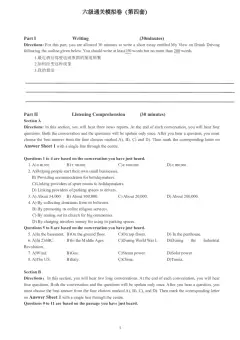
六级模拟卷(五)
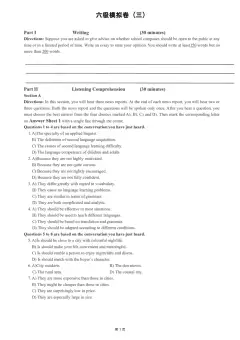
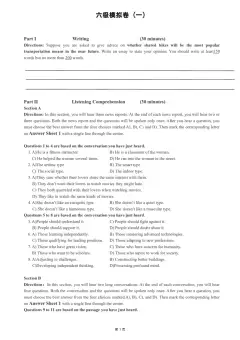
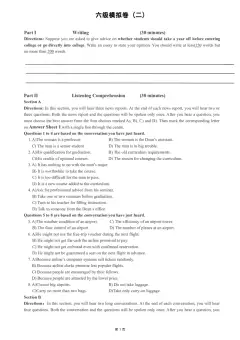
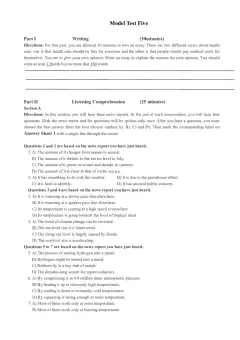
Part I Writing (30 minutes)
Directions: For this part, you are allowed 30 minutes to write a short essay on social skills. Your essay should
include the importance of social skills and measures to be taken to cultivate social skills. You are required to write
at least150 words but no more than 200 words.
PartII ListeningComprehension (30minutes)
SectionA
Directions: In this section, you will hear three news reports.At the end of each news report, you will hear two or
three questions. Both the news report and the questions will be spoken only once.After you hear a question, you
must choose the bestanswer from the four choices markedA), B), C) and D).Then mark the corresponding letter
onAnswerSheet1withasinglelinethroughthecentre.
Questions1to4arebasedontheconversationyouhavejustheard.
1.A)Acaraccident. B)Anearthquake.
C)Atrainaccident. D)Aplaneaccident.
2.A)Hegavethemansomewatertodrink. B)Hecalledtheambulanceimmediately.
C)Hecalledthepolicefirst. D)Hegavethemanfirstaid.
3.A)Thosewhoaresufferingfromchoking. B)Thosewhoaresufferingfromminorscratches.
C)Thosewhoaresufferingfromcancer. D)Thosewhoaresufferingfromdiabetes.
4.A)Itmaycurethedisease. B)Itmayonefrompunishment.
C)Itmaysaveone’slife. D)Itmayhelponeescapeunhurt.
Questions5to8arebasedontheconversationyouhavejustheard.
5.A)Ithasgotitsnamefromastyleofarchitecture.
B)Ithasgotitsnamefromakindofmusic.
C)IthasgotitsnamefromatribenamedGoths.
D)Ithasgotitsnamefromaspecialart.
6.A)Priestsandworshipers. B)Somenon-humanentities.
C)Kingsandknights. D)Successfulbusinessmen.
7.A)Becausemankindisalwaysinsearchoffame.
B)Becausemankindisgreedyforgoldandyouth.
C)Becausemankindisafterforbiddenknowledge.
D)Becausemankindbelievesthattheycanachieveeverything.
8.A)Thenarrativespiralstowardsthehiddentruth.
B)Thenarrativedirectlyrevealsthetruth.
C)Thenarrativeisoftenathird-personnarrator.
D)Thenarrativeoftenhideshisownsecrets.
SectionB
Directions:In this section, you will hear two long conversations.At the end of each conversation, you will hear
第 1 页four questions. Both the conversation and the questions will be spoken only once.After you hear a question, you
must choosethe bestanswer fromthe four choices markedA), B), C), andD).Then mark thecorresponding letter
onAnswerSheet 1withasinglelinethroughthecentre.
Questions9to11arebasedonpassageyouhavejustheard.
9.A)An81-year-oldJapanesewoman’stechnicallife.
B)AnintroductiontoatraditionalartinJapan.
C)Howexerciseislinkedtohealth.
D)Howtodelayagingprocess.
10.A)Becausesheisfondofnewinventions.
B)BecausesheisinterestedinpreservingJapanesetraditions.
C)Becausesheiskeenontechnologyandcommunication.
D)Becausesheisgoodatkeepinghealthy.
11.A)Keepingdoingexercise. B)Playingcomputergames.
C)SurfingtheInternet. D)Havingregularphysicalexamination.
Questions12to15arebasedonthepassageyouhavejustheard.
12.A)Teachingnon-nativeEnglishlearners.
B)ProvidingvariousteachingmethodstoEnglishteachers.
C)Acceptingmorenon-nativeEnglishspeakingstudentsintokindergarten.
D)EncouragingyoungstudentstospendmoretimelearningEnglish.
13.A)TherearemoreschoolsforSpanish-speakingstudents.
B)MoreSpanish-speakingstudentsthinkaboutgoingtocollege.
C)ThenumberofSpanish-speakinghighschoolgraduateshasincreased.
D)MoreSpanish-speakingstudentscangraduatefromcollege.
14.A)Itattractsthefederal’sattentiontotheissue.
B)Itmakesfederalmoneymoreaccessible.
C)Itleadstobetterworkingconditionsofteachers.
D)Itraisesthenumberlimitofnewprograms.
15.A)Allowingthemlongertimetomasterthelanguage.
B)Teachingthemreadingandmathintheirnativelanguage.
C)UsingbothEnglishandtheirnativelanguagewhenteaching.
D)MakingthemproficientinEnglishbeforeteachingthemothersubjects.
SectionC
Directions: In this section, you will hear three recordings of lectures or followed by three or four questions. The
recordings will be played only once. After you hear a question, you must choose the best answer from the four
choices marked A), B), C), D). Then mark the corresponding letter on Answer Sheet 1 with a single line
throughthecentre.
Questions16to18arebasedontherecordingyouhavejustheard.
16.A)Mostpeoplelovereadingbooksonsmartphones.
B)MostpeoplelovereadingTheNewYorkTimes.
C)Mostpeoplestillloveprintedbooks.
D)Mostpeoplehavechangedtheirtasteforprintedbooks.
17.A)VisitamagnificentGildedAgeManhattanlibrary.
B)Spendmuchtimeinbookstoresofallkinds.
C)Borrowalotofbooksfromlibraries.
D)Buyalotofbooksfrombookstores.
第 2 页18.A)Heisalibrarian. C)Heisabusinessman.
B)Heisanauthor. D)Heisabookseller.
Questions19to22arebasedontherecordingyouhavejustheard.
19.A)Thosewhocanshowtheirloveromantically.
B)ThosewhocanspeakAmericanEnglish.
C)Thosewhocanspeakmorethanonelanguage.
D)Thosewhocanlearnanewlanguagequickly.
20.A)Aboutoneinfour. C)Aboutnineoutoften.
B)Aboutoneineight. D)Abouttwo-thirds.
21.A)Theonethathassimilarpronunciationwiththeirmothertongue.
B)Theonethathassimilarspellingwithmothertongue.
C)Theonethathassimilargrammarwiththeirmothertongue.
D)Theonethatispartofthesamefamilyastheirmothertongue.
22.A)Itsuseofaspecialpronunciation. B)ItsuseoftheCyrillicalphabetsystem.
C)Itsuseofatotallydifferentspelling. D)Itsuseoftoomanygrammaticalrules.
Questions23to25arebasedontherecordingyouhavejustheard.
23.A)Favorable. B)Doubtful. C)Critical. D)Reserved.
24.A)Womenarelikelytohavealongerlifeexpectancythanmenbecauseofparenthood.
B)Men’slifeexpectancyincreasesmorethanwomenbecauseofparenthood.
C)Womencanexpecttolive18monthslongerthanmenbecauseofparenthood.
D)Mencanexpecttolive2yearslongerthanwomenbecauseofparenthood.
25.A)Marriedwomen. C)Unmarriedwomen.
B)Marriedmen. D)Unmarriedmen.
PartⅢ Reading Comprehension (40minutes )
SectionA
Directions: In this section, there is a passage with ten blanks.You are required to select one word for each blank
from a list of choices given in a word bank following the passage. Read the passage through carefully before
making your choices. Each choice in the bank is identified by a letter. Please mark the corresponding letter for
each item on Answer Sheet 2 with a single line through the centre. You may not use any of the words in the
bankmorethanonce.
Questions26to35arebasedonthefollowingpassage.
Ifyouhadtoguesstheorganthathasundueinfluenceonyouremotions,yourmood,evenyourchoices,what
wouldyouguess?Thebrain?Sure,butwhatelse?Theheart—that__26__seatofthesoul?Notquite.Thestomach?
You’re getting warmer. Would you believe it’s the trillions of bacteria—the microbiota(微生物群)—than live in
your gut. Each of us__28__up to four and a half pounds of bacteria around in our guts at any given time. More
than100trillionmicrobeslivedownthere.That’sasmanycellsasmakeuptherestofyourbody.
Now, this crowd is mostly good guys, and they do important work, to the extent that some
scientists__29__classifying these collective microbiota as its own__30__. Aside from helping digest our food,
theyprotectusfromdisease,neutralizesome ofthetoxicby-productsofthe__31__process,andmakeitharderfor
bad bacteria to set up shop. In short, your gut does way more than just digest everything from Cheetos to
Camembert.
But it turns out gut bacteria may also__32__how we feel. Who knew the next__33__in mental well-being
would lead right to the toilet? With that lively__34__in mind, we know here are various ways our microbiota
are__35__toourmentalhealth.
第 3 页A)advocate I)gathers
B)affect J)image
C)attached K)irreplaceable
D)carries L)mythical
E)collectively M)notoriously
F)connected N)organ
G)digestive O)result
H)frontier
SectionB
Directions: In this section, you are going to read a passage with ten statements attached to it. Each statement
containsinformationgiveninoneoftheparagraphs.Identifytheparagraphfromwhichtheinformationisderived.
You may choose a paragraph more than once. Each paragraph is marked with a letter. Answer the questions by
markingthecorrespondingletteronAnswerSheet2.
IsNutritiousFoodReallyPricier,and,Ifso,IsThatReallytheProblem?
[A]Nobody disagrees: WeAmericans eat badly. We eat too many calories, too much highly processed food
and not nearly enough vegetables. Why is that? Ask the question, and you get a lot of answers, which is
appropriate for a lot of answers, which is appropriate for a matter as complex as a country’s diet. But one of the
answers that bubbles to the top almost every time is that nutritious food just costs more. Does it? There are two
relevant questions here.The first is empirical: Is healthfulfood more expensive?Thesecond is behavioral: Is cost
whatstandsbetweenpeopleandabetterdiet?
[B]By one very straightforward measure, healthful eating does indeed cost more. If you look at cost per
calorie, nutrient-dense vegetables and fruits cost far more on average, than the ubiquitous(普遍存在的),
nutrition-sparsesourcesofcalories:refinedgrains(细粮),sugarandvegetableoil.
[C] The fact that vegetables are, on average, more expensive than, say, Doritos doesn’t mean you have to
abandon the idea of healthful eating and head for the snack food aisle. Sugar-snap peas and asparagus may bring
uptheaveragepriceofproduce,butthereareinexpensivecaloriesinthecategory,too.Thinksweetpotatoes.
[D]An ordinary supermarket offers a variety of affordably priced calories to meet the daunting challenge of
making your daily menu come in at under $ 4 per person, the average benefit under the Supplemental Nutrition
Assistance Program, informally referred to as food stamps. Sure enough, there are the usual suspects: the
processed foods that are a microwave away from being a microwave away from being a microwave away from
beingameal.Similarly,therewasafrozenburrito(玉米煎饼)for14cents,cannedbeefraviolifor17centsandhot
dogs for 10 cents. But the rock-bottom-cheapest meal option was instant ramen, at 6 cents, a price point so
irresistible that I almost bought some. As inexpensive as it is, ramen isn’t the cheapest source of calories at the
grocery store. That honor belongs to all-purpose flour and vegetable oil, both of which cost all of 2 cents per 100
calories.
[E] Nomatter howcheapthe processedfoodsare, theraw materials thatgo into them areeven cheaper.And,
if those raw materials are so very cheap for us, imagine how cheap they are for Kraft. So cheap that the company
can manufacture a food out of them, box it, ship it and market it, and still sell it for pennies. Even so, you almost
alwaysdobetter,cost-wise,whenyoubuytheingredientsandcookthemyourself,whichisoneofthereasonsthat
upgradingtoadecentmaycostlessthanyouthink.A2013reviewofstudiesquantifyingthepriceofahealthfulvs.
unhealthfuldietfoundthatthehealthfulversioncost$1.48moreperperson,perday.
[F]Although$1.48doesn’tsoundlikeenough tomake muchdifferenceinthequalityofyour diet,itcanbuy
a variety of cheap, nutritious staples: peanut butter, whole-grain pasta, whole-wheat flour, eggs, rolled oats,
pearledbarley,cornflour,brownrice,driedblackbeansandunpoppedpopcorn.
[G]Inthatlist, wefindthe cruxof theissue.Thehealthfulmeals youcanmake ataprice pointthatcompetes
with ramen are anchored by rice, beans andwhole grains.And, if you have time and skill, you can combine those
第 4 页with foods that cost a more, such as chicken thighs(13 cents),sweet potatoes (38 cents),carrots(30 cents),frozen
corn(25 cents),walnuts(30 cents),yogurt(36 cents)or frozen broccoli(63 cents),and eat pretty well for under $4 per
day.
[H]Before we go on, let’s spend a moment on subsidies. Although farm subsidies have certainly had an
impact on the price of staples, that impact is dwarfed by the inherent costs of growing crops as different as corn
andbroccoli.Inthatparticularcase,broccolicosts50timeswhatcorndoestogrow.It’salsoimportanttonotethat
the same commodity programs that affect corn and soy subsidize rolled oats, pearled barley, lentils, peanut butter
and whole-wheat bread. Although I’m in favor of revamping(修改)those programs, they can’t shoulder all the
blameforramen.
[I] Back to our dinner of chicken, carrots and black beans, and to the single parent on a very limited budget,
who has the challenge of trying to carve out the time to make it, only to have her kids complain that what they
reallywantisinstantramen.
[J]Adam Drewnowski, director of the University of Washington’s Center, tells me in an email, “Obesity is
almost entirely an economic issue, and the higher cost of healthier foods is the main problem,” but he
acknowledges that factors other than money come into play. He mentions two in particular: skill and time, which
canfeedyouwellifmoneyisshortsupply.
[K]So, sure, it’s possible to make a healthful dinner on a SNAP budget, but the other resources
required—time and skill—may be in short supply as well. Tonja Nansel, a senior investigator at the Eunice
Kennedy Shriver National Institute of Child Health and Human Development, points out that, if cost were the
major barrier,we’d expect higher-income groups to eat much better than lower-income groups. “The differencein
diet quality isn’t that big,” says Nansel, although it’s hard to determine exactly what the difference is because of
thelimitations of databasedon people’s ability to remember whatthey ateyesterday.A2013studythatattempted
to quantify that difference found that the lowest-income group did indeed eat less-nutritious diets than the
wealthiest group, but if you compare the lowest with the next group up, the diets are extremely similar. It’s not
until you get to five times the poverty level that diets improve, and even then it’s not a big jump. If cost were the
primarydriver ofpoordiets,we’dexpectasignificantincome boosttocorrespondtoasignificantimprovementin
diet,particularlysinceameaningfulimprovementcanbehadfor$1.48perday.
[L]Nobody I’ve talked to disputes that cost is an issue. Likewise, nobody disputes that convenience and
preference are also issues. But it’s hard to say what’s most important. “Most people prefer the taste of ramen to
brown rice. They prefer chips to kale,” says Nansel. “The fact that we would rather not have to look at some of
those other reasons is part of reason cost gets so much traction.” Food isn’t just nutrition. Food is pleasure,
something very-low-income peoplehave very few sourcesof,says Nansel.Thatdoesn’tmeanwe shouldn’ttackle
costatapolicylevel,sheadds.“Ifwecanmakehealthfulfoodmoreaffordableandaccessible,weoughtto.”
[M]Looking at cost as a barrier to eating well is much more comfortable than looking at preference, which
smacks of blaming the victim. The idea that our lousy diet was perpetrated on us, with the poor as the most
vulnerable, gets around that problem. But until we acknowledge that we—rich and poor—are complicit in our
foodsupply,thatwehelpshapeiteverytimewebuyfoodwewanttoeat,we’reunlikelytoimproveit.
36.Astudy indicates that no significant price differences were seen between nutritious diet and unwholesome
one.
37.According to one expert, the differences in diet quality between the rich and the poor are not as obvious as
expected.
38.Compared with the farm subsidies, the built-in costs of growing crops have a bigger impact on the price of
staples.
39.Forthepoor,foodcanbringsatisfactionandasenseofpleasureinadditiontonutrition.
40.It’seasiertoblameoncostsandotherexternalfactorsthanonourownpreferenceonfoodforourunhealthy
diet.
第 5 页41.It’sgenerallythoughtthatthemainreasonfortheAmerican’sunhealthyeatinghabitsisthecostofnutritious
food.
42.Nofoodischeaperthanall-purposeflourandvegetableoilassourcesofcaloriesinacommonsupermarket.
43.One expert claimed that higher cost of healthier foods was the leading reason of obesity, but it can be
compensatedbyskillandtime.
44.Whentakingtimetocookdespiteabusyschedule,asinglemomprobablywillfindherkidswouldrathereat
instantramen.
45.Havingtimeandcookingskill,onecouldenjoyawholesomemealonaverylimitedbudget.
SectionC
Directions: There are 2 passages in this section. Each passage is followed by some questions or unfinished
statements. For each of them there are four choices marked A), B), C) and D). You should decide on the best
choiceandmarkthecorrespondingletteronAnswerSheet 2withasinglelinethroughthecentre.
PassageOne
Questions46to50arebasedonthefollowingpassage.
Business cards have been around a long time in one form or another. The Chinese invented calling cards in
the 15th century to give people notice that they intended to visit. European merchants invented trade cards in the
17thcenturytoactasminiatureadvertisements.
Lots of companies try to turn their cards into miniature plugs for their products. Employees at Lego give out
miniature plastic figures with their contact details stamped on them. McDonald’s business cards are shaped like a
portion of fries.ACanadian divorce lawyer once gave out cards that can be torn in two—one half for each of the
feudingspouses.
Suchtrickscanquicklypall.Fortechno-utopians,theyjustgotoshowthatthephysicalbusinesscardis inits
death throes(垂死挣扎). After all, why bother exchanging bits of thick paper at all when you can simply swap
electronicversionsbysmartphone?
However,one can just as well argue the opposite: thatbusiness cards are here to stay,and in a blizzard(大风
雪)of meetings and correspondence, it is more important than ever that your card stands out.Attempts to reinvent
businesscardsforthedigitalagehavegotnowhere.
Thatbusinesscardsarethrivinginadigitalageisaforcefulreminderthatthereismuchaboutbusinessthatis
timeless. Take, for instance, the eternal and inescapable question of whether you can trust someone. The number
of things that machines can do better than humans grows by the day. But they cannot look people in the eye and
decidewhatsortofpersontheyare.
And they cannot transform acquaintanceships into relationships.Agood deal of business life will always be
about building social bonds—having dinner with people, playing sport with them, even getting drunk with
them—and the more that machines take over the quantitative stuff more human beings will have to focus on the
touchy-feely.
The rapid advance of both globalization and virtualization means that this trust-building process is becoming
ever more demanding. Managers have to work harder at establishing trust with people from different cultures:
chiefexecutives ofglobalorganizationsroutinelyspendthreeoutofevery fourweeks traveling.Theyalsohaveto
getbetteratusingpersonalmeetingstoreinforcebondsthatwerefirstformedoverthephoneorinternet.
Here,businesscardsaredoublyuseful.Theycanbeaquickwayofestablishingconnections,andcanalsoact
as a physical reminder that you have actually met someone rather than just Googled them. Rifling(搜索)through
piles of different cards helps to summon up memories of meetings in ways that simply looking through uniform
electroniclistsneverwould.
46.Theexampleofdivorcelawyer’scardsismentionedto_______.
A)revealthehistoricalchangeofbusinesscards
B)illustratethefunctionofcardsasadvertisements
第 6 页C)displaytheingeniousdesignsofbusinesscards
D)testifytheeffectofbusinesscardsisdeclining
47.Theword“pall”(Line1,Para.3)mostprobablymeans_______.
A)tohaveeffect B)tomaketroubles C)tobecomepopular D)toloseappeal
48.Thereasonwhybusinesscardscannotbereplacedliesin_________.
A)theyhelptobuildactualsocialbondsinbusinesslife
B)theymakethetrust-buildingprocessmoreurgent
C)theysetpeoplefreefromtheirquantitativeroutines
D)theybringmoresentimentsintothebusinesscontact
49.Itisimpliedinthelasttwoparagraphsthat_______.
A)peoplefromdifferentculturescanhardlytrusteachother
B)itisimpossibletoestablishtrustoverthephoneorinternet
C)businesscardsremindpeopleoftheirface-to-facecontact
D)uniformelectroniclistsmaynothelppeoplegetacquainted
50.Whatisthispassagemainlyabout?
A)Whybusinesscardsthriveindigitalage.
B)Whenbusinesscardswillbereplaced.
C)Howelaboratelythecardscanbedesigned.
D)Whatbusinesscardscanhelpmanagersdo.
PassageTwo
Questions51to55arebasedonthefollowingpassage.
Ahard Brexit poses risks to the integrity of financial markets and could make it harder to protect consumers
fromwrongdoingbybanks,theheadofthecityregulatorhaswarnedMPs.
Andrew Bailey, chief executive of the Financial Conduct Authority, said a cliff-edge Brexit—one in which
the regulatory framework changes the instant the UK leaves the EU—also presented competition risks, alongside
threatstolegalandmarketstability.
In his latest letter to the Treasury Select Committee, Bailey said a sudden exit from the EU could make it
difficult for regulators to obtain information about the firms they regulate. “Any lack of certainty with regard to
the regulatory framework may affect the ability of the FCA, and perhaps other regulators, to take enforcement
actionasameansofbothaddressinganddeterringmisconduct,”saidBailey.
He also highlighted the risks associated with the sudden loss of the “passport” that firms based in the EU
use to operate freely within the 28 member states. Bailey has previously told the committee that 5,476
UK-registered firms hold at least one passport to do business in another EU or EEA member state while just
over8,000companiesauthorizedinotherEUstatesusetheserulestodobusinessintheUK.
Therewas a risk, he said,that firms couldand endupwithout thecorrectpermissions to sellproducts or find
themselves vulnerable to legal action if they were not able to meet pledges to provide services for customers. The
FCA may not have enough time to process applications-which take about 23 weeks-if the loss of passporting is
onlyagreedlateinthenegotiations.
Former shadow chancellor Chris Leslie, a leading supporter of the Open Britain campaign, said : “The last
thing post-Brexit Britain needs is to tie the hands of the Financial ConductAuthority behind their back . A hard
Brexitdoesn’tjustriskpushingoureconomyoveracliffedge,itrisksthrowingrobustregulationintothevoidas
well.”
“If we learned anything from the 2008 global economic crash, it is that a clear system of regulation for
financial services is essential. It is deeply worrying that the people responsible for that in country are saying they
willnotbeabletodotheirjobproperlyifBritaincrashesoutoftheEUwithoutatransitionaldealinplace.”
“When the financial watchdogs are themselves saying they will not be able to properly protect consumers
第 7 页following a hard Brexit, the government needs to sit up and take notice.” “If the watchdog cannot watch
financialtransactionsproperly,weareleavingbothpeoples’financesandmarketsvulnerabletoabuse.”
51.WhatdoweknowaboutAndrewBailey?
A)HestronglyopposesthehardBrexit.
B)Hecallsforaclearregulatorysystem.
C)Herequiresenhancedfinancialregulation.
D)Hepredictssomepost-Brexitproblems.
52.ThedataquotedinParagraphFourillustrates______.
A)theextensiveinfluenceofBrexitonbusiness
B)thelargeamountofworkloadoftheFCA
C)thesignificanceofacquiringthe“passport”
D)theenormousscaleoftheoverseasmarket
53.Whatmaybetheproblemposedbyasuddenlossoffirms’“passport”?
A)RestrictionontravelaroundEUmemberstates.
B)Influenceonthefirms’abilitytoprovideservice.
C)Increaseoflegaldisputesininternationaltrade.
D)Extendedtimetodealwithpassportapplication.
54.Inthelasttwoparagraphs,ChrisLeslieemphasizes______.
A)theurgencytoreinforcethefunctionofFCA
B)theimportanceofamanifestregulators
C)theresponsibilityofthefinancialregulators
D)thenecessityofthegovernment’sinvolvement
55.WhatcanwelearnaboutChrisLeslie’spositionontheresultofahardBrexit?
A)HeprovidesproofsforBailey’sview. B)HechallengesBailey’sconclusion.
C)Heposesawholenewinsight. D)HeechoesBailey’sopinionontheissue.
PartⅣ Translation (30 minutes)
Directions:Forthispart,youareallowed30minutestotranslateapassagefromChineseinto
English.YoushouldwriteyouransweronAnswerSheet2.
中国结(Chineseknot)是中国特有的手工编织工艺品,在中华民族艺术文化遗产中占据重要的地位。
它的特点是每一个结都由一根绳索编成,并根据其特定的外形和意义来命名。中国结的传统源远流长。在
古代,中国结仅仅是人们用来记事或绑住衣物的工具。如今,人们多将其用作室内装修的道具、亲友间的
馈赠礼物及个人的随身饰物。在汉语中,“结”寓意团圆、友好、和平和爱等,所以中国结经常被用来表
达美好的祝愿。
第 8 页