5~15 , A B C D
,
,
,
:
1. :
: ,
2. :
: ,
, , , ,
3. :
: , ,
:(1) ;(2) ;(3)
, , ,
, ,
,
,
,
1.(1) ,
;
(2) , , , ,
;
(3) ;
(4) ;
(5)
,
,
2.
(1) ;
(2) ;
(3)
, ,
,
:
1. ,
, 3~4 , ,
, , , , , ,
,
2. ,
, , ,
, ,
,
3. ,, , ,
, , ,
, , ,
:
(1) , , ;
(2) ;
(3) ;
(4) ,
1 (2014· )
One Friday night, a poor young man stood at a gate of the railway station, playing his violin.
Many people put money into the hat 1 in front of him.
The next day, 2 young man came to the gate of the railway station again, and put his hat
on the ground. But 3 what he always did in the past days, he took out a large piece of paper
and laid it on the ground. It said, “Last night, a gentleman named George Sang put an important
thing into my hat by mistake. Please come soon, Mr Sang.”
After about half an hour, a middle-aged man ran to the young man 4 and said “It's you!
You do come here. I know that you're an honest man and will certainly 5 here.” The young
man asked “Are you Mr George Sang? Did you lose anything?” “A lottery( ) ticket.”
answered the middle-aged man. The young man took out a lottery ticket and gave it to the man.
The prize of the lottery ticket was $ 500, 000. Yesterday when the middle-aged man knew he
6 , he was very happy. He took out 50 dollars and put it in the hat. However, the lottery ticket
was also 7 in.
Later, someone asked the young man, “You 8 the violin in the railway station every day
to make money. Why didn't you just take the prize of the lottery ticket for yourself?” The young
man said, “Although I don't have much money, I live 9 . But I lose 10 . I won't be happy
forever.”
1. A. lying B. sleeping C. bowing D. dropping
2. A. B. a C. an D. the
3. A. far from B. similar to C. different from D. same as
4. A. slowly B. in a hurry C. strongly D. sleepily5. A. hide B. come C. flee D. leave
6. A. lost B. won C. fell D. chased
7. A. filled B. pulled C. kicked D. thrown
8. A. play B. sell C. buy D. repair
9. A. sadly B. happily C. normally D. lively
10. A. job B. pleasure C. honesty D. purse
, ,
,
1. A : lying , ;sleeping ;bowing ;dropping
A
2. D : a poor young man” , , the
3. C he took out a large piece of paper and laid it on the ground” ,“
different from ,
4. B : a middle-aged man ran to the young man” It's you! You
do come here.” , in a hurry ,
5. B :hide ;come ;flee ;leave ,
B
6. B :lost ;won , ;fell ;chased he was very happy”
He took out 50 dollars and put it in the hat.” ,
B
7. D :filled ;pulled ;kicked ;thrown ,
D
8. A : One Friday night, a poor young man stood at a gate of the railway
station, playing his violin.” ,
play the violin A
9. B :sadly ;happily ;normally ;lively
, B
10. C job ;pleasure ;honesty ;purse ,
C
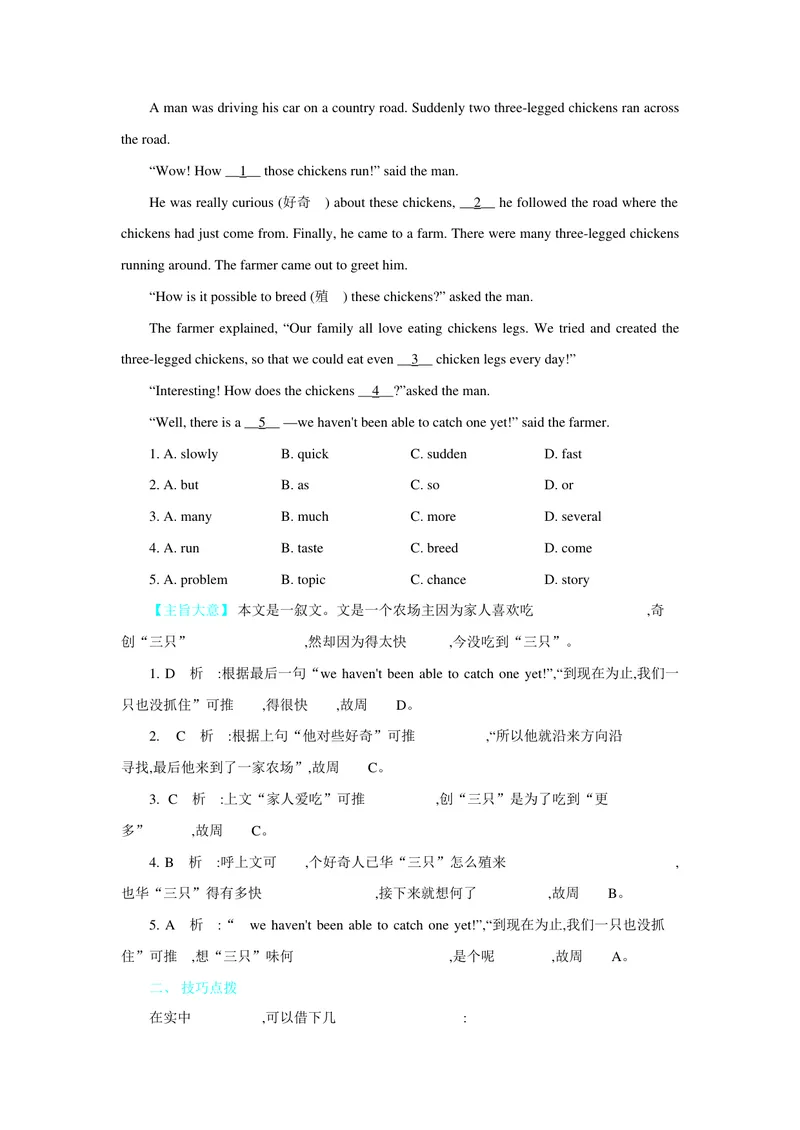
2 (2013· )A man was driving his car on a country road. Suddenly two three-legged chickens ran across
the road.
“Wow! How 1 those chickens run!” said the man.
He was really curious ( ) about these chickens, 2 he followed the road where the
chickens had just come from. Finally, he came to a farm. There were many three-legged chickens
running around. The farmer came out to greet him.
“How is it possible to breed ( ) these chickens?” asked the man.
The farmer explained, “Our family all love eating chickens legs. We tried and created the
three-legged chickens, so that we could eat even 3 chicken legs every day!”
“Interesting! How does the chickens 4 ?”asked the man.
“Well, there is a 5 —we haven't been able to catch one yet!” said the farmer.
1. A. slowly B. quick C. sudden D. fast
2. A. but B. as C. so D. or
3. A. many B. much C. more D. several
4. A. run B. taste C. breed D. come
5. A. problem B. topic C. chance D. story
,
, ,
1. D : we haven't been able to catch one yet!”,“ ,
, , D
2. C : ,“
, , C
3. C : ,
, C
4. B : , ,
, , B
5. A : we haven't been able to catch one yet!”,“ ,
, , , A
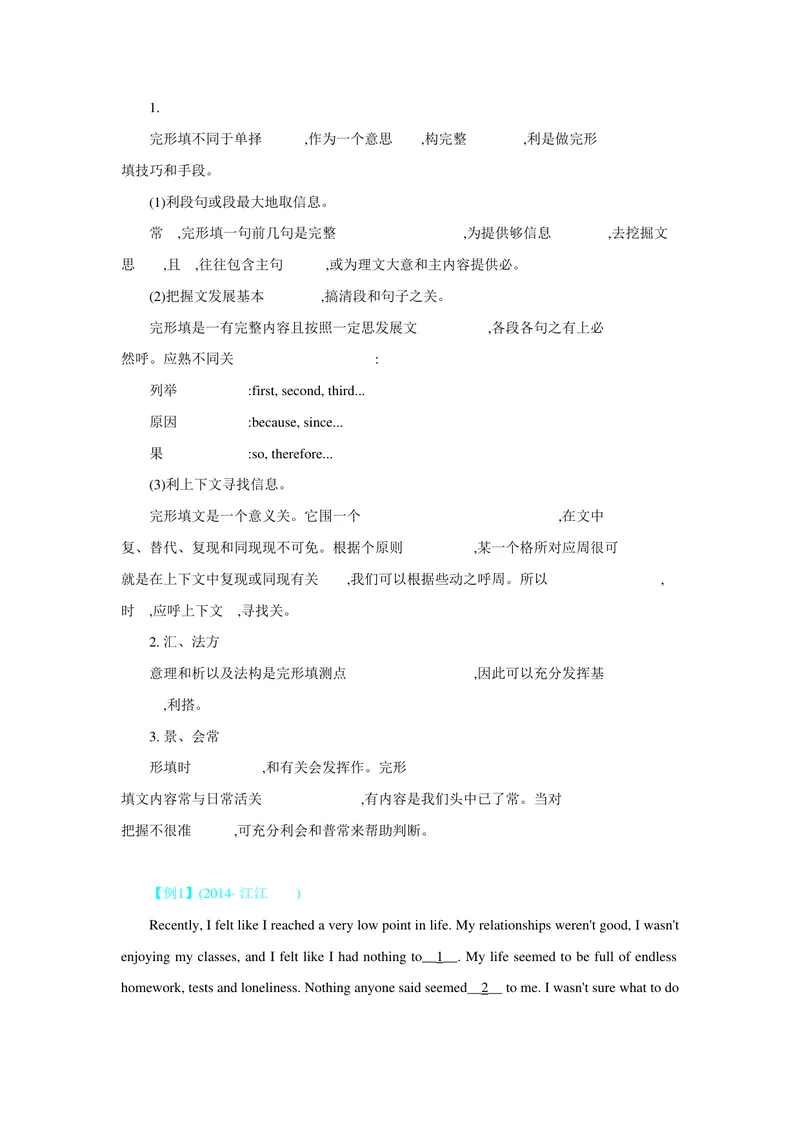
, :1.
, , ,
(1)
, , ,
, , ,
(2) ,
,
:
:first, second, third...
:because, since...
:so, therefore...
(3)
,
,
, ,
, ,
2.
,
,
3.
,
,
,
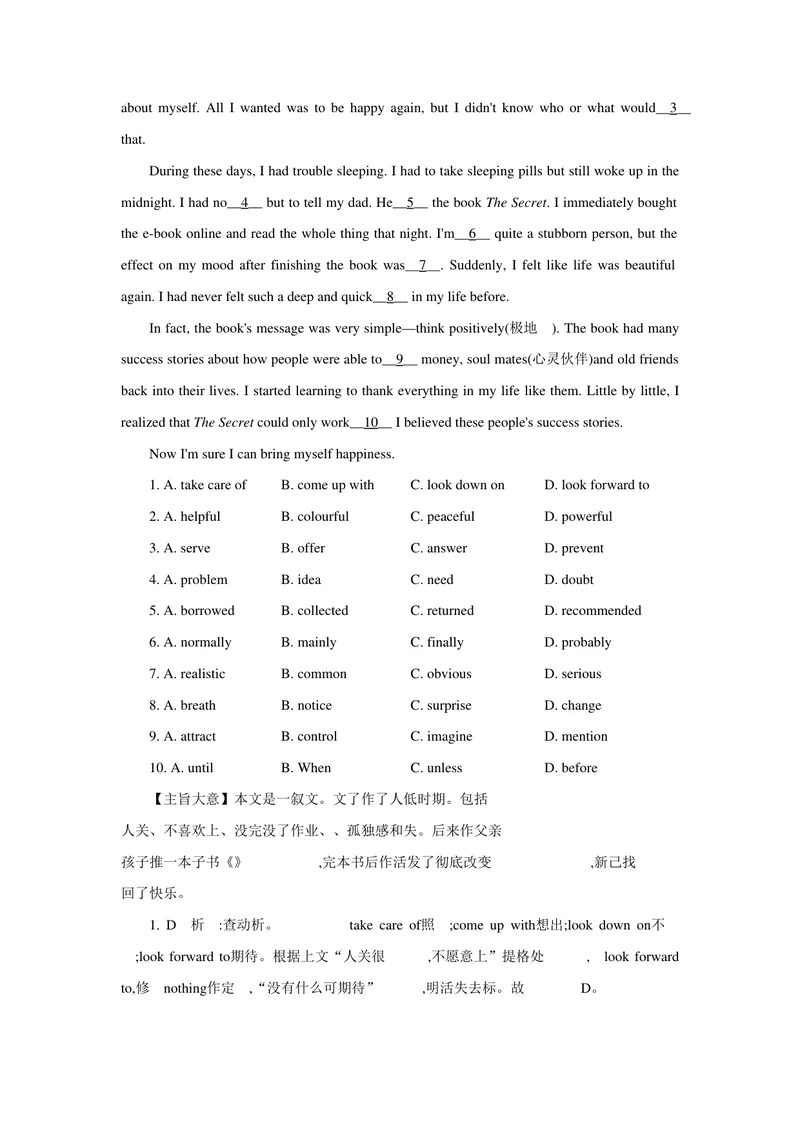
1 (2014· )
Recently, I felt like I reached a very low point in life. My relationships weren't good, I wasn't
enjoying my classes, and I felt like I had nothing to 1 . My life seemed to be full of endless
homework, tests and loneliness. Nothing anyone said seemed 2 to me. I wasn't sure what to doabout myself. All I wanted was to be happy again, but I didn't know who or what would 3
that.
During these days, I had trouble sleeping. I had to take sleeping pills but still woke up in the
midnight. I had no 4 but to tell my dad. He 5 the book The Secret. I immediately bought
the e-book online and read the whole thing that night. I'm 6 quite a stubborn person, but the
effect on my mood after finishing the book was 7 . Suddenly, I felt like life was beautiful
again. I had never felt such a deep and quick 8 in my life before.
In fact, the book's message was very simple—think positively( ). The book had many
success stories about how people were able to 9 money, soul mates( )and old friends
back into their lives. I started learning to thank everything in my life like them. Little by little, I
realized that The Secret could only work 10 I believed these people's success stories.
Now I'm sure I can bring myself happiness.
1. A. take care of B. come up with C. look down on D. look forward to
2. A. helpful B. colourful C. peaceful D. powerful
3. A. serve B. offer C. answer D. prevent
4. A. problem B. idea C. need D. doubt
5. A. borrowed B. collected C. returned D. recommended
6. A. normally B. mainly C. finally D. probably
7. A. realistic B. common C. obvious D. serious
8. A. breath B. notice C. surprise D. change
9. A. attract B. control C. imagine D. mention
10. A. until B. When C. unless D. before
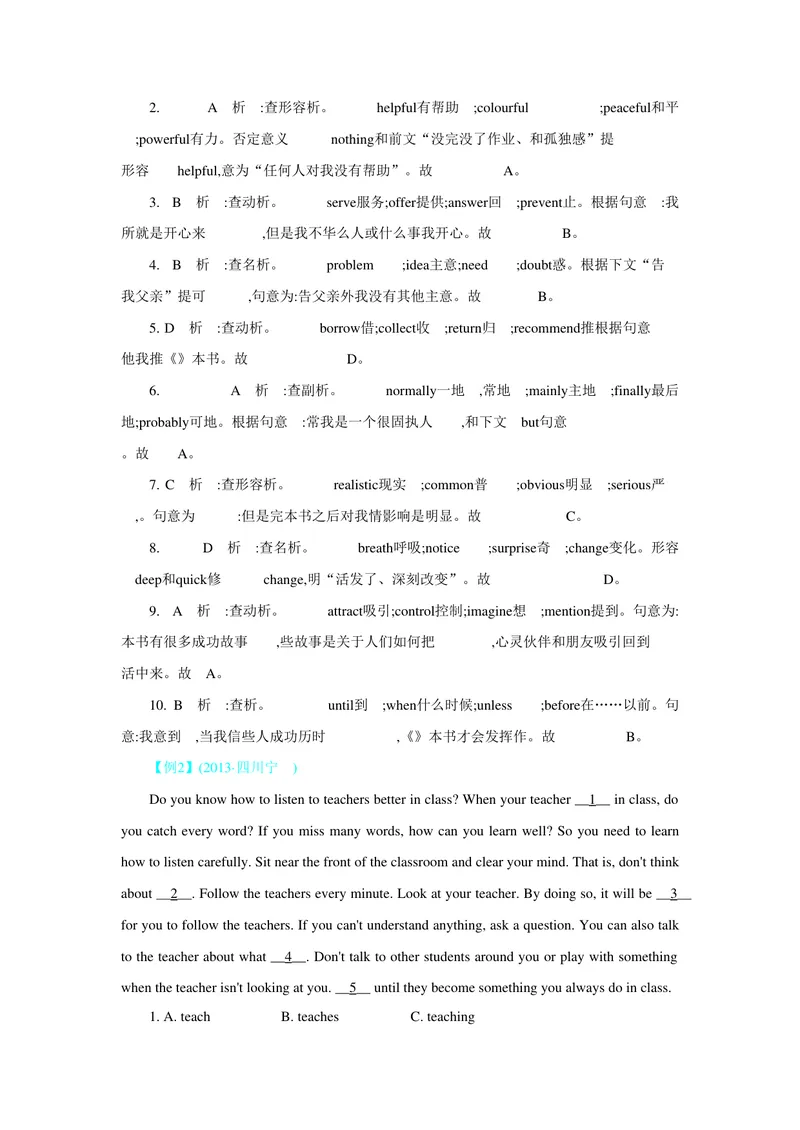
, ,
1. D : take care of ;come up with ;look down on
;look forward to , , look forward
to, nothing , , D2. A : helpful ;colourful ;peaceful
;powerful nothing
helpful, A
3. B : serve ;offer ;answer ;prevent :
, B
4. B : problem ;idea ;need ;doubt
, : B
5. D : borrow ;collect ;return ;recommend
D
6. A : normally , ;mainly ;finally
;probably : , but
A
7. C : realistic ;common ;obvious ;serious
, : C
8. D : breath ;notice ;surprise ;change
deep quick change, D
9. A : attract ;control ;imagine ;mention :
, ,
A
10. B : until ;when ;unless ;before
: , , B
2 (2013· )
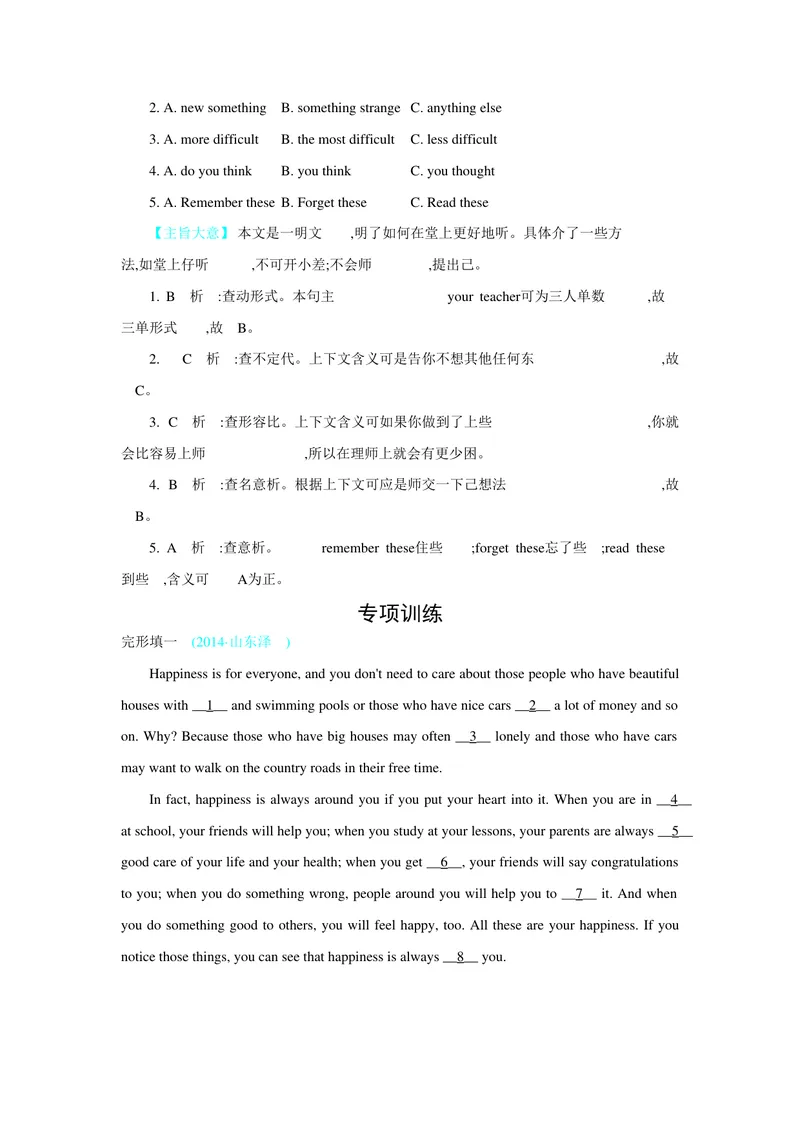
Do you know how to listen to teachers better in class? When your teacher 1 in class, do
you catch every word? If you miss many words, how can you learn well? So you need to learn
how to listen carefully. Sit near the front of the classroom and clear your mind. That is, don't think
about 2 . Follow the teachers every minute. Look at your teacher. By doing so, it will be 3
for you to follow the teachers. If you can't understand anything, ask a question. You can also talk
to the teacher about what 4 . Don't talk to other students around you or play with something
when the teacher isn't looking at you. 5 until they become something you always do in class.
1. A. teach B. teaches C. teaching2. A. new something B. something strange C. anything else
3. A. more difficult B. the most difficult C. less difficult
4. A. do you think B. you think C. you thought
5. A. Remember these B. Forget these C. Read these
,
, , ; ,
1. B : your teacher ,
, B
2. C : ,
C
3. C : ,
,
4. B : ,
B
5. A : remember these ;forget these ;read these
, A
(2014· )
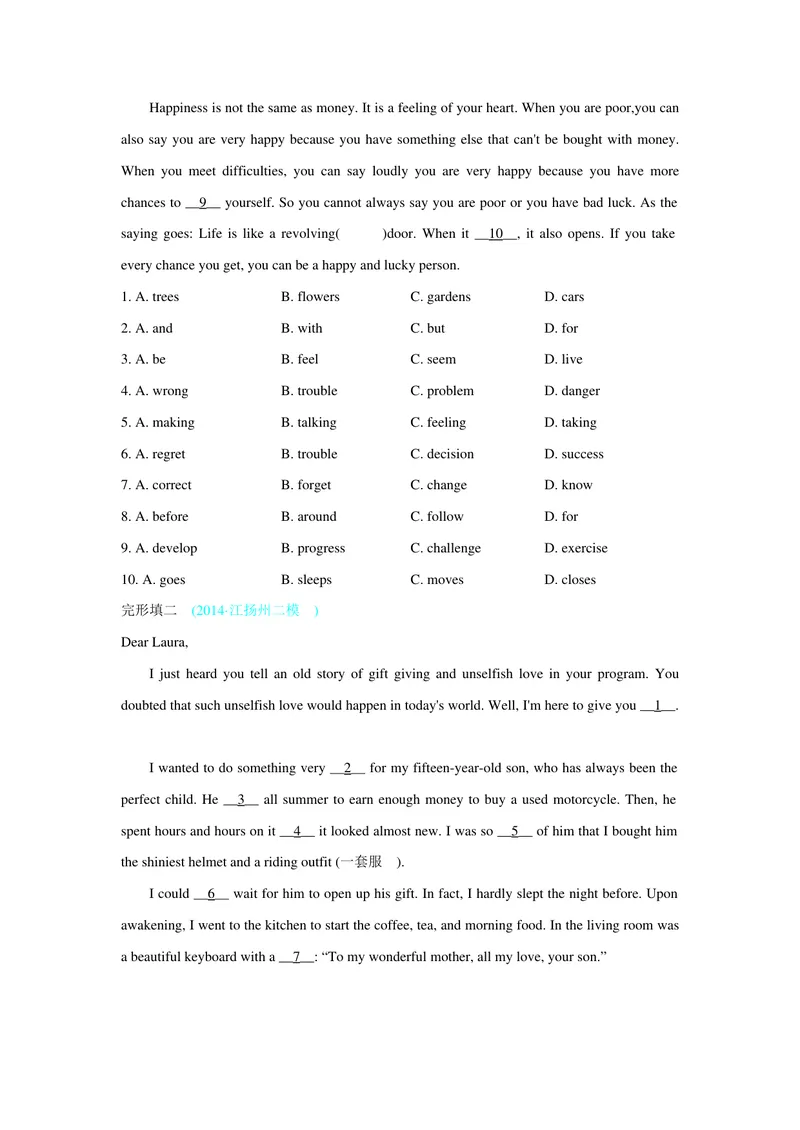
Happiness is for everyone, and you don't need to care about those people who have beautiful
houses with 1 and swimming pools or those who have nice cars 2 a lot of money and so
on. Why? Because those who have big houses may often 3 lonely and those who have cars
may want to walk on the country roads in their free time.
In fact, happiness is always around you if you put your heart into it. When you are in 4
at school, your friends will help you; when you study at your lessons, your parents are always 5
good care of your life and your health; when you get 6 , your friends will say congratulations
to you; when you do something wrong, people around you will help you to 7 it. And when
you do something good to others, you will feel happy, too. All these are your happiness. If you
notice those things, you can see that happiness is always 8 you.Happiness is not the same as money. It is a feeling of your heart. When you are poor,you can
also say you are very happy because you have something else that can't be bought with money.
When you meet difficulties, you can say loudly you are very happy because you have more
chances to 9 yourself. So you cannot always say you are poor or you have bad luck. As the
saying goes: Life is like a revolving( )door. When it 10 , it also opens. If you take
every chance you get, you can be a happy and lucky person.
1. A. trees B. flowers C. gardens D. cars
2. A. and B. with C. but D. for
3. A. be B. feel C. seem D. live
4. A. wrong B. trouble C. problem D. danger
5. A. making B. talking C. feeling D. taking
6. A. regret B. trouble C. decision D. success
7. A. correct B. forget C. change D. know
8. A. before B. around C. follow D. for
9. A. develop B. progress C. challenge D. exercise
10. A. goes B. sleeps C. moves D. closes
(2014· )
Dear Laura,
I just heard you tell an old story of gift giving and unselfish love in your program. You
doubted that such unselfish love would happen in today's world. Well, I'm here to give you 1 .
I wanted to do something very 2 for my fifteen-year-old son, who has always been the
perfect child. He 3 all summer to earn enough money to buy a used motorcycle. Then, he
spent hours and hours on it 4 it looked almost new. I was so 5 of him that I bought him
the shiniest helmet and a riding outfit ( ).
I could 6 wait for him to open up his gift. In fact, I hardly slept the night before. Upon
awakening, I went to the kitchen to start the coffee, tea, and morning food. In the living room was
a beautiful keyboard with a 7 : “To my wonderful mother, all my love, your son.”I was so 8 . It had been a long-standing ( ) joke in our family that I wanted a
piano so that I could 9 lessons. “Learn to play the piano, and I'll get you one.” was my
husband's response( ).
I stood there shocked, crying a river, asking myself how my son could 10 this expensive
gift.
Of course, the house awoke, and my son was excited with my reaction. Many kisses were
11 , and I immediately wanted him to 12 my gift.
As he saw the helmet and outfit, the look on his face was not 13 what I was expecting.
Then I 14 that he has sold the motorcycle to get me the keyboard.
Of course I was the proudest mother ever on that day, and my feet never hit the ground for a
month.
So I wanted you to know, that kind of love still exists( ) and lives even in the ever-
changing world of me, me, me!
I thought you'd love to 15 this story with me.
Yours,
Hilary
P. S. The next day, my husband and I bought him a new “used” already shiny motorcycle.
1. A. an example B. advice C. support D. courage
2. A. polite B. similar C. special D. private
3. A. played B. studied C. traveled D. worked
4. A. after B. before C. unless D. until
5. A. sure B. fond C. proud D. confident
6. A. perhaps B. really C. almost D. hardly
7. A. note B. notice C. word D. sign
8. A. disturbed B. frightening C. surprised D. surprising
9. A. give B. take C. draw D. teach
10. A. present B. afford C. find D. order
11. A. exchanged B. happened C. helped D. lost
12. A. tear B. open C. check D. receive
13. A. purely B. basically C. obviously D. exactly14. A. realized B. remembered C. imagined D. supposed
15. A. send B. publish C. share D. write
(2014· )
What's your idea about success? Some people say that beginners have all the luck, while
others believe that success 1 only with practice. In fact, I felt both of these statements are not
true all the time. Each is true in some ways 2 not in others.
For example, I went to a drawing competition many years ago and 3 surprisingly. As a
prize, I got a film ticket to see “Titanic”. I was really 4 because it was the first time I had
taken part in any competition, thinking that I might be lucky again, I 5 joining in other art
competitions,But the result was that I 6 won again. I accepted the fact that the other people
had a 7 artistic ability than I did. Art was not something I was especially interested in and I
had never practiced the different art skills. So, the 8 I produced were not of a very high
standard.
These experiences taught me a lot. Though I might have been lucky 9 , I also need to put
in hard work. As we know, 10 makes perfect. So I believe success builds on less luck and
chance.
1. A. moves B. comes C. returns D. leaves
2. A. or B. so C. and D. but
3. A. won B. began C. failed D. ended
4. A. sorry B. active C. lucky D. nervous
5. A. tried B. forgot C. stopped D. remembered
6. A. often B. ever C. sometimes D. never
7. A. greater B. more natural C. lower D. more common
8. A. results B. film C. prizes D. drawings
9. A. at last B. at most C. at first D. at least
10. A. chance B. practice C. difference D. experience
(2014· )
It was midday when I got the call that my grandfather was not well and he was quickly
getting worse. My family did not know how long he would 1 in the world. I knew I had to getto the hospital to tell him how much I loved him. As I drove to the hospital, I pictured him before I
got to tell him how much he 2 to me. Trying to fight back the tears, I wanted to stay calm
when I saw him.
3 I got to the hospital, I hurriedly looked for his hospital room. I found him in a semi-
conscious state( ). On my knees, I said softly, “Hello, Grandpa.”
Still feeling shy, I 4 not to leave his bedside without letting him know. While I asked
about how he was, he told me, “I'll be fine, Henry.” although we both knew that wasn't 5 .
Then he asked me with a smile 6 I was doing.
Hearing what my grandpa said, I was much 7 . I made the decision that I had to show my
gratitude for him. As I found all the courage( ) I had, I hold his hand tightly. I 8 out,
“Grandpa. I just want to let you know how much I love you. I hope you already know that yet I
just want to make sure.” By this time, tears were rolling down my face. All those years of love
that I had shut and not let him know, became 9 .
Smilingly, he said, “I know. Thank you for telling me that. All I have on this planet is my
family and my love for 10 . If there is anything I could ask of you, I want you to be good to
your family, your mother, your father, and your brother. That's all I want of you.”
What I learned that day 11 my whole life.
From then on, I began telling people how much I love them, care for them, and respect them.
I get in touch with, for example, my babysitter, my barber, to 12 my appreciation. I go down
into the city once a week and serve pizza to the homeless. I wake up every morning and list
everything I'm thankful to in my life.
1. A. keep B. stay C. leave D. stop
2. A. talked B. helped C. wanted D. meant
3. A. But B. When C. Before D. Because
4. A. told B. wanted C. decided D. expected
5. A. true B. right C. correct D. certain
6. A. how B. what C. when D. why
7. A. moved B. agreed C. carried D. surprised
8. A. got B. cried C. walked D. stood
9. A. open B. free C. closed D. hidden10. A. us B. him C. you D. them
11. A. finished B. increased C. improved D. changed
12. A. show B. tell C. know D. understand
(2013· )
In the United States, learning is children's own thing. When U. S. students are 1 a young
age, they know they should learn according to their own interests, and 2 is their own thing.
The self-learning attitude is impressed in their 3 . And more, when the children are very
young, their 4 tell them they shouldn't depend on parents but themselves. In the United
States, if 5 are after the age of 18, they must make money to 6 themselves. Even some
very rich families would usually not 7 all kinds of fees for children, but let them write an
IOU to the home, 8 them to return after graduation.
In China, of course parents also love their children very much. But I think the way parents
love children between China and USA are quite 9 . Chinese parents often offer all things that
children need to them. Especially, most children of the very rich families do nothing all day, their
parents will give much money to them, but the children's 10 don't develop at all. Is that right
or wrong?
1. A. at B. in C. of D. with
2. A. speaking B. learning C. reading D. writing
3. A. hung B. heads C. hearts D. stomach
4. A. friends B. parents C. teachers D. cousins
5. A. fathers B. mothers C. parents D. children
6. A. feed B. give C. thank D. teach
7. A. pay B. cost C. spend D. take
8. A. wanting B. dreaming C. forcing D. asking
9. A. different B. similar C. same D. opposite
10. A. age B. height C. abilities D. study(2013· )
Here is a story maybe you can't read it in any comic book, but it's true. The family was going
to 1 their house. Luckily, they found a box of old comic 2 , including Action Comics 1.
The Superman in Action Comics 1 helped the family get back their house.
Action Comics 1 is about the first superhero, 3 . In fact, it's the bible that has led us to
Iron Man, the Incredible Hulk, X-Men, and all the other supermen out there. It may mean 4 to
you, but not for millions of comic book fans. The most important is that an original copy means
5 money. It's more than enough to 6 their house.
Stephen Fishler is an owner of New York's Comic Connect and Metropolis Collectibles. He
was very 7 when he knew what the family was selling him. But 8 couldn't be as excited
about it as the family. One of the 9 members told Fishler. “I'm still surprised about finding
this book. I was so happy when I knew it can 10 us lots of money to get back our house. I
know we are very lucky. I will also be happy when this book finds a new home.”
1. A. buy B. lose C. find D. reach
2. A. films B. CDs C. books D. videos
3. A. the Superman B. Iron Man C. X-Men D. the Incredible Hulk
4. A. something B. anything C. nothing D. everything
5. A. little B. no C. any D. much
6. A. clean up B. pay for C. give away D. build up
7. A. sad B. excited C. bored D. disappointed
8. A. he B. she C. it D. we
9. A. club B. team C. family D. school
10. A. lend B. bring C. borrow D. take
(2013· )I have been playing the piano for four years. My deepest memory is my first piano show. I
remember that year, I was only nine years old, and just started learning piano for 1 months.
One day, my teacher told me there 2 a piano performance in three weeks. When I heard
the news, I felt very 3 . But the teacher said, “You can do it. Just play 4 you have
practiced the piece, you'll play well. And when the time comes, I'm sure you'll 5 .” Listening
to what the teacher had said, I just put all of my worries at the back of my head.
After three weeks of hard practicing, the piece for the performance was finally 6 . On the
night of the performance, I was so excited that I couldn't stand or sit, and I was too impatient to
wait. When it was my 7 to perform, I held my head high up, went up the stage, sat on the
chair, quickly 8 the song over in my head, and lifted up my hands to play. In one breath, I
played the piece from beginning to end and played it very pleasantly. Soon, a thunder of applause
9 the concert hall, I felt very happy, and proud of 10 , too.
That is my first piano performance, and I will never forget it for the rest of my life.
1. A. little B. a little C. few D. a few
2. A. was going to be B. is going to be C. was going to have D. is going to have
3. A. comfortable B. enjoyable C. nervous D. energetic
4. A. while B. when C. as D. since
5. A. suit B. succeed C. increase D. interest
6. A. successful B. ready C. exciting D. careful
7. A. heart B. turn C. entertainment D. challenge
8. A. went through B. made up C. came up with D. looked out
9. A. entered B. shocked C. missed D. filled
10. A. me B. my C. myself D. mine
(2013· )There are more than 35 million Americans who are between the ages of 13 and 19. They are
no longer children. They are not yet adults. Teenagers 1 to be free. Yet they also want to be
taken care of. But many teenagers don't 2 with their parents. They say their parents do not
understand them.
Today American teenagers 3 a lot of money buying records, clothes and other things.
Last year teenagers spent almost 100 4 million dollars. It was more than their parents spent
5 those things. Where do the American teenagers get all this money? Many of them have 6
jobs. Some work as baby-sitters. Others work at fast food places. They 7 about 4 dollars an
hour. Many teenagers do not have jobs. 8 , they receive money from their parents. They might
get as much as 20 dollars a week.
They don't get their first full-time job or begin university studies 9 they are 17 or 18
years old. The high school day is about 7 hours long. There are five classes in a day. The students
have lunch at school. American teenagers 10 English, history, math, science, art and foreign
languages. Some also learn job skills. They might learn how to use a computer. Other students
might learn by working in an office, a hospital or other places one day a week.
1. A. stop B. think C. want D. ask
2. A. agree B. say C. play D. like
3. A. pay B. cost C. take D. spend
4. A. thousands of B. hundred C. thousand D. hundreds of
5. A. at B. on C. of D. in
6. A. easy B. free C. full-time D. part-time
7. A. make B. spend C. run D. try
8. A. Instead of B. Instead C. But D. Then
9. A. till B. while C. until D. when
10. A. like B. hate C. ask D. study
(2013· )
The Dragon Boat Festival, also called the Duanwu Festival, is celebrated on the fifth day of
the 1 month in Chinese calendar. People often eat zongzi and row dragon boats 2 the
festival.Thousands of years ago, people often 3 rice into the Miluo river to feed Qu Yuan on
May 5th every year. Because he died in Miluo River. They thought he was still 4 in the river.
Now, in order to 5 the honest man, people in China often make zongzi. They will 6 all
kinds of zongzi during the Duanwu Festival. This kind of food is very 7 and very popular.
Man and woman, young and old all like eating zongzi very much.
The festival is also best known for its dragon-boat races. During the festival, people often
race dragon-boats in many places. 8 in the south China where there are many rivers and
lakes. The dragon-boat is about 50~100 feet 9 , 5 feet wide. And the boat is not very heavy.
There are more than 20 strong men on the boat. They sit in the boat side 10 side. At the head
of the boat, there is a big drum on it. The drummer plays the drum during the race.
1. A. fourth B. fifth C. sixth D. seventh
2. A. in B. between C. at D. during
3. A. got B. took C. threw D. brought
4. A. asleep B. good C. alive D. well
5. A. remember B. think C. like D. forget
6. A. like B. make C. take D. bring
7. A. beautiful B. big C. well D. delicious
8. A. Especially B. Clearly C. Exactly D. Easily
9. A. tall B. short C. wide D. long
10. A. at B. by C. on D. in
,
, ; , ; ,
1. C : beautiful houses( )' ,
C2. A : , and A
3. B : be ;feel ;seem ;live live lonely( )'
B
4. B : be in trouble( )' B
5. D : take good care of( )' D
6. D : congratulations to you( )' , get
success( )' D
7. A : correct ;forget ;change ;know
do something wrong,' , A
8. B : happiness' , around B
9. C : have more chances to ( )' ,
C
10. D : goes ;sleeps ;moves . closes opens. '
, open D
Hilary Laura , ,
1. A : A ;B ;C ;D give sb. an example(
) ' A
2. C : perfect child( )' , ,
C
3. D : A , ;‘B ;C ;D to earn
enough money...( )', worked D
4. D : , until
D
5. C : be proud of sb. ( )' C
6. D : , , hardly
D
7. A : , note( )' A8. C : , ,
C
9. B : A , ;B ;C ;D take lessons( )'
B
10. B : A ;B ;C ;D
expensive gift' , B
11. A : A ;B ;C ;D ,
A
12. B : A ;B ;C ;D B
13. D : A ;B ;C ;D
, , D
14. A : A ;B ;C ;D ,
realize A
15. C : A ;B ;C ;D share sth. with sb. (
)' C
1. B : moves ;comes ; returns ;leaves ,
, A C D B
2. D : , D
3. A : won ;began ;failed ;ended As a
prize' , A
4. C : sorry ; active ;lucky ;nervous
lucky again( )' , C
5. A : tried ;forgot ;stopped ;remembered try doing
sth. ( )' A
6. D : D
7. A : artistic ability( )' ,
great than A8. D : results ;film ;prizes ;drawings high
standard( )' , D
9. C : at last ; at most ; at first ; at least
hard work( )' , , C
10. B : chance ; practice ;difference ;experience
Practice makes perfect( )' B
, ,
1. B : keep ;stay ;leave ;stop ,
, B
2. D : talked ;helped ;wanted ;meant How
much ...mean to sb. ( ) D
3. B : hurriedly( )' , when
B
4. C : told ;wanted ;decided ;expected
decide not to do sth. ( )' C
5. A : , A
6. A : , ,
A
7. A : A
8. B : got ;cried ;walked ;stood cry out( , )
B
9. B : All those years of love' ,
B
10. D : ,
D
11. D : finished ;increased ;improved ;changed
, , D12. A : show ; tell ; know ; understand my
appreciation( )' , show A
,
,
1. A : at
2. B : ,learning
3. C :
4. B :
5. D : 18
6. A :
7. A :
8. D : ,
9. A : ,
10. C : ,
,
,
1. B :
B
2. C : C
3. A : A
4. C : , ,
: , C
5. D : lots of money to get back our house”
, : D
6. B : ,
, B
7. B : , , ,Stephen Fishler
B8. A : he Stephen Fishler A
9. C : ,
C
10. B : B
1. D : , , month , a few
,
2. A : there be , ,
A
3. C : , , nervous ( )
4. C : as ,
5. B : ,
6. B : ready ,
7. B : it's one's turn to do...,
8. A : go through ; ,
9. D : fill ; ,
10. C : ,
, 3500 13~19 , ,
, ,
1. C : , , ( )
, , C
2. A : ,
, A
3. D : ,
American teenagers, buying, D
4. C : , A D , B ,
C, ( ) 15. B : , spend
on, B
6. D : , , D
, , A B
7. A : 4 , B C D
8. B : , ( ) ,
, , , , B,
A
9. C : ( )
, , until, , C
10. D : ,
, D
, ,
,
1. B : , , B
2. D : , , D
3. C : ,
, C
4. C : , C
5. A : , , , A
6. B : , , B
7. D : , : ,
D
8. A : , ,
, A
9. D : : 50~100 , D
10. B : ( ), side by
side, B