Contents
Unit 1 How can we become good learners?
Unit2 I think that mooncakes are delicious!
Unit 3 Could you please tell me where the restrooms are?
Unit 4 I used to be afraid of the dark.
Unit 5 What are the shirts made of?
Unit 6 When was it invented?
Unit 7 Teenagers should be allowed to choose their own clothes
Unit 8 It must belong to Carla
Unit9 I like music that I can dance to
Unit 10 You are supposed to shake hands.
Unit11 Sad movies make me cry
Unit12. Life is full of the unexpected
Unit 13 We are trying to save the earth!
Unit 14 I remember meeting all of you in Grade 7
Unit 1 How can we become good learners?课文知识点梳理
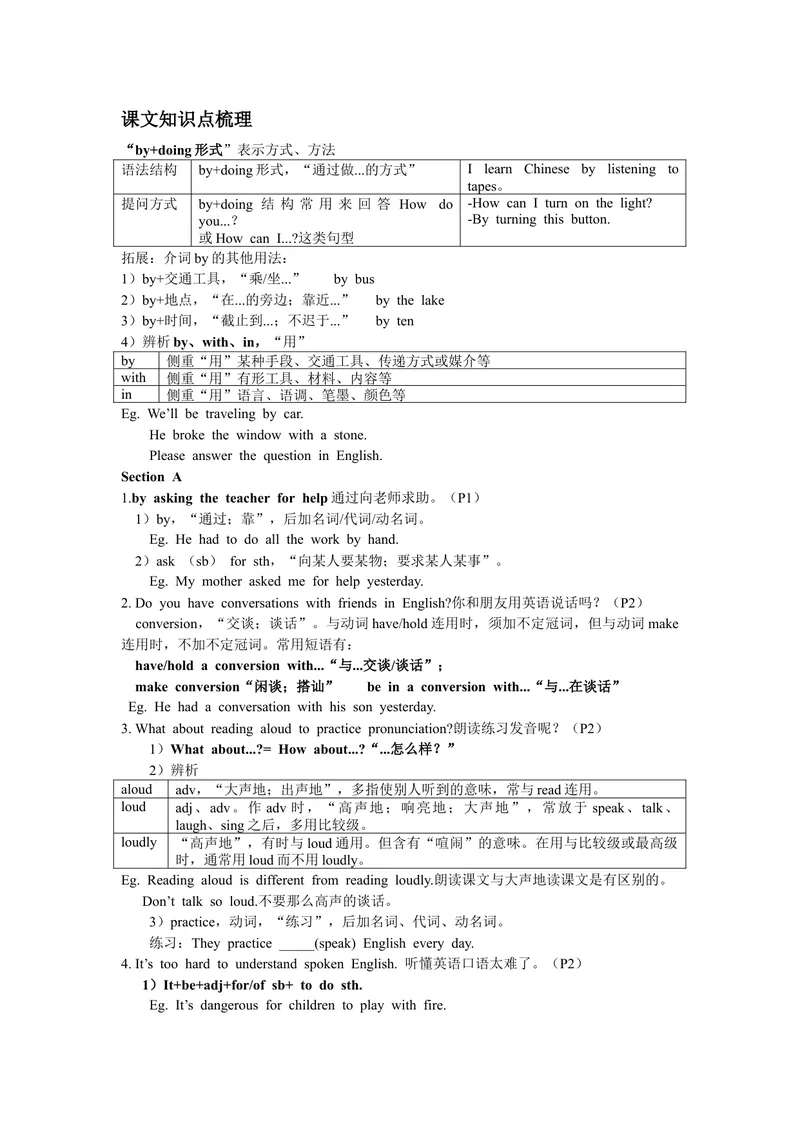
“by+doing形式”表示方式、方法
语法结构 by+doing形式,“通过做...的方式” I learn Chinese by listening to
tapes。
提问方式 by+doing 结 构 常 用 来 回 答 How do -How can I turn on the light?
you...? -By turning this button.
或How can I...?这类句型
拓展:介词by的其他用法:
1)by+交通工具,“乘/坐...” by bus
2)by+地点,“在...的旁边;靠近...” by the lake
3)by+时间,“截止到...;不迟于...” by ten
4)辨析by、with、in,“用”
by 侧重“用”某种手段、交通工具、传递方式或媒介等
with 侧重“用”有形工具、材料、内容等
in 侧重“用”语言、语调、笔墨、颜色等
Eg. We’ll be traveling by car.
He broke the window with a stone.
Please answer the question in English.
Section A
1.by asking the teacher for help通过向老师求助。(P1)
1)by,“通过;靠”,后加名词/代词/动名词。
Eg. He had to do all the work by hand.
2)ask (sb) for sth,“向某人要某物;要求某人某事”。
Eg. My mother asked me for help yesterday.
2. Do you have conversations with friends in English?你和朋友用英语说话吗?(P2)
conversion,“交谈;谈话”。与动词have/hold连用时,须加不定冠词,但与动词make
连用时,不加不定冠词。常用短语有:
have/hold a conversion with...“与...交谈/谈话”;
make conversion“闲谈;搭讪” be in a conversion with...“与...在谈话”
Eg. He had a conversation with his son yesterday.
3. What about reading aloud to practice pronunciation?朗读练习发音呢?(P2)
1)What about...?= How about...?“...怎么样?”
2)辨析
aloud adv,“大声地;出声地”,多指使别人听到的意味,常与read连用。
loud adj、adv。作 adv 时,“高声地;响亮地;大声地”,常放于 speak、talk、
laugh、sing之后,多用比较级。
loudly “高声地”,有时与loud通用。但含有“喧闹”的意味。在用与比较级或最高级
时,通常用loud而不用loudly。
Eg. Reading aloud is different from reading loudly.朗读课文与大声地读课文是有区别的。
Don’t talk so loud.不要那么高声的谈话。
3)practice,动词,“练习”,后加名词、代词、动名词。
练习:They practice _____(speak) English every day.
4. It’s too hard to understand spoken English. 听懂英语口语太难了。(P2)
1)It+be+adj+for/of sb+ to do sth.
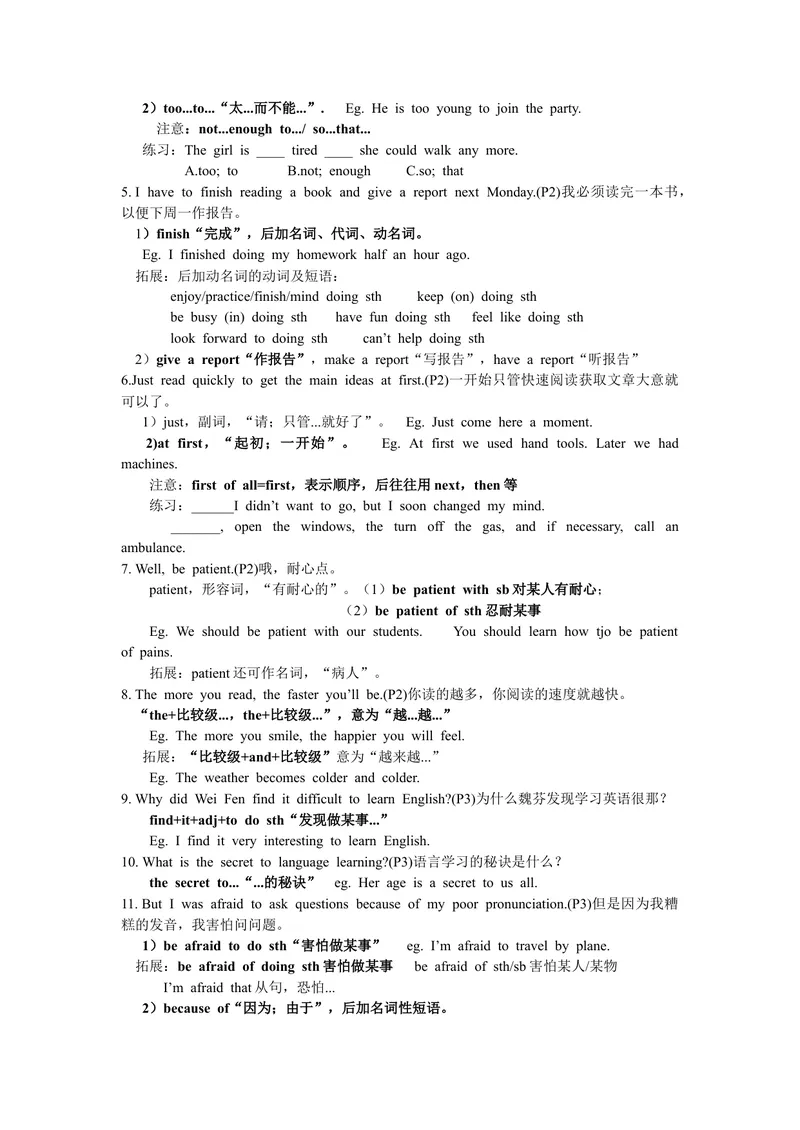
Eg. It’s dangerous for children to play with fire.2)too...to...“太...而不能...”. Eg. He is too young to join the party.
注意:not...enough to.../ so...that...
练习:The girl is ____ tired ____ she could walk any more.
A.too; to B.not; enough C.so; that
5. I have to finish reading a book and give a report next Monday.(P2)我必须读完一本书,
以便下周一作报告。
1)finish“完成”,后加名词、代词、动名词。
Eg. I finished doing my homework half an hour ago.
拓展:后加动名词的动词及短语:
enjoy/practice/finish/mind doing sth keep (on) doing sth
be busy (in) doing sth have fun doing sth feel like doing sth
look forward to doing sth can’t help doing sth
2)give a report“作报告”,make a report“写报告”,have a report“听报告”
6.Just read quickly to get the main ideas at first.(P2)一开始只管快速阅读获取文章大意就
可以了。
1)just,副词,“请;只管...就好了”。 Eg. Just come here a moment.
2)at first,“起初;一开始”。 Eg. At first we used hand tools. Later we had
machines.
注意:first of all=first,表示顺序,后往往用next,then等
练习:______I didn’t want to go, but I soon changed my mind.
_______, open the windows, the turn off the gas, and if necessary, call an
ambulance.
7. Well, be patient.(P2)哦,耐心点。
patient,形容词,“有耐心的”。(1)be patient with sb对某人有耐心;
(2)be patient of sth忍耐某事
Eg. We should be patient with our students. You should learn how tjo be patient
of pains.
拓展:patient还可作名词,“病人”。
8. The more you read, the faster you’ll be.(P2)你读的越多,你阅读的速度就越快。
“the+比较级...,the+比较级...”,意为“越...越...”
Eg. The more you smile, the happier you will feel.
拓展:“比较级+and+比较级”意为“越来越...”
Eg. The weather becomes colder and colder.
9. Why did Wei Fen find it difficult to learn English?(P3)为什么魏芬发现学习英语很那?
find+it+adj+to do sth“发现做某事...”
Eg. I find it very interesting to learn English.
10. What is the secret to language learning?(P3)语言学习的秘诀是什么?
the secret to...“...的秘诀” eg. Her age is a secret to us all.
11. But I was afraid to ask questions because of my poor pronunciation.(P3)但是因为我糟
糕的发音,我害怕问问题。
1)be afraid to do sth“害怕做某事” eg. I’m afraid to travel by plane.
拓展:be afraid of doing sth害怕做某事 be afraid of sth/sb害怕某人/某物
I’m afraid that从句,恐怕...
2)because of“因为;由于”,后加名词性短语。12. Then one day I watched an English movie called Toy Story. I fell in love with this
exciting and funny movie.(P3)之后有一天,我看了一部名为《玩具总动员》的英文电影。
我爱上了这部令人兴奋而有趣的电影!
1)called Toy Story过去分词短语作后置定语,called可换为named,修饰movie。
Eg. That man called Bob is my uncle.
2)fall/be in love with“爱上”
Eg. They fell in love with each other after working together,
13. Although I could not understand everything the characters said, their body language
and the expressions on their faces helped me to get the meaning.(P3)尽管我并不能听懂各
个角色说的所有台词,但他们的肢体语言和面部表情帮助我理解意思。
1)although“尽管;虽然”,引导让步状语从句,相当于though,不能与but同时出现
在一个句子中。
Eg. Although it rained, the boys still played outside.=It rained, but the boys still played
outside.
2)help sb (to)do sth;help sb with sth;help (to) do sth
Eg. She often helps me with my English.
14. I discovered that listening to something interesting is the secret to language learning.
(P3)我发现听有趣的东西是语言学习的秘诀。
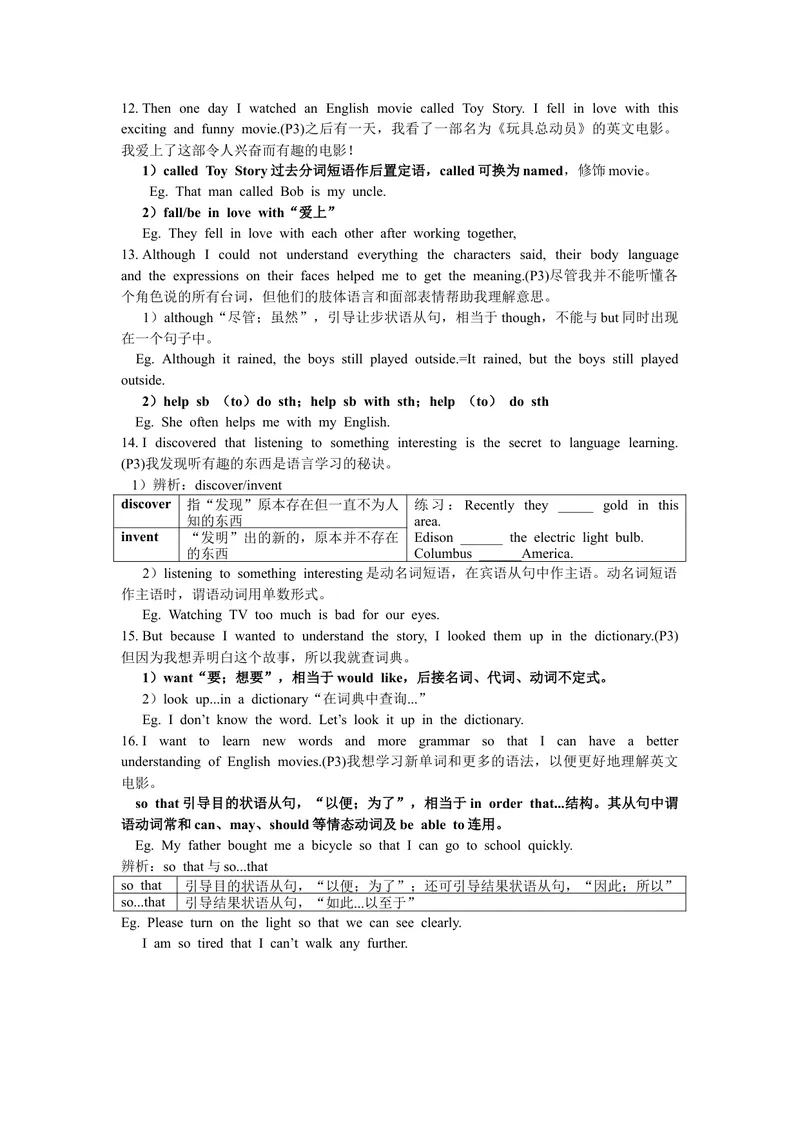
1)辨析:discover/invent
discover 指“发现”原本存在但一直不为人 练习:Recently they _____ gold in this
知的东西 area.
invent “发明”出的新的,原本并不存在 Edison ______ the electric light bulb.
的东西 Columbus ______America.
2)listening to something interesting是动名词短语,在宾语从句中作主语。动名词短语
作主语时,谓语动词用单数形式。
Eg. Watching TV too much is bad for our eyes.
15. But because I wanted to understand the story, I looked them up in the dictionary.(P3)
但因为我想弄明白这个故事,所以我就查词典。
1)want“要;想要”,相当于would like,后接名词、代词、动词不定式。
2)look up...in a dictionary“在词典中查询...”
Eg. I don’t know the word. Let’s look it up in the dictionary.
16. I want to learn new words and more grammar so that I can have a better
understanding of English movies.(P3)我想学习新单词和更多的语法,以便更好地理解英文
电影。
so that引导目的状语从句,“以便;为了”,相当于in order that...结构。其从句中谓
语动词常和can、may、should等情态动词及be able to连用。
Eg. My father bought me a bicycle so that I can go to school quickly.
辨析:so that与so...that
so that 引导目的状语从句,“以便;为了”;还可引导结果状语从句,“因此;所以”
so...that 引导结果状语从句,“如此...以至于”
Eg. Please turn on the light so that we can see clearly.
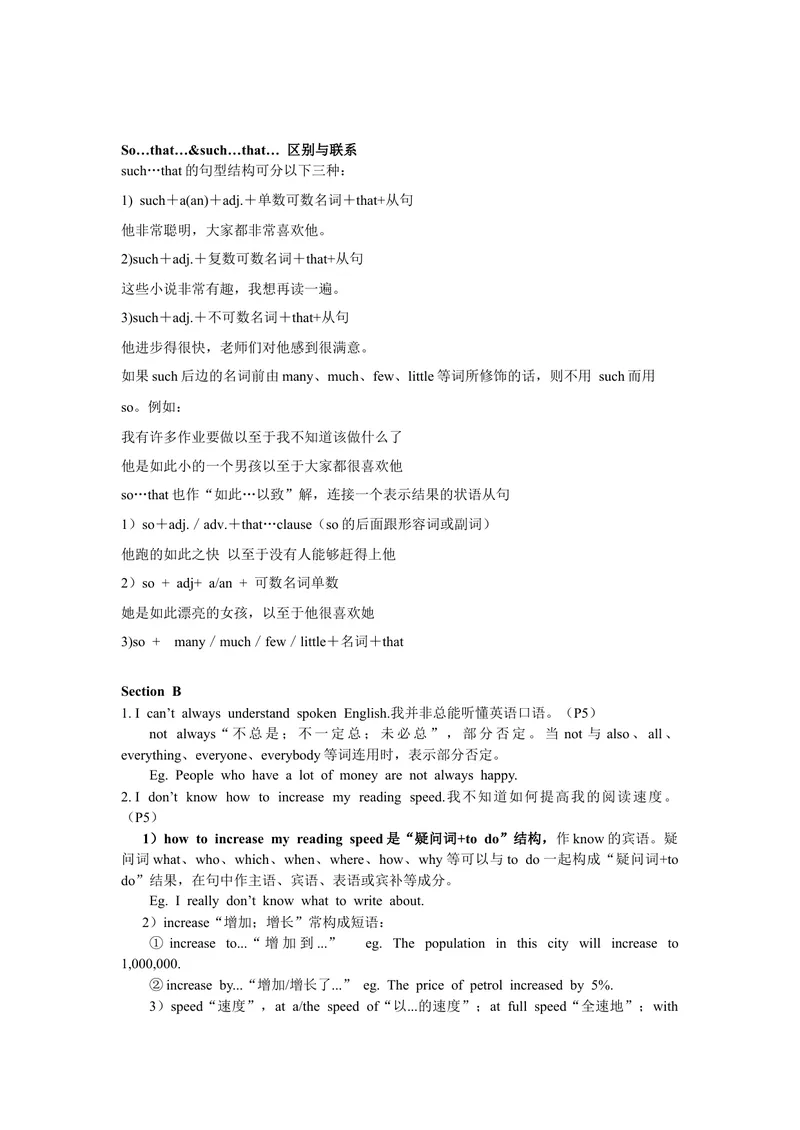
I am so tired that I can’t walk any further.So…that…&such…that… 区别与联系
such…that的句型结构可分以下三种:
1) such+a(an)+adj.+单数可数名词+that+从句
他非常聪明,大家都非常喜欢他。
2)such+adj.+复数可数名词+that+从句
这些小说非常有趣,我想再读一遍。
3)such+adj.+不可数名词+that+从句
他进步得很快,老师们对他感到很满意。
如果such后边的名词前由many、much、few、little等词所修饰的话,则不用 such而用
so。例如:
我有许多作业要做以至于我不知道该做什么了
他是如此小的一个男孩以至于大家都很喜欢他
so…that也作“如此…以致”解,连接一个表示结果的状语从句
1)so+adj./adv.+that…clause(so的后面跟形容词或副词)
他跑的如此之快 以至于没有人能够赶得上他
2)so + adj+ a/an + 可数名词单数
她是如此漂亮的女孩,以至于他很喜欢她
3)so + many/much/few/little+名词+that
Section B
1. I can’t always understand spoken English.我并非总能听懂英语口语。(P5)
not always“不总是;不一定总;未必总”,部分否定。当 not 与 also、all、
everything、everyone、everybody等词连用时,表示部分否定。
Eg. People who have a lot of money are not always happy.
2. I don’t know how to increase my reading speed.我不知道如何提高我的阅读速度。
(P5)
1)how to increase my reading speed是“疑问词+to do”结构,作know的宾语。疑
问词what、who、which、when、where、how、why等可以与to do一起构成“疑问词+to
do”结果,在句中作主语、宾语、表语或宾补等成分。
Eg. I really don’t know what to write about.
2)increase“增加;增长”常构成短语:
① increase to...“增加到...” eg. The population in this city will increase to
1,000,000.
②increase by...“增加/增长了...” eg. The price of petrol increased by 5%.
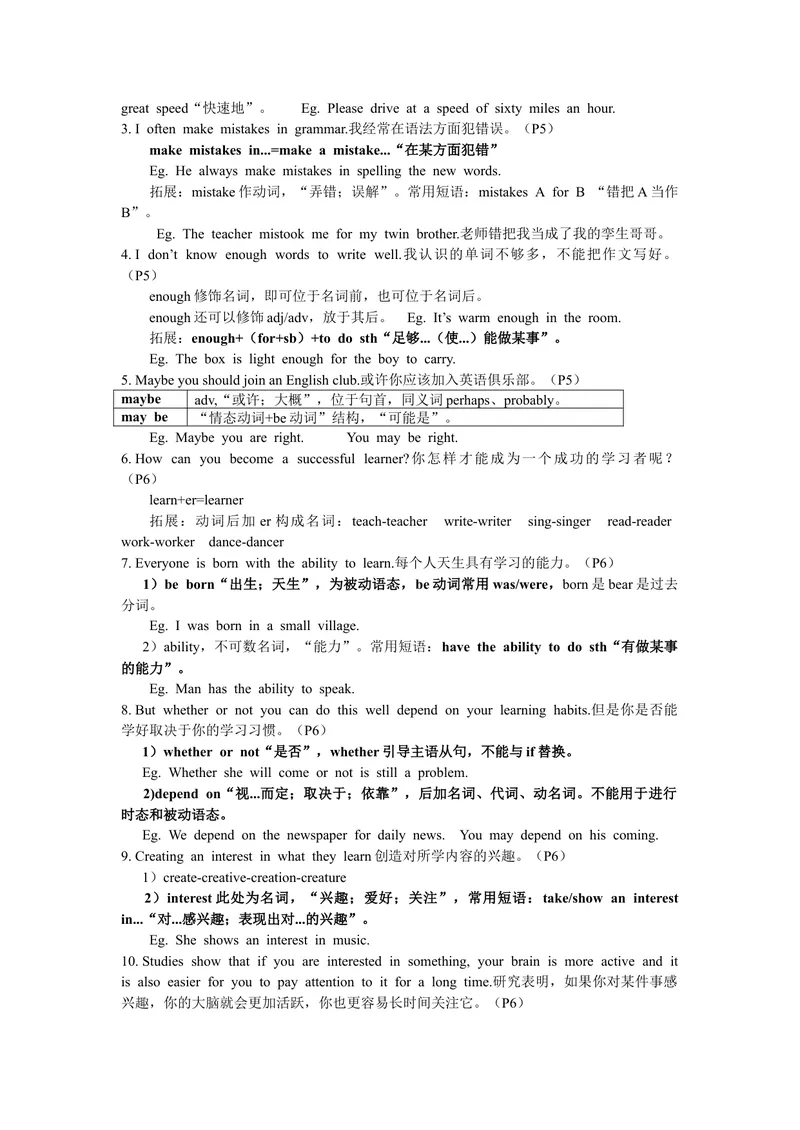
3)speed“速度”,at a/the speed of“以...的速度”;at full speed“全速地”;withgreat speed“快速地”。 Eg. Please drive at a speed of sixty miles an hour.
3. I often make mistakes in grammar.我经常在语法方面犯错误。(P5)
make mistakes in...=make a mistake...“在某方面犯错”
Eg. He always make mistakes in spelling the new words.
拓展:mistake作动词,“弄错;误解”。常用短语:mistakes A for B “错把A当作
B”。
Eg. The teacher mistook me for my twin brother.老师错把我当成了我的孪生哥哥。
4. I don’t know enough words to write well.我认识的单词不够多,不能把作文写好。
(P5)
enough修饰名词,即可位于名词前,也可位于名词后。
enough还可以修饰adj/adv,放于其后。 Eg. It’s warm enough in the room.
拓展:enough+(for+sb)+to do sth“足够...(使...)能做某事”。
Eg. The box is light enough for the boy to carry.
5. Maybe you should join an English club.或许你应该加入英语俱乐部。(P5)
maybe adv,“或许;大概”,位于句首,同义词perhaps、probably。
may be “情态动词+be动词”结构,“可能是”。
Eg. Maybe you are right. You may be right.
6. How can you become a successful learner?你怎样才能成为一个成功的学习者呢?
(P6)
learn+er=learner
拓展:动词后加 er 构成名词:teach-teacher write-writer sing-singer read-reader
work-worker dance-dancer
7. Everyone is born with the ability to learn.每个人天生具有学习的能力。(P6)
1)be born“出生;天生”,为被动语态,be动词常用was/were,born是bear是过去
分词。
Eg. I was born in a small village.
2)ability,不可数名词,“能力”。常用短语:have the ability to do sth“有做某事
的能力”。
Eg. Man has the ability to speak.
8. But whether or not you can do this well depend on your learning habits.但是你是否能
学好取决于你的学习习惯。(P6)
1)whether or not“是否”,whether引导主语从句,不能与if替换。
Eg. Whether she will come or not is still a problem.
2)depend on“视...而定;取决于;依靠”,后加名词、代词、动名词。不能用于进行
时态和被动语态。
Eg. We depend on the newspaper for daily news. You may depend on his coming.
9. Creating an interest in what they learn创造对所学内容的兴趣。(P6)
1)create-creative-creation-creature
2)interest此处为名词,“兴趣;爱好;关注”,常用短语:take/show an interest
in...“对...感兴趣;表现出对...的兴趣”。
Eg. She shows an interest in music.
10. Studies show that if you are interested in something, your brain is more active and it
is also easier for you to pay attention to it for a long time.研究表明,如果你对某件事感
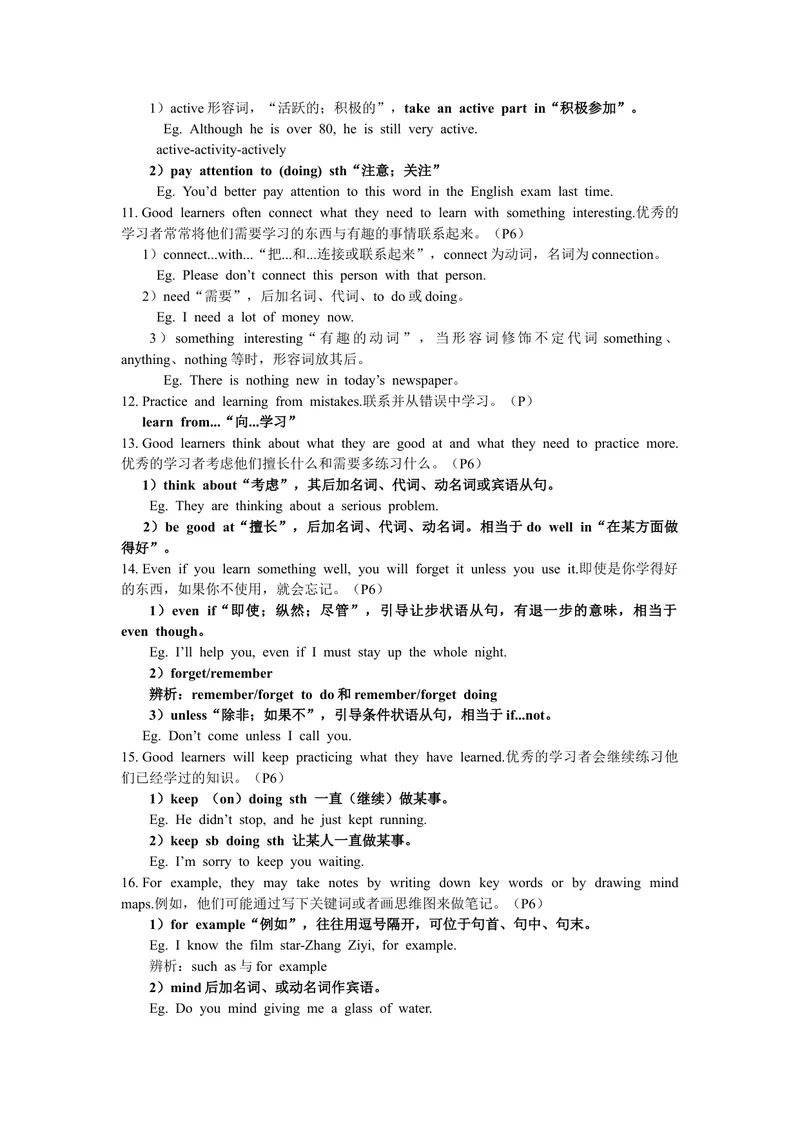
兴趣,你的大脑就会更加活跃,你也更容易长时间关注它。(P6)1)active形容词,“活跃的;积极的”,take an active part in“积极参加”。
Eg. Although he is over 80, he is still very active.
active-activity-actively
2)pay attention to (doing) sth“注意;关注”
Eg. You’d better pay attention to this word in the English exam last time.
11. Good learners often connect what they need to learn with something interesting.优秀的
学习者常常将他们需要学习的东西与有趣的事情联系起来。(P6)
1)connect...with...“把...和...连接或联系起来”,connect为动词,名词为connection。
Eg. Please don’t connect this person with that person.
2)need“需要”,后加名词、代词、to do或doing。
Eg. I need a lot of money now.
3)something interesting“有趣的动词”,当形容词修饰不定代词 something、
anything、nothing等时,形容词放其后。
Eg. There is nothing new in today’s newspaper。
12. Practice and learning from mistakes.联系并从错误中学习。(P)
learn from...“向...学习”
13. Good learners think about what they are good at and what they need to practice more.
优秀的学习者考虑他们擅长什么和需要多练习什么。(P6)
1)think about“考虑”,其后加名词、代词、动名词或宾语从句。
Eg. They are thinking about a serious problem.
2)be good at“擅长”,后加名词、代词、动名词。相当于do well in“在某方面做
得好”。
14. Even if you learn something well, you will forget it unless you use it.即使是你学得好
的东西,如果你不使用,就会忘记。(P6)
1)even if“即使;纵然;尽管”,引导让步状语从句,有退一步的意味,相当于
even though。
Eg. I’ll help you, even if I must stay up the whole night.
2)forget/remember
辨析:remember/forget to do和remember/forget doing
3)unless“除非;如果不”,引导条件状语从句,相当于if...not。
Eg. Don’t come unless I call you.
15. Good learners will keep practicing what they have learned.优秀的学习者会继续练习他
们已经学过的知识。(P6)
1)keep (on)doing sth 一直(继续)做某事。
Eg. He didn’t stop, and he just kept running.
2)keep sb doing sth 让某人一直做某事。
Eg. I’m sorry to keep you waiting.
16. For example, they may take notes by writing down key words or by drawing mind
maps.例如,他们可能通过写下关键词或者画思维图来做笔记。(P6)
1)for example“例如”,往往用逗号隔开,可位于句首、句中、句末。
Eg. I know the film star-Zhang Ziyi, for example.
辨析:such as与for example
2)mind后加名词、或动名词作宾语。
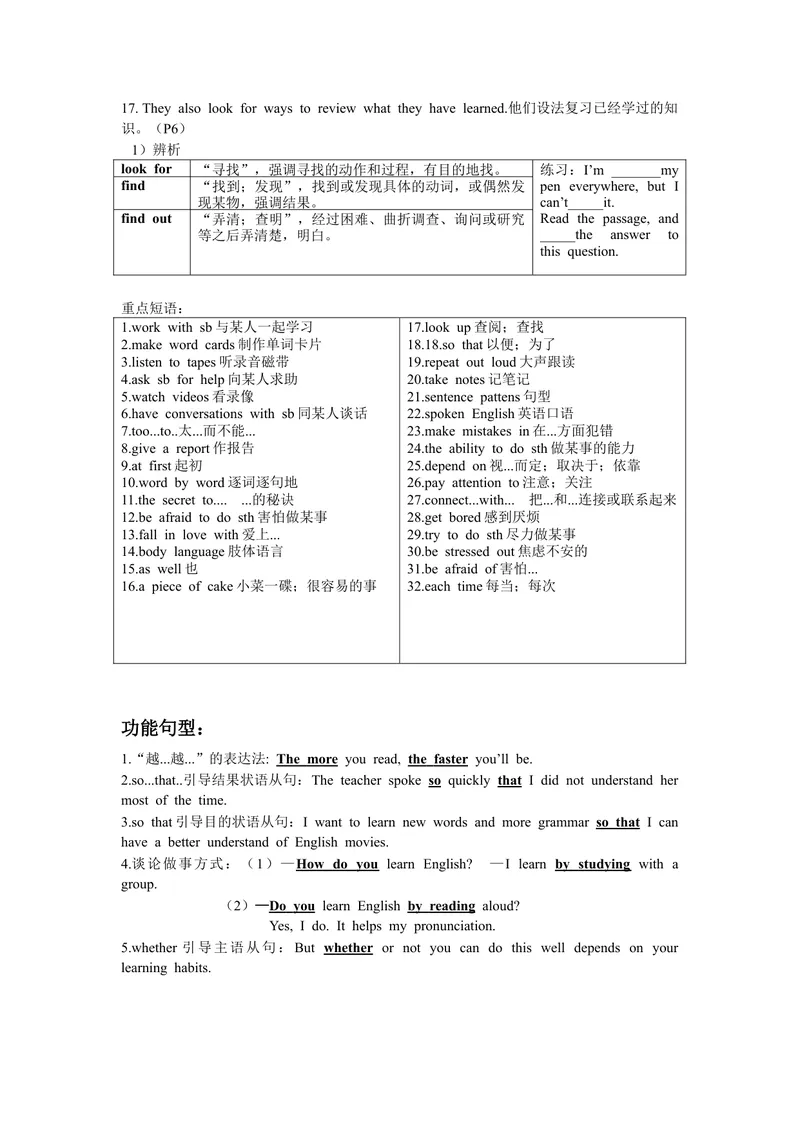
Eg. Do you mind giving me a glass of water.17. They also look for ways to review what they have learned.他们设法复习已经学过的知
识。(P6)
1)辨析
look for “寻找”,强调寻找的动作和过程,有目的地找。 练习:I’m _______my
find “找到;发现”,找到或发现具体的动词,或偶然发 pen everywhere, but I
现某物,强调结果。 can’t_____it.
find out “弄清;查明”,经过困难、曲折调查、询问或研究 Read the passage, and
等之后弄清楚,明白。 _____the answer to
this question.
重点短语:
1.work with sb与某人一起学习 17.look up查阅;查找
2.make word cards制作单词卡片 18.18.so that以便;为了
3.listen to tapes听录音磁带 19.repeat out loud大声跟读
4.ask sb for help向某人求助 20.take notes记笔记
5.watch videos看录像 21.sentence pattens句型
6.have conversations with sb同某人谈话 22.spoken English英语口语
7.too...to..太...而不能... 23.make mistakes in在...方面犯错
8.give a report作报告 24.the ability to do sth做某事的能力
9.at first起初 25.depend on视...而定;取决于;依靠
10.word by word逐词逐句地 26.pay attention to注意;关注
11.the secret to.... ...的秘诀 27.connect...with... 把...和...连接或联系起来
12.be afraid to do sth害怕做某事 28.get bored感到厌烦
13.fall in love with爱上... 29.try to do sth尽力做某事
14.body language肢体语言 30.be stressed out焦虑不安的
15.as well也 31.be afraid of害怕...
16.a piece of cake小菜一碟;很容易的事 32.each time每当;每次
功能句型:
1.“越...越...”的表达法: The more you read, the faster you’ll be.
2.so...that..引导结果状语从句:The teacher spoke so quickly that I did not understand her
most of the time.
3.so that引导目的状语从句:I want to learn new words and more grammar so that I can
have a better understand of English movies.
4.谈论做事方式:(1)— How do you learn English? —I learn by studying with a
group.
(2)— Do you learn English by reading aloud?
Yes, I do. It helps my pronunciation.
5.whether 引导主语从句:But whether or not you can do this well depends on your
learning habits.Unit2 I think that mooncakes are delicious!
课文知识点梳理
1.I’m going to Chiang Mai in two weeks.两周后我要去清迈。
(1)go/come/leave/start/fly等表示位置移动的动词,常用这些动词的现在进行时表示将要
发生的动作。
Jim is going boating this afternoon. Are they all coming tomorrow?
(2)in two weeks两周后,表示将来的时间,常用how soon来对其提问。
---How soon will the dinner be ready? ---In ten minutes.
例:这艘船不久就要起航开往纽约了。
The ship______ _______ _______New York soon. (is leaving for)
2. I wonder if it’s similar to the Water Festival of the Dai people in Yunnan Province.
我想知道它是否类似于云南傣族的泼水节。
be similar to...与……相似
His problem is similar to yours.
3. Yes, I think so.是的,我认为是这样。
在口语中,常用so代替上文讲到的内容,尤其是上文内容在下文中以宾语从句形式出现时。
如果在下文被替代者为否定含义的宾语从句,常用“否定句+so”或直接用not代替。
---Do you think it will rain? ---Yes, I think so./ No, I don’t think so.
例:---Are you sure you can do well in today’s test, Lucy?
---_______.I’ve got everything ready.
A .It’s hard to say B. I’m afraid not C.I think so D.I hope not
4.Then,you’ll have good luck in the new year. 然后,你将在新的一年里有好运气。
短语have good luck意为“有好运气”
Nobody can always have good luck.
归纳拓展:Good luck!意为“祝你好运!”,用于对别人的祝福。
---I’ll take part in the boys’ 200-meter race this afternoon! ---Good luck!
5.Chinese people have been celebrating Mid-Autumn Festival and enjoying mooncakes for
centuries.
中国 人庆祝中秋节、吃月饼已经有几个世纪了。
enjoy常用作及物动词,意思是“喜欢,享受……的乐趣”。现将其用法简述如下:① enjoy后接名词或代词 Do you enjoy the film?
② enjoy后接动词-ing形式 I enjoy listening to light music.
enjoy后接反身代词oneself,构成固定搭配,意为“过得愉快,玩得高兴”,相当于have a
good time.
---Did you enjoy yourself at the party?
---I enjoyed myself very much at the party.
例:We know that she enjoys_________films very much.
A.watch B.watches C.watching D.to watch
6. Hou Yi was so sad that he called out her name to the moon every night.后羿非常伤
心,他每天晚上对着月亮大喊她的名字。
so...that...意为“如此……以至于……”,引导表示结果的状语从句。so是副词,用以修饰
其后的形容词或副词,说明其程度的大小。
She is so lucky that she always wins at cards.
“so...that...”句型中的that在口语中常可以省略,其意思不变。
The story was so funny that it made everybody laugh.
该句型中的“so+adj./adv.”可以提至句首,以加强语气,但要注意用倒装语气。
例:改为同义句
The box is so heavy that we can’t carry it.
=The box is _________ heavy for us________ carry.
7. Marley used to be just like Scrooge, so he was punished after he died.
马利曾经就像斯克鲁奇一样,所以他死后被惩罚。
(1)used to意为“曾经,过去常常”,表示与现在比较,这种动作已经成为过去的事实,
现在已经不再这样了。
There used to be an old house near the river.
(2)just like正如,就像
That baby looks just like her father!
8.This holiday is always on a Sunday between March 22nd and April 25th.
这个节日总是在3月22日至4月25日之间的一个周日。
Between介词,(表示位置)在……中间;介于……之间;
(表示时间)在……之间,在……中间。
I’m usually free between Tuesday and Friday.易混辨析:between与among
① among指三者或三者以上之间,其宾语通常是一个表示笼统数量或具有复数(或
集合)意义的名词或代词。
They hid themselves among the trees.
② Between主要指两者之间,其宾语往往是表示两者的名词或代词,或者是有and连
接的两个人或物。
There was a fight between the two boys.
③ between还可以用来指三个或三个 以上的人或物的每两个之间。三个三个以上的
名词用and连接,前面用between,而不用among。
Switzerland lies between France, Germany, Austria and Italy.
瑞士位于法国、德国、奥地利、意大利之间。
④ among还看了用来表示一个比较的范围,常与最高级连用。
She is the tallest among the classmates.
9.Not only do people spread them around in different hiding places for an egg hunt, but
they also give out these treats as gifts.
人们不禁会把鸡蛋分散地藏在不同的地方来玩寻蛋游戏,而且还会把它们作为礼物分发
出去。
not only...but also...是一个并列连词,在句中连接两个并列对等的成分。
She not only plays well ,but (also) writes music.
We go there not only in winter, but also in summer.
在使用not only...but also...时还应注意以下几点:
① 当not only...but also...连接两个主语时,谓语动词的数原则上与其临近的主语保持
一致。
Not only you but also he is wrong.
② 为了强调,可将not only置于句首,此时其后的句子通常要用部分倒装形式。
Not only do they need clothes, but they are also short of water.
重点短语:
1.给出个人反应 give a personal reaction 50.一个……另一个……one …the other…
2.泼水节 the Water Festival 51.五月第二个星期 the second Sunday of
3.龙舟节 the Dragon Boat Festival May
4.春节 the Spring Festival 52.六月第三个星期天 the third Sunday of
5.灯笼节 the Lantern Festival June
6.在泰国/香港/北京 in Thailand/Hong 53.母亲节/父亲节 Mother’s Day/Father’s
Kong/Beijing Day
7.多么美好的一天! What a great day! 54.给…礼物 give gifts to sb8.一点 a little/ a bit/ a little bit 55. 带 … 出 去 吃 饭 take sb out for
9. 看 望 亲 戚 / 朋 友 / 同 学 visit dinner/lunch
relatives/friends/classmates 56.越来越受欢迎 more and more
10.出去吃饭 eat out/ go out for dinner popular
11.在六月 in June 57.展示/表达我们的爱 show our love
12.在(某人的)假期 on the /one’s vacation 58.花很多的钱 spend a lot of
13.一天吃五餐 eat five meals a day money
14.看着很有意思 be fun to watch 59.帮助…做… help (to) do sth/help with
15.增加(体重)/发胖/穿上 put on sth
16.在两周以后 in two weeks(将来 60.打扮/装扮 dress up
时) 61.装扮成卡通人物 dress up as a sb
after two weeks (过去时) 62.不招待就使坏 trick and treat
after +点(将来时或过去式) 63.看上去吓人/可怕 look scary
17.听起来像… sound like+n或句子 64. 关 上 / 打 开 / 调 高 / 调 低 turn
18.一年最热的月 the hottest month of the off/on/up/down
year 65.把……放在…….周围 put sth. around
19.从…到… from …to… …
20.和…相似 be similar to/ be the same 66.寻求…… ask for…
as 67.开某人玩笑 play a trick /a joke on
21.…的时间 the time of ab.
22.在街道上 in /on the street 68.了解 learn about
23.把某物扔给某人/某地 throw sth to sb 69.在北美 in North America
/ sp 70.给某人款待 give sb. a treat
24.把某物向某人扔去 throw sth at 71.考虑 think of
(带情感) 72.…的真正意义 the true meaning
25.彼此互相 each other of…
26.…..的时候 a time for doing 73.……的重要性 the importance of doing
27.洗掉… wash away sth.
28.(有)好运 (have)good luck 74.(….的)最好的例子 the best example
29.满月 a full moon (of )
30.品尝月饼 enjoy mooncakes. 75.只想着自己 only think about
30.好几世纪 for centuries oneself
31.呈/以……的形状 in the shape of 76.对别人友好 treat others nicely
32.把…带给… carry sth to sb 77.关心/关注 care about
33.传统的民间故事 traditional folk stories 78.挣(更多)钱 make (more) money
34.…的故事 the story of… 79.过去常常… used to do sth.
35.最令人感动的 the most touching 80.受到惩罚 be punished
36.射掉 shoot down 81.处某人以… punish sb.
37.给某人某物 give sb. sth./give sth. with/by…
to sb. 82.因…而处罚某人 punish sb. for…
38.(为做某事)感谢某人 thank sb.(for doing 83.告诫…去做… warn sb. to do
sth.) 84.提醒…要注意… warn sb. about sth.
(通过做)感谢某人 thank sb. by doing 85.警告…不要做… warn sb. not to do
sth. 86.最终成为 end up
39.计划做… plan to do sth 87.期待…做… expect sb. to do sth.
40.设法偷 try to steal 88.带回到… take back…
41.不在家 be not home 89.把…带回到… take sb back to sp
42.拒绝做… refuse to do sth 90.使…想起… remind sb of sth/ sb
43.飘向… fly up to 91.提醒某人做… remind sb to do sth
44.对…喊出 call out one’s name 92.醒来 wake up
to… 93.查明/弄清情况 find out
45.摆开/布置 lay out sth in /on /at 94.决定做… decide to do sth
46.回来 come back/ be back/ 95.改变…的生活 change one’s life
get back 96.承诺做… promise to do sth47.……的传统 the tradition of… 97.真需要 in need
48.赏月 admire the moon 98.…对待… treat sb with +adj
49.结果 as a result 99.…的开端 the beginning of
100.产生新生命 give birth to life
101.…的象征 a symbol of
102.不但…而且 not only … but
(also)
103.结果 as a result
104.圣诞节前夕 Christmas Eve
功能句型:
1. I think that they’ re fun to watch.
我认为它们看着很有意思。
2. What do you like about.. . ?
What do you like best about the Dragon Boat Festival?
关于端午节,你最喜欢什么?
3. What a great day!
多么美好的一天!
3.1.感叹句句型结构
(1)what引导的感叹句的中心词时名词。该名词前常有形容词修饰,句中的主语和谓语
一般可省去。句型结构为:what(+a/an)+形容词+名词(主语+谓语)!
What a cold day(it is) today! What delicious food(it is)!
What引导感叹句中的名词若为单数可数名词,要用不定冠词a/an,而不用the;若为复数或
不可数名词,则不用冠词。
(2)how引导的感叹句的中心词时形容词或副词。其句型结构为:how+形容词/副词+主
语+谓语!或how+形容词+a/an+单数可数名词+主语+谓语!
How cold it is today! How happy the children are!
3.2.陈述句改为感叹句常使用“一断二加三换位”的方法:
(1)“一断”,即在谓语动词后边断开,把句子分成两部分
She is~a beautiful girl. He works ~hard.
(2)“二加”,即如果第二部分的第一个词为形容词、副词,就加上how;如果是名词(词
组),就加上what。
She is~(what)a beautiful girl. He works ~(how) hard.
(3)“三换位”,即把第一部分与第二部分互换位置,同时把句号换为感叹句。
What a beautiful girl she is! How hard he works!
4.1 wonder if...
I wonder if it’ s similar to the Water Festival of the Dai people in Yunnan Province.我想知道它是否与云南傣族的泼水节相似。
5. How+adj. /adv. + 主 + 谓!
How fantastic the dragon boat teams were!龙舟队多棒啊!
6. What do/does+sb. + think of sth. ?
What does Wu Yu think of this festival?
吴宇觉得这个节日怎么样?
8. It’s my favorite festival because...
它是我最喜欢的节日,因为……
Unit 3 Could you please tell me where the restrooms are?
课文知识点梳理
1.could you please tell me where the restrooms are?请您告诉我洗手间在哪里好吗?
could you please...?意为“请你……好吗?”,是表示请求的礼貌用语,后接动词原形。其
否定形式是在please后加not。
—Could you please turn off the lights? —Sure,I can.
归纳拓展:表示请求时可用can,could,may,might表达,它们没有时态上的差别,只是could
比can,might比may在语气上要客气。用can或could表示“请求”比较普遍,但在正式、
庄重的场合用may或might为宜。Could/Can you lend me some money,please?
对could you please...?句型回答时,肯定回答可用sure./certainly./of course.等;否定回答可
用sorry,I can’t./sorry,I’m afraid not.等。
—Could you please open the window?
—Of course. /Sorry, I can’t.Because the windows are locked on the train.
2.The Fine Arts Museum is really interesting.美术博物馆真的很有趣。
(1)really“真正地,确实地”,通常用于预料对方会有不同意见的场合,因而含有“确
实如此,不骗你”的意思;有时也用于表示惊讶或含蓄的怀疑。
Do you really care nothing about your future? Really,I’m afraid Idon’t agree with
you.
易混辨析:really,indeed与truly
这三个词都可表示“真正地”。其区别在于:indeed多用于肯定对方的话或加强自己的
话;really多用于进一步说服对方,或表示惊奇,或表示含蓄的怀疑;而truly多用于强调
事物的真实性。You are right.It is indeed a difficult problem. Do you really want to go? It is
truly hot today.
例:---Yesterday I won the first prize in the singing competition. ---
_____Congratulations!
A.That’s right! B.What’s up? C.Really? D.Have fun!
(2)interested,interest和interesting
① interested是形容词,有被动意味,意味“感兴趣的”,主语通常是人,多用于
be/get/feel/become interested in结构中。
I’m interested in history.
② interest用作名词时意为“兴趣,趣味”;用作动词时意为“使(人)产生兴趣”,
其主语多为事物。American football doesn’t interest me at all.
③ interesting是形容词,有主动意味,意为“有趣的”。作表语时,主语通常是物。
作定语时,既可修饰人,也可修饰物。
That’s an interesting storybook for children.
例:We all love Miss Wang. She always makes her English class very______.
A.interest B.interests C.interesting D.interested
拓展:-ing & -ed区别
英语中不少动词加 ing 或ed 都变成形容词,但词意却大不相同,前于表示客观存的感
觉,后者表示主观的感觉。
下面举例说明:
1. excite exciting excited
I get excited whenever I hear the playing of our national anthem
It's such an exciting place
2. annoy annoying annoyed
It is annoying to be honest to no purpose
I'm extremely annoyed at the way he always stares at me in the office
3. embarrass embarrassing embarrassed
I don't like making speeches in public; it's so embarrassing
She was embarrassed when they asked her age
4. astonish astonishing astonished
The variety of his writing was astonishing
I was astonished at the news of his escape
5. frighten frightening frightened
The magnitude of the epidemic was frightening
The frightened child gripped its mother's hand
6. interest interesting interested
Your interesting report raises several important queriesAre you more interested in theater or in television?
7. surprise surprising surprised
It's surprising: they lost!
I'm not surprised at her frankness
8. shock shocking shocked
Her racy stories can be rather shocking
I was shocked by his wickedness
9. disgust disgusting disgusted
That's disgusting
I'm disgusted with her affectation
10. amuse amusing amusied
I fail to see why you find it so amusing
We were greatly amused
11. bore boring bored
It is awfully boring
I'm rather bored by the rumor
12. relax relaxing relaxed
It is relaxing to kite with friends
Her features suddenly relaxed
13. puzzle puzzling puzzled
The teachers explanation clarify the puzzling problem
She listened with a puzzled expression on her face
14. move moving moved
This is a very moving story
I was moved
15. inspire inspiring inspired
The inspiring music acted on the emotions of the students
The good life is one inspired by love and guide by knowledge
16. encourage encouraging encouraged
It's encouraging to receive a favorable report on one's work
Consumers are encouraged to complain about faulty goods
17. disappoint disappointing disappointed
I found it very disappointing
I was more disappointed than discouraged
18. please pleasing pleased
This wine is most pleasing to the taste
I am only too pleased to do business with you
19. discourage discouraging discouraged
It's very discouraging to be sneered at all time
I was never discouraged against learning English
20. affect affecting affected
She is constantly under pressure and it is affecting her health
She has also been affected, but to a lesser degree3.Pardon me,could you please tell me where to park my car?对不起,你能告诉我在哪里
停车吗?
句中Pardon me意为“对不起”,具体用法如下:
(1)表示道歉,意为“对不起”
---Pardon me,I suppose I should have knocked. ---That’s all right.
(2)表示没听清或没听懂对方的话,请求对方再说一遍(也说I beg your pardon/Pardon
等,注意说时用升调),意为“请再说一遍;对不起,我没听清”。
---Where’s the post office? ---Pardon me? ---I asked where the post office was.
(3)用于提出异议之前,意为“对不起”。Pardon me, but this is my coat.
(4)用来引起对方注意,意为“对不起;打扰一下;请问”。
Pardon me,may I disturb you a minute?
例:---Open the window please,Mike? ---________? I didn’t hear what you said.
A.What B.Pardon C.Really D.All right
重点难点全解 疑问词引导的宾语从句
① 宾语从句的连接词
特殊疑问词引导宾语从句时,从句的连接词由该特殊疑问句的疑问词充当。特殊疑
问句的疑问词通常有疑问代词what,which,who,whose和疑问副词where,when,why,how
等。
He wondered what had happened to her.
Could you tell me how I can get to the hospital?
② 宾语从句的语序
特殊疑问句作宾语从句时,不管主句是陈述句还是疑问句,从句都是用“连词+陈述
句语序的句子”,句末是否用问号由主句来定。主句是陈述句时,句末用句号;主句
是疑问句时,句末用问号。
Where does Mr.Liu live?Do you know?---Do you know where Mr.Liu lives?
易错易混全解
1.Excuse me, I’m sorry与I beg your pardon
三者都有“对不起,请原谅”的意思,但用法有区别。
(1)下列情景中要用Excuse me:
① 向别人问路、问时间时。 Excuse me! Where are the washrooms?
② 当你询问别人是否准许你做某事时。 Excuse me!Can I put my bike here?③ 当你向别人打听某人(某事)时或当你要证实对方是不是某人 时。
---Excuse me!Are you Mr.Black? ---No,I’m not.
(2)I’m sorry常用来表示自己犯了某种过错,也可表示“遗憾”,如对别人的不幸有所表
示或不满足对方的要求等。
I’m sorry for giving you so much trouble.
(3)I beg your pardon可用于(正式场合):
① 做错事而道歉(比I’m sorry更正式,也可说pardon me)
② 谈话中提出异议之前
③ 没听清对方的话,希望对方重复一遍时(可说 pardon me或pardon,可用问号,
说时用升调)
④ 用来引起地方的注意
I beg your pardon for coming late.
I beg your pardon, is this your handbag?
2.问路和指路的常用句型:
(1)向别人问路时,可以用一般疑问句提出,也可用特殊疑问句提问。常用的表达方式
有:
① Is there a...near here?
② Where is...?
③ How can I get to...?
④ Which is the way to...?
⑤ Can you tell me the way to...?
⑥ Can you tell me how I get to...?
出于礼貌,应先说Excuse me,然后再提问。
(2)为别人指路时,可以用以下句子:
① Go/Walk along this road/street.沿着这条路走。
② Take the first turning on the left/right.在第一个拐弯处左转/右转。
③ It’s about...meter(s) from here.大约离这儿有……米。
指路时,要根据对方问路时所用的句型恰当地作出回答。如果知道,可以指点方向;如果
不知道,可以说:I’m sorry.I don’t know.这时问路者仍应有礼貌地向对方表示谢意,说
thank you all the same.还是要谢谢你。
---Excuse me.Where is the bookshop,please?---Sorry,I don’t know.
---Thank you all the same.
3.at,beside,by与near
(1)at“靠近”,往往意为着有目的、有意识的靠近,而by,beside,near只意味着“靠近”。
He sat at the desk.He wanted to read.
(2)beside“在。。。旁边”;by(=just at t he side of)“就在。。。旁边”。两者一般可通用。
但by比beside语气较强些,并多用于日常用语中。
There is a hospital beside/by the river.
注意:指“在某人身边”时,多用 besid e 。
The little boy is standing beside his mother.
(3)near“在。。。附近”或“离。。。不远”,它表示的距离要比 by/beside表示的距离远
些。
We live near the sea.(表示离海边有些距离)
We live by/beside the sea.(表示海就在身边)
重点短语:
1.turn left 向左转 13. one one’ s way to... 在去…….的路上
2. get a pair of shoes 买一双鞋子 14. pass by 路过
3. on one’ s right 在某人的右边 15. a rock band 摇滚乐队
4. go along Main Street 沿着主大街走 16.something to eat 一些吃的东西
5.have dinner 吃饭 17.mail a letter 寄信
6.go to the third floor 去三楼 18.in the shopping center 在购物中心
7.go past the bookstore 走过书店 19.in some situations 在某些场合
8.a room for resting 休息室 20.such as 例如
9.be special about.. . 有……独特之处 21.lead in to a request 引人一个请求
10. pardon me 请再说一次 22.use proper language 使用合适的语言
11. come on 过来;加油 23. park one’ s car 停车
12. hold one’s hand 抓住某人的手 24.an underground parking lot 地下停车库
25. change money 换钱
26.the way to... 去……的路
27. thank sb. for doing sth. 为……感谢某
人28. look forward to….期盼……
29. meet sb. for the first time 第一次见到
某人30.in a rush to do sth. 仓促地做某事
31. be convenient to do sth. 做某事很方便
功能句型:
1. not…until…You never know until you try something.
凡事只有亲身经历了才能了解。
2. It seems (that)…It seems a rock band plays there every evening.那里好像每天晚上都有乐队演奏。
3.—do you know...Excuse me, do you know where I can buy some
medicine?打扰了,请问哪里能买到药?
4. Could you please tell me... ?Could you please tell me how to get to the post office?
你能告诉我去邮局怎么走吗?
5.I wonder...I wonder where we should go next.我想知道接下来该去哪里。
6.sb. suggest+ 从句The clerk suggests they go to the... museum.
工作人员建议他们去……博物馆。
Unit 4 I used to be afraid of the dark.
课文知识点梳理
1. He used to be really short. 他原来很矮。
· 基本用法
这句话中used to do意为“过去常常做某事,而现在不做了”,而be used to意为“被用
来……”,
be used to doing意为“习惯于做某事”。如:
He used to get up early in the morning.
他原来早上起得早。
The cup is used to drink coffee.
这个杯子是用来喝咖啡的。
I am used to eating rice now.
我习惯吃米饭。
2.It’s been three years since we last saw our primary school classmates.
自从最后见到我们的小学同学已经有三年了。
· 基本用法
本句中“It’s / It has been + 一段时间 + since + 时间状语从句”中,主句的谓语动词用
一般现在时或
现在完成时,从句的谓语动词用一般过去时。当从句的谓语动词是终止性动词时,译作
“自从…以来,
已经…(时间)了”。 如:
It’s / has been three months since he moved to this city.
他搬到这座城市已经3个月了。
注:若since引导的状语从句的谓语动词是持续性动词或表示状态的动词的过去时时,
则从句表示的时间
是“从那持续动作或状态结束时算起”。如:
It is half a month since he was a League member.
他退团(不当团员)半个月了。
3.I used to see him reading in the library every day.
之前我每天都看见他在图书馆看书。
· 基本用法这句话中see sb. doing sth.意为“看见某人正在做某事”,表正在进行;see sb. do sth.意
为“看见某人
做过某事”,强调过程。
On weekends, we often watch some children fly kites at Nanhu Square.
在周末,我经常看到孩子们在南湖广场放风筝。
When I walked past the park, I saw some old people doing Chinese Taiji.
当我走过公园的时候,看到一些老人在练太极。
4.What does Candy have to say to all those young people who want to become
famous?
坎迪会对所有渴望成名的年轻人说些什么呢?
· 基本用法
本句中all those young people是介词to的宾语;用到了say sth to sb的结构,who want to
become
famous是一个定语从句,修饰先行词all those young people,关系代词who在从句中作主
语。
Your mother prepared delicious food for us yesterday. Please say thanks to her.
你妈妈昨天为我们准备了可口的食物,请向她道谢。
Do you know the man who is standing at the door?
你认识站在门口的那个人吗?
建议:搜索关于定语从句的题目时,可在关键词中输入who,可精确找到引导词为
who的定语从句。
5. “you have to be prepared to give up your normal life.”
“你不得不准备放弃你正常的生活。”
· 基本用法
本句中包含了两个固定搭配,分别是:
1. be prepared to do sth.准备做某事
The two teams prepared to debate about the given topic.
两个队准备就所给定的题目展开辩论。
2. give up sth./doing sth. 放弃某事/做某事
He was not prepared to give up that easily.
他可不是个善罢甘休的人。
6.The head teacher advised his parents to talk with their son in person.
校长建议父母单独和他们的儿子谈话。
· 基本用法
这句话中所包含的句型为:advise sb. to do sth.意为“建议某人做某事”。
The minister advised him to leave as soon as possible.
部长建议他尽快离开。
· 知识拓展
advise的其他用法
1. advise + 名词 / 代词
Li Ming advised a swim after school.
李明建议放学以后去游泳。
2. advise + sb. + 特殊疑问词 + 不定式短语,在这个句式中,“特殊疑问词 + 不定式短
语”作 advise的宾语补足语。
She advised them how to solve the problem .
她给他们出主意怎样解决这个问题。
3. advise + 动名词
I advised holding a meeting to discuss the matter.
我建议开一个会来讨论这件事情。
4. advise + sb. +against + doing sth.
The lawyers have advised us against signing the contract.
=The lawyers have advised us not to sign the contract.
律师建议我们不要签订这个合同。
5. advise + 宾语从句 ,advise 后面接宾语从句时,从句中的谓语动词应为虚拟语气,即用
“ should + 动词原形”, should 可以省略。
I advise that you (should) do it right away .
我建议你马上就做这件事情。
7.To Li Wen’s surprise, their conversation changed his life.
让李文吃惊的是,他们的谈话改变了他的人生。
· 基本用法
to one’s surprise意为“让某人吃惊的是……”,to前可以用much来修饰,表示程度。
类似的表达方式还有:
To her great joy, her daughter was finally saved by the doctors.
让她非常高兴的是,女儿最终被医生救活了。
Much to my disappointment, the football team didn't win the match.
让我很失望的是,足球队没有赢得比赛。
To people's shock, he was a thief 20 years ago.
让人们震惊的是,他20年前十个小偷。
8 I used to be nervous about tests all the time.
原来考试时我总是很紧张。
· 基本用法
本句中使用了两个表达方式,分别是:be nervous about sth/doing sth 以及all the time。
1. be nervous about sth./doing sth.对某事/做某事很紧张
He is quite nervous about making a speech in front of so many people.
他对在这么多人面前演讲感到很紧张。
She's nervous about something, because she is always drinking water.
她正为了什么事神经紧张,因为她一直在喝水。
2. all the time意为“一直”。
I have been busy all the time.
我一直很忙。
9. They also told me that even though they couldn’t be there to take care of me,
they were always thinking of me and would take pride in everything good
that I did.
他们也告诉我尽管他们不能在这里照顾我,但是他们总能想到我,并为我做的好的事
情感到骄傲。
· 基本用法
本句中包含了4个常用的表达方式,分别是even though引导的让步状语从句,take careof, think of
以及take pride in。
1. even though引导让步状语从句,意为“尽管”
He's the best teacher even though he has the least experience.
尽管他经验最少, 但教得最好。
Bob always enjoys sailing, even though the weather is cloudy.
鲍勃总是很喜欢航行, 即使空中乌云密布。
2. take care of意为“照顾;照料”
There was no one else to take care of their children.
没有别人可以照料他们的孩子。
3. think of意为“想到;考虑;想象”
Will you think of me after I've left?
我离开之后, 你还会记得我吗?
4. take pride in意为“为……感到自豪”
She will probably take great pride in wearing school uniform.
她大概会为穿上校服而感到非常得意。
建议:搜索引导词为even though的让步状语时,在关键词中输入:even though,可精
确定位。
10.His parents’ love has made him feel good about himself.
他父母的爱让他自我感觉良好。
· 基本用法
本句中包含了使役动词make的用法,make接宾语时,后接不加to的动词不定式,也
就是make sb. do sth.
(让某人做某事),有相同用法的词还有:have, let, help。help可以用help sb to do sth,也
可以用
help sb do sth。
The talk show on TV is very popular. It often makes people laugh.
这个脱口秀很受欢迎,因为它经常使人发笑。
Let Tim get the chair for you.
让蒂姆给你搬过那把椅子来。
My mother often has me finish my homework before 10 o'clock.
我妈妈经常让我10点前完成作业。
Can you help me (to) clean up the house?
你能帮我打扫房间吗?
11. Even the teacher agreed that Li Wen was wasting his time.
甚至连老师都同意李文是在浪费时间。
· 基本用法
本句中采用了“agree+that从句”,意为“赞同……”。Agree的其他用法:
1. agree with sb. 同意某人的意见、想法、分析、解释等。如:
I quite agree with you.
我完全同意你的意见。
2. agree to do sth. 表示同意或接受某事。
We agreed to leave early.
我们同意早点出发。3. agree on sth./doing sth. 指双方通过协商而取得一致意见或达成协议或同意做某事。如:
Both sides agreed on these terms.
双方都同意这些条件。
He agreed on helping us.
他同意帮助我们。
4. agree to sth. 主要用来表示一方提出一项建议、安排、计划等,另一方同意协作。
We agreed to their arrangement.
我们同意了他们的安排。
重点语法
used to的用法
· 定义
used to是一个固定结构,意为“过去经常,以前常常”,其后用动词原形,它表示过去
存在某种状态或者
过去的某种经常性、习惯性的行为或者动作,并意味着这种动作目前已经不存在,所以
它只能用一般过
去时,不能用现在时态。
· 用法
1. 它的陈述句的肯定形势:主语+used to+动词原形。如:
I used to play with my friends after school.
我过去常常放学后跟同学一起玩儿。
2. 它的否定形式:主语+didn’t+use to+动词原形。如:
You didn’t use to like pop songs.
你过去不喜欢流行音乐。
3. 它的一般疑问句形式:Did+主语+use to+动词原形+其他?如:
Did your sister use to be quiet?
你妹妹过去很文静吗?
4. used to的状语可以用副词always, often, sometimes等,但是仍然是过去的习惯,不是指
现在的习惯,
所以不能用一般现在时。如:
He always used to be late for class.
他过去总是上课迟到。
5. used to可以用在there be结构中表示“过去经常有”的意思。如:
There used to be a lot of fishes in this river.
河里之前有很多鱼。
6. be used to do sth.意为“被用来做某事”,是动词短语use…to do的被动语态结构,used
是动词的过去
分词。它可以用各种时态。如:
Knives are used to cut things.
刀被用来切东西。
7. be used to doing sth.意为“习惯于做某事”,to后用动名词,它可以用现在、过去和将
来等时态,be
可以用get,become连系动词代替。如:
My father is used to living in the village.
我爸爸现在习惯于在乡村生活。反意疑问句是英语四大问句之一,它是由一个陈述句加上一个短问句而构成的。反意疑问
句的基本构成形式是:陈述句+动词(肯定或否定)+主语?如:
①She often has lunch at school, doesn't she? ②You don't like sports, do you?
使用反意疑问句要注意以下若干对应规则:
一、 反意疑问句中问句部分的动词与陈述部分的动词在语气上成相反的对应关系,即:
肯定+否定? 否定+肯定?如:
①You can't do it, can you? ②They are very late for the meeting, aren't they?
二、 反意疑问句中问句部分的动词与陈述部分的动词种类要对应一致。如:
①He has supper at home every day, doesn't he? (不能用hasn't he?)
②They have known the matter, haven't they? (不能用don't they?)
三、 反意疑问句中问句部分的动词在时态上应和陈述部分的时态一致。如:
①They will go to town soon, won't they?(不能用don't they?或 aren't they?)
②He works very hard, doesn't he?(不能用didn't he?或won't he?)
四、反意疑问句的陈述部分带有little, few, never, hardly, seldom等否定意义的词时,问句
部分用肯定式。如:
①She never tells a lie, does she?(不用doesn't she?)
②He was seldom late, was he?(不用wasn't he?)
五、反意疑问句的陈述部分为I am……时,问句部分习惯上用aren't I?表示。如:
I am a very honest man, aren't I?
六、陈述部分的主语为不定代词something, anything, nothing, everything时,问句部分的
主语用it。如:
①Something is wrong with the computer, isn't it?②Nothing has happened to them, has
it?
七、陈述部分的主语为不定代词 somebody(someone), anybody(anyone), nobody(no one),
everybody(everyone)时,问句部分的主语用he或 they,这时问句动词的数应和he或 they
一致。如:
① Someone has taken the seat, hasn't he?② Everyone has done their best in the game,
haven't they?
八、陈述部分为Let me……时,问句部分习惯上用shall I? 或will you?形式。如:
Let me have a try, shall I?(will you?)
九、陈述部分为Let us……时,问句部分习惯上用will you?形式。如:
Let us stop to rest, will you?
十、陈述部分为Let's……时,问句部分习惯上用shall we?形式。如:
Let's go home together, shall we?
十一、陈述部分用上述情况以外的祈使句时,问句部分一般用will you?形式表示请求,用
won't you?形式表示委婉请求或邀请。如:
①Do sit down, won't you?/ will you? ②You feed the bird today, will you?
③Please open the window, will you?(won't you?)
十二、陈述部分为否定祈使句时,问句部分一般用will you?形式。如:
Don't make any noise, will you?
十三、陈述部分为There (Here) + be + 主语时,问句部分用动词+there(here)?形式。如:
①There are two cakes on the plate, aren't there? ②Here is a story about Mark Twain,
isn't here?
十四、陈述部分用used to +主语时,问句部分用didn't + 主语?或usedn't +主语?形式。①He used to live in the country, didn't he?/usedn't he?
②They used to be good friends, didn't they?/usedn't they?
重点短语:
1. used to 过去常常;以前常常 12.appear to “给……的印象”
2 be terrified of 非常害怕的极度恐惧的 13.fight on 继续战斗
3. go to sleep 去睡觉 14.not...any more 不再
4. in the end 最后,终于 15.the number of+名词复数 “……的数
5. make a decision 下定决心 量”
6. to one’s surprise 令某人惊奇的是 16.a number of——名词复数 “许多……”
7. even though 即使,纵然,尽管 17.take up “开始做”
8. no longer 不再;已不 18. too much “太多”
9. take pride in对……感到骄傲 19.be proud of “以……为自豪”
10. pay attention to对……注意;留心 20.in person “亲自”
11. give up 放弃 21.move in with “搬来与……一起住”
22.no longer “不再”
功能句型:
1. I used to be afraid of ... 我过去害怕……
2. –You used to ...’didn’t you? 你过去常常……是吗?
--Yes, I did. / No, I didn’t.
3. –Did you use to ...? 你过去常常……吗?
--Yes, I did. / No, I didn’t.
4. I didn’t use to ...?我过去不经常……?
5. Are you still afraid of ...? 你还害怕……吗?
6. I go to sleep with my bedroom light on. 我睡觉的时候卧室的等开着的。
Unit 5 What are the shirts made of?
课文知识点梳理
1.Yes, and it was made in Thailand.
是的,它是在泰国制造的。
· 基本用法
这句话中be made in意为“在……生产或制造”。
It‘s a car which is made in Germany.
这是一辆德国造的车。
其他相似的结构还有:be made of,be made from,be made into,be made by,be made
out of,
区别如下:
1. be made of “由……制成/造”成品看得出原料。如:
The desk is made of wood.
这张桌子是木头制成的。2. be made from “由……制造/成”成品看不出原料。如;
Paper is made from rags.
纸是由破布做的。(已看不出原料)
3. be made into 为"被制成为…"。
This piece of wood will be made into a small bench.
这块木头将要被制成一个小凳。
4. be made by指由制造者、制造方制造
The software is made by Microsoft company.
这款软件由微软公司制造.
2. No matter what you may buy, you might probably think those products were
made in those countries.
不管你可能会买什么,你很可能想到这些商品产自这些国家。
· 基本用法
No matter what在这里意为“无论什么”,引导让步状语从句。
No matter what you say, I like to listen.
不管你说什么,我都喜欢听。
No matter what the matter may be, we should do our best.
不论事情会成什么样,我们都应当尽最大的努力。
3.He found it interesting that so many products in the local shops were made in
China.
他发现有趣的是当地的许多商品是中国制造的。
· 基本用法
这句话中所包含的句型为: find+it+ adj./n.+that.../(for sb. ) (not) to do sth.,意为“我发
现做
某事是……”。如:
I find it hard to learn Maths well.
我发现学好数学很难。
注:在该结构中,如果不使用形式宾语it,则可转换为:
make/find/consider/...+sth.+ adj./n.+(for sb. ) (not) to do结构。
I found it easy to understand this lecture.
= I found this lecture easy to understand.
4.It takes several weeks to complete everything.
完成这些事花费了几个星期。
· 基本用法
It takes (sb.) some times to do sth.意为“做某事花费(某人)……时间。”。如:
It takes me two hours to finish the task.
完成这项任务花费了我两个小时。
· 知识拓展---“花费”辨析
1. spend 的主语经常是人 , 用来表示人花钱买东西或花时间做某事,常用的句型有:
spend...on sth/in doing sth
I spend 5 yuan on the book.
我买这书花五元钱。
The boy spent 10 minutes drawing a dog.
那个男孩花了10分钟画一只狗。2. take 也可表“花费时间和金钱”,(一般只指花费时间)
其常用结构为:It +take(各种时态)+time/money+to do sth.
It took me three hours to finish the work.
我花了三小时完成工作。
3. pay “支付,花费”,主语只能是人 且只用于花费金钱
其结构是: pay + sb + some money + for sth. “为……付给某人多少钱” ,其中的人、钱、
事,可以根据
具体情况取舍。
I paid (him)5 yuan.
我付(给他)5元钱。 I paid him 5 yuan for the book.
我买那本书付给了他五元钱。
I paid him for the book.
我买那本书付给了他钱。
I paid for the book. 我付了那本书的钱。
4. cost 指某东西“值……钱”; “需要花费……钱/ 精力”等,它的主语一般为表示东西
的名词,不能为
表示人的名词,作及物动词和名词。可接双宾语,无被动语态。如:
I’ll bet that dress cost a thousand dollars.
我敢说那件衣服得花1000美元。
The chair cost me thirty yuan.
这把椅子花了我30元。
5. My hometown is famous for …
我的家乡以……而闻名。
· 基本用法
sth. be famous for…意为“某物因……而闻名。”。如:
The city is famous for its buildings.
这座城市因它的建筑而闻名。
· 知识拓展---词义辨析
be famous for/be famous as
1. be famous as “以(某种身份)……出名(著名)”as后跟人宾语往往与主语同位,意
思相当于
(be) well known as。如:
She is famous as a poet.
他以一名诗人而著名。
The town is famous as a car-making place.
该城镇以制造汽车而闻名。
2. be famous for “困……而闻名(驰名)”表示由于某种特征而出名,for后的宾语一般
为主语人从属内容,
意思相当于 (be) known for。如:
China has been famous for its silk.
中国素以丝绸闻名。
This city is famous for its big gambling resort.
该市因其大赌场而驰名。
6. Which art form do you think is the most interesting?你认为哪种艺术形式最有趣?
· 基本用法
这句话中“do you think”是插入语,请注意位于疑问词后的插入句,这种插入句本身前
后无逗号,和整
个句子连成一体,插入句后的主句主谓用陈述句的语序。如果整个句子为疑问句,则插
入句用一般疑
问句的语序。在这种句子中如果我们把插入句移到句子前部去,它就会成为主要成分,
而原来句子的
主要部分会变成一个从句。如:
How long did she say she would stay here?
她说她要在这里等多久?
When do you suppose they will be back?
你认为他们会什么时候回来?
What do you think I should do first?
你认为我应该先做什么呢?
7.The pieces are carefully shaped by hand from a very special kind of clay and then
allowed to air-dry.
这些东西都是从一个特殊形状的泥块经过手工精心制成的,然后让它风干。
· 基本用法
本句中有两句采用了被动语态的结构,分别是:...are carefully shaped...以及...allowed to
air-dry。
by hand意为”手工地“,指方式、方法。
1. by hand 用手的,亲自的;手工
The skirt was made by hand in the factory.
这条裙子是在工厂里手工做的。
He brought up the child by hand.
那孩子是他亲手带大的。
2. be allowed to do 意为:被允许做某事
We are not allowed to enter the computer room with shoes.
我们不允许穿鞋进机房。
8. These small pieces of clay art show the love that all Chinese people have for life
and beauty.
这些泥制品展示了所有的中国人对生活和美的热爱。
· 基本用法
本句中the love是show的宾语,that all Chinese people have是定语从句,修饰先行词the
love,关系
代词that 在这里指物。
· 定语从句引导词that的用法
1. that也可指物,在句中可以充当从句的主语、宾语、表语。如:
The old man that I visited yesterday is my teacher.
我昨天拜访的那个老人是我的老师。
2. 引导词只能用that的情况
(1) 先行词是不定代词或先行词被补丁代词修饰时,关系代词通常只用that。如:That’s all that I know.
我知道的就这些。
(2) 先行词被序数词、形容词最高级、the only, the very, the last等修饰时,关系代词通常只
用that。如:
The first English novel that I read was Cities.
我读的第一本英文小说是《城市》。
(3)先行词既有人又有物时,关系代词只用that。如:
The scientist and his achievements that you told me about are admired by us all.
我们所有人都钦佩你告诉我的那位科学家和他所取得的成就。
重点语法
一般现在时的被动语态
· 定义
被动语态中动作接受者作句子主语,动作执行者置于句末,用 by连接,有时可以省去
不用。谓语动词由
“be+动词的过去分词”构成,一般现在时被动语态的结构为:
主语(动作接受者)+is/am/are+动词的过去分词+(by+动作执行者)
被动语态的句型结构如下:
肯定句:主语+be+过去分词+(by…)。
否定句:主语+be not+过去分词+(by…)。
一般疑问句:Be+主语+过去分词+(by…)?
特殊疑问句:特殊疑问词+be+主语+过去分词+(by…)?
· 用法
1. 要表达“被……”、“受……”、“遭……”、“让……”之类的语义。如:
Teachers are well respected.
老师很受尊敬。
The child is well loved by people.
这孩子很找人喜爱。
2. 强调动作的承受者。如:
He is known far and wide.
他远近闻名。
3. 不知道或没有必要支出动作的执行者。如:
The room is cleaned every day.
房子每天都有人打扫。
重点短语:
1.be made of/from 由……制成 17.all over the world全世界
2. be made in 在……地方制造 18.American products 美国产品
3. environmental protection 环境保护 19.no matter what无论什么
4. be famous/known for… 因……而出名 20.local shops 本地商铺
5. as far as I know 据我所知 21.made in China 中国制造
6. by hand 用手 22.American brand 美国品牌
7. search for 寻找 23.in fact 事实上
8. no matter what 无论什么 24.pet food宠物食品
9. avoid doing sth 避免做某事 25.mobile phone 手机
10. be good at 擅长 26.American flag美国国旗
11. according to 根据 27.everyday things日常用品
13. be turned into 被变成 28.make high-technology products 制造高科
技产品14. be seen as 被视为 29.in all parts of the world在世界所有的地
15. send out 发出 区
16, t seems that... 似乎……, 看来好像……
功能句型:
① —Are your shorts made of cotton?
你的T恤是用棉花制成的吗?
—Yes, they are. And they were made.
是的,而且它们是在美国生产的。
② What is the model plane made of/f?
这架模型飞机是用什么制成的?
—it’s made of used wood and glass.
它是由用过的木头和玻璃制成的。
③ How is tea produced?
茶叶是如何生产的?
— Tea plants are grown on the sides of mountains. When the leaves are ready, they
are picked by hand and then are sent for processing.
茶树生长在山坡上,当叶子长好时,用手摘下它们,然后送去加工。
④ Where is tea produced in China?
中国哪里产茶叶?
—It’s produced in many different areas.
它是在很多不同的地方生产的。
Unit 6 When was it invented?
课文知识点梳理
Section A
1.invent (v.)发明;创造
invent 指发明创造出自然界本来不存在的东西,如工具、方法、手段、汽车、电器、合成
材料等。
Bell invented the telephone. 贝尔发明了电话。
Smith invented a new teaching method. 史密斯发明了一种新的教学方法。
拓展 discover, find, create
1.discover是“发现”的意思,是指发现原来就有而一直没被发现,如发现电、煤、石油等
矿藏及新星、星系或科学真理等。
Columbus discovered America in 1492.1492年哥伦布发现了新大陆。
Recently they have discovered a comet. 最近他们发现了一颗彗星。
2.find的意思是“寻找”,强调找的结果,并不指发现。
I've tried to find another copy but couldn't find one. 我试图再找一本,但没能弄到。
3.create指有目的地把原材料制成新产品,也指创造出原来不存在的或与众不同的事物。
Man creates himself. 人类创造了自己。A novelist creates characters and a plot. 小说家塑造人物并设计情节。
根据语境提示,用invent, discover,find或create的形式填空,完成句子。
1.When _____ the stream engine(蒸汽机) ___?
2. I can’t ____ my bike, I’m looking for it.
3. Scientists are now trying to ___ if this is possible.
4. Do you know who______ the plane?
5. He ____quite a number of wonderful characters in his play.
【解析】I.1.was, invented 2.find 3.discover 4.invented 5. created
2. be used for 用来做……
此短语中的for是介词,表示用途,后接名词或动词-ing形式。
An orange is used for medicine. 桔子可以入药。
A pen is used for writing. 钢笔用来写字。
拓展 be used as& be used by
1.be used as 意为“被用作……”,介词as表示“作为”,其后一般接名词,强调使用的
工具及手段。
【例句】
English is used as the second language in many countries.
英语在许多国家被当作第二语言使用。
This room is used as their office. 这人房间被用作他们的办公室。
2.be used by 意为“被……使用”,介词by后面接动作的执行者(宾语)。
【例句】
English is used by travelers and business people all over the world.
全世界的旅行者和商人们使用英语。
Tractors are used by the farmers. 农民使用拖拉机。
3. pleasure n. 高兴,愉快;
常用于口语中;it’s my pleasure. With pleasure.
It’s my pleasure to help you look after your pet cat.我感到很荣幸帮你照看你的宠物猫。
拓展 please, pleased, pleasure, pleasant 的区别
一、please
1.表请求或要求的语气。是动词(及物动词)。
-Come in, please.请进来吧。(或Pease come in)
-Sit down, please.请坐。(或Please sit down)
2.表“讨好,讨人喜欢;喜欢”(不及物动词)或者“使···高兴,使···满意,使···喜欢”
(及物动词)
-Go where you please.你想去哪就去哪。
-What pleases you best?你最喜欢什么?
二、pleased形容词。表示“高兴的,喜欢的,满意的”。它指的是人主观上感到的满足心
理
-I'm pleased to see you!见到你真高兴!
常用句型有:be pleased to do sth.高兴做某事
be pleased at/about/with/by 对···感到满意/高兴
be pleased that从句 对··· 感到满意/高兴
三、pleasant形容词。表示“令人愉快的”“让人感到满意”。主语一般为物。The walk was very pleasant. 那次散步很(让人)愉快。
四、pleasure名词 表示“满足;乐趣;消遣、娱乐”
It's a pleasure to read this book. 读这本书真是件乐事。
4.remain (v.) 保持;剩余;残余
remain意为“停留,留下”,相当于 stay。“呆在那里”可以说 remain / stay there,但
“呆在家里”只能说stay (at) home。
She remains in the house all these days. 她这些天一直呆在那栋房子里。
They all wished us to remain. 他们都希望我们留下来。
拓展 remain作连系动词
remain用作连系动词,意为“保持(某种状态),继续存在,仍旧是”,后面接形容词,名
词,分词,不定式或介词短语。
【例句】
She remained sitting when they came in.他们进来时,她仍然坐着(没有站起来)。
Peter became a manager but John remained a worker.
彼得当上了经理,但约翰仍然是一个工人。
Whatever great progress you have made, you should remain modest.
无论你取得了多么大的进步,你都应一直保持谦虚。
This remains to be proved. 这有待证实。(将来被动动作)
5. by accident偶然地;意外地
He made this mistake by accident.他犯这个错误纯属偶然。
6.by mistake 错误地
by mistake 是介词短语,意为“错误地;无意地;不小心地”,指由于错误的判断而千百
万的失误,常在句中作状语。
I took your bag instead of mine by mistake. 我错拿了你的手提包,还以为是我的呢。
Susan forgot her key and locked herself out by mistake. 苏珊忘了带钥匙,误把自己关在
门外了。
拓展 mistake...for…
mistake...for…把……错认为, 错把……当作
She mistook him for the professor.她把他错当作教授了。
7.divide (v.) 分开;划分
divide …into 意为“把……划分为……” ,be divided into 意为“划分为”。
【备课例句】
This class is too large; we shall have to divide it for oral practice.
这个班级太大,我们必须把它分成小班作口语练习。
This river divides at its mouth. 这条河在河口处分岔。
His lecture divides into three parts.他的演讲分三部分。
Let's divide ourselves into several groups. 我们分成几个小组吧。
重难点
一、When was it invented? 它是何时发明的?
本句用于询问某个物品的发明时间,结构为“When + was+某项物品+invented?”,其中
was invented是一般过去时的被动语态,其基本结构是“was/were + 过去分词”
例句:This book was bought yesterday. 这本书是昨天买的。【拓展 几种基本时态的被动语态
1.一般现在时:am/is/are +过去分词
Football is played all over the world. 足球运动遍及全世界。
2.一般过去时:was/were + 过去分词
This book was bought yesterday. 这本书是昨天买的。
3.一般将来时:will be +过去分词
The class meeting will be held tomorrow. 班会将在明天开。
4.现在进行时:am/is/are +being +过去分词
Our teaching building is being built now. 我们的教学楼正在兴建中。
5.过去进行时:was/were + being +过去分词
The bus wasn’t being repaired by me then. 那时这辆车不是由我修的。
6.现在完成时:have/has + been +过去分词
The work has been finished by them. 这项工作已经被他们做完了。
二、 In England, tea didn’t appear until around 1660.在英国,茶直到1660年才出现。
此句是由until引导的时间状语从句。not.. until 意为“只到…才…”。
例句
She didn’t leave until I felt better.只到我感觉好点了,她才离开。
拓展 until的用法
until常用作介词或连词,用来引导介词短语或从句在句子中作时间状语。
1. 在肯定句中,until与延续性、持续性动词连用,表示“直到……为止”。
I worked until late in the afternoon. 我一直干到下午很晚的时候。
2. 在否定句中,until常与瞬间动词、短暂性动词连用,表示“直到……才……”,“不
到……不……”。
The rain didn’t stop until midnight. 雨直到半夜才停。
I won’t leave until you promise to help me. 你不答应帮助我,我不会离开。
三、George wanted to make the customer happy. 乔治想让顾客开心。
句中的make意为“使得”,happy是形容词,作宾语you的补足语,对宾语起补充说明作
用,常用的结构为“make+名词/代词+形容词”。
The bad news makes her sad. 那个坏消息使得她伤心不已。
A boy broke the window. It made the headmaster angry.
一个孩子打碎了玻璃。这使得校长很生气。
【温馨提示】
当宾语是不定式短语或从句时,多用it作形式宾语。
I made it a condition that everybody must be on time. 我提出一个条件,人人都要准时。
The heavy rain made it impossible for us to go out. 大雨使得我们无法出去。
拓展make的其他相关句式
1.“make+宾语+n”意为‘使/让某人 / 某物(成为)……”。
【例句】
We made him captain of our football team. 我们推选他作我们足球队队长。
We made him our monitor. 我们选他当班长。
2.“make+宾语+do sth”意为“使某人做某事”。 在被动语态中,此类结构中省略的动词不定式 to 要还原。
【例句】
Our teacher makes us feel more confident. 老师使得我们感到更自信了。
The boy was made to work twelve hours a day. 这个男孩被迫每天干十二个小时的活。
四、It is believed that the first basketball game in history was played on December
21st, 1891,. 人们认为1891年12月21日是历史上的第一次篮球比赛的日子。
本句中的It is believed that... 相当于people believe that...是“人们相信/认为“的意思,
that引导的是主语从句。
It is believed that by the year 2010, the population of the world will be seven billion.
(=People believe that by the year 2010, the population of the world will be seven billion.)
人们都认为到2010年,世界人口将达到七十亿。
拓展 类似的结构:
It is reported that… 据报道……
It is supposed/thought that… 人们认为……
It’s known that…众所周知……
五、被动语态的用法
1.什么情况下用被动语态?
(1)当我们不知道或没有必要说出动作的发生者是谁时,通常用被动语态。这种情况下,
句子中不带由by引起的短语。例如:
The book is written for children. 这书是为孩子写的。
(2)当动作的承受者是谈话的中心时通常用被动语态。这时可以带by短语。
This pen was given to me by Tom.这支笔是汤姆给我的。
(3)无必要或不愿说出动作的发出者。这种情况通常是出于礼貌方面的考虑。
Smoking is not allowed here.这儿禁止吸烟。
2.怎样变主动语态为被动语态
把主动语态变为被动语态,可分作三步进行:
第一步:找出主动句的宾语,把它作为被动句的主语。
第二步:将谓语动词的主动语态变为被动语态(助动词be+及物动词的过去分词)。变为被
动语态时,时态不要变化。
第三步:将原主动语态的主语(若是人称代词,须变为宾格)放在介词by后边组成by短语,
放到句子的后边。如果我们没有必要说出动作的发出者,by短语则可以不要。例如:
He often helps his brother. (主动语态)
His brother is often helped by him.(被动语态)
重点短语:
1. shoes with special heels 特殊后跟的鞋子 13. at a low price 以一个很低的价格
2. hot ice cream scoop热的冰其淋勺子 14. translate the book into different
3. run on electricity 电动的 language 把书翻译成不同种的语言
4. be used for 被用作 15. all of sudden 突然
5. the subject for my school project学校项 16. by mistake 错误地
目的课题 17. a much-loved and active sport 一
6. our daily lives 我们的日常生活 个深受喜爱并且积极的运动
7. have a poin 有点道理 18. divide…into 把…分开
8. by accident 偶然,意外地 19. stop sb from doing sth 阻止某人做9. over the open fire 在火堆上 某事
10. fall into the water 落入水中 20. look up to 钦佩,仰慕
11. take place 发生 21. the professional basketball groups
12. without doubt 毫无疑问 职业篮球机构
22. use someone else’s idea 借用其他人
的想法
功能句型:
This special pen was invented by...这支笔是……发明的
It has three colors and is used for...它有三种颜色,可用作
Did you know...? 你知道……吗?
“was/were+动词的过去分词+by短语”是一般过去时的被动语态结构:
be动词的单复数由主语决定,by短语用于强调动作是谁做的,可以省略。
Unit 7 Teenagers should be allowed to choose their own clothes
课文知识点梳理
1.allow动词,“允许;准许”,常用于下列结构中:
1.1.allow sb. to do sth,允许某人做某事。
The teacher allowed him to go into the classroom.老师允许他进入教室。
1.2. allow doing sth允许做某事。
We don't allow smoking in public. 我们不允许在公共场合吸烟
1.3.be allowed to do sth.被允许做某事。
Passengers are not allowed to smoke. 乘客不被允许吸烟。
2.be worried about为......担心”,与worry about 同义
Mothers are always worried about their children. =Mothers always worry about their
children.
妈妈们总是为她们的孩子担心。
safety不可数名词,意为“安全;安全性”,其反义词是danger
For your own safety, please do not smoke inside the plane.为了你自身的安全,请不要在
飞机上吸烟。
3.have sth done”使某物被……”
You’d better go to see a doctor and have your blood temperature measured.
你最好去看医生量一下血压。
4.stop doing sth 和 stop to do sth.1. stop to do sth 意为“停下来去做某事”。 强调停下手中正在做的事。如: The
students stop to listen to their teacher. 学生们停下来去听他们老师讲话。
2.stop doing sth 意为“停止做某事”。强调停下手中正做的事。如: The students stopped
talking. 学生们停止了谈话。 与它们相反的句式是:go on to do sth “继续做某事(与刚才一
事不同)”和 go on doing sth “继续做某事(与刚才同一件事)”。如: He finishes his
homework and goes on to study English. 他完成了作业,接着继续去念英语。 They went on
playing games. 他们继续玩游戏。
5.across和through的区别
两个词都表示“穿过”,但用法有区别:
1.through 强调从人群或物体中间穿过,该动作在三维空间进行.
eg.The sun goes through the window.阳光透过窗户.
The stream runs through th forest.这条小溪穿过森林.
2.across 指在某一空间从一段到另一端或呈十字交叉穿过,该动作在物体表面进行.
eg.She went across the street to do some shopping.
Can you swim across the river?
希望能帮到你,祝你开心.
6.Keep sb from sth“使某人远离……”
We should keep ourselves from fire hazard.我们应该远离火灾。
7.be strict with对……严格。
be strict with, with 后 加人
如;His father is strict with him
他父亲对他严格要求.
be strict in , in 后加事物
如:We should be strict in (doing) our work.
对工作我们应该严格要求.
8.get in the way of固定短语,意为“妨碍”get可以换成be动词
Her social life got in the way of her studies
她的社交生活妨碍了她的学习。
9.as much as sb want “随心所欲做地”
Don’t let children play computer games as much as they want.
不要让孩子随喜所欲地玩电脑游戏。
10.against是介词,意为“反对”,可接名词、代词、宾语从句;接动词时要用动词 ing形
式。
(1)靠着
He stood against the wall.他靠着墙站。
(2)“撞着,碰着”
The crazy man hit his head against the wall.
那个疯子以头撞墙。(3)以……对抗
Which team will you play against.
11.practice doing sth 练习做某事。
意为练习时,接动词作宾语,只能用动词ing形式。
I practice playing basketball everyday. 我每天都练习打篮球。
practice 名词
in practice 实际上,事实上
be/get/out of practice 生疏 疏于练习
practice makes perfect 熟能生巧
重点短语:
1.instead of 代替 13.part-time job 兼职工作
2.the other day 前几天 14.go to the mall 去商业街
3.at present 目前,现在 15.have a chance to do sth 有机会做
4.stay up 熬夜 16.achieve one’s dream 实现某人的梦
5.concentrate on 全神贯注于 17.cut one’s hair 理发
6.old peoples home 敬老院 18.have one’s hair cut 理发
7.get in the way of 妨碍 19. be strict with sb in sth 做某事对某人
8.care about 关心,在乎 要求严格
9.have some time off休息 20.take a test 参加考试
10.be good for 对……有好处 21.fail a test 考试不及格
11.take the time to do sth 花时间做某事 22.at that age 在那个年龄
12.go out with friends 和朋友一起出去 23.at the age of...在……几岁时
24.at least 至少
功能句型:
I don;t agree with...我不同意
I think I should be allowed to ...我认为我应该被允许……
I would like to...我想……
I could...if I...如果我……我可以
I don’t think +that 引导的宾语从句,表“我认为……不……”
含有情态动词can/may/should/must的被动语态结构为can/may/should/must_be_动词的过去
分词,表示“……能/也许/必须被……”
Unit 8 It must belong to Carla
课文知识点梳理1. It must belong to Carla.它肯定属于卡拉。
belong v 属于 = be owned by
belong to +人名(不能用所有格)+代词宾格(不能用物主代词) 属于
【注】:belong to不能用于进行时态或被动形式,其主语常常是物。
Sth belongs to sb = sth is sb’s
例如:The yellow car belongs to Mr. Smith = The yellow car is Mr. Smith’s.
【辨析】belong to someone 和 be someone’s
【相同点】 belong to someone 和 be someone’s 含义基本相同,都表示“属于某人,归
某人所有”,
【不同点】用法上的区别:
(1)belong to + 名词或宾格代词。
(2)be someone’s意思是be + 名词所有格或名词性物主代词
The English book must belong to Tom.
The English must be Tom’s ( English book).
2. He was the only little kid at the picnic.他是野餐中唯一的小孩。(1b)
【解析】go on a picnic = go for a picnic 去野餐 have a picnic 野餐
What a fine autumn morning! Let’s go on a (野餐), OK?
3. Whose book is this? 这是谁的排球?(1c)
【解析】who → whose → whom
(1)who pron. 谁 是主格,做主语时,谓语动词用单数
— Who is on duty? — I am.
(2)whose adj. &pron.“谁的”,可以作定语后(跟名词)或主语,
【结构】whose+一般疑问句/whose +名词+一般疑问句 用于询问东西的主人,
回答是用名词所有格或名词性物主代词
—Whose book is this? =Whose is the book?
— It’s Tom’s/It’s mine.
4. It must be Mary’s.J. K. Rowling is her favorite writer
它一定是玛丽的。J.K罗琳是她最喜欢的作家。
must 表示肯定推测,“ 一定,肯定” ,(1)must 一般用于肯定句,
表示对现在的情况进行推测、推断、猜测或判断,一般把握性较大。
You must be very hungry. Please come in and have something to eat.
(2)含有must推测的句子变为反意疑问句,要根据must后面的动词来确定
There must be something wrong with the bike, _____________?
(3)含有must推测的句子变为否定句时,用can’t“不可能”
There can’t be something wrong with the bike.
【拓展】mustn’t ,表示 “不准,禁止,不可以”
You mustn’t lend the book to others.
5. I attended a concert yesterday so it might still be in the music hall.
昨天我参加了一个音乐会,所以它可能还在音乐厅。
attend v 出席;参加 attend a meeting 出席会议
【辨析】 join/take part in/attend
(1)join指加入某个党派, 团体组织等, 成为其中一员, 意为“ 参军, 入党, 入团 ”。
join the Army/the Party/the League
join sb. in (doing) sth. 和某人一道做某事
Will you join us in the picnic? 你参加我们的野炊吗?
join in多指参加小规模的活动如“游戏, 比赛”, 口语中常用。
Join in the basketball game. 参加篮球赛。
(2)take part in 指参加群众性活动, 着重说明主语参加该项活动并在活动中发挥作用。
We’ll take part in the sports meeting/club.
take an active part in 积极参加……
(3)attend 正式用语 attended a concert ______________
vt. 指参加会议, 婚礼, 葬礼, 典礼; 去上课, 上学, 听报告等。
句子主语只是去听, 去看, 自己不一定起积极作用。
6.Do you have anything valuable in your schoolbag?
你书包里有什么贵重的东西吗?【解析】value n 价值 → valuable adj. 贵重的;很有用的;宝贵的
I think nothing else in the world is more ___________ (有价值的) than my parents’
love.
7.So it can’t be stolen. 所以它不可能被偷
【解析】can’t “不可能”, 是否定推测,语气较有把握。
8. I remember I had my schoolbag with me at the picnic.
我记得野餐时我背着我的书包了。
【解析】remember v 记住(反) forget
(1)remember doing sth 记得做过某事(已做了)
(2) remember to do sth 记住要做某事(还没做)
9. I left early, before the rest of my friends. 我先于我的其他朋友早早就离开了。
【解析】rest v休息 n 剩余部分
“the rest of +名词 ”时,谓语动词的数要与the rest of所表示的名词的数保持一致
10.I think somebody must have picked it up.我认为一定有人捡到它了
【解析】pick up 接电话
pick up 接电话 Tom, I called you, but you didn’t pick up
捡起;拾起 I pick up a wallet on my way home
(开车)接某人 I will pick you up at the station
学到;获得 He was picking up the skills quickly.
11. I’ll call them now to check if anybody has it我现在打电话问问他们是否有人捡到
它了。
【解析】 anybody pron. 任何人
(1)anybody是不定代词,表示“任何人,无论什么人”。anybody与somebody相对应,
但是anybody常用在否定句、一般疑问句或条件句中,用在 肯定句 中表示“任何人”。
(2) anybody作主语时,谓语动词用 单数 形式。
【拓展】由body组成的不定代词:some somebody某人;有人
any = anybody任何人
no nobody 没有人 every everybody 每个人;人人
【拓展】不定动词的用法:
(1)构成:some, any, every, no都能和one, body, thing 一起构成复合不定代
a. some构成的复合不定动词(something, somebody, someone) 用于肯定句
b. any构成的复合不定动词(anything, anybody, anyone)用于否定句或疑问句;
c. no构成的复合不定动词(nothing, nobody)用于肯定句,表否定意思
d. every 构成的复合不定动词(everything, everybody, everyone) 用于肯定句
(2)复合不定动词作主语,谓语动词用单数
Everybody is here.
(3)修饰不定动词的定语要后置
something interesting有趣的东西 something to eat吃的东西
(4)在表示请求、建议、反问等语气的疑问句中,问话者希望得到肯定回答时要用
something, somebody, someone — Would you like something to drink?
—Yes, please.
(5)在反意疑问句中,somebody, anybody等作主语时,附加问句用 he或they; something,
everything等作主语时,附加问句用it.
Nobody is in the classroom, is he/are they?
Everything is ready, isn’t it?
12. When he was interviewed by the town newspaper, he said, “Every night we hear
strange
noises outside our window.
当他被镇上的报社采访的时候,他说:“每天晚上我们听见窗户外面有奇怪的声音....”
【解析】 noise n 噪音 → noisy adj. 吵闹的→noisily adv 吵闹地make a noise 制造噪音
【拓展】noise, voice与sound辨析:
(1) noise意为“噪声”,指不悦耳的……等,可以用a, some, much等词修饰。
(2) voice意为“声音”,多指人的说话声、歌声和笑声等。
(3) sound可以指听到的自然界的一切声音。
13. My parents called the policemen, but they couldn’t find anything strange.
我的父母给警察打电话了,但是他们没有找到任何奇怪的东西。
【解析】 policemen n 男警察 (pl) policemen
Policewoman 女警察 (pl) policewomen
【短语】police station 警察局 police car 警车 call the police 报警
14. At first, I thought that it might be a dog, but I couldn’t see a dog, or anything
else, either.
起初,我认为它可能是一只狗,但我没有看见狗,也没有看见其他任何东西。
【解析1】else.
else 与other的区别: 二者均有“别的;其他的”意思,
⑴else修饰疑问词或不定代词,放所修饰词之后;
【注】当 else 修饰不定代词时, 所有格应该放在 else 上,而不应该放在代上,
somebody else. Anybody else 等的所有格形式是somebody else’s ; anybody else’s 等
or else 否则,要不然
I don’t want to get anybody else’s money and help.
⑵ other修饰名词,且放名词前。
【解析2】either
【辨析】too/ also/ either 的用法
too “也” 肯定句。句末。also “也”肯定句。句中,be后面,行为动词前。
either “也”否定句。句末。
e.g. She is a singer, too. 她也是个歌手。
He can also sing the English song. 他也可以唱英文歌。
If you don't go to the park, he won't go there ,either. 如果你不去公园,他也不去。
15.One woman in the area saw something running away, but it was dark so she is
not sure.
这个地方的一个女人看见有东西逃跑了,但是天黑了,所以她不确定。
【解析1】see sb. doing sth. 看见某人正在做某事( 强调动作正在发生)
see sb. do sth. 看见某人做某事 (强调发生的整个过程)
I see mom cooking in the kitchen. 我看见妈妈正在厨房做饭。
Lucy said she saw me do the housework.露西说她看见我做家务了。
【解析2】run away =escape v 逃跑,逃脱
【短语】run off (从容器中溢出;流出) run out (of) ____________ run after
__________
There are some girls (追逐) butterflies in the park.
【解析3】sure adj. 一定的,可靠的
(1)be sure to do sth 一定要,务必,一定会(表推测判断)
Be sure ________(write) to me as soon as you arrive there.
(2) be sure of/about doing sth 确信,对„„有把握
I’m sure of success.
(3) be sure + that 从句 确信,认为„„一定会
17. Everyone in our town is feeling uneasy, and everyone has his or her own ideas.
我们镇上的每个人都感到不安,并且每个人都有自己的看法。【解析】feel用作实义动词的用法
表示“感觉”,属感官动词,其后接不定式的复合结构作宾语时,不定式不能带 to We
all felt the house shake. 我们都感觉这房子在震动。
feel用作连系动词的用法
1. 表示某人的感觉,以人作主语。
I don’t feel very well today. 我今天感到不太舒服。
2. 表示某物摸起来给人的感觉,通常要以被摸之物作主语。
Silk feels soft and smooth. 丝绸摸起来很柔软平滑。
( ) Cotton______nice and soft.
A.feel like B.feels like C.feel D.feels
【拓展】feel like的用法表示“感到想要(做某事)”,其后接名词或动名词。
feel like doing sth = would like to do sth = want to do sth 想要去做某事
Do you feel like ___________ (have) a drink? 要喝一杯吗?
18. There must be something visiting the homes in our neighborhood, but what is it?
一定有什么东西在拜访我们社区的人家,但是它是什么呢?
【解析】There be sb./sth. doing sth.
There:意为“一定有”;
there be句型和情态动词连用时,表示对现有情况的猜测,
其结构形式:there+情态动词+be+名词。
19. Most people hope that this animal or person will simply go away, but I do not
think that is going to happen.大多数人希望这种动物或者人会消失,但是我认为那不会
发生。
【解析1】 (1)hope的用法:hope __________ sth.
My little brother hopes to ________ (be )a good singer. 我弟弟希望成为一名好的歌手。
(2)hope +______ 从句I hope you can get good grades in the final exam. 我希望你在期末考试中能取得好成绩。
重点短语:
1. belong to 属于
2. attend a concert 参加音乐会 9. run after 追赶
3. pick up 捡起 10. catch a bus 赶上公共汽车
4. something unusual 一些不寻常的事情 11. at the same time 同时
5. have fun doing sth 做某事很开心 12. not only… but also… 不但……而
6. run away 逃跑 且……
7. think of 考虑;想起 13. in a certain way 以某种方式
8. feel sleepy 感到困倦 14. prevent… from doing sth 阻止……做某
事
15. a victory over… 战胜……
16.迟到 be late for
功能句型:
There must be +名词/代词,表“肯定有”:must 和 there be 句型连用时,must 必须放
在there 之后。
“must+动词原形”结构对现在的情况作肯定推测,表示“一定……”只能用在肯定句中,
语气最强
“can’t+动词原形”结构对现在的情况作否定推测,表示“不可能……”
Unit9 I like music that I can dance to
课文知识点梳理
1. prefer动词 更喜欢 宁愿
prefer sth 更喜欢某事 I prefer English我更喜欢英语。
Prefer doing/to do宁愿做某事 I prefer siting/to set我宁愿坐着。
prefer sth to sth同…相比更喜欢… I prefer doss to cats与猫相比我更喜欢狗。
prefer doing to doing宁愿做某事而不愿做某事 I prefer walking to sitting我宁愿走路也不
愿坐着。
2. along with 伴随… 同… 一道
I will go along with you. 我同你一道去。
I sing along with music. 我伴随着音乐唱歌。
3. dance to sth. 随着…跳舞 She likes dancing to the music. 她喜欢随着音乐而跳舞。
4. different kinds of 各种各样different kinds of clothes 各种各样的衣服
5. music n. 音乐 musician n. 音乐家 musical
6. take … to … 带…去…. 如:我的爸爸经常带我去公园。
My father often take me to the park.
请拿这个盒子到我的办公室。
Please take this box to my office.
7. remind sb. of sb./sth. 提醒 使…记起….
这首歌使他记起了他的妈妈。
8. clear adj. 清楚的,清澈的 clearly adv. 清楚地
9. be important to sb. 对…重要
be important for sb. to do. 做某事对某人很重要
10. unfortunately adv. 不幸运地 fortunately adv. 幸运地
11. fun n. 有趣 funny adj. 有趣的
12 be sure to do 一定做某事 肯定做某事 如:
It’s sure to snow.肯定要下雪 Be sure not to forget it,千万不要忘记呀!
13.. known adj. 有名的 著名的 know v. 知道 认识
14. on display 展览
15. over the years 很多年来,常与现在完成时连用如:
Over the years, they have planted many trees on the hills.多年来他们已在山上种植了
许多树。
16. energy n. 活力 energetic adj. 有活力的
17. be in agreement 意见一致 常与介词on /about连用如:
They are in agreement on that question.
他们对那个问题意见一致。
单元语法
定语从句的用法
一、定语从句的概念
在复合句中,修饰某一名词或代词的从句叫定语从句。被修饰的名词或代词叫先行词,定语
从句一般放在先行词的后面。
二、定语从句的关系词
引导定语从句的关系词有关系代词和关系副词,常见的关系代词包括that, which, who(宾格
whom,所有格whose)等,关系副词包where, when, why等。关系代词和关系副词放在先行词
及定语从句之间起连接作用,同时又作定语从句的重要成分。(定语从句中的关系词分为关
系代词和关系副词两种)
that which who whom whose when where why关
语
主语 宾语 定语 表语
系
法
词
指
代
指人 who whom whose that
that that
指物 which which whose that
that that
注: 关系代词在句中充当主语、宾语,因此定语从句中不能再出现关系代词所替代的名
词或代词。
三、定语从句的分类
根据定语从句与先行词的关系,定语从句可分为限制性定语从句及非限制性定语从句。限
制性定语从句紧跟先行词,主句与从句不用逗号分开,从句不可省去,非限制性定语从句主句
与从句之间有逗号分开,起补充说明作用,如省去,意思仍完整。
四、关系代词的用法
1. that 既可以用于指人,也可以用于指物。在从句中作主语或宾语,作主语时不可省略,作
宾语可省略。例如:
Mary likes music that is quiet and gentle.玛丽喜欢轻柔的音乐。(that作主语)
The coat (that) I put on the desk is blue.我放在桌子上的那件外套是蓝色的。(that作宾语)
2.which用于指物,在句中作主语或宾语,作主语不可省略,作宾语可省略。例如:
The building which stands near the train station is a supermarket.位于火车站附近的那座大楼
是一家超市。(作主语)
The film (which) we saw last night was wonderful. 我们昨天晚上看的那部电影很好看。(作
宾语)
3.who, whom用于指人,who 用作主语,whom用作宾语。在口语中,有时可用who代替
whom, 也可省略。例如:
The girl who often helps me with my English is from England.经常在英语方面帮助我的那个
女孩是英国人。(作主语)
Who is the teacher (whom) Li Ming is talking to? 正在与李明谈话的老师是谁?(作宾语)
注意:(1)当定语从句中含有介词,介词放在句末时,who, that, which可省略,但介词在关系代
词前时,只能用“介词+which/whom”结构。例如:
This is the house in which we lived last year.这是我们去年居住的房子。Please tell me from whom you borrowed the English novel.请告诉我你从谁那借的这本英文
小说。
(2)含有介词的固定动词词组中,介词不可前置,只能放在原来的位置上。例如:
This is the person whom you are looking for. 这就是你要找的那个人。
(3)that 作介词的宾语时,介词不能放它的前面,只能放在从句中动词的后面。例如:
The city that she lives in is very far away.她居住的城市非常远。
(4)关系词只能用that的情况:
a. 先行词被序数词或形容词最高级所修饰,或本身是序数词、基数词、形容词最高级时,只
能用that,而不用which.例如:
He was the first person that passed the exam. 他是第一个通过考试的人。
b.被修饰的先行词为all, any, much, many, everything, anything, none, the one等不定代词
时,只能用that,而不用which.例如:
Is there anything that you want to buy in the shop? 你在商店里有什么东西要买吗?
c.先行词被the only, the very, the same, the last, little, few 等词修饰时,只能用that,而不用
which.例如:
This is the same bike that I lost.这就是我丢的那辆自行车。
d. 先行词里同时含有人或物时,只能用that, 而不用which.例如:
I can remember well the persons and some pictures that I saw in the room.我能清楚记得我在
那个房间所见到的人和一些照片。
e.以who或which引导的特殊疑问句,为避免重复,只能用that.例如:
Who is the girl that is crying? 正在哭泣的那个女孩是谁?
f.主句是there be 结构,修饰主语的定语从句用that,而不用which.例如:
There is a book on the desk that belongs to Tom. 桌子上那本书是汤姆的。
g.关系代词在从句中做定语
① The novel whose cover was broken blongs to me .
② Henery is the boy whose mother is our English teacher . I know the person whose
company produces computers .
This is the person whose story surprised everybody .
(5)关系词只能用which,而不用that 的情况:
a.先行词为that, those时,用which, 而不用that.例如:
What’s that which is under the desk? 在桌子底下的那些东西是什么?
b.关系代词前有介词时,一般用which,而不用that.例如:
This is the room in which he lives. 这是他居住的房间。
c.引导非限制性定语从句,用which, 而不用that.例如:
Tom came back, which made us happy. 汤姆回来了,这使我们很高兴。
五、关系副词的用法(1)when指时间,其先行词表示时间,在句中作时间状语。例如:
This was the time when he arrived.这是他到达的时间。
(2)where指地点,其先行词表示地点,在句中作地点状语。例如:
This is place where he works.这是他工作的地点。
(3)why 指原因,其先行词是原因,起原因状语作用。例如:
Nobody knows the reason why he is often late for school. 没人知道他为什么上学总迟到。
重点短语:
1. sing along with 跟着一起唱 30. Chinese folk music 中国民间音乐
2. the music that can dance to 能跟着跳舞 31. sense a strong sadness and pain感觉到
的音乐 一种强烈的悲伤与痛苦
3. play different kind of music 演奏不同种 32. look up 查阅
类的音乐 33. in total 总计
4.have great lyrics 有优美的歌词 34. in the city of 在...... 城市
5. Prefer = like better 更喜欢 6. electronic 35. play many musical instruments 弹奏许
music 电子音乐 多乐器
7.after a long week at work 在漫长的一周 36. be born 出生
工作之后 37. be known for = be famous for 因 ......
8. have spare time 有空闲时间 in one’s 而出名
spare time = in one’s free time 在某人的 38.develop a serious illness 得了一种严重
空闲时间 的疾病
9. in that case 如果那样的话 , 既然那样 39.become blind变瞎
10.think about 思考, 考虑 40. make money挣钱
11. feel like doing sth 感觉想做某事 feel 41.continue to do 继续做某事
like = want / would like 想要 (但结构不 42. get married to sb . 与某人结婚(表动
同, feel like doing = want to do =would 作) be married with sb 与某人结婚(表状
like to do ) 态,可接时间段)
12. stick to坚持,固守 stick to sth / doing 43. China’s national treasures 中国的民族
sth 坚持某事/ 坚持做某事 瑰宝/ 财富
13. depend on 决定/ 取决于 44.in total 总计
14. have a happy ending有一个快乐的结局 45. amazing musical skills 令人惊讶的音乐
/结尾 技能
15. Cheer up 使开心/高兴 46. recall one’s deepest wounds 回想起某
16.be down 心情沮丧的 人最深的伤痛
17. have funny dialogs( dialogues )有幽默 46. painful experiences痛苦的经历
的对话 47. It’s a pity +句子 真遗憾......
18. try one’s best to do sth 尽某人最大 48. spread joy传播快乐
努力做某事 49. do an excellent job表现优异
19. Solve problems 解决问题 50. play the hero扮演英雄人物
20. seem less serious似乎不严重 51. during his lifetime 在他的一生期间
52. have much experience 有很多经验
21.a good way to relax 一种放松的好方式
22. Provide sb. with sth . = provide sth for
sb .给某人提供某物
23.. plenty of = lots of / a lot of 大量,
充足
24. . shout off 关闭
25. once in a while 偶尔,间或
26.not... anymore = no more 不再
27. write their own lyrics 自己作词
28. sing the words clearly 唱词清楚
29. be unusual 不寻常的功能句型:
My favorite kind of music/movie is...我最喜欢的音乐/电影的种类是……
I like... because...我喜欢……因为……
It was...by...它是由……的
When I listen to/watch it,I feel...我听这首歌/看这部电影时,我感到……
I think you should listen to/watch it too because...我想你也应该听一听/看一看,因为……
Unit 10 You are supposed to shake hands.
课文知识点梳理
1. be supposed to do . 应该 如: We are supposed to stop smoking. 我们应该停止吸烟。
知识拓展 表示应该的词有:should, ought to ,be supposed to
2. shake hands 握手 shake 本意是“摇动、震动”
3. You should have asked what you were supposed to wear.
你本应该问清楚怎么样穿才得体。中的“should have asked”是
“情态动词+现在完成时”表示过去本应该做某事,事实上没有做
如:She should have gone to Beijing. 她本 去了北京。(没有去)
应该
4. be relaxed about sth. 对某事随意、不严格 如:
They are relaxed about the time. 他们对时间很随意。
5. pretty adv. 相当,很=very She is pretty friendly. 她相当友好。
adj. 美丽的 She is a pretty girl.她是一个美丽的女孩。
6. make plans to do == plan to do. 打算做某事 如:
She has made plans to go to Beijing.==She has planed to go to Beijing.
7. drop by 访问 看望 拜访 串门
We just dropped by our friends’ homes.我们刚刚去朋友家串门。
8. on time 按时
9. after all 毕竟 终究 如: You see I was right after all.你看,毕竟还是我对了。
10. invite sb. to do sth. 邀请某人做某事 如:
Lily invited me to have dinner.莉莉请我吃晚饭。
11. without 没有
12. around the world == all over the world 全世界
13. pick up 捡起 挑选 如:He picked up his hat. 他捡起他的帽子。
14. start doing == start to do 开始做某事 如
He started reading.== He started to read. 他开始读。
15. point at 指向
16. stick v. 剌 截 n. 棒,棍
chopstick 筷子 是由chop(砍)+stick(棒)合成,通常用复数形式:chopsticks
17. go out of one’s way to do 特意,专门做某事 如:He went out of his way to make me happy. 他特意使我高兴。
18. make mistakes 犯错误(复数)make a mistake 犯错误(一个)
19. be different from 与…不同 如:
Chinese food is different from theirs. 中国菜与他们的不同.
20. get/be used to sth. 习惯于…
get/be used to doing 习惯于…
be used to do 被用于做…
be used for doing 被用于做…
used to do 过去常常做… 如:
I wash clothes everyday. But I’m used to it.
我每天都洗衣服,但我习惯了
I am used to washing clothes. 我习惯于洗衣服了。
The knives are used to cut things. 小刀被用来切东西。
The knives are used for cutting things. 小刀被用来切东西。
She used to watch TV after school. 她 去放学后常常看 。
过 电视
21. 我 要 住每一 事是困 的。
发现 记 样 难
I find it difficult to remember everything.
形式 真正
宾语 宾语
常 的形式 有: find / think + it/them +形容 to do sth. 如:
见 宾语 词
I think it hard to study English.
22. cut up 切开 切碎 如:Let’s cut up the water melon. 让我们切开这个西瓜吧。
23. make a toast 敬酒
24. crowd v.挤满 其形容词和过去式及过去分词都是:crowded
25. set n. 一套 v. 设置
26. can’t stop doing 忍不住做某事 I can’t stop laughing. 我忍不住笑
27. make faces 做鬼脸
28. face to face 面对面
29. learn…by oneself 自学 如: I learn English by my self. 我自学英语。
重点短语:
1.after all 终归 7.go out one’s way 格外努力地
2. get mad 大动肝火 8.get used to 习惯
3.drop by 顺便拜访 9.make... feel at home 使(某人)感到宾至
4.make an effort 作出努力 如归
5.clean...off把……擦掉 10.cut up 切碎
6.take off 起飞 11.be worth doing sth 值得做某事
12.hold out 伸出
13.thanks for因……而感谢功能句型:
find it+形容词+动词不定式短语,表“……发现……是……的”:it 是形式宾语,指代不
定式;形容词作宾补,不能换成其它词性。
Unit11 Sad movies make me cry
课文知识点梳理
Section A
1. I’d rather go to Blue Ocean because I like to listen to quiet music while I’m
eating.
我宁愿去蓝色海洋餐馆,因为吃饭时我喜欢听点舒缓的音乐。
【解析】’d rather 是would rather 的缩写形式,“宁愿;宁可;更喜欢”,后跟动词原
形
常用来表示选择的意愿。没有人称和数的变化,其中would 常缩写成’d 形式
【肯定句:would rather do sth. =prefer to do sth.
I would rather stay at home because it’s cold outside.
【否定句:would rather not do sth 宁愿不做某事
【拓展】would rather do sth than do sth
2. But that music makes me sleepy. 但是那种音乐会让我昏昏欲睡。
【解析1】主语+make sb. +adj.意为“使某人感到……; 使……处于某种状态” 。 宾补结
构
The color red makes me nervous. 红色会使我紧张。
make 构成的句型
(1) make sb/sth + 形容词 “让某人或某物…”
可用到的形容词有:happy,pleased,surprised,angry,annoyed,sad,upset,unhappy,
worried,anxious,
excited,relaxed,stressed out,tense,calm,scared,comfortable,sick …
Mr. Liu usually makes his lesson interesting so that we all like to listen to him in class.
3.Waiting for Amy drove Tina mad.
【解析1】动名词做主语,谓语动词用第三人称单数
______ (say) is easy, ______(do) is difficult. 说起来容易,做起来难
【解析2】 drive → drove→driven ① v 驾驶 v迫使 → driver n 司机 drive to (开车
去) go for a drive 开车兜风(for 表示目的)
②drive v. 迫使 drive sb.+adj.使某人怎样
(1)drive sb. crazy/mad =make sb. crazy使某人发疯/发狂
That thing almost drive me crazy.那件事几乎要使我发狂了。
(2)drive sb. to do sth 驱使某人做某事
4. The movie was so sad that it made Tina and Amy ________ .
【辨析】so… that … /so that(1)so+形容词或副词+that ...引导的肯定的结果状语从句“如此……以至于……”
I studied so hard that I got the first place. 我如此地努力以至于得了第一名
(2)so that“以便……;为了……”,引导目的状语从句。
从句中常使用can /could /may /might /will /would /should等情态动词或助动词;
I study hard so that I can have a good future. 我努力学习是为了能有美好的未来
5.John: Did you have fun with Amy last night? 你昨晚和埃米玩的开心吗? Tina:
Well ... yes and no. She was really late. 嗯,既开心又不开心。
【解析1】have fun =have a good time/ great time = enjoy oneself 玩的开心 have fun
with sb. 和某人玩的开心
have fun doing sth 很愉快做某事
【解析2】yes and no “既是又不是;不能说定”。表示对某一问题的两可回答, —
Were you surprised when you received something from Andy? 你收到安迪的东西时惊吗?
—Well, yes and no. I knew he would send me something. But I just wasn’t sure what
it would be.
嗯,既惊讶又不惊讶。我知道他会送我东 西,但是不知道他会送什么。
6. I’m not sure what to do about it. 关于这件事我不确信该做什么。
【解析1】sure ① adj.确信的,确实的; 一定的make sure 确保,核实,查收,弄清楚
be sure to do sth 一定要做某事
be sure not to do sth 千万不要做某事
be sure +that 从句 相信;对......有把握
②adv.当然; 确实地; 无疑地=Certainly = Of course
—Can I borrow these magazines?我能借这些杂志吗?
—Sure / Certainly / Of course. 当然可以。
7. What happened? 发生了什么事
【解析】(1) happen v “发生” 不及物动词,没有被动语态 ,主语是物,强调某事发生
的偶然性
(1) “sth.+happen+地点/时间”,“某地/某时发生了某事”
What’s happening outside? 外面发生什么事了?
(2) sth. happen to sb. 某事发生在某人身上
A car accident happened to him yesterday. 昨天他发生了交通事故。
What happened to you?=What was wrong with him?
(3) sb. happen to do sth. 某人碰巧做某事
She happened ________(be) out when we called.
【拓展】take place 发生,指事情有计划有安排地发生
The sports meeting took place in our school last week.
8.Well, the more I got to know Julie, the more I’ve realized that we have a lot in
common.
我越是了解朱莉,就越意识到我们是有多么的相似。
【解析】(1) “The+形容词或副词比较级(+句子), the+形容词或副词比较级(+句子)”
The harder you work, the greater progress you will make.你越用功,进步就越大。
【解析2】have …in common “有共同点;相似”
My sister and I have only one thing in common. 我和姐姐只有一个共同点。
9.Umm ... it makes Alice unhappy because she thinks Julie is now better friends withme than with her.
嗯......这使艾丽斯不开心,因为她认为朱莉现在比她和我的关系更好。
【解析】friend n 朋友 → friendly adj. 有好的 (反)unfriendly → friendship n 友谊
10. Mmm ... why don’t you ask Alice to join you each time you do something with
Julie?
嗯……每次你和朱莉在一起的时候,你何不邀请爱丽丝加入呢?
【解析1】Why don’t +sb.+do sth.? =Why not + do sth.? 为何不……?用来提出建议或
劝告。
Why don’t you go with us? =Why not go with us?你为什么不和我们一起去呢?
【解析2】each time 名词词组, 充当连词引导时间状语从句, 意为“每一次……”, 类似的
词组还有 every time, next time, last time, the first time 等。 You should take off your
shoes first each time you enter the room. 每次你进入房间就应该先脱鞋。
11.Then she won’t feel left out. 然后她就不会觉得被忽略
【解析】leave out 不包括;不提及;忽略 to be /feel left out (感觉)被遗忘;(感觉)
被忽略
No one speaks to him, he always feels left out. 没人跟他讲话,他总是觉得被人冷落。
12.He slept badly and didn’t feel like eating anything. 他睡眠不好,而且不想吃东西。
【解析1】feel like doing sth.=want to do sth. “想要做……”, 此处like为介词,意
为“相似;类似;像”。
I feel like going out for a walk . = I want to go out for a walk.我想出去散散步。
【拓展】feel like 的其他用法
(1) 表示“摸起来像……”
It feels like silk. 这东西摸起来像丝绸。
(2) 表示“感觉像(是)……”
My legs feel like cotton wool. 我感觉两条腿软得像棉花一样。
13.His face was always pale as chalk. 他总是面色 苍白。
【解析】(as) pale as chalk 是一种明喻修辞结构, chalk是一种白色的石灰岩,汉语描述不
健康的人面部
颜色时常用“白”字,如“煞白;苍白;灰白”等等,英语常用pale来表达。
You look as pale as chalk today. What’s wrong with you? 今天你看着面色苍白,哪里
不舒服吗?
14.He often cried for no reason( 3a ) 他经常无缘无故的哭泣。
【解析】for no reason 没有理由的;无缘无故
15. One day, a doctor was called in to examine the king. 一天,一位医生被叫去为国
王检查身体。
【解析1】call in 召来,叫来 Call in the doctor at once. 马上去请医生来。
(1) call sb. in “召来;叫来”。
I called the police in. 我叫来了警察。
(2) call sth. in “下令收回;要求退回”。
He only waited two minutes before he was called in. 他只等了两分钟就被叫了进去。
call短语归纳
call back 唤回,叫回; call up (给……)打电话;
【解析2】examine v (仔细)检查,检验 → n examination
examine sb. On /in sth对某人进行......的考试16. Neither medicine nor rest can help him. 无论是药物还是休息都帮不了他。
【解析】 neither...nor...“既不……也 不……; ……和……都不”,
其含义是否定的,可连接任意两个并列的成份,谓语动词的单复数采取“就近原则”。
I have neither money nor time. 我既没有钱也没有时间。
Neither Tom nor his sisters were at home.汤姆和珍都不在家。
17. I’m always worried about losing my power. Many people are trying to take my
position.
我总在担心失去我的权力。 很多人都想要取代我的位置。
【解析1】worry v 担心 → worried adj. 焦急的
be worried about =worry about 担心
We are all worried about my grandpa’s health. 我们总是担心我爷爷的健康
【解析2】 take one’s position 取代某人的位置=take one’s place
He takes my position/place.他取代了我的位置。
18. I have a lot of wealth, but I’m always worried about losing my money 我有许
多财富,但是我总是很担心失去我的钱。
【解析】wealth n 财富 → wealthy adj. 富有的(比较级 wealthier ;最高级wealthiest
be wealthy in ......丰富
Health is better than wealth 健康胜于财富
19. It’s true that I’m famous and everyone loves my songs.
我很有名气,每个人都喜欢我的歌曲,这是事实。
【解析】 It’s+ adj. +that 从句 某事/做某事是怎样的
It is important that we all should attend the meeting. 重要的是我们每个人都应该参加这
个会议。
20. I’m always worried about being followed by others. 我总是担心被人跟随。
【解析】be followed by 被跟随
follow v 跟随,跟着→ following adj. 下述的,接着的
follow sb. to do sth 跟随某人做某事
as follow 如下
21. …find a happy man in three day’s time. 在三天是时间内找到一个快乐的人
【解析】 in three days’ time 3天的时间
【注】: in+时间段 在一段时间内,用于将来时
I will be back in three days. 我三天之内回来。
22. To start with, it was cloudy and grey. 首先,天气多云,而且灰蒙蒙的。【解析】
to start with“首先”,= first或firstly, 用于句首,表示事情发生的先后顺序。 To start with,
let's listen to some relaxing music. 首先,我们来听点轻松的音乐。
【start短语】 start to do sth/ start doing sth开始做某事
from start to finish 自始自终
23.That made me disappointed. 那使我很失望。
【解析】disappoint vt.1. 使(人)失望 2. 使破灭;使落空→disappointed→ disappointing
(1) disappoint sb.“使某人失望”
(2) disappointed指人,表“感到失望的”
常用表达有:
①be disappointed at sth. 对......感到失望②be disappointed with sb.; 对某人感到 失望
③be disappointed to do sth.; 很失望做某事
We were all disappointed at the news that our picnic was cancelled because of the rain.
(3)disappointing指物,表“令人失望的”
a disappointment表示“一件令人失望的事”或“令人扫兴的人”;
to one's disappointment表示“使某人失望的是”,
Section B
1.The general finds a happy person with power, money and fame. 将军找到一个既有
权又有钱的快乐的人。
【解析】 with 表伴随, “带着……, 与…… 一起, 随着, 有”;
反义词: without “没有”。后面均可接名词或动名词。
He left without saying a word.他一句话都没有说就走了。
2. Peter kept his eyes on the ground …皮特盯着地面……
【解析】 keep one’s eyes on sth. “盯着……” “留意;照看”。
I need to go out for a while. Would you please keep an eye on my son?
我需要出去一会儿,你能帮我照看下我儿子吗?
3.He felt a heavy weight on his shoulders English.as he walked home alone 当他独自
走回家的时候,感到肩上有沉重的负担
【解析1】weigh v 称.....的重量;衡量 →weight n 重量
【解析2】shoulder n 肩;肩膀 on one’s shoulder 在某人的双肩上 shoulder to shoulder
肩并肩的
4.How could he have missed scoring that goal?
【解析】 could have done表示“过去本能够做某事但未做”, 包含“责备”意义。 How
could he have been such a fool?他怎么这么糊涂?
5. He had let his whole team down. 他让整个团队失望了。
【解析1】 let sb. down “不能帮助;不能支持(某人);使失望;放下;降低” let sb.
down =make sb. frustrated使……失望或沮丧
【拓展】down短语:
go down下降,降低,被载入,传下去
take down记下,写下
die down渐渐消失,平息
write down写下,记下
put down记下,放下,镇压,平定
up and down上上下下
turn down 把音量)调低
walk down ...沿着...走
look down upon
let sb. down 让某人失望
【解析2】all/ whole辨析
Ⅰ. 二者意义(“全部、都、整个”)相同,然而词序不同。
Ⅱ. all用于冠词,所有格或其它“限定词”之前。
whole 则用于冠词之后。
①all the time. ────→the whole time.全部时间
②all my life ────→the whole life.我的一生Ⅲ. 如果没有冠词,或其它限定词,whole不能与单数名词连用。可以说: ①The whole
city was burning.但不能说:Whole London was burning.
Ⅳ.whole 和 all 与复数名词连用时意思不同。Whole 的意思为“全部”,而all的意思则近
乎“每一个”
Ⅴ. whole 一般不用来修饰不可数名词(包括物质名词)
①可以说:all the money 或all the wine
②不可以说:the whole money 或the whole wine.
③The whole of = whole 与单数名词连用。它用于冠词、所有格之前。
6.His team lost the game because of him. 他们队由于他输了比赛。
7. He was really worried that his coach might kick him off the team.
他真的担心教练会把他开除这个队。
8. As soon as he walked through the door, his father asked, “What’s
wrong, son?”
【解析】 as soon as表示“一……就……”
引导时间状语从句,遵循“主将来,从现在”,主句用将来时,从句用一般现在时
9.Ten minutes later, Peter heard his father knocking on his bedroom door.
【解析】 knocking在这里做hear的宾补。
相同用法的词还有: see/watch/find/hear/notice sb. doing sth.
10. But whatever it was, don’t be too hard on yourself. be hard on sb.
【解析1】whatever =no matter what 无论什么
whoever = no matter who 无论谁
wherever = no matter wherever 无论哪里
11.Besides, winning or losing is only half the game. 除此之外,输赢只是比赛的一半。
【解析】 besides/ / except辨析
(1) besides “除……以外还有”, 指的是“已有……另加上,表示包括后面提到的人或物
在内。
Lucy went to the cinema besides Lily. (Lily也去了)
【注】beside prep. “在……旁边”意思如其它的大不相同。
They are used to taking a walk on the path beside the the river.他们习惯于在河边的小路
上散步。
(2)except “除去”, 着重在除去的部分。表示不包括后面所提到的人或物在内。 I like
all the fruits except pears. 除了梨外,我喜欢所有的水果
All the students went to the park except Jim. (Jim没去)
12. The next day, Peter went to soccer practice with courage rather than fear in his
heart.
第二天,皮特并没有害怕,而是勇敢地去参加足球训练。
【解析1】courage n. 勇气; 勇敢 → courageous adj. 勇敢的;有勇气的 lose courage 灰
心丧气 take courage 鼓起勇气
【解析2】rather than 并非; 而不是(是一个并列连词)
The most valuable thing is time, rather than money.最珍贵的是时间, 而不是金钱 rather
than 用法小结
1)rather than 与would 连用时,构成“would rather...than...”句式,意思是“宁愿……而
不愿……”,
表示主观愿望,即在两者之中选择其一。She'd rather die than lose the children. 她宁愿死也不愿失去孩子们。
2)rather than 不与 would 连用时,表示客观事实,意为“(是……) 而不是……;与
其……不如……”。
它连接的并列成分可以是名词、代词、形容词、介词(短语)、动名词、分句、不定式、动
词等。
I decided to write rather than (to) telephone. 我决定写信而不是打电话
13.We were so close to winning that game我们差点儿就赢了那场比赛。
【解析】be close to 接近......,差点儿......
14.But I think if we continue to pull together, we’re going to win the next one.
【解析1】continue v 继续
continue doing sth =go on doing sth 继续做某事(前后做同一件事)
continue to do sth = go on to do sth 继续做某事(前后不是同一件事)
【解析2】 pull together 齐心协力; 通力合作
If all of us pull together, there must be something we can do to improve the
environment.
如果我们都能齐心协力, 我们一定能做点什么来改善环境。
15.To his surprise and relief, his teammates all nodded in agreement. 令他惊讶和欣慰
的是,他的队友全都赞同地点头。
【解析1】“to +one’s+情感名词”是英语中一个十分常见的结构,主要表示某人由于某
事的发生而唤起其内心的某种情感,通常译为“令某人……的是;使某人感到……的是”。
常接的情感名词有
disappointment(失望) relief(放心;宽慰) satisfaction(满意)
shame(羞愧) surprise(惊讶)
16.What kind of advice did Peter’s father offer to his son? 皮特的父亲给自己儿子提
供了哪种建议?
【解析】advice n 建议(不可数名词)→ advise v 建议
(1) a piece of advice 一条建议 two pieces of advice两条建议
(2)give sb. some advice 给某人一些建议
(3)advise sb. to do sth 建议某人做某事
17.You should learn to relax and not put so much pressure on yourself.
你应该学会放松并且不要给自己太多压力。
【解析】press v 挤;挤压 → pressure n 压力 under the pressure 在压力之下
18. getting into a fight with your best friend 和你最好的朋友吵架
【解析】get in = get into进入
get into trouble惹上麻烦
重点短语:
1.would rather 宁愿 12.rather than 而不是
2.quiet music 轻音乐 13.pull together 齐心协力
3.drive sb. crazy/mad 使人发疯/发狂 14.prime minister 首相
4.the more…the more… 越……越……; 15.to start with 起初
5.be friends with [sb] 成为【某人的】朋 16.even though 即使
友 17.be hard on 对……严格
6.leave out 忽略;不提及;不包括 18.hear sb doing sth 听到某人正在做某事
7.have fun with 和某人过得愉快 19.feel like 感觉像是
8.call sb. In 召来;叫来 20.explain sth to sb 向某人解释9.let...down 使……失望
10.kick sb off 开除某人
11.be hard on sb 对某人苛刻
功能句型:
Could+主语+have done+其他? Could have done 的一般疑问句结构,表示对过去行为的
怀疑
It is true that...表示“……是真的” it 三个形式主语,指代that引导的主语从句。
make表“使得”常用的结构为
Make sb+形容词表示“使某人处于某种状态”
Make sb to do sth 表“使某人做某事”
Unit12. Life is full of the unexpected
课文知识点详解
Section A.
1.Life is full of the unexpected. 生活充满了意外。
【解析1】be full of = be filled with充满,装满
【 解析2】 unexpected adj. 出乎意料的;始料不及的
the unexpected ―意外的事情‖―出乎意料的事‖。
the +adj.表示一类人或事物。
英语中,有些形容词与定冠词the连用,表示一类人或事物,在句子中起名词的作用。
the homeless (无家可归者) the disabled(残疾人)
2. By the time I got outside, the bus had already left. 当我出来时,公共汽车已经离开
了。
【解析】 by the time 在……以前,指从过去的某一点到从句所示的时间为止,常引导表
示过去的时间状语从句,主句常用过去完成时,即had+动词过去分词。
By the time I got up, he had already left. 当我起床时,他已经离开了。
【拓展】by now 表示―到现在为止‖,通常与现在完成时连用。
By now I have collected 200 dolls. 到现在为止,我已收集了二百个布娃娃。
3. When I got to school, I realized I had left my backpack at home.
当我到学校时我意识到我把书包忘在家里了。
【 解析】leave sth. +地点―把某物忘在某处‖
forget意为―遗忘某物‖,指忘记一件具体的东西,但不能有具体的地点。 I left my book
on the desk. 我把书忘在了桌 子上。
I forgot my umbrella yesterday .我昨天忘了带伞。
【拓展】?leave → left → left v 离开
(1)leave sth +地点 把某物遗忘在某地
(2)leave for +地点 离开去某地
(3) leave a message 留言 ask for leave 请假 leave school (中学) 毕业
(4)leave one by oneself=leave sb alone 把某人单独留下
【注意】英语中表示―把某物遗忘在某处‖常用 leave + 地点
而不是forget+地点
Unluckily, I left my book at home 不幸的是,我把书忘在家里了。
【延伸】动词leave 的第三人称单数形式为leaves;
而名词leaf的复数也是leaves.
5. A: What happened? 发生了什么?
B: I overslept. And by the time I got up, my brother had already gotten in the
shower
我睡过头了。等我起来时,我哥哥已经在洗澡了。
【解析】oversleep =sleep late v 睡过头
sleep → slept → slept
oversleep—overslept—overslept
6..By the time I got back to school, the bell had rung
【解析】get back to school 意为―回到学校
【解析】(1)get back to 后接表地点的名词,意为 ― 回到某地
(2) get back to 后面接人,可引申为―回复某人的信件,电子邮件,电话等;
(3) get back 还可表示― 回来,返回,拿回,取回‖等含义。
7. My alarm clock didn’t go off! 我的闹钟没响。
【解析】go off 发出响声, (闹钟)闹响
The alarm went off just now. 刚才警钟响了
【短语】
go over 复习 go away 离开
go by (时间)过去 go for a walk 出去散步
【拓展】⑴ go by ―(时间)过去;消逝。
Time goes by second by second. 时间一秒秒地消逝。
⑵ go on ―继续‖。
Please go on working. 请继续工作。
8.So I just quickly put on some clothes and rushed out the door.
【解析】 rush out 冲出去,冲出……
Henry rushed out the room and disappeared in the rain.亨利冲出房间,消失在了雨中。
9.Carl’s day saw me on the street and gave me a lift in his car.
Carl的爸爸在街上看到我,捎了我一程。(2d)
【解析】 give sb. a lift =give sb. a ride / give a ride to sb. ―捎某人一程,
10. I was about to go up when I decided to get a coffee first.
我正要去办公室时,我决定先喝一杯咖啡。
【解析】be about to 忙于;即将做某事。
侧重于表示动作马上就要发生,常与when引导的从句连用,但不与具体的时间状语连用。
11.I went to my favorite coffee place even though it was two blocks east from my
office.我走向我最喜欢的咖啡馆,尽管它在我的办公室东面有两个街区远。(3a)
【解析1】 even though 即使, 虽然, 尽管, 用于引导让步状语从句。
【拓展】even if / even though/ though 三者都可以引导让步状语从句。
Even if =even though―即使、纵然‖引出的从句叙述的是假设或把握很大的事情
Tamara stared at him in disbelief, shaking her head. 塔玛拉一边狐疑地盯着他看,一边摇
着头。
She looked at him in disbelief. 她全然不信地看着他。
【解析3】above
1)prep (表示位置)在…正上方;高于‖。(与 below相对)
The moon is now above the trees.月亮正位于树梢上。
2)prep 表示在地位、级别、能力、资历、重要性等方面―超过
He is above me in every way. 他各个方面都比我强。
3) adv. ―在上面; (级别、数目等)更高; 更大;更多;在上文。
See the examples given above.见上述例子。
【拓展】above/over/on辨析
【相同点】方位介词,―在……之上
【不同点】
1)above 着重指:在……上方,不一定含有垂直在上的意思。反义词为:below. The sun
rose above the horizon. 太阳升到了地平线上。
2)over 表盖在……上面,或铺在……上面。此时不能用 above.代替。含有垂直在上的意
思。反义词为 under.
Spread the tablecloth over the table.把桌布铺在桌子上。
3)on 含有与表面相接触的意思。
The book is on the desk.
【解析4】burn v. 着火,燃烧(burnt, burnt / burned, burned)
burning adj. 着火的;燃烧的
He was trapped in a burning house. 他被困在正在燃烧的房屋里。
15. I felt lucky to be alive.我感到很幸运能活下来。
辨析:alive, living, live与lively
alive
宾补
living―活着, 尚在人间, 健在的‖ 指人或物 定语或表语
live ―活着的,活生生的‖ 指物,不指人 定语 ―活着,活的,有生命的,还出气的‖可
指人也可指物 表语,后置定语,
lively―活泼的,活跃,充满生气的‖ 可指人,也可指物 定语、表语或宾补
16.But by the time I got to the airport, my plane to NewZealand had already taken
off.(3a)
当我到达机场时,我乘坐的开完新西兰的班级已经起飞了。
【解析1】 airport n. 机场
【解析2】take off 脱掉; 起飞
take off 在此句中意为―起飞‖,off 在此为副词表示―离开;走开‖。
take off 后不能直接加宾语,故它没有被动语态
take off 也有―脱下‖之意, 此时 off 为介词,后可直接跟宾语。
17. The other planes were full so I had to wait till the next day.别的飞机也满员了,因此我不得不等到第二天。
【解析】till 意为―到,直到‖,相当于until.
⑴ 用于肯定句时, 主句的动词只用延续性的,它所表示的动作一直延续到till或until表示
的时间为止,意为―直到……为止‖。
She watched TV till her mother came back. 她看电视直到她母亲回来。
⑵ 用于否定句时,主句的动词一般是非延续性的,也可以是延续性的,它所表示
的动作直到till或until所表示的时间才发生,意为―直到…(才)‖。
She didn‘t watch TV till her mother came back. 直到她母亲回来她才(开始)看电视。
18.My bad luck had unexpectedly turned into a good thing.
我的坏运气意外地变成了一件好事。
【解析】 turn into 变成
Section B
1. 【解析】fool (1) n. 傻子 呆子 (2) v. 愚弄 欺骗
→foolish adj. 愚蠢的
on April Fool‘s Day 愚人节 make a fool of sb. 愚弄某人
He is a fool. 他是一个呆子。(名词)
We can‘t fool our teach. 我们不能欺骗我们的教师。(动词)
2. 【解析】embarrass v 使尴尬→embarrassed adj. 尴尬的(用来修饰人)(1a) →embarrassing
adj. 令人难堪的((修饰物)
3.Last Friday night, my friend invited me to his birthday party
【解析】invite v → invitation n邀请
(1)invite sb. to do sth 邀请某人做某事
4.the other kids showed up
【解析】show up 出席
【短语】:on show =on display 展览
show off 炫耀 show sb. around 带某人参观
show sb. sth=show sth to sb 向某人展示某物
5. April Fool’s Day is a celebration that takes place in different countries around
D. stay up
6. It happens on April 1st every year and is a day when many people play all kinds
of tricks and jokes on each other. 愚人节是每年的四月一日,在这一天,人们互相捉弄
开各种玩笑。
【解析】play tricks on sb. ―捉弄某人‖,
play jokes on sb.―对某人开玩笑 ‖
7. Many people ran to their local supermarkets to buy buy as much as spaghetti as
they could. 很多人跑到当地的超市抢购尽可能多的意大利面条。
【解析】as +形容词/副词的原级+ as sb. can / could 意为―尽可能地……‖,在句中作
状语。
as +形容词/副词的原级+ as sb. can / could = as + 形容词/副词原级+ as possible.
We must do everything as possible. = We must do everything as well as we can. 我们要
尽量做好每一件事。
8.By the time people realized that the story was a hoax, all of the spaghetti across
the country had been sold out(2b)当人们意识到这是个骗局时,全国所有的意大利面都
销售一空了【解析】sell out 卖光 (用物作主语时,常用于被动语态 be sold out)
The next day the bookshops sold out. 第二天书店就卖断了货。
【拓展】out 构成的短语:
give out hand out work out run out of
go out find out look out take out
9. By the end of the day, more than 10,000 people had phoned the TV station to
find out how to get the water. 一天之内有一万多人打电话给电视台,询问如何弄到这种
水。
【解析】find out ―找出,查明,弄清楚‖,后可接名词名词性短语或宾语从句
【辨析】find out, look for 与 find
(1)find out 强调经过调查、询问、研究等曲折过程后才能找出。如:
Please find out when the train leaves. 请查明火车什么时间离开。
(2)look for 意为―寻找‖,强调寻找的过程。如:
I'm looking for it everywhere.我正在到处找它。
(3)find 意为―发现,找到‖,强调寻找的结果。如:
I can't find my pet dog.我找不到我的宠物狗。
10.Many April Fool’s jokes may end up being not very funny.
【解析】end up (doing sth.)(以…)结束;最终成为;最后处于
I must make good use of my spare time, or I will end up doing nothing.
我必须充分利用空闲的时间,否则我的生命将会在无所事事中告终。 end up sth. 表示―结
束某事。
The scientist ended up his speech at last.那个科学家最后结束了演讲。
end up with sth. (以……)结束
The students began with speaking English, but ended up with speaking Chinese.
同学们以说英语开始,却以说汉语结束。
11. He asked her to marry him. 他向她求婚。
【解析2】marry v嫁娶
(1)A marry B. ―A 与B结婚‖
Bill married Mary on January 1, 1994.
(2) A and B get married = A and B are married A和B结婚
get married 结婚
Kate and Tom get married last year.
(3) be married to sb 与……结婚
12.In that month in 1938, actor Orson Welles announced on his radio program that
aliens from Mars had landed on the earth. 在1938年的那个月,演员奥森.威尔斯在他
的广播节目中宣布火星人已经登陆地球。
【解析1】 land on 意为―着陆;降落于‖,反义词组为take off
13. How did you feel about this day? 今天你感觉怎么样?
【解析】How do you feel about…? = What do you think of…?= How do you like…?
―你怎样看待……?‖ 用于提问对方对某事物的观点
How do you feel about the talk show? 你觉得这个访谈节目怎么样?
B. clear up C. end up D. make up
14.I’m so glad that I cancel my plan to go to the market. 我如此高兴以至于我取消
了去市场的计划。【解析】so … that … ―那么(表程度)、如此……以至于……‖,引导结果状语从句。 so
后跟形容词/副词,so … that …引导的复合句可转换成简单句。 。
【单元语法】本单元语法:过去完成时。
一、过去完成时的概念与结构特点
概念:过去完成时表示在过去某一时间或动作之前已经发生或完成了的动作,即
“过去的过去( past-in-the-past )”。
----|-------------------------- |-------------------------------|---------------------------->
那时以前 那时 现在
构成:过去完成时由“助动词 had + 过去分词”构成,其中 had 通用于各种人称。
They had already had breakfast before they arrived at the hotel.
She had finished writing the composition by 10 :00 this morning.
二、过去完成时的判断依据
1. 由时间状语来判定
一般说来,各种时态都有特定的时间状语。与过去完成时连用的时间状语有:
( 1 ) by + 过去的时间点。如:
I had finished reading the novel by nine o'clock last night.
( 2 ) by the end of + 过去的时间点。如:
We had learned over two thousand English words by the end of last term. ( 3 ) before + 过去
的时间点。如:
They had planted six hundred trees before last Wednesday.
2. 由“过去的过去”来判定。
过去完成时表示“过去的过去”,是指过去某一动作之前已经发生或完成的动作,
即动作有先后关系,动作在前的用过去完成时,在后的用一般过去时。这种用法常出现在
( 1 )宾语从句中
当宾语从句的主句为一般过去时,且从句的动作先于主句的动作时,从句要用过去完
成时。在told, said, knew, heard, thought等动词后的宾语从句。如:
She said that she had seen the film before.
( 2 )状语从句中
在时间、条件、原因、方式等状语从句中,主、从句的动作发生有先后关系,动作在
前的,要用过去完成时,动作在后的要用一般过去时。如:
When I got to the station, the train had already left.
After he had finished his homework, he went to bed.
注意: before, after 引导的时间状语从句中,由于 before 和 after 本身已表达了动作的
先后关系,若主、从句表示的动作紧密相连,则主、从句都用一般过去时。如:
Where did you study before you came here?
After he closed the door, he left the classroom.
(3)表示意向的动词,如hope, wish, expect, think, intend, mean, suppose等,用过去
完成时表示"原本…,未能…"
We had hoped that you would come, but you didn't.
3. 根据上、下文来判定。
I met Wang Tao in the street yesterday. We hadn't seen each other since he went to Beijing.
三、过去完成时的主要用法
1. 过去完成时表示一个动作或状态在过去某一时间或动作之前已经完成或结束,即发
生在“过去的过去”。如:
When I woke up, it had stopped raining.
我醒来时,雨已经停了。(主句的动作发生在“过去的过去”)
2. 过去完成时是一个相对的时态,表示的是“过去的过去”,只有和过去某一时间或
某一动作相比较时才使用它。如:
He told me that he had written a new book. (had written 发生在 told 之前 )
3. 过去完成时需要与一个表示过去的时间状语连用,它不能离开过去时间而独立存在。此时多与 already , yet , still , just , before , never 等时间副词及 by , before ,
until 等引导的短语或从句连用。如:
Before she came to China, Grace had taught English in a middle school for about five years.
Peter had collected more than 300 Chinese stamps by the time he was ten.
4. 过去完成时表示某一动作或状态在过去某时之前已经开始,一直延续到这一过去时
间,而且动作尚未结束,仍然有继续下去的可能。如:
By the end of last year, he had worked in the factory for twenty years. ( had worked 已有
了 20 年,还有继续进行下去的可能)
四、过去完成时与现在完成时的区别
现在完成时表示的动作发生在过去,但侧重对现在产生的结果或造成的影响,与现在
有关,其结构为“助动词 have (has) + 过去分词”;过去完成时则是一个相对的时态,它
所表示的动作不仅发生在过去,更强调“过去的过去”,只有和过去某时或某动作相比较
时,才用到它。试比较:
I have learned 1000 English words so far.
到目前为止我已经学会了 1000 个英语单词。
I had learned 1000 English words till then.
到那时为止我已经学会了 1000 个英语单词。
— I'm sorry to keep you waiting. 对不起,让你久等了。
— Oh, not at all. I have been here only a few minutes.
没什么,我只等了几分钟。(“等”的动作从过去某一时间点持续到现在)
— John returned home yesterday. 约翰昨天回到家的。
— Where had he been?
他去哪儿了?(答语中使用过去完成时是指约翰在 returned home 之前去了哪些地方,
即“过去的过去”)
五、过去完成时与一般过去时的区别
虽然这两种时态都表示过去发生的动作或存在的状态,但在使用时应注意以下几点:
1. 时间状语不同:过去完成时在时间上强调“过去的过去”;而一般过去时只强调过去某
一特定的时间。试比较:
They had arrived at the station by ten yesterday.
They arrived at the station at ten yesterday.
2. 在没有明确的过去时间状语作标志时,谓语动词动作发生的时间先后须依据上下文
来判断:先发生的用过去完成时,后发生的则用一般过去时。如:
She was very happy. Her whole family were pleased with her, too. She had just won the first
in the composition competition.
3. 当两个或两个以上接连发生的动作用 and 或 but 连接时,按时间顺序,只需用一般
过去时来代替过去完成时;另外,在 before , after , as soon as 引导的从句中,由于这
些连词本身已经表示出时间的先后,因此也可以用过去时来代替过去完成时。如:
He entered the room, turned on the light and read an evening paper.
I (had) called her before I left the office.
重点短语:
1,by the time 在……以前 9.go off 响铃
2.give...a lift 捎(某人)一程 10.turn into 转变
3.in line with (与……)成一排 11.hear about 听说
4.show up 赶到;露面 12.wake up 醒来;叫醒
5.by the end of 在(某时间点)以前 13.to oneself 在心中
6.sell out 卖光 14.take place 举行
7.costume party 化装舞会
8.be about to 即将功能句型:
1.I will always remember the date...
2.This was the luckiest/unluckiest day of my life...
3.When I woke up that morning...
4.Later that day...
5.I couldn’t believe
6.Then/After that...
7.Finally...
8.I think...
10.What a luck/an unlucky day!
Unit 13 We are trying to save the earth!
课文知识点梳理
1.与“花费”有关,但用法上有区别。
(1 cost sth. costs (sb.) +money
(2 spend (1). spend+ time/money on sth. (2). spend +time/money (in) doing
sth.
(3 take It takes (sb.) time +to do sth. (4 pay (sb.)+money for sth.
2. take part in/join/join in/attend 这些动词或词组均含“参加,加入”之意。
take part in 常指参加大型比赛或活动。
join 特指加入党派、团体等;join sb. in (doing) sth. 指“和某人一起做某事”。
join in 多指参加小规模的活动,如:球赛、游戏等。attend 侧重参加或出席会议、学术活动、音乐会、上课等等,着重强调成为其中的听众
或观众。
3. turn词组
Turn on打开 turn off关上 turn up把……调高 turn down把……调低 turn out原来是,
结果是 turn out (to be) +adj./n turn around转身 turn back返回
turn to翻到……求助于……turn into将……转变为……;译成……turn over 翻转
4. afford to do sth.:买得起……,足够支付……
be harmful to:对……有害 Staying up often is harmful to your health.
(1). harm:n. 害处 (2). do harm to:对……有害
5. at the top of:在……顶端 There was not enough oxygen at the top of the
mountain.
反义词 at the bottom of:在……的底端
6. take action:采取行动 The police had to take action to deal with the riots.骚乱
7. throw away扔掉、错过机会等Many people throw away cigarette ends carelessly.
拓展: (1). throw at:扔向…… (2). throw about:到处扔
8. put sth. to good use:好好利用某物
If you focus your mind on the task, your talents can be put to good use.
9, pull…down:拆毁
They are going to pull down the old building and replace it with a new shopping mall.
10. upside down:上下颠倒 The lid, turned upside down, served as a coffee table. 那
个盖子被反过来当作咖啡桌。
11.,bring back:归还;使想起 Your article brought back sad memories for me. 你的
文章使我想起了伤心的往事。
拓展:bring 词组 (1). bring up:抚养长大 (2). bring in:引进 (3). bring forward:提
出 (4). bring about:带来,造成
12 一词多义:work n.工作;(音乐、艺术)作品;工厂 v. 工作 He has much
work to do.
拓展: 英语中有些名词,单复数形式意义有差别。 manner 方式,方法 manners
礼貌,礼仪 arm 胳膊 arms 武器 water 水 waters 海水,水域 wood
木头 woods 森林
重点短语:
1.at the bottom of the river 在河床底部 18. turn off 关掉
2. be full of the rubbish 充满了垃圾 19. pay for付费
3. throw litter into the river把垃圾扔入河中 20. add up累加
4. play a part in cleaning it up尽一份力把它清 21. use public transportation 使用公共交通
理干净 22. recycle books and paper 回收书和废纸
5. land pollution 土地污染 23. use paper napkins 使 用 纸 巾
6. fill the air with black smoke使空气中充满 24. turn off the shower 关掉喷头
了黑烟 25. ride in cars 开车出行
7. cut down air pollution 减少空气污染 26. throw away 扔掉
8. make a difference 产生影响 27. put sth to good use 好好利用
9. shark fin soup 鱼 鳍 汤 28. pull…down拆下
10. at the top of the food chain 处于食物链的 29. an old boat turned upside down 一艘倒过
顶端 来的旧船
11. in the last 20 to 30 years在最近的20到30 30. be an inspiration to sb 成为…的榜样
年间 31. set up a website 建立一个网站
12. environmental protection groups around the 32. a “metal art” theme park 一个“金属艺world 全球环境保护组织 术”主题公园
13.develop laws 建全法律 33. be known for 以 … … 而 闻 名
14.the sale of shark fins 鱼鳍买卖 34. not only…but also…不仅……而且……
15.take part in 参加
16. can’t afford to do sth 负担不起做某事
17. take action 采取行动
功能句型:
1.We’re trying to save the earth!我们正在竭力拯救地球!
2.The river used to be so clean.这条河流过去式那么干净。
3.The air is badly polluted.空气被严重污染。
4.No scientific studies have shown that shark fins are good for health.每一科学研究表明
鲨鱼鳍对健康有益。
Unit 14 I remember meeting all of you in Grade 7
课文知识点梳理
1.work out 表示“解决”,可接表示“问题”的词作宾语。
2.no matter how difficult they were 是由 no matter how 引导的让步状语从句。no
matter how 意为“不管怎么”,可换为however,how和however后要接形容词或副词。
No matter how/however tired I am, I will go on working.
3.whenever I couldn’t understand anything 是由 whenever 引导的时间状语从句。
whenever在此意为“每当”,语气比when强。
Whenever we see him, we speak to him.
4.put into effort是短语动词,意为“再使把劲;更加努力。”
In life, when faced with failure sometimes, it is appropriate to work harder and put in
more effort.
单元语法
一般现在时
表示经常发生的动作或存在的状态,常与频率副词连用。(always, often, sometimes)My father often does housework.
I speak English well.
描述客观真理
Light travels faster than sound.
谚语中必须使用一般现在时
Practice makes perfect.
一般过去时:描述过去发生的动作或存在的状态,常与表示过去的时间状语连用(yesterday,
last week 等等)
He visited the zoo yesterday.
一般将来时:描述将要发生的动作或存在的状态,由be going to /shall/will+V构成,可与
表示将来的时间状语连用(tomorrow,next week, in +时间段)
I shall go to park this morning.
She will get there tomorrow.
I am going to visit the zoo tomorrow.
现在进行时:am/is/are+V-ing,其中V-ing由动词加ing构成,用于表示正在发生的动作。
They are having a party.
She is not singing.
What are you reading?
I am reading a cartoon.
祈使句的用法
英语中祈使句的用法
祈使句用以表达命令,要求,请求,劝告或建议等。
祈使句有两种类型,
1)一种是以动词原形开头,在动词原形之前加do例如:
Take this seat. 坐这儿。
Do be careful. 务必小心。
否定结构是在句子签名加Don’t:例如:
Don't move. 不准动。
Don't be late. 不要迟到。
2)第二种祈使句以let开头。
例如:
Let's have another try, shall we / shan't we? = Shall we have another try? 我们
再试一次,如何?
Let us have another try,will you / won't you? = Will you please let us have
another try? 你让我们再试一次,好吗?
否定结构在动词原形前加not:例如:
Let's not talk of that matter. 不要谈这件事。
Let us not talk of that matter. 你不要让我们谈这件事。
重点短语:
1.work out算出,解决 look through浏览 7.first of all首先,第一,放在句首,通常用
2.no matter how无论怎么,无论多么 来强调事情的重要性。
3.make a mess弄得一团糟 8.congratulate sb. on sth.
4.look forward to通常指以愉快的心情来期 9.be thirsty for渴望,渴求 be full of充满待。 10.be thankful to sb. for sth. 感谢,感激
5.hope to do sth. 希望做某事 11. fail to do sth.未能做某事
6.believe in信任,信赖,信仰 12.be responsible for对…有责任,负责任
13.set out出发,启程
14.in the future将来
功能句型:
There be+名词+doing sth表示“有……在做某事”:动词ing作主语补足语修饰它前面的
名词,名词和它之间是一种逻辑上的主谓关系。