义 务 教 育 教 科 书
九年级
上册
人民教育出版社 课程教材研究所 编著
·北 京·致同学
亲爱的同学们,欢迎你们进入九年级的英语学习!相信在过去的
两年时间里,你们和这套教科书已经成为了好朋友,在学习中也有了
很多收获。
本套教科书各单元以主题为引领,以问题为线索,以活动为途
径,关联现实生活,体现时代特征,包含丰富的文化内容。学习这套
教科书可以帮助你们发展语言能力,培育文化意识,提升思维品质,
提高学习能力,树立国际视野,涵养家国情怀,坚定文化自信,形成
正确的世界观、人生观和价值观。
九年级上册共有八个单元。第一单元讲述我国在绿色发展、乡村
振兴以及对外合作共建等方面的故事和成果,希望你们热爱家乡、心
系世界。第二单元学习令人崇敬的人物及其事迹,希望你们从中受到
鼓舞,汲取奋斗的力量。第三单元讨论多种学习方法和策略,希望你
们乐学、善学。第四单元从有关记忆的小故事入手,带你们了解记忆
的原理和提高记忆的方法。第五单元讨论古今中外的发明创造,引导
你们思考创新的意义,鼓励你们实践创新。第六单元聚焦太空探索的
成就和意义,鼓励你们勇敢探秘,追逐梦想。第七单元讨论音乐及音
乐家的故事,带你们感受音乐的魅力,思考音乐的价值。第八单元介
绍体育赛事活动以及其中的人物事迹,帮助你们理解体育精神和体育
赛事的意义。
行百里者半九十。到了九年级,你们会更加忙碌,所以你们需要
做好时间管理,提高学习效率,坚持知行合一、学思结合。加油吧,
同学们!相信你们在这一年的时间里会取得更大的进步!CONTENTS
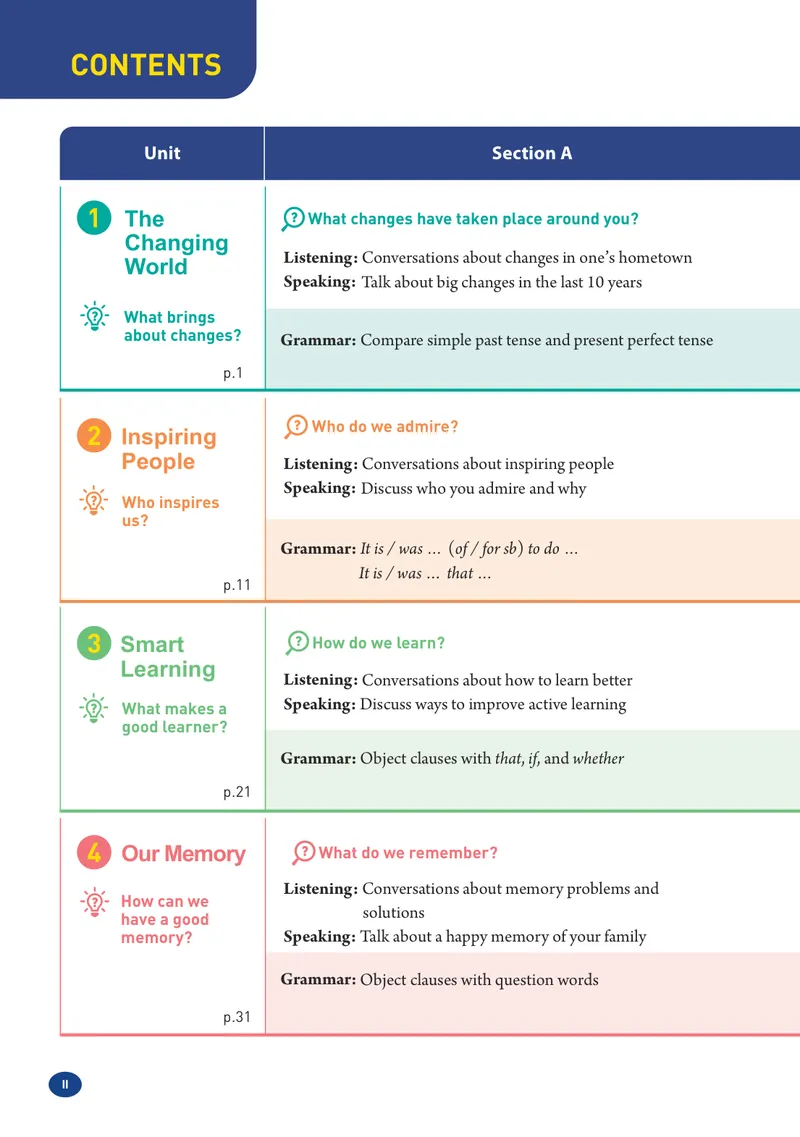
Unit Section A
1
The What changes have taken place around you?
Changing
Listening: Conversations about changes in one’s hometown
World
Speaking: Talk about big changes in the last 10 years
What brings
about changes?
Grammar: Compare simple past tense and present perfect tense
p.1
Who do we admire?
2
Inspiring
People Listening: Conversations about inspiring people
Speaking: Discuss who you admire and why
Who inspires
us?
Grammar: It is / was … (of / for sb) to do …
It is / was … that …
p.11
3 Smart How do we learn?
Learning
Listening: Conversations about how to learn better
What makes a Speaking: Discuss ways to improve active learning
good learner?
Grammar: Object clauses with that, if, and whether
p.21
4 Our Memory What do we remember?
Listening: Conversations about memory problems and
How can we
solutions
have a good
memory? Speaking: Talk about a happy memory of your family
Grammar: Object clauses with question words
p.31
IISection B *Project
How do changes influence us? Compare then and now
Reading: A report on changes brought by a railway
Writing: Write about changes in your life since primary school
Vocabulary: Compound words
Words related to changes
What makes people admirable?
Make a wall of
Listening: Conversations about inspiring people Reading: A biography of a seed scientist inspiration
Speaking: Discuss who you admire and why Writing: Write a post about an inspiring person
Vocabulary: Suffixes (-ist, -er, -ian)
Words related to professions
How can we get better at learning? Carry out a survey on
learning
Reading: An informative text on how to improve learning
Writing: Write about your reading habits
Vocabulary: Collocations related to learning
How can we improve our memory? Debate: Do we need to
memorize things?
Reading: An informative text on how to improve memory
Writing: Write a diary entry about your memory challenge
Vocabulary: Words related to memory
IIIUnit Section A
5
Power of What changes can inventions bring to our lives?
Ideas
Listening: Conversations about inventions at an exhibition
What do Speaking: Talk about important inventions
creative ideas
bring about?
Grammar: Passive voice in the simple present and past tenses
p.41
Why do we explore space?
6
Beyond
Listening: News about space exploration
Earth
A Q&A session of a live class in space
What does it Speaking: Discuss reasons for space exploration
take to explore
space?
Grammar: Passive voice in the simple future tense
p.51
7 Feel the What do you like about music?
Rhythm
Listening: Conversations about a school concert
Why do we Speaking: Talk about music you like on different occasions
need music?
Grammar: Relative clauses with that, which, and who
p.61
Why do we like sports events?
8
More than a
Game Listening: Conversations about Sports Day
A live sports report
How does sport
Speaking: Talk about Olympic sports events
inspire us?
Grammar: Subject-verb agreement
p.71
*Reading Plus p.81 Grammar p.104
Listening Scripts p.94 Vocabulary in Each Unit p.107
IVSection B *Project
How do we turn ideas into reality?
Come up with your own
Reading: An informative text about the invention of paper invention
Writing: Write about an invention
Vocabulary: Words related to inventions
How far can we go into space?
Make a poster
Reading: A popular science article on space exploration
about China’s space
Writing: Describe your space dream
programme
Vocabulary: Compound words
Words related to space exploration
What is the power of music? Give a presentation on
a famous musician
Reading: A biography of Chopin
Writing: Write your music story
Vocabulary: Words related to music
How does sport bring us together?
Introduce your
Reading: A speech about Beijing as the first city to host both favourite sports event
the Summer and the Winter Olympics
Writing: Write an introduction to an admirable athlete
Vocabulary: Words related to sports events
Vocabulary A-Z p.117 Irregular Verbs p.127
Vocabulary from Primary School p.126
V1 The Changing
UNIT
World
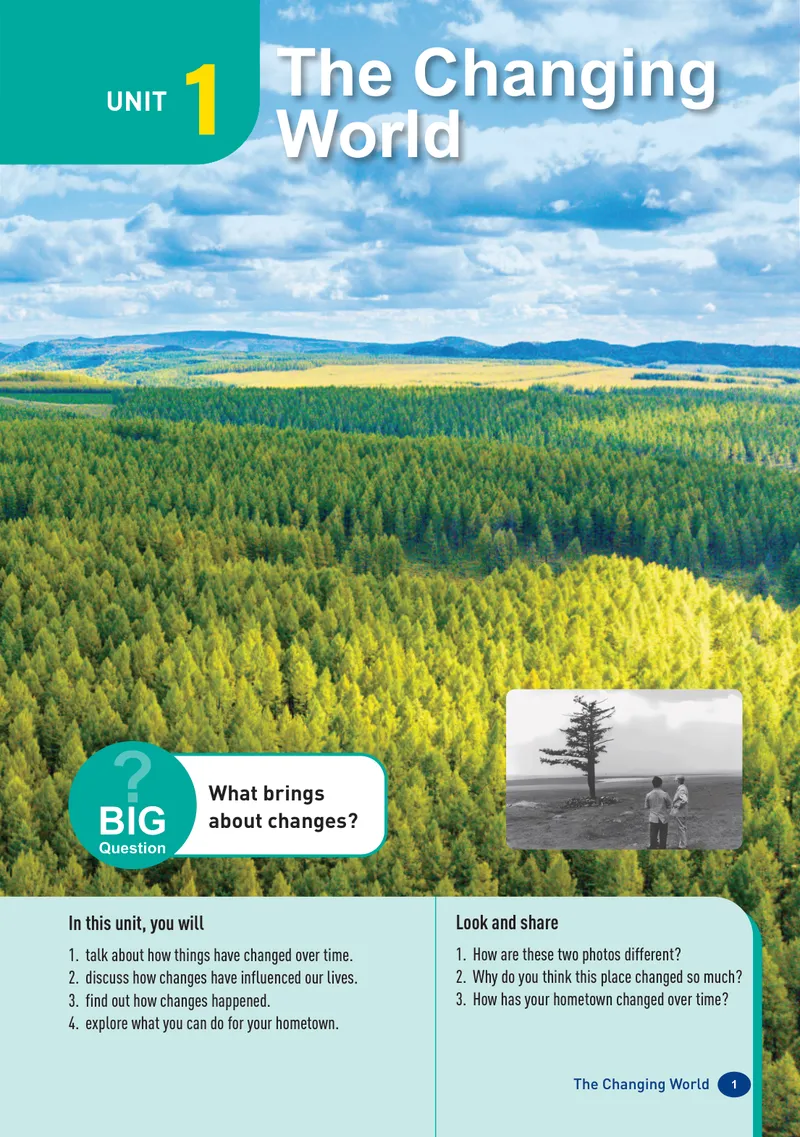
What brings
BIG about changes?
Question
In this unit, you will Look and share
1. talk about how things have changed over time. 1. How are these two photos different?
2. discuss how changes have influenced our lives. 2. Why do you think this place changed so much?
3. find out how changes happened. 3. How has your hometown changed over time?
4. explore what you can do for your hometown.
The Changing World 1E
CTIO
S N
A
What changes have taken place
around you?
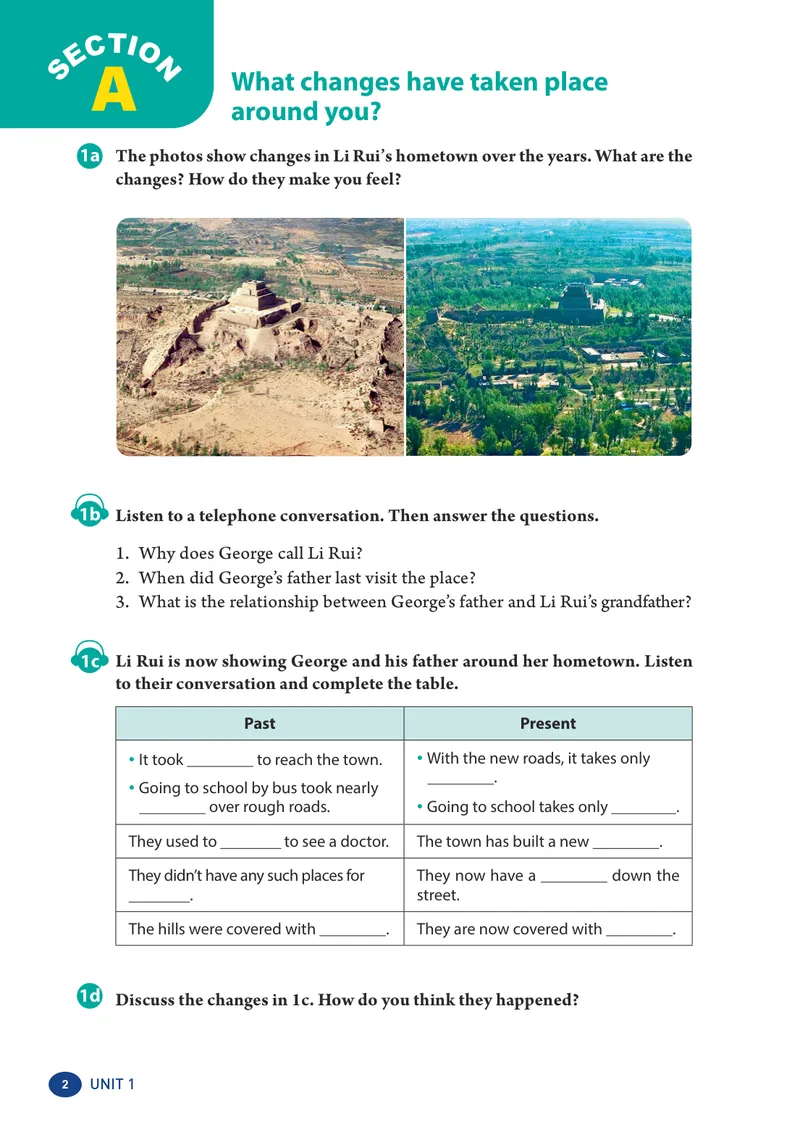
1a The photos show changes in Li Rui’s hometown over the years. What are the
changes? How do they make you feel?
1b Listen to a telephone conversation. Then answer the questions.
1. Why does George call Li Rui?
2. When did George’s father last visit the place?
3. What is the relationship between George’s father and Li Rui’s grandfather?
1c Li Rui is now showing George and his father around her hometown. Listen
to their conversation and complete the table.
Past Present
● It took to reach the town. ● With the new roads, it takes only
.
Going to school by bus took nearly
●
over rough roads. Going to school takes only .
●
They used to to see a doctor. The town has built a new .
They didn’t have any such places for They now have a down the
. street.
The hills were covered with . They are now covered with .
1d
Discuss the changes in 1c. How do you think they happened?
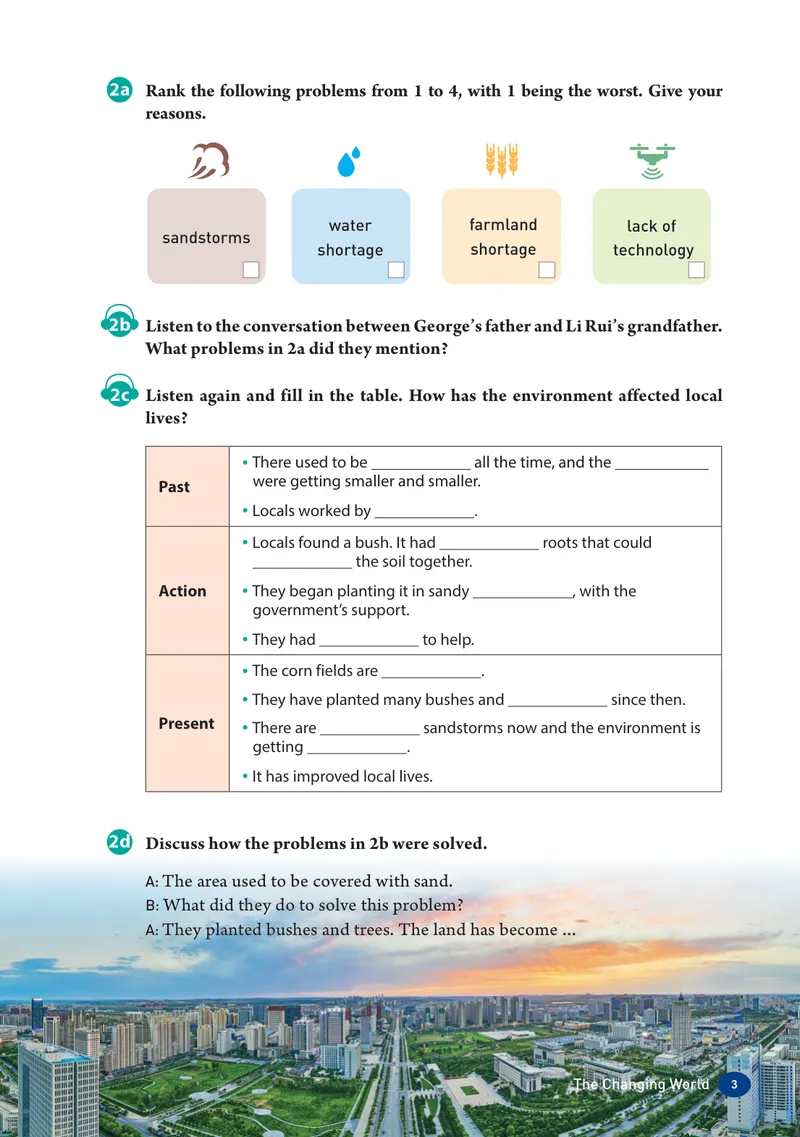
2 UNIT 12a Rank the following problems from 1 to 4, with 1 being the worst. Give your
reasons.
water farmland lack of
sandstorms
shortage shortage technology
2b Listen to the conversation between George’s father and Li Rui’s grandfather.
What problems in 2a did they mention?
2c Listen again and fill in the table. How has the environment affected local
lives?
●
There used to be all the time, and the
were getting smaller and smaller.
Past
●
Locals worked by .
●
Locals found a bush. It had roots that could
the soil together.
Action
●
They began planting it in sandy , with the
government’s support.
●
They had to help.
●
The corn fields are .
●
They have planted many bushes and since then.
Present
●
There are sandstorms now and the environment is
getting .
●
It has improved local lives.
2d Discuss how the problems in 2b were solved.
A: The area used to be covered with sand.
B: What did they do to solve this problem?
A: They planted bushes and trees. The land has become ...
The Changing World 33a Read the interview between a reporter and two villagers. In what ways have
the villagers’ lives changed?
Reporter: How has life changed in your hometown over the last 20 years?
Mr Yan: Oh, it has changed quite a lot! Many young people used to work in
big cities. Now, more of them have come back to live and work here.
Reporter: Great! Have there been any other changes?
Ms Wu: Yes, we’ve changed the way we farm. I used to grow a few vegetables
on a small farm to sell at the local market. Now, I have large, high-
tech greenhouses. There, I grow tons of fruit and vegetables, and sell
them in large cities.
Reporter: Wow, the new highway and railway must have helped a lot!
Mr Yan: Oh, they have! Our village has become a tourist attraction. We can
now sell local products to tourists. We also sell products online to
people all over China.
Reporter: Have these changes greatly improved
your lives?
Ms Wu: Yes! We now have new houses. And
our village has just built a new
hospital and a library.
Reporter: Wonderful! Together you are
building a new socialist village.
3b Complete the table with the information from 3a.
Past Present
3c Listen to the conversation. Pay attention to the use of different tenses. Then
role-play the conversation.
3d Choose the things that have greatly changed over the last 10 years in your
hometown. Talk about the changes and how you feel about them.
hospital school e-payment shopping transport
environment restaurant cinema housing
A: In your opinion, what has changed the most in your hometown over
the last 10 years?
B: The environment, I think.
A: How has it changed?
B: ...
4 UNIT 1Grammar Focus
4a Read the sentences and circle the verbs. Pay attention to the verb tenses.
He became a good friend of your
They haven’t seen each other for ages!
grandfather about 20 years ago.
We used to have to travel far to see a
Our village has just built a new hospital.
doctor.
Now, more of them have come back to
Many people used to work in big cities.
live and work here.
4b Complete the conversation with the correct forms of the verbs in brackets.
A: you (be) to the new library yet?
B: No, I (not know) there was a new library. When did it (open)?
A: It (open) last Friday. I (go) there with my grandpa on
Saturday night.
B: you (like) it?
A: Of course! It’s the most high-tech library I ever (visit).
B: Oh, what you (see) there?
A: There are sections with books about science and Chinese culture, as well as a
huge section with children’s books. I also (read) some digital books
on the computer. My grandpa (listen) to some audio books because
he can’t see well.
B: Cool! I (bring) my little brother there tomorrow.
4c Complete the passage with the correct forms of the verbs in brackets. Why
are local people richer and happier than before?
In the past, it (be) difficult to
travel in Guizhou. In many places, there
used to (be) no bridges to cross
mountains and rivers, and most roads
were just dirt tracks. This
(make) it difficult for locals to bring
products to the market or to develop
industry.
Now great changes (take) place.
The government (build) thousands of kilometres of highways,
railways, and wide roads. It has also built many bridges and tunnels. A journey
that used to (take) a day now takes only a few hours. As a result, the
lives of local people (improve). They are much richer and happier
than they once (be).
The Changing World 5E
CTIO
S N
B
How do changes influence us?
1a Does your hometown have a train system? How does it benefit local lives?
1b Look at the title and the picture. What is the text probably about? Read it
quickly to check your prediction.
On the Fast Track
In 2017, the new 480-kilometre Mombasa–
Nairobi railway was opened. Before then, the
Making predictions
only transport links between Mombasa, Kenya’s The title and
pictures can help
main port, and Nairobi, Kenya’s capital, were
you guess what the
rough roads and an old railway line completed
text is about.
in 1901. The old trains were very slow. It took 10
hours to get to Nairobi from Mombasa by train.
However, the new railway, built with China’s help, has already cut the
travel time between Mombasa and Nairobi to about five to six hours for
passengers. Now, more than two million people use it every year.
Local Kenyans have benefited a lot from the new railway. A government
worker said, “I’m very happy with the new railway built by our Chinese
friends. Many changes have taken place in the town over the last few
years, and the people who live here have become rich.” A businessman
said, “My experience of using the train since 2017 has been good. It is very
convenient and doesn’t cost much money. I am able to get to places on
time and make business deals with ease.” The railway has also made the
transport of food easier. “It used to take
hundreds of lorries to carry food between
the two cities, but now it takes only
two or three trains,” said a supermarket
manager. As a result, people now have
more fresh food to eat.
Although China and Kenya are far away
from each other, the railway shows how
different countries can work together to
build a better world.
66 UUNNIITT 111c Match the numbers with the information.
about five to six 10 480 1901 2017 more than two million
1. : the year the new railway was opened
2. : the year the old railway line was completed
3. : the number of people who use the new train every year
4. : the length of the Mombasa–Nairobi railway in kilometres
5. : the hours it used to take to reach Nairobi from Mombasa by train
6. : the hours it takes to reach Nairobi from Mombasa now by train
1d Read again and answer the questions.
1. What type of writing is the text?
2. What was the problem with the old railway?
3. How have local Kenyans benefited from the new railway?
4. Why is it important to make food transport easier?
5. What does “on the fast track” mean?
1e Complete the table with the information from the text.
Introduction The new railway was in 2017.
Old railway
New railway
government worker:
Comments
businessman:
from locals
supermarket manager:
Conclusion
1f Discuss the questions.
1. Have you seen or heard of any similar changes in the world over the last
several years? Where were they and what happened?
2. In what other ways can China work together with other countries to build
a better world?
The Changing World 7Vocabulary in Use
2a Use a word on the left and a word on the right to create a compound word.
What other compound words do you know?
green sand high storm way land greenhouse, ...
+ =
farm rail house road
2b Complete the sentences with the words in the box.
product corn bridge wide capital
1. The road used to be narrow and dirty. Now, it is and clean.
2. The made it convenient for the villagers to travel across the river
to the city.
3. Beijing, China’s , hosted the 2008 Summer Olympics and the
2022 Winter Olympics.
4. Our farm has a lot of laying hens. They feed on , vegetables,
and insects.
5. Look! This is a digital that only sells online.
2c Complete the passage with the correct forms of the words in the box. What
other stories do you know about China’s environmental achievements?
government bush sandstorm result sandy soil
In 1962, Wang Shanghai moved with his family from
their house in Chengde to the lands of
Saihanba. There were few trees to hold the
together, and there were often . Temperatures
were below freezing during the winter. Life there
was very difficult.
With support from the , Wang Shanghai led a group of 369 people
who were determined to make the environment of Saihanba better. Over
the next 60 years, workers planted and trees, creating the world’s
biggest man-made forest.
Today, Saihanba is known as “the green miracle”. This is the of
hard work and people working together. Now, the land is covered with green
trees and the water is clean and fresh.
8 UNIT 13a Read the text. What has stayed the same in the student’s life?
Changes in My Life
Now that I am older, my life is different from when I was in primary school.
For example, my primary school was near my home, so I used to walk to
school with my parents. Now my junior high school is farther from home. I
take a bus every day with my friends.
My home has changed too. My family used to live in a small flat, but now
we have moved to a much larger one. My grandma lives with us now as
well. She has her own room and her own TV set. I am glad that I get to see
her every day.
The way I study is also different. I have become more confident in my
studies and often attend group discussions. I enjoy studying with my friends.
It’s amazing how much we have achieved together.
My life has changed in many ways, but one thing has stayed the same: the
feeling of love and happiness shared by my family.
3b Complete the table with the information from the text.
Aspect Past Present
school
home
study
3c Think back to when you were in primary school. In what ways has your life
changed? Make notes in a table like the one in 3b.
home school study
neighbourhood transport environment
3d Choose three changes. Write a short passage about them. End with one thing
that has stayed the same.
The Changing World 9*Project Compare then and now
4a In groups, think of 10 things that are important in life. Here are some examples.
technology environment transport
entertainment education shopping
housing medical care
4b Design a survey for your parents or grandparents using the 10 things you
thought of.
SURVEY
1. What were computers like when you were young?
2. How did you get to school? How long did it take?
3. What did you do for entertainment when you were my age?
4. ...
4c Interview your parents or grandparents about their lives when they were
your age. Note down their answers.
4d List the differences between their lives and your own.
Then Now
● Most people didn’t have ● Home computers are common and
computers in their homes. many people use smart devices.
● ... ● ...
4e Give a presentation to your class about the differences between then and now.
Reflecting
1. What do you think brings about changes?
2. Which changes mentioned in this unit impressed you the most? Why?
3. Can you use the simple past and present perfect tenses to talk about changes?
4. What is one change you would like to see in the world?
5. What is one change you would like to see in yourself?
Change is the opportunity to create a
better future.
10 UNIT 12 Inspiring
UNIT
People
Who inspires us?
BIG
Question
In this unit, you will Look and share
1. talk about inspiring people. 1. Who do you see in this picture?
2. discuss who you admire and why. 2. Do you know any of these people’s stories?
3. describe admirable people and their achievements. 3. What do these people have in common?
4. explore the spirit of inspiring people.
Inspiring People 11E
CTIO
S N
A
Who do we admire?
1a Match the people with their professions. More than one option is possible.
historian scientist chemist physicist
A B C D
Sima Qian Yuan Longping Michael Faraday Marie Curie
1b Listen to the conversations. Match the speakers with the people they admire.
1. Yaming 2. Peter 3. Fu Xing’s father
4. Emma’s grandma 5. Ms Gao
1c Listen again and complete the notes.
Yuan ● developed a new kind of rice and helped hunger
Longping
● trained people to on farming
● did research in physics and chemistry even though he didn’t
Michael a formal education
Faraday ● dropped out of school at an early age, but he found
to study and became a great scientist
Sima ● was the of the book Shiji (Records of the Grand Historian)
Qian ● played in reviewing the Chinese calendar at that time
Marie ● made many important discoveries in and chemistry
Curie ● won Nobel Prizes
1d What do you think about the people mentioned above? Talk about who you
admire and why.
12 UNIT 22a Match the people with their achievements.
A B C D
Isaac Newton Isambard Brunel Florence Nightingale Alan Turing
1. was an important engineer in the 19th century.
2. volunteered as a nurse to help the wounded soldiers.
3. made important discoveries in physics.
4. created a test to see if a computer could really think like a person.
2b Listen to the conversation. Who does each family member admire?
1. Dad: . 2. Mum: . 3. Steve: and .
2c Listen again and circle the coloured words you hear to complete the notes.
Brunel built the first British airports / railways and many other
●
important things
helped the UK develop into a modern / developed nation
●
Nightingale created / developed modern nursing
●
helped us understand the need for better / cleaner hospitals
●
to stop the spread of diseases
Newton developed physics / science
●
Turing pioneer of computer technology / science
●
2d Match the people with their fields of work. Then discuss why these people
are inspiring.
railway
sea travel
physics
medicine
Tu Youyou Zhan Tianyou He Zehui, Zheng He
Qian Sanqiang
I think … is / are great / admirable / inspiring because …
It is / was … of / for …
Inspiring People 133a Read the conversation and complete the chart.
Adam: Hi, everyone. Who is the person you admire the most?
Yaming: My favourite person is I. M. Pei.
Adam: Did he design the glass pyramid at the Louvre Museum?
Yaming: Yes. It was very creative of him to design it. The Suzhou Museum
is also one of his amazing designs. He created a beautiful balance
between the East and the West.
Adam: Wow, you really know a lot about him!
Yaming: I read books and reports about him. I want to be a creative person
like him.
Adam: What about you, Chen Jie? Who inspires you?
Chen Jie: Wang Yaping, of course, China’s first woman to walk in space. She is
full of courage and wisdom. She was also the first woman to teach a live
class from space. What about you, Adam? Who do you look up to?
Adam: Me? My biggest inspiration is not a famous person. It’s my father.
It’s really very nice of him to support and encourage my exchange
study here.
the glass pyramid at the Louvre
Museum and the
created between
the East and the West
Inspiring
China’s first woman to and
People
to from space
full of
Adam’s
supports and
father
3b Listen to the conversation. Pay attention to the questions the speakers used.
Then role-play the conversation.
3c Work in groups. Discuss who you admire and why. Use the words and
expressions to help you.
creative brave amazing inspiring full of courage
full of wisdom great curiosity dream big never give up
14 UNIT 2Grammar Focus
4a Complete each sentence with a famous person or someone you know.
It was great of ... to develop a new kind of rice and help reduce hunger.
It was amazing that ... did research in physics and chemistry even though ...
It was difficult for ... to do that kind of work back in those days.
It’s really very nice of ... to support and encourage ...
4b Rewrite each sentence using the words in brackets.
1. We listen to our teacher’s advice. (necessary)
→ .
2. Tall trees can grow from tiny seeds. (amazing)
→ .
3. Confucius said that we should treat our elders with respect. (wise)
→ .
4. Professor Gui’s childhood dream of becoming a space scientist came true
through his efforts and hard work. (inspiring)
→ .
5. Victor Hugo stood up for the common people he cared about. (brave)
→ .
4c Complete the passage with the correct sentence parts. In what ways do you
find Zhang Qian inspiring? Give your reasons.
A. It is important for us B. It was really brave and admirable
C. It is always inspiring D. It seemed impossible for him
to read about great people and learn from their stories. Recently, I read
about Zhang Qian, the pioneer of the famous Silk Road. In order to help
defeat his enemies, Emperor Wu of the Han Dynasty sent Zhang Qian to
find the Yuezhi people. Unfortunately, Zhang Qian was caught by the enemy.
to finish his task or to return home. However, around 10 years later,
he got a chance to run away, and he finally succeeded in finding the Yuezhi
people. that he never forgot his task, and his travels also brought back
valuable information about the Western Regions. Later, he was sent to
these places again to build relationships. Stories like this give us power and
inspiration. to remember the past and find ways to do more for a better
future.
Inspiring People 15E
CTIO
S N
B
What makes people admirable?
1a Look at the title of the text. What do you think a seed scientist does? Do you
think it is an interesting job?
1b Read the text quickly. Who was the seed scientist? What did he do?
The Inspiring Seed Scientist
On 25 September 2017, the scientific world was shaken by the news that
Chinese professor Zhong Yang had died in a car accident. The well-respected
biologist had spent his whole life researching plants and seeds. Over the years,
he collected many important seeds for China’s seed banks. These special banks
protect all kinds of plant seeds, including the ones we need for food, and they
make sure that important plants do not disappear from the world forever.
Zhong Yang was born in 1964. When he was young, he showed a deep love
for and a curiosity about the things he studied. He was an excellent student,
entering university at the early age of 15. There, he studied radio engineering
and later became interested in plants. The research and study of plants,
especially the seeds, became the focus of his life after he became a professor at
Fudan University.
It is important for seed banks to include many different kinds of seeds. When
Zhong Yang discovered that there was not enough research on the seeds from
Xizang, he went there to collect seeds himself. In 2001, he began his travels
across Xizang. It was very difficult for him to brave the cold weather and great
heights. He sometimes fell sick, but he always continued with his work.
Zhong Yang knew it was better to include more people when doing important
work. He began a programme to find and train local students in field research
to become scientists. Together, he and his team collected more than 40 million
seeds from over 1,000 types of plants. Their hard work provided the world
with lots of new information about the plants in China.
Zhong Yang left behind more than just a huge
collection of seeds. His love for his job and research
lives on in his students. He once said, “My students
will continue on the road of scientific exploration,
and the seeds we have collected may grow hundreds of
years from now.”
16 UNIT 21c Read again and match each paragraph with its topic.
Paragraph 1 A. Training local students to do important work
Paragraph 2 B. Introduction to Zhong Yang and seed banks
Paragraph 3 C. What he left behind
Paragraph 4 D. Becoming interested in seeds
Paragraph 5 E. Starting to work and collect seeds in Xizang
1d Fill in the blanks with the information from the text. Then put the events
into the timeline and tell the story of Zhong Yang in your own words.
A. Zhong Yang was born.
B. He at the age of 15.
C. He began to train local students.
D. He died in .
E. He studied and later .
F. He travelled around Xizang to .
1964 2017
1e Explain the meanings of these sentences in your own words. Pay attention to
the underlined words.
1. It was very difficult for him to brave Using context
Examining a sentence’s
the cold weather and great heights.
context may help you
2. His love for his job and research lives guess and learn the
meanings of difficult
on in his students.
words and phrases.
1f Discuss the questions.
1. Why did Zhong Yang want more people to do seed collection and research?
2. What makes Zhong Yang admirable? What can you learn from him?
3. What other admirable scientists do you know of? What can you learn
from their stories?
Inspiring People 17Vocabulary in Use
2a Circle the correct words to complete the sentences. Then write down more
words ending with -ist, -er, and -ian.
1. My sister wants to become a science / scientist because she likes to find
out how the universe works.
2. The history / historian wrote a book about the successful development of
socialism in China.
3. My favourite school subject is chemistry / chemist. I love mixing things
together and learning why they change.
4. Some biology / biologist students at the university are studying how life
on earth began.
5. Teng Fei likes physics / physicist very much, and he wants to be a scientific
researcher / research in the future.
2b Complete the sentences with the correct forms of the words in the box.
spread wise elder calendar radio
1. I heard about the latest discoveries about black holes on the .
2. Curiosity and lead us to explore the secrets of the universe.
3. I would love to have lunch with you next week. Let me check my
to see if I am free.
4. You’d better wear a mask when you go out. The flu is , and the
number of patients is going up.
5. Marie Curie’s daughter, Irène, was also very interested in science
and won a Nobel Prize in Chemistry.
2c Complete the passage with the correct forms of the words in the box. Try to
introduce Amelia Earhart in your own words.
look up to pioneer courage pilot come true encourage
Amelia Earhart was always a brave child, full of . Her
parents supported her and her to be herself. After
taking her first flight in a plane, she knew that she wanted to
become a more than anything else in the world. Later,
she worked hard to pay for her own flying lessons. In 1922, she
flew higher than any woman had done before. Earhart is best
known for being a flight as the first woman to fly on
her own across the Atlantic Ocean in 1932. She became famous
around the world. Many people Earhart and find
her an inspiring person because of her efforts to work hard and her ability to
make her dreams .
18 UNIT 23a Read an online post. Who does the writer admire? Why?
To me, one of the most inspiring people in Chinese history is Mozi (about
468-376 BCE). It is said that Mozi was a soldier, good at woodwork, and
was the inventor of the kite. But in fact, above all, he was a great thinker.
Mozi lived during the Warring States Period. Back then, many kingdoms were
fighting against each other. In these wars, the common people were always
hurt. To Mozi, this had to stop, so he spent his lifetime trying to bring peace.
His idea of love was one reason that Mozi wanted peace. It was
important to him that everyone should show the same kindness
and care to everyone else, whether they were family, friends, or
strangers. He also believed states should avoid attacking one
another.
Though Mozi lived more than 2,000 years ago, his ideas live
on. I think he is still a great inspiration to many people. Now,
more than ever, people around the world need to hear the
message of peace and love, and work together to build a community
of a shared future for mankind.
3b Complete the chart using the information from the post.
Life Lived in China during the Period
Mozi,
Believed
a great Belief
and
thinker
His ideas
Inspiration
People need to
3c Research a person in this unit or any other person that you find inspiring.
Make notes in a chart like the one above.
3d Use your notes to write a post about the person you find inspiring.
Inspiring People 19*Project Make a wall of inspiration
4a Brainstorm inspiring people you know of. Then do some research on each
one and write down a simple introduction. Here are some examples.
He Zehui Mao Yisheng
A famous engineer known as
A brilliant physicist known as “the father of modern bridges
China’s Madame Curie in China”
Dedicated her life to science Shared his knowledge by
and teaching young researchers teaching at universities and
writing books
Galileo Huang Wenxiu
A young village leader who
An Italian physicist and worked to fight poverty in the
astronomer countryside
Discovered that the earth
Believed that serving the
moves around the sun
people was the most important
thing
4b Discuss what these inspiring people have in common. List the qualities you
all agree on.
4c Work in your groups to choose a person you admire and make a poster.
4d Present your poster to the class. Put it on the wall of inspiration in your
classroom or school hallway.
Reflecting
1. What inspiring people have you learnt about? Why are they inspiring?
2. What are some words and expressions to describe inspiring people?
3. Can you talk about who you admire and explain why?
4. How can you inspire people around you?
Inspiring people show us the way forward.
20 UNIT 23 Smart
UNIT
Learning
What makes a good
BIG learner?
Question
In this unit, you will Look and share
1. talk about learning school subjects. 1. What do you see in this photo?
2. discuss ways of active learning. 2. What do you think is going on in this
3. express opinions on learning strategies using object photo?
clauses. 3. How is this like your own studies?
4. explore how to become a better learner.
Smart Learning 21E
CTIO
S N
A
How do we learn?
1a Look at these learning tips. Tick the ones that you use. You can add more.
take notes use flashcards
review key ideas do research projects
test myself watch learning videos
use learning apps or websites set learning goals
create mind maps work in groups or teams
1b Listen to the conversations and match them with the pictures.
Conversation 1: Conversation 2: Conversation 3:
A B C
1c Listen again and complete the sentences.
1. Teng Fei says the best way to study maths is to .
2. The learning app will find your weak points and to work on them.
3. Adam wonders if Fu Xing could help him with his .
4. Fu Xing takes notes a lot and tests herself on .
5. Ella wants to know Peter’s secret to .
6. By doing hands-on experiments, Peter finds that he can connect physics
with something .
1d Talk about how you study the school subjects mentioned above.
A: How do you study ...?
B: I study by reviewing my notes. I think it helps. How do you ...?
A: I use websites to help me with ...
22 UNIT 32a
Think about how you learn English. Tick the ways that are true for you.
look up words in a dictionary
keep a learning diary
speak English with friends / classmates
take part in class discussions
read aloud to practise speaking
repeat dialogues from English films
2b Listen to the conversation in a school English club. Complete the chart.
Today’s question:
learn new words by useful a lot
expressions and outside class
2c Listen again. Choose the tips mentioned in the listening.
A. Flashcards are easy to carry around for reviewing words.
B. It’s good to put words in groups when you learn them.
C. It’s important to speak English a lot outside class.
D. Reading is important for learning in general.
E. You should read books that suit your English level.
F. You will improve your reading speed if you know a lot of words.
2d What do you find difficult about learning English? What are some ways to
overcome these problems? Share with a partner.
I can’t read quickly.
I’m afraid of making mistakes.
I can’t remember new words.
I find it difficult to follow conversations.
I can’t use grammar rules correctly.
_____________________________
Smart Learning 233a Read the podcast interview. Why did Ella invite Binbin to her podcast?
Ella: Hi, this is Ella’s podcast. Today’s guest is Binbin. He’s going to give us
some ideas for learning English.
Binbin: Hi, Ella. Thanks for having me! For learning English, I think first you
need to become an active learner.
Ella: What do you mean by that?
Binbin: Well, because I want to speak English well, I practise English all the time.
Ella: Oh, you must spend a lot of time studying!
Binbin: Well, it doesn’t mean you have to study all the time. You need to spend
time using the language. For example, I speak English with friends. I
repeat the dialogues from the films I like. I read English books, and
sometimes I write my diary in English.
Ella: Wow! I guess you really enjoy learning.
Binbin: Yes, it’s true! But you see, I started out at zero and came across
problems. I mean, you just have to take things step by step. Start
simple and build up.
Ella: That’s so true.
3b Which of these active learning tips does Binbin follow? What about you?
TOP TIPS FOR LEARNING ENGLISH ACTIVELY
Spend time Read a lot Make Develop Be positive
using the learning your own when you
language enjoyable strategies have
difficulties
3c Read the descriptions and decide who are active learners.
A. Jenny practises what she learnt in maths class when going shopping.
B. Frank takes evening classes to prepare for his HSK examination.
C. Tony wrote a play based on his favourite history lesson.
D. Cathy often puts off working on projects until the last day.
3d Listen to the conversation. Pay attention to how the speaker explains his
ideas. Then role-play the conversation.
3e Discuss the ways for you to learn other school subjects actively.
24 UNIT 3Grammar Focus
4a Read the sentences. Circle the connecting words and underline the object clauses.
I believe (that) reading is important for learning.
I think (that) the best way is to do maths problems.
Peter finds (that) he can connect physics with something in real life.
I wonder if / whether you could help me.
I want to know if / whether you read English books outside class.
4b Complete the sentences with that or whether / if.
1. Jim doesn’t know he can take part in the research project or not.
2. My parents think they need to be stricter about my studies.
3. Ms Gao understands some students need more time to improve.
4. Terry wonders it will be easy to study courses on AI.
5. Could you tell me this sentence is correct in English?
4c Complete the passage with the correct sentence parts. Then discuss whether
you would like to try the learning method suggested.
A. by studying maths books B. He suggested that
C. He wondered whether D. learning had many challenges
E. It is hard to believe
As a youth, Hua Luogeng left high school to support his
family. However, he loved maths and did not want to give
up. there was a way to continue learning.
Finally, he decided to teach himself . Hua
Luogeng later introduced a reading and learning method
to young learners. learners should read
and take notes very carefully, and then summarize the
key points. He once said, “A book starts heavy and thick but
becomes thinner as you understand it better.” As an active
learner, Hua Luogeng stayed positive no matter what
difficulties he met in his life and studies.
that such a talent also failed exams in school, but that was true for him. He said
that and it was important to take things step by step.
Smart Learning 25E
CTIO
S N
B
How can we get better at learning?
1a Look at the title of the text. What advice do you think the writer will give?
Discuss your ideas.
1b Read the text quickly. Match each paragraph with its main idea.
Paragraph 1 A. Learn from other students.
Identifying text
Paragraph 2 B. Make learning a lifetime habit.
organization
Paragraph 3 C. Have a growth mindset towards Finding main ideas
learning. in paragraphs helps
understand text
Paragraph 4 D. Practice makes perfect.
organization.
Paragraph 5 E. Use learning materials wisely.
Paragraph 6 F. Everyone has the ability to learn.
How to Become a Successful Learner
Everyone has the ability to learn. Experts on the science of learning will tell
you that anyone can become a successful learner. However, many students do
not realize this, and they have trouble learning.
Studies show that the first key to becoming a successful learner is to have a
growth mindset. This means, in part, believing in yourself. It also means
setting goals, taking action, and meeting challenges. People with a growth
mindset see mistakes as chances for learning, as they teach us how to
improve.
Research also shows that practice is important for learning. The more we
practise, the better we learn. We learn best by practising new and difficult
things. Sometimes it is also important to get guidance from a teacher or a
coach. They can show us the right way to practise and give us important
feedback and advice.
In addition, studies show that students learn more when they hang out with
other students who are serious about study. First, by being together, students
can easily learn from each other. Second, students are challenged to do better
by each other. This has been proven to encourage learner growth.
Successful learners also use the best learning materials they can find. In
the 21st century, this means using new technology and resources, not just
textbooks. Since there are so many learning materials on the internet, it is
26 UNIT 3important to think carefully and choose wisely what and how you study. Take
advantage of the best tools and resources to learn wisely and efficiently.
Finally, successful learners see learning as part of daily life. It is something
they will do even after they leave school, and even when they are old. As you
continue on your learning journey, you should try to walk at your own speed
and enjoy the trip. Never lose heart. The road ahead of you may be long and
may have many mountains and valleys, but it also has great treasure. You will
find more joy in living a life with learning!
1c Read again and answer the questions.
1. What do many students not realize about learning?
2. Why are mistakes good for learning?
3. Why do we need a teacher or a coach?
4. What is important to encourage learner growth?
5. Why do we need to think carefully about what and how we study?
1d
Find clues from the text to complete the mind map.
believe in yourself
have a set , take , and meet
see mistakes as
the more
practise practise things
How to get
become a
successful
learn from
learner
study with
challenged to
use the think carefully and
walk at
see learning as enjoy
never
1e What do you think of yourself as a learner? Tick the ones that are true for you.
Discuss how you can do better.
□I believe in myself. □I practise new and difficult things.
□I set learning goals. □I get help from a teacher or a coach.
□I see mistakes as friends. □I see learning as part of daily life.
□I think carefully about what and how to study.
Smart Learning 27Vocabulary in Use
2a Find the hidden words in the wordsearch to complete the expressions on the
right.
A T I L H G F E E 1. read aloud
L L R E P E A T V
2. follow g rules of study
O C O O U N E Z I
3. discover g rules
U Y M U Y E T D T
4. be an a learner
D I A R Y R E C C
5. keep a learning d
E R A M M A R G A
6. improve reading s
S P E E D L S F T
7. do a research p
E P R O J E C T W
2b Circle the correct words to complete the sentences.
1. This app proves / provides guidance on pronunciation for any words you
click on.
2. You can use talent to your advantage / advice, but without hard work,
talent is nothing.
3. There are a lot of learning methods / results, but you need to know which
one suits you the best.
4. Before taking the experiment / examination, you need to understand why
you didn’t do well last time.
5. We can improve spoken English by practising this play’s story / dialogue.
2c Complete the passage with the phrases in the box. Try to use this method in
your study.
as well as in part in addition
work on step by step connect ... with
According to some experts, teaching others is, , a good method
to learn actively. , it is a way to get a deeper understanding of a
subject or course. For example, you might try to explain your understanding
of a topic to another learner, or you might creating learning
materials for them. Here are some tips: First, teach the simple points clearly
and . Second, try to your teaching the
learner’s experience. Third, ask the learner to explain what they have learnt
to you. This helps to check their understanding your teaching.
28 UNIT 33a Read the post. How did Chen Lei develop his love of reading?
My love of books comes from my mother. Because of
her, our home is full of books on different subjects.
When I was a child, my mother used to sit me on
her knee, tell me stories, and teach me how to read.
Soon, I was reading by myself. Over time, I found
children’s books no longer kept me interested. So
I started reading other books, newspapers, and
magazines. I especially enjoyed popular science
books and books about the lives of famous people.
After dinner, I would just pick a book from the shelf to read in my
room. Reading opened up new worlds and allowed me to discover new
things for myself. In general, I prefer print books, but sometimes I read
e-books. I think that reading is great fun.
Now that I am older, I can always find time to read in the school library.
I believe that reading has helped me a lot with my schoolwork and
made me more confident about my future.
Chen Lei, age 15
3b Find the information from the post to fill in the survey for Chen Lei.
1. How much do you enjoy reading?
A lot. It’s OK. Not much. Not at all.
2. Where do you read?
At home. At school. At the library.
On the bus / subway.
3. What kinds of books do you read?
History books. Comics. Literature.
Science books. Art books.
4. Why do you read?
3c Answer the questions in 3b with your own information. You can add more
questions.
● How many hours do you spend reading each week?
● What was the most recent book you read? Did you enjoy it?
3d Write a post about your reading habits. Share it in class.
Smart Learning 29*Project Carry out a survey on learning
4a What are the important things to do in order to become a successful learner?
Rate each method from 1 to 10 (1=least important, 10=most important).
being able to focus well being well-organized
believing in yourself taking notes
having deep motivation studying with others
not giving up reflecting on learning
reviewing lessons studying all the time
4b Work in groups. Compare your results and work out an average score for
each method.
4c Create a chart to show your group’s results. Display it and explain the results
to the class. Below is an example.
studying all the time
reflecting on learning
studying with others
taking notes
being well-organized
reviewing lessons
not giving up
having deep motivation
believing in yourself
being able to focus well
Average Score 0 2 4 6 8 10
Reflecting
1. What learning methods have you learnt?
2. Which learning methods do you think are good for you?
3. Can you use object clauses to express your opinions on learning?
4. Have you become more confident in learning? How so?
It is not just about what we need to learn,
but how we learn.
30 UNIT 34
Our Memory
UNIT
How can we have a
BIG good memory?
Question
In this unit, you will Look and share
1. discuss memory problems using object clauses. 1. What are the people looking at?
2. describe a happy memory of your family. 2. What might be in their photos?
3. discover how memory works. 3. What methods do you use to keep
4. explore ways to improve your memory. memories?
Our Memory 31E
CTIO
S N
A
What do we remember?
1a Which of the following are easy for you to remember? Which are hard?
Study Life Moment
numbers words names ages happiness sadness
rules speeches appearances dates fear surprise
poems stories positions events anger peace
1b Listen to the first conversation. Circle the things Peter needs to buy.
Sugar
1c Listen again and complete the sentences.
1. Mum reminds Peter about buying by saying, “It’s running
out.”
2. Mum is going to make a strawberry cake, so Peter has to buy .
3. Mum advises Peter to take a next time.
1d Listen to the second conversation. Tick the things Billy forgot.
Fu Xing’s birthday to bring his homework to school
to attend a lecture the time of the lecture
1e Listen again and answer the questions.
1. How did Fu Xing react when Billy said sorry to her?
2. In Fu Xing’s opinion, why has Billy been so forgetful recently?
3. What advice did Fu Xing give him?
1f Discuss the questions.
1. What can you do to avoid Peter’s and Billy’s mistakes?
2. Do you have any memory problems? If yes, what are they?
32 UNIT 42a Imagine you are attending Professor Green’s lecture too. What questions do
you want to ask?
2b Listen to the conversation between some students and Professor Green. Tick
the topics they are talking about.
What does linking knowledge mean?
Why do we get some words mixed up?
Why is riding a bike not so easy to forget?
How can we put our brain to good use?
2c Listen again. Complete the sentences based on Professor Green’s answers.
1. is like a chain, and new knowledge is best remembered by
it with old knowledge.
2. Pay attention to . Study how they are from each other.
Create a for each word in your mind.
3. Scientists are still working on this . Such kind of memory is
probably in a more stable area of our brain.
2d Work in groups. Discuss the questions.
1. How can you link new knowledge with old knowledge? Give an example.
2. When should you pay attention to details?
● studying how two words are different
● noting down the main points of a lecture
● retelling a story well
● remembering what someone looks like
● memorizing a rule exactly
3. Why should students put their brain to good use? What is your opinion?
4. Here are some tips for developing your brain. Tick what works for you
and add more.
exercise your memory do something creative
learn something new get enough sleep
reduce stress stay confident
Our Memory 333a
Read the conversation and complete the table.
Chen Jie: Why do you look worried, Rick?
Rick: Yesterday I visited my grandma,
but she kept calling me Johnny.
Chen Jie: Who’s Johnny?
Rick: My dad!
Chen Jie: Oh dear!
Rick: And then she told me not to eat the
cookies because she was saving them
for her grandson.
Chen Jie: Who’s that?
Rick: Me!
Chen Jie: Well, that’s not a good sign.
Rick: No. My parents are taking her to hospital tomorrow.
Chen Jie: Good. Follow what the doctor says. She may need special care.
Rick: Yeah. I just feel so sad. I don’t understand what she’s going through.
Chen Jie: Well, you know how some people’s memory gets worse as they get
older. It happened to my grandpa too.
Rick: Oh, no. What happened?
Chen Jie: We used to fly kites in the park. But now he forgets how to reach the
park. So, I walk him there every weekend.
Rick: That’s sweet!
Chen Jie: Thanks. Instead of what he forgets, I keep in mind what he remembers.
In your case, your grandma still remembers that you love cookies!
Rick: You’re right! Thanks, Chen Jie!
What to do
Family member What they forget What they remember
for them
Rick’s grandma
Chen Jie’s grandpa
3b What does Chen Jie mean by “keep in mind what he remembers”? In your
opinion, why are happy memories important?
Listen to the conversation. Pay attention to how emotions are expressed by
3c
stressing key words. Then role-play the conversation.
3d Work in pairs. Share a happy memory of your family.
● When did it happen? ● Who was there? ● What did they say or do?
● What kinds of things do you remember? (smells, tastes, sounds, weather, ...)
34 UNIT 4Grammar Focus
4a Read the sentences. Circle the connecting words and notice the word order
in the object clauses.
I don’t understand what she’s going through.
I can’t remember which things you asked me to buy.
Study how they are different from each other.
Could you tell me why it is easy to forget a word?
4b
Combine two sentences into one using object clauses.
1. She cannot remember. Where did she put the opera ticket?
→ She cannot remember where she put the opera ticket.
2. Bob does not know. Who took his wallet?
→
3. When is the next test? Can you tell me?
→
4. I do not understand. Why didn’t you invite him to the picnic?
→
5. Pardon me, where can I get a bus to the airport? Could you please show me?
→
4c Complete the story with the words in the box. Some may be used more than
once. Why did Fox cry after tasting a grape?
where what why that
One morning, Mother Fox told Baby Fox she was going
to pick some grapes for him. Then she ran out, and he waited.
After a long time, Baby Fox heard a familiar cry nearby: “Danger!
Run!” It was his mother! He also heard gunshots! Poor, scared Baby Fox
quickly ran away. He wondered happened to his mother, but he
was too afraid to look back.
Many years later, the grown-up fox returned home. He felt sad
when he recalled happened. Then he saw a grapevine
nearby. “That’s strange,” said Fox. “I wonder it grows
here.” He tasted a grape, “So sweet!” It reminded him of his
mother. Suddenly, tears filled his eyes. He realized the
grapevine came from. When Mother Fox was on her way home
with grapes in her mouth, she shouted out to warn her baby of
danger. This was she dropped the grapes.
Our Memory 35E
CTIO
S N
B
How can we improve our memory?
1a What memory techniques do you use? Are they useful?
1b Read the text and answer the questions.
Using prior
knowledge
How to Boost Your Memory You can often
improve reading
Would you like to improve your memory? To start comprehension
by using your own
with, it is important to understand how memory
knowledge of the
works.
topic.
There are two main kinds of memory: short-term
memory and long-term memory. Short-term memory helps you remember
things that you may only need for a short time, like phone numbers
when you need to make a phone call. Long-term memory is the ability to
remember things for days, years, or even a lifetime. So the real question is:
How do you make sure what you learn enters your long-term memory? By
using some clever memory techniques and leading a healthy life, you will see
some great results. Let’s take a look.
First, pay attention. However, you might fail to remember all the details.
So, try taking notes by writing down key points. After all, it is easier to
remember a summary than every word in a passage.
Second, use it or lose it. The more you review what you learn, the more
likely you will remember it. However, you should not wear out your brain.
Try studying for 40 minutes, and then take a break. You can also review
information by discussing it with others or by teaching others.
A third way is to make use of your senses. Create images by using tables,
graphs, and mind maps to organize information. You can also create a story
with information and view it in your mind like a film. In addition, make use
of your other senses. For example, listening to recorded information can be
very effective.
Last but not least, boost your memory by staying healthy.
● Sleep well. While you sleep, your brain organizes your memories. Bad
sleep makes it harder for new information to enter your long-term
memory.
● Eat well. Your brain needs food like an engine needs fuel. Healthy food
and drink will help your brain work much better.
36 UNIT 4● Exercise. A healthy and active body boosts both your memory and
your mind. Exercise can also reduce stress and anxiety.
Many more memory techniques can be found in books or online. Try
some different methods to see which ones work best for you. You are sure
to improve your memory!
1. What is the real question about improving one’s memory?
2. What is the right way to take notes?
3. Why is taking a break necessary for your brain?
4. How can you use your senses to help you remember better?
5. Why is staying healthy important for a good memory?
1c What kind of memory is needed for these tasks? Write S for short-term memory
or L for long-term memory.
1. You need to remember what you are going to say in a speech next
week.
2. You need to remember a new friend’s name.
3. You need to remember an address until you find a piece of paper to
write it down.
4. You need to remember the password to your online bank account.
1d Read again and complete the mind map.
Pay Use it or
attention lose it
Ways to
improve
your
memory
Use Stay
senses healthy
1e Do you know how to use the following memory techniques? Try to add some
more.
making up a song making up a poem using letters for words
grouping information picturing images
Our Memory 37Vocabulary in Use
2a Use affixes to create as many new words as possible. Use your dictionary.
re- -ion
forget effect
-ful -able
-ive
act
-ive -or -ness un- -ly -ness
2b Complete the sentences with the correct forms of the words from the word cloud.
1. The customer badly to the price
increase.
2. Starting over is not easy, but it is
necessary in my .
3. His memory technique is simple but .
4. The man has lost a lot of blood. He is
to die from his wounds if not treated at once.
5. Our hotel is in a great near the central mall.
6. I can’t recall which notebook I wrote your email in.
2c Complete the passage with the correct forms of the phrases in the box. Which
animal impressed you the most?
go through run out happen to keep in mind
Research shows that many animals have
good long-term memories. They
where food can be found and where it is safe.
For example, when squirrels of
food, they go straight to the place where they hid
nuts. Every autumn, wild geese fly thousands
of kilometres south for the winter. Humans
do not know for sure what their minds during the journey, but
wild geese seldom get lost. A similar situation dolphins. They
can recognize voices of other dolphins—even when they have not met each
other for a long time.
38 UNIT 43a Read Billy’s diary entry about his memory challenge. Then complete the table.
Friday, 20 November
In the past, I always felt stressed when I had to give a speech. I used to spend
lots of time trying to memorize my speech, but I still forgot some parts. Last
week, I decided to find out what the right way is to memorize a speech. I
looked online and asked friends, and I found many useful methods.
I learnt how to create a speech outline. Instead of trying to remember every
word of my speech, I remembered the key words first. Then I formed images
of these key words in my mind, and linked them in order.
Another method is to divide the speech into short sections. I practised the
first section until I could fully recall it. Then I moved on to the next. This
helped me to find out which parts of the speech I needed to work on the
most.
Finally, a friend told me that I should have confidence in myself. Nobody
knows my speech except me. If I do forget some words, I shouldn’t panic.
Just remember the key words and continue!
I followed all these great methods and my speech today was a great success!
Challenge
Goal
1.
Method 2.
3.
Result
3b
What is your biggest memory challenge? Use the table in 3a to create a plan
to overcome the challenge. Here are some tips.
● Divide your goal into smaller ones if it is difficult.
● List three methods to improve your memory.
● There is no one-size-fits-all method. Practise to find out what works the
best for you.
3c Write a diary entry to start tracking your progress. Reward yourself for each
small step forward. You are sure to get better!
Our Memory 39*Project Debate: Do we need to memorize things?
4a Think about this question:“Is it still necessary to memorize things when
they can be found online?”What is your opinion?
4b Form two groups based on different opinions. Add at least three reasons to
support your opinion.
Opinion We need to memorize things. We don’t need to memorize things.
Memorizing things trains our Everything we need is already
brain. online.
If we memorize things, we can Memorizing things takes up too
use them right away. much time.
Reason
Sometimes online information Thinking skills are much more
is lost. What will we do then? important than memory.
4c
Use examples and data to support your opinions.
4d
Have a debate on the question. Each student takes turns to speak.
Reflecting
1. Can you talk about memories that are important to you?
2. Can you use object clauses to express your opinions?
3. What have you learnt about how memory works?
4. What methods have you learnt to improve your memory?
If you review what you have learnt, you will
acquire new knowledge more effectively.
40 UNIT 45
Power of Ideas
UNIT
What do creative
BIG ideas bring about?
Question
In this unit, you will Look and share
1. talk about inventions. 1. What can you see in the photo?
2. discuss how inventions change our lives. 2. How do you feel about the photo?
3. describe inventions using the passive voice. 3. What creative ideas can you find in it?
4. explore the stories of inventors and inventions.
Power of Ideas 41E
CTIO
S N
A
What changes can inventions bring
to our lives?
1a Match the names with the things. Find out when they were invented.
plane camera laptop mobile phone TV high-speed train
1. 2. 3.
4. 5. 6.
1b Listen to the conversations. Choose the invention each conversation talks
about and find out where they are from.
Conversation 1: Conversation 2:
A. Super See, from B. Smart Cook, from
1c Listen again and circle T for true or F for false.
1. Super See is a pair of sunglasses designed to protect people’s eyes. T F
2. A mini-camera is connected to Super See to help with reading. T F
3. A button on Smart Cook should be pressed before cooking. T F
4. All the food is added by Smart Cook itself. T F
5. Hundreds of kinds of dishes can be made by Smart Cook. T F
1d
What can the two inventions be used for? Describe them to a partner.
A: What can the special glasses be used for?
B: They’re for people who can’t see well.
A: How do they work?
B: ...
42 UNIT 52a Tick the things that you think a 3D printer can make. You can add more.
medicine arms and legs hearts toys
tables shoes computers houses
chairs food
2b Listen to the conversation and answer the questions.
1. Where did Han Lin go last weekend?
2. Why was the 3D printer Han Lin’s favourite invention?
2c Complete the sentences with the correct forms of the words in the box. Then
listen again and check your answers.
read design produce create send
1 First, the object is on the computer.
2 Then, a file is by the computer.
3 And the file is to the 3D printer.
4 Next, the file is by the 3D printer.
5 Finally, the object is by building up plastic.
2d List the things you use every day and choose the one that you like the most.
Then talk about what it can be used for and its importance.
A: What invention do you like
Things I use every day
the most?
B: I like ... the most. 1. laptop
A: What can it be used for?
2. pencil
B: It can be used for / to ...
3. desk
A: Amazing! / Fantastic! Is it important
4.
in your daily life?
B: Yes, it ...
Power of Ideas 433a Read the conversation. What does Peter think is the most useful invention
of all time?
Fu Xing: What do you think is the most useful invention of all time, Peter?
Peter: It has to be the radio.
Fu Xing: The radio? Why?
Peter: Before the radio was invented, information travelled very slowly. The
world was made much smaller by the radio. Suddenly, news could be
spread around the world in seconds.
Fu Xing: Right. Who was the inventor?
Peter: An Italian inventor called Guglielmo Marconi. He developed the idea
in the 1890s. In 1901, a radio message was sent across the Atlantic
Ocean for the first time.
Fu Xing: Wow! That was quite a distance at that time.
Peter: Yeah. And because of the radio, some other important inventions
were developed as well.
Fu Xing: Like the television?
Peter: That’s right. It also had a big
effect on music. The radio made
it much easier for people to enjoy
music from artists around the
world.
3b Read again and complete the chart.
Who was the inventor?
Invention:
When was it invented?
How did it change the world?
3c Listen to the conversation. Pay attention to how the key information is
stressed. Then role-play the conversation.
3d Choose another invention that you think is the most important and make a
mind map about it. Then describe it to a partner.
44 UNIT 5Grammar Focus
4a Read the sentences. Circle the verbs in the passive voice.
A mini-camera is connected to the front of the glasses.
The oil and salt are also added by the machine itself.
Toys, chairs, tables, and even houses can all be made by the 3D printer.
A radio message was sent across the Atlantic Ocean for the first time in 1901.
4b Complete the sentences with the correct forms of the verbs in brackets.
1. The telephone (invent) by Alexander Bell in 1876.
2. People all over the world (connect) to each other through
the internet.
3. The word “robot” (introduce) for the first time in a play
in 1920.
4. It wasn’t supposed to make such a loud noise when the button
(press) to start the machine.
5. It is believed that the world’s oldest wheel (find) in Eastern
Europe.
4c Complete the passage with the correct forms of the verbs in brackets. Make
a profile of the Qinghai-Xizang Railway.
The Qinghai-Xizang Railway was completed in 2006. It
(connect) Xining to Lhasa, a huge distance of 1,956 kilometres, and it is the highest
railway in the world, reaching 5,072 metres above sea level at Tanggula Pass.
The building of the railway was a great challenge. Creative ideas
(need) to solve different problems. In summer, the top layer of the frozen
ground would melt and become too soft to build on, so pipes
(use) to keep the ground hard. However, in some places, it was impossible to
build the railway over the frozen ground, so tunnels had to
(create) instead. In some other places, bridges (build) to keep
the railway up above the ground. These bridges are animal-friendly and
(allow) animals to pass under the tracks.
As an important and successful project, the railway has
(increase) tourism and economic development in the area. The lessons learnt
and experience gained from building this railway will help
(improve) transport in other similar places in the world.
GrPeoawt Ienrv eonf tIdioenass 4455E
CTIO
S N
B
How do we turn ideas into reality?
1a What material are these things made of? Find more things that are made of
this material.
1b Read the text and match each paragraph with its topic.
An Invention That Changed the World
Can you imagine a world without books, newspapers, or magazines? All of
these things depend on one invention—papermaking. It, more than any other
invention, was responsible for the rapid spread of information that shaped our
modern world.
In ancient China, many different materials were used to write on, such as
animal bones, bronze ware, stones, wood, bamboo, and even silk. In the
Western Han Dynasty, there was also a very early form of paper made from
jute—a fibre that comes from plants. However, all of these materials were
either difficult to use and store, or very expensive.
As the head officer of the palace workshop for the emperor in the Eastern Han
Dynasty, Cai Lun became interested in trying to solve the problem. Different
methods for creating something to write on were tried, but none were ideal.
In his time, some kinds of bark—the outer part of trees—were used to
make clothes. From past experiences, Cai Lun got the idea that bark, certain
plants, and old clothes could be used to make a special material suitable to
write on.
In the first step of Cai Lun’s experiment, all the ingredients were mixed
and boiled in water. Then, this material was beaten, cut up, and mixed with
water again. Next, the liquid was poured over a bamboo screen, leaving
just the fibre. Finally, this fibre was dried and pressed to form paper. To
everyone’s surprise, this paper was soft, light, easy to make and use, and most
importantly, cheap. In 105 CE, Cai Lun showed his creation to the emperor.
The emperor was very pleased and praised Cai Lun for his great work.
Later on, the papermaking technique not only speeded up the development
46 UNIT 5of Chinese culture, but also changed civilizations around the world. It first spread
to China’s neighbouring countries and finally reached Europe through Arab
countries in the 12th century. When the use of paper and printing came together
in later centuries, it led to a rapid increase in the number of books. This resulted
in a new birth of knowledge, creating the world we have today.
Paragraph 1 A. Early materials to write on
Paragraph 2 B. Cai Lun’s experiment
Paragraph 3 C. Introduction to the topic
Paragraph 4 D. How paper changed the world
Paragraph 5 E. Cai Lun’s creative idea
1c Find out what these pronouns from the text refer to.
Understanding
● It in Paragraph 1: reference words
Noticing what
● It in Paragraph 5:
pronouns refer
● it in Paragraph 5: to will help you
understand how
● This in Paragraph 5:
different parts of
the reading are
connected.
1d Read again and complete the table.
Material to write on
Question Cai Lun’s paper
before Cai Lun
What was it like?
What was used to make it?
1e Put the sentences in order. Then retell the process of making paper in your
own words.
A. The material was beaten, cut up, and mixed with water.
B. All the ingredients were mixed and boiled in water.
C. The fibre was dried and pressed to form paper.
D. The liquid was poured over a bamboo screen, leaving just the fibre.
1f
Discuss the questions.
1. What other ancient Chinese inventions do you know? How was the world
changed by them?
2. What qualities do you think a great inventor has?
Power of Ideas 47Vocabulary in Use
2a Complete the table with different forms of the words. You can add more.
Noun Verb Adjective
collect
creative
invent
product
2b
Choose the correct word to complete each sentence.
1. The use of modern medicine has helped control / spread many dangerous
diseases.
2. News could travel much more rapidly / slowly with inventions like the
radio and the television.
3. Fibre made from oil provides a(n) cheap / expensive solution to the
problem that many people cannot afford to buy enough clothes.
4. A film was invented / produced by a film company to tell us about what
robots could do for people’s lives in the future.
5. In January 1911, Feng Ru carried out a secret / public test flight in
Oakland City. He showed the world what Chinese people could achieve.
2c Complete the passage with the correct forms of the phrases in the box. Then
discuss how an invention like sticky notes is turned into reality.
piece of stand up result in to sb’s surprise
Did you know that an accident led to the invention of sticky notes? In 1968,
a scientist named Spencer Silver was trying to make a strong glue. ,
he produced a glue that was really weak. It could stick things, but it could be
removed very easily. The glue was interesting, but no one could find a use for it.
Then, in 1974, a man named Arthur Fry was trying to mark the pages in
a songbook using small paper. However,
whenever he to sing, the pieces fell to the
floor. Then he remembered Silver’s glue. With the
glue, the paper stayed in the songbook, but it could
later be removed. Fry’s idea the production
of sticky notes of many sizes and colours. They
gradually became popular and now are widely used all
over the world.
48 UNIT 53a Read the text and complete the chart.
The invention of the plane has greatly changed the world. However, it
seems that its inventors, Orville Wright and Wilbur Wright, were not looking
to change the world at all. Rather, they just wanted to fly like birds.
To solve the problem of heavier-than-air flight, the Wright brothers
began working with gliders. There were two main challenges. The
first was how to get the glider into the air. The second was how to
control it once it was flying. For both problems, they found their
solutions by looking at how birds flew. After they solved these problems,
they added an engine to the glider. Then, in December 1903, the world’s
first plane flights were made.
The invention of the plane has made our travels around the world
much easier and faster. Journeys that once took days, weeks, or even
months, can now be made in only a few hours. As a result, communication
among people in different countries is now much easier, and the
world has become a much smaller place.
What was invented?
Paragraph 1 Who were the inventors?
Why was it invented?
What challenges were met?
Paragraph 2 How was it invented?
When was it invented?
Paragraph 3 What was its effect?
3b Choose a great invention you are interested in. Do some research and make
notes about it.
● was invented by in .
● It was invented because .
● It was made of / from .
● The inventor had difficulties in .
● The invention was responsible for / led to .
3c Write about the invention you have chosen using the information from 3b.
Power of Ideas 49*Project Come up with your own invention
4a Read the school notice. Choose one area you want to make improvements in.
Inventions Needed
Do you have any ideas about what could make the world a
better place? Share them in the school’s invention exhibition!
We are looking for inventions in the following areas:
● green technology ● health ● farming
● natural disasters ● education
● taking care of elderly people
Your invention should meet the following requirements:
● inexpensive
● easy to operate
● beneficial to people and society
If you have an invention like this, apply now!
4b Work in groups. Discuss what inventions could help in your chosen area.
4c
Make a poster about your invention. The poster should include:
● the name of the invention ● a picture of it
● what it is made of / from ● what it is used for
● what effect it has on people’s lives
4d Present your poster in the exhibition. Vote for your favourite ones.
Reflecting
1. Which invention and inventor in this unit impressed you the most, and why?
2. How can inventions change people’s lives?
3. Can you use the passive voice to talk about inventions?
4. How do inventors make an idea come true?
Creativity is seeing what others see and
thinking what no one else has ever thought.
50 UNIT 56
Beyond Earth
UNIT
What does it take
BIG to explore space?
Question
In this unit, you will Look and share
1. talk about space achievements. 1. What does the photo show?
2. make predictions about space exploration using the 2. How does this photo make you feel?
passive voice. 3. Would you like to experience space travel
3. describe your space dream. one day?
4. explore the meaning of and reasons for space exploration.
Beyond Earth 51E
CTIO
S N
A
Why do we explore space?
1a What do you know about the objects or names in the pictures? Complete the
sentences.
B
Zhurong
Tiangong
C
Chang’e
D
Xuntian
A
1. is a space programme’s name for a mission to the moon.
2. is China’s first long-term space station.
3. is another name for the China Space Station Telescope (CSST).
4. is a rover sent to Mars to explore its surface.
1b Listen to three news reports and circle the objects in 1a that you hear.
1c Listen again and complete the notes.
News report 1
Zhurong rover successfully landed on Mars .
It is hoped that a manned mission to the moon will follow .
News report 2
More will be sent there.
The Tiangong space station was completed .
News report 3
Chang’e-6 collected 1,935.3 grams of samples.
It is believed that our understanding of the moon and the
will be greatly improved.
1d Retell a news report from above or share a different one with a partner.
A: Do you know / Have you heard that ... will be launched soon?
B: No. What’s that about? / Oh, yes. I heard about that. It’s ...
52 UNIT 62a
What questions do you have about life in a space station? Write down two
questions and share them with a partner.
1.
2.
2b Listen to the conversation from a live class in space and number these
questions in the order you hear them.
A. How does it feel to be weightless?
B. Will you be visited by other astronauts?
C. What does Earth look like from space?
D. What’s difficult about living in space?
E. How do you eat up there?
2c Listen again and take notes to complete the mind map.
do some experiments
Work
fun
Earth is beautiful
can easily
Movement View and looks like
can move by pushing
.
against
Life in
Space
prepared _______ to fall asleep
Food Sleep
kept _______ have to be tied down
over _______ to
Visitor
choose from
will be visited by _______
2d Answer the questions in 2b. Use the mind map to help you.
2e Brainstorm more questions you would like to ask about life in space.
If I want to become an astronaut, what would you suggest?
What do you do for fun in space?
What’s the coolest thing you’ve done in space?
Beyond Earth 533a Read the interview and complete the mind map.
Host: Our question today is: Why do we explore space? Let’s talk to
space scientist Dr Yang. Welcome, Dr Yang!
Dr Yang: Thank you very much. Well, there are three good reasons to
explore space. First, to improve our knowledge of Earth and its
place in the universe.
Host: Could you explain that a bit more?
Dr Yang: Sure. The study of other planets helps us better understand Earth’s
geology, history, and relationship with other planets.
Host: Oh, right.
Dr Yang: Second, technology developed for space can benefit us here on
Earth.
Host: Could you give our listeners an example?
Dr Yang: Of course. Some satellites, for example, help us deal with problems
caused by climate change.
Host: Yes, that’s very useful. And the third reason?
Dr Yang: Well, at some point in the far future, we may find new resources
in outer space. It might sound crazy, but our Earth may run out of
resources. In that case, a new home for us human beings will be
needed.
Host: Wow, interesting! Maybe Mars will be turned into our new home
in the future.
Reasons for space exploration
The study of other planets Technology for space We may
helps can
. . .
3b Listen to the interview. Pay attention to how the host keeps the interview
going with questions and comments. Then role-play the interview.
3c Work with a partner to discuss your reasons for space exploration.
54 UNIT 6Grammar Focus
4a Read the sentences and underline the verbs in the passive voice. Pay
attention to how they are used in the simple future tense.
Will you be visited by other astronauts?
More astronauts will be sent there.
Exploration of the planet Mars and the moon will be continued.
A new home for us human beings will be needed.
It is believed that our understanding of the moon and the universe will be greatly
improved.
4b Change these sentences from the active voice to the passive voice.
1. This project will require students to do research on space exploration.
Students .
2. Scientists will position more satellites in space.
More satellites .
3. Because of the bad weather, they will cancel the trip to the space museum.
The trip .
4. The magazine will publish an article about future space travel next month.
An article .
5. Will the space centre launch a new rocket next month?
Will a new rocket ?
4c Complete the passage with the correct forms of the verbs in brackets. What
are exoplanets? What are your views on finding life on another planet?
For a long time, scientists have known that the universe (fill)
with stars. In more recent times, however, thousands of “exoplanets”
have also been discovered. These are planets that (move)
around stars—just like in our own solar system. So far, more than 5,000
exoplanets have been known to us, and as technology improves, many more
(find). Some exoplanets are similar to Earth. They are of a
similar size and temperature, and they might (have) water.
Scientists are excited about this. It (think) that if there is water,
there might also be alien life!
Beyond Earth 55E
CTIO
S N
B
How far can we go into space?
1a Where do you prefer to find information about space exploration? Choose
the ones that are true for you.
A. Popular science magazines. B. Science fiction books. C. Online news.
1b Read the title and the text quickly. Where would you find an article like this?
Identifying the text type
Before you read, decide what kind of text it
Reaching for
is. Is it a sci-fi story, popular science article,
the Stars news report, or something else?
Since the beginning of human history, people have looked up at the stars
and wondered what they were like. Many ancient cultures believed that
these points of light were from gods or other mysterious worlds. However, as
science and technology developed, we learnt the truth about stars. They are
real places like our own sun, and they are farther away than anyone imagined.
This raises the question: Can we visit the stars one day?
The man-made object which has travelled farthest from
Earth is Voyager 1. This spacecraft was launched in 1977.
In case Voyager 1 is found by alien life, a special record
with sounds and pictures from Earth is carried on board.
It shows who we are and where we are from. By 2025,
Voyager 1 was over 25 billion kilometres from Earth, but
that is still a long way from Earth’s second-closest star,
Proxima Centauri. That star is 4.2 light years away—about
40 trillion kilometres!
The challenge of visiting the stars gets even bigger for
space flights with humans. The farthest that any human
has travelled in space is only about 400,000 kilometres,
to the far side of the moon. Time is a big problem. At present, even a journey
to the planet Mars will take around six to nine months. What will the astro-
nauts eat and drink during this period? And how about their health and safety?
These problems grow when we talk about visiting another star. It might take
hundreds of thousands of years to get there!
Scientists, however, believe that visiting the stars is not a completely wild
dream. One idea is to have the astronauts sleep during their journey, like
some animals do in winter. Another is to develop much faster spacecraft.
56 UNIT 6While this is not possible right now, with nations and scientists cooperating with one
another, there is hope that the necessary technology will be developed. Humans
have photographed other galaxies, set foot on the moon, and even successfully
landed rovers on Mars. It seems likely that one day we will reach the stars.
1c Read again and match each paragraph with its main idea.
Paragraph 1 A. Long distance space travel is difficult for humans.
Paragraph 2 B. Humans have long been curious about the stars.
Paragraph 3 C. In the future, it may be possible to visit a star.
Paragraph 4 D. No spacecraft has travelled close to a star.
1d Complete the mind map with the information from the text. You can use
your own words.
Humans looked up People learnt the
Human
at the stars and about stars as science
Imagination
what they were like. and technology developed.
Voyager 1 was Voyager 1 carried a
Achievement
launched in . special .
Can we visit
the stars
one day? Even a journey to the Astronauts may face
Challenge planet Mars will take health and
around months. problems.
Astronauts can We can much
Expectation
during their journey. faster spacecraft.
1e Discuss the questions. Find more information to support your answers.
1. What did some ancient cultures think about the stars? Why?
2. What is carried on board by Voyager 1? Why?
3. What is the farthest trip that a human has travelled from Earth? Do you
know any details about it?
4. What do you think about the future of space exploration?
Beyond Earth 57Vocabulary in Use
2a Match the word space with the words in the box and complete the sentences.
Then discuss the questions.
space 1. Do you hope to travel by spaceship to other planets one day?
+ 2. Who was the first Chinese astronaut to do a ?
walk
3. What is the name of China’s first large survey ?
suit
4. How many kilograms does a that an astronaut
craft
wears usually weigh?
telescope
5. What is the longest time that an astronaut has lived on
station
a ?
ship
6. How fast do you think a can travel?
2b Complete the conversation with the phrases in the box.
on board fall asleep in space rocket launch in case in time
Ann: Are you going to watch the tomorrow morning?
Bob: Y es. I’m going there early there are too many people.
Ann: Yeah, it will be very crowded. I think I’ll watch it online instead.
Bob: I ’d prefer to see it with my own eyes. I want to be an astronaut in the future.
Ann: Cool! The job must require you to be strong both in mind and body.
Bob: Yes. I think it’s fantastic to live and work .
Ann: But it must be difficult to if you need to be tied down!
Bob: N ot a problem for me. I believe that space travel will be made much easier
.
Ann: Well, I’ve only been a plane twice, and I was scared. I prefer
to have a job that keeps my feet on the ground.
2c Complete the passage with the correct forms of the words in the box.
set foot on complete cooperate cancel
For thousands of years, human beings dreamt of visiting the moon and
other planets. Though many missions failed or had to be , space
exploration never stopped. In 1969, humans finally the moon’s
surface. Since then, more missions to the moon have been . It is
hoped that moon bases will be built in the near future so that scientists can
and do more research there. In time, it seems possible that the
wildest dream of visiting other planets will also come true.
58 UNIT 63a Read about one teenager’s space dream. Then complete the chart.
My Space Dream
My space dream is that one day a research station will be built on the moon.
I believe there are quite a few benefits.
First, it will be a good place for scientists to cooperate and do space research
together. New technologies can be developed, tested, and operated there. These
technologies can then be used to help build stations on Mars and other planets.
Second, more resources will be found. I think the moon may have some
special kind of energy resource that can be useful to Earth. It will just take
time for scientists to find it.
Third, people may live and work there. Tourists will also be able to visit. I want
to be one of the first visitors. I hope that one day we humans can spend
holidays in space and explore the universe.
Humans have achieved many things that were once only dreams. I hope the
research station on the moon will be built in the near future, and I hope it will
happen during my lifetime.
What?
My Space
Dream
Reason 1 :
Why? Reason 2 :
Reason 3 :
3b Discuss the ideas about space. Which
interests you the most and why?
build a research station on the moon
send a spacecraft to the nearest star
system
search for life in the solar system
build a satellite to collect the sun’s
energy and send it to Earth
...
3c Write your own space dream. You can
include some pictures in your writing.
Beyond Earth 59*Project Make a poster about China’s space
programme
4a
Put these names into different groups. You may add other space missions
you know.
Shenzhou Chang’e Tiangong Tianwen Tianhe
Zhurong Yutu ...
Manned space Mission to Mars Mission to the Space station
flight moon
4b Work in groups. Choose one type of space mission to research. Share and
discuss the information you find.
4c Make a poster about what you have found to showcase China’s space programme.
You can include the following:
● important events or missions
● pictures or drawings of the space flights,
spaceships, or satellites
● important people or organizations
4d Present your poster to the class and give a group presentation.
Reflecting
1. Which part of space exploration interests you the most?
2. Why do you think human beings want to explore space?
3. Can you talk about future space exploration using the passive voice?
4. Can you talk about China’s achievements in space exploration?
5. What is your dream for space exploration?
To explore and discover new things and places is
part of what makes us human.
60 UNIT 67
Feel the Rhythm
UNIT
Why do we need
BIG music?
Question
In this unit, you will Look and share
1. talk about different kinds of music. 1. What do you see in the photo?
2. describe music using relative clauses. 2. How do you think the girl feels?
3. write your music story. 3. Would you like to play any musical
4. explore the power of music and the influence instrument?
of great musicians.
Feel the Rhythm 61E
CTIO
S N
A
What do you like about music?
1a Match the kinds of music with the pictures. What other kinds of music do
you know?
Northern Shaanxi folk music Suzhou pingtan Beijing opera
A B C
1b Listen to the interview. Tick the kinds of music that are mentioned.
classical folk pop
jazz rock rap
1c Listen again and complete the table.
Favourite
Student Comment
music
Teng Fei
●
likes traditional music that
Clarice
●
likes music that she can dance to
Jack
●
needs music that has a strong
●
is not that into
Debbie
●
prefers music that she can sing along to
1d
What kind of music do you like? Talk about it with a partner.
A: What kind of music do you like?
B: I like music that has beautiful lyrics. How about you?
A: Oh, I agree! / Well, I prefer ...
62 UNIT 72a Match the names with the musical instruments.
electric guitar guqin keyboard trumpet pipa violin
C
A B
D
F
E
2b Listen to the conversation. What are the students talking about?
2c Listen again and complete the mind map.
music style musician
mix rock, pop, and Chinese Dragon lead ________:
______________ Bob Wu
to make a new style
musical piece
musical
instrument
everyone
erhu, ________,
loves:
________, and
___________
electric guitar
2d What kind of musicians do you like? Give examples.
A: I like musicians who play different kinds of music, such as ...
B: I prefer musicians who can write their own songs, like ...
Feel the Rhythm 633a
Read the conversation. Then circle T for true or F for false for the statements
about the concert.
Clarice: That was a great concert! Which performance did you like the best,
Jack?
Jack: I thought “Horse Racing” was especially good. It really gave me the
feeling of a horse race.
Debbie: Me too!! I love music which is energetic! Their use of the keyboard
and erhu made me imagine horses running down a track.
Clarice: Yes, but for me, I really like music which is full of joy and celebration,
such as “Dance of the Golden Snake”.
Teng Fei: The use of the erhu, pipa, and drums was exciting, but I prefer
music that touches me—that’s why I liked “Butterfly Lovers” more.
The music tells a sad and romantic story.
Jack: Yeah, and it’s interesting that the performers used both Chinese and
Western instruments. I’ve never heard the erhu played together with
the violin.
Teng Fei: I also liked “Voices of Spring”. I never realized that you could dance to it!
1. “Horse Racing” was Jack’s favourite performance. T F
2. “Horse Racing” used the keyboard and the erhu. T F
3. Teng Fei prefers exciting music. T F
4. “Butterfly Lovers” used Chinese musical instruments only. T F
3b Read again and complete the notes.
energetic
“Horse Racing”
you can imagine horses
“Dance of full of
the Golden Snake”
used the , , and
tells a story
“Butterfly Lovers”
used the erhu and
“Voices of Spring” you can
3c Listen to the conversation. Pay attention to how the reasons are emphasized
when people speak. Then role-play the conversation.
3d In pairs, talk about the music you like listening to on different occasions.
A: What kind of music do you like listening to while travelling / exercising /
relaxing / ...?
B: I like music that ... For example, ...
64 UNIT 7Grammar Focus
4a
Read the sentences. Underline the relative clauses. What are their functions?
I love traditional music that / which tells a story.
I prefer music that / which is full of joy and celebration.
We want to find out the kind of music (that / which) everyone likes.
I like musicians who / that are creative.
4b
Combine the sentences using that, which, or who.
1. This piece is my favourite. It uses the violin and piano.
→ The piece that / which uses the violin and piano is my favourite.
2. The girl in purple is a gifted poet. I met her at university.
→
3. The policewoman will help you. She is standing near the concert hall.
→
4. They are playing a beautiful piece of music. It was written by a deaf composer.
→
5. George is listening to some electronic music. He downloaded it last night.
→
4c Complete the story with that, which, or who. How does music make a difference?
Chris began to show an interest in playing the piano when he was five years old.
After years of practice, it has become something Chris is good at.
Recently, he decided to share his music with others. Every weekend, he goes to a
home for the elderly to play the piano. People there used to play chess or watch
TV after dinner. The music Chris plays on the piano makes them all
stop to listen. They love music touches their hearts and makes them
smile. This means a lot to Chris too. He is a shy boy finds it difficult to
talk to others, but he is still able to communicate through music. When he plays the
piano, he no longer feels shy. Instead, he is happy to be around people
enjoy his playing.
4d
Make a survey to find out the most popular kind of music in your class.
0: I don’t like it at all. 1: It’s OK. 2: I like it. 3: I love it!
Kind of music Your rating Reason
classical 0 1 2 3 I like / don’t like music that ...
rock 0 1 2 3
pop 0 1 2 3
... 0 1 2 3
Feel the Rhythm 65E
CTIO
S N
B
What is the power of music?
1a Have you ever heard the music of Chopin? What do you know about him?
1b
Read the text and complete Chopin’s profile.
Chopin: A Great Inspiration
When the great composer Robert Schumann first heard a work
which was written by young Chopin, he said, “Hats off,
gentlemen! A genius!”
Frédéric Chopin (1810–1849) is considered one of the
greatest musicians in history. During his short lifetime,
he was celebrated as one of the world’s greatest pianists—
even though he only gave around 30 concerts! He was also
a gifted composer who left behind more than 200 musical
works.
Chopin was born in a village in Poland. He didn’t attend music
school until he was 16, but soon outdid his teachers. His parents sent him
to Vienna in 1829 to widen his musical experience. By 1832, he had made
his way to Paris, the city that he would call home for the rest of his life.
Chopin was not only a great pianist, but also a respected piano teacher. He
often told his students, “Put all your soul into it! Play the way you feel!”
This is advice that is still followed by musicians today.
Polish folk music was a kind of music that some people looked down on
at the time—it was seen as too simple and common. But it became an
important characteristic of Chopin’s music. His use of Polish folk music
caused people to see it as a valuable art form.
His music also helped build a nation which was divided up by other countries.
By using Polish folk music, Chopin seemed to be saying to the world, “We are
our own country with our own culture! We are our own people!” Chopin’s
music encouraged his people and helped them keep going through years of
difficulty. Today, the Polish people proudly think of Poland as the country of
Chopin.
66 UNIT 7When Chopin died from ill health at 39, thousands of people travelled from
faraway countries to attend his funeral. Today, people around the world still
listen to his moving and often sad music. It is studied in music schools, played
by pianists, heard in films and on TV, and loved by listeners young and old.
Name Frédéric Chopin
Country Poland
Birth year
Death year
Profession composer, pianist,
Contribution He left behind over musical works.
His is followed by musicians today.
His use of caused people to see its value.
His music helped build .
1c Read again and match each paragraph with its main idea.
Paragraph 1 Chopin’s contribution to Polish folk music
Paragraph 2 Chopin as one of the greatest musicians Finding main ideas
in paragraphs
Paragraph 3 A comment from Schumann
Main ideas are often
Paragraph 4 Chopin’s death and influence found in the first
or last sentence
Paragraph 5 Chopin’s life experiences across countries
of a paragraph.
Paragraph 6 Chopin’s music to help build a nation Sometimes you
need to summarize
Paragraph 7 Chopin as a piano teacher them based on key
words.
1d Circle T for true or F for false.
1. Robert Schumann really liked Chopin’s work. T F
2. Chopin gave many concerts in his lifetime. T F
3. Chopin was sent to Vienna when he was a child. T F
4. Chopin’s use of Polish folk music made people value it more. T F
5. Only a few close friends attended Chopin’s funeral. T F
1e Discuss the questions.
1. What did Chopin’s music bring to his nation and the world?
2. Do you know any other inspiring musicians? Tell his or her story.
Feel the Rhythm 67Vocabulary in Use
2a Build your word bank for music. Add as many words as possible.
Music
Kind of music Musical instrument Word to describe music Musician
folk, ... piano, ... energetic, ... pianist, ...
2b Complete the sentences with the phrases in the box. Change the verb forms
if necessary.
dance to sing along to look down on young and old hats off
1. The cartoon character is loved by everyone, .
2. to you! You won the match fair and square.
3. Emma knew all the performer’s songs well and could them
with the correct lyrics.
4. When the tape started playing, Ella began to tap her feet and the
rhythm.
5. The champion never anyone, and always treated everyone with
respect.
2c
Complete the story with the words in the box. What impressed you the most
about the story?
valuable friendship instrument soul commented performed gifted
Boya was a musician. He played the guqin with all his , but it
was only fully understood by his friend Zhong Ziqi. One day, Boya played a
piece of music about mountains. Ziqi , “The rhythm is so powerful! It
reminds me of high mountains!” Then Boya played a piece about rivers, and
Ziqi said, “It sounds like flowing water!” Boya was touched and said, “What
a friend! You always understand my music!”
After Ziqi passed away, Boya was so sad that he
broke his musical into pieces. He never
again.
The story shows the Chinese ideal of . The
term zhiyin (understanding the music) is now used to
describe a friend who knows you well.
68 UNIT 73a Read the story from a teen magazine and put the events in order.
My Music Story
The present that changed my life was the guitar my father bought me for my
eighth birthday. I spent the next several months learning to play the guitar.
I often sat next to my father while he showed me how to play a song. Then
I went to my room and practised until my fingers hurt. I had a lot of trouble
at first. But gradually, I became good at playing the guitar.
Some of my schoolmates invited me to join their band. At first, I was too
shy to play in front of people. Then I realized that I enjoyed music more
when I shared it with others. We had great fun playing music, and I made
good friends with those in the band. Nowadays, our band is getting more
and more popular. We often take part in performances both inside and
outside our school.
Although I have become busier this year, I still love playing the guitar and
manage to find time for it. Music makes me happy when I am feeling sad,
and it relaxes me when I am stressed. It will always be part of my life.
Jack, age 15
A. Jack made friends in the band and had great fun.
B. Jack became good at playing the guitar.
C. Jack’s father showed him how to play the guitar.
D. Jack joined a band formed by his schoolmates.
E. Jack’s father bought him a guitar.
3b Discuss the questions and take notes.
1. What role does music play in your life?
bring happiness celebrate
inspire imagination communicate emotions
make friends find courage
2. Is there a song, a musician, or a musical instrument that has influenced you?
The song makes me feel ...
I like musicians that ...
The musician’s works mean a lot to me. For example, ...
I learnt to play ... when ...
3c
Write your music story for the magazine.
Feel the Rhythm 69*Project Give a presentation on a famous musician
4a In groups, write a list of famous musicians. Here are some examples.
Xian Xinghai Nie Er Lü Qiming Mozart Beethoven Tchaikovsky
4b Choose one musician your group wants to introduce. Do some research and
complete his or her profile.
Name
Birth date and place
Famous work
Experience
Contribution
Your comment
4c Prepare your presentation. Add recordings and pictures if possible.
4d Give your presentation to the class. Vote for the best presentation.
Reflecting
1. What words and expressions have you learnt to describe music?
2. Can you talk about your favourite kind of music using relative clauses?
3. Can you tell a music story?
4. Why do you think music is important?
Music is the universal language of
humanity.
70 UNIT 78 More than a
UNIT
Game
How does sport
BIG inspire us?
Question
In this unit, you will Look and share
1. talk about Sports Day at school. 1. What do you see in this photo?
2. discuss world-famous sports events. 2. What event is shown in this photo?
3. describe your favourite athlete. 3. How does this photo make you feel?
4. explore the meaning of the Beijing Olympic Games.
More than a Game 71E
CTIO
S N
A
Why do we like sports events?
1a Match the sports with the images. Which sports do you have on your school’s
Sports Day?
long jump pull-up high jump volleyball relay race football
table tennis tennis kung fu shot-put baseball boxing
1b Listen to three conversations and choose their topics.
Conversation 1: Conversation 2: Conversation 3:
A. Sports Day is coming. B. Everyone can take part.
C. Who will join the relay team? D. We all like sports competitions.
1c Listen again. Write short answers to the questions.
Conversation 1
When is the last day to sign up for the tryouts?
What event will Fu Xing sign up for this time?
Conversation 2
Who are Teng Fei’s teammates in the 4 × 100 m
relay race?
Conversation 3
What’s Meimei’s duty on Sports Day?
What events are the speakers looking forward to?
1d
Discuss what you can do for your school’s Sports Day.
A: I like running, so I’ll try the 1,500 metres ...
B: ...
72 UNIT 82a
Complete the sentences with the words in the box.
finish line handoff starting line champion baton judge
1. The is where a race ends.
2. Runners begin a race at the .
3. A is a stick passed between runners in a relay.
4. When runners pass the baton to each other, it is called a .
5. A is a person who decides the winner of a competition.
6. A is an athlete or a team that has won first place.
2b Listen to the conversation. What kind of talk is it?
A. A sports advertisement.
B. A news report about sports.
C. A live sports report.
2c Listen again. Circle T for true or F for false.
1. Yaming took the lead first. T F
2. Peter kept the lead over other runners. T F
3. Peter performed a smooth handoff to Han Lin. T F
4. Li Lei was making up ground on Han Lin. T F
5. Teng Fei didn’t catch up with Xie Tao. T F
6. Class 1 won the relay. T F
2d Work in pairs. Complete the table with runners’ information. Then retell
what happened during the relay race.
Class 1st 2nd 3rd 4th
1 Wang Yaming
Today’s 4 × 100 m relay
was so exciting …
More than a Game 733a Read the conversation. What events would the people watch? Tick them in
the table.
Ella: The Winter Olympics start next month. What event would you like
to watch?
Teng Fei: Ski jumping is at the top of my list.
Ella: Same here!
Teng Fei: Really? I just love seeing the athletes fly through the air!
Ella: I agree. It’s not easy to do what they do.
Teng Fei: My parents and I also enjoy watching figure skating. I’m always
amazed by their strength and technique.
Ella: Like you, my family watch sports together, especially speed skating.
It’s truly amazing. What about the Summer Games? Do you have a
favourite event?
Teng Fei: Oh yes! I especially like the men’s swimming.
Ella: You must be a good swimmer.
Teng Fei: Not really, but I love watching it anyway. For me, the swimming
events are so exciting because swimmers often win by just 0.01
seconds. My family also watch team sports together, like women’s
volleyball. That’s my mum’s favourite.
Ella: Cool! Oh, don’t forget to watch the opening ceremony.
Teng Fei: Yeah. That’s always exciting!
Figure Ski Speed Women’s Men’s
Skating Jumping Skating Volleyball Swimming
Person
Teng Fei
Teng Fei’s family
Ella
Ella’s family
3b Listen to the conversation. Pay attention to how the speakers describe the
events they like. Then role-play the conversation.
3c Discuss which Olympic sports events you would like to watch and why.
74 UNIT 8Grammar Focus
4a Read the sentences. Circle the subjects and underline the verbs. What do you
notice about subject-verb agreement?
Everybody is looking forward to the 4 × 100 m relay. Both are quite fast.
Either Wang Yaming or Adam is a possible choice.
The Winter Olympics
start next month.
Neither is really suitable for me.
My family also watch / watches team sports together.
4b Complete the sentences with the correct forms of the verbs in brackets.
1. Tennis (require) strength and skill.
2. Both kung fu and boxing (be) popular sports among young
people.
3. Neither winning nor losing (be) everything in the Olympics. It’s
about doing your best.
4. Athletes train for years to try out for the Olympics, and each (have)
a unique story.
5. Everyone (look) forward to the opening ceremony. It is always a
great event.
4c Complete the conversation with the correct forms of the verbs in brackets.
Ann: H ey, do you know what “sport climbing” is? It (be) one of the
newest sports in the Olympic Games.
Jim: Really? Tell me more about it.
Ann: Sure. It (come) from traditional rock climbing and is divided
into three different types: speed climbing, bouldering, and lead climbing.
Jim: I see. What (be) the rules?
Ann: Well, each type (be) different. In bouldering, there
(be) no safety ropes. But in lead climbing, athletes (wear)
ropes. In speed climbing, climbers (have) to compete against
the clock.
Jim: Oh, I see. Each event (sound) difficult to me.
Ann: Yes, they all (require) a lot of training.
4d Discuss what sports you would like to add to the Olympic sports list. Then
make a report to the class.
Both / All of us agree / think … Our group think / thinks …
Everyone / Nobody in the group … Neither / None of us …
More than a Game 75E
CTIO
S N
B
How does sport bring us together?
1a What do you know about the Beijing Olympics? Write K for the topics you
know about and W for the topics you want to know about.
Olympic mascots the kinds of events held
the Olympic village famous champions
Olympic mottos dramatic victories
how Beijing prepared for and organized the games
important facts and figures about the Olympics
1b
Predict what topics will be included in a speech about the Beijing Olympic
Games. Then read the speech quickly to check your prediction.
Good morning, everyone!
Identifying the writer’s
attitude
Today, I’d like to talk about my favourite sports
Recognize the writer’s
event. Actually, when I used the word “event”, I
feelings through word
meant two events: the 2008 Summer Olympics choice and sentence
structures. These can help
and the 2022 Winter Olympics. They were held
readers better understand
in Beijing—the first city ever to host both the the context and the topic.
Summer and the Winter Olympics.
The most recent was the 2022 Winter Olympics. A total of nearly 2,900 athletes
attended and competed in 109 events in seven Olympic winter sports. There
were many exciting moments. Nearly the whole world watched the fantastic
figure skating and ski jumping competitions. I watched the freestyle skiing,
and like everyone else, I fell in love with those brave and talented athletes. I
also became a huge fan of the mascot, Bing Dwen Dwen.
And we shall not forget the amazing achievements in the 2008 Summer Olympics.
I watched in wonder as Usain Bolt smiled his way across the finish line in the 100
metres, setting a new world record. Then I watched the drama of the shooting
event. Du Li won her second Olympic gold medal, after the first one in 2004. Both
were dramatic come-from-behind victories.
76 UNIT 8Hosting two Olympics brought challenges but also opportunities to Beijing. Both
Games showed China’s success in its reform and opening-up on the world stage.
China’s great achievements have gained worldwide attention. In both events, many
volunteers and citizens helped out. They worked with pride to make sure that
people from around the world had a pleasant stay.
Events like the Olympic Games build bridges between countries and form friendships
between people. The purpose of the Olympics is to build relationships between
people, to celebrate the Olympic spirit, and to bring people together for peace and
harmony. This is shown in both the motto of the 2008 Olympics, “One World,
One Dream”, and the motto of the 2022 Olympics, “Together for a Shared Future”.
These mottos touch my heart quite deeply, as I’m sure they touch yours.
Thank you for listening!
1c Read again and complete the mind map. You can add more information.
Beijing
2008 Olympics 2022
Summer Winter
Olympics Olympics
Amazing achievements: Important figures:
Usain Bolt nearly athletes;
Du Li events; sports
Motto: Motto:
... ...
1d Discuss the questions.
1. What did the two Olympic Games in Beijing have in common?
2. What feelings does the speaker express in the speech? How do you know?
3. What kind of city is a good choice to host the Olympic Games?
1e Read aloud and practise the speech. Then introduce Beijing’s two Olympic
Games in your own words.
More than a Game 77Vocabulary in Use
2a Match the pictures with the sentences.
Junior high students need to take shot-put classes as part
of their physical education.
Four runners make up a team for the relay race.
Though he was defeated, he had competed to the best of
his ability in the boxing match.
The master explained that kung fu, also known as wushu,
was a fighting skill.
Peter learnt to ski on family holidays when he was a child.
2b
Complete the sentences with the correct forms of the phrases in the box.
set a record help out catch up sign up try out
1. A huge number of volunteers got together to at the Olympics!
2. Since he for the relay race, he has trained hard with his team.
3. The coach helped the team to for the 4 × 100 m relay.
4. The figure skater some new moves, but they did not satisfy the
coach.
5. The losing team managed to in the last minute of the event.
2c Complete the passage with the correct forms of the words in the box. Find
more information about the development of the Olympic Games.
compete citizen prize final pride medal gain
The first Olympic Games began in ancient Greece in 776
BCE. There were neither team sports nor water sports.
It only had one event: a race about 192 metres long.
The Olympics included more events over time. Greek
from different cities around the country came
together to in the events. They hoped to bring
and honour to their hometowns. The Games were
held every four years until the Roman emperor stopped them. The
ancient Olympic Games were held in 394 CE. In 1896, the
first modern Olympics were held in Greece. In 1904, gold were
introduced as for the winners. Today, the Olympic Games
have the love and interest of people worldwide.
78 UNIT 83a Read the text and answer the questions in the mind map below.
An Olympic Swimmer Who Nearly Drowned
You may have never heard of my favourite
athlete, Eric Moussambani, the first
Olympic swimmer from Equatorial
Guinea.
Eric swam in the 100-metre freestyle at
the 2000 Sydney Olympics. However,
he had just begun swimming only eight
months before the Games! The only
swimming pool for him was a hotel pool about 13 metres long, and even then
he could only use it for an hour every morning. In fact, the first time he ever
saw an Olympic-sized 50-metre swimming pool was at the Olympics.
During his race, he swam well for the first 50 metres, but the last 15 metres
of the race were especially difficult for him. In fact, it looked like he was
going to drown! But he tried hard and finished the race, winning loud cheers
from the crowd.
Though Eric Moussambani is not an Olympic medal winner, he is still my
favourite athlete. He never gave up no matter how hard it was. With hard work
and practice, Eric later became quite fast at the 100 metres. His time for the
100-metre event improved from 1 minute 52 seconds, his Olympic record, to
under 57 seconds! He later became the coach of the national swimming team for
Equatorial Guinea, and he is a true example of the Olympic spirit.
What sport did he
compete in?
What other
aspects about What were his
Eric Moussambani
him do you want achievements?
to share?
What made him
admirable?
3b
Who is the athlete you admire the most? Make a mind map about him or her.
3c
Write an introduction to the athlete. Explain why you admire him or her.
More than a Game 79*Project Introduce your favourite sports
event
4a Work in groups. Choose a world-famous sports event that you all like.
● Women’s Volleyball World FIFA
Championship
World Cup
● World Table Tennis
Championships
● FIFA World Cup
● Wimbledon Championships
● ...
Began in 1930
4b Research the questions.
The oldest and most famous football event in
the world
1. When did the event start? Held every four years in a different country
2. How often does it take place?
The most successful teams in history:
3. Who takes part in it?
Brazil 5 wins Germany 4 wins Italy 4 wins
4. What is the prize?
Great players in history:
5. Who are the most famous
Pelé, Maradona, etc.
champions?
The host country automatically qualifies for
the tournament.
4c Make a poster or a short video A celebration for all football fans!
It brings together people from all over the world!
with the information you find.
4d Present your poster or video in class. Vote for the top three.
Reflecting
1. Can you describe some sports events that you have learnt about in this unit?
2. What have you learnt about the two Beijing Olympic Games?
3. What have you learnt about the rules for subject-verb agreement?
4. Can you talk about your favourite sports event or athlete and explain why?
5. How do you understand the spirit of sport?
The most important thing in sport is
not winning but taking part.
80 UNIT 8*Reading Plus
UUnniitt 11
Love My Hometown, Build My Hometown
With a deep love for their hometown, people of different ages and professions are
contributing to its development and growing along with it. Today, let us explore three
such stories.
The watermelon farmer
Liu Guanghui is an agricultural technology expert in watermelon farming. Although he
is more than 70 years old, he still spends most of his days working in the sun on the
farmland. He wears a wide hat, and his skin is brown from the sun. He loves farming
and has spent his life researching ways to improve it. On his days off, Guanghui provides
local farmers with technical training and guidance for free. With joint efforts of the
government, farmers, and experts like him, the farming economy in the province has
grown by more than one billion yuan over the years.
The flower live-streamer
Jiang Hui’s friends and fellow villagers call her the “flower girl”. When she was young, Hui
often visited her aunt’s flower field after school, where she learnt how to grow flowers. She
also showed great talent in putting different flowers together beautifully. After graduating
from university, Hui decided to return to her hometown and start her own flower business.
To promote sales, she started to sell her flowers online. It was hard at first, but she didn’t
give up. She always patiently explained and offered practical advice to customers. Gradually,
her online shop became more popular. She also helped other villagers and taught them how
to sell agricultural products online. “Many people now know about the agricultural products
from our town,” Hui said with a big smile. “This makes all the hard work worthwhile!”
The village teacher
When Yuan Bailing was a little girl, it took her almost an hour to get to school each day, but
she loved school so much that she never missed it. As she grew up, she witnessed how her
village changed greatly over the years. Better roads and bridges have been built. Now it takes
only ten minutes for children to get to school. As the first person from her village to graduate
from university, Bailing decided to return to her hometown to become a teacher. She wanted
to help more children get a good education and be part of her hometown’s growth and
development. Though the area still needs further development, through the courage and
hard work of its people—like Bailing—it has a bright future ahead.
*Reading Plus 811 Read the text and complete the table. How did each person in the text
contribute to the development and growth of their hometown?
Name Job Contribution
2 What can you do for your hometown to make a difference in the future?
Discuss your ideas in groups.
Unit 2
Edward Jenner and the
Battle Against Smallpox
Smallpox used to be one of the worst global diseases. It killed millions of people
in history. However, we do not hear much about it any more. Why? Because it is
no longer around in nature. This happened mainly because of the work of Edward
Jenner (1749–1823), an English doctor and scientist.
Jenner did not have an easy childhood. His parents died when he was young, and his elder
brother raised him. It was difficult for him to do well in school, but he had a passion for
nature. At 13, he became an apprentice to a doctor for eight years. It was hard for doctors
to be well-respected at that time because modern medicine had not fully developed.
When Jenner was 21, he studied at a hospital in London. After he finished his studies,
Jenner went back to his home in the countryside because he liked it more. There, he
became a family doctor and people started to hear about his good work. In his free
time, he continued to do research and study nature.
82 *Reading PlusIt was while working as a doctor that Jenner discovered that milkmaids—women
who milk cows—rarely got smallpox. They often got cowpox, a disease like smallpox,
but these milkmaids did not get very sick and they did not die. He wondered: Do
milkmaids get protected from smallpox just because they often get cowpox?
To test this, Jenner came up with the idea of first giving some people cowpox, then giving
them smallpox. These people did not get the smallpox!
After many other tests, he realized that cowpox could
actually be used to protect people from getting smallpox.
Jenner invented a new word to describe what he
had created: “vaccine”. The word comes from the
Latin word for “cow”. It is wonderful that, because of
Jenner’s work, smallpox is not around any more and
people no longer die from it. His pioneering research
has been used to create vaccines for other diseases.
1 Read the text. What was Edward Jenner’s major achievement?
A. He became one of the best doctors in the world.
B. He developed a new way to do science.
C. He found a way to protect people from a disease.
2 Number the events in Edward Jenner’s life in the order they happened.
1 A. born in England in 1749
B. became a family doctor
C. developed a vaccine for smallpox
D. became a doctor’s apprentice
E. studied at a London hospital
F. moved back to the countryside
3 Write answers to the questions.
1. What was Jenner interested in when he was young?
2. Why did Jenner go back to the countryside?
3. What did Jenner notice about milkmaids?
4. Where does the word “vaccine” come from?
*Reading Plus 83Unit 3
The Problem of Procrastination
Cathy knew that she had an essay due on Monday. However, instead of beginning
work on it today, she waited until the last minute and started on Sunday night. Of
course, it was impossible to do a good job writing an essay in one night, so she got a
bad grade. She then kicked herself for not starting earlier and promised to do better
next time, but she didn’t.
Does Cathy’s story sound familiar? Like Cathy, many of us procrastinate—we put off
doing something important until the last moment. But why do we do this? Some
research shows that we procrastinate because of negative feelings, such as fear or
worry. We are afraid of doing a poor job or getting bad grades. We think that we
might fail. We put off doing the work in order to avoid having these bad feelings.
Sadly, we are more likely to fail or do poorly when we procrastinate. This creates
even more negative feelings and makes it more likely that we will procrastinate the
next time.
The long-term solution to this problem is to deal with our negative feelings. We need
to forgive ourselves for failing. We need to accept that sometimes we will not meet
the goal. We also need to realize that difficult work isn’t always a bad thing. It is
through difficulty that we learn and grow.
So what can we do? Here are some tips. First, realize that once we face our fears and
get started, our fears often go away, and we start to enjoy the work. Second, break
large projects into small parts, each with their own smaller deadline. Take each thing
step by step. Third, reward yourself for getting a step done. Relax or do something
fun, then get back to work. Finally,
remove temptation. This means if you
watch TV to put off work, then work at
the library. If you chat with friends to
put off work, then work alone and turn
off your phone. Find a place to work
that does not have such distractions.
In the end, it is up to you and the actions
you take to overcome procrastination.
So what are you waiting for?
84 *Reading Plus1 Read the text. What is Cathy’s problem? Choose the best option.
A. She finds it difficult to write good essays.
B. She often delays doing important tasks.
C. She gets very worried about exams.
2 Tick the advice mentioned in the text.
□ be more positive about difficult work
□ study with a friend
□ break large tasks into a number of smaller ones
□ reward yourself regularly
□ listen to music to help you concentrate
□ try to avoid distractions
3 Think of an important task you need to do. Create an action plan to help you.
Action Plan
Task
Step
What:
1
By when:
Reward:
Step
What:
2
By when:
Reward:
Step
What:
3
By when:
Reward:
*Reading Plus 85Unit 4
Brain Sports
How good is your memory? How many words can
you memorize in 15 minutes? Well, some people can
memorize 335 words. Some people are even more
amazing. For example, someone once memorized
the order of 2,530 playing cards in just one hour!
Just as there are sports competitions using our bodies, there are also sports
competitions using our minds, such as the World Memory Championships. These
were held in Wuhan, China, in 2019. There were many different events. For instance,
the “brain athletes” had to remember as many names and faces as they could or as
many words as possible in 15 minutes.
While you might think that these competitors were all born with a strong memory,
this is often not true. For example, one champion has an average memory, but he
makes full use of memory techniques. So, if he wants to remember the names of
the Great Lakes in the US and Canada, he thinks of HOMES, because each letter in
HOMES stands for a different lake.
Many competitors use what is called a “memory palace” to remember things. While
most people are terrible at remembering lists, they are quite good at remembering
where things are. Think about your bedroom. You can probably picture in your mind
where everything in your bedroom is. Now, picture in your mind the things on the
list in different places in your bedroom. Later, if you want to remember the words, all
you need to do is remember the picture.
Memory competitions are not for everyone, and not everyone is a brain athlete.
On the other hand, some of their memory techniques may be useful to you in your
studies. You should give them a try!
1 Read the text and then choose the correct answers.
1. Some people can memorize in 15 minutes.
A. 335 words B. 2,530 playing cards
86 *Reading Plus2. According to the text, “brain athletes” can .
A. do difficult maths problems B. memorize a lot of things
3. The memory of the champion mentioned in the third paragraph is
most people’s memories.
A. better than B. the same as
4. Thinking of HOMES to remember the Great Lakes is an example of a
memory .
A. technique B. competition
5. With a “memory palace”, you create a picture of where
things are so you can remember them better.
A. in your mind B. on a piece of paper
2 What memory techniques can you use to remember the following words?
sentence deaf bridge university spread grape narrow fox
Shakespeare grass fork weak feed universe business
Unit 5
Young Inventors
You may think that all inventors are adults with rich experience and university
degrees, but you would be wrong. In fact, many famous inventions have been created
by teenagers just like you.
Helping the blind to read
At the age of three, Louis Braille became blind as a result
raised letters
of an accident. At a school for the blind, he was taught to
read using books with raised letters. Blind people would
raised dots
run their fingers over the letters and guess their shapes.
However, sometimes it was confusing because letters like
“Q” and “O” were very similar, and they also took up too
Braille’s code
much space on a page. To solve these problems, a system
*Reading Plus 87was invented where letters were replaced with a code of raised dots. However, this
new method was still too slow and difficult. At the age of 15, Braille made important
improvements to the raised dot system. He made the code simpler and reduced the
number of raised dots. Braille’s system was incredibly successful and is still used
today around the world.
Bringing entertainment to our homes
Philo Farnsworth was a teenager when he read about the
problem of creating an electronic television in a science
magazine and became interested in it. One day, while he
was working on a farm, he noticed the straight rows of crops,
and it gave him an idea. Perhaps an image could be broken
down into lines, changed into electronic signals, and then
sent through the airwaves. For years, Farnsworth worked to
develop his idea, but he faced many challenges along the
way. Many people did not believe his idea would work, and
he found it difficult to get money to pay for his research.
However, he never gave up. When he was 21, he eventually
succeeded in sending a simple image using his invention.
This breakthrough was an important step in creating the modern televisions that we
use for entertainment today.
These stories show that with a passion for solving problems, anyone can make a
difference in the world, no matter how old they are. So, if you have an idea that you
believe in, do not be afraid to go for it. Who knows? You may just be the next Louis
Braille or Philo Farnsworth.
1 Read the text and complete the table about the young inventors and their
inventions.
Who What Why When How
Louis Braille
Philo Farnsworth
2 Discuss the questions.
1. What do the inventors mentioned in the text have in common?
2. How were they able to make their creative ideas come true?
88 *Reading PlusUnit 6
All About Satellites
In October 1957, people listening to radios around the world heard something no
one had ever heard before. For three weeks, there was just “beep, beep, beep”.
About one beep a second. Millions of people sat round their radios just listening for
this beep. The beep itself was not all that amazing. The amazing thing was the place where
it came from—space. The beep came from the world’s first man-made satellite, Sputnik 1.
Sputnik 1 was launched by the Soviet Union on 4 October 1957. It was round, made
of metal, and more than twice as wide as a basketball. It weighed about 84 kilograms,
travelled at 29,000 kilometres an hour, and took 96.2 minutes to circle Earth. Sputnik
1 stopped beeping when its radio battery died on 26 October, and it burnt up when
it fell back to Earth on 4 January 1958.
The launch of Sputnik 1 also began the age of satellites. The first satellites were used
for research. Through them, we can better understand the world we live in. They also
send back photographs that help us to make better maps of our world.
Communication satellites were also soon developed. These allow TV and radio
signals to be sent across oceans or to places thousands of kilometres away. This is
how people can watch TV across continents and oceans. Weather satellites soon
followed. These can tell us when a
storm is coming or whether it will
snow next week. One new kind of
satellite that is now becoming more
useful to the public is the positioning
satellite. This satellite works with a
highly complicated system, like the
BDS (BeiDou Navigation Satellite
System), which can tell us where our
car or even our mobile phone is.
It seems that there is no end to the possible uses of satellites. The only real limit to
their use is our own imagination.
*Reading Plus 891 Read the text. Tick the uses of satellites that are mentioned.
□ as homes for people
□ for research
□ to make maps
□ to grow plants
□ to help us communicate
□ to collect energy from the sun
□ to help us know the weather
□ to show the position of things on Earth
2 Answer the questions.
1. Why was Sputnik 1 important? What happened to it in the end?
2. What other types of satellites do you know? What are they used for?
Unit 7
The Beauty of Chinese Music
Last night, one of my Chinese friends took me to a traditional Chinese music concert.
I have always wanted to see traditional Chinese music performed live. The most
common Chinese instruments that I recognized were the erhu, pipa, guzheng, and
dizi. The concert was a superb performance by Chinese artists, attended by both
the elderly and the young. As a foreign audience member, I felt the legacy and
continuation of traditional Chinese music in China, and I deeply felt the charm of
traditional Chinese music.
The first song that was performed was a familiar tune, “Molihua”
(“Jasmine Flower”). It was one of the first Chinese folk songs to
become popular outside of China. The romantic song, played in
a simple five-note scale that is characteristic of Chinese music,
expressed the love for natural beauty. It was adapted into the
90 *Reading PlusItalian opera Turandot by Puccini. It was also played during the 2008 Beijing Olympic
Games, the opening ceremony of the 2010 Shanghai Expo, and the opening ceremony
of the Youth Olympics in Nanjing in 2014. No wonder it sounded so familiar!
My favourite performance was the erhu solo of “Erquan Yingyue”. The
piece has a poetic name, which means “Moon Reflected on Second
Spring”. The gifted performer was so expressive that I almost
cried along with it as I listened. The piece is considered one of
the masterpieces of Chinese string music and the most famous
piece by Chinese musician Abing. Its sad beauty reminded me of
the hardships in Abing’s life, but under the sadness, I sensed the
musician’s optimism and deep love for life.
The concert ended with “Chunjie Xuqu” (the “Spring Festival Overture”),
the first movement of the Spring Festival Suite by Li Huanzhi.
Composed in the 1950s, the piece was based on the folk music
of northern Shaanxi. It depicts the Spring Festival celebrated in
this region in China during the Chinese People’s War of Resistance
Against Japanese Aggression. The piece had a lively beginning, and
then slowed down to a soothing tune. As the melody played, I felt as
though I was among the crowd celebrating the Spring Festival in Shaanxi
back then, sharing the people’s uplifting spirit and their hopes for a bright future.
1 Read the text and answer the questions.
1. Why did the writer attend a Chinese music concert?
2. Why did “Molihua” sound familiar to the writer?
3. Why do you think the writer liked “Erquan Yingyue” the most?
4. How did “Chunjie Xuqu” make the writer feel?
2 What’s your favourite traditional Chinese music piece? How does it make
you feel?
3 Research one of the composers mentioned in the text and make a timeline.
How do you think their life experiences affected their music?
*Reading Plus 91Unit 8
The Paralympics—Strength and Spirit
Every two years, millions of people from around the world turn on their TVs to watch the
Summer or Winter Olympic Games. However, did you know that a few weeks later, the
same city hosts another major sports event—the Paralympic Games?
The Paralympics is an international sports event for athletes with physical disabilities.
The original idea came from a doctor named Ludwig Guttmann in England shortly after
World War II. Guttmann was interested in improving the lives of soldiers dependent
on wheelchairs. He therefore decided to arrange a sports competition between a
small group of patients on the same day as the opening of the 1948 Olympic Games.
This small event slowly grew, and in 1960 it became known as the first Paralympic
Games. It was decided that from then on the Paralympics would be held in the same
year and country as the Olympic Games. Nowadays, the Paralympic Games take
place in the same cities as the Olympics and use the same venues a short time later.
In the beginning, the Paralympics were open only to people in wheelchairs. However,
in 1976, athletes with visual and other physical disabilities were included. Generally,
athletes at the Paralympics only compete against others with the same kind of
disability.
Like the Olympics, the Paralympics have
also produced many great heroes and
champions, including Natalia Partyka,
who was born without a right hand.
She has competed in table tennis in the
Olympics, and also in the Paralympics,
where she has won gold medals. Some
Paralympians are blind and need a
guide to help them in racing events.
For example, Chinese Paralympian Liu
92 *Reading PlusCuiqing has won four gold medals with her guide, Xu Donglin. She won gold in the 400
metres and 4 × 100 m relay in 2016, and the 400 metres and 200 metres in 2021.
The Paralympics’ goal has always been to help those with disabilities to improve
their physical health and bring them joy and purpose. The motto for the Olympic
movement is “Faster, Higher, Stronger—Together”. The Paralympic Games follow
this motto, showing the amazing strength and spirit of athletes with physical
disabilities.
1 Read the text quickly. Choose suitable headers for paragraphs 2 to 5.
A. The Paralympics’ Goal
B. Famous Champions
C. Opening Up to New Athletes
D. Origins of the Paralympics
2 According to the text, why are the following dates important in the history
of the Paralympics? Write your answers.
1. 1948:
2. 1960:
3. 1976:
3 Answer the questions.
1. Why is Ludwig Guttmann an important person in the history of the
Paralympics?
2. Which famous Paralympians are mentioned in the text? What were their
achievements?
3. Can you find some information about the latest Paralympic Games and
share an impressive story?
*Reading Plus 93Listening Scripts
Unit 1 The Changing World
Section A, 1b
Li Rui: Hello, George.
George: Hi, Li Rui. Guess what! My father, Bob, and I are going to visit your hometown.
Could you be our guide?
Li Rui: Sure! I’d love to!
George: Wonderful! You know, my father’s last visit was about 20 years ago. He became a
good friend of your grandfather.
Li Rui: Grandpa will be so happy. They haven’t seen each other for ages!
George: Yes, and my father really wants to see how the place has changed since he last
visited.
Section A, 1c
Li Rui: What do you think of your trip so far?
Bob: Amazing! When I first visited here, it took half a day to reach the town. Now,
with the new roads, it takes only an hour.
Li Rui: Yes. When I was a child, the bus took nearly 40 minutes over rough roads to get
to school. Now, it takes only 15 minutes.
George: Life is much easier!
Li Rui: Not only that. We used to have to travel far to see a doctor, but now our town has
built a new hospital.
Bob: Great! And didn’t I see a supermarket down the street?
Li Rui: Yes. We didn’t have any such places for shopping until 10 years ago.
Bob: But the biggest change is on the hills. They used to be covered with sand.
Li Rui: And now they have been covered with beautiful trees!
Section A, 2b and 2c
Bob: I’m amazed by how green your hometown has become!
Grandpa: Have you seen the corn fields outside of the town yet?
Bob: Yeah! They’re huge!
Grandpa: There used to be sandstorms all the time, and the fields were getting smaller and
smaller. Then, after one big sandstorm, we decided to do something.
94 Listening ScriptsBob: What did you do?
Grandpa: We found a small bush. It had long roots that could hold the soil together. We
began planting it in sandy areas. The government provided support too.
Bob: Wasn’t it difficult to plant so many bushes?
Grandpa: Yes, it was. In the beginning, we worked by hand. Later, we had machines
to help. We have planted many bushes and trees since then. There are fewer
sandstorms now and the environment is getting better. It has also improved our
lives. Everyone has become richer and happier.
Unit 2 Inspiring People
Section A, 1b and 1c
Conversation 1
Ms Gao: Class, who do you admire the most? Yes, Yaming?
Yaming: I really admire Yuan Longping. It was great of him to develop a new kind of rice
and help reduce hunger.
Ms Gao: That’s great! Yuan Longping also trained many people to do research on farming
in China and other parts of the world. Who else inspires you? Yes, Peter?
Peter: I admire Michael Faraday very much. It was amazing that he did scientific research
in physics and chemistry even though he didn’t receive a formal education.
Ms Gao: Yes, Michael Faraday dropped out of school at an early age, but he found every
chance to study and became a great scientist. Thanks!
Conversation 2
Ms Gao: Who do your parents or grandparents admire? Do you know, Fu Xing?
Fu Xing: Yes, Ms Gao. My father loves history. He admires Sima Qian.
Ms Gao: Ah yes, the writer of the book Shiji (Records of the Grand Historian). He also
played a big part in reviewing the Chinese calendar at that time.
Fu Xing: Oh, I didn’t know that. But I know he was the kind of person who never gave up.
Ms Gao: Right. It’s always important to keep going in life. What about you, Emma?
Emma: My grandma told me about Marie Curie, a great scientist. She made many
important discoveries in physics and chemistry.
Ms Gao: Yes. I admire Madame Curie too! It was difficult for women to do that kind of
work back in those days. And she won two Nobel Prizes!
Section A, 2b and 2c
Gina: Dad, do you have a second? We need to do a survey of our family members
about their most admired people. Can you help me, please?
Listening Scripts 95Dad: Sure. Go ahead.
Gina: OK, Dad. Who do you admire the most?
Dad: For me, it has to be Isambard Brunel, a famous English engineer. He built the
first British railways and many other important things, such as bridges, ships,
and tunnels. All these helped the UK develop into a modern nation.
Gina: Oh, I see. How about you, Mum?
Mum: Well, I am really inspired by Florence Nightingale. She created modern nursing.
It was wonderful of her to help us understand the need for cleaner hospitals to
stop the spread of diseases.
Gina: That’s nice. What about you, Steve?
Steve: Isaac Newton, of course. It was so important that he developed physics! I also
admire Alan Turing. You know the famous Turing test? It’s so cool!
Gina: Yes, I agree. He was a pioneer of computer science. Thanks, Steve.
Unit 3 Smart Learning
Section A, 1b and 1c
Conversation 1
Lisa: Teng Fei, you always do well in maths. How do you study for it?
Teng Fei: For me, I think the best way is to do maths problems. I found a learning app for
that. Let me show you.
Lisa: Cool! How does it work?
Teng Fei: You begin by taking a test. It will find your weak points. Then it gives exercises
to work on them.
Lisa: Oh, good. That’s smart.
Teng Fei: Exactly!
Conversation 2
Adam: Hi, Fu Xing. I wonder if you could help me with my history study. You always
get good marks in history. How do you do it?
Fu Xing: Sure, Adam. I study by taking notes a lot.
Adam: What do you mean by that?
Fu Xing: Well, for historical events, I usually make a timeline and test myself on the key
points. I like using mind maps. I think they can help me better understand
historical events.
Adam: Sounds interesting. Thanks!
96 Listening ScriptsConversation 3
Ella: What is your secret to learning physics well, Peter?
Peter: Well, Ella, I like doing hands-on experiments.
Ella: How does that help?
Peter: You know, everything in physics connects with something in real life. By doing
hands-on experiments, I can see that connection.
Ella: Wow, I see! Many famous physicists also started doing experiments when they
were young.
Peter: Exactly!
Section A, 2b and 2c
Mr Smith: Welcome to the English club! Today’s question is: What are some good ways to
learn English?
Fu Xing: I like to learn new words by using flashcards.
Mr Smith: Yes, flashcards are easy to carry around and let you review the words.
Teng Fei: It’s also good to note down useful expressions and word groups.
Mr Smith: Right. It’s helpful to put words into meaningful groups. I also want to know
whether you read English books outside class.
Yaming: Yes. I like reading a lot, both in English and Chinese.
Mr Smith: Good. I believe reading is important for learning in general.
Meimei: I like reading too. But I can’t read very fast.
Fu Xing: I guess maybe you need to read books that suit your English level.
Mr Smith: Yes, choose something interesting and easy to read. Read something every day
and read widely. The more you read, the faster and better you’ll become. Any
other ideas?
Unit 4 Our Memory
Section A, 1b and 1c
Conversation 1
Peter: Hi, Mum.
Mum: Hi, Peter. What’s up?
Peter: I can’t remember what things you asked me to buy.
Mum: OK, so tell me what you’ve got so far.
Peter: Let me see ... butter, milk, eggs, flour, ...
Mum: Flour? That’s not what I asked you to buy.
Peter: Oh, OK. I’ll put it back.
Mum: Did you buy any sugar? It’s running out.
Listening Scripts 97Peter: Right! I wonder how I forgot about the sugar.
Mum: And don’t forget to buy strawberries. I’m going to make a strawberry cake, remember?
Peter: Oh, yeah! Anything else, Mum?
Mum: One more thing, darling. Next time, take a shopping list!
Section A, 1d and 1e
Conversation 2
Billy: Morning, Fu Xing. Sorry I forgot your birthday yesterday.
Fu Xing: Oh, that’s OK, Billy. But you’re forgetting quite a lot recently. Is everything OK?
Billy: Yes, fine, thanks. I don’t know why I am so forgetful.
Fu Xing: Maybe you’re too busy. Can I help you with anything?
Billy: Thanks. You are a good friend ... Oh, no! I left my homework at home! I need
to go back!
Fu Xing: Go! I’ll meet you at the school hall then.
Billy: Right, Professor Green’s lecture on how to improve your memory.
Fu Xing: You’d better hurry up. It will begin at 9:00.
Billy: Oh, no. I thought it was 9:30!
Fu Xing: Oh, Billy, you really should go to that lecture on time!
Section A, 2b and 2c
Billy: Professor, I don’t quite understand what you said about linking knowledge.
Professor: Well, knowledge is like a chain, and new knowledge is best remembered by linking
it with old knowledge. The more links you create, the more you remember.
Fu Xing: Professor, I often get some words mixed up, like “kitchen” and “chicken”.
Professor: Pay attention to details. Study how they are different from each other. You can
also create a picture for each word in your mind.
Peter: Hello, Professor, could you tell me why it is much easier to forget things to buy
than to forget how to ride a bike?
Professor: Scientists are still working on this mystery. For one thing, the memory of how
to ride a bike is probably stored in a more stable area of our brain.
Peter: There are so many mysteries about our brain!
Professor: Exactly! And at your age, your brain is developing fast, so put it to good use!
Unit 5 Power of Ideas
Section A, 1b and 1c
Conversation 1
Guide 1: Welcome to the International Exhibition of Inventions! Over here, we have
98 Listening ScriptsSuper See from Germany.
Ella: They look like sunglasses. What are they used for?
Guide 1: They’re for people who can’t see well. They don’t find normal glasses helpful.
Ella: How do they help people to see?
Guide1: Well, a mini-camera is connected to the front of the glasses. It makes everything
look larger. Words can also be turned into sound.
Ella: Cool! So they can help people watch TV and read books.
Guide 1: Yes. They can also control the colour and picture.
Ella: Amazing!
Conversation 2
Teng Fei: What smells so delicious?
Guide 2: Come and have a try. Smart Cook from China is cooking some food.
Teng Fei: Really? How does it work?
Guide 2: It’s simple! Put food like carrots and onions in the cup on the top of the machine.
Then press this button. All the food is cut and fried. The oil and salt are also
added by the machine itself.
Teng Fei: Fantastic! How many kinds of dishes can it make?
Guide 2: Hundreds! It has an app with many recipes.
Teng Fei: Great! With this robot, my parents can take a break from cooking.
Guide 2: How nice of you to think so. I’m sure they will love it.
Section A, 2b and 2c
Ella: Hi, Han Lin! Did you go to the International Exhibition of Inventions last weekend?
Han Lin: Yes, some amazing inventions were shown from all over the world.
Ella: What invention did you like the most?
Han Lin: Oh, the 3D printer was amazing.
Ella: Why?
Han Lin: Almost everything under the sun can be made by it.
Ella: Really? Like what?
Han Lin: Well, all kinds of everyday objects. Toys, chairs, tables, and even houses can all be
made by the 3D printer.
Ella: That’s cool!
Han Lin: Yeah. And in medicine, for example, arms and legs, and even hearts can be created
by the 3D printer.
Ella: That’s great! How does it work?
Han Lin: Well, first, the object is designed on a computer. Then, a file is created and sent
Listening Scripts 99to the 3D printer. The 3D printer reads the file, and after that, the object is
produced by building up plastic.
Ella: Is only plastic used?
Han Lin: No, other materials can also be used to produce things. It can even make food.
Ella: Oh, really? I’d love to try 3D-printed food!
Unit 6 Beyond Earth
Section A, 1b and 1c
News report 1
China’s new space programme was made public today. Exploration of the planet Mars
and the moon will be continued. China’s Zhurong rover successfully landed on Mars in
2021, and it is hoped that a manned mission to the moon will follow around 2030.
News report 2
China has announced that more astronauts will be sent to the Tiangong space station.
Since the space station was completed in 2022, it has been used to do research on
biology, medicine, and materials. It will also continue its cooperation with Germany,
Italy, and Russia on scientific research.
News report 3
According to Chinese space scientists, Chang’e-6 collected 1,935.3 grams of precious
soil samples from the far side of the moon. These samples will be stored and studied
by scientists. It is believed that our understanding of the moon and the universe will
be greatly improved. Let’s wait and see what will be discovered in the future.
Section A, 2b and 2c
Ms Wang: All right. So, we’ve done some experiments. Now it’s time for questions.
Anna: Hi, Ms Wang! I want to know how it feels to be weightless.
Ms Wang: Oh, it’s so much fun! I can turn around easily! You see, I can move every-
where by just pushing against the wall!
Mike: Ms Wang, what does Earth look like from the space station?
Ms Wang: It looks like a huge shining ball. It’s really beautiful.
Julie: Ms Wang, I want to know how you eat up there.
Ms Wang: Nice question. Well, all our food is prepared on Earth and kept in bags. We
have over 120 dishes to choose from.
David: What’s difficult about living in space?
Ms Wang: Well, it’s a little hard to fall asleep. We have to be tied down so we don’t fly away!
100 Listening ScriptsLi Hua: Do you get bored? Will you be visited by other astronauts?
Ms Wang: It’s never boring in space. Actually, two astronauts will arrive next month. It’s
very exciting.
Unit 7 Feel the Rhythm
Section A, 1b and 1c
Han Lin: Hey, everyone! The New Year School Concert is around the corner. We want
to find out what kind of music everyone likes. How about you, Teng Fei?
Teng Fei: I love traditional music that tells a story, for example, folk music.
Han Lin: Folk music is great. What’s your favourite, Clarice?
Clarice: Of course it’s rock. I like music that I can dance to.
Han Lin: What about you, Jack?
Jack: Well, I need something that has a strong rhythm, like rap. Wouldn’t you agree,
Debbie?
Debbie: Hmm ... I’m not that into rap.
Han Lin: Then what kind of music do you like?
Debbie: I prefer music that I can sing along to, so it’s pop for me.
Section A, 2b and 2c
Teng Fei: Hey, guys! Have you heard the news?
Debbie: No. What?
Teng Fei: The Chinese Dragon band is going to perform at our New Year School
Concert!
Debbie: Oh, great!
Jack: I love their music!
Clarice: Me too! I like the fact that they mix rock, pop, and traditional Chinese music
to make a new style.
Debbie: Yes, it’s amazing to hear the erhu and pipa being played together with the
keyboard and electric guitar.
Jack: Yeah, I like musicians who are creative.
Clarice: So do I! And the lead singer, Bob Wu, has a voice that I could listen to all day!
Teng Fei: Do you think they’ll play “Horse Racing”?
Debbie: They should! It’s a piece which everyone loves!
Jack: Oh, I just remembered!
Clarice: What?
Jack: I’ve got a T-shirt which has the band’s name on the back!
Clarice: Cool! You should wear it to the concert!
Listening Scripts 101Unit 8 More than a Game
Section A, 1b and 1c
Conversation 1
Fu Xing: Hi, guys. Sports Day is coming soon. We need to sign up for the tryouts by
Friday. What do you think?
Peter: Well, the 100 metres is usually exciting and everybody is looking forward to
the 4 × 100 m relay. I could sign up for both. What about you, Binbin?
Binbin: I don’t know. Neither is really suitable for me. I might not take part.
Fu Xing: But you like jogging. You could try the 1,500 metres.
Binbin: Well, maybe. How about you, Fu Xing?
Fu Xing: I like the high jump, so I will try that.
Peter: Good idea!
Conversation 2
Peter: Hi, Teng Fei. Have we found anybody who can join our 4 × 100 m relay?
Teng Fei: Hi, Peter. I was just about to tell you. Han Lin will join us. But for the fourth
member, either Wang Yaming or Adam is a possible choice.
Peter: So, who do you prefer?
Teng Fei: Both are quite fast. But Adam seems quite busy already ... I’ll go with Wang
Yaming. And we need to start training soon!
Peter: No problem. The team looks great!
Conversation 3
Peter: Everybody is so excited about Sports Day. What events are you taking part in,
Meimei?
Meimei: I’m really not much of an athlete.
Peter: Oh, that’s OK.
Meimei: Yes, no problem at all. Ms Gao made me the school photographer and
reporter.
Peter: Cool! You can get a closer look at every event. What are you looking forward
to the most?
Meimei: Hmm, the 4 × 100 m relay and the team pull-up competition.
Peter: Me too.
102 Listening ScriptsSection A, 2b and 2c
Meimei: Hello, everyone! Finally, here comes the exciting 4 × 100 m relay! I’m Song
Meimei.
Adam: This is Adam. Welcome to the 4 × 100 m relay.
Meimei: Look. The runners are at the starting line. The race is about to start.
Adam: They’re off! Wang Yaming for Class 1 takes the lead.
Meimei: He passes the baton to Peter. Peter keeps the lead. Now for the handoff to Han
Lin.
Adam: Oh, no! Peter drops the baton! Han Lin picks it up! But the other runners run
past him.
Meimei: Li Lei for Class 5 takes the lead now. Wait a minute! Han Lin is making up
ground on Li Lei.
Adam: Here comes the final handoff. Li Lei passes the baton to Xie Tao. Han Lin
passes the baton to Teng Fei.
Meimei: And here are Teng Fei and Xie Tao side by side! They cross the line together!
Adam: But who won?
Meimei: The judges are reviewing the video to decide who the winner is. Let’s wait for
their final decision! Oh! The winner is Teng Fei!
Adam: Congratulations to Class 1!
Listening Scripts 103Grammar
一、动词的语态(Voices of Verbs)
1. 主动语态和被动语态
英语动词有两种语态,即主动语态(active voice)和被动语态(passive voice)。当
主语为动作的执行者时,谓语动词要用主动语态;当主语为动作的承受者时,谓语动词
要用被动语态。例如:
Many people speak English(. 主动语态,句子的主语many people是动作speak的
执行者)
English is spoken by many people(. 被动语态,句子的主语English是动作speak的
承受者)
Alexander Bell invented the telephone in 1876(. 主动语态)
The telephone was invented by Alexander Bell in 1876(. 被动语态)
2. 被动语态的构成
被动语态由“助动词be+及物动词的-ed形式”构成。助动词be有人称、数和时态
的变化。现以动词ask为例,将一般现在时、一般过去时和一般将来时被动语态的肯定
式、否定式及疑问式列表如下。
表1 动词ask在被动语态中的变化
时态 肯定式 否定式 疑问式
I am not asked ...
I am asked ... Am I asked ...?
He / She / It is not
He / She / It is asked ... Is he / she / it asked ...?
一般现在时 asked ...
We / You / They are Are we / you / they
We / You / They are
asked ... asked ...?
not asked ...
I was not asked ... Was I asked ...?
I was asked ...
He / She / It was not Was he / she / it asked
He / She / It was asked ...
一般过去时 asked ... ...?
We / You / They were
We / You / They were Were we / you / they
asked ...
not asked ... asked ...?
I / He / She / It / We / I / He / She / It / We / Will I / he / she/ it /
一般将来时 You / They will be You / They will not be we / you / they be
asked ... asked ... asked ...?
104 Grammar3. 被动语态的用法
从语义方面来看,当不知道或没有必要说明动作的执行者,或需要特别强调动作的
承受者时,常用被动语态。例如:
A mini-camera is connected to the front of the glasses.
Some of the old buildings were destroyed in the earthquake.
More astronauts will be sent to the space station.
The moon will be visited by tourists one day.
从语篇方面来看,有时出于上下文衔接连贯的需要,也会使用被动语态;从语体方
面来看,被动语态在科技或新闻报道等正式文体中使用频率更高。
二、宾语从句(Object Clauses)
在复合句中,用作宾语的句子叫宾语从句。引导宾语从句的常见关联词有that、if、
whether、who、what、which、when、where、why和 how等。
表2 常见关联词引导的宾语从句
关联词 例句
Mary thinks (that) the teams were just fantastic.
that(在口语或非正式
I believe (that) reading is important for learning.
文体中常省略)
Grandma still remembers (that) you love cookies.
I wonder if / whether there will be races again next year.
if、whether(在口语中
I want to know if / whether you read English books outside class.
常用if)
I wonder if / whether you could help me.
Can you tell me who she is?
He cannot remember what he ate for breakfast.
who、what、which、 I can’t remember which book I borrowed last month.
when、where、 Excuse me, do you know when the bookstore closes?
why、how Do you know where he lives?
I don’t know why I am so forgetful.
I want to know how memory works.
三、关系从句(Relative Clauses)
关系从句是由关系词(关系代词或关系副词)引出的修饰名词或代词的分句结构。
因为这种分句的主要功能是作名词或代词的修饰语(即“定语”),所以关系从句亦称
“定语从句”。关系从句通常置于它修饰的名词或代词之后,被修饰的名词或代词叫作先
行词。例如:
I love traditional music which / that tells a story.
I prefer music which / that is full of joy and celebration.
Grammar 105I like musicians who are creative.
前面例句中的music和musicians都是先行词,关系从句放在先行词之后,分别修饰
music和musicians。引导关系从句的词有关系代词that、which、who(宾格whom,所
有格whose)和关系副词where、when、why。关系代词和关系副词在从句中充当特定
的成分。此处重点介绍由关系代词that、which、who引导的限定性关系从句。
表3 关系代词引导的限定性关系从句
关系代词 指代 例句
指物 I prefer music that touches me(. 作主语)
that在从句中作
或指 That’s the only thing (that) I can do now(. 作宾语)
主语或宾语
人 He is the singer (that) you are looking for(. 作宾语)
The song which uses the violin and the erhu is my favourite.
which在从句中 (作主语)
指物
作主语或宾语 He is listening to the music (which) he downloaded just now.
(作宾语)
He is the kind of man who never gives up(. 作主语)
who在从句中
指人 The man (who) we met at the library this morning is our new
作主语或宾语
teacher(. 作宾语)
注:在非正式文体中,关系代词在从句中作宾语时常可省略。
106 GrammarVocabulary in Each Unit
(注:依据《义务教育英语课程标准(2022年版)》,本词表中的重点词汇用粗体显示。)
Unit 1 dirt /dɜːt/ n. 泥土;尘土 p.5
bring about 带来;引起 p.1 track /træk/ n. 小路;轨道 p.5
rough /rʌf/ adj. 崎岖的 p.2 wide /waɪd/ adj. 宽的;宽阔的 p.5
be covered with 被……覆盖 p.2 tunnel /ˈtʌnl/ n. 隧道;地下通道 p.5
sandstorm /ˈsændstɔːm/ n. 沙尘暴 p.3 link /lɪŋk/ n. 交通路线;联系 v. 连接 p.6
shortage /ˈʃɔːtɪdʒ/ n. 短缺 p.3 port /pɔːt/ n. 港口城市;港口 p.6
farmland /ˈfɑːmlænd/ n. 耕地 p.3 capital /ˈkæpɪtl/ n. 首都 p.6
lack /læk/ n. 缺乏 p.3 complete /kəmˈpliːt/ v. 完成;结束
bush /bʊʃ/ n. 灌木 p.3 adj. 完全的;彻底的 p.6
root /ruːt/ n. 根 p.3 Kenyan /ˈkenjən/ n. 肯尼亚人
soil /sɔɪl/ n. 土壤 p.3 adj. 肯尼亚的;肯尼亚人的 p.6
sandy /ˈsændi/ adj. 铺满沙子的; convenient /kənˈviːniənt/ adj. 方便的 p.6
含沙的 p.3 business /ˈbɪznəs/ n. 生意;商业 p.6
government /ˈɡʌvənmənt/ n. 政府 p.3 ease /iːz/ n. 容易;自在 p.6
support /səˈpɔːt/ n. & v. 支持 p.3 with ease 轻而易举地 p.6
corn /kɔːn/ n. 玉米;谷物 p.3 lorry /ˈlɒri/ n. 卡车 p.6
high-tech /ˌhaɪ ˈtek/ adj. 高科技的 p.4 manager /ˈmænɪdʒə(r)/ n. 经理 p.6
greenhouse /ˈɡriːnhaʊs/ n. 温室 p.4 comment /ˈkɒment/ n. & v. 评论;批评 p.7
highway /ˈhaɪweɪ/ n. 公路 p.4 conclusion /kənˈkluːʒn/ n. 总结 p.7
railway /ˈreɪlweɪ/ n. 铁路 p.4 rail /reɪl/ n. 铁路 p.8
attraction /əˈtrækʃn/ n. 向往的地方; narrow /ˈnærəʊ/ adj. 狭窄的 p.8
吸引力 p.4 villager /ˈvɪlɪdʒə(r)/ n. 村民 p.8
product /ˈprɒdʌkt/ n. 产品 p.4 the Olympics /əˈlɪmpɪks/
greatly /ˈɡreɪtli/ adv. 大大地;非常 p.4 (=the Olympic Games)奥林匹克
socialist /ˈsəʊʃəlɪst/ adj. 社会主义的 运动会 p.8
n. 社会主义者 p.4 lead /liːd/ v. (led /led/, led)带领;过
e-payment /ˈiː peɪmənt/ n. 电子支付 p.4 (某种生活)n. 领先地位;主角 p.8
housing /ˈhaʊzɪŋ/ n. 住房;住宅 p.4 man-made /ˌmæn ˈmeɪd/
digital /ˈdɪdʒɪtl/ adj. 数字的 p.5 adj. 人造的;非天然的 p.8
audio /ˈɔːdiəʊ/ adj. 音频的 n. 音频 p.5 miracle /ˈmɪrəkl/ n. 奇迹 p.8
VVooccaabbuullaarryy iinn EEaacchh UUnniitt 110077junior /ˈdʒuːniə(r)/ pyramid /ˈpɪrəmɪd/ n. 金字塔 p.14
adj. 初级的;低年级的 p.9 balance /ˈbæləns/ n.平衡 v. 保持平衡 p.14
flat /flæt/ n. 公寓 p.9 courage /ˈkʌrɪdʒ/ n.勇气;胆量 p.14
discussion /dɪˈskʌʃn/ n. 讨论 p.9 wisdom /ˈwɪzdəm/ n. 智慧;学问 p.14
aspect /ˈæspekt/ n. 方面 p.9 live /laɪv/ adj. 现场直播的 p.14
look up to sb 钦佩;仰慕 p.14
Mombasa /mɒmˈbæsə/ brave /breɪv/ adj. 勇敢的;无畏的
蒙巴萨(肯尼亚城市) p.6 v. 勇敢面对;经受(困难) p.14
necessary /ˈnesəsəri/
Unit 2 adj. 必要的;必需的 p.15
inspiring /ɪnˈspaɪərɪŋ/ seed /siːd/ n. 种子 p.15
adj. 鼓舞人心的;激励的 p.11 childhood /ˈtʃaɪldhʊd/ n. 童年 p.15
admire /ədˈmaɪə(r)/ v. 钦佩;赞赏 p.12 dynasty /ˈdɪnəsti; ˈdaɪnəsti/
historian /hɪˈstɔːriən/ n. 历史学家 p.12 n. 朝代;王朝 p.15
chemist /ˈkemɪst/ n. 化学家 p.12 western /ˈwestən/ adj. 西方的;西部的 p.15
physicist /ˈfɪzɪsɪst/ n. 物理学家 p.12 region /ˈriːdʒən/ n. 区域;地区 p.15
hunger /ˈhʌŋɡə(r)/ n. 饥饿 p.12 scientific /ˌsaɪənˈtɪfɪk/
chemistry /ˈkemɪstri/ n. 化学 p.12 adj. 科学(上)的 p.16
drop out (of sth) 辍学;退出 p.12 biologist /baɪˈɒlədʒɪst/ n. 生物学家 p.16
calendar /ˈkælɪndə(r)/ n. 日历 p.12 whole /həʊl/ adj. 所有的;完全的 p.16
discovery /dɪˈskʌvəri/ n. 发现 p.12 bank /bæŋk/ n. 库;银行 p.16
century /ˈsentʃəri/ n. 世纪 p.13 forever /fərˈevə(r)/ adv. 永远 p.16
wounded /ˈwuːndɪd/ radio /ˈreɪdiəʊ/ n. 无线电;收音机 p.16
adj. 受伤的;负伤的 p.13 leave behind 留下;遗留 p.16
British /ˈbrɪtɪʃ/ adj. 英国的;英国人的 collection /kəˈlekʃn/
n. 英国人 p.13 n. 收集物;收藏品 p.16
airport /ˈeəpɔːt/ n. 机场 p.13 live on 继续存在;继续活着 p.16
nation /ˈneɪʃn/ n. 国家;民族 p.13 exploration /ˌekspləˈreɪʃn/ n. 探索 p.16
spread /spred/ n. 传播;散布 universe /ˈjuːnɪvɜːs/ n. 宇宙 p.18
v. (spread, spread)传播;散布 p.13 socialism /ˈsəʊʃəlɪzəm/ n. 社会主义 p.18
disease /dɪˈziːz/ n. 疾病 p.13 hole /həʊl/ n. 洞;孔 p.18
pioneer /ˌpaɪəˈnɪə(r)/ n. 先驱;先锋 p.13 daughter /ˈdɔːtə(r)/ n. 女儿 p.18
admirable /ˈædmərəbl/ herself /hɜːˈself; həˈself/
adj. 令人钦佩的 p.13 pron. 她自己;她本人 p.18
108 Vocabulary in Each Unitflight /flaɪt/ n. 飞行;航班 p.18 the Warring States Period 战国时期 p.19
woodwork /ˈwʊdwɜːk/ n. 木工手艺 p.19
inventor /ɪnˈventə(r)/ n. 发明家 p.19 Unit 3
above all 最重要的是;尤其是 p.19 learner /ˈlɜːnə(r)/ n. 学习者 p.21
thinker /ˈθɪŋkə(r)/ n. 思想家 p.19 flashcard /ˈflæʃkɑːd/ n. (用于学习的)
period /ˈpɪəriəd/ n. 时期;一段时间 p.19 卡片;抽认卡 p.22
kindness /ˈkaɪndnəs/ n. 善良 p.19 project /ˈprɒdʒekt/ n. 专题研究;项目 p.22
mankind /mænˈkaɪnd/ n. 人类 p.19 website /ˈwebsaɪt/ n. 网站 p.22
belief /bɪˈliːf/ n. 信念;看法 p.19 hands-on /ˌhændz ˈɒn/
adj. 动手的;实际操作的 p.22
Michael /ˈmaɪkl/ Faraday /ˈfærədeɪ/ experiment /ɪkˈsperɪmənt/
迈克尔·法拉第 p.12 n. 实验;试验 p.22
Marie Curie /ˈkjʊəri/ 玛丽·居里 p.12 look up 查阅;检查 p.23
Nobel Prize /ˌnəʊbel ˈpraɪz/ 诺贝尔奖 p.12 dictionary /ˈdɪkʃənri/ n. 词典;字典 p.23
Isaac /ˈaɪzək/ Newton /ˈnjuːtn/ aloud /əˈlaʊd/ adv. 出声地;大声地 p.23
艾萨克·牛顿 p.13 dialogue /ˈdaɪəlɒɡ/ (=dialog)
Isambard /ˈɪzmbɑːd/ Brunel /bruːˈnel/ n. 对话;对白 p.23
伊桑巴德·布鲁内尔 p.13 general /ˈdʒenrəl/ adj. 总的;大体的 p.23
Alan /ˈælən/ Turing /ˈtjʊərɪŋ/ in general 总的来说;通常 p.23
阿兰·图灵 p.13 suit /suːt/ v. 适合;有利于 n. 套装 p.23
I. M. Pei /peɪ/ 贝聿铭 p.14 speed /spiːd/ n. 速度
Louvre /ˈluːvə/ Museum v. (sped /sped/, sped; speeded, speeded)
卢浮宫博物馆 p.14 加速;促进 p.23
Confucius /kənˈfjuːʃəs/ 孔子 p.15 grammar /ˈɡræmə(r)/ n. 语法 p.23
Victor /ˈvɪktə(r)/ Hugo /ˈhjuːɡəʊ/ podcast /ˈpɒdkɑːst/ n. 播客 p.24
维克多·雨果 p.15 zero /ˈzɪərəʊ/ num. 零;最低程度 p.24
the Silk Road 丝绸之路 p.15 come across (偶然)遇见;发现 p.24
the Western Regions /ˈriːdʒəns/ 西域 p.15 step by step 逐步地;循序渐进地 p.24
Irène /aɪˈriːn/ 艾琳 p.18 build up 增加;加强;创建 p.24
Amelia /əˈmiːljə/ Earhart /ˈeəhɑːt/ actively /ˈæktɪvli/ adv. 积极地 p.24
阿梅莉亚·埃尔哈特 p.18 enjoyable /ɪnˈdʒɔɪəbl/ adj. 有乐趣的;
Atlantic /ətˈlæntɪk/ Ocean 大西洋 p.18 使人快乐的 p.24
BCE /ˌbiː siː ˈiː/ (before the strategy /ˈstrætədʒi/ n. 策略 p.24
Common Era /ˈɪərə/ )公元前 p.19 suggest /səˈdʒest/ v. 建议;提议 p.25
VVooccaabbuullaarryy iinn EEaacchh UUnniitt 110099method /ˈmeθəd/ n. 方法 p.25 Terry /ˈteri/ 特里; 特丽 p.25
summarize /ˈsʌməraɪz/ (=summarise)
v. 总结;概括 p.25 Unit 4
growth /ɡrəʊθ/ n. 成长;增加 p.26 position /pəˈzɪʃn/ n. 位置;地方
mindset /ˈmaɪndset/ n. 观念模式 p.26 v. 安置;使处于 p.32
material /məˈtɪəriəl/ n. 材料 p.26 sadness /ˈsædnəs/ n. 悲伤 p.32
in part 在某种程度上;部分地 p.26 run out (of sth)用完;耗尽 p.32
guidance /ˈɡaɪdns/ n. 指导 p.26 lecture /ˈlektʃə(r)/ n. 讲座;讲课 p.32
feedback /ˈfiːdbæk/ n. 反馈的意见 p.26 react /riˈækt/ v. 作出反应;回应 p.32
addition /əˈdɪʃn/ n. 添加;加法 p.26 mix up 混淆;弄乱 p.33
in addition 另外;此外 p.26 put sth to good use
resource /rɪˈsɔːs/ n. 资源;资料 p.26 有效使用(或利用)某物 p.33
textbook /ˈtekstbʊk/ n. 教科书;课本 p.26 brain /breɪn/ n. 脑;智力 p.33
advantage /ədˈvɑːntɪdʒ/ n. 优势;优点 p.27 chain /tʃeɪn/ n. 链条 p.33
take advantage of 利用 p.27 stable /ˈsteɪbl/ adj. 稳定的;稳固的 p.33
efficiently /ɪˈfɪʃntli/ adv. 效率高地 p.27 retell /ˌriːˈtel/ v. 复述 p.33
valley /ˈvæli/ n. 山谷;溪谷 p.27 memorize /ˈmeməraɪz/ (=memorise)
pronunciation /prəˌnʌnsiˈeɪʃn/ v. 记住;记忆 p.33
n. 发音;读音 p.28 tick /tɪk/ v. 给……打钩
click /klɪk/ v. (用鼠标或在触摸板上) n. 对号;钩号 p.33
点击;(使)发出咔嗒声 p.28 grandson /ˈɡrænsʌn/ n. 孙子;外孙 p.34
newspaper /ˈnjuːzpeɪpə(r)/ n. 报纸 p.29 go through 经历;仔细察看 p.34
magazine /ˌmæɡəˈziːn/ n. 杂志;期刊 p.29 happen to 发生于;使遭遇 p.34
shelf /ʃelf/ n. (pl. shelves) keep (...) in mind 记在心中;记住 p.34
(墙壁、书橱等的)架子;搁板 p.29 case /keɪs/ n. 情况;事实 p.34
open up 打开;开放 p.29 in sb’s case 就某人的情况而言 p.34
print /prɪnt/ n. 印刷品 v. 打印 p.29 opera /ˈɒprə/ n. 歌剧;歌剧团 p.35
e-book /ˈiː bʊk/ n. 电子书 p.29 picnic /ˈpɪknɪk/ n. 野餐 p.35
schoolwork /ˈskuːlwɜːk/ n. 学校作业 p.29 pardon /ˈpɑːdn/ v. 原谅
recent /ˈriːsnt/ adj. 最近的;最新的 p.29 interj. 请再说一遍;抱歉 p.35
gunshot /ˈɡʌnʃɒt/ n. 枪声;
Frank /frænk/ 弗兰克 p.24 (射出的)炮弹 p.35
HSK 汉语水平考试 p.24 grown-up /ˌɡrəʊn ˈʌp/ adj. 成年的 p.35
Cathy /ˈkæθiː/ 凯茜 p.24 recall /rɪˈkɔːl/ v. 回忆起;回想起 p.35
110 Vocabulary in Each Unitgrapevine /ˈɡreɪpvaɪn/ wild /waɪld/ adj. 野生的;自然生长的 p.38
n. 葡萄藤;葡萄树 p.35 dolphin /ˈdɒlfɪn/ n. 海豚 p.38
boost /buːst/ v. 促进;使增长 recognize /ˈrekəɡnaɪz/ (=recognise)
n. 帮助;增长 p.36 v. 辨认出;认可 p.38
to start with首先 p.36 outline /ˈaʊtlaɪn/ n. 纲要 v. 概述 p.39
short-term /ˌʃɔːt ˈtɜːm/ adj. 短期的 p.36 divide /dɪˈvaɪd/ v. (把……)分成 p.39
long-term /ˌlɒŋ ˈtɜːm/ adj. 长期的 p.36 divide sth into 把某物分为 p.39
technique /tekˈniːk/ n. 技巧 p.36 fully /ˈfʊli/ adv. 完全地 p.39
passage /ˈpæsɪdʒ/ n. 段落;走廊 p.36 one-size-fits-all /ˌwʌn saɪz fɪts ˈɔːl/
likely /ˈlaɪkli/ adv. 很可能 adj. 可能的 p.36 adj. 通用的 p.39
wear out 使疲乏;磨损 p.36
discuss /dɪˈskʌs/ v. 讨论;谈论;商量 p.36 Rick /rɪk/ 里克 p.34
image /ˈɪmɪdʒ/ n. 图像;形象 p.36 Johnny /ˈdʒɒni/ 约翰尼 p.34
graph /ɡrɑːf/ n. 图;图表 p.36 Bob /bɒb/ 鲍勃 p.35
organize /ˈɔːɡənaɪz/ (=organise)
v. 处理;组织 p.36 Unit 5
view /vjuː/ v. 看;观看 n.观点;视野 p.36 invention /ɪnˈvenʃn/ n. 发明;创造 p.42
effective /ɪˈfektɪv/ adj. 有效的 p.36 camera /ˈkæmərə/
engine /ˈendʒɪn/ n. 发动机 p.36 n. 照相机;摄影机 p.42
fuel /ˈfjuːəl/ n. 燃料 p.36 laptop /ˈlæptɒp/ n. 笔记本电脑 p.42
anxiety /æŋˈzaɪəti/ n. 焦虑;担心 p.37 high-speed train 高速列车 p.42
address /əˈdres/ n. 地址 p.37 super /ˈsuːpə(r)/ adj. 超级的;顶好的 p.42
password /ˈpɑːswɜːd/ n. 密码;口令 p.37 sunglasses /ˈsʌnɡlɑːsɪz/ n. 墨镜 p.42
account /əˈkaʊnt/ n. 账户;账目 p.37 button /ˈbʌtn/ n. 按钮;扣子 p.42
increase n. /ˈɪŋkriːs/ 增长 itself /ɪtˈself/ pron. 它自己 p.42
v. /ɪnˈkriːs/ 增加 p.38 hundreds (of ...) 许多;大量 p.42
blood /blʌd/ n. 血 p.38 printer /ˈprɪntə(r)/
wound /wuːnd/ n. 伤口;创伤 n. 打印机;印刷公司 p.43
v. 使受伤 p.38 produce /prəˈdjuːs/ v. 生产;繁育 p.43
mall /mɔːl/ n. 购物商场 p.38 file /faɪl/ n. (计算机的)文件;文件夹 p.43
notebook /ˈnəʊtbʊk/ plastic /ˈplæstɪk/ n. 塑料 adj. 塑料的 p.43
n. 笔记本;笔记本电脑 p.38 invent /ɪnˈvent/ v. 发明;编造 p.44
squirrel /ˈskwɪrəl/ n. 松鼠 p.38 telephone /ˈtelɪfəʊn/ n. 电话 p.45
nut /nʌt/ n. 坚果 p.38 suppose /səˈpəʊz/ v. 认为;推断 p.45
VVooccaabbuullaarryy iinn EEaacchh UUnniitt 111111be supposed to do / be sth certain /ˈsɜːtn/ adj. 某些;确定的
应当做(某事)或是(某物) p.45 pron(. 不提及人或事物的
wheel /wiːl/ n. 车轮;轮子 p.45 名称时用)某些 p.46
eastern /ˈiːstən/ adj. 东部的;东方的 p.45 suitable /ˈsuːtəbl/
layer /ˈleɪə(r)/ n. 层;表层 p.45 adj. 合适的;适宜的 p.46
frozen /ˈfrəʊzn/ adj. 冻硬的;冰封的 p.45 liquid /ˈlɪkwɪd/ n. 液体 adj. 液体的 p.46
melt /melt/ v(. 使)融化;逐渐消失 p.45 cheap /tʃiːp/ adj. 便宜的 adv. 低廉地 p.46
pipe /paɪp/ n. 管道;管子;烟斗 p.45 creation /kriˈeɪʃn/ n. 创造;作品 p.46
tourism /ˈtʊərɪzəm/ n. 旅游业 p.45 later on 后来;其后 p.46
economic /ˌiːkəˈnɒmɪk/ speed up( 使)加速 p.46
adj. 经济的;经济学的 p.45 Arab /ˈærəb/ adj. 阿拉伯的
gain /ɡeɪn/ v. 获得;取得 p.45 n. 阿拉伯人 p.47
reality /rɪˈæləti/ n. 现实;事实 p.46 result in 造成;导致 p.47
papermaking /ˈpeɪpəˌmeɪkɪŋ/ lead to 导致;造成 p.47
n. 造纸工艺;造纸业 p.46 birth /bɜːθ/ n. 诞生;出现 p.47
responsible /rɪˈspɒnsəbl/ rapidly /ˈræpɪdli/ adv. 迅速地;快速地 p.48
adj. 作为原因的;有责任的 p.46 afford /əˈfɔːd/ v. 买得起;能做 p.48
responsible for sth 引起某事 p.46 company /ˈkʌmpəni/ n. 公司;陪伴 p.48
rapid /ˈræpɪd/ adj. 迅速的;瞬间的 p.46 sticky /ˈstɪki/ adj. 黏(性)的;闷热的 p.48
shape /ʃeɪp/ v. 塑造 n. 形状 p.46 songbook /ˈsɒŋbʊk/ n. 歌曲集 p.48
bronze /brɒnz/ n. 青铜 p.46 production /prəˈdʌkʃn/ n. 生产;制作 p.48
ware /weə(r)/ n. 制品;陶器 p.46 gradually /ˈɡrædʒuəli/ adv. 逐渐地;
stone /stəʊn/ n. 石头;岩石 p.46 逐步地 p.48
jute /dʒuːt/ n. 黄麻纤维 p.46 widely /ˈwaɪdli/ adv. 广泛地;普遍地 p.48
fibre /ˈfaɪbə(r)/ (=fiber) n. 纤维; be looking to do sth
纤维素 p.46 试图找到做某事的方法 p.49
expensive /ɪkˈspensɪv/ glider /ˈɡlaɪdə(r)/ n. 滑翔机 p.49
adj. 昂贵的;价格高的 p.46
officer /ˈɒfɪsə(r)/ n. 官员;军官 p.46 3D /ˌθriː ˈdiː/ adj. 三维的 n. 三维 p.43
workshop /ˈwɜːkʃɒp/ n. 作坊;讲习班 p.46 Guglielmo /ˈɡʊjelməʊ/ Marconi
none /nʌn/ pron. 没有一个;毫无 p.46 /mɑːˈkəʊnɪ/ 古列尔莫·马科尼 p.44
ideal /aɪˈdiːəl/ adj. 理想的;最合适的 Alexander Bell 亚历山大·贝尔 p.45
n. 理想;完美的人(或事物) p.46 Europe /ˈjʊərəp/ 欧洲 p.45
bark /bɑːk/ n. 树皮 p.46 Lhasa /ˈlɑːsə/ 拉萨(中国城市) p.45
112 Vocabulary in Each UnitTanggula Pass 唐古拉山口 p.45 publish /ˈpʌblɪʃ/ v. 刊登;出版 p.55
CE /ˌsiː ˈiː/ (Common Era) 公元 p.46 rocket /ˈrɒkɪt/ n. 火箭 p.55
Oakland /ˈəuklənd/ 奥克兰 exoplanet /ˈeksəʊˌplænɪt/ n. 系外行星 p.55
(美国城市) p.48 solar /ˈsəʊlə(r)/ adj. 太阳的;太阳能的 p.55
Spencer /ˈspensə(r)/ Silver god /ɡɒd/ n. 神 p.56
斯潘塞·西尔弗 p.48 mysterious /mɪˈstɪəriəs/
Arthur /ˈɑːθə(r)/ Fry 亚瑟·弗赖伊 p.48 adj. 神秘的;奇怪的 p.56
Orville /ˈɔːvɪl/ Wright /raɪt/ spacecraft /ˈspeɪskrɑːft/
奥维尔·赖特 p.49 n. (pl. spacecraft)宇宙飞船 p.56
Wilbur /ˈwɪlbə(r)/ Wright in case 以防万一 p.56
威尔伯·赖特 p.49 board /bɔːd/ n. 板;牌子 p.56
on board 在船(或火车、飞机)上 p.56
Unit 6 billion /ˈbɪljən/ num. 十亿 p.56
beyond /bɪˈjɒnd/ prep. 超出; trillion /ˈtrɪljən/ num. 万亿;兆 p.56
在……较远的一边 cooperate /kəʊˈɒpəreɪt/ v. 合作;协作 p.57
adv. 在(或向)更远处 p.51 cooperate with 与……合作 p.57
mission /ˈmɪʃn/ n. 任务;使命 p.52 galaxy /ˈɡæləksi/ n. 星系 p.57
telescope /ˈtelɪskəʊp/ n. 望远镜 p.52 set foot on 访问;参观(某地) p.57
rover /ˈrəʊvə(r)/ n. 探测器;漫游者 p.52 imagination /ɪˌmædʒɪˈneɪʃn/
manned /mænd/ adj. 载人的; n. 想象;想象力 p.57
需人操作的 p.52 expectation /ˌekspekˈteɪʃn/ n. 期望;希望 p.57
launch /lɔːntʃ/ v. & n. 发射;发起 p.52 craft /kraːft/ n.技艺;工艺
weightless /ˈweɪtləs/ (pl. craft) 飞行器;船 p.58
adj. 失重的;无重量的 p.53 spaceship /ˈspeɪsʃɪp/ n(. 航天)飞船 p.58
movement /ˈmuːvmənt/ n. 活动;运动 p.53 survey /ˈsɜːveɪ/ n. 测绘;民意调查 p.58
asleep /əˈsliːp/ adj. 睡着(的) p.53 crowded /ˈkraʊdɪd/
fall asleep入睡 p.53 adj. 人(太)多的;拥挤的 p.58
tie /taɪ/ v. 系上;束紧 n. 领带 p.53 operate /ˈɒpəreɪt/ v. 操作;运行 p.59
geology /dʒiˈɒlədʒi/ n. 地质;地质学 p.54
satellite /ˈsætəlaɪt/ n. 人造卫星;卫星 p.54 Mars /mɑːz/ n. 火星 p.52
crazy /ˈkreɪzi/ adj. 疯狂的;不理智的 p.54 Voyager /ˈvɔɪɪdʒə(r)/ 1
human being 人;人类 p.54 旅行者1号探测器 p.56
require /rɪˈkwaɪə(r)/ v. 要求;需要 p.55 Proxima Centauri /ˌprɒksɪmə senˈtɔːraɪ/
cancel /ˈkænsl/ v. 取消;终止 p.55 比邻星 p.56
VVooccaabbuullaarryy iinn EEaacchh UUnniitt 111133Ann /æn/ 安 p.58 policewoman /pəˈliːswʊmən/
n. (pl. policewomen)女警察 p.65
Unit 7 deaf /def/ adj. 聋的 p.65
rhythm /ˈrɪðəm/ n. 节奏;韵律 p.61 composer /kəmˈpəʊzə(r)/ n. 作曲家 p.65
folk /fəʊk/ adj. 民间的 electronic /ɪˌlekˈtrɒnɪk/ adj. 电子的 p.65
n. 民间音乐;(pl. folks)各位 p.62 download v. /ˌdaʊnˈləʊd/ 下载
classical /ˈklæsɪkl/ n. /ˈdaʊnləʊd/ 已下载的数据资料 p.65
adj. 古典音乐的;古典的 p.62 rating /ˈreɪtɪŋ/ n. 评分;等级 p.65
pop /pɒp/ n. 流行音乐 v. 蹦出 p.62 hats off (to sb)(向某人)表示敬佩 p.66
jazz /dʒæz/ n. 爵士乐 p.62 genius /ˈdʒiːniəs/ n. 天才人物;天赋 p.66
rap /ræp/ n. 说唱乐 v. 表演说唱乐 p.62 pianist /ˈpɪənɪst/
traditional /trəˈdɪʃənl/ n. 钢琴家;钢琴演奏者 p.66
adj. 传统的;习俗的 p.62 outdo /ˌaʊtˈduː/ v. (outdid /ˌaʊtˈdɪd/,
dance to 随着跳舞 p.62 outdone /ˌaʊtˈdʌn/)胜过 p.66
sing along to 随着唱 p.62 widen /ˈwaɪdn/ v. 拓宽;(使)扩展 p.66
lyric /ˈlɪrɪk/ n. 歌词 adj. 抒情的 p.62 soul /səʊl/ n. 真挚情感;灵魂 p.66
electric /ɪˈlektrɪk/ look down on 轻视;蔑视 p.66
adj. 电的;令人激动的 p.63 Polish /ˈpəʊlɪʃ/ adj. 波兰的
electric guitar 电吉他 p.63 n.波兰人;波兰语 p.66
keyboard /ˈkiːbɔːd/ n. 电子琴;键盘 p.63 characteristic /ˌkærəktəˈrɪstɪk/
trumpet /ˈtrʌmpɪt/ n. 小号;喇叭 p.63 n. 特征;品质
style /staɪl/ n. 风格;方式 p.63 adj.典型的;独特的 p.66
piece /piːs/ n. 一首;一篇 p.63 proudly /ˈpraʊdli/
performance /pəˈfɔːməns/ adv. 自豪地;壮观地 p.66
n. 演出;表演 p.64 funeral /ˈfjuːnərəl/ n. 葬礼 p.67
golden /ˈɡəʊldən/ adj. 金色的 p.64 young and old 老老少少 p.67
lover /ˈlʌvə(r)/ n. 情人;爱好者 p.64 profession /prəˈfeʃn/ n. 职业;行业 p.67
romantic /rəʊˈmæntɪk/ contribution /ˌkɒntrɪˈbjuːʃn/
adj. 浪漫的;爱情的 p.64 n. 贡献;捐款 p.67
performer /pəˈfɔːmə(r)/ cartoon /kɑːˈtuːn/ n. 动画片;漫画 p.68
n. 演奏者;表演者 p.64 fair /feə(r)/ adj. 公平的;合理的
purple /ˈpɜːpl/ n. 紫色 adj. 紫色的 p.65 n. 露天游乐场;集市 p.68
gifted /ˈɡɪftɪd/ adj. 有天赋的 p.65 fair and square 光明正大 p.68
poet /ˈpəʊɪt/ n. 诗人 p.65 tape /teɪp/ n. 磁带;录像带 p.68
114 Vocabulary in Each Unittap /tæp/ v. 用(手指或脚)打节拍; make up ground on sb/sth
轻敲 n. 水龙头;轻拍 p.68 逼近正在向前的人或物 p.73
tap one’s feet 用脚打节拍 p.68 catch up with 赶上;追上(某人) p.73
champion /ˈtʃæmpiən/ n. 冠军 v. 捍卫 p.68 figure /ˈfɪɡə(r)/ n(. 冰上动作的)花样;
flowing /ˈfləʊɪŋ/ adj. 流畅的;松散的 p.68 数字;人物 v. 认为 p.74
finger /ˈfɪŋɡə(r)/ n. 手指 p.69 figure skating 花样滑冰 p.74
schoolmate /ˈskuːlmeɪt/ n. 同学 p.69 amaze /əˈmeɪz/ v. 使惊奇;使惊诧 p.74
nowadays /ˈnaʊədeɪz/ truly /ˈtruːli/ adv. 真正地;诚恳地 p.74
adv. 现在;目前 p.69 swimming /ˈswɪmɪŋ/ n. 游泳 p.74
anyway /ˈeniweɪ/
Clarice /ˈklæris/ 克拉丽斯 p.62 adv. 无论如何;不管怎样 p.74
Debbie /ˈdebi/ 黛比 p.62 ceremony /ˈserəməni/ n. 典礼;仪式 p.74
Frédéric /ˈfredərɪk/ Chopin /ˈʃəʊpæn/ neither /ˈnaɪðə(r); ˈniːðə(r)/
弗雷德里克·肖邦 p.66 conj. 两者都不 adv. 也不 p.75
Robert Schumann /ˈʃuːmən/ nor /nɔː(r)/ conj. & adv. 也不 p.75
罗伯特·舒曼 p.66 neither … nor … 既不……也不…… p.75
Poland /ˈpəʊlənd/ 波兰 p.66 try out 参加选拔;试用 p.75
Vienna /viˈenə/ 维也纳(奥地利首都) p.66 unique /juˈniːk/
adj. 独一无二的;罕见的 p.75
Unit 8 bouldering /ˈbəʊldərɪŋ/ n. 攀岩 p.75
pull-up /ˈpʊl ʌp/ n. 引体向上 p.72 compete /kəmˈpiːt/ v. 参加比赛;竞争 p.75
relay /ˈriːleɪ/ n. 接力赛 p.72 compete against 与……竞争 p.75
shot-put /ˈʃɒt pʊt/ n. 推铅球 p.72 mascot /ˈmæskət/ n. 吉祥物 p.76
boxing /ˈbɒksɪŋ/ n. 拳击(运动) p.72 motto /ˈmɒtəʊ/ n. 口号;格言 p.76
competition /ˌkɒmpəˈtɪʃn/ dramatic /drəˈmætɪk/
n. 比赛;竞赛 p.72 adj. 激动人心的;出乎意料的 p.76
tryout /ˈtraɪaʊt/ n. 预赛;选拔赛 p.72 freestyle /ˈfriːstaɪl/ n. 自由式体育比赛 p.76
handoff /ˈhændɒf/ n. 递传 p.73 talented /ˈtæləntɪd/
baton /ˈbætɒn/ n. 接力棒 p.73 adj. 有才能的;天才的 p.76
judge /ˈdʒʌdʒ/ n. 裁判员;法官 in wonder 惊奇地 p.76
v. 判断;认定 p.73 set a record 创造纪录 p.76
runner /ˈrʌnə(r)/ n. 参加赛跑的人 p.73 gold /ɡəʊld/ n. 金;金牌;金色
take the lead 带头(做某事) p.73 adj. 金质的;金色的 p.76
smooth /smuːð/ adj. 顺利的;光滑的 p.73 medal /ˈmedl/ n. 奖章;勋章 p.76
VVooccaabbuullaarryy iinn EEaacchh UUnniitt 111155reform /rɪˈfɔːm/ n. 改革;变革 p.77 n. 罗马人;罗马字体 p.78
reform and opening-up 改革开放 p.77 drown /draʊn/
worldwide /ˌwɜːldˈwaɪd/ adj. 世界范围的 v(. 使)淹死;(使)溺毙 p.79
adv. 在全世界;世界各地 p.77 cheer /tʃɪə(r)/ n. 喝彩声 v. 欢呼 p.79
citizen /ˈsɪtɪzn/ n. 市民;公民 p.77 crowd /kraʊd/ n. 人群;观众 p.79
pride /praɪd/ n. 自豪(感);骄傲 p.77
harmony /ˈhɑːməni/ n. 和谐;和睦 p.77 Bing Dwen Dwen 冰墩墩 p.76
deeply /ˈdiːpli/ adv. 深深地;非常 p.77 Usain /ˈjuːseɪn/ Bolt /bəʊlt/
master /ˈmɑːstə(r)/ n. 能手 尤塞恩·博尔特 p.76
v. 掌握;精通 p.78 Greece /ɡriːs/ 希腊 p.78
satisfy /ˈsætɪsfaɪ/ v. 使(某人)满意 p.78 Eric Moussambani /ˌmʊsʌmˈbɑːni/
Greek /ɡriːk/ adj. 希腊的;希腊人的 埃里克·穆桑巴尼 p.79
n. 古希腊人;希腊人 p.78 Equatorial Guinea /ˌekwətɔːriəl ˈɡɪni/
Roman /ˈrəʊmən/ adj. 古罗马的;罗马的 赤道几内亚 p.79
116 Vocabulary in Each UnitVocabulary A–Z
(注:依据《义务教育英语课程标准(2022年版)》,本词表中的重点词汇用粗体显示。)
A be covered with 被……覆盖 p.2
above all 最重要的是;尤其是 p.19 be looking to do sth
account /əˈkaʊnt/ n. 账户;账目 p.37 试图找到做某事的方法 p.49
actively /ˈæktɪvli/ adv. 积极地 p.24 be supposed to do / be sth
addition /əˈdɪʃn/ n. 添加;加法 p.26 应当做(某事)或是(某物) p.45
address /əˈdres/ n. 地址 p.37 belief /bɪˈliːf/ n. 信念;看法 p.19
admirable /ˈædmərəbl/ beyond /bɪˈjɒnd/ prep. 超出;
adj. 令人钦佩的 p.13 在……较远的一边
admire /ədˈmaɪə(r)/ v. 钦佩;赞赏 p.12 adv. 在(或向)更远处 p.51
advantage /ədˈvɑːntɪdʒ/ n. 优势;优点 p.27 billion /ˈbɪljən/ num. 十亿 p.56
afford /əˈfɔːd/ v. 买得起;能做 p.48 biologist /baɪˈɒlədʒɪst/ n. 生物学家 p.16
airport /ˈeəpɔːt/ n. 机场 p.13 birth /bɜːθ/ n. 诞生;出现 p.47
aloud /əˈlaʊd/ adv. 出声地;大声地 p.23 blood /blʌd/ n. 血 p.38
amaze /əˈmeɪz/ v. 使惊奇;使惊诧 p.74 board /bɔːd/ n. 板;牌子 p.56
anxiety /æŋˈzaɪəti/ n. 焦虑;担心 p.37 boost /buːst/ v. 促进;使增长
anyway /ˈeniweɪ/ n. 帮助;增长 p.36
adv. 无论如何;不管怎样 p.74 bouldering /ˈbəʊldərɪŋ/ n. 攀岩 p.75
Arab /ˈærəb/ adj. 阿拉伯的 boxing /ˈbɒksɪŋ/ n. 拳击(运动) p.72
n. 阿拉伯人 p.47 brain /breɪn/ n. 脑;智力 p.33
asleep /əˈsliːp/ adj. 睡着(的) p.53 brave /breɪv/ adj. 勇敢的;无畏的
aspect /ˈæspekt/ n. 方面 p.9 v. 勇敢面对;经受(困难) p.14
attraction /əˈtrækʃn/ n. 向往的地方; bring about 带来;引起 p.1
吸引力 p.4 British /ˈbrɪtɪʃ/ adj. 英国的;英国人的
audio /ˈɔːdiəʊ/ adj. 音频的 n. 音频 p.5 n. 英国人 p.13
bronze /brɒnz/ n. 青铜 p.46
B build up 增加;加强;创建 p.24
balance /ˈbæləns/ n.平衡 v. 保持平衡 p.14 bush /bʊʃ/ n. 灌木 p.3
bank /bæŋk/ n. 库;银行 p.16 business /ˈbɪznəs/ n. 生意;商业 p.6
bark /bɑːk/ n. 树皮 p.46 button /ˈbʌtn/ n. 按钮;扣子 p.42
baton /ˈbætɒn/ n. 接力棒 p.73
VVooccaabbuullaarryy AA––ZZ 111177C compete /kəmˈpiːt/ v. 参加比赛;竞争 p.75
calendar /ˈkælɪndə(r)/ n. 日历 p.12 compete against 与……竞争 p.75
camera /ˈkæmərə/ competition /ˌkɒmpəˈtɪʃn/
n. 照相机;摄影机 p.42 n. 比赛;竞赛 p.72
cancel /ˈkænsl/ v. 取消;终止 p.55 complete /kəmˈpliːt/ v. 完成;结束
capital /ˈkæpɪtl/ n. 首都 p.6 adj. 完全的;彻底的 p.6
cartoon /kɑːˈtuːn/ n. 动画片;漫画 p.68 composer /kəmˈpəʊzə(r)/ n. 作曲家 p.65
case /keɪs/ n. 情况;事实 p.34 conclusion /kənˈkluːʒn/ n. 总结 p.7
catch up with 赶上;追上(某人) p.73 contribution /ˌkɒntrɪˈbjuːʃn/
century /ˈsentʃəri/ n. 世纪 p.13 n. 贡献;捐款 p.67
ceremony /ˈserəməni/ n. 典礼;仪式 p.74 convenient /kənˈviːniənt/ adj. 方便的 p.6
certain /ˈsɜːtn/ adj. 某些;确定的 cooperate /kəʊˈɒpəreɪt/ v. 合作;协作 p.57
pron(. 不提及人或事物 cooperate with 与……合作 p.57
的名称时用)某些 p.46 corn /kɔːn/ n. 玉米;谷物 p.3
chain /tʃeɪn/ n. 链条 p.33 courage /ˈkʌrɪdʒ/ n. 勇气;胆量 p.14
champion /ˈtʃæmpiən/ n. 冠军 v. 捍卫 p.68 craft /kraːft/ n. 技艺;工艺
characteristic /ˌkærəktəˈrɪstɪk/ (pl. craft) 飞行器;船 p.58
n. 特征;品质 crazy /ˈkreɪzi/ adj. 疯狂的;不理智的 p.54
adj.典型的;独特的 p.66 creation /kriˈeɪʃn/ n. 创造;作品 p.46
cheap /tʃiːp/ adj. 便宜的 adv. 低廉地 p.46 crowd /kraʊd/ n. 人群;观众 p.79
cheer /tʃɪə(r)/ n. 喝彩声 v. 欢呼 p.79 crowded /ˈkraʊdɪd/
chemist /ˈkemɪst/ n. 化学家 p.12 adj. 人(太)多的;拥挤的 p.58
chemistry /ˈkemɪstri/ n. 化学 p.12
childhood /ˈtʃaɪldhʊd/ n. 童年 p.15 D
citizen /ˈsɪtɪzn/ n. 市民;公民 p.77 dance to 随着跳舞 p.62
classical /ˈklæsɪkl/ daughter /ˈdɔːtə(r)/ n. 女儿 p.18
adj. 古典音乐的;古典的 p.62 deaf /def/ adj. 聋的 p.65
click /klɪk/ v. (用鼠标或在触摸板上) deeply /ˈdiːpli/ adv. 深深地;非常 p.77
点击;(使)发出咔嗒声 p.28 dialogue /ˈdaɪəlɒɡ/ (=dialog)
collection /kəˈlekʃn/ n. 对话;对白 p.23
n. 收集物;收藏品 p.16 dictionary /ˈdɪkʃənri/ n. 词典;字典 p.23
come across (偶然)遇见;发现 p.24 digital /ˈdɪdʒɪtl/ adj. 数字的 p.5
comment /ˈkɒment/ n. & v. 评论;批评 p.7 dirt /dɜːt/ n. 泥土;尘土 p.5
company /ˈkʌmpəni/ n. 公司;陪伴 p.48 discovery /dɪˈskʌvəri/ n. 发现 p.12
118 Vocabulary A–Zdiscuss /dɪˈskʌs/ v. 讨论;谈论;商量 p.36 expensive /ɪkˈspensɪv/
discussion /dɪˈskʌʃn/ n. 讨论 p.9 adj. 昂贵的;价格高的 p.46
disease /dɪˈziːz/ n. 疾病 p.13 experiment /ɪkˈsperɪmənt/
divide /dɪˈvaɪd/ v. (把……)分成 p.39 n. 实验;试验 p.22
divide sth into 把某物分为 p.39 exploration /ˌekspləˈreɪʃn/ n. 探索 p.16
dolphin /ˈdɒlfɪn/ n. 海豚 p.38
download v. /ˌdaʊnˈləʊd/ 下载 F
n. /ˈdaʊnləʊd/ 已下载的数据资料 p.65 fair /feə(r)/ adj. 公平的;合理的
dramatic /drəˈmætɪk/ n. 露天游乐场;集市 p.68
adj. 激动人心的;出乎意料的 p.76 fair and square 光明正大 p.68
drop out (of sth) 辍学;退出 p.12 fall asleep 入睡 p.53
drown /draʊn/ farmland /ˈfɑːmlænd/ n. 耕地 p.3
v(. 使)淹死;(使)溺毙 p.79 feedback /ˈfiːdbæk/ n. 反馈的意见 p.26
dynasty /ˈdɪnəsti; ˈdaɪnəsti/ fibre /ˈfaɪbə(r)/ (=fiber) n. 纤维;
n. 朝代;王朝 p.15 纤维素 p.46
figure /ˈfɪɡə(r)/ n(. 冰上动作的) 花样;
E 数字;人物 v. 认为 p.74
ease /iːz/ n. 容易;自在 p.6 figure skating 花样滑冰 p.74
eastern /ˈiːstən/ adj. 东部的;东方的 p.45 file /faɪl/ n. (计算机的)文件;文件夹 p.43
e-book /ˈiː bʊk/ n. 电子书 p.29 finger /ˈfɪŋɡə(r)/ n. 手指 p.69
economic /ˌiːkəˈnɒmɪk/ flashcard /ˈflæʃkɑːd/ n. (用于学习的)
adj. 经济的;经济学的 p.45 卡片;抽认卡 p.22
effective /ɪˈfektɪv/ adj. 有效的 p.36 flat /flæt/ n. 公寓 p.9
efficiently /ɪˈfɪʃntli/ adv. 效率高地 p.27 flight /flaɪt/ n. 飞行;航班 p.18
electric /ɪˈlektrɪk/ flowing /ˈfləʊɪŋ/ adj. 流畅的;松散的 p.68
adj. 电的;令人激动的 p.63 folk /fəʊk/ adj. 民间的
electric guitar 电吉他 p.63 n. 民间音乐;(pl. folks)各位 p.62
electronic /ɪˌlekˈtrɒnɪk/ adj. 电子的 p.65 forever /fərˈevə(r)/ adv. 永远 p.16
engine /ˈendʒɪn/ n. 发动机 p.36 freestyle /ˈfriːstaɪl/ n. 自由式体育比赛 p.76
enjoyable /ɪnˈdʒɔɪəbl/ adj. 有乐趣的; frozen /ˈfrəʊzn/ adj. 冻硬的;冰封的 p.45
使人快乐的 p.24 fuel /ˈfjuːəl/ n. 燃料 p.36
e-payment /ˈiː peɪmənt/ n. 电子支付 p.4 fully /ˈfʊli/ adv. 完全地 p.39
exoplanet /ˈeksəʊˌplænɪt/ n. 系外行星 p.55 funeral /ˈfjuːnərəl/ n. 葬礼 p.67
expectation /ˌekspekˈteɪʃn/ n. 期望;希望 p.57
VVooccaabbuullaarryy AA––ZZ 111199G adj. 动手的;实际操作的 p.22
gain /ɡeɪn/ v. 获得;取得 p.45 happen to 发生于;使遭遇 p.34
galaxy /ˈɡæləksi/ n. 星系 p.57 harmony /ˈhɑːməni/ n. 和谐;和睦 p.77
general /ˈdʒenrəl/ adj. 总的;大体的 p.23 hats off (to sb)(向某人)表示敬佩 p.66
genius /ˈdʒiːniəs/ n. 天才人物;天赋 p.66 herself /hɜːˈself; həˈself/
geology /dʒiˈɒlədʒi/ n. 地质;地质学 p.54 pron. 她自己;她本人 p.18
gifted /ˈɡɪftɪd/ adj. 有天赋的 p.65 high-speed train 高速列车 p.42
glider /ˈɡlaɪdə(r)/ n. 滑翔机 p.49 high-tech /ˌhaɪ ˈtek/ adj. 高科技的 p.4
go through 经历;仔细察看 p.34 highway /ˈhaɪweɪ/ n. 公路 p.4
god /ɡɒd/ n. 神 p.56 historian /hɪˈstɔːriən/ n. 历史学家 p.12
gold /ɡəʊld/ n. 金;金牌;金色 hole /həʊl/ n. 洞;孔 p.18
adj. 金质的;金色的 p.76 housing /ˈhaʊzɪŋ/ n. 住房;住宅 p.4
golden /ˈɡəʊldən/ adj. 金色的 p.64 human being 人;人类 p.54
government /ˈɡʌvənmənt/ n. 政府 p.3 hundreds (of ...) 许多;大量 p.42
gradually /ˈɡrædʒuəli/ adv. 逐渐地; hunger /ˈhʌŋɡə(r)/ n. 饥饿 p.12
逐步地 p.48
grammar /ˈɡræmə(r)/ n. 语法 p.23 I
grandson /ˈɡrænsʌn/ n. 孙子;外孙 p.34 ideal /aɪˈdiːəl/ adj. 理想的;最合适的
grapevine /ˈɡreɪpvaɪn/ n. 理想;完美的人(或事物) p.46
n. 葡萄藤;葡萄树 p.35 image /ˈɪmɪdʒ/ n. 图像;形象 p.36
graph /ɡrɑːf/ n. 图;图表 p.36 imagination /ɪˌmædʒɪˈneɪʃn/
greatly /ˈɡreɪtli/ adv. 大大地;非常 p.4 n. 想象;想象力 p.57
Greek /ɡriːk/ adj. 希腊的;希腊人的 in addition 另外;此外 p.26
n. 古希腊人;希腊人 p.78 in case 以防万一 p.56
greenhouse /ˈɡriːnhaʊs/ n. 温室 p.4 in general 总的来说;通常 p.23
grown-up /ˌɡrəʊn ˈʌp/ adj. 成年的 p.35 in part 在某种程度上;部分地 p.26
growth /ɡrəʊθ/ n. 成长;增加 p.26 in sb’s case 就某人的情况而言 p.34
guidance /ˈɡaɪdns/ n. 指导 p.26 in wonder 惊奇地 p.76
gunshot /ˈɡʌnʃɒt/ n. 枪声; increase n. /ˈɪŋkriːs/ 增长
(射出的)炮弹 p.35 v. /ɪnˈkriːs/ 增加 p.38
inspiring /ɪnˈspaɪərɪŋ/
H adj. 鼓舞人心的;激励的 p.11
handoff /ˈhændɒf/ n. 递传 p.73 invent /ɪnˈvent/ v. 发明;编造 p.44
hands-on /ˌhændz ˈɒn/ invention /ɪnˈvenʃn/ n. 发明;创造 p.42
120 Vocabulary A–Zinventor /ɪnˈventə(r)/ n. 发明家 p.19 live on 继续存在;继续活着 p.16
itself /ɪtˈself/ pron. 它自己 p.42 long-term /ˌlɒŋ ˈtɜːm/ adj. 长期的 p.36
look down on 轻视;蔑视 p.66
J look up 查阅;检查 p.23
jazz /dʒæz/ n. 爵士乐 p.62 look up to sb 钦佩;仰慕 p.14
judge /ˈdʒʌdʒ/ n. 裁判员;法官 lorry /ˈlɒri/ n. 卡车 p.6
v. 判断;认定 p.73 lover /ˈlʌvə(r)/ n. 情人;爱好者 p.64
junior /ˈdʒuːniə(r)/ lyric /ˈlɪrɪk/ n. 歌词 adj. 抒情的 p.62
adj. 初级的;低年级的 p.9
jute /dʒuːt/ n. 黄麻纤维 p.46 M
magazine /ˌmæɡəˈziːn/ n. 杂志;期刊 p.29
K make up ground on sb/sth
keep (...) in mind 记在心中;记住 p.34 逼近正在向前的人或物 p.73
Kenyan /ˈkenjən/ n. 肯尼亚人 mall /mɔːl/ n. 购物商场 p.38
adj. 肯尼亚的;肯尼亚人的 p.6 manager /ˈmænɪdʒə(r)/ n. 经理 p.6
keyboard /ˈkiːbɔːd/ n. 电子琴;键盘 p.63 mankind /mænˈkaɪnd/ n. 人类 p.19
kindness /ˈkaɪndnəs/ n. 善良 p.19 man-made /ˌmæn ˈmeɪd/
adj. 人造的;非天然的 p.8
L manned /mænd/ adj. 载人的;
lack /læk/ n. 缺乏 p.3 需人操作的 p.52
laptop /ˈlæptɒp/ n. 笔记本电脑 p.42 mascot /ˈmæskət/ n. 吉祥物 p.76
later on 后来;其后 p.46 master /ˈmɑːstə(r)/ n. 能手
launch /lɔːntʃ/ v. & n. 发射;发起 p.52 v. 掌握;精通 p.78
layer /ˈleɪə(r)/ n. 层;表层 p.45 material /məˈtɪəriəl/ n. 材料 p.26
lead /liːd/ v. (led /led/, led)带领;过 medal /ˈmedl/ n. 奖章;勋章 p.76
(某种生活) n. 领先地位;主角 p.8 melt /melt/ v. (使)融化;逐渐消失 p.45
lead to 导致;造成 p.47 memorize /ˈmeməraɪz/ (=memorise)
learner /ˈlɜːnə(r)/ n. 学习者 p.21 v. 记住;记忆 p.33
leave behind 留下;遗留 p.16 method /ˈmeθəd/ n. 方法 p.25
lecture /ˈlektʃə(r)/ n. 讲座;讲课 p.32 mindset /ˈmaɪndset/ n. 观念模式 p.26
likely /ˈlaɪkli/ adv. 很可能 adj. 可能的 p.36 miracle /ˈmɪrəkl/ n. 奇迹 p.8
link /lɪŋk/ n. 交通路线;联系 v. 连接 p.6 mission /ˈmɪʃn/ n. 任务;使命 p.52
liquid /ˈlɪkwɪd/ n. 液体 adj. 液体的 p.46 mix up 混淆;弄乱 p.33
live /laɪv/ adj. 现场直播的 p.14 motto /ˈmɒtəʊ/ n. 口号;格言 p.76
VVooccaabbuullaarryy AA––ZZ 112211movement /ˈmuːvmənt/ n. 活动;运动 p.53 P
mysterious /mɪˈstɪəriəs/ papermaking /ˈpeɪpəˌmeɪkɪŋ/
adj. 神秘的;奇怪的 p.56 n. 造纸工艺;造纸业 p.46
pardon /ˈpɑːdn/ v. 原谅
N interj. 请再说一遍;抱歉 p.35
narrow /ˈnærəʊ/ adj. 狭窄的 p.8 passage /ˈpæsɪdʒ/ n. 段落;走廊 p.36
nation /ˈneɪʃn/ n. 国家;民族 p.13 password /ˈpɑːswɜːd/ n. 密码;口令 p.37
necessary /ˈnesəsəri/ performance /pəˈfɔːməns/
adj. 必要的;必需的 p.15 n. 演出;表演 p.64
neither /ˈnaɪðə(r); ˈniːðə(r)/ performer /pəˈfɔːmə(r)/
conj. 两者都不 adv. 也不 p.75 n. 演奏者;表演者 p.64
neither … nor … 既不……也不…… p.75 period /ˈpɪəriəd/ n. 时期;一段时间 p.19
newspaper /ˈnjuːzpeɪpə(r)/ n. 报纸 p.29 physicist /ˈfɪzɪsɪst/ n. 物理学家 p.12
none /nʌn/ pron. 没有一个;毫无 p.46 pianist /ˈpɪənɪst/
nor /nɔː(r)/ conj. & adv. 也不 p.75 n. 钢琴家;钢琴演奏者 p.66
notebook /ˈnəʊtbʊk/ picnic /ˈpɪknɪk/ n. 野餐 p.35
n. 笔记本;笔记本电脑 p.38 piece /piːs/ n. 一首;一篇 p.63
nowadays /ˈnaʊədeɪz/ pioneer /ˌpaɪəˈnɪə(r)/ n. 先驱;先锋 p.13
adv. 现在;目前 p.69 pipe /paɪp/ n. 管道;管子;烟斗 p.45
nut /nʌt/ n. 坚果 p.38 plastic /ˈplæstɪk/ n. 塑料 adj. 塑料的 p.43
podcast /ˈpɒdkɑːst/ n. 播客 p.24
O poet /ˈpəʊɪt/ n. 诗人 p.65
officer /ˈɒfɪsə(r)/ n. 官员;军官 p.46 policewoman /pəˈliːswʊmən/
on board 在船(或火车、飞机)上 p.56 n. (pl. policewomen)女警察 p.65
one-size-fits-all /ˌwʌn saɪz fɪts ˈɔːl/ Polish /ˈpəʊlɪʃ/ adj. 波兰的
adj. 通用的 p.39 n.波兰人;波兰语 p.66
open up 打开;开放 p.29 pop /pɒp/ n. 流行音乐 v. 蹦出 p.62
opera /ˈɒprə/ n. 歌剧;歌剧团 p.35 port /pɔːt/ n. 港口城市;港口 p.6
operate /ˈɒpəreɪt/ v. 操作;运行 p.59 position /pəˈzɪʃn/ n. 位置;地方
organize /ˈɔːɡənaɪz/ (=organise) v. 安置;使处于 p.32
v. 处理;组织 p.36 pride /praɪd/ n. 自豪(感);骄傲 p.77
outdo /ˌaʊtˈduː/ v. (outdid /ˌaʊtˈdɪd/, print /prɪnt/ n. 印刷品 v. 打印 p.29
outdone /ˌaʊtˈdʌn/)胜过 p.66 printer /ˈprɪntə(r)/
outline /ˈaʊtlaɪn/ n. 纲要 v. 概述 p.39 n. 打印机;印刷公司 p.43
122 Vocabulary A–Zproduce /prəˈdjuːs/ v. 生产;繁育 p.43 require /rɪˈkwaɪə(r)/ v. 要求;需要 p.55
product /ˈprɒdʌkt/ n. 产品 p.4 resource /rɪˈsɔːs/ n. 资源;资料 p.26
production /prəˈdʌkʃn/ n. 生产;制作 p.48 responsible /rɪˈspɒnsəbl/
profession /prəˈfeʃn/ n. 职业;行业 p.67 adj. 作为原因的;有责任的 p.46
project /ˈprɒdʒekt/ n. 专题研究;项目 p.22 responsible for sth 引起某事 p.46
pronunciation /prəˌnʌnsiˈeɪʃn/ result in 造成;导致 p.47
n. 发音;读音 p.28 retell /ˌriːˈtel/ v. 复述 p.33
proudly /ˈpraʊdli/ rhythm /ˈrɪðəm/ n. 节奏;韵律 p.61
adv. 自豪地;壮观地 p.66 rocket /ˈrɒkɪt/ n. 火箭 p.55
publish /ˈpʌblɪʃ/ v. 刊登;出版 p.55 Roman /ˈrəʊmən/ adj. 古罗马的;罗马的
pull-up /ˈpʊl ʌp/ n. 引体向上 p.72 n. 罗马人;罗马字体 p.78
purple /ˈpɜːpl/ n. 紫色 adj. 紫色的 p.65 romantic /rəʊˈmæntɪk/
put sth to good use adj. 浪漫的;爱情的 p.64
有效使用(或利用) 某物 p.33 root /ruːt/ n. 根 p.3
pyramid /ˈpɪrəmɪd/ n. 金字塔 p.14 rough /rʌf/ adj. 崎岖的 p.2
rover /ˈrəʊvə(r)/ n. 探测器;漫游者 p.52
R run out (of sth) 用完;耗尽 p.32
radio /ˈreɪdiəʊ/ n. 无线电;收音机 p.16 runner /ˈrʌnə(r)/ n. 参加赛跑的人 p.73
rail /reɪl/ n. 铁路 p.8
railway /ˈreɪlweɪ/ n. 铁路 p.4 S
rap /ræp/ n. 说唱乐 v. 表演说唱乐 p.62 sadness /ˈsædnəs/ n. 悲伤 p.32
rapid /ˈræpɪd/ adj. 迅速的;瞬间的 p.46 sandstorm /ˈsændstɔːm/ n. 沙尘暴 p.3
rapidly /ˈræpɪdli/ adv. 迅速地;快速地 p.48 sandy /ˈsændi/ adj. 铺满沙子的;
rating /ˈreɪtɪŋ/ n. 评分;等级 p.65 含沙的 p.3
react /riˈækt/ v. 作出反应;回应 p.32 satellite /ˈsætəlaɪt/ n. 人造卫星;卫星 p.54
reality /rɪˈæləti/ n. 现实;事实 p.46 satisfy /ˈsætɪsfaɪ/ v. 使(某人)满意 p.78
recall /rɪˈkɔːl/ v. 回忆起;回想起 p.35 schoolmate /ˈskuːlmeɪt/ n. 同学 p.69
recent /ˈriːsnt/ adj. 最近的;最新的 p.29 schoolwork /ˈskuːlwɜːk/ n. 学校作业 p.29
recognize /ˈrekəɡnaɪz/ (=recognise) scientific /ˌsaɪənˈtɪfɪk/
v. 辨认出;认可 p.38 adj. 科学(上)的 p.16
reform /rɪˈfɔːm/ n. 改革;变革 p.77 seed /siːd/ n. 种子 p.15
reform and opening-up 改革开放 p.77 set a record 创造纪录 p.76
region /ˈriːdʒən/ n. 区域;地区 p.15 set foot on 访问;参观(某地) p.57
relay /ˈriːleɪ/ n. 接力赛 p.72 shape /ʃeɪp/ v. 塑造 n. 形状 p.46
VVooccaabbuullaarryy AA––ZZ 112233shelf /ʃelf/ n. (pl. shelves) summarize /ˈsʌməraɪz/ (=summarise)
(墙壁、书橱等的)架子;搁板 p.29 v. 总结;概括 p.25
shortage /ˈʃɔːtɪdʒ/ n. 短缺 p.3 sunglasses /ˈsʌnɡlɑːsɪz/ n. 墨镜 p.42
short-term /ˌʃɔːt ˈtɜːm/ adj. 短期的 p.36 super /ˈsuːpə(r)/ adj. 超级的;顶好的 p.42
shot-put /ˈʃɒt pʊt/ n. 推铅球 p.72 support /səˈpɔːt/ n. & v. 支持 p.3
sing along to 随着唱 p.62 suppose /səˈpəʊz/ v. 认为;推断 p.45
smooth /smuːð/ adj. 顺利的;光滑的 p.73 survey /ˈsɜːveɪ/ n. 测绘;民意调查 p.58
socialism /ˈsəʊʃəlɪzəm/ n. 社会主义 p.18 swimming /ˈswɪmɪŋ/ n. 游泳 p.74
socialist /ˈsəʊʃəlɪst/ adj. 社会主义的
n. 社会主义者 p.4 T
soil /sɔɪl/ n. 土壤 p.3 take advantage of 利用 p.27
solar /ˈsəʊlə(r)/ adj. 太阳的;太阳能的 p.55 take the lead 带头(做某事) p.73
songbook /ˈsɒŋbʊk/ n. 歌曲集 p.48 talented /ˈtæləntɪd/
soul /səʊl/ n. 真挚情感;灵魂 p.66 adj. 有才能的;天才的 p.76
spacecraft /ˈspeɪskrɑːft/ tap /tæp/ v. 用(手指或脚)打节拍;
n. (pl. spacecraft)宇宙飞船 p.56 轻敲 n. 水龙头;轻拍 p.68
spaceship /ˈspeɪsʃɪp/ n(. 航天)飞船 p.58 tap one’s feet 用脚打节拍 p.68
speed /spiːd/ n. 速度 tape /teɪp/ n. 磁带;录像带 p.68
v. (sped /sped/, sped; speeded, speeded) technique /tekˈniːk/ n. 技巧 p.36
加速;促进 p.23 telephone /ˈtelɪfəʊn/ n. 电话 p.45
speed up( 使)加速 p.46 telescope /ˈtelɪskəʊp/ n. 望远镜 p.52
spread /spred/ n. 传播;散布 textbook /ˈtekstbʊk/ n. 教科书;课本 p.26
v. (spread, spread)传播;散布 p.13 the Olympics /əˈlɪmpɪks/
squirrel /ˈskwɪrəl/ n. 松鼠 p.38 (=the Olympic Games)奥林匹克
stable /ˈsteɪbl/ adj. 稳定的;稳固的 p.33 运动会 p.8
step by step 逐步地;循序渐进地 p.24 thinker /ˈθɪŋkə(r)/ n. 思想家 p.19
sticky /ˈstɪki/ adj. 黏(性)的;闷热的 p.48 tick /tɪk/ v. 给……打钩
stone /stəʊn/ n. 石头;岩石 p.46 n. 对号;钩号 p.33
strategy /ˈstrætədʒi/ n. 策略 p.24 tie /taɪ/ v. 系上;束紧 n. 领带 p.53
style /staɪl/ n. 风格;方式 p.63 to start with 首先 p.36
suggest /səˈdʒest/ v. 建议;提议 p.25 tourism /ˈtʊərɪzəm/ n. 旅游业 p.45
suit /suːt/ v. 适合;有利于 n. 套装 p.23 track /træk/ n. 小路;轨道 p.5
suitable /ˈsuːtəbl/ traditional /trəˈdɪʃənl/
adj. 合适的;适宜的 p.46 adj. 传统的;习俗的 p.62
124 Vocabulary A–Ztrillion /ˈtrɪljən/ num. 万亿;兆 p.56 western /ˈwestən/ adj. 西方的;西部的 p.15
truly /ˈtruːli/ adv. 真正地;诚恳地 p.74 wheel /wiːl/ n. 车轮;轮子 p.45
trumpet /ˈtrʌmpɪt/ n. 小号;喇叭 p.63 whole /həʊl/ adj. 所有的;完全的 p.16
try out 参加选拔;试用 p.75 wide /waɪd/ adj. 宽的;宽阔的 p.5
tryout /ˈtraɪaʊt/ n. 预赛;选拔赛 p.72 widely /ˈwaɪdli/ adv. 广泛地;普遍地 p.48
tunnel /ˈtʌnl/ n. 隧道;地下通道 p.5 widen /ˈwaɪdn/ v. 拓宽;(使)扩展 p.66
wild /waɪld/ adj. 野生的;自然生长的 p.38
U wisdom /ˈwɪzdəm/ n. 智慧;学问 p.14
unique /juˈniːk/ with ease 轻而易举地 p.6
adj. 独一无二的;罕见的 p.75 woodwork /ˈwʊdwɜːk/ n. 木工手艺 p.19
universe /ˈjuːnɪvɜːs/ n. 宇宙 p.18 workshop /ˈwɜːkʃɒp/ n. 作坊;讲习班 p.46
worldwide /ˌwɜːldˈwaɪd/ adj. 世界范围的
V adv. 在全世界;世界各地 p.77
valley /ˈvæli/ n. 山谷;溪谷 p.27 wound /wuːnd/ n. 伤口;创伤
view /vjuː/ v. 看;观看 n. 观点;视野 p.36 v. 使受伤 p.38
villager /ˈvɪlɪdʒə(r)/ n. 村民 p.8 wounded /ˈwuːndɪd/
adj. 受伤的;负伤的 p.13
W
ware /weə(r)/ n. 制品;陶器 p.46 Y
wear out 使疲乏;磨损 p.36 young and old 老老少少 p.67
website /ˈwebsaɪt/ n. 网站 p.22
weightless /ˈweɪtləs/ Z
adj. 失重的;无重量的 p.53 zero /ˈzɪərəʊ/ num. 零;最低程度 p.24
VVooccaabbuullaarryy AA––ZZ 112255Vocabulary from Primary School
Unit 1 Unit 4
hill /hɪl/ n. 山丘 p.2 mouth /maʊθ/ n. 嘴 p.35
paper /ˈpeɪpə/ n. 纸 p.37
Unit 3
internet /ˈɪntənet/ n. 互联网 p.26 Unit 6
star /stɑː(r)/ n. 星;恒星 p.56
ship /ʃɪp/ n. (大)船;舰 p.58
126 Vocabulary from Primary SchoolIrregular Verbs
(注:本词表不含情态动词。)
Verb Past tense Past participle
awake awoke awoken
be (am, is, are) was, were been
bear bore born / borne
beat beat beaten
become became become
begin began begun
bleed bled bled
blow blew blown
break broke broken
bring brought brought
build built built
burn burnt / burned burnt / burned
buy bought bought
catch caught caught
choose chose chosen
come came come
cost cost cost
cut cut cut
deal dealt dealt
dig dug dug
do did done
draw drew drawn
dream dreamt / dreamed dreamt / dreamed
drink drank drunk
drive drove driven
Irregular Verbs 127Verb Past tense Past participle
eat ate eaten
fall fell fallen
feed fed fed
feel felt felt
fight fought fought
find found found
fly flew flown
forget forgot forgotten
freeze froze frozen
get got got / gotten
give gave given
go went gone
grow grew grown
hang (悬挂) hung hung
have had had
hear heard heard
hide hid hidden
hit hit hit
hold held held
hurt hurt hurt
keep kept kept
know knew known
lay laid laid
lead led led
learn learnt / learned learnt / learned
leave left left
lend lent lent
let let let
lie (躺) lay lain
128 Irregular VerbsVerb Past tense Past participle
light lit / lighted lit / lighted
lose lost lost
make made made
mean meant meant
meet met met
mistake mistook mistaken
pay paid paid
put put put
read /riːd/ read /red/ read /red/
ride rode ridden
ring rang rung
rise rose risen
run ran run
say said said
see saw seen
sell sold sold
send sent sent
set set set
shake shook shaken
shine shone shone
shoot shot shot
show showed shown
shut shut shut
sing sang sung
sit sat sat
sleep slept slept
smell smelt / smelled smelt / smelled
speak spoke spoken
speed sped / speeded sped / speeded
Irregular Verbs 129Verb Past tense Past participle
spell spelt / spelled spelt / spelled
spend spent spent
spread spread spread
stand stood stood
steal stole stolen
stick stuck stuck
sweep swept swept
swim swam swum
take took taken
teach taught taught
tell told told
think thought thought
throw threw thrown
understand understood understood
wake woke woken
wear wore worn
win won won
write wrote written
130 Irregular Verbs后 记
本套教科书(七~九年级)由人民教育出版社课程教材研究所英语课程教材研究
开发中心依据教育部《义务教育英语课程标准(2022年版)》编写。
本套教科书集中反映了基础教育课程改革的最新成果,总结了上一版《义务教育
教科书 英语》的编写经验,凝聚了教育专家、学科专家、教材编写人员、教研人员及
一线教师的集体智慧。本套教科书封面设计由中央美术学院设计团队完成,人民教育
出版社设计部制作。本册教科书版式设计为胡白珂,内文插图绘制为王平。参加本书
编写工作的还有马小洁、游晓霞、张译峻、张琳琳、肖菲、熊金霞、王生军,参加编
辑工作的还有辜翔宇。我们感谢为本册教科书提供部分内容素材和咨询的中国科学技
术馆、全国科学技术名词审定委员会、中国原子能科学研究院以及所有对教科书的编
写、审读、试教、出版等提供过帮助与支持的同仁和社会各界朋友。
本册教科书出版之前,我们通过多种渠道与教科书选用作品的作者进行了联系,
得到了他们的大力支持。视觉中国等图库、陕西省林业局、四川师范大学附属中学锦
华分校、北京市上地实验学校、北京市陈经纶中学分校以及张朝平为本册教科书提供
了图片素材。对此,我们表示衷心的感谢!
我们真诚地希望广大教师、学生及家长在使用本册教科书过程中提出宝贵的意见
和建议。我们将本着精益求精的态度,集思广益,不断修订,努力使教科书日趋完善。
联系方式
电 话:010-58758086,58758866
电子邮箱:jcfk@pep.com.cn
意见反馈平台:jcyjfk.pep.com.cn
人民教育出版社 课程教材研究所